
Auction 107: Rare and Important Items
Apr 15, 2026
- and (82) Apply and filter
- item (32) Apply item filter
- various (27) Apply various filter
- object (23) Apply object filter
- ornament (23) Apply ornament filter
- ornaments, (23) Apply ornaments, filter
- synagogu (23) Apply synagogu filter
- torah (23) Apply torah filter
- book (17) Apply book filter
- print (17) Apply print filter
- earli (15) Apply earli filter
- incunabula (15) Apply incunabula filter
- jewish (13) Apply jewish filter
- the (13) Apply the filter
- manuscript (12) Apply manuscript filter
- public (12) Apply public filter
- letter (10) Apply letter filter
- ketubot (9) Apply ketubot filter
- anti (8) Apply anti filter
- anti-jewish (8) Apply anti-jewish filter
- antijewish (8) Apply antijewish filter
- antisemit (8) Apply antisemit filter
- edict (8) Apply edict filter
- edicts, (8) Apply edicts, filter
- law (8) Apply law filter
- laws, (8) Apply laws, filter
- ordin (8) Apply ordin filter
- rabbin (8) Apply rabbin filter
- royal (8) Apply royal filter
- haggadot (6) Apply haggadot filter
- israel (6) Apply israel filter
- mandatori (6) Apply mandatori filter
- of (6) Apply of filter
- palestin (6) Apply palestin filter
- passov (6) Apply passov filter
- siddurim (6) Apply siddurim filter
- state (6) Apply state filter
- zionism (6) Apply zionism filter
- zionism, (6) Apply zionism, filter
- bind (5) Apply bind filter
- havdalah (5) Apply havdalah filter
- holiday (5) Apply holiday filter
- person (5) Apply person filter
- shabbat (5) Apply shabbat filter
- shabbat, (5) Apply shabbat, filter
- silver (5) Apply silver filter
- art (4) Apply art filter
- brueckheim (4) Apply brueckheim filter
- collect (4) Apply collect filter
- from (4) Apply from filter
Displaying 1 - 12 of 104
![Chumash in elaborate silver binding. [Probably Germany], dedicatory inscription to groom dated 1779.
Silver, repouss&eac](https://files.kedem-auctions.com/files/Sale107/1_1.jpg "Elaborate Silver Binding with Dedication to Groom – Probably Germany,")
![Chumash in elaborate silver binding. [Probably Germany], dedicatory inscription to groom dated 1779.
Silver, repouss&eac](https://files.kedem-auctions.com/files/Sale107/1_2.jpg "Elaborate Silver Binding with Dedication to Groom – Probably Germany,")
![Chumash in elaborate silver binding. [Probably Germany], dedicatory inscription to groom dated 1779.
Silver, repouss&eac](https://files.kedem-auctions.com/files/Sale107/1_3-WEB.jpg "Elaborate Silver Binding with Dedication to Groom – Probably Germany,")
![Chumash in elaborate silver binding. [Probably Germany], dedicatory inscription to groom dated 1779.
Silver, repouss&eac](https://files.kedem-auctions.com/files/Sale107/1_4.jpg "Elaborate Silver Binding with Dedication to Groom – Probably Germany,")
Auction 107: Rare and Important Items
Apr 15, 2026
Opening: $5,000
Estimate: $10,000 - $15,000
Sold for: $16,250
Including buyer's premium
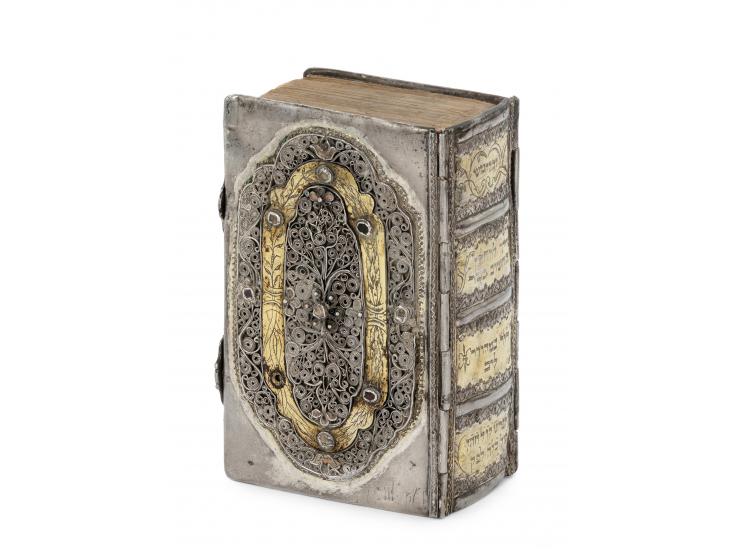
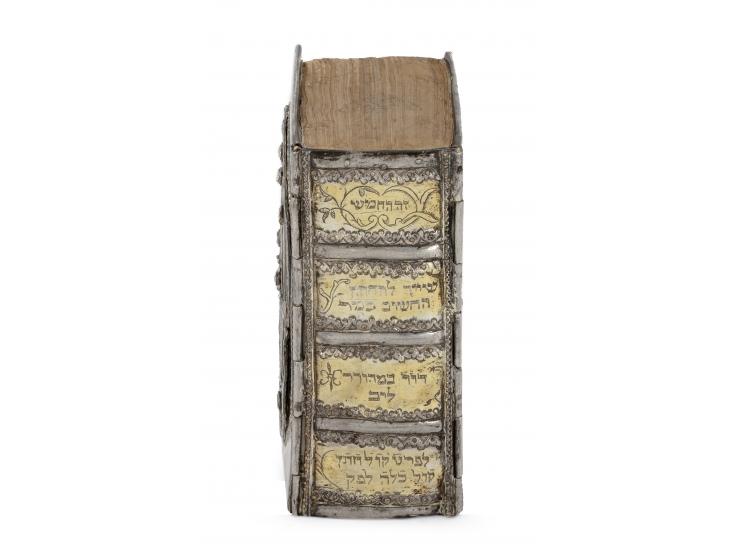
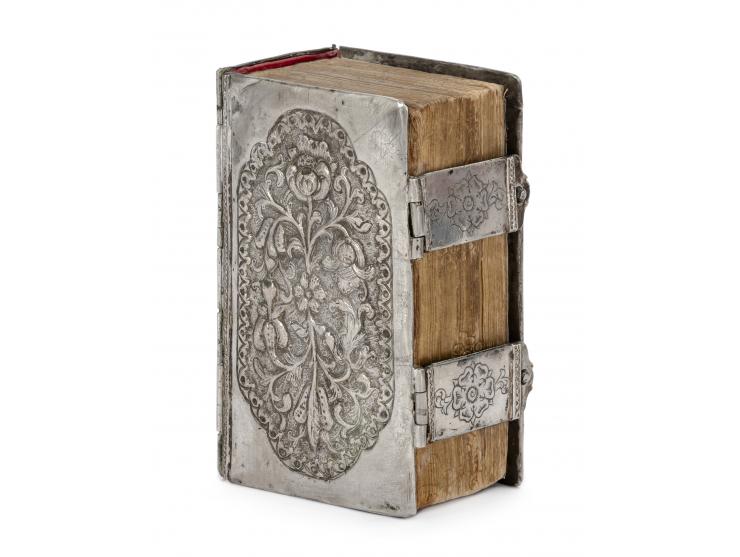
Chumash in elaborate silver binding. [Probably Germany], dedicatory inscription to groom dated 1779.
Silver, repoussé and engraved (unmarked); parcel gilt; filigree and granulation; glass beads.
Elegant silver binding presented as a wedding gift to a bridegroom. On the front binding is a gilt silver decoration, incorporating filigree decorations in vegetal patterns, and set with glass stones. The back of the binding is fashioned into matching vegetal patterns. A dedicatory inscription is engraved on the spine: "This Chumash belongs to the distinguished groom R. David son of R. Leib" followed by a chronogram for the year 1779 (the year may possibly be read as 1788). Includes a pair of silver clasps with matching decorations.
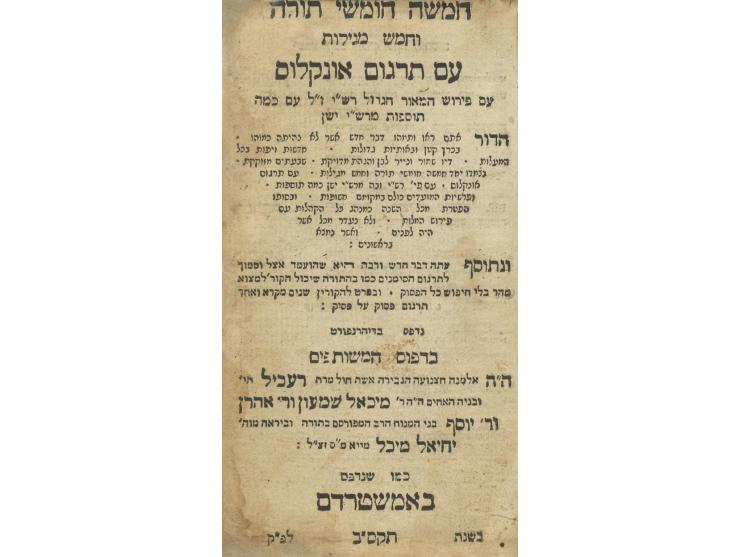
The book (later): Five Books of the Torah and Five Megillot with Targum Onkelos. Dyhernfurth: Rachel and her sons Michael Shimon, Aharon and Yosef May, 1802. Bound with: Year-round haftarot according to Ashkenazic and Sephardic rites. Dyhernfurth: Rachel and her sons Michael Shimon, Aharon and Yosef May, 1803.
494; 81 leaves. Overall good condition. Some stains and wear, mainly to first leaves and haftarot. Gauffered and gilt edges.
Height of binding: 14 cm. Width: 9 cm. Thickness: 6 cm. Overall good condition. Minor defects. Some pieces missing, minor fractures and loose pieces in filigree decorations. Glass beads lacking.
Category
Silver Bindings and Personal Items
Catalogue Value
Auction 107: Rare and Important Items
Apr 15, 2026
Opening: $5,000
Estimate: $10,000 - $15,000
Sold for: $6,875
Including buyer's premium
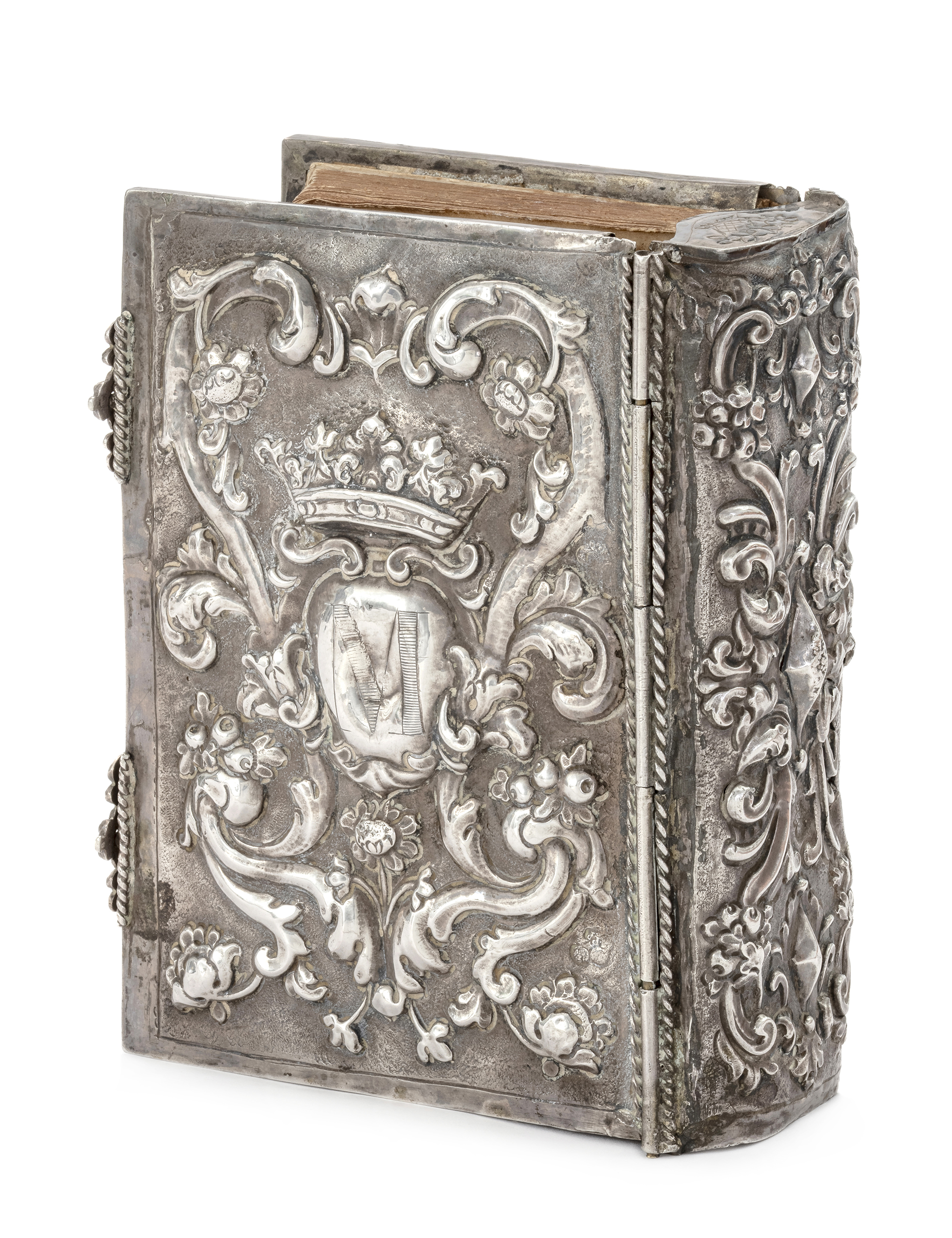
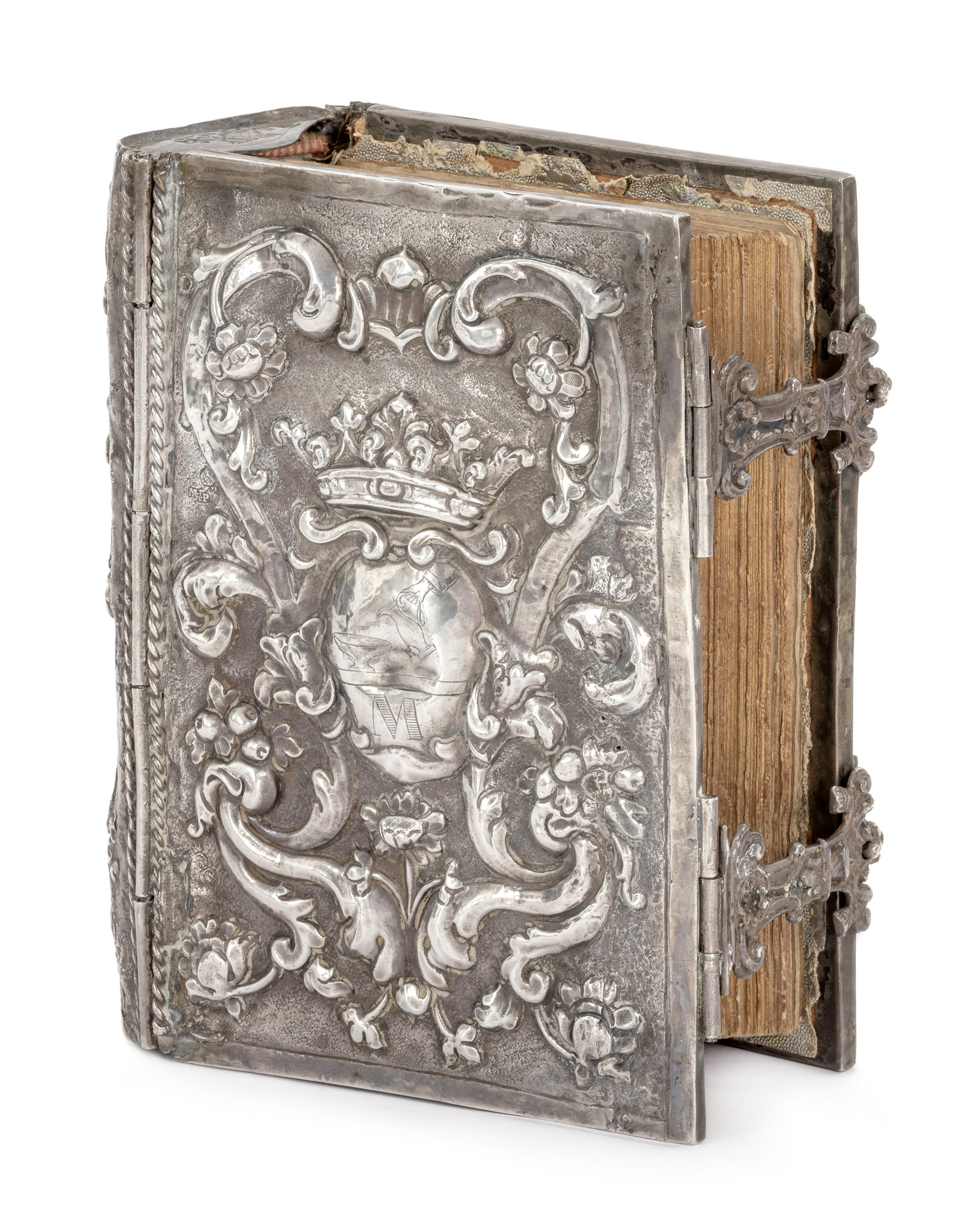
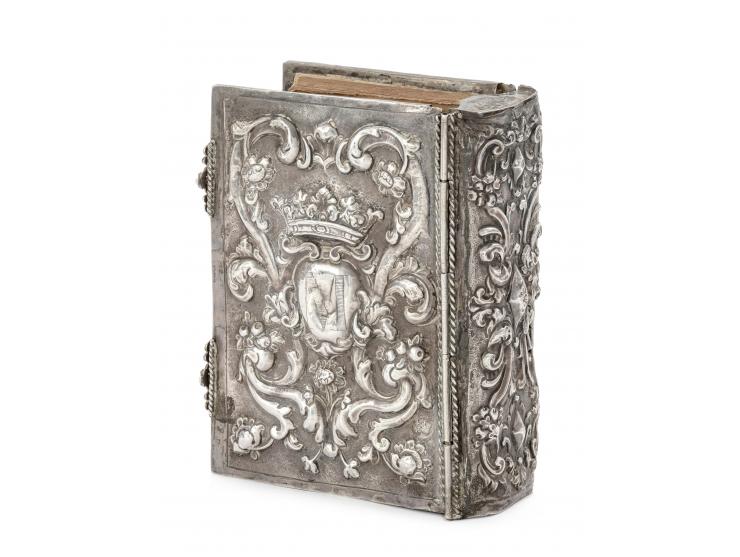
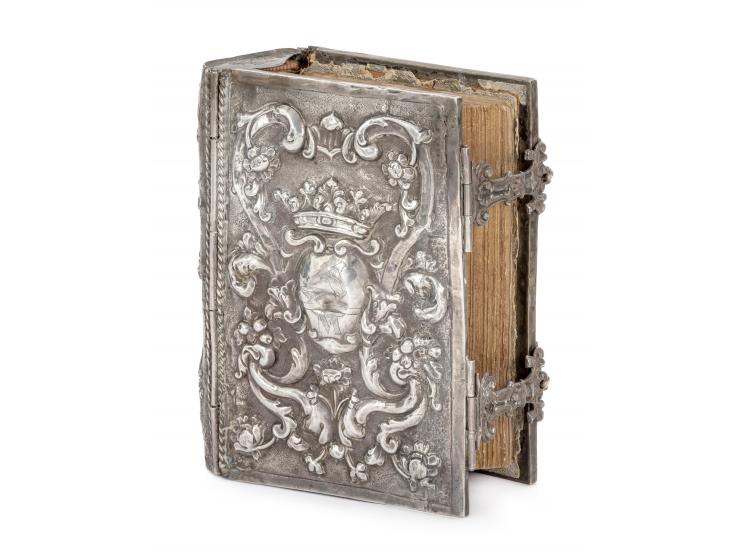
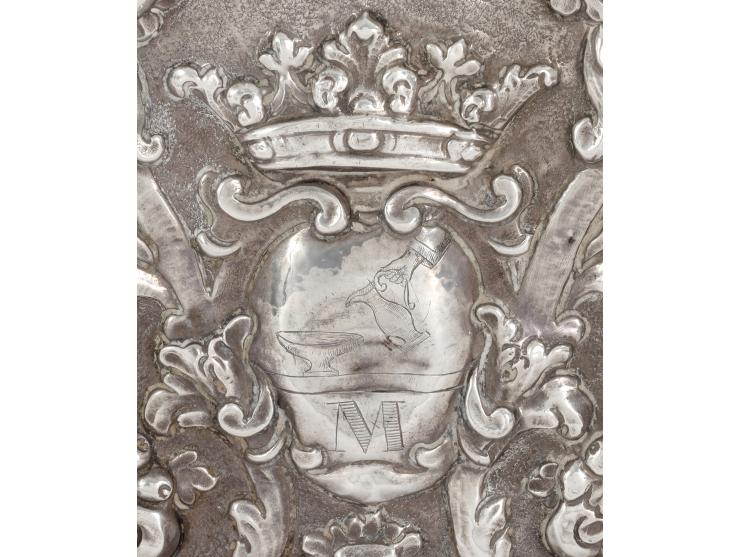
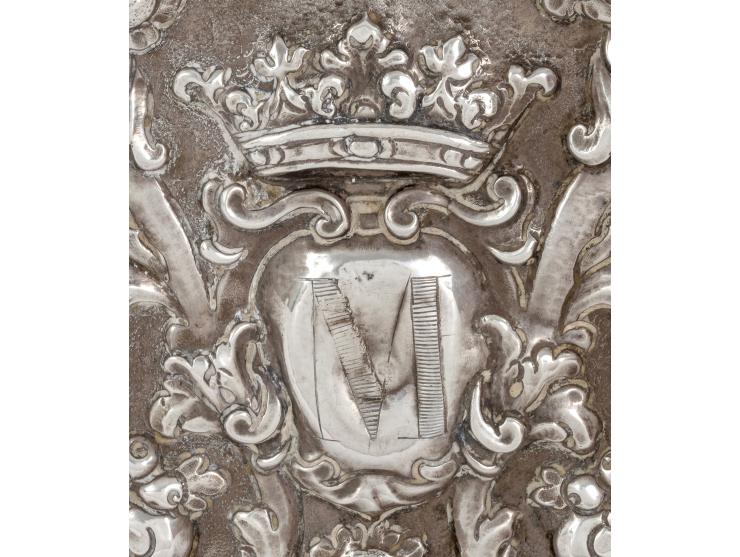
Siddur in elaborate silver binding. Venice, Italy, 18th century.
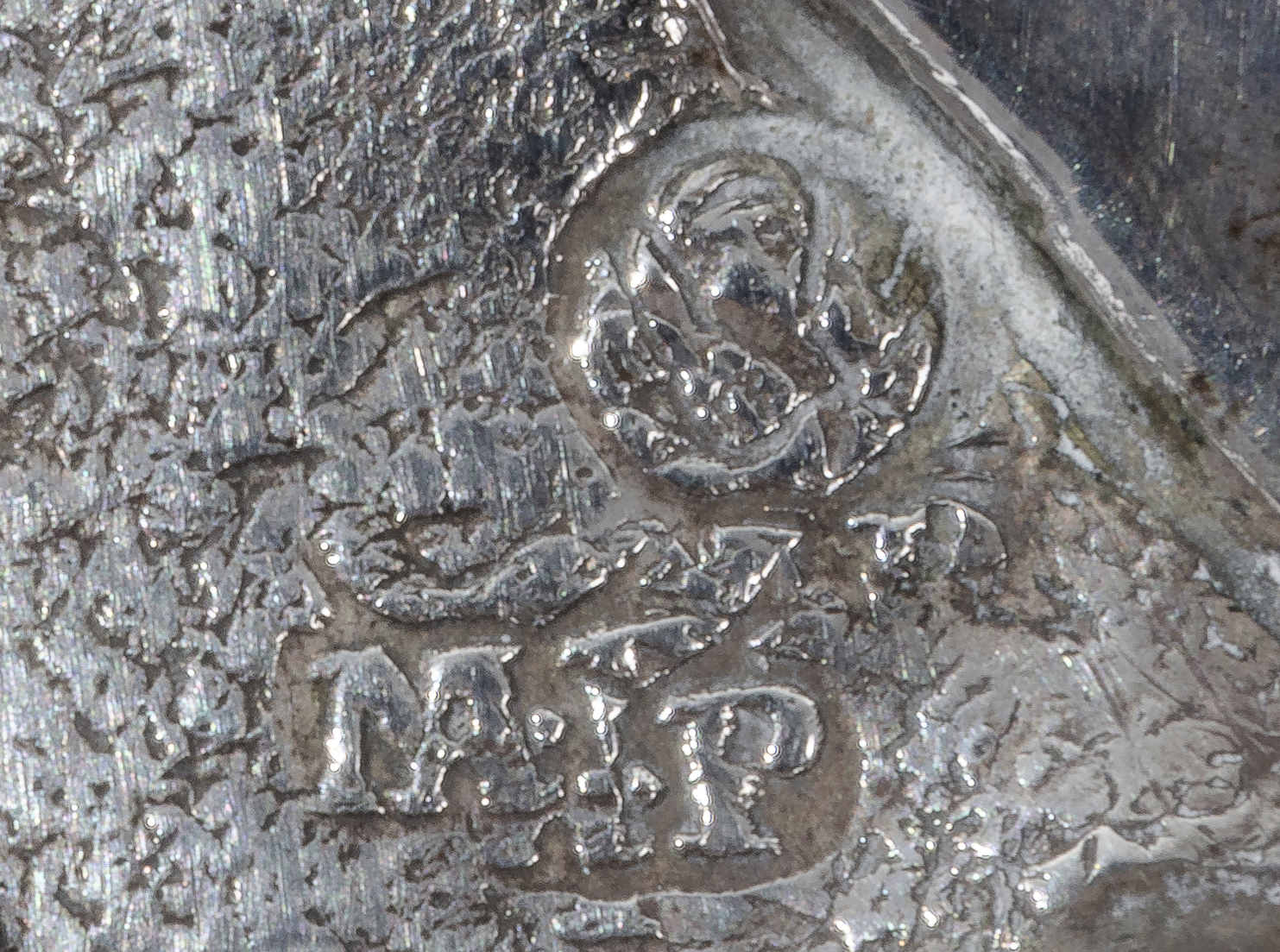
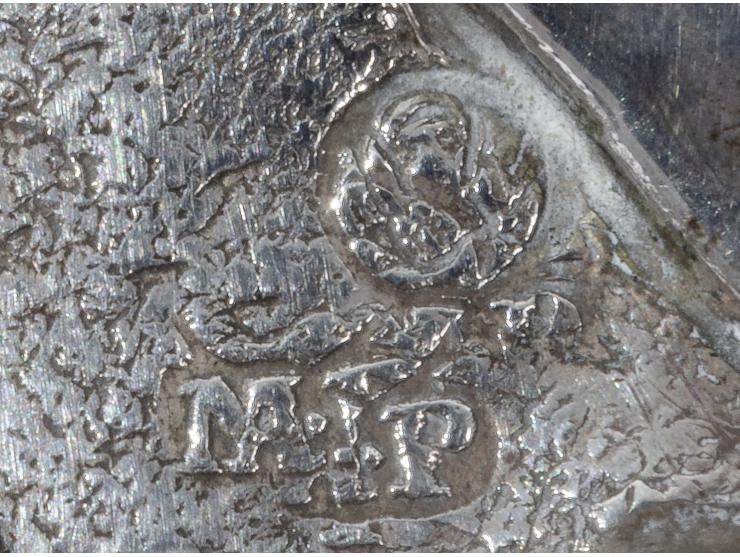
Silver, repoussé and engraved (with Venice mark – Lion of St. Mark – with initials of assayer, M·P).
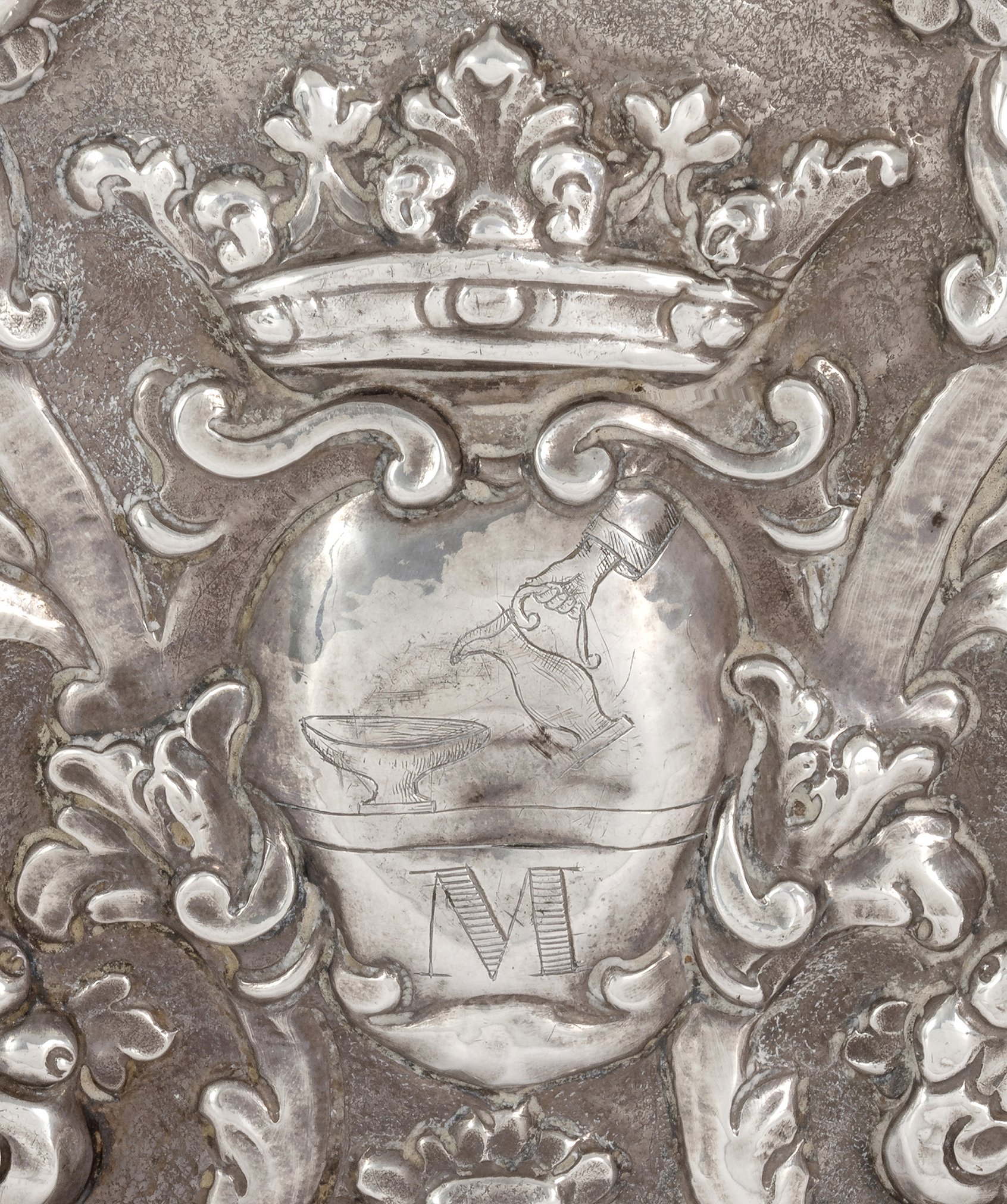
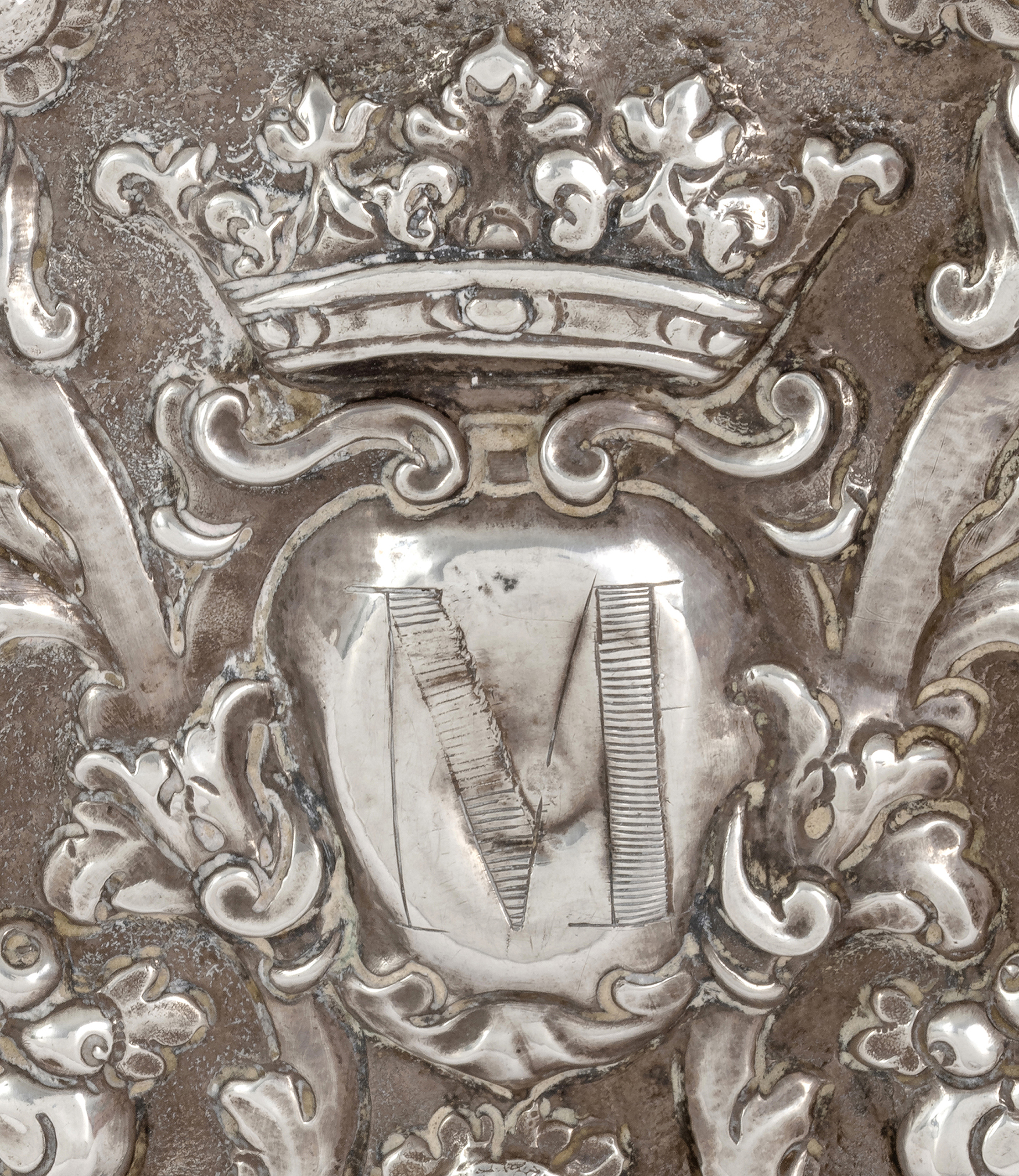
Elaborate binding, decorated identically and symmetrically on both sides with vegetal patterns including acanthus leaves, flowers and fruit, with a central cartouche topped by a crown. The cartouche on the front binding is engraved with an M, and the cartouche on the back binding is engraved with the Levi family coat of arms (a hand pouring a pitcher into a basin), with the letter M below. The combination of the coat of arms and the letter M may indicate that the siddur was given as a wedding gift, with the initial and coat of arms representing the couple's families.
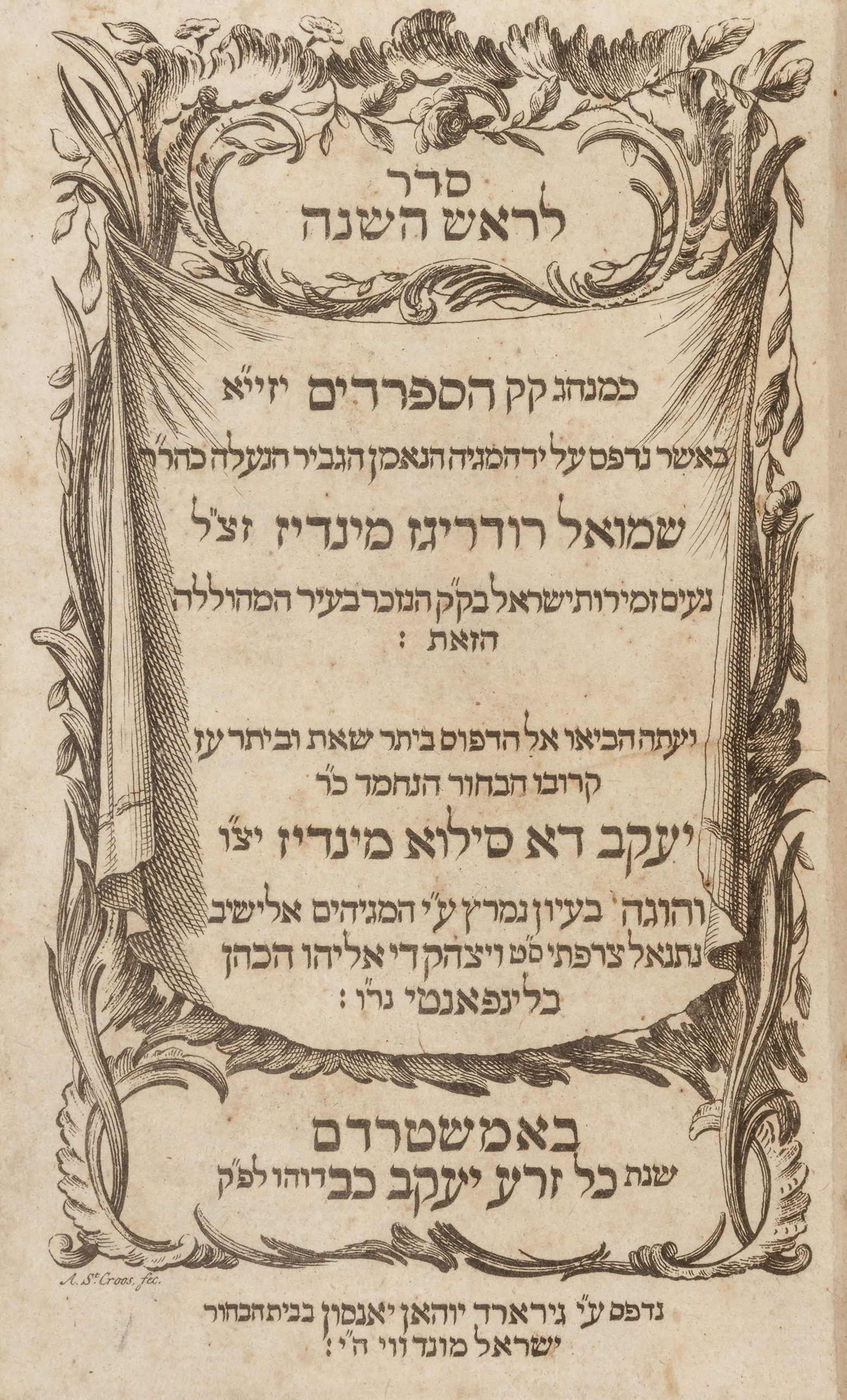
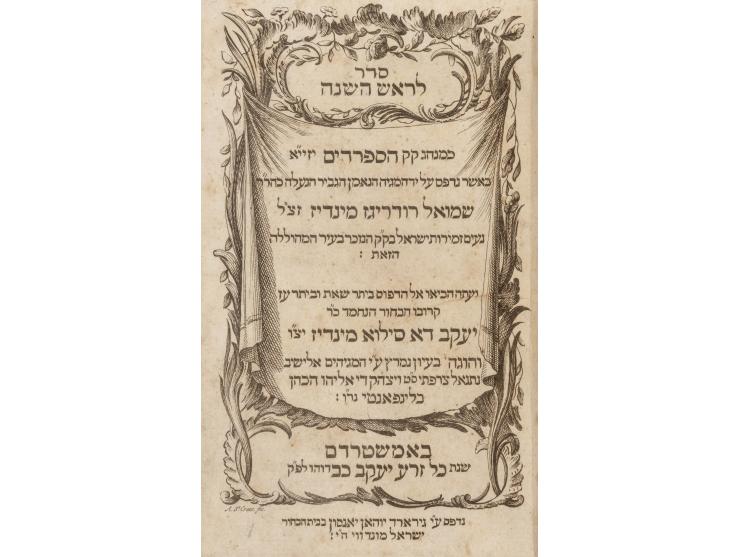
The book: Sephardic-rite siddur, as printed by Shmuel Rodriguez Mendes, brought to press by Yaakov da Silva Mendes. Amsterdam: Gerard Johann Janson, [1771]. Three divisional title pages (for Rosh Hashanah, Yom Kippur and Festivals) decorated with engravings by A. St. Croos. On final page of Yom Kippur siddur, notice by printer Yaakov da Silva Mendes, followed by a handwritten signature.
[2], 86; [1], 171; [2], 179 leaves + blank leaves bound at end. Printed on thick paper, with gilt and gauffered edges. Overall good condition. Stains and some creases. Book separated and detached in two parts. Original wooden binding boards, with later endpapers.
Height of binding: 18 cm. Width: 14 cm. Thickness: 7 cm. Overall good condition. Old soldering repairs. Minor fractures and warping. Minor fractures and pieces lacking at spine and edges.
Category
Silver Bindings and Personal Items
Catalogue Value
Auction 107: Rare and Important Items
Apr 15, 2026
Opening: $10,000
Estimate: $20,000 - $25,000
Sold for: $28,750
Including buyer's premium
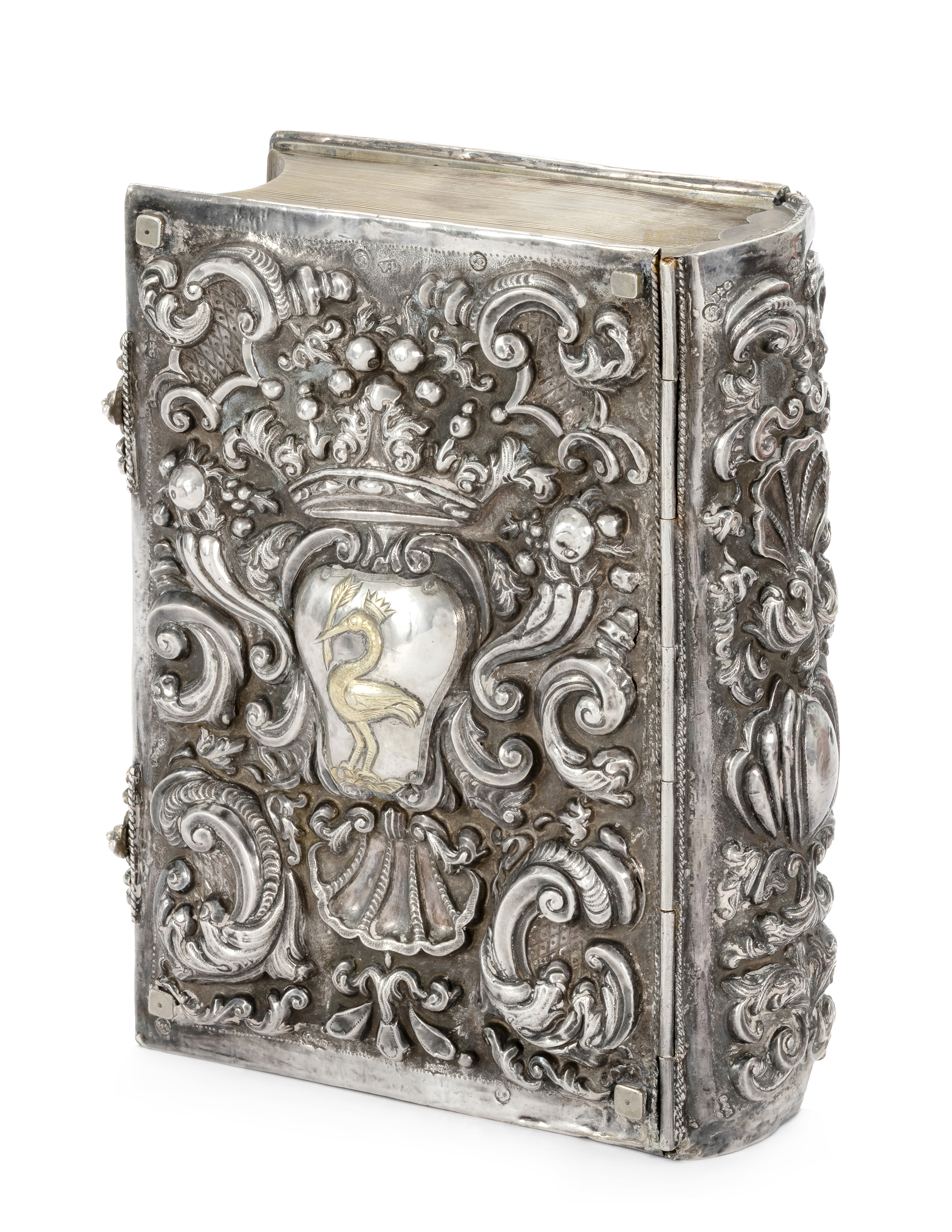
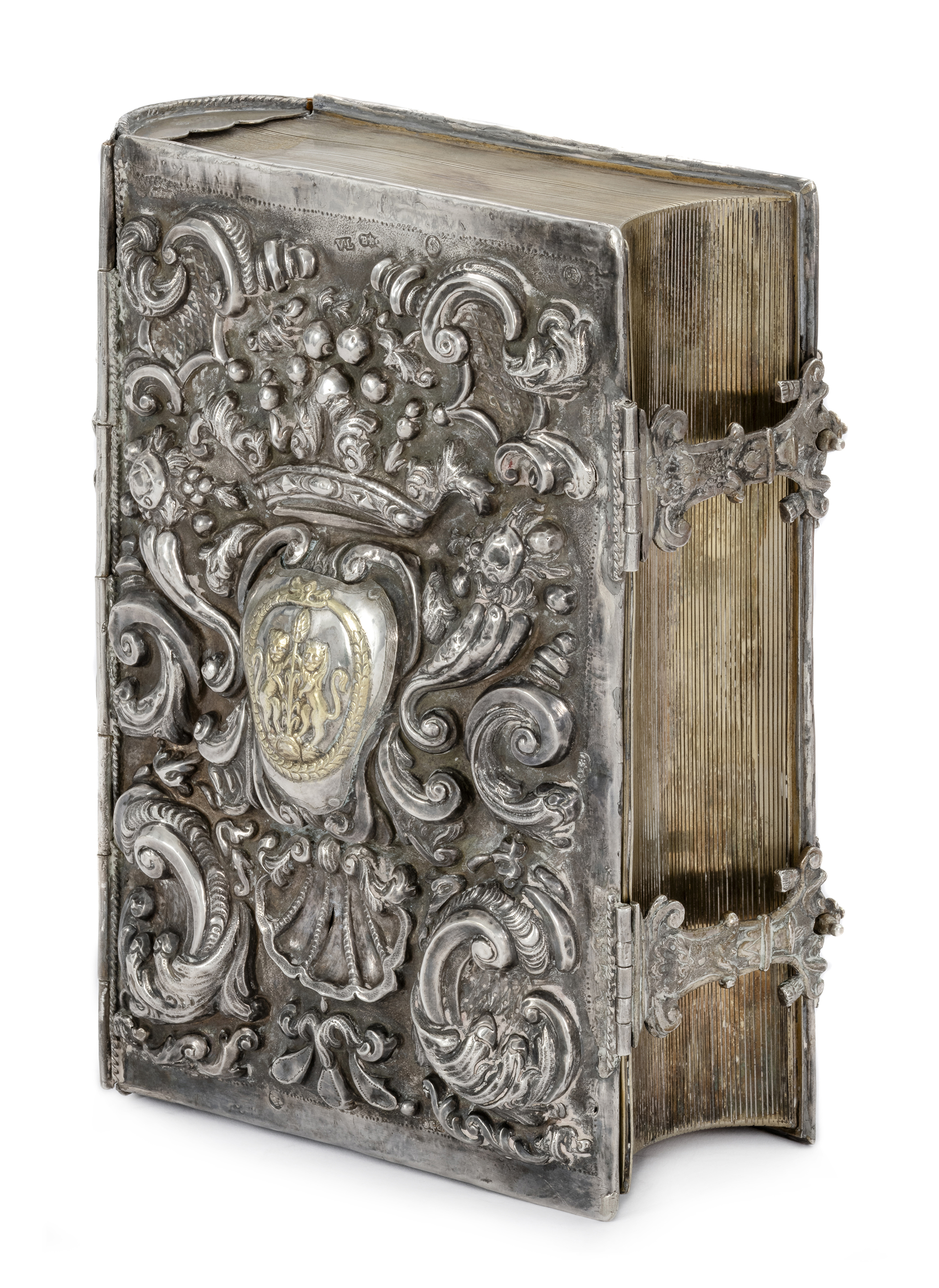
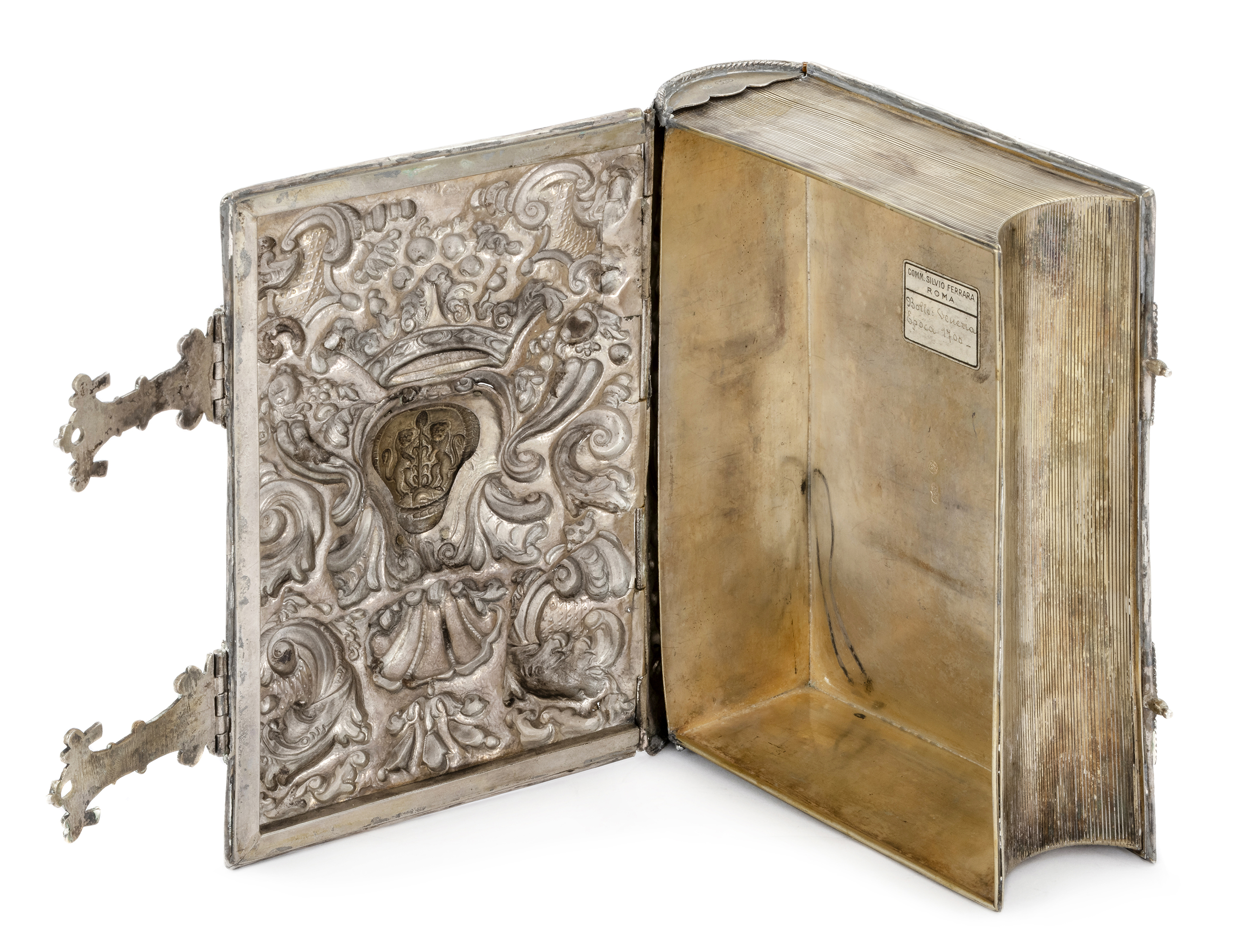
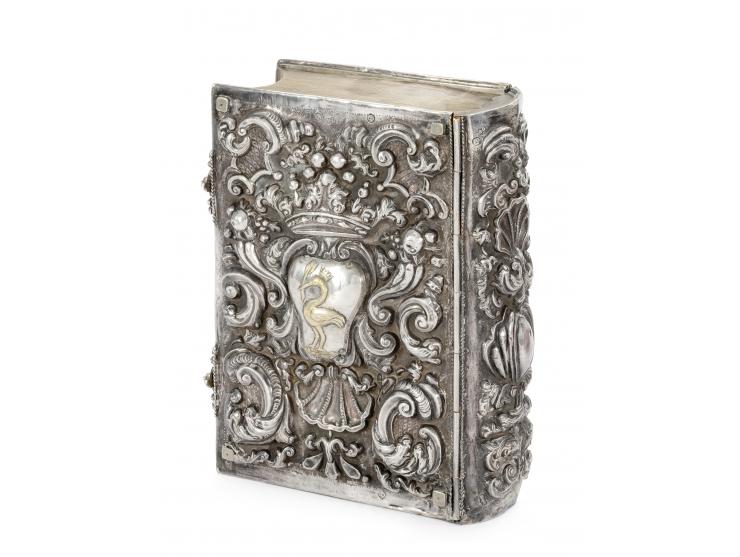
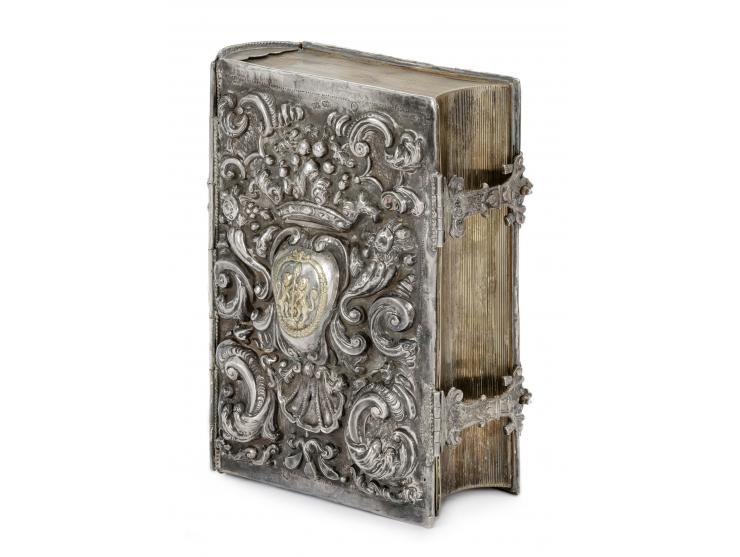
Silver box stylized as a book. Venice, second half of 18th century.
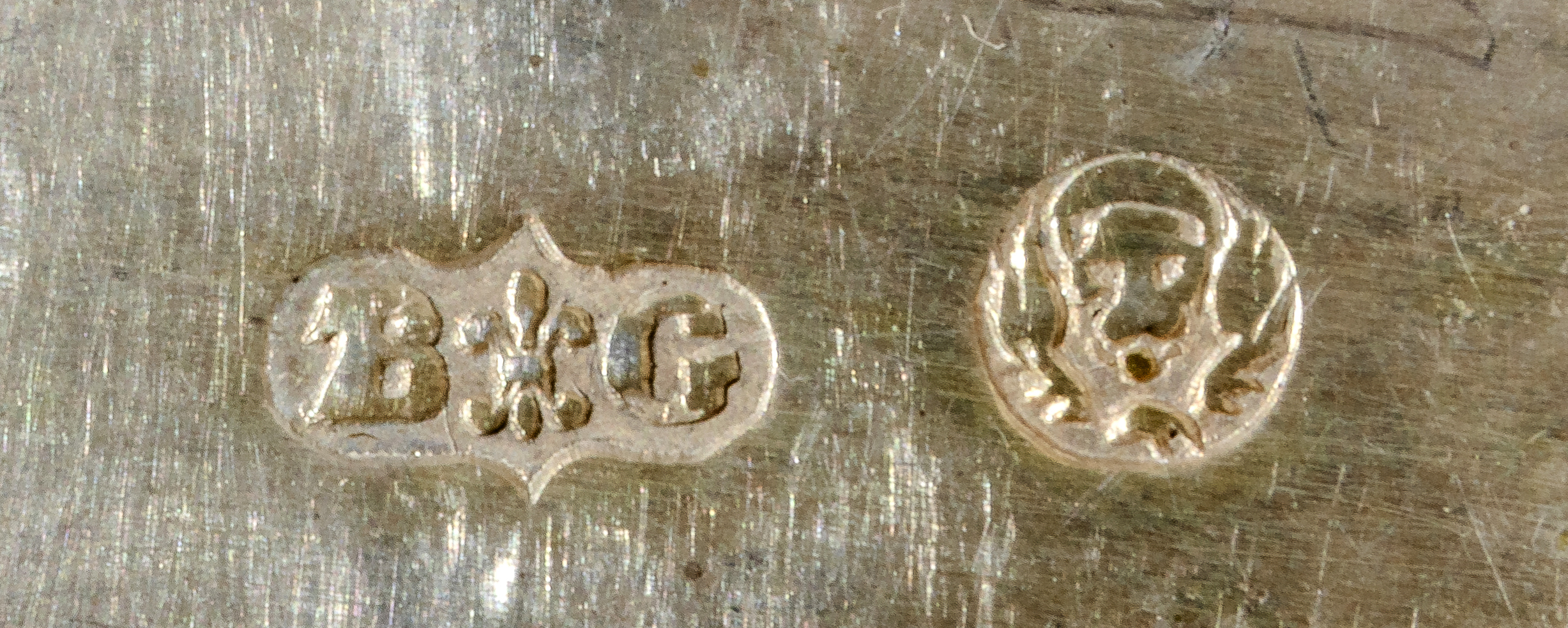
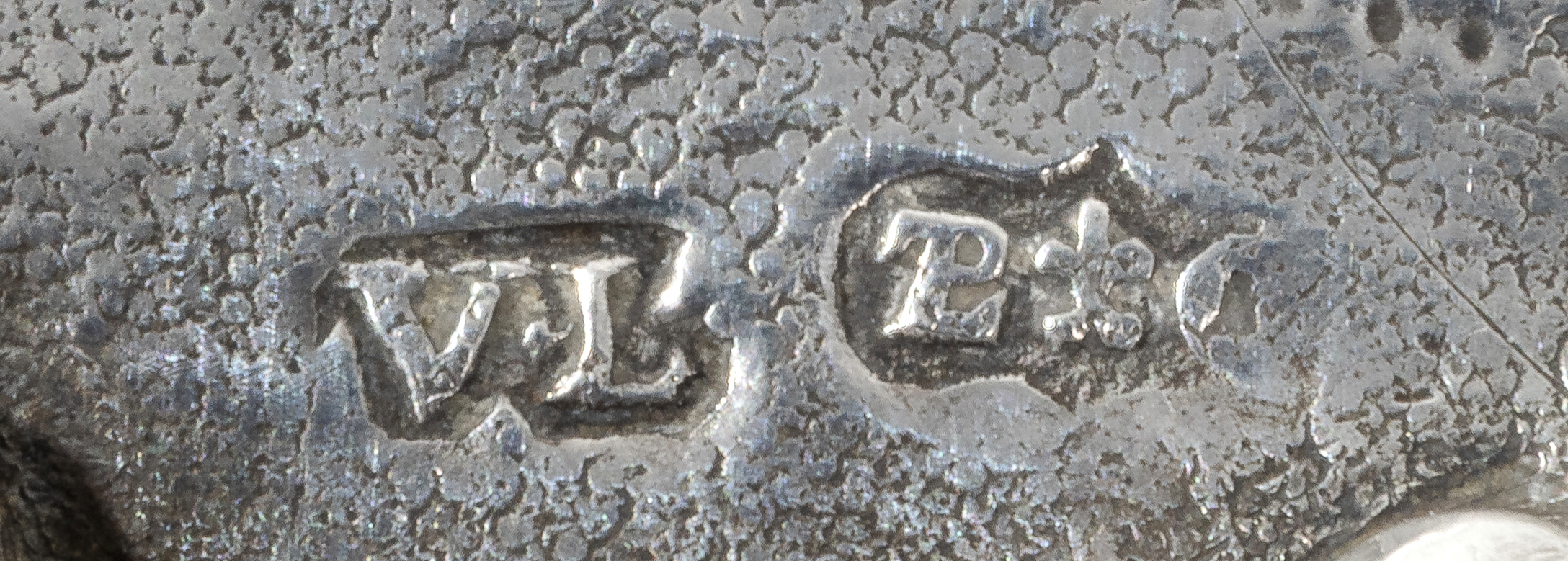
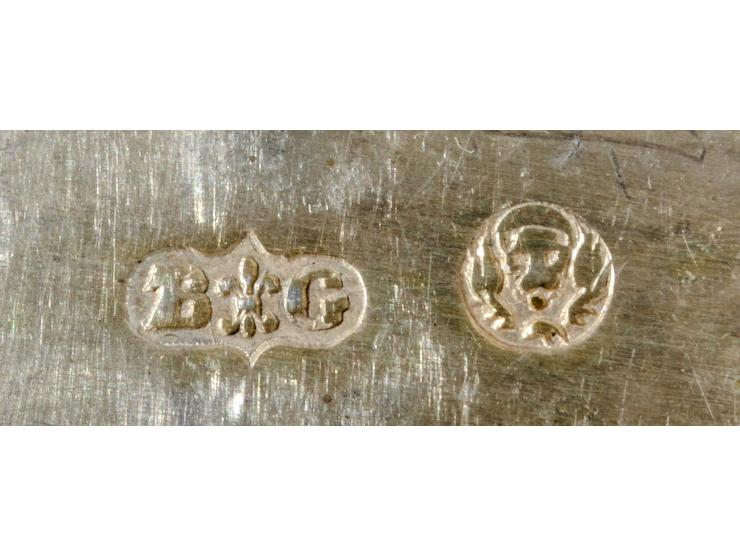
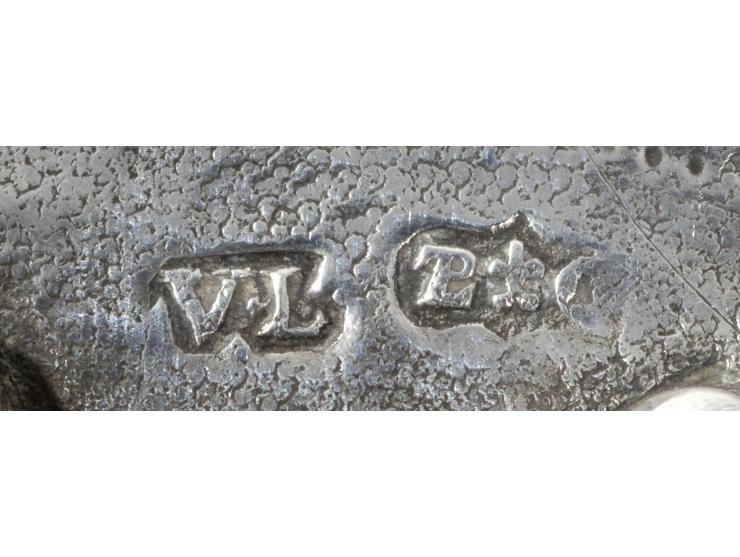
Silver, repoussé (with Venice standard mark – Lion of St. Mark – with marks of assayer Zuan Piero Grappiglia, active 1758-1802, another mark by a different assayer, and an undocumented maker's mark, V·L); cast silver; parcel gilt.
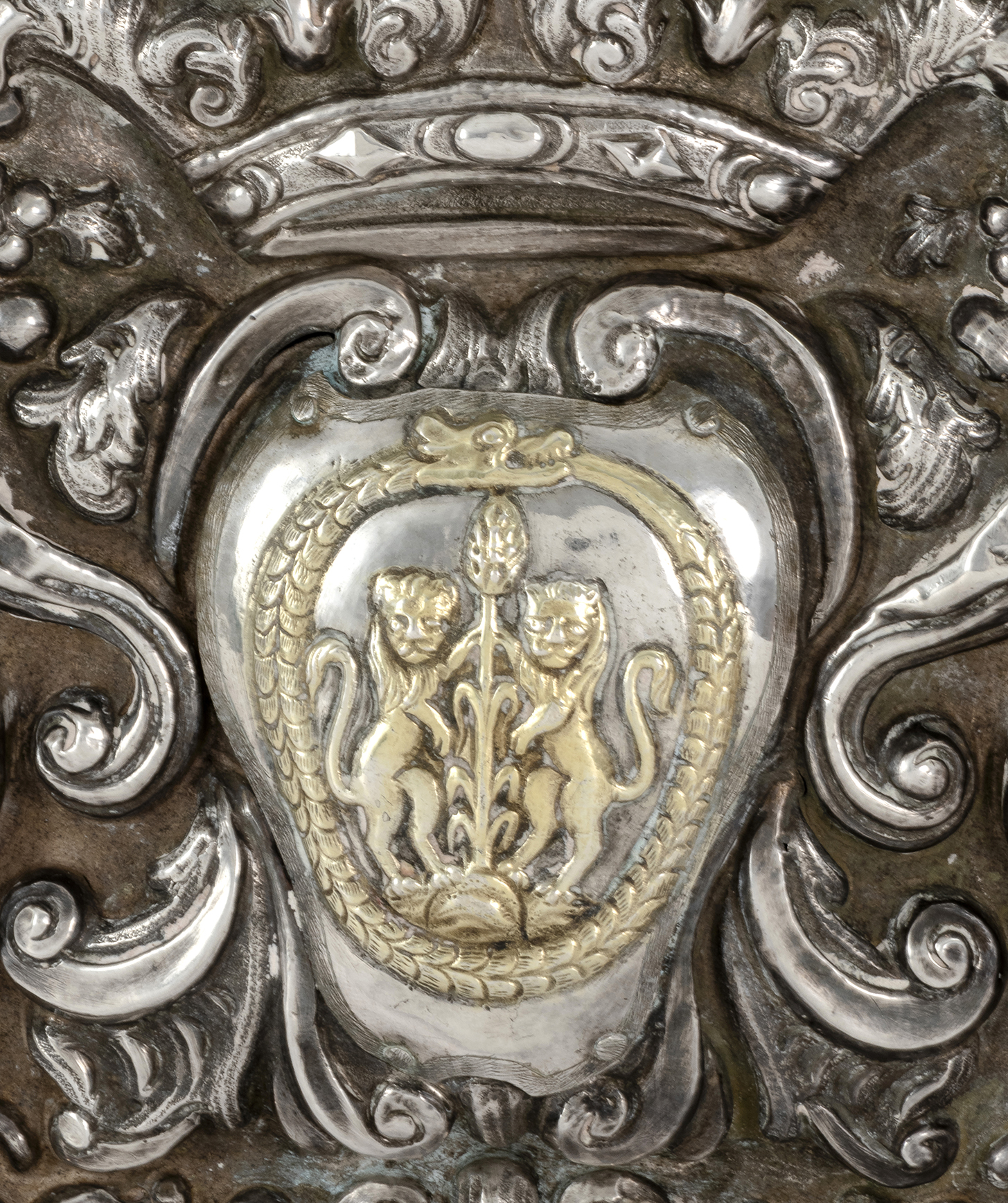
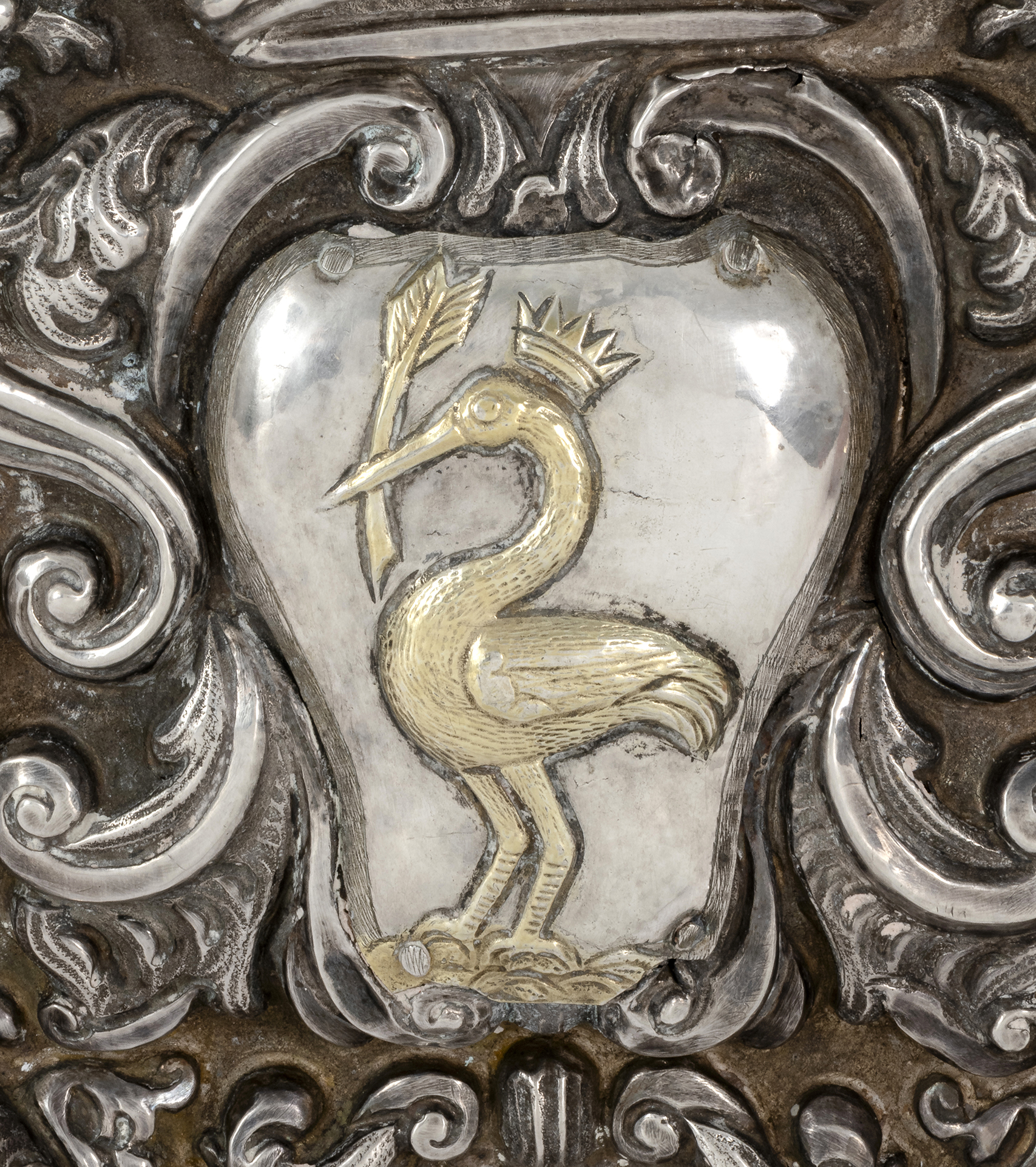
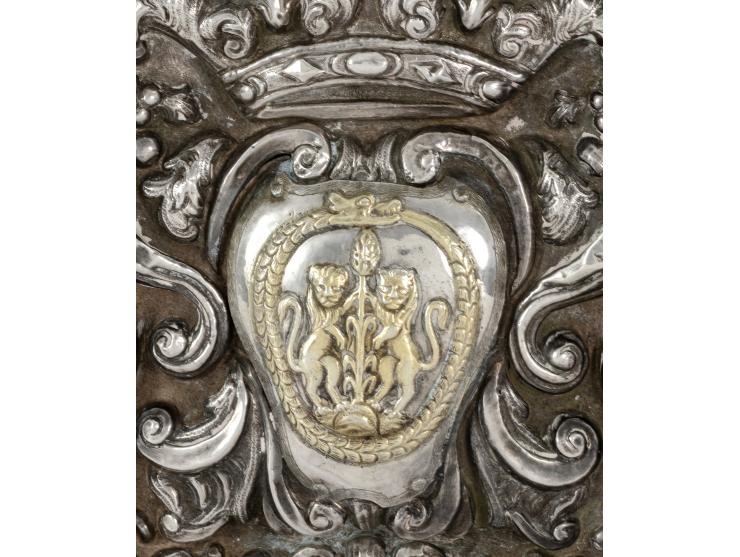
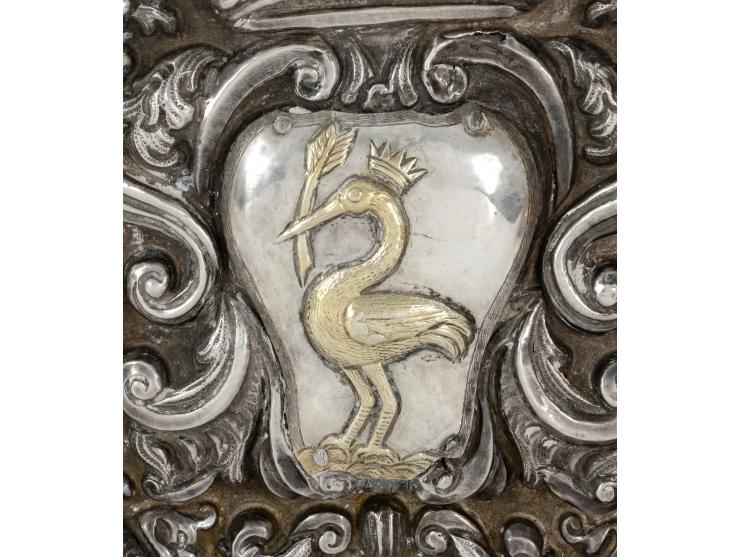
Large box, decorated identically on both sides, with a large, impressive relief in rococo style, with rich vegetal patterns including shells and acanthus leaves, cornucopias with flowers and fruit, and large crowns. In the central cartouches – on the front and back – are coats of arms of Jewish families, repoussé into partially-gilt silver plates nailed to the binding. The front binding appears to feature the Uzieli family coat of arms (a pair of lions with a large stalk of grain between them); the back binding features the Trieste family coat of arms (a crowned crane holding a branch in its beak). The binding is decorated in matching patterns, with a pair of original cast silver clasps.
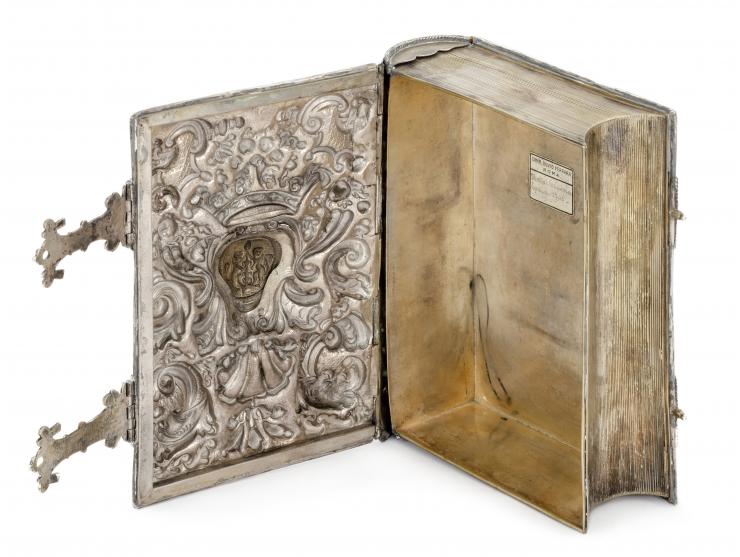
This box was produced by artistic soldering of a rectangular gilt silver box to the binding of a book, probably to house religious books. The box's finishings include striated decorations resembling pages of books, with a concave depression mimicking the rounded interior of the book. The silver hallmarks indicate that the binding and box were probably joined in the 18th century.
Height: 21.5 cm. Width: 16 cm. Thickness: 6.5 cm. Weight: 1000 g. Good condition. Fractures and minor warping. Minor fractures to joints between box and binding. Old soldering repairs near spine. Paper tag mounted on interior: "Comm. Silvio Ferrara, Roma" (an antiquarian of Rome), with handwritten description (Venice 1700).
Reference: Donaver-Dabbene, Argenti italiani del Settecento (Milano, 2000), no. 405.
Category
Silver Bindings and Personal Items
Catalogue Value
![Amulet case. Italy, [18th century].
Silver, cast, repoussé and engraved (unmarked).
Two-sided amulet case, dec](https://files.kedem-auctions.com/files/Sale107/4_1.jpg "Silver Amulet Case – Italy, 18th Century")
![Amulet case. Italy, [18th century].
Silver, cast, repoussé and engraved (unmarked).
Two-sided amulet case, dec](https://files.kedem-auctions.com/files/Sale107/4_2.jpg "Silver Amulet Case – Italy, 18th Century")
Auction 107: Rare and Important Items
Apr 15, 2026
Opening: $2,000
Estimate: $6,000 - $8,000
Sold for: $2,500
Including buyer's premium
Amulet case. Italy, [18th century].
Silver, cast, repoussé and engraved (unmarked).
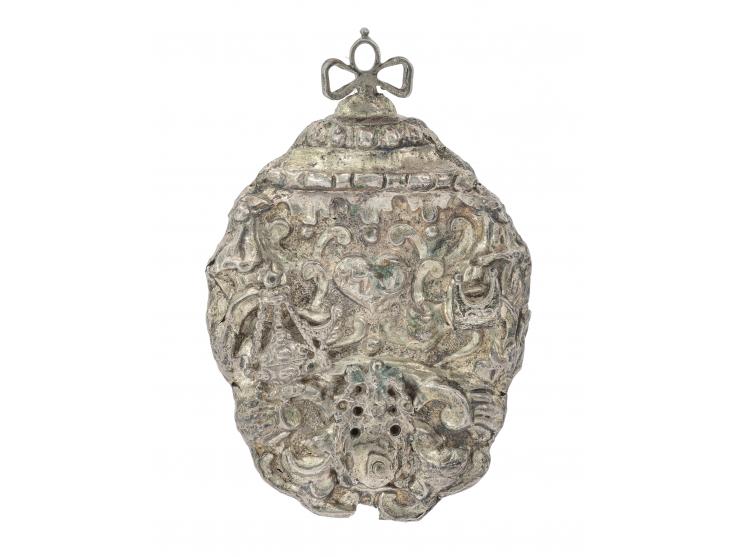
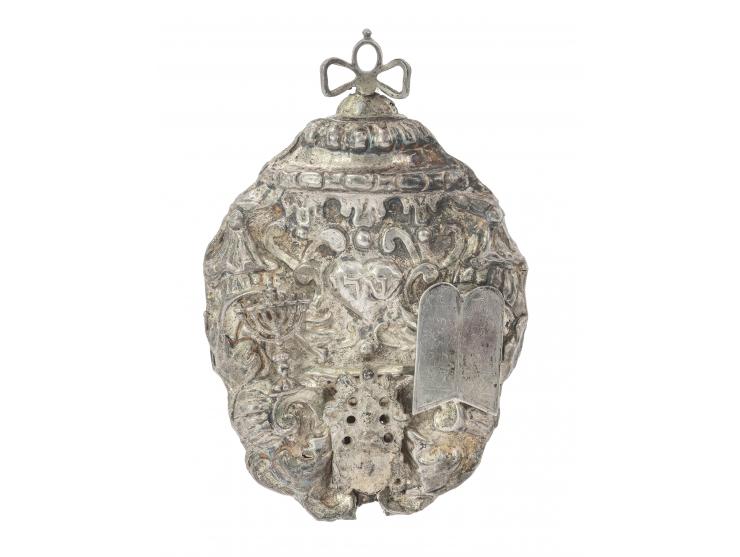
Two-sided amulet case, decorated with rocailles and leaves in rococo style. Upper edge with domed canopy with a trefoil suspension loop. On both sides, a heart-shaped cartouche bearing the Holy Name "Shaddai" in the center, next to various decorations: the Tablets of the Law (engraved with the Ten Commandments and two Stars of David) and a seven-branched menorah on one side; with a priestly turban and incense pan on the other. On the bottom side of the case is an opening within which to place the amulet, covered with a removable lid fastened by a screw and nut.
Cases of this sort were used for keeping amulets, which were folded up and housed in the inner cavity. Some amulets were prepared for a specific individual; some were intended for a specific purpose. Such amulets would typically be exchanged when the case changed hands. Over time, the cases themselves began to serve as amulets.
Height: 11.5 cm. Width: 7.5 cm. Weight: 80.4 g. Fair condition. Warping, fractures and defects. Slight corrosion. Old soldering repairs. Grape cluster decoration lacking from bottom. Case flattened, consequently losing some of its capacity.
Category
Silver Bindings and Personal Items
Catalogue Value
Auction 107: Rare and Important Items
Apr 15, 2026
Opening: $3,000
Estimate: $6,000 - $8,000
Sold for: $18,750
Including buyer's premium
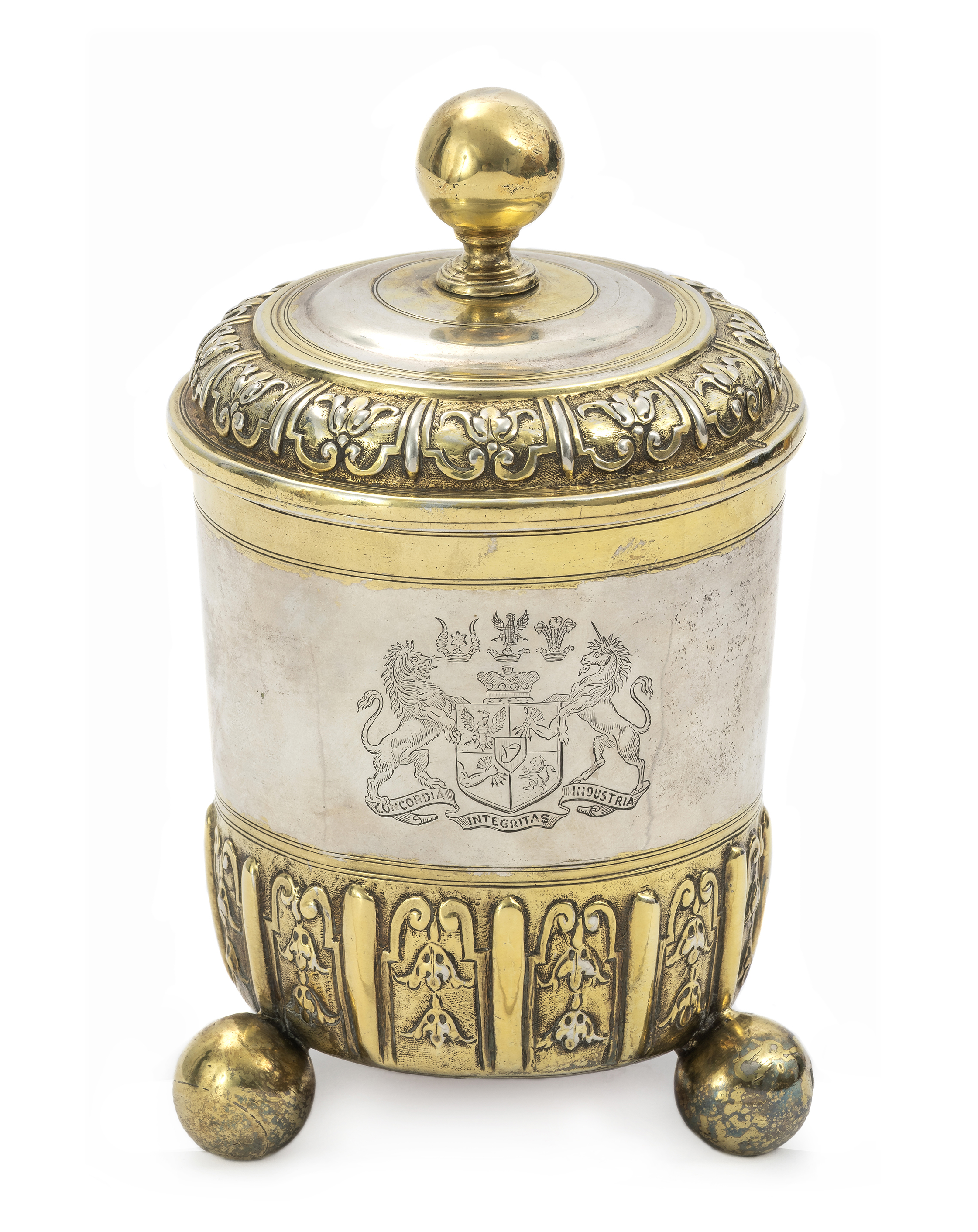
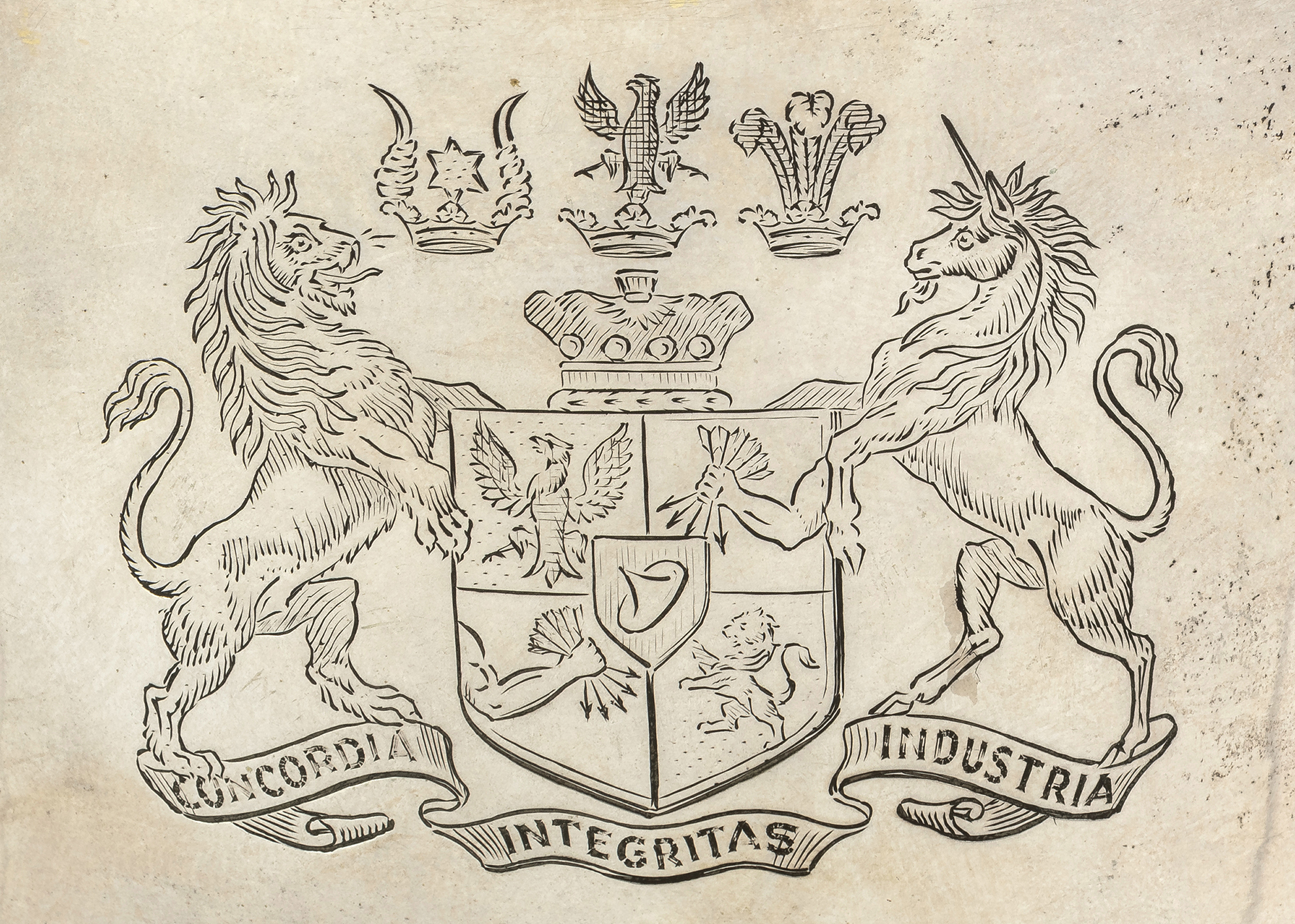
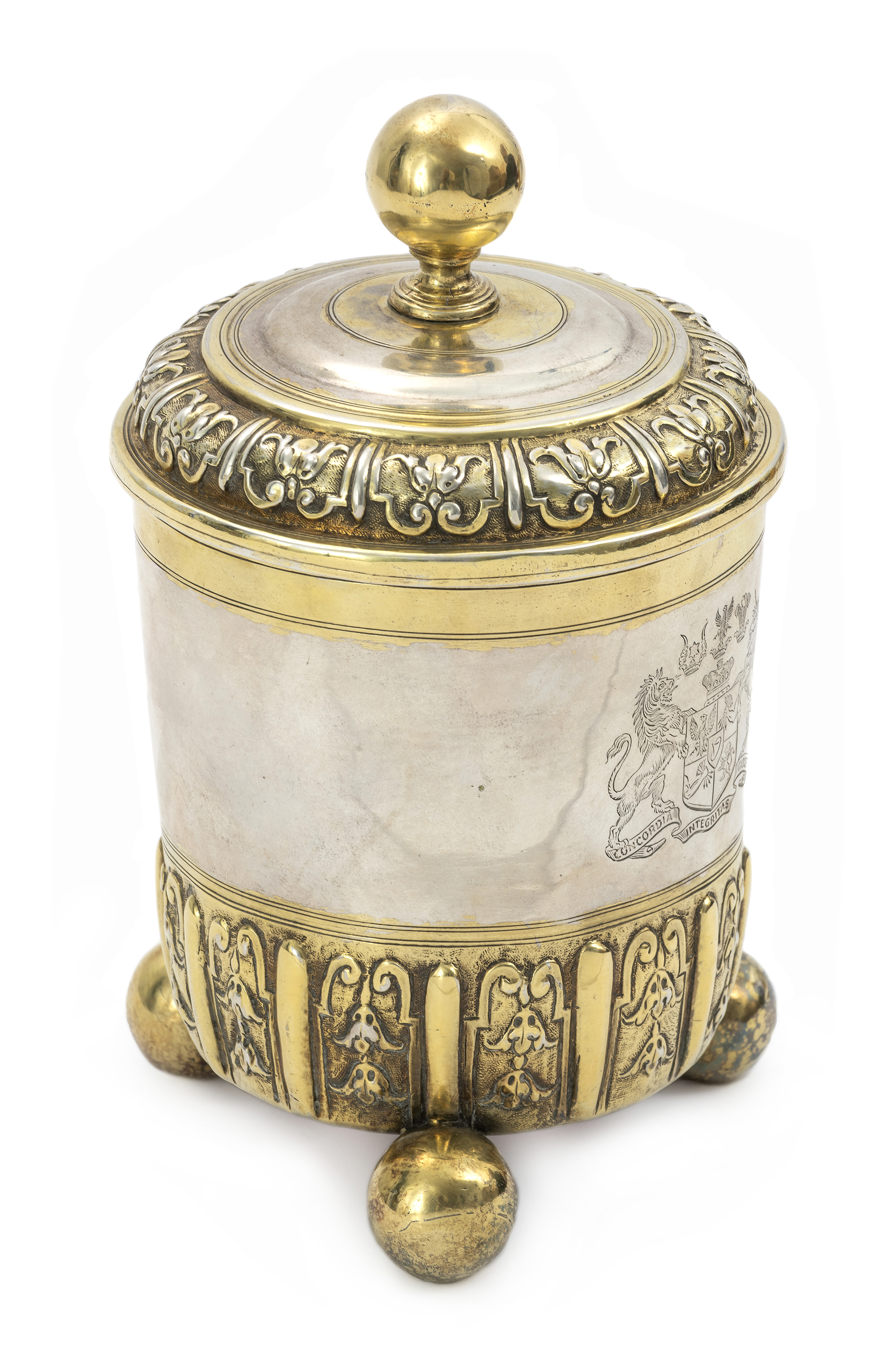
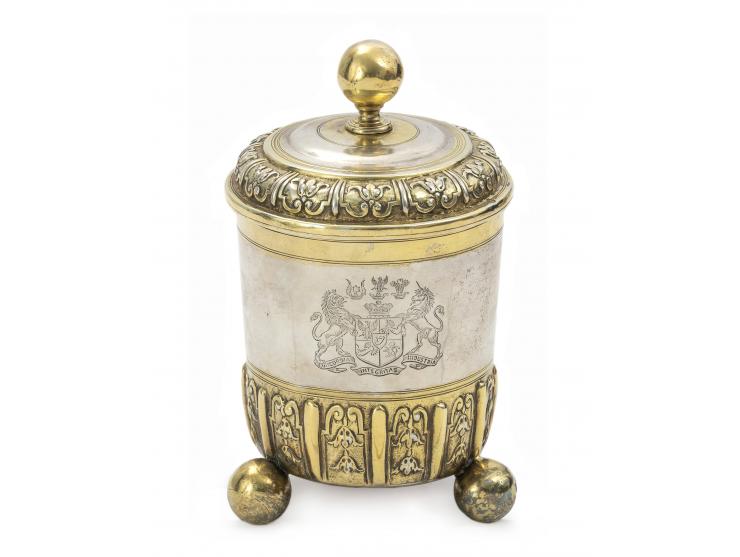
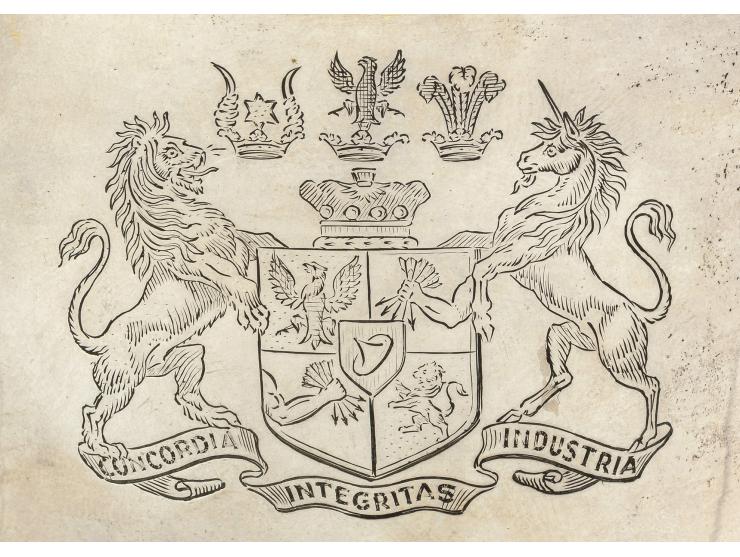
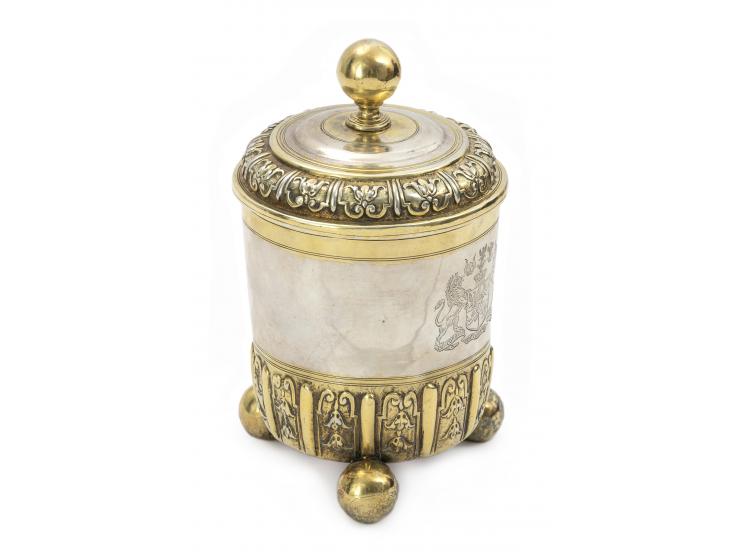
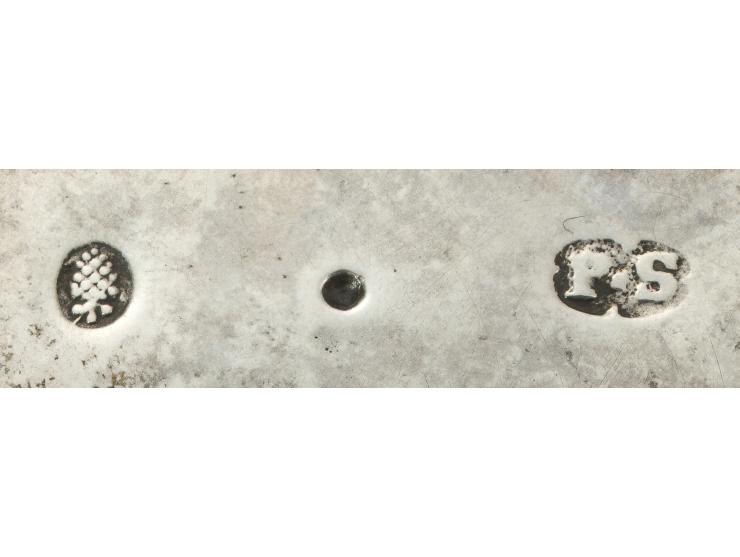
Silver goblet by Philipp Stenglin, Augsburg, Germany, ca. 1712-1715, with 19th century Rothschild family coat of arms.
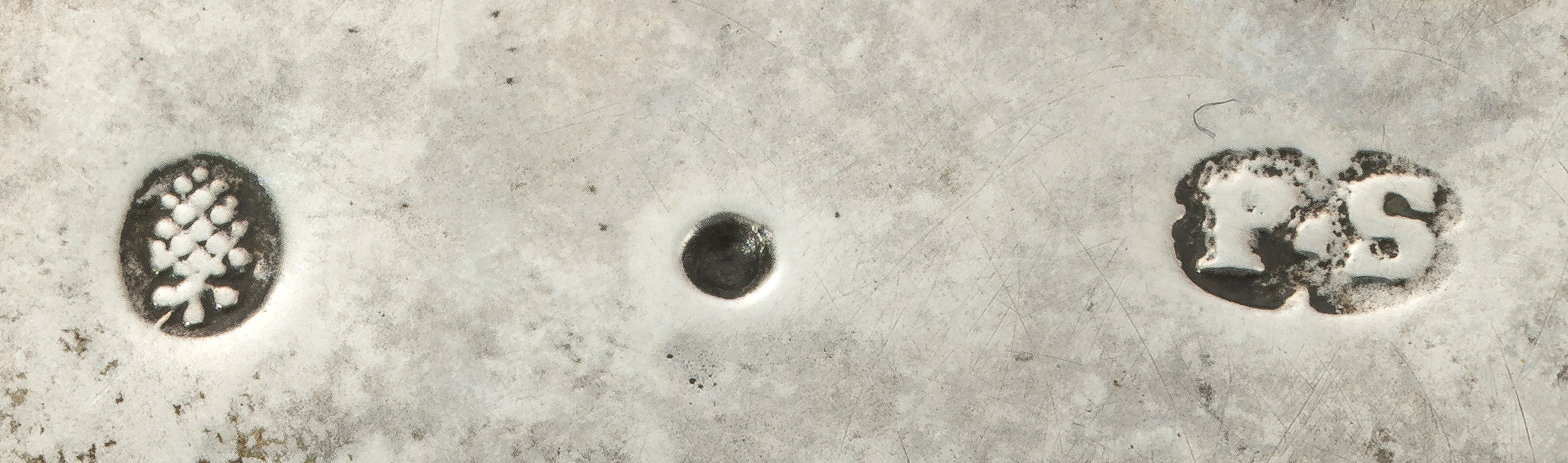
Silver, cast, repoussé and engraved (marked at bottom and on lid with hallmark of Augsburg and maker's mark of Philipp Stenglin, master from 1693); gilt.
Impressive and large goblet, with a removable lid, raised on three ball feet. Interior, lid, rim and base are gilt.
Body of goblet engraved with Rothschild family coat of arms. This symbol, officially granted in 1822, was probably added onto the goblet in the 19th century.
The oeuvre of the silversmith Philipp Stenglin – member of a silversmithing family active in Augsburg during the 17th and 18th century – includes many silver goblets, many preserved in museum collections. Rosenberg documents another goblet of the same maker from the collection of Baron Leopold de Rothschild of London, see: Rosenberg, Der Goldschmiede Merkzeichen, vol. 1, no. 778b, plate 22; Seling, Die Kunst der Augsburger Goldschmiede, nos. 174, 1880.
Height: 17 cm. Diameter of rim: 10.3 cm. Maximum width: 10.5 cm. Weight: 359 g. Good condition. Gilt worn off in several places.
Provenance: Sotheby's, Tel Aviv, 29 September 1994, Lot 166.
Category
Silver Bindings and Personal Items
Catalogue Value
Auction 107: Rare and Important Items
Apr 15, 2026
Opening: $3,000
Estimate: $5,000 - $10,000
Sold for: $4,250
Including buyer's premium
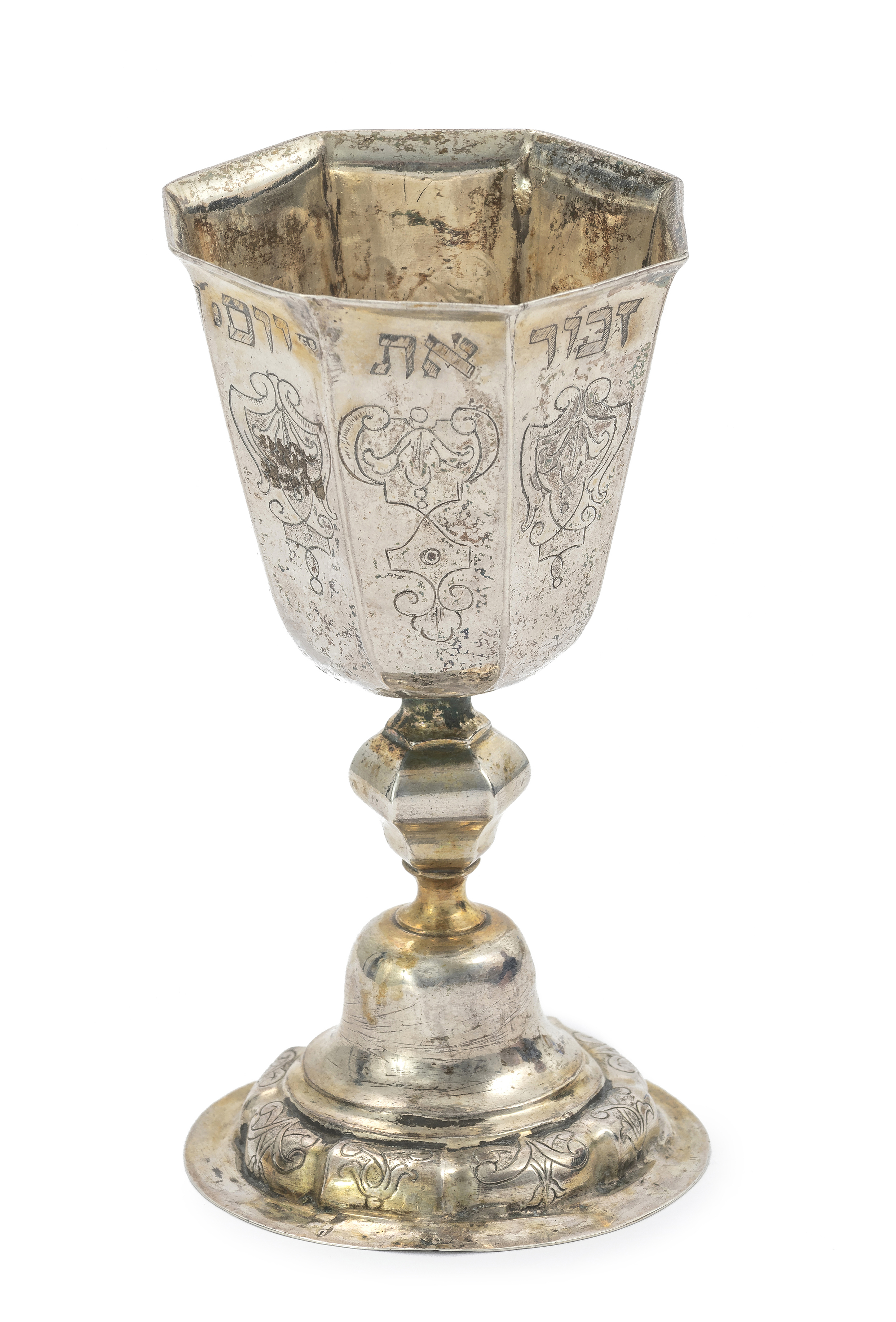
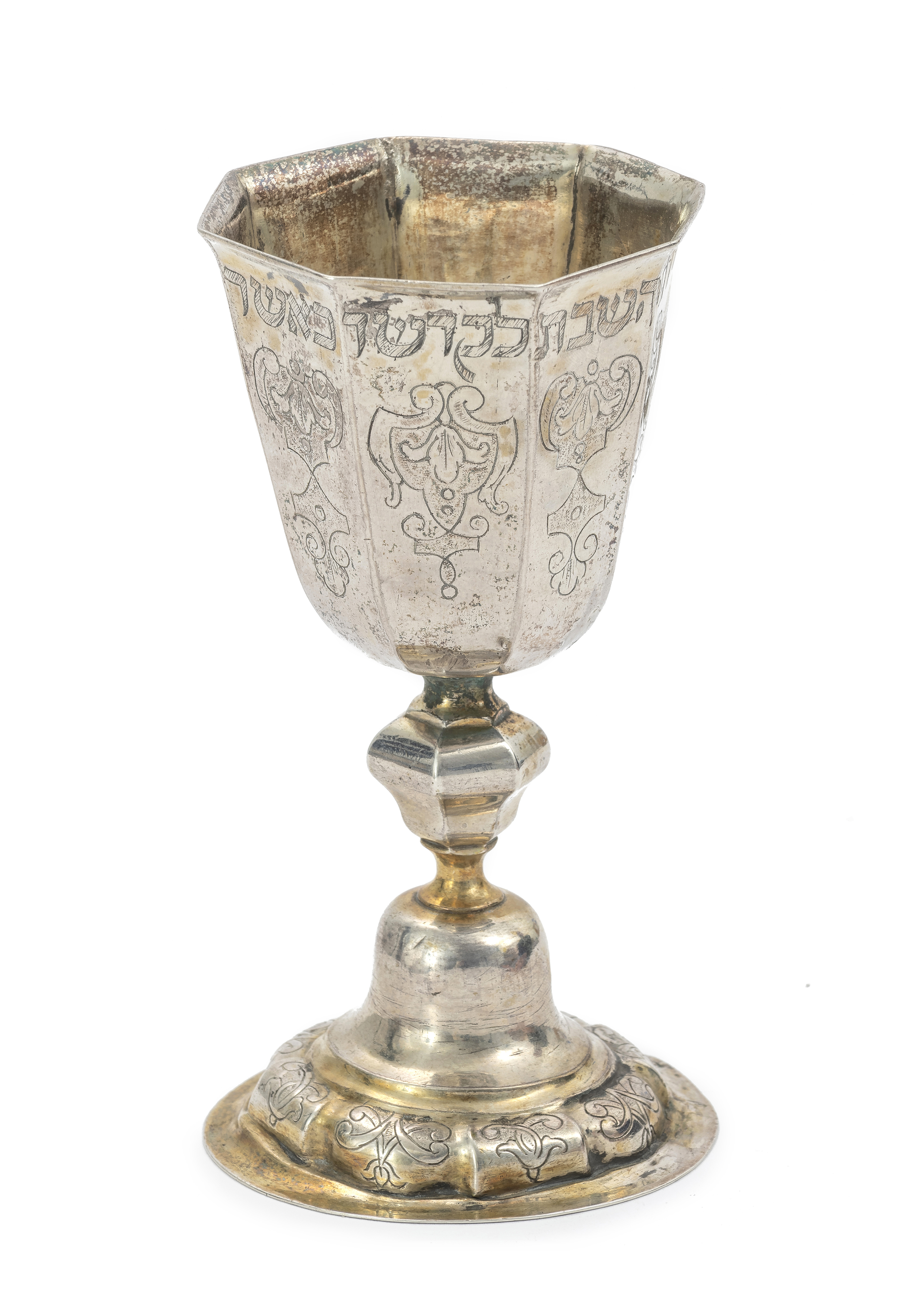
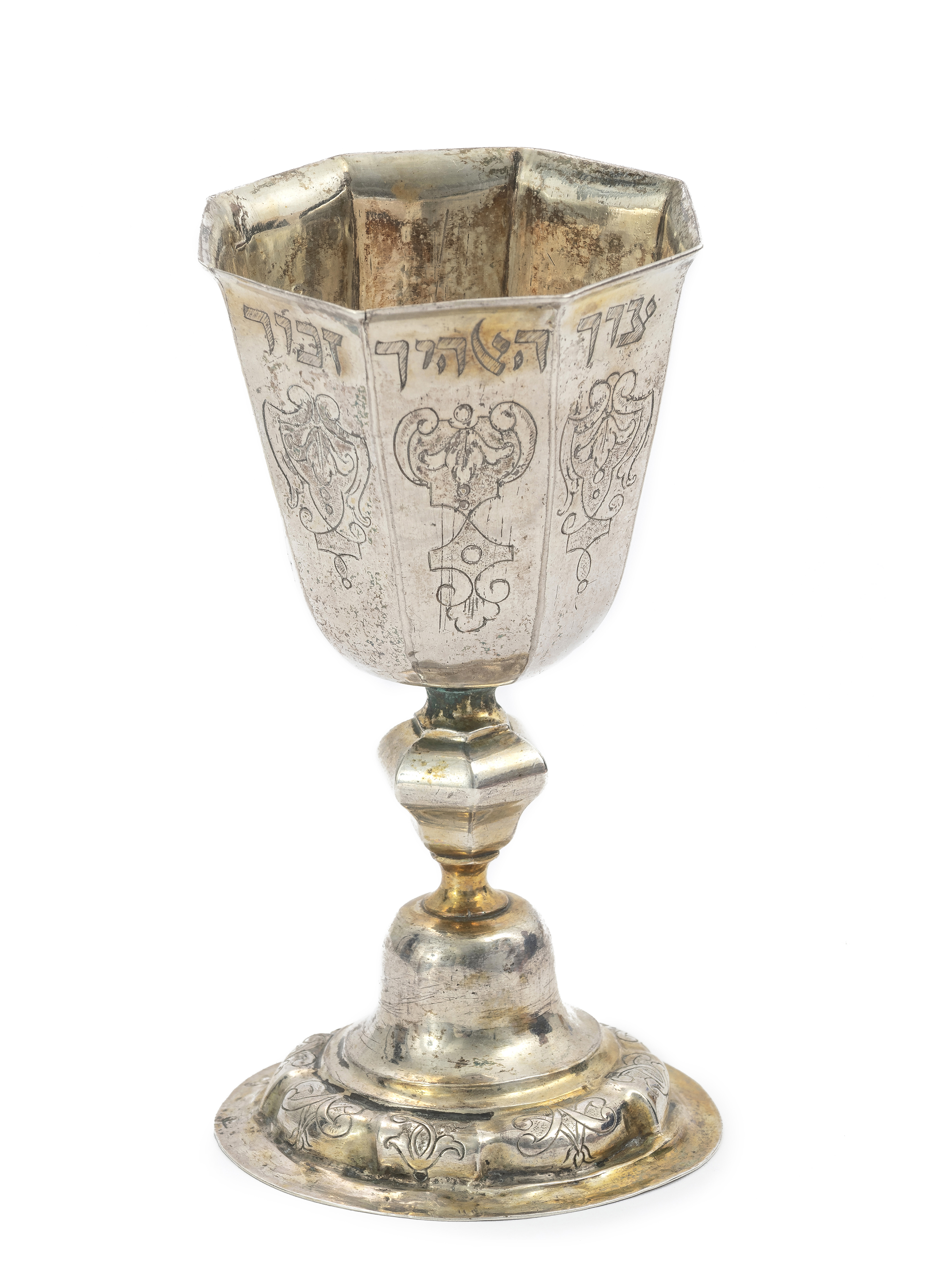
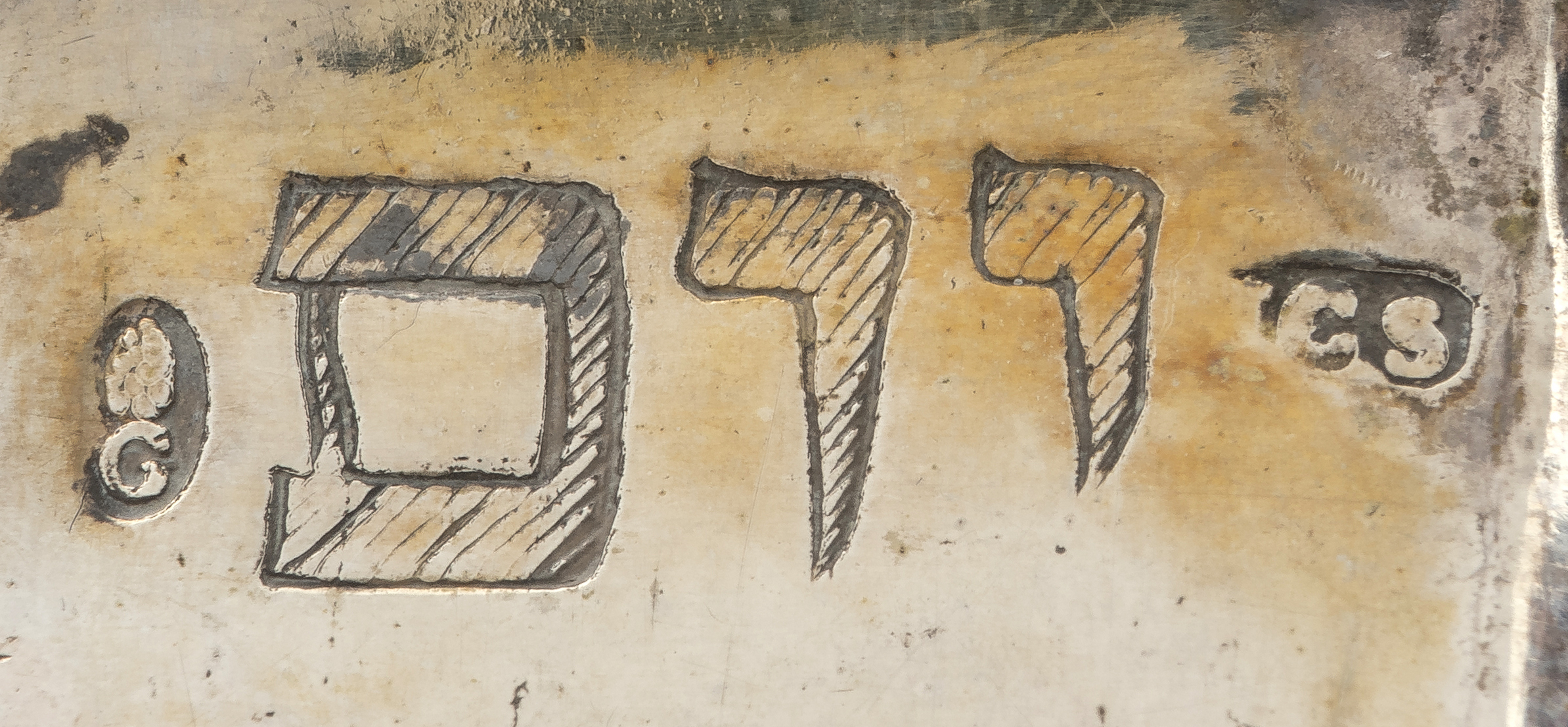
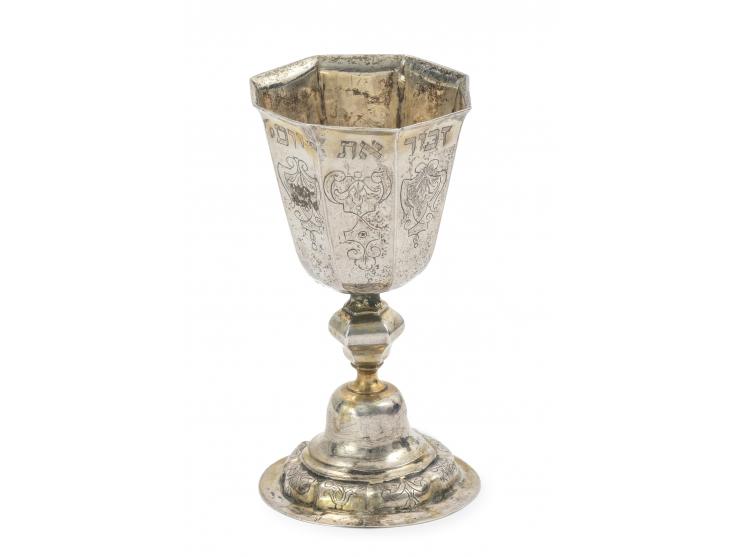
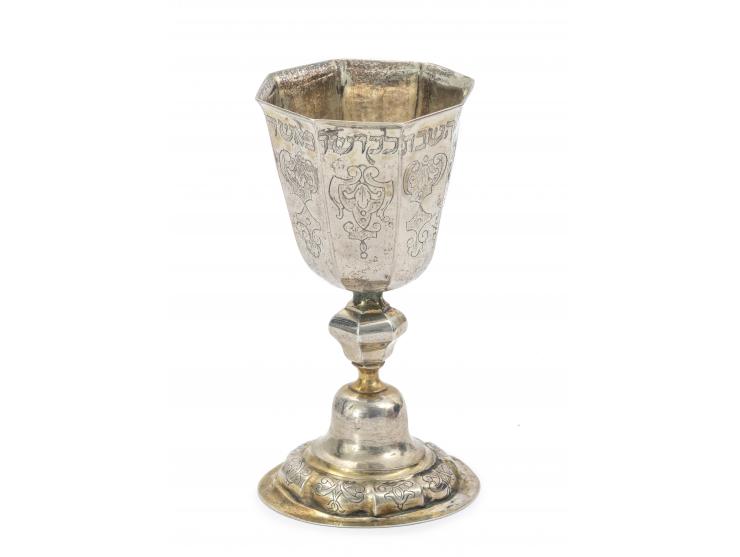
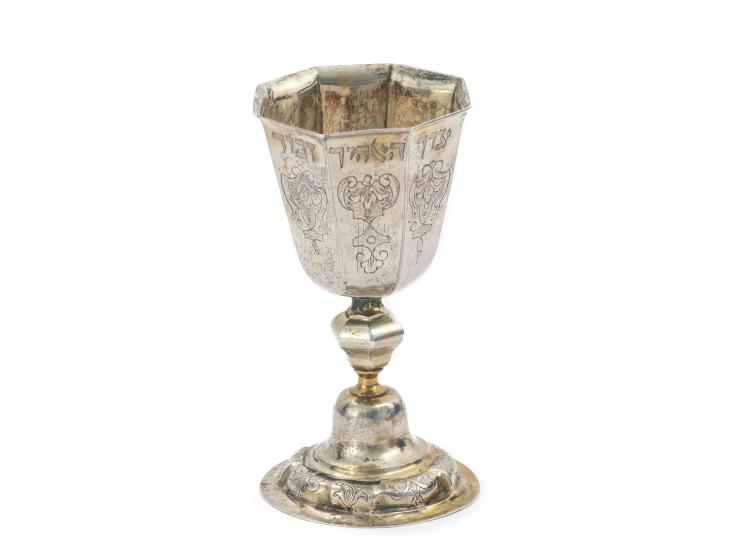
Kiddush cup, made by Johann Carl Stiebeldey. Augsburg, Germany, 1745-1747.
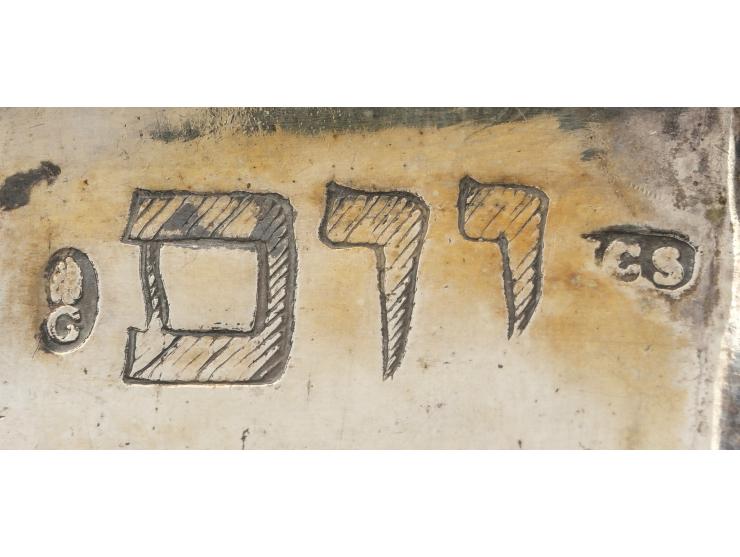
Silver, repoussé and engraved (base and cup marked with Augsburg city mark, the letter "G"; and with maker’s mark, the initials "ICS" = Johann Carl Stiebeldey); remnants of gilt.
Octagonal kiddush cup, supported on an elegant, graduated, broad circular base. Cup and base with matching, symmetrical vegetal patterns. Dedicatory inscription (Hebrew) engraved just beneath rim of cup, on all eight facets: "Remember the Sabbath Day and keep it holy, as the Lord your G-d has commanded you" [blending of Shemot 20:8 with Devarim 5:12].
The silversmith Johann Carl Stiebeldey (or Stippeldey) was active in Augsburg in the years 1731-1765. For similar Kiddush cups he created, see: Kestenbaum and Company, New York, 6 December 2012, Lot 1 (from the collection of the Jewish Historical Society of England [JHSE]); Sotheby’s, New York, 24 November 2009, Lot 58.
Height: 14 cm. Diameter at base: 7 cm. Weight: 127 g. Overall good condition. Minor warping and fractures to base, mended with old soldering repairs to silver. Faded gilt. Parts soldered together. Slight corrosion to joints.
Reference: Marc Rosenberg, Der Goldschmiede Merkzeichen, Frankfurt A.M.: Frankfurter Verlags, 1922, Vol. 1., Nos. 251, 907-908.
Provenance: Probably Christie’s, Amsterdam, 1 June 1999, Lot 527.
Category
Shabbat, Havdalah and Jewish Holidays
Catalogue Value
![Spicebox. [Central Europe, perhaps Germany or Poland, 19th century].
Silver, cast, repoussé, pierced and engraved](https://files.kedem-auctions.com/files/Sale107/7_1.jpg "Large Spicebox – Central Europe, 19th Century")
![Spicebox. [Central Europe, perhaps Germany or Poland, 19th century].
Silver, cast, repoussé, pierced and engraved](https://files.kedem-auctions.com/files/Sale107/7_2-WEB.jpg "Large Spicebox – Central Europe, 19th Century")
![Spicebox. [Central Europe, perhaps Germany or Poland, 19th century].
Silver, cast, repoussé, pierced and engraved](https://files.kedem-auctions.com/files/Sale107/7_3.jpg "Large Spicebox – Central Europe, 19th Century")
![Spicebox. [Central Europe, perhaps Germany or Poland, 19th century].
Silver, cast, repoussé, pierced and engraved](https://files.kedem-auctions.com/files/Sale107/7_4.jpg "Large Spicebox – Central Europe, 19th Century")
![Spicebox. [Central Europe, perhaps Germany or Poland, 19th century].
Silver, cast, repoussé, pierced and engraved](https://files.kedem-auctions.com/files/Sale107/7_5.jpg "Large Spicebox – Central Europe, 19th Century")
Auction 107: Rare and Important Items
Apr 15, 2026
Opening: $1,500
Estimate: $3,000 - $5,000
Sold for: Unsold
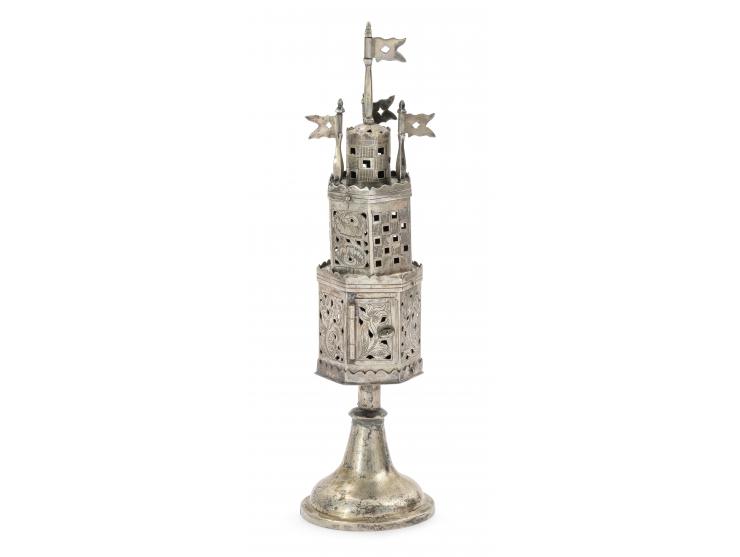
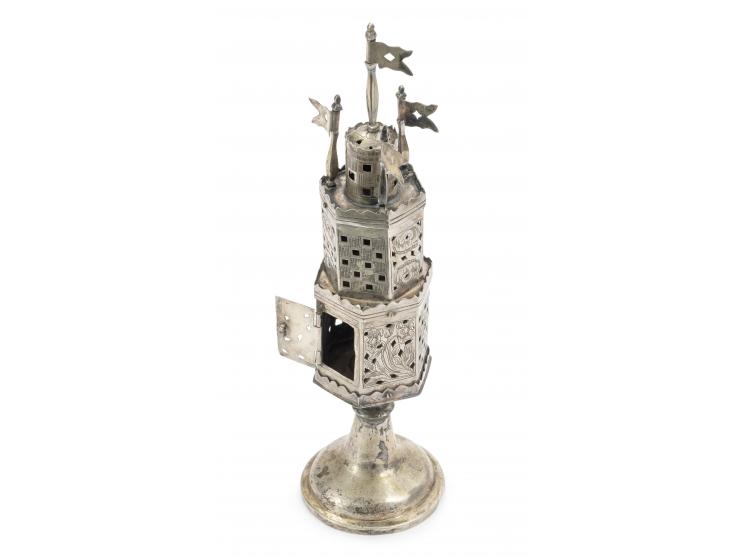
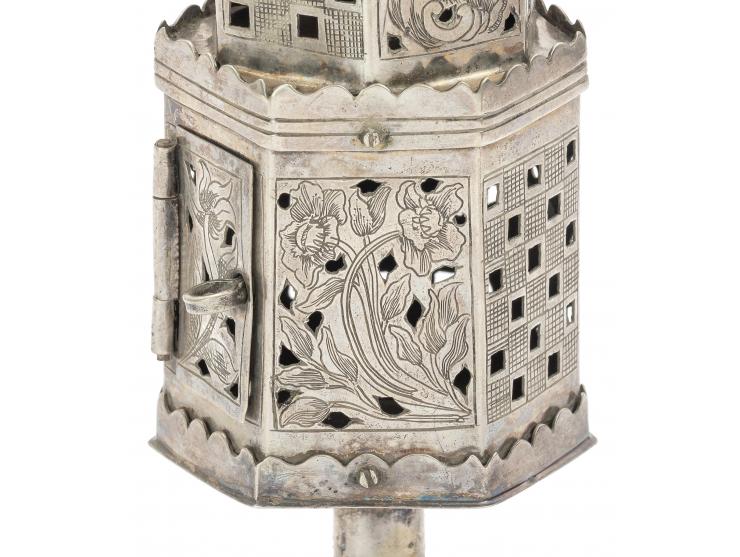
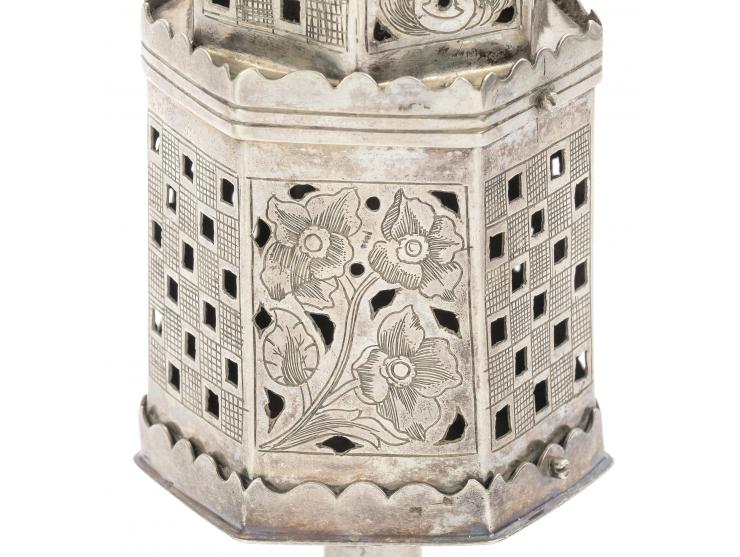
Spicebox. [Central Europe, perhaps Germany or Poland, 19th century].
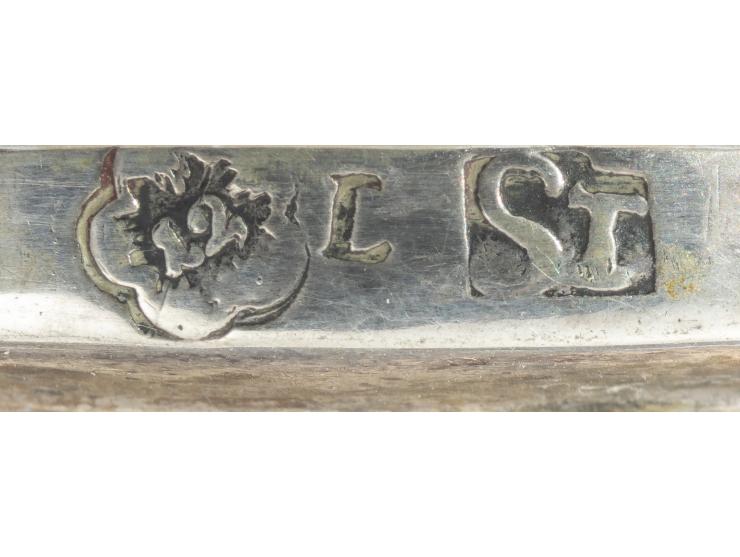
Silver, cast, repoussé, pierced and engraved (with unidentified marks, a standard mark – "12" inside a flower, date mark "L", and maker's mark, apparently "SI").
Large, high-quality spicebox, stylized as a two-story tower topped by a low cylindrical turret and four raised flags at the edges. Spice container and tier above it are hexagonal, with sides pierced and decorated with alternating vegetal patterns or small square impressions and brick-like decorations. Mounted on short cylindrical leg on a wide dome-like base.
Height: 28 cm. Diameter of base: 7.5 cm. Weight: 217 g. Good condition. Old soldering repairs to leg, joints of box, and flag.
Category
Shabbat, Havdalah and Jewish Holidays
Catalogue Value
Auction 107: Rare and Important Items
Apr 15, 2026
Opening: $1,000
Estimate: $2,000 - $4,000
Sold for: $15,000
Including buyer's premium
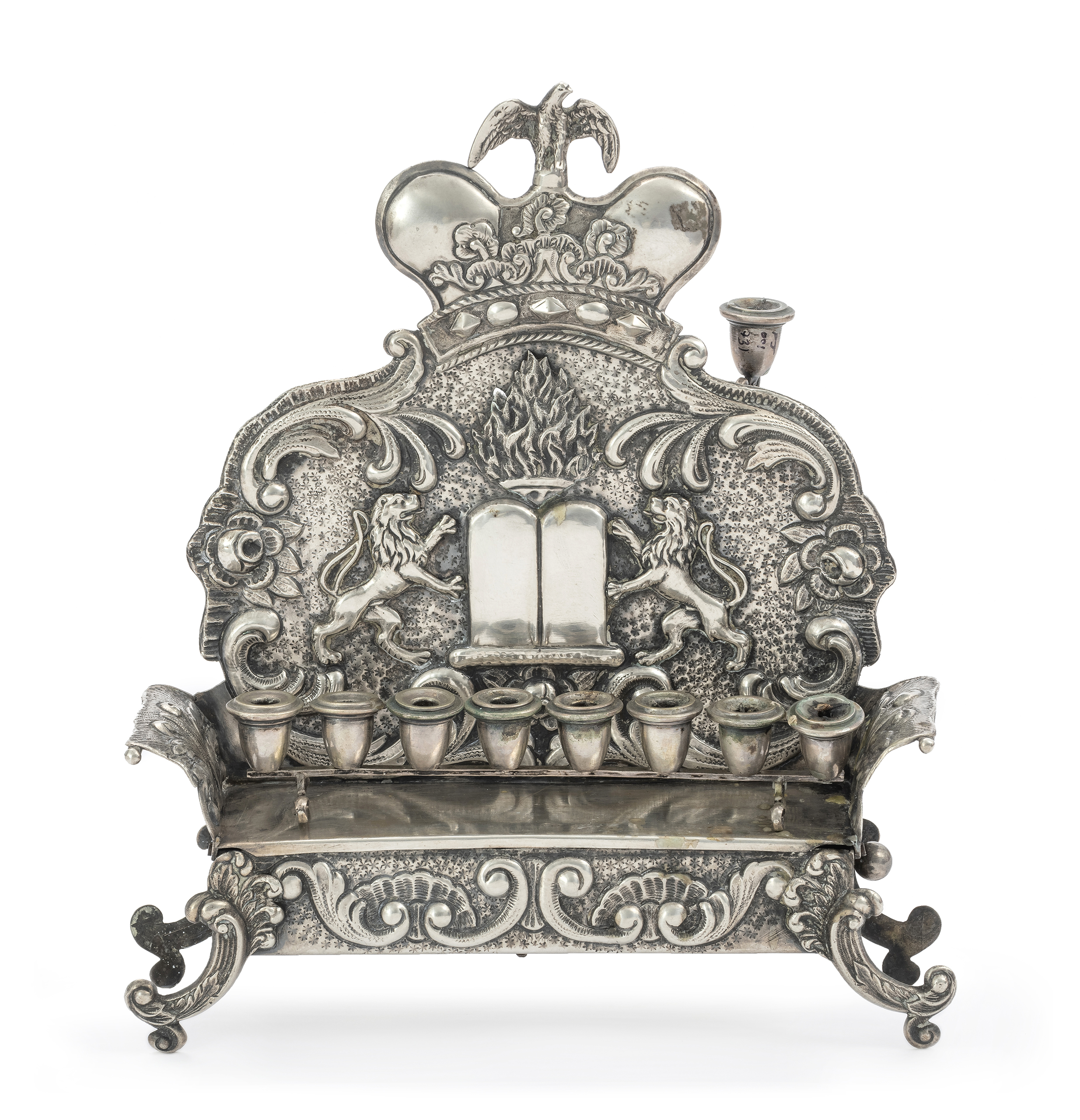
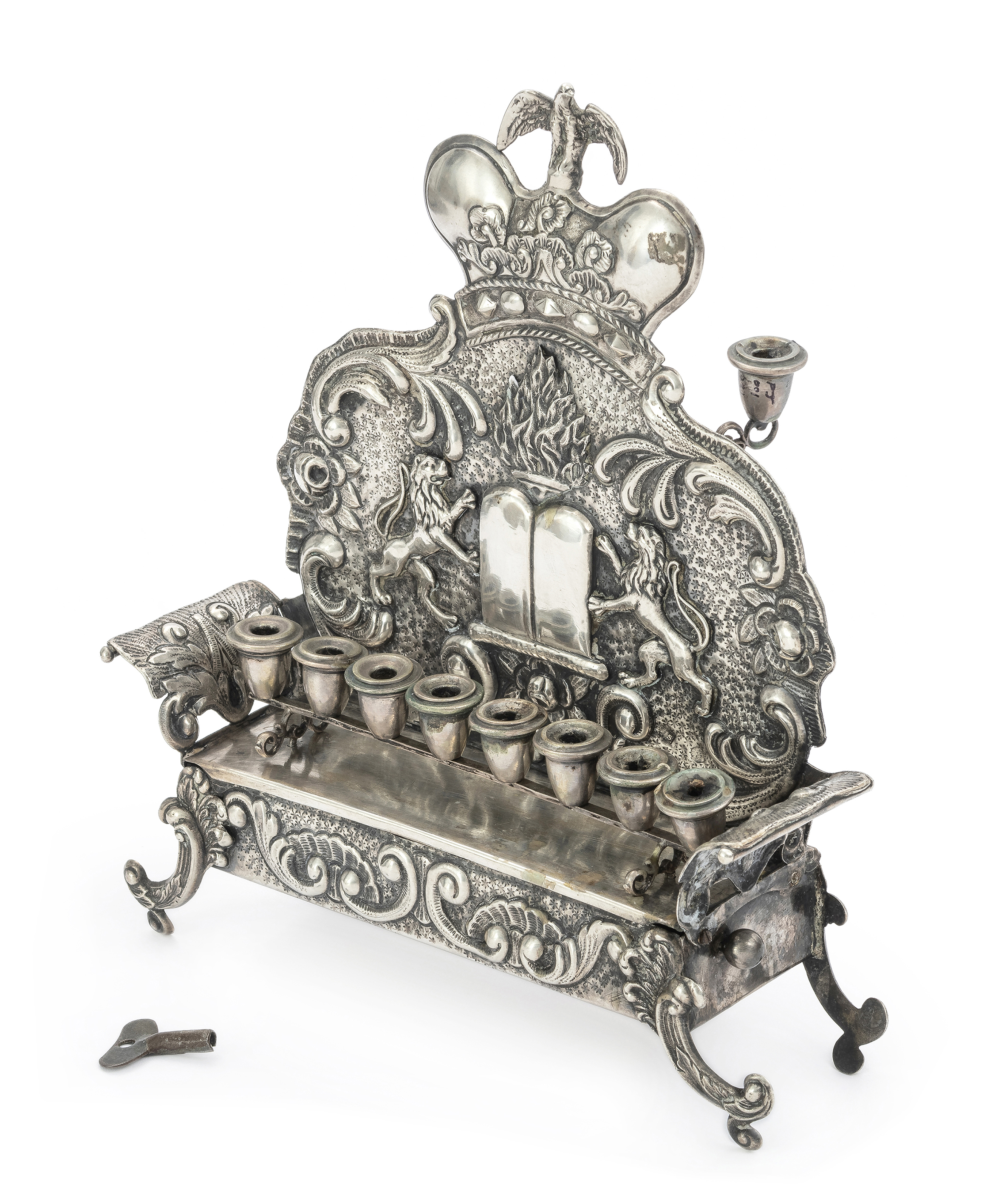
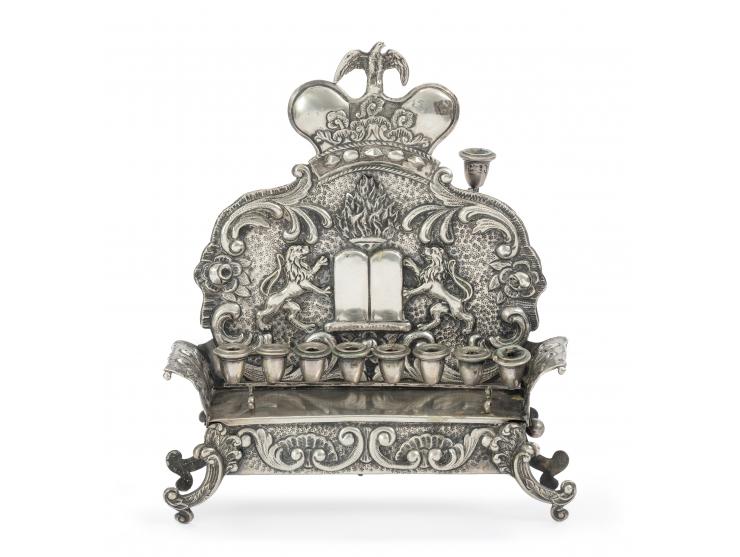
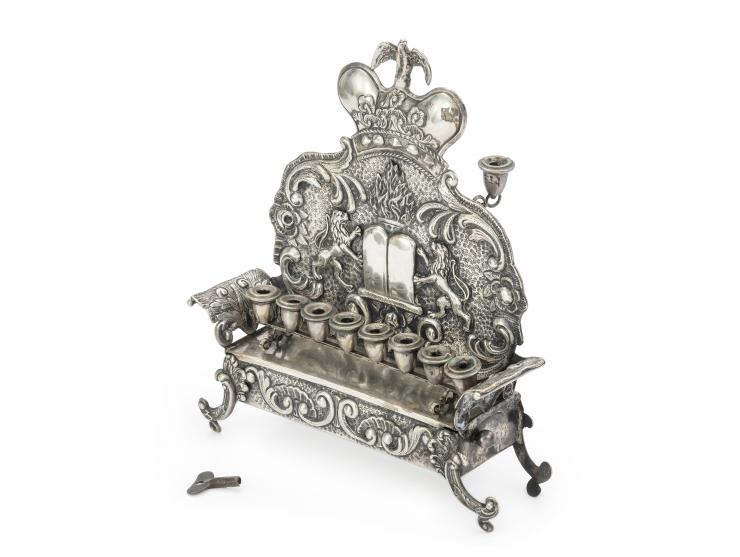
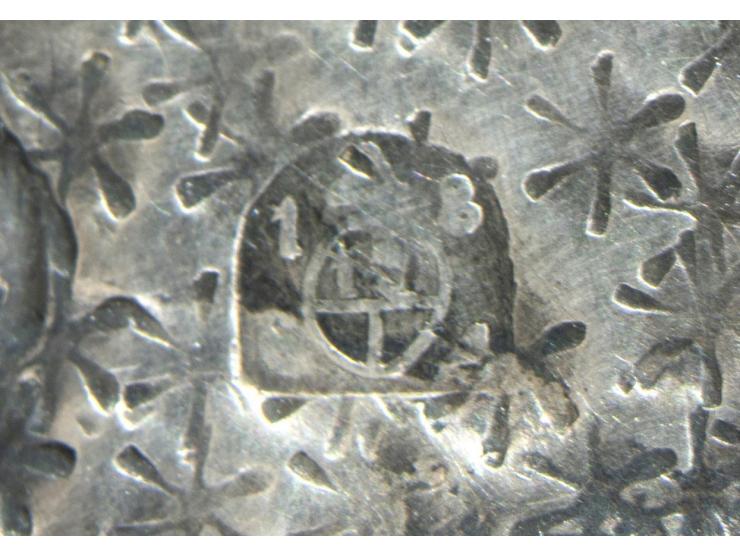
Hanukkah lamp with music box, probably made by Hermann Südfeld. Vienna, 1884.
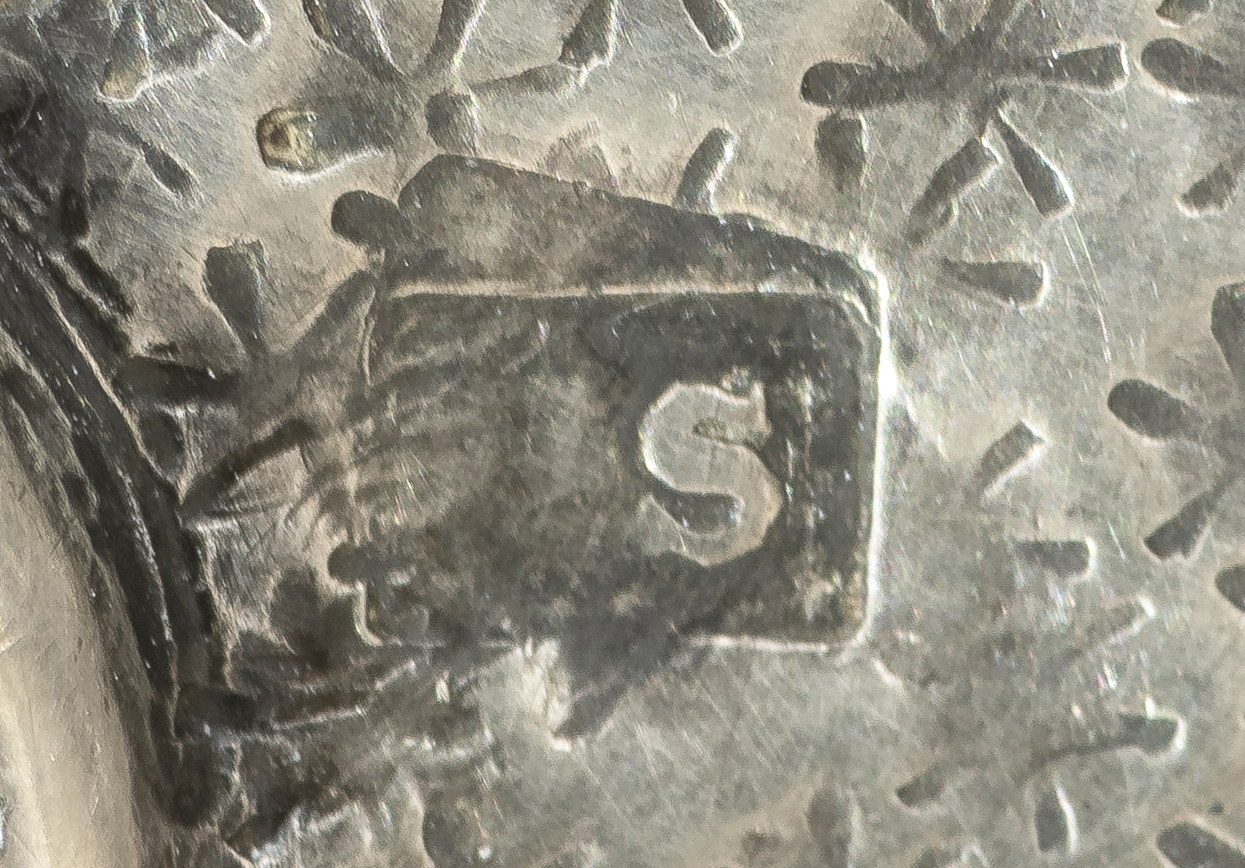
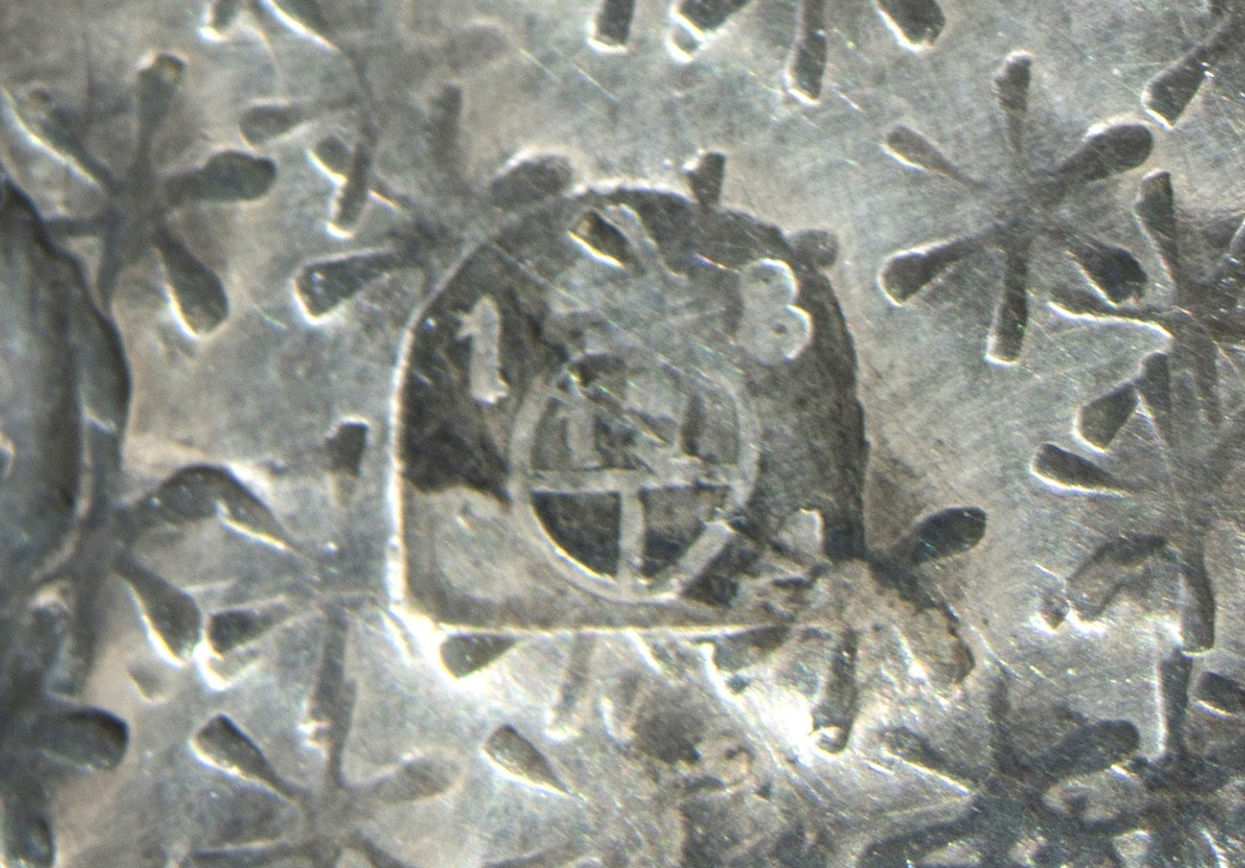
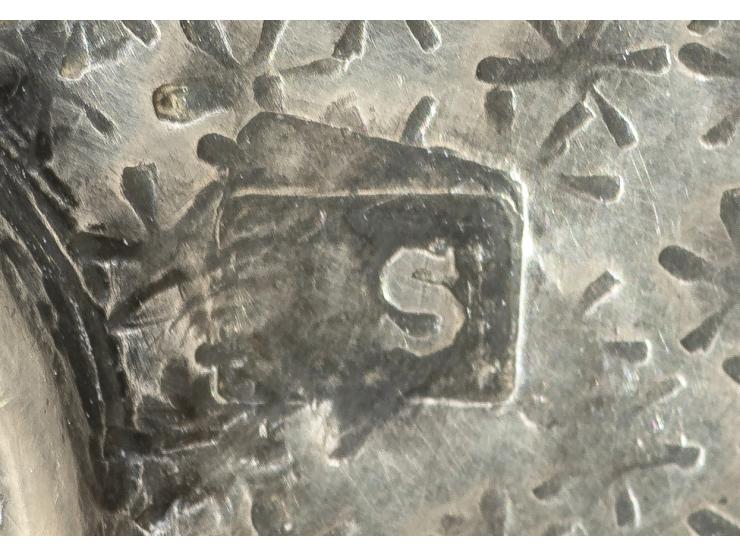
Silver, repoussé and cast (marked with Viennese quality marks dated 1884; and with partial maker’s mark, probably HS = the silversmith Hermann Südfeld).
In shape of sofa with tall backrest – exemplar of a type prevalent among Austro-Hungarian Hanukkah lamps of the 19th and 20th centuries. Backplate and base with vegetal patterns. Backplate topped with crown-shaped ornament surmounted by eagle. At center, Two Tablets of the Law (blank) surmounted by flame and flanked on either side by rampant lions. Removable row of oil fonts at front. Servant light (also removable) positioned behind backplate, off to the side.
At the base of the lamp, beneath the row of oil fonts, is a rectangular music box, operated by a spring and lever and wound with a key, which plays a melody (based on a popular German tune) for the liturgical Hanukkah song "Maoz Tzur" ("My Rock of Salvation").
The Jewish silversmith Hermann Südfeld (1835-1915) was active in Vienna in the second half of the 19th and early 20th centuries. He created domestic silver items (candlesticks, boxes) – some of them in the Art Nouveau style. He also made Jewish ceremonial objects, including Torah ornaments (preserved in the collections of the Jewish Museum in Prague and the Bar-David Art and Judaica Museum, Kibbutz Bar’am), Hanukkah lamps (including a number of examples in the collection of the Jewish Museum, New York, some of them similar in design to the present lamp), and Havdalah spiceboxes (Collection of the Israel Museum, Jerusalem, B50.02.0978).
Height: 24 cm. Width: 21 cm. Depth: 6 cm. Weight: 680 g. Overall good condition. One oil font detached. One screw missing. Music box mechanism operational; winding key enclosed.
Category
Shabbat, Havdalah and Jewish Holidays
Catalogue Value
![Embroidered Seder towel (Sederzwëhl). [Southern Germany or Alsace], 1787.
Embroidery of colorful cotton and silk on](https://files.kedem-auctions.com/files/Sale107/9_1.jpg "Embroidered Seder Towel – Southern Germany or Alsace, 1787 – Rachel Sü")
![Embroidered Seder towel (Sederzwëhl). [Southern Germany or Alsace], 1787.
Embroidery of colorful cotton and silk on](https://files.kedem-auctions.com/files/Sale107/9_2.jpg "Embroidered Seder Towel – Southern Germany or Alsace, 1787 – Rachel Sü")
![Embroidered Seder towel (Sederzwëhl). [Southern Germany or Alsace], 1787.
Embroidery of colorful cotton and silk on](https://files.kedem-auctions.com/files/Sale107/9_3.jpg "Embroidered Seder Towel – Southern Germany or Alsace, 1787 – Rachel Sü")
![Embroidered Seder towel (Sederzwëhl). [Southern Germany or Alsace], 1787.
Embroidery of colorful cotton and silk on](https://files.kedem-auctions.com/files/Sale107/9_4.jpg "Embroidered Seder Towel – Southern Germany or Alsace, 1787 – Rachel Sü")
Auction 107: Rare and Important Items
Apr 15, 2026
Opening: $1,000
Estimate: $2,000 - $4,000
Sold for: $1,250
Including buyer's premium
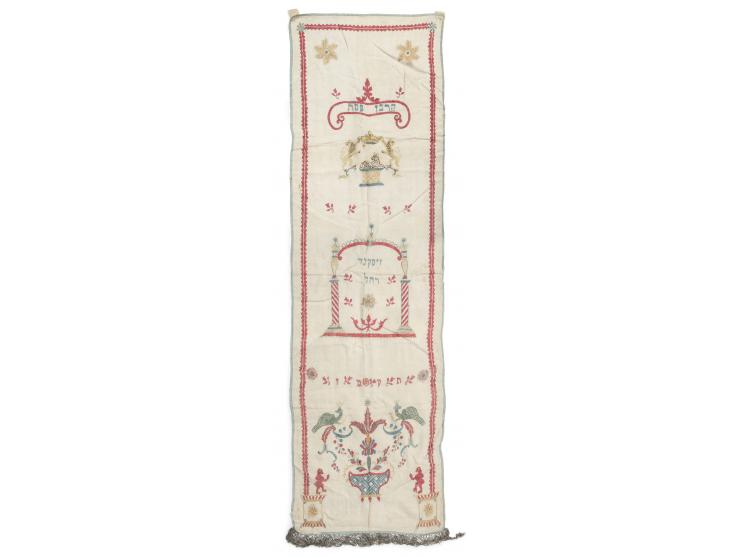
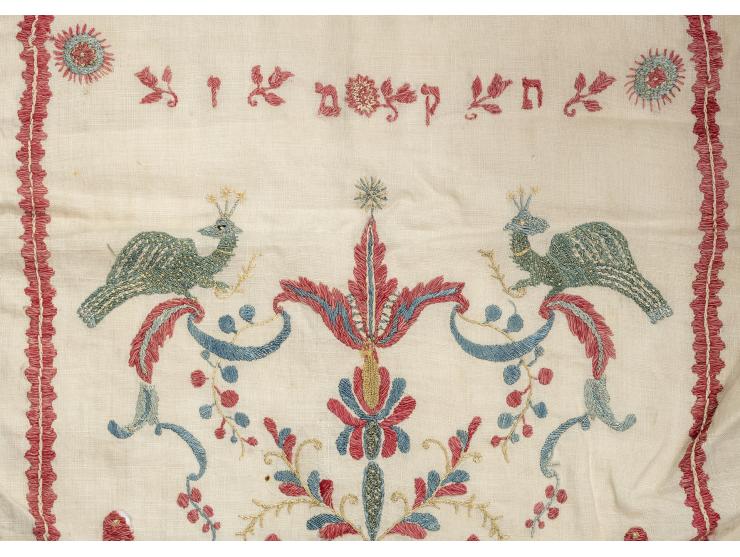
Embroidered Seder towel (Sederzwëhl). [Southern Germany or Alsace], 1787.
Embroidery of colorful cotton and silk on linen; decorative silvery metal lace ribbon.
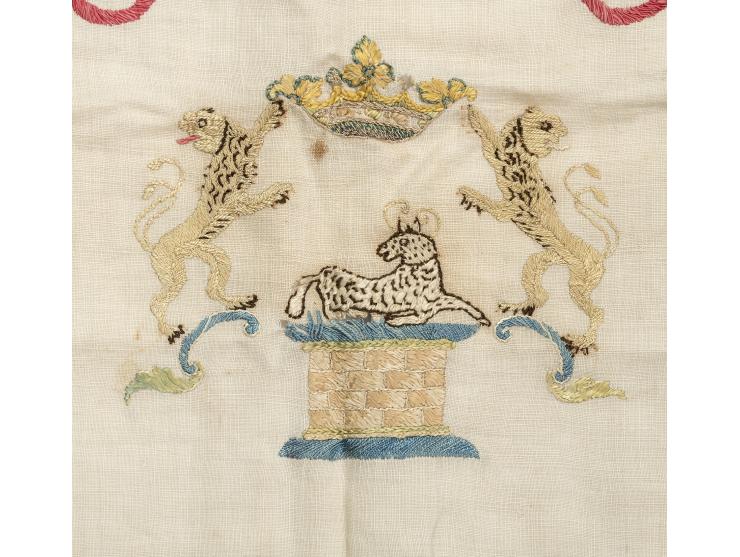
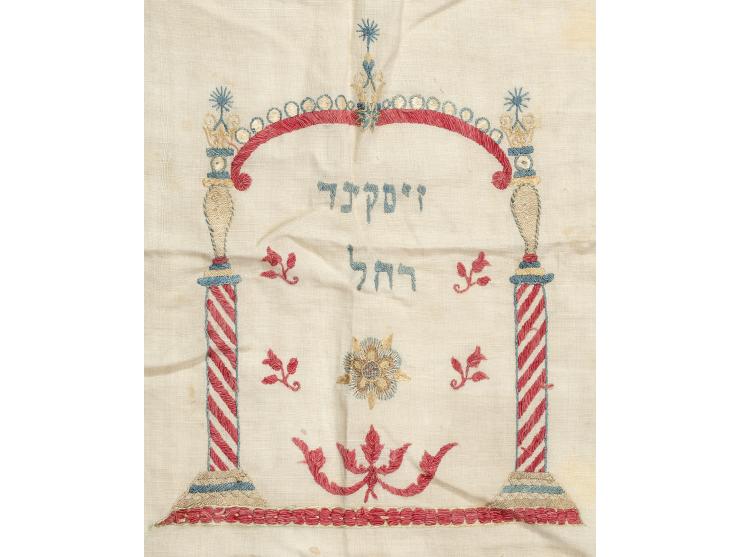
Long, thin fabric sheet. The top features a lamb on an altar with the embroidered caption "Passover Sacrifice". Around the altar, a pair of rampant lions hold a crown. The center features the name of the embroiderer – "Süsskind Rachel" – within a structure with two pillars, under which the date is given as 1787. The bottom embroidery features a basket producing vegetal patterns topped by a pair of peacocks and unidentified creatures or figures standing upon two rectangular bases. A blue silken ribbon is woven into the edges, with an endpiece of silvery metal tassels. Remains of silk suspension loops at upper edges.
Seder towels such as the present object were characteristic of the communities of southern Germany and Alsace, and were produced for home use on festive occasions, usually Passover. For comparisons, see: Grossman, Fabric of Jewish Life (New York, 1977), nos. 220-221; Isaiah Shachar, The Feuchtwanger Collection (Jerusalem, 1971; Hebrew), no. 436; Ester Muchawsky-Schnapper, The Jews of Alsace (Jerusalem, 1991; Hebrew), no. 33.
Height: 132 cm. Width: 40 cm. Overall good condition. Creases and folding marks. Some stains. Tears to blue ribbon at edges. Several tears across margins. Top suspension loops torn.
Category
Shabbat, Havdalah and Jewish Holidays
Catalogue Value
Auction 107: Rare and Important Items
Apr 15, 2026
Opening: $2,000
Estimate: $4,000 - $6,000
Sold for: $4,000
Including buyer's premium
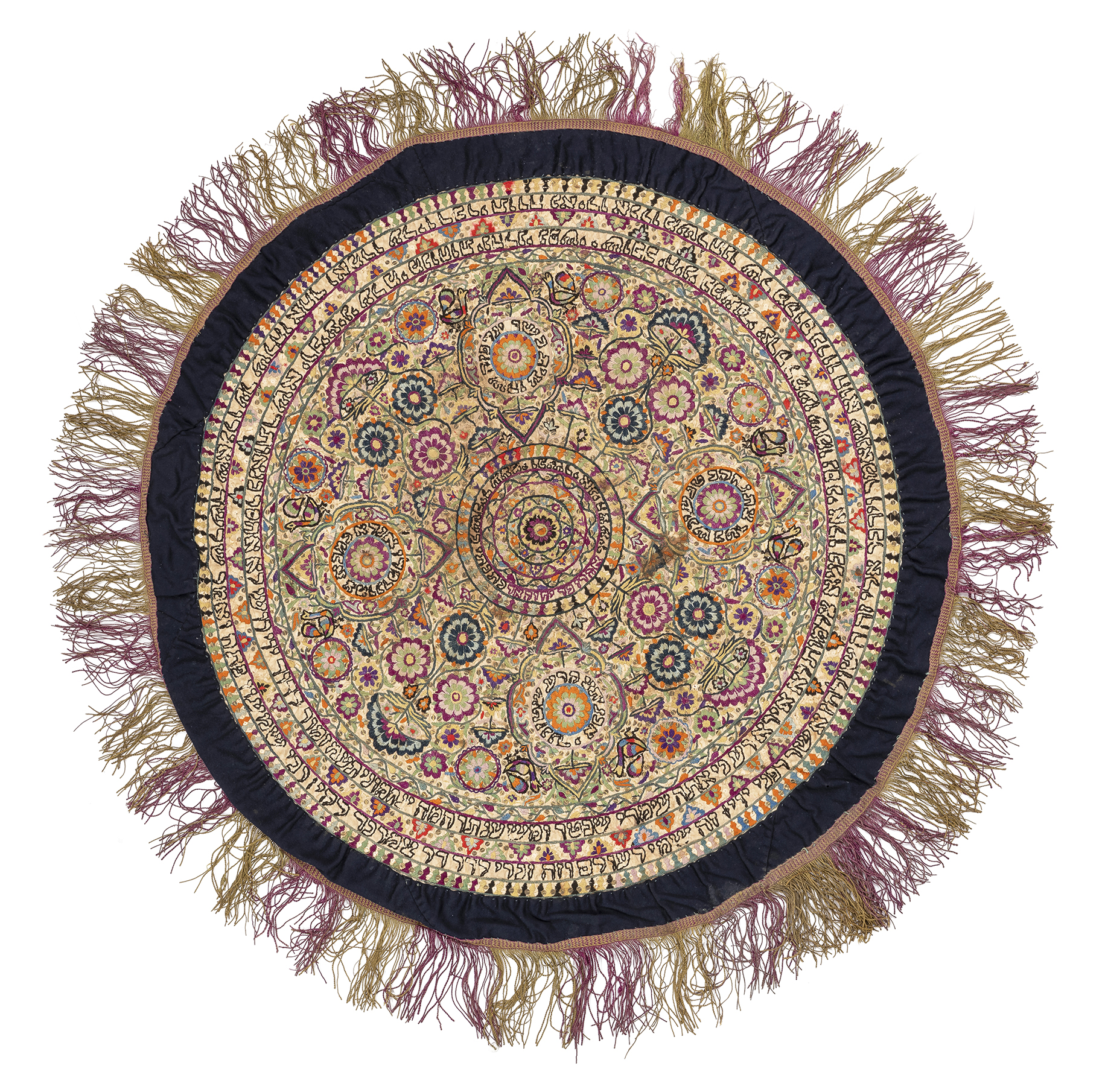
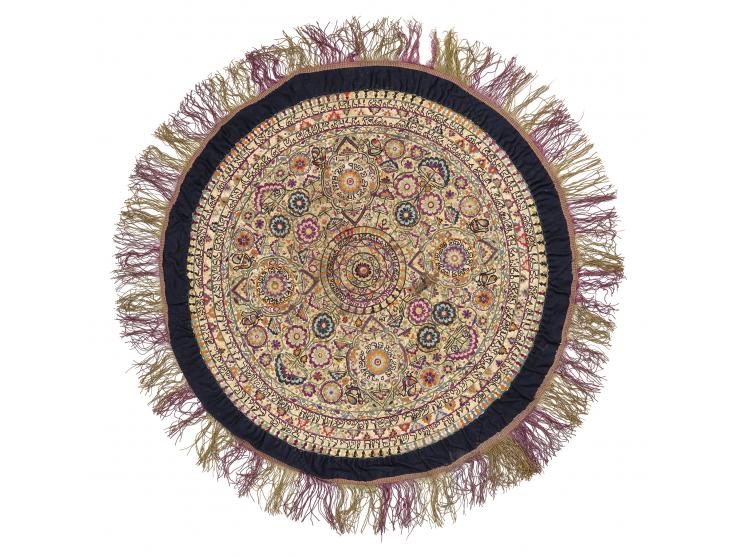
Embroidered tablecloth for Sabbath and festivals. [Saqqez or its environs, Iranian Kurdistan, last quarter of the 19th century].
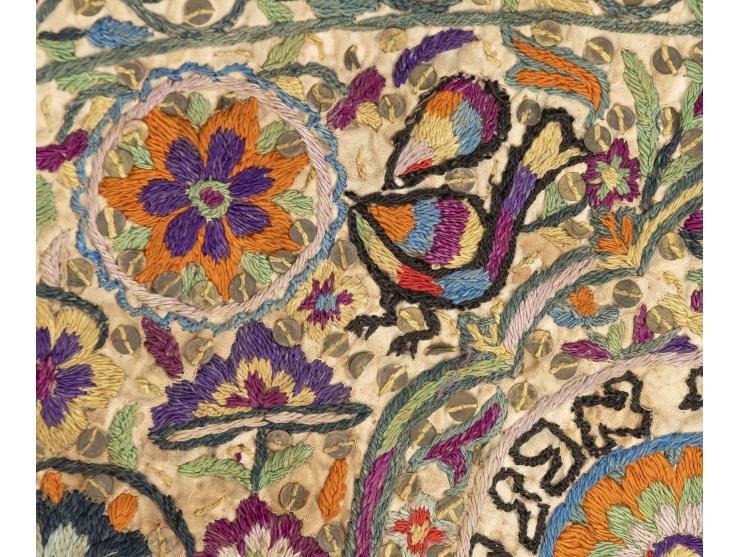
Color silk embroidery on cotton fabric; black cotton cloth; sequins; fringed border.
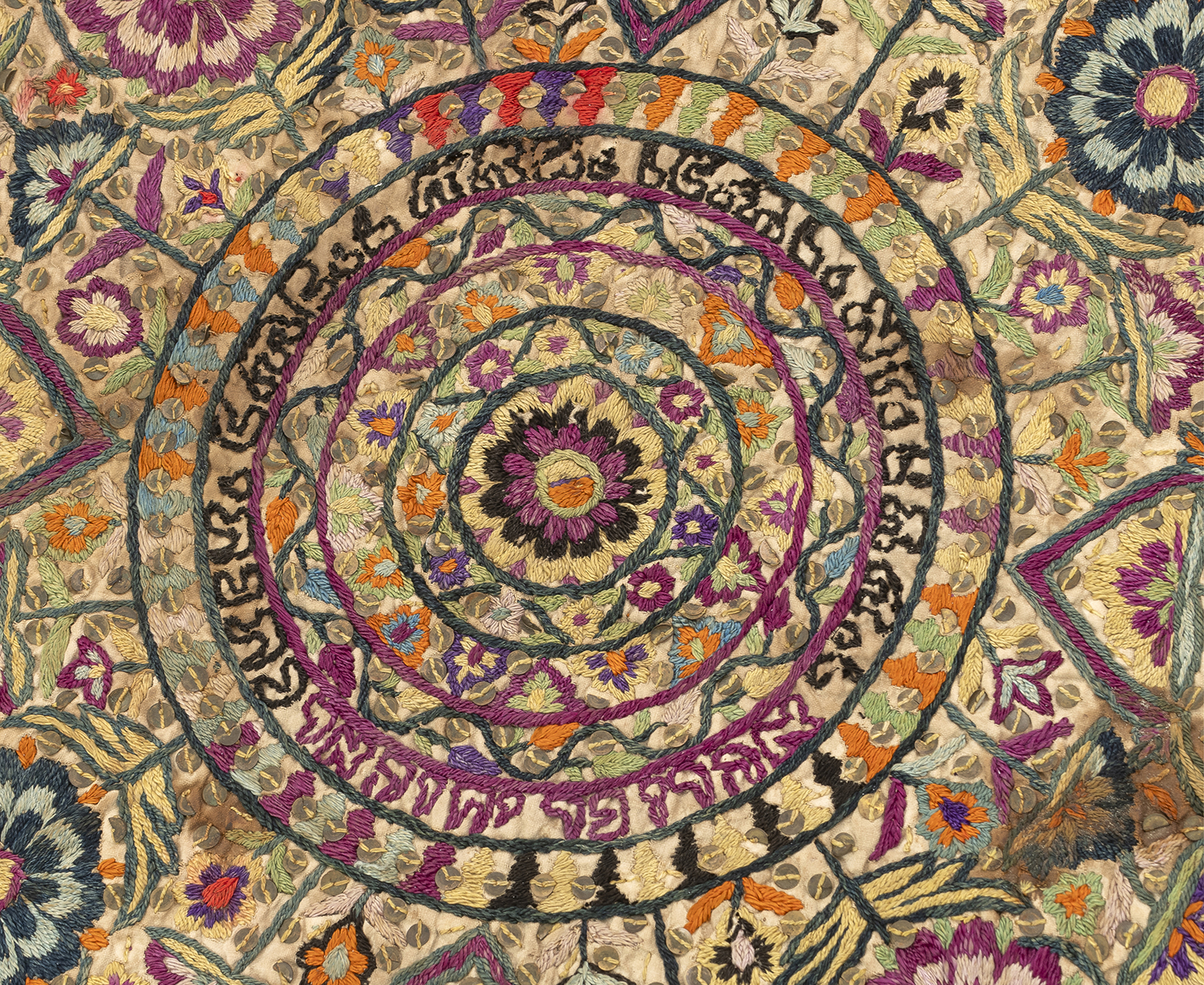
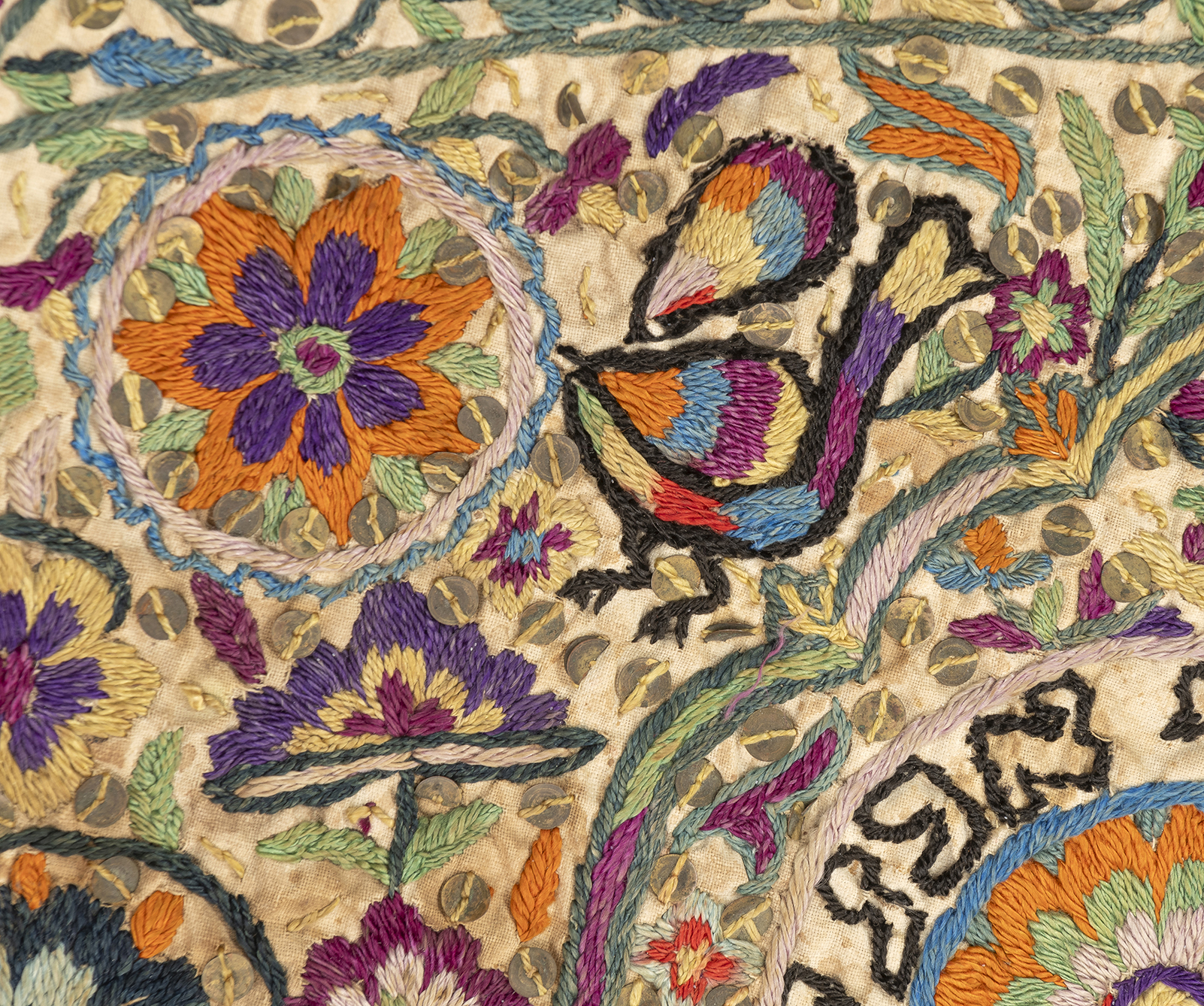
A large, colorful, circular tablecloth of a type used among the Jews of Kurdistan. Such cloths were intended to cover the table or food trays placed upon it on Sabbaths, at ceremonies, and on festivals. Densely embroidered with flowers and repeating, symmetrical vegetal patterns, with stylized medallions and peacock motifs.
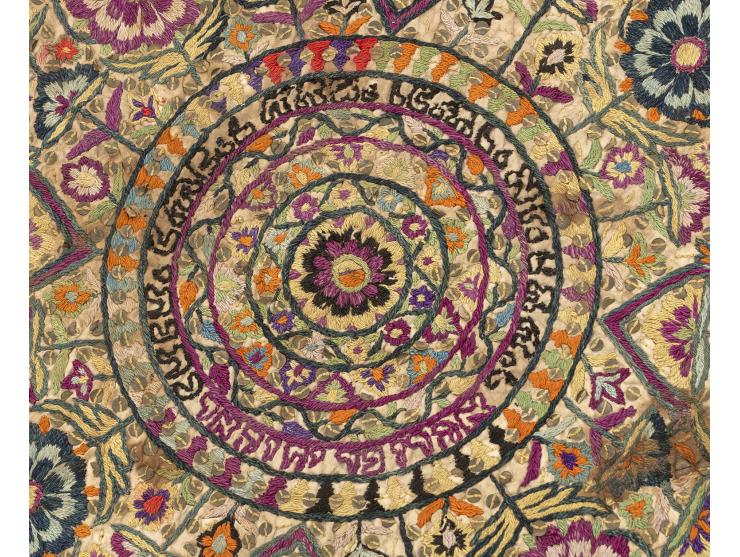
The embroidery incorporates several concentric text bands, stitched in black thread, containing biblical verses, rabbinic sayings, and a dedicatory inscription by the maker of the cloth. In the outer marginal band are embroidered verses and a rabbinic dictum relating to the dining table: "[Rabbi Shimon said]: … three who have eaten at one table, and have spoken there words of Torah, [it is] as if they had eaten at the table of the All-Present, blessed be He, as it is said, And He said unto me, 'this is the table before the Lord' / This is My name forever, and this is how I should be mentioned in every generation / [For Your salvation, I hope, O Lord!]" (Pirkei Avot 3:3; Shemot 3:15).
Within the inner marginal band are embroidered verses from Tehillim: "A song of David. The Lord is my shepherd; I shall not want. He causes me to lie down in green pastures; He leads me beside still waters. He restores my soul; He leads me in paths of righteousness for His name's sake. Even when I walk in the valley of darkness, I will fear no evil for You are with me; Your rod and Your staff – they comfort me" (Tehillim, 23:1-4).
In the four central medallions are embroidered the initials of the piyyut Ana BeKo'ach and various letter combinations (initials and final letters); in the central roundel is embroidered a dedicatory inscription by the maker of the cloth, Aaron son of Yehezkel.
Diameter of embroidered cloth: approx. 79 cm. The tablecloth has undergone professional conservation and has been sewn onto new fabric panels at its base and border. Overall diameter including the added border cloth: approx. 90 cm; overall diameter including fringes: approx. 110 cm. Overall good-fair condition. Stains and dark staining. Wear and tears affecting the embroidery in several places. Repairs and restorations. Accompanied by a round, printed colorful fabric panel, apparently originally sewn to the base of the tablecloth.
Details from this tablecloth are documented in the exhibition catalogue The Jews of Kurdistan: Daily Life, Customs, Arts and Craft. Jerusalem: The Israel Museum, 1981, pp. 152-153; 186-187 (Hebrew edition).
Category
Shabbat, Havdalah and Jewish Holidays
Catalogue Value
![Torah mantle. [Italy, probably Padua], 1744-1745.
Embroidery of coiled gold- and silver-colored metal thread on wine-red](https://files.kedem-auctions.com/files/Sale107/11_1.jpg "Embroidered Torah Mantle – Italy, 1745 – Aziz (Da Zara) Family")
![Torah mantle. [Italy, probably Padua], 1744-1745.
Embroidery of coiled gold- and silver-colored metal thread on wine-red](https://files.kedem-auctions.com/files/Sale107/11_2.jpg "Embroidered Torah Mantle – Italy, 1745 – Aziz (Da Zara) Family")
![Torah mantle. [Italy, probably Padua], 1744-1745.
Embroidery of coiled gold- and silver-colored metal thread on wine-red](https://files.kedem-auctions.com/files/Sale107/11_3.jpg "Embroidered Torah Mantle – Italy, 1745 – Aziz (Da Zara) Family")
Auction 107: Rare and Important Items
Apr 15, 2026
Opening: $10,000
Estimate: $15,000 - $20,000
Sold for: Unsold
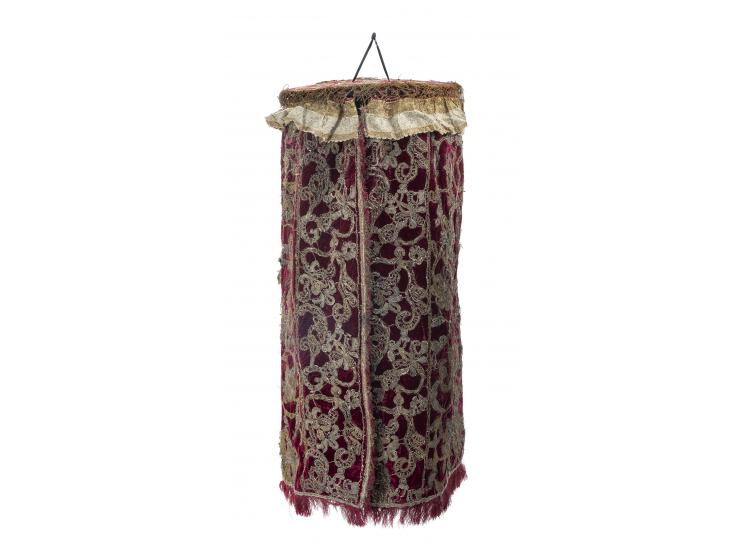
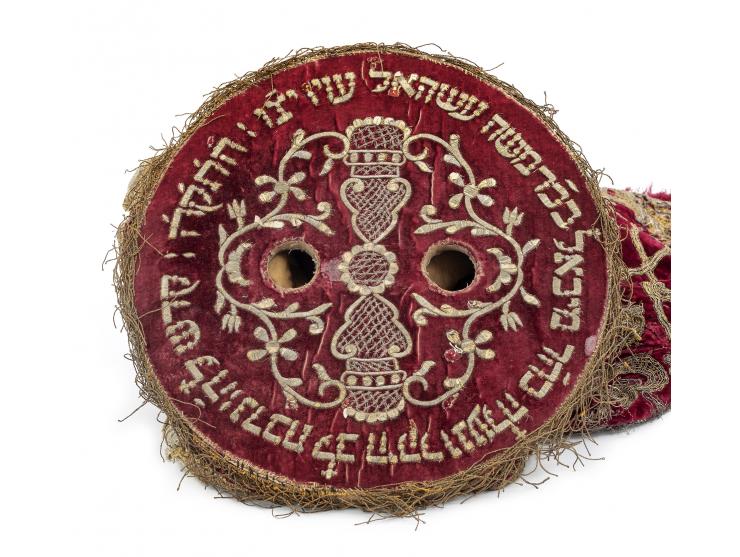
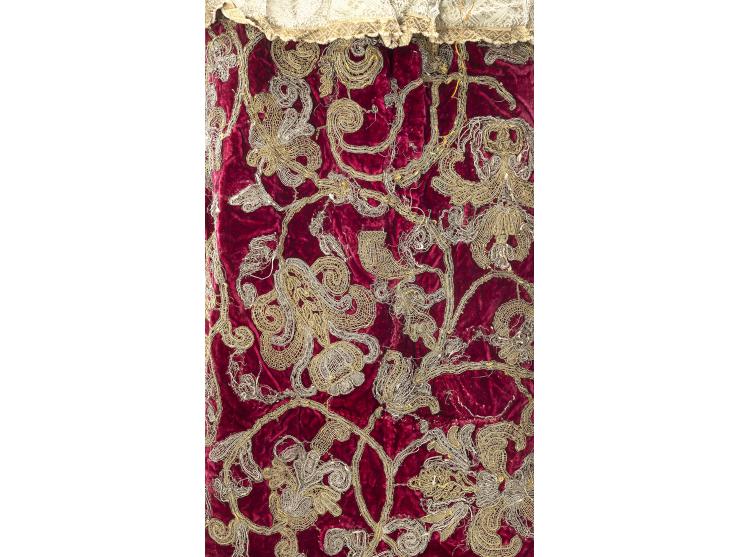
Torah mantle. [Italy, probably Padua], 1744-1745.
Embroidery of coiled gold- and silver-colored metal thread on wine-red velvet and a foundation of cardboard cutouts; decorative ribbons embroidered with gold- and silver-colored metal thread; strings of metal thread; wood.
Elaborate mantle including a solid circular top lid with two round apertures for Torah rollers, and a decorated fabric panel to wrap around and cover the Torah scroll. On the top lid, embroidered gold metal thread forms various decorations in symmetrical patterns, and around them the dedicatory inscription: "Consecrated to G-d: Donated by the dear and lofty R. Michael son of R. Moshe Asael Aziz: [1744-1745]".
The Aziz (Da Zara) family originates in Padua, northern Italy. Elaborate ketubot of this family, produced in Padua in the 17th and 18th centuries, are found in the NLI collection (Ms. Heb. 901.264=1) and the Israel Museum collection (B79.1468).
Height: 85 cm. Width: 37 cm. Overall good condition. Fabric edges of some embroidered decorations and inscriptions unraveled. Wear, tears and unraveling to interior of mantle and top lid joint. Later notations in paint to interior of mantle: "7, 1P".
Provenance: Sotheby's, New York, June 5 2019, Lot 39.
Category
Torah Ornaments, Synagogue Items
and Various Objects
Catalogue Value
Auction 107: Rare and Important Items
Apr 15, 2026
Opening: $1,000
Estimate: $4,000 - $6,000
Sold for: $2,250
Including buyer's premium
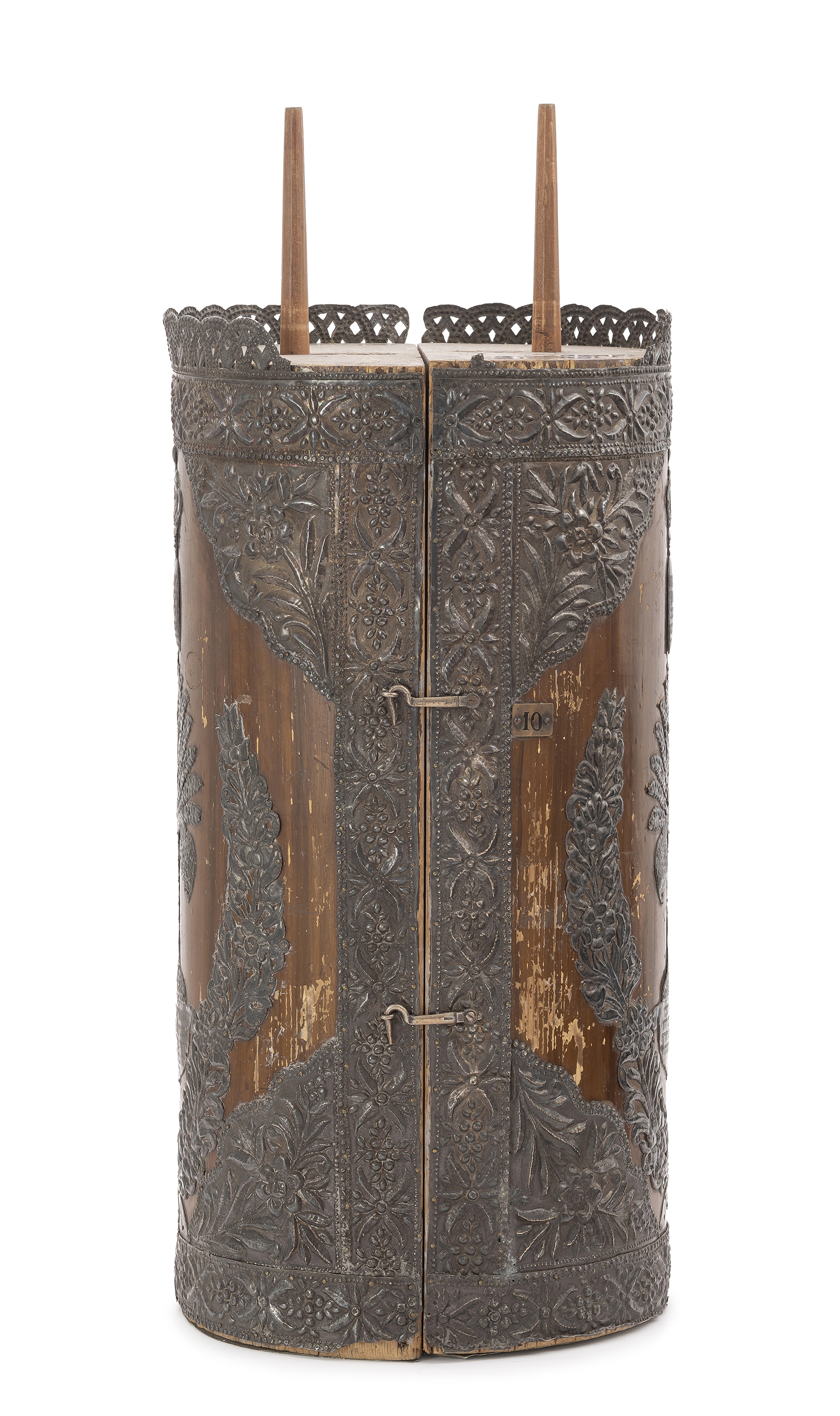
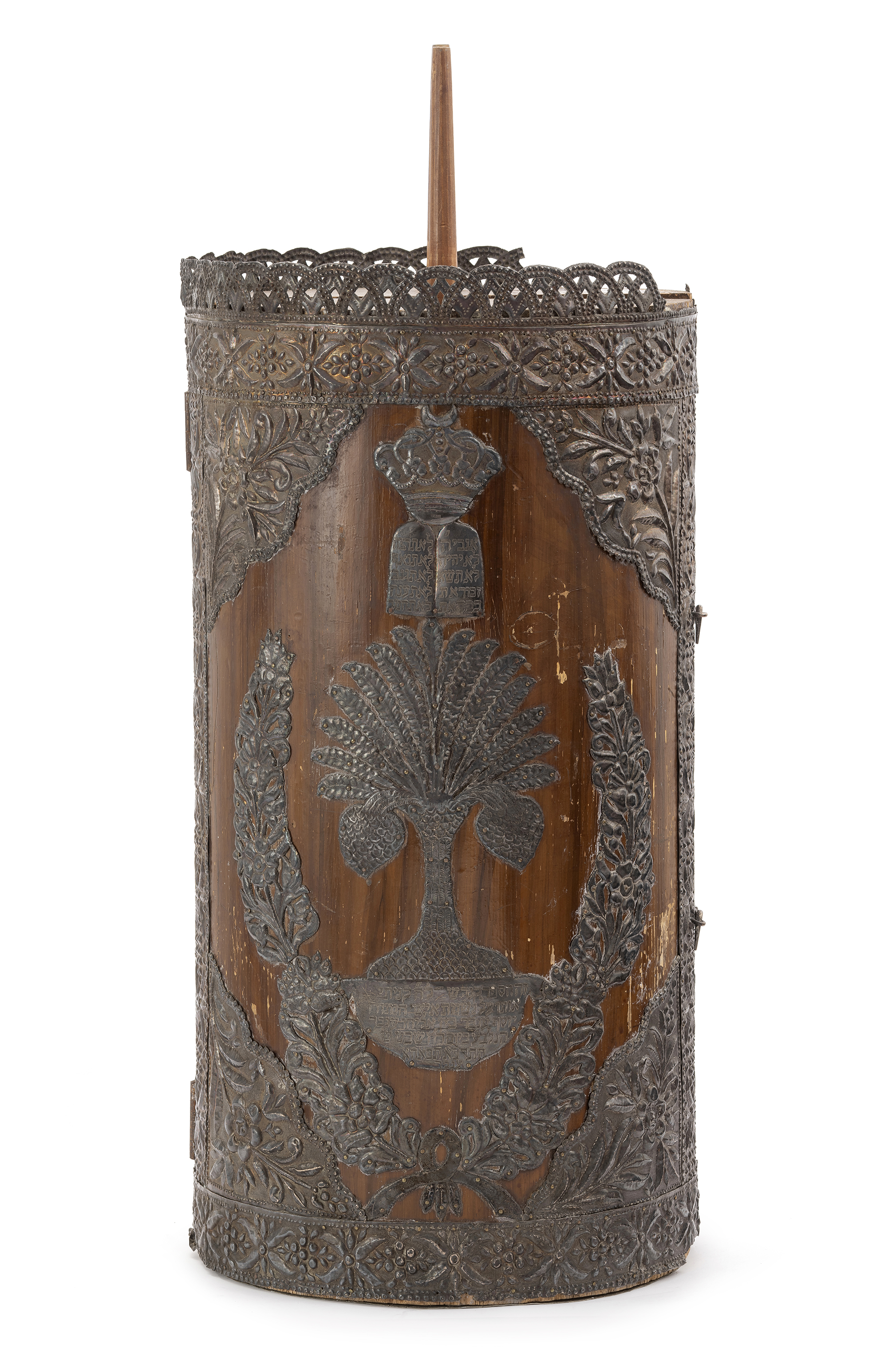
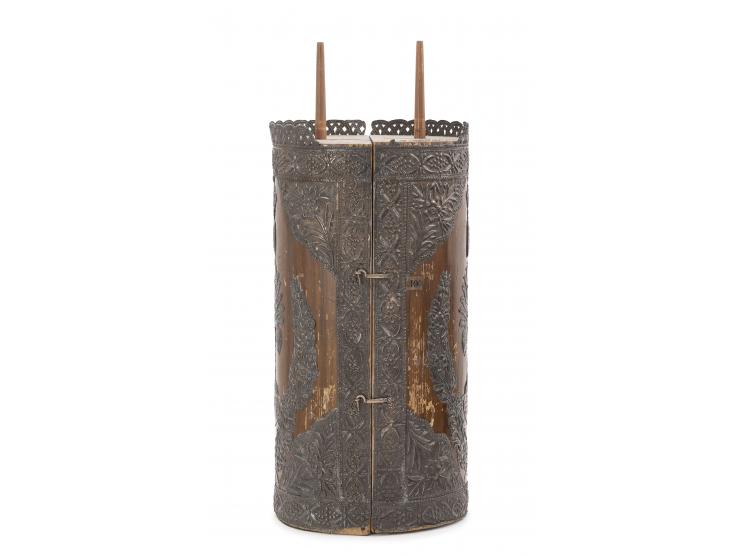
Torah scroll case. Egypt (probably Alexandria), 1921-1922.
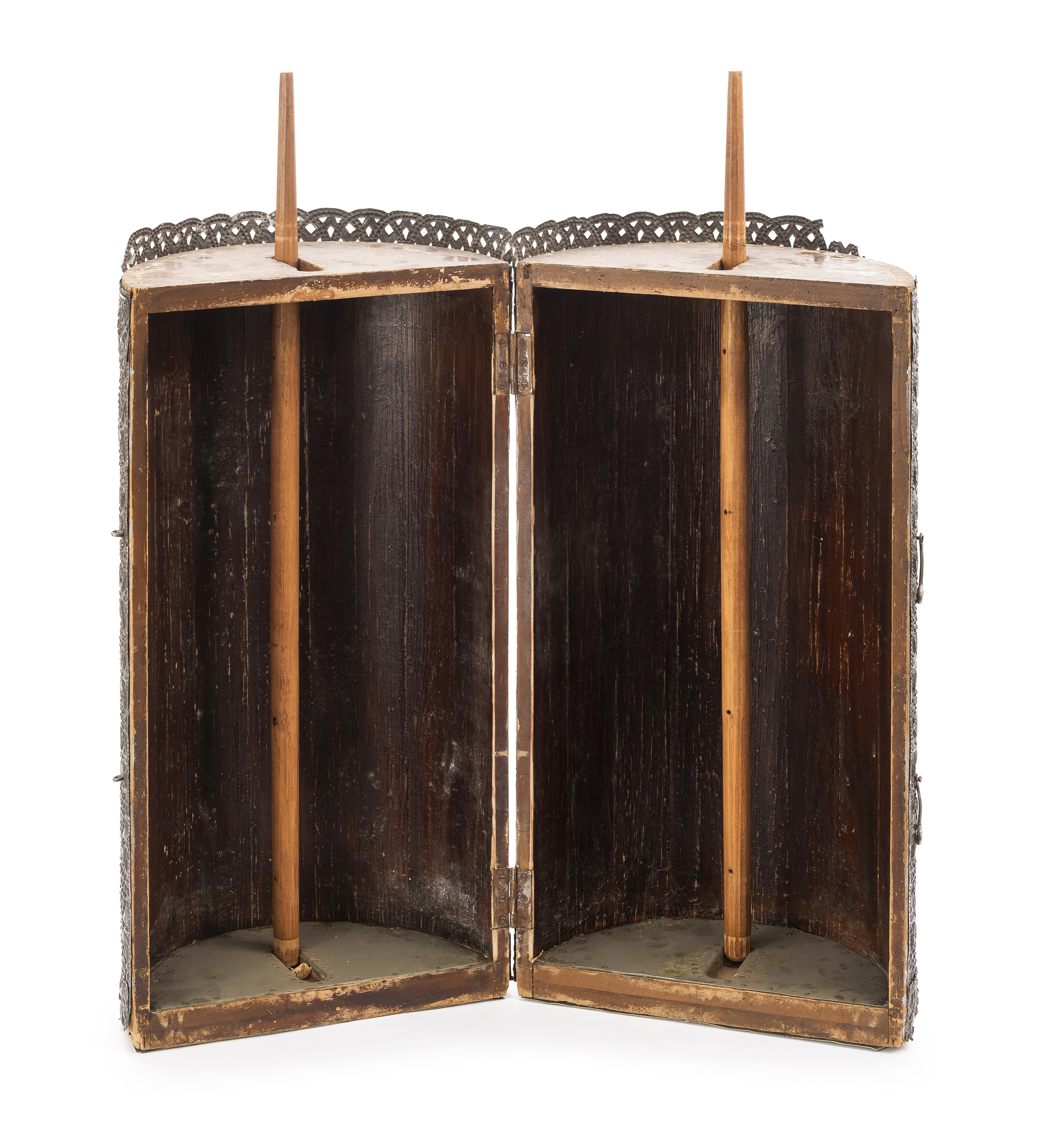
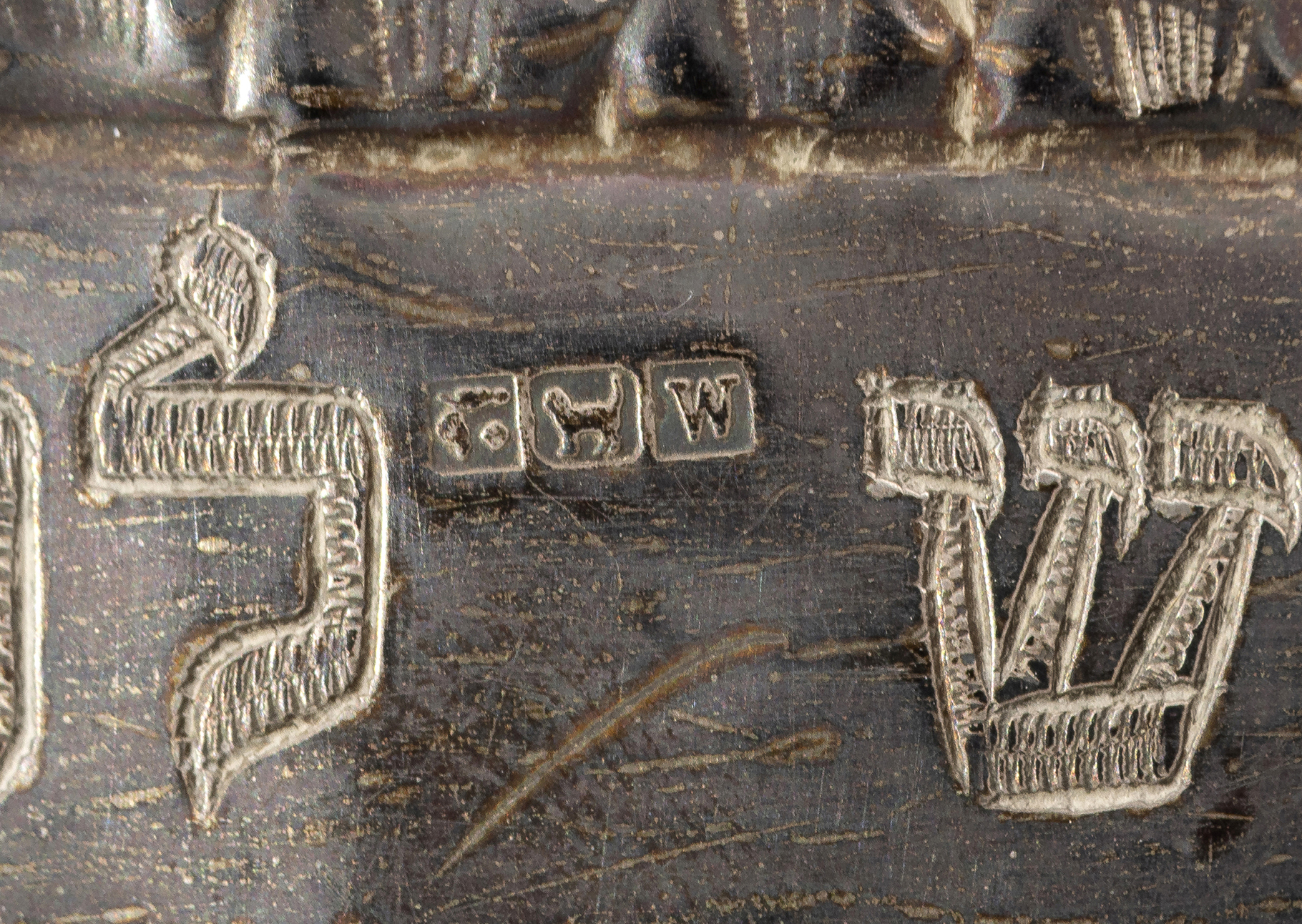
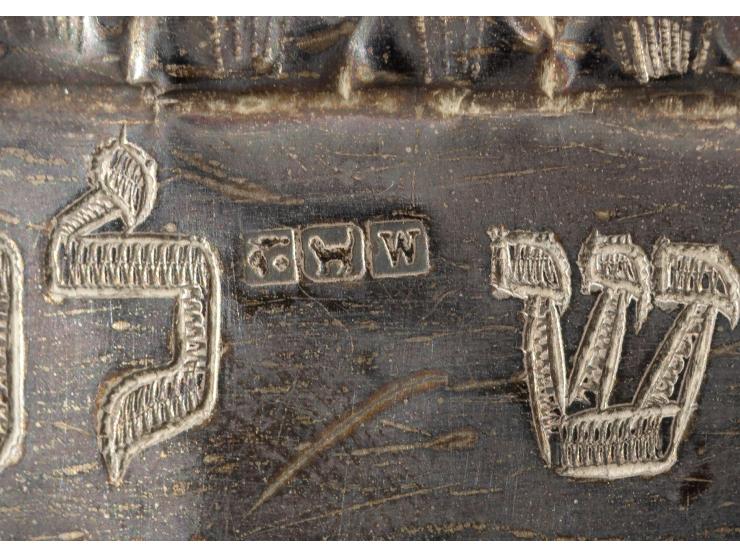
Wood; silver sheet, repoussé, cut, embossed and engraved (with many Egyptian standard marks and date mark "W" – 1921-1922); cast silver. Without Torah scroll.
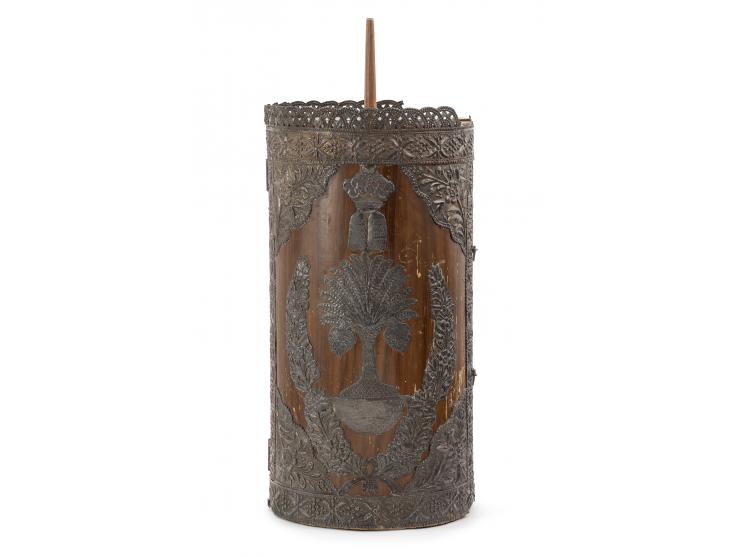
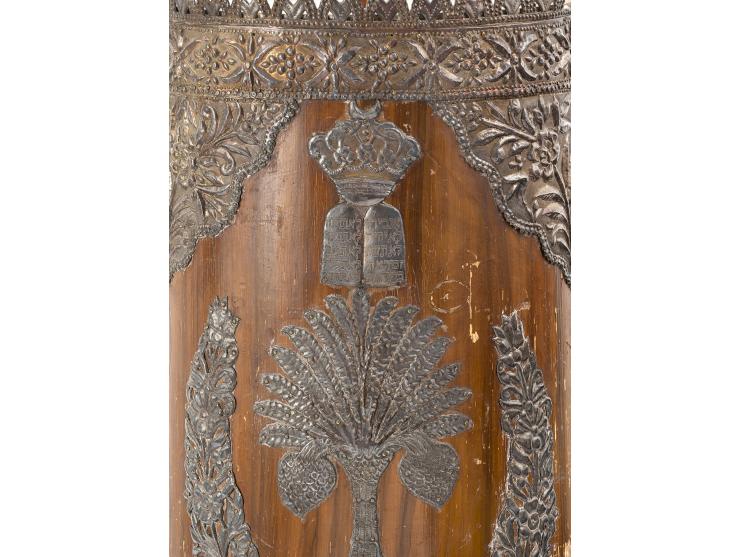
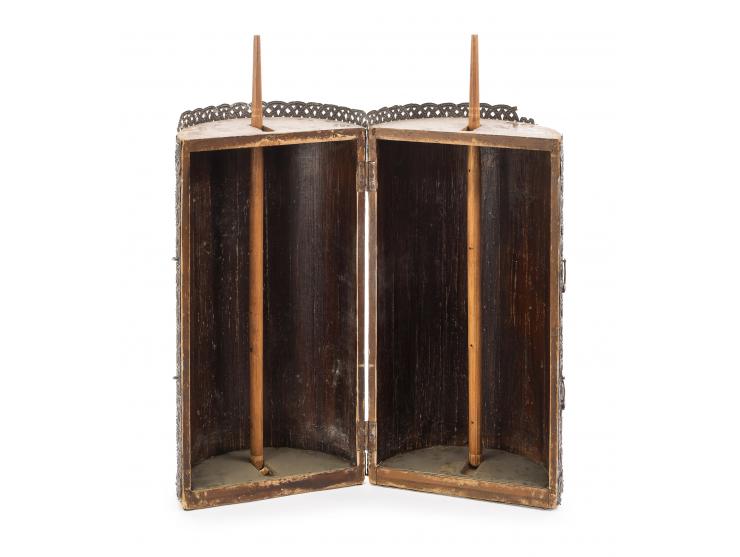
Cylindrical wooden case, with two rollers (removable). Outer surface mostly coated with silver sheet decorated with symmetrical vegetal patterns. The front of each part of the case features a large matching central decoration: a palm tree with two date clusters, topped by the Tablets of the Covenant (engraved with the Ten Commandments), and a crown topped by a small crescent ornament. Across the upper margins is a silver crown cut in a repeating pattern. The front, near the opening, has a brass plate numbered "10". A pair of silver clasps are included. The floor and base of the case are coated with white metal.
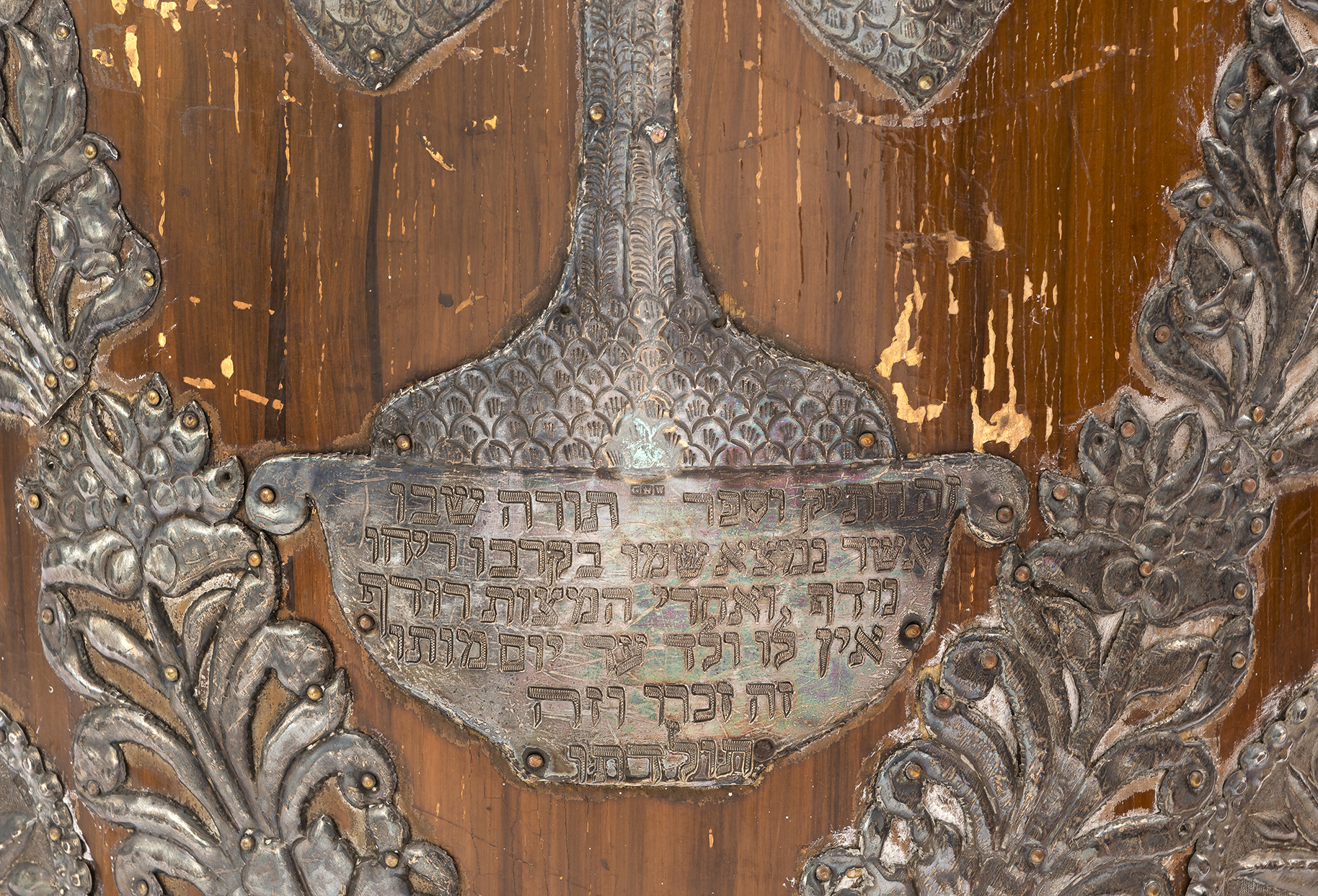
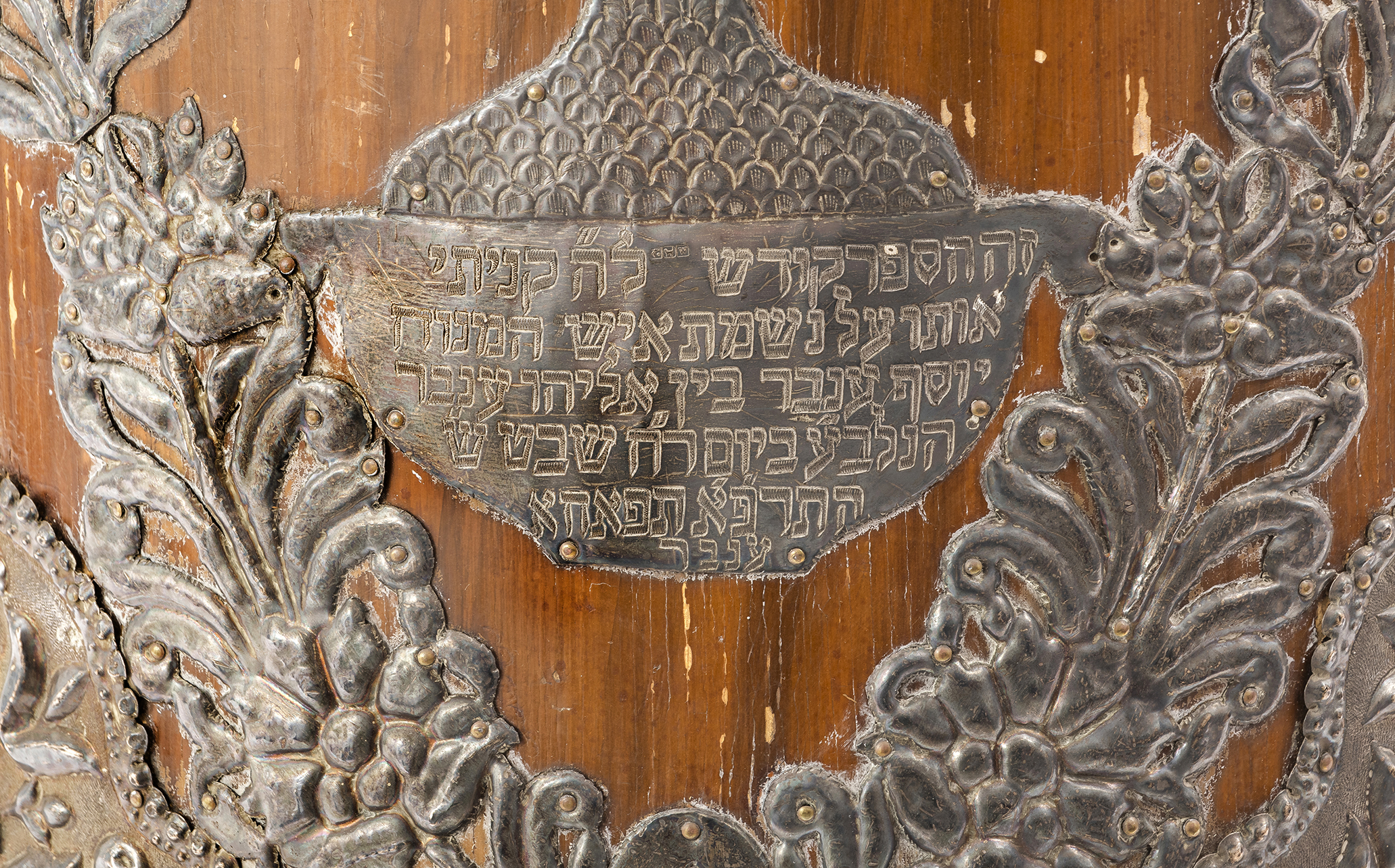
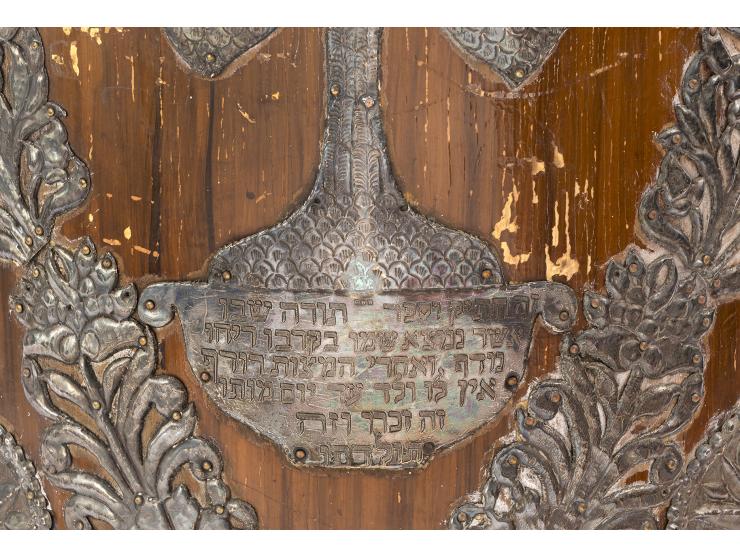
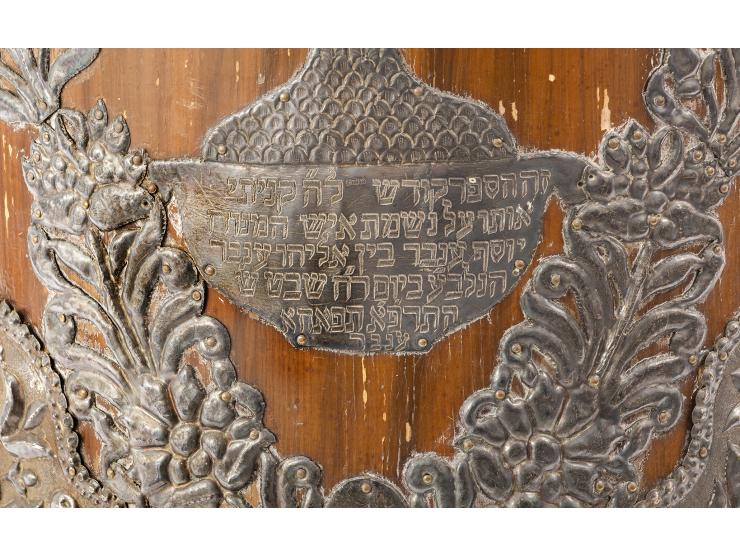
Dedicatory inscriptions are engraved on the silver plates, serving as a sort of flowerpot for the palms, with a dedicatory inscription (rhymed) by a woman named Tafacha Inbar in memory of her husband: "This case and the Torah scroll within it, containing the name of one whose fragrance wafted and who pursued the mitzvot, who had no child to the day of his death – this is his memory and this is his offspring" (on the right); "This scroll is consecrated to G-d, I purchased it in memory of the deceased Yosef Inbar son of Eliyahu Inbar, who passed away on Rosh Chodesh Shevat 1921. Tafacha Inbar" (on the left).
Height (without rollers): 66 cm. Diameter: 33.5 cm. Overall good condition. Rubbing and scratching to wood; some silver sheets lacking (approx. one fourth of silver strip at top edge, and small part of bottom near opening); warping, cracks, rubbing and defects in various places.
Category
Torah Ornaments, Synagogue Items
and Various Objects
Catalogue Value