
Auction 107: Rare and Important Items
Apr 15, 2026
- and (82) Apply and filter
- item (32) Apply item filter
- various (27) Apply various filter
- object (23) Apply object filter
- ornament (23) Apply ornament filter
- ornaments, (23) Apply ornaments, filter
- synagogu (23) Apply synagogu filter
- torah (23) Apply torah filter
- book (17) Apply book filter
- print (17) Apply print filter
- earli (15) Apply earli filter
- incunabula (15) Apply incunabula filter
- jewish (13) Apply jewish filter
- the (13) Apply the filter
- manuscript (12) Apply manuscript filter
- public (12) Apply public filter
- letter (10) Apply letter filter
- ketubot (9) Apply ketubot filter
- anti (8) Apply anti filter
- anti-jewish (8) Apply anti-jewish filter
- antijewish (8) Apply antijewish filter
- antisemit (8) Apply antisemit filter
- edict (8) Apply edict filter
- edicts, (8) Apply edicts, filter
- law (8) Apply law filter
- laws, (8) Apply laws, filter
- ordin (8) Apply ordin filter
- rabbin (8) Apply rabbin filter
- royal (8) Apply royal filter
- haggadot (6) Apply haggadot filter
- israel (6) Apply israel filter
- mandatori (6) Apply mandatori filter
- of (6) Apply of filter
- palestin (6) Apply palestin filter
- passov (6) Apply passov filter
- siddurim (6) Apply siddurim filter
- state (6) Apply state filter
- zionism (6) Apply zionism filter
- zionism, (6) Apply zionism, filter
- bind (5) Apply bind filter
- havdalah (5) Apply havdalah filter
- holiday (5) Apply holiday filter
- person (5) Apply person filter
- shabbat (5) Apply shabbat filter
- shabbat, (5) Apply shabbat, filter
- silver (5) Apply silver filter
- art (4) Apply art filter
- brueckheim (4) Apply brueckheim filter
- collect (4) Apply collect filter
- from (4) Apply from filter
Displaying 25 - 36 of 104
![Torah shield. Fürth, late 18th century. Dedicatory inscription dated 5563 [1803].
Silver, cast, stamped, repouss&ea](https://files.kedem-auctions.com/files/Sale107/25_1.jpg "Torah Shield – Johann Jakob Runnecke – Fürth, Germany, Late 18th Centu")
![Torah shield. Fürth, late 18th century. Dedicatory inscription dated 5563 [1803].
Silver, cast, stamped, repouss&ea](https://files.kedem-auctions.com/files/Sale107/25_2.jpg "Torah Shield – Johann Jakob Runnecke – Fürth, Germany, Late 18th Centu")
![Torah shield. Fürth, late 18th century. Dedicatory inscription dated 5563 [1803].
Silver, cast, stamped, repouss&ea](https://files.kedem-auctions.com/files/Sale107/25_3.jpg "Torah Shield – Johann Jakob Runnecke – Fürth, Germany, Late 18th Centu")
![Torah shield. Fürth, late 18th century. Dedicatory inscription dated 5563 [1803].
Silver, cast, stamped, repouss&ea](https://files.kedem-auctions.com/files/Sale107/25_4.jpg "Torah Shield – Johann Jakob Runnecke – Fürth, Germany, Late 18th Centu")
![Torah shield. Fürth, late 18th century. Dedicatory inscription dated 5563 [1803].
Silver, cast, stamped, repouss&ea](https://files.kedem-auctions.com/files/Sale107/25_5.jpg "Torah Shield – Johann Jakob Runnecke – Fürth, Germany, Late 18th Centu")
Auction 107: Rare and Important Items
Apr 15, 2026
Opening: $2,000
Estimate: $4,000 - $6,000
Sold for: $6,250
Including buyer's premium
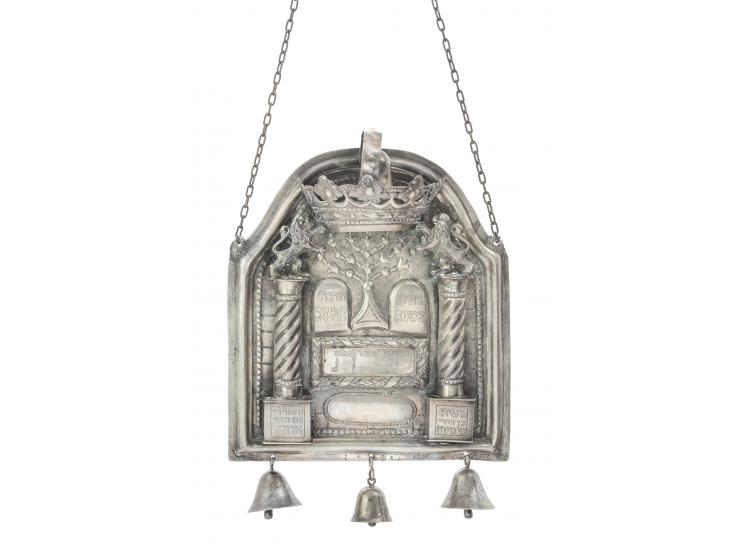
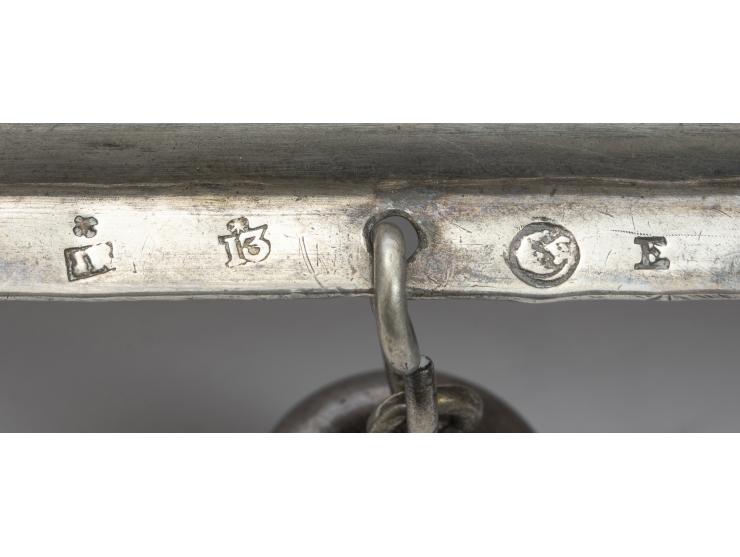
Torah shield. Fürth, late 18th century. Dedicatory inscription dated 5563 [1803].
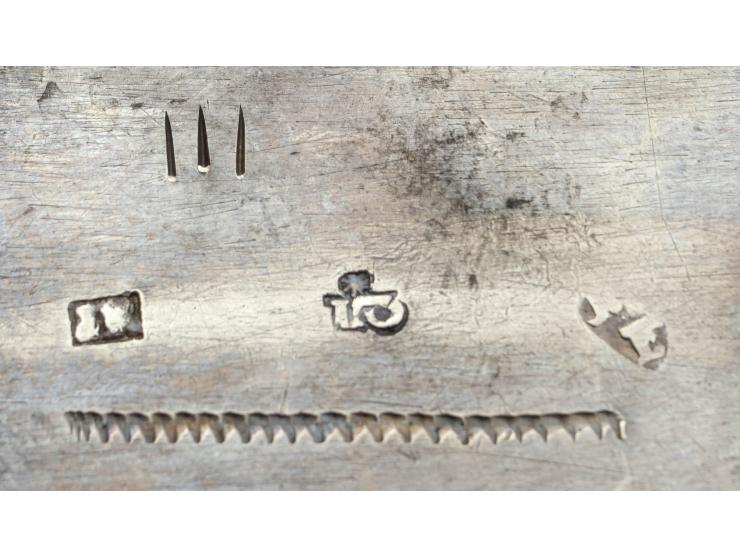
Silver, cast, stamped, repoussé, and engraved (marked on front and back with crescent-shaped city mark of Fürth [18th century] – the letter "F"; quality mark, "13"; year mark, "E"; and maker’s mark, the initials "IR", and above them, a four-dot mark = the silversmith Johann Jakob Runnecke / Runecke).
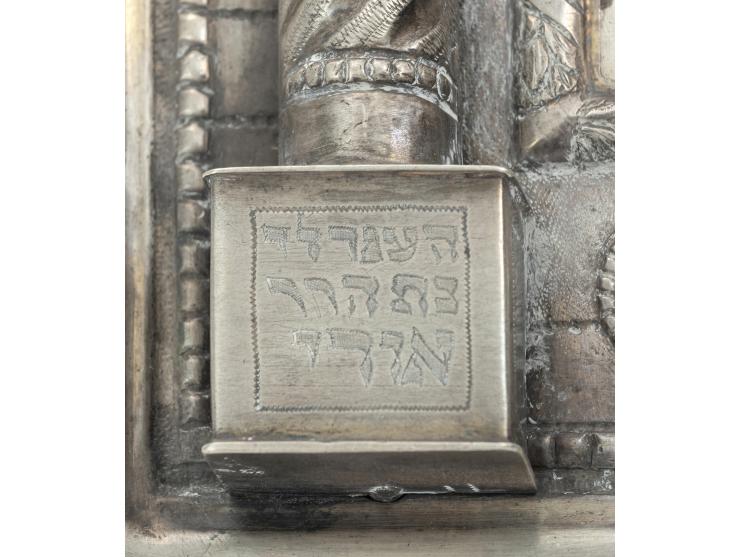
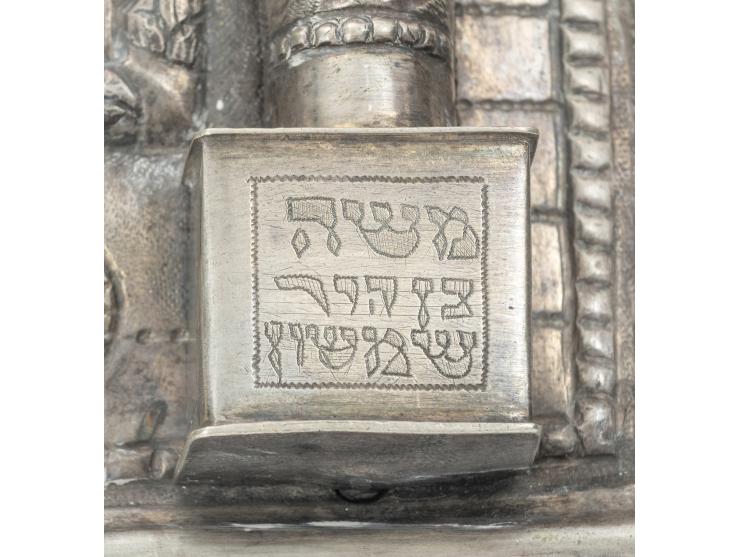
Small Torah shield, in a design typical of such shields from nearby Nuremberg. At the top, an elegant crown in relief; on either side a pair of spiraling architectonic columns, also in relief, each supported on a square base and surmounted by a rampant lion. At center, a seven-branched menorah flanked on either side by each of the Two Tablets of the Law, engraved with the (Hebrew) inscription: "Crown / [of the] Torah / in the Year / 5563 [1803]". Underneath the menorah is a rectangular receptacle for interchangeable plaques (one two-sided plaque included); receptacle enclosed in a vegetal-patterned frame. Under this, a blank oval medallion. Dedicatory inscription (Hebrew) engraved on square bases of pillars: "Moshe / son of R. / Shimshon // Handele daughter of R. / Uri". Three large bells are suspended by rings from the bottom edge of the shield, and an additional bell is suspended from the upper crown. All bells apparently original. Suspension chain.
The silversmith Johann Jakob Runnecke has been documented in the past by Marc Rosenberg (Der Goldschmiede Merkzeichen, Frankfurter Verlags, Frankfurt A.M., 1922) and other sources and authorities, where Runnecke is referred to as "J. Rimonim". This craftsman, whose Berliner father was also a silversmith, was active in Fürth and produced quite a few articles of Judaica in the late 18th century, including Hanukkah lamps, Torah shields and Torah finials, Kiddush cups, and at least one magnificent Sabbath lamp (formerly part of the Sassoon Family Collection). For another one of his Torah shields, see: Rafi Grafman, Crowning Glory: Silver Torah Ornaments of the Jewish Museum, New York, NY, 1996, no. 32. See also previous lot.
Height: 23.5 cm. Width: 19.5 cm. Weight: 566 g. Overall good condition. Warping, slight fractures, and minor soldering repairs to edges. Chain may not be original.
Category
Torah Ornaments, Synagogue Items
and Various Objects
Catalogue Value
Auction 107: Rare and Important Items
Apr 15, 2026
Opening: $1,500
Estimate: $8,000 - $10,000
Sold for: $2,500
Including buyer's premium
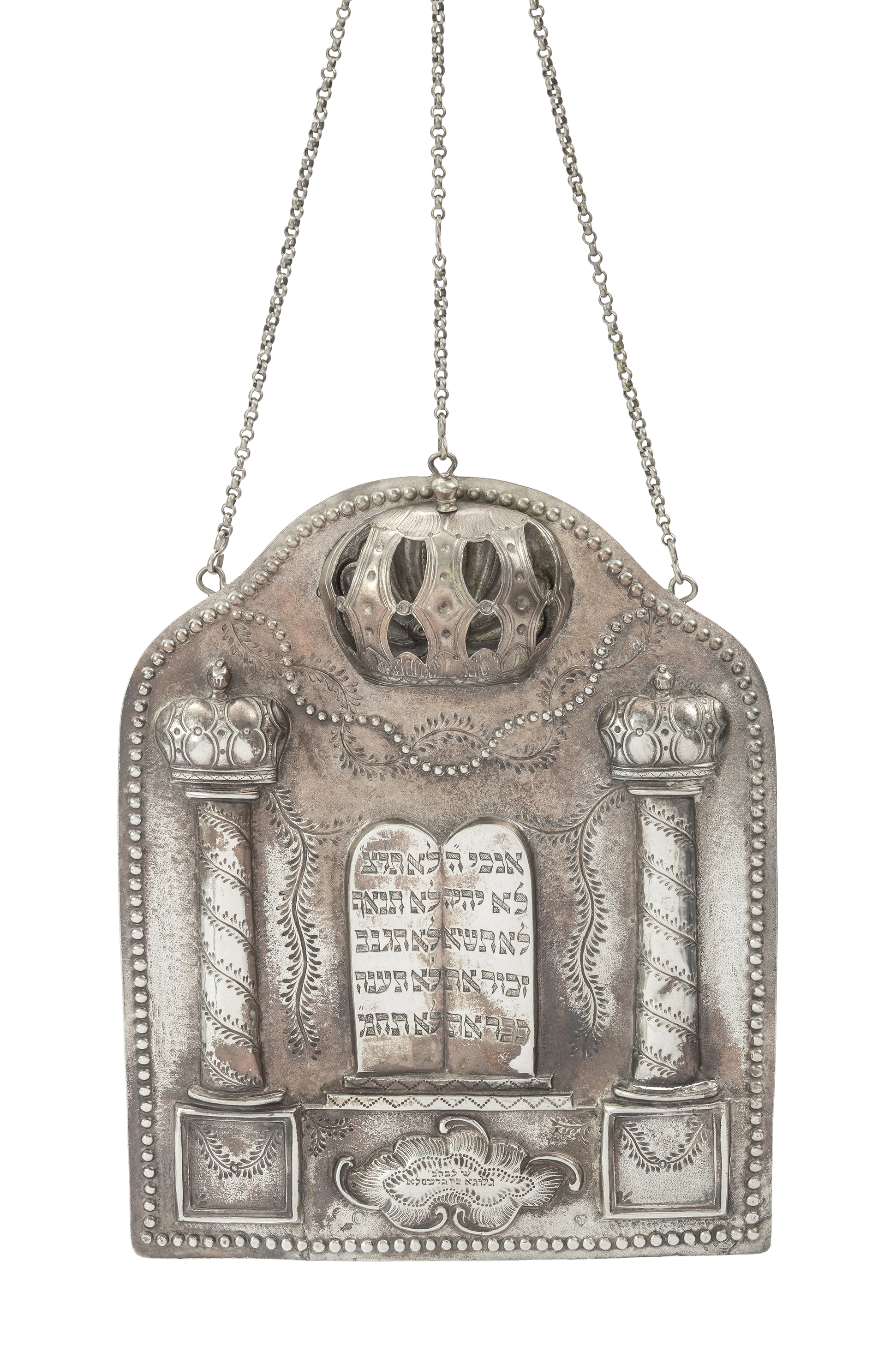
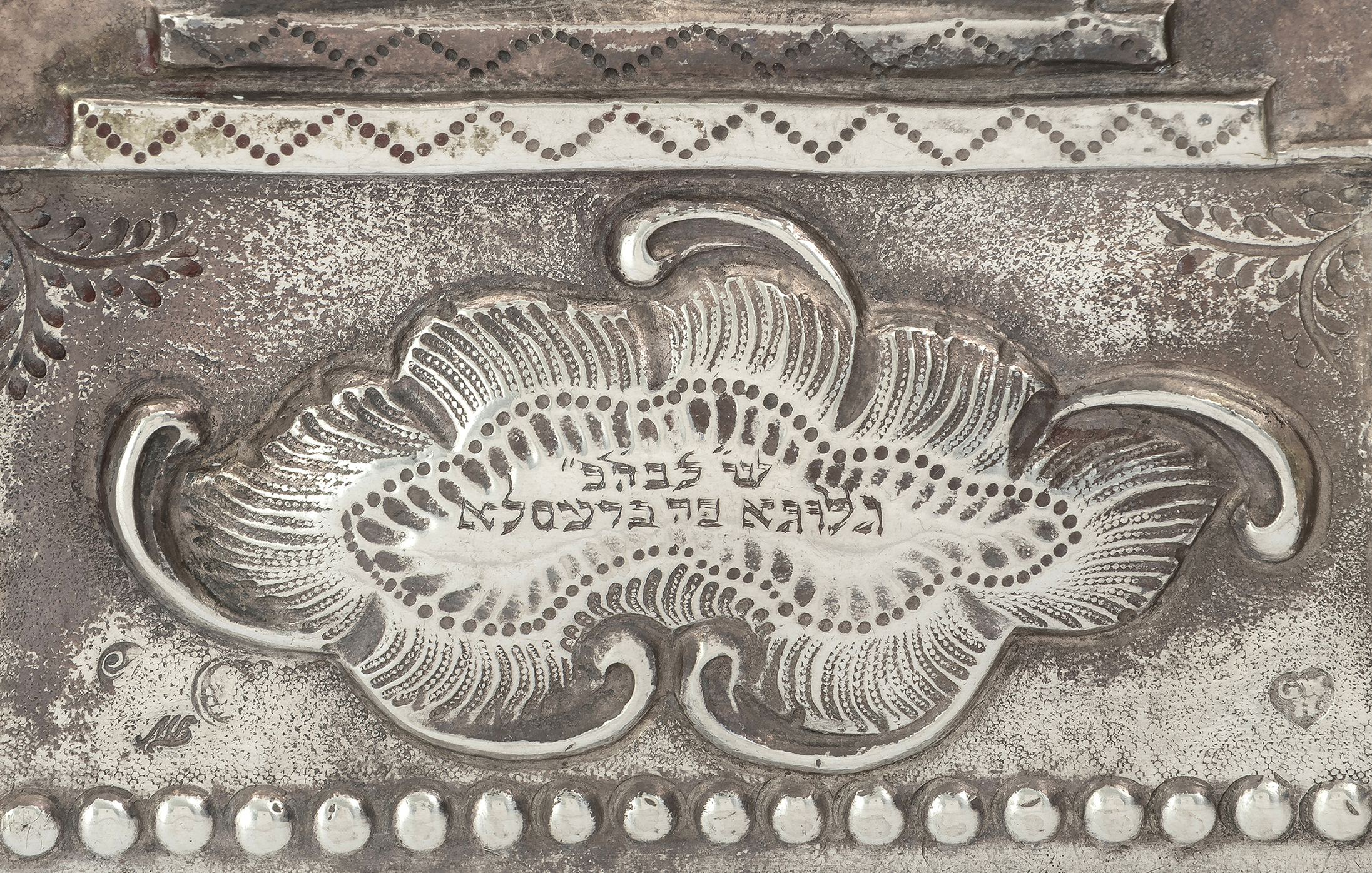
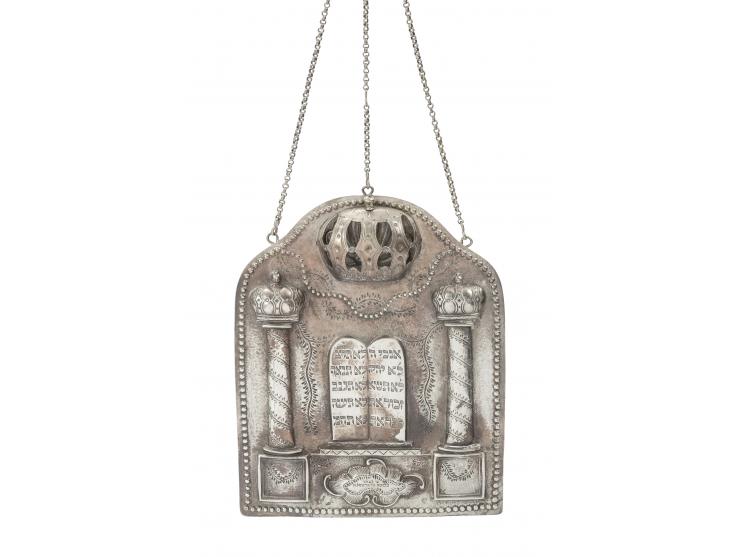
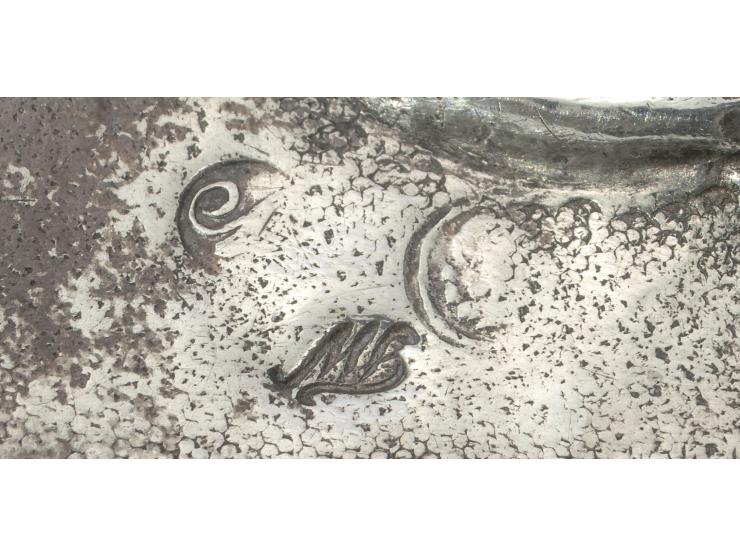
Torah shield. Breslau, Germany (today Wrocław, Poland), ca. 1810.
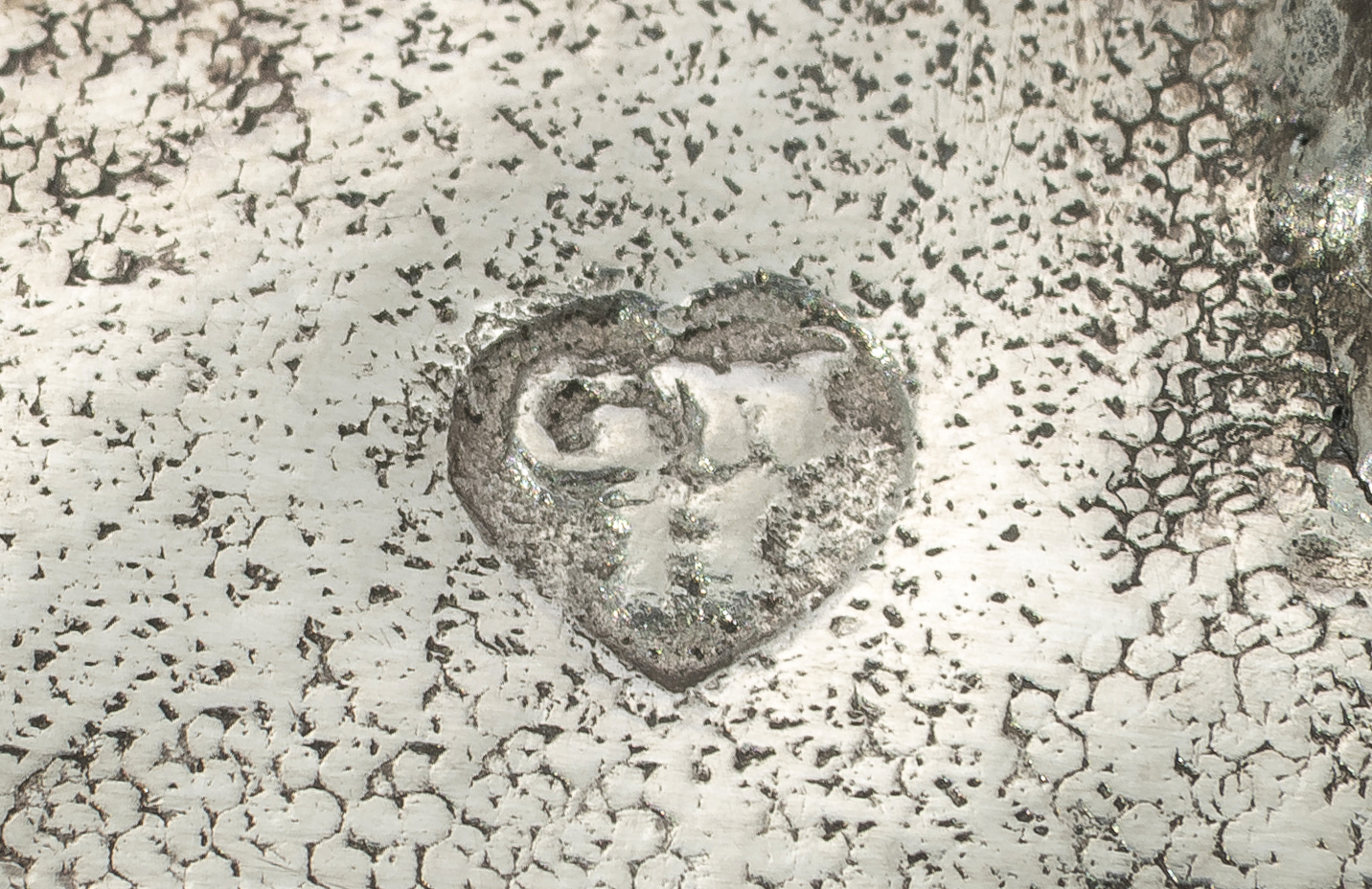
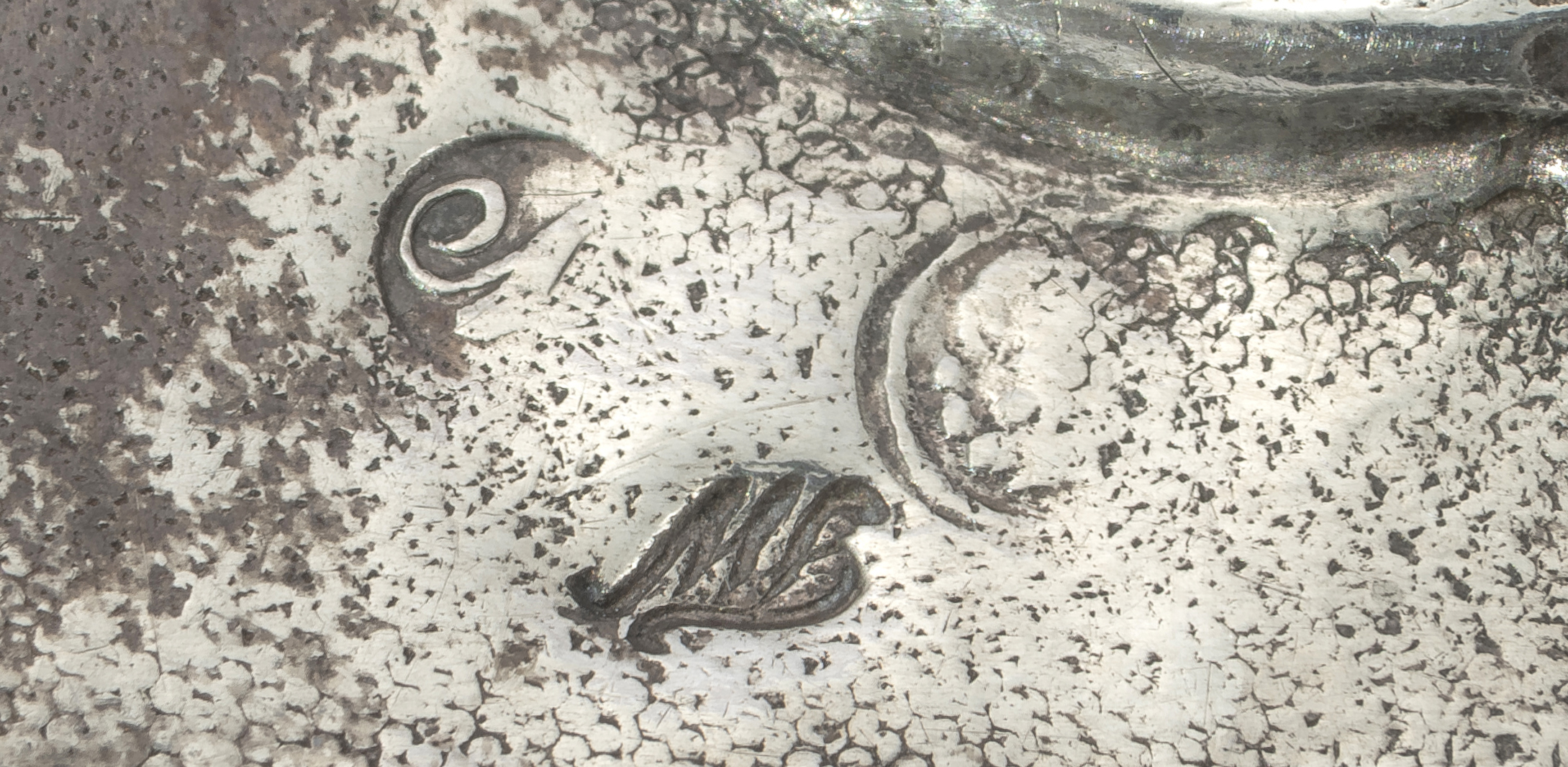
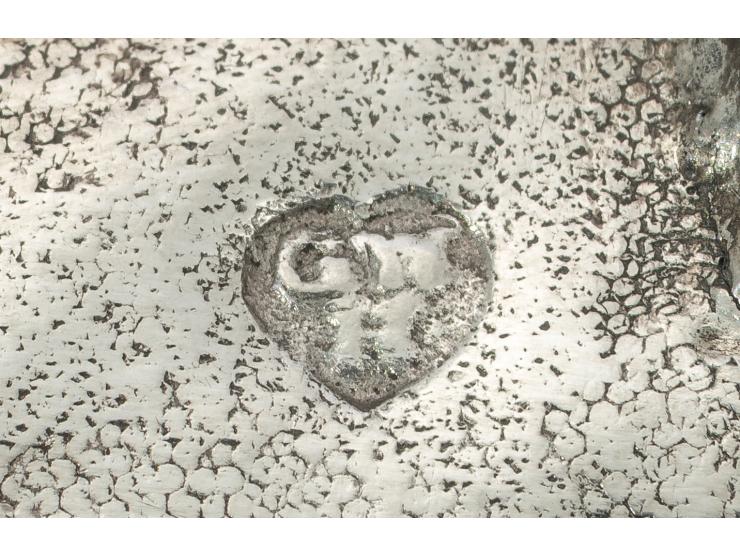
Silver, repoussé, stamped, and engraved (marked with city mark of Breslau [faded]; year mark, probably the letter "N" for 1804-1813, maker's mark "GW/H" framed inside heart shape = the silversmith Gottfried Wilhelm Hoensch; and with Prussian tax mark, in use in years 1809-1812).
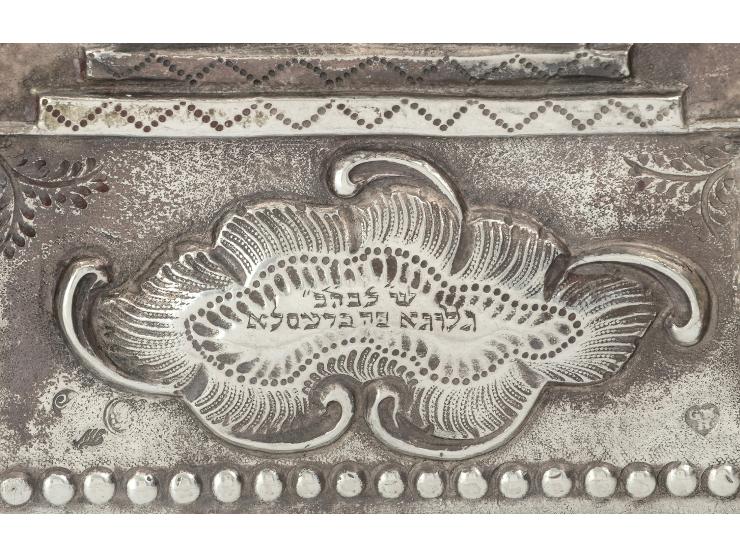
At the top of the Torah shield is a three-dimensional crown in relief, attached by screws, protruding forward. At right and left of center are a pair of spiraling architectonic columns supported on square bases and surmounted by repoussé crowns. In between the columns, at center, are the Two Tablets of the Law (engraved in Hebrew with the abbreviated Ten Commandments), adorned on either side with leafy branches. At bottom is a convex cartouche engraved with the (Hebrew) dedicatory inscription: "Belongs to the Glogau Synagogue, here Breslau". Three-part suspension chain, held together with a large suspension ring.
The silversmith Gottfried Wilhelm Hoensch, son of the silversmith Christian Hoensch, was active in Breslau in the years 1780-1811. His maker’s mark also appears on the silver chest in the form of an elegant miniature Torah ark, belonging to the Rothschild family (created by silversmith Johann Christoph Müller), sold in 2014 at Christie’s, New York, and today part of the collection of Ariel Muzicant, Vienna. The present Torah shield is mentioned in Erwin Hintze's volume on the silversmiths of Breslau (1906, see below) as belonging to the Pinkus Collection in Neustadt, Upper Silesia (today Prudnik, Poland). Other than these two works, we have no information with regard to other Jewish items Hoensch may have created.
Height: 27 cm. Width: 21 cm. Weight: 397 g. Good condition. Minor warping. Several fractures to lower edge, mended with old repairs, soldering, and addition of minute silver pieces on back.
Reference: Erwin Hintze, Die Breslauer Goldschmiede; eine archivalische Studie, Breslau: Kommissionsverlag von K.W. Hiersemann in Leipzig, 1906 (German), Nos. 23-24, 42, 172, Fig. 9a, and p. 88.
Category
Torah Ornaments, Synagogue Items
and Various Objects
Catalogue Value
![Torah shield and Torah pointer, created by Avraham Keller. [Jerusalem, ca. 1900]
Carved olivewood; carved mother-of-pear](https://files.kedem-auctions.com/files/Sale107/27_1.jpg "Olivewood Torah Shield and Torah Pointer, Made by the Artist Avraham K")
![Torah shield and Torah pointer, created by Avraham Keller. [Jerusalem, ca. 1900]
Carved olivewood; carved mother-of-pear](https://files.kedem-auctions.com/files/Sale107/27_2-WEB.jpg "Olivewood Torah Shield and Torah Pointer, Made by the Artist Avraham K")
![Torah shield and Torah pointer, created by Avraham Keller. [Jerusalem, ca. 1900]
Carved olivewood; carved mother-of-pear](https://files.kedem-auctions.com/files/Sale107/27_3-WEB.jpg "Olivewood Torah Shield and Torah Pointer, Made by the Artist Avraham K")
![Torah shield and Torah pointer, created by Avraham Keller. [Jerusalem, ca. 1900]
Carved olivewood; carved mother-of-pear](https://files.kedem-auctions.com/files/Sale107/27_4.jpg "Olivewood Torah Shield and Torah Pointer, Made by the Artist Avraham K")
![Torah shield and Torah pointer, created by Avraham Keller. [Jerusalem, ca. 1900]
Carved olivewood; carved mother-of-pear](https://files.kedem-auctions.com/files/Sale107/27_5.jpg "Olivewood Torah Shield and Torah Pointer, Made by the Artist Avraham K")
![Torah shield and Torah pointer, created by Avraham Keller. [Jerusalem, ca. 1900]
Carved olivewood; carved mother-of-pear](https://files.kedem-auctions.com/files/Sale107/27_6.jpg "Olivewood Torah Shield and Torah Pointer, Made by the Artist Avraham K")
![Torah shield and Torah pointer, created by Avraham Keller. [Jerusalem, ca. 1900]
Carved olivewood; carved mother-of-pear](https://files.kedem-auctions.com/files/Sale107/27_7.jpg "Olivewood Torah Shield and Torah Pointer, Made by the Artist Avraham K")
![Torah shield and Torah pointer, created by Avraham Keller. [Jerusalem, ca. 1900]
Carved olivewood; carved mother-of-pear](https://files.kedem-auctions.com/files/Sale107/27_8.jpg "Olivewood Torah Shield and Torah Pointer, Made by the Artist Avraham K")
![Torah shield and Torah pointer, created by Avraham Keller. [Jerusalem, ca. 1900]
Carved olivewood; carved mother-of-pear](https://files.kedem-auctions.com/files/Sale107/27_9.jpg "Olivewood Torah Shield and Torah Pointer, Made by the Artist Avraham K")
Auction 107: Rare and Important Items
Apr 15, 2026
Opening: $2,000
Estimate: $6,000 - $8,000
Sold for: $4,500
Including buyer's premium
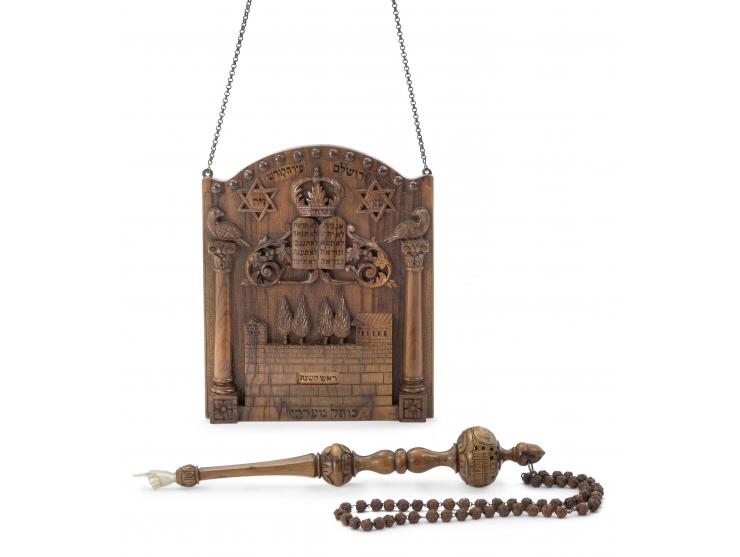
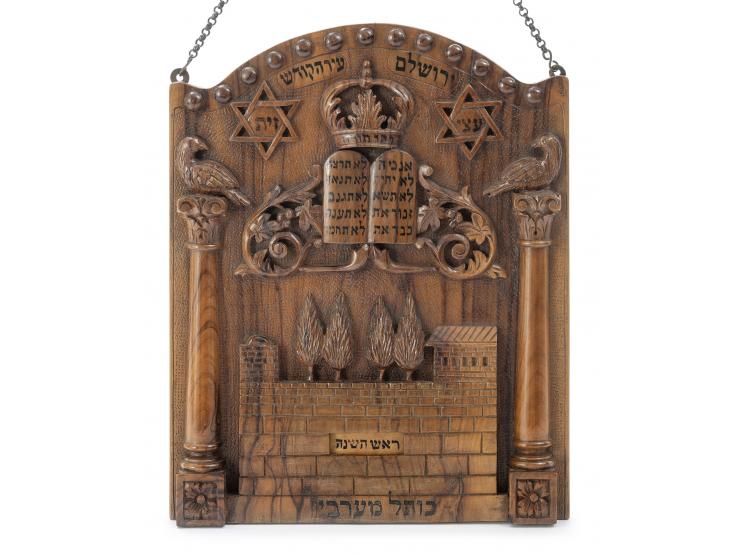
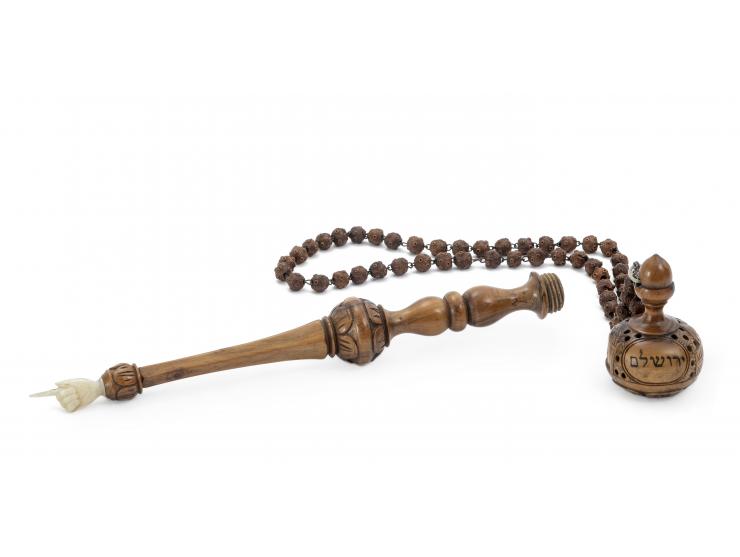
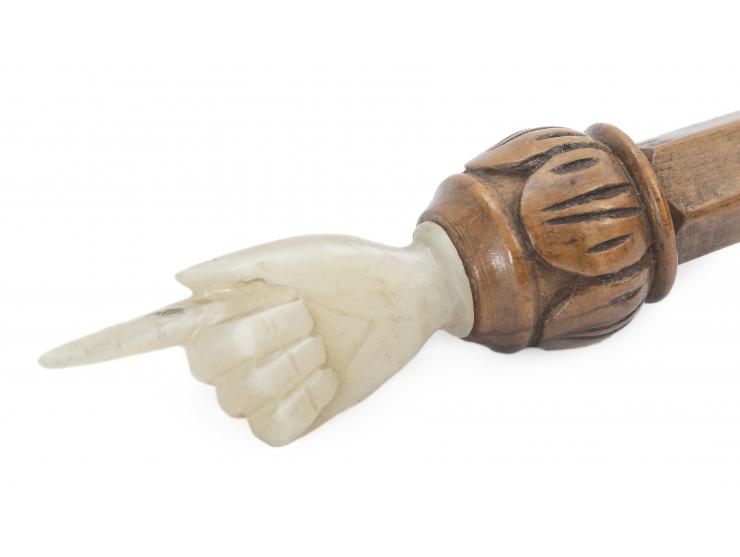
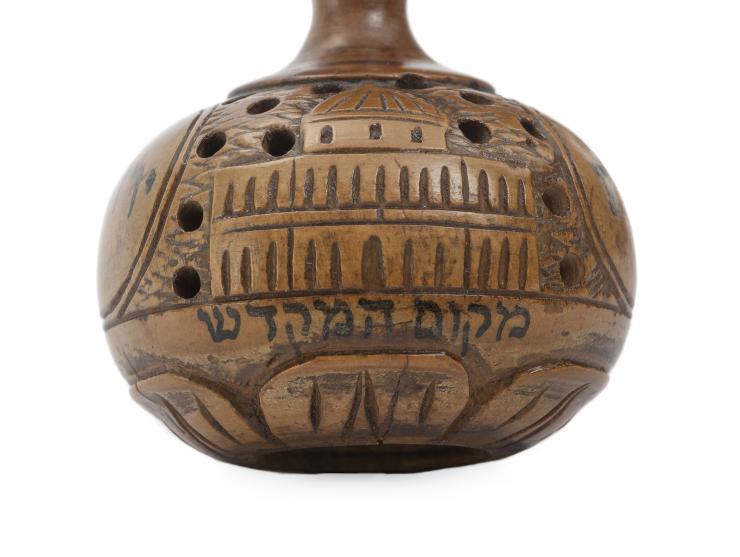
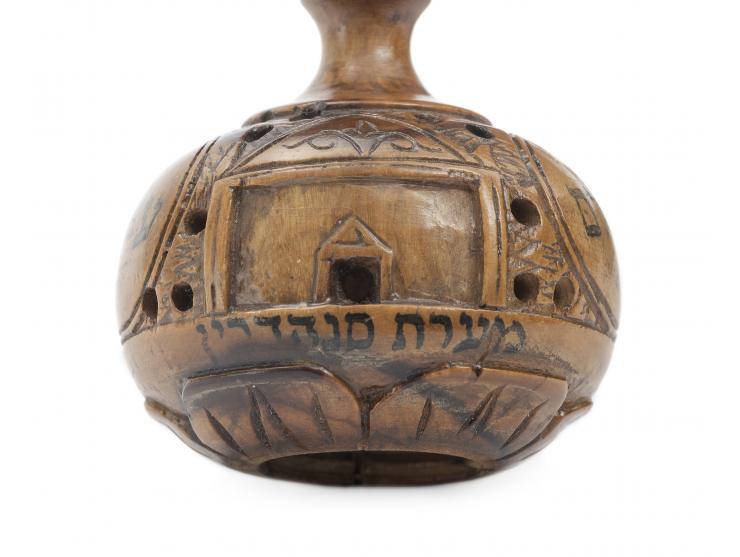
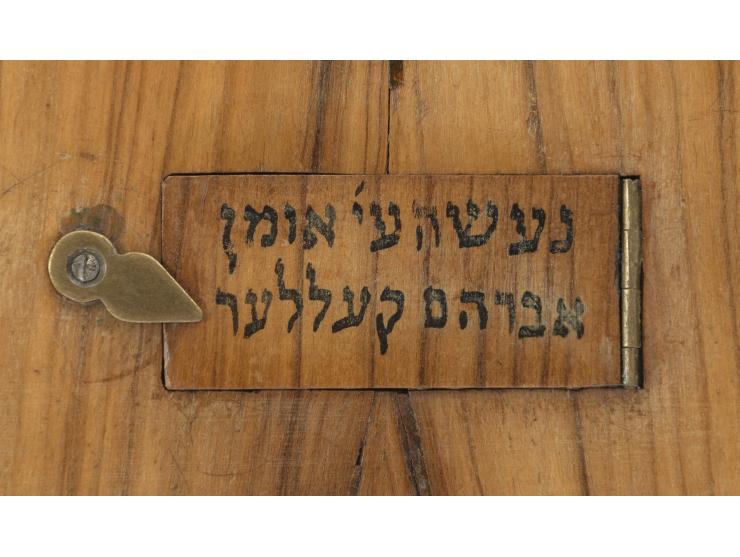
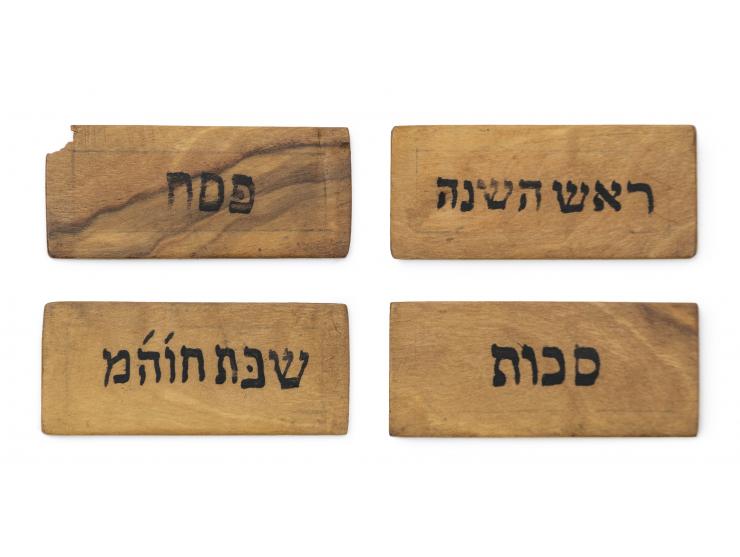
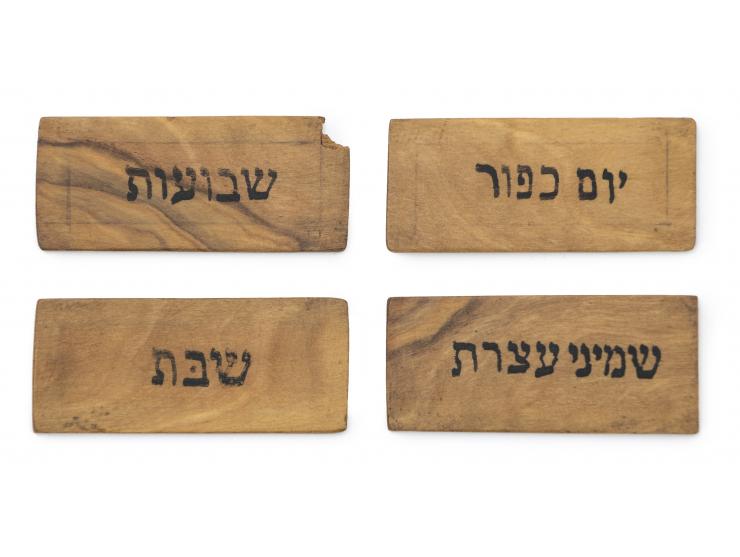
Torah shield and Torah pointer, created by Avraham Keller. [Jerusalem, ca. 1900]
Carved olivewood; carved mother-of-pearl (abalone); paint.
Two unique, high-quality Torah-scroll adornments made of olivewood and mother-of-pearl (abalone), created in Jerusalem in the late 19th or early 20th century by the artist Avraham Keller.
1. Torah shield.
Two Stars of David are carved on either side of the upper section, and between them, below, are the Two Tablets of the Law inscribed with the abbreviated (Hebrew) Ten Commandments, with symmetrical vegetal patterns on either side and surmounted by a large, elegant crown. In addition to the Ten Commandments, a number of (Hebrew) inscriptions appear in black ink: "Jerusalem the Holy City" (on top), "Olive / Trees" (inside the Stars of David), and "Crown of Torah" (on the crown). In the bottom section is a carved depiction of the Western Wall, labeled below (Hebrew), "Western Wall"; carved above this illustration are images of four cypress trees and two buildings. In the right and left margins is a pair of tall architectonic columns with ornamental bases and capitals, and surmounted by a symmetrical pair of large birds. In the middle of the Western Wall is a rectangular compartment for interchangeable plaques (enclosed, 4 original two-sided plaques made of thin strips of wood).
Marked on the back (Hebrew, in black ink): "Made by the artist / Avraham Keller". Lengthy metal suspension chain.
2. Torah pointer.
With three somewhat flattened spherical segments adorned in a vegetal pattern. Carved into the segment at the upper end are depictions of the Dome of the Rock and the opening to the Tombs of the Sanhedrin (labeled with the Hebrew words, inscribed in black, for "Place of the Temple" and "Cave of the Sanhedrin", respectively). This segment can be opened and closed by means of a screw mechanism; thanks to this and a number of small apertures carved into it, this part is also meant to serve as a "Havdalah" spicebox. The segment is surmounted by an acorn-shaped ornament, through which a suspension ring passes. A chain consisting of 54 carved wooden beads is attached to the suspension ring. The pointer "hand" (with an extended index finger) is made of carved mother-of-pearl (abalone).
A large number of highly diverse olivewood objects, of many types, were made in Palestine from the second half of the 19th century through to the early decades of the 20th. They served a broad range of functional and decorative purposes, and were marketed to Christian, Muslim, and Jewish clienteles. Among the Jewish objects, we find reliefs of the Western Wall and the "Place of the Temple"; Rachel’s Tomb and other holy sites; and a significant number of objects intended for sacred ritual purposes, such as Passover Seder plates, etrog (citron) boxes, Hanukkah lamps, Esther scroll cases, Havdalah spiceboxes, Torah finials, and Torah pointers. Nevertheless, it is rare and highly unusual to find such objects bearing the name or maker’s mark of the artist. And from among all the documented olivewood Jewish items, no other Torah shield is known to be extant.
Little is known about the artist Avraham Keller (1870-1941). He was born in Safed, and moved from there, with his brother and sister, to Jerusalem. He was married to Sheindel (née Eisenberg), who came from the "moshava" of Rehovot. The couple and their three children moved to Rehovot in 1910. Keller lived in New York for a few years, where he worked in a factory, designing iron rods. Upon returning to Rehovot, he used the money earned in New York to purchase 40 dunams (4 hectares or roughly 10 acres) of land in the area between Rehovot and Ness Ziona, where he planted citrus groves. More information regarding Avraham Keller and his family can be found on the website of the Rehovot City Archive (in Hebrew only, on a page devoted to the Keller family. For an additional item created by Avraham Keller ca. 1894-95 (a bookbinding for the rules and regulations of the Achva Society), see Kedem, Auction 103, 1 September 2025, Lot 176.
Torah shield: Height: 24 cm. Width: 19.5 cm. Thickness: 1.7 cm. Overall good condition. Open fracture to corner of one interchangeable plaque.
Torah pointer: Length: 31.5 cm. Maximal width: 4.5 cm. Length of chain: 32 cm. Good condition. Fracture, mended with glue, to index finger of pointer. Fractures to wood of screw thread of upper segment.
Category
Torah Ornaments, Synagogue Items
and Various Objects
Catalogue Value
![Torah pointer, produced by Henrik Wigström. St. Petersburg, [1884-1899].
Gold; silver; gemstones and pearls (marked](https://files.kedem-auctions.com/files/Sale107/28_1.jpg "Torah Pointer Decorated with Gold and Gemstones – Fabergé Workmaster H")
![Torah pointer, produced by Henrik Wigström. St. Petersburg, [1884-1899].
Gold; silver; gemstones and pearls (marked](https://files.kedem-auctions.com/files/Sale107/28_2.jpg "Torah Pointer Decorated with Gold and Gemstones – Fabergé Workmaster H")
![Torah pointer, produced by Henrik Wigström. St. Petersburg, [1884-1899].
Gold; silver; gemstones and pearls (marked](https://files.kedem-auctions.com/files/Sale107/28_3.jpg "Torah Pointer Decorated with Gold and Gemstones – Fabergé Workmaster H")
![Torah pointer, produced by Henrik Wigström. St. Petersburg, [1884-1899].
Gold; silver; gemstones and pearls (marked](https://files.kedem-auctions.com/files/Sale107/28_4.jpg "Torah Pointer Decorated with Gold and Gemstones – Fabergé Workmaster H")
![Torah pointer, produced by Henrik Wigström. St. Petersburg, [1884-1899].
Gold; silver; gemstones and pearls (marked](https://files.kedem-auctions.com/files/Sale107/28_5-WEB.jpg "Torah Pointer Decorated with Gold and Gemstones – Fabergé Workmaster H")
![Torah pointer, produced by Henrik Wigström. St. Petersburg, [1884-1899].
Gold; silver; gemstones and pearls (marked](https://files.kedem-auctions.com/files/Sale107/28_6.jpg "Torah Pointer Decorated with Gold and Gemstones – Fabergé Workmaster H")
Auction 107: Rare and Important Items
Apr 15, 2026
Opening: $5,000
Estimate: $10,000 - $15,000
Sold for: $81,250
Including buyer's premium
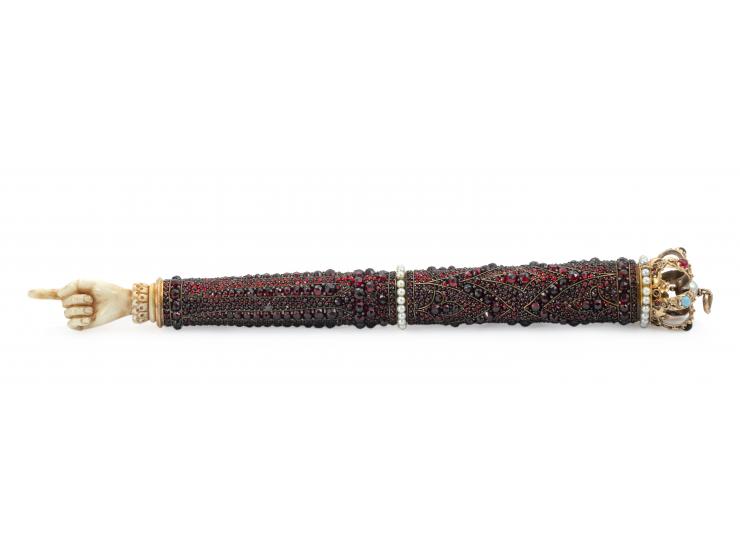
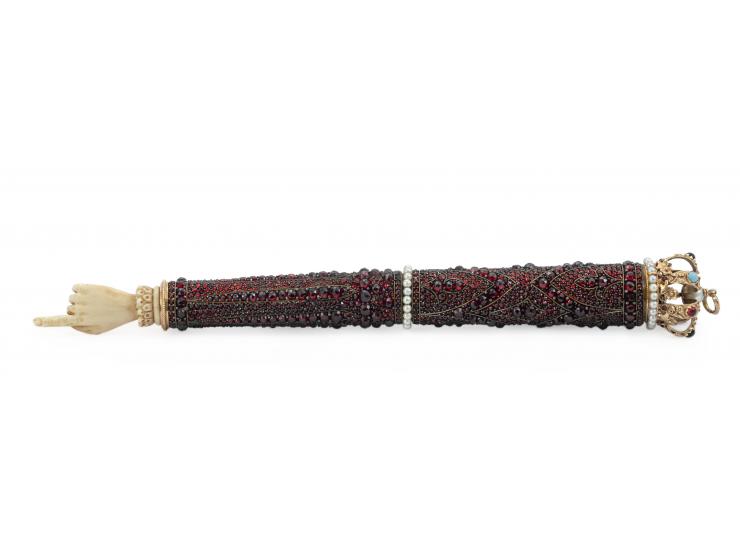
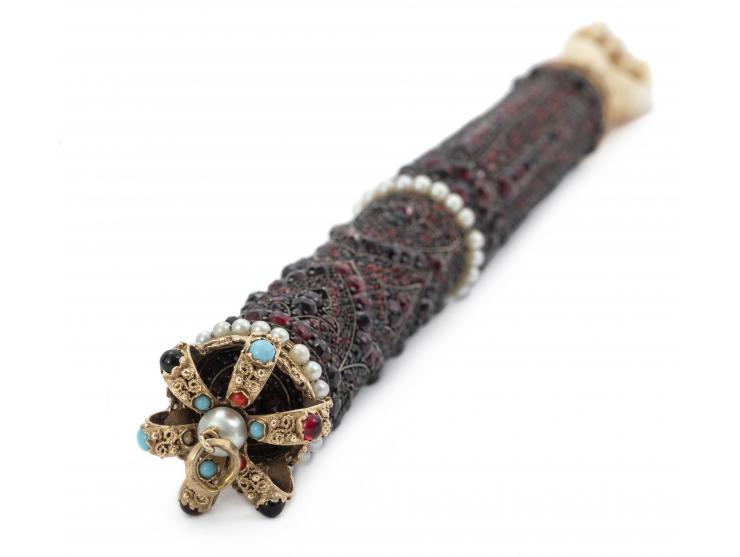
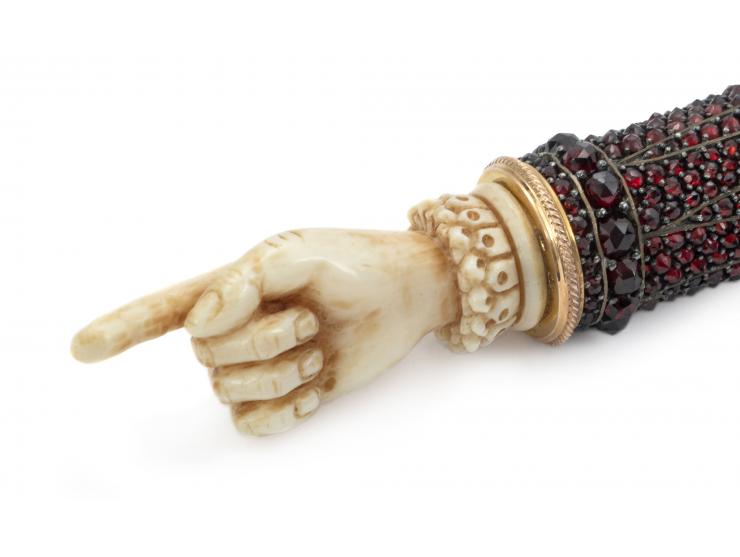
Torah pointer, produced by Henrik Wigström. St. Petersburg, [1884-1899].
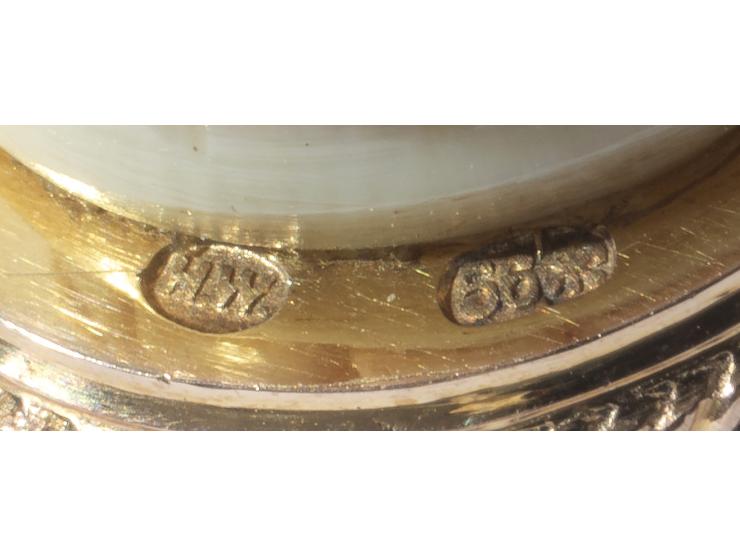
Gold; silver; gemstones and pearls (marked at base of cuff with Russian "56" Zolotnik mark [= 14 karat], dating to the late 19th century, and maker's mark, "H.W." in an oval frame = Henrik Wigström).
This high-quality decorative Torah pointer was produced by a distinguished Fabergé workmaster, who supervised the workshop that produced most of the Fabergé eggs in 1904-1917.
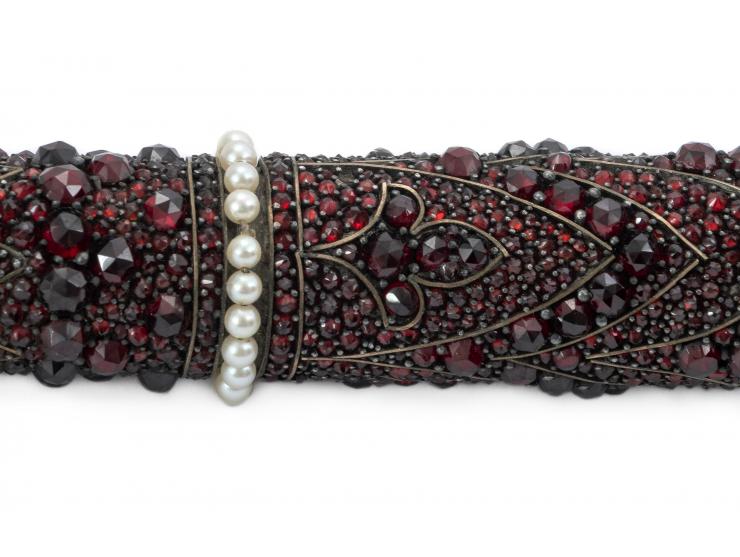
Cylindrical shape, tapering towards the bottom edge. The upper edge contains a six-arched crown with a pearl attached to the ring in the center (without chain). The arches of the crown are decorated with minute floral patterns and set with 17 gemstones (one lacking) in black, turquoise, red and orange. The arches include meticulous minute decorations of flowers with leaves. The top of the pointer is decorated with stylized pointed arches with fleurs-de-lis. The bottom part is decorated to match with lengthened pointed arches. The fist and long pointing finger is magnificently designed, with a stylized cuff and golden base. A chain of pearls separates the crown decoration from the upper part of the hand, and another chain is located in the center, between the top and bottom. The gemstones are set between minute silver balls.
Henrik Wigström (1862-1923), born in Finland, arrived in St. Petersburg in 1875. In 1884, he began to work as an assistant to the goldsmith Mikhail Perkhin, at his exclusive Fabergé workshop. After Perkhin's death in 1903, he inherited his workshop and became head workmaster until 1917; the workshops of Perkhin and Wigström produced most of the Fabergé Imperial eggs.
Another Torah pointer by Henrik Wigström (crafted from bone, gold and diamonds) was sold by Parke-Bernet, New York, 30 November 1967, Lot 388 (the Charles A. Feinberg Collection); an additional jeweled Torah pointer from the same period, by Mikhail Perkhin, was sold at Christie's, Amsterdam, 19 December 1990, Lot 180. Aside from these two Torah pointers and the present example, we are unaware of any other Torah pointers produced by the craftsmen of the House of Fabergé, nor are we aware of any other Judaica objects created by the goldsmith Henrik Wigström.
Length: 23 cm. Maximum width: 2.7 cm. Weight: 138 g. Good condition. Some red gemstones lacking and some broken. Gemstone lacking at upper crown ornament. Middle pearl chain somewhat loose. Does not include suspension chain.
Category
Torah Ornaments, Synagogue Items
and Various Objects
Catalogue Value
Auction 107: Rare and Important Items
Apr 15, 2026
Opening: $1,000
Estimate: $4,000 - $6,000
Sold for: $15,000
Including buyer's premium
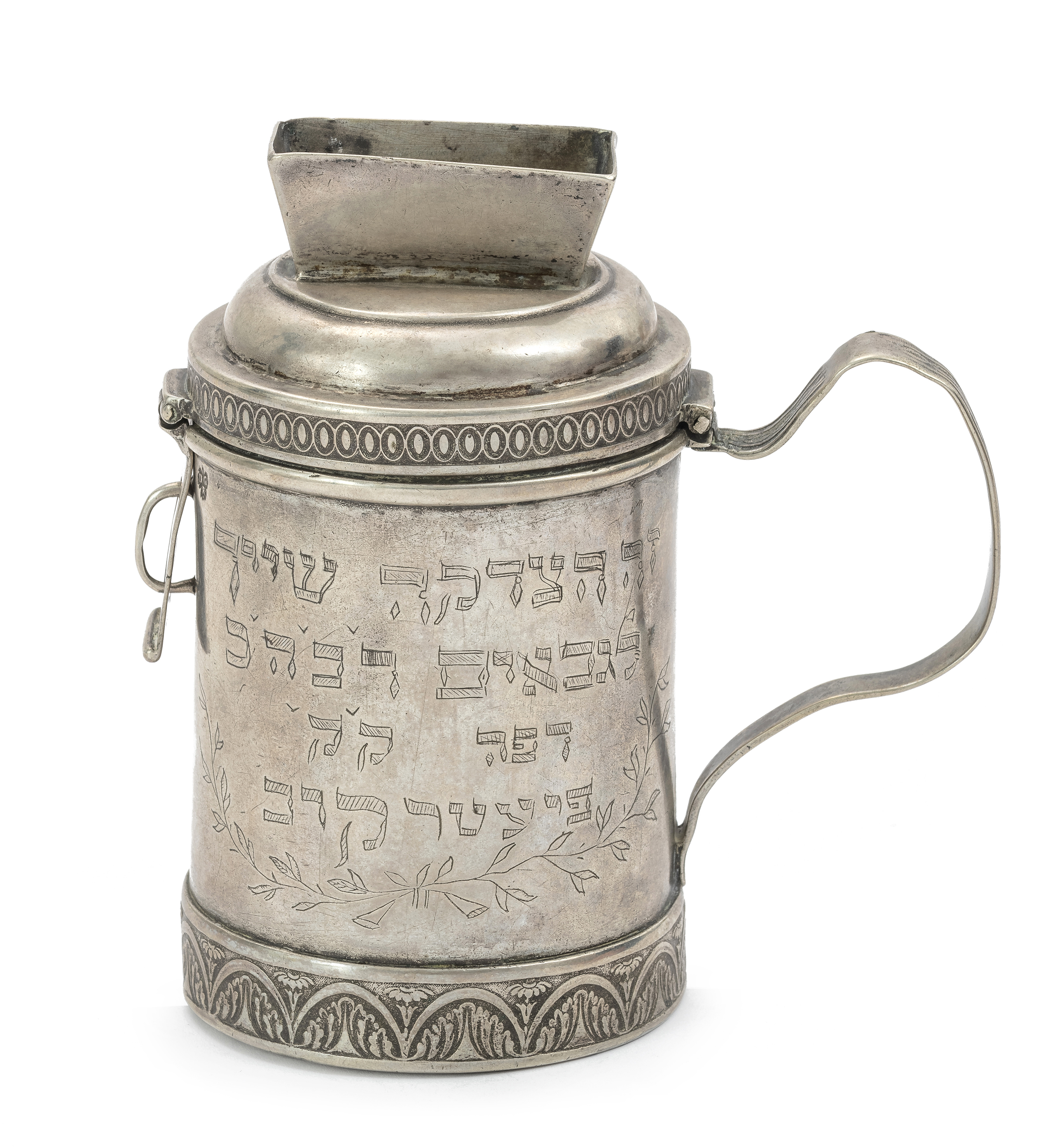
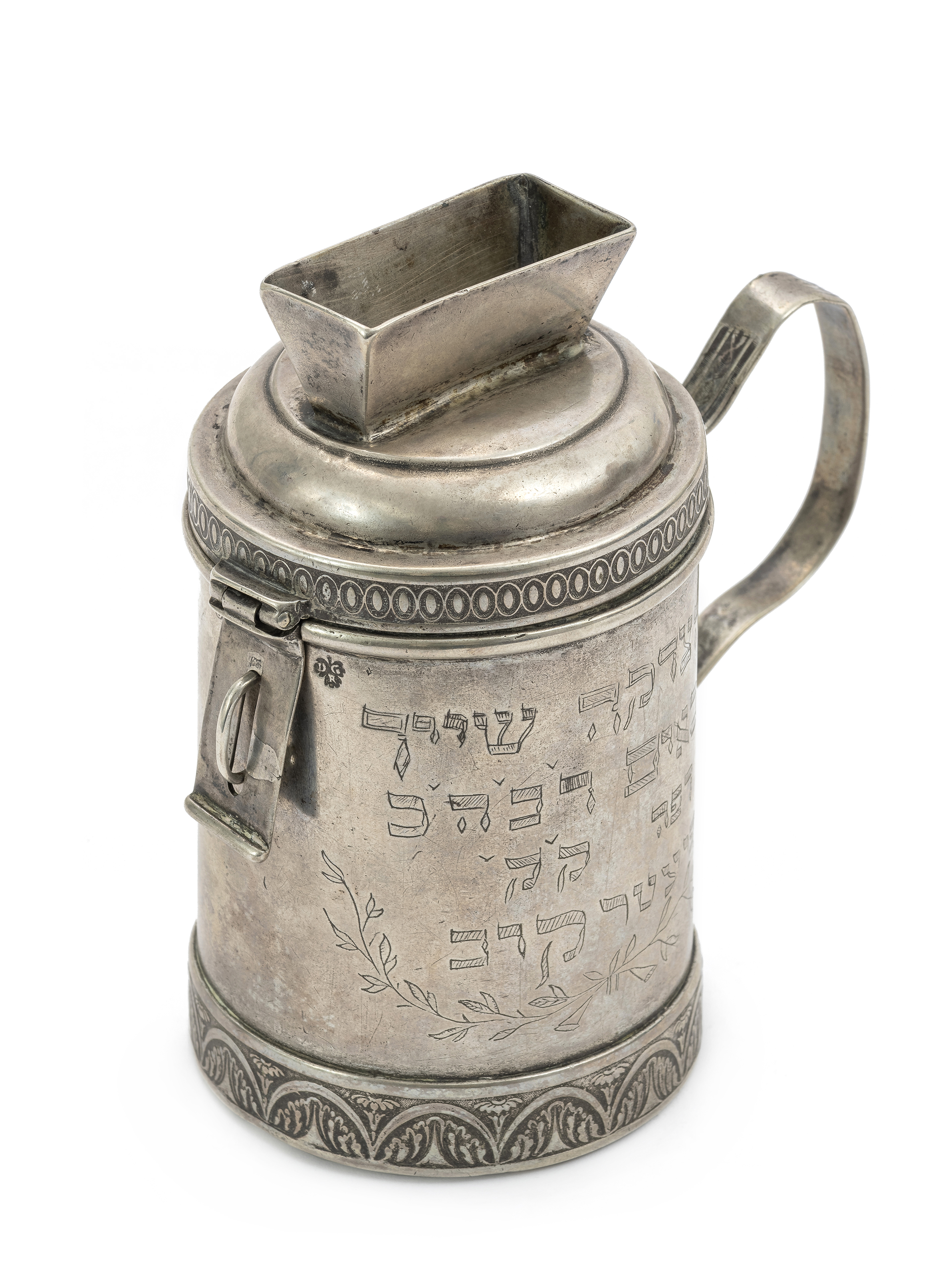
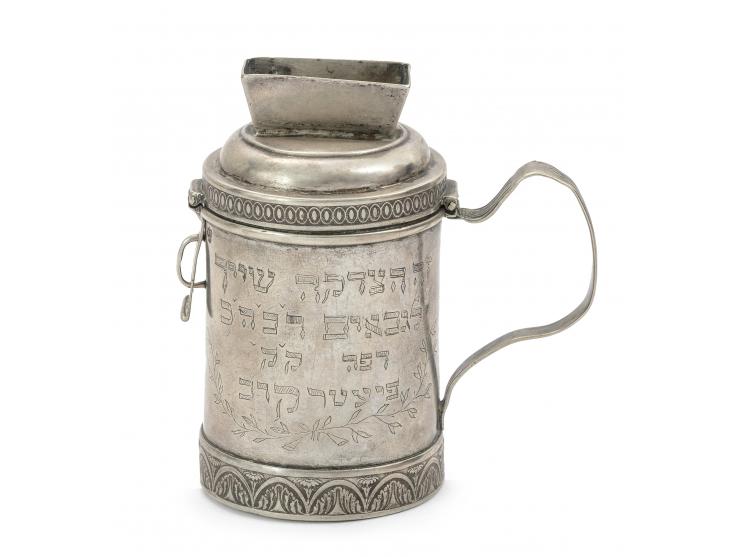
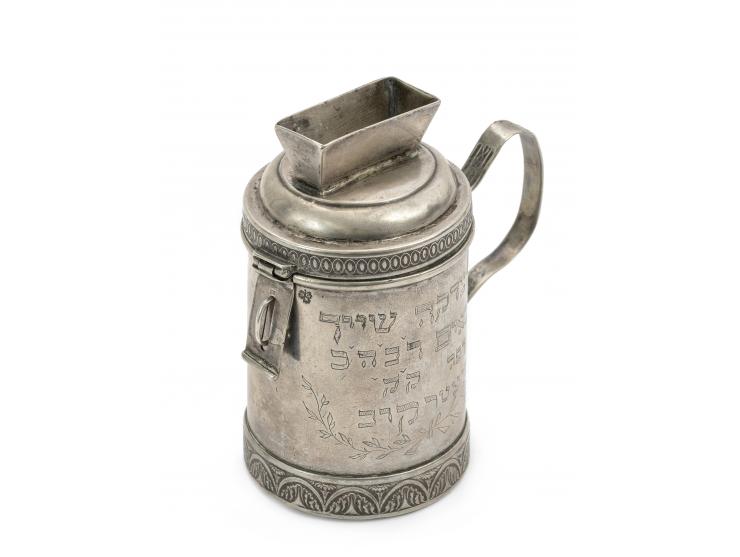
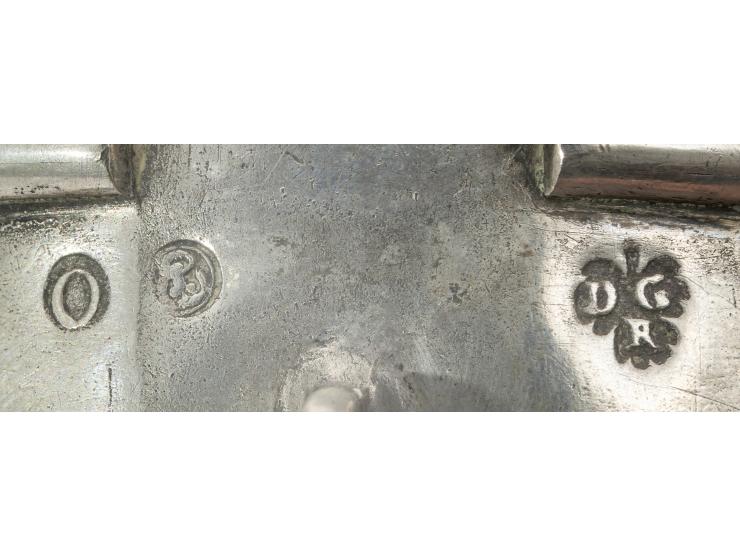
Alms box, made by David Gottlieb Raudner. Breslau, Germany (today Wrocław, Poland), ca. 1813-1816.
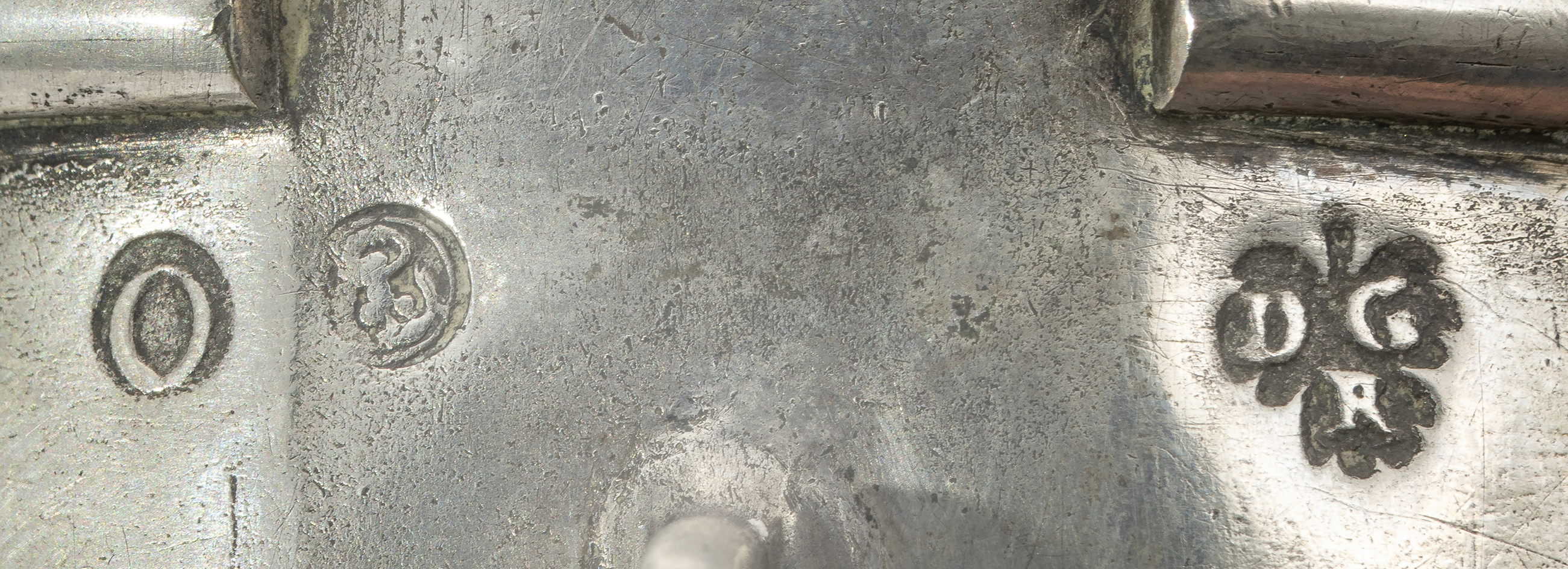
Silver, engraved, repoussé, cut, and stamped (marked with Breslau city mark; year mark, the letter "O" [1813-1816]; and with maker’s mark, the initials "DG/R" in leaf-shaped frame = David Gottlieb Raudner).
Cylindrical alms box, shaped like a small jug. At the top is a graduated lid, attached by a hinge, and with a broad, elevated coin slot. Locking mechanism, attached to lid, also by a hinge. Long, curving carrying handle. Box stamped with recurrent vegetal and geometric patterns on upper and lower borders and on handle, and engraved with a floral wreath on lower body. Also engraved with inscription (Hebrew) ascribing ownership to the synagogue of Piotrków Trybunalski, central Poland: "This charity belongs / to the managers of the synagogue / here in the holy congregation [of] / Piotrków". A steadily growing Jewish community existed in Piotrków for centuries, coming to an end only with the Second World War. The small city’s "Great Synagogue" was founded in 1793 and renovated following WWII, and is today regarded as the best-preserved of all surviving Jewish houses of worship in the Łódź region.
The silversmith David Gottlieb Raudner was active in Breslau, Germany in the years 1793-1845. He mostly produced tabletop items (candlesticks, teapots, salt shakers, and the like); no other Jewish objects of his are known to us.
Height: 15 cm. Maximal width: 15 cm. Diameter at base: 8 cm. Weight: 379 g. Overall good condition. Hinge broken and partly missing. Old soldering repairs to upper attachment of handle. Minor warping. Missing chains next to upper coin slot.
Reference: Erwin Hintze, Die Breslauer Goldschmiede: eine archivalische Studie, Breslau: Kommissionsverlag von K.W. Hiersemann in Leipzig, 1906 (German), Nos. 24, 43, 176.
Provenance: Collection of Sir Isaac Wolfson, Hechal Shlomo Museum. Serial number, indicated in marker, at bottom: H.S. 1368-46/6. Documented in Hechal Shlomo Museum catalogue, Yehuda L. Bailer and Estelle Fink, eds., Jewish Life in Art and Tradition, Hechal Shlomo, Jerusalem, 1980, p. 94.
Category
Torah Ornaments, Synagogue Items
and Various Objects
Catalogue Value
Auction 107: Rare and Important Items
Apr 15, 2026
Opening: $1,000
Estimate: $4,000 - $6,000
Sold for: $1,250
Including buyer's premium
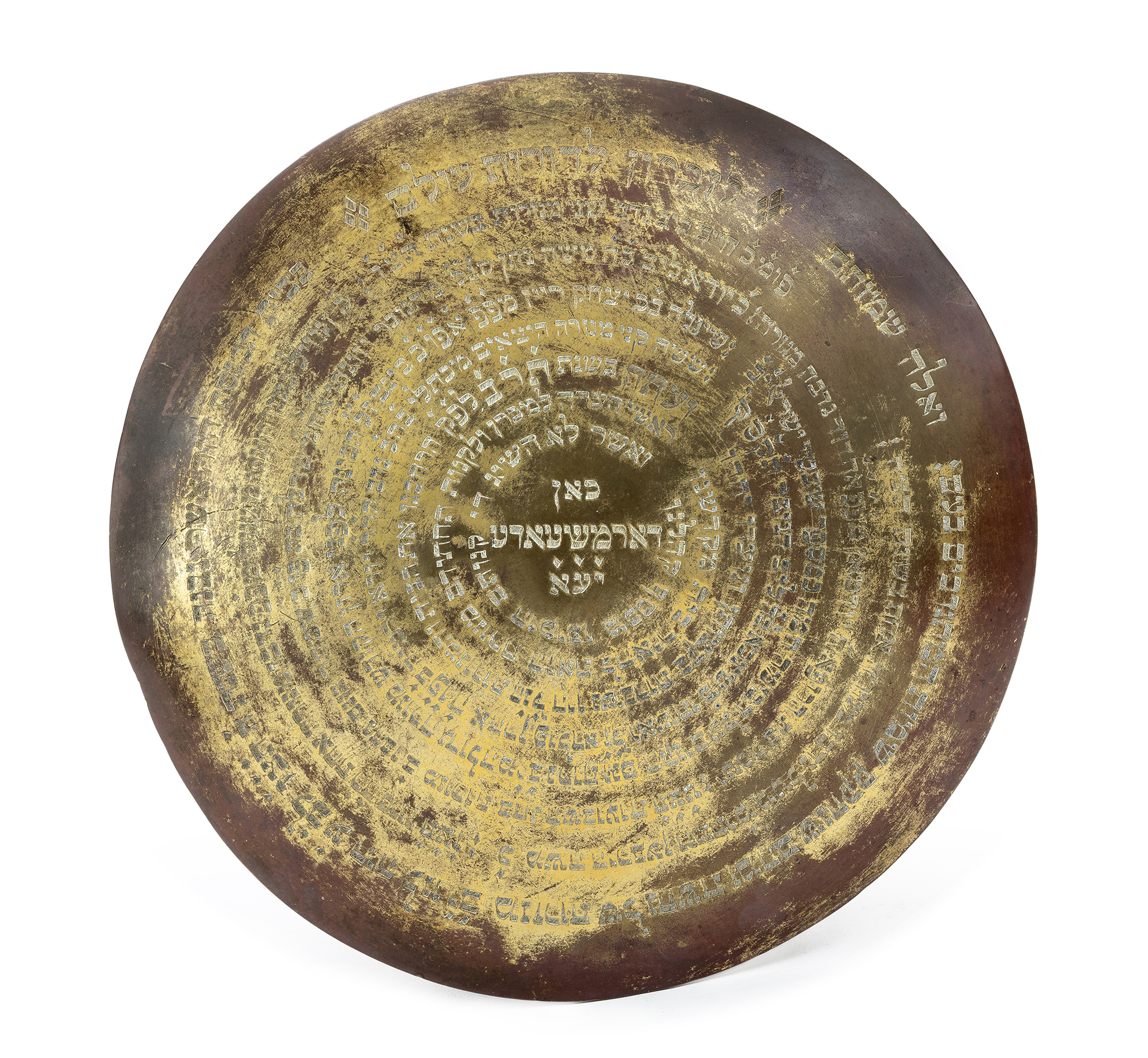
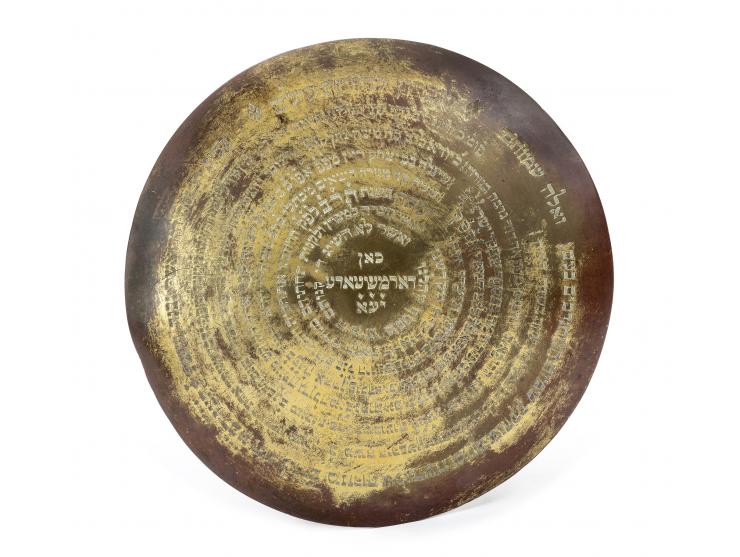
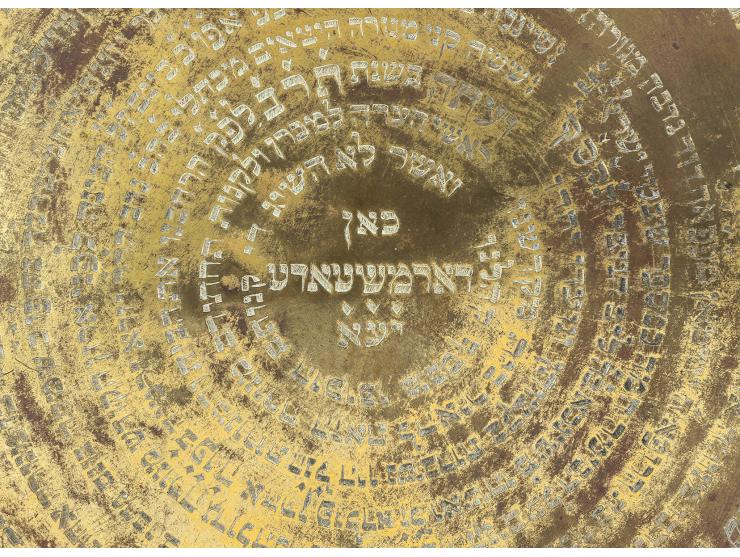
Dedicatory plaque for synagogue lamp. Darmstadt, State of Hesse, Germany, 1842.
Brass, repoussé and engraved; gilt.
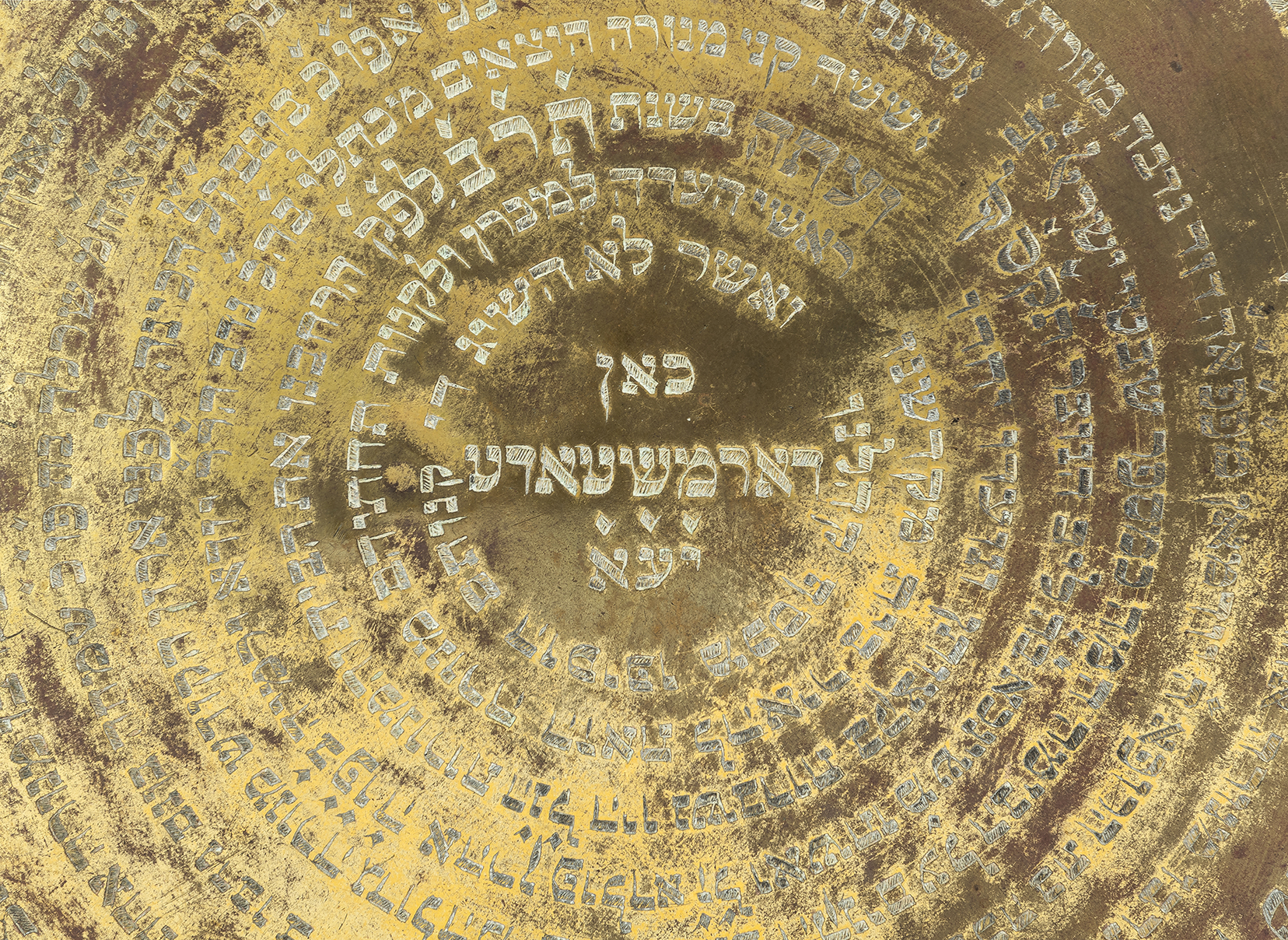
Unique dedicatory plaque engraved with the detailed history of the synagogue lamps of the synagogue of Darmstadt from the day of its establishment in 1737 until 1842, whereupon the synagogue was renovated and expanded, and new lamps were acquired. The plaque was meant to be hung on, or adjacent to, one of the synagogue's lamps.
A round, convex plaque upon which the following inscription is engraved in concentric circles:
"For eternal remembrance. In this synagogue built in the year 5497 to the Creation of the World
[1737]
, we had 12 copper lamps, some of them engraved with the names of the donors among the people. And these are their names: / Community leader R. Chaim Leib donated two lamps in 1737; R. Sanwel Gans and his wife Mrs. Ettel of Frankfurt donated one lamp on Rosh Chodesh Sivan 1737; R. Moshe Herben and his wife Mrs. Gittel donated one lamp in 1738; / R. Yuda Leib son of R. Moshe Natan Segal of Hanover and his wife… Mrs. Serela daughter of community leader R. Simcha Bunem donated two lamps on Shavuot 1739; Jetcha daughter of the physician R. Judman of Frankfurt, wife of R. David, donated one lamp; / Shenla daughter of R. Yitzchak Reis of Frankfurt, wife of the late community leader R. Bunem, arranged before the Torah Ark a large lamp of 12 lights, and also candlesticks on the Bimah corresponding in number to the 12 Tribes of Israel; / six sconces protruding from the walls of the synagogue were donated by R. Yuda Yirmiah son of the late community leader R. Aharon Fulda, and his wife Shencha daughter of R. Leib Hanover, 1800; / and now in 1842 we have expanded the synagogue and the aforementioned lamps were broken at their edges, and / the community leaders convened to sell them and purchase instead this lamp to illuminate our sanctuary, / and insofar as what was reached was insufficient, they added from the funds of our congregation / here / Darmstadt…".
[1737]
, we had 12 copper lamps, some of them engraved with the names of the donors among the people. And these are their names: / Community leader R. Chaim Leib donated two lamps in 1737; R. Sanwel Gans and his wife Mrs. Ettel of Frankfurt donated one lamp on Rosh Chodesh Sivan 1737; R. Moshe Herben and his wife Mrs. Gittel donated one lamp in 1738; / R. Yuda Leib son of R. Moshe Natan Segal of Hanover and his wife… Mrs. Serela daughter of community leader R. Simcha Bunem donated two lamps on Shavuot 1739; Jetcha daughter of the physician R. Judman of Frankfurt, wife of R. David, donated one lamp; / Shenla daughter of R. Yitzchak Reis of Frankfurt, wife of the late community leader R. Bunem, arranged before the Torah Ark a large lamp of 12 lights, and also candlesticks on the Bimah corresponding in number to the 12 Tribes of Israel; / six sconces protruding from the walls of the synagogue were donated by R. Yuda Yirmiah son of the late community leader R. Aharon Fulda, and his wife Shencha daughter of R. Leib Hanover, 1800; / and now in 1842 we have expanded the synagogue and the aforementioned lamps were broken at their edges, and / the community leaders convened to sell them and purchase instead this lamp to illuminate our sanctuary, / and insofar as what was reached was insufficient, they added from the funds of our congregation / here / Darmstadt…".
Diameter: 20 cm. Depth: 3 cm. Overall good condition. Slight warping to rim. Gilt mostly faded. Two suspension chains on back, one torn and partly missing.
Category
Torah Ornaments, Synagogue Items
and Various Objects
Catalogue Value
![Synagogue lamp. [Iraq, early 20th century].
Silver, cast, bent, cut, and engraved (unmarked).
Synagogue lamp consisti](https://files.kedem-auctions.com/files/Sale107/31_1-WEB.jpg "Silver Synagogue Lamp – Iraq, Early 20th Century")
![Synagogue lamp. [Iraq, early 20th century].
Silver, cast, bent, cut, and engraved (unmarked).
Synagogue lamp consisti](https://files.kedem-auctions.com/files/Sale107/31_2.jpg "Silver Synagogue Lamp – Iraq, Early 20th Century")
![Synagogue lamp. [Iraq, early 20th century].
Silver, cast, bent, cut, and engraved (unmarked).
Synagogue lamp consisti](https://files.kedem-auctions.com/files/Sale107/31_3-WEB.jpg "Silver Synagogue Lamp – Iraq, Early 20th Century")
![Synagogue lamp. [Iraq, early 20th century].
Silver, cast, bent, cut, and engraved (unmarked).
Synagogue lamp consisti](https://files.kedem-auctions.com/files/Sale107/31_4.jpg "Silver Synagogue Lamp – Iraq, Early 20th Century")
Auction 107: Rare and Important Items
Apr 15, 2026
Opening: $1,000
Estimate: $4,000 - $6,000
Sold for: $4,500
Including buyer's premium
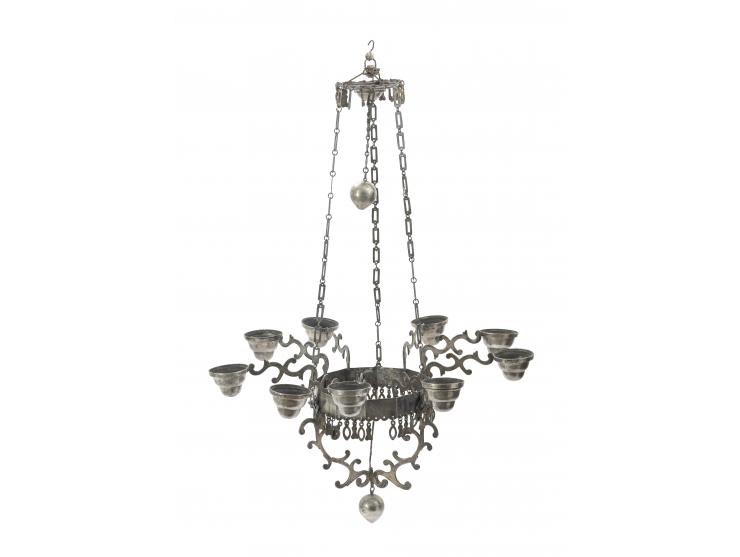
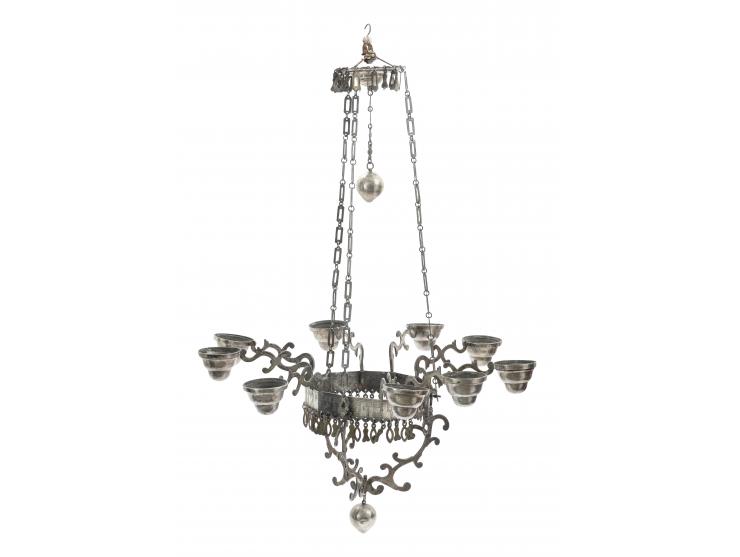
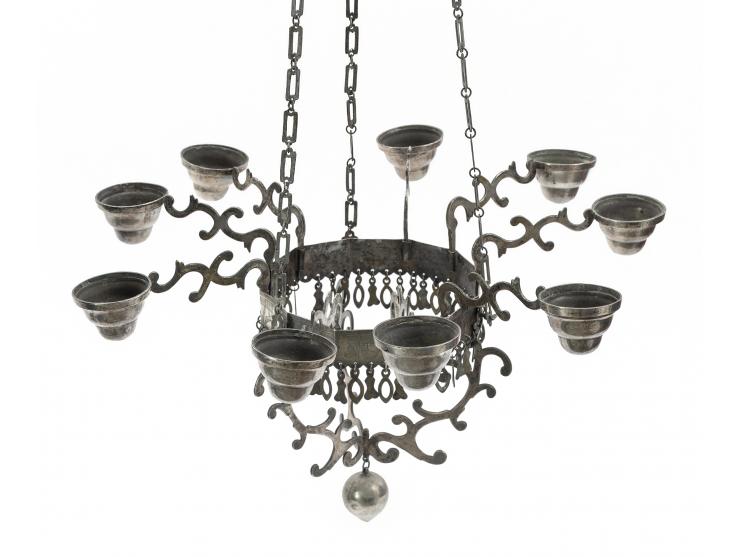
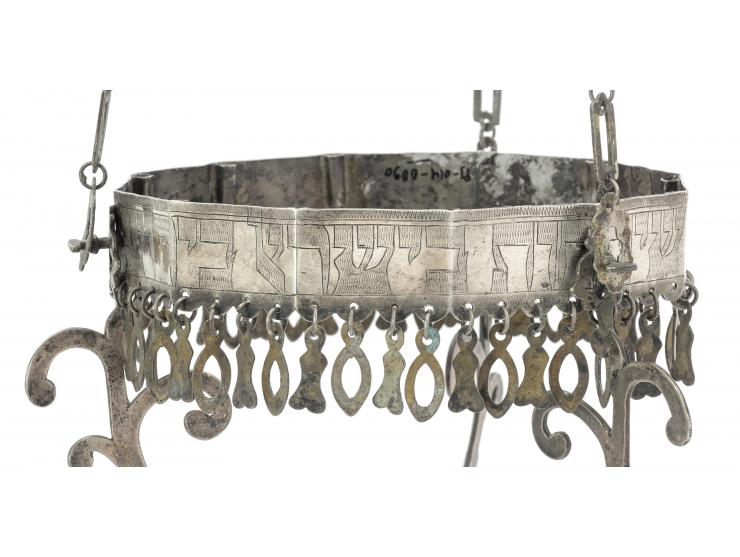
Synagogue lamp. [Iraq, early 20th century].
Silver, cast, bent, cut, and engraved (unmarked).
Synagogue lamp consisting of three main components:
1. An upper suspension device in the shape of an inverted dome, with an undulating rim, from which pendants in two alternating forms are suspended. The device is surmounted by a suspension hook. Suspended underneath it is an egg-shaped weight at the end of a chain.
2. A band consisting of a silver strip bent into twelve rectangular faces, upon which the following (Hebrew) inscription is engraved: "Ben Porat Yossef Ben Porat Alei Ayin [Bereshit 49:22]: May [joyous] celebrations proliferate among Israel in Jerusalem". The lower edge of the band is cut in an undulating pattern. From this edge, pendants in two alternating forms are suspended. Positioned on the interior of the band are nine removable tendril-shaped arms. At their tips are small, deep round bowls for oil or for lighting cups. Each bowl has a low cylindrical screw thread at its bottom. The band has three protuberances that serve as suspension devices for the bottom ornament and for three chains connected to the upper suspension device.
3. Bottom ornament with three tendril-shaped branches, connected to the central band. Another egg-shaped weight is suspended from the bottom end.
Height: 85 cm. Width of central band: 20-21 cm. Maximal width (incl. arms and branches): 60 cm. Weight: 2375 g. Overall good condition. Minor warping. Attachments of chains to upper suspension device not original. Several pendants missing from central band.
Category
Torah Ornaments, Synagogue Items
and Various Objects
Catalogue Value
![Decorated brass platter, created by Avraham Muwas. [Syria, probably Damascus, early 20th century].
Brass, repoussé](https://files.kedem-auctions.com/files/Sale107/32_1.jpg "Large Brass Platter with Damascening – Work of Artist Avraham Muwas, S")
![Decorated brass platter, created by Avraham Muwas. [Syria, probably Damascus, early 20th century].
Brass, repoussé](https://files.kedem-auctions.com/files/Sale107/32_2-WEB.jpg "Large Brass Platter with Damascening – Work of Artist Avraham Muwas, S")
![Decorated brass platter, created by Avraham Muwas. [Syria, probably Damascus, early 20th century].
Brass, repoussé](https://files.kedem-auctions.com/files/Sale107/32_3.jpg "Large Brass Platter with Damascening – Work of Artist Avraham Muwas, S")
![Decorated brass platter, created by Avraham Muwas. [Syria, probably Damascus, early 20th century].
Brass, repoussé](https://files.kedem-auctions.com/files/Sale107/32_4.jpg "Large Brass Platter with Damascening – Work of Artist Avraham Muwas, S")
![Decorated brass platter, created by Avraham Muwas. [Syria, probably Damascus, early 20th century].
Brass, repoussé](https://files.kedem-auctions.com/files/Sale107/32_5.jpg "Large Brass Platter with Damascening – Work of Artist Avraham Muwas, S")
![Decorated brass platter, created by Avraham Muwas. [Syria, probably Damascus, early 20th century].
Brass, repoussé](https://files.kedem-auctions.com/files/Sale107/32_6-WEB.jpg "Large Brass Platter with Damascening – Work of Artist Avraham Muwas, S")
![Decorated brass platter, created by Avraham Muwas. [Syria, probably Damascus, early 20th century].
Brass, repoussé](https://files.kedem-auctions.com/files/Sale107/32_7-WEB.jpg "Large Brass Platter with Damascening – Work of Artist Avraham Muwas, S")
![Decorated brass platter, created by Avraham Muwas. [Syria, probably Damascus, early 20th century].
Brass, repoussé](https://files.kedem-auctions.com/files/Sale107/32_8-WEB.jpg "Large Brass Platter with Damascening – Work of Artist Avraham Muwas, S")
Auction 107: Rare and Important Items
Apr 15, 2026
Opening: $2,000
Estimate: $6,000 - $8,000
Sold for: $3,250
Including buyer's premium
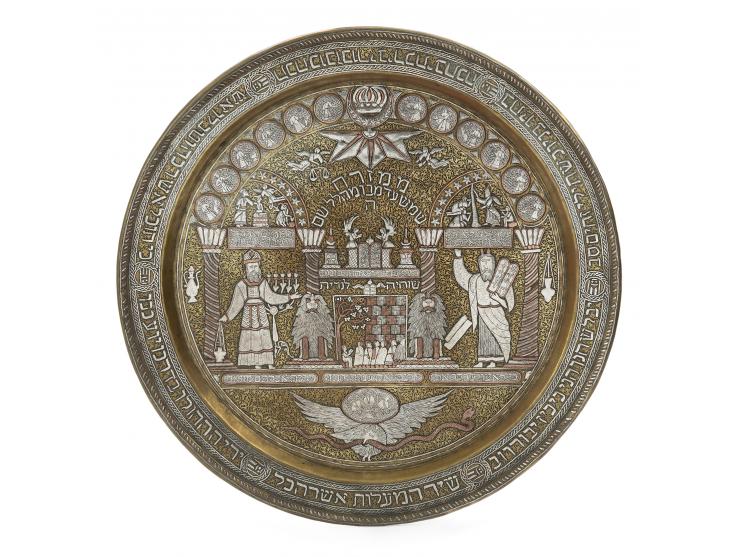
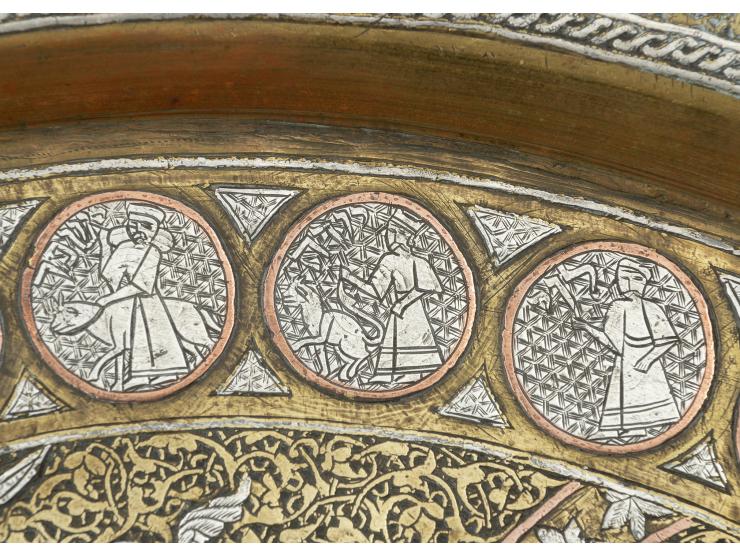
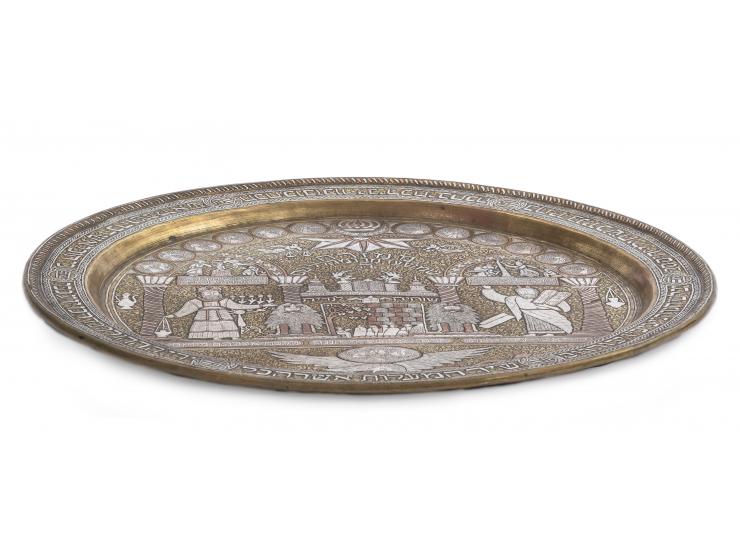
Decorated brass platter, created by Avraham Muwas. [Syria, probably Damascus, early 20th century].
Brass, repoussé, inlaid silver (engraved) and copper (damascening).
Large, massive, circular platter with elevated rim, decorated with high-quality damascening.
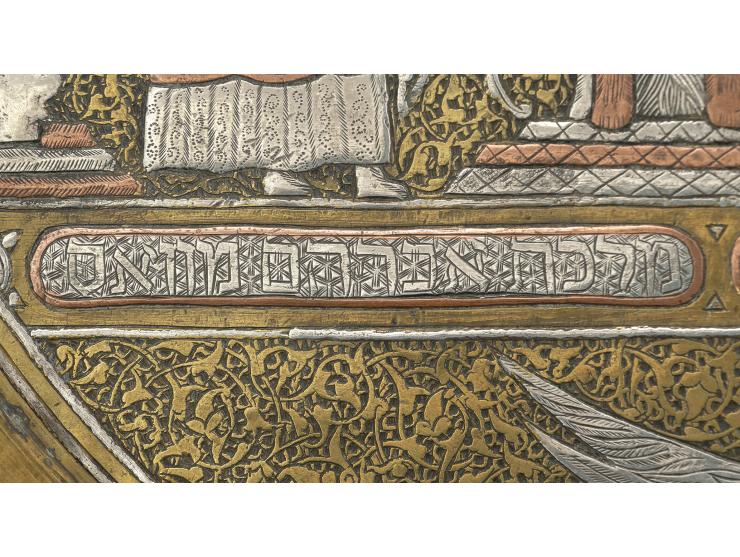
The rim bears biblical verses (in Hebrew) from Tehillim 128, from "A song of ascents. Happy is any man who fears G-d, who follows His ways" to "So shall all who fear G-d be blessed" (with minor errors). Numerous decorative elements appear within the main circle of the platter, most of them derived from the style and illustrations of "Mizrach" plaques originating from Central Europe in the late 19th century (for instance, Breslau and Prague). Undoubtedly, the artist was looking directly at one of these "Mizrach" plaques at the time he created this platter.
The decorative elements are arranged in three main groups, encircling and enclosed within an architectonic structure consisting of columns and arches:
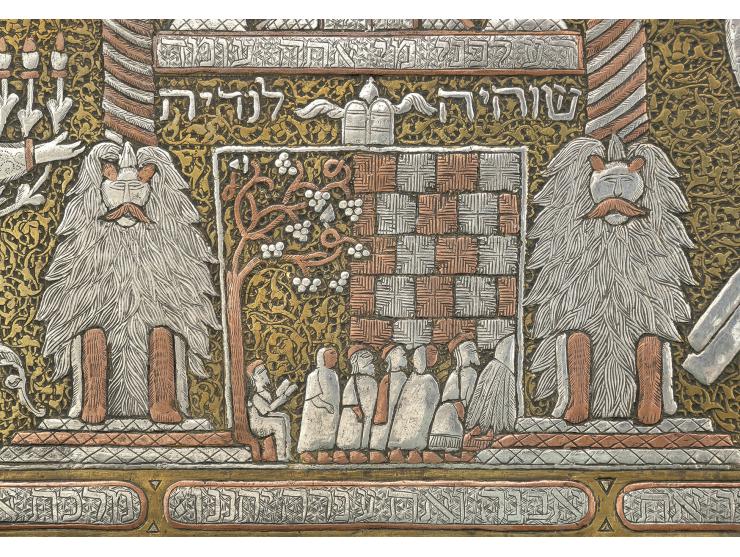
1. Central elements: At the top is a sun-like image, surmounted by a crown and flanked on either side by angels in flight. Underneath this is the arched (Hebrew) inscription: "From east to west [two-letter deletion here], G-d's name is praised" (Tehillim, 113:3). At the center of the platter is a depiction of the Ark of the Covenant, and under it the (Hebrew) inscription: "Know before Whom you stand"; under this is a depiction of the Western Wall with worshipers and a grape vine, and above that, the somewhat distorted Hebrew verse (Tehillim, 16:8): " I have set the Lord always before me…" The depiction of the Western Wall is flanked on either side by a pair of large, crouched, mustached lions.
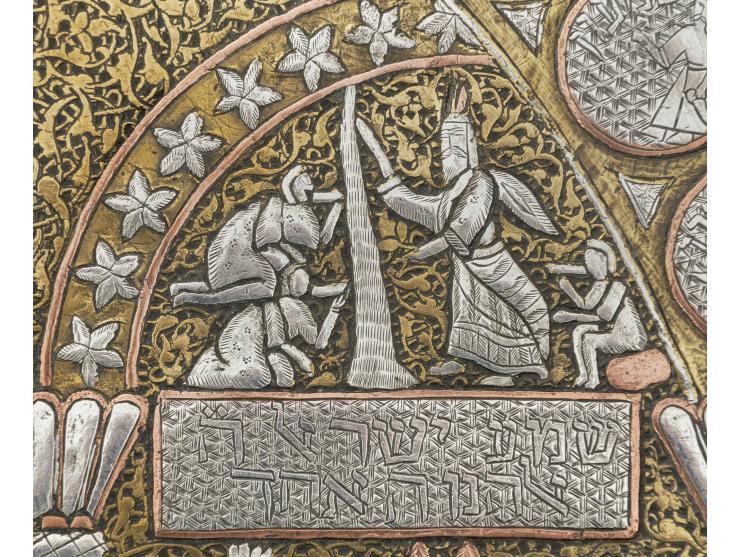
2. Elements on the right: Under the arch is an illustration of Moses striking the rock, with the inscription (below, Hebrew) "Hear O Israel, the Lord our G-d, the Lord is One" (Devarim 6:4); and beneath this, a depiction of Moses holding the Two Tablets of the Law, and next to him, a Torah scroll.
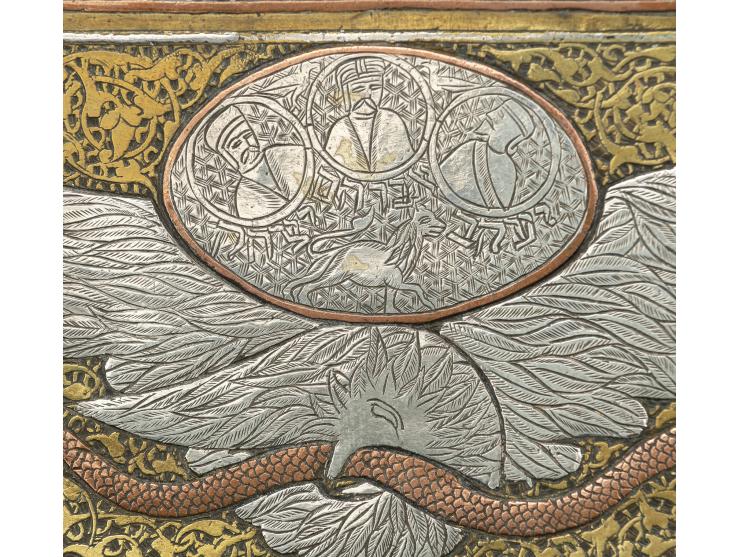
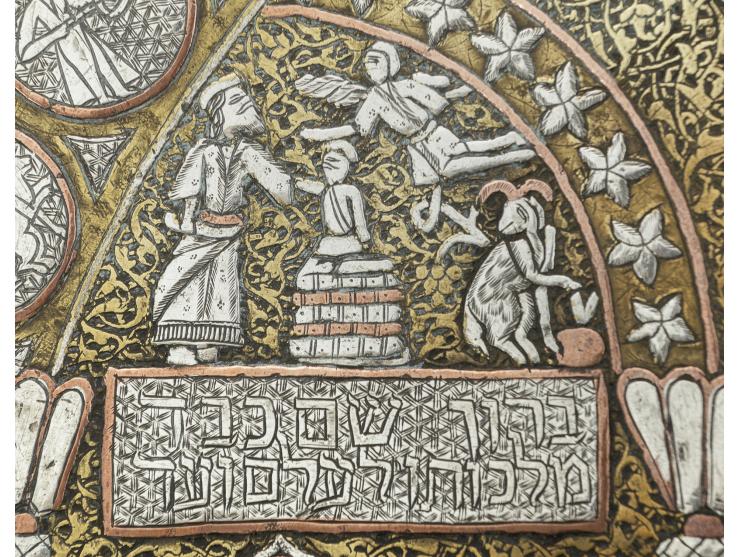
3. Elements on the left: Under the arch, an illustration of the Binding of Isaac, with the inscription (below, Hebrew) "Blessed be the name of the glory of His kingdom forever and ever" and beneath this, a depiction of Aaron, wearing the priestly breastplate and holding an incense burner, with the seven-branched Menorah behind him. Underneath these elements is the (Hebrew) verse "Your servants take delight in its stones, and cherish its dust" (Tehillim 102:15, with errors), and the artist’s mark (Hebrew): "Work of Avraham Muwas". Along the upper border are 12 round medallions bearing the names of the Twelve Tribes of Israel, along with depictions of the 12 sons of Jacob and emblems of the Twelve Tribes. To the right of the right column is a hanging lamp, and to the left of the left column is a pitcher, together representing the vessels of the Great Temple. And at bottom center, an illustration of a large bird of prey grasping a snake in its beak, and bearing a medallion with images of the Three Patriarchs, along with a lion and birds.
Diameter: 47 cm. Height: 2.5 cm. Overall good condition. Several minute silver pieces missing. Suspension hook on back.
Provenance: Sotheby's, Tel Aviv, 17 April 2001, Lot 336.
Category
Torah Ornaments, Synagogue Items
and Various Objects
Catalogue Value
![Bracelet produced by Ilya Schor (1904-1961). New York, United States, [ca. 1946].
Silver, sawed and pierced; gold; turqu](https://files.kedem-auctions.com/files/Sale107/33_1.jpg "Silver, Gold and Turquoise Bracelet – Ilya Schor – New York, Ca. 1946")
![Bracelet produced by Ilya Schor (1904-1961). New York, United States, [ca. 1946].
Silver, sawed and pierced; gold; turqu](https://files.kedem-auctions.com/files/Sale107/33_2.jpg "Silver, Gold and Turquoise Bracelet – Ilya Schor – New York, Ca. 1946")
![Bracelet produced by Ilya Schor (1904-1961). New York, United States, [ca. 1946].
Silver, sawed and pierced; gold; turqu](https://files.kedem-auctions.com/files/Sale107/33_3.jpg "Silver, Gold and Turquoise Bracelet – Ilya Schor – New York, Ca. 1946")
![Bracelet produced by Ilya Schor (1904-1961). New York, United States, [ca. 1946].
Silver, sawed and pierced; gold; turqu](https://files.kedem-auctions.com/files/Sale107/33_4.jpg "Silver, Gold and Turquoise Bracelet – Ilya Schor – New York, Ca. 1946")
![Bracelet produced by Ilya Schor (1904-1961). New York, United States, [ca. 1946].
Silver, sawed and pierced; gold; turqu](https://files.kedem-auctions.com/files/Sale107/33_5.jpg "Silver, Gold and Turquoise Bracelet – Ilya Schor – New York, Ca. 1946")
Auction 107: Rare and Important Items
Apr 15, 2026
Opening: $5,000
Estimate: $10,000 - $15,000
Sold for: $13,750
Including buyer's premium
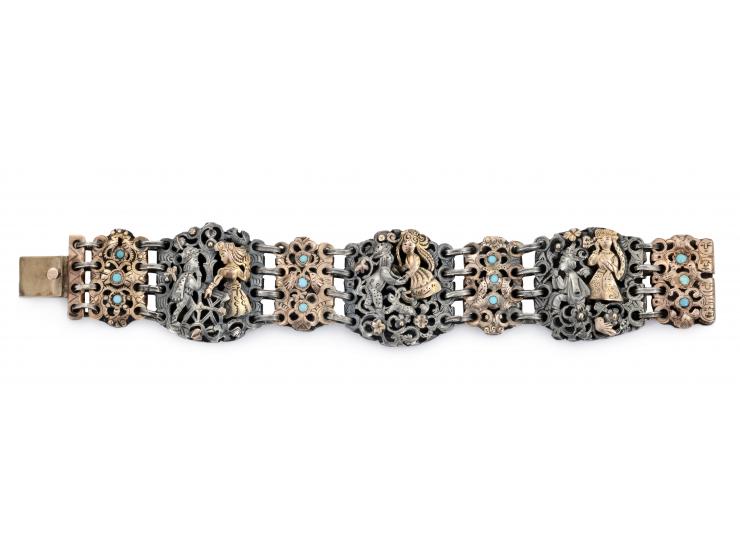
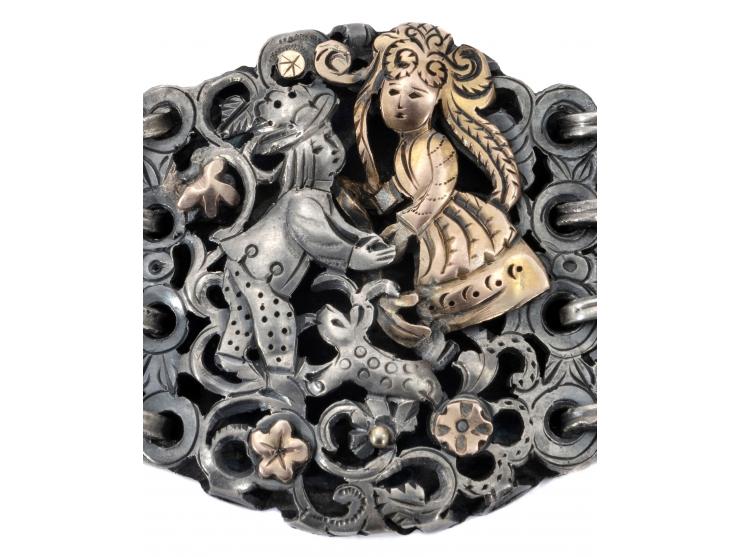
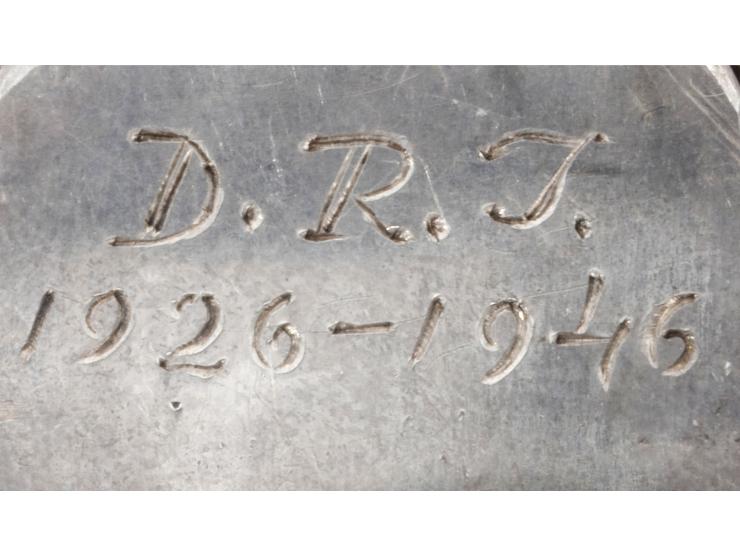
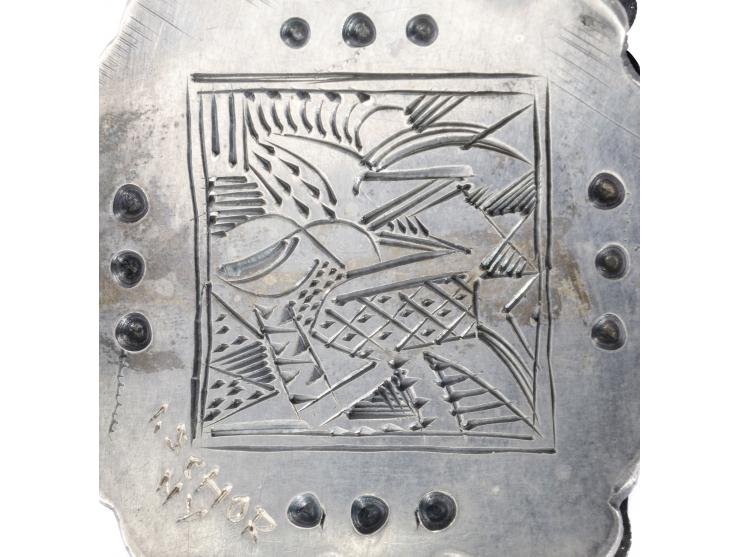
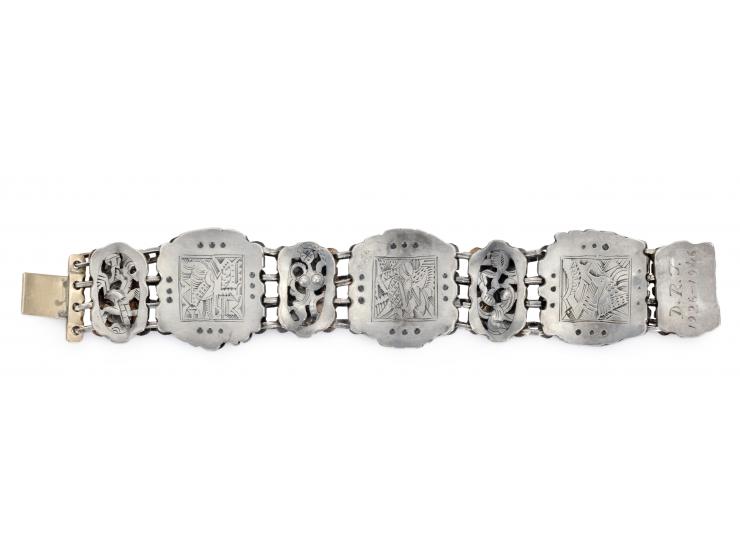
Bracelet produced by Ilya Schor (1904-1961). New York, United States, [ca. 1946].
Silver, sawed and pierced; gold; turquoise. Marked: "I. Schor NY".
The bracelet is composed of three large ornamental units depicting a man and woman (apparently a bride and a groom) in various positions, surrounded by decorations of animals and flowers. Four smaller ornaments – each set with three turquoise stones – separate the larger units, and are linked to them with small silver rings. The reverse side of the bracelet is adorned with engraved and pierced decorations in (abstract) geometric style, characteristic of Schor's work. Initials engraved on last unit, which serves as a fastener: "D. R. J. 1926-1946".
Width: 19 cm. Height: 3 cm. Weight: 64 g. Good condition. One small ring partially detached.
Provenance:
1. Private Collection, New York.
2. Sotheby's, New York, 6-7 December 1984, Lot 243.
3. Sotheby's, New York, 29 April 2013, Lot 379 (Steinhardt Collection).
Category
Torah Ornaments, Synagogue Items
and Various Objects
Catalogue Value
Auction 107: Rare and Important Items
Apr 15, 2026
Opening: $1,500
Estimate: $3,000 - $5,000
Sold for: $3,000
Including buyer's premium
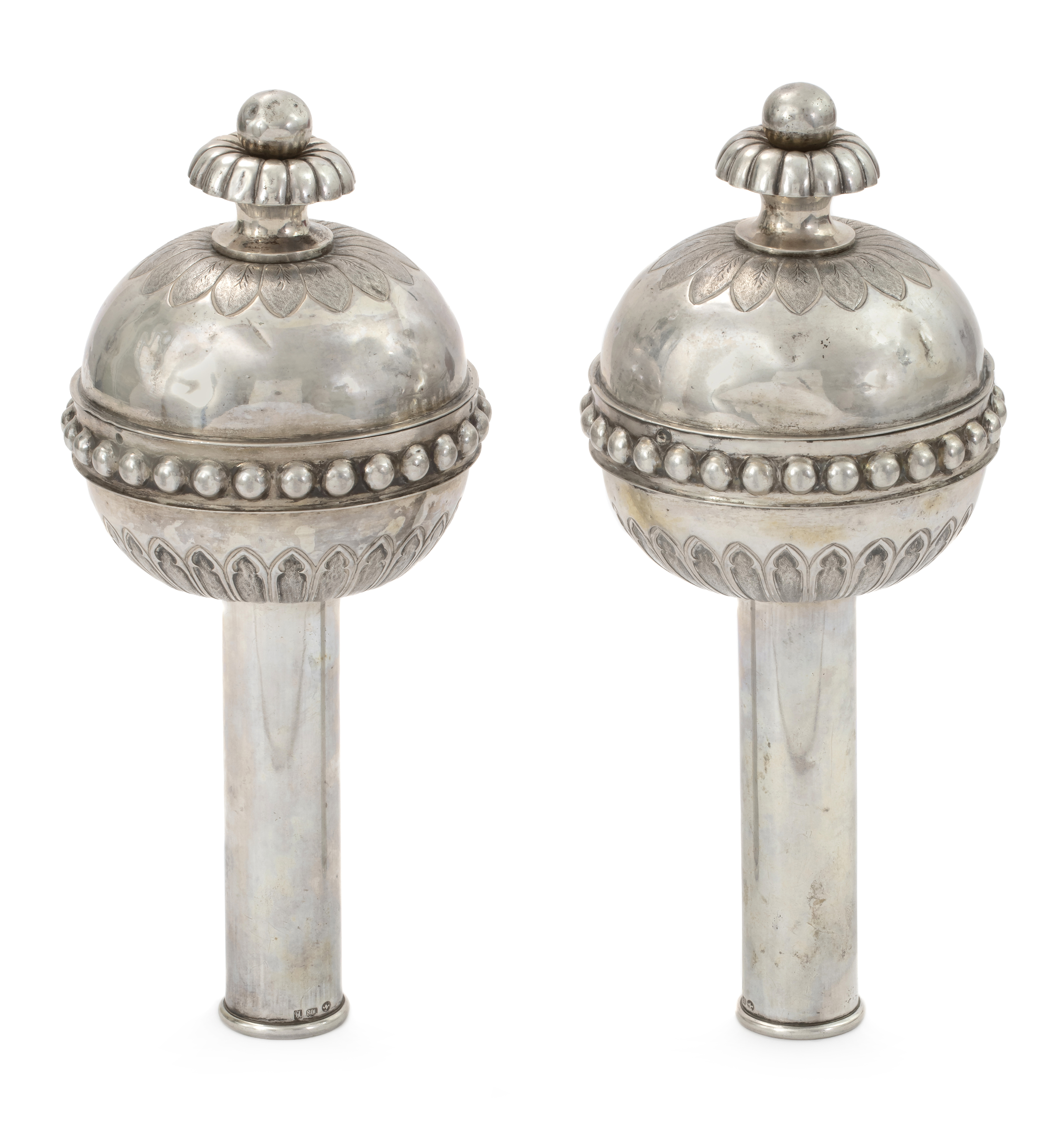
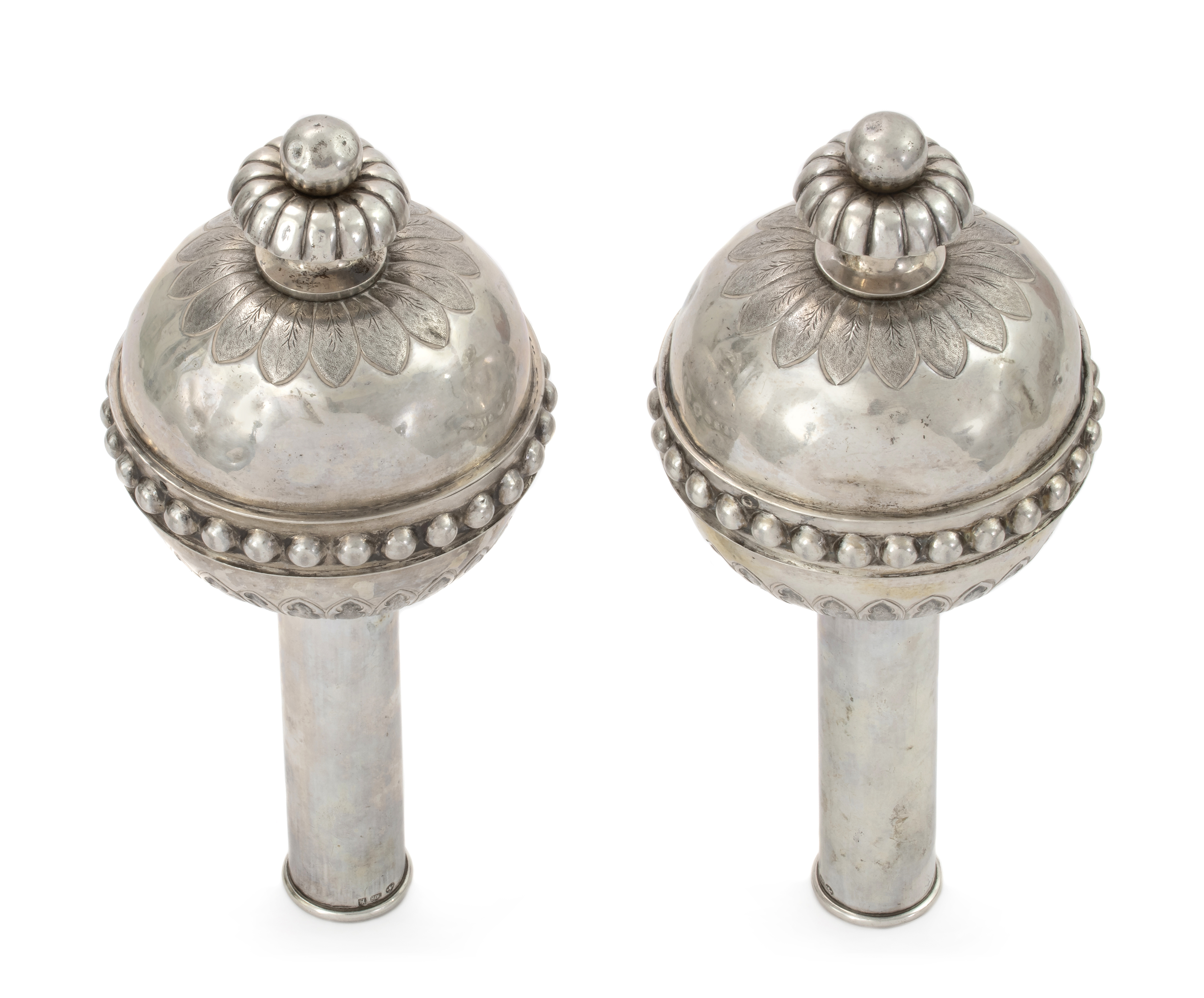
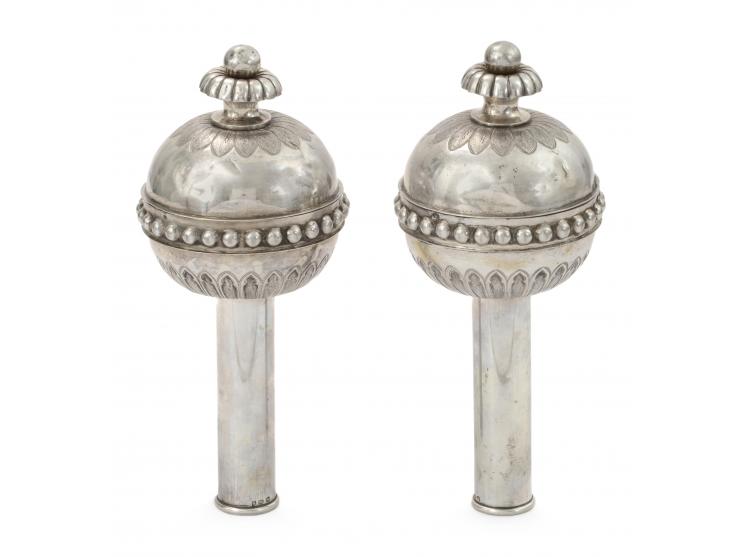
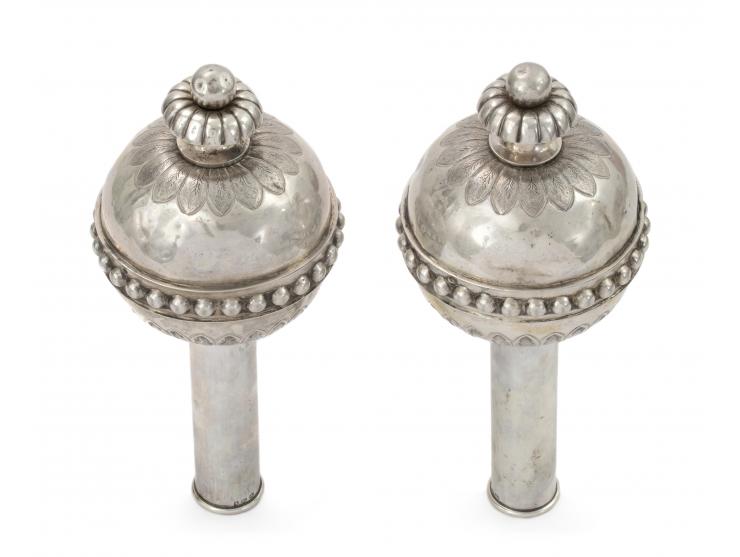
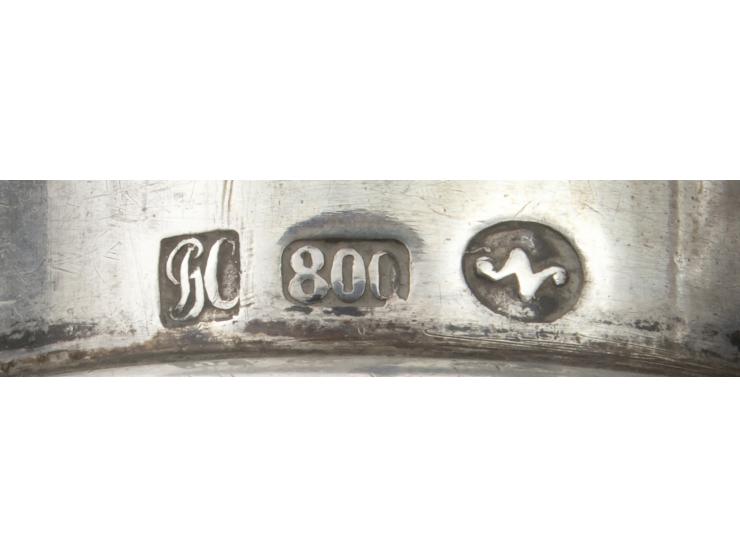
Pair of Torah finials, made by a silversmith of the Häberlein family. Nuremberg, Germany, [probably first half of 19th century].
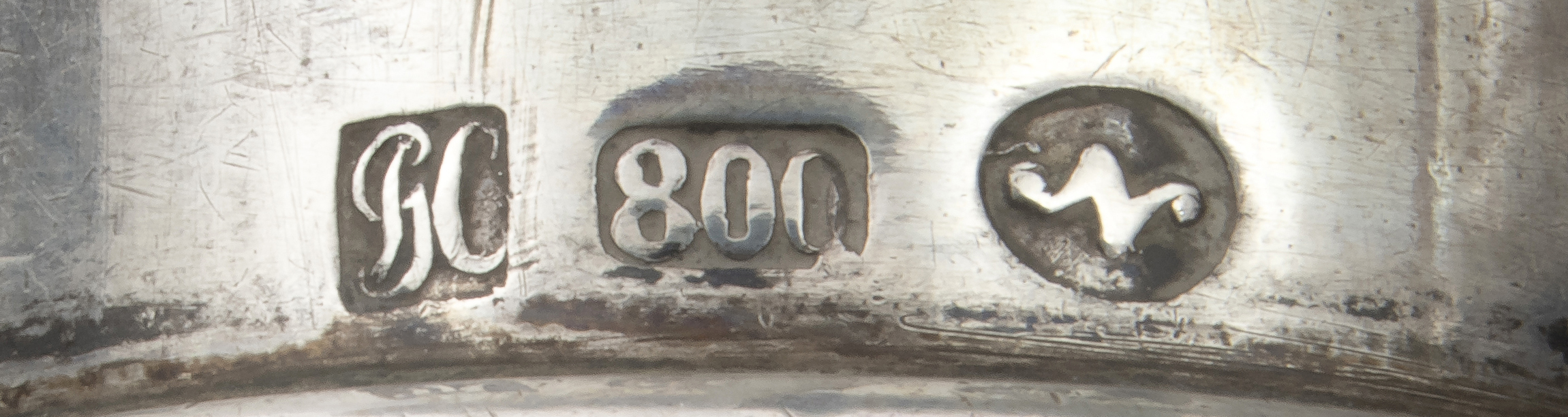
Silver, repoussé and engraved (marked with Nuremberg city mark of the 19th century, the letter "N"; maker’s mark, the initials GH – a silversmith of the Häberlein family, possibly Georg Häberlein; and with quality mark, "800").
Torah finials of an unconventional design. Finial bodies in shapes of flattened spheres, with a belt of spherical protuberances adorning the midline, and with engraved vegetal patterns adorning the top of the sphere as well as its base. Both bodies surmounted by a flower-shaped ornament, in turn surmounted by an additional sphere. Tall, cylindrical shafts.
References: Karin Tebbe, ed., Nürnberger Goldschmiedekunst 1541-1868, exhibition catalogue, Germanisches Nationalmuseum Abt. Verlag, Nuremberg, 2007, No. MZ1025b; Marc Rosenberg, Der Goldschmiede
Merkzeichen, Frankfurt A.M.: Frankfurter Verlags, 1922, No. 4313.
Height: 24.5 cm. Maximal width: 10 cm. Weight: 630 g. Overall good condition. Minor warping. Pin missing from middle part of one finial. Loose screw joints to upper parts of both finials.
Provenance: The Simon Brueckheimer Collection.
Simon Brueckheimer, born in Külsheim, Germany, in 1889. Moved to Marktbreit in 1911, and began serving there as an educator in 1920. In 1929 he initiated a project to document sacred objects and property of Bavarian Jewish communities, which he pursued during his vacation time as a teacher, under the auspices of the Union of Bavarian Jewish Communities (Verband Bayerischer Israelitischer Gemeinden). Brueckheimer escaped to Frankfurt in the heat of Kristallnacht, but was then arrested and sent to Buchenwald Concentration Camp. After six weeks he was released, returned to Marktbreit, and then emigrated with his family to London, where he continued his documentation project on Bavarian Jewry. In the course of his visits to small Bavarian Jewish communities and later, after moving to London, Brueckheimer succeeded in assembling a small collection of Jewish items, which he had acquired either during his visits to the towns themselves or from purchases from Jewish refugees escaping to England. The important items in his collection include a cup used for special dinners by the "Chevrah Kadisha" (Burial Society) of Schwabach, today part of the collection of the Israel Museum, Jerusalem, and a Torah Shield belonging to the community of Goßmannsdorf, sold at Kedem, Auction 106, 24 February 2026, Lot 14. His notes and listings – documenting 150 small Jewish communities throughout Bavaria – are kept in the archives of the Yad VaShem World Holocaust Remembrance Center, Jerusalem. Brueckheimer passed away in England in 1950.
Several additional items from the Simon Brueckheimer Collection will be offered for sale at our upcoming public auctions. All proceeds from these sales will be donated.
Category
Selected Items from the Simon Brueckheimer Collection
Catalogue Value
![Seal of the "Gemilut Chassadim Chevrah Kadisha" of Bechhofen, Germany, [ca. 1750 or earlier].
Brass, cast and](https://files.kedem-auctions.com/files/Sale107/35_1.jpg "Seal of the \"Chevrah Kadisha\" of Bechhofen, Bavaria, ca. 1750 or Earli")
![Seal of the "Gemilut Chassadim Chevrah Kadisha" of Bechhofen, Germany, [ca. 1750 or earlier].
Brass, cast and](https://files.kedem-auctions.com/files/Sale107/35_2.jpg "Seal of the \"Chevrah Kadisha\" of Bechhofen, Bavaria, ca. 1750 or Earli")
![Seal of the "Gemilut Chassadim Chevrah Kadisha" of Bechhofen, Germany, [ca. 1750 or earlier].
Brass, cast and](https://files.kedem-auctions.com/files/Sale107/35_3.jpg "Seal of the \"Chevrah Kadisha\" of Bechhofen, Bavaria, ca. 1750 or Earli")
Auction 107: Rare and Important Items
Apr 15, 2026
Opening: $1,500
Estimate: $4,000 - $6,000
Sold for: $2,000
Including buyer's premium
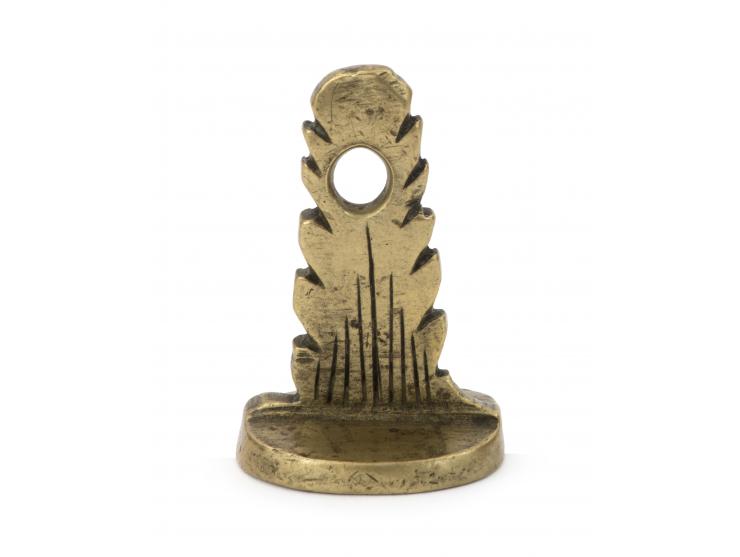
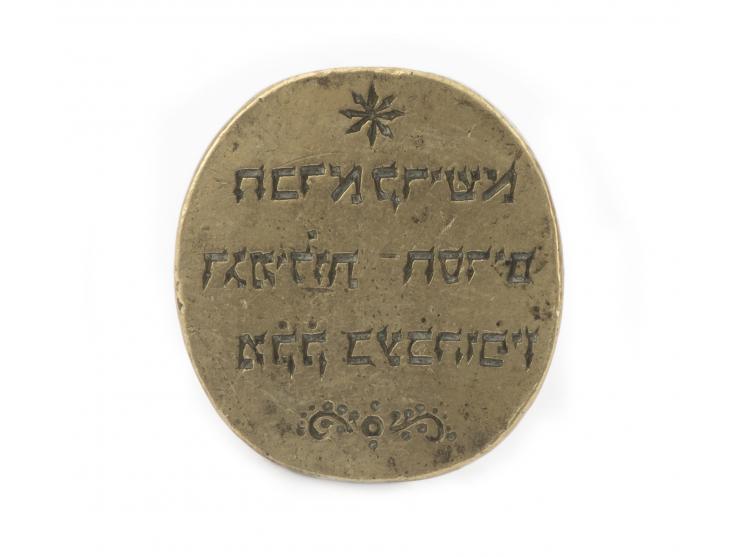
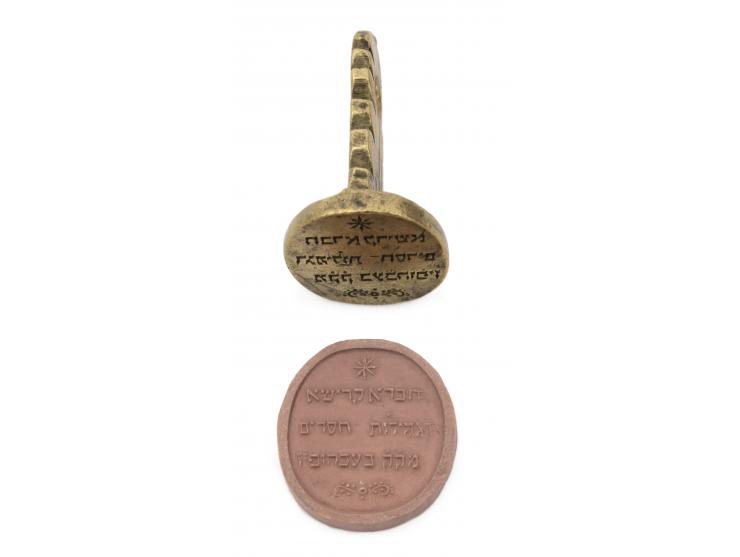
Seal of the "Gemilut Chassadim Chevrah Kadisha" of Bechhofen, Germany, [ca. 1750 or earlier].
Brass, cast and engraved.
Round Seal engraved with the (Hebrew) inscription: "'Chevrah Kadisha' / of the 'Gemilut Chassadim' / of the Holy Congregation of Bechhofen" (the Hebrew letters "kaf" and "pe" are marked with small dots as Rafe marks). Stamped above the inscription is an eight-point asterisk-like star, and beneath it, a vegetal pattern. The Seal is equipped with a fashioned brass handle with serrated edges, and a hole for a suspension chain.
In the German market town of Bechhofen – located near Ansbach in the district of Middle Franconia, Bavaria, roughly 55 kilometers southwest of Nuremberg – lived a small Jewish community from the 16th century till the 1930s. In 1700, Bechhofen's Jewish cemetery, which had probably been established as early as the 16th century, was serving an additional 16 Jewish communities in the district.
In addition, and for similar reasons, the takkanot for Bechhofen’s "Chevrah Kadisha - Gemilut Chassadim" burial society, compiled in 1749, was signed by 24 representatives of the district's communities that made use of the cemetery. Only a single Jewish family resided in Bechhofen in 1763, but the Jewish population steadily grew in subsequent years, and numbered 170 individuals in 1837, representing 21% of the small town's overall population of 810. From April 1934 till October 1938 – following acts of incitement, harassment, and violence under Nazi rule – Bechhofen's remaining 36 Jewish residents departed; some moved to other parts of Germany, while others emigrated to the United Sates.
Exhibited in the Catalogue of the Permanent and Loan Collections of the Jewish Museum, London (Barnett, 1972), item 1191; illustrated on plate CCVI.
2X1.9 cm. Height: 3.3 cm. Good condition. Minor blemishes.
Provenance: The Simon Brueckheimer Collection.
Simon Brueckheimer, born in Külsheim, Germany, in 1889. Moved to Marktbreit in 1911, and began serving there as an educator in 1920. In 1929 he initiated a project to document sacred objects and property of Bavarian Jewish communities, which he pursued during his vacation time as a teacher, under the auspices of the Union of Bavarian Jewish Communities (Verband Bayerischer Israelitischer Gemeinden). Brueckheimer escaped to Frankfurt in the heat of Kristallnacht, but was then arrested and sent to Buchenwald Concentration Camp. After six weeks he was released, returned to Marktbreit, and then emigrated with his family to London, where he continued his documentation project on Bavarian Jewry. In the course of his visits to small Bavarian Jewish communities and later, after moving to London, Brueckheimer succeeded in assembling a small collection of Jewish items, which he had acquired either during his visits to the towns themselves or from purchases from Jewish refugees escaping to England. The important items in his collection include a cup used for special dinners by the "Chevrah Kadisha" (Burial Society) of Schwabach, today part of the collection of the Israel Museum, Jerusalem, and a Torah Shield belonging to the community of Goßmannsdorf, sold at Kedem, Auction 106, 24 February 2026, Lot 14. His notes and listings – documenting 150 small Jewish communities throughout Bavaria – are kept in the archives of the Yad VaShem World Holocaust Remembrance Center, Jerusalem. Brueckheimer passed away in England in 1950.
Several additional items from the Simon Brueckheimer Collection will be offered for sale at our upcoming public auctions. All proceeds from these sales will be donated.
Category
Selected Items from the Simon Brueckheimer Collection
Catalogue Value
![Pewter platter. [Probably Germany, 18th century].
Pewter, cast and engraved (marked with unidentified maker’s mark – a s](https://files.kedem-auctions.com/files/Sale107/36_1.jpg "Pewter Platter with Illustration of a Synagogue – \"Mizrach\" – Germany,")
![Pewter platter. [Probably Germany, 18th century].
Pewter, cast and engraved (marked with unidentified maker’s mark – a s](https://files.kedem-auctions.com/files/Sale107/36_2-WEB.jpg "Pewter Platter with Illustration of a Synagogue – \"Mizrach\" – Germany,")
![Pewter platter. [Probably Germany, 18th century].
Pewter, cast and engraved (marked with unidentified maker’s mark – a s](https://files.kedem-auctions.com/files/Sale107/36_3.jpg "Pewter Platter with Illustration of a Synagogue – \"Mizrach\" – Germany,")
![Pewter platter. [Probably Germany, 18th century].
Pewter, cast and engraved (marked with unidentified maker’s mark – a s](https://files.kedem-auctions.com/files/Sale107/36_4-WEB.jpg "Pewter Platter with Illustration of a Synagogue – \"Mizrach\" – Germany,")
Auction 107: Rare and Important Items
Apr 15, 2026
Opening: $1,000
Estimate: $2,000 - $4,000
Sold for: Unsold
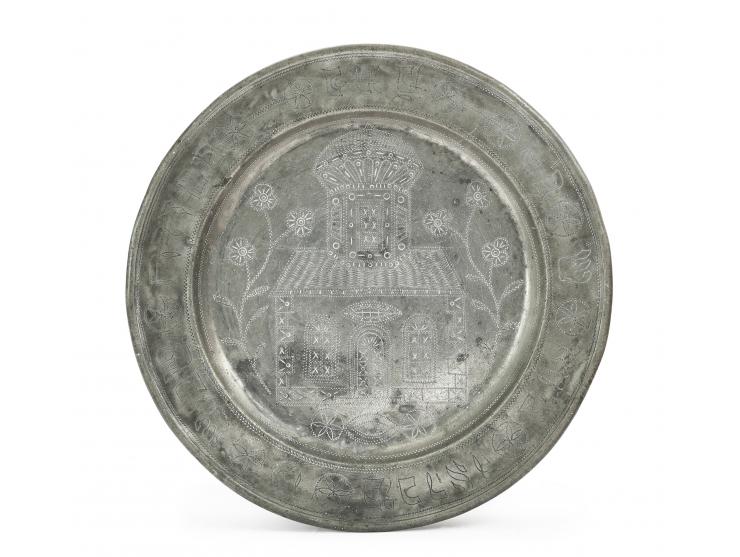
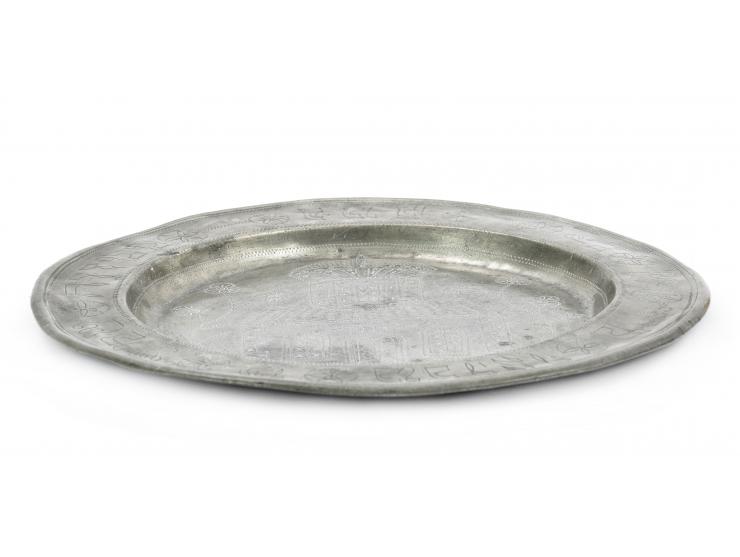
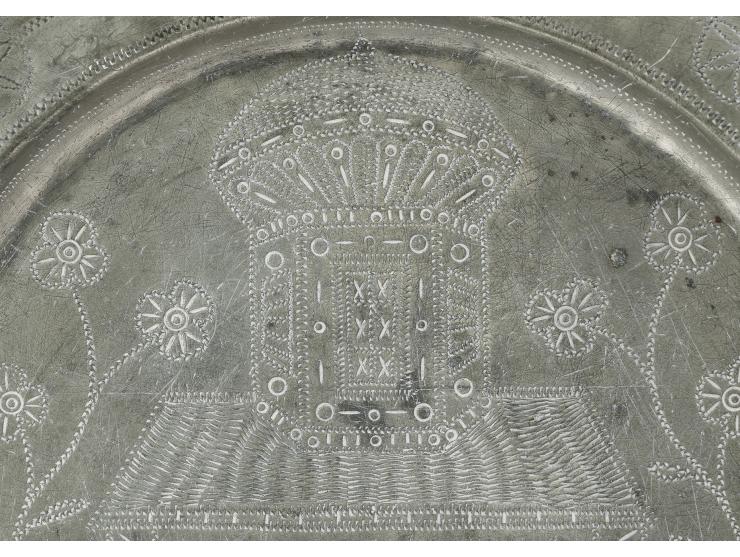
Pewter platter. [Probably Germany, 18th century].
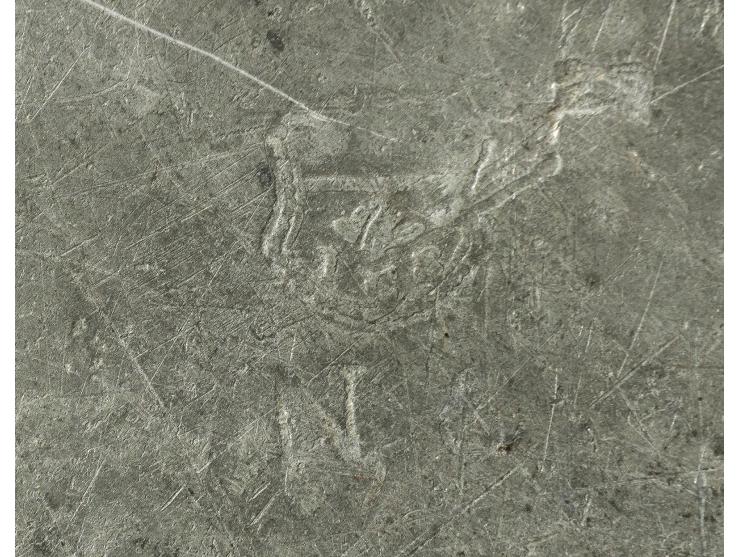
Pewter, cast and engraved (marked with unidentified maker’s mark – a shield with an ornament at bottom bearing the letters "ICS" [undocumented by Erwin Hintze]; underneath this, the letters "NS" are stamped).
Round platter with a broad, elevated rim. Engraved on the rim is an inscription with the Biblical verse (Hebrew) "From east to west, [G-d’s] [?] name is praised", and after this, the Hebrew initials "peh", "mem", "mem" [?].
The Hebrew verse "From east to west…" (Tehillim, 113:3) appears frequently on "Mizrach" plaques, meant to indicate the eastwardly direction of prayer in Jewish homes. The fact that the verse appears on this platter seems to suggest it may have indeed served as something of a "Mizrach" plaque. On the other hand, a very similar platter with the engraved Biblical inscription (Hebrew) "G-d’s right hand is exalted! G-d’s right hand is triumphant!" (Tehillim, 118:16) can be found in the collection of the Cologne City Museum (Kölnische Stadtmuseum; Item no. RM 1928/1067c), and this particular item has been identified as a Passover seder plate.
Diameter: 31 cm. Height: 1.5-2 cm. Good condition. Warping and scratches.
Provenance: The Simon Brueckheimer Collection.
Simon Brueckheimer, born in Külsheim, Germany, in 1889. Moved to Marktbreit in 1911, and began serving there as an educator in 1920. In 1929 he initiated a project to document sacred objects and property of Bavarian Jewish communities, which he pursued during his vacation time as a teacher, under the auspices of the Union of Bavarian Jewish Communities (Verband Bayerischer Israelitischer Gemeinden). Brueckheimer escaped to Frankfurt in the heat of Kristallnacht, but was then arrested and sent to Buchenwald Concentration Camp. After six weeks he was released, returned to Marktbreit, and then emigrated with his family to London, where he continued his documentation project on Bavarian Jewry. In the course of his visits to small Bavarian Jewish communities and later, after moving to London, Brueckheimer succeeded in assembling a small collection of Jewish items, which he had acquired either during his visits to the towns themselves or from purchases from Jewish refugees escaping to England. The important items in his collection include a cup used for special dinners by the "Chevrah Kadisha" (Burial Society) of Schwabach, today part of the collection of the Israel Museum, Jerusalem, and a Torah Shield belonging to the community of Goßmannsdorf, sold at Kedem, Auction 106, 24 February 2026, Lot 14. His notes and listings – documenting 150 small Jewish communities throughout Bavaria – are kept in the archives of the Yad VaShem World Holocaust Remembrance Center, Jerusalem. Brueckheimer passed away in England in 1950.
Several additional items from the Simon Brueckheimer Collection will be offered for sale at our upcoming public auctions. All proceeds from these sales will be donated.
Category
Selected Items from the Simon Brueckheimer Collection
Catalogue Value