
Auction 107: Rare and Important Items
Apr 15, 2026
- and (82) Apply and filter
- item (32) Apply item filter
- various (27) Apply various filter
- object (23) Apply object filter
- ornament (23) Apply ornament filter
- ornaments, (23) Apply ornaments, filter
- synagogu (23) Apply synagogu filter
- torah (23) Apply torah filter
- book (17) Apply book filter
- print (17) Apply print filter
- earli (15) Apply earli filter
- incunabula (15) Apply incunabula filter
- jewish (13) Apply jewish filter
- the (13) Apply the filter
- manuscript (12) Apply manuscript filter
- public (12) Apply public filter
- letter (10) Apply letter filter
- ketubot (9) Apply ketubot filter
- anti (8) Apply anti filter
- anti-jewish (8) Apply anti-jewish filter
- antijewish (8) Apply antijewish filter
- antisemit (8) Apply antisemit filter
- edict (8) Apply edict filter
- edicts, (8) Apply edicts, filter
- law (8) Apply law filter
- laws, (8) Apply laws, filter
- ordin (8) Apply ordin filter
- rabbin (8) Apply rabbin filter
- royal (8) Apply royal filter
- haggadot (6) Apply haggadot filter
- israel (6) Apply israel filter
- mandatori (6) Apply mandatori filter
- of (6) Apply of filter
- palestin (6) Apply palestin filter
- passov (6) Apply passov filter
- siddurim (6) Apply siddurim filter
- state (6) Apply state filter
- zionism (6) Apply zionism filter
- zionism, (6) Apply zionism, filter
- bind (5) Apply bind filter
- havdalah (5) Apply havdalah filter
- holiday (5) Apply holiday filter
- person (5) Apply person filter
- shabbat (5) Apply shabbat filter
- shabbat, (5) Apply shabbat, filter
- silver (5) Apply silver filter
- art (4) Apply art filter
- brueckheim (4) Apply brueckheim filter
- collect (4) Apply collect filter
- from (4) Apply from filter
Displaying 61 - 72 of 104
Auction 107: Rare and Important Items
Apr 15, 2026
Opening: $5,000
Estimate: $8,000 - $12,000
Sold for: $30,000
Including buyer's premium
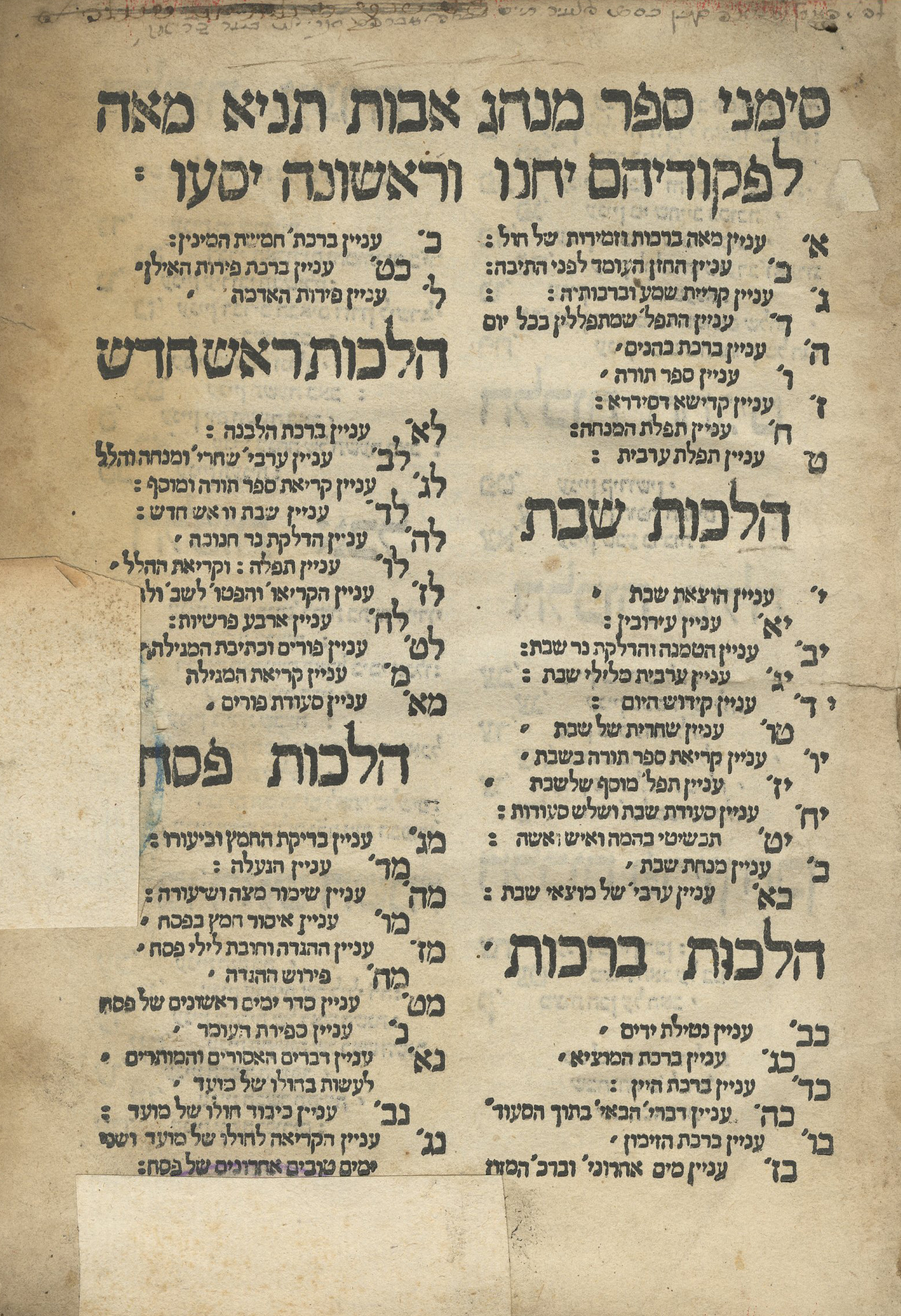
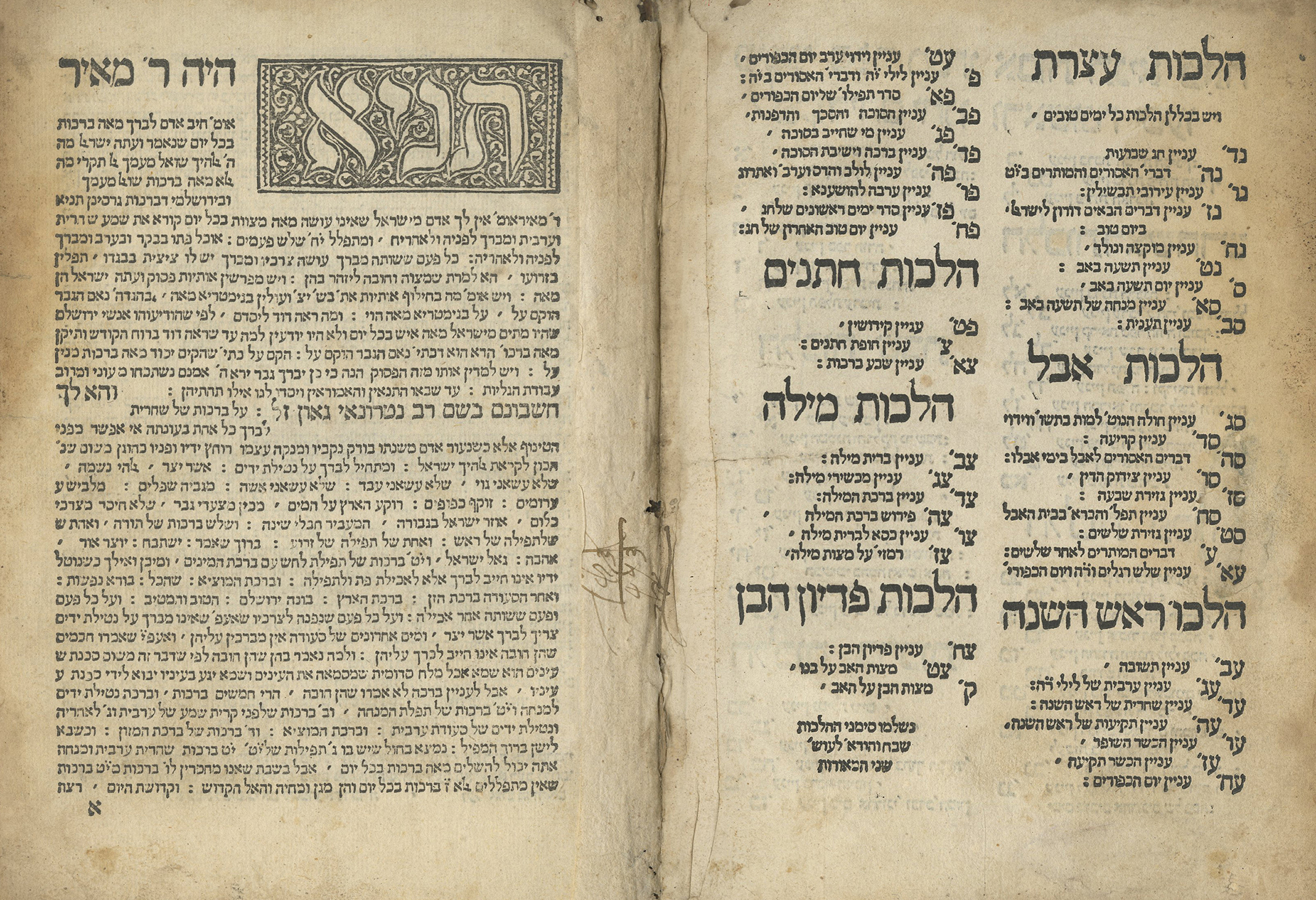
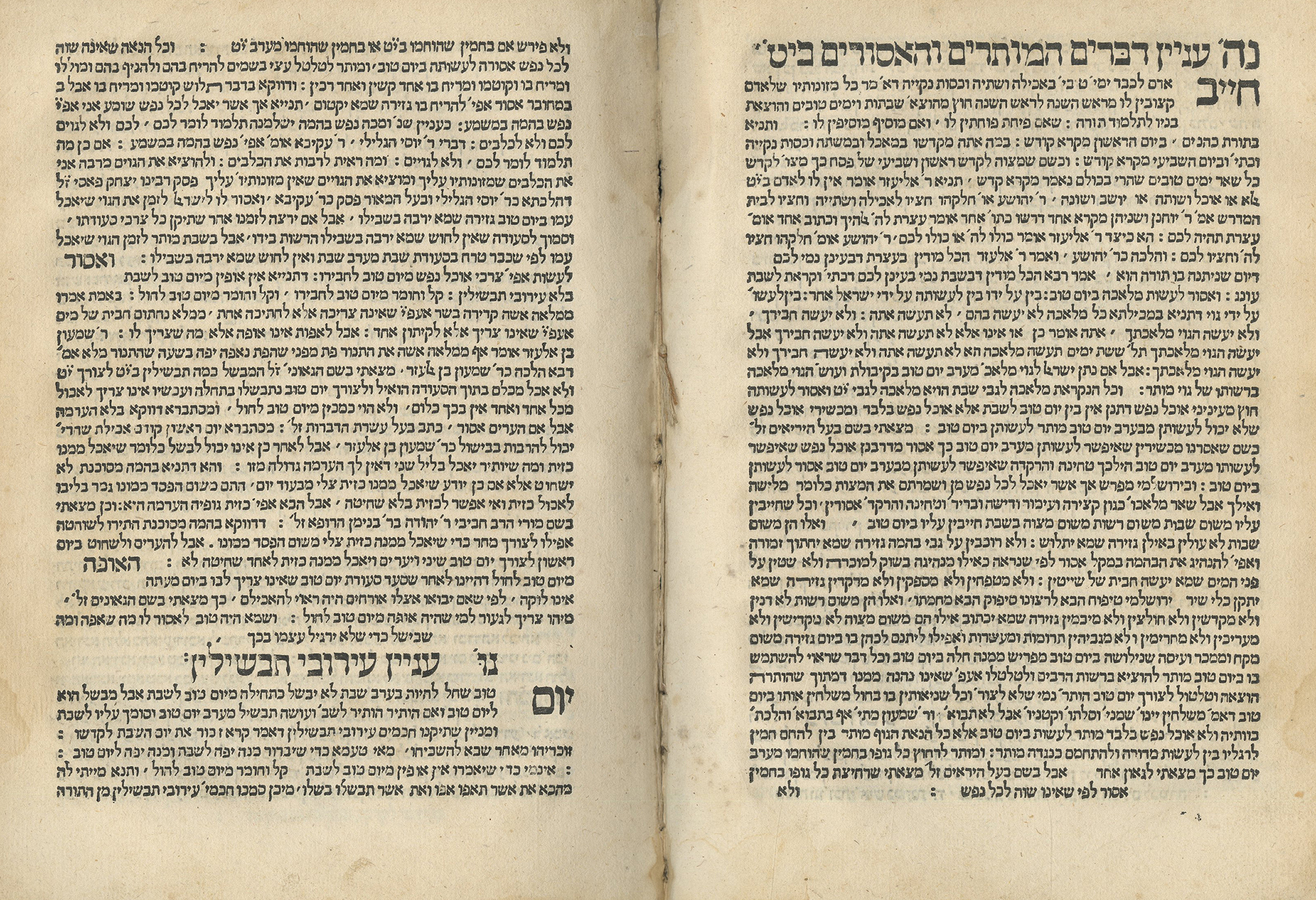
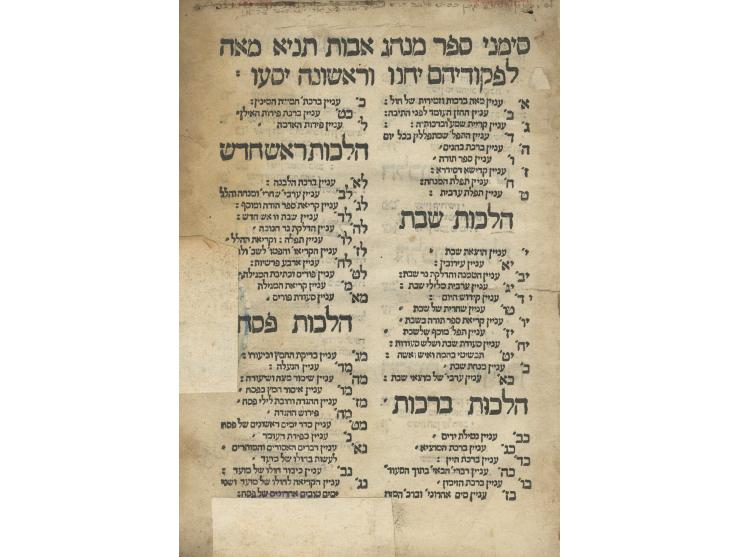
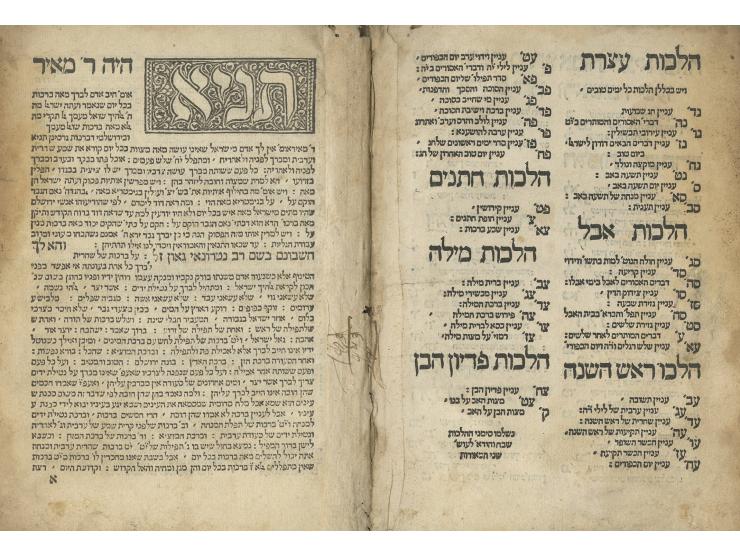
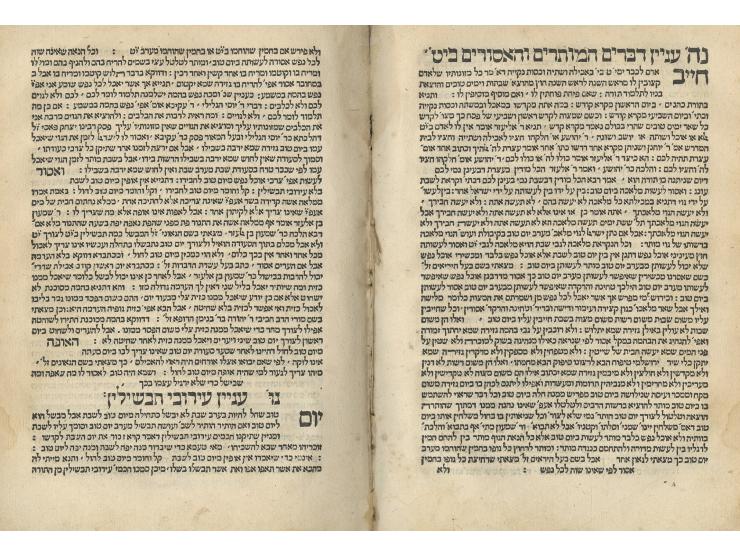
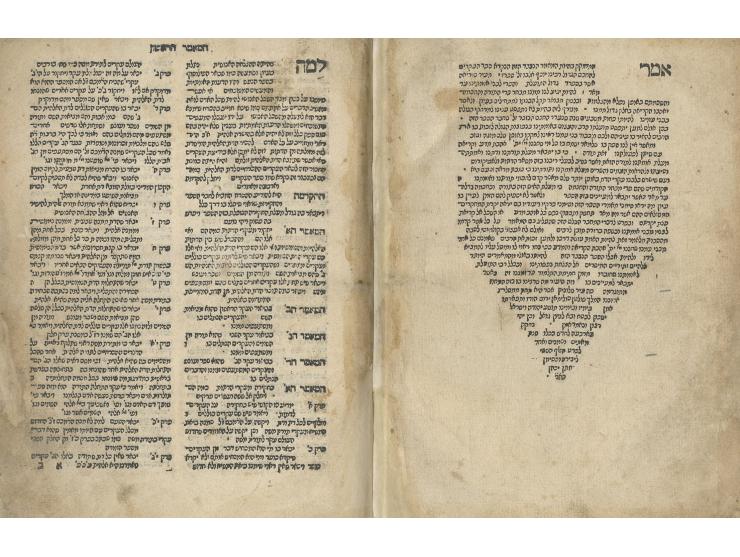
Minhag Avot Tanya, customs and laws, by R. Yechiel son of R. Yekutiel Anav, author of Maalot HaMidot. Mantua: Shmuel Latif, 1514. First edition.
Complete copy, including leaf with table of contents which does not appear in all copies, bound in the present copy at the beginning of the book.
Printed without a title page. Printer's colophon on final leaf, dated Sivan 1514, signed by Shmuel Latif in Mantua.
Tanya is an abridgment of Shibolei HaLeket, with many additions. It was composed as a halachic supplement to the Italian-rite siddur (Minhag Bnei Roma). The book was printed anonymously, but various editions attribute it to R. Yechiel son of R. Asher (the Rosh) and to R. Yechiel son of R. Tzidkiyah. It was reprinted in many editions, usually titled Tanya Rabati or Tanya Rabata.
Ownership inscription in Italian script on first leaf: "Purchased by me, Chaim son of R. Avraham Segre…". Above is another earlier ownership inscription, deleted with ink.
Glosses to several leaves, in Italian script (trimmed).
Censorship expurgations to one leaf (handwritten replacements in margins for some deleted words).
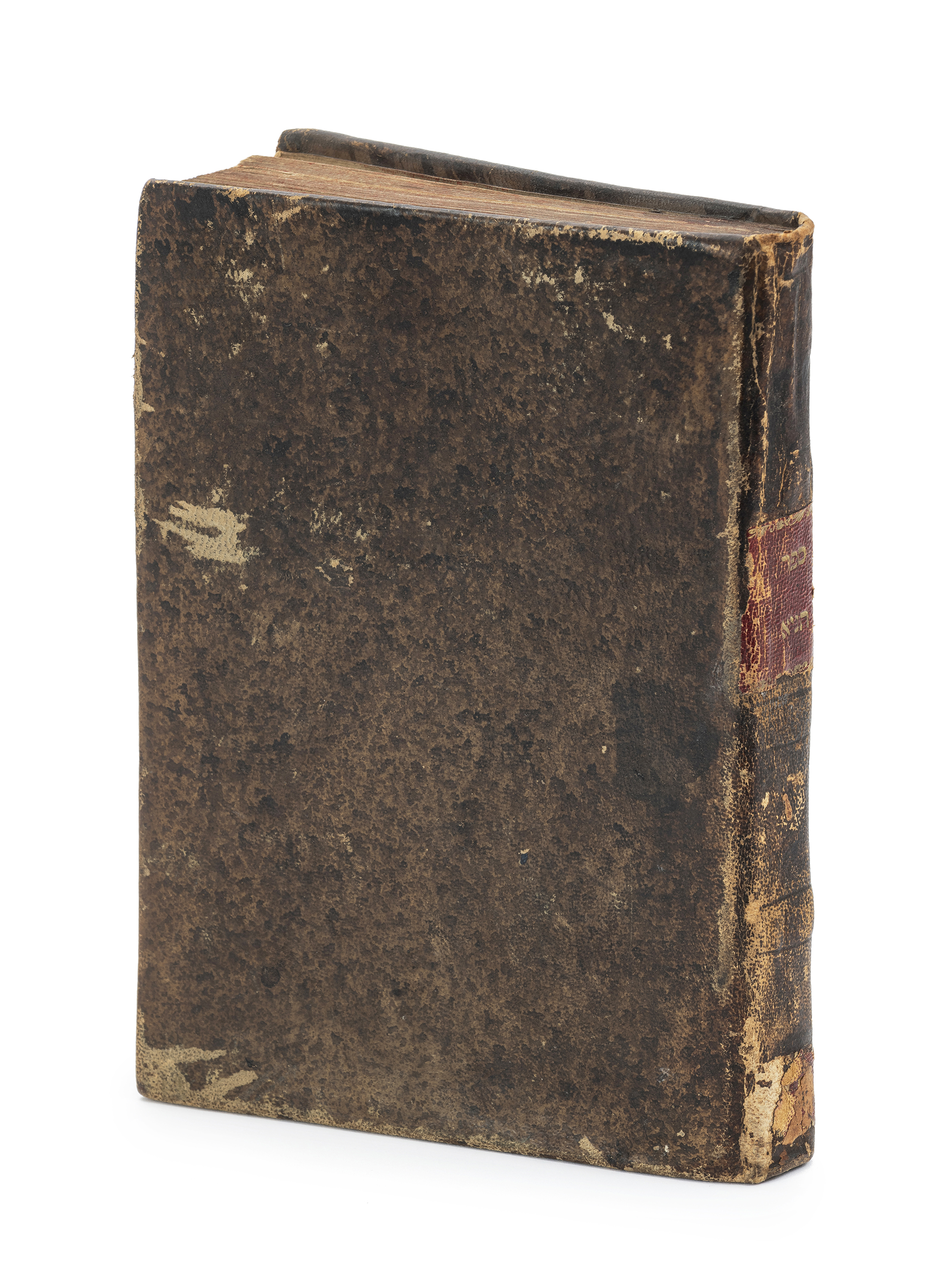
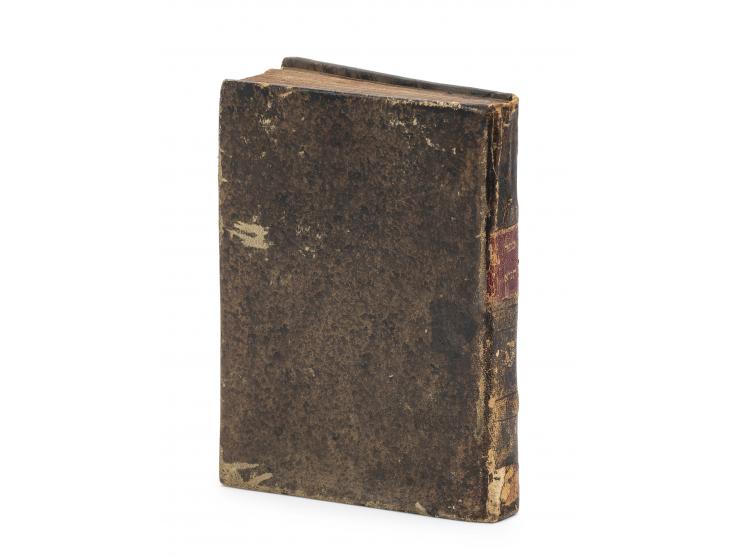
[100] leaves. 19.5 cm. Most leaves in good-fair condition, first leaves in fair condition. Stains, including dampstains and dark stains. Tears, including open tears, affecting text. Worming, partially repaired with paper. Erased stamps on several leaves (some covered by mounted paper strips). Early leather binding. Wear and defects to binding.
On last leaf, signature of censor Domenico Gerosolimitano (paper mounted over part of signature), and signature of censor Jacobus Geraldini, dated 1555.
Category
Incunabula and Early Printed Books
Catalogue Value
Auction 107: Rare and Important Items
Apr 15, 2026
Opening: $8,000
Estimate: $10,000 - $15,000
Sold for: $17,500
Including buyer's premium
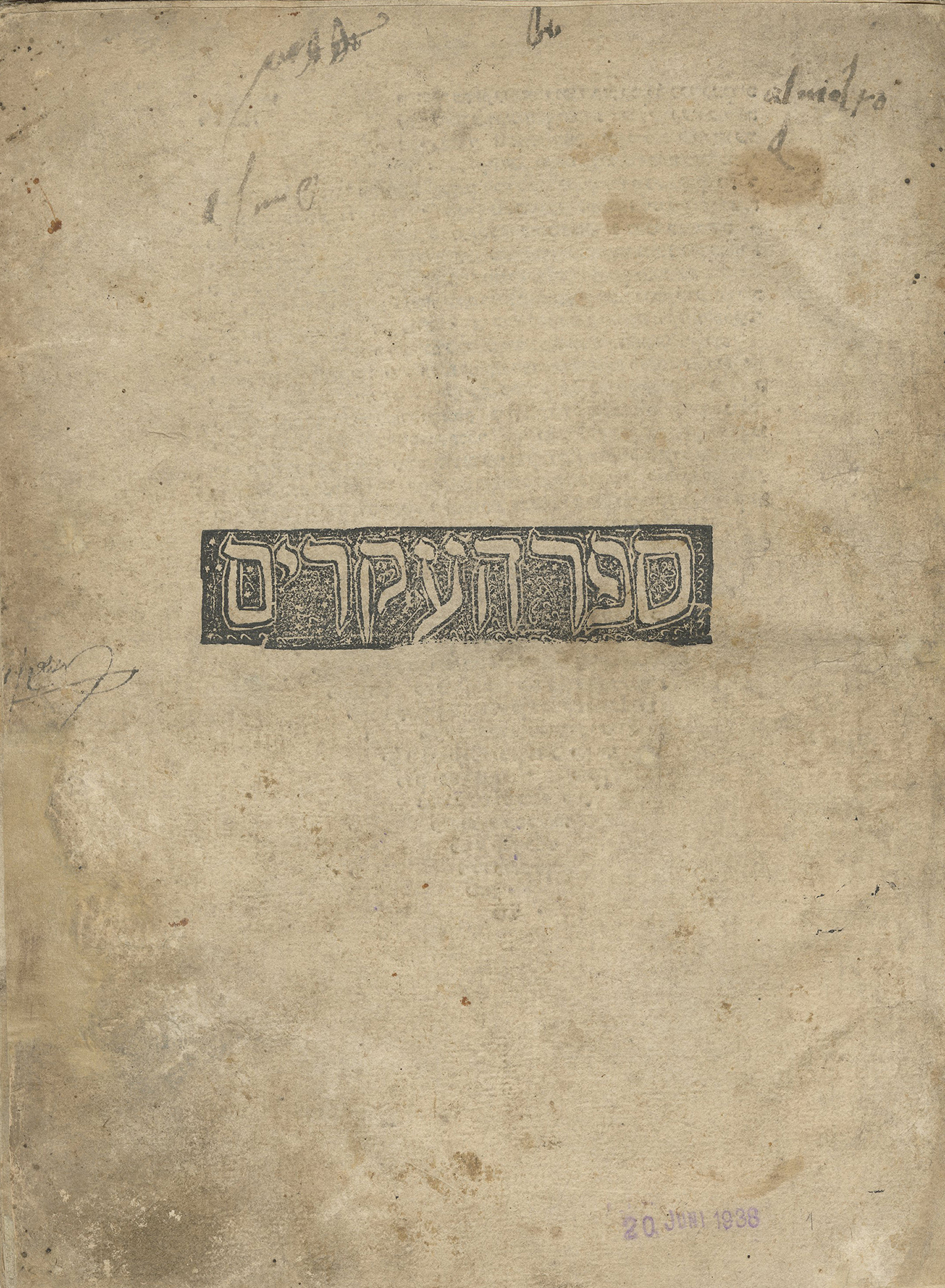
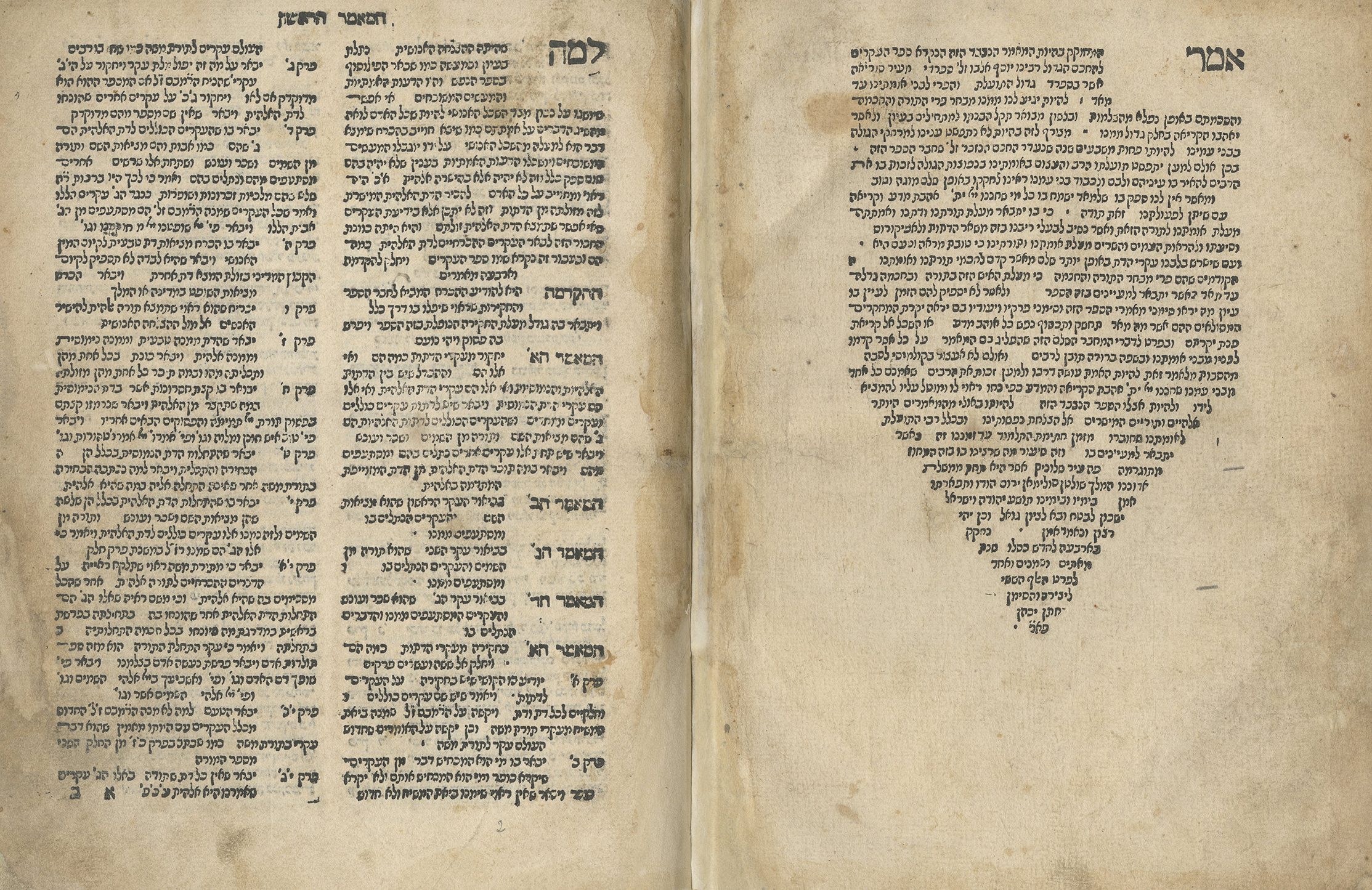
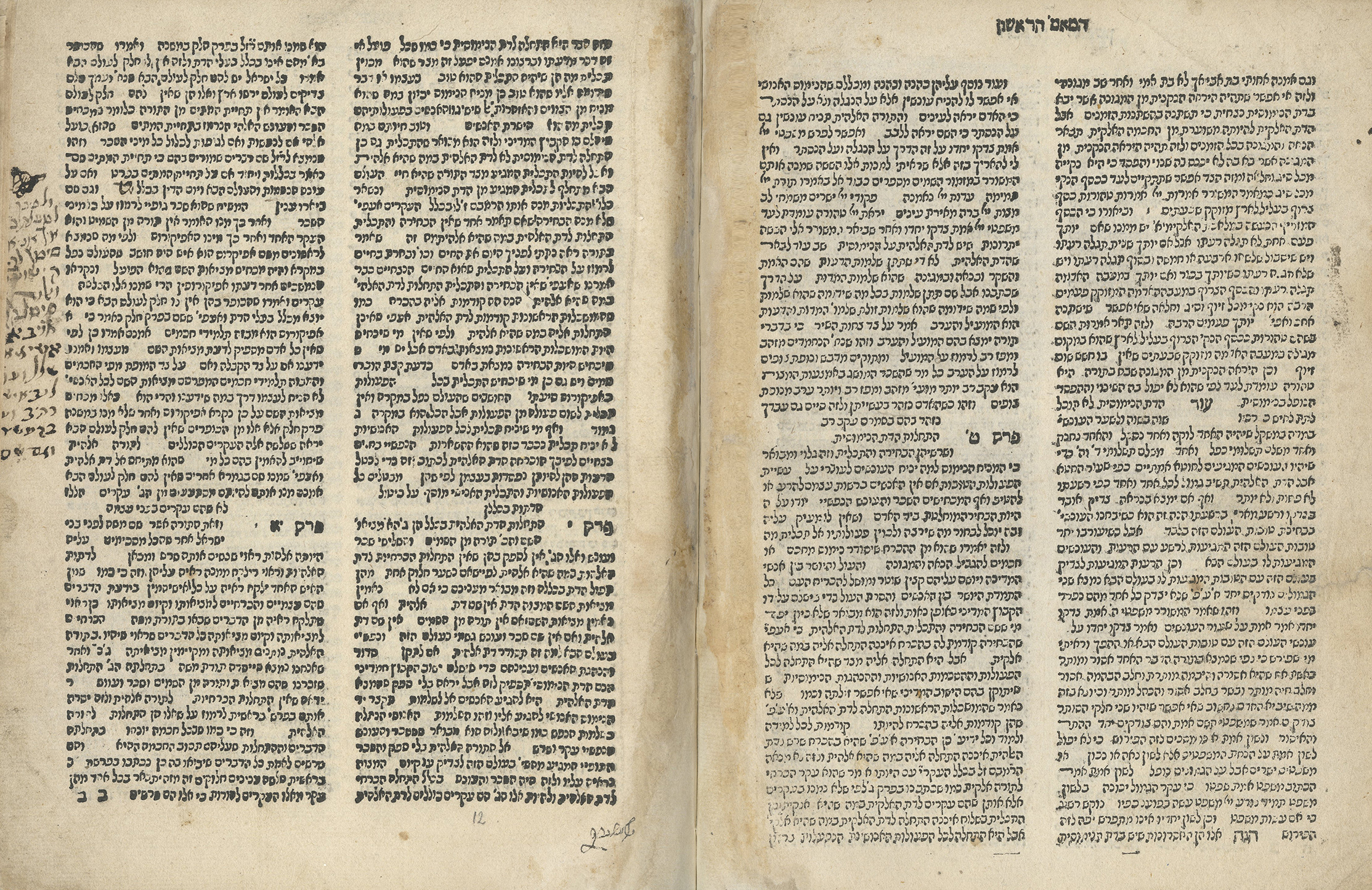
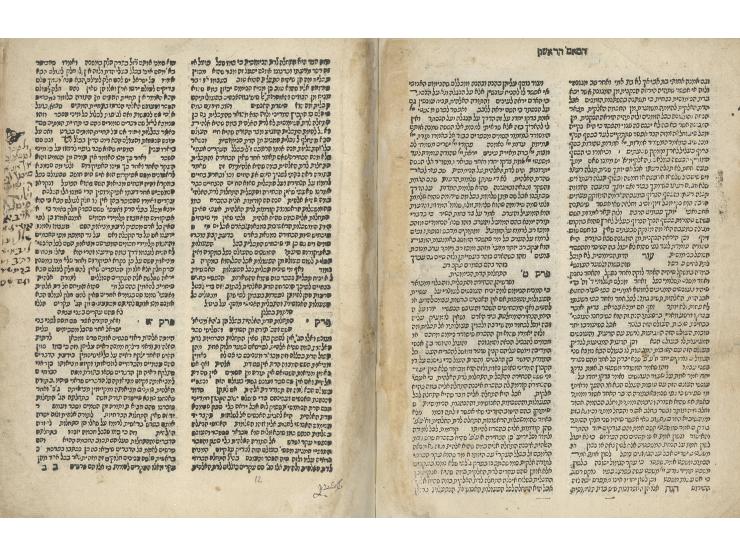
Sefer HaIkarim, principles of Jewish faith, by R. Yosef Albo. Salonika: printer not indicated (see below), 1520.
Fine woodcut on title page featuring title of work, Sefer HaIkarim.
On verso of title page, introduction by printer that appeared in the first edition of the book (Soncino, 1485; see Lot 57), followed by a sort of colophon, with details on location and date of printing of the present edition: "Here in Salonik… typeset on the fourth of Kislev [1520]". One known copy has the last lines with the date omitted.
Another edition of Sefer HaIkarim was printed in 1520-1521, by Daniel Bomberg in Venice. The colophon to Bomberg's edition states that it was printed "a second time", but it does not include a precise date, leaving it unclear whether or not the Venice edition preceded the present edition.
Gloss (trimmed) on leaf [12].
Incomplete copy. [90] leaves (handwritten foliation to margins, inaccurate in part). Original: [100] leaves. Lacking ten leaves from middle of book: [31]-[40] (all of gathering iv). Collation: i-iii10, v-vi10, vii-viii6, ix-x10, xi8. 25.5 cm. Fair-good condition. Stains (dark stains to inner margins). Traces of former dampness on some leaves. Tears and open tears to title page and most leaves (mainly to inner margins), some bordering text, repaired with paper filling. Worming, affecting text, partially repaired with paper filling. Stamp and handwritten inscriptions on title page. New binding.
The identity of the printer is unclear. A.M. Habermann posits that it was printed by Moshe son of Shlomo Soncino (who printed three books in Salonika, 1526-1527, including Yalkut Shimoni), but also casts doubt on the theory (see: A.M. Habermann, Perakim BeToldot HaMadpisim HaIvrim, Jerusalem, 1978, p. 47, and p. 19, note 11).
Especially rare edition. Recorded in the Bibliography of the Hebrew Book based on a copy in the British Library. The NLI catalogue records only a facsimile of a copy from the Bodleian Library, Oxford. To the best of our knowledge, this edition has never before been offered at auction.
Category
Incunabula and Early Printed Books
Catalogue Value
Auction 107: Rare and Important Items
Apr 15, 2026
Opening: $30,000
Estimate: $40,000 - $60,000
Sold for: $87,500
Including buyer's premium
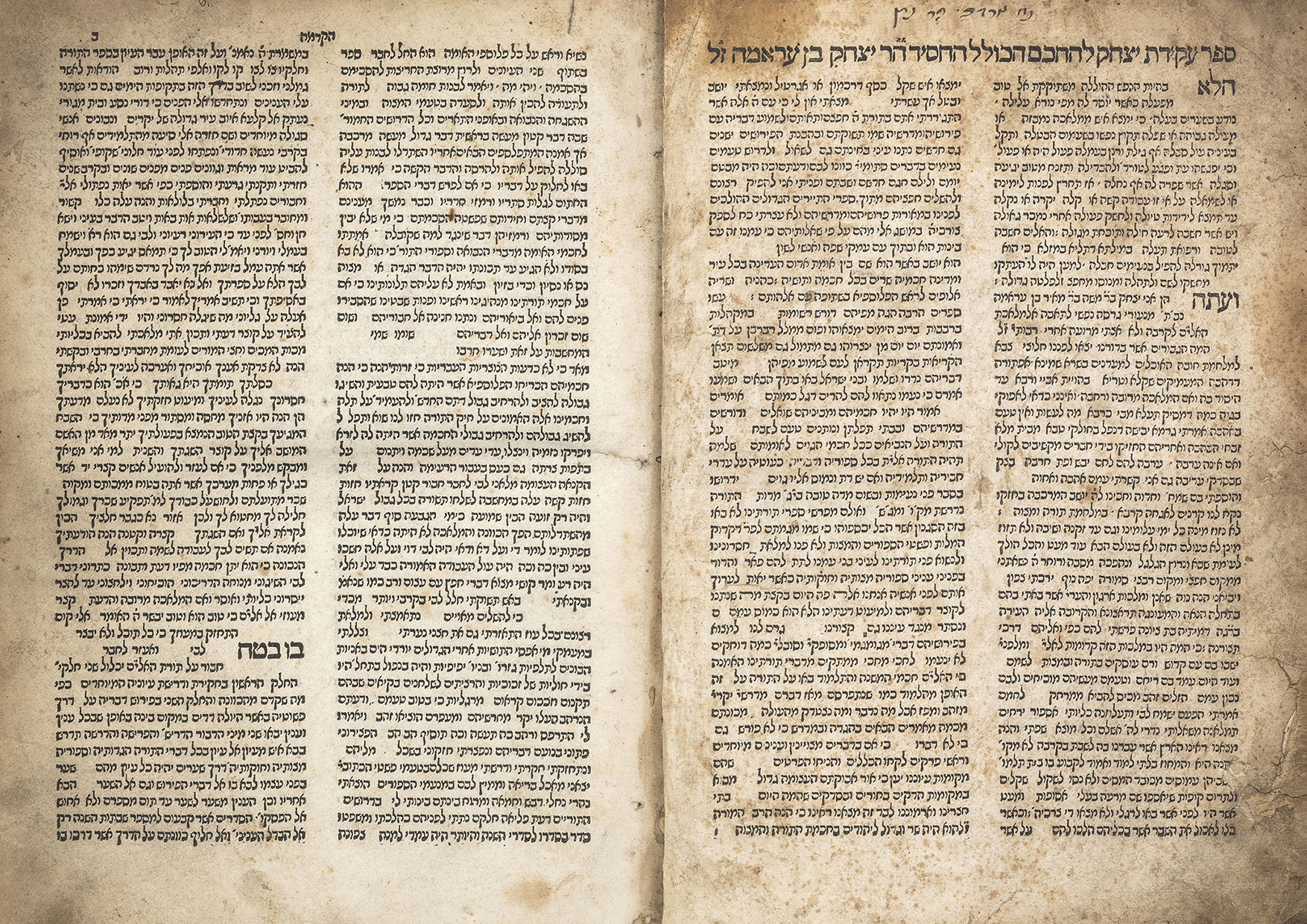
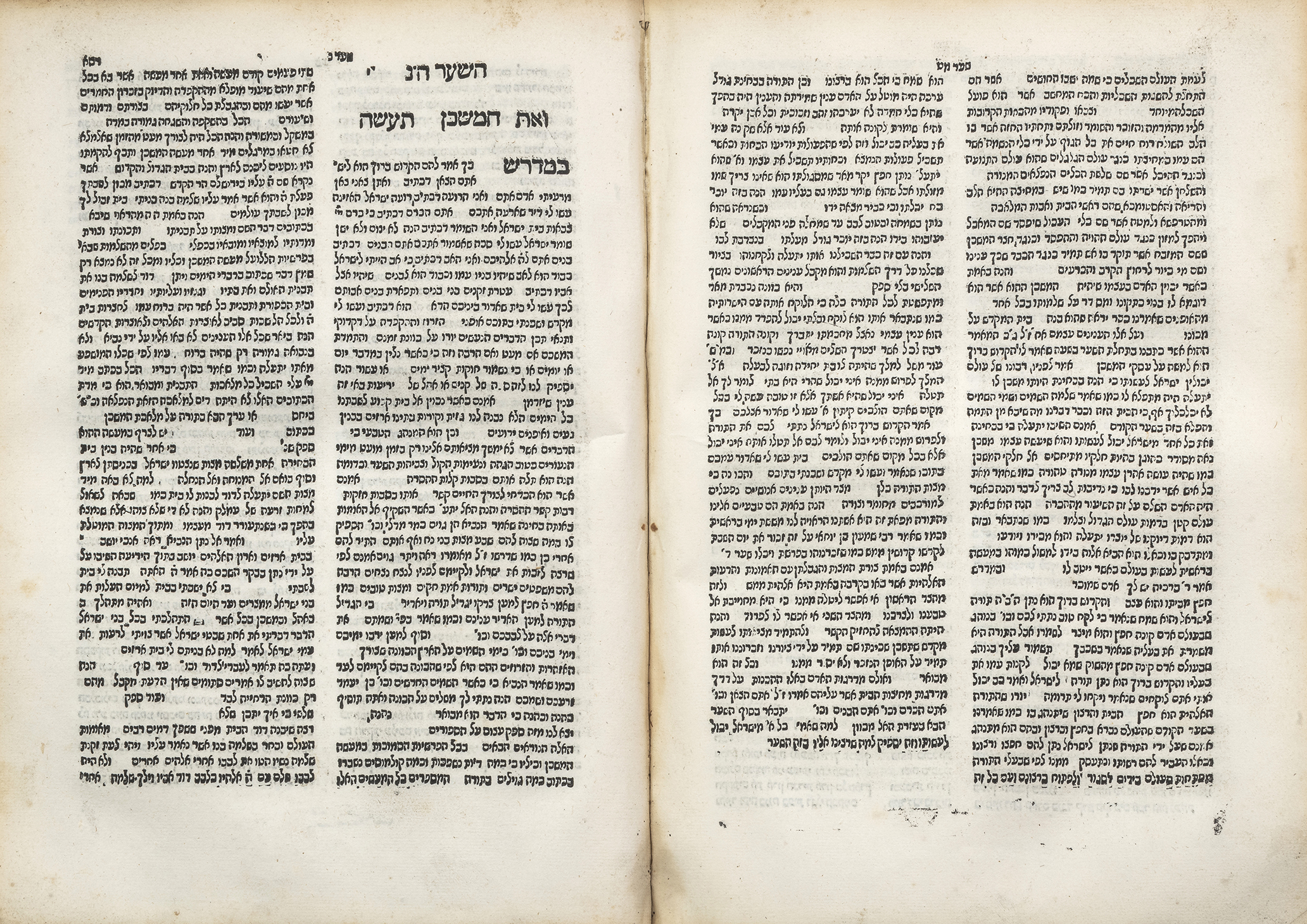
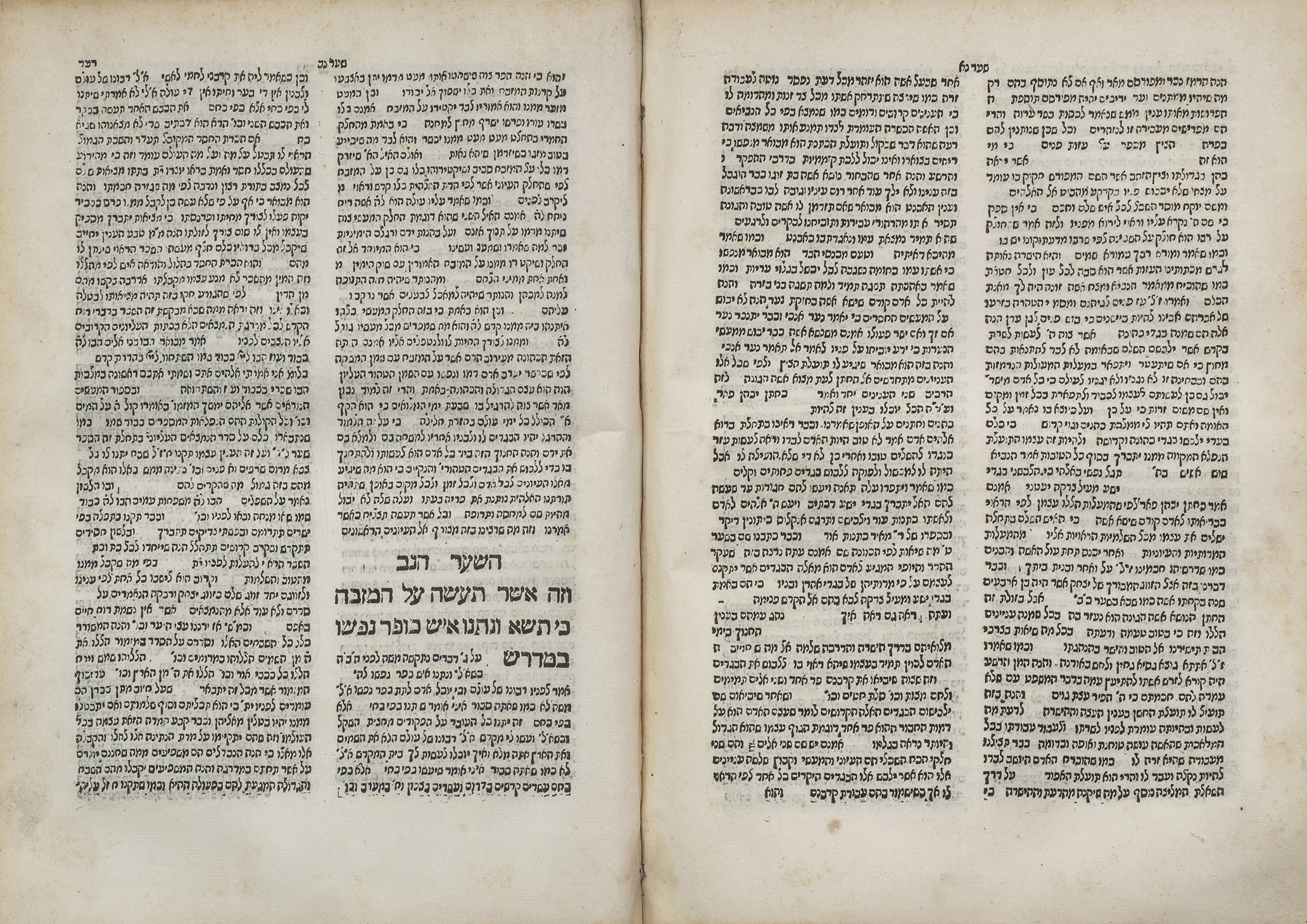
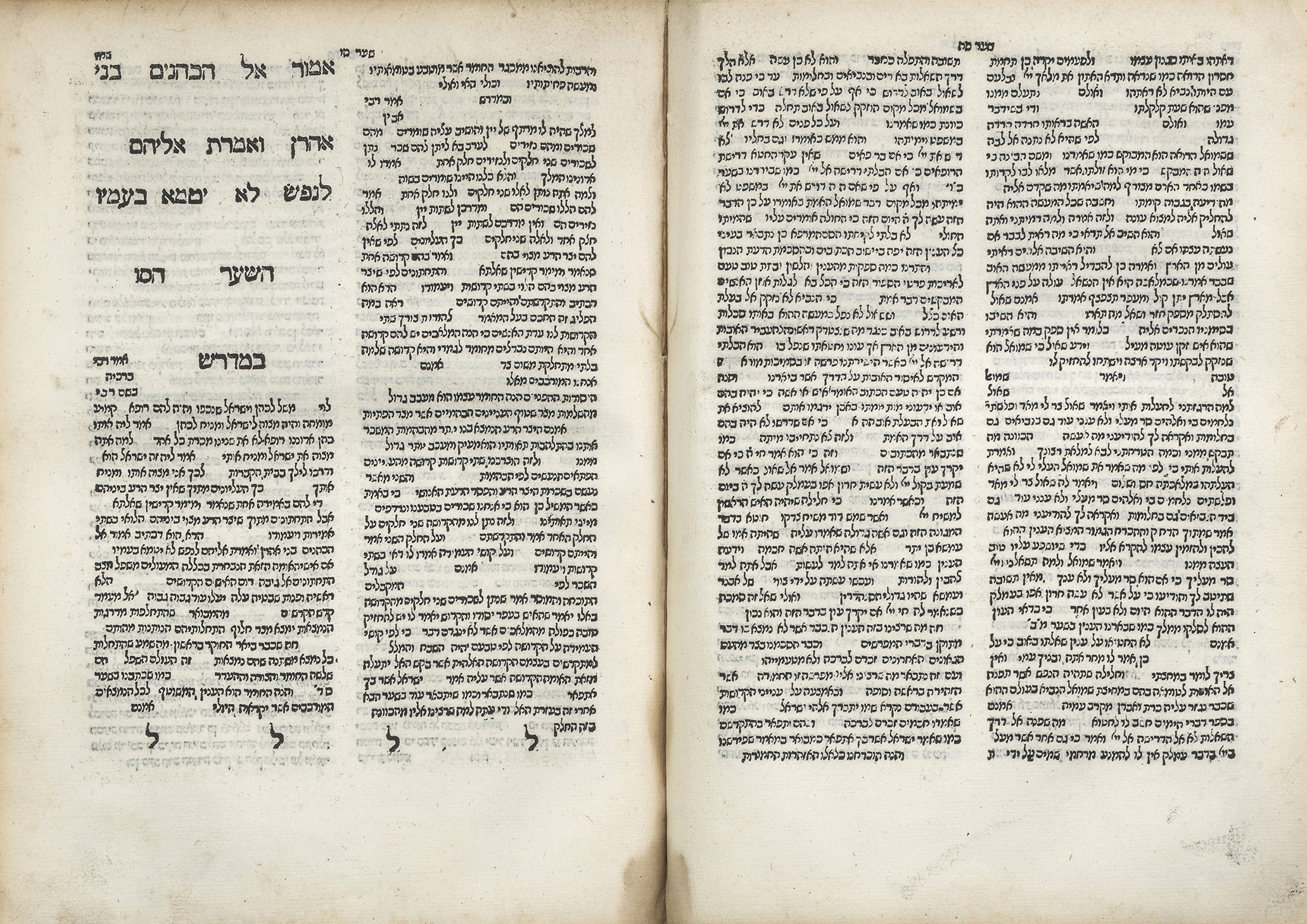
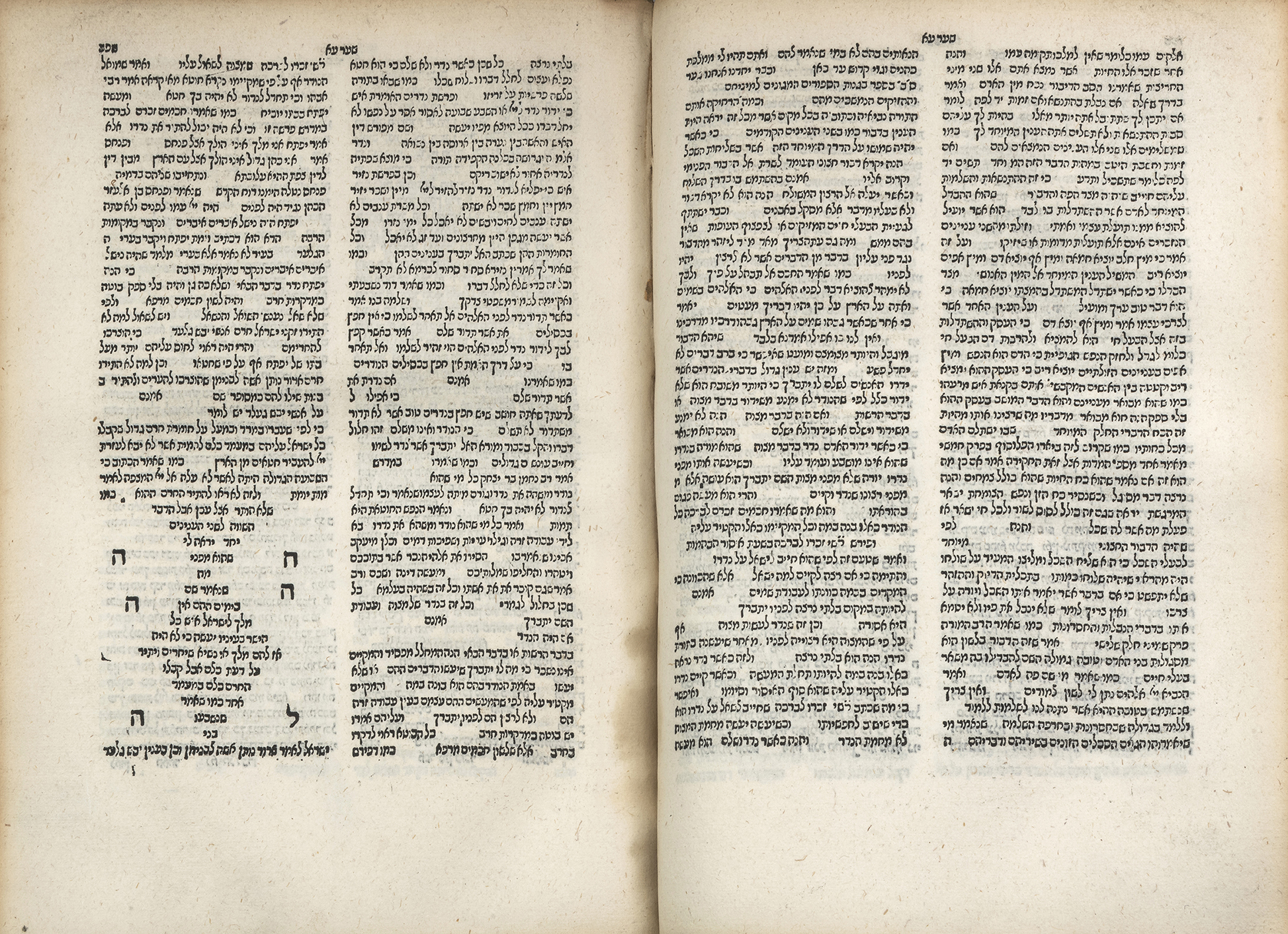
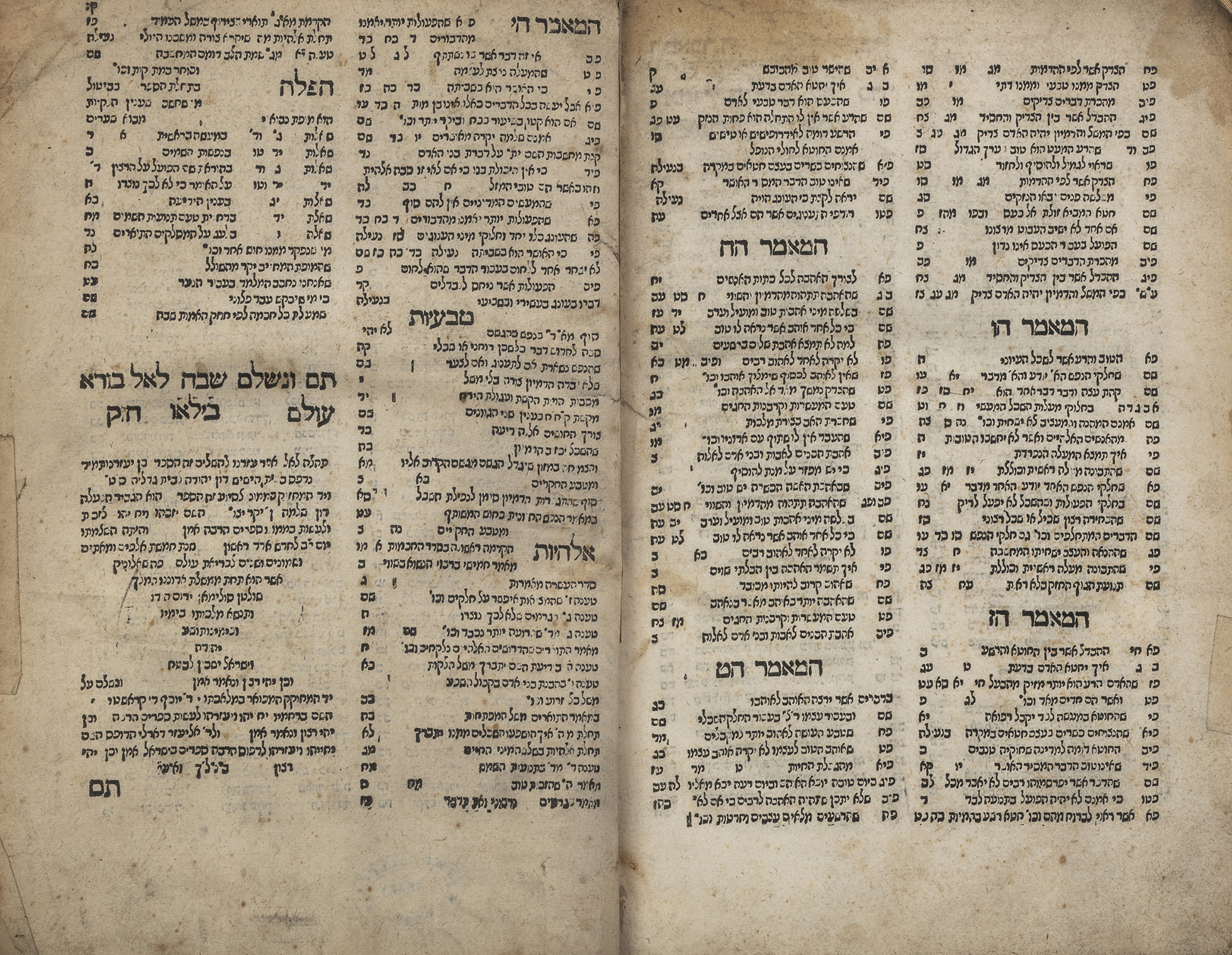
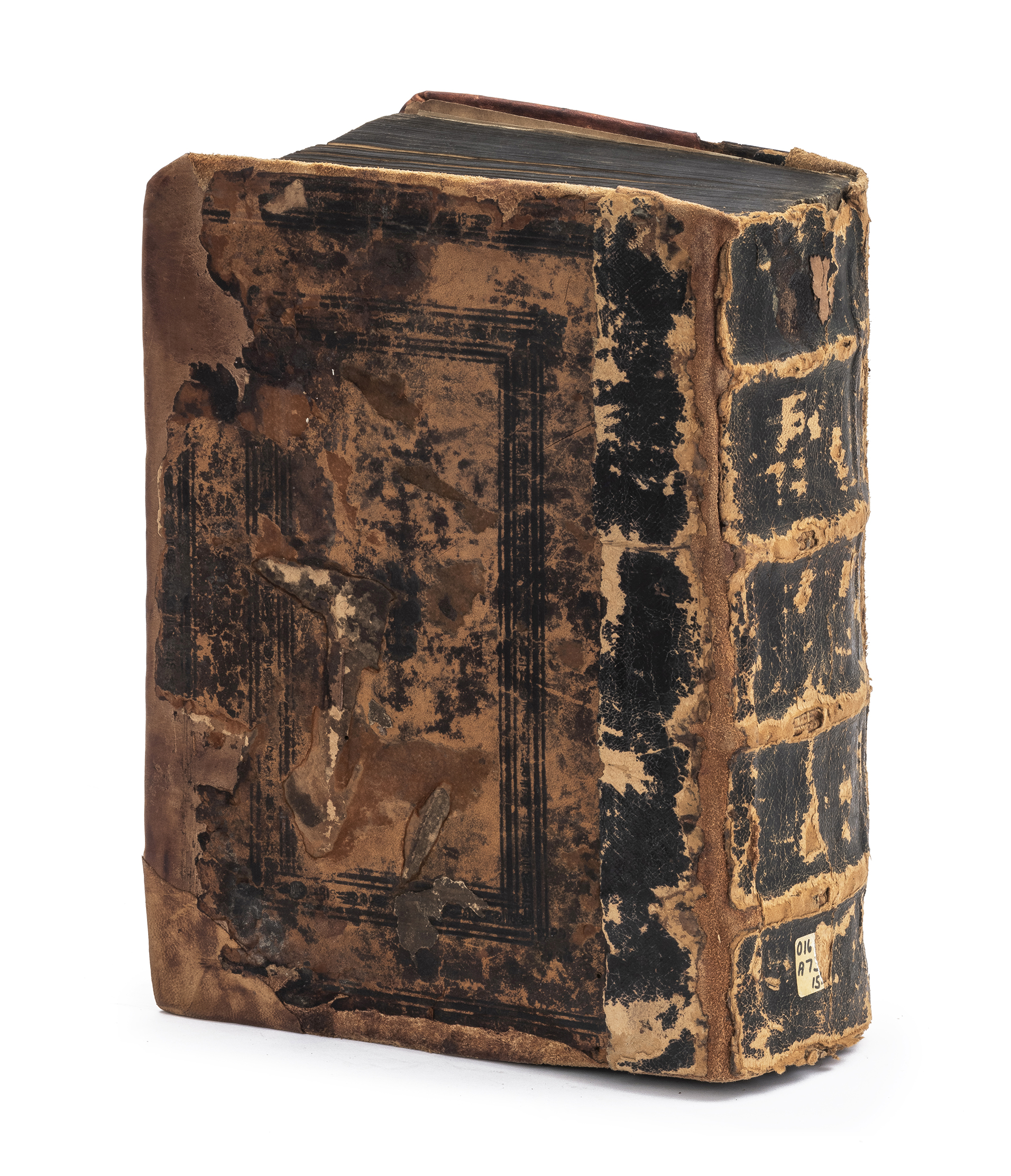
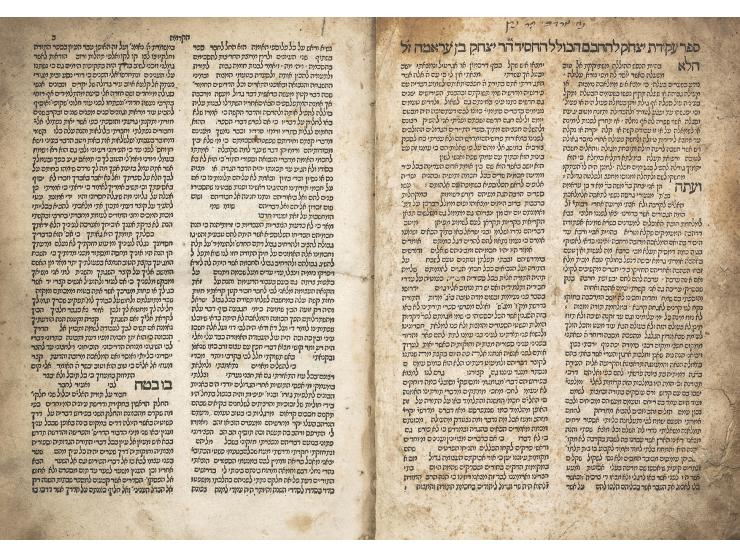
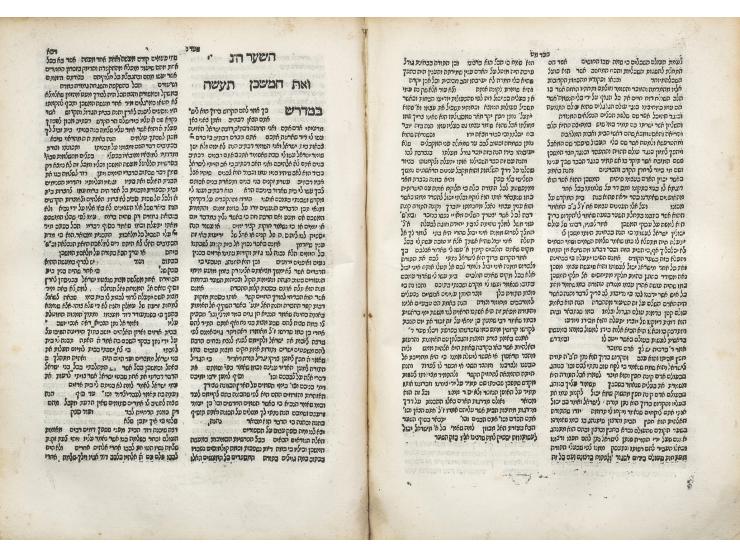
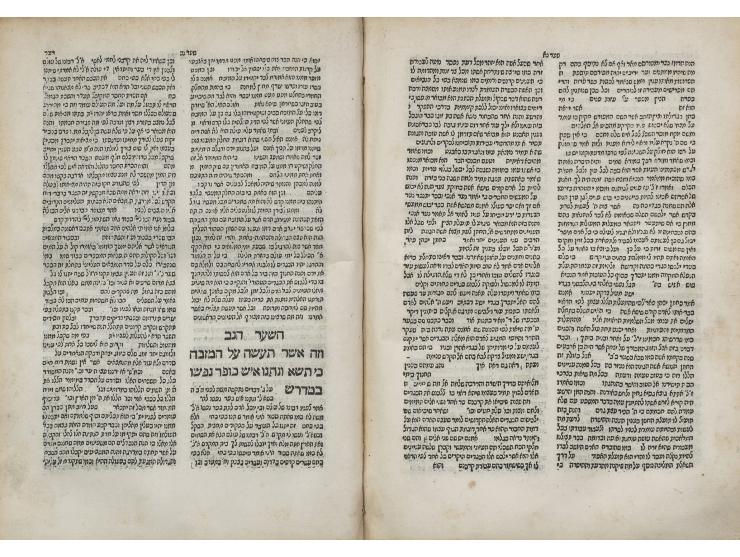
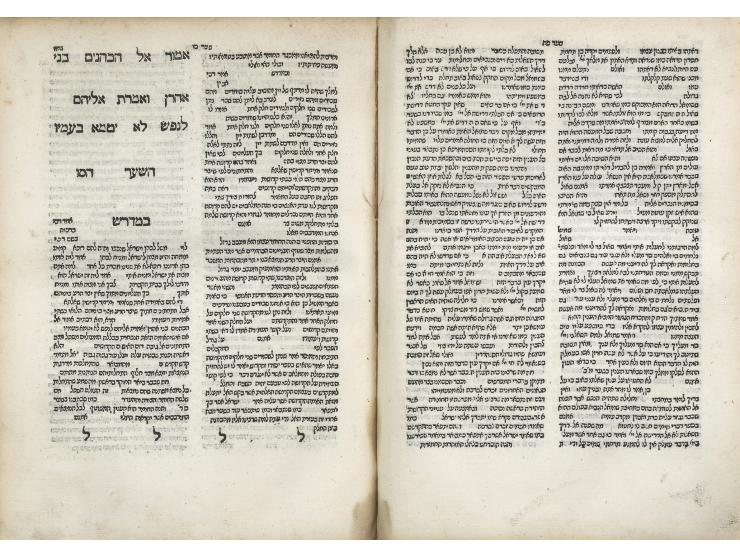
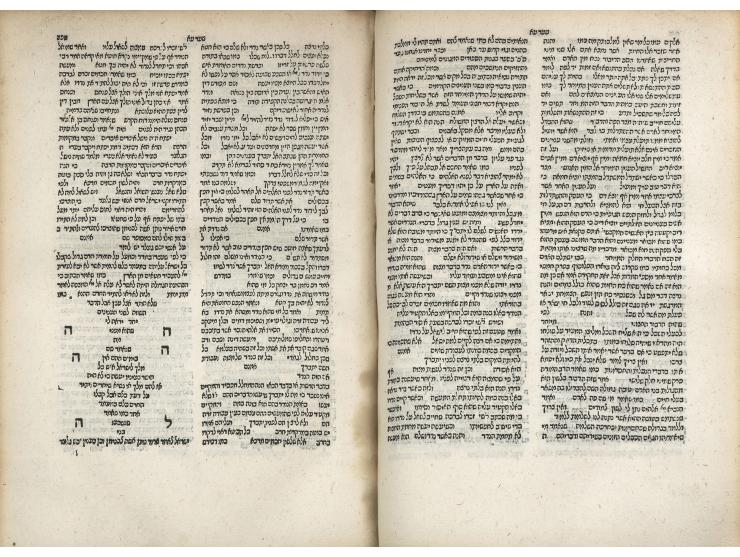
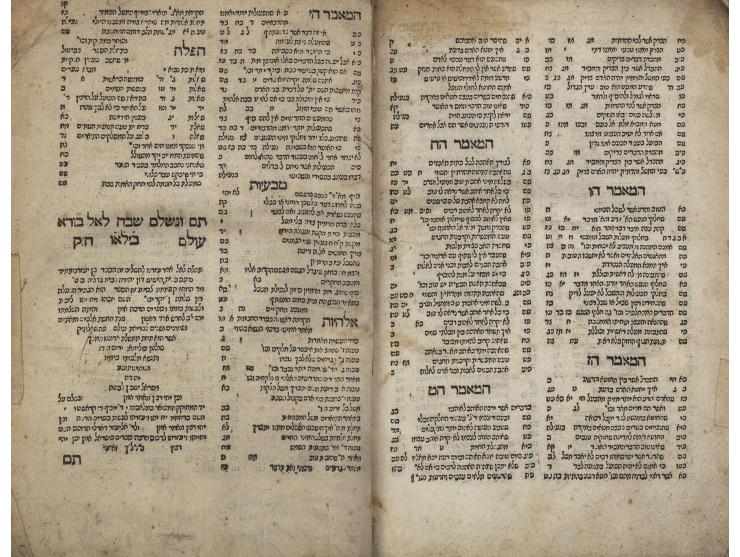
Akedat Yitzchak, commentary on the Torah by R. Yitzchak Arama. Salonika: Yehudah Gedaliah, 1522. First edition.
Elegant full set, two parts in one volume. Printed without title page (first page blank).
The present book is the first edition of Akedat Yitzchak, the celebrated work by R. Yitzchak Arama (1420-1495), a renowned Sephardic rabbi from the generation of the Spanish Expulsion, an orator, commentator and thinker known as the Akedah after his work. Akedat Yitzchak is ordered after the Torah portions, comprising 150 "gates", each of which is composed of three parts: the first with a discussion of a topic in religious philosophy, connecting it to the Torah portion under discussion; the second with a homily on the Torah portion, usually based on a psalm, midrash or Zohar passage; and the third with various comments on the Torah portion presented as questions and answers. Throughout the book, the author quotes the leading Jewish philosophers and commentators, including R. Saadiah Gaon, Rambam, R. Avraham ibn Ezra, R. Bachya ibn Pakuda, R. Chasdai Crescas, R. Yosef Albo and many others. The book also cites philosophers from the non-Jewish world, especially Aristotle's Ethics and Alghazali's Intentions of the Philosophers.
Akedat Yitzchak gained immediate renown upon publication, and was cited at length by his contemporaries. Commentaries have been written on the book throughout the generations, and it remains to this day a focus of study and research.
The book begins with a lengthy introduction by the author: "…I, Yitzchak son of R. Moshe son of R. Meir ibn Arama… ventured to author… a work on the Torah of G-d, comprised of two parts. The first part investigates and exposits its particular topics… while the second part is a commentary of its words according to the simple method… such that each topic will include two modes of speech – exposition and commentary. The expositions are arranged according to the topics of the Torah… in 'gates', with each such topic given its own gate… A related section of the Prophets or Writings will be explained tangentially… And I called the part dedicated to this method Meah Shearim ("hundredfold"), for they increase rather than decreasing… The commentaries begin by noting the difficulties… with the simple meaning of Scripture… so I provide an explanation… whereby the verses are resolved… And I called the part dedicated to this method Be'er Acheret… and I called the book… Akedat Yitzchak…".
Colophon on last leaf: "Praise to G-d Who assisted us to complete this book… Printed at the press of the elder Don Yehudah Gedaliah… and it was completed on 12th Adar I 1522, here in Salonika…".
Last page includes list of gatherings, with first words of first three leaves of each gathering (as an aid for bookbinders).
Signature inside front board: "I, Noach Mordechai son of Natan of Fulda", and more signatures of his in several places. Other ownership inscriptions: "Moshe son of Zanvil Menisht", "Natan Feivel son of Yehudah", and more.
Dedication on endpaper: "A gift sent to my dear friend, the expert physician called Dr. Asten[?] as a souvenir of love, from me, his friend desiring his welfare. May there be peace in his walls in accordance with the wishes of his friend, seeking his welfare, Aryeh Yehudah Leib son of R. Yissachar Ber, dayan" (Hebrew) and "A L Barnett" (Latin) [R. Aryeh Leib Barnett (Lichtenstadt), 1799-1875, dayan and member of the Beit Din of R. Solomon Hirschell in London].
Inscriptions and glosses to margins and within text on some leaves. Lengthy non-Hebrew gloss on one leaf.
Stamps of Jews' College Library on endpaper and last leaf.
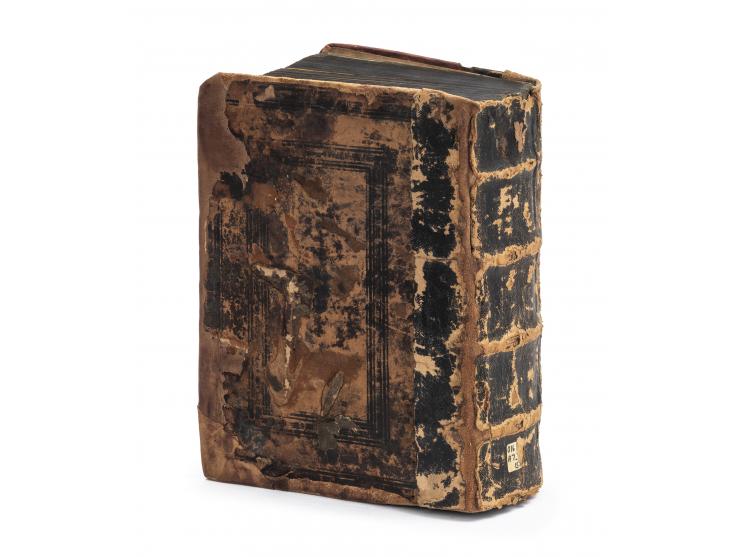
Complete copy, both parts in one volume. Bereshit-Vayikra: 383 leaves. Bamidbar-Devarim: 145, [29] leaves. Misfoliation in both parts. 28.5 cm. Most leaves in overall good condition, first and last leaves in fair condition. Stains, including dark dampstains (many stains to first leaves). Much wear to first and last leaves. Tears, including marginal open tear to one leaf, slightly affecting leaf number, partially repaired with paper. Light worming. Early leather binding, with wear and defects, partly repaired.
On R. Arama and his book, see: Sarah Heller-Willensky, R. Yitzchak Arama UMishnato, Jerusalem 1956, pp. 29-31.
Provenance:
1. Jews' College Library, London.
2. Kestenbaum, New York, 17 December 2002, Lot 3.
Category
Incunabula and Early Printed Books
Catalogue Value
Auction 107: Rare and Important Items
Apr 15, 2026
Opening: $4,000
Estimate: $5,000 - $7,000
Sold for: $7,500
Including buyer's premium
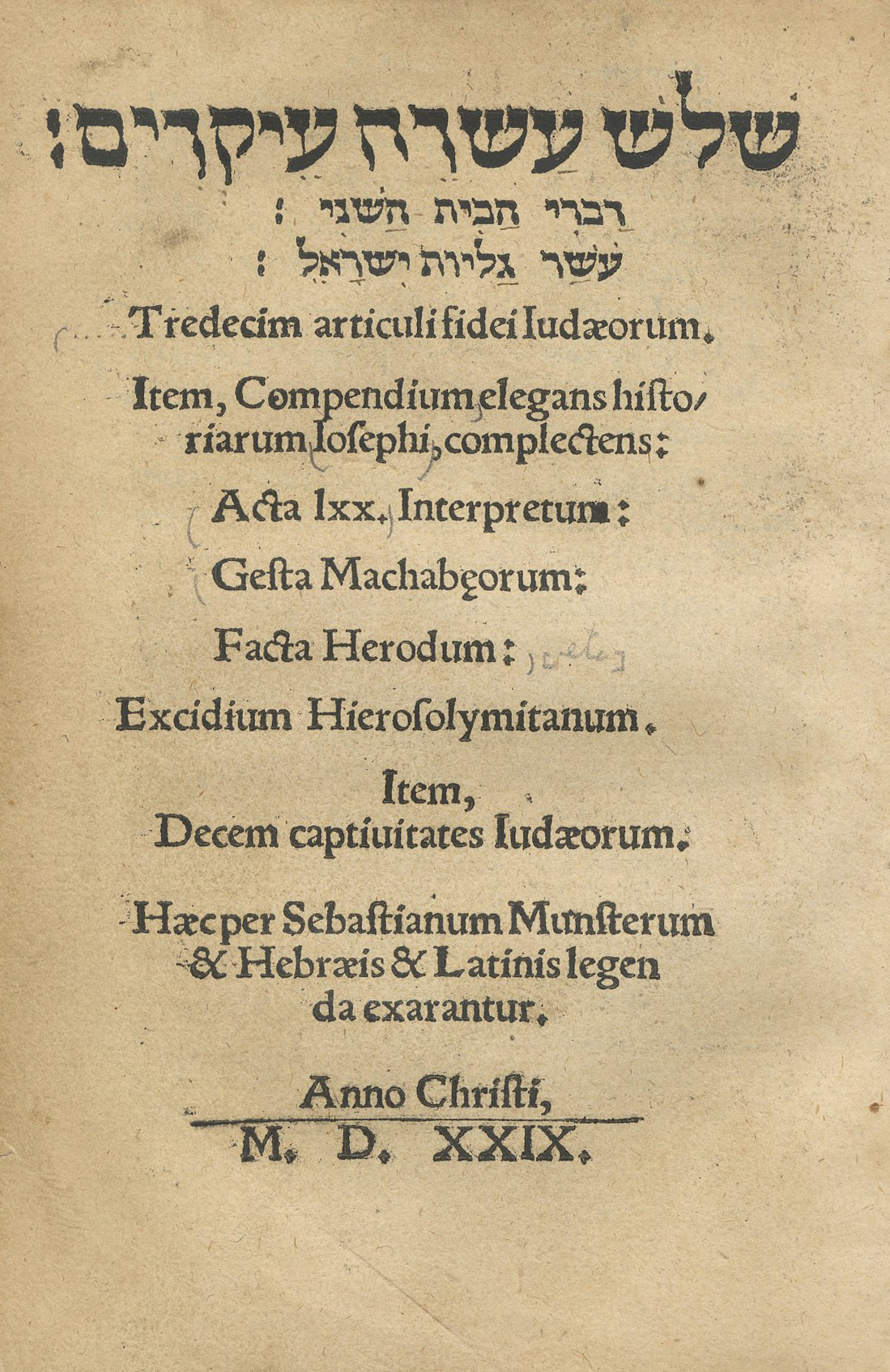
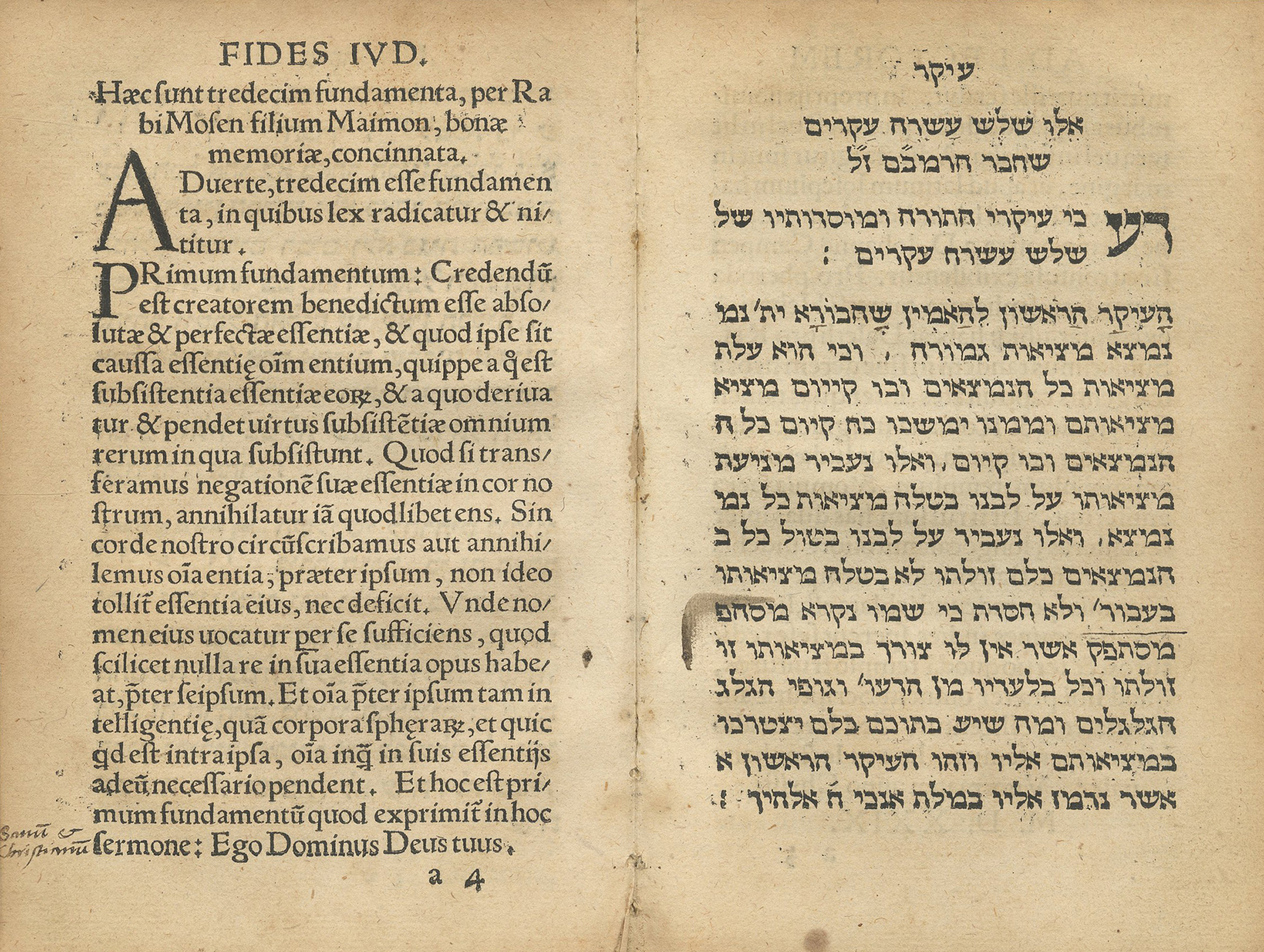
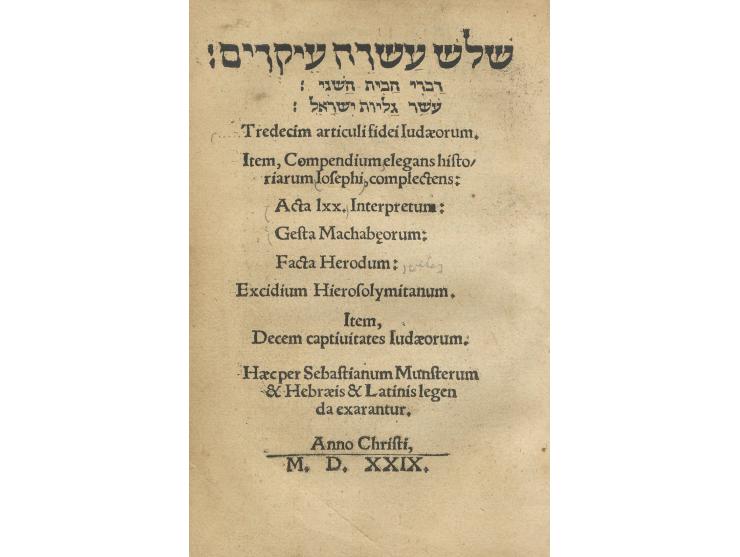
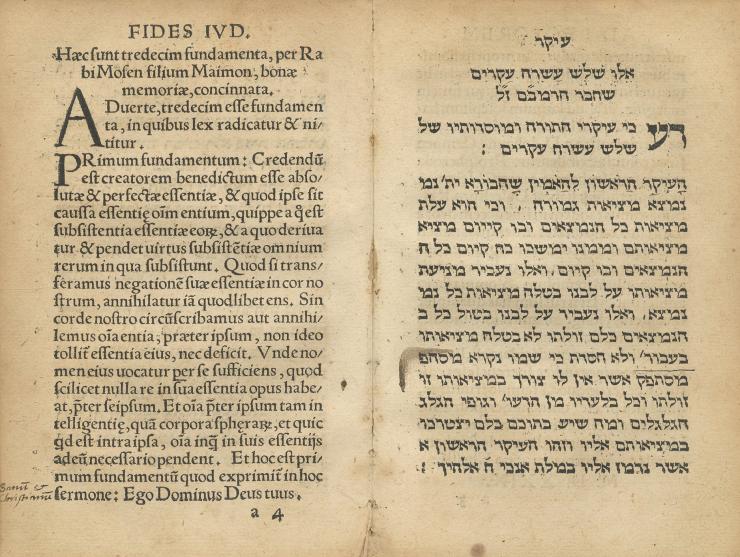
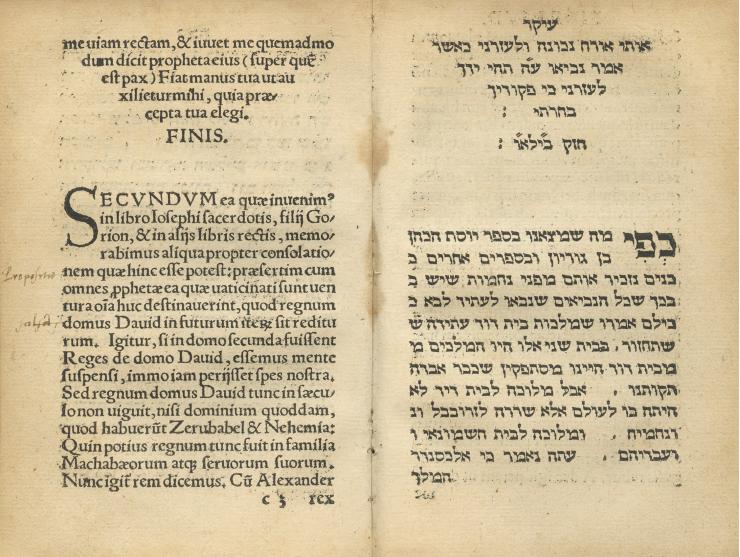
Tredecim articuli fidei Iudaeorum. Item, Compendium elegans historiarum Iosephi… Item, Decem captivitates Iudaeorum [Thirteen Principles of Faith, history of the Second Temple period, and the Ten Exiles of Israel, translated and edited by Sebastian Münster. Worms (Vuormaciae): Peter Schöffer (the Younger), 1529. Hebrew and Latin on facing pages. First Latin edition of the works.
The book begins with an introduction (Latin only) by the translator and editor Sebastian Münster.
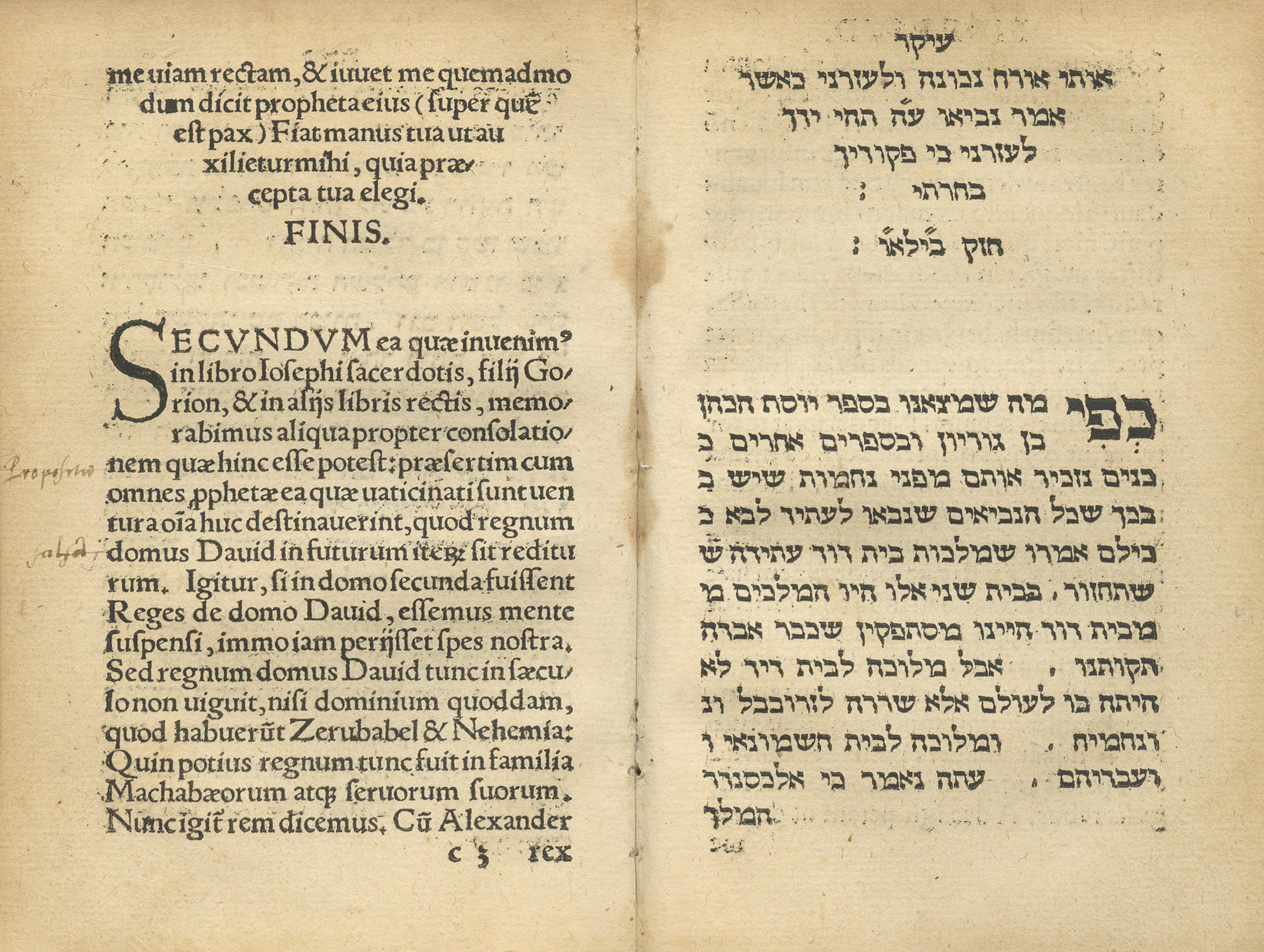
The book is comprised of three different works, with a Latin translation: the Thirteen Principles of Faith by the Rambam (from his commentary to Tractate Sanhedrin); a history of the Jewish kings of the Second Temple period, from Yosifon (text from Sefer HaKabbalah by R. Avraham ibn Daud; page headers in Hebrew and Latin: "Yosef-Iosippus"; this work takes up most of the present volume); and the Ten Exiles of Israel, a history of Israel from the exile of Sennacherib to the exile of Hadrian (based on a midrash cited in Sefer HaKabbalah by R. Avraham ibn Daud).
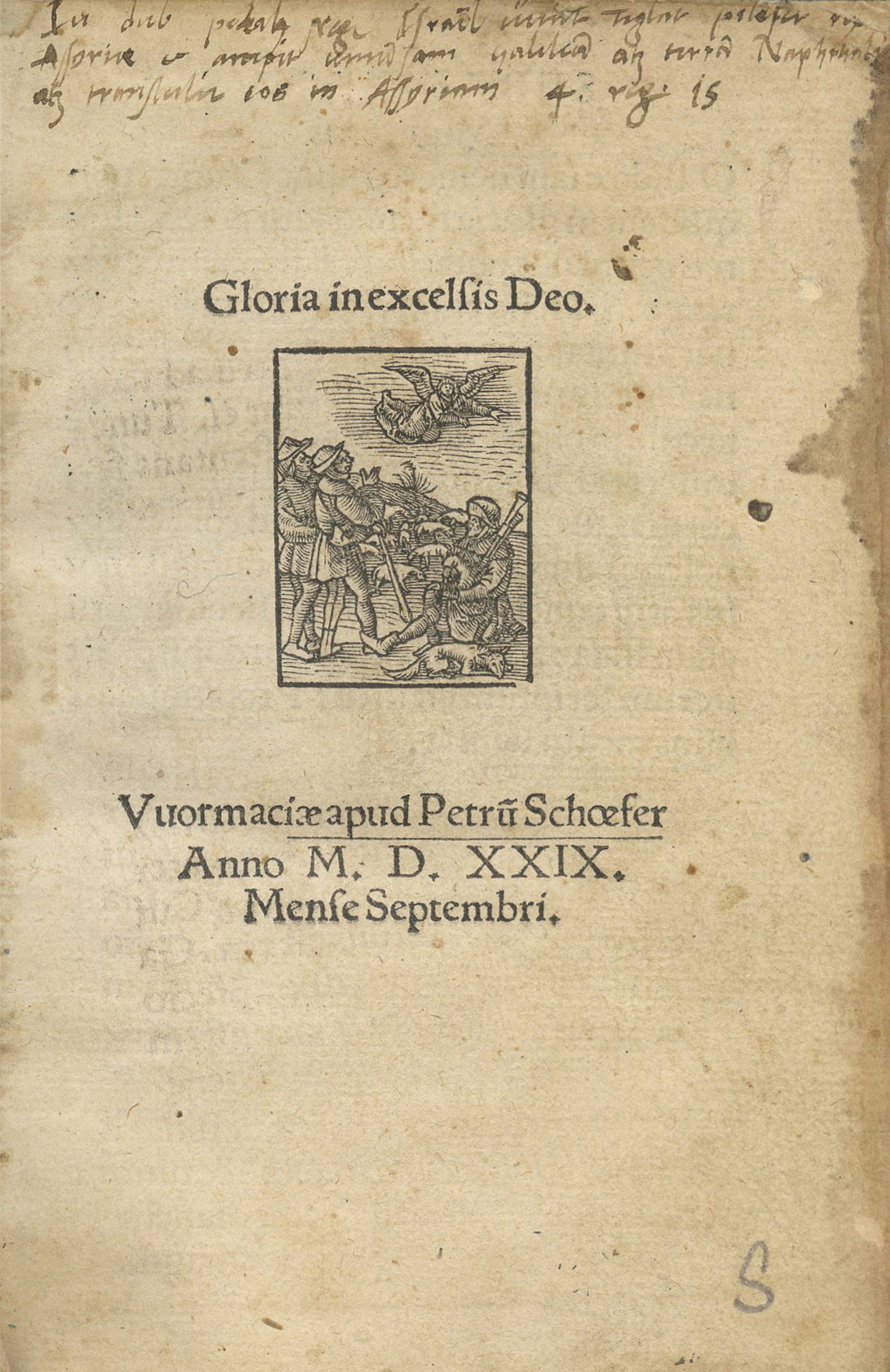
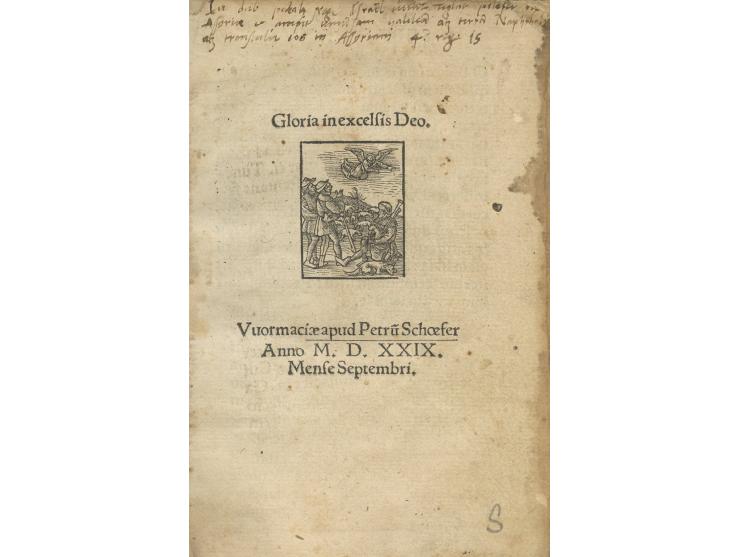
The location of printing is named in a colophon on the last page, featuring Schöffer's printer's device, with a fine woodcut depicting a man holding bagpipes, next to a pair of shepherds and an angel hovering in the sky, captioned above: "Gloria in excelsis Deo" ("Glory to G-d in heaven").
The book concludes with an attack on the Jewish religion by the editor, Sebastian Münster.
Notations and inscriptions within text and to margins of some leaves, as well as on verso of title page and last leaf, in Latin.
On penultimate leaf, stamp (perfin) of General Theological Seminary Library, New York.
[182] leaves. 14.5 cm. Good condition. Stains, including dampstains to inner margins of some leaves. Close trimming, slightly affecting marginal notes, in several places. Original leather binding, front side detached, without spine (wear and defects to binding).
This book was printed by Peter Schöffer the Younger (ca. 1475-1547), son of the famous printer Peter Schöffer, active in Mainz in the early days of printing, printing specialist in Johann Gutenberg's press and his chief assistant.
First Hebrew book printed in Worms (a few other books in Hebrew letters were printed there centuries later).
On the book, and on copies with title page erroneously indicating a different year of printing, see:
• Y. Yudlov, Ginzei Yisrael, no. 1872.
• Karl Heinz Burmeister, Sebastian Munster Bibliographie, Wiesbaden 1964, p.121, no. 163.
• F. W. E. Roth, Die Mainzer Buchdruckerfamilie Schoeffer waehrend des 16. Jahrhunderts und deren Erzeugnisse zu Mainz, Worms, Strassburg und Venedig. Leipzig, 1892, p. 141, no. 15.
Category
Incunabula and Early Printed Books
Catalogue Value
Auction 107: Rare and Important Items
Apr 15, 2026
Opening: $3,000
Estimate: $4,000 - $6,000
Sold for: $16,250
Including buyer's premium
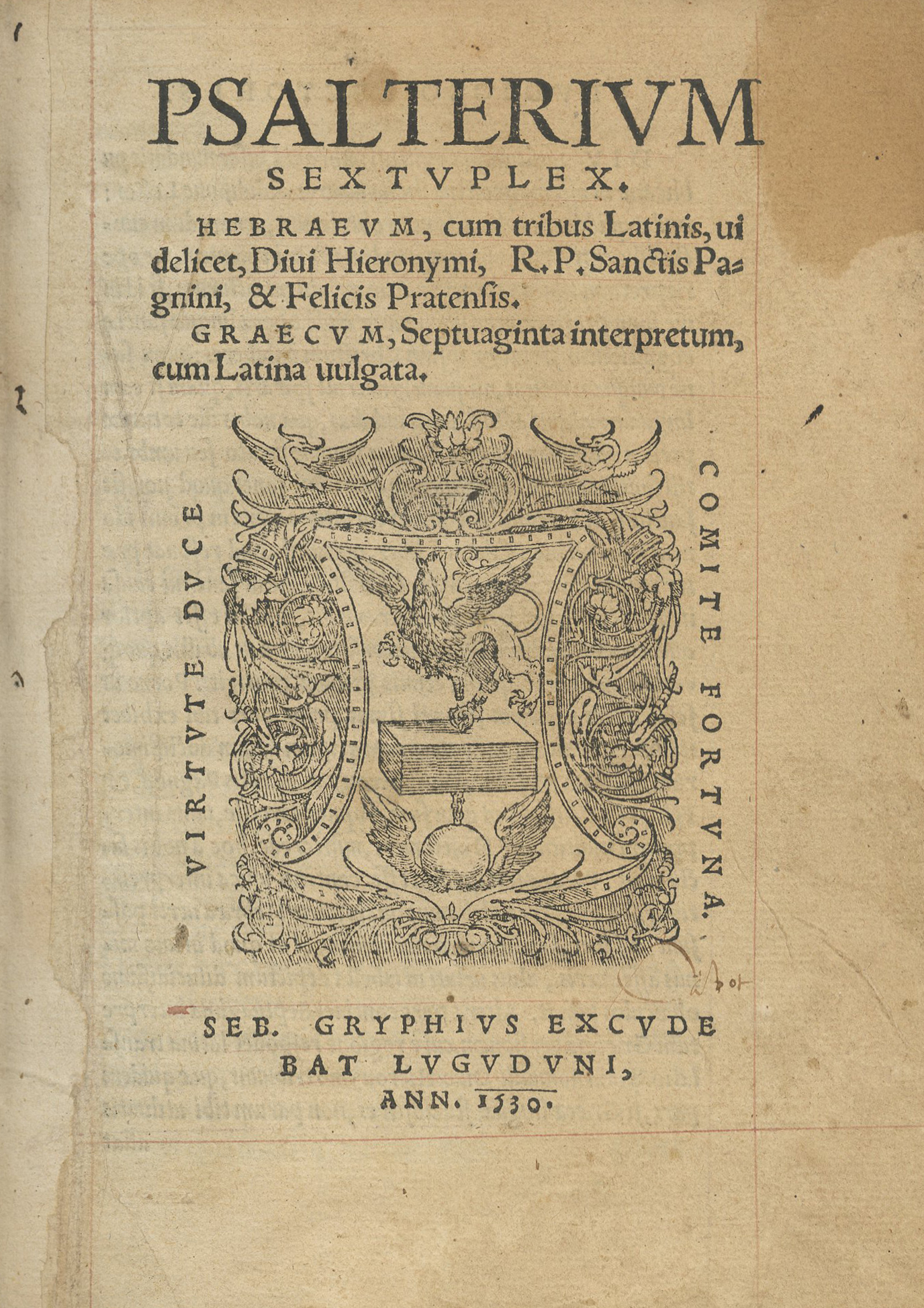
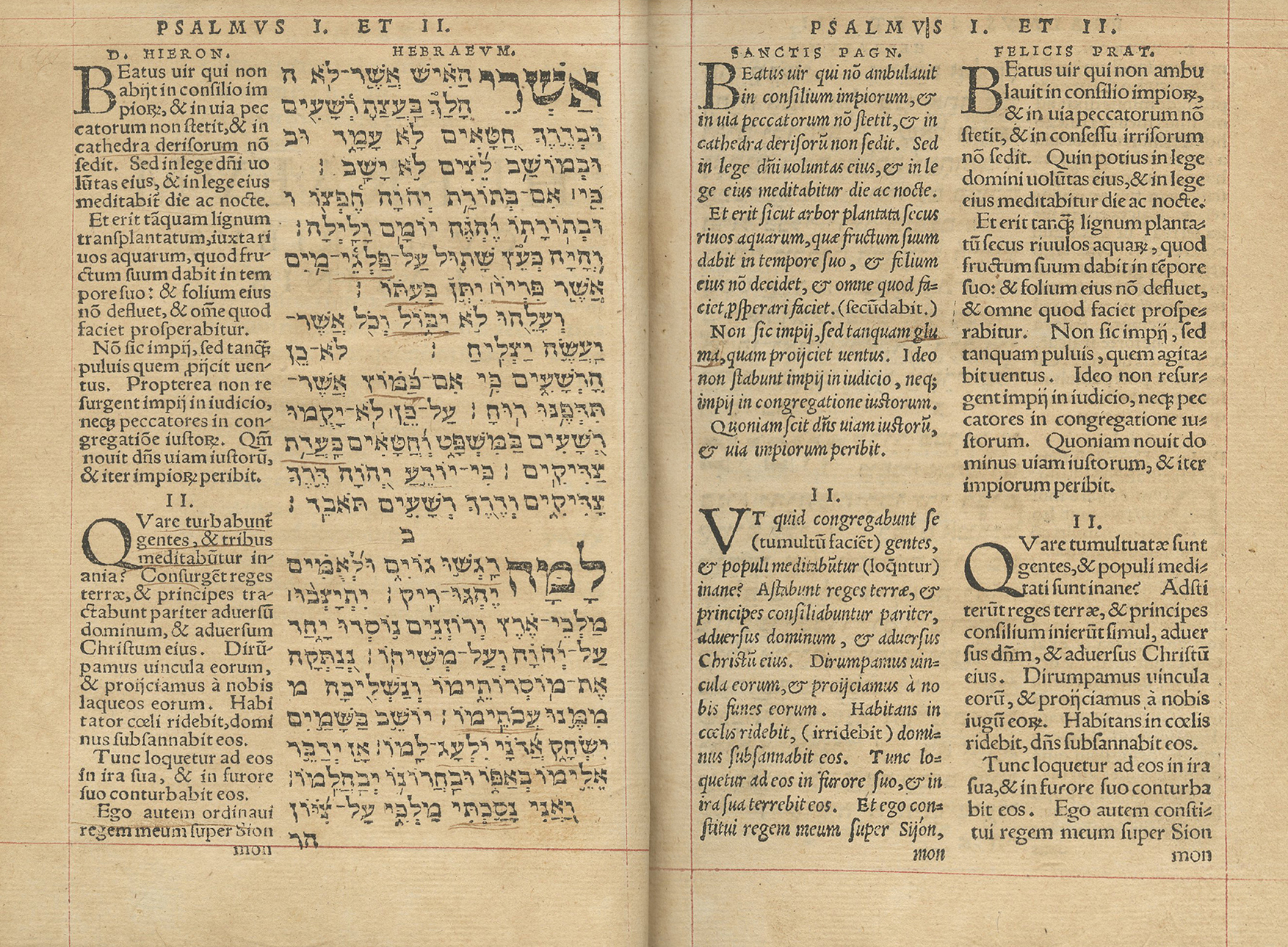
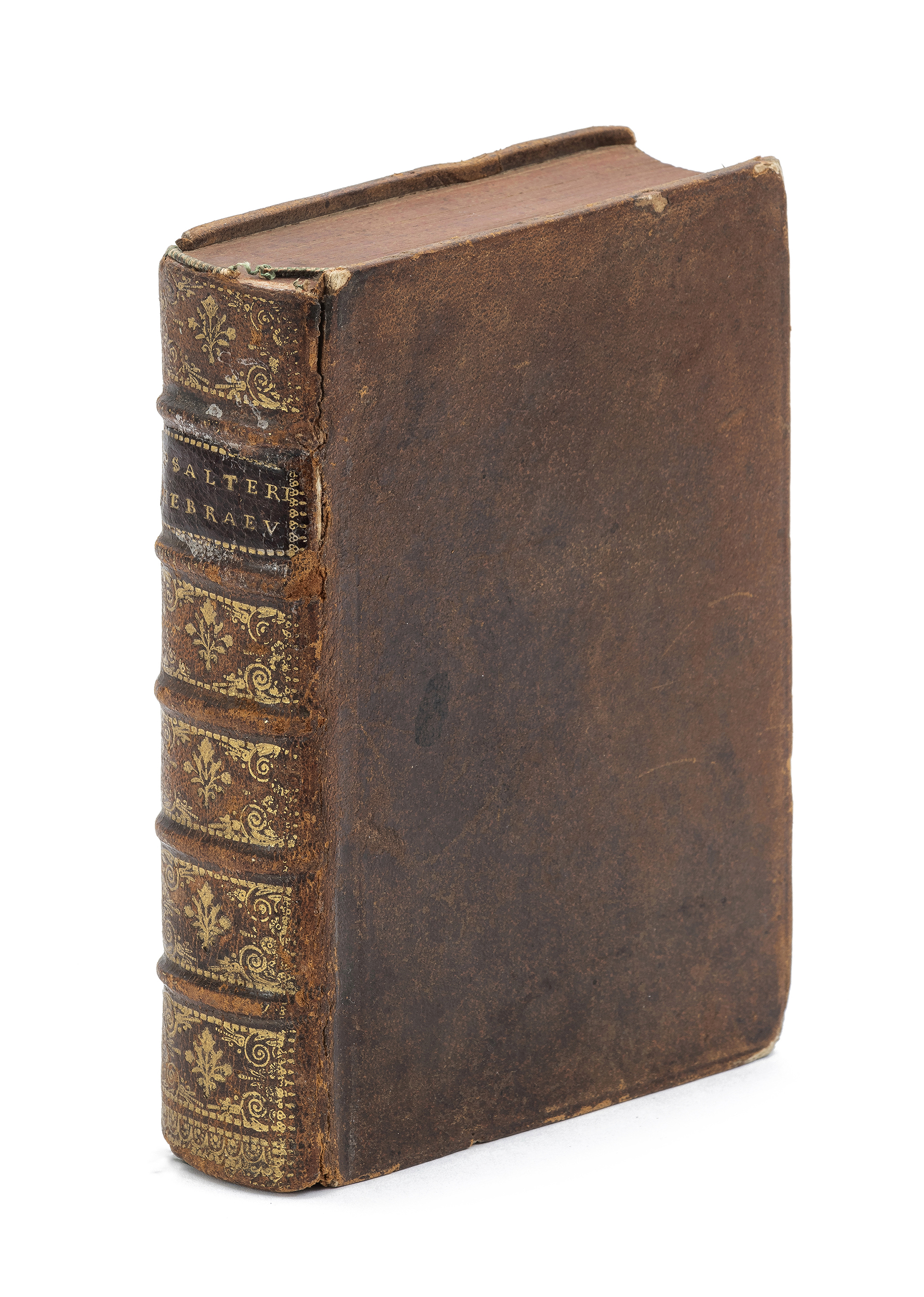
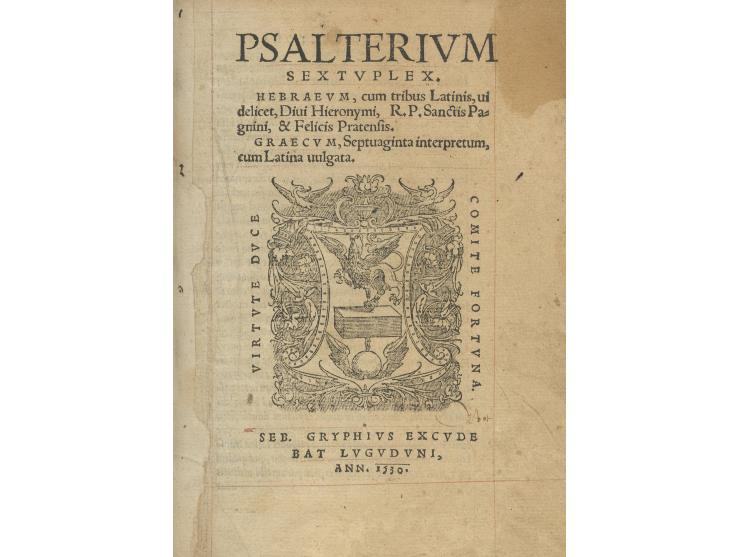
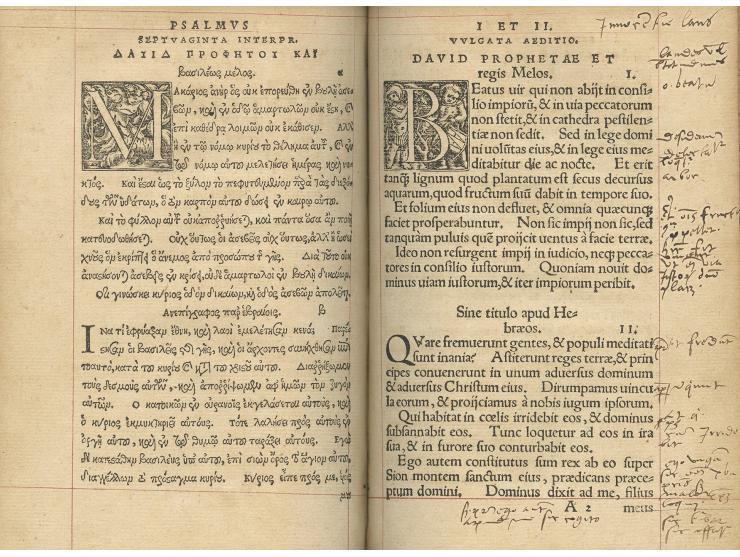
Psalterium Sextuplex, Hebraeum, cum tribus latinis videlicet, Divi Hieronymi, R. P. Sanctis Pagnini & Felicis Pratensis [Book of Tehillim, Hebrew text with five translations]. Lyon (France): Sebastian Gryphius, 1530.
First Hebrew Book of Tehillim printed in France.
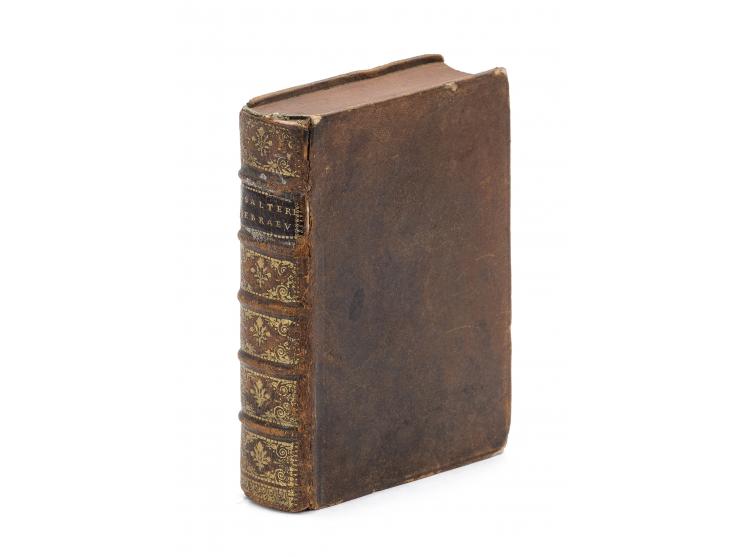
Fine copy, in early leather binding, with gilt decorations to spine.
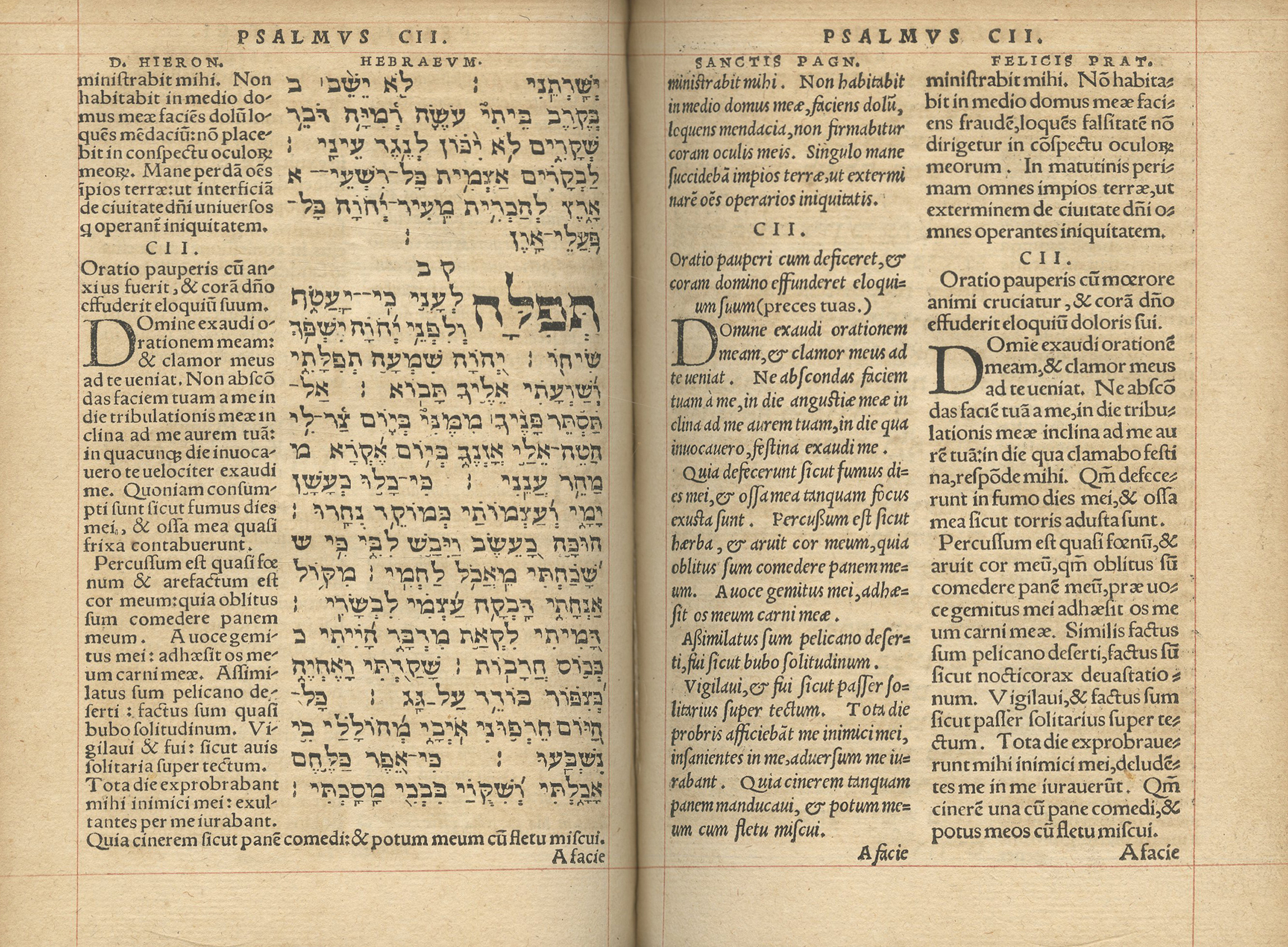
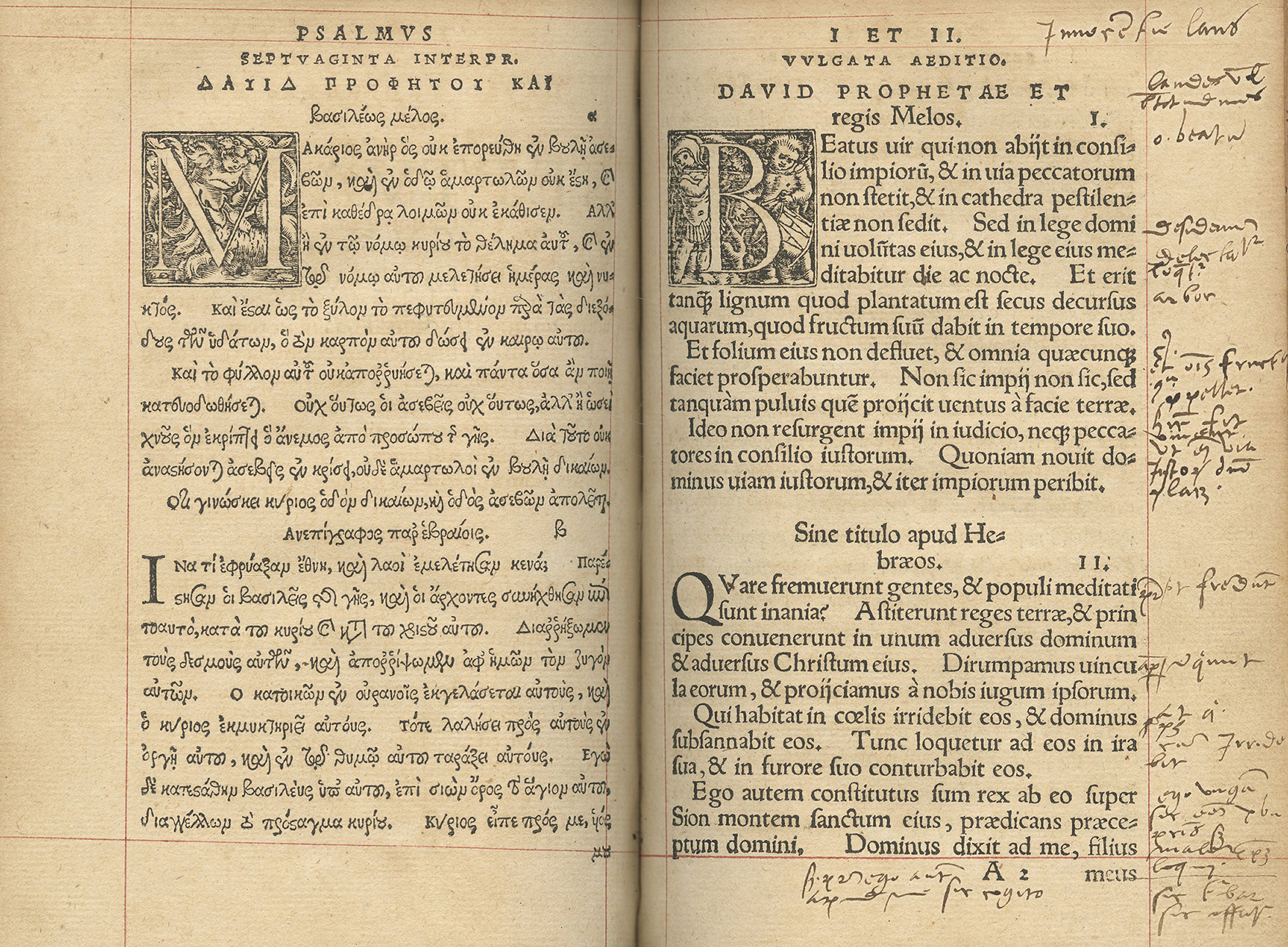
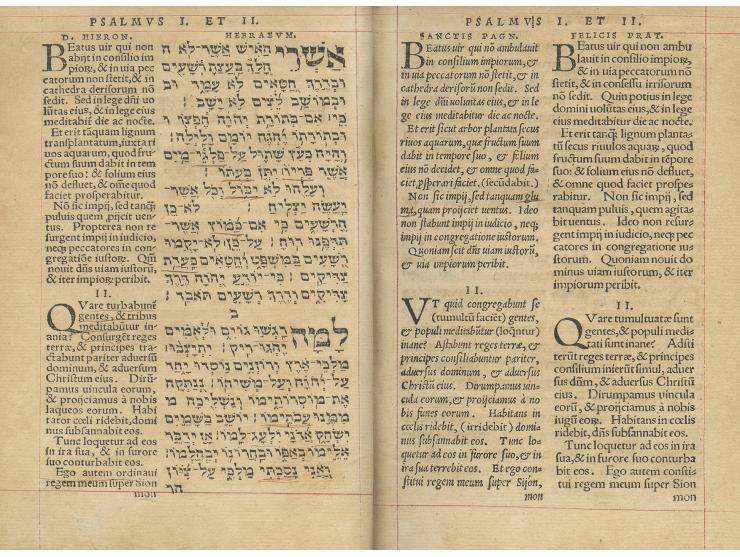
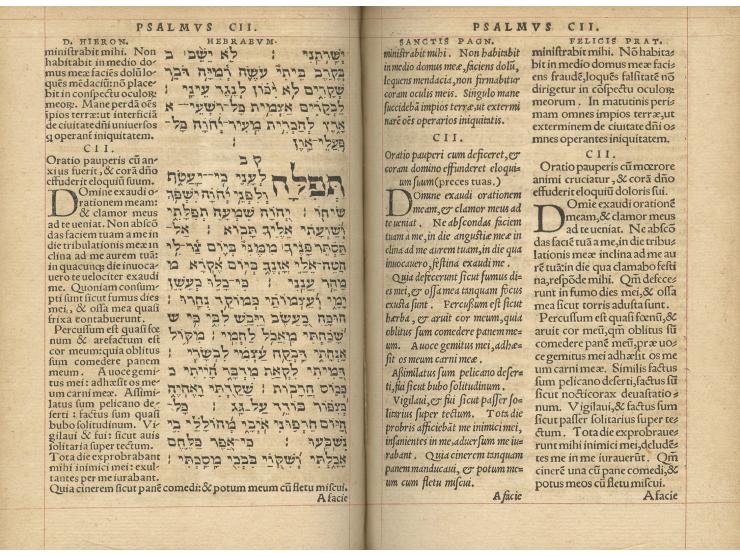
The book is comprised of two parts. Part I contains the entire Hebrew text of Tehillim accompanied by three Latin translations of Jerome, Pagnino and Pratensis, printed in four columns. Part II (with a separate inner title page) contains the Vulgate translation and the Septuagint (Greek) on facing pages.
The book opens with an index of the Latin names of the chapters (in alphabetical order).
A fine printer's device appears in the center of the title page.
Notations and inscriptions within text, and handwritten glosses by several writers (in Latin) in margins of some leaves (partially trimmed).
[360] leaves. Approx. 17 cm. Color edges. Overall good condition. Stains. Marginal open tear to title page, not affecting text, repaired with paper filling. Early leather binding. Defects to binding (wear and tears to edges of spine and corners).
Recorded in the Bibliography of the Hebrew Book based on a copy in the Palatine Library in Parma. The book is not recorded in the Bodleian Library in Oxford, nor in the NLI catalogue.
Darlow & Moule, 1415.
Category
Incunabula and Early Printed Books
Catalogue Value
Auction 107: Rare and Important Items
Apr 15, 2026
Opening: $1,500
Estimate: $2,000 - $3,000
Sold for: $4,000
Including buyer's premium
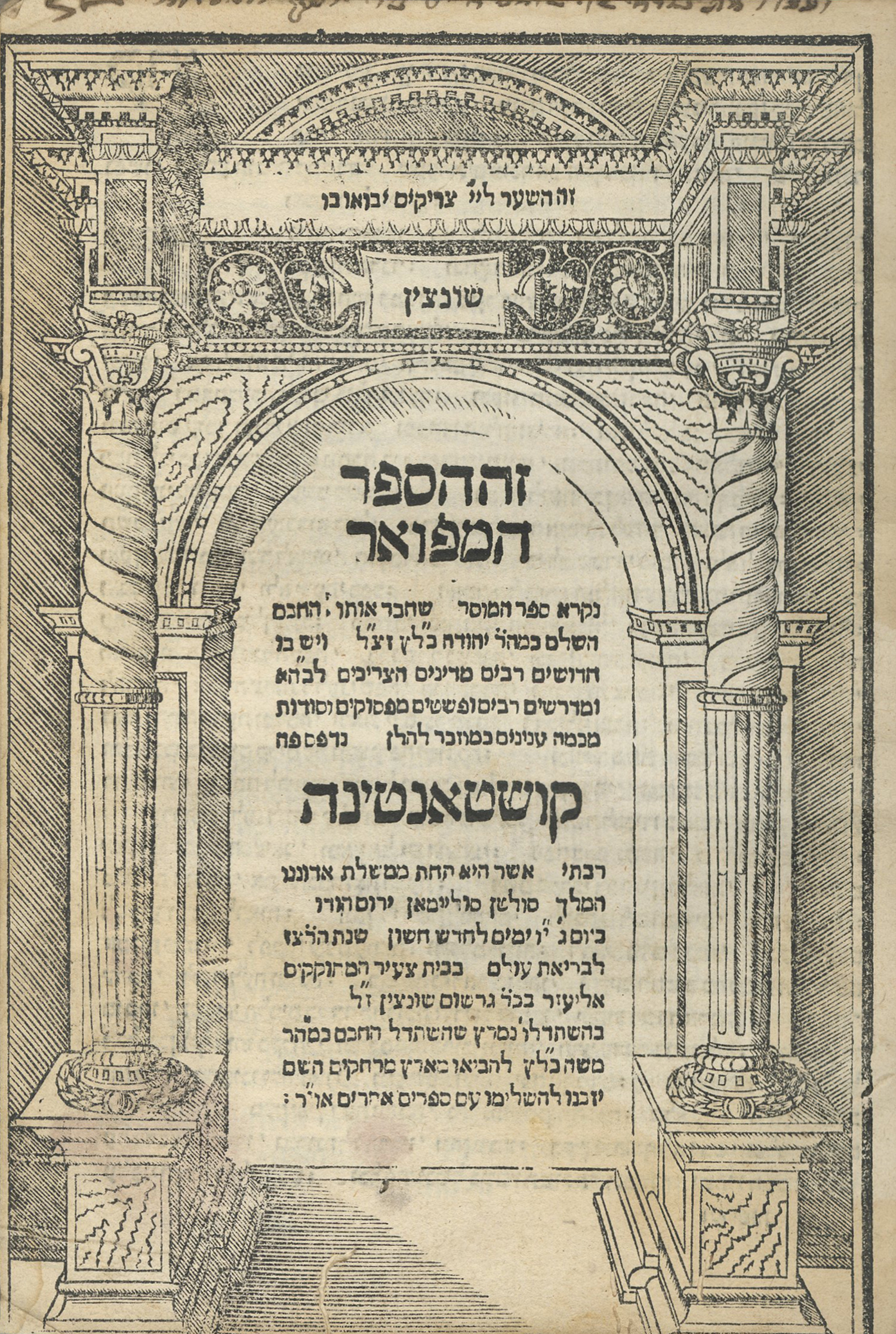
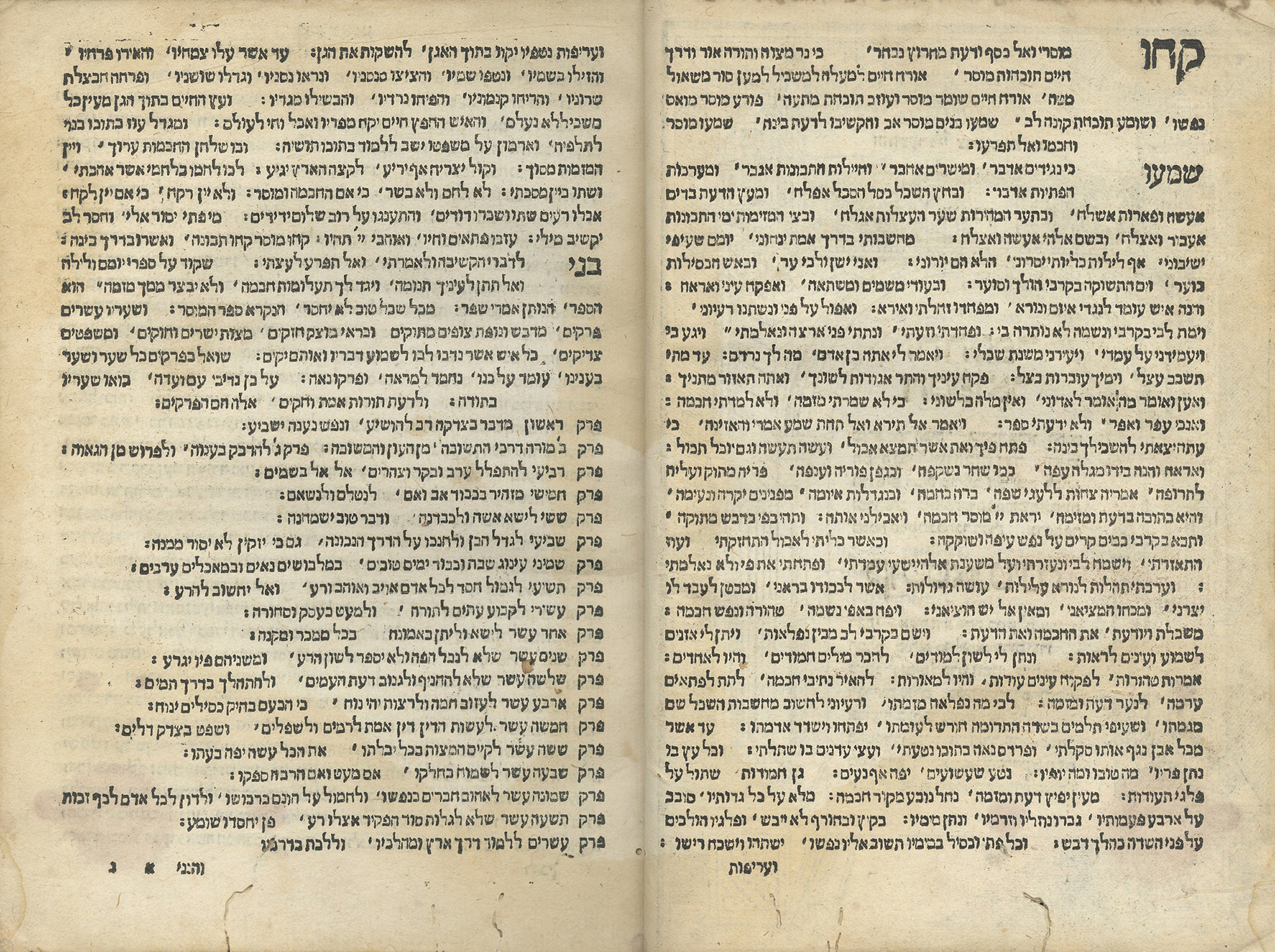
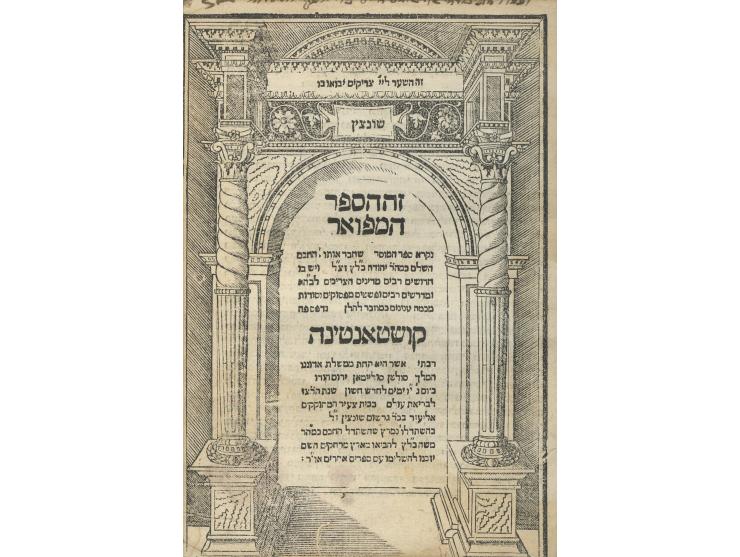
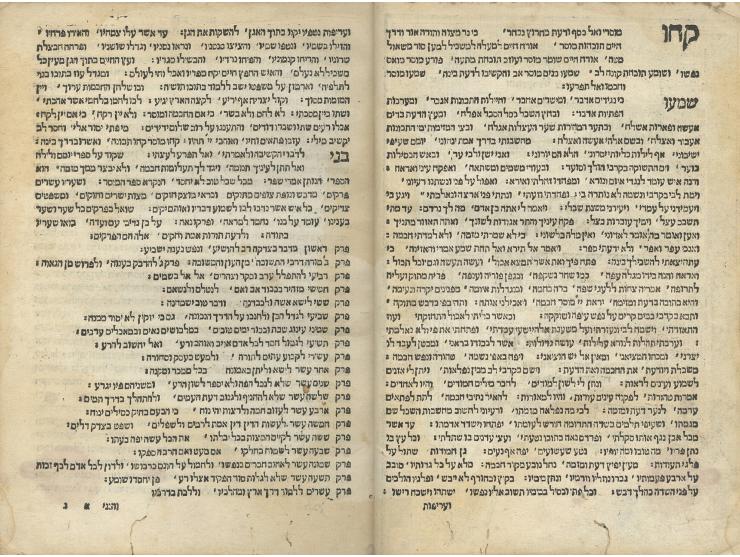
Sefer HaMusar, on ethics, virtues and rationales for the commandments and prayers, by R. Yehudah Khalatz. Constantinople: Eliezer son of Gershom Soncino, 1537. First edition.
The book comprises ten chapters on ethics and virtues, as well as rationales for the mitzvot and prayers, with kabbalistic explanations.
At the beginning of the book, before the title page, are [4] leaves beginning with an introduction by the publisher, the author's nephew, R. Moshe Khalatz, who writes: "I possess a wonderful book called Sefer HaMusar, authored by my uncle R. Yehudah Khalatz, and I studied it and saw that it is necessary for every Jew… as it comprises all the laws necessary for every layman with proofs from the Talmud… as well as many clear and pure Midrashim. I decided to print it… to bring merit to the public with this work… as well as to publicize the author's name and character, and I proofread it to the best of my ability… and when I saw the virtue and perfection of the book, I decided to complete it in order that it be absolutely perfect…".
The text incorporates some signed additions by the publisher, and the end of the introduction lists all the esoteric explanations introduced by the publisher, "enumerated, each with a reference to its chapter, gathering and leaf…".
The author, R. Yehudah Khalatz, a Sephardic rabbi of the second half of the 15th century. Born in Castile ca. 1440, in the wake of massacres he left for Granada in 1477, where he established a yeshiva. In 1481 he relocated to Malaga, also establishing a yeshiva there. In 1486 he immigrated to Honaine, Algeria, as usual establishing a yeshiva. He later moved to Tlemcen. Sefer HaMusar is his best-known work, effectively an abridgment and popular adaptation of Menorat HaMaor by R. Yisrael Alnaqua, omitting the halachic discussions.
Colophon on last leaf: "The holy work of heaven was completed, refined sevenfold, today on Monday, 24th Sivan of the Hebrew calendar, [1537]…".
Trimmed ownership inscription on upper part of title page ["…Chaim? son of? Yosef?..."].
Censor's signature on last page: "Hippolitus Ferrarensis", dated 1601.
[140] leaves. Approx. 19 cm. Fair condition. Stains, including dampstains and traces of former dampness with mold stains (heavy stains to last leaves). Wear. Worming in many places, significant worming in some, affecting text. Close trimming, affecting headers in several places. Old binding, with leather spine and corners. Wear and defects to binding.
Category
Incunabula and Early Printed Books
Catalogue Value
Auction 107: Rare and Important Items
Apr 15, 2026
Opening: $50,000
Estimate: $60,000 - $80,000
Sold for: $93,750
Including buyer's premium
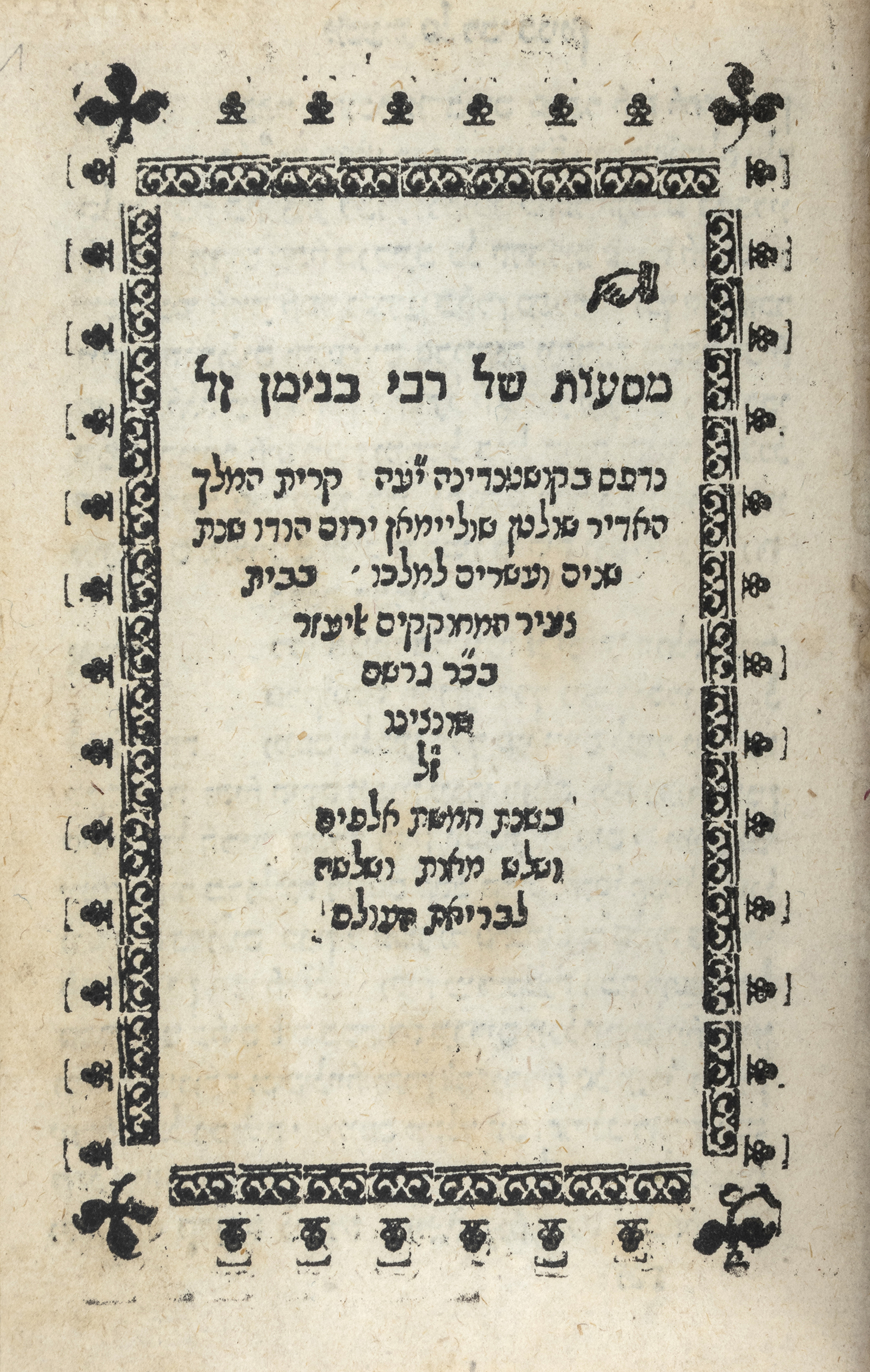
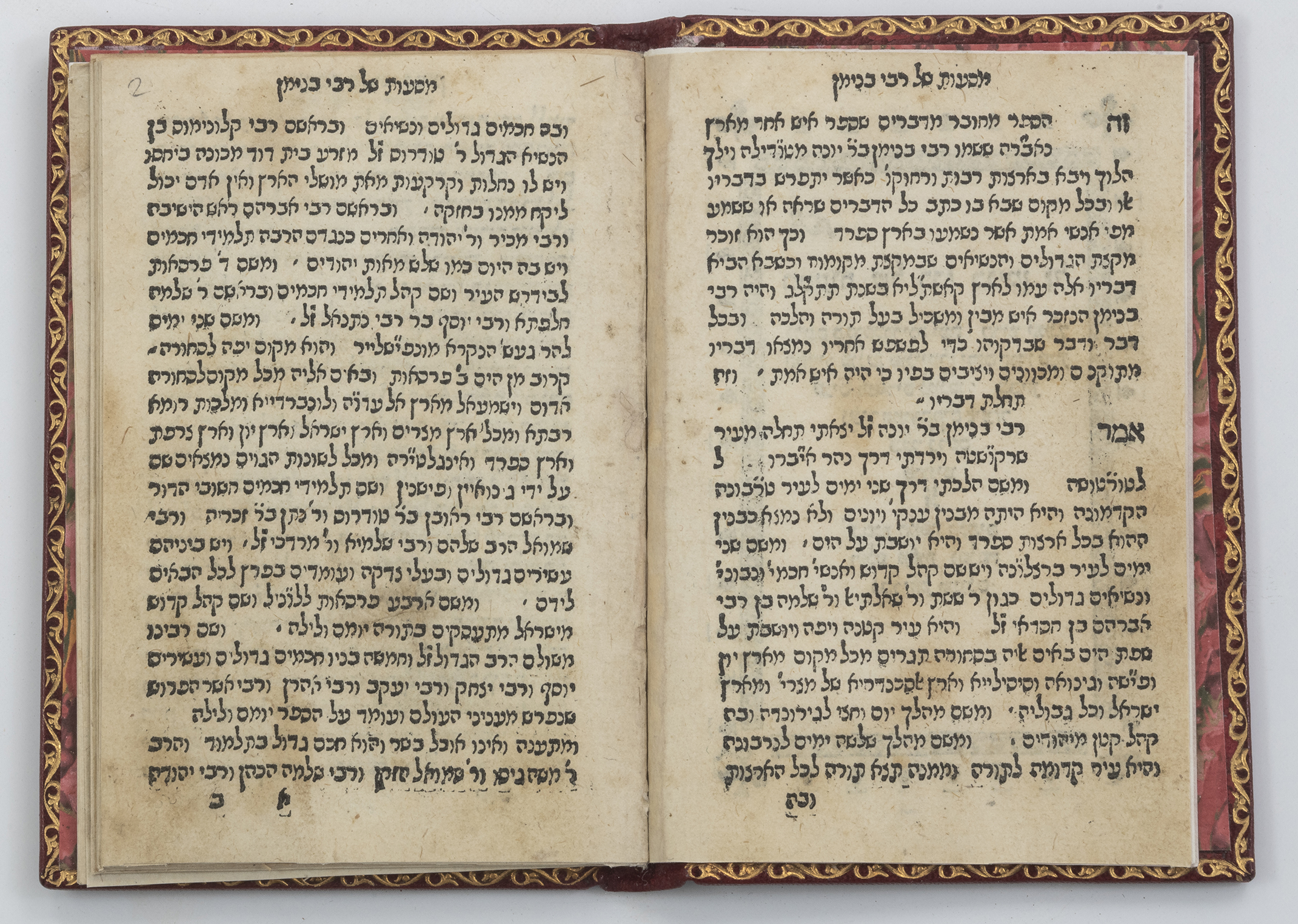
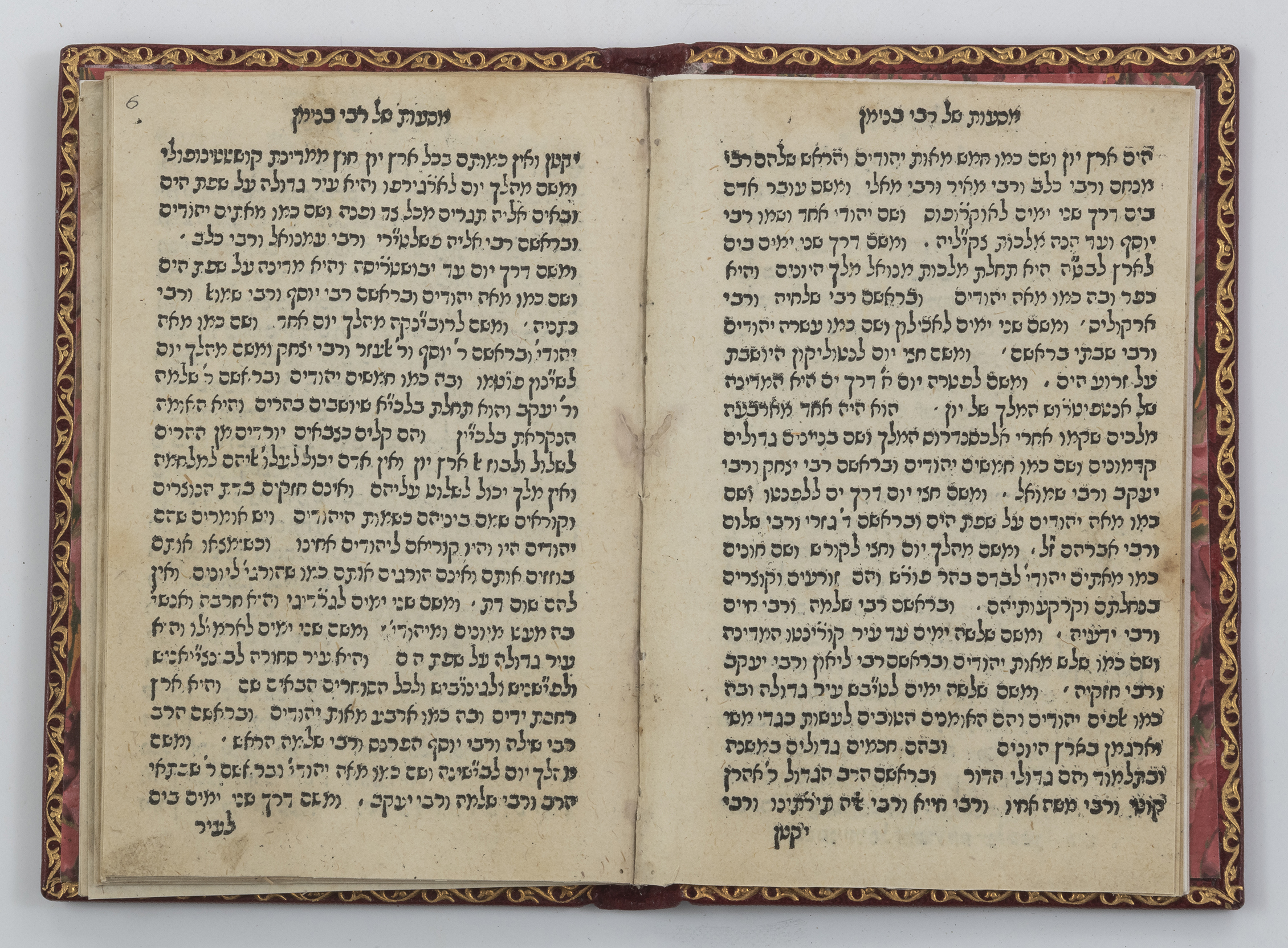
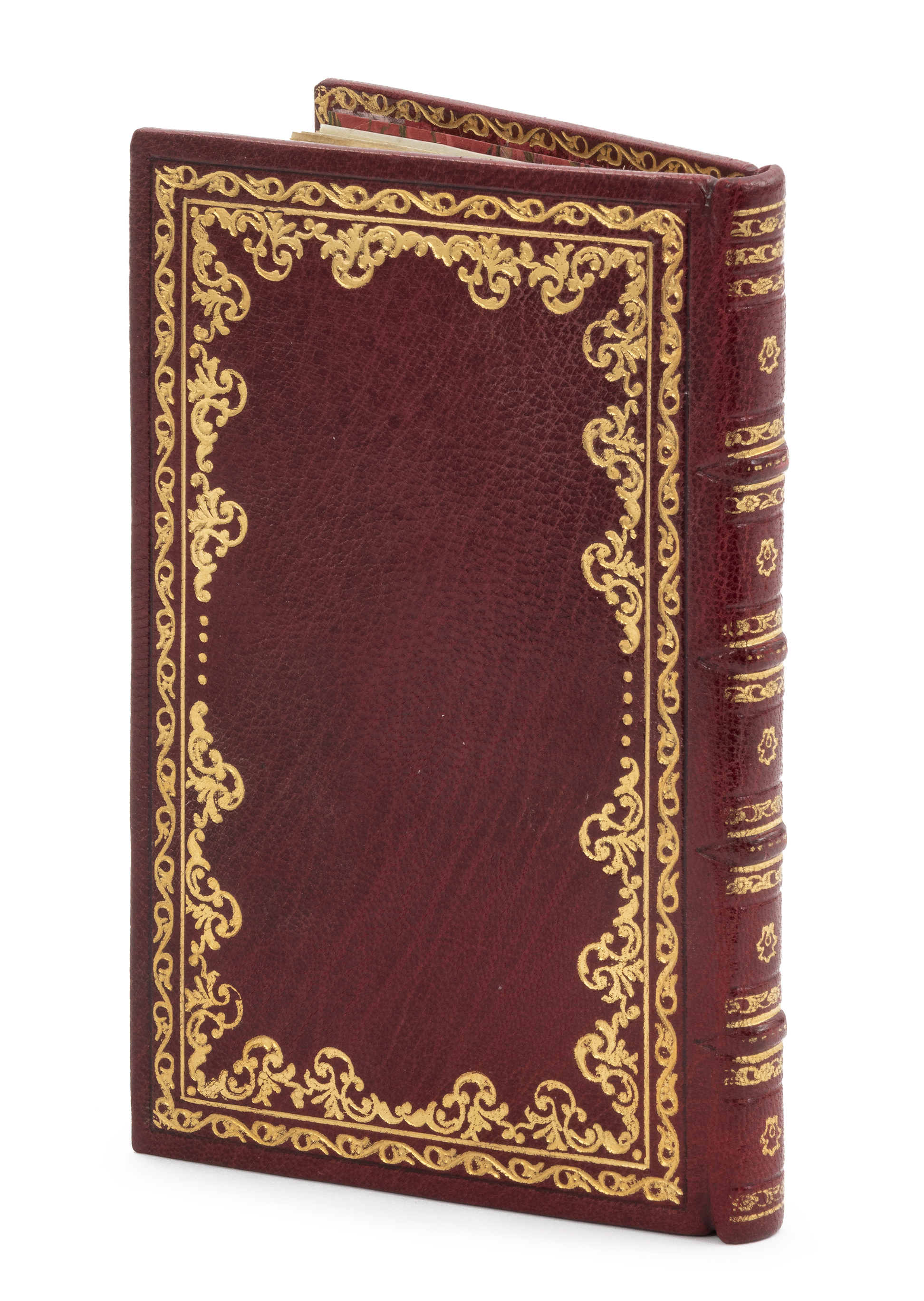
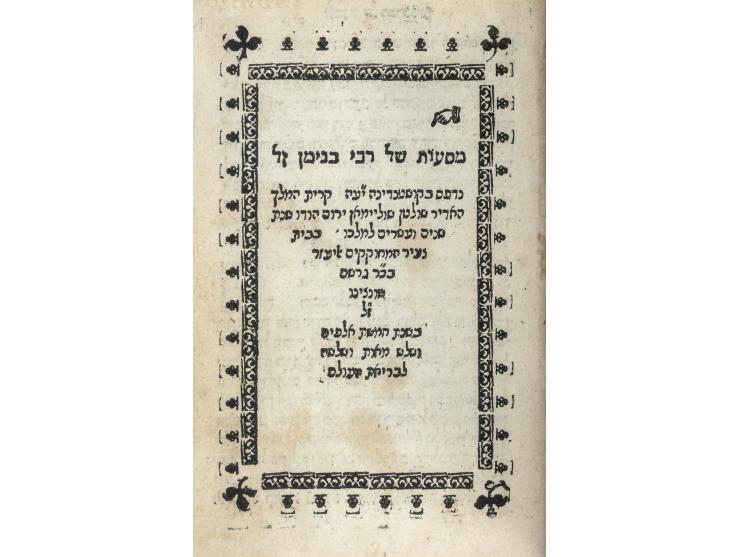
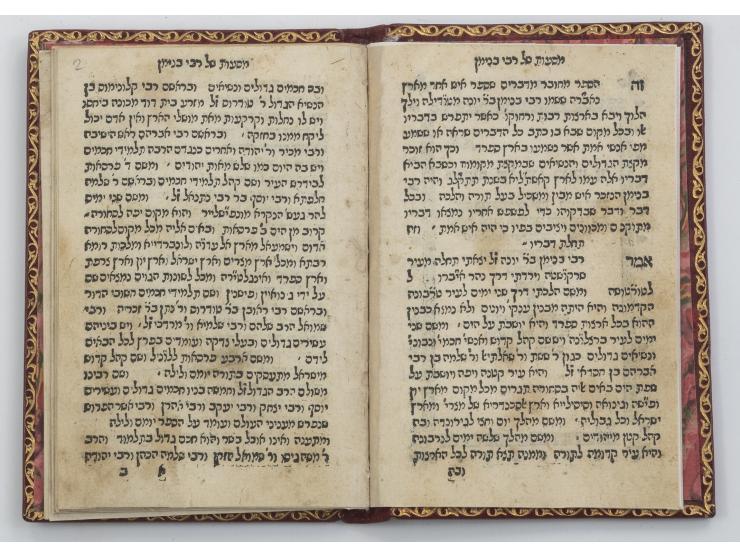
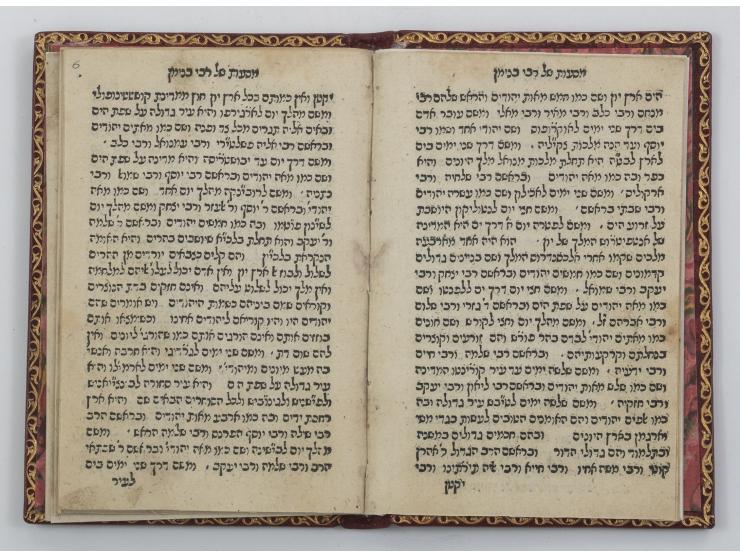
Masaot, the Itinerary of R. Binyamin. Constantinople: Eliezer son of Gershom Soncino, 1543. First edition.
Rare first edition of one of the most famous Jewish travelogues, including a rich and important description of Jewish life in various locations in the 12th century, the Rishonim period.
On the verso of the title page, the book begins with a short foreword on R. Binyamin and his book: "This book was composed based on what was recounted by a man from Navarra named R. Binyamin son of Yonah of Tudela. He traveled and came to many distant lands… and in every place he visited, he wrote down everything he saw or heard from trustworthy people… And when he returned, he brought these words of his with him to Castile in the year 1173".
R. Binyamin of Tudela, a 12th-century Jewish traveler and explorer. In 1165, R. Binyamin departed on a lengthy voyage in Europe, the Middle East and North Africa. He began his voyage in Saragossa, and he later traveled to southern France, departed Marseilles for Genoa, reached Rome and southern Italy, sailed through Corfu to Greece, Turkey and Constantinople, traveled through Syria to Eretz Israel and also reached Mesopotamia and Yemen, finally returning to Spain in 1173. In his travelogue, R. Binyamin describes the lands he visited, with particular attention to the Jewish communities, their number in each location, their ways of life and their customs. His descriptions often mention important Jewish sages he met in various lands.
R. Binyamin's itinerary has been printed in dozens of editions over the years and has also been printed in translation in various languages. The book was first translated into Latin by the Spanish scholar Benito Arias Montano (Antwerp, 1575), whose edition formed the basis for translations into other languages printed thereafter.
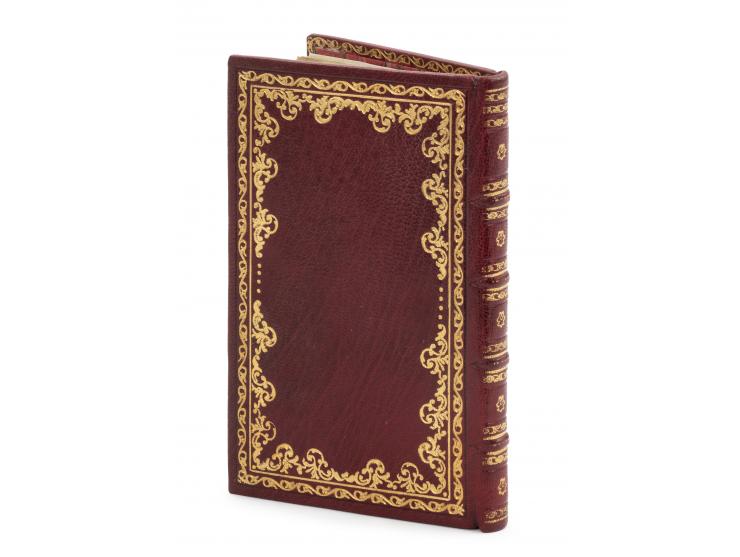
[32] leaves. Approx. 13 cm. Varying condition of leaves, good-fair to fair. Stains. Marginal open tears to some leaves (mainly to second half of book and towards end), slightly affecting text, repaired with paper filling. Worming, repaired with paper filling. Fine new leather binding, gilt-decorated. Placed in cardboard slipcase with marbled coating.
Complete copies are very rare. Recorded in the Bibliography of the Hebrew Book based on a copy in the British Library.
Provenance: Sotheby's, New York, 3 December 2004, Lot 89.
Category
Incunabula and Early Printed Books
Catalogue Value
Auction 107: Rare and Important Items
Apr 15, 2026
Opening: $10,000
Estimate: $12,000 - $15,000
Sold for: Unsold
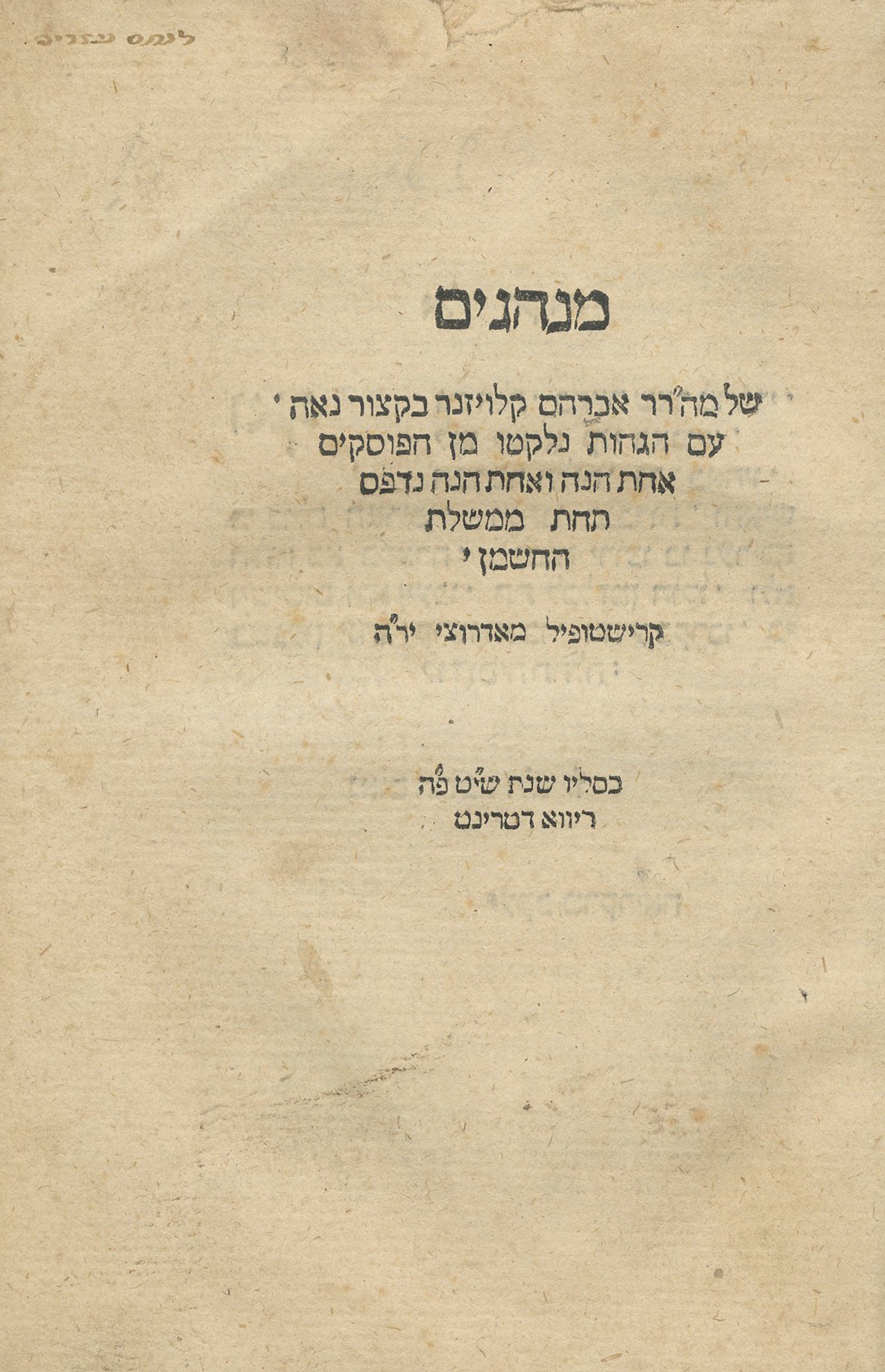
Minhagim of R. Avraham Klausner, with selected glosses. Riva di Trento: Yaakov Marcaria and Antonio Bruin, 1558. First edition.
Early signature at top of title page, in Italian semi-cursive script: "Menachem Azariah".
First edition of an early Minhagim book, including customs, laws and prayers according to the French and Ashkenazic rites, following the days of the year. The main part of the book is based primarily on Siddur Rashi and Machzor Vitri, along with several other sources, with additions by R. Yechizkiyah of Magdeburg and R. Chaim Paltiel; the latter converting the book to follow the Ashkenazic rite. The glosses on the margins include those of R. Avraham Klausner, some of which name him explicitly, giving this work its name.
On the last leaf a notable story is printed: "I, the scribe, personally had this experience, that I vowed to fast Mondays and Thursdays for an entire year, and Tishah B'Av of that year fell on a Tuesday, and the Torah scholar R. Lipman of Neustadt and R. Mendel Klausner permitted me to have, after the Mincha prayer, only one cooked dish of lentils with no oil and no other supplement".
R. Avraham Klausner (Maharak), a Torah scholar of Austria, rabbi and yeshiva dean in Vienna in the 14th century. Among his disciples were the Maharil and R. Eizik of Tyrnau, authors of famous Minhagim books which quote many sayings from their teacher; their teacher's Minhagim book was likely the inspiration for their own. R. Avraham Klausner's halachic rulings are also cited in the writings of R. Yaakov (Mahari) Weil and other Ashkenazi rabbis.
28, 33-43, [1] leaves. 15.5 cm. Good-fair condition. Stains, including light dampstains and traces of former dampness. Small marginal tears and open tears, including tear affecting text of one leaf (without loss). Worming to some leaves, repaired with paper. New binding.
On verso of last leaf, signature of censor Giovanni Domenico Carretto, dated 1618 (?).
Category
Incunabula and Early Printed Books
Catalogue Value
Auction 107: Rare and Important Items
Apr 15, 2026
Opening: $20,000
Estimate: $30,000 - $35,000
Sold for: $27,500
Including buyer's premium
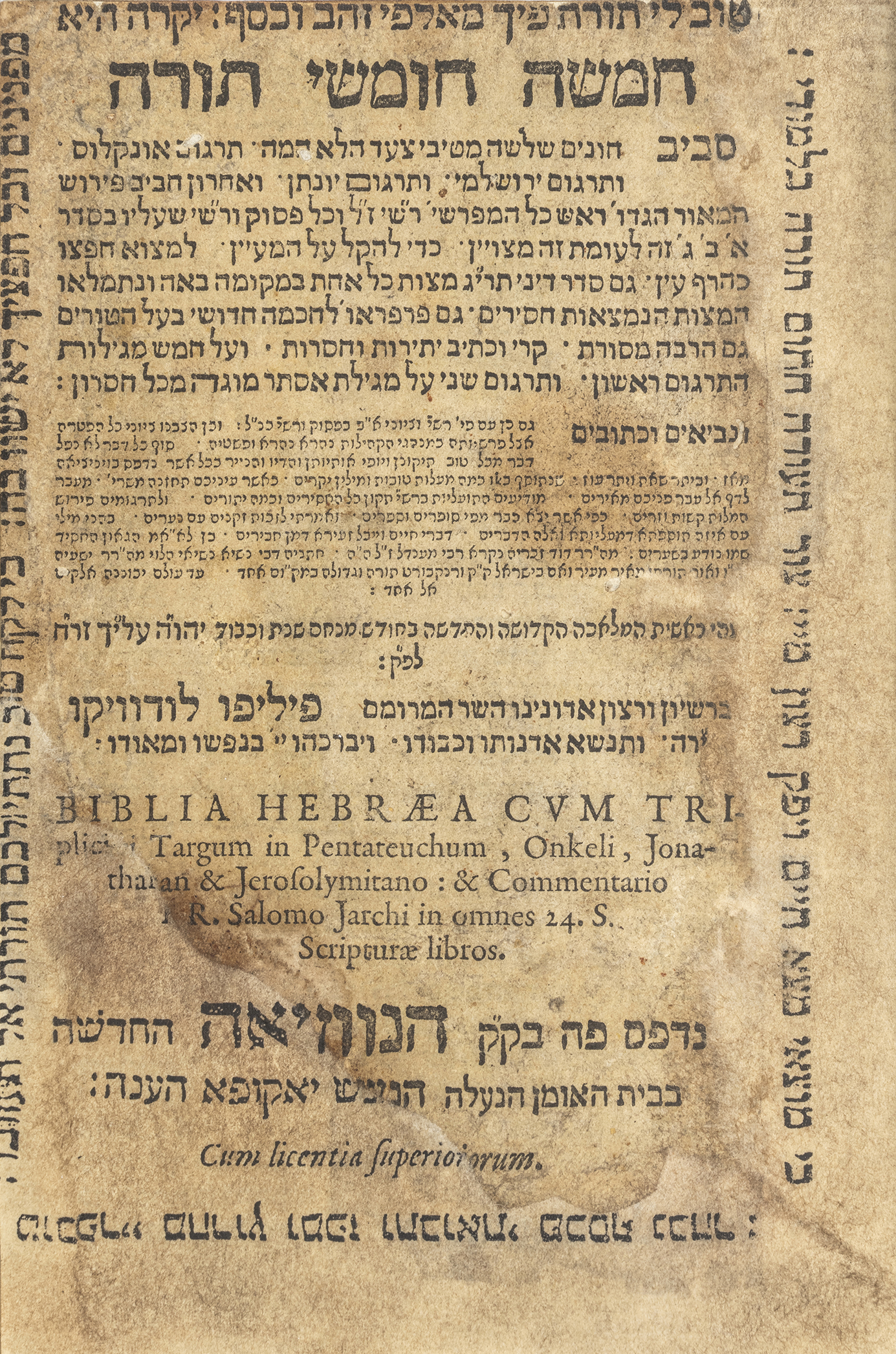
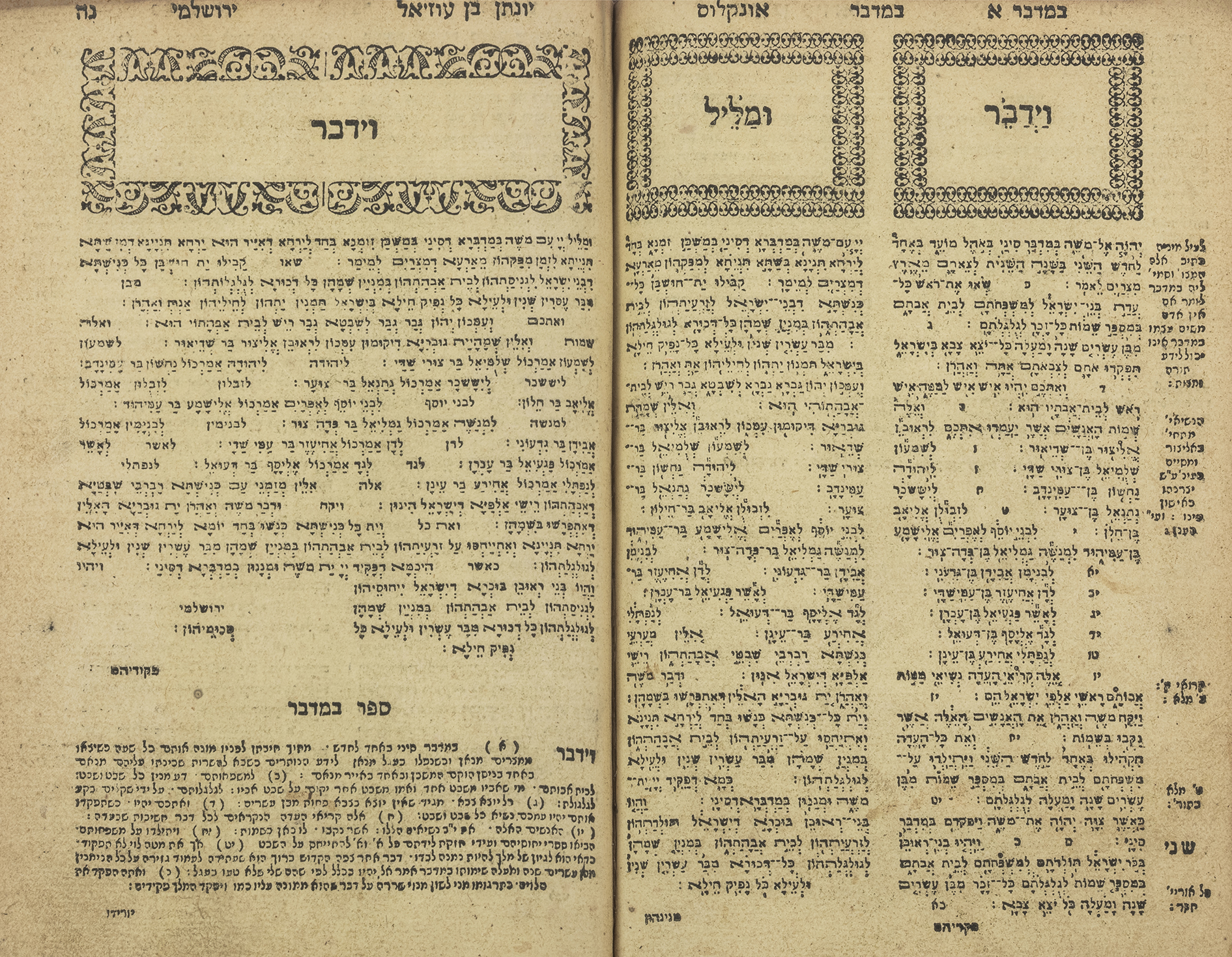
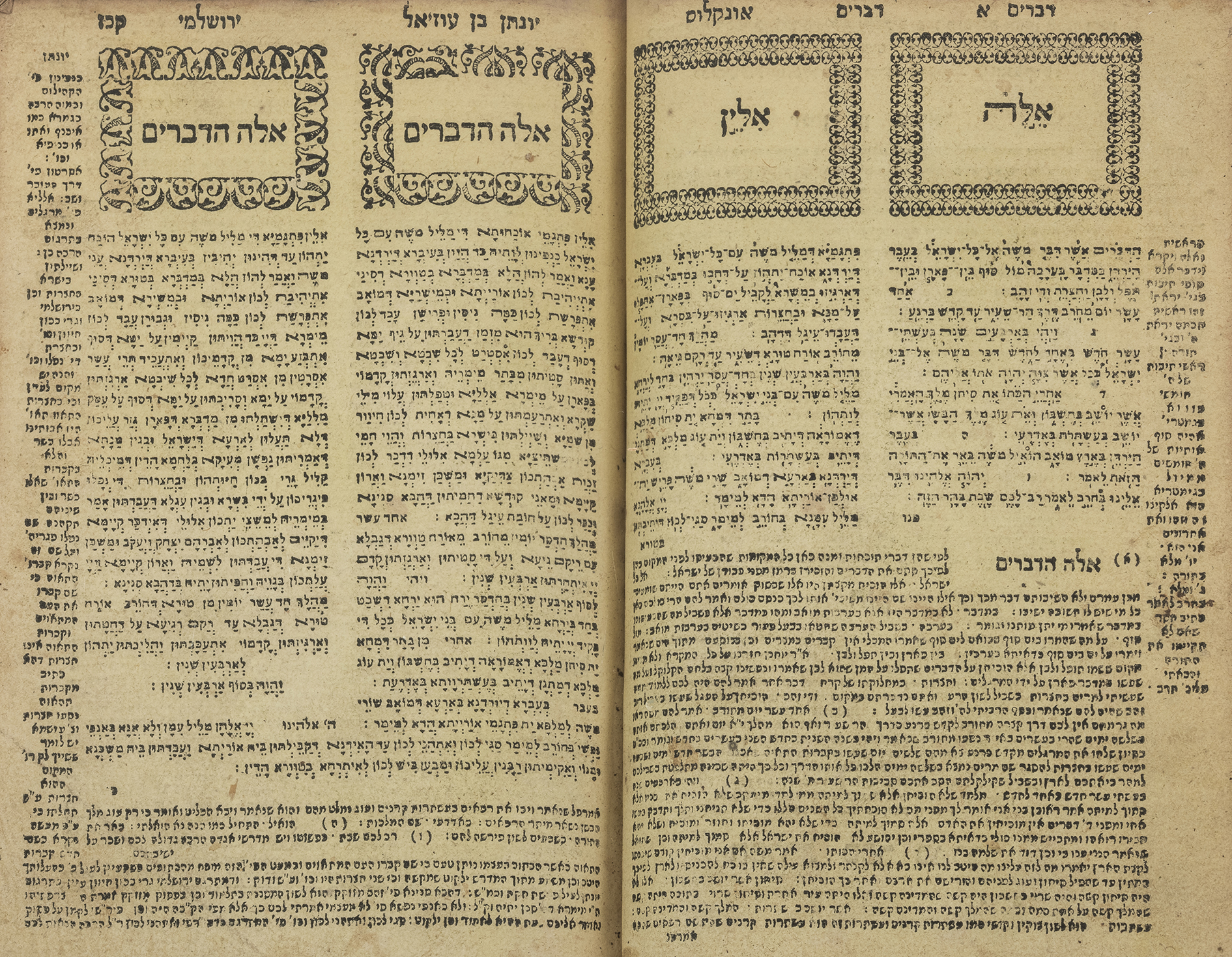
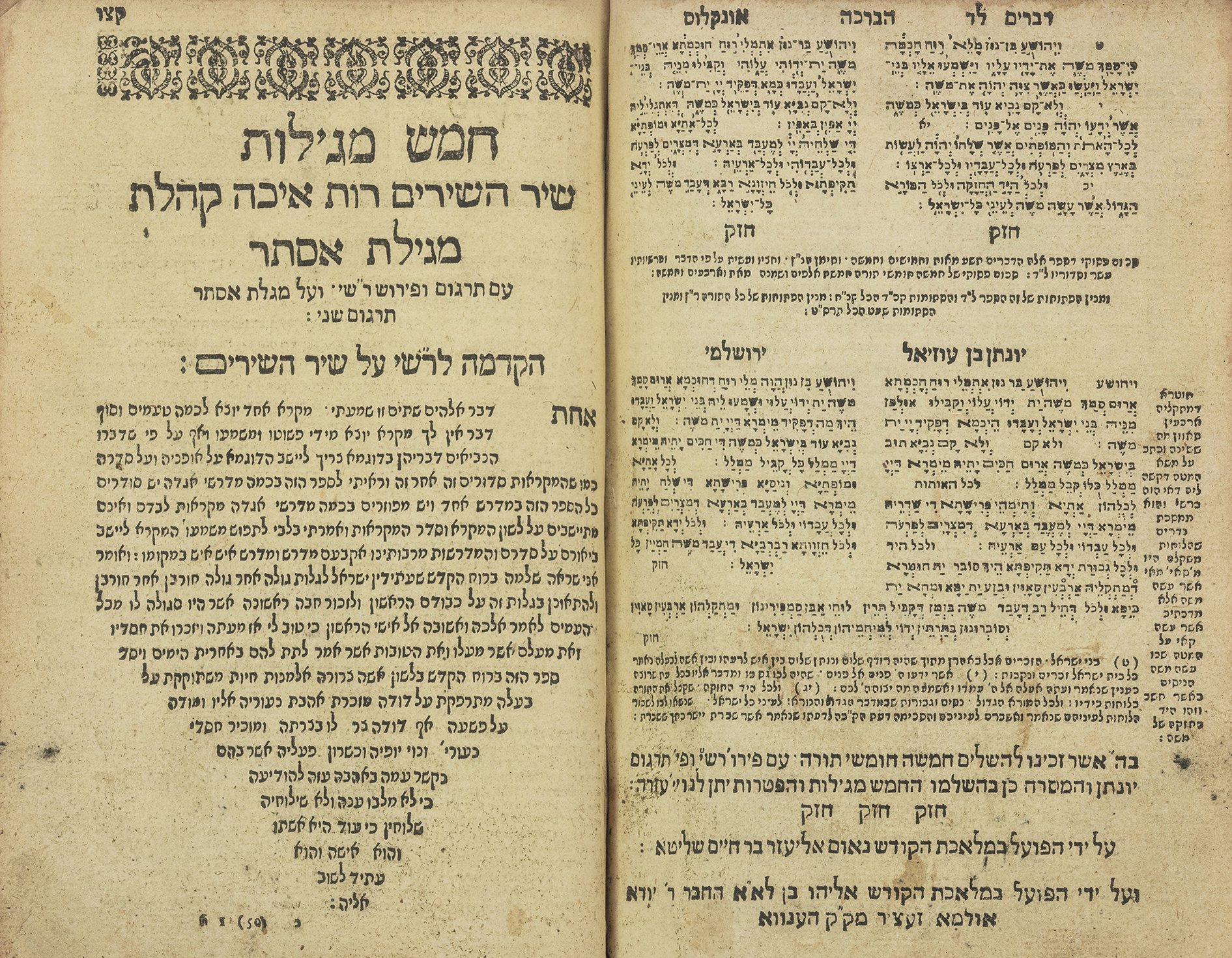
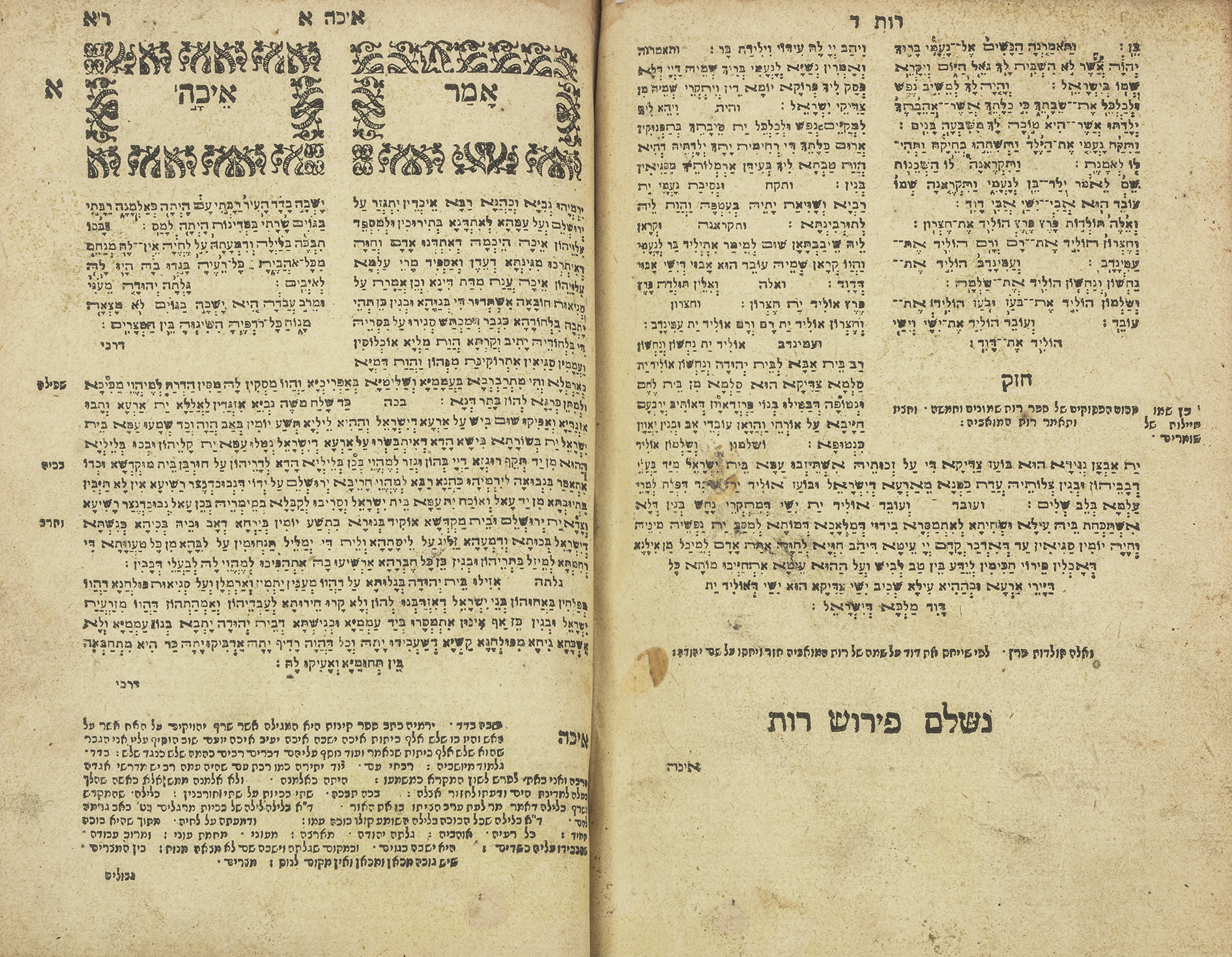
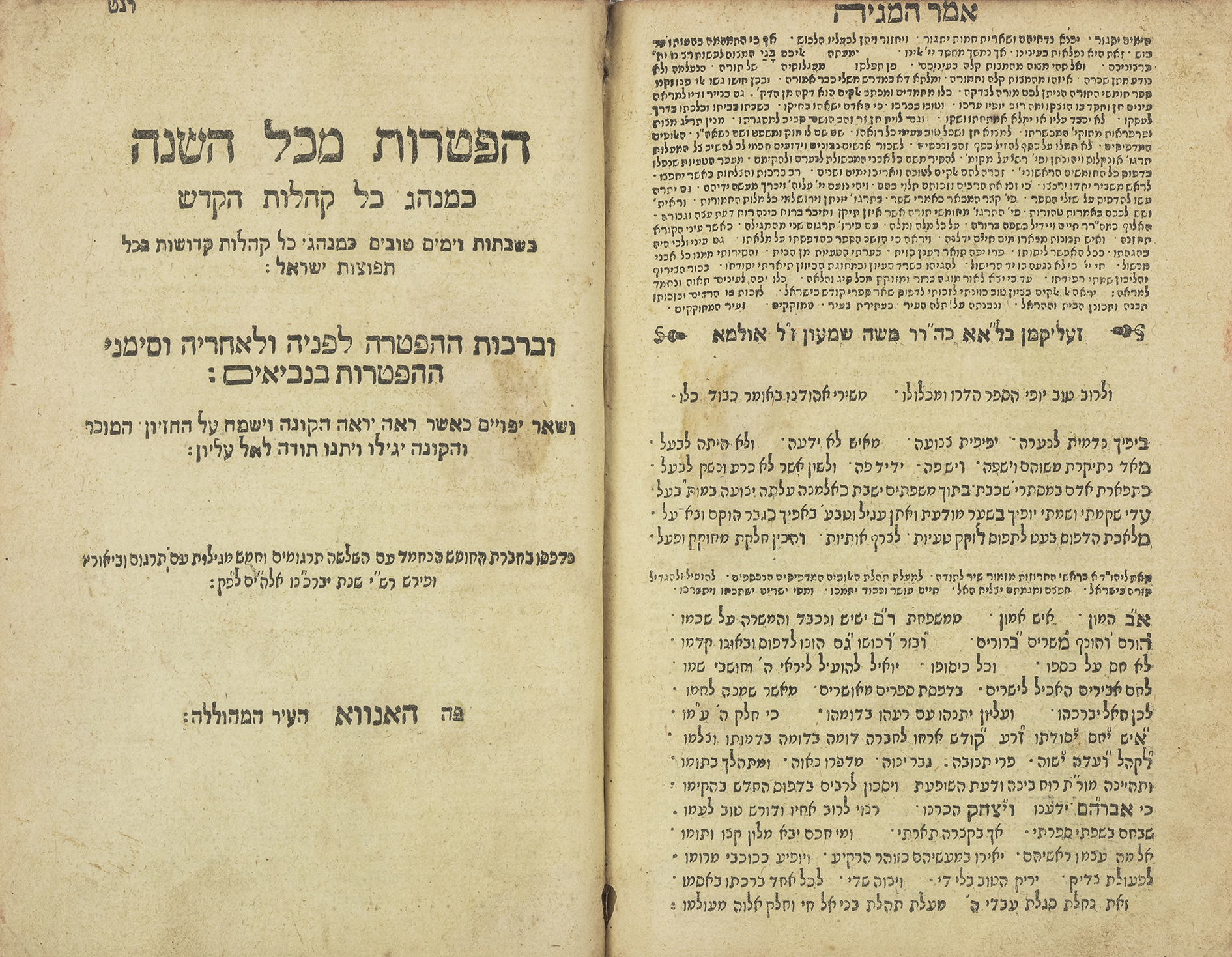
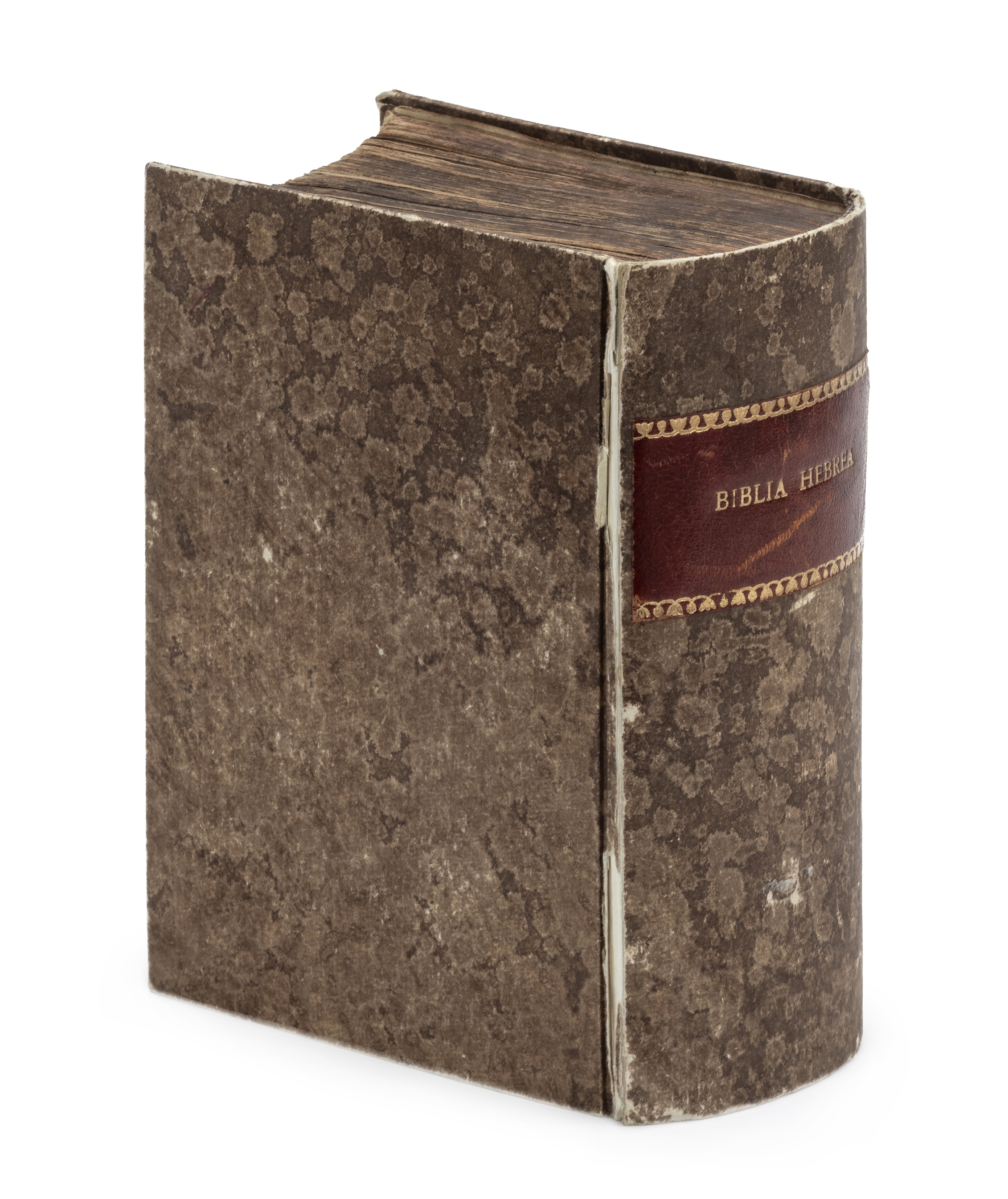
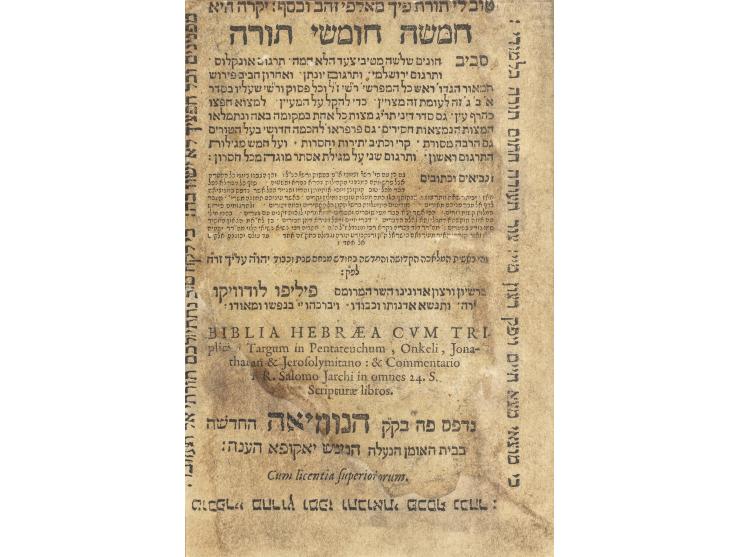
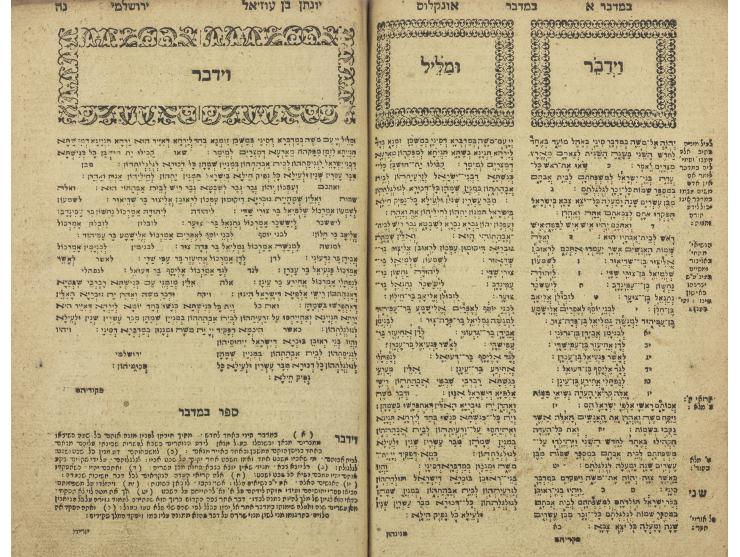
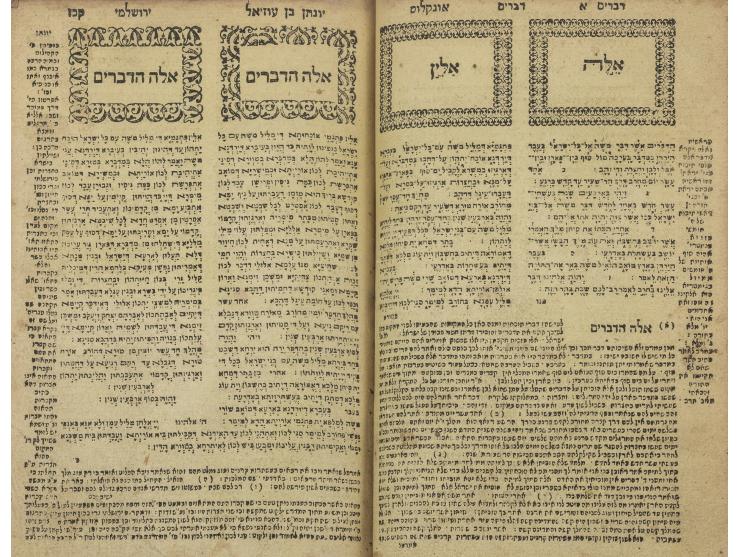
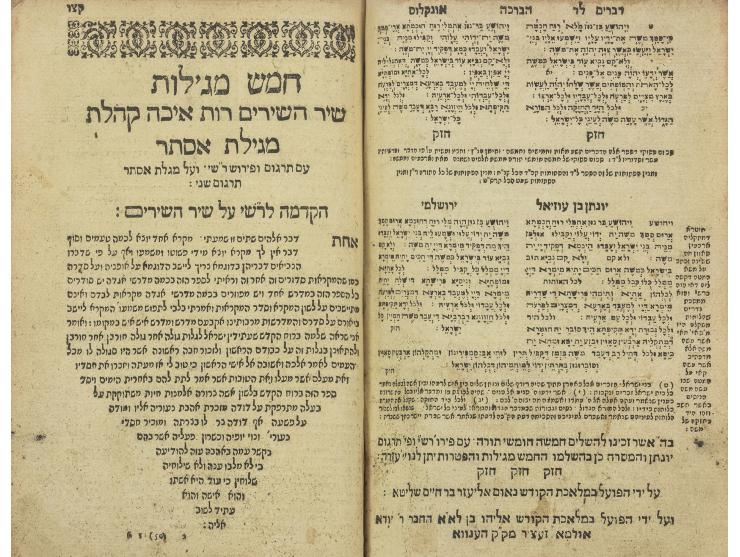
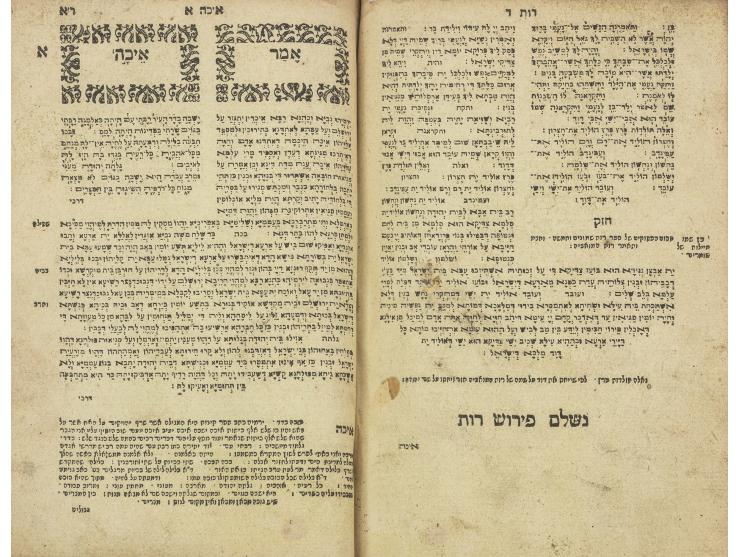
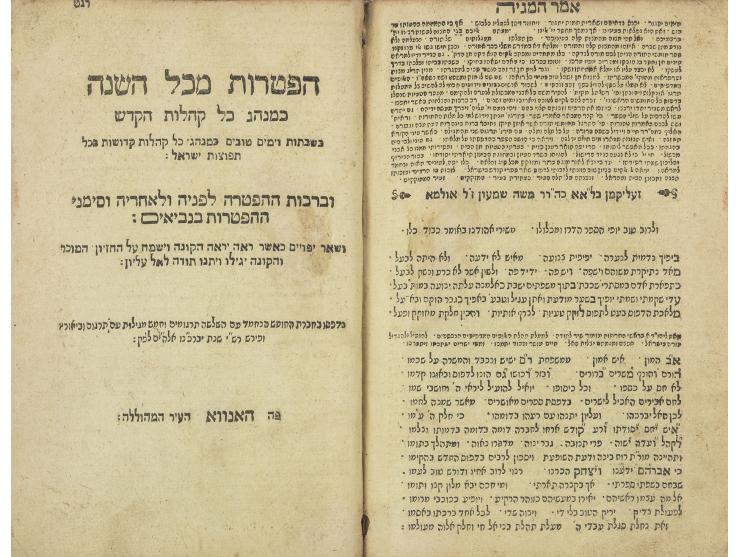
Five Books of the Torah, with commentaries of Rashi and Baal HaTurim, Targum Onkelos, Targum Yonatan and Targum Yerushalmi (with commentaries), haftarot and Five Megillot. Hanau: Hans Jacopa Hena, 1611-1614.
Special copy printed on yellow paper.
Divisional title pages for Five Megillot and haftarot (main title page dated 1611, haftarot title page and colophon on last page dated 1614).
The present edition was edited by R. Chaim Feivel son of R. David Zechariah (R. Mendel), son-in-law of the Shlah, and its text was based on the personal Chumash owned and emended by the Shlah. The Shlah was known for his insistence on textual accuracy, thus the text of the Torah and Targum, and especially the Rashi commentary in the present edition, are regarded as especially accurate (the present edition was printed during the lifetime of the Shlah). Apart from emending the Torah and Targum texts, R. Chaim Feivel also added references to the Talmud, Midrash, Zohar, Recanati and Pardes Rimonim, on the page margins, as well as authoring a commentary on Targum Sheni on the Book of Esther, completed on "Erev Rosh Chodesh, Friday, 1599", according to the colophon (p. 257a).
Furthermore, this edition includes two commentaries on the Targumim: the first selected by the editor from the commentary by R. David Shebreshin (Prague, 1609) and the second selected from Kur LaZahav by R. Avraham of Ostroh (unpublished).
On verso of title page, short foreword describing the virtues of the present edition: "The first virtue is that it was printed from the Chumash emended by… R. Yeshayah HaLevi… who purified and paved the road of all errors of omission, corruption or addition, found in the Torah, Targum and especially in the commentary of Rashi. The second virtue is that we also merited to have these three Targumim by the son-in-law of the above Gaon… for they were also ridden with errors… He wrote a short and sufficient commentary for the reader to consult with no need of a rabbi or teacher, referencing three books: Zohar, Recanati and Pardes [Rimonim]… all done by the abovementioned son-in-law of the Gaon… The third virtue… is that the entire Biblical text… is proofread by R. Feivel, son-in-law of the above Gaon, very carefully, in order to enable reading as from a Tikun for Torah scrolls…".
Rashi's commentary incorporates additions from an "old Rashi" version, as well as some selections from classic Rashi commentators: R. Eliyahu Mizrachi, Maharal and Maharshal.
The Baal HaTurim commentary printed in this edition is a selection from his shorter commentary (after the Venice 1690-1691 edition).
165; 194; 196-263, 265-287, 289-291 leaves. 17 cm. Varying condition of leaves, first and last leaves in fair condition, many leaves in middle in fair-good condition. Stains. On several leaves, heavy stains and traces of wax, affecting text. Light wear. Tears and open tears, including large open tears to title page and first leaves, heavily affecting text, repaired with paper filling, with photocopy replacements (large parts of text from bottom and margins lacking from title page, affecting printing details and foreword on verso). Worming, affecting text, partially repaired with paper filling. Close trimming, bordering page headers. New binding, with defects.
Especially rare edition. The NLI catalogue records only several incomplete copies.
Provenance: Kestenbaum, New York, 17 November 1998, Lot 30.
Category
Incunabula and Early Printed Books
Catalogue Value
Auction 107: Rare and Important Items
Apr 15, 2026
Opening: $1,500
Estimate: $2,000 - $2,500
Sold for: $2,250
Including buyer's premium
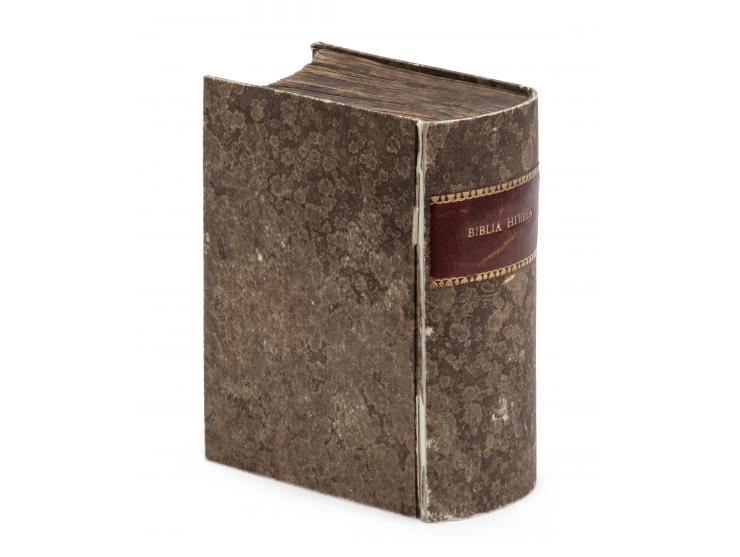
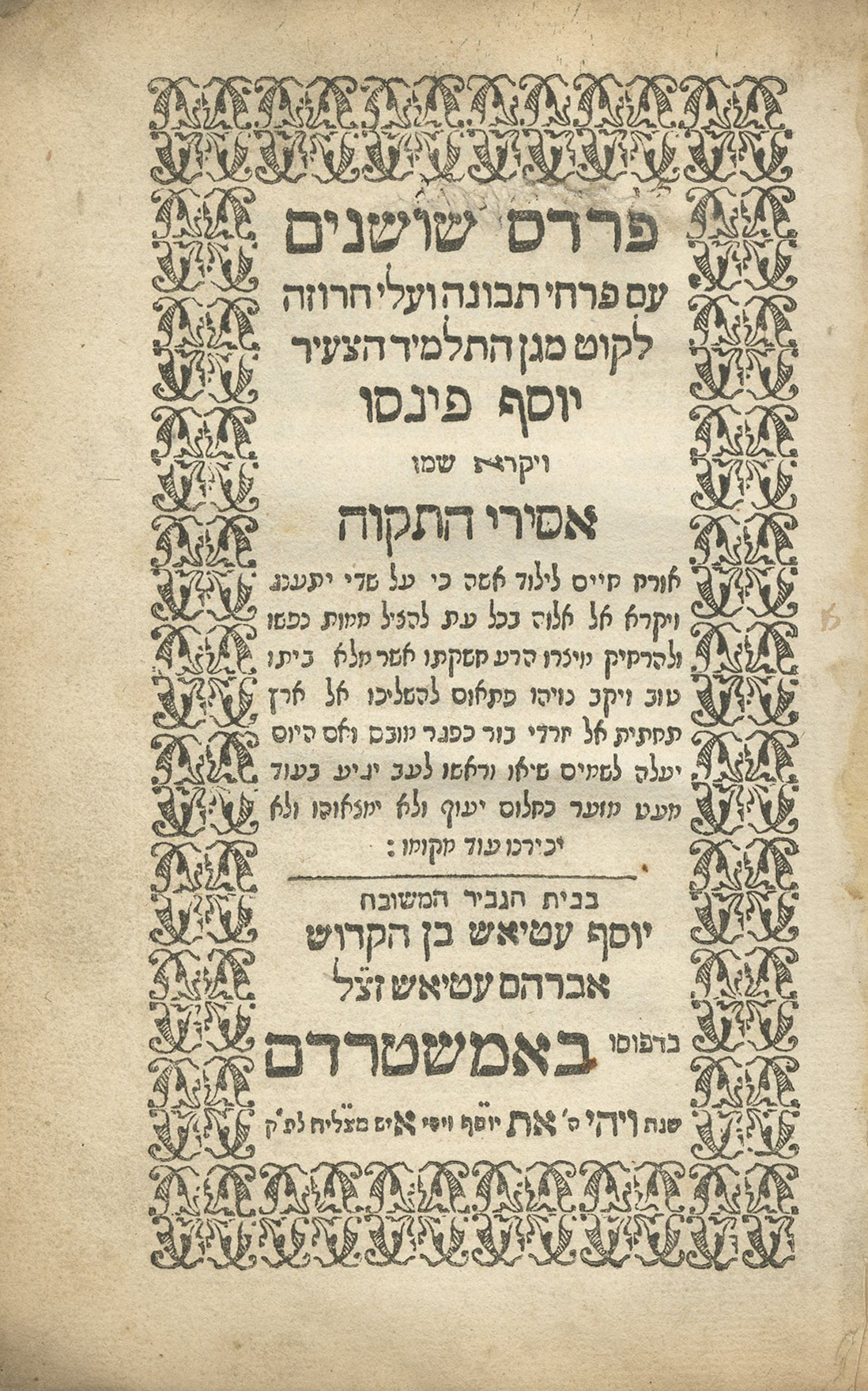
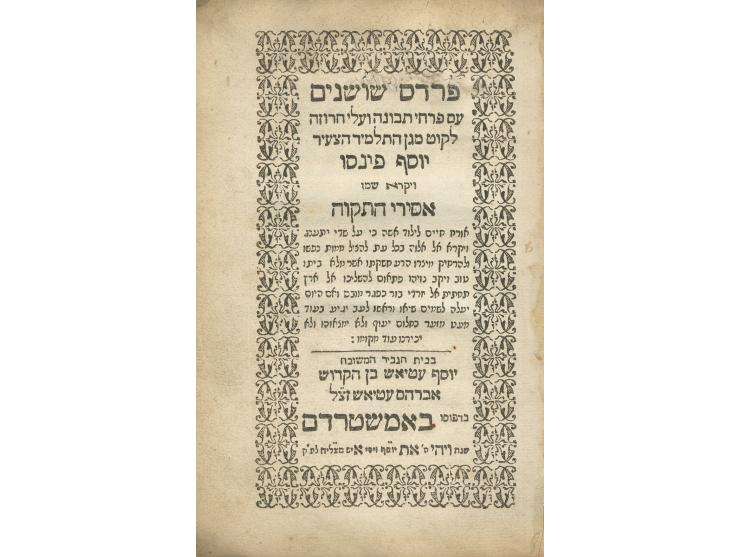
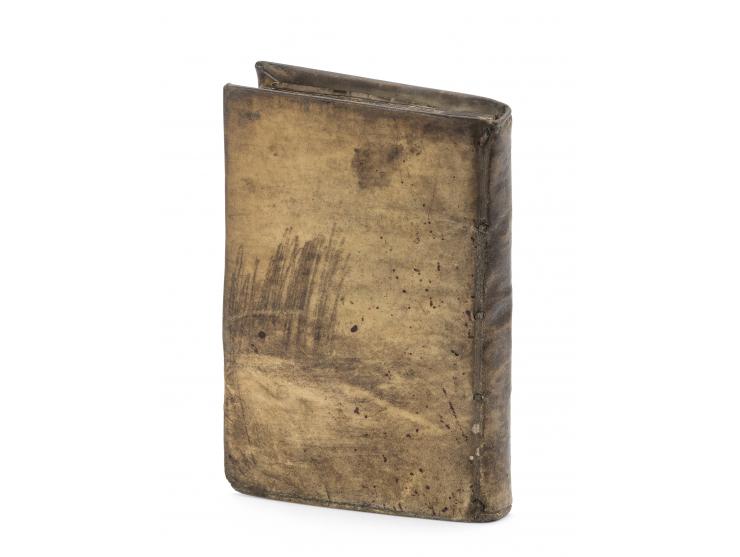
Pardes Shoshanim – Asirei HaTikvah, allegorical play in rhyme, in three acts, by Joseph Penso de la Vega (author of Mehumat HaMehumot – Confusion de Confusiones, Amsterdam 1688). Amsterdam: Yosef Athias, 1673.
Morality play in three acts, on the theme of human free will. The play's hero is an unnamed king, representing man's free will. Satan attempts to tempt the king to evil, using his three servants – Pleasure, the Evil Inclination and Woman. They are opposed by Intellect, Providence, Truth and an Angel of G-d, who attempt to direct him to the right path.
Penso authored this play in 1667 (about six years before it was printed), at the young age of 17, and he is in fact referred to on the title page as "the young student" (Schirmann, referenced below, argues that the play may have been staged when Penso finished his school studies).
The book begins with an approbation in Portuguese by R. Moshe Refael de Aguilar and R. Avraham Kohen Pimentel, as well as a dedication in Portuguese by the author to his father, Yitzchak Felix Penso. The author's introduction is followed by many poems in praise of the book, in Hebrew, Spanish and Latin, by distinguished contemporary rabbis and poets (including the authors of the approbation).
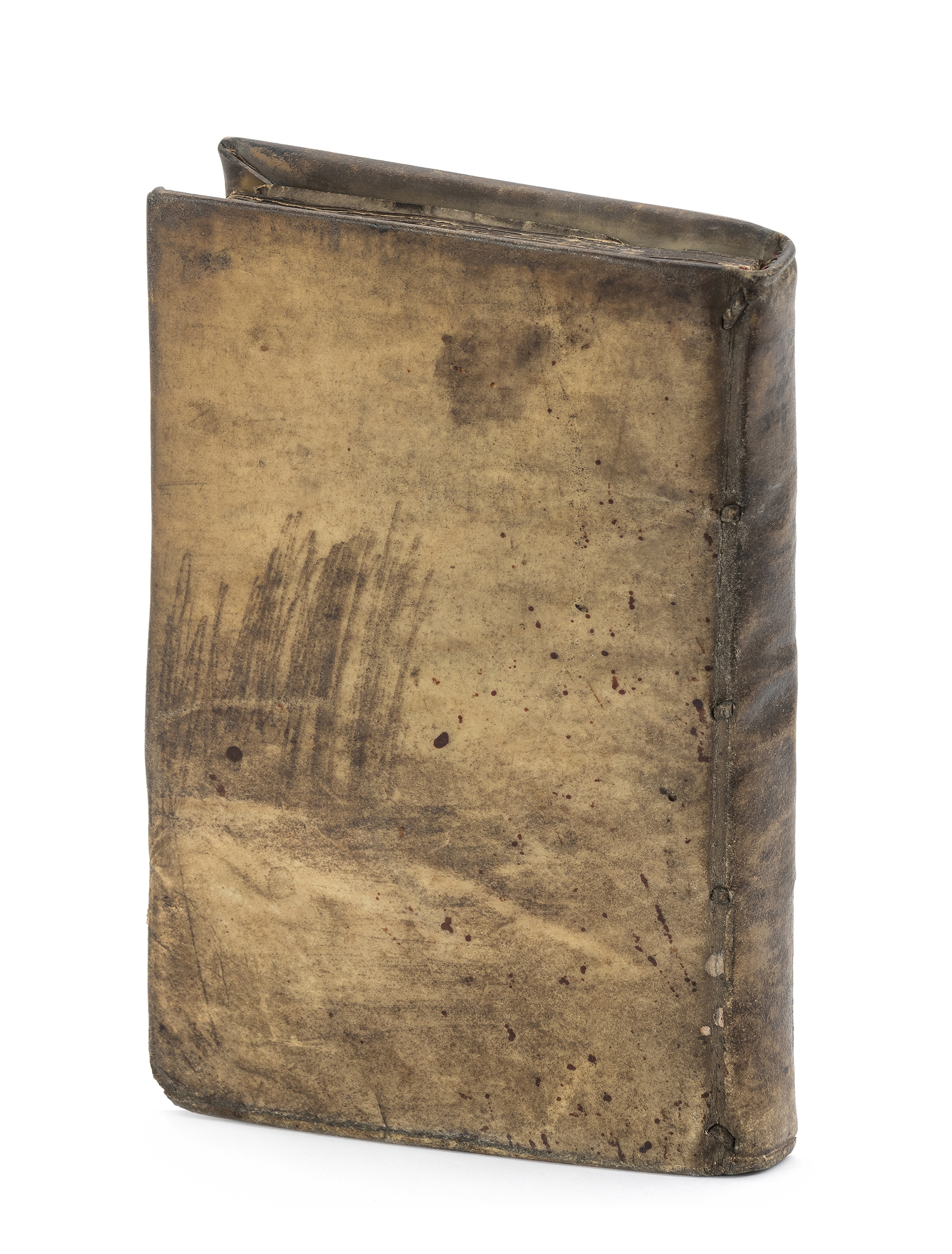
[20], 54 leaves. 15.5 cm. Good-fair condition. Stains (somewhat dark dampstains to last leaves). Light wear. Minor worming, slightly affecting text. Tear to center of title page (with almost no loss), and minor tears to margins of title page and several other leaves. Original parchment binding, somewhat loose. Many stains and defects to binding.
See: A. Yaari, HaMachazeh HaIvri, Jerusalem 1956, p. 104 (Yaari notes that this is the first Hebrew play to be published by its author); Ch. Schirmann, LeToldot HaShirah VehaDrama HaIvrit, Mechkarim UMasot, Mosad Bialik, Jerusalem 1980, II, pp. 132-137.
Joseph Penso de la Vega (1650-1692), was a Jewish-Dutch merchant, preacher, poet and philanthropist, and a member of the Sephardic-Portuguese community in Amsterdam. He was born to a family of Marranos originating near Cordova, Andalusia, who fled to Holland to practice Judaism openly. Penso was educated in the Sephardic Torah school in Amsterdam, under the auspices of R. Moshe Refael de Aguilar and R. Yitzchak Aboab. Like his father, Yitzchak Penso, he was also a merchant, but in addition to his financial activities he also took part in cultural and spiritual community life.
He was one of the founders of literary circles ("academies") in Amsterdam and Livorno, and some of his addresses to these groups have been published. He authored poetry and prose, mainly in Spanish. Of special note is his early Hebrew play Asirei HaTikvah (Amsterdam, 1673), authored at the young age of 17, widely celebrated and considered one of the first plays to be printed in Hebrew. His fame is mainly due to his Mehumat HaMehumot (Confusion de Confusiones), published in Amsterdam in 1688, regarded as the first literary work about the stock market. The book, written as a philosophical dialogue, garnered attention even outside of Jewish circles, and was translated to various languages and printed in many editions over the course of the 20th century. In 2000, the Federation of European Securities Exchanges (FESE) began to award the De La Vega prize, named for him, to outstanding securities researchers.
Bookplate of Mozes Heiman Gans.
Category
Incunabula and Early Printed Books
Catalogue Value
Auction 107: Rare and Important Items
Apr 15, 2026
Opening: $1,000
Estimate: $3,000 - $5,000
Sold for: $13,750
Including buyer's premium
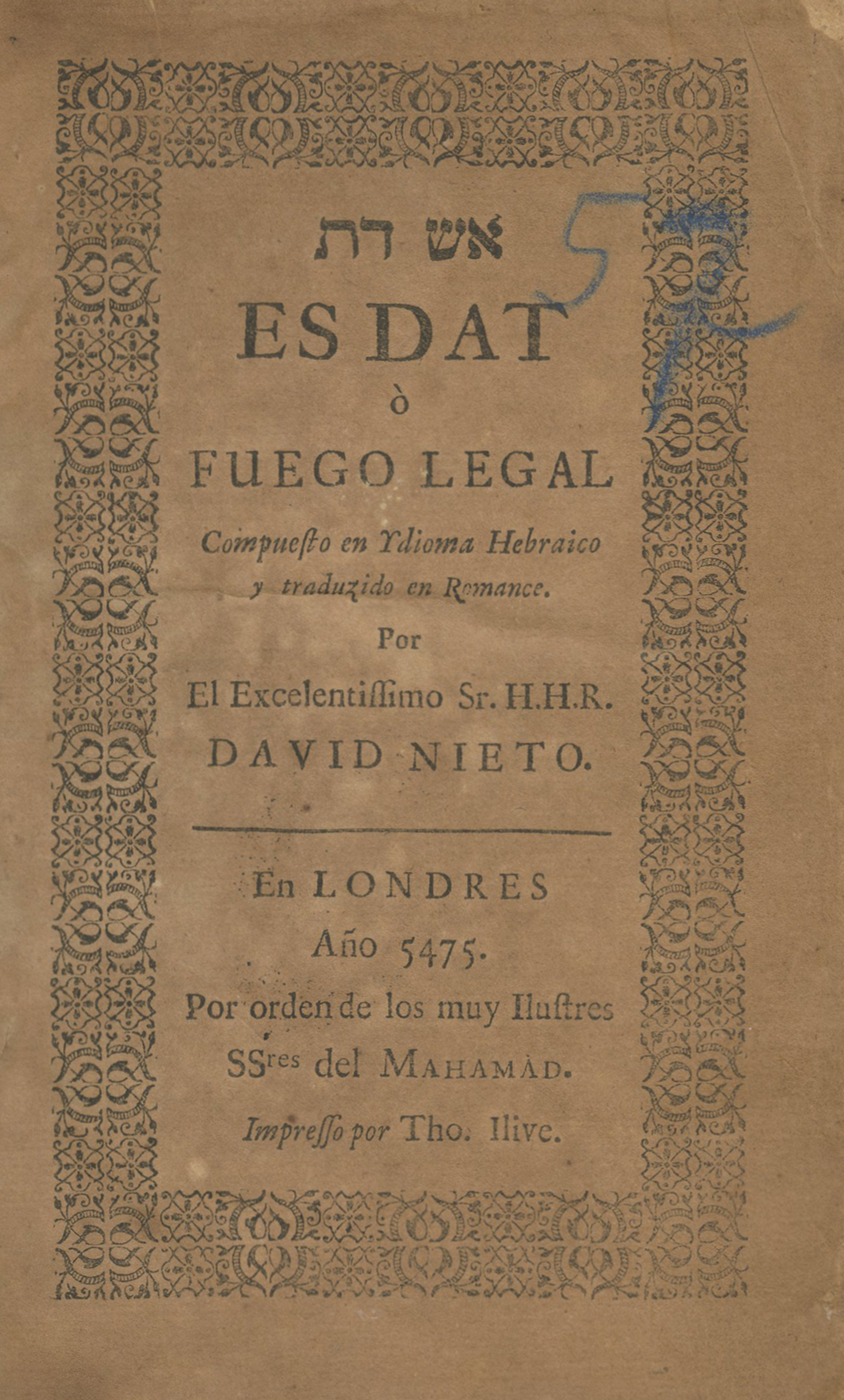
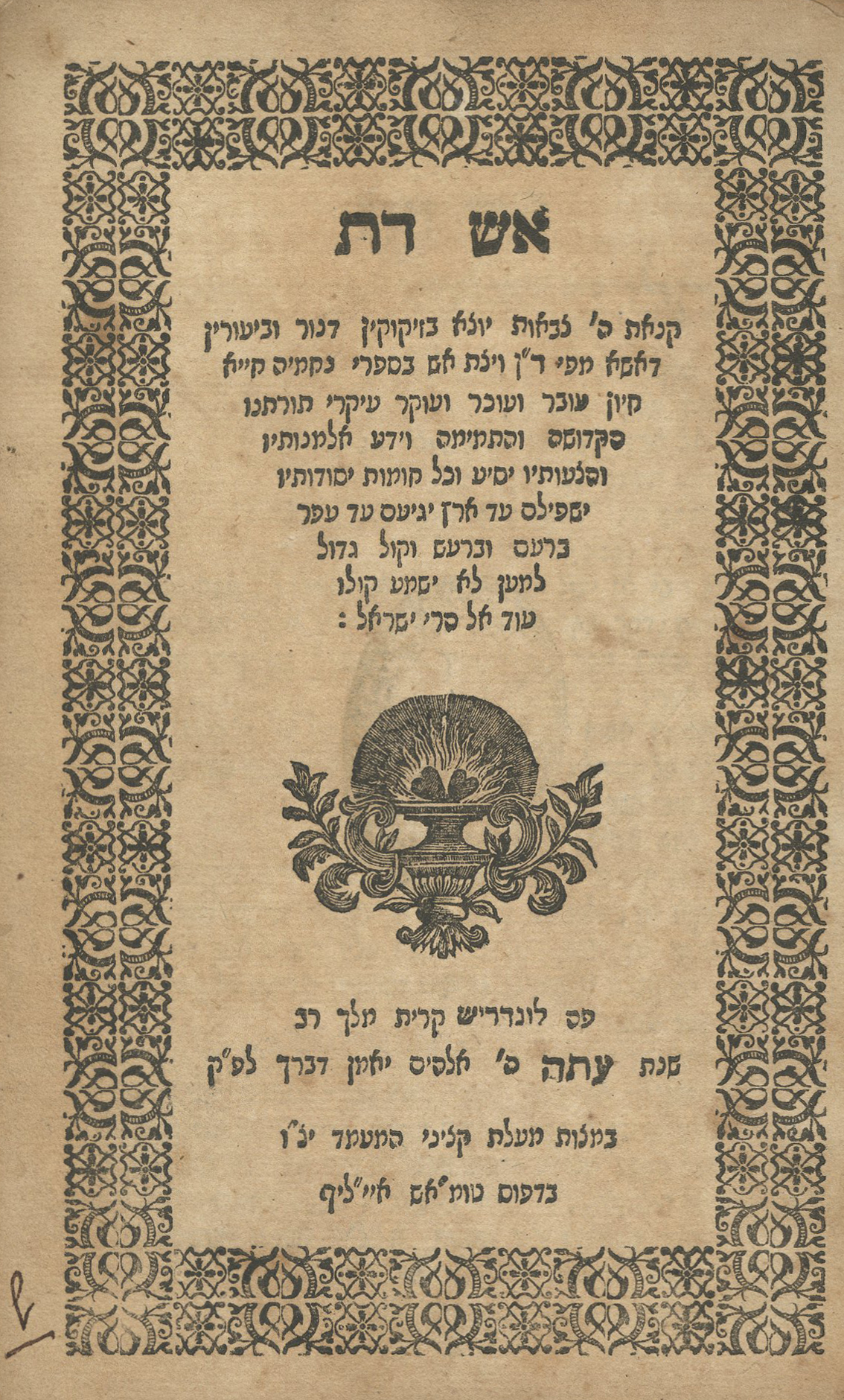
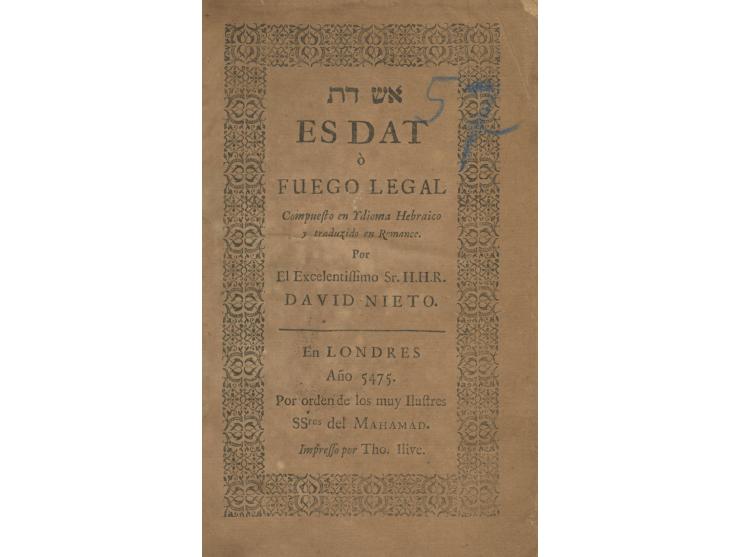
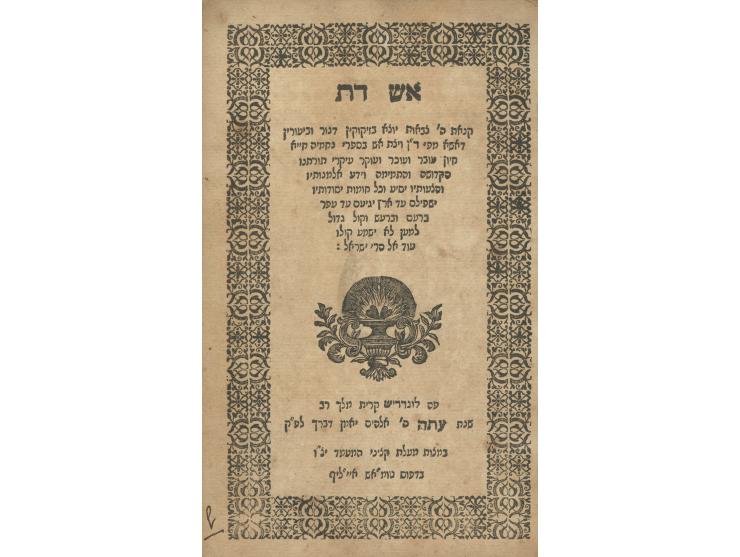
Esh Dat, a polemical work against Nechemiah Chiya Hayyun, by R. David Nieto. London: Thomas Ilive, 1715. Bound with manuscript, another work by R. David Nieto in Spanish (see below).
Esh Dat is a polemical book comprising two dialogues against the Sabbatean movement and against the Sabbatean Nechemiah Hayyun of Amsterdam.
The present copy includes another part with a Spanish translation of the book (Es Dat, ò Fuego Legal), printed together with the Hebrew part, with a divisional title page in Spanish. This part is not included in most copies.
R. David Nieto (1654-1728), scholar of Torah and science. Dayan, orator and physician in Livorno, and later the first rabbi of the Sephardi community in London. Author of Kuzari Sheni and Mateh Dan. One of the leading opponents of Sabbateanism.
Nechemiah Chiya Hayyun
(ca. 1655-1730), a Sabbatean scholar and kabbalist, probably the most prominent Sabbatean after Shabtai Tzvi's death.
(ca. 1655-1730), a Sabbatean scholar and kabbalist, probably the most prominent Sabbatean after Shabtai Tzvi's death.
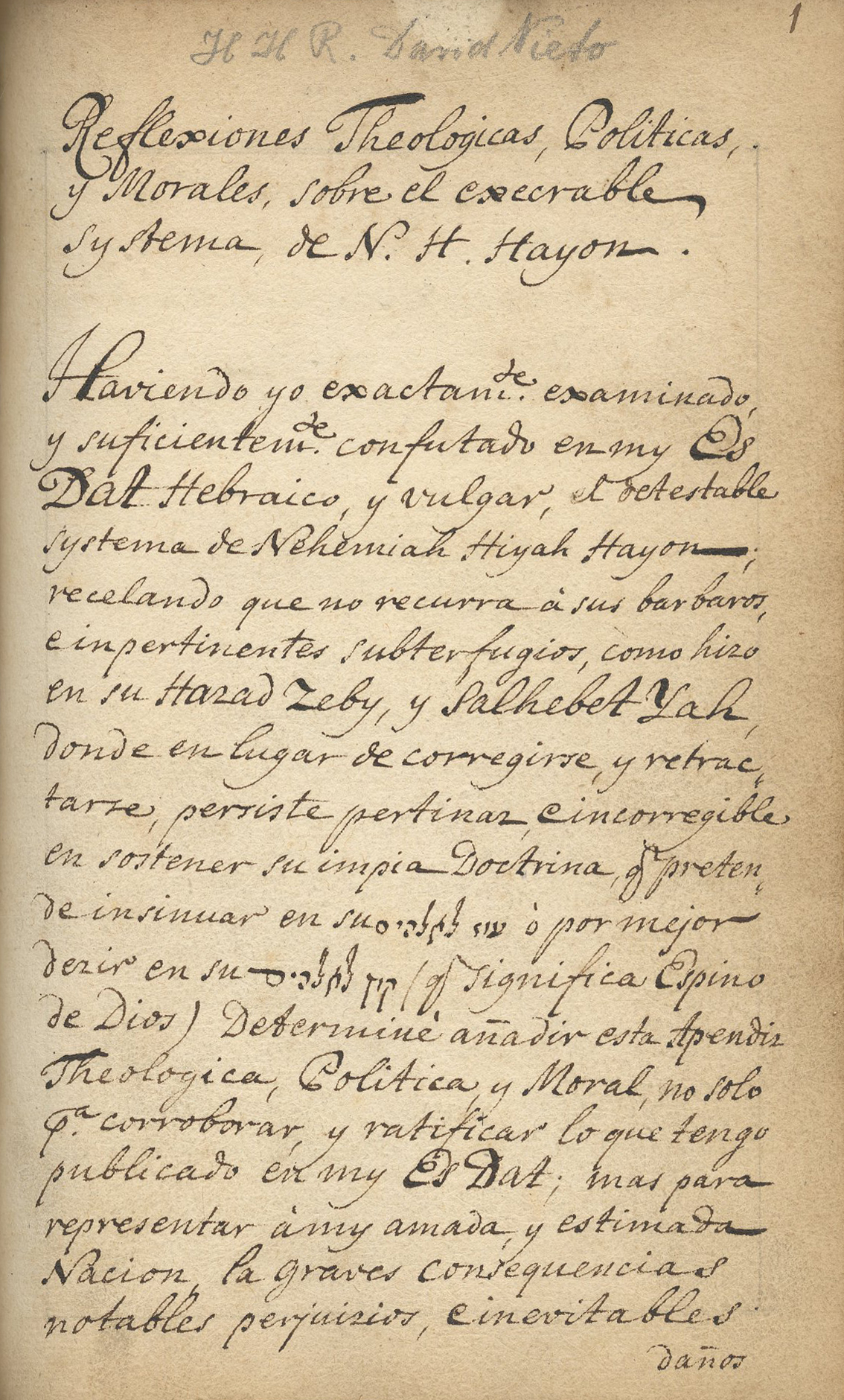
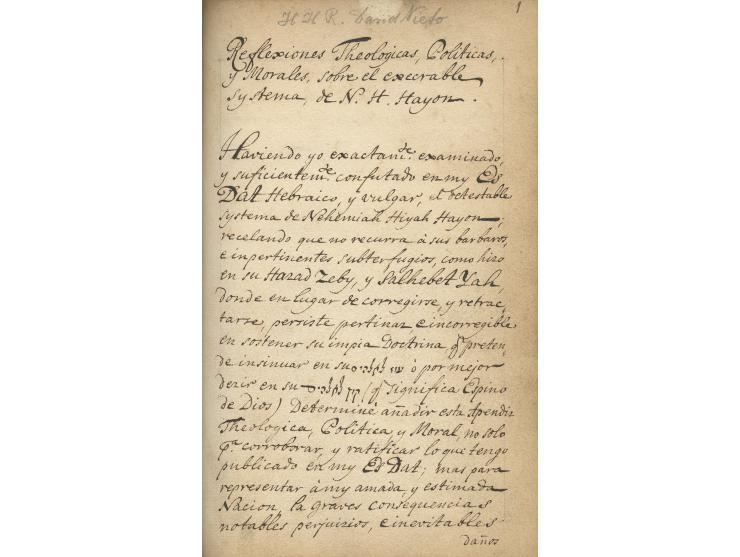
Between the Hebrew and Spanish parts, the present copy includes another work in manuscript ([17]-pages), in Spanish (with a few words in Hebrew), by R. David Nieto, entitled "Reflexiones Theologicas, Politicas y Morales, Sobre el execrable Systema de N. H. Hayon". This work of Nieto is a sort of appendix to his Esh Dat, in which Nieto persists in his sharp critique of Nechemiah Hayyun and the danger of his views, both theologically and morally, as well as socially and politically. This work has never before been printed (at the end of his introduction to the Spanish part of Esh Dat, Nieto writes that he refrained from publishing all his thoughts on the matter, and that he is keeping the remainder in manuscript, for whoever is interested to read them; apparently, he is referring to the present work).
The NLI catalogue records only a photocopy of the work, from the present copy. Several other copies of Esh Dat are known, which have this manuscript work included (most, like in the present copy, have it bound between the Hebrew and Spanish parts): a copy in the UCL library, London, from the Mocatta Collection (Mocatta Ms. 43); a copy in the University of Columbia Library (B893.1 N51); a copy in the Bodleian Library, Oxford (Opp. Add. 8° II. 63); and a copy in the Klau Library, in the Hebrew Union College in Cincinnati (RBR E 184 c.1).
[1], 38 leaves; [17] handwritten pages; XII, 169 pages. Approx. 16 cm. Partly dark paper. Good-fair condition. Many stains. Marginal tears to title page of Spanish part, repaired with paper. New parchment binding.
Bookplates of Mozes Heiman Gans.
On the manuscript work, see at length:
• Alex Kerner, Lost in Translation, Found in Transliteration, Leiden, Boston, 2018, pp. 166-174.
• Raphael Loewe, The Spanish Supplement to Nieto's "Esh Dath", Proceedings of the American Academy for Jewish Research, XLVIII (1981), pp. 268-296.
• Israel Solomons, David Nieto and some of his Contemporaries, Transactions (Jewish Historical Society of England), XII (1928-1931), pp. 31-33.
Category
Incunabula and Early Printed Books
Catalogue Value
Auction 107: Rare and Important Items
Apr 15, 2026
Opening: $1,000
Estimate: $3,000 - $5,000
Sold for: $4,250
Including buyer's premium
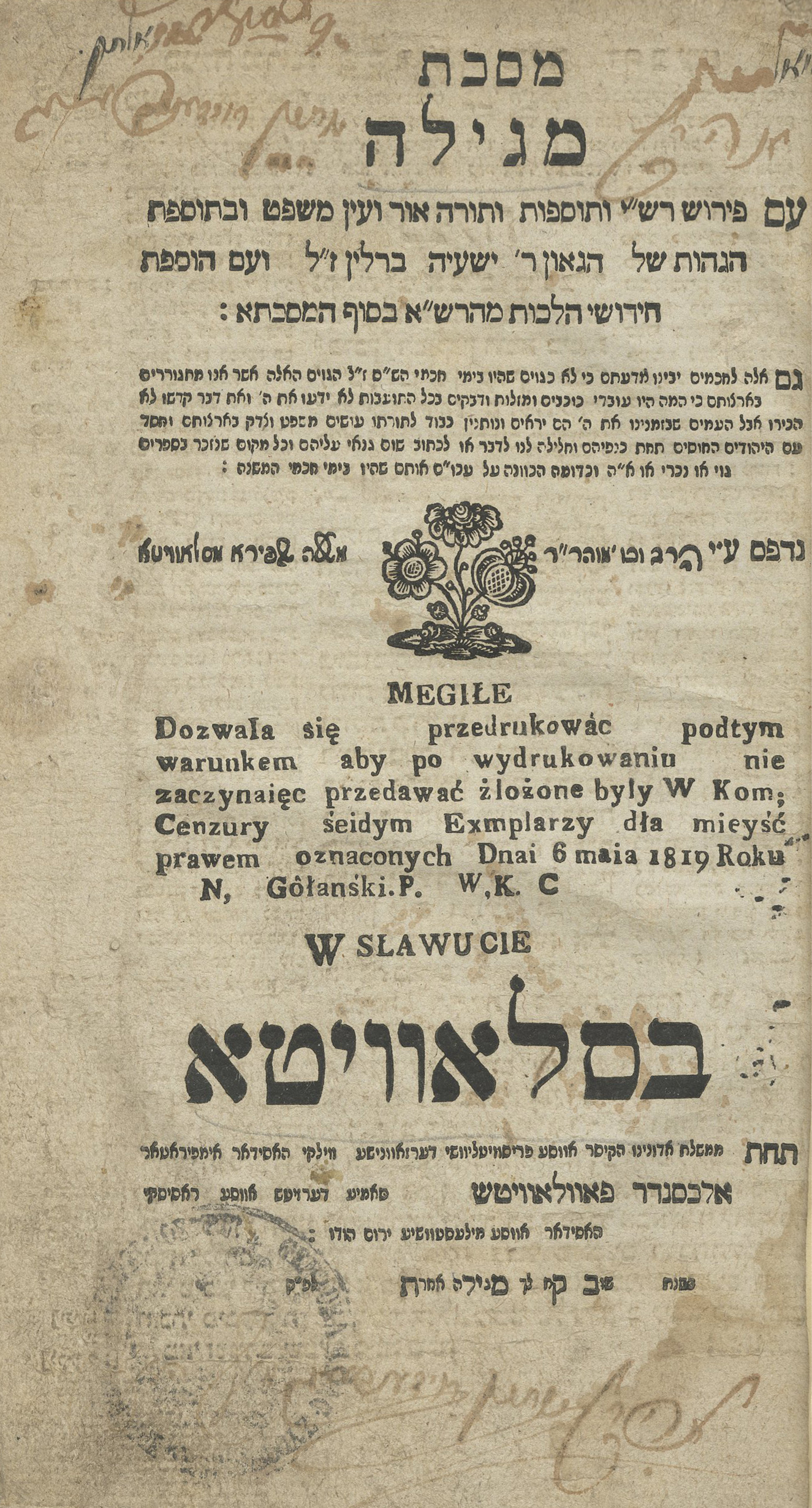
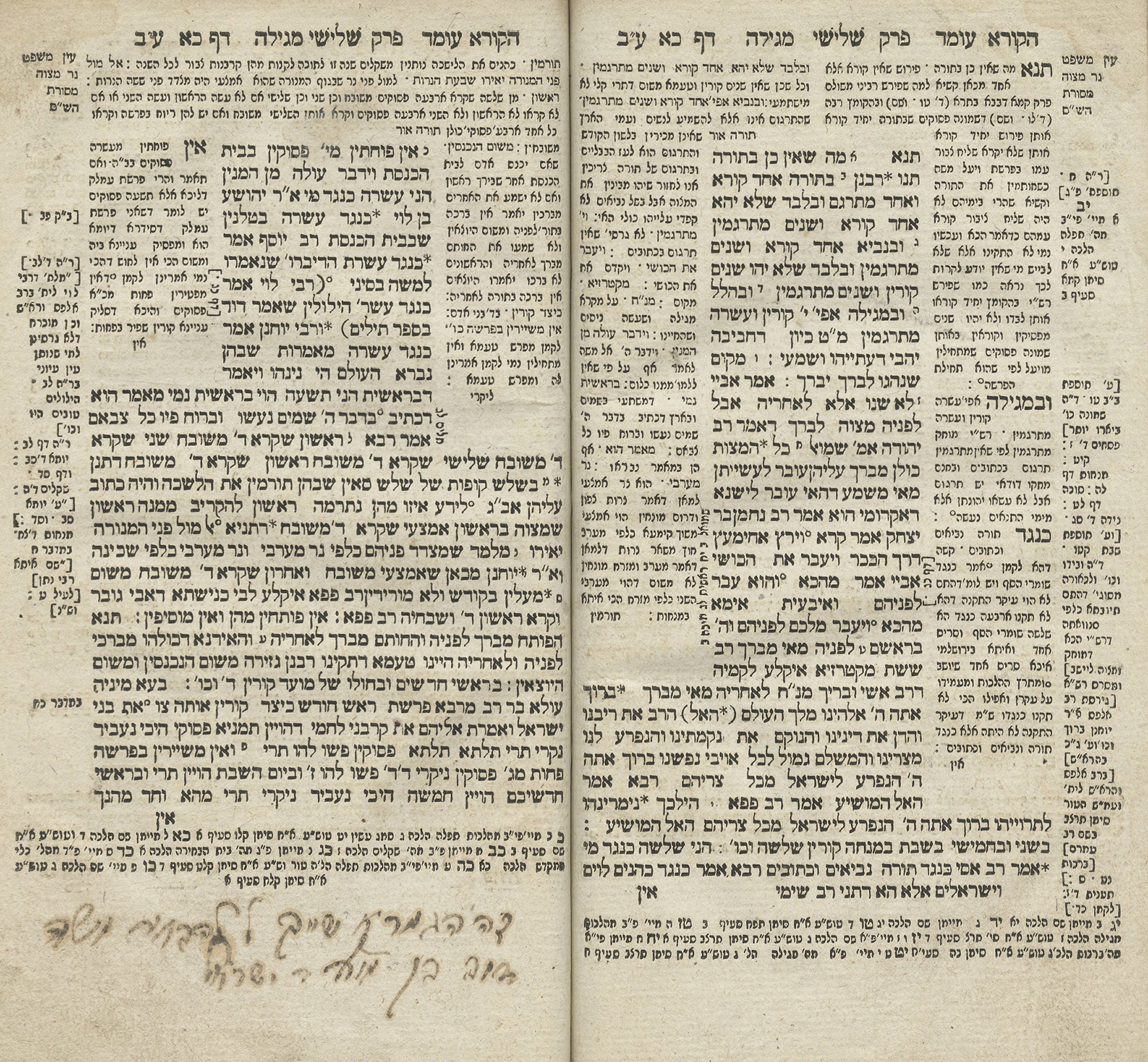
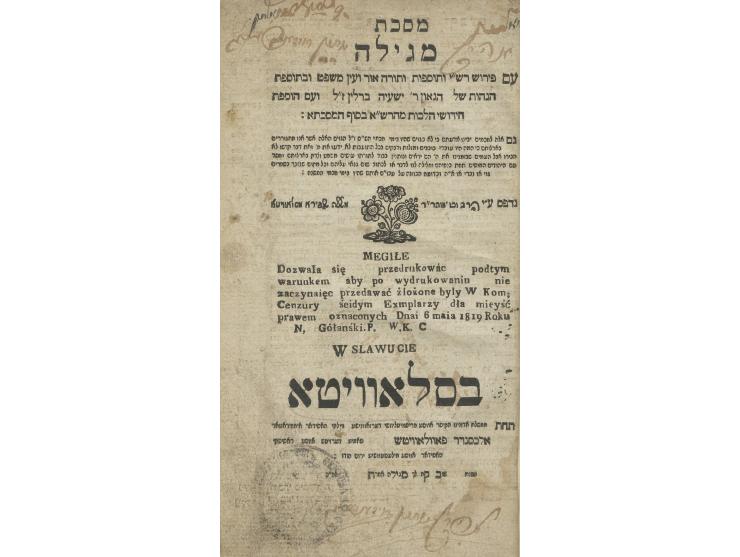
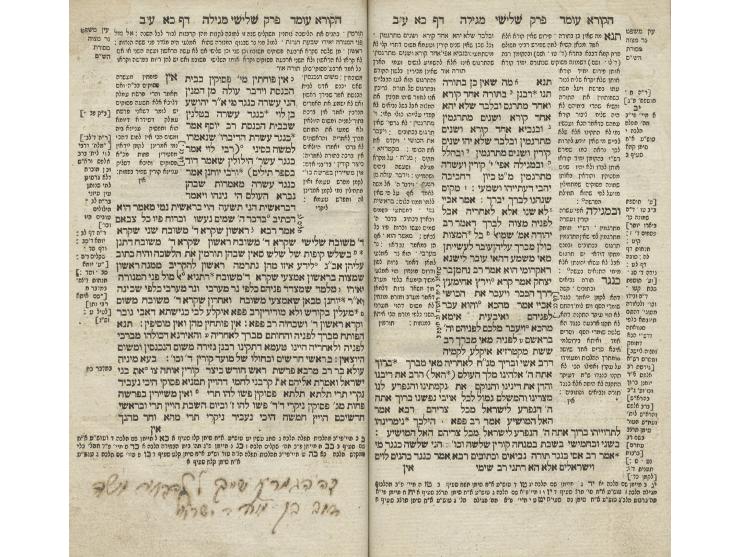
Talmud Bavli, Tractate Megillah, with commentary of Rashi and Tosafot, Torah Or and Ein Mishpat, glosses of R. Yeshayah Berlin and novellae of Maharsha. Slavita: R. Moshe Shapira, [1822].
Small format (travel edition), with every two pages covering one page of the standard Talmud editions. Novellae of Maharsha printed at end of tractate.
Several individual tractates were printed at the time in this format, not a complete set of the Talmud.
Signatures on title page: "Aharon Yochanan Rosenberg"; "Shmuel Elchanan". Extended signature covering first leaves: "Shmuel Elchanan son of R. Aharon Rosenberg from here, Widoma". Signature on folio 27b/2: "Aharon Yochanan son of R. Shmuel"; extended signature covering folio 18b/2-20a: "Aharon Yochanan son of R. Sh.A., from here, Przedbórz". Ownership inscription on folio 21a/1: "This Gemara belongs to m[e], Moshe Dov son of R. Yisrael".
[62], 33-34 leaves. 21 cm. Good-fair condition. Stains, including dark dampstains. Worming to several leaves, slightly affecting text. New cardboard binding.
Category
Books Printed in Slavita and Zhitomir
Catalogue Value