
Auction 107: Rare and Important Items
Apr 15, 2026
- and (82) Apply and filter
- item (32) Apply item filter
- various (27) Apply various filter
- object (23) Apply object filter
- ornament (23) Apply ornament filter
- ornaments, (23) Apply ornaments, filter
- synagogu (23) Apply synagogu filter
- torah (23) Apply torah filter
- book (17) Apply book filter
- print (17) Apply print filter
- earli (15) Apply earli filter
- incunabula (15) Apply incunabula filter
- jewish (13) Apply jewish filter
- the (13) Apply the filter
- manuscript (12) Apply manuscript filter
- public (12) Apply public filter
- letter (10) Apply letter filter
- ketubot (9) Apply ketubot filter
- anti (8) Apply anti filter
- anti-jewish (8) Apply anti-jewish filter
- antijewish (8) Apply antijewish filter
- antisemit (8) Apply antisemit filter
- edict (8) Apply edict filter
- edicts, (8) Apply edicts, filter
- law (8) Apply law filter
- laws, (8) Apply laws, filter
- ordin (8) Apply ordin filter
- rabbin (8) Apply rabbin filter
- royal (8) Apply royal filter
- haggadot (6) Apply haggadot filter
- israel (6) Apply israel filter
- mandatori (6) Apply mandatori filter
- of (6) Apply of filter
- palestin (6) Apply palestin filter
- passov (6) Apply passov filter
- siddurim (6) Apply siddurim filter
- state (6) Apply state filter
- zionism (6) Apply zionism filter
- zionism, (6) Apply zionism, filter
- bind (5) Apply bind filter
- havdalah (5) Apply havdalah filter
- holiday (5) Apply holiday filter
- person (5) Apply person filter
- shabbat (5) Apply shabbat filter
- shabbat, (5) Apply shabbat, filter
- silver (5) Apply silver filter
- art (4) Apply art filter
- brueckheim (4) Apply brueckheim filter
- collect (4) Apply collect filter
- from (4) Apply from filter
Displaying 73 - 84 of 104
Auction 107: Rare and Important Items
Apr 15, 2026
Opening: $10,000
Estimate: $15,000 - $20,000
Sold for: $12,500
Including buyer's premium
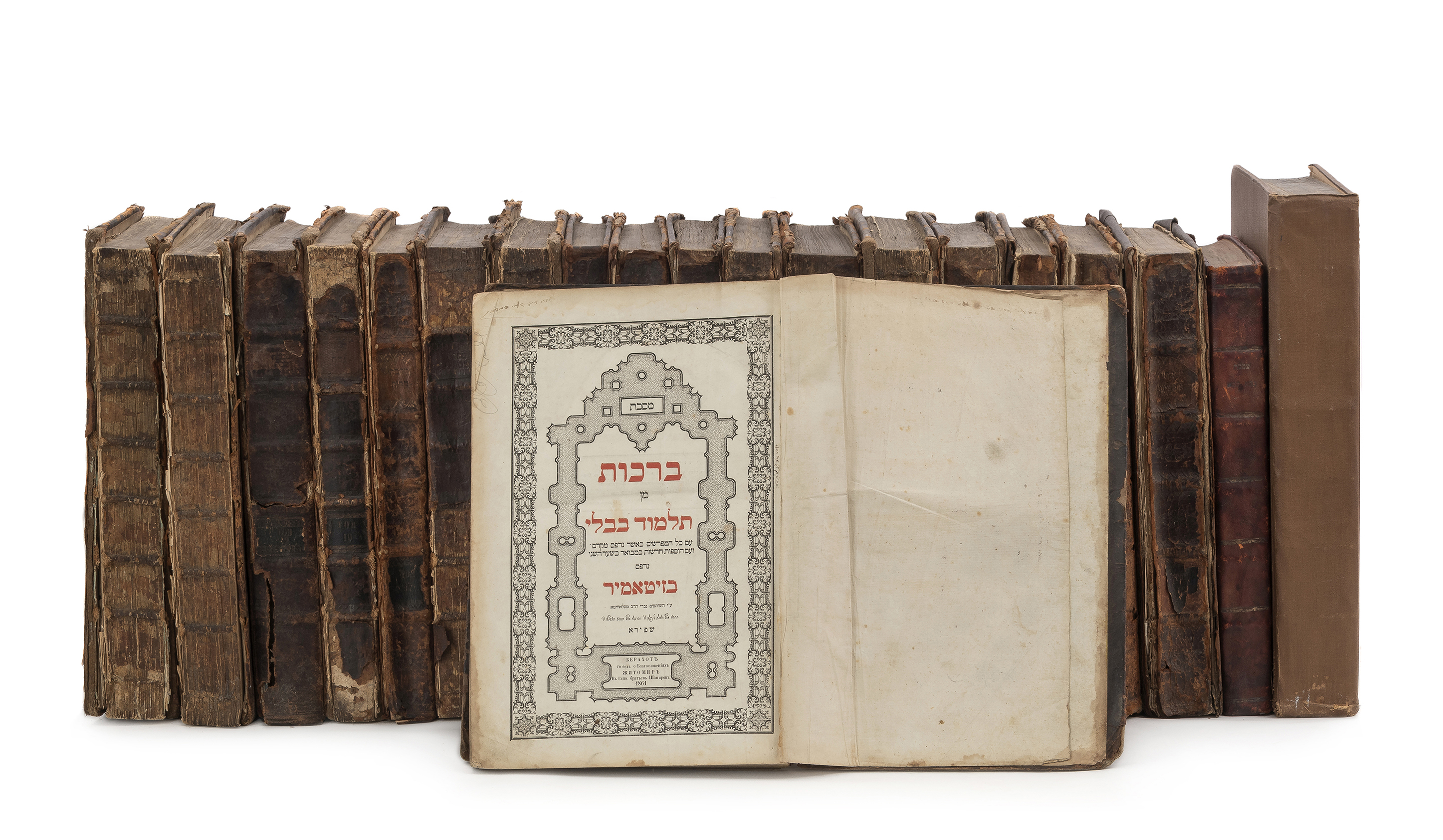
Talmud Bavli, complete set of 20 volumes. With Piskei Tosfot, Rosh, the Rambam's commentary on Mishnah, Maharsha, Maharam Schiff and Meir Nativ. Zhitomir: R. Chanina Lipa and R. Yehoshua Heshel Shapira, grandsons of the Rabbi of Slavita, 1858-1864.
Most volumes in original leather bindings, many with defects and wear.
This edition includes in all volumes Meir Nativ by R. Shabtai HaKohen (a relative of the Shach), omitted from later editions of the Talmud printed in Vilna, Warsaw and Lviv. The Chazon Ish favored and praised the Zhitomir edition of the Talmud, both because of the publishers' reverence for the holiness of the Talmud and mainly for its inclusion of Meir Nativ, absent from other editions.
Signatures in most volumes in various places: "Chaim Moshe Friedman"; "Shabtai David Friedman of Goworowo"; "Shabtai David son of R. Shlomo HaLevi"; "Shabtai David HaLevi Friedman"; and others.
Glosses in several places, and handwritten inscriptions to some endpapers
.
.
20 volumes. Varying size, 36.5-42 cm (several volumes apparently supplied from another set). Two title pages in each volume, with words in red. One black title page for tractates later in volume (except Tractate Avodah Zarah, with two title pages and red ink). Tractate Megillah lacking leaves 5-6 (leaves 3-4 bound again in their place). After title pages of Menachot appear first two leaves of Horayot. Varying condition of volumes, fair to good-fair. Some leaves in several places in fair-poor condition. Stains, including dampstains. Much wear and creases to some volumes. Tears and open tears, including open tears to title pages, affecting text and title frames. Detached leaves and gatherings in several places (including some title pages). Mostly original leather bindings (two volumes in different, later bindings). Many bindings detached, with defects, much wear and tears (spines lacking and torn in some volumes).
Category
Books Printed in Slavita and Zhitomir
Catalogue Value


Auction 107: Rare and Important Items
Apr 15, 2026
Opening: $3,000
Estimate: $5,000 - $10,000
Sold for: $10,625
Including buyer's premium
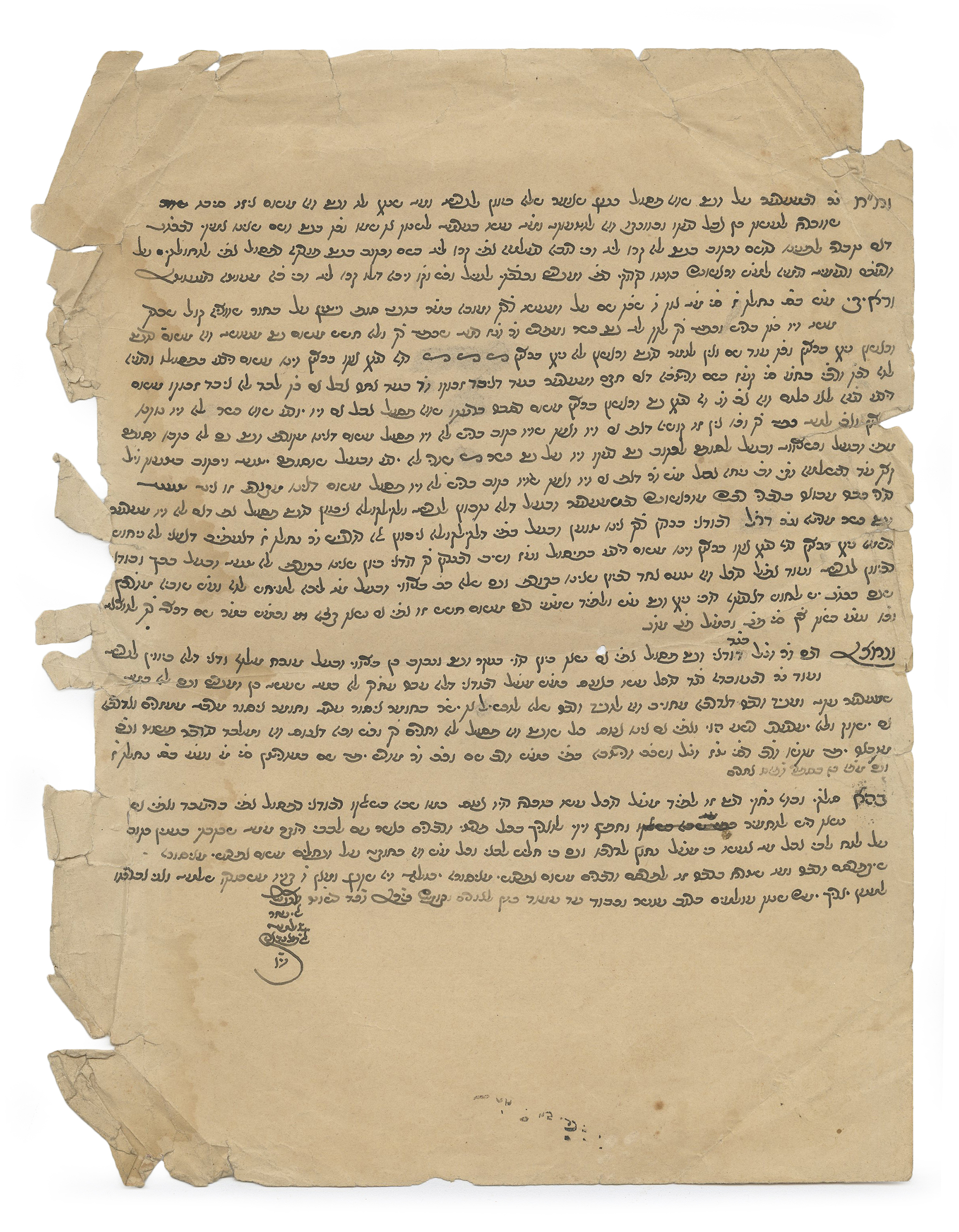
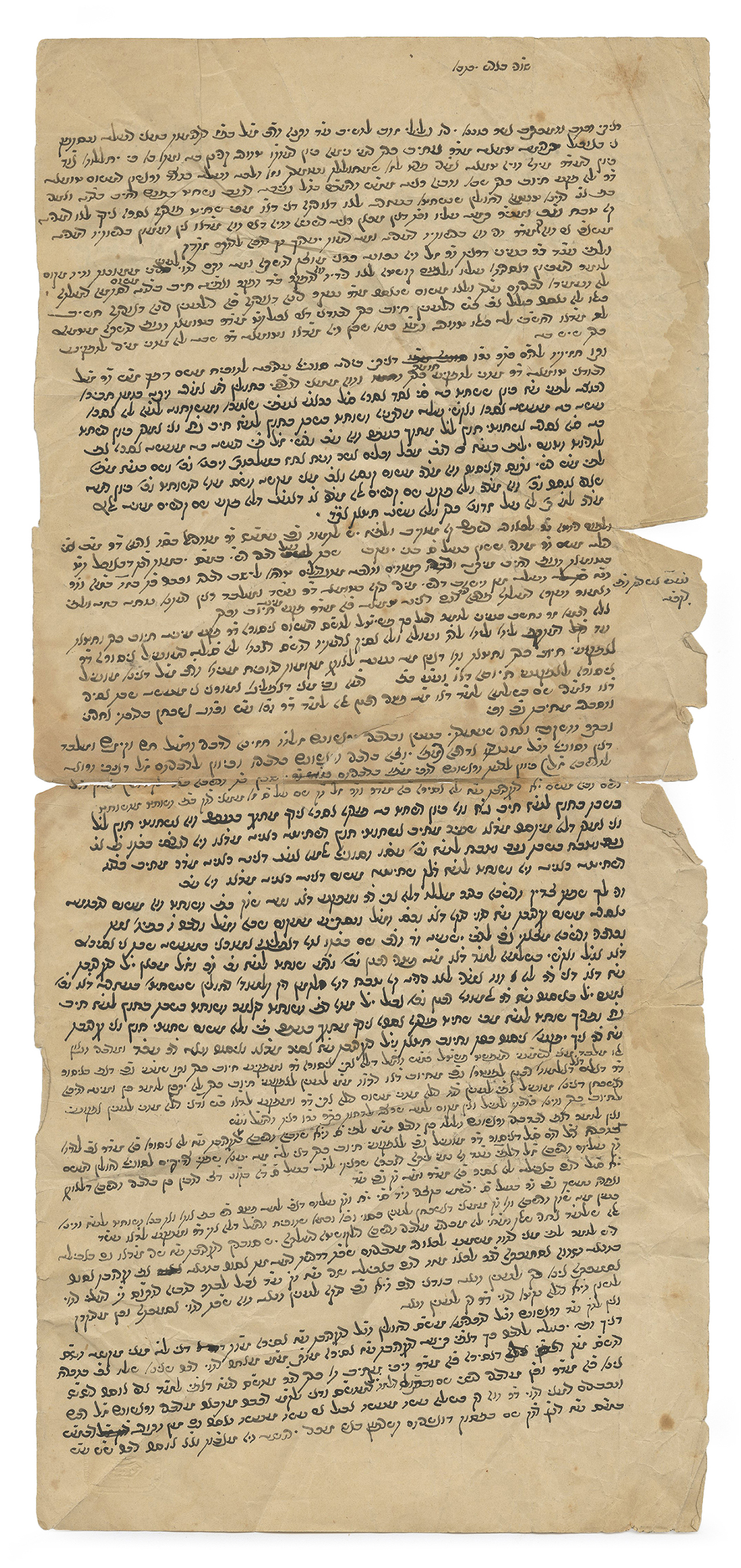
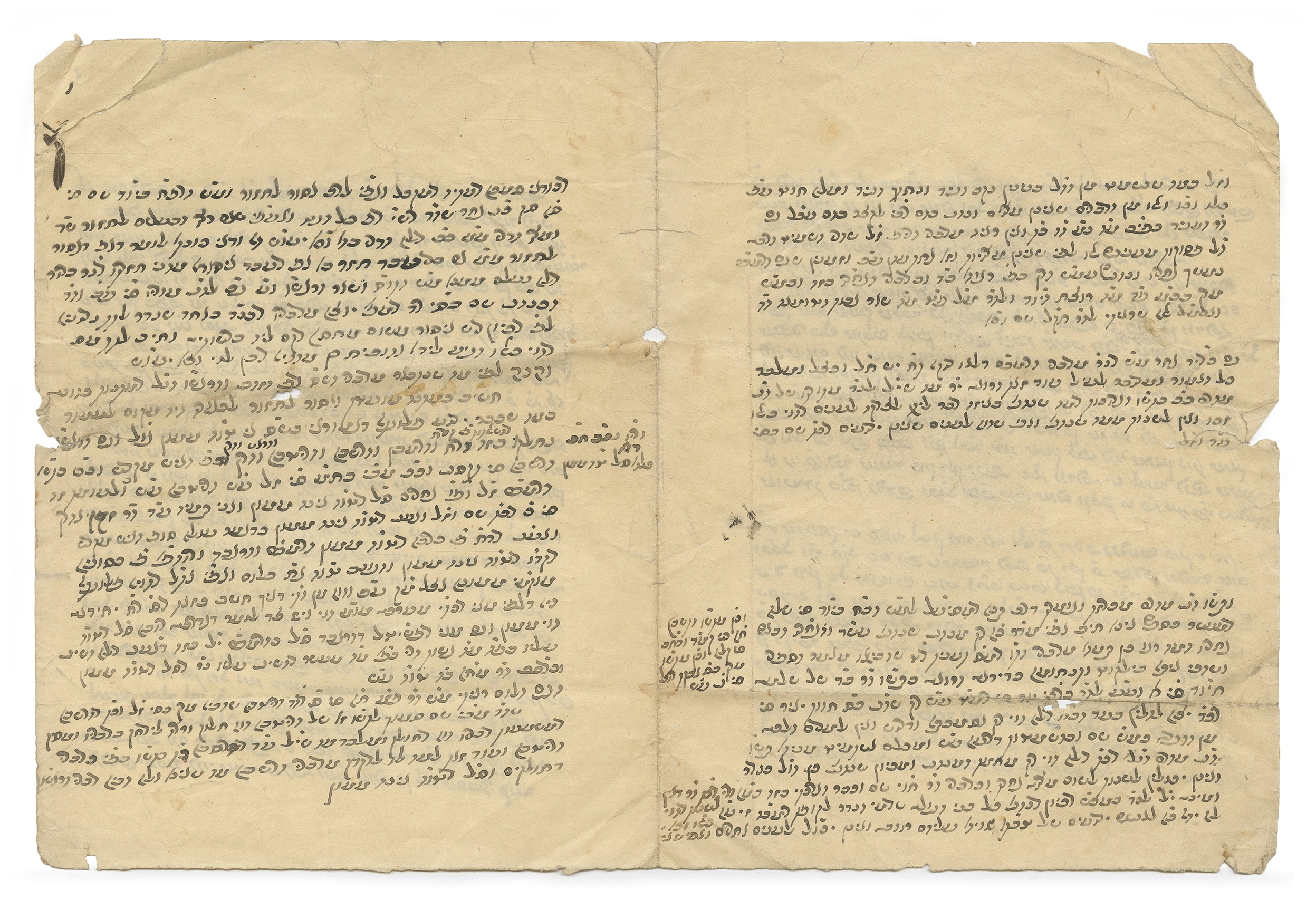
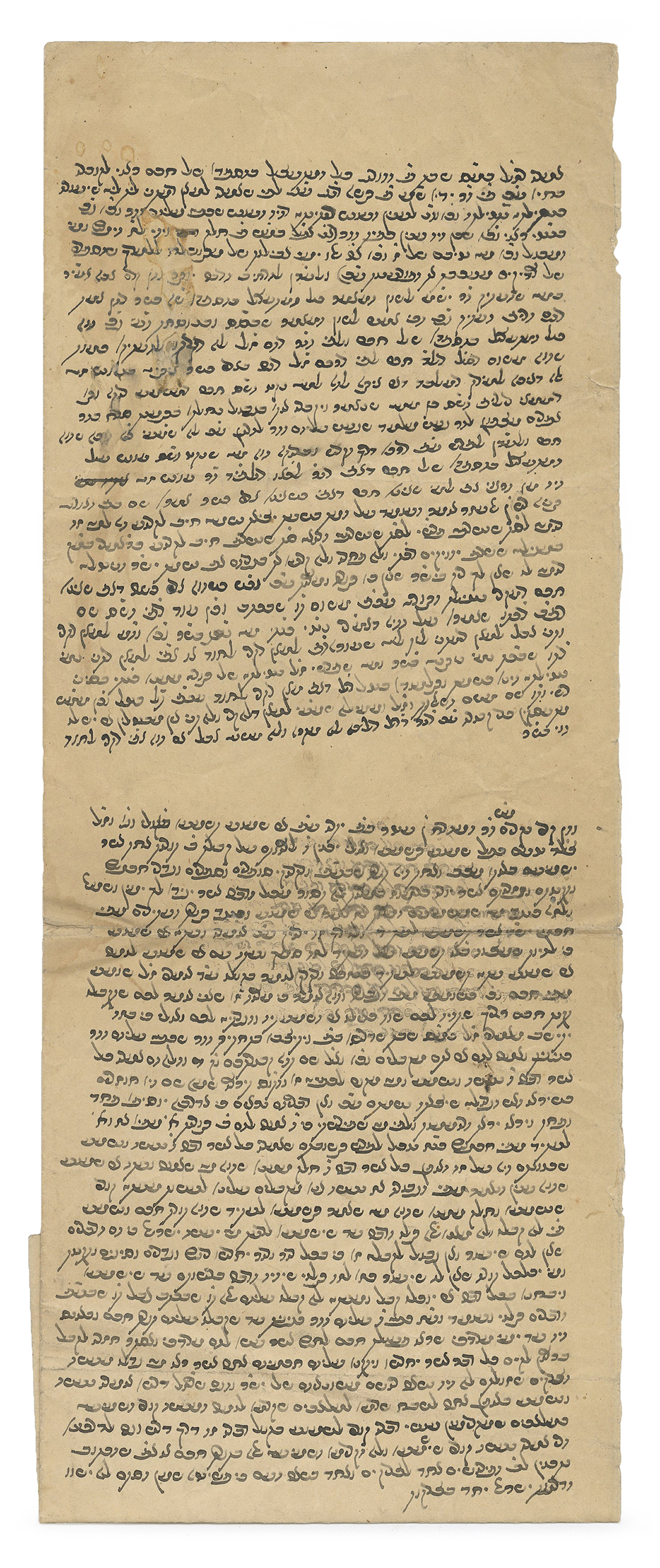
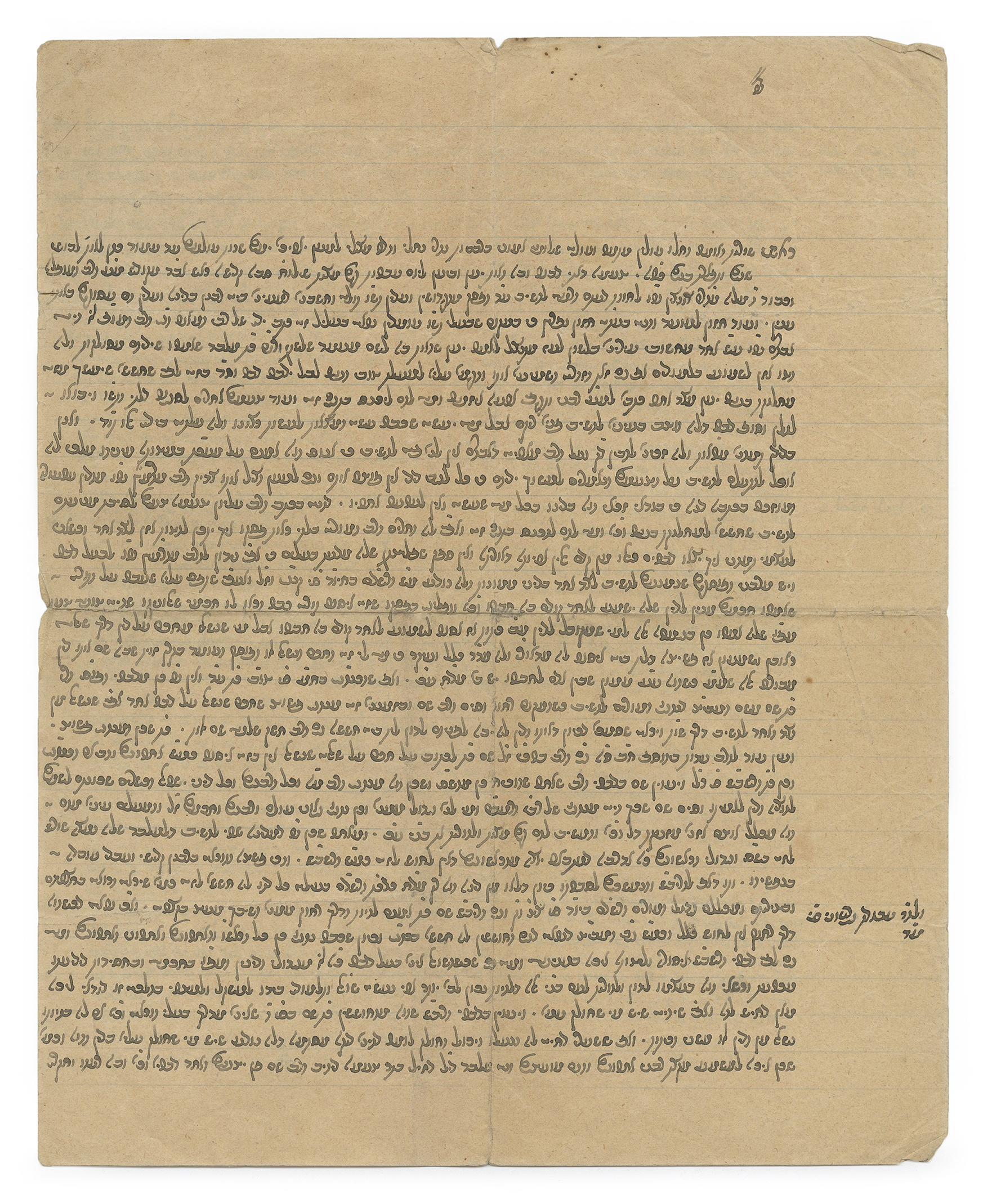
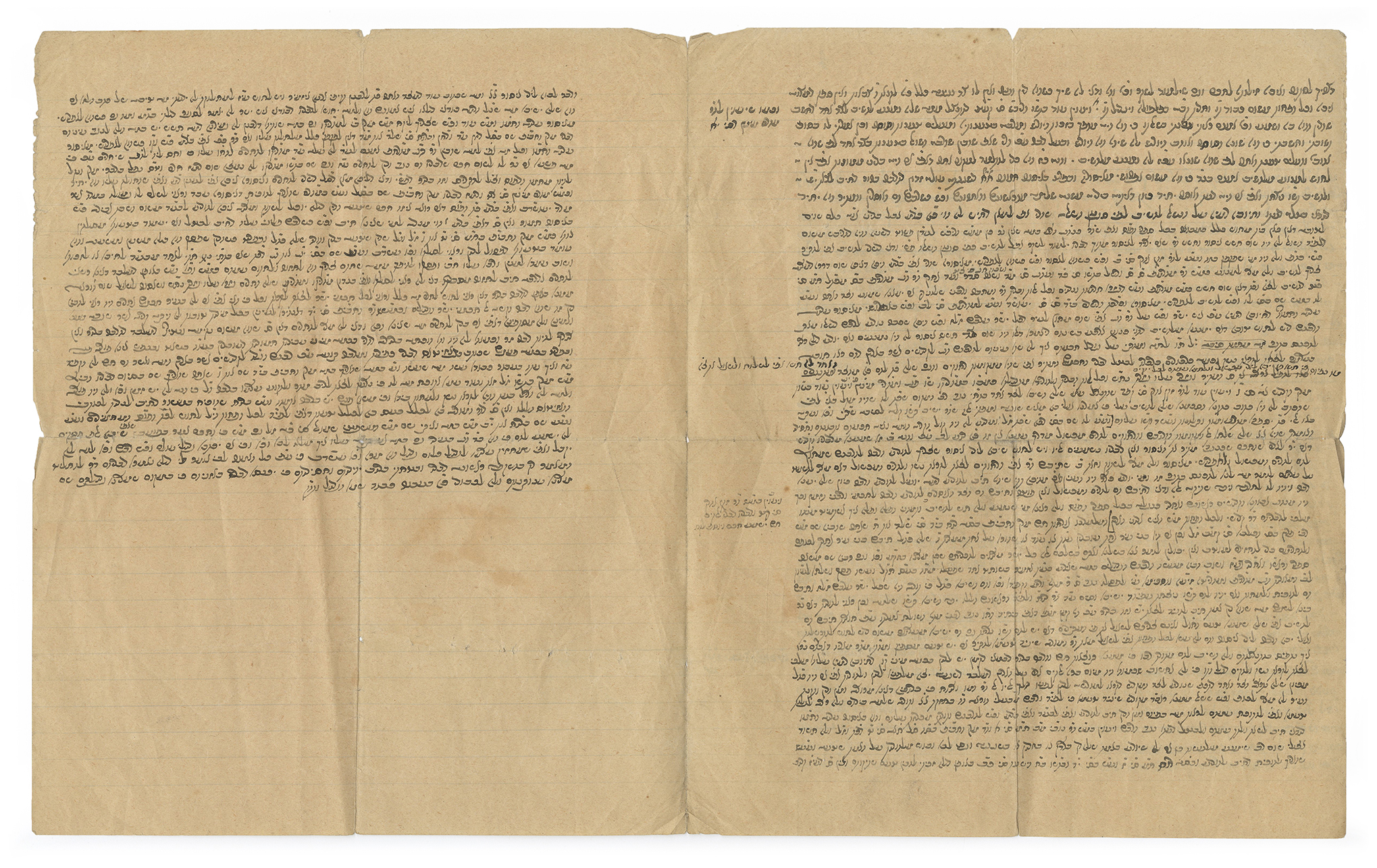
Collection of leaves handwritten by the Saba Kadisha R. Shlomo Eliezer Alfandari, a rabbi of Constantinople, Damascus, Safed and Jerusalem – including passages of Torah novellae, halachic responsa and homilies. [Written in Turkey, Damascus and Safed, ca. 1880s-1910s].
The collection's contents include: Last leaf of a halachic responsum on rescission of a divorce document, signed "Eliezer Shlomo Alfandari"; leaves of Torah novellae regarding eating terumah while ritually impure, and regarding terumah and chametz on Pesach; leaf (partial) of Torah novellae regarding agency in me'ilah; a leaf with a eulogy sermon; four pages of a halachic responsum on the laws of tzedakah and the R. Meir Baal HaNes funds (printed in Responsa Maharsha, Jerusalem 1932, Yoreh Deah 8); three pages of a halachic responsum on testimony of betrothal, relating to a contested halachic responsum of R. Menachem Soncin [apparently a follow-up to the discussion in Responsa Saba Kadisha (I, Jerusalem 1973, Even HaEzer section 27 – R. Menachem Soncin's ruling is at the end of the responsum [R. Menachem Soncin, head of the Constantinople Beit Din, died in 1884 (Pinkas Beit HaDin BeKushta, p. 94) and thus the present manuscript was written beforehand]); a draft responsum regarding candidacy of women [from the 1919 polemic; a responsa on this issue is published in Responsa Saba Kadisha (I, Choshen Mishpat, section 32); this is another responsum]; and more.
Some of the present letters have been printed, or are additions to responsa printed in his books. However, most of the present writings have not yet been printed.
The Saba Kadisha, R. Shlomo Eliezer Alfandari (ca. 1813-1930), leading Turkish rabbi. In his youth, he corresponded on halachic issues with R. Akiva Eger (who passed away in 1837). He served as Chief Rabbi of Constantinople and Damascus. When he was about 100 years old, he immigrated to Eretz Israel, serving as rabbi in Safed and settling in his final years in Jerusalem, where he passed away near the age of 120. During his Jerusalem period, his involvement in public issues declined, in favor of halachah and kabbalah which he studied with a small group of elevated individuals. During his final year, the Minchat Elazar of Munkacs came to Eretz Israel specially to visit him, and they discussed kabbalistic matters together. He authored Responsa Maharsha, Responsa Saba Kadisha, and more.
9 paper items (comprising approx. 19 written pages). Varying size and condition. Tears and wear.
Category
Rabbinical Letters and Manuscripts
Catalogue Value


Auction 107: Rare and Important Items
Apr 15, 2026
Opening: $2,000
Estimate: $3,000 - $4,500
Sold for: $4,250
Including buyer's premium
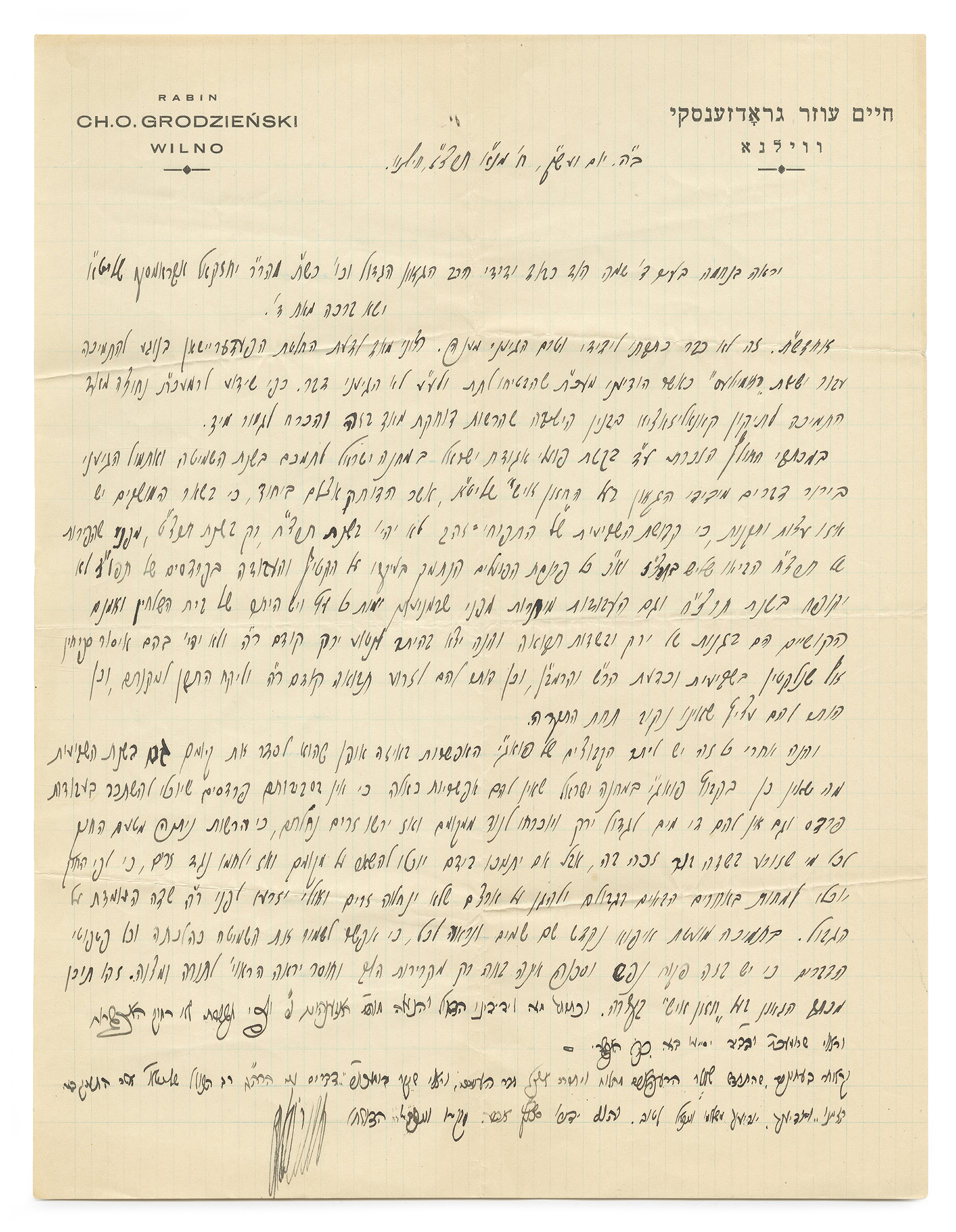
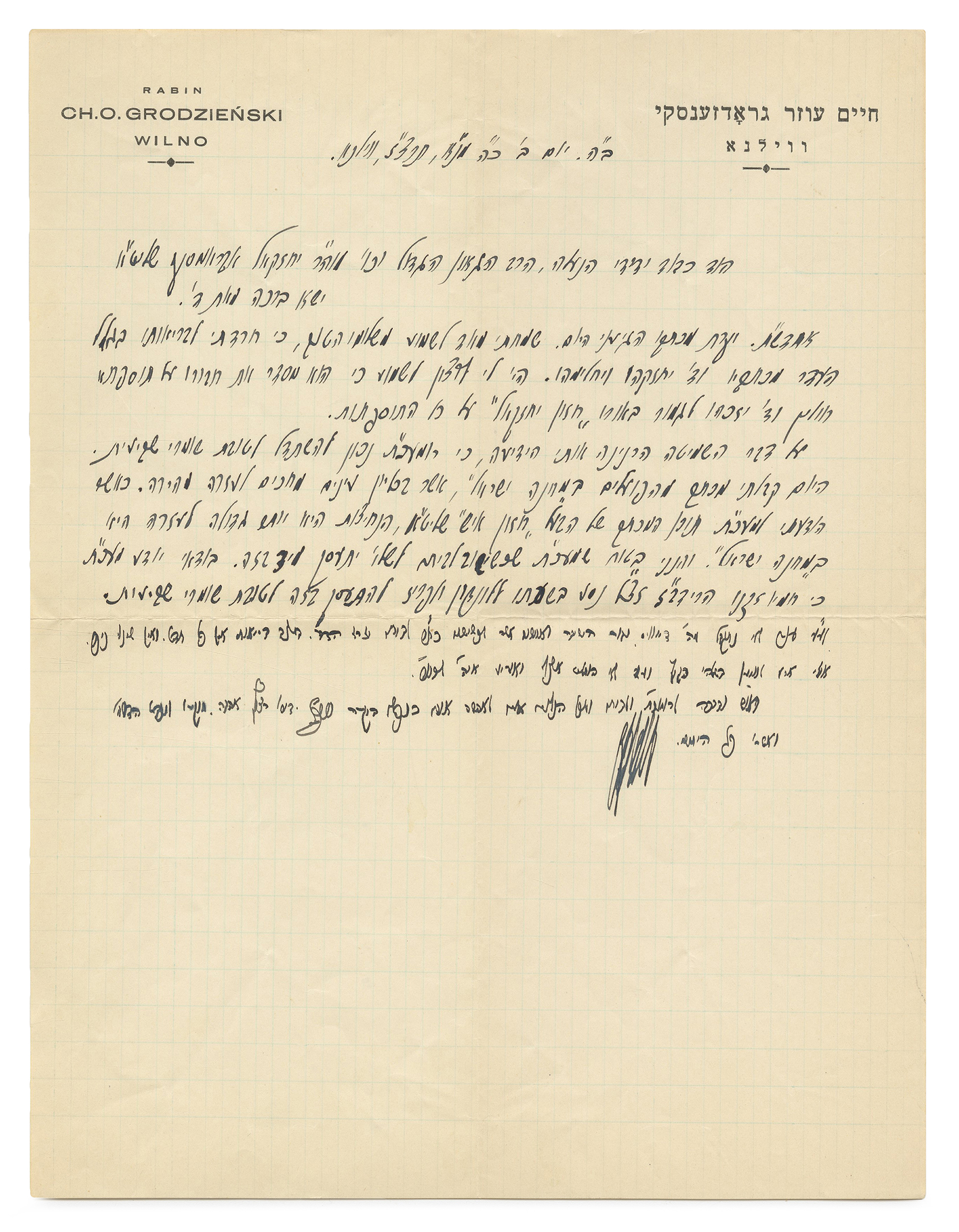
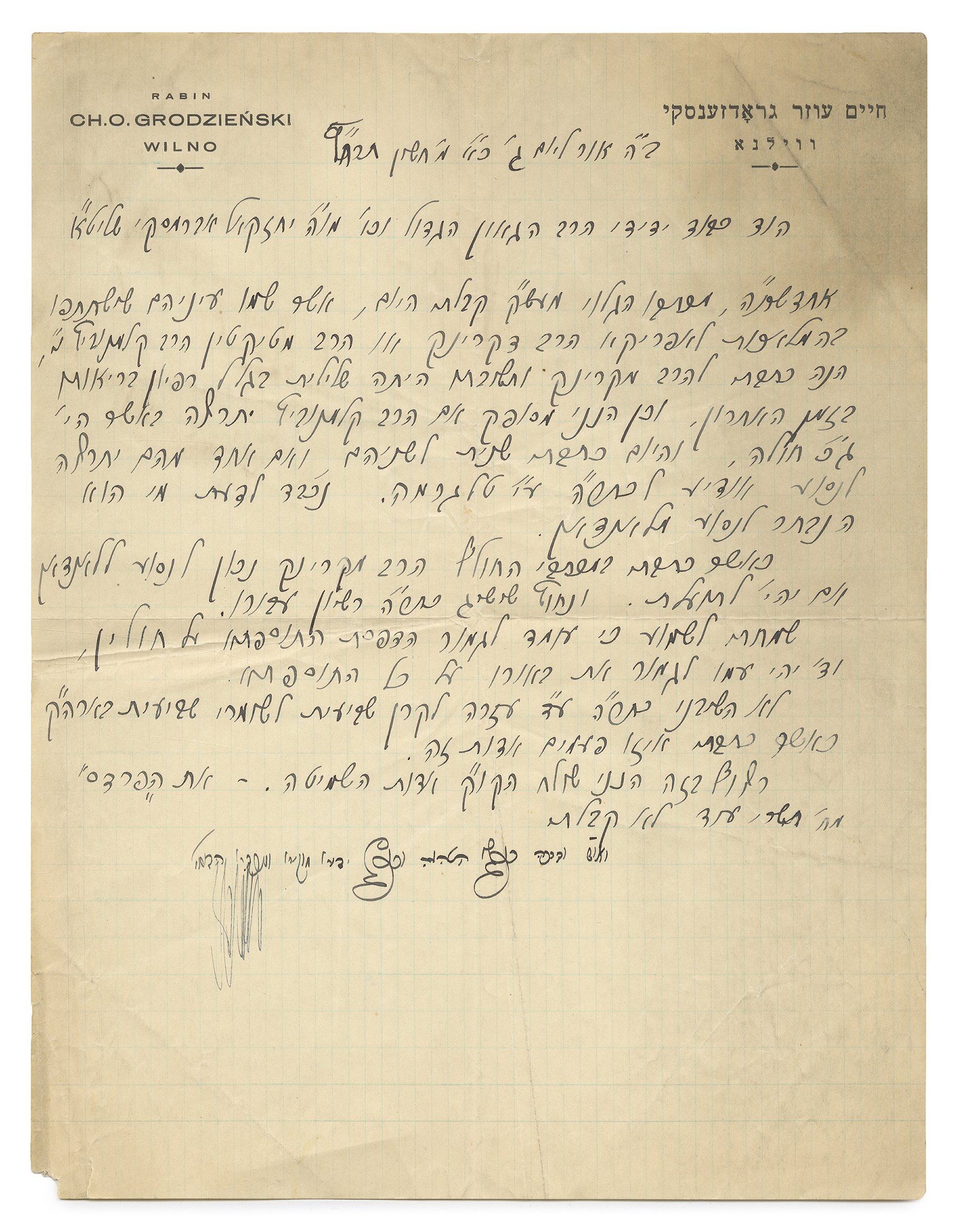
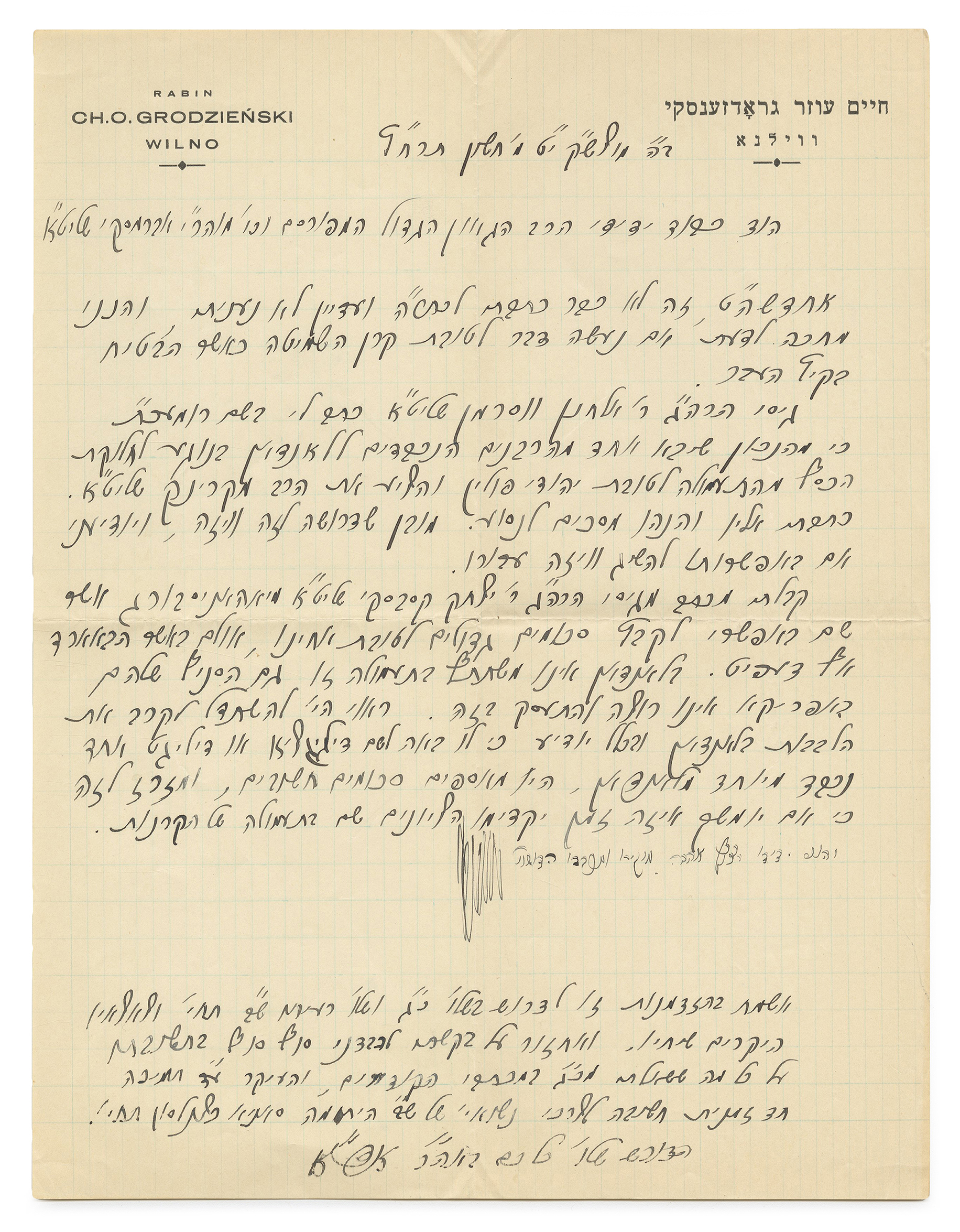
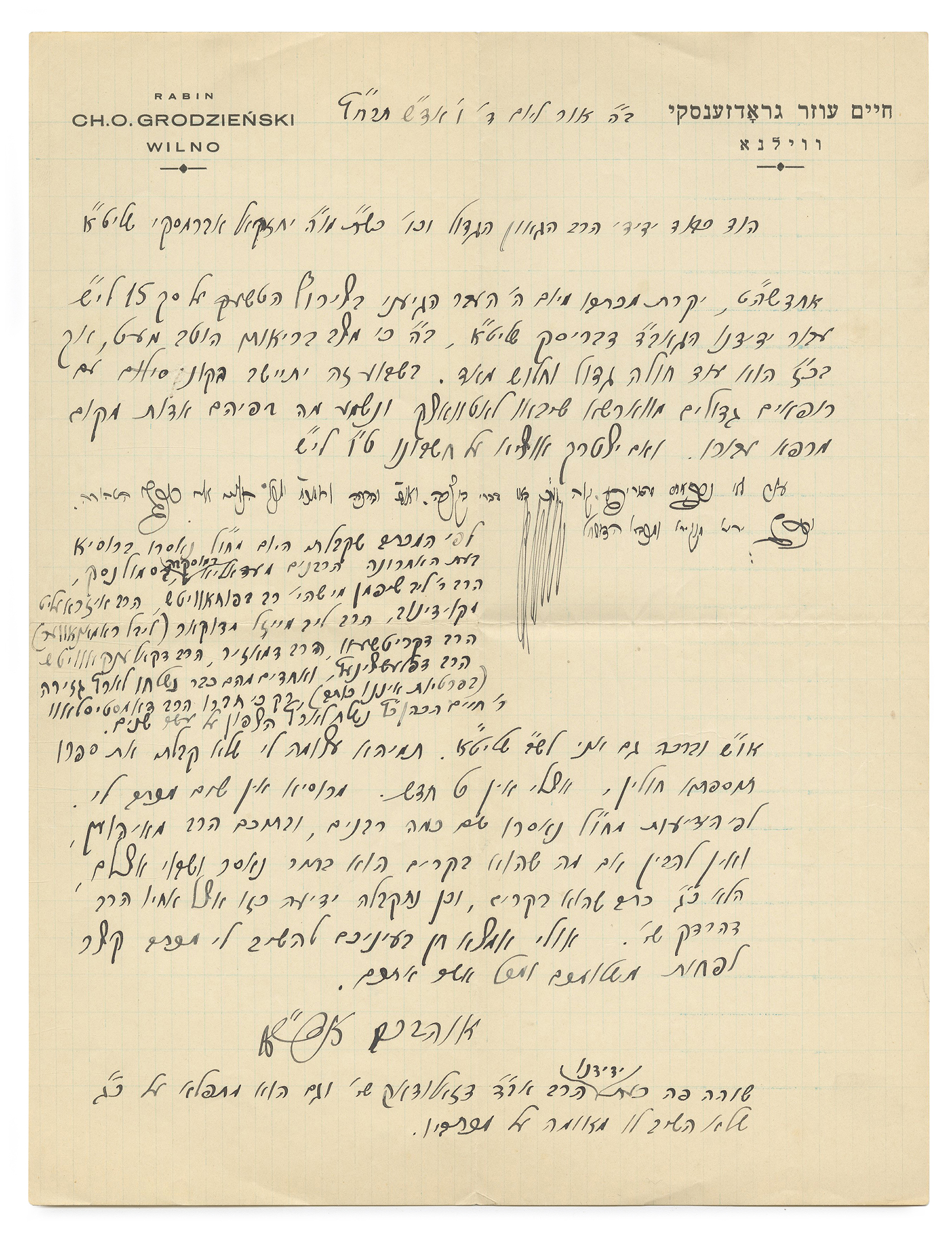
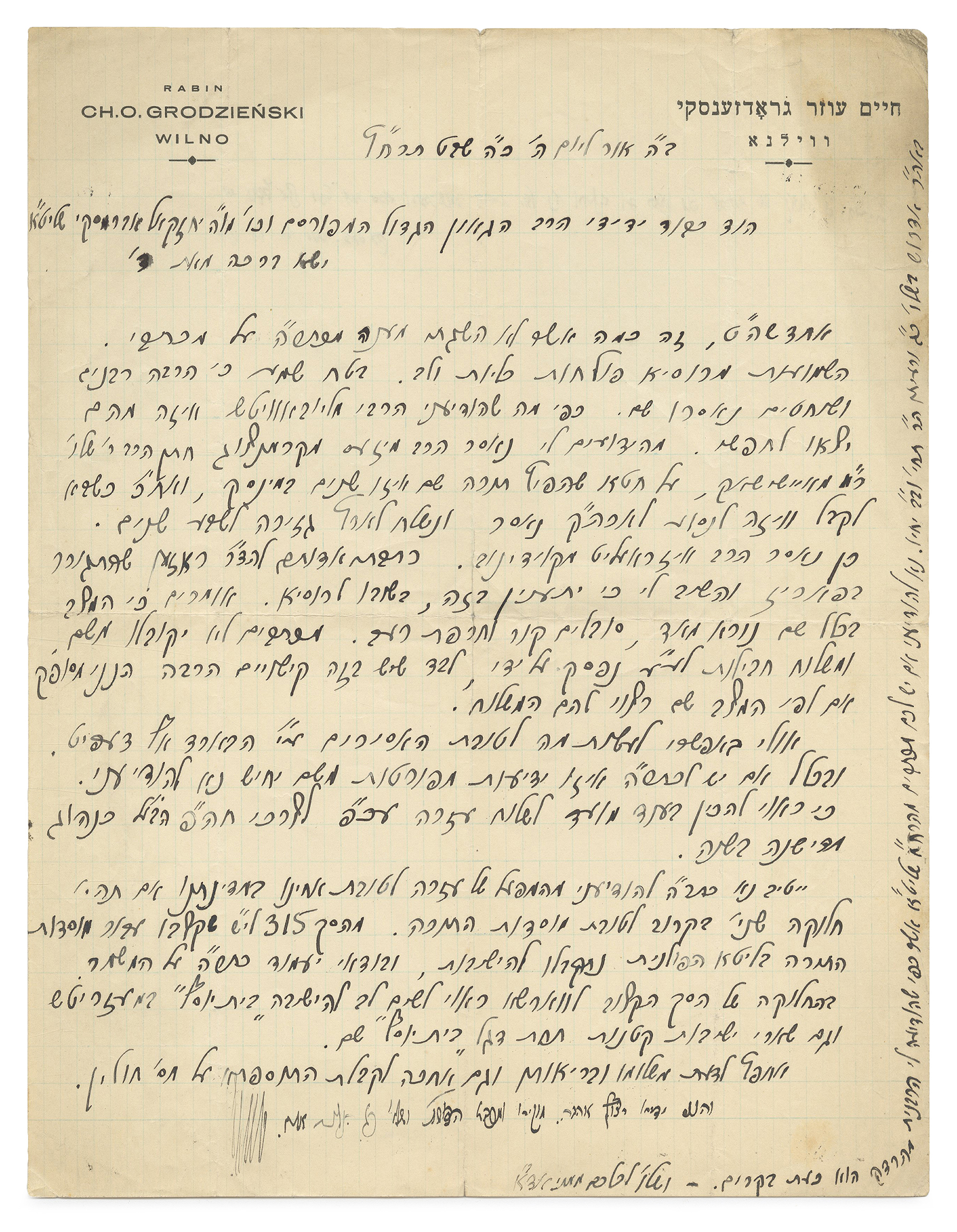
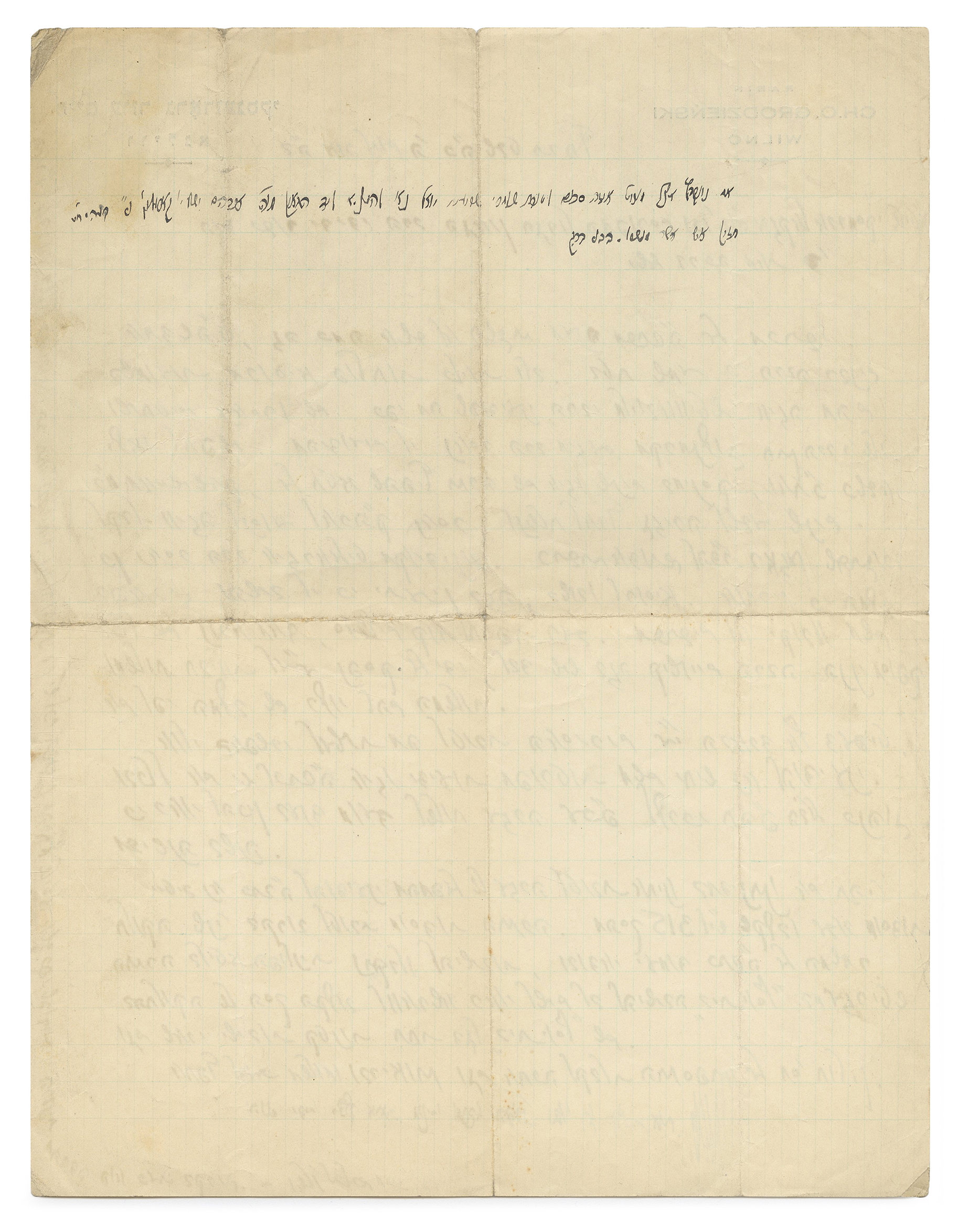
Four letters of R. Chaim Ozer Grodzinski. Vilna, Av-Cheshvan 1937.
Handwritten by R. Chaim Ozer's scribe, with several lines handwritten and signed by R. Chaim Ozer. Addressed to his intimate associate R. Yechezkel Abramsky, head rabbi of the London Beit Din. One of the letters contains additional lines added in the margins, handwritten and signed (with initials) by R. Aharon Dov Alter Voronovsky – confidant, scribe and secretary of R. Chaim Ozer, and relative of R. Abramsky.
The letters comprise various matters, and mainly discuss funding for yeshivas in Poland, and assistance for Shemitah-observant settlements in Eretz Israel, in view of the approaching Shemitah year (1937-1938).
In the first letter, dated 8th Av 1937, R. Chaim Ozer writes of assistance to the Ramailes yeshiva in Vilna. He goes on to write at length discussing the assistance to Shemitah observers in the Machaneh Yisrael settlement in Eretz Israel. He goes on to expand on the details of Shemitah law, quoting a letter by his friend the Chazon Ish: "…In my previous letter I mentioned the request of the Poalei Agudat Yisrael in Machaneh Yisrael for support in the Shemitah year, and yesterday I received a clarification from my friend the author of the Chazon Ish, stating that the pressure affects them in particular. Now the other moshavim have some kind of recourse, since the Shemitah status of oranges will not be in the year 5698 (1937-1938) but rather 5699 (1938-1939), because the fruits of 5698 had already sprouted one third of the way, and consequently the livelihood of the workers mainly supported by harvest and work in orange orchards will not be ruined in 5698, and the work is permitted since every tree would die otherwise… and it was ruled permissible to plant a vegetable before Rosh Hashanah without violating the prohibition of Sefichin even when gathered during the Shemitah year… Consequently, the other kibbutzim of Poalei Agudat Yisrael have some way to organize their subsistence even in the Shemitah year. This is not the case in the Poalei Agudat Yisrael kibbutz in Machaneh Yisrael which does not have such options, since they have no orchards in the environs to tend for their livelihood, nor do they have enough water to grow vegetables, and they would be forced to relocate and have strangers possess their land… With small support we may then sanctify G-d's name and show to all that it is possible to observe Shemitah properly, and all the rumors that it involves mortal danger only come from cold-heartedness and lack of proper fear of Torah and mitzvot. This is the content of the letter of the Chazon Ish in brief…".
In the margins of this letter, R. Chaim Ozer adds several lines in his handwriting regarding the question of halachic time reform and Chief Rabbi Dr. Joseph Hertz's struggle against the change, which would threaten Shabbat observance worldwide.
In the second letter, dated 25th Av 1937, among other subjects, the letter addresses the Shemitah issue: "Regarding the Shemitah, I was overjoyed to learn that you are prepared to endeavor for the benefit of Shemitah observers. Today I received a letter from the Poalim in Machaneh Yisrael who are despondently awaiting speedy assistance. As I informed you of the contents of the letter of the Chazon Ish [see previous letter], the most urgent need for assistance is in Machaneh Yisrael, and I am confident that when you return home safely you will engage in this at once. You surely know how your grandfather the RIdvaz traveled at the time to London and Paris to work for the benefit of Shemitah observers…".
In the margins of this letter, R. Chaim Ozer adds several handwritten lines regarding various issues, with friendly blessings to him and his family: "And I wish peace and blessing to you, your family and friends, as is your dear wish and that of your loving friend, esteeming and respecting you, seeking your welfare and happiness always, Chaim Ozer Grodzinski".
In the letter dated 19th Cheshvan 1938, R. Chaim Ozer asks: "…I am waiting to find out whether something has been done on behalf of the Shemitah fund, as you promised last summer". R. Chaim Ozer goes on to discuss a letter he received from his brother-in-law, R. Elchanan Wasserman, regarding fundraising in London for the yeshivas in Poland, and regarding a letter R. Chaim Ozer had received from his brother-in-law R. Yitzchak Kosovsky of Johannesburg regarding the possibility of acting in South Africa on behalf of the yeshivas, by the Board of Deputies in London – "It would be appropriate to attempt to win hearts in London. In general, he informs me that if a delegation were to come there… they would gather respectable sums. He urges to do so, since if there is a delay, the Zionists will advertise their funds first". R. Chaim Ozer signs in his handwriting: "Your loving friend, esteeming and respecting you, seeking your welfare, Chaim Ozer Grodzinski".
In the letter dated 21st Cheshvan 1937, R. Chaim Ozer discusses the proposal of R. Abramsky to appoint "the Rabbi of Krynki" [R. Chizkiyahu Yosef Mishkovsky] or the Rabbi of Tykocin [R. Avraham Kalmanowitz] to the yeshiva fundraising delegation to South Africa. R. Chaim Ozer goes on to discuss the assistance for the Eretz Israel Shemitah Fund, enclosing the announcement regarding the Shemitah.
R. Chaim Ozer Grodzinski (1863-1940) was a foremost rabbi of his generation and leader of European Jewry. He was the son of R. David Shlomo Grodzinski, Rabbi of Iwye. He was renowned from his childhood for his exceptional brilliance. He entered the Volozhin yeshiva at the young age of 11, and became a disciple of R. Chaim of Brisk. At the age of 24, he was appointed rabbi and posek of Vilna, succeeding his father-in-law R. Eliyahu Eliezer Grodnansky, a posek in Vilna (son-in-law of R. Yisrael Salanter). He assumed the yoke of public leadership from a young age, and his opinion was conclusive on all public issues which arose throughout the Jewish world for close to fifty years.
The recipient of the letters, R. Yechezkel Abramsky (1886-1976), was a confidant and agent of R. Chaim Ozer of Vilna ever since developing close ties with him in his youth while studying under his influence in Vilna. In winter of 1806, the "prodigy of Masty" Yechezkel Abramsky was forced to leave the Telshe yeshiva and flee to Vilna [which was then under Polish control] to avoid conscription to the Russian army. In Vilna he was accepted into the Ramailes yeshiva and joined the elite class of students who listened to the advanced lectures of R. Chaim Ozer (based on Melech BeYofyo, pp. 29-33). While subsequently serving as Rabbi of Smilavichy and Slutsk, he served often as R. Chaim Ozer's agent in various communal affairs. R. Abramsky smuggled the manuscript of Part I of his Chazon Yechezkel from Slutsk to his teacher R. Chaim Ozer in Vilna, who was involved in its publication in Vilna, 1925, through his confidant R. Aharon Dov Alter Voronovsky (R. Abramsky's wife's cousin).
When R. Abramsky was arrested by the Soviets and sent to Siberia in 1930, R. Chaim Ozer made every possible effort to release him. After his release in 1931, R. Chaim Ozer and the Rebbe Rayatz of Lubavitch joined with R. Abramsky to initiate the project of sending Pesach flour and food packages to Jews under the Bolshevik regime in Russia. Likewise, R. Abramsky was active on missions on behalf of R. Chaim Ozer for yeshivas in Poland and Lithuania and for rabbis of Europe. They also cooperated on many public issues, including the struggles for Jewish marriage and against the anti-Semitic laws in Germany and Europe forbidding Jewish shechitah (requiring stunning animals before slaughtering, which renders the meat non-kosher), and on rescue activity for rabbis and yeshivas who fled as refugees to Vilna at the start of the Holocaust. The present letters reflect some of their cooperation on halachah, public and private affairs, and assistance to rabbis.
4 letters, on official stationery. 28.5 cm. Varying condition, good to good-fair. Stains, wear and folding marks. Dark stains to fourth letter.
Category
Rabbinical Letters and Manuscripts
Catalogue Value


Auction 107: Rare and Important Items
Apr 15, 2026
Opening: $1,500
Estimate: $2,000 - $3,000
Sold for: $3,000
Including buyer's premium
Two letters from R. Chaim Ozer Grodzinsky. Vilna, Shevat / Adar II 1938.
Handwritten by R. Chaim Ozer's scribe, with several lines handwritten and signed by R. Chaim Ozer. Addressed to his intimate associate R. Yechezkel Abramsky, head rabbi of the London Beit Din. Two of the letters contain additional lines added in the margins, with a personal note handwritten and signed (with initials) by R. Aharon Dov Alter Voronovsky – confidant, scribe and secretary of R. Chaim Ozer, and relative of R. Abramsky.
The letters discuss various issues, primarily rescuing Russian rabbis from Soviet persecution, many of whom had been sent to Siberia for the "crime" of disseminating or observing Judaism.
The first letter, dated 25th Shevat 1938, discusses the "heart-wrenching news from Russia. You must have heard that many rabbis and shochatim were arrested there. From what the Lubavitcher Rebbe told me, some of them have been released. Among those known to me, R. Mizes of Kremenchuk, son-in-law of R. Shalom dean of the Eišiškės yeshiva, was arrested for the crime of disseminating Torah there for some years in Minsk, and later when he came to get a visa to travel to the Holy Land, he was arrested and sent to the wilderness for seven years. Likewise R. Israelit of Koidanov was arrested… The general situation is said to be awful there; they suffer from cold and famine, letters are not received from there and I have stopped sending packages there for the present time, apart from the great difficulties I am unsure whether sending is desirable in view of the situation there. Perhaps it is possible to do something for the benefit of the prisoners through the Board of Deputies…".
Later in the letter, R. Chaim writes of assistance to yeshivas, especially the Beit Yosef yeshiva of Novardok students. On the verso, R. Chaim Ozer adds a handwritten request to send funds to support Shemitah observers in Eretz Israel, by the Chazon Ish: "If you have received any sum for the benefit of the Shemitah observers, please make it available to R. Avraham Yeshayah Karelitz, author of Chazon Ish, who resides in Bnei Brak".
In the second letter, dated 6th Adar II 1938, R. Chaim Ozer writes of the health condition of "our friend, the head of the Brisk Beit Din. Thank G-d, his health condition has somewhat improved, but he is nevertheless still very sick and weak…". After the signature he adds another piece of information about the arrests of rabbis and mitzvah functionaries in Soviet Russia: "According to the letter I received today from abroad, these rabbis have been lately arrested in Russia: R. Medalia in Moscow; in Smolensk, R. Leib Schiffman, who was rabbi in Pukhavichy; R. Israelit of Koidanov; R. Leib Meisel of Dukora (Leibl Romanover); the Rabbi of Krychaw; the Rabbi of Mazyr; the Rabbi of Kalinkavichy; the Rabbi of Plyeshchanitsy; and a few of them have already been sent to the wilderness (he does not write in detail), except his friend the Rabbi of Mstsislaw R. Chaim HaKohen Katz has been sent to the north for ten years".
R. Aharon Dov Alter Voronovsky goes on to enumerate further rabbis who were then arrested in Russia.
R. Chaim Ozer Grodzinski (1863-1940) was a foremost rabbi of his generation and leader of European Jewry. He was the son of R. David Shlomo Grodzinski, Rabbi of Iwye. He was renowned from his childhood for his exceptional brilliance. He entered the Volozhin yeshiva at the young age of 11, and became a disciple of R. Chaim of Brisk. At the age of 24, he was appointed rabbi and posek of Vilna, succeeding his father-in-law R. Eliyahu Eliezer Grodnansky, a posek in Vilna (son-in-law of R. Yisrael Salanter). He assumed the yoke of public leadership from a young age, and his opinion was conclusive on all public issues which arose throughout the Jewish world for close to fifty years.
The recipient of the letters, R. Yechezkel Abramsky (1886-1976), was a confidant and agent of R. Chaim Ozer of Vilna ever since developing close ties with him in his youth while studying under his influence in Vilna. In winter of 1806, the "prodigy of Masty" Yechezkel Abramsky was forced to leave the Telshe yeshiva and flee to Vilna [which was then under Polish control] to avoid conscription to the Russian army. In Vilna he was accepted into the Ramailes yeshiva and joined the elite class of students who listened to the advanced lectures of R. Chaim Ozer (based on Melech BeYofyo, pp. 29-33). While subsequently serving as Rabbi of Smilavichy and Slutsk, he served often as R. Chaim Ozer's agent in various communal affairs. R. Abramsky smuggled the manuscript of Part I of his Chazon Yechezkel from Slutsk to his teacher R. Chaim Ozer in Vilna, who was involved in its publication in Vilna, 1925, through his confidant R. Aharon Dov Alter Voronovsky (R. Abramsky's wife's cousin).
When R. Abramsky was arrested by the Soviets and sent to Siberia in 1930, R. Chaim Ozer made every possible effort to release him. After his release in 1931, R. Chaim Ozer and the Rebbe Rayatz of Lubavitch joined with R. Abramsky to initiate the project of sending Pesach flour and food packages to Jews under the Bolshevik regime in Russia.
Likewise, R. Abramsky was active on missions on behalf of R. Chaim Ozer for yeshivas in Poland and Lithuania and for rabbis of Europe. They also cooperated on many public issues, including the struggles for Jewish marriage and against the anti-Semitic laws in Germany and Europe forbidding Jewish shechitah (requiring stunning animals before slaughtering, which renders the meat non-kosher), and on rescue activity for rabbis and yeshivas who fled as refugees to Vilna at the start of the Holocaust. The present letters reflect some of their cooperation on halachah, public and private affairs, and assistance to rabbis.
2 letters on official stationery. 28 cm. Varying condition, good to good-fair. Stains, wear and folding marks. Dark stains to first letter.
Category
Rabbinical Letters and Manuscripts
Catalogue Value
Auction 107: Rare and Important Items
Apr 15, 2026
Opening: $2,000
Estimate: $3,000 - $4,000
Sold for: $4,250
Including buyer's premium
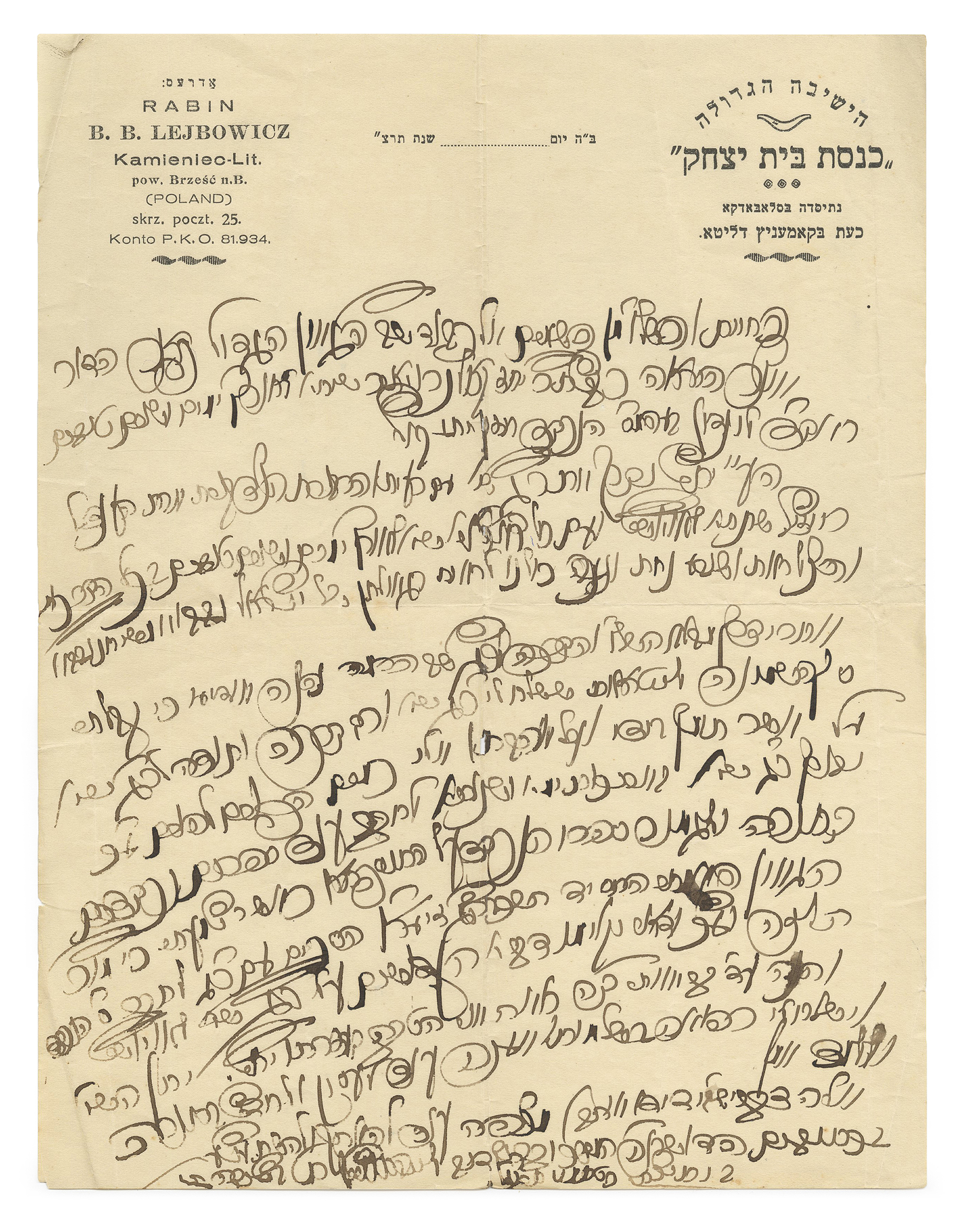
Letter handwritten and signed by R. Baruch Dov (Ber) Leibowitz, dean of the Knesset Beit Yitzchak yeshiva of Kamenets. [Kamenets], 1937.
Addressed to his relative R. Yechezkel Abramsky, author of Chazon Yechezkel, in London. Letter of blessings and thanks for his financial support:
"Life and peace from Heaven to my distinguished relative… R. Yechezkel… head of the London Beit Din, author of the distinguished book Chazon Yechezkel. May G-d bless you with your righteous wife Rebbetzin Hendel Reizel… and all your offspring… with all the blessings, successes, and satisfaction, and may we all see the redemption of Israel and the coming of our Messiah speedily in our days, Amen".
R. Baruch Ber thanks him for receipt of his financial support, and he blesses him to complete his magnum opus on the Tosefta, an enterprise approved of by their teacher R. Chaim of Brisk: "…Thank you for supporting me and for your love for me which I reciprocate 'as the face's reflection in water'. Therefore may you be blessed with lengthy days and years to author more distinguished Torah books and to complete your distinguished book on the Tosefta, as I heard that my teacher, the true Gaon and pious man, rabbi of the entire diaspora, approved of you authoring this distinguished book, so his holy words will certainly be fulfilled in you…".
R. Baruch Ber goes on to relate his personal health condition: "…Regarding my health, thank G-d I am improving with G-d's help, may G-d grant me a full recovery and may I merit to further endeavor and innovate in Torah study and teach, Amen".
He concludes the letter by signing as "your relative, your friend, who loves you, and hopes to have the pleasure of further writing to you at length, seeking your welfare, blessing you, Baruch Dov Leibowitz, dean of the holy Beit Yitzchak yeshiva, 29th Tamuz 1937".
R. Baruch Dov (Ber) Leibowitz (1864-1939), author of Birkat Shmuel on Talmudic topics. A disciple of R. Chaim of Brisk in the Volozhin yeshiva, and son-in-law of R. Avraham Yitzchak Zimmerman, Rabbi of Hlusk (son-in-law of R. Yaakov Moshe Direktor, Rabbi of Novaya Mysh). Succeeded his father-in-law in Hlusk and established a yeshiva. After a 13-year tenure, he was asked to head the Knesset Beit Yitzchak yeshiva in Slabodka. During WWI, he wandered with the yeshiva to Minsk, Kremenchuk and Vilna, finally settling in Kamenets. His teachings and writings are classics of yeshiva study.
The recipient of the letter, R. Yechezkel Abramsky, Rabbi of Slutsk and London (1886-1976), was a relative of R. Baruch Ber – Rebbetzin Beila Zimmerman of Kremenchuk, R. Baruch Ber's mother-in-law, was the sister of R. Yisrael Yaakov Yerushalimsky, R. Abramsky's father-in-law.
[1] leaf. Official stationery. 28 cm. Approx. 18 handwritten lines. Good-fair condition. Stains. Folding marks, with small open tear to one fold.
Category
Rabbinical Letters and Manuscripts
Catalogue Value


Auction 107: Rare and Important Items
Apr 15, 2026
Opening: $1,000
Estimate: $1,500 - $3,000
Sold for: Unsold
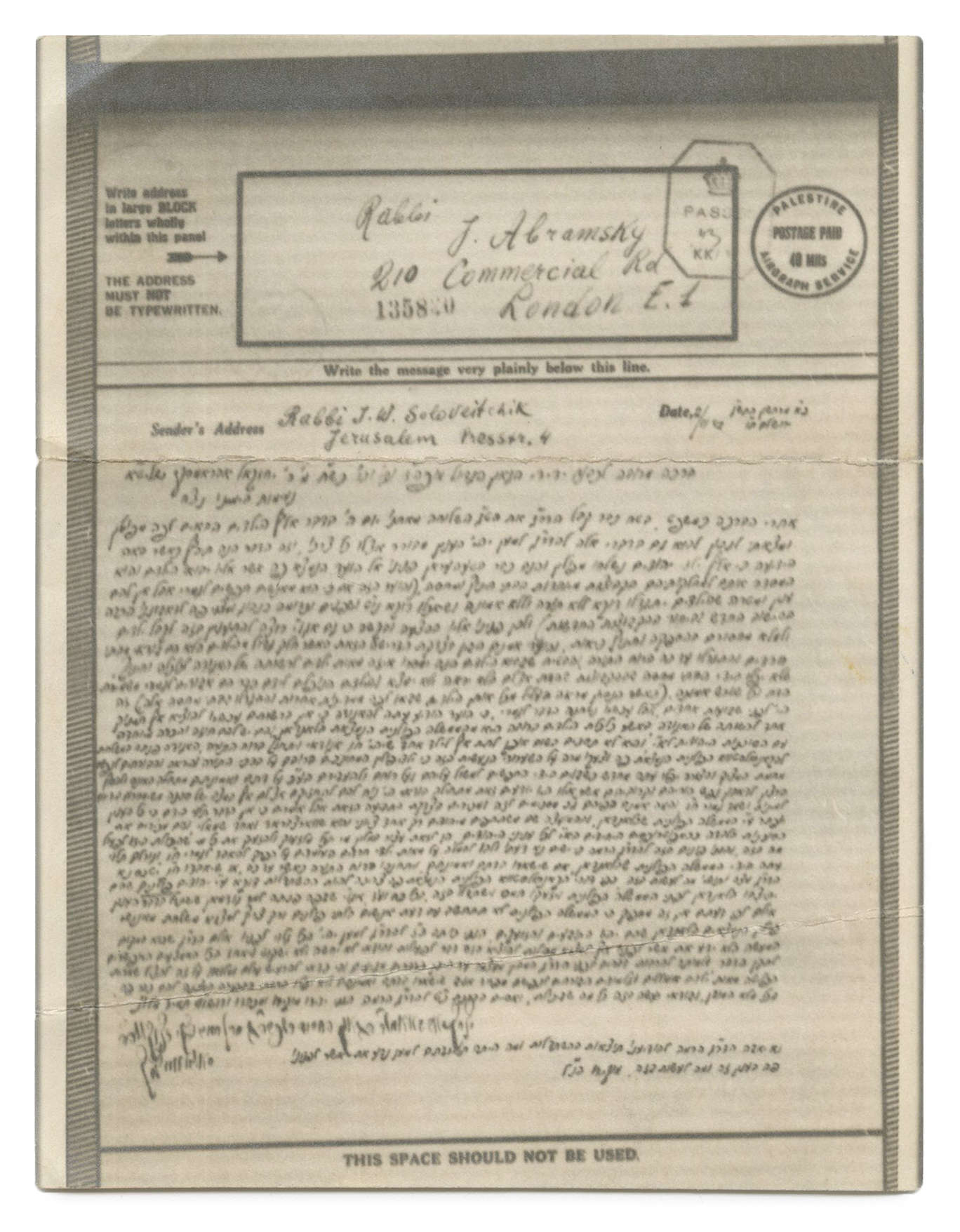
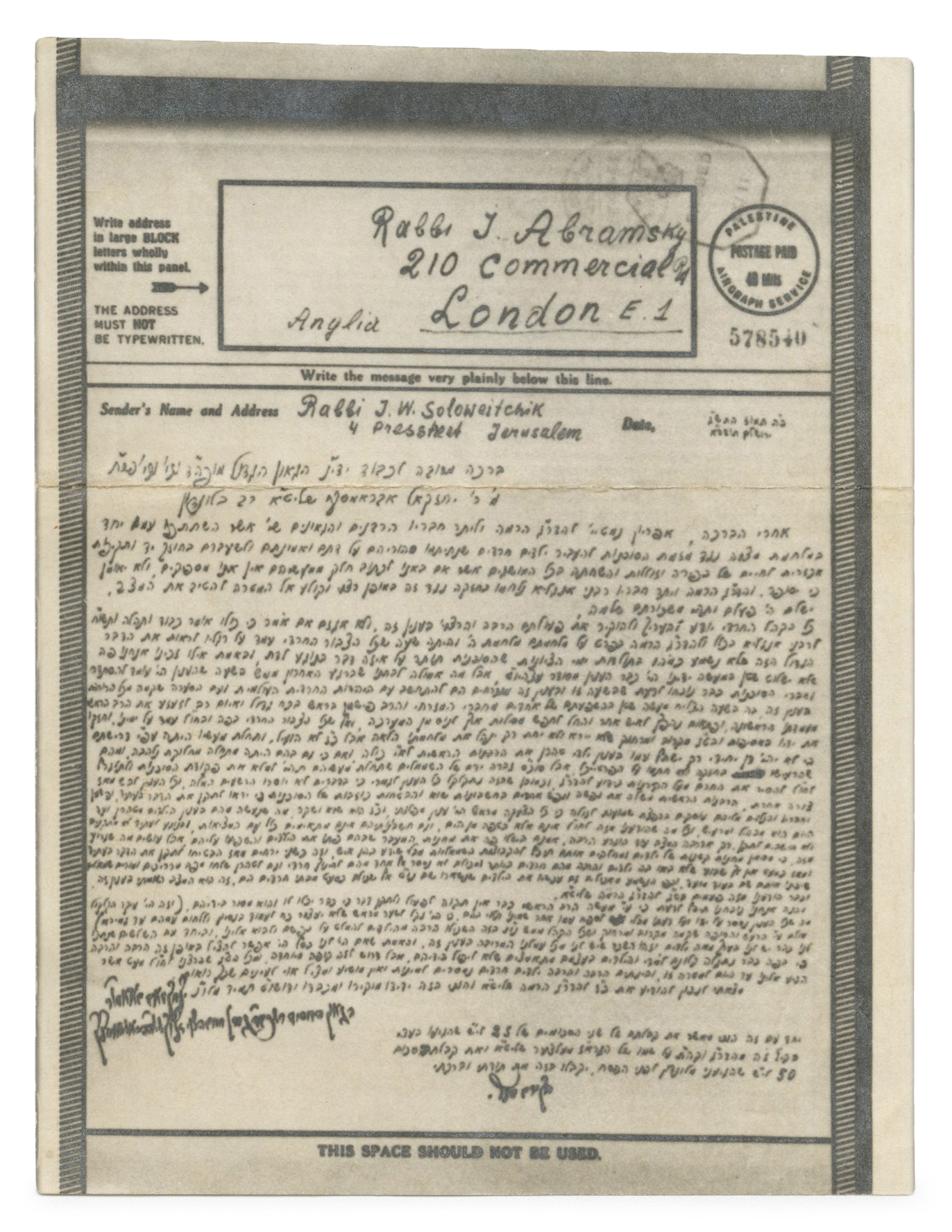
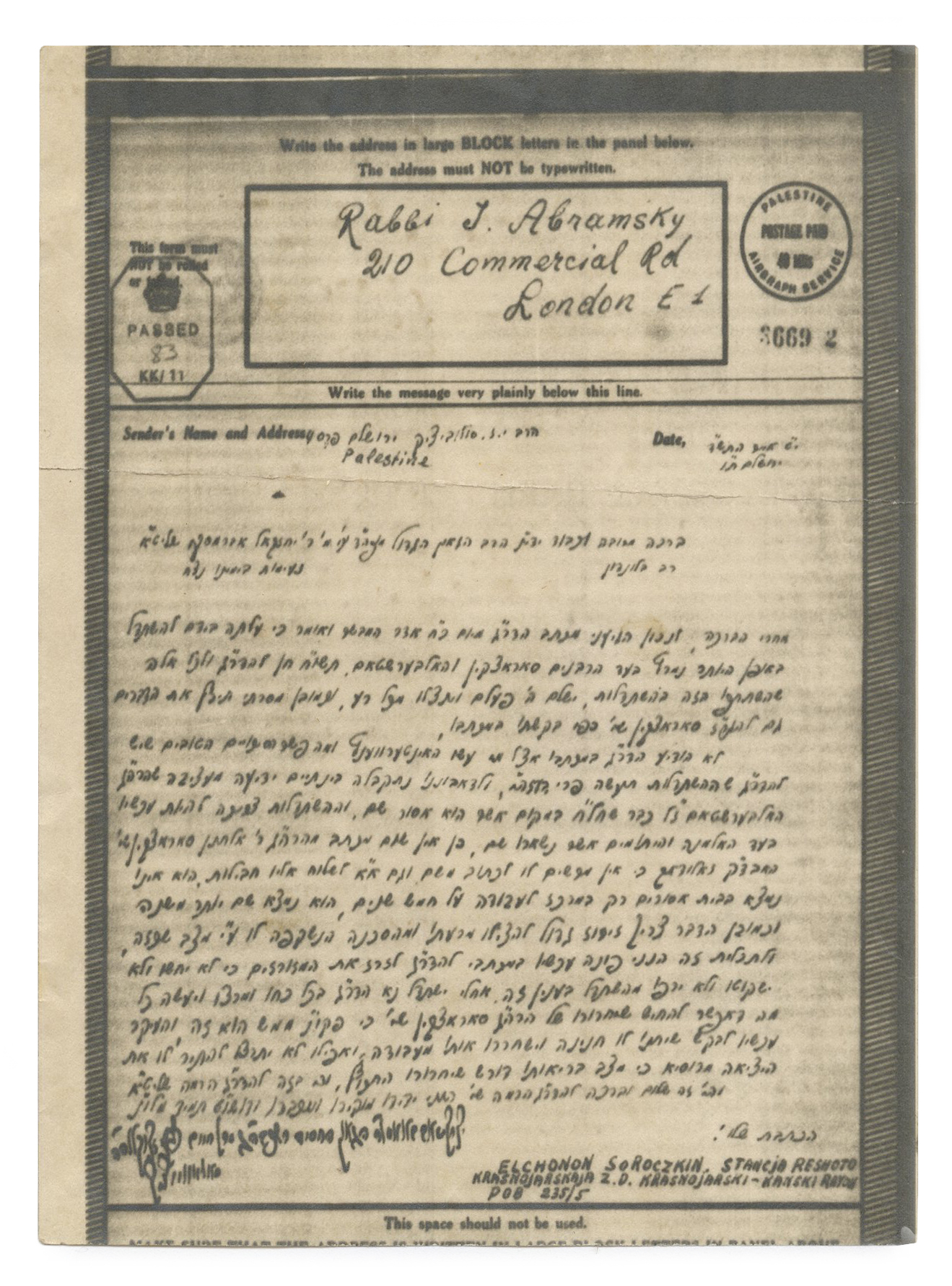
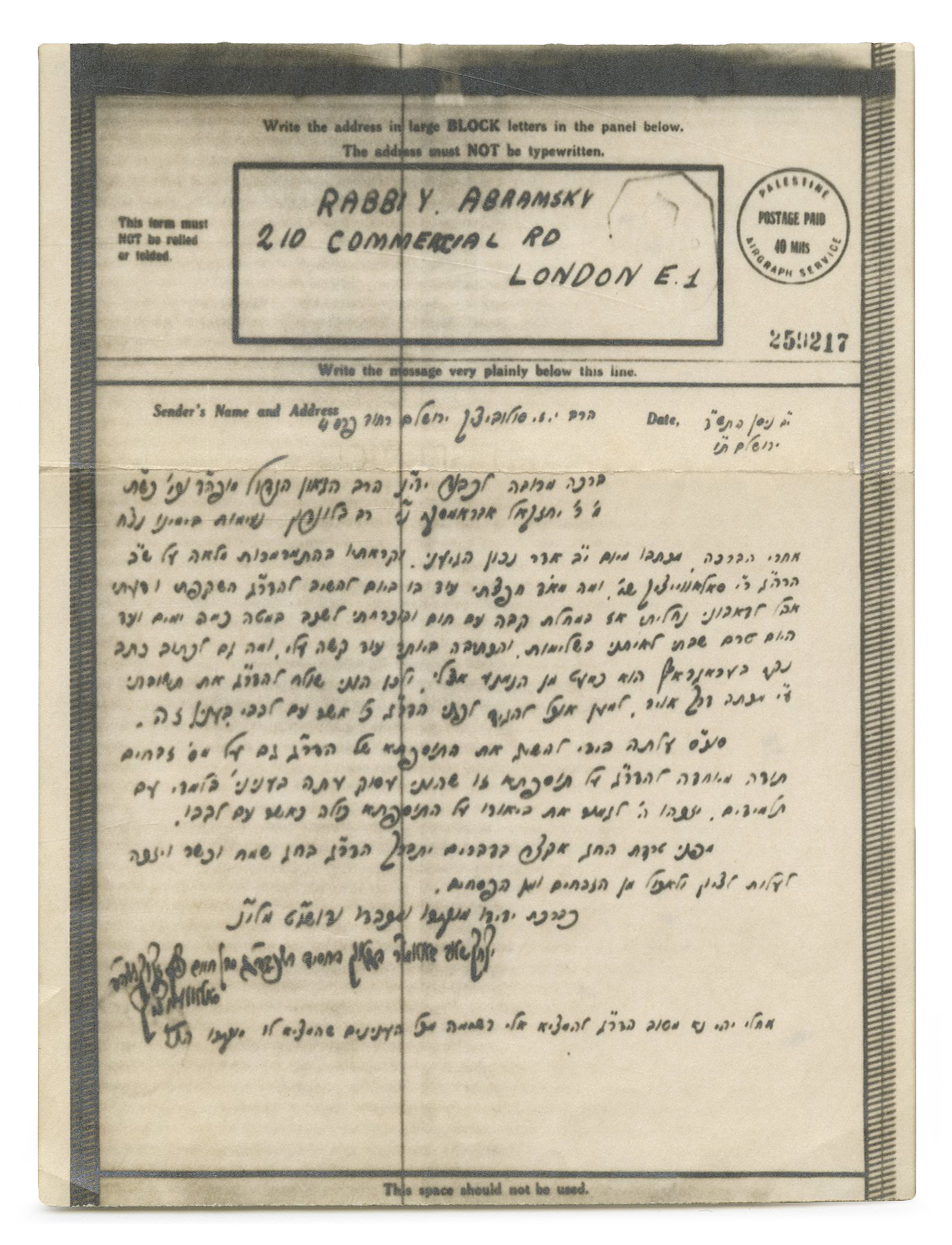
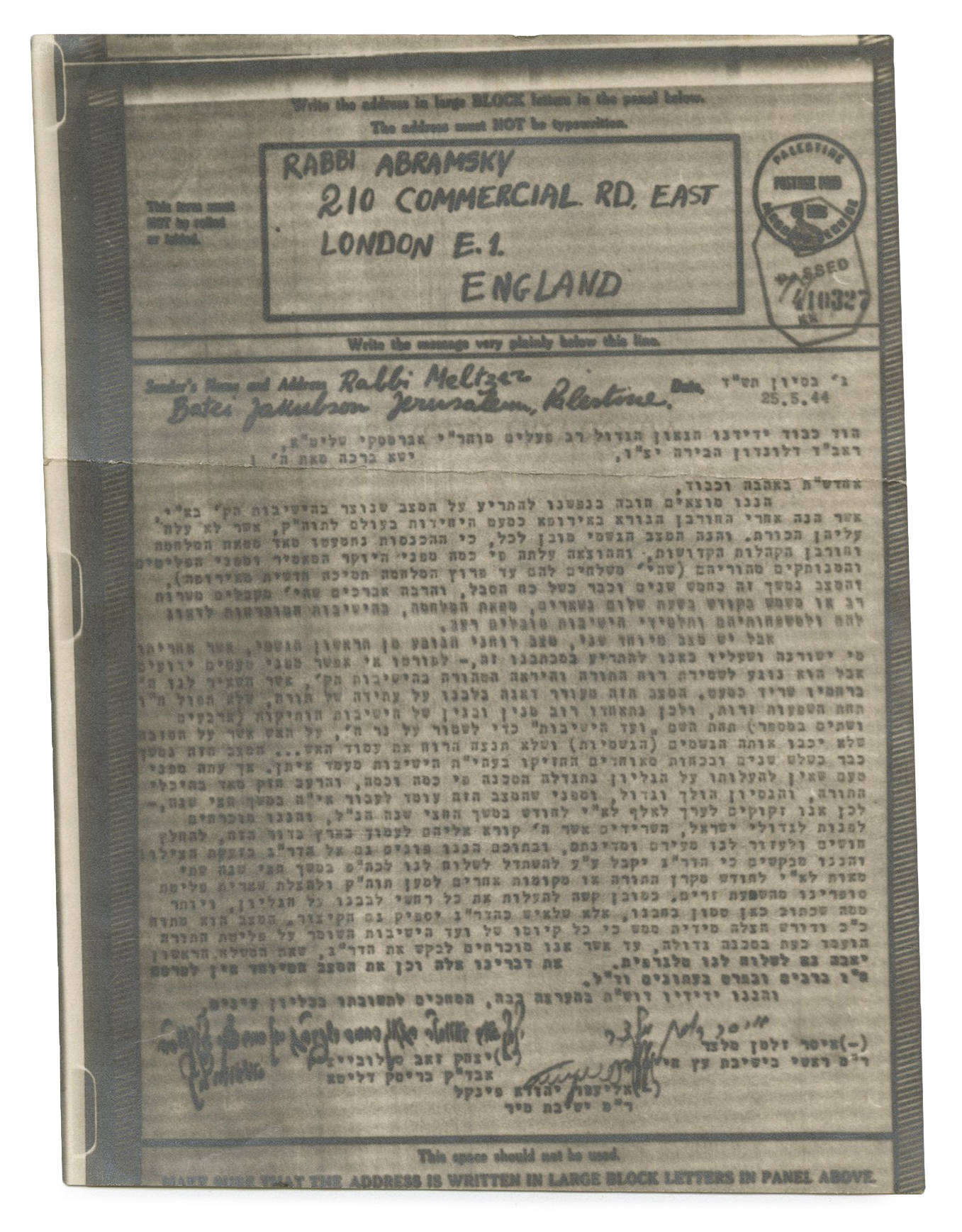
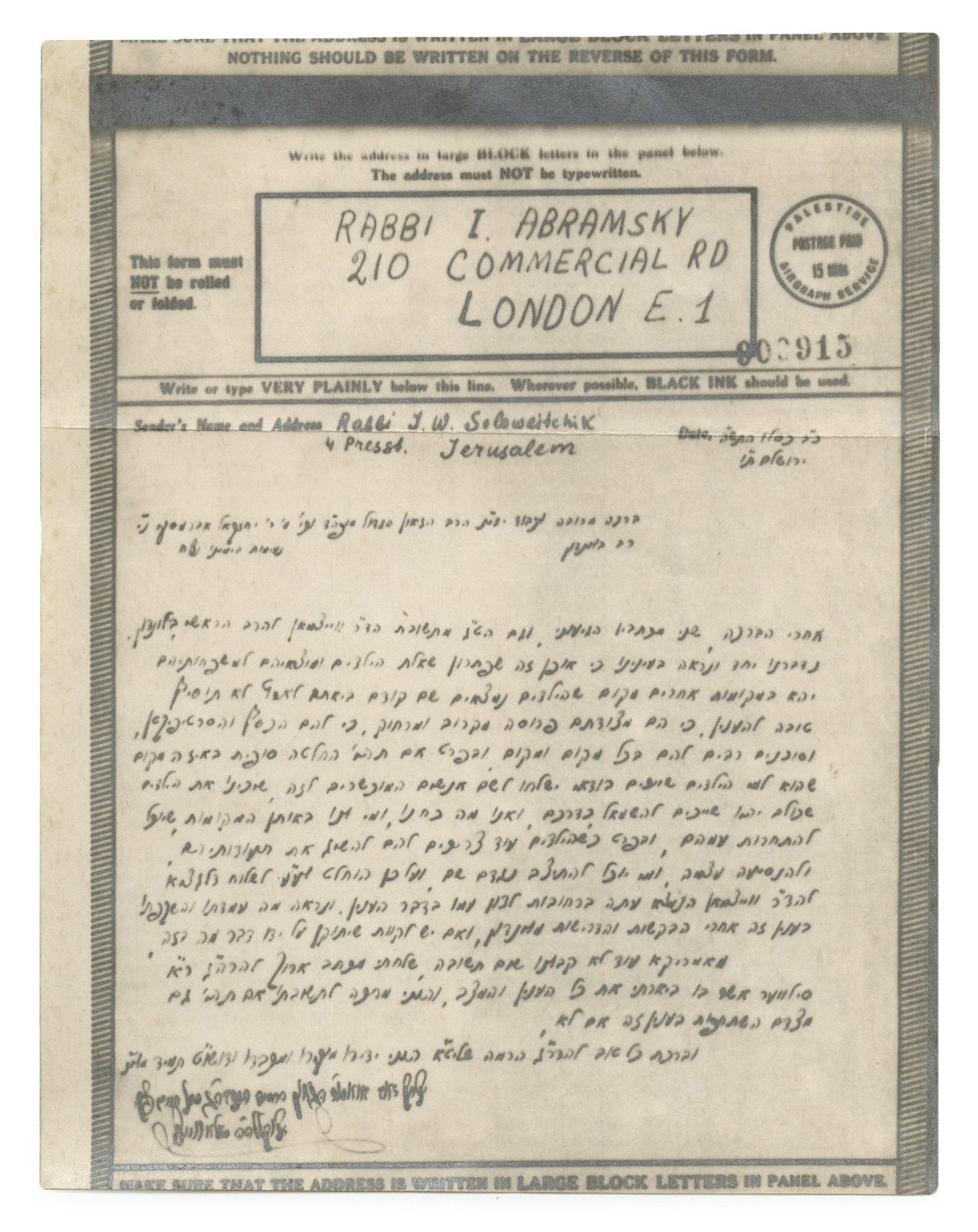
Seven lengthy V-mail letters from R. Yitzchak Ze'ev Soloveitchik, the Brisker Rav, addressed to his friend R. Yechezkel Abramsky, head rabbi of the London Beit Din. [Jerusalem-London], 1942-1944.
The present letters were sent by V-mail (airgraph) – a process of microfilming developed during World War II, which was used to correspond with the soldiers on the battlefront. The letters were photographed and transported as thumbnail-sized images on negative microfilm. Upon arrival at their destination, the negatives would be printed on photographic paper at approximately a quarter of the original size of the letter, and the reduced letter was delivered to the addressee. The original letter was usually discarded after being photographed in the country of origin, and the V-mail letters are generally the only remaining documentation of letters sent by this method.
Six of the original letters were handwritten by R. Yosef Dov (Berel) Soloveitchik, son of the Brisker Rav, with the full signature of the Brisker Rav: "Yitzchak Ze'ev son of… R. Chaim HaLevi Soloveitchik". The seventh letter (dated 3rd Sivan 1944), discussing relief of the yeshivas in Eretz Israel, was typewritten and handsigned by R. Isser Zalman Meltzer, the Brisker Rav R. Yitzchak Ze'ev, and R. Eliezer Yehudah Finkel.
In the letters dated Cheshvan 1942 and Tamuz 1943, he discusses the thousand children saved from the Holocaust in Poland (the Tehran children), and the Jewish Agency's plan to secularize them. In his letter of Kislev 1944, the Brisker Rav also discusses the negotiations between Dr. Weizman and the Chief Rabbi of London on the Jewish Agency's interference in education of the refugee children.
In the letter dated 18th Av 1943, he writes of the need to rescue R. Elchanan Sorotzkin, Rabbi of Zhaludok (son of R. Zalman Sorotzkin, Rabbi of Lutsk), who was "imprisoned in Siberia and sentenced to the Gulag". In his letter from Iyar 1944, the Brisker Rav writes at length to encourage rescue of Rabbis Sorotzkin and Halberstam from exile in Siberia.
In his letter of 12th Nisan 1944 regarding the printing of the notebook novellae ("tag buch") of his father R. Chaim of Brisk, R. Yitzchak Ze'ev writes that he read his letter "fully discontent with my relative R. Yisrael Soloveitchik, may he live", writing that it is hard for him to write a lengthy airgraph letter on the issue, and that he would write another letter by normal post on the matter (see Lot 78 for the complete letter on this issue, which he concluded writing in Sivan 1944).
R. Yitzchak Ze'ev Soloveitchik, the Brisker Rav (1886-1959), son of R. Chaim HaLevi of Brisk, and grandson of the Beit HaLevi. Already at a young age, still in his father's lifetime, he was considered one of the prominent Torah leaders of the generation. In 1919 (about the age of 32), he succeeded his forefathers as Rabbi of Brisk, and with his Torah authority, he governed all religious matters in his city and the entire region. He managed to escape the Holocaust together with some of his children who fled from Brisk to Vilna, from which they immigrated to Jerusalem in 1941. His authority was recognized by the entire Torah world in Eretz Israel and abroad. His books: Chidushei Maran Riz HaLevi on the Rambam and the Torah. His oral teachings were published as Chidushei HaGriz. His teachings serve to this day as a cornerstone of in-depth yeshiva learning and form the basis for the thought of large portions of Orthodox Jewry. He was famous for his searing fear of Heaven and zeal for pure truth.
The recipient, R. Yechezkel Abramsky (1886-1976), close disciple of R. Chaim of Brisk and close friend of his son R. Yitzchak Ze'ev. Shortly after his marriage, he traveled to Brisk to study under R. Chaim, ca. 1910 (at the advice of his father-in-law R. Yisrael Yehonatan Yerushalimsky, a disciple of R. Chaim during his Volozhin period), where he stayed for some four months, after which point he became devoted to his Torah teachings for the rest of his life. While serving as Rabbi of Smilavichy, he visited his teacher R. Chaim, then staying in Minsk, for long periods, during which time he would clarify Torah topics with him. R. Yechezkel would say of his teacher R. Chaim's method of learning: "R. Chaim goes at once to the heart of the issue". R. Chaim greatly appreciated his disciple's wisdom, and in one letter he calls him a friend (Melech BeYofyo, p. 95). During those periods, R. Abramsky became a close friend of his teacher's son, R. Yitzchak Ze'ev (R. Velvele), which led to some fifty years of friendship and a close correspondence. Some of their Torah discussions and correspondence are printed in Chidushei Maran Riz HaLevi. When R. Abramsky was living in Jerusalem (after he immigrated to Israel in 1951), they met often and dealt with Torah issues and public affairs together.
In the 1930s, R. Abramsky was one of those encouraging the family members of his teacher R. Chaim Soloveitchik to accelerate the printing of Chidushei Rabbeinu Chaim HaLevi. Famously, after his expulsion from Russia to Latvia by the Bolsheviks, his first telephone call from the border telephone station was about the progress of printing the book (see Melech BeYofyo, pp. 219-221).
7 leaves. 13.5-14 cm. Printed on thin film stock. Overall good condition. Creases, folding marks and wear.
Category
Rabbinical Letters and Manuscripts
Catalogue Value


Auction 107: Rare and Important Items
Apr 15, 2026
Opening: $1,000
Estimate: $3,000 - $4,000
Sold for: $2,375
Including buyer's premium
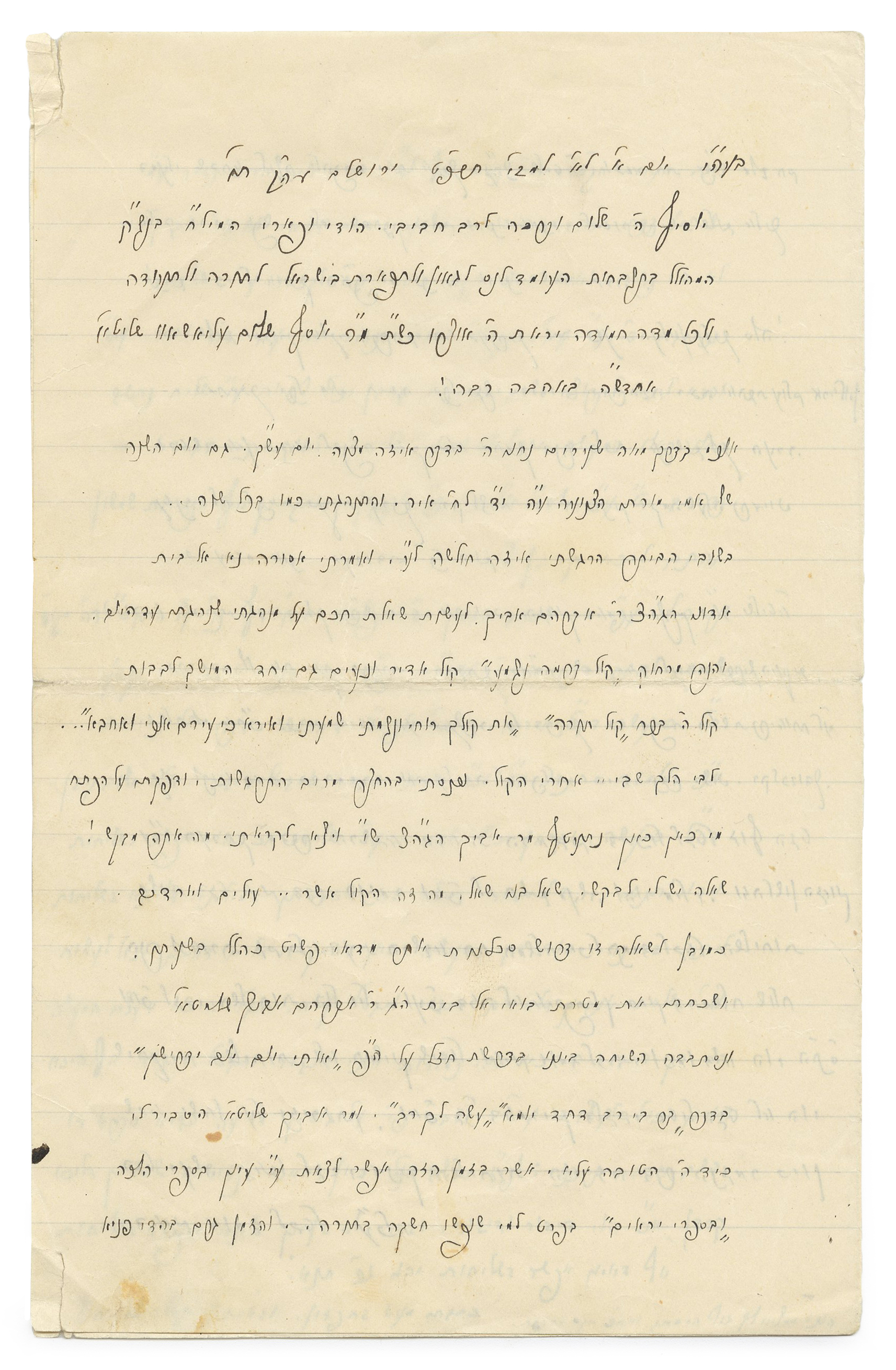
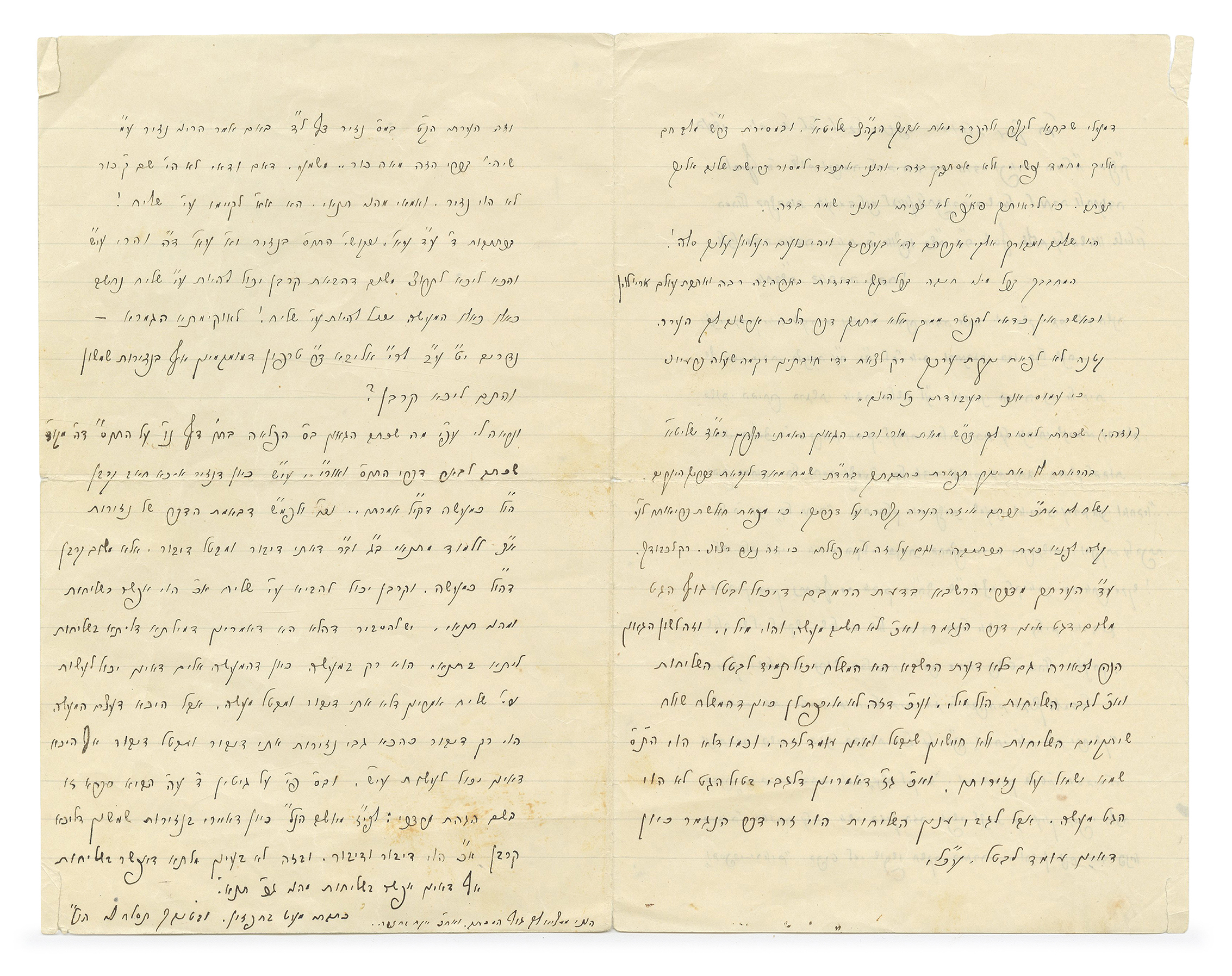
Lengthy letter (3 pages) handwritten and signed by the "Tzaddik of Jerusalem" R. Aryeh Levin. Jerusalem, "Sunday, 31st of the Omer" [16th Iyar, May] 1929.
Addressed to his prospective son-in-law, the young R. Yosef Shalom Elyashiv. The letter begins with poetic blessings: "May G-d increase peace [Yosif Shalom] and consolation to my dear… son-in-law-to-be, of holy descent, well-praised, who stands as a banner of pride and glory among the Jewish people… R. Yosef Shalom Elyashov…". R. Aryeh goes on to recount how he visited his father's home on Friday to release him from a vow, and how he didn't want to disturb him in the middle of his Torah study "in an attractive voice, both powerful and pleasant". R. Aryeh Levin goes on to apologize and praise his father, Rabbi of Gomel, who received him kindly and patiently (in the middle of Shabbat preparations, after the model of Hillel the Elder), when having forgotten his halachic question he began conversing with him on non-halachic topics that are not urgent on a Friday afternoon:
"G-d guided me on the streets of Meah Shearim for some mitzvah on Erev Shabbat… and I decided to visit the home of my master, the Tzaddik R. Avraham, your father, to release me from the custom I had practiced up to that point, when from afar I heard 'a voice on high', an attractive voice, both powerful and pleasant, 'the voice of G-d in strength', the voice of the Torah. 'Your voice', my spirit and soul, 'I heard, and I was fearful for I was naked and I hid'. My heart was taken captive by the voice. I excitedly entered the courtyard and knocked on the door. 'Who's there?'… Your father clothed himself and came out towards me. 'What do you seek?' 'I have a question to ask'. 'Ask, my son, ask'. 'What is this voice… [of angels] ascending and descending?' Of course, a question such as this necessitates such patience… as that of Hillel. And I forgot to what end I had come to the home of your father R. Avraham… The conversation meandered… and the timing, afternoon of Erev Shabbat, made us shorten the conversation and separate from your father the Tzaddik, with heartfelt greetings to you, my dear. I have the honor of sending you a greeting in writing, since I did not merit to see you face to face, and I am happy because of this… With great love and eternal love, Aryeh Levin".
In a postscript after his signature, R. Aryeh Levin offers Torah thoughts (on the topics of agency and stipulations), with an additional comment on the high esteem his teacher R. Isser Zalman Meltzer had for R. Yosef Shalom Elyashiv, and his comment on the prospective son-in-law's Torah thoughts, in a letter addressed to him: "…I forgot to send you greetings from my teacher… R. Isser Zalman. When I showed him the noble beauty of your Torah novellae, he was very happy with your words, and he later sent me in writing a short comment on what you said…".
The Tzaddik of Jerusalem, R. Aryeh Levin (1885-1969), excelled in Torah and in charitable deeds. He served as the spiritual director and supervisor of the Etz Chaim Torah school. An alumnus of Lithuanian yeshivot Hlusk, Slutsk, Volozhin and the Torat Chaim yeshiva in Jerusalem, he was a cherished disciple of the leading Torah scholars of the generation: R. Refael Shapiro of Volozhin, R. Chaim Berlin, R. Shlomo Elyashiv the Leshem, R. Baruch Ber Leibowitz, R. Avraham Yitzchak HaKohen Kook, his brother-in-law R. Tzvi Pesach Frank and R. Yitzchak Ze'ev Soloveitchik of Brisk. He immigrated to Jerusalem in his youth and married the granddaughter of the head of the Jerusalem Beit Din, R. Chaim Yaakov Shapira.
He was renowned for his devotion to acts of benevolence. He was a beloved friend to one and all, wholeheartedly sharing the difficulties and joys of his brethren. The "hidden tzaddik" concealed his knowledge of Talmud and Mishnah, his wide-ranging expertise and his learning as a Lithuanian yeshiva alumnus and elite disciple of R. Baruch Ber Leibowitz. Three parts of his comprehensive Mishnah commentary, Mishnat Aryeh, were published in 2011-2013, after nearly a century of concealment. R. Aryeh's will self-effacingly denies expertise "even in a chapter of Mishnah" – despite his voluminous Mishnah commentary. His son-in-law, R. Yosef Shalom Elyashiv, in his approbation to Mishnat Aryeh, writes of "my father-in-law R. Aryeh Levin, who humbly disguised and concealed his Torah greatness…".
When the eminent kabbalist R. Shlomo Elyashov, the Leshem (1841-1926), immigrated to Jerusalem, R. Aryeh Levin attended to and studied with him constantly; after his passing, his family permitted him to print a biographical account of R. Shlomo Elyashov (first published as an appendix to Leshem Shevo VeAchlamah – Beurim, printed in Jerusalem immediately after the author's passing). In 1929, R. Aryeh's daughter Rebbetzin Chayah became engaged to R. Yosef Shalom Elyashiv – the Leshem's beloved grandson, and the wedding was held a year later, in late Adar 1930.
The recipient of the letter, R. Yosef Shalom Elyashiv (1910-2012), only son of R. Avraham, a rabbi in Gomel (son-in-law of the Leshem), and son-in-law of the Tzaddik of Jerusalem, R. Aryeh Levin. From 1943, he served in his father's office as rabbi of Tiferet Bachurim and posek in the Meah Shearim neighborhood. Over the course of some twenty years, he served as a senior dayan in Eretz Israel, retiring in the early 1970s (when non-halachic reasoning was introduced into the court system). Over his last twenty years, he led the Torah world in Eretz Israel and beyond. R. Elyashiv was a leading posek for over seventy years. He was known for his exceptional diligence and his deep, fundamental understanding of all parts of the Torah, enabling him to provide clear rulings on every issue. His Torah novellae were published by his disciples in his Hearot on the Talmud, compiled from his lectures, and hundreds of his thousands of responsa were compiled in his six-part Kovetz Teshuvot.
[1] double leaf (3 written pages). Approx. 21 cm. Good-fair condition. Wear and folding marks. Tears to folds and margins, not affecting text.
The present letter was first published in part in the Torah periodical Tzohar (IV, Jerusalem, 1999, pp. 54-56), and later published in full in various places, including Kovetz Teshuvot (II, Jerusalem, 2003, section 189) and the memorial volume Tiferet Refael (Beit Shemesh, Cheshvan 2005, pp. 225-227).
Category
Rabbinical Letters and Manuscripts
Catalogue Value


Auction 107: Rare and Important Items
Apr 15, 2026
Opening: $3,000
Estimate: $4,000 - $5,000
Sold for: $6,250
Including buyer's premium
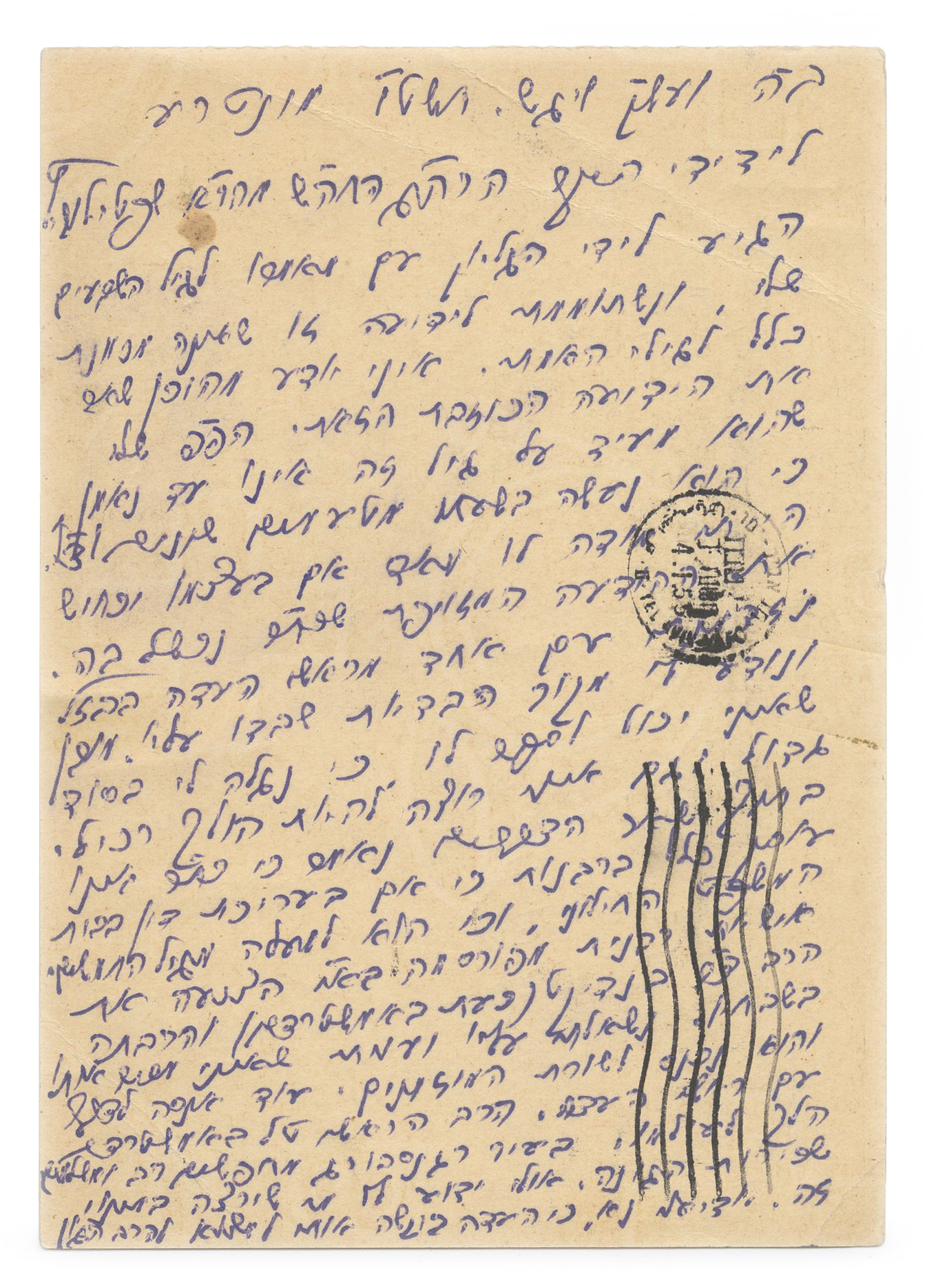
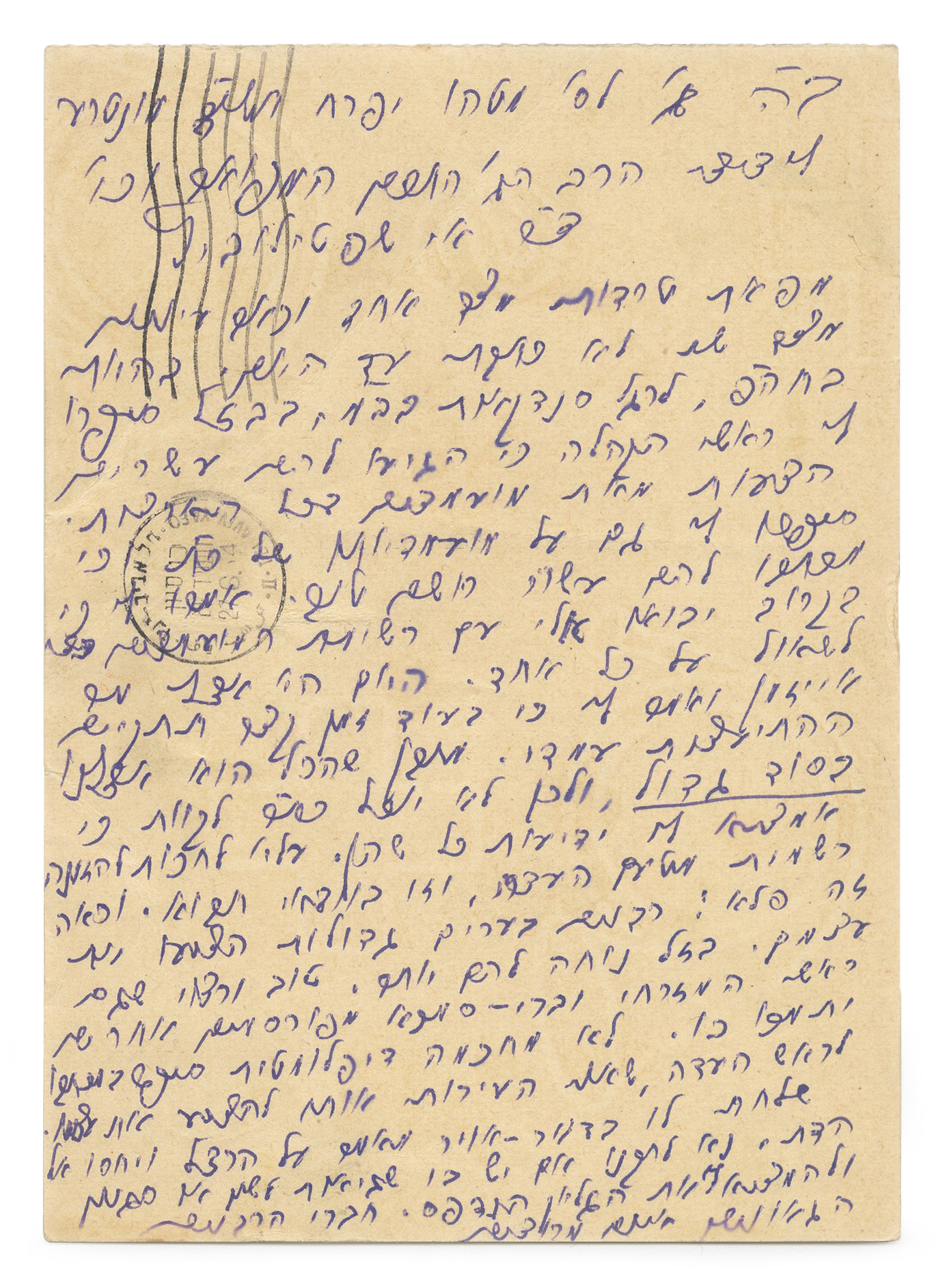
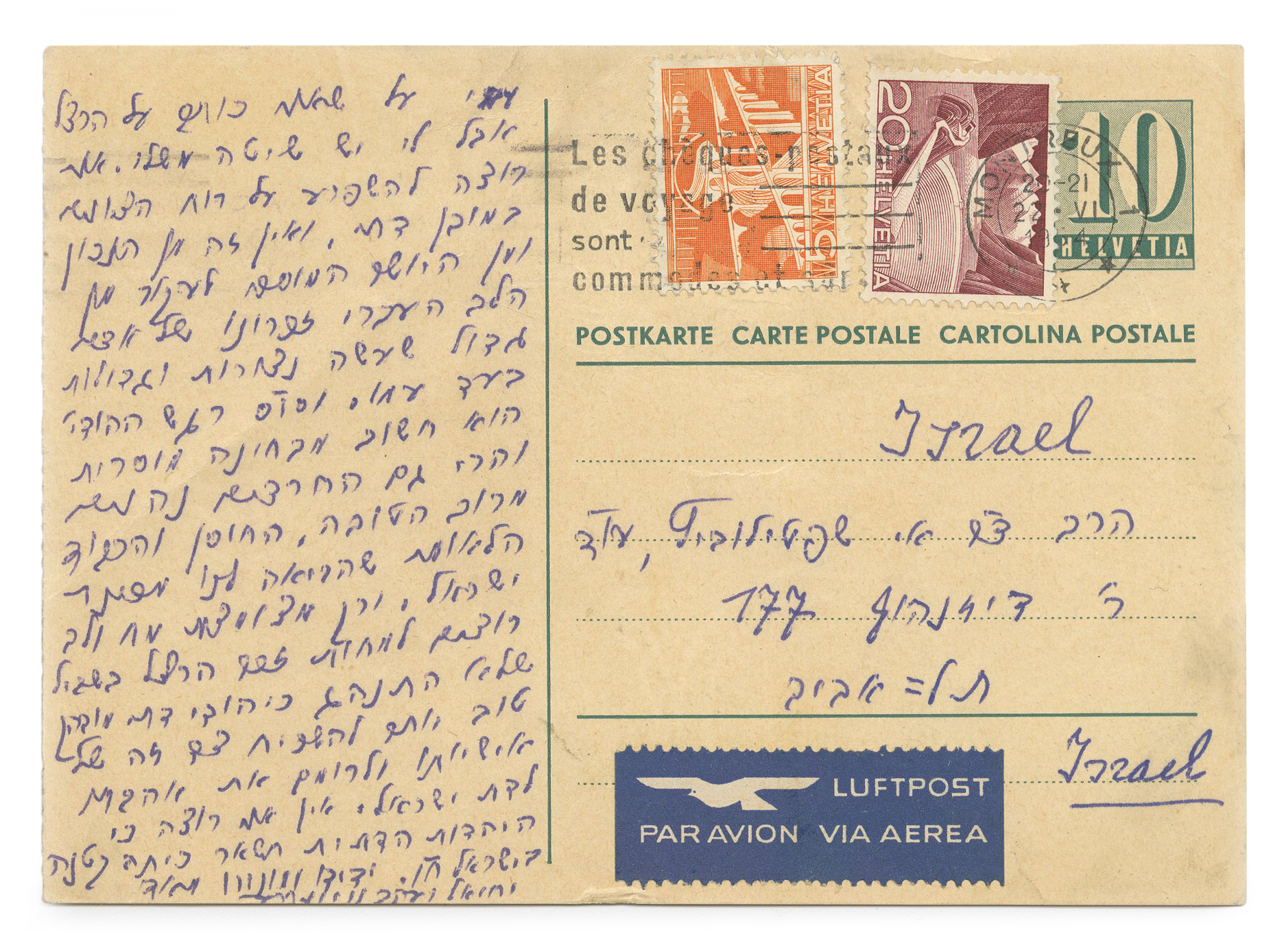
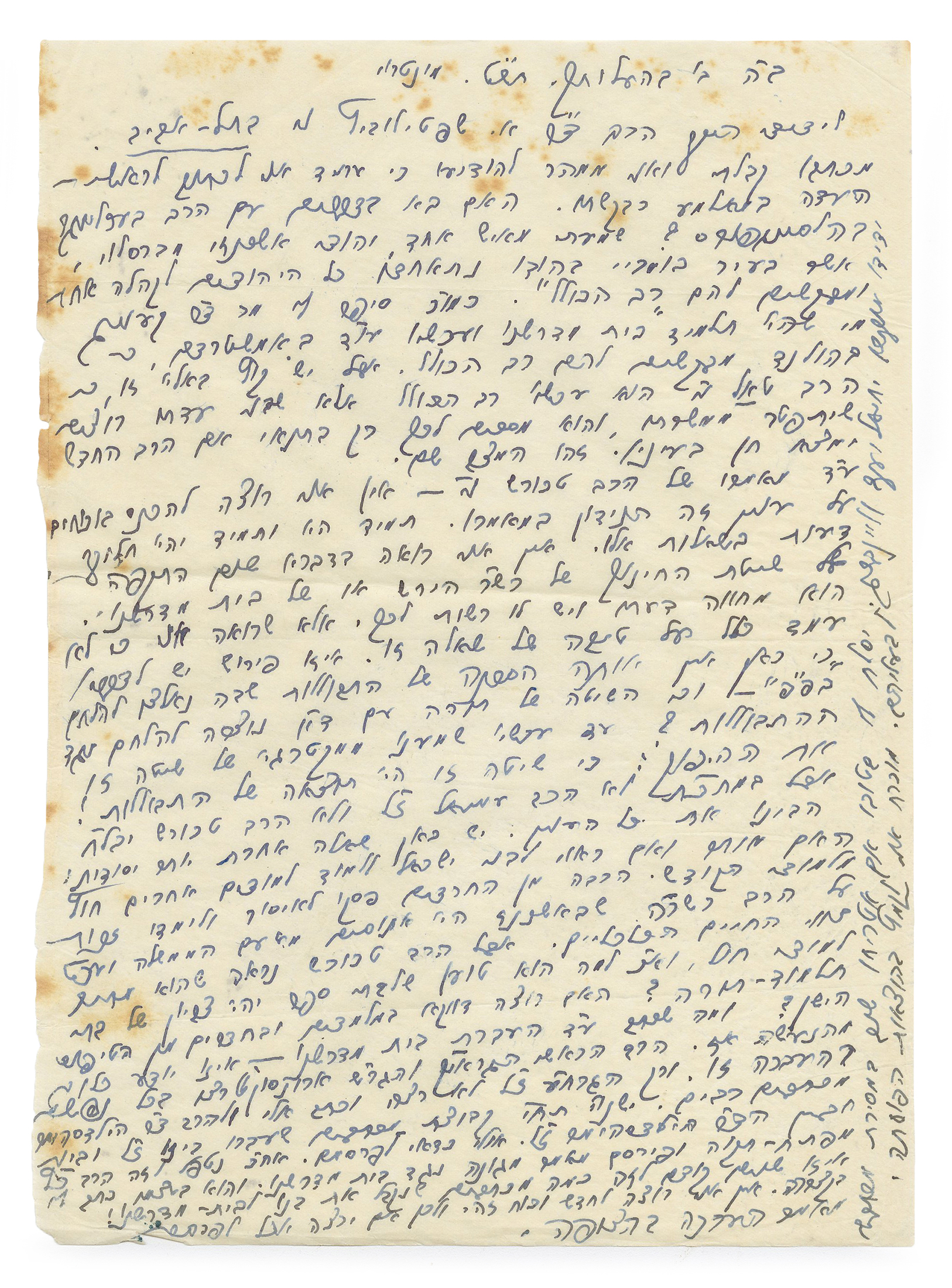
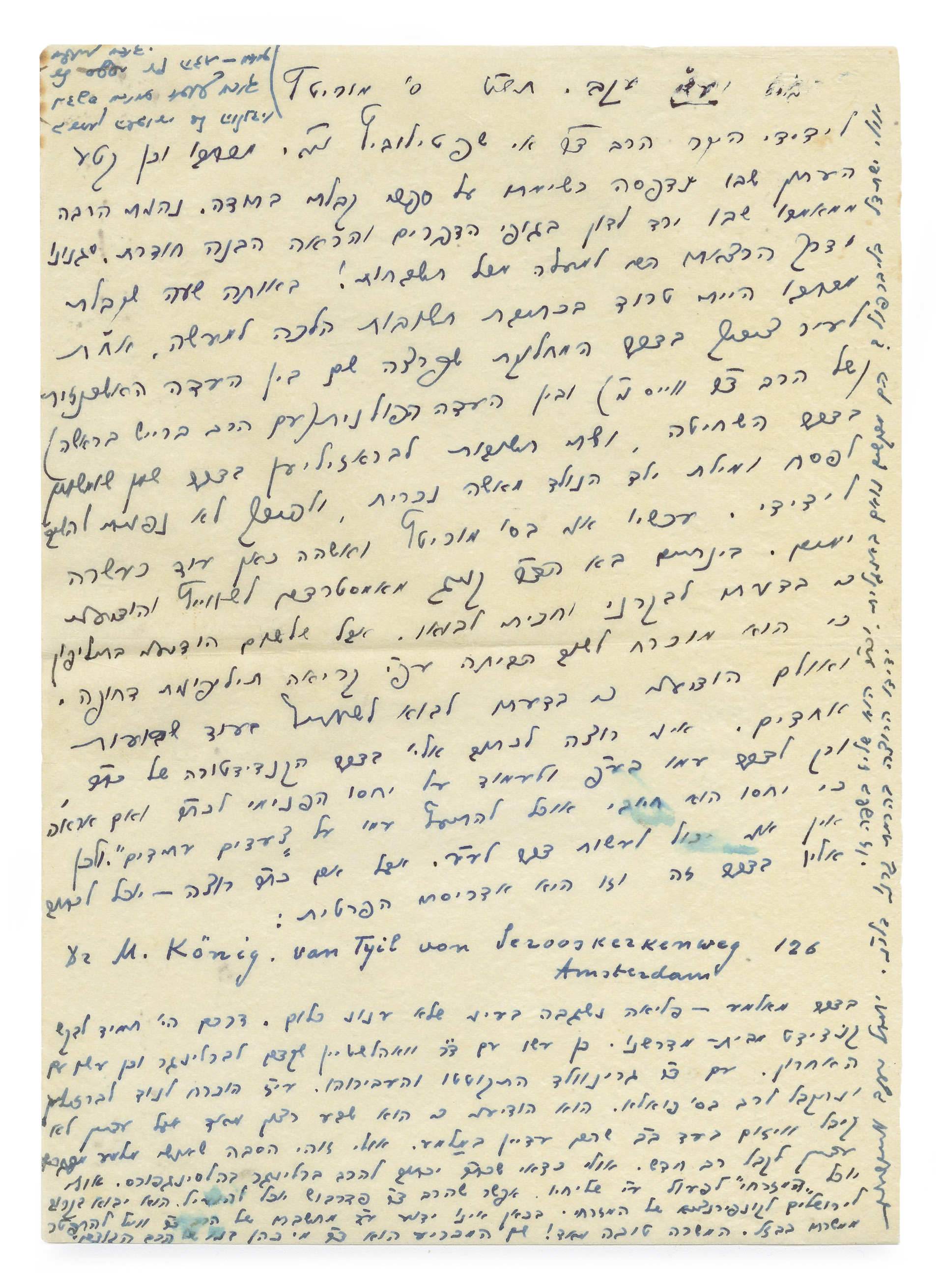
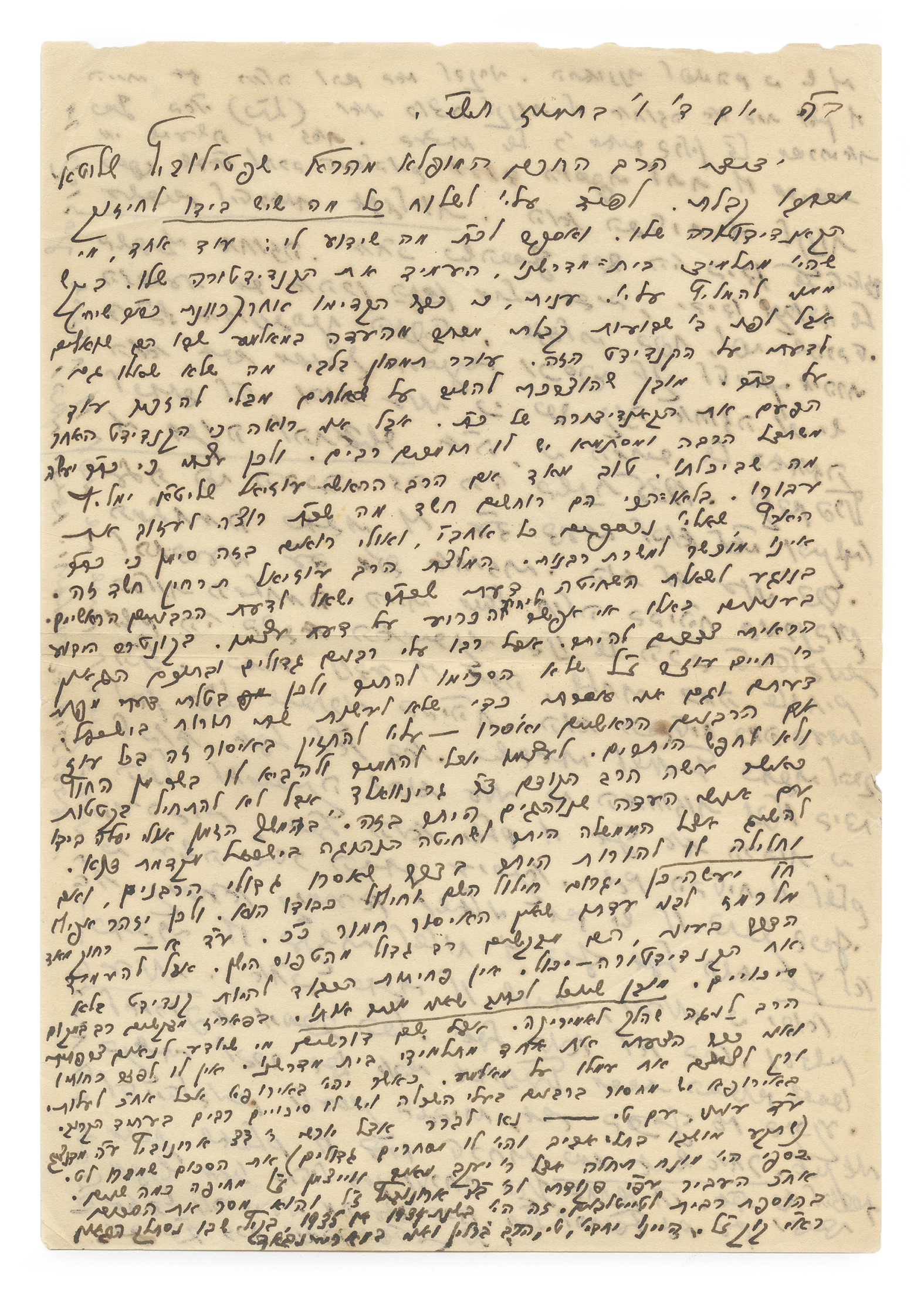
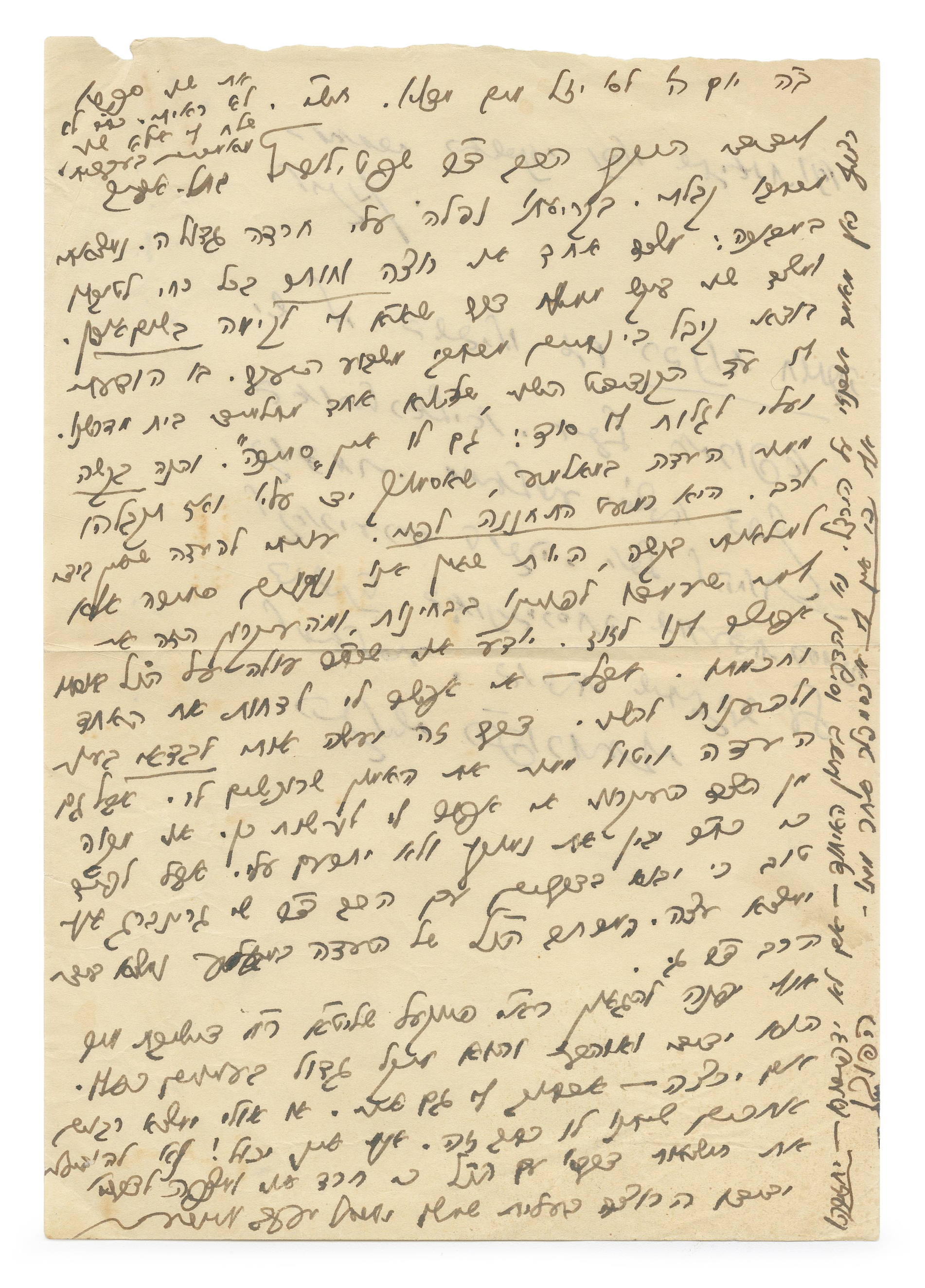
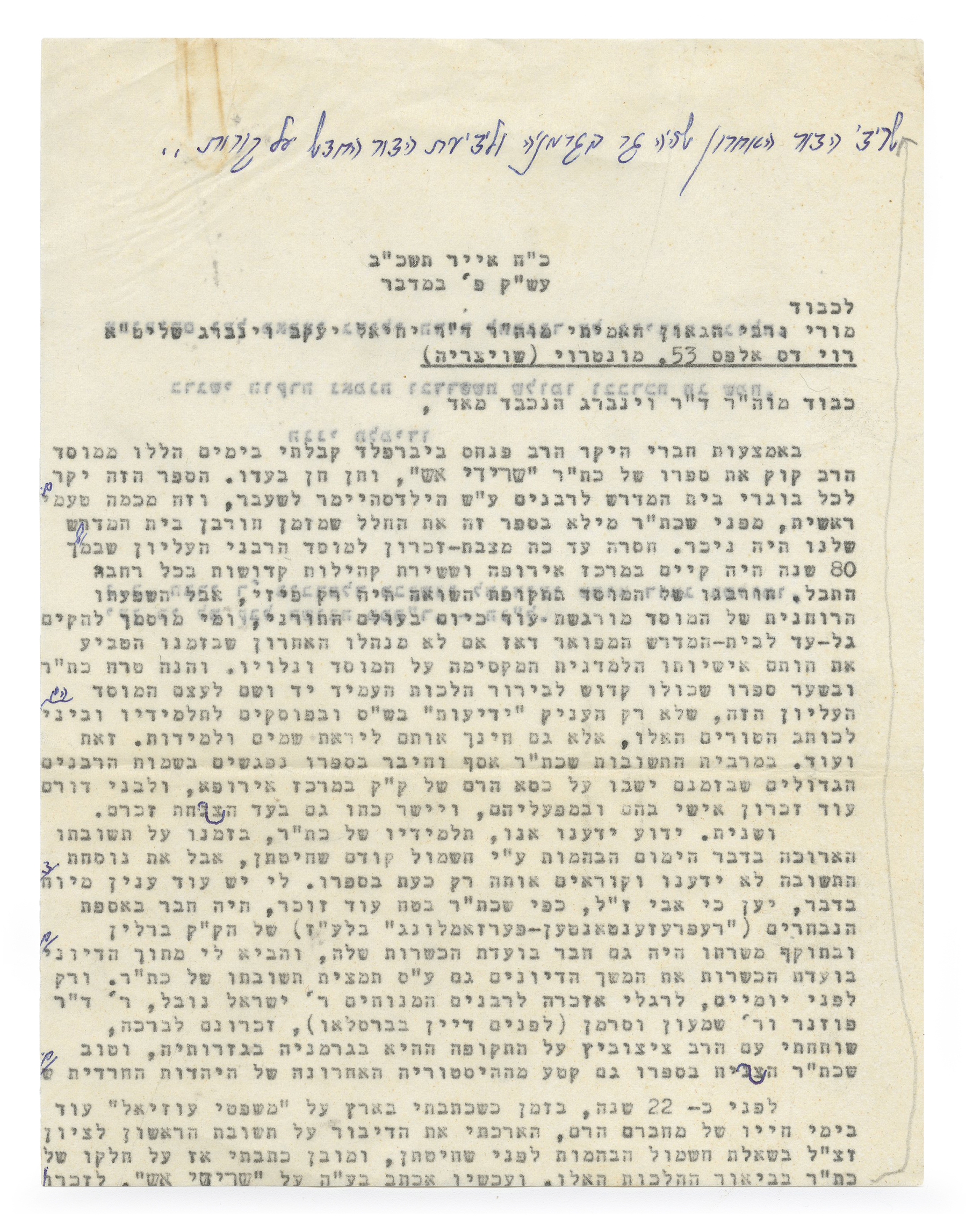
Collection of letters and other paper items, including 22 letters handwritten and signed by R. Yechiel Yaakov Weinberg, author of Seridei Esh. Montreux, Switzerland and elsewhere, between 1949-1963.
The letters are addressed to his disciple Rabbi Dr. Erwin Elchanan Scheftelowitz, a graduate of the Rabbinical Seminary in Berlin, and one of R. Weinberg's dearest students. Many letters discuss R. Scheftelowitz's candidacy for rabbinic positions in various cities in Europe, mainly discussing the question of his rabbinic service in Malmö (Sweden) where another rabbi was eventually chosen. Other letters discuss articles submitted by R. Weinberg for publication (including his article "Dr. Herzl and His Relation to Religion"), and appreciations by R. Scheftelowitz for R. Weinberg's Seridei Esh. Enclosed are various letters and newspaper clippings on R. Weinberg's books.
In a letter dated "Monday Behaalotcha, 1949", R. Weinberg discusses at length the Torah Im Derech Eretz approach transmitted by R. Shimshon Refael Hirsch, and mistaken interpretations imputed to it by a diverse range of rabbis. In another letter, dated 6th Tamuz 1950, R. Weinberg discusses among other things the issue of kosher shechitah, recounting his deference to the decision of R. Chaim Ozer not to publicize his ruling permitting certain methods of stunning animals: "Regarding the shechitah question, my opinion is that you should ask the Chief Rabbis. In matters such as these, no individual can issue a decision based on his own opinion. In the mentioned booklet I demonstrated permissive possibilities, but I was outnumbered by great rabbis, including R. Chaim Ozer, who did not decide to permit it, and therefore I deferred to them and also forbade it, in order not to divide Judaism into two…".
In a notable letter, R. Weinberg reveals that the birthday appearing on his passport is fabricated. This was written in response to R. Scheftelowitz's publication of a newspaper article in honor of the seventieth birthday of his teacher R. Weinberg. In this letter, dated Friday Vayigash 1954 (6th Tevet, 31 December): "…I received the issue with your article for my seventieth birthday, and I was surprised at this information which is wholly unlike my true age. I don't know what the source was for this false fact; my passport attesting to this age is unreliable, as it was made at the time for various reasons; enough said. I would be grateful if you would personally retract the false information that you were misled by" [notably, all biographies of R. Yechiel Yaakov Weinberg give his date of birth as ca. 1884-1885; the present letter indicates that the true date differs by several years, and we do not know whether it was earlier or later than 1884].
R. Yechiel Yaakov Weinberg (ca. 1880s-1966), renowned Torah scholar and posek, a leading disciple of the Alter of Slabodka. Served as rabbi in Pilviškės (Lithuania) at a young age. After the passing of his friend R. Avraham Eliyahu Kaplan, he succeeded him as head of the Rabbinical Seminary in Berlin. During the Holocaust, he was deported to Poland, residing in the Warsaw Ghetto where he served as president of the Rabbinical Association. He was sent to a concentration camp, and he survived the Holocaust. After the war, he settled in Montreux, Switzerland, where he headed the yeshiva until his passing. His works include: Responsa Seridei Esh, Chidushei Baal Seridei Esh, Lifrakim and more.
The recipient of the letters, Rabbi Dr. Erwin Elchanan Scheftelowitz (1911-1998), a Tel Aviv rabbi of German origin, as well as a jurist. He authored books and articles, mainly on Jewish, Mandatory and Israeli law: The Jewish Law of Family and Inheritance and its Applications in Palestine (Tel Aviv, 1941; English translation 1947), with an approbation by R. Uziel; The Jewish Law of Family and its Jurisprudence for the Jews of Israel (Tel Aviv, 1965; Hebrew); and many other books and articles in Hebrew and German.
27 letters and drafts, including 22 original letters from R. Weinberg (14 on postcards). Varying size and condition. + 5 original envelopes + 4 newspaper clippings in German and Hebrew.
Category
Rabbinical Letters and Manuscripts
Catalogue Value


Auction 107: Rare and Important Items
Apr 15, 2026
Opening: $1,500
Estimate: $4,000 - $5,000
Sold for: $2,125
Including buyer's premium
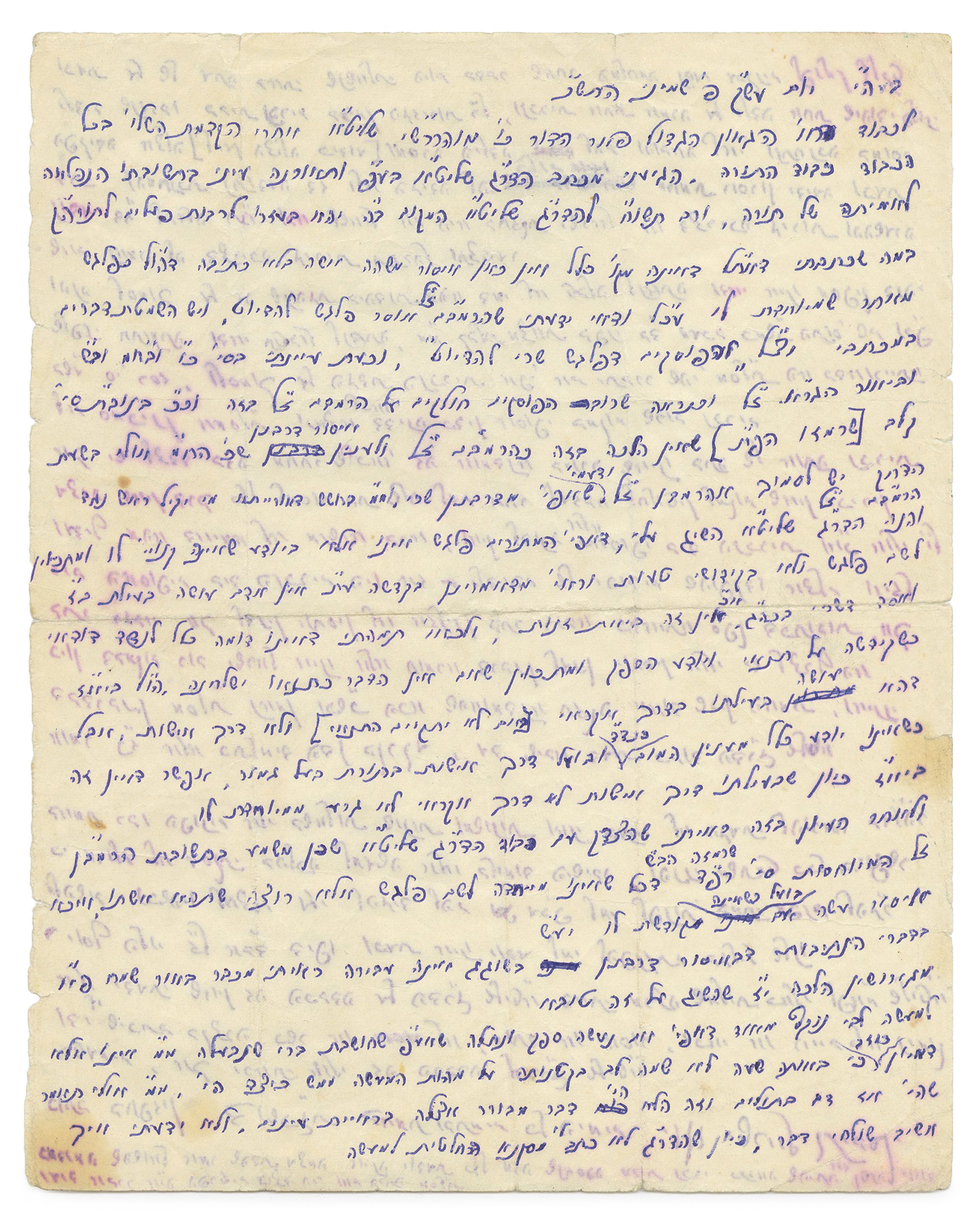
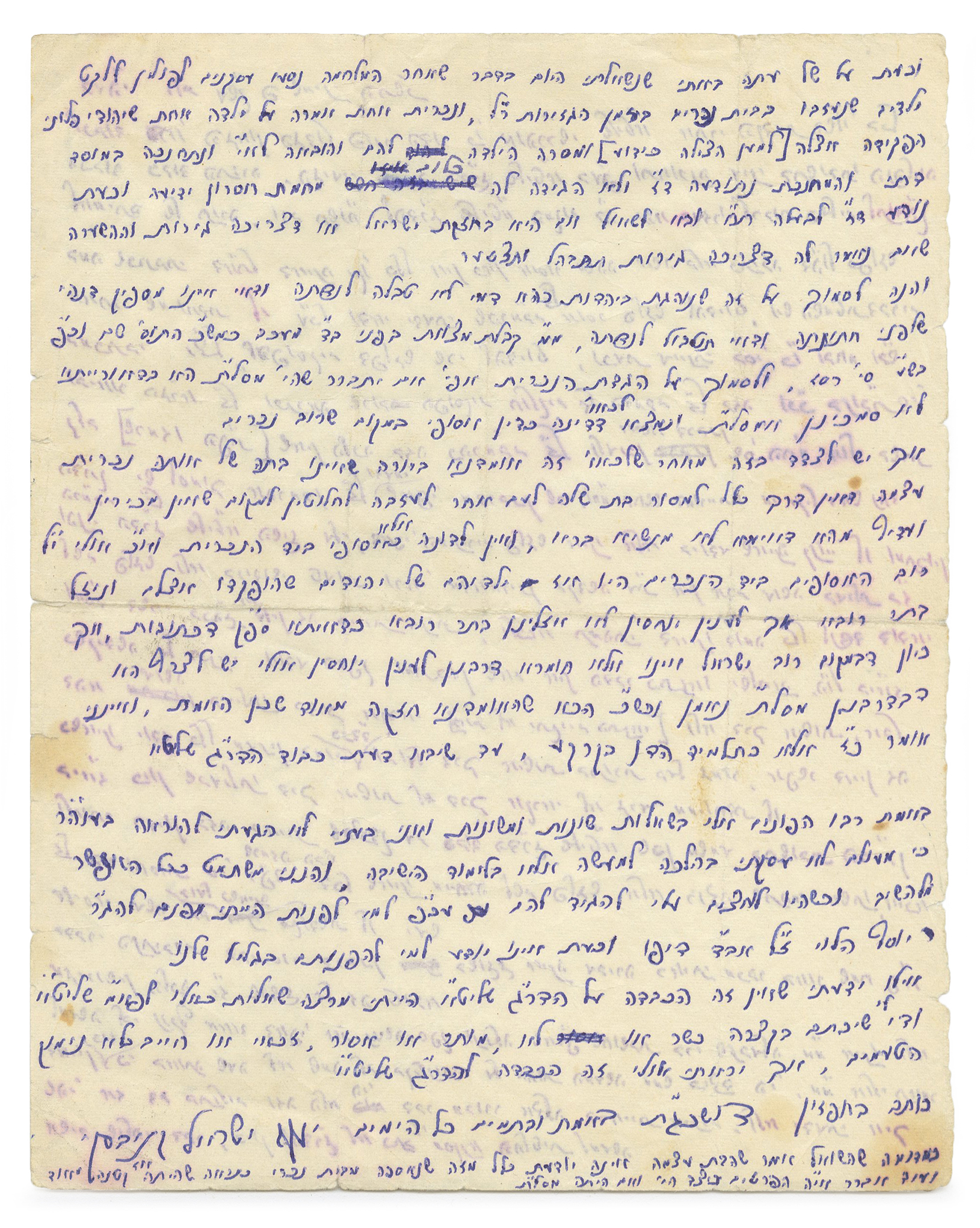
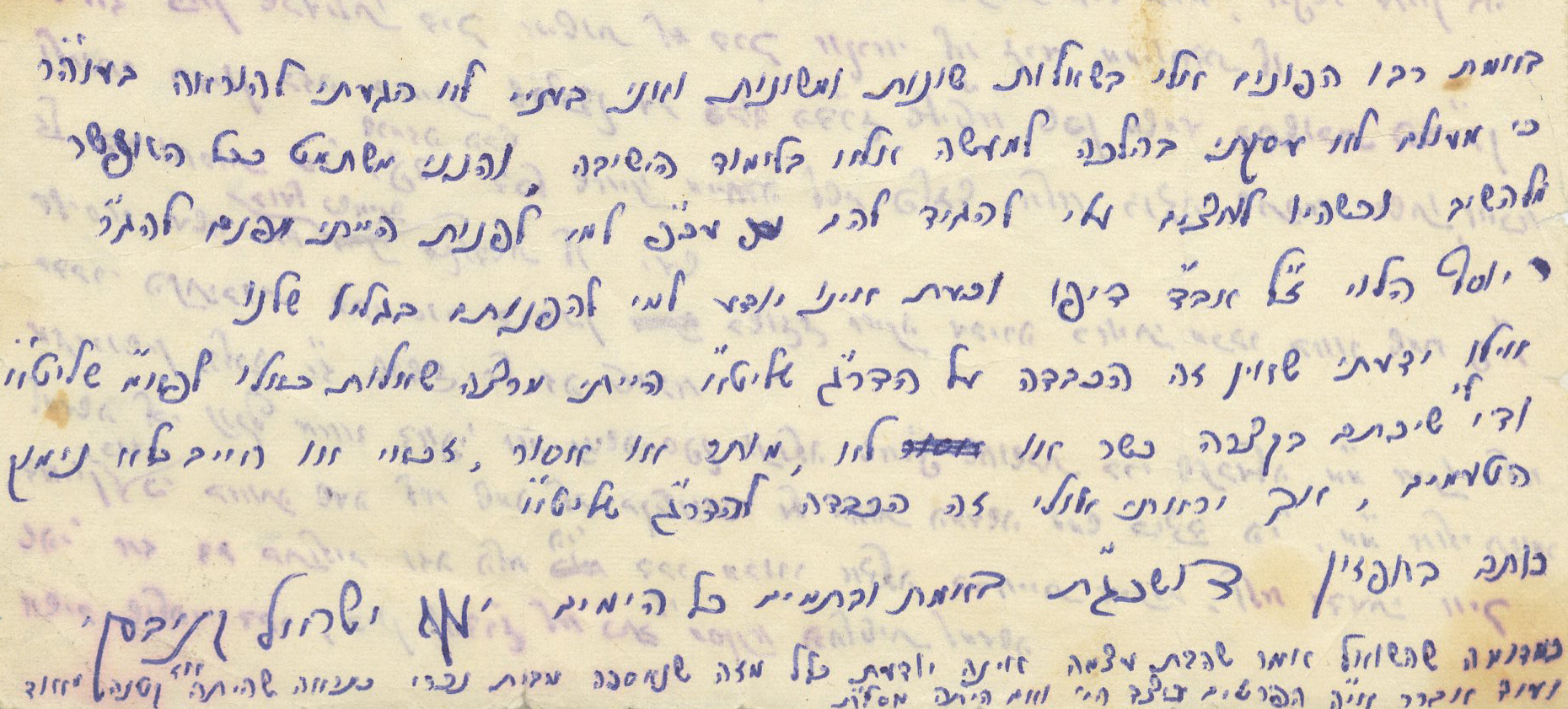
Lengthy letter (54 lines) handwritten and fully signed by R. Yaakov Yisrael Kanievsky (the Steipler Gaon), addressed to his mechutan R. Yosef Shalom Elyashiv. Bnei Brak, Friday Shemini [25th Nisan] 1960.
Deletions and corrections in original (handwritten by the Steipler). He begins the letter by thanking him for a letter he had received on Erev Pesach: "My eyes were illuminated with your wondrous Torah-true response, much appreciation, may G-d assist you to increase your deeds for the holy Torah". R. Yaakov Yisrael Kanievsky goes on to discuss a halachic topic related to betrothal and concubinage, concluding: "…and I do not know how to respond to my querent, since you did not write me a definite practical conclusion".
On the second page of the letter, R. Yaakov Yisrael Kanievsky discusses a halachic question that had reached him regarding the proof of Jewish ancestry of the wife of a Torah scholar, who was hidden in a non-Jewish home in Poland during the Holocaust, and after the Holocaust was brought to Eretz Israel and educated in a religious institution. Now that the matter became known to her husband, he asks "whether she has the halachic presumption of Jewishness or needs to be converted; and we anticipate that if we tell her she needs a conversion she will be dismayed and distressed…". The Steipler humbly concludes: "I am only saying this as a student speaking from the floor, until I receive your opinion".
The Steipler Gaon concludes by humbly asking his mechutan R. Yosef Shalom Elyashiv to decide all the halachic questions asked of him: "In truth, many address me with various diverse questions, but among my many sins I have never attained the ability to make halachic decisions, because I never studied practical halachah but rather yeshiva learning, and I avoid answering as far as possible. And when they would press me at least to tell them whom to address, I used to refer them to R. Yosef HaLevi Rabbi of Jaffa, and now I don't know who to refer them to in our region. If I knew that this is no burden on you, I would refer these questions to you, and it would be enough to write in brief… without explanation, but I was afraid this might be a burden on you… Seeking your welfare truly and sincerely always, Yaakov Yisrael Kanievsky".
The content of the present letter was published (in parts, divided into multiple sections) in the collection of R. Yaakov Yisrael Kanievsky's letters, Karyana DeIgarta (new 2011 edition, II, letters 431, 464 and 659; see further letter 594). R. Yosef Shalom Elyashiv's response appears in the same book (letter 659), expressing his surprise that R. Yaakov Yisrael would refer people who ask halachic questions to him and humbly disclaiming Torah knowledge, proceeding to comment on the issue while leaving the final decision open.
The present letter is also published in R. Yosef Shalom Elyashiv's Kovetz Teshuvot (I, 123; IV, 122), with different division and ordering. The first part of the letter was also published in Igrot UReshimot HaKehillot Yaakov (I, Bnei Brak, 2002, letter 34, pp. 64-65).
R. Yaakov Yisrael Kanievsky (1899-1985), a leading Torah scholar of the past generation. He was known as the Steipler, an appellation derived from his hometown Hornostaipil, Ukraine. A foremost student of the Novardok yeshivas in Ukraine and Poland, he was reputed as one of the most diligent and scholarly students in the yeshiva world. Following his marriage to the sister of the Chazon Ish, he was appointed dean of the Novardok yeshiva in Pinsk, and in 1934, he immigrated to Eretz Israel to serve as dean of the Beit Yosef Novardok yeshiva in Bnei Brak. For many years, he lived in Bnei Brak in the same house as his brother-in-law, the Chazon Ish. After the yeshiva shut down, he continued his studies in Kollel Chazon Ish and in his home, and authored the Kehillot Yaakov series on most Talmudic topics and tractates. He was known as a wonder-worker benefiting from divine inspiration, and many sought his blessings and counsel.
The recipient of the letter, R. Yosef Shalom Elyashiv (1910-2012), father-in-law of the Steipler's son, R. Chaim Kanievsky (1928-2022). The Steipler and R. Elyashiv were close friends and had a voluminous and warm correspondence on Torah and personal affairs. The Steipler esteemed R. Elyashiv highly (calling him a "true posek"), and forwarded many halachic queries to him, as well as requests for prayer and blessing.
1 leaf (from a notebook), written on both sides. 20 cm. Good-fair condition. Stains and wear. Folding marks and tears.
Category
Rabbinical Letters and Manuscripts
Catalogue Value


Auction 107: Rare and Important Items
Apr 15, 2026
Opening: $4,000
Estimate: $8,000 - $12,000
Sold for: $5,000
Including buyer's premium
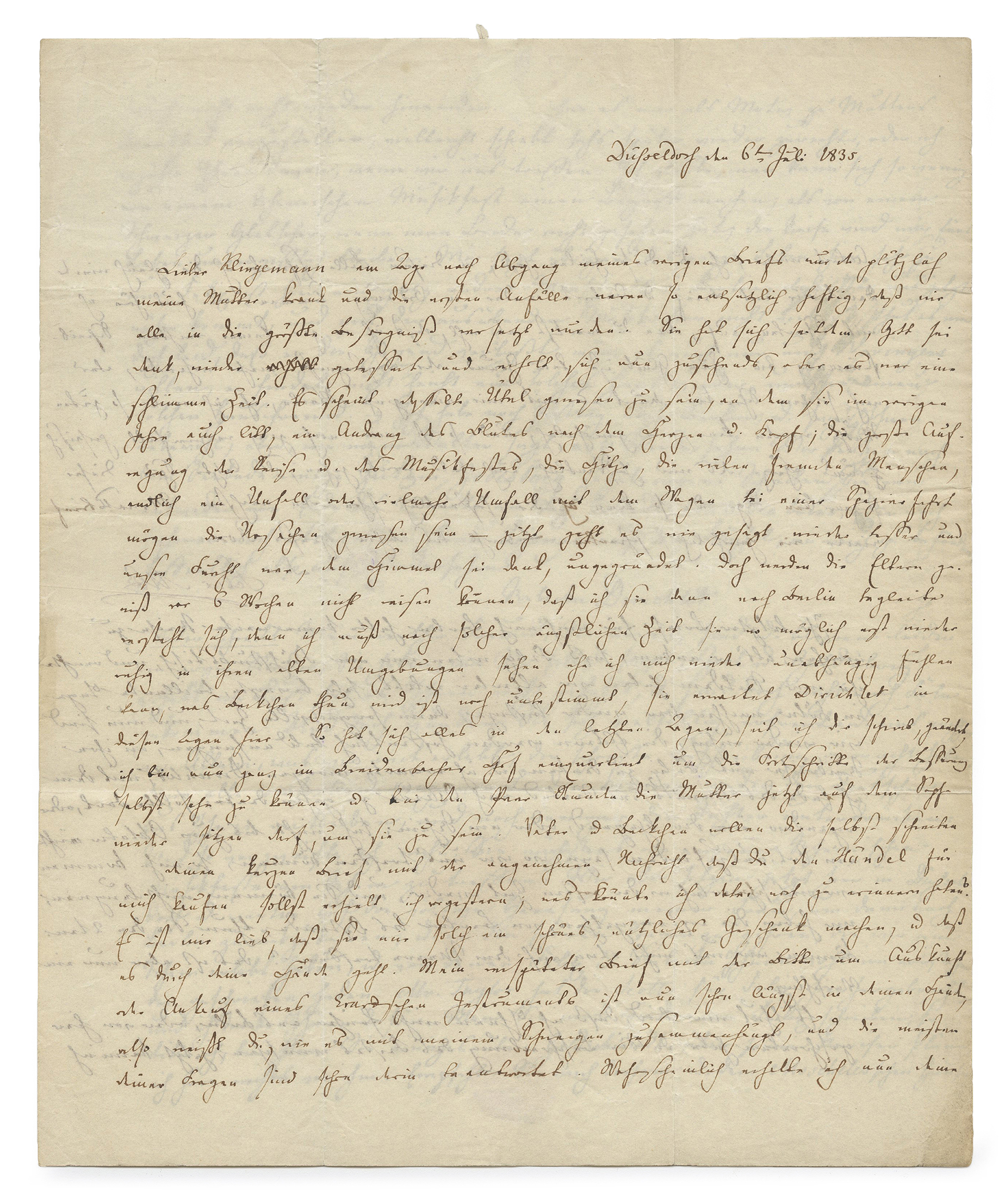
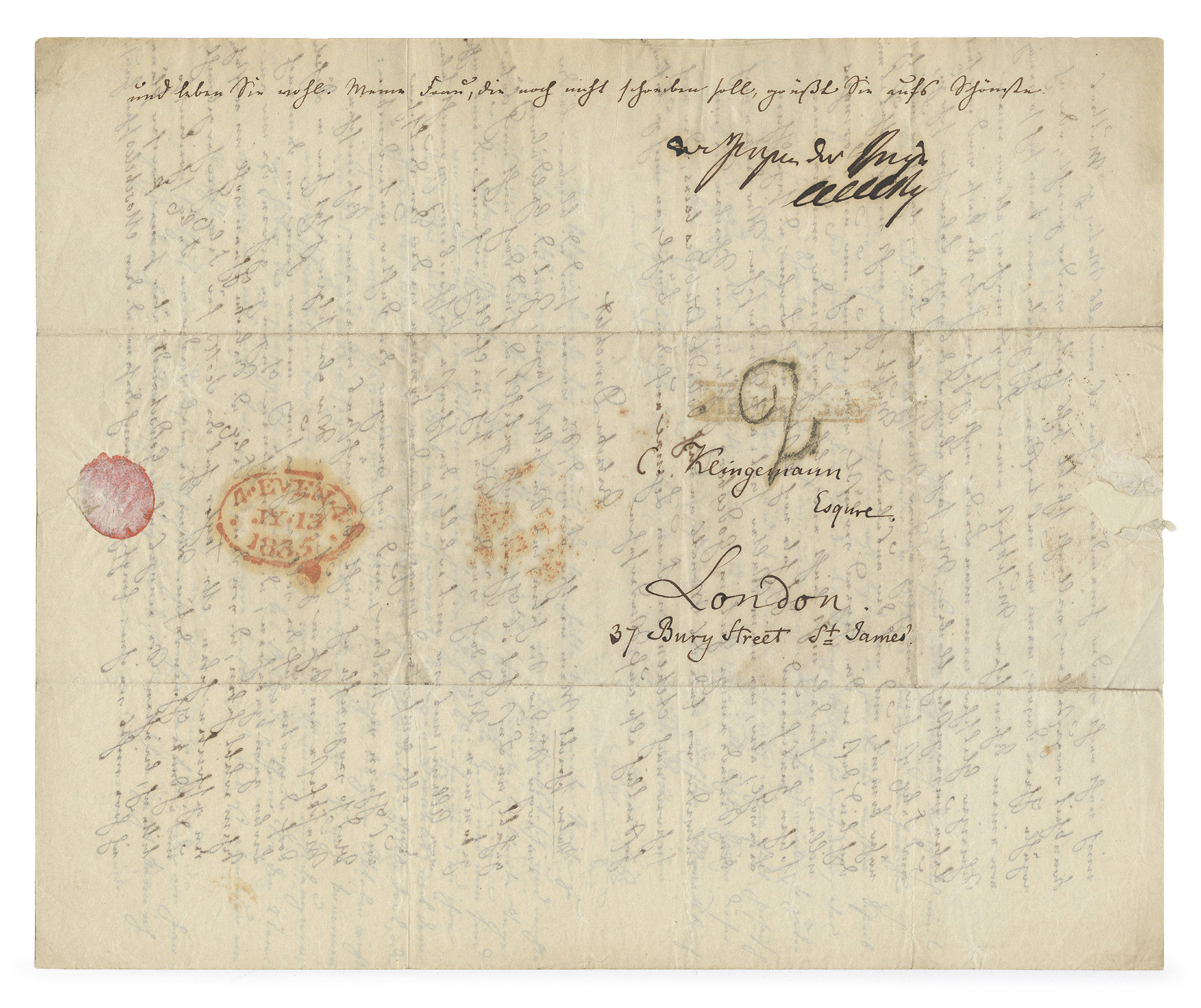
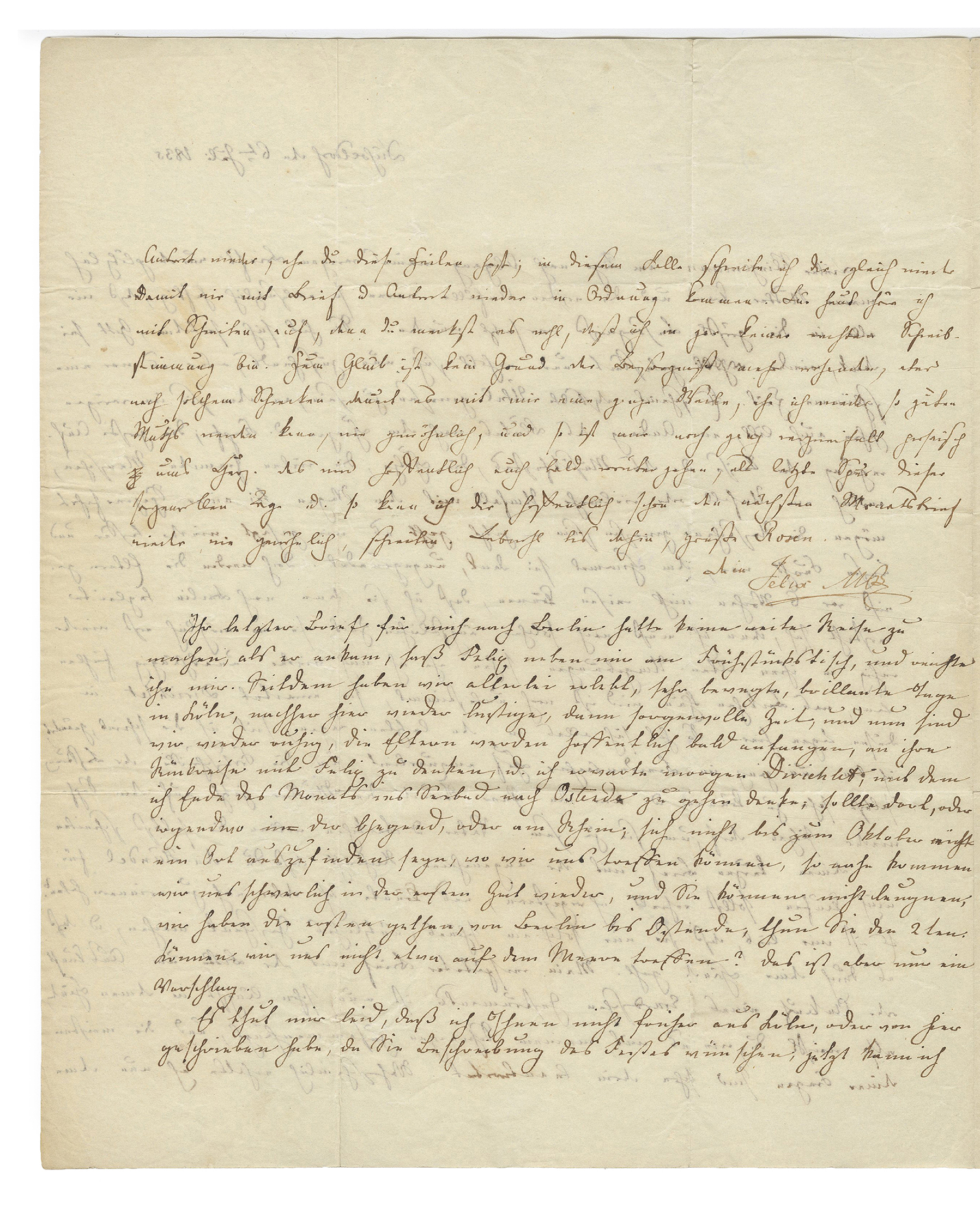
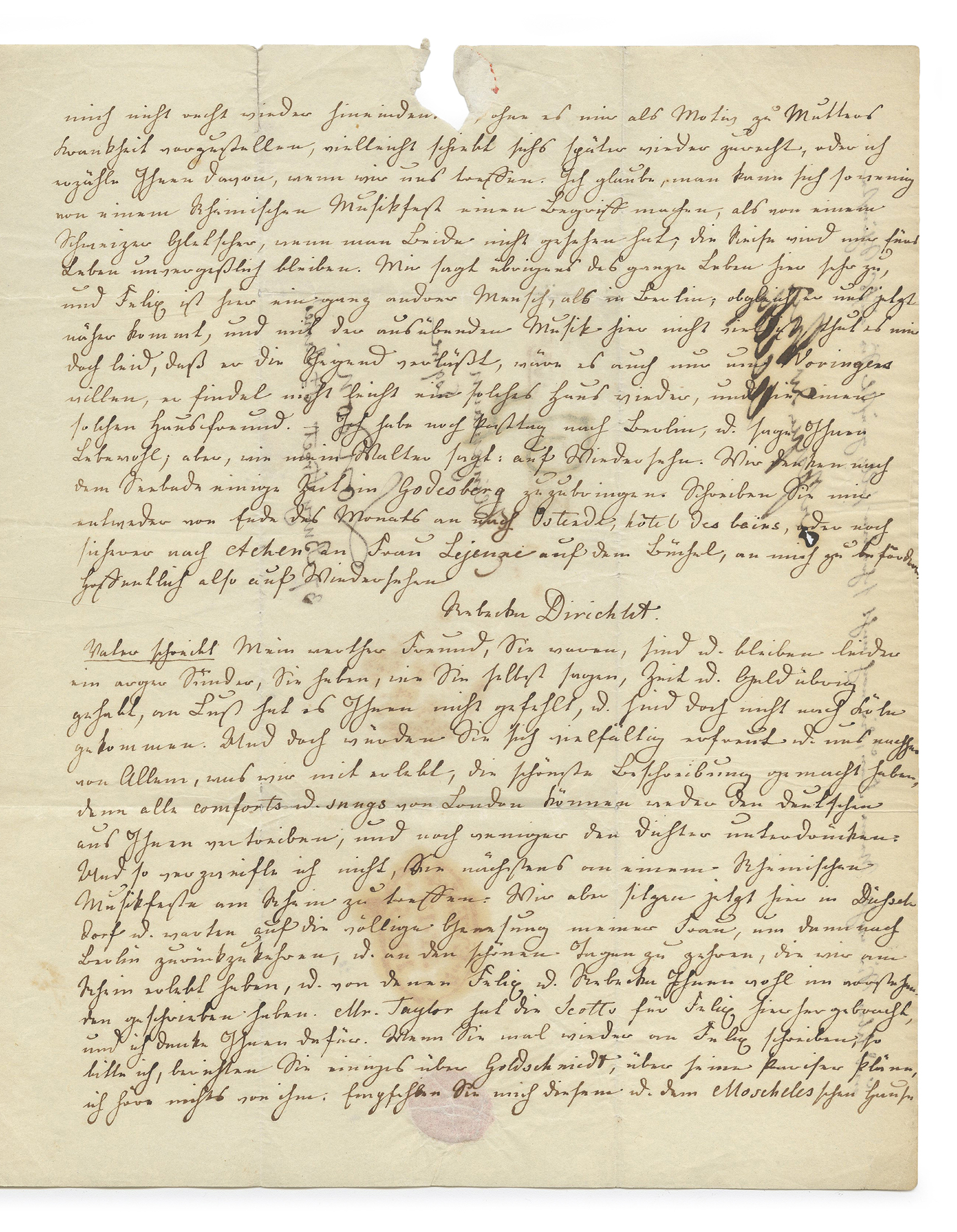
Double leaf (4 pages) – Signed autograph letter by composer Felix Mendelssohn-Bartholdy; accompanied by another signed autograph letter by his sister, Rebecka Lejeune-Dirichlet, and an additional letter (in Rebecka’s hand) signed by his father, Abraham Mendelssohn-Bartholdy, son of philosopher Moses Mendelssohn. Düsseldorf, 6 July, 1835. German.
An intimate family letter, signed by three members of the Mendelssohn-Bartholdy family (son and two grandchildren of Moses Mendelssohn); sent to a family friend, the diplomat and poet Karl Klingemann, then serving on the staff of the Embassy of Hanover in London.
The letter was written shortly after the conclusion of the Niederrheinisches Musikfest (Lower Rhine Music Festival), held that year in Cologne under Mendelssohn’s artistic direction. At the opening of the letter, Mendelssohn recounts the sudden illness of his mother, Lea Mendelssohn, which struck shortly after their return from the festival; he attributes the deterioration in her condition to the excitement of the events, the intense heat, and a carriage accident that occurred on the way. Owing to her condition, Mendelssohn notes, his parents would be required to remain in Düsseldorf for approximately six additional weeks, and he plans to accompany them back to Berlin once she has recovered.
At the close of his letter, Mendelssohn thanks Klingemann for acquiring musical scores of Handel (apparently the oratorio 'Solomon', translated into German by Klingemann and conducted by Mendelssohn-Bartholdy at the Cologne festival) and for handling the purchase of a piano by the renowned maker Erard.
On pages 2-3 appear additional letters by Mendelssohn’s sister and father (both written in Rebecka’s hand). In her letter, Rebecka describes the intense experiences of the Cologne festival, notes the improvement in Felix’s spirits, and relates her plans to meet her husband, the mathematician Johann Peter Gustav Lejeune-Dirichlet, and their forthcoming journey to the seaside resort of Ostend in Belgium.
In his letter, dictated to his daughter Rebecka, Abraham Mendelssohn reproaches Klingemann for failing to attend the Cologne festival: "You are and, alas, will remain a great sinner; as you yourself say, you had time and money to spare… and yet you did not come to Cologne… you would have enjoyed it in many ways and afterwards would have given us the most beautiful description of all that we witnessed… London cannot drive the German out of you, and still less suppress the poet [in you]".
Felix Mendelssohn-Bartholdy (1809-1847), grandson of philosopher Moses Mendelssohn and among the foremost composers of the Romantic period. The present letter was written at a pivotal juncture in his career, shortly before leaving his post as municipal music director in Düsseldorf and assuming the conductorship of the renowned Leipzig Gewandhaus Orchestra.
Rebecka Lejeune-Dirichlet (1811-1858), younger sister of Felix Mendelssohn and Fanny Hensel; a salonnière and accomplished musician in her own right. In 1832 she married the distinguished mathematician Johann Peter Gustav Lejeune-Dirichlet. Their home in Berlin (and later in Göttingen) served as a cultural salon and musical center, hosting leading artists of the era, including Clara Schumann and Johannes Brahms.
Abraham Mendelssohn-Bartholdy (1776-1835), Berlin banker and philanthropist, son of Moses Mendelssohn. In 1822 he converted to Christianity and adopted the name Bartholdy. He played a decisive role in the musical education of his children and is credited with the remark: "Formerly I was my father’s son; now I am my son’s father". He died in Berlin on 19 November 1835, only months after signing the present letter.
Karl Klingemann (1798-1862), poet and diplomat, member of the Hanoverian foreign service in London from 1827. His association with the Mendelssohn family began in 1825, when Hanover's diplomatic legation was housed in the family residence in Berlin.
Klingemann played a key role in establishing Mendelssohn’s standing in England; he hosted the composer during his London visits and accompanied him on his celebrated journey to the Scottish Highlands (1829), which inspired the 'Scottish Symphony' and the overture 'The Hebrides' ('Fingal’s Cave'). He collaborated with Mendelssohn in writing and translating various libretti, including the German translation of Handel’s oratorio 'Solomon', performed by Mendelssohn at the Cologne festival (see: Hellmuth Christian Wolff, "Mendelssohn and Handel", The Musical Quarterly, Vol. 45, No. 2, April 1959, pp. 175-190). Their close friendship endured throughout their lives and is documented in more than 300 letters exchanged between them.
[1] double leaf (4 pages). 26.5 cm. Good condition. Folding marks. Minor tears at margins and along fold lines. Open tear at upper margin (affecting one word). Postal stamp and traces of wax seal.
Category
Autograph Letters
Catalogue Value


Auction 107: Rare and Important Items
Apr 15, 2026
Opening: $4,000
Estimate: $6,000 - $10,000
Sold for: $5,000
Including buyer's premium
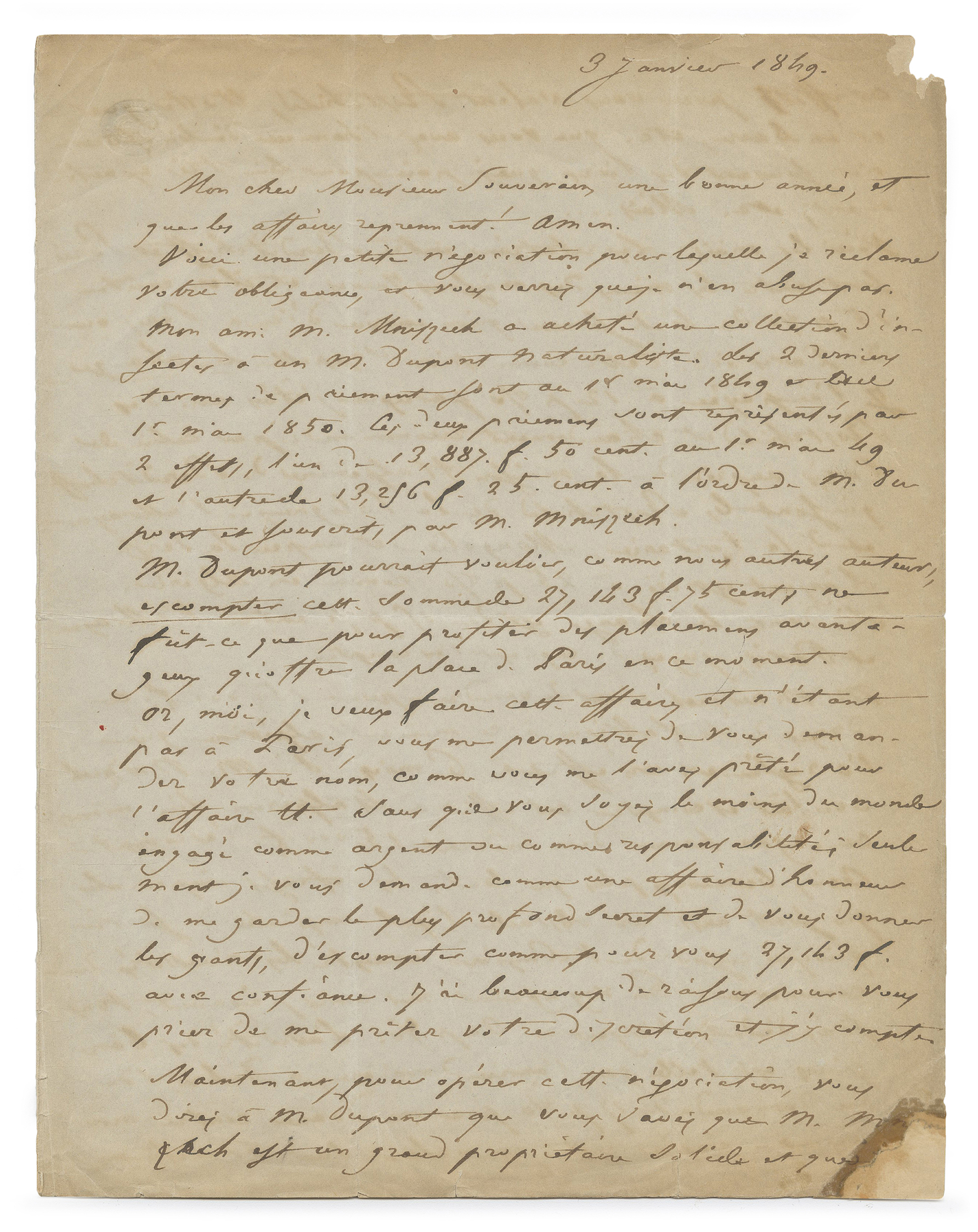
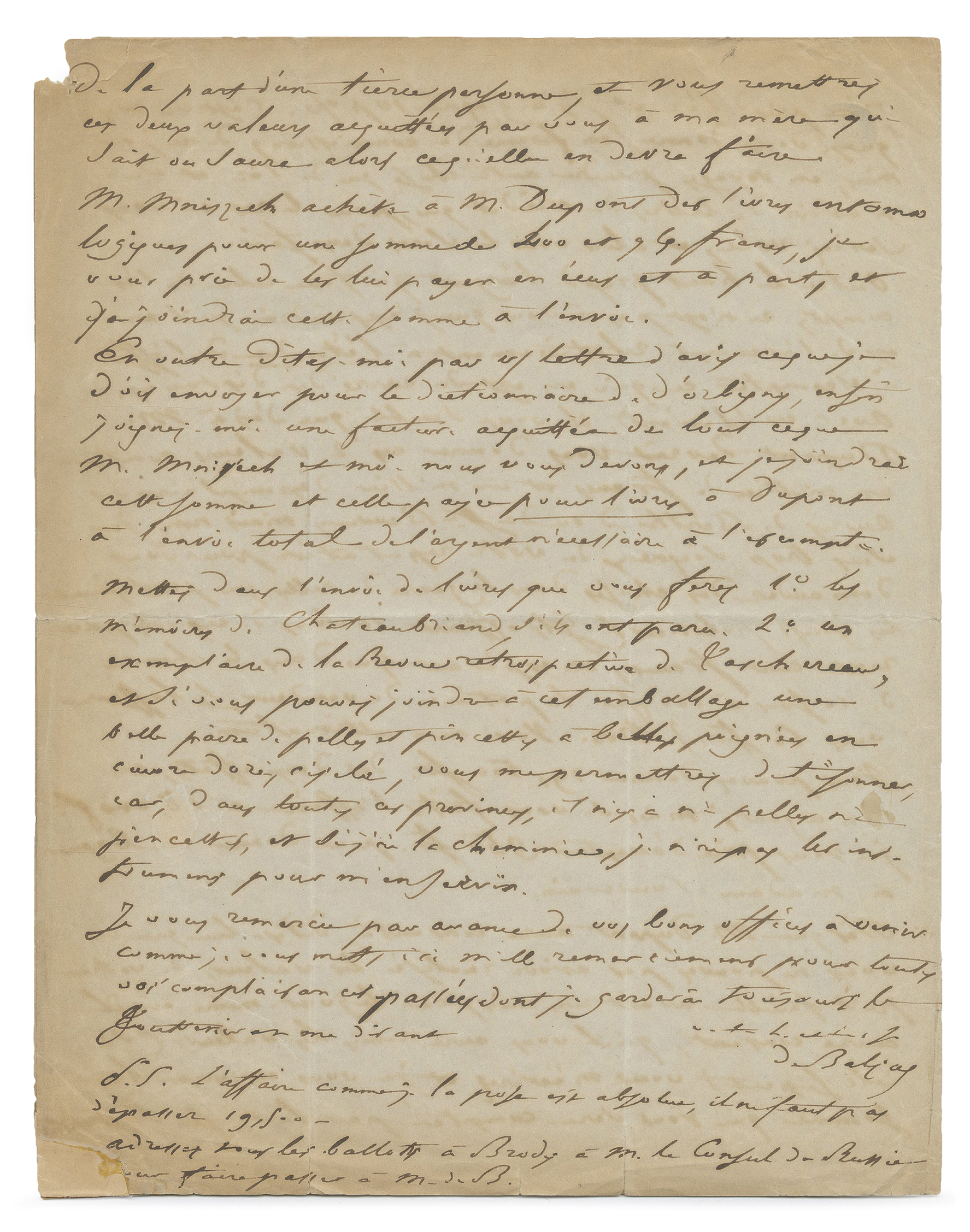
Large autograph letter (folded leaf; 4 full pages), handwritten and signed by the celebrated French author Honoré de Balzac. Wierzchownia estate, Ukraine, 3 January 1849. French.
The letter, addressed to Parisian publisher Hippolyte Souverain, is a remarkable historical and sociological document. Written while staying at the estate of his beloved (and future wife) Countess Ewelina Hańska, near the great Jewish center of Berditchev. In his letter, Balzac reveals himself as a seasoned businessman, involved in complex business dealings and analyzing financial systems, topics that were also an inseparable part of his literary production.
The letter revolves around a deal to purchase the valuable insect collection of naturalist Richard Henry Dupont for Countess Hańska's son-in-law, Georges Mniszech. Balzac directs Souverain to serve as the "straw man" in the deal, in order to escape financial restrictions of the Russian Empire limiting transfer of money to the West.
Balzac describes at length the trade channels between France and Ukraine, highlighting the key role of Jewish bankers in the financial system: "The relations between Berditchev and Paris are in the hands of Jewish houses, and it costs 15% of whatever sum one sends from here to Paris or from Paris to here". He calls Halperin's bank in Berditchev "the Rothschilds of Poland, Ukraine, Tartaria, Mongolia and even some of Persia". He recounts how his friendship with the Rothschild family in Paris helped him win low duties at Halperin's bank in Berditchev: "It costs 15% tax… I paid 12% because I was a friend of the Rothschilds, and I earned a warm recommendation from those in Paris to Halperin's bank…".
At the same time, the letter reflects the stereotypes and preconceived notions characteristic of Balzac's time towards the negotiation strategies of Jewish merchants: "I am too concerned for your good name to ask you to do the kind of thing Polish Jews usually do: they offer 10 centimes for what they would pay 100 francs for, hoping that… the seller will lose patience around 60 francs". He complains of high interest rates, writing that "the greed of the bankers is such that last year, in Dubno, they asked me for 17% in order to give me… Frankfurt market value for my Russian securities". The letter is signed at the edge of the fourth page.
In the concluding part of the letter, Balzac discusses the lack of books and high-quality objects in his stay in Ukraine, asking the publisher Souverain to send him the memoirs of Chateaubriand, a Parisian periodical and copies of works by Charles Augustin Sainte-Beuve and Samuel-Henri Berthoud. He also adds a personal request: "If you could enclose with this package a beautiful pair of dustpan and tongs with beautiful handles in chiseled and gilt copper, that would enable me to deal with the fire, as in all of these provinces there is neither dustpan nor tongs, and if I have a fireplace I also need tools to use it".
The insect collection purchased in this dealing formed the basis of the Mniszech collection, regarded as the largest European collection of insects in the 19th century, now held in the National Museum of Natural History in Paris.
Reference:
Daszkiewicz, Piotr, "Documents inédits concernant l’histoire et la vente de la collection entomologique de Georges Vandalin Mniszech (1822-1881)", in Le Coléoptère. 16/2, 2013, pp. 80-82.
Daszkiewicz, Piotr, "Documents inédits concernant l’histoire et la vente de la collection entomologique de Georges Vandalin Mniszech (1822-1881)", in Le Coléoptère. 16/2, 2013, pp. 80-82.
[1] double leaf (4 pages). 27 cm. Good-fair condition. Folding marks. Creases and minor tears. Open tears to four corners, affecting some letters, some repaired with paper.
Category
Autograph Letters
Catalogue Value


Auction 107: Rare and Important Items
Apr 15, 2026
Opening: $1,000
Estimate: $3,000 - $4,000
Sold for: $27,500
Including buyer's premium
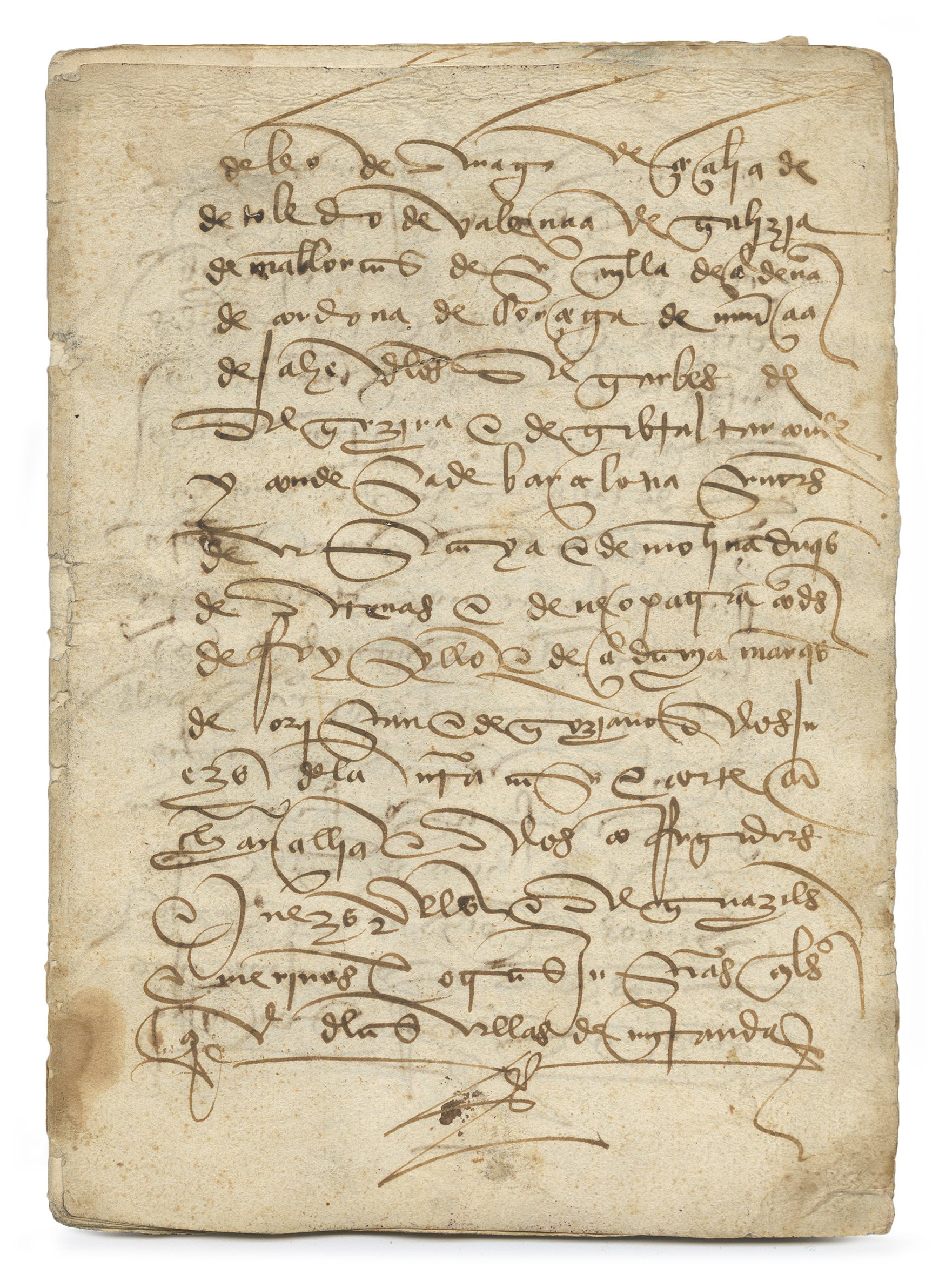
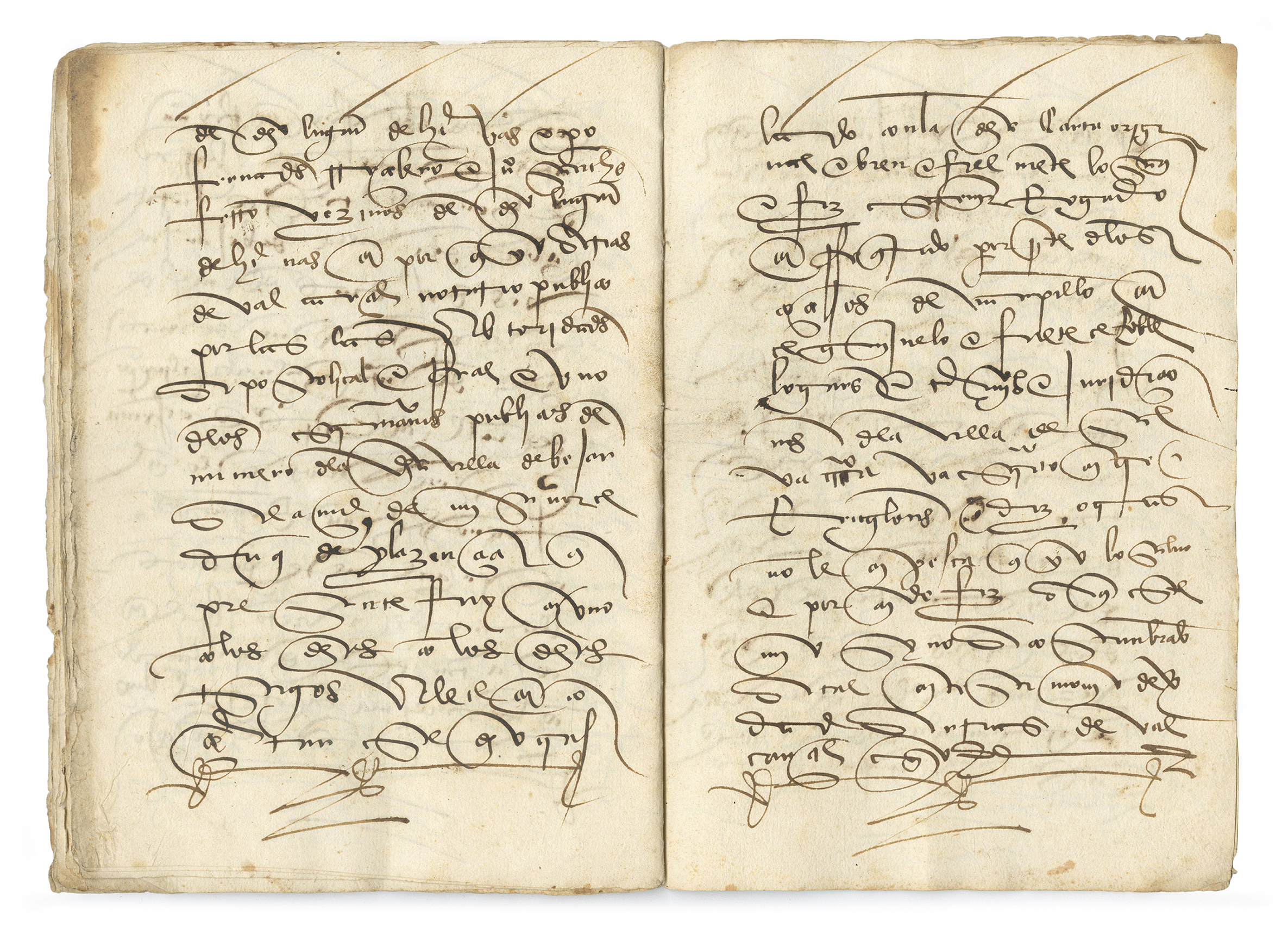
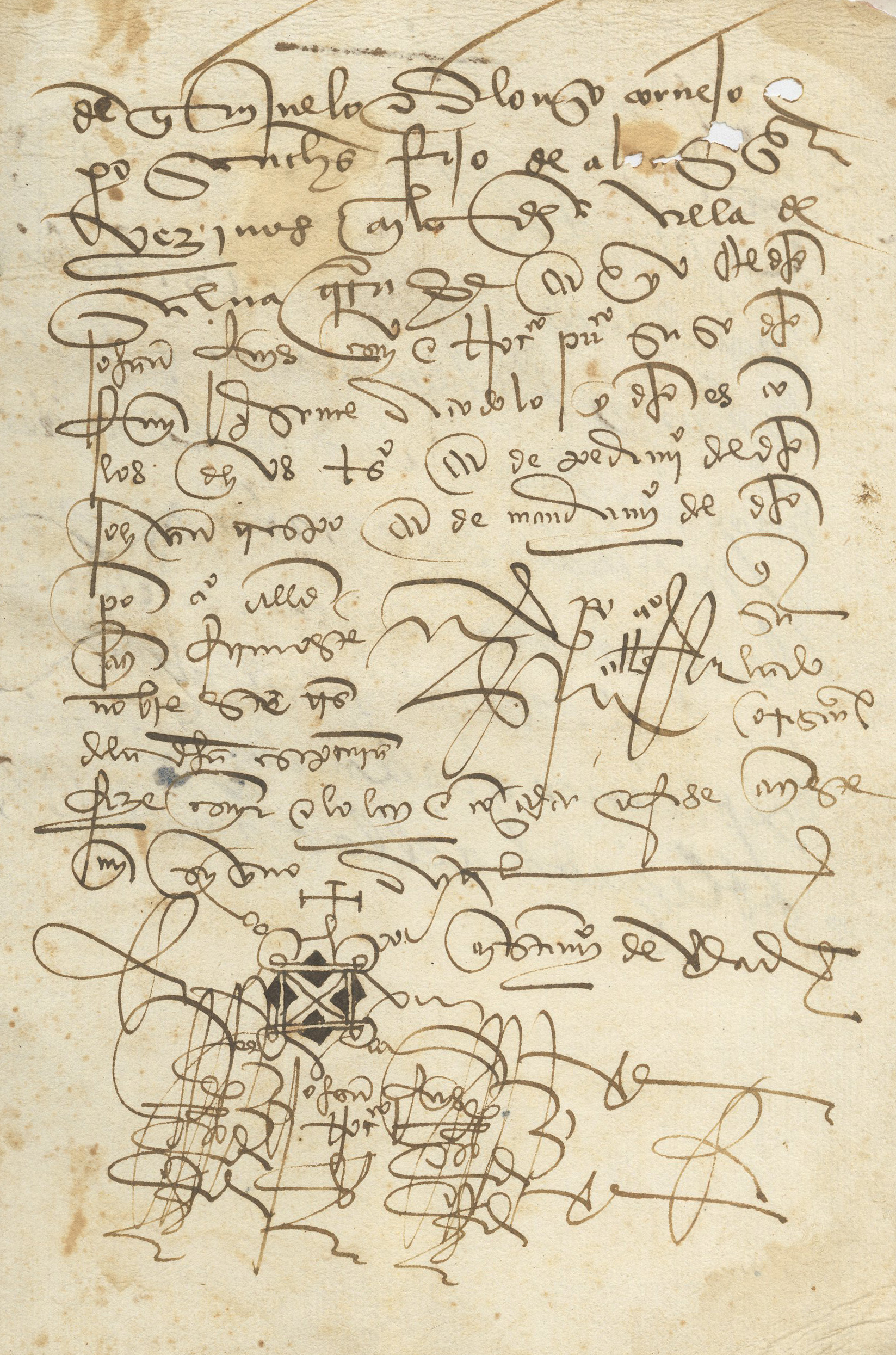
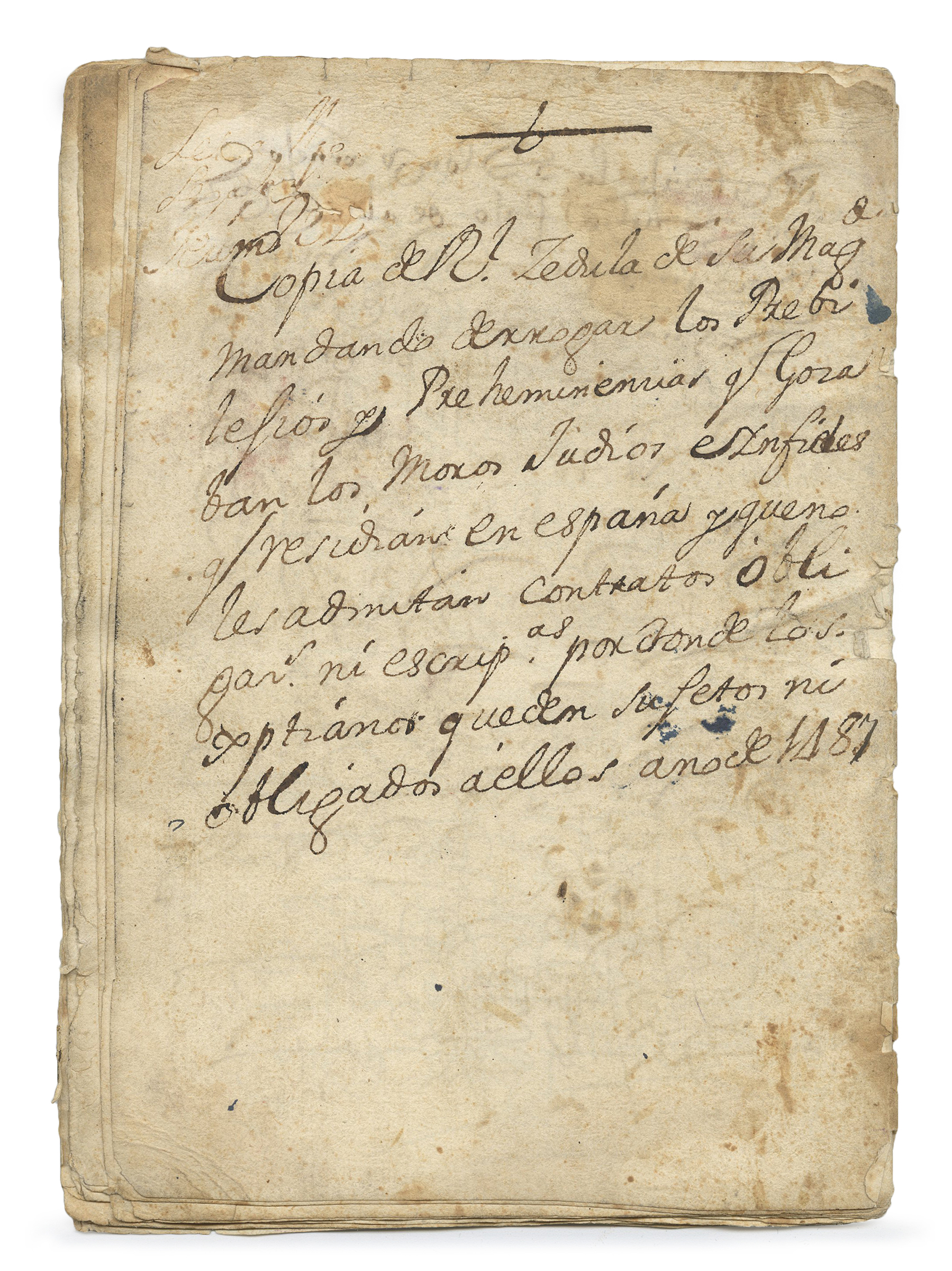
Manuscript booklet containing an official notarial copy (Traslado) of a royal decree (Real Cédula) issued by the Catholic Monarchs (los Reyes Católicos), King Ferdinand II of Aragon and Queen Isabella I of Castile. [Spain, Madrid?, 1487?]. Old Spanish (Gothic cursive script).
Royal decree issued shortly before the completion of the Christian Reconquista and less than five years prior to the Expulsion of the Jews from Spain (1492), revoking the charters of rights granted to Jews, "Moors" (Muslims), and other non-Christians residing in Spain.
The decree prohibits Christians from entering into contracts, obligations, or deeds with Jews and other non-Christians by which Christians might become subject or indebted to them; annuls all privileges and letters of protection granted by previous Spanish monarchs; and threatens severe penalties and fines upon those who violate its provisions.
The document was written and authenticated by an official public notary. His abbreviated signature appears in the margin of each page; his full and elaborate signature appears on the final page, accompanied by a distinctive personal notarial sign (signo notarial).
A later inscription (apparently 18th century) on the final page summarizes the principal contents of the decree.
16 leaves (32 manuscript pages). Approx. 22 cm. Overall good condition. Stains, creases, and wear. Minor tears at margins (open tears to inner margins of first and last leaves). Leaves detached.
Category
Royal Edicts, Anti-Jewish Ordinances and Laws, and Antisemitic Publications
Catalogue Value