
Auction 107: Rare and Important Items
Apr 15, 2026
- and (82) Apply and filter
- item (32) Apply item filter
- various (27) Apply various filter
- object (23) Apply object filter
- ornament (23) Apply ornament filter
- ornaments, (23) Apply ornaments, filter
- synagogu (23) Apply synagogu filter
- torah (23) Apply torah filter
- book (17) Apply book filter
- print (17) Apply print filter
- earli (15) Apply earli filter
- incunabula (15) Apply incunabula filter
- jewish (13) Apply jewish filter
- the (13) Apply the filter
- manuscript (12) Apply manuscript filter
- public (12) Apply public filter
- letter (10) Apply letter filter
- ketubot (9) Apply ketubot filter
- anti (8) Apply anti filter
- anti-jewish (8) Apply anti-jewish filter
- antijewish (8) Apply antijewish filter
- antisemit (8) Apply antisemit filter
- edict (8) Apply edict filter
- edicts, (8) Apply edicts, filter
- law (8) Apply law filter
- laws, (8) Apply laws, filter
- ordin (8) Apply ordin filter
- rabbin (8) Apply rabbin filter
- royal (8) Apply royal filter
- haggadot (6) Apply haggadot filter
- israel (6) Apply israel filter
- mandatori (6) Apply mandatori filter
- of (6) Apply of filter
- palestin (6) Apply palestin filter
- passov (6) Apply passov filter
- siddurim (6) Apply siddurim filter
- state (6) Apply state filter
- zionism (6) Apply zionism filter
- zionism, (6) Apply zionism, filter
- bind (5) Apply bind filter
- havdalah (5) Apply havdalah filter
- holiday (5) Apply holiday filter
- person (5) Apply person filter
- shabbat (5) Apply shabbat filter
- shabbat, (5) Apply shabbat, filter
- silver (5) Apply silver filter
- art (4) Apply art filter
- brueckheim (4) Apply brueckheim filter
- collect (4) Apply collect filter
- from (4) Apply from filter
Displaying 85 - 96 of 104


Auction 107: Rare and Important Items
Apr 15, 2026
Opening: $3,000
Estimate: $5,000 - $7,000
Sold for: $4,000
Including buyer's premium
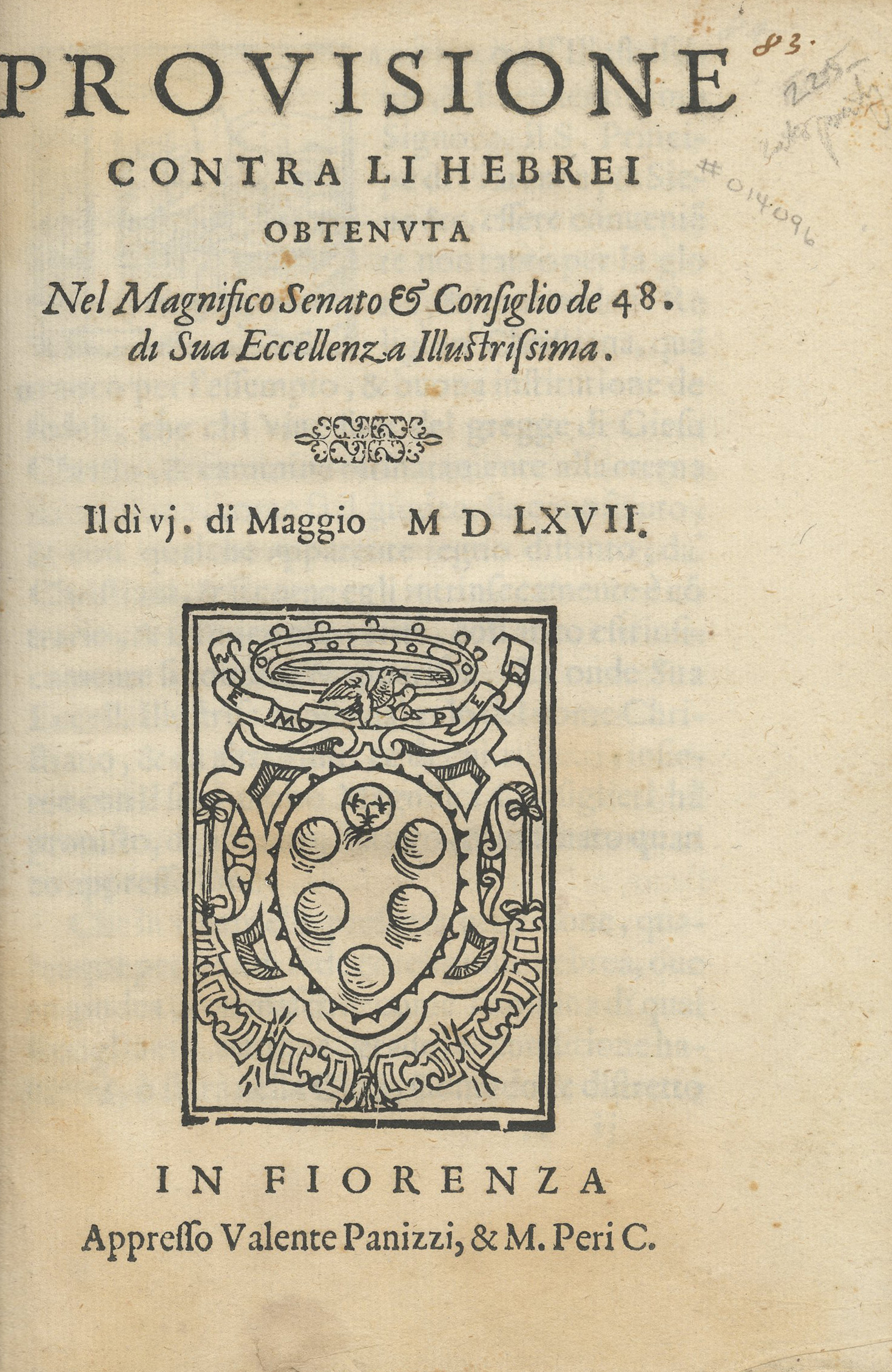
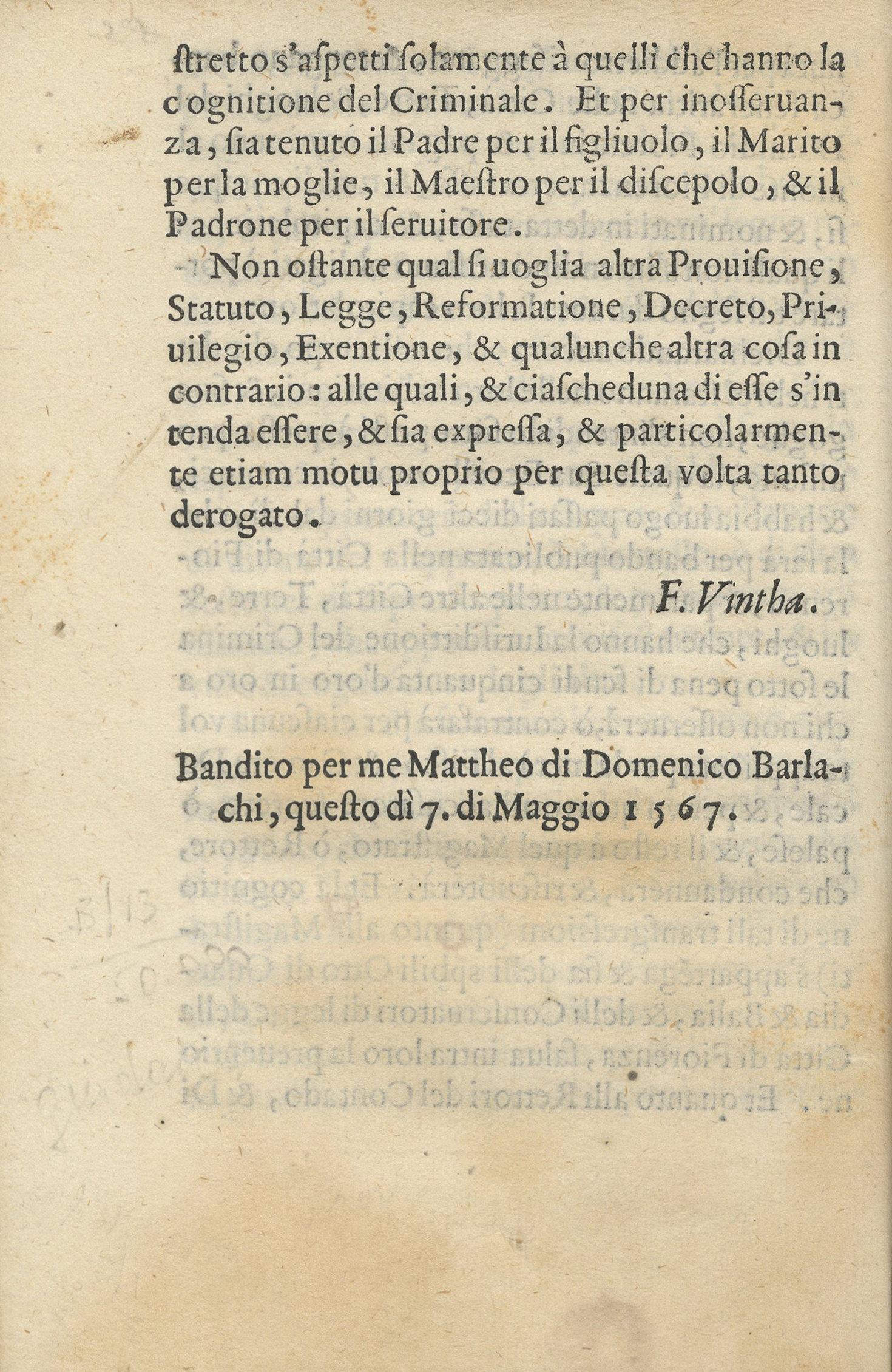
Printed booklet, Provisione contra li Hebrei obtenuta Nel magnifico Senato & Consiglio de 48. di Sua Eccellenza Illustrissima – Decree against the Jews, mandating marking of dress by Jews of the Duchy of Florence. Florence: Valente Panizzi, & M. Peri, 1567. Italian.
The decree, enacted on 6 May, 1567 in the Senate and in a council of 48 dukes of Florence, mandates that ten days from its promulgation, "every person of the Hebraic, that is Jewish, faith and religion, male or female, of whatever age, nationality, status or condition, residing or staying in the city, region or province of Florence" shall wear a permanent mark of their Judaism: Jewish men were to place a yellow circle in the shape of the letter O upon the kippah or hat (or, at his choice, on the hood or back of the coat) – clearly visible and identifiable by others. Jewish women were to wear a yellow sleeve on her arm – "so that it would be immediately known well, both by him and by her, that they are members of the same false religion, the Jewish religion".
The decree later exempts bankers and moneychangers who pay a fixed annual tax to the state. Additionally, the decree exempts the Jews from the obligation to wear this identification while at home or in the synagogue. It levies a fine of fifty scudi for each violation. In addition, it holds the father responsible for his son, the husband for his wife, the teacher for his student and the master for his servant.
The obligation of marking the Jews' clothing in yellow enacted in 1567 was an early measure that preceded a more dramatic move only four years later: the establishment of the Florence ghetto by Duke Cosimo I de' Medici in 1571. This deterioration in the Jews' living conditions had its roots in wide-ranging religious and political changes in Europe. As part of the Counter-Reformation, the Catholic Church began pressing Catholic rulers to enact strict measures and restrictions against the Jews. To gain the title of Grand Duke, Cosimo I de' Medici had to demonstrate his faithfulness to the Church by a series of strict anti-Jewish measures – first by requiring marking the dress in yellow, later establishing a Jewish ghetto.
On first page, Medici family coat of arms.
[3] leaves (5 printed pages). 19.5 cm. Good condition. Stains, creases and wear. Inscriptions. Bound with new paper wrapper.
Rare. Not recorded in NLI catalogue (three additional copies recorded in WorldCat were printed by two other Florence presses – Giorgio Marescotti and Giunti). To the best of our knowledge, this item has not previously been sold at auction.
Category
Royal Edicts, Anti-Jewish Ordinances and Laws, and Antisemitic Publications
Catalogue Value
Auction 107: Rare and Important Items
Apr 15, 2026
Opening: $6,000
Estimate: $10,000 - $12,000
Sold for: $10,625
Including buyer's premium
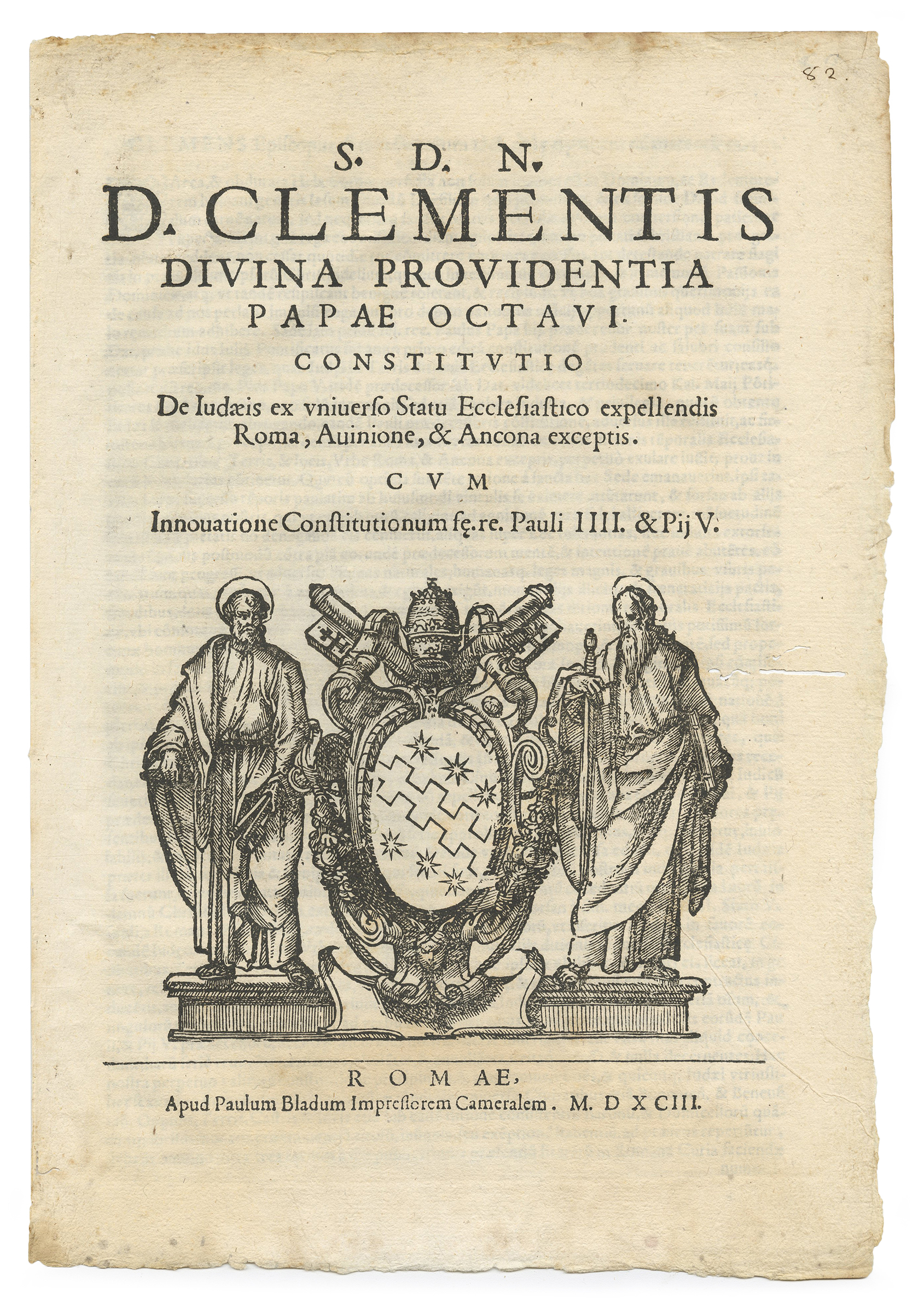
Printed papal bull: Caeca et Obdurata Hebraeorum perfidia ("The blind and obdurate perfidy of the Jews"), by Pope Clement VIII (1592-1605). Rome: Paolo Blado, 25 February 1593. Latin.
The bull expels all the Jews from the Papal States within three months of its publication, excepting only three cities: Rome, Ancona and Avignon. It reinstates and harshens the anti-Jewish decrees of his predecessors Paul IV (Cum nimis absurdum, 1555) and Pius V (Hebraeorum gens sola, 1569), abrogating the leniencies and permissions granted to Jews under later popes, including the permission to return to the Papal States granted by Pope Sixtus V (Christiana pietas, 1586).
The bulla levels a series of accusations against the Jews, including: ingratitude towards Christianity, moral corruption, financial fraud and injurious usury, deceit and fraud, which it claims reduced many Christians "not only to extreme poverty and beggary, but almost into slavery". It ordains that every Jew found outside of the three permitted cities at the end of the three-month period have their property confiscated and be sentenced to a lifetime of hard labor.
In tandem, and in accordance with earlier decrees of his predecessors Paul IV and Pius V, the Jews inhabiting the permitted cities were to live in a closed quarter outside the walls (the Jewish ghetto); they were required to sell their real estate; they were permitted to have a single synagogue in each city, and they were forbidden from building new synagogues; they were required to wear markings on their dress; they were absolutely forbidden from collecting interest; they were forbidden to hire Christian wet nurses and servants; Jewish doctors were forbidden from treating Christians; and their property and business rights were restricted.
Although the bull's directives were only partially enforced, they brought about significant suffering and deep uncertainty among the Jewish communities of the Papal States. Moreover, it eroded the Jews' sources of income and densely concentrated the population of the Jewish ghettos of Rome and Ancona.
Only three days after the promulgation of the present bull, on 28 February, 1593, Clement VIII published another anti-Jewish bull, Cum Hebraeorum malitia. This bull ordered copies of the Talmud and kabbalistic works to be confiscated and burned (see next lot).
Large papal insignia of Pope Clement VIII at top of first leaf (papal tiara with crossed keys and the Aldobrandini coat of arms).
[1] folded leaf (3 printed pages). 32 cm. Fair condition. Stains, creases and wear. Marginal tears. Worming, affecting text.
See: Attilio Milano, Il ghetto di Roma, Rome: Staderini, 1964, p. 83.
Rare. Not recorded in NLI catalogue.
Category
Royal Edicts, Anti-Jewish Ordinances and Laws, and Antisemitic Publications
Catalogue Value
Auction 107: Rare and Important Items
Apr 15, 2026
Opening: $4,000
Estimate: $8,000 - $10,000
Sold for: $8,125
Including buyer's premium
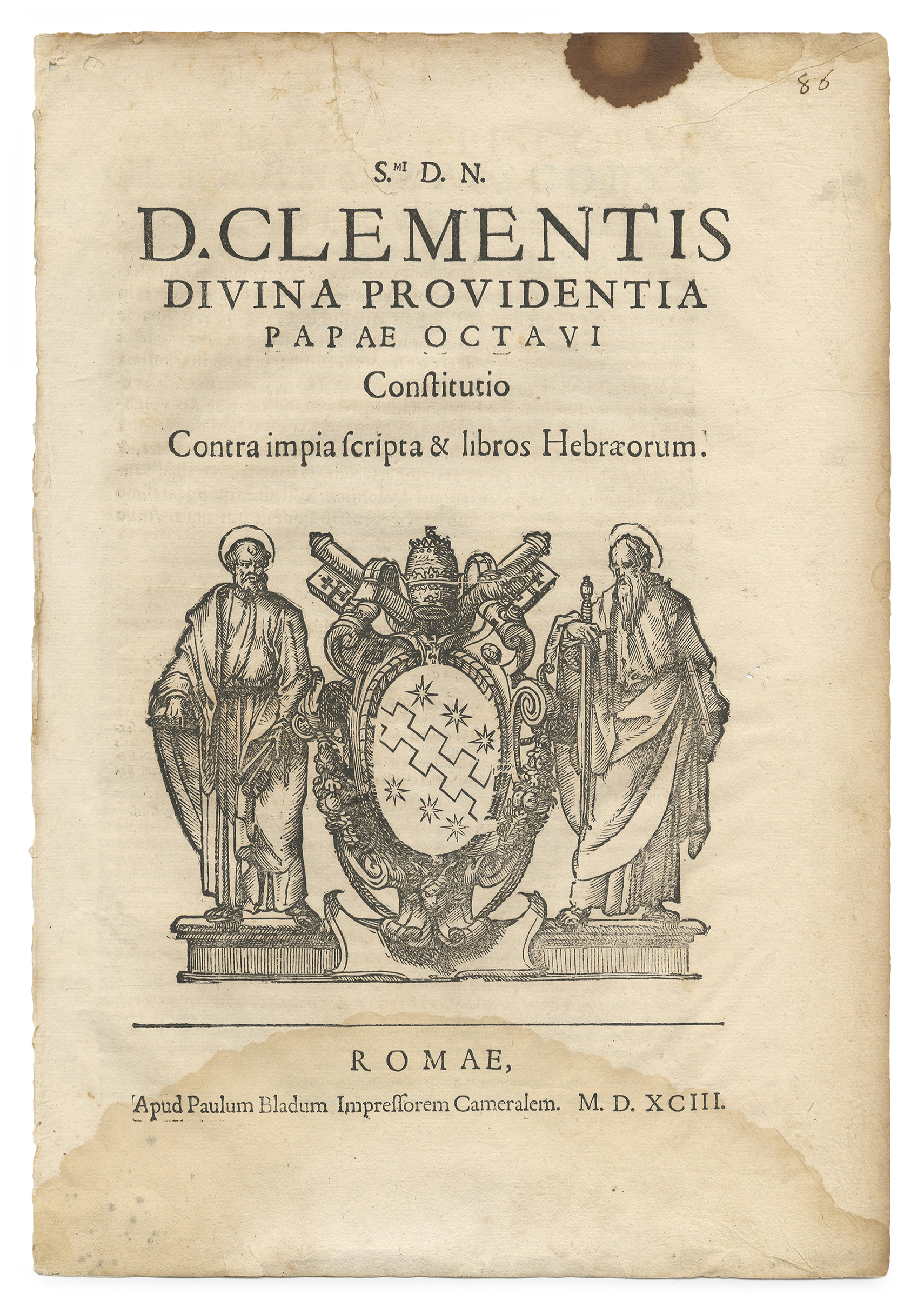
Printed papal bull: Cum Hebraeorum malitia, by Pope Clement VIII (1592-1605). Rome: Paolo Blado, 28 February 1593. Latin.
The bull reinstates and harshens the anti-Jewish decrees against the Talmud and kabbalistic literature, abrogating all leniencies and permissions given to the Jews by previous popes. It bases itself on a long line of earlier decrees levied by popes since the Middle Ages, and extends them further.
The bull absolutely prohibits the Jews to own, read or distribute the Talmud, kabbalistic writings or any book that contains explicit or implicit "affronts, impieties and blasphemies" against G-d, Christianity and the Church. It moreover forbids even books that have already been censored and purged of offensive material, or books reprinted with Church approval. The bull expands the prohibition to include printers – both Jewish and Christian – who are prohibited from printing, scribing, copying or trading in these books.
The bull mandates that the Jews of Rome most provide the Inquisition with all the forbidden books within ten days; the rest of the Jews in the Papal States were commanded to do so within two months. These books were to be burned publicly with no delay. Church authorities are instructed to diligently search for forbidden books in synagogues, community institutions, private homes and Christian bookshops, threatening strict punishment for anyone caught with these books in their possession.
This bull is regarded as one of the harshest prohibitions levied by the Church against the Talmud and kabbalistic literature, as it effectively annulled all permissions and leniencies granted by previous popes, and indiscriminately forbade books that had been censored or received official approval. This calamity followed yet another blow no less serious: a mere three days earlier (25 February 1593), the bull Caeca et Obdurata Hebraeorum perfidia had decreed that all the Jews were to be expelled from the Papal States, apart from the cities Rome, Ancona and Avignon (see previous lot).
[1] folded leaf (3 printed pages). 32.5 cm. Fair condition. Stains, including dampstains and dark stains. Creases and wear. Marginal tear to first leaf.
See: Attilio Milano, Il ghetto di Roma, Rome: Staderini, 1964, p. 83.
Rare. Not recorded in NLI catalogue.
Category
Royal Edicts, Anti-Jewish Ordinances and Laws, and Antisemitic Publications
Catalogue Value
![Der gantz jüdisch Glaub [The Complete Jewish Faith], by Anton Margaritha. Augsburg: Heinrich Steyner, 1530. First edit](https://files.kedem-auctions.com/files/Sale107/89_1.jpg "The Complete Jewish Faith – Anti-Semitic Work by Apostate Anton Margar")
![Der gantz jüdisch Glaub [The Complete Jewish Faith], by Anton Margaritha. Augsburg: Heinrich Steyner, 1530. First edit](https://files.kedem-auctions.com/files/Sale107/89_2.jpg "The Complete Jewish Faith – Anti-Semitic Work by Apostate Anton Margar")
![Der gantz jüdisch Glaub [The Complete Jewish Faith], by Anton Margaritha. Augsburg: Heinrich Steyner, 1530. First edit](https://files.kedem-auctions.com/files/Sale107/89_3.jpg "The Complete Jewish Faith – Anti-Semitic Work by Apostate Anton Margar")
![Der gantz jüdisch Glaub [The Complete Jewish Faith], by Anton Margaritha. Augsburg: Heinrich Steyner, 1530. First edit](https://files.kedem-auctions.com/files/Sale107/89_4.jpg "The Complete Jewish Faith – Anti-Semitic Work by Apostate Anton Margar")
![Der gantz jüdisch Glaub [The Complete Jewish Faith], by Anton Margaritha. Augsburg: Heinrich Steyner, 1530. First edit](https://files.kedem-auctions.com/files/Sale107/89_6.jpg "The Complete Jewish Faith – Anti-Semitic Work by Apostate Anton Margar")
![Der gantz jüdisch Glaub [The Complete Jewish Faith], by Anton Margaritha. Augsburg: Heinrich Steyner, 1530. First edit](https://files.kedem-auctions.com/files/Sale107/89_7-WEB.jpg "The Complete Jewish Faith – Anti-Semitic Work by Apostate Anton Margar")


Auction 107: Rare and Important Items
Apr 15, 2026
Opening: $2,000
Estimate: $4,000 - $6,000
Sold for: $4,000
Including buyer's premium
Der gantz jüdisch Glaub [The Complete Jewish Faith], by Anton Margaritha. Augsburg: Heinrich Steyner, 1530. First edition. Second printing (7 April 1530); printing details from colophon. German (and some Hebrew).
Polemical anti-Semitic work by apostate Anton Margaritha (1492-1542), scion of a famous German rabbinic family – son of R. Shmuel Margaliot Rabbi of Regensburg, and grandson of R. Yaakov Margaliot Rabbi of Nuremberg.
Several woodcuts incorporated in text, including woodcuts depicting Jews at the synagogue (after Johannes Pfefferkorn, Ich heyß ain büchlein der juden peicht [Augsburg 1508]).
This work, which claims to expose the true face of Judaism, mocks Jewish customs and makes serious accusations against the Jews. Among other things, Margaritha warns his Christian readers against having contact and trading with Jews, cautions them not to consult with Jewish physicians and negatively portrays the custom of using a "Sabbath Gentile". One of the harshest accusations in the work challenges Jewish political allegiance, painting them as traitors and supporters of enemy nations, foremost among them the Ottoman Empire. This work deeply affected Martin Luther, who was inspired by it to write his book "On the Jews and Their Lies".
Alongside its wide-ranging influence on early modern anti-Semitism, the work is also considered an important source for daily life and customs of contemporary Jews. This work includes the first translation of the Jewish prayer service for a non-Jewish readership (see: Daniel Lehmann, Bein Yahadut LeNatzru(yo)t, Bein Ethnografiya LePulmus).
As a result of the grim accusations against the Jews made in his book, Margaritha was invited to a public debate, conducted in 1530 before an imperial committee that convened in the Reichstag of Augsburg in the presence of Emperor Karl V. Margaritha's opponent in this debate was the well-known Jewish activist R. Yosef son of Gershon of Rosheim (Joseph Loans). After Margaritha's claims against the Jews were refuted, Margaritha was banished from Augsburg.
Early ownership inscription at top of title page (of Saint Peter's Abbey, Salzburg, Austria). Numerous references, notations and glosses in early handwriting to many margins and interior of binding.
[183] pages (gatherings: A-Z4). 19.5 cm. Good-fair condition. Stains. Light wear. Light worming to margins of last leaves. Small marginal open tears to some leaves (without loss). Loose and partially detached gatherings. Early wood and leather binding, somewhat rubbed and worn; open tears to spine; leather and brass clasp.
Category
Royal Edicts, Anti-Jewish Ordinances and Laws, and Antisemitic Publications
Catalogue Value
Auction 107: Rare and Important Items
Apr 15, 2026
Opening: $4,000
Estimate: $8,000 - $12,000
Sold for: $10,625
Including buyer's premium
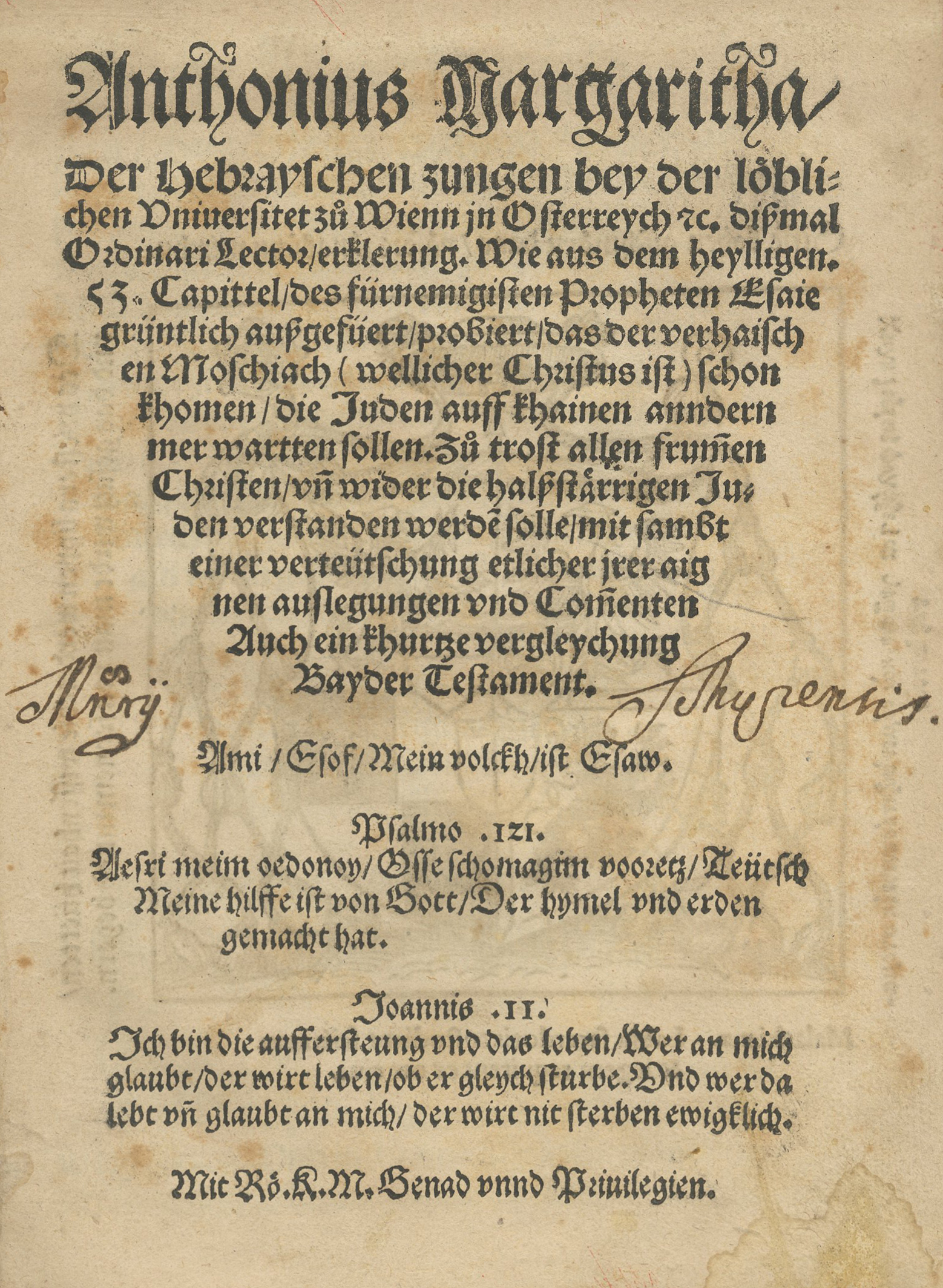
Erklerung wie aus dem heylligen 53 Capittel... Esaie… der verhaischen Moschiach... schon khomen, die Juden auff khainen anndern mer wartten sollen…, by Anton Margaritha. Vienna: Joannem Singrenium, 1534 (printing details from colophon). German (incorporating Latin and transliterated Hebrew).
First and only edition of a sharp polemical work by Jewish apostate Anton Margaritha (1492-1542), scion of a famous German rabbinic family – son of R. Shmuel Margaliot Rabbi of Regensburg, and grandson of R. Yaakov Margaliot Rabbi of Nuremberg.
The work focuses on Yeshayahu chapter 53, by means of which the author attempts to demonstrate the truth of Christianity. Margaritha quotes leading commentators with German translation – including Rashi, Ibn Ezra and Radak – accusing them of distorting the original meaning of Scripture. The work, as Margaritha declares on the title page, is meant to "for the consolation of all pious Christians against the stubborn Jews".
In the author's dedication and introduction at the beginning of the book, Margaritha recounts his personal life. He mentions his father, R. Shmuel Margaliot, describing the pressures and material temptations he was offered in an attempt to return him to Judaism. He further recounts how after his conversion to Christianity the Jewish community attempted to take advantage of his financial straits, offering him large sums to return to Judaism. Among other things, he also describes theological debates he held with his former coreligionists.
On the verso of the title page is a large coat of arms of Prince-Elector Albrecht von Brandenburg of Mainz (1490-1545). On p. [4b] are printed four small woodcuts depicting the trial, crucifixion and burial of Jesus. Decorated initial panels at beginning of some chapters.
The work was published during Margaritha's tenure as Professor of Hebrew at the University of Vienna, a few years before he published his infamous Complete Jewish Faith (Augsburg, 1530; see previous lot), attacking Jewish prayer rites and customs. As a result of the grim accusations against the Jews made in his book, Margaritha was invited to a public debate, conducted in 1530 before an imperial committee that convened in the Reichstag of Augsburg in the presence of Emperor Karl V. Margaritha's opponent in this debate was the well-known Jewish activist R. Yosef son of Gershon of Rosheim (Joseph Loans). After Margaritha's claims against the Jews were refuted, Margaritha was banished from Augsburg. Even after his banishment, Margaritha continued to publish anti-Jewish works, using the Jewish education he had gained growing up to attack Judaism.
[4], CXVIII (118) leaves. 18.5 cm. Good condition. Light stains (mainly to first leaves). Early signature on title page. Marginal handwritten inscriptions to some leaves. First gatherings loose. Old cardboard binding, somewhat rubbed and worn.
Rare. Few copies are recorded in OCLC (the book was last sold at auction by Maggs Bros., London, 1922, p. 33, no. [41a]).
Provenance: Collection of Dr. Felix Guggenheim: Mark Funke, The Rare Book Collection of Dr. Felix Guggenheim, Fifty Highlights from a Lifetime of Collecting and Publishing, Presented in Two Parts: Judaica & Germanistic [Mill Valley, California], 2025, p. 27.
Category
Royal Edicts, Anti-Jewish Ordinances and Laws, and Antisemitic Publications
Catalogue Value


Auction 107: Rare and Important Items
Apr 15, 2026
Opening: $1,000
Estimate: $2,000 - $4,000
Sold for: $13,750
Including buyer's premium
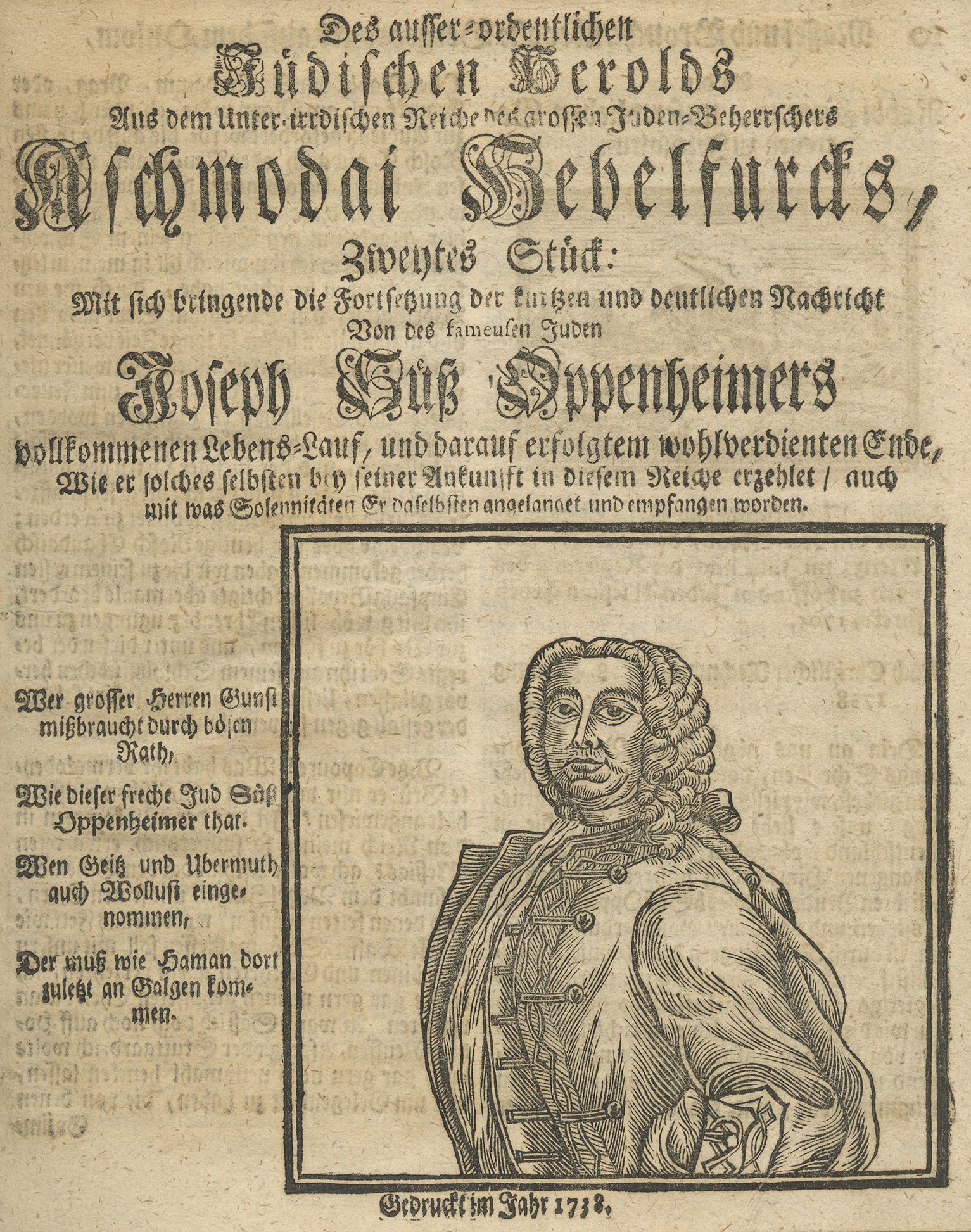
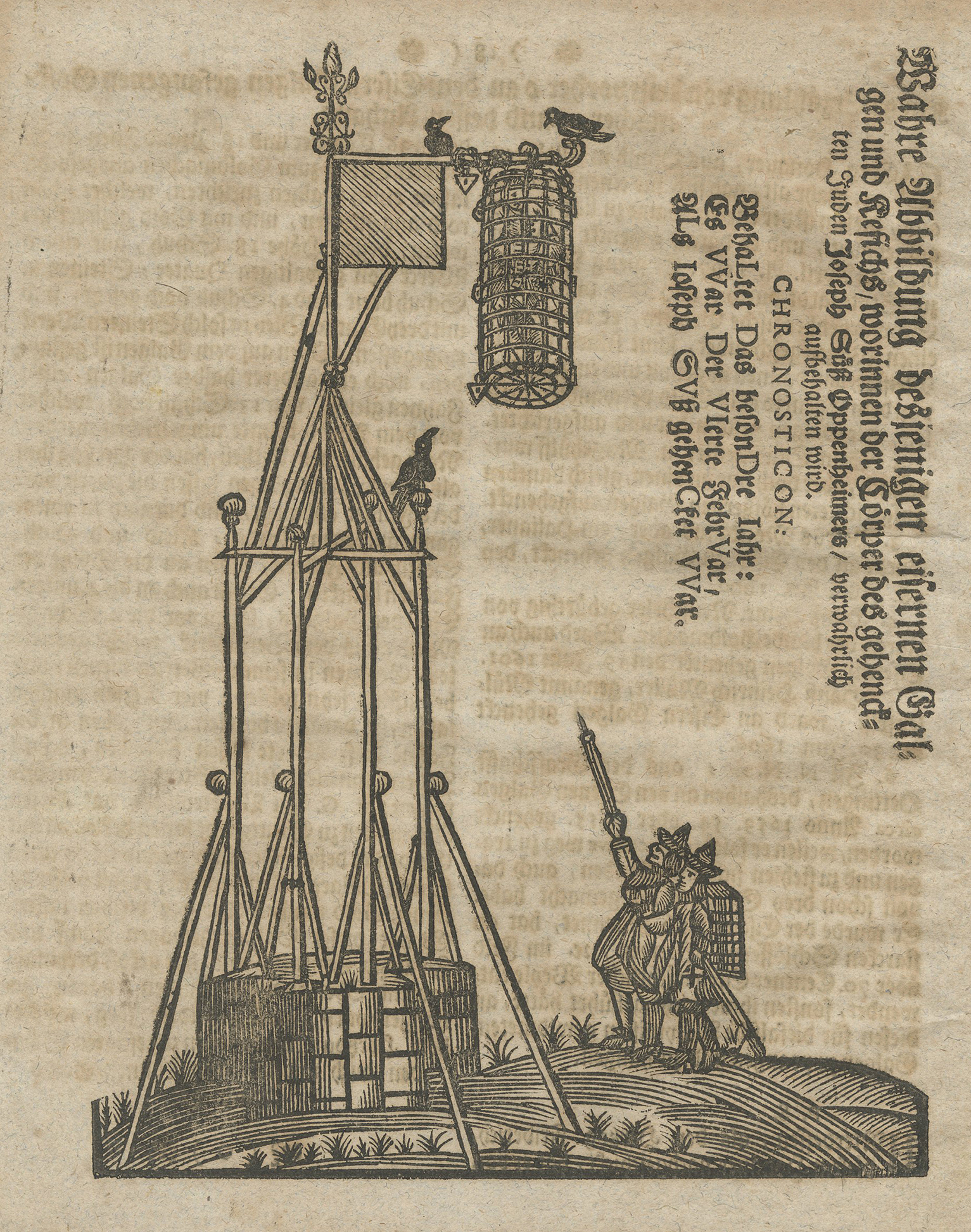
Collection of anti-Semitic publications relating to the life and figure of Joseph Süss (Ziskind) Oppenheimer, banker and financial adviser to Duke Charles Alexander of Württemberg, known disparagingly as Süss the Jew, and executed on false charges:
1. Volume comprising three works:
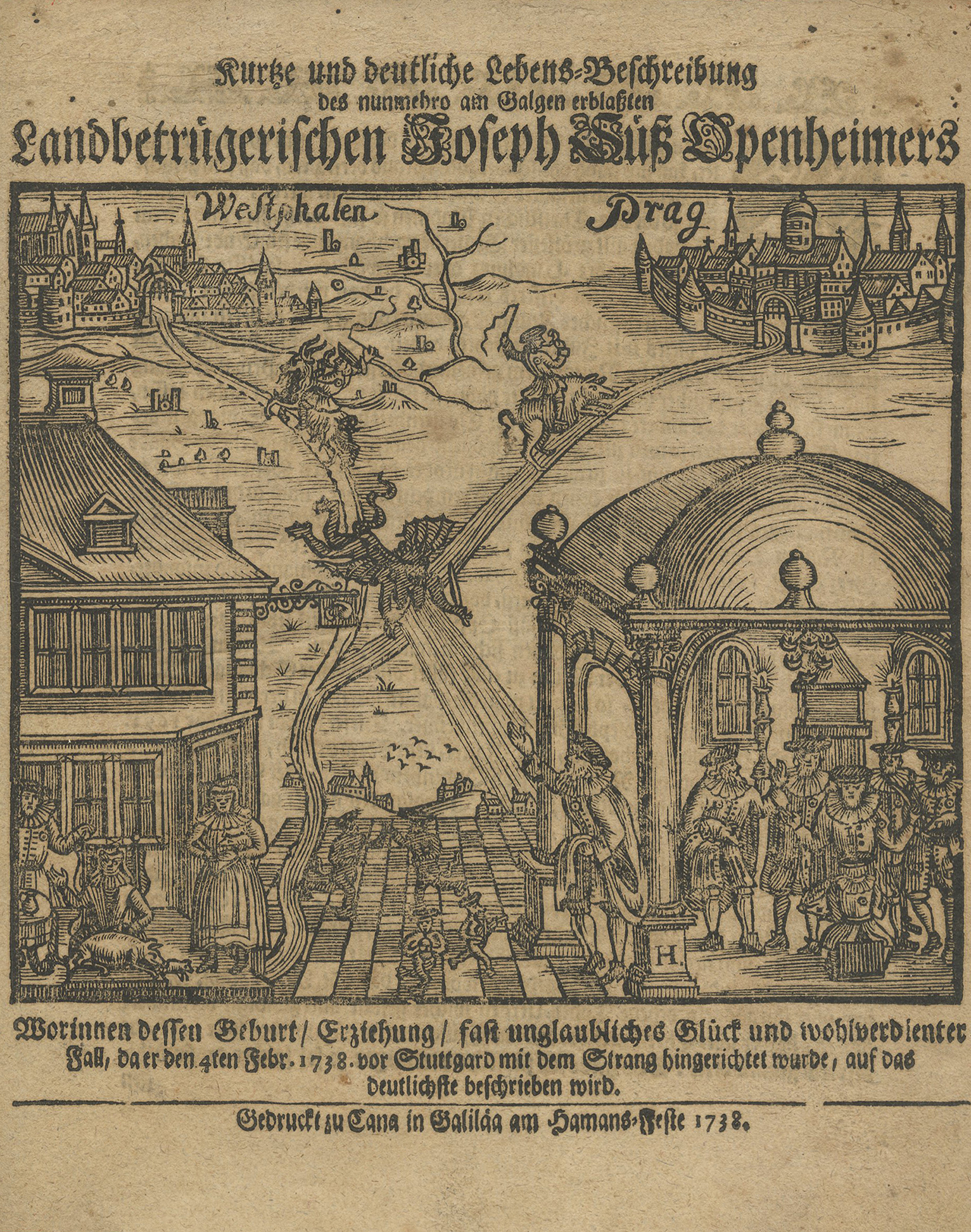
• Kurtze und deutliche Lebens-Beschreibung des nunmehro am Galgen erblaßten Landbetrügerischen Joseph Süß Openheimers… [by Johann Zacharias Gleichman], 1738.
Short biography of Joseph Oppenheimer, "Süss the Jew". The title page features a woodcut brimming with anti-Semitic imagery, depicting chief stations in Oppenheimer's life.
False imprint on title page: "Cana in Galiläa" (Cana in Galilee; perhaps published by Monath, Nuremberg).
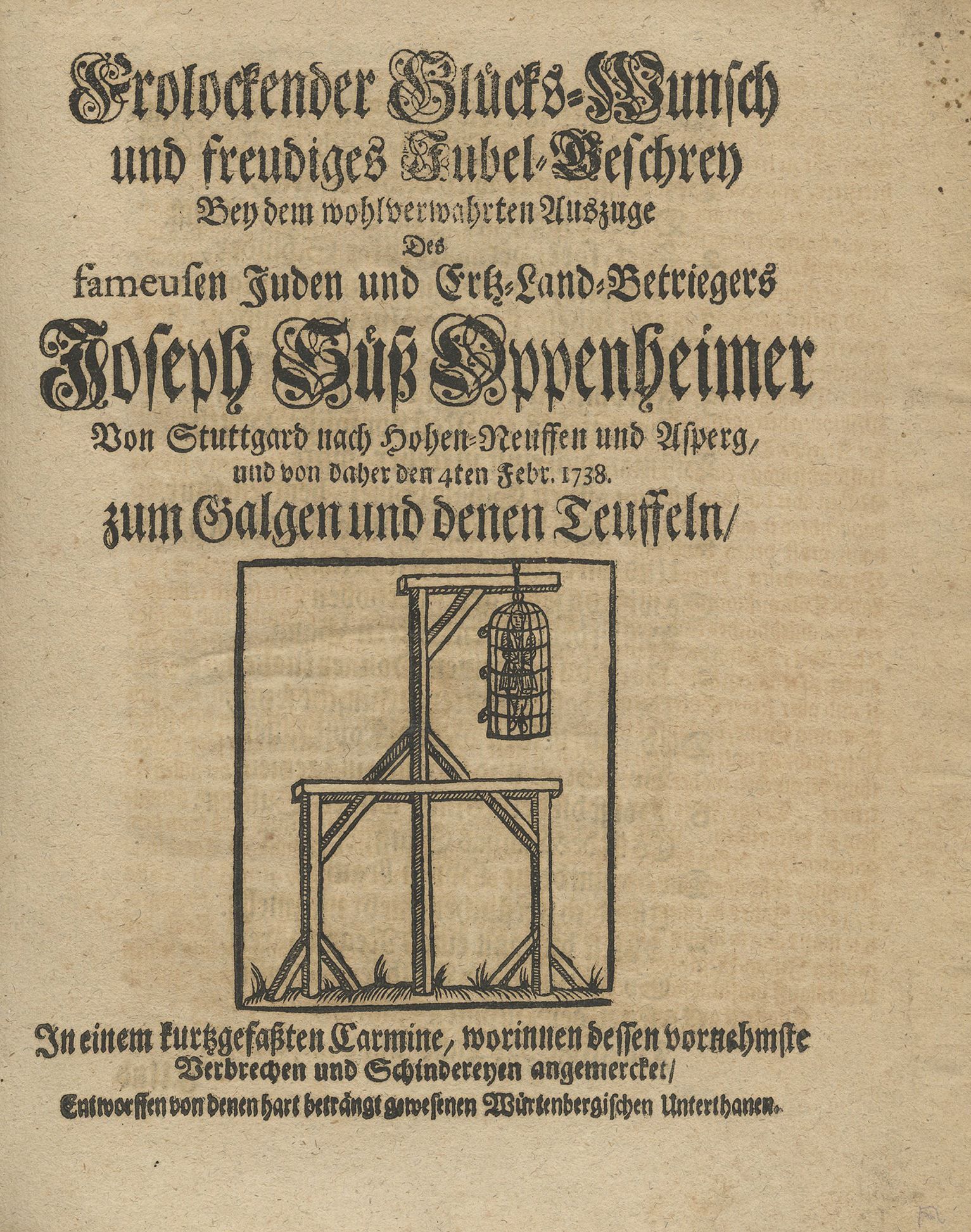
• Frolockender Glücks-Wunsch und freudiges Jubel-Geschrey bey dem wohl-verwahrten Auszuge des fameusen Juden und Ertz-Land-Betrügers Süß Oppenheimers, von Stuttgard nach Hohen-Neiffen, und von daher zum Galgen und denen Teuffeln... Author, printer and location not indicated [1738].
Three-page poem celebrating the fall of Süss the Jew; the title page features a woodcut depicting a famous scene identified with the occasion: the corpse of Süss the Jew after his execution, displayed in a cage.
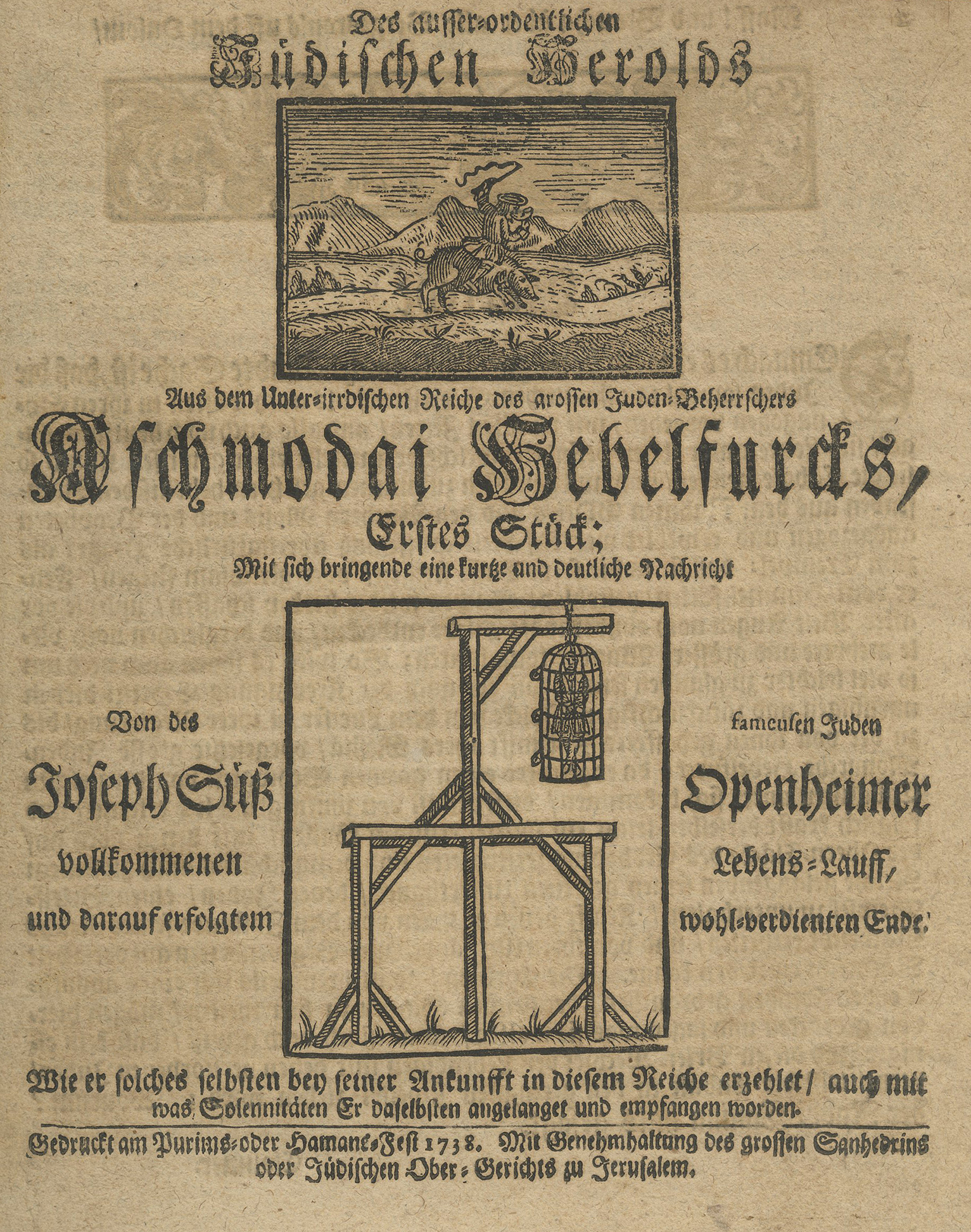
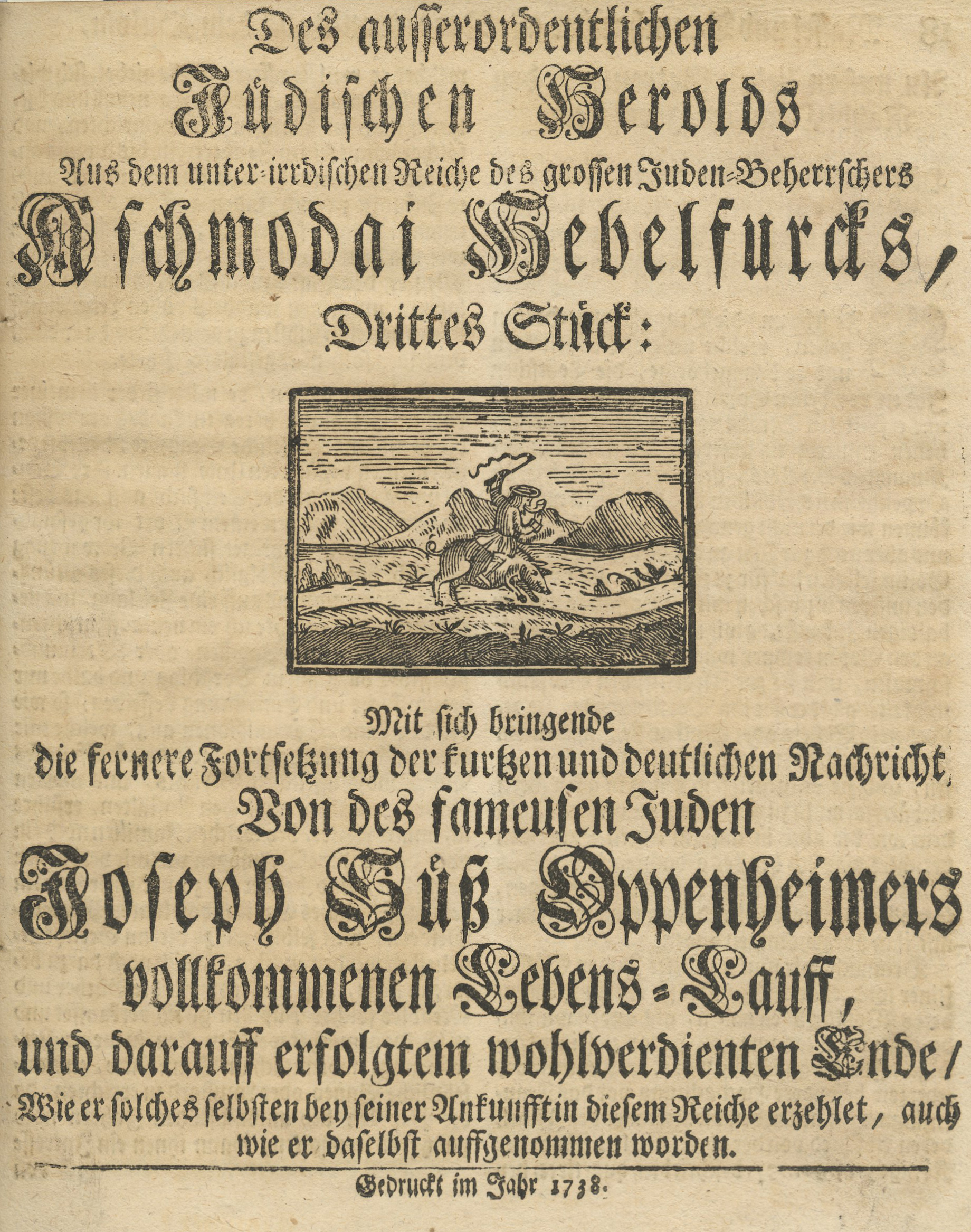
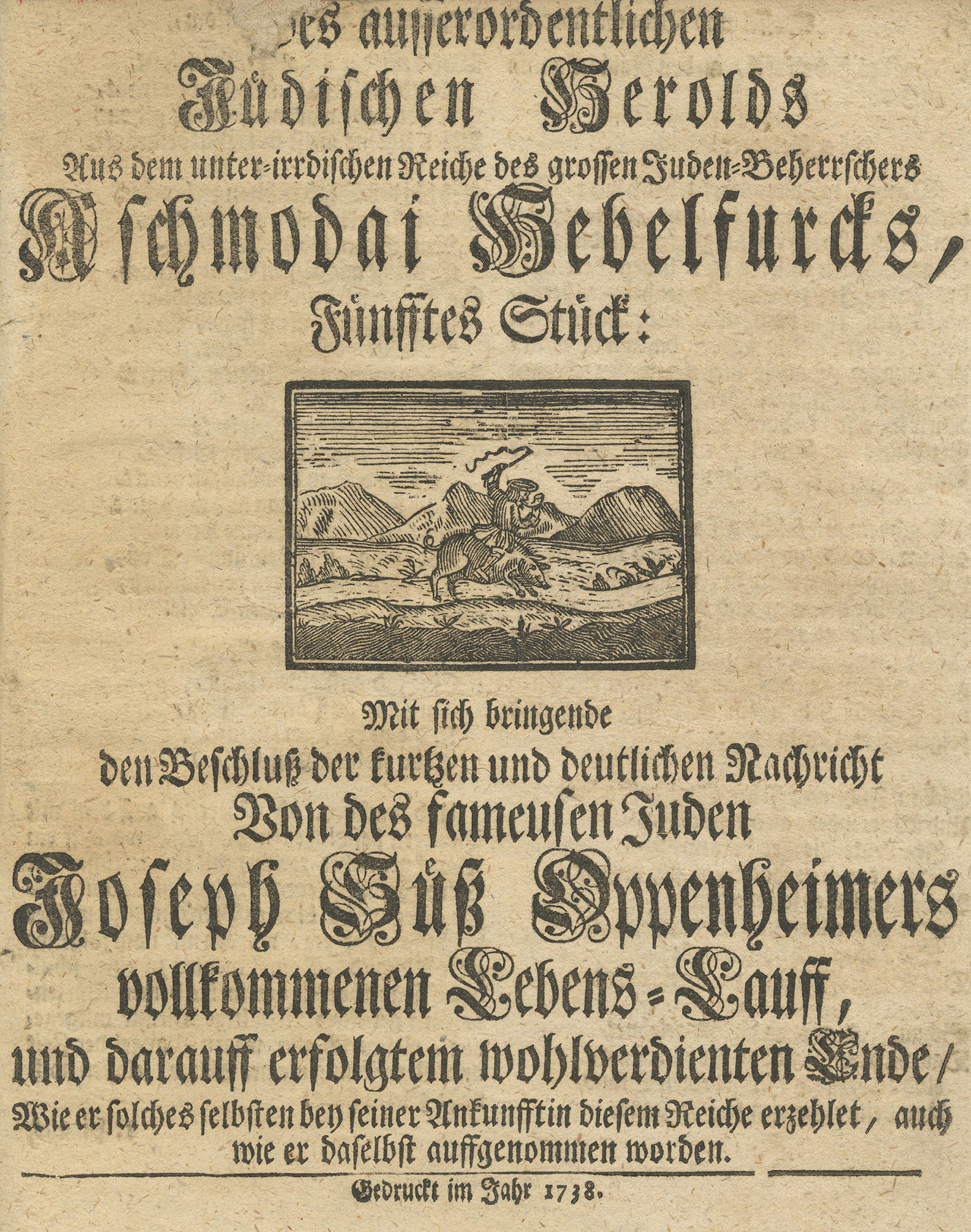
• Des ausser-ordentlichen jüdischen Herolds aus dem unter-irrdischen Reiche des grossen Juden-Beherrschers Aschmodai Hebelfurcks... Author not indicated. Frankfurt: Philipp Jacob Rudolph, 1738 (printing details on last page). Five parts, with divisional title pages (rare, only first part documented by Freimann).
The story of the rise and fall of Süss the Jew. Woodcuts on title pages, including portrait of Süss the Jew.
False imprint on title page: "Gedruckt am Purims- oder Hammansfest 1738. Mit Benehmhaltung des grossen Sanhedrins oder Jüdischen Ober-Gerichts zu Jerusalem" [Printed on Purim or Haman festival 1738. In the name of the Great Sanhedrin, or the Jewish high court in Jerusalem].
Three works in one volume. [4], [4], 36 pages. 20.5 cm. Good condition. Light stains. Creases and minute tears. Close trimming, bordering text. Binding worn and rubbed. Tears to spine. Spine partially repaired with paper.
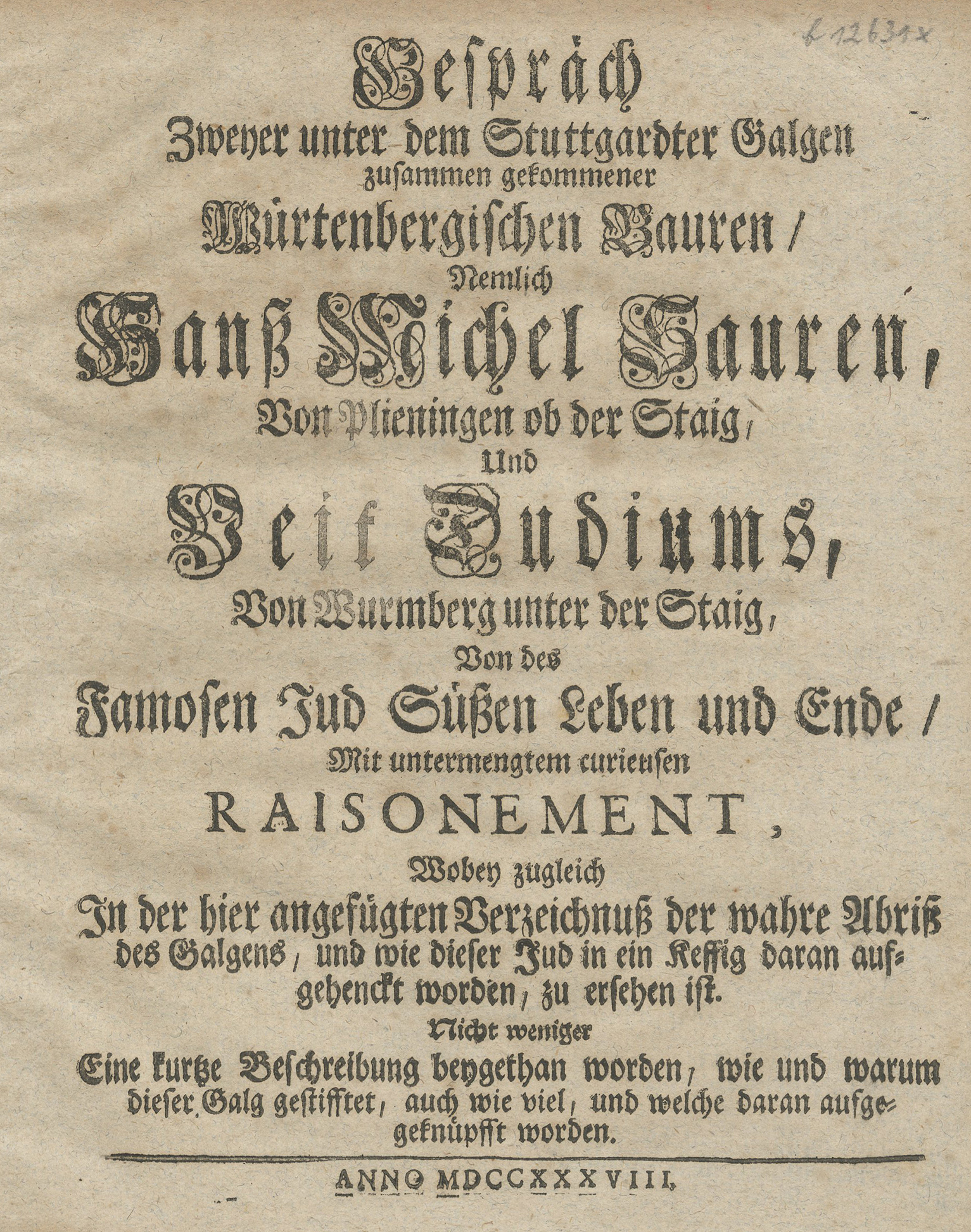
2. Additional work in a separate volume: Gespräch zweyer unter dem Stuttgardter Galgen zusammen gekommener Würtembergischen Bauren... von des famosen Jud Süssen Leben und Ende... Author, printer and location not indicated, 1738.
The volume begins with an imagined dialogue between peasants of Württemberg standing under the iron cage that displayed the remains of Süss the Jew. Over the course of their discussion, the story of the rise and fall of Süss, ending with his violent end, comes to light. The text appears in both dialectal and standard German, in facing columns. The rest of the volume contains a number of poems, including a eulogy for Süss the Jew spoken by the ravens standing on his cage, Süss's last words, and a full-page woodcut depicting Süss in his cage.
[2], 18, [1] pages. 20.5 cm. Good condition. Professionally restored leaves. Close trimming, bordering text (minutely affecting text on p. 16). Wear and rubbing to binding.
See:
• Aaron Freimann, Bibliographie der Flugschriften über Joseph Süss Oppenheimer, in: Freimann and Brody, Zeitschrift für Hebraeische Bibliography, IX. Frankfurt: J. Kauffmann, 1905, pp. 80-81.
• Theodor Harburger, Die Judaica-Sammlung S. Kirschstein, Berlin Kultgeräte für Haus und Synagoge, Manuskripte, Gemälde, Miniaturen, Graphik, Urkunden, Bücher; 12. bis 14. Juli 1932. Munich: Helbing, 1932, p. 37, no. 674.
Joseph Süss Oppenheimer (1698-1738), a court Jew known as "Jew Süss", who served as banker and financial advisor to Duke Charles Alexander of Württemberg. After the Duke's sudden death, Oppenheimer was tried for treason, abuse of authority for personal gain, reckless personal use of state funds and ties with Christian women. Oppenheimer was hanged, and his corpse was left hanging in a locked cage for six years. This cage appears in many of the prints.
Category
Royal Edicts, Anti-Jewish Ordinances and Laws, and Antisemitic Publications
Catalogue Value


Auction 107: Rare and Important Items
Apr 15, 2026
Opening: $10,000
Estimate: $15,000 - $25,000
Sold for: $12,500
Including buyer's premium
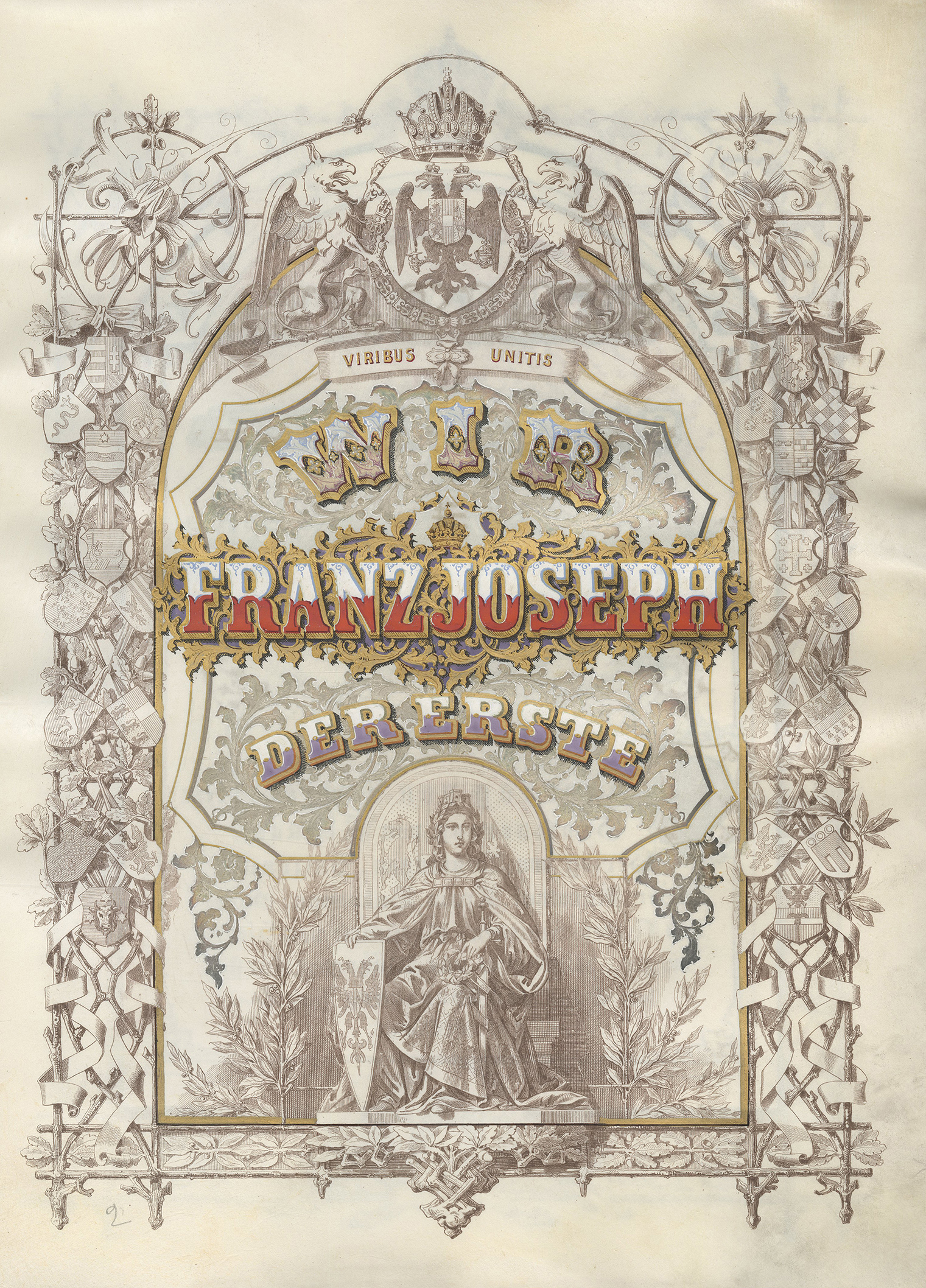
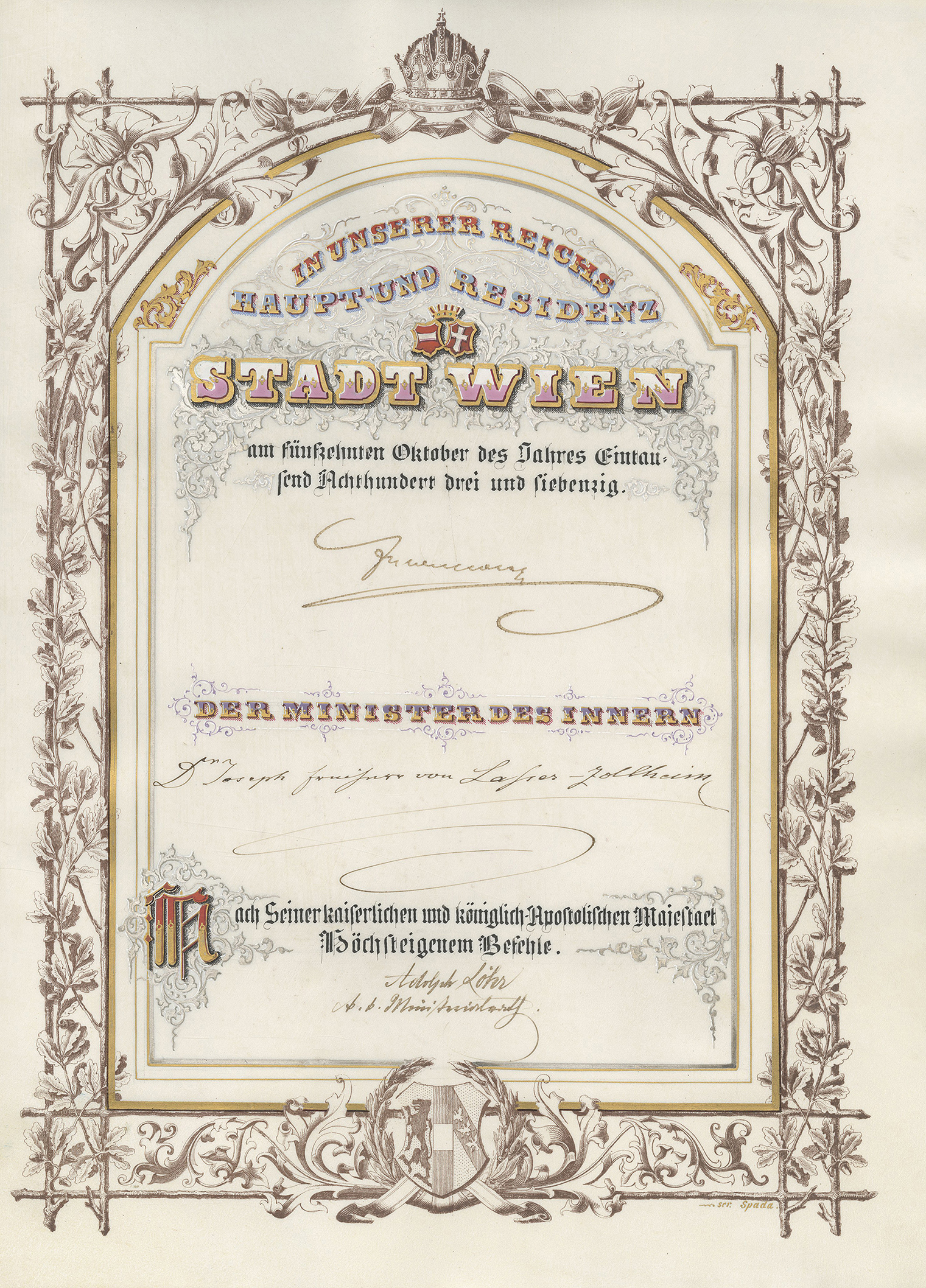
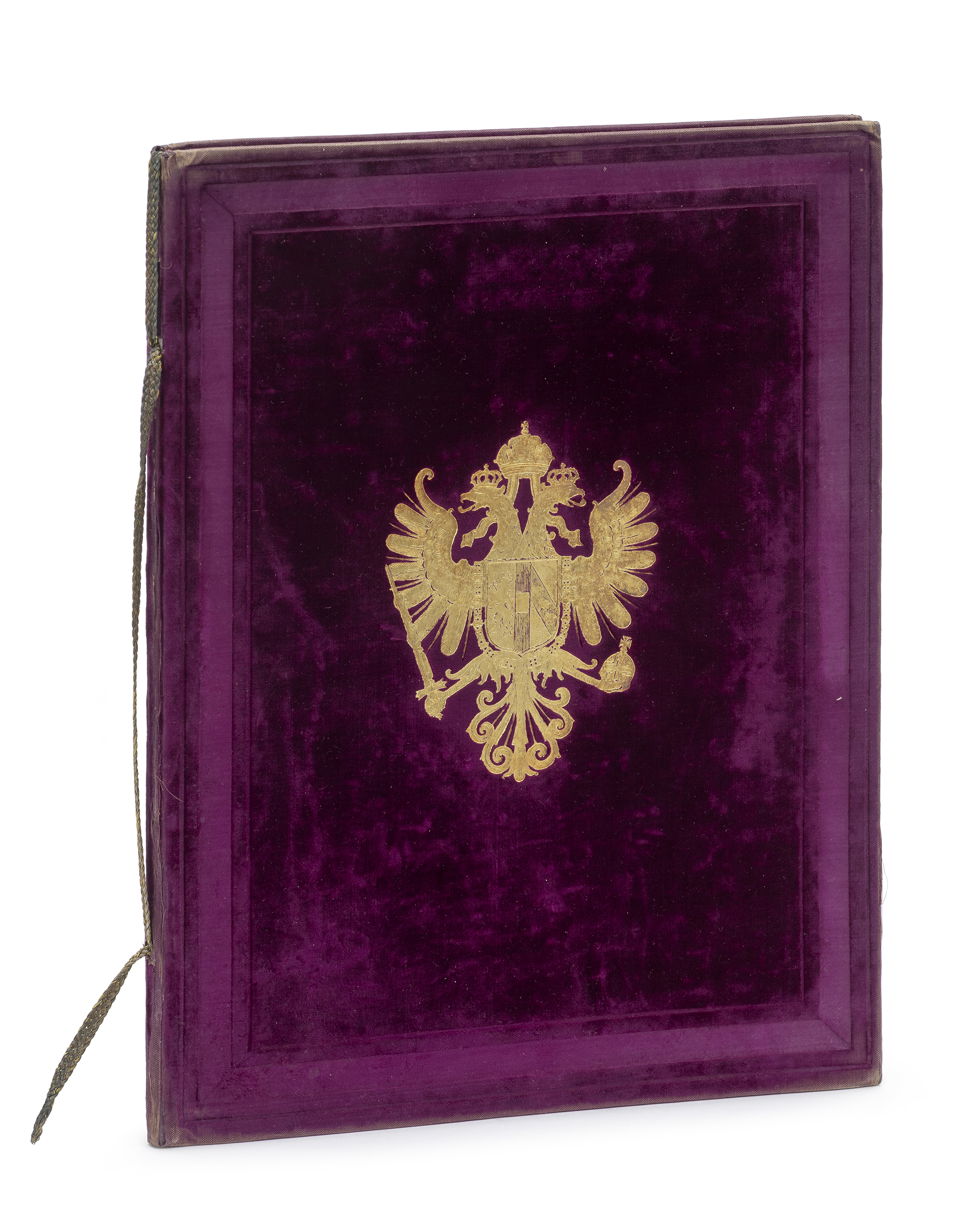
Elaborate patent of nobility, written in calligraphy on decorated parchment leaves and placed in an elegant velvet binding. The certificate was granted to the banker Jacob Levi de Menasce of Alexandria, and is signed by Emperor Franz Joseph I of the Austro-Hungarian Empire. Vienna, 15 October 1873. German and some Latin.
The document grants the title of Ritter (knight) to the banker Jacob Levi de Menasce of Alexandria, as well as the right to use a heraldic coat of arms. Next to the Emperor's signature, the certificate includes signatures of Baron Joseph Freiherr von Lasser-Zollheim, Austrian Minister of the Interior, and Adolph Löhr, ministerial adviser.
The certificate is written in fine calligraphy in black ink over four thick parchment leaves; initial letters, headers and important names are decorated in gilt ink and in red and blue. All leaves are framed in artistic engravings, decorated with vegetal patterns and symbols of the Austro-Hungarian Empire. The name of the calligrapher (Spada) appears at the edge of the last page.
Jacob Levi de Menasce (1809-1887), progenitor of the famous De Menasce banking dynasty. Born in Cairo, he began as a moneychanger. He gradually acquired great wealth, securing the position of personal banker to Isma'il Pasha, Khedive of Egypt. He founded the J. L. Menasce et Fils company and oversaw an international trade and shipping network, with branches in the financial capitals of Europe. He took part in funding some of Egypt's largest industrialization initiatives spanning half of the 19th century, serving as a key venue of trade between Austria-Hungary and the Levant. Alongside his manifold business dealings, de Menasce was a pillar of the Egyptian Jewish community and a leader of the community in Alexandria.
The present certificate documents the entrance of the Menasce family to the European nobility. In the patent, the Emperor notes that Jacob Levi Menasce is a highly meritorious man, with laudable achievements, having been awarded the Order of Franz Joseph, Order of the Iron Crown and the Ottoman Order of the Medjidie. Due to his merits and contributions to trade, he and all his legitimate descendants are granted the title of Knight, and the right to the name Jacob Levi Ritter von Menasce. Three years later, in 1876, Jacob Levi de Menasce was awarded the rank of Baron (Freiherr), and gained the aristocratic preposition "de" (de Menasce). His grandson was the famous Zionist leader Baron Felix de Menasce.
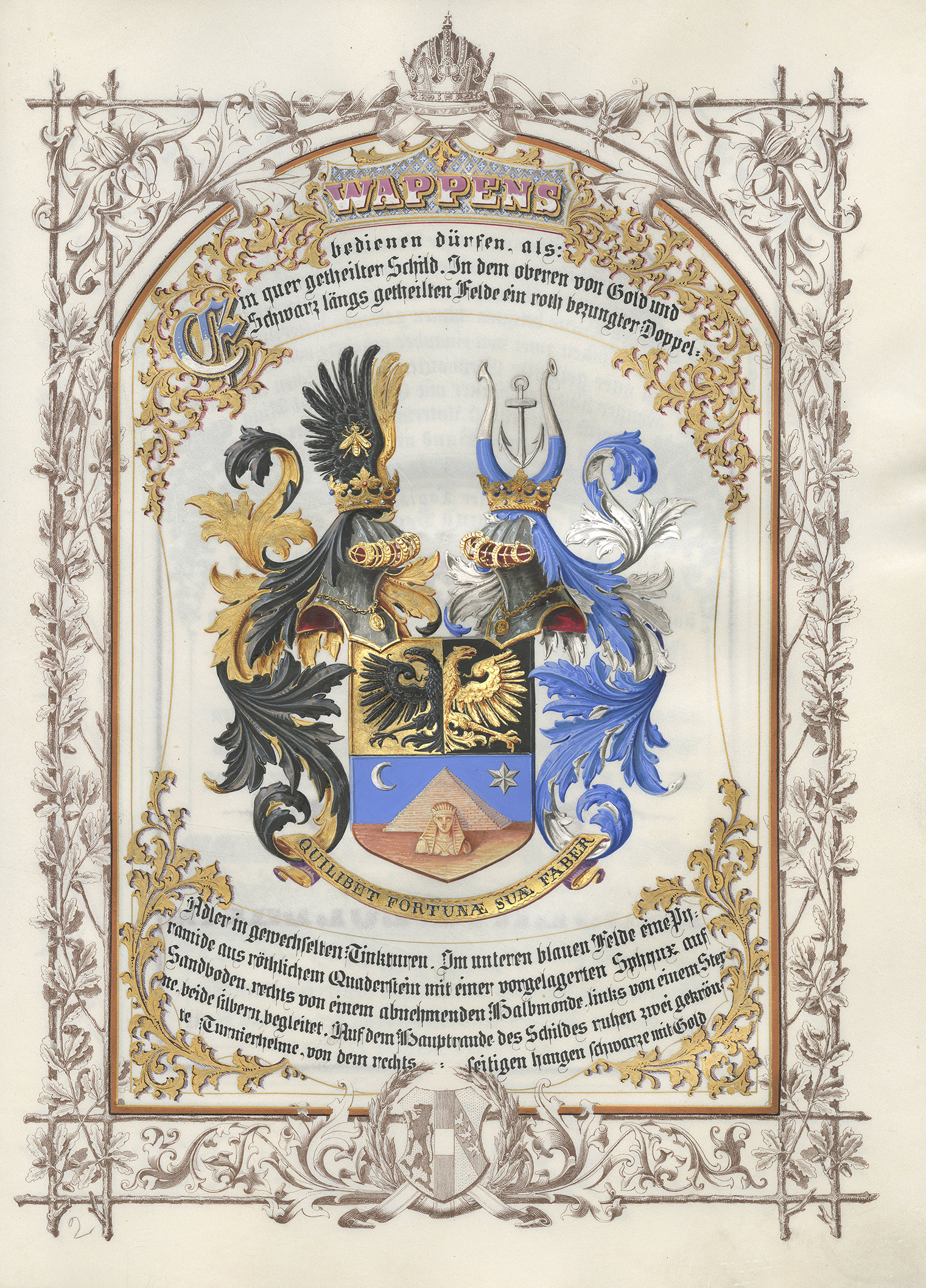
The document goes on with a high-quality full-page illustration of the family's new coat of arms, alongside a detailed and exact description of each element. The unique coat of arms incorporates Egyptian motifs with European heraldry: the center of the shield depicts the imperial two-headed Austrian eagle, below which is the sphinx crouching in front of a pyramid built of red stones, next to a half-crescent and star of silver (symbols of Islam and the Orient). The crest of the knights' helmets depicts a golden bee (a symbol of industry), an anchor (a symbol of maritime trade) and two elephant trunks (a motif highlighting the connection to Africa). At the bottom, the Menasce family motto is featured on a gilt ribbon: "Quilibet Fortunae Suae Faber" (each person is the maker of his fortune).
Original velvet binding in royal purple (the color of the Empire), decorated in the center with a large and impressive gilt decoration of the Austro-Hungarian coat of arms. Parchment leaves bound to spine with gold-colored lace.
[4] parchment leaves. Covered with endpapers. 36 cm. Good condition. Stains and creases. Marginal tears to some endpapers. Light wear to edges of binding and spine. Back of binding partially repaired.
Category
Royal Edicts, Anti-Jewish Ordinances and Laws, and Antisemitic Publications
Catalogue Value
![Cinq années de ma vie, 1894-1899 [Five Years of My Life], by Alfred Dreyfus. Paris: Librairie Charpentier et Fasque](https://files.kedem-auctions.com/files/Sale107/93_1.jpg "Alfred Dreyfus – Five Years of My Life – Paris, 1901 – Inscribed by th")
![Cinq années de ma vie, 1894-1899 [Five Years of My Life], by Alfred Dreyfus. Paris: Librairie Charpentier et Fasque](https://files.kedem-auctions.com/files/Sale107/93_2.jpg "Alfred Dreyfus – Five Years of My Life – Paris, 1901 – Inscribed by th")
![Cinq années de ma vie, 1894-1899 [Five Years of My Life], by Alfred Dreyfus. Paris: Librairie Charpentier et Fasque](https://files.kedem-auctions.com/files/Sale107/93_3-WEB.jpg "Alfred Dreyfus – Five Years of My Life – Paris, 1901 – Inscribed by th")
![Cinq années de ma vie, 1894-1899 [Five Years of My Life], by Alfred Dreyfus. Paris: Librairie Charpentier et Fasque](https://files.kedem-auctions.com/files/Sale107/93_4-WEB.jpg "Alfred Dreyfus – Five Years of My Life – Paris, 1901 – Inscribed by th")


Auction 107: Rare and Important Items
Apr 15, 2026
Opening: $5,000
Estimate: $8,000 - $12,000
Sold for: $11,250
Including buyer's premium
Cinq années de ma vie, 1894-1899 [Five Years of My Life], by Alfred Dreyfus. Paris: Librairie Charpentier et Fasquelle, 1901. French.
Memoirs of Alfred Dreyfus recounting his imprisonment in the penal colony of Devil’s Island, edited from his private diaries and published in 1901. On the margins of the first leaf is an autograph inscription by the author: "à Mr. Sletten, en souvenir sympathique, A. Dreyfus".
The present copy was apparently inscribed to Thorvald Sletten – a young Norwegian man accused of murdering his adoptive mother, convicted on scant evidence and sentenced to life imprisonment. Much like the Dreyfus Affair, Sletten’s incarceration provoked a public and press uproar in Norway; dozens of articles, books, pamphlets, and poems asserting his innocence were published by leading Norwegian writers, including Nobel laureate Bjørnstjerne Martinius Bjørnson. The case was frequently compared to Dreyfus’s conviction, and in 1900 a long poem titled Den norske Dreyfus (“The Norwegian Dreyfus”) was published, a sobriquet that thereafter adhered to Sletten (the poem appeared anonymously and is today attributed to Rudolf Muus). Following sustained public pressure and a prolonged campaign, Sletten was granted a pardon in 1907 and released after six years of imprisonment.
360 pages. Approx. 22.5 cm. Good condition. Light staining. Several unopened leaves. Binding with leather spine and gilt stamping over the original cover.
Category
The Dreyfus Affair
Catalogue Value
!["Réponse à M. G. Cavaignac, ministre de la guerre" [Reply to Mr. G. Cavaignac, Minister of War]. Pa](https://files.kedem-auctions.com/files/Sale107/94_1.jpg "\"Reply to Mr. G. Cavaignac, Minister of War\" – Poster of Dreyfus Suppo")
Auction 107: Rare and Important Items
Apr 15, 2026
Opening: $1,500
Estimate: $4,000 - $6,000
Sold for: Unsold
"Réponse à M. G. Cavaignac, ministre de la guerre" [Reply to Mr. G. Cavaignac, Minister of War]. Paris: Le Siècle, 1898. French.
Poster; a sharp condemnation of the arrest of French Major Georges Picquart, an investigator of the Dreyfus affair – after he publicized the forgery of the incriminating documents in the Dreyfus Affair (July 1898).
On the left column of the poster is a portion of a letter sent by Picquart to the Minister of War, Godefroy Cavaignac – claiming that the three primary documents used to incriminate Dreyfus were forged or falsified. Below the letter are printed two letters in which Dreyfus claims he is innocent – one shortly after the investigation, and the second after he was stripped of his rank (to counter claims that he had admitted his guilt), next to several other testimonies.
On the right side of the poster is a public appeal from the Human Rights League (Ligue des droits de l'Homme), protesting the arrest of Georges Picquart, the perversion of justice and violation of his rights: "…This officer had a duty of conscious to fulfill; he sacrificed his interest and career for it… It would be better to lend him an ear and hear his testimony, than to oppress him into silence!" (the public appeal is signed in print by members of the League – physicians, artists, statesmen and journalists, including the editor of L'Aurore – the newspaper that had published "J'Accuse" months earlier).
Approx. 80.5X61.5 cm. Good condition. Stains. Some creases. Holes and tears (mostly minor, some repaired with paint). Ink stamp on margins (revenue stamp). Poster mounted on linen fabric for display and preservation.
Category
The Dreyfus Affair
Catalogue Value


Auction 107: Rare and Important Items
Apr 15, 2026
Opening: $1,500
Estimate: $3,000 - $5,000
Sold for: $3,250
Including buyer's premium
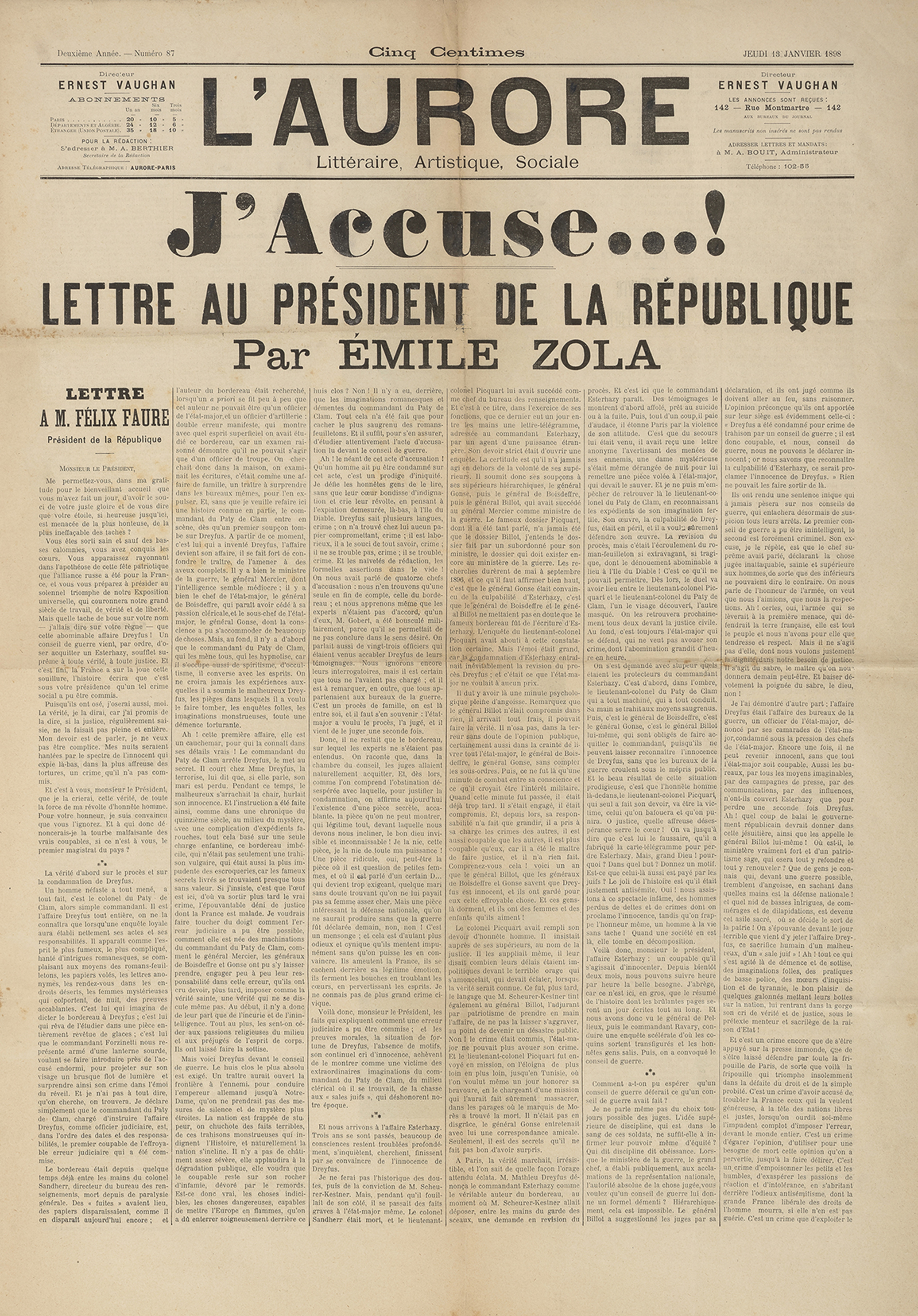
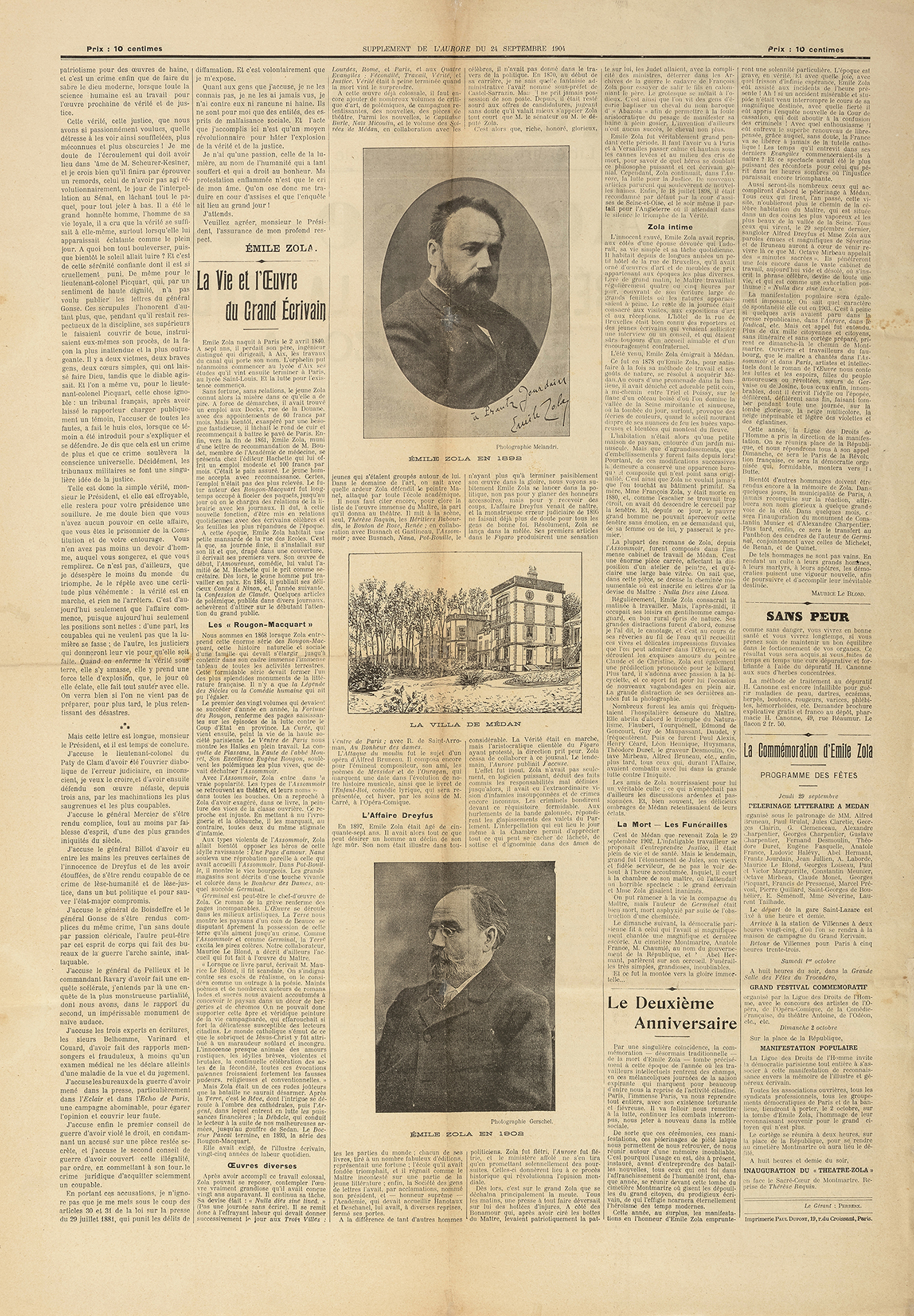
Official reproduction of "J'Accuse" (front page of issue 87, published 13 January 1898), in honor of the first anniversary of Émile Zola's death. Printed as an official supplement to L'Aurore (the original publisher). Paris, 24 September 1904. French.
Commemorative issue, with a reproduction of "J'Accuse" on one side, as it had appeared six years earlier (page reproduced in full, with original issue number and date). On the reverse side of the issue is a biography of Émile Zola, with two portraits and an illustration of his home.
The French writer and publicist Émile Zola (1840-1902) was a prominent supporter of Alfred Dreyfus when the latter was accused of treason and espionage for Germany in 1895. In 1897 he published a series of articles in support of Dreyfus; in January 1898 he published the article "J'Accuse" in the newspaper L'Aurore. This was an open letter to the president of France, in which he accused the heads of the military, the War Office and the military court of a travesty of justice. The letter's publication resonated throughout France. Zola was accused of libel, sentenced to a year's imprisonment and compelled to flee to England.
[2] pages, approx. 47X65 cm. Good condition. Folding marks. Some stains. Several tears and holes across central fold and margins (partially repaired).
Category
The Dreyfus Affair
Catalogue Value


Auction 107: Rare and Important Items
Apr 15, 2026
Opening: $3,000
Estimate: $5,000 - $8,000
Sold for: $15,000
Including buyer's premium
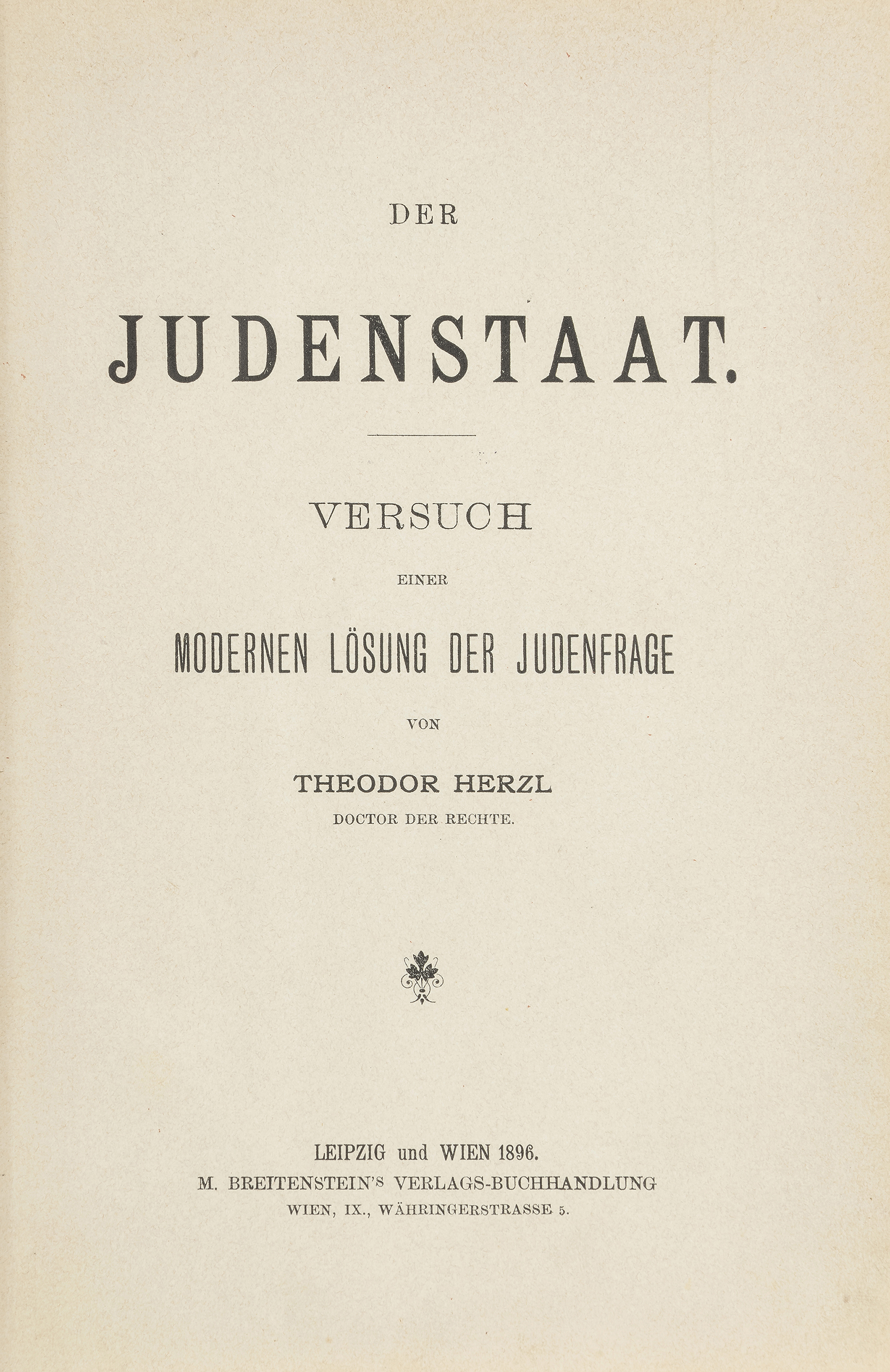
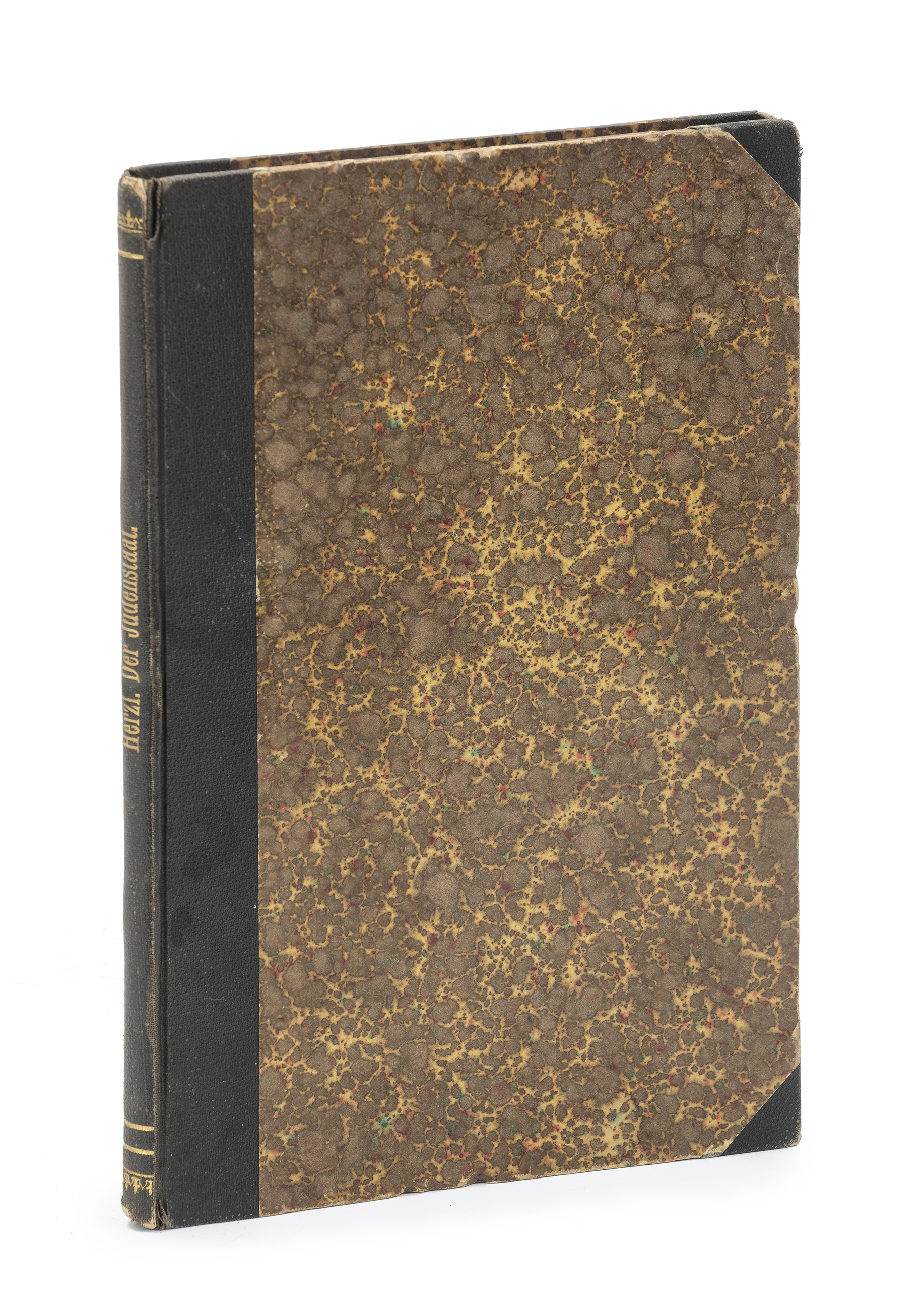
Der Judenstaat, Versuch einer modernen Lösung der Judenfrage [The Jewish State: An Attempt at a Modern Solution of the Jewish Question], by Theodor Herzl. Vienna-Leipzig: M. Breitenstein, 1896. German. First edition.
Herzl’s groundbreaking manifesto, in which he first set forth his vision for the establishment of a Jewish state.
86 pages. 23 cm. Good condition. Fine contemporary binding, with illustrated bookplate ("Dr. Max Weis"). Tear along spine.
Publication of Herzl's "Der Judenstaat"
The story behind "Der Judenstaat" – commonly translated as "The Jewish State" and widely regarded as the book that served as the founding statement of the Zionist movement – can be said to have begun with the "Speech to the Rothschilds", composed by Theodor (Binyamin Ze'ev) Herzl in time for his meeting with members of the Rothschild family in 1895. This speech, 22 pages in length, laid out the preliminary outline for what would eventually become Herzl's grand landmark plan. This outline would gradually undergo a number of incarnations and versions before it sufficiently matured into a full-fledged plan, whereupon Herzl decided to turn it into a complete book.
According to Herzl's own account, the book was written all at once, in two months of non-stop writing, "walking, standing, lying down, in the street, at the table, at night when I started up from sleep…". Once completed, the manuscript would, for the first time, present Herzl's grand vision in all its glory – a detailed plan for the establishment of a Jewish state, stage by stage, beginning with the gathering and organizing of the Jews of the world, up until the enactment of a legal constitution and the adoption of a national flag. Regarding his thoughts and feelings at the time of the writing, Herzl said: "I do not recollect ever having written anything in such an elevated frame of mind as that book. [Heinrich] Heine says that he heard the wings of an eagle beating over his head while writing certain verses. I do believe that something also beat its wings above my head while I was writing that book". Initially, no book publisher was willing to publish the book. Herzl found himself rejected by all his regular publishing companies, such as Duncker & Humblot, as well as the Berlin-based publisher Siegfried Cronbach, who insisted that anti-Semitism was a waning force throughout the world. In the end, Herzl turned to Max Breitenstein, a small bookseller in Vienna who agreed to print the book even though he did not share Herzl's beliefs, nor was he sympathetic to the Zionist cause.
In February 1896, a small edition of "Der Judenstaat" was finally published in German with the subtitle "An Attempt at a Modern Solution to the Jewish Question". In order to ensure the work would be treated with the seriousness he felt it deserved, Herzl added his academic degree – Doctor of Laws – to the authorship of the book.
Immediately upon publication, the book stirred up a maelstrom. A majority of public figures – Jewish and non-Jewish alike – viewed it as nonsensical and absurd; one particular Jewish newspaper editor even offered the use of his personal carriage to transport Herzl to an insane asylum. Among the book's initial opponents were such unlikely personalities as Hayim Nahman Bialik and Nahum Sokolow, the pioneer of Hebrew journalism who would one day become author of the first Hebrew translation of Herzl's "Altneuland". In the words of author Stefan Zweig, "never in Vienna had anyone been subjected to such ridicule as Herzl".
As agreed in advance, Max Breitenstein published three additional editions (distinguished from the original edition only in minute details on the respective covers and title pages) that same year. He published no subsequent editions of "Der Judenstaat".
Notwithstanding the scathing reactions of public figures and noted academics to "Der Judenstaat" the book succeeded in igniting the imaginations of a great many readers in Europe and around the world, and new editions – in Yiddish, Russian, English, and other languages – appeared not long after the publication of the original German editions. One of the earliest editions to see the light of day was the Hebrew translation by Herzl's personal secretary, Michael Berkowitz. It was published by Tushiah in 1896, the same year as the first German edition. In its introduction, Berkowitz brought attention to two "corrections" that Herzl insisted upon in oral communications with him, and wrote the following (in Hebrew): "I hereby testify to two issues that relate in particular to the Hebrew translation… In the chapter [entitled] 'Language of the Land'… after he was made aware that a Hebrew-speaking readership exists for this book… a changed spirit took hold of him, as he was ensured that the Hebrew language could surely be rejuvenated… As to the place of settlement… he [likewise] changed his mind… and addressed his attention exclusively to the Land of our Forefathers".
In subsequent years, with the burgeoning of the Zionist movement and the convening of the early Zionist Congresses, the book came to be translated in yet more languages, and began to appear overseas, particularly in the United States, where Zionism quickly developed into a movement that carried weight and influence. In sum total, during Herzl's brief remaining lifetime, no fewer than 17 editions of "Der Judenstaat" were published – most in small editions numbering only a few thousand copies, and often in the form of thin, nondurable booklets. Dozens more editions were published following Theodor Herzl's passing, including translations into such languages as Ladino, Esperanto, Serbo-Croatian, and many others. It was to become one of the best-known Jewish works of all time.
Reference:
1. Rephael Patai (ed.), The Complete Diaries of Theodor Herzl. New York and London: Herzl Press and Thomas Yoseloff, 1960. Vol. I, p. 24.
2. Ritchie Robertson (ed.), The German-Jewish Dialogue: An Anthology of Literary Texts, 1749-1993. Oxford: Oxford University Press, 1999. p. 150.
Category
Zionism, Mandatory Palestine and the State of Israel
Catalogue Value


Auction 107: Rare and Important Items
Apr 15, 2026
Opening: $1,000
Estimate: $2,000 - $4,000
Sold for: $3,250
Including buyer's premium
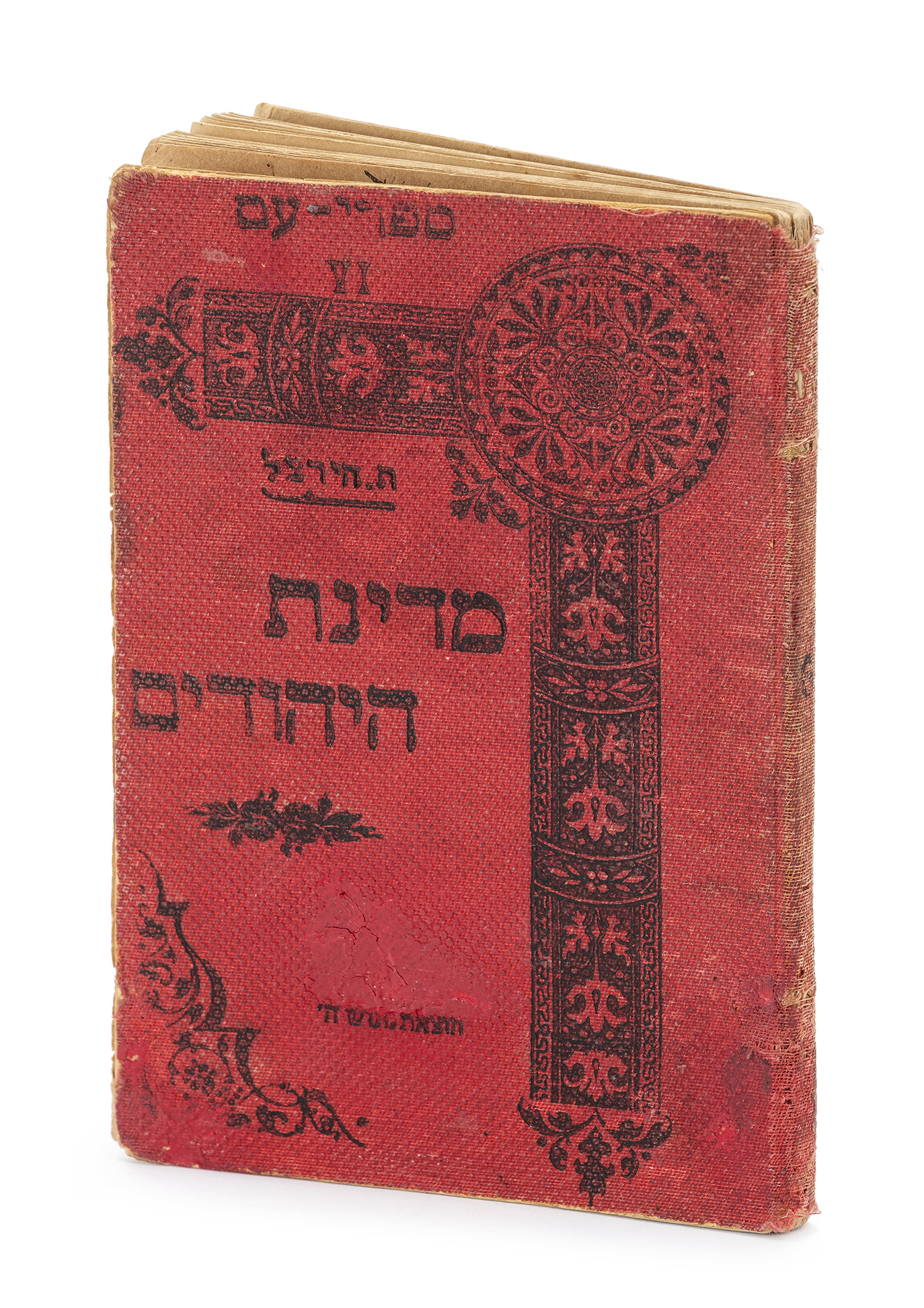
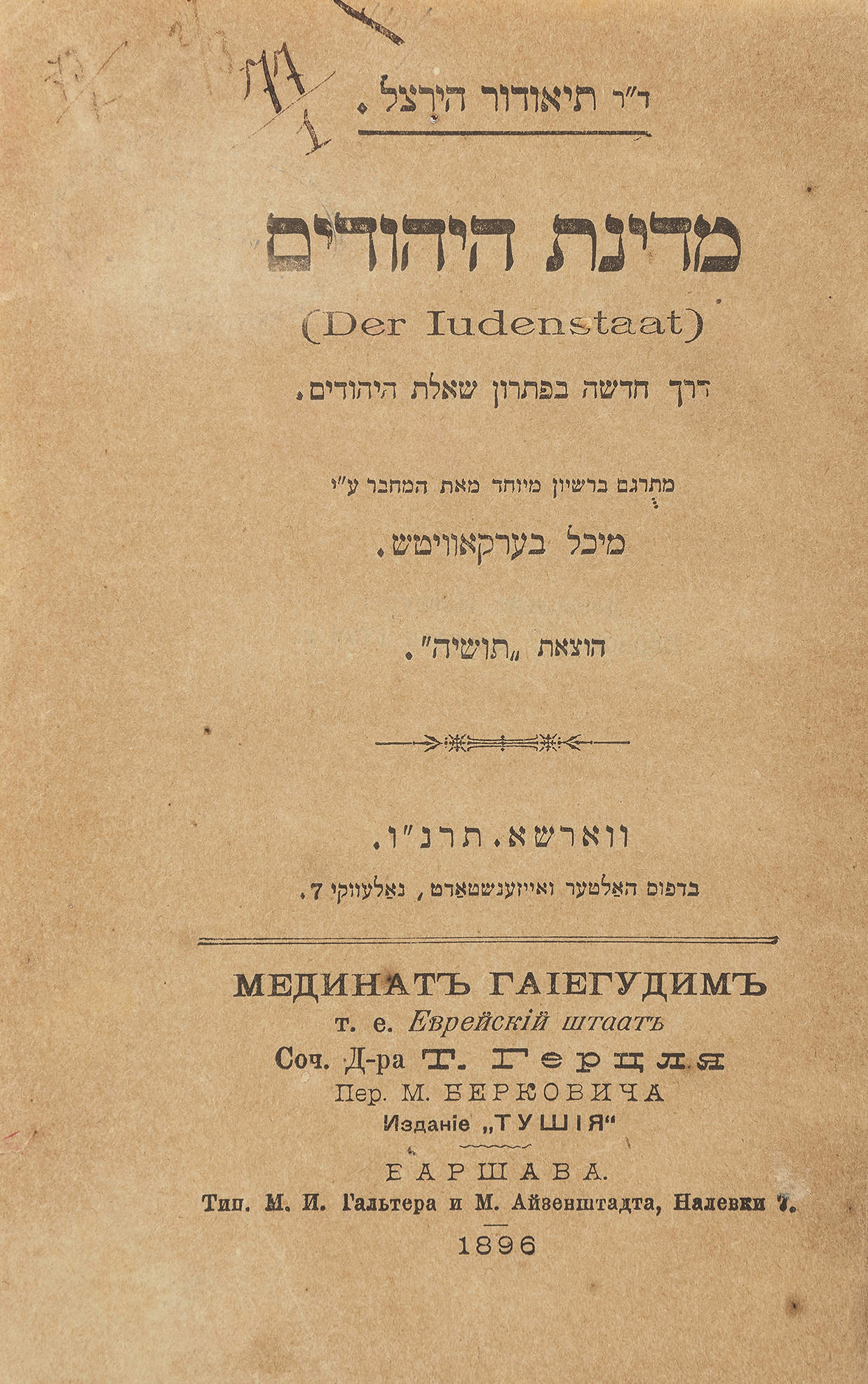
Medinat HaYehudim (Der Iudenstaat / The Jewish State: A New Approach to Solving the Jewish Question, translated with special permission from the author by Michael Berkowitz). Warsaw: Tushiya, 1896.
Herzl's revolutionary book, presenting for the first time his vision for establishing a Jewish State. First Hebrew edition. Printed as part of the Sifrei-Am series by the Tushiya publishing house, in the same year as the German edition was published.
Copy in fine, decorated binding, with name of publisher and series.
[2] leaves, 82, iv pages, [1] leaf. Approx. 18 cm. Good-fair condition. Stains and creases. Minor marginal tears. Stamp of Gedera moshava school library. Several inscriptions. Defects and wear to binding (partially repaired).
Publication of Herzl's "Der Judenstaat"
The story behind "Der Judenstaat" – commonly translated as "The Jewish State" and widely regarded as the book that served as the founding statement of the Zionist movement – can be said to have begun with the "Speech to the Rothschilds", composed by Theodor (Binyamin Ze'ev) Herzl in time for his meeting with members of the Rothschild family in 1895. This speech, 22 pages in length, laid out the preliminary outline for what would eventually become Herzl's grand landmark plan. This outline would gradually undergo a number of incarnations and versions before it sufficiently matured into a full-fledged plan, whereupon Herzl decided to turn it into a complete book.
According to Herzl's own account, the book was written all at once, in two months of non-stop writing, "walking, standing, lying down, in the street, at the table, at night when I started up from sleep…". Once completed, the manuscript would, for the first time, present Herzl's grand vision in all its glory – a detailed plan for the establishment of a Jewish state, stage by stage, beginning with the gathering and organizing of the Jews of the world, up until the enactment of a legal constitution and the adoption of a national flag. Regarding his thoughts and feelings at the time of the writing, Herzl said: "I do not recollect ever having written anything in such an elevated frame of mind as that book. [Heinrich] Heine says that he heard the wings of an eagle beating over his head while writing certain verses. I do believe that something also beat its wings above my head while I was writing that book". Initially, no book publisher was willing to publish the book. Herzl found himself rejected by all his regular publishing companies, such as Duncker & Humblot, as well as the Berlin-based publisher Siegfried Cronbach, who insisted that anti-Semitism was a waning force throughout the world. In the end, Herzl turned to Max Breitenstein, a small bookseller in Vienna who agreed to print the book even though he did not share Herzl's beliefs, nor was he sympathetic to the Zionist cause.
In February 1896, a small edition of "Der Judenstaat" was finally published in German with the subtitle "An Attempt at a Modern Solution to the Jewish Question". In order to ensure the work would be treated with the seriousness he felt it deserved, Herzl added his academic degree – Doctor of Laws – to the authorship of the book.
Immediately upon publication, the book stirred up a maelstrom. A majority of public figures – Jewish and non-Jewish alike – viewed it as nonsensical and absurd; one particular Jewish newspaper editor even offered the use of his personal carriage to transport Herzl to an insane asylum. Among the book's initial opponents were such unlikely personalities as Hayim Nahman Bialik and Nahum Sokolow, the pioneer of Hebrew journalism who would one day become author of the first Hebrew translation of Herzl's "Altneuland". In the words of author Stefan Zweig, "never in Vienna had anyone been subjected to such ridicule as Herzl".
As agreed in advance, Max Breitenstein published three additional editions (distinguished from the original edition only in minute details on the respective covers and title pages) that same year. He published no subsequent editions of "Der Judenstaat".
Notwithstanding the scathing reactions of public figures and noted academics to "Der Judenstaat" the book succeeded in igniting the imaginations of a great many readers in Europe and around the world, and new editions – in Yiddish, Russian, English, and other languages – appeared not long after the publication of the original German editions. One of the earliest editions to see the light of day was the Hebrew translation by Herzl's personal secretary, Michael Berkowitz. It was published by Tushiah in 1896, the same year as the first German edition. In its introduction, Berkowitz brought attention to two "corrections" that Herzl insisted upon in oral communications with him, and wrote the following (in Hebrew): "I hereby testify to two issues that relate in particular to the Hebrew translation… In the chapter [entitled] 'Language of the Land'… after he was made aware that a Hebrew-speaking readership exists for this book… a changed spirit took hold of him, as he was ensured that the Hebrew language could surely be rejuvenated… As to the place of settlement… he [likewise] changed his mind… and addressed his attention exclusively to the Land of our Forefathers".
In subsequent years, with the burgeoning of the Zionist movement and the convening of the early Zionist Congresses, the book came to be translated in yet more languages, and began to appear overseas, particularly in the United States, where Zionism quickly developed into a movement that carried weight and influence. In sum total, during Herzl's brief remaining lifetime, no fewer than 17 editions of "Der Judenstaat" were published – most in small editions numbering only a few thousand copies, and often in the form of thin, nondurable booklets. Dozens more editions were published following Theodor Herzl's passing, including translations into such languages as Ladino, Esperanto, Serbo-Croatian, and many others. It was to become one of the best-known Jewish works of all time.
Reference:
1. Rephael Patai (ed.), The Complete Diaries of Theodor Herzl. New York and London: Herzl Press and Thomas Yoseloff, 1960. Vol. I, p. 24.
2. Ritchie Robertson (ed.), The German-Jewish Dialogue: An Anthology of Literary Texts, 1749-1993. Oxford: Oxford University Press, 1999. p. 150.
Category
Zionism, Mandatory Palestine and the State of Israel
Catalogue Value