
Auction 107: Rare and Important Items
Apr 15, 2026
- and (82) Apply and filter
- item (32) Apply item filter
- various (27) Apply various filter
- object (23) Apply object filter
- ornament (23) Apply ornament filter
- ornaments, (23) Apply ornaments, filter
- synagogu (23) Apply synagogu filter
- torah (23) Apply torah filter
- book (17) Apply book filter
- print (17) Apply print filter
- earli (15) Apply earli filter
- incunabula (15) Apply incunabula filter
- jewish (13) Apply jewish filter
- the (13) Apply the filter
- manuscript (12) Apply manuscript filter
- public (12) Apply public filter
- letter (10) Apply letter filter
- ketubot (9) Apply ketubot filter
- anti (8) Apply anti filter
- anti-jewish (8) Apply anti-jewish filter
- antijewish (8) Apply antijewish filter
- antisemit (8) Apply antisemit filter
- edict (8) Apply edict filter
- edicts, (8) Apply edicts, filter
- law (8) Apply law filter
- laws, (8) Apply laws, filter
- ordin (8) Apply ordin filter
- rabbin (8) Apply rabbin filter
- royal (8) Apply royal filter
- haggadot (6) Apply haggadot filter
- israel (6) Apply israel filter
- mandatori (6) Apply mandatori filter
- of (6) Apply of filter
- palestin (6) Apply palestin filter
- passov (6) Apply passov filter
- siddurim (6) Apply siddurim filter
- state (6) Apply state filter
- zionism (6) Apply zionism filter
- zionism, (6) Apply zionism, filter
- bind (5) Apply bind filter
- havdalah (5) Apply havdalah filter
- holiday (5) Apply holiday filter
- person (5) Apply person filter
- shabbat (5) Apply shabbat filter
- shabbat, (5) Apply shabbat, filter
- silver (5) Apply silver filter
- art (4) Apply art filter
- brueckheim (4) Apply brueckheim filter
- collect (4) Apply collect filter
- from (4) Apply from filter
Displaying 37 - 48 of 104
![Engraved Esther Scroll. [Amsterdam, The Netherlands, 18th century].
Engravings and ink on parchment; wood and cardboard.](https://files.kedem-auctions.com/files/Sale107/37_1.jpg "Engraved Esther Scroll – Amsterdam, 18th Century")
![Engraved Esther Scroll. [Amsterdam, The Netherlands, 18th century].
Engravings and ink on parchment; wood and cardboard.](https://files.kedem-auctions.com/files/Sale107/37_2.jpg "Engraved Esther Scroll – Amsterdam, 18th Century")
![Engraved Esther Scroll. [Amsterdam, The Netherlands, 18th century].
Engravings and ink on parchment; wood and cardboard.](https://files.kedem-auctions.com/files/Sale107/37_3.jpg "Engraved Esther Scroll – Amsterdam, 18th Century")
Auction 107: Rare and Important Items
Apr 15, 2026
Opening: $5,000
Estimate: $10,000 - $15,000
Sold for: $7,500
Including buyer's premium
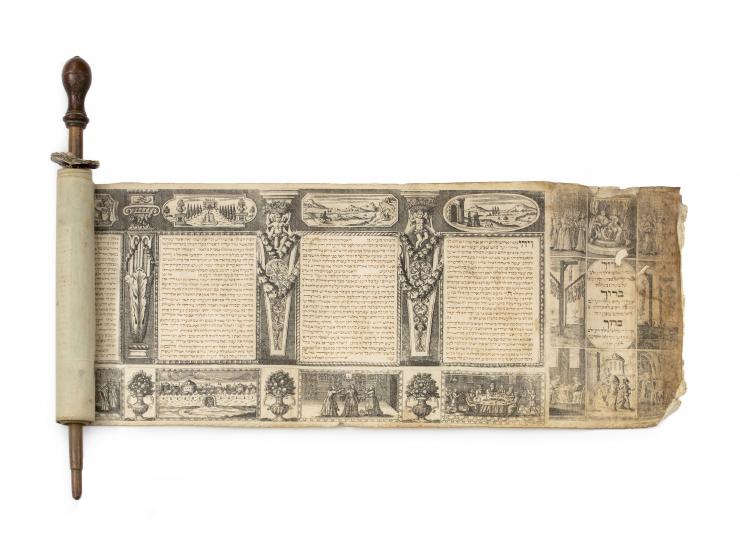
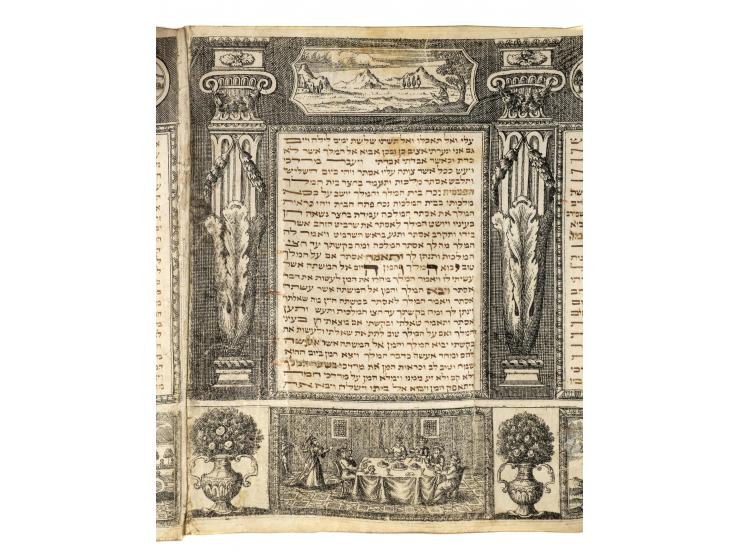
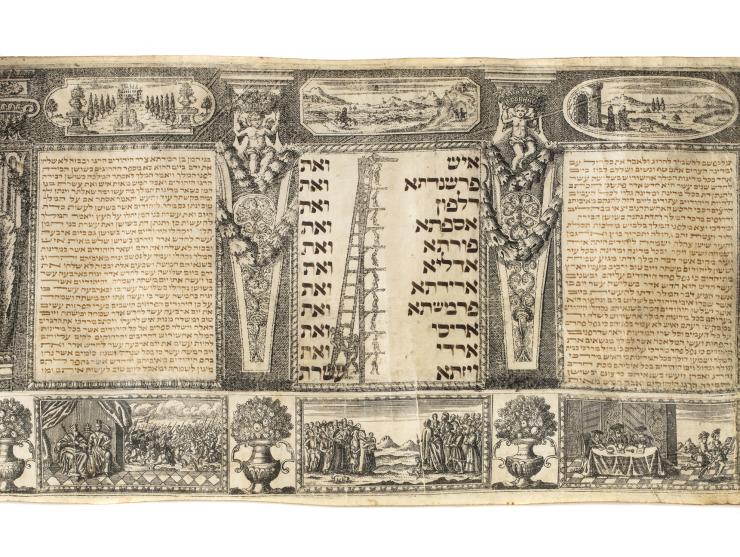
Engraved Esther Scroll. [Amsterdam, The Netherlands, 18th century].
Engravings and ink on parchment; wood and cardboard.
Esther scroll, inscribed in sepia-colored ink on 4 sheets of parchment glued one to the other; text of Book of Esther arranged in 16 columns, with 23-28 rows per column. Additional opening column. Tetragrammaton (4 letters of the Divine Name) highlighted in the eighth column. Opening column contains blessings over the reading of the Megillah.
The present scroll belongs to a group of Esther scrolls adorned with engravings, created in several different versions in Amsterdam throughout the 18th century. From among the known variations, the type represented by this particular scroll is the earliest; a copy of this type, part of the René Braginsky Collection, Zürich, has been dated to Hebrew year 5461 [1701].
This Esther Scroll is decorated with numerous high-quality engravings; eight of them, depicting scenes from the narrative of the Book of Esther, appear on the opening column; sixteen engravings adorning the lower margin of the textual columns also present scenes from the Esther story, some of them derived from Midrashic sources; and another sixteen engravings located above the textual columns include landscapes – in effect, a series of four landscape scenes, recurrently appearing four times; separating the textual columns are large architectonic columns, some adorned with putti angels holding fruit baskets on their heads; underneath each architectonic column, in the lower margin, is a large urn filled with fruits and flowers; these urns separate the scenes depicting the Esther narrative.
Height of parchment sheets: 17.5 cm. Length of scroll: 171 cm. Wrapped around wooden roller, probably original, with upper handle (bottom handle missing). Length of roller and upper handle: 32 cm. Scroll in good condition. Few stains and slight wear to parchment. Several words and letters erased and rewritten. Stains, wear, and tears to opening of the first parchment sheet. Piece of paper adhered to the outer edge of first sheet for reinforcement. Small holes in vertical margins of sheets suggest that they were originally sewn one to the other. Scroll housed in cylindrical cardboard case, somewhat more recent, with wear and tear.
Provenance: The Simon Brueckheimer Collection.
Simon Brueckheimer, born in Külsheim, Germany, in 1889. Moved to Marktbreit in 1911, and began serving there as an educator in 1920. In 1929 he initiated a project to document sacred objects and property of Bavarian Jewish communities, which he pursued during his vacation time as a teacher, under the auspices of the Union of Bavarian Jewish Communities (Verband Bayerischer Israelitischer Gemeinden). Brueckheimer escaped to Frankfurt in the heat of Kristallnacht, but was then arrested and sent to Buchenwald Concentration Camp. After six weeks he was released, returned to Marktbreit, and then emigrated with his family to London, where he continued his documentation project on Bavarian Jewry. In the course of his visits to small Bavarian Jewish communities and later, after moving to London, Brueckheimer succeeded in assembling a small collection of Jewish items, which he had acquired either during his visits to the towns themselves or from purchases from Jewish refugees escaping to England. The important items in his collection include a cup used for special dinners by the "Chevrah Kadisha" (Burial Society) of Schwabach, today part of the collection of the Israel Museum, Jerusalem, and a Torah Shield belonging to the community of Goßmannsdorf, sold at Kedem, Auction 106, 24 February 2026, Lot 14. His notes and listings – documenting 150 small Jewish communities throughout Bavaria – are kept in the archives of the Yad VaShem World Holocaust Remembrance Center, Jerusalem. Brueckheimer passed away in England in 1950.
Several additional items from the Simon Brueckheimer Collection will be offered for sale at our upcoming public auctions. All proceeds from these sales will be donated.
Category
Selected Items from the Simon Brueckheimer Collection
Catalogue Value
Auction 107: Rare and Important Items
Apr 15, 2026
Opening: $5,000
Estimate: $10,000 - $13,000
Sold for: $15,000
Including buyer's premium
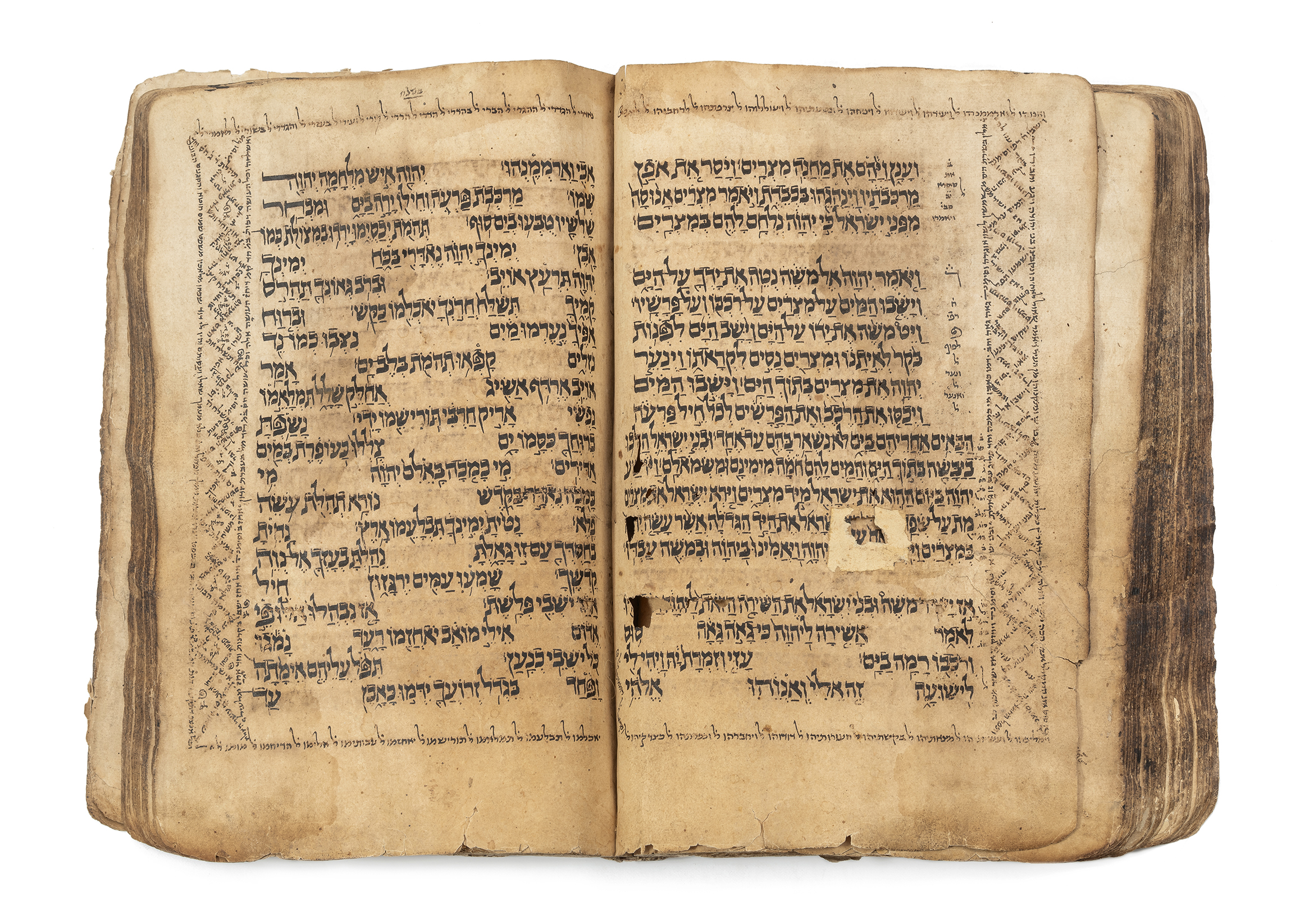
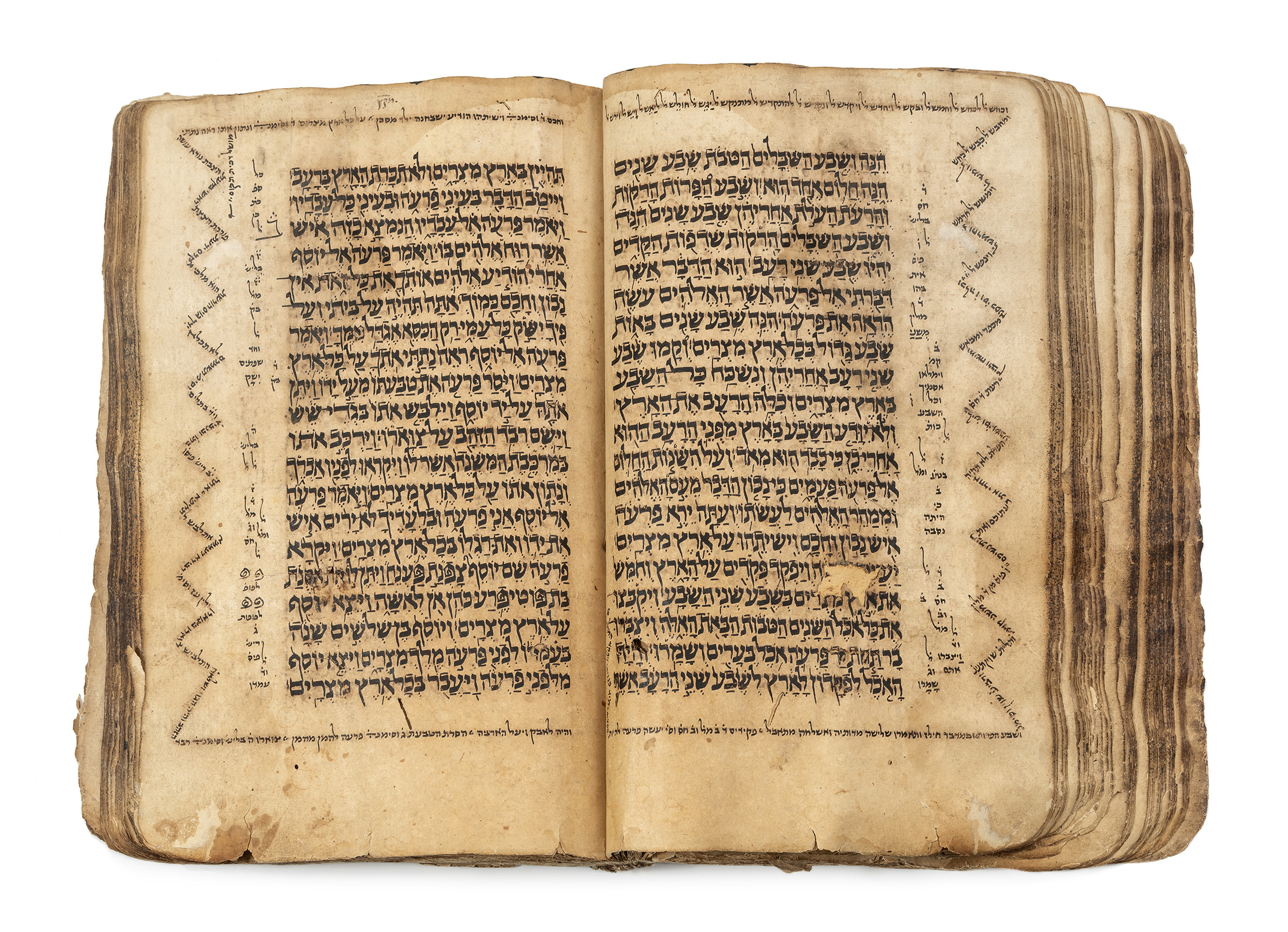
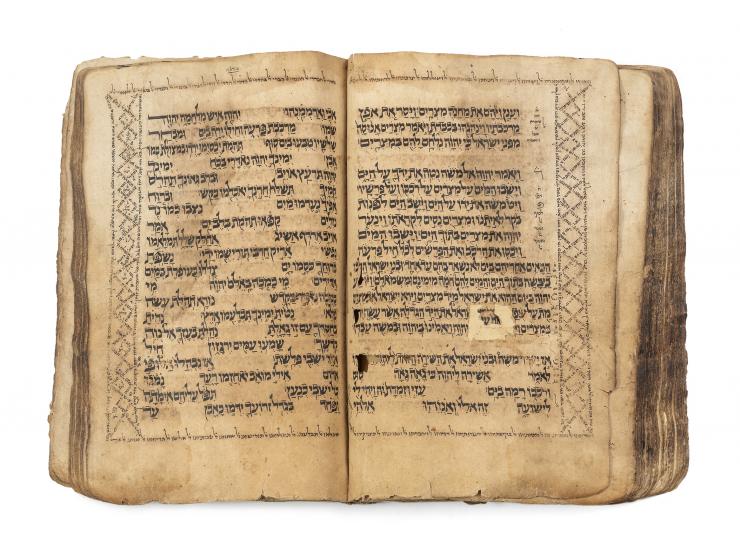
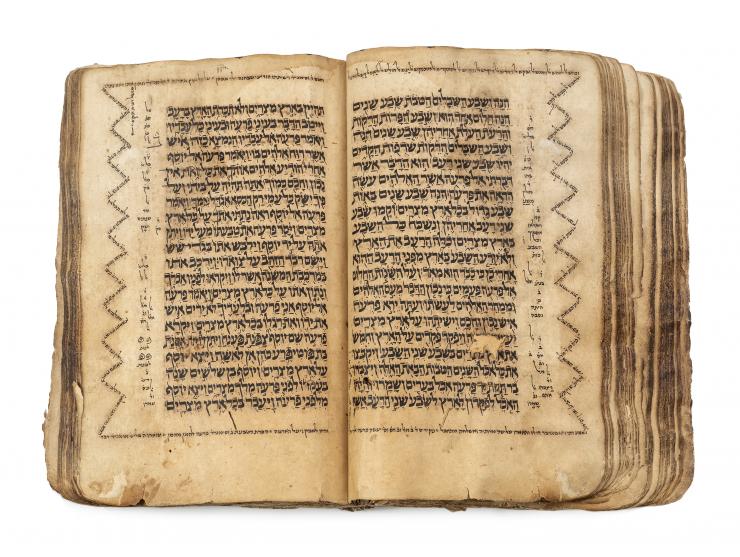
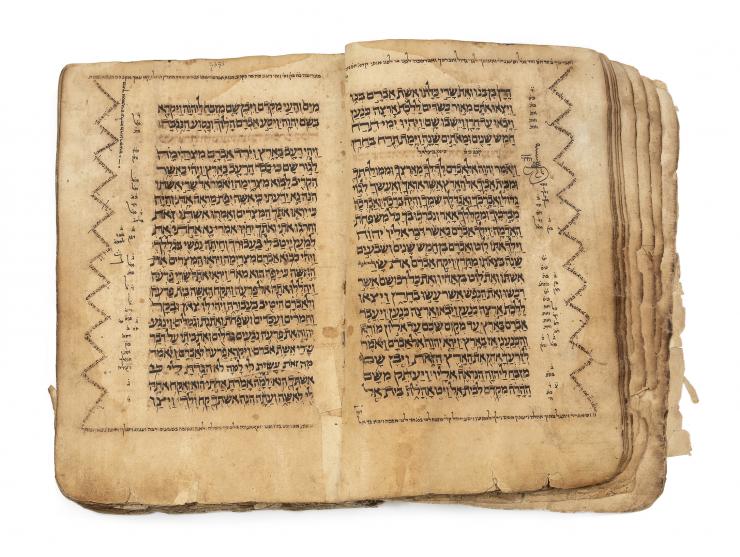
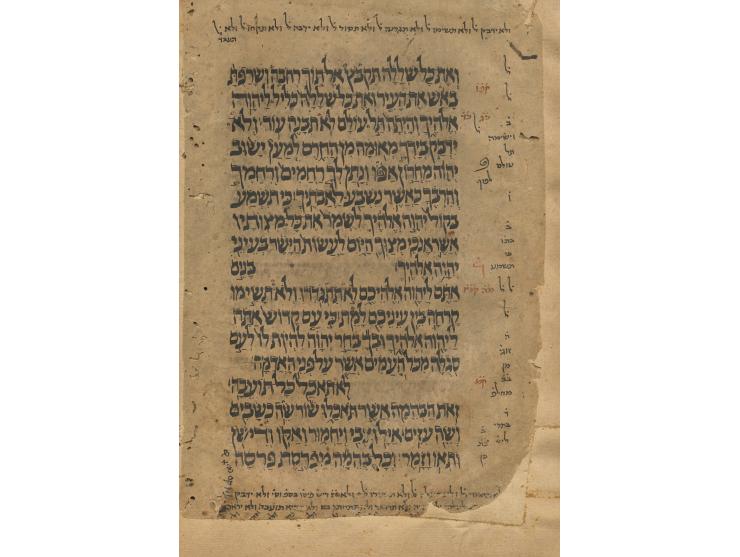
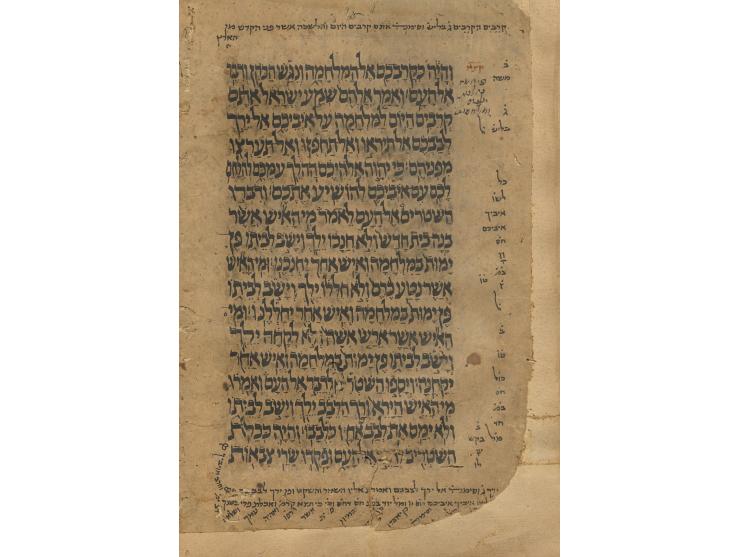
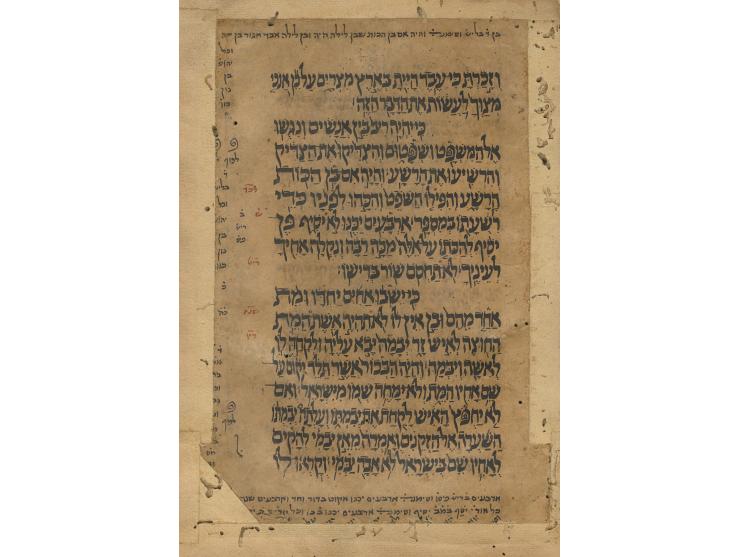
Manuscript, Taj Torah (Keter Torah) – Bereshit and Shemot, with cantillation and vocalization, Masorah Gedolah, Masorah Ketanah and Machberet HaTijan, handwritten by a member of the family of Benaiah HaSofer. [Yemen, 15th/16th century].
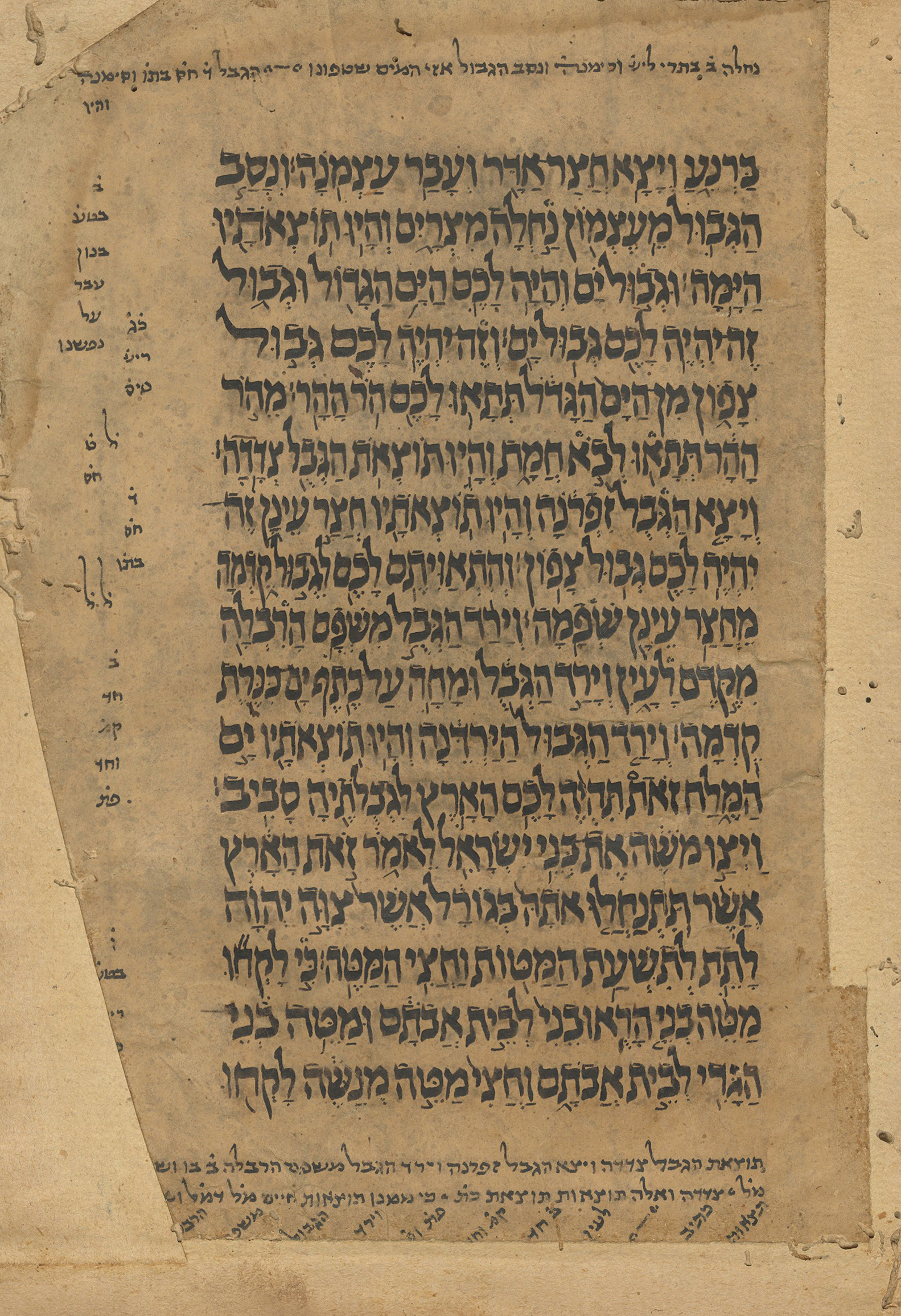
Ink on paper, particularly neat Yemenite script, in large square (Stam) script, with vocalization and cantillation. Winding Peh in several places (such as the Song of the Sea).
Masorah Ketanah appears in margins, next to text; Masorah Gedolah at top and bottom of pages, with micrographic decoration (zigzag). The Song of the Sea is written in the format prescribed for a Torah scroll. On the pages of the Song, the Masorah Gedolah is written with a different micrographic decoration (a net; characteristic of the scribes of Benaiah's family).
Based on the form of the writing and other characteristics, the scribe appears to be a member of the renowned Yemenite family of Benaiah HaSofer. The page and line format in the present manuscript is notably identical to that of Bodleian Ms. Opp. Add. Qu. 97a, written by Yosef son of Benaiah HaSofer (based on its colophon), writing of which was completed in Cheshvan 1478.
At the end of the manuscript appears Machberet HaTijan (generally copied along with Taj books), in Yemenite semi-cursive script. This work is lacking in the middle and the end.
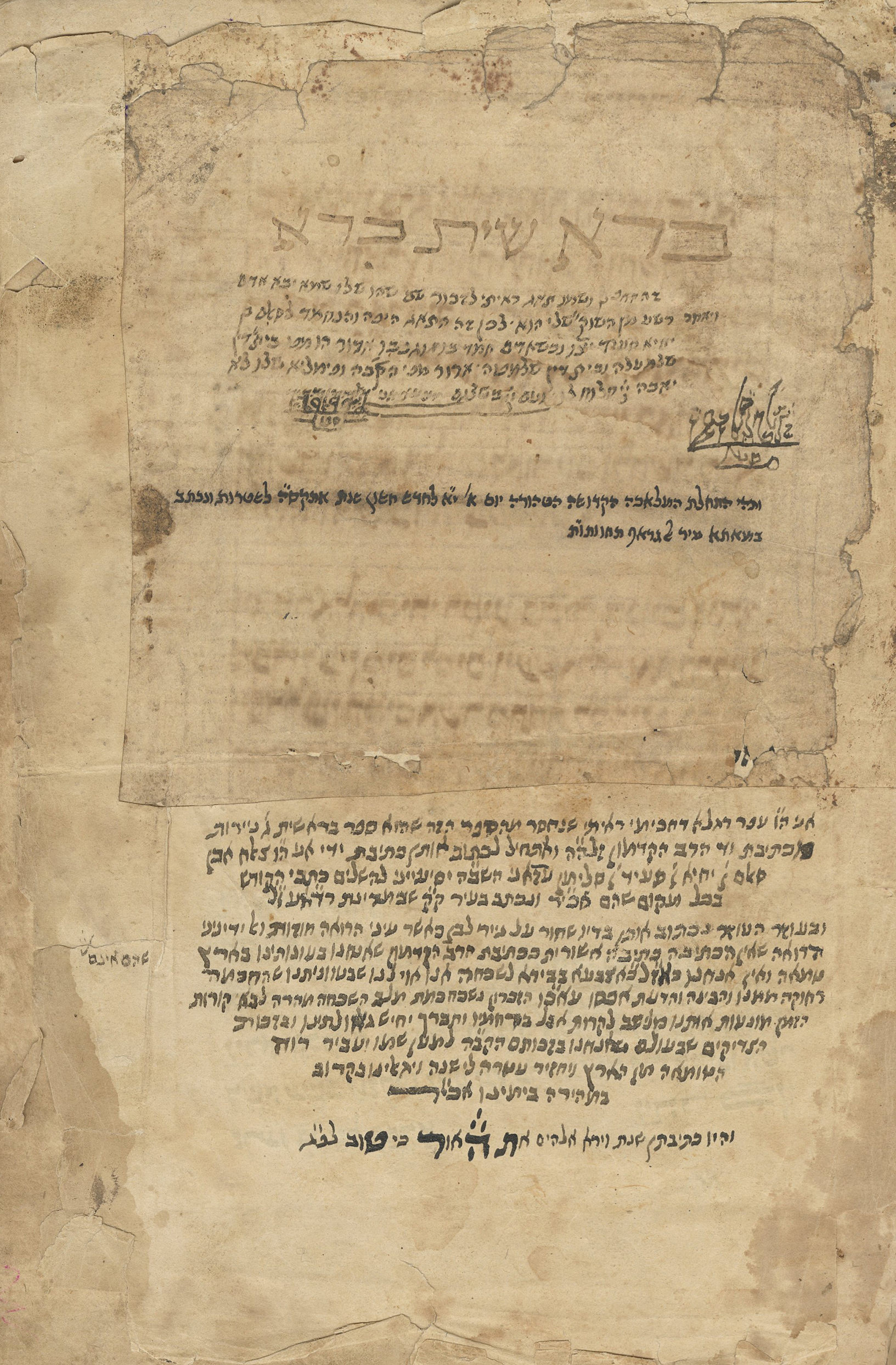
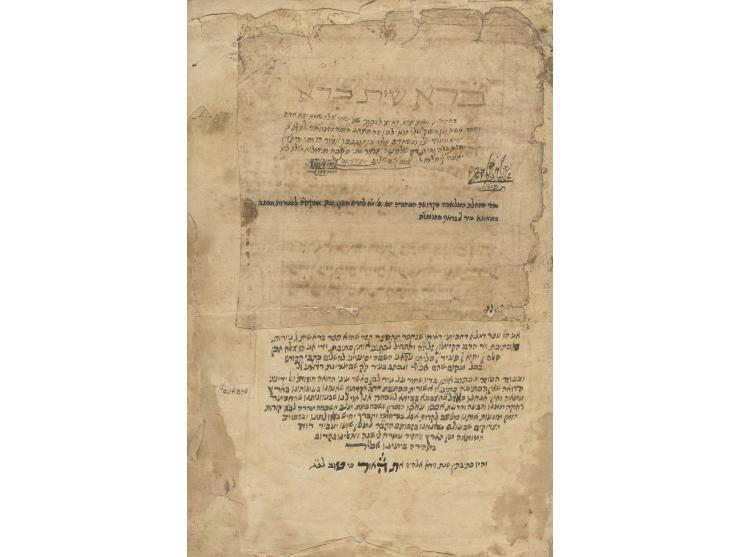
On the blank (front) side of the first leaf, various later inscriptions, including ownership inscription and inscription of scribe who added handwritten replacement leaves:
"As for this object, named Taj, I saw fit to mention my name as it belongs to me lest some wicked man come from the marketplace saying it is his, therefore this beautiful and desirable Taj belongs to Salim son of Yichya Sa'id. And should a man covet or steal it, may he be cursed by the heavenly and earthly courts, cursed by G-d and His retinue, may G-d not desire to forgive Him and may the people of G-d be at peace, I am [Salim son of Sa'id (calligraphic signature)]".
Below this inscription (and another calligraphic signature):
"The holy and pure labor began Sunday, 11th Cheshvan 1565 Seleucid era, written in the city of al-Jiraf, may it be destroyed and barren, and may Jerusalem be rebuilt".
This inscription, in a later hand, is likely misdated (to 1253!). A facsimile of this inscription appears in Encyclopedia LaKehilot HaYehudiyot BeTeiman, I, p. 124, where Gavra conjectures that the date should be 1965 Seleucid era (1653), although the inscription may be later.
Another inscription at bottom of the same leaf: "I, dust at the feet of the sages, saw that this book, namely Bereshit, was lacking three leaves in the hand of the ancient rabbi, so I will begin to write them in my own hand, Salih son of Salim son of Yichya son of Sa'id son of Suleiman Azani, may G-d assist me to complete Scriptures wherever they be, Amen. Written in the city of K.K. in the province of Rada'a… And with the help of the Helper we shall write it in black ink on white paper as the viewer shall see. And let the viewer not judge me for not writing in Ashuri [Stam] script like the ancient rabbi, for we in our sins are in an impure land, and as the Sages say, we forget as easily as one would put one's finger in a well. Woe to us that among our sins wisdom is distant from us, and understanding and knowledge have come to naught! All the more so is our memory lost as the dead is forgotten from the heart; forgetfulness comes easily, and the daily occurrences prevent us from settling down to study Scripture. But may G-d in His mercy bring our redemption closer, and in the merit of the Tzaddikim in the world in whose merit we are, may G-d, for the sake of His name, dispel the spirit of impurity from the land and bring us back as of old and redeem us, speedily in our days, Amen. And it was written in the year [1849]".
The Family of Benaiah HaSofer in Yemen
R. Benaiah son of Saadiah son of Zechariah – "the most renowned scribe in Yemen" (Encyclopedia LeChachmei Teiman, I, p. 42), head of the famous family of scribes active in Sanaa, Yemen. Colophons of other known books he scribed read: "The weak scribe… the least of scribes… Benaiah son of Saadiah son of Zechariah son of Benaiah son of Oded, known as Ben Margaz" (see: M. Beit-Arié, Asufat Ketavim Ivriyim MiYemei HaBeinayim, I, Oriental and Yemenite Scripts, Jerusalem 1988, plate 140). The famous traveler R. Yaakov Sapir, who visited Yemen in the 19th century, reports in his Even Sapir: "…I did not find as many early manuscript Bibles as I hoped, since their last exiles and tribulations did not leave much surviving; the oldest ones are some five hundred years old. The most accurate ones were produced by Benaiah, the expert and punctilious scribe, and unbelievably, he is said to have scribed four hundred books in his lifetime…" (Even Sapir, Lyck, 1866, leaf 102). R. Yaakov Sapir also mentions Miriam the scribe, daughter of R. Benaiah, who also worked as a copyist: "He also had a daughter who was an expert scribe, and I was shown a manuscript Chumash concluding with the inscription: 'Do not condemn me if you find any errors, as I am a nursing woman, Miriam daughter of Benaiah the scribe' – and it is accurate, with neat, beautiful script" (Even Sapir, ibid.).
R. Benaiah himself scribed books ca. 1450-1483, and he passed away ca. 1484, as evidenced by a colophon written by his son the scribe R. Yosef son of Benaiah, where R. Benaiah is mentioned as deceased (Ms. Jerusalem, Benayahu collection, quoted by: M. Riegler, Benaya the Scribe and His Descendants – A Family of Scribes from Yemen, Pe'amim, LXIV, 1995, p. 63).
According to Encyclopedia LeChachmei Teiman, R. Benaiah son of Saadiah is "the most renowned scribe in Yemen… His fame is due to the dozens of manuscripts he, his sons and grandsons copied… According to one opinion, he served as head of the Sanaa Beit Din… The vast majority of books he copied are Bibles with Masorah and Machberet HaTijan… His copyings are considered the most accurate, and he is viewed as the greatest Masoretic authority. The question of the relation of his Masorah to the Tiberian Masoretic school is greatly contested among scholars… Tradition holds that he and his family copied hundreds of manuscripts, of which dozens have passed down to us…" (Gavra, Encyclopedia LeChachmei Teiman, I, pp. 42-43). See there for a partial list of his known extant manuscripts.
The Hebrew Paleography Project lists some 40 manuscripts from the family of Benaiah, located today in various libraries and collections (M. Riegler, Benaya the Scribe and His Descendants – A Family of Scribes from Yemen, ibid., p. 54).
Stamps of kabbalist R. "Shlomo Yosef Mabari – licensed scribe and shochet – also officiates at divorces and marriages – Shaarayim near Rechovot".
Approx. 150 leaves (several missing leaves replaced in a later hand). Approx. 26 cm. Fair-poor condition. Stains. Most leaves with tears and open tears (some large), affecting text in many places. Some places repaired with pieces of paper with later handwritten replacements. Some leaves of Machberet HaTijan torn and lacking. Several leaves detached. Without binding.
Provenance: Library of Kabbalist R. Shlomo Yosef Mabari (1913-1969), a rabbi of the Yemenite community in Eretz Israel. In 1930, he immigrated from Dhamar, Yemen, to the Yemenite neighborhood Shaarayim, Rechovot. R. Shlomo and his father R. Yosef were known for their work as scribes of Torah scrolls and copyists. He was frequently visited for counsel, salvation and healing of the sick. During World War II, in 1943, he authored a prayer for salvation ordained to be recited by the community's rabbis.
Category
Manuscripts
Catalogue Value
Auction 107: Rare and Important Items
Apr 15, 2026
Opening: $3,000
Estimate: $5,000 - $8,000
Sold for: $5,750
Including buyer's premium
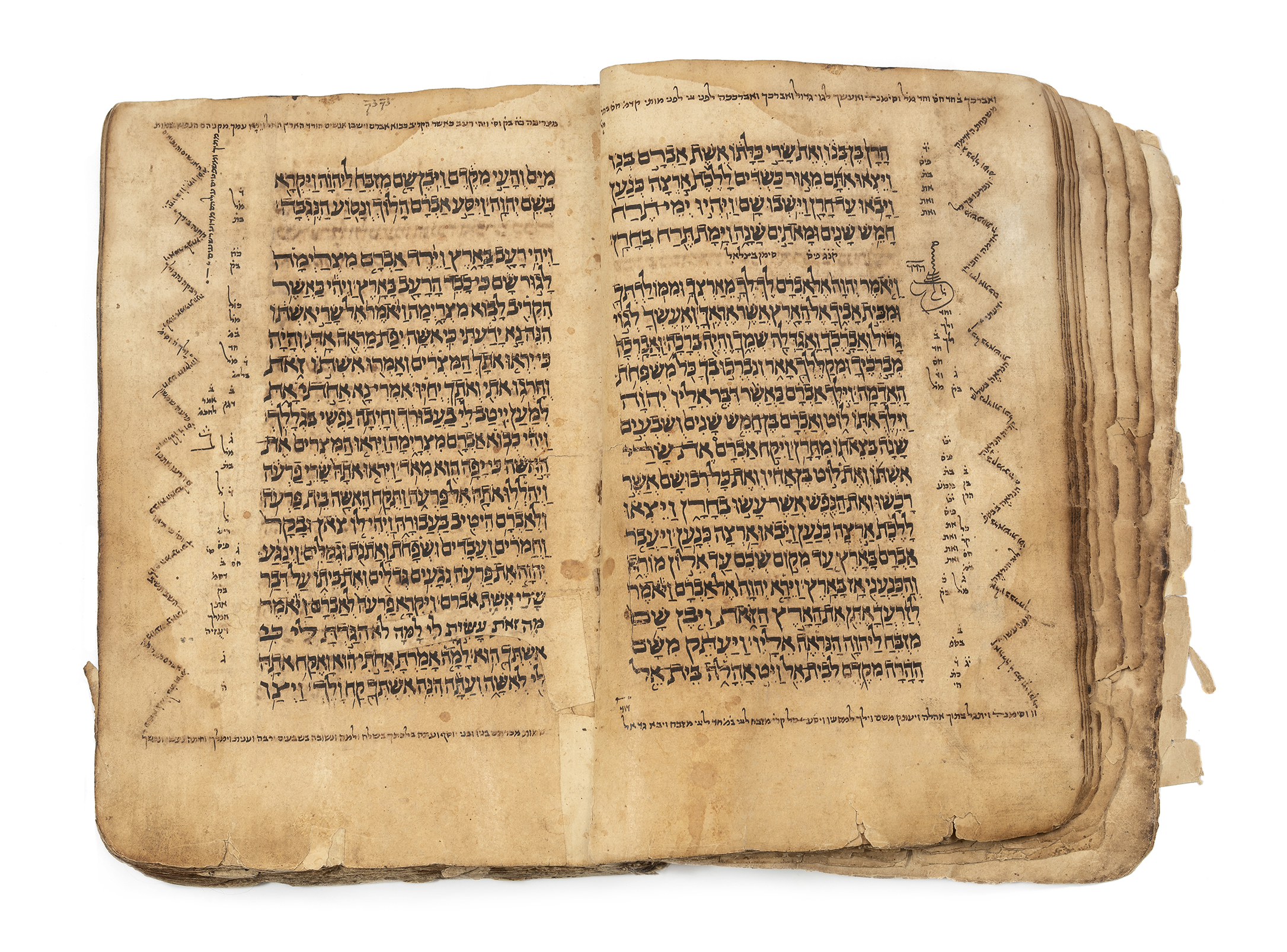
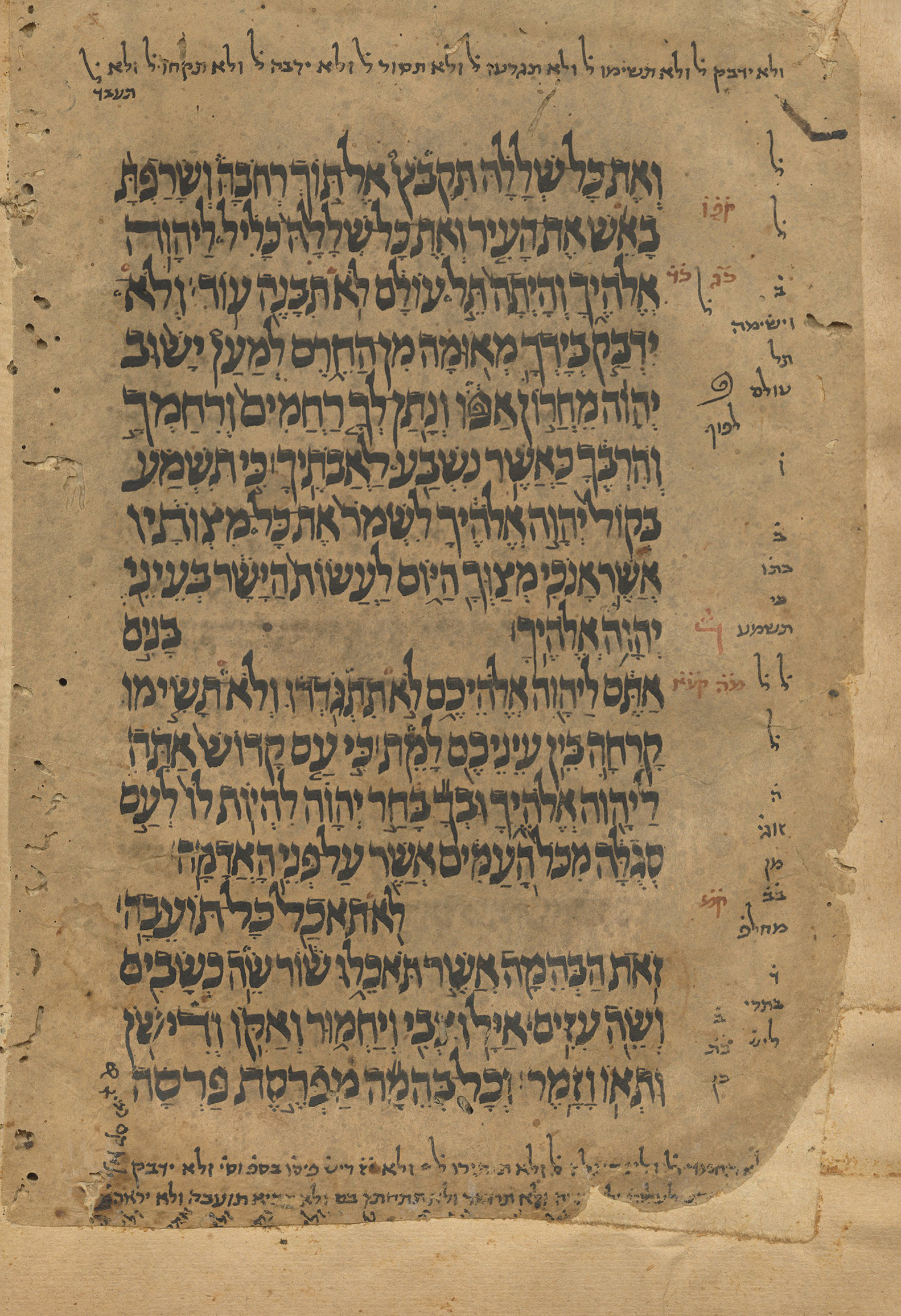
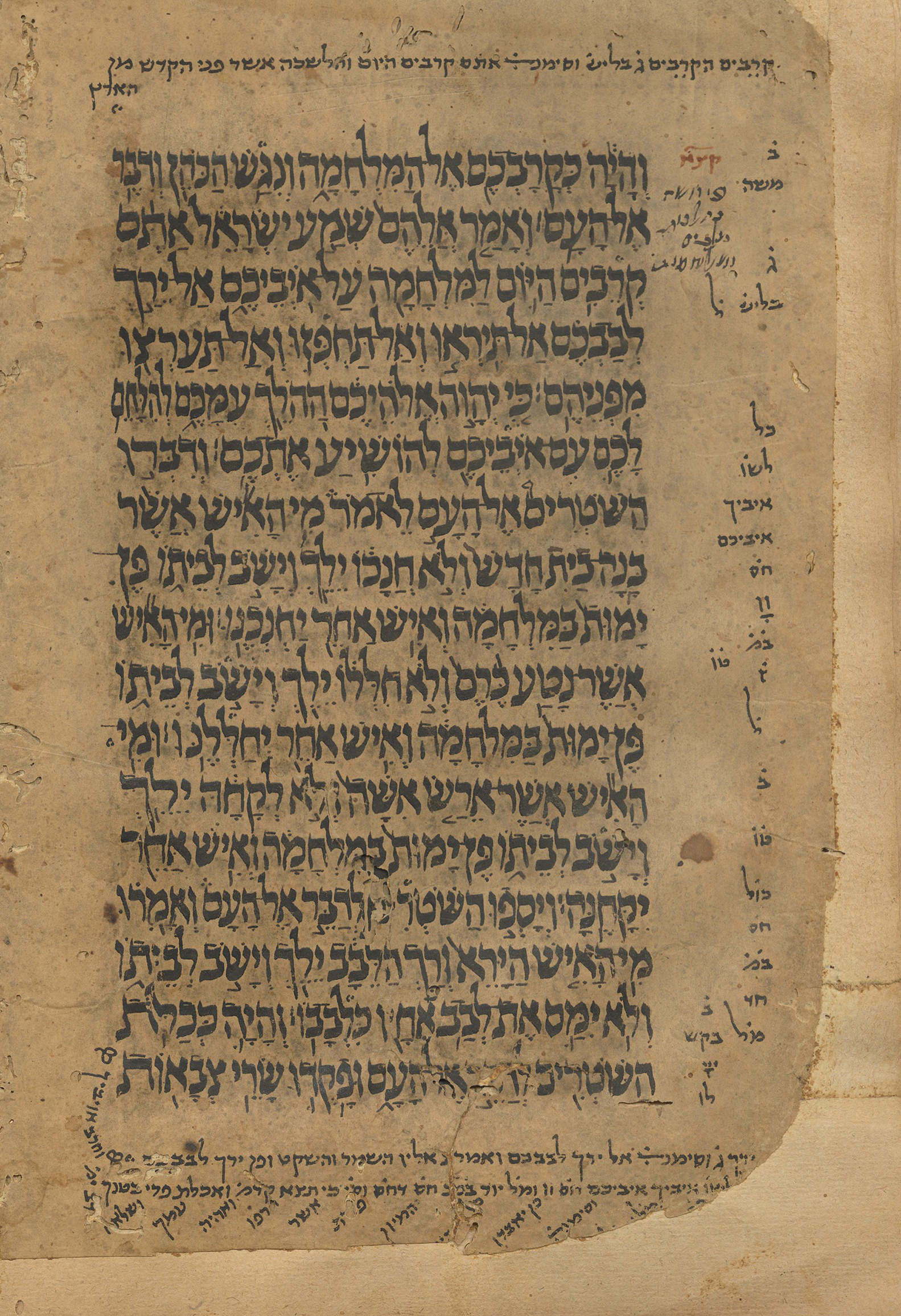
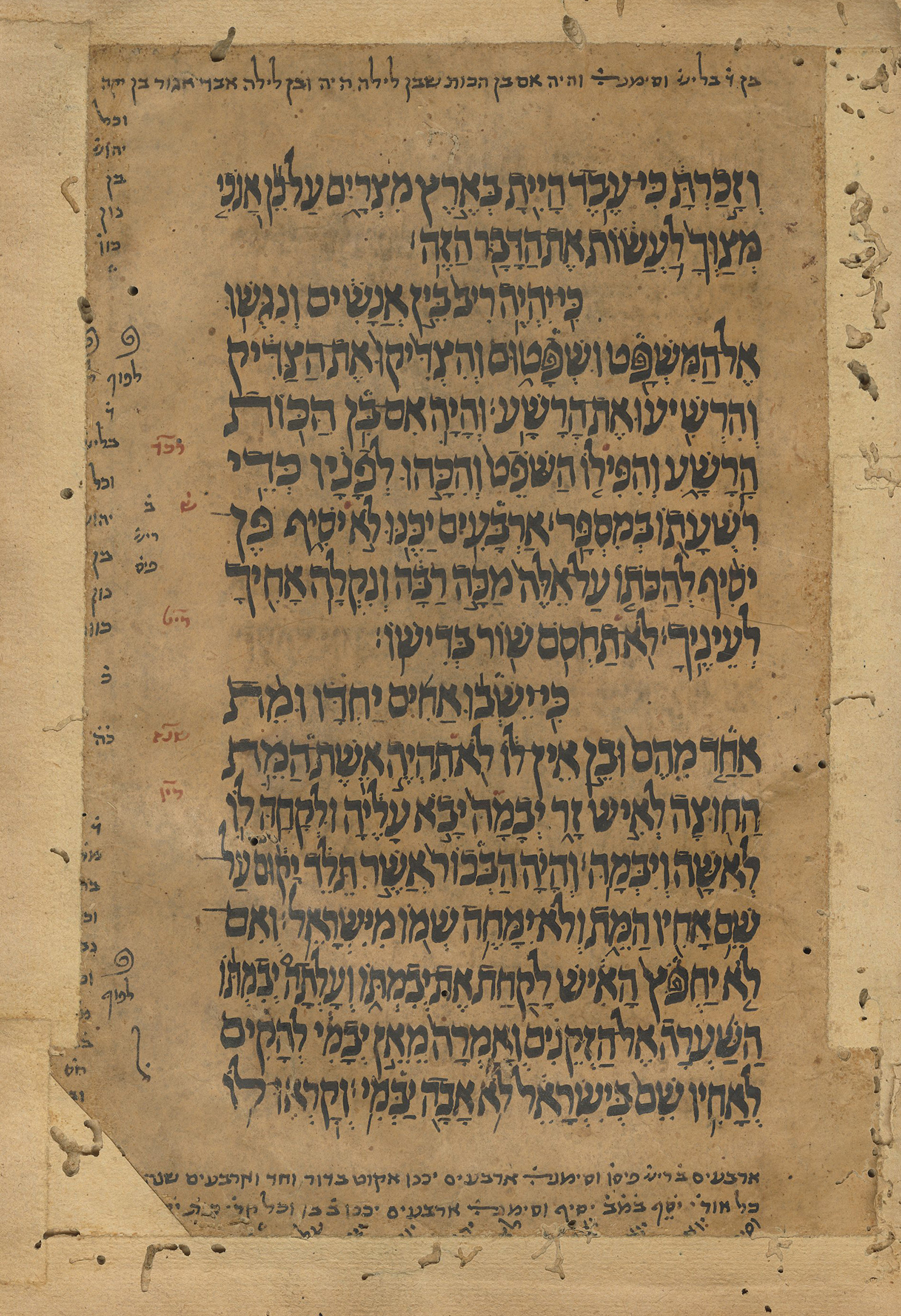
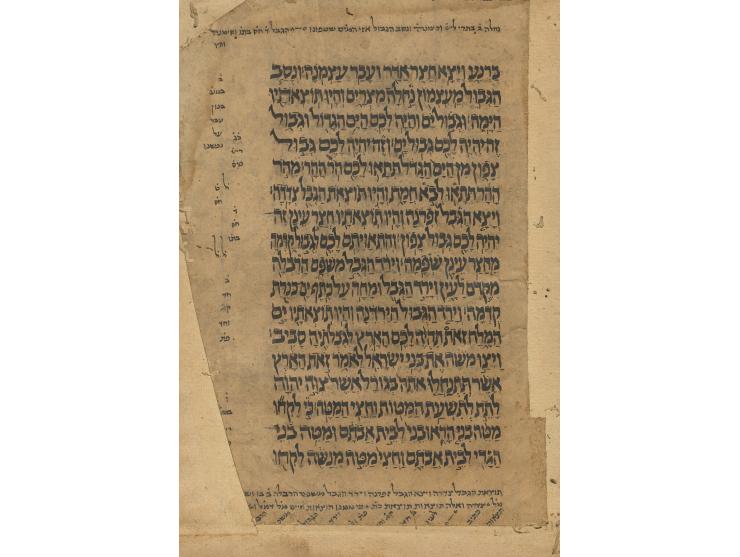
Manuscript, Taj Torah (Keter Torah) – Bamidbar and Devarim, with cantillation and vocalization, Masorah Gedolah, Masorah Ketanah and Machberet HaTijan, handwritten by a member of the family of Benaiah HaSofer. [Yemen, 15th/16th century].
Ink on paper, neat Yemenite script, in large square (Stam) script, with vocalization and cantillation. Winding Peh in several places.
Masorah Ketanah and Masorah Gedolah at top and bottom of pages. Bottom of most leaves damaged, affecting text of Masorah, with loss.
Based on the form of the writing and other characteristics, the scribe appears to be a member of the renowned Yemenite family of Benaiah HaSofer. For more information on this family, see previous lot.
Stamps of kabbalist R. "Shlomo Yosef Mabari – licensed scribe and shochet – also officiates at divorces and marriages – Shaarayim near Rechovot".
[90] leaves + 6 replacement leaves in a later hand. Bamidbar lacking first part (manuscript begins in middle of Parashat Korach). Approx. 24 cm. Fair-poor condition. Stains, wear and tears. Much worming, affecting text. Many open tears, affecting text. Damaged or lacking text in many places repaired with pieces of paper with later handwritten replacements. Bottom of most leaves damaged and repaired with paper, affecting Masorah text with loss. Detached leaves and gatherings. Without binding.
Enclosed is an additional manuscript, written as a supplement to the present manuscript, containing a copying of Vayikra and the first part of Bamidbar (up to the verse where the ancient Taj volume begins). [Yemen, ca. 19th century]. 85 leaves.
Provenance: Library of Kabbalist R. Shlomo Yosef Mabari (1913-1969), a rabbi of the Yemenite community in Eretz Israel. In 1930, he immigrated from Dhamar, Yemen, to the Yemenite neighborhood Shaarayim, Rechovot. R. Shlomo and his father R. Yosef were known for their work as scribes of Torah scrolls and copyists. He was frequently visited for counsel, salvation and healing of the sick. During World War II, in 1943, he authored a prayer for salvation ordained to be recited by the community's rabbis.
Category
Manuscripts
Catalogue Value
Auction 107: Rare and Important Items
Apr 15, 2026
Opening: $5,000
Estimate: $10,000 - $15,000
Sold for: $6,250
Including buyer's premium
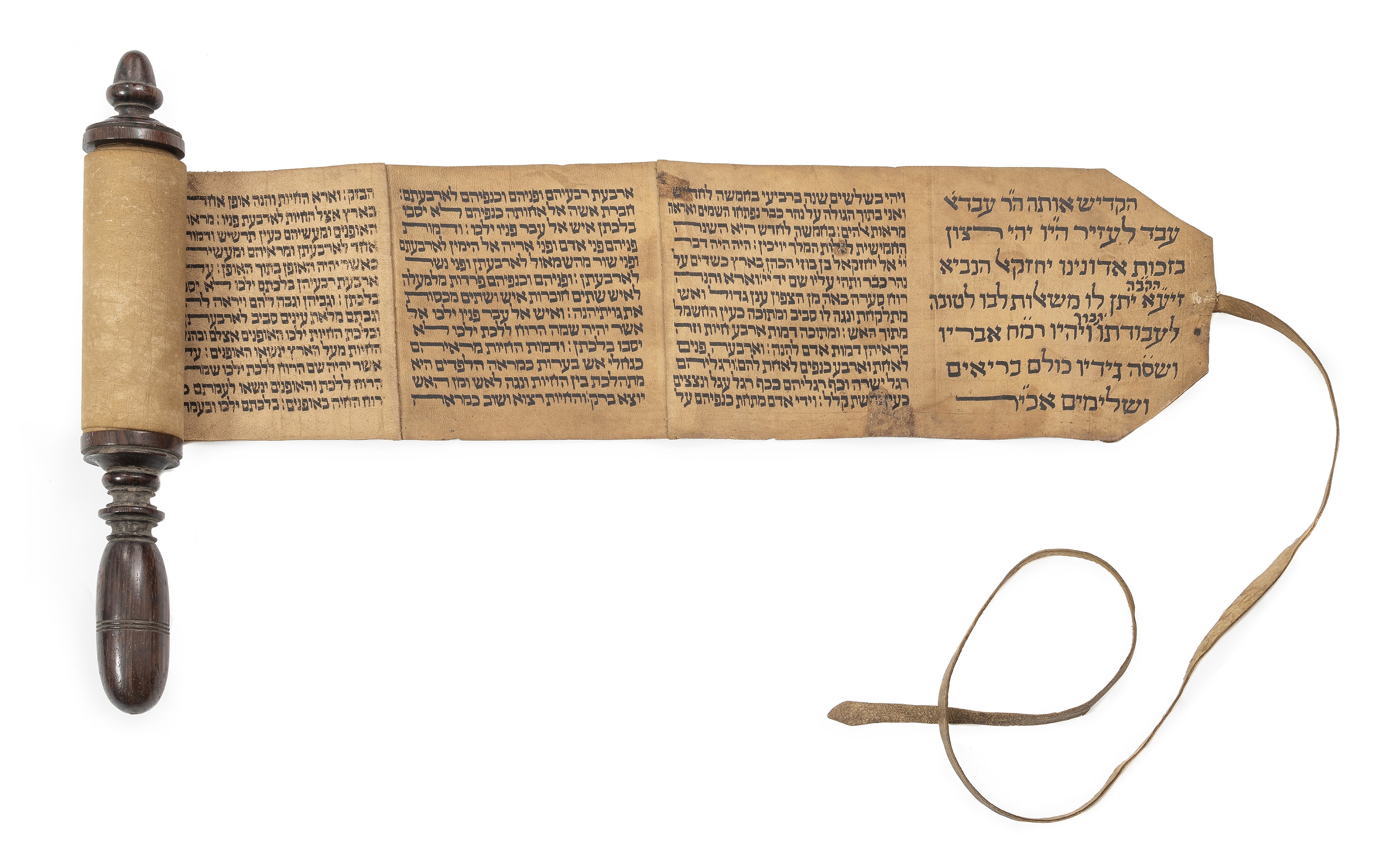
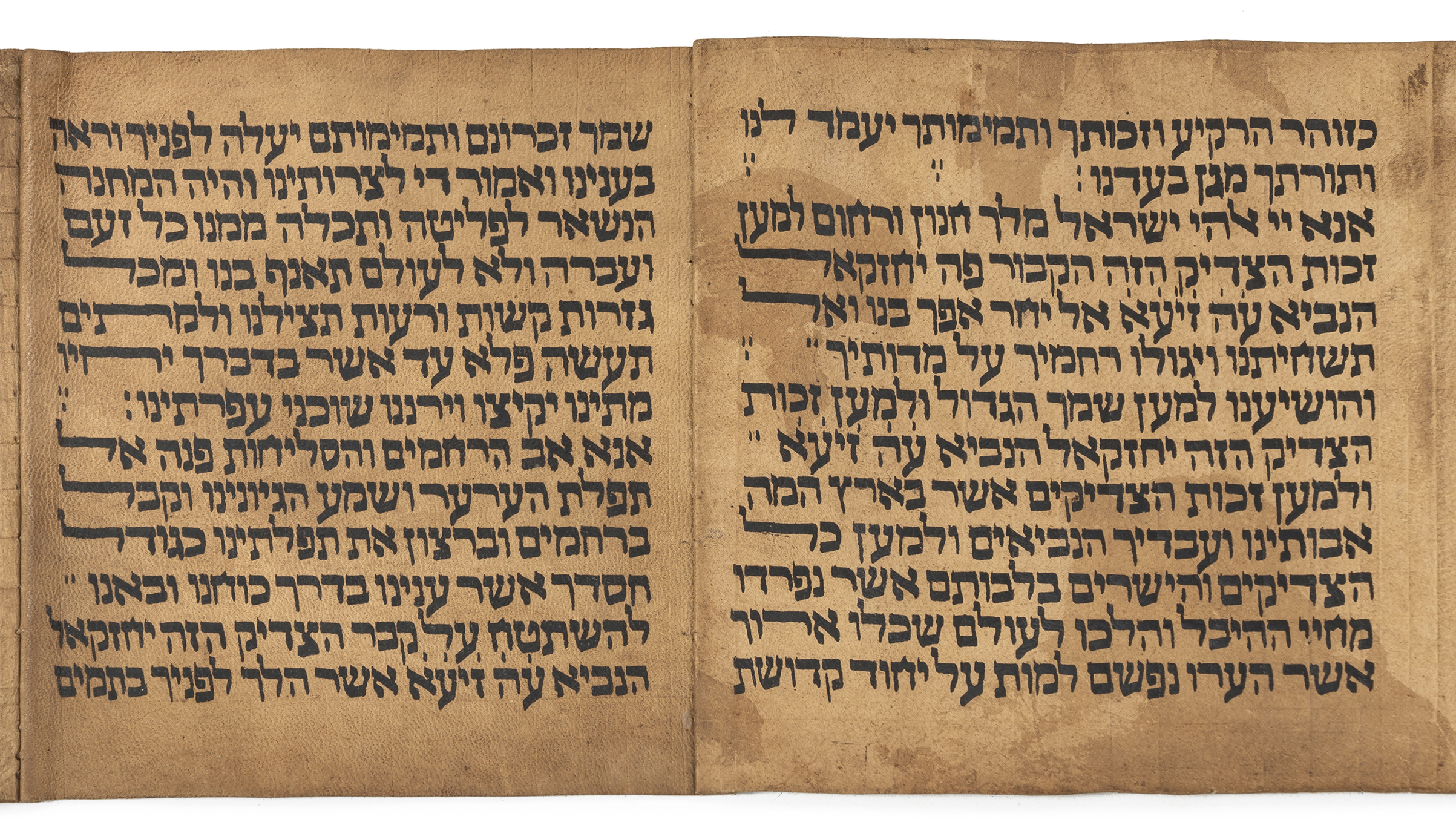
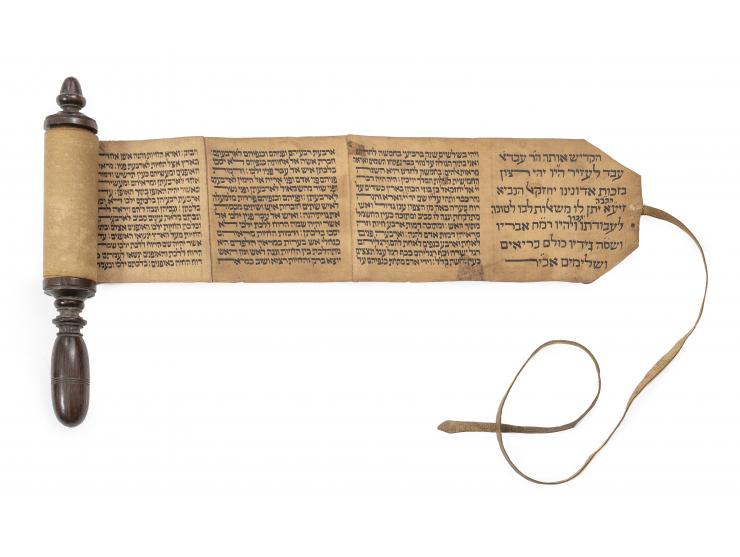
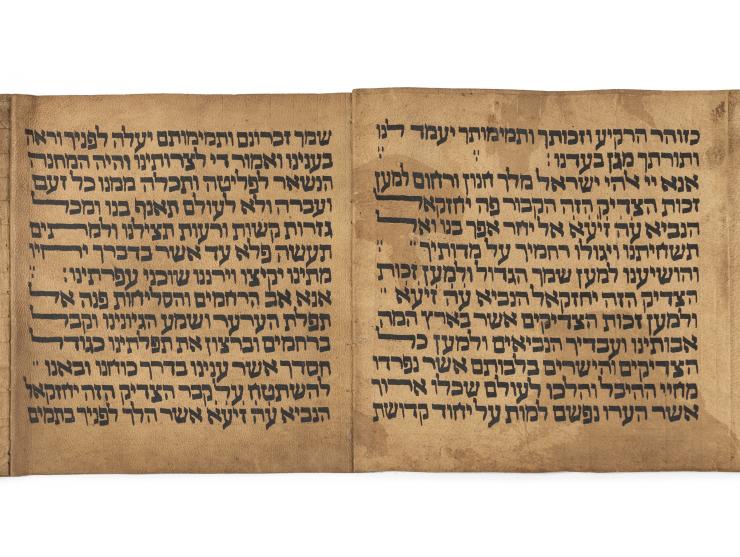
Manuscript, parchment Megillat Yechezkel – order of verses and prayers to be recited at the tomb of the prophet Yechezkel on the Euphrates. [Iraq, ca. 19th century].
Ink on gevil (soft, brown parchment), in Iraqi Torah scroll script. 18 columns on 9 membranes, approx. 13 lines per column. Parchment lace for fastening. Mounted on a carved wooden roller.
Iraqi Jews customarily read from such scrolls during the pilgrimage to the gravesite of the prophet Yechezkel on Shavuot (Eid al-Ziyara) and Elul.
The contents of the present scroll: sections of the Book of Yechezkel (Maaseh Merkavah – from Yechezkel chapter 1; Yechezkel 3:12, and the Vision of the Dry Bones – chapter 37); a lengthy prayer – "Peace be upon you our master and teacher, peace to you and peace to your pure and holy body here buried… O Lord, G-d of Israel… in the merit of the righteous man buried here, the prophet Yechezkel…"; several chapters of Tehillim and rabbinic sayings; and another brief prayer – "May it be Your will… that everything we requested of You be in Your eyes like the incense… for You hear prayer for the sake of all the righteous and this righteous man, the prophet Yechezkel, for You hear the prayer of every mouth…". At the top of the scroll is a dedicatory inscription: "Dedicated by R. Abdallah Abd Lazir. In the merit of our master the prophet Yechezkel, may G-d grant him the wishes of his heart for the good for His service, and may all his 248 limbs and 365 sinews be healthy and complete, Amen".
The tomb of the prophet Yechezkel was venerated by Jews of Iraq and neighboring regions, and for hundreds of years was a focal point for pilgrimage. The tomb is located in the Al Kifl village (known as "the village of our master, prophet Yechezkel"), in a structure built on the banks of the Euphrates (approx. 120 km south of Baghdad and 28 km south of Hillah, Babylon, Iraq). R. Binyamin of Tudela, who visited the site in 1170 writes: "...that place is venerated by the Jewish people to this day; people come from afar to pray and celebrate there between Rosh Hashanah and Yom Kippur, and the exilarch and heads of the yeshivas also come from Baghdad...".
In 1180, R. Petachiah of Regensburg visited the site and likewise described the mass pilgrimage and miracles which took place on that occasion: "...on Sukkot, people come from all countries, and the entrance widens and heightens on its own to the extent camels can enter; some sixty thousand or eighty thousand Jews convene there, apart from the Muslims, and build Sukkot in the courtyard of Yechezkel. Then the entrance contracts to its original size and everyone witnesses it..." (for more information about the Tomb of Yechezkel, associated customs and historical attestations, see: Avraham Ben-Yaakov, Kevarim Kedoshim BeBavel, Jerusalem 1974, pp. 38 ff.).
Many wondrous stories are associated with the Tomb of Yechezkel, and many Jews would visit it to pray and beg for salvation. There was an ancient custom to visit Yechezkel's tomb on Shavuot, on the first day of which the beginning of the Book of Yechezkel (Maaseh Merkavah) is read as haftarah. Thousands of Jews from the area would participate in this event. Another prevalent pilgrimage time was the month of Elul and the subsequent festivals of Tishrei. On both these occasions, pilgrims to the gravesite would recite a special order of verses and prayers from parchment scrolls (see Kevarim Kedoshim BeBavel, ibid, pp. 80-81).
Height of parchment: approx. 11.5 cm. Good-fair condition. Dark stains and wear. Slight erasure of some letters. Height of handle: approx. 27.5 cm. Good condition. Minor open fractures.
For more information on other Scrolls of Yechezkel written and dedicated to the prophet Yechezkel, see: David Solomon Sassoon, Descriptive Catalogue of the Hebrew and Samaritan Manuscripts in the Sassoon Library, London (I, pp. 558-564) – one of them is the scroll dedicated by R. Eliyahu Chaim, father of the Ben Ish Chai, in 1859 (Sassoon Ms. 312 – ibid., I, p. 559); Kedem, Auction 83, 6 September 2022, Lot 8.
Category
Manuscripts
Catalogue Value
Auction 107: Rare and Important Items
Apr 15, 2026
Opening: $2,000
Estimate: $3,000 - $5,000
Sold for: $5,000
Including buyer's premium
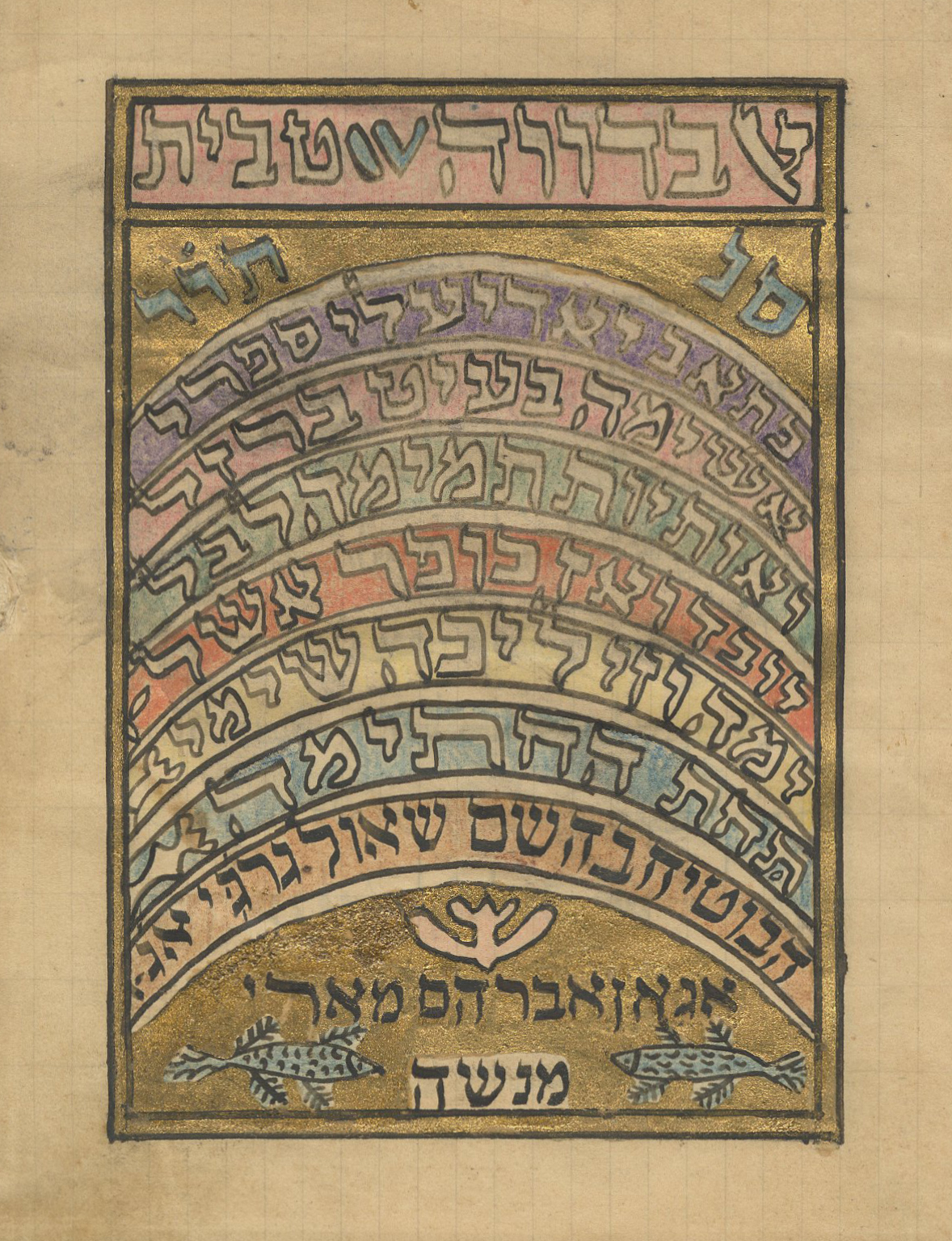
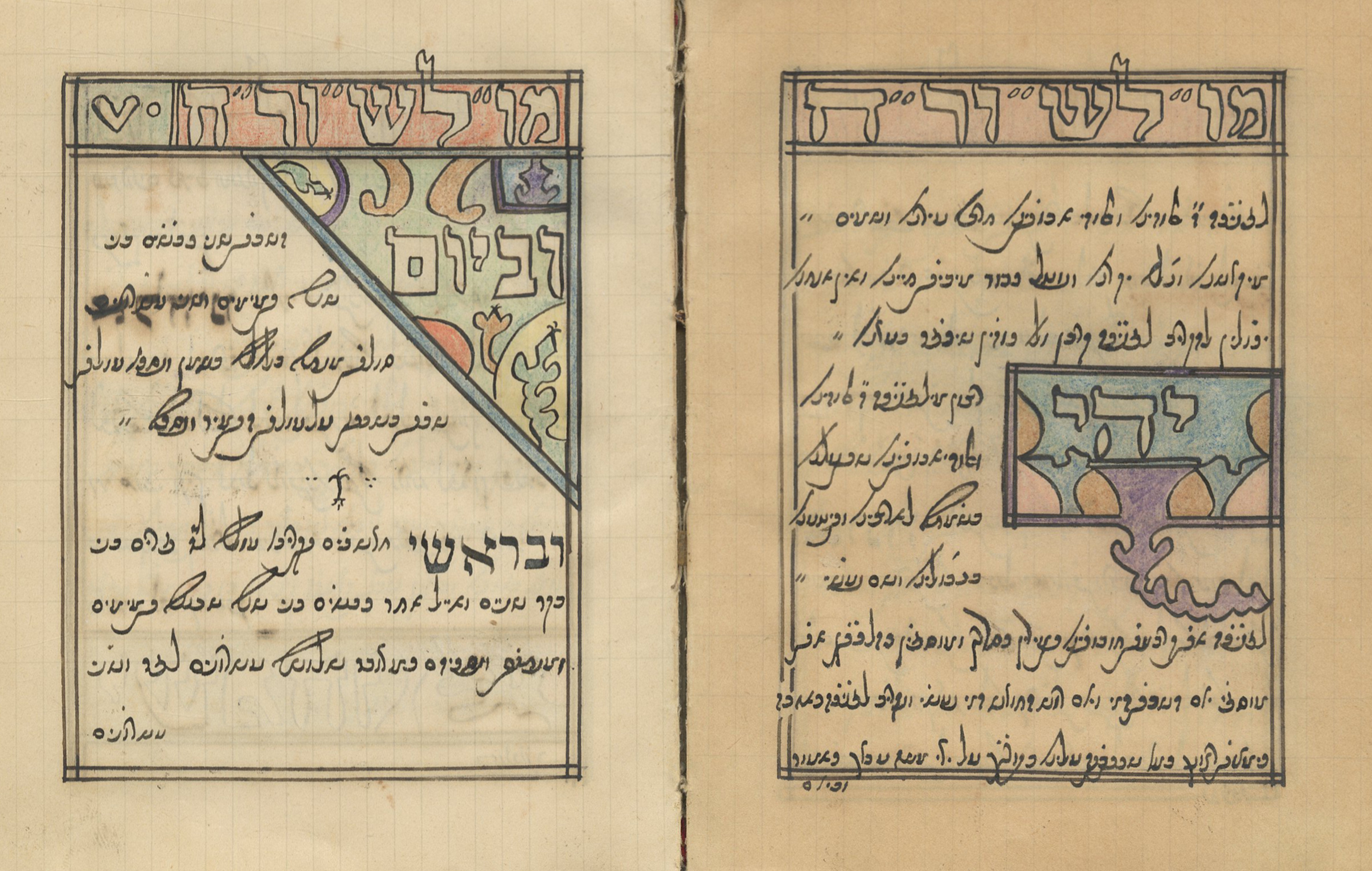
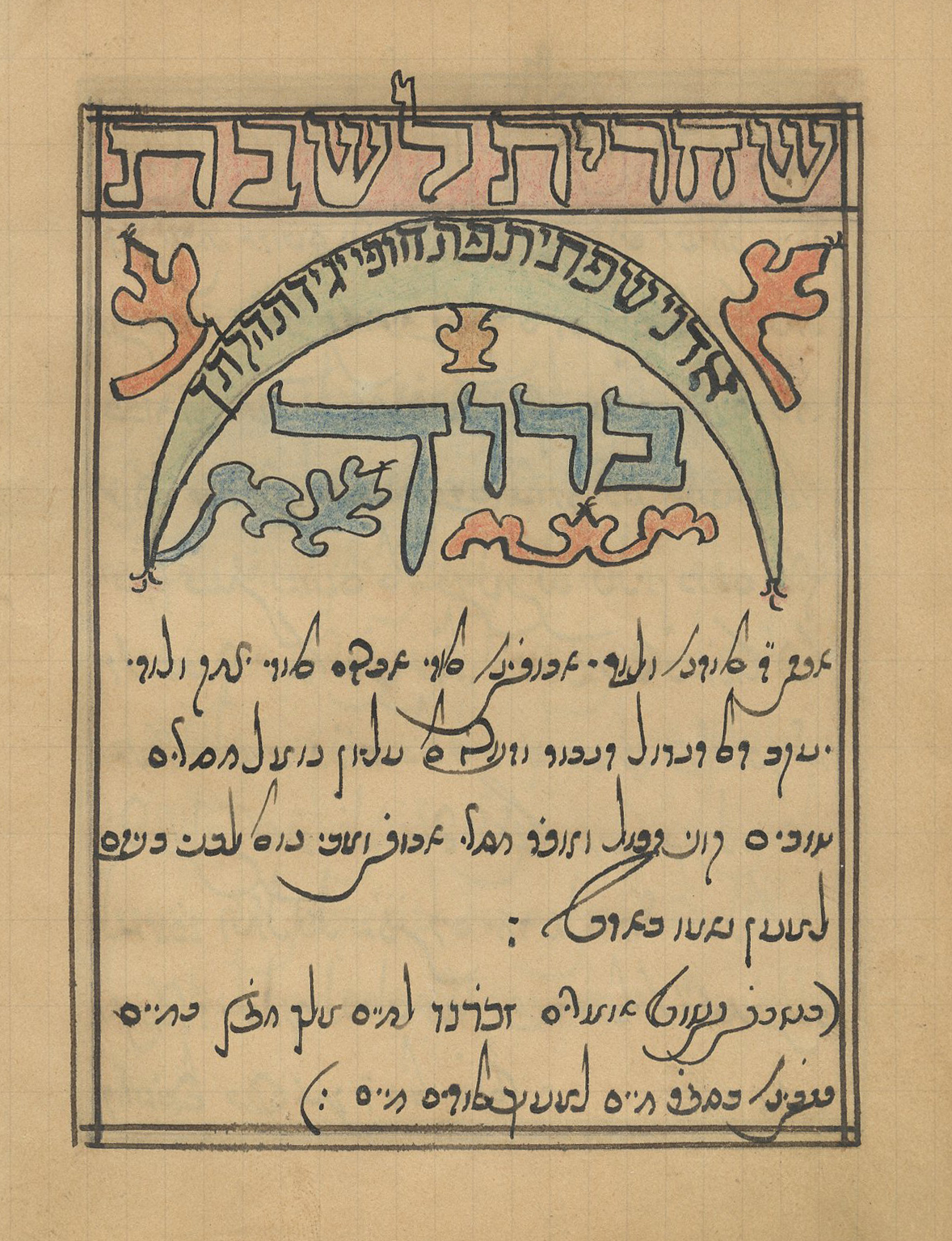
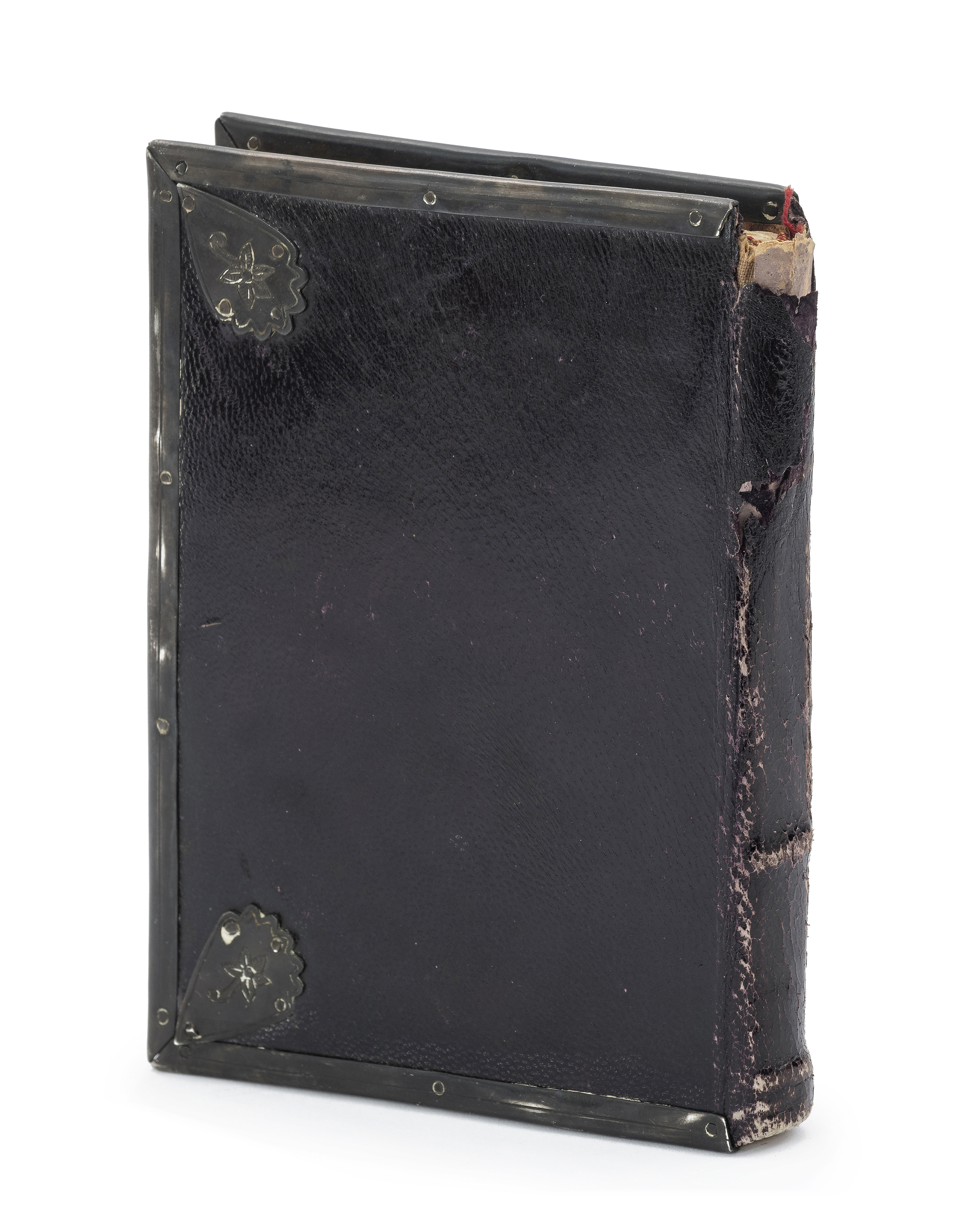
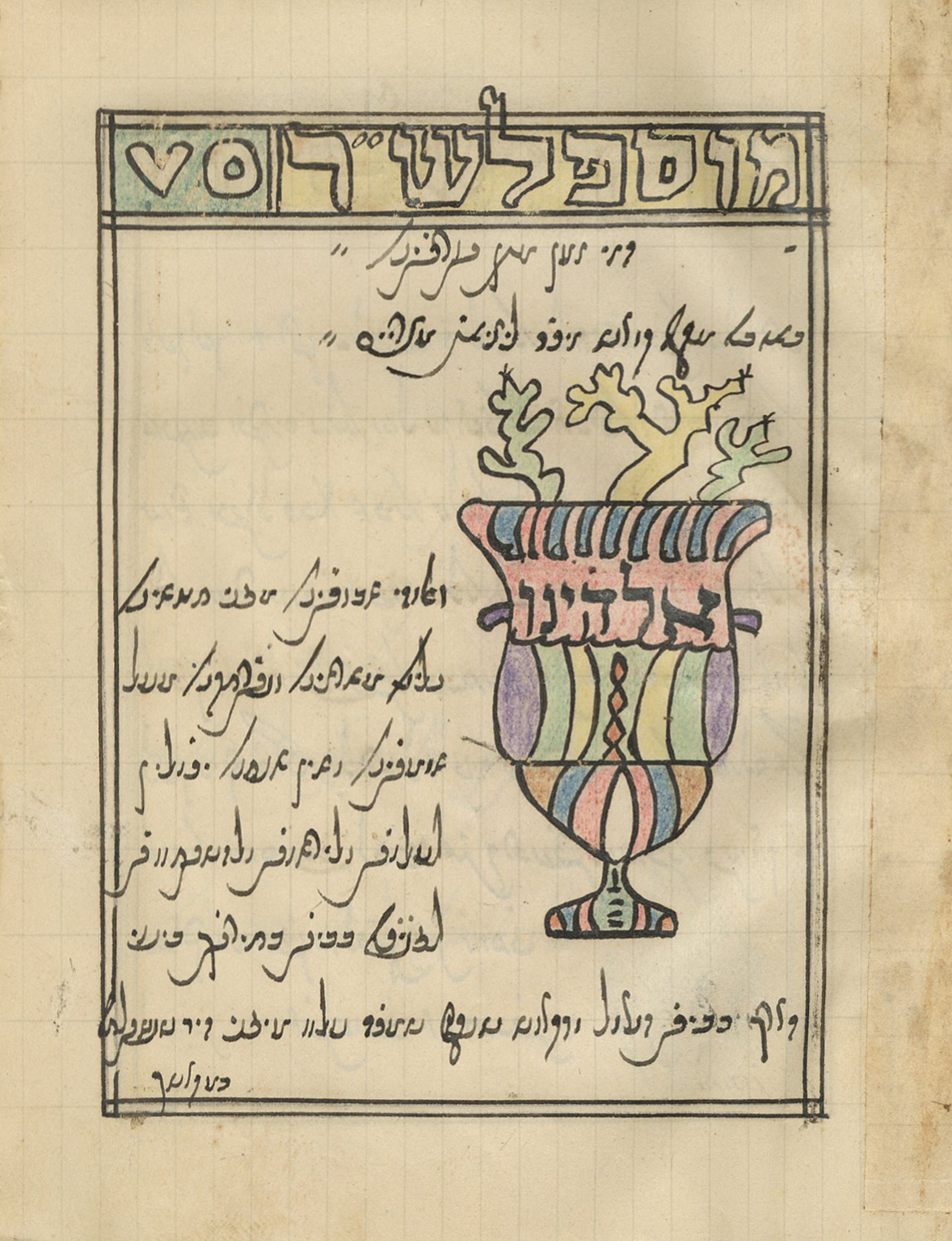
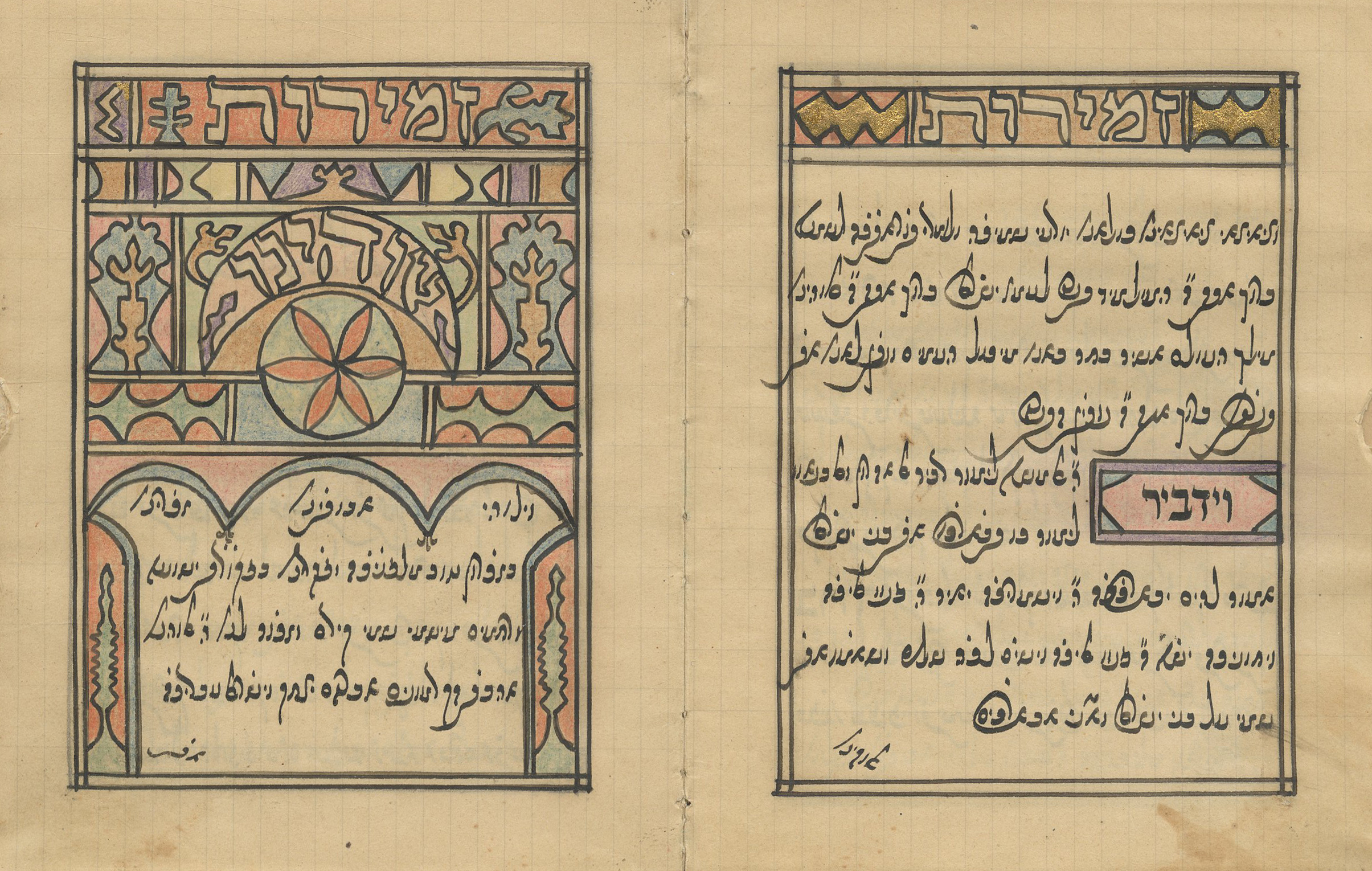
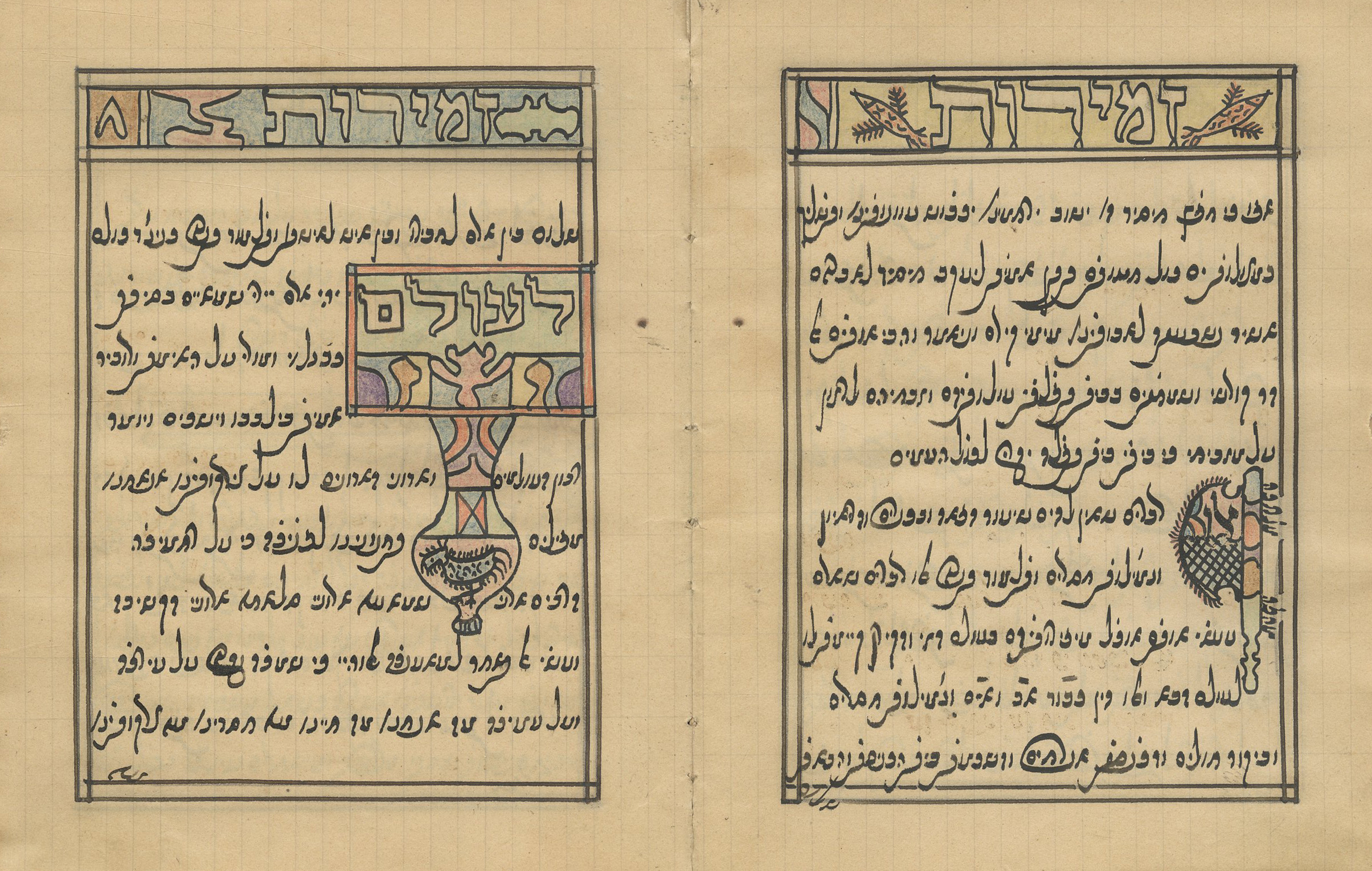
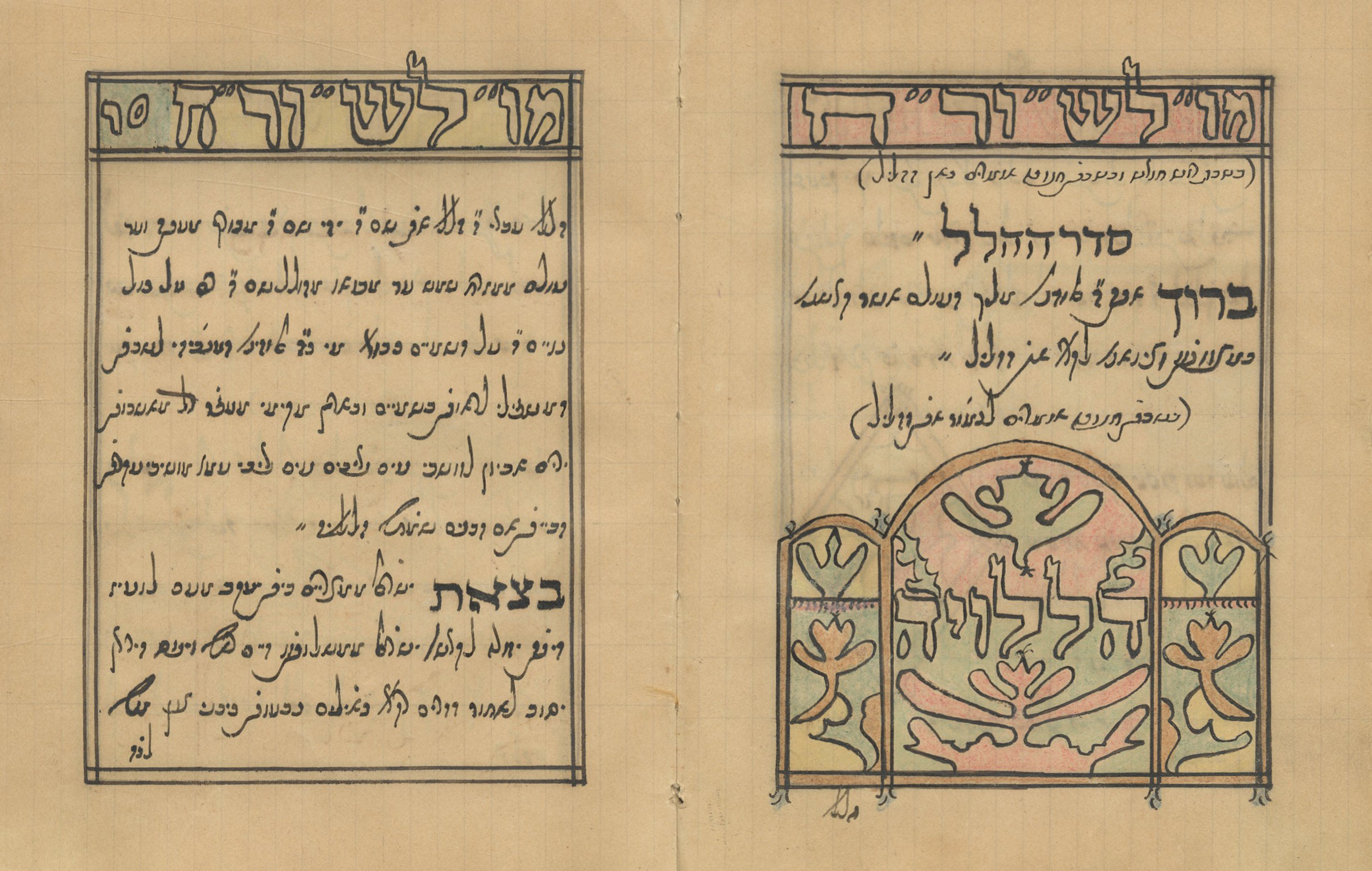
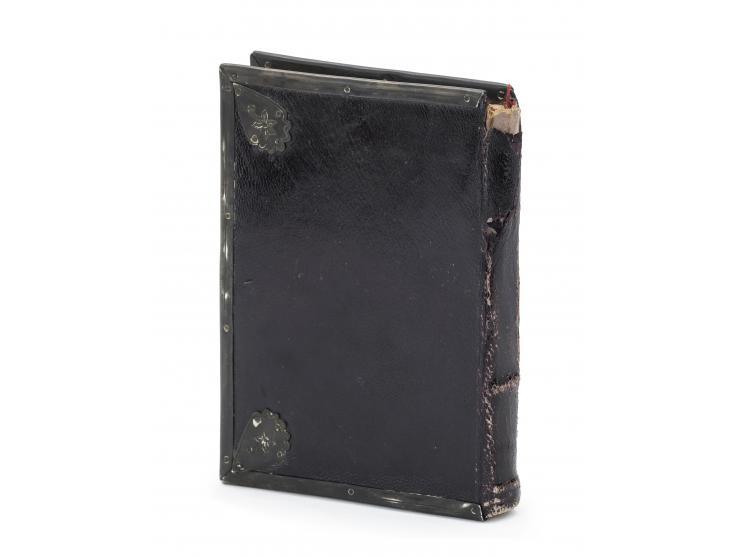
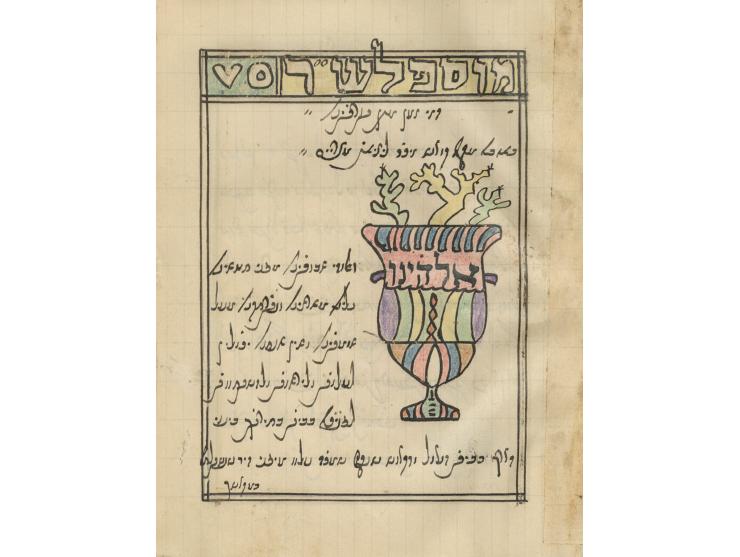
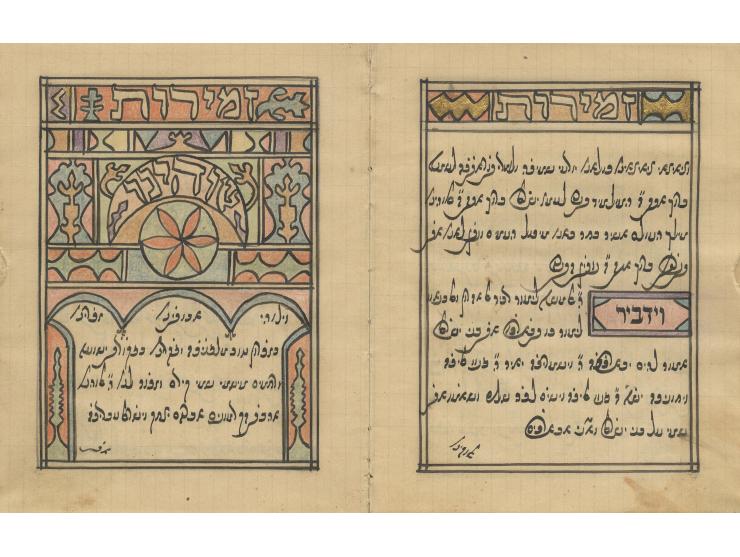
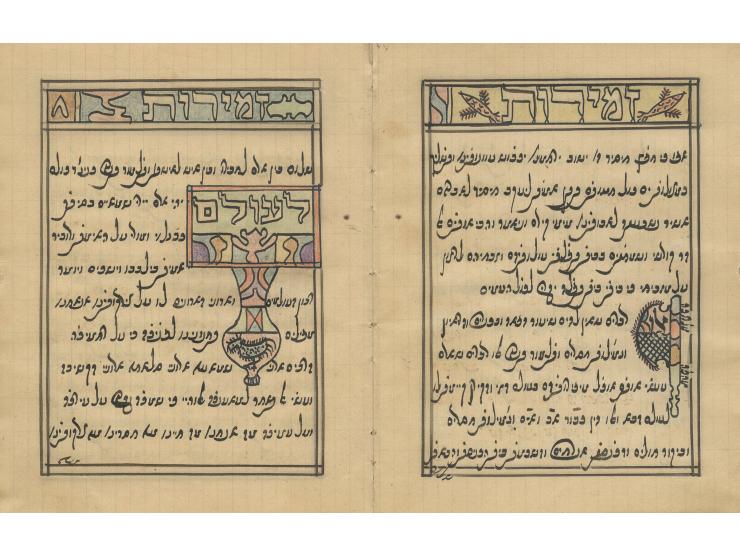
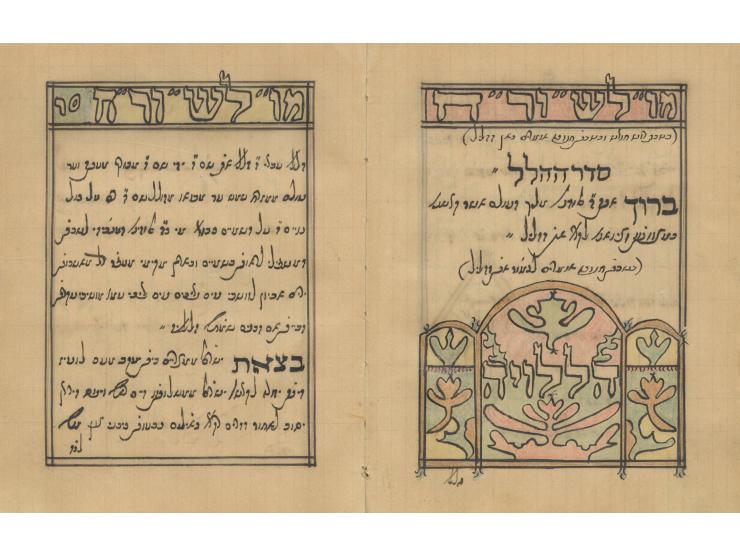
Decorated manuscript, siddur for Shacharit and Musaf prayers of Shabbat, Shabbat Rosh Chodesh and three festivals. [Baghdad, early 20th century].
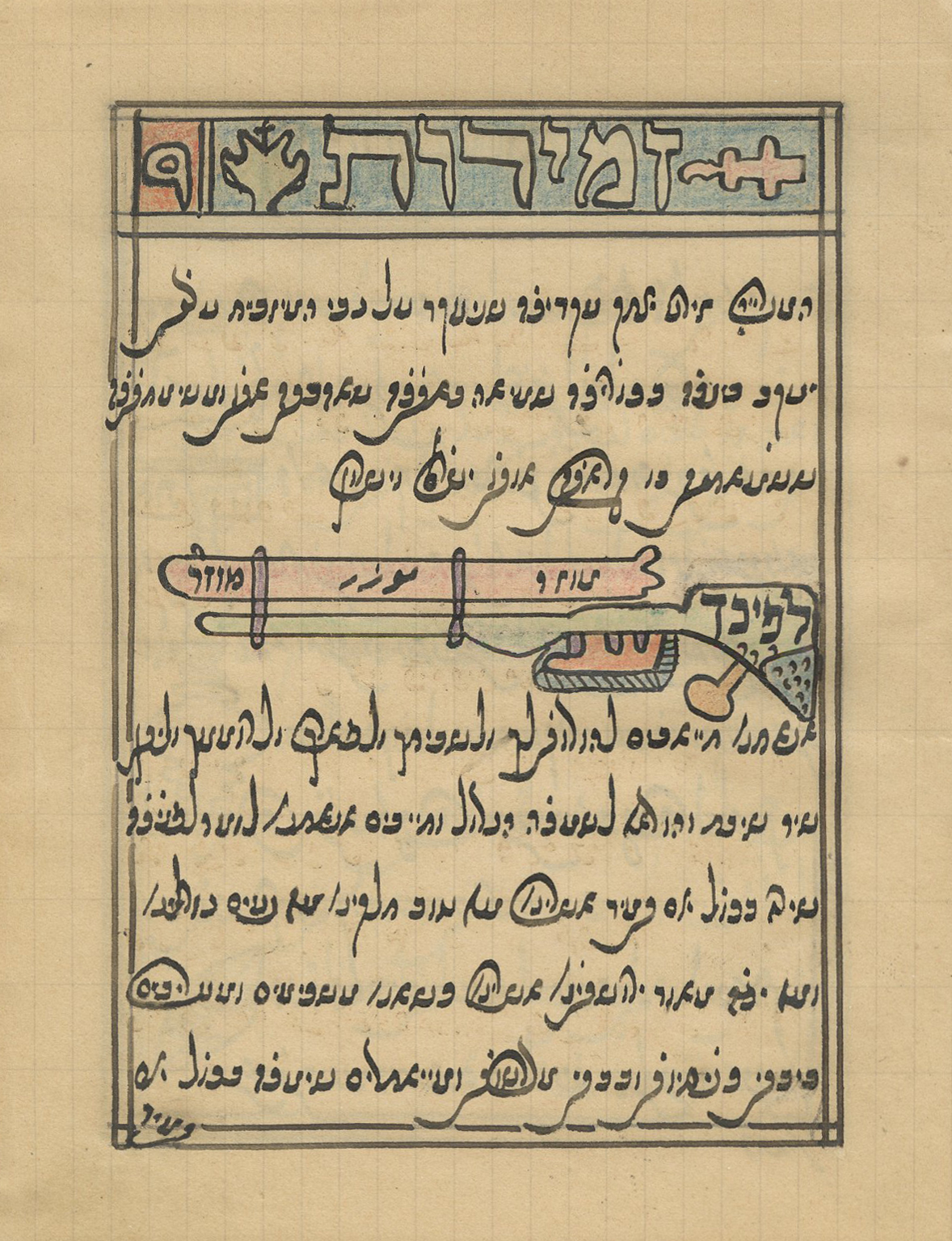
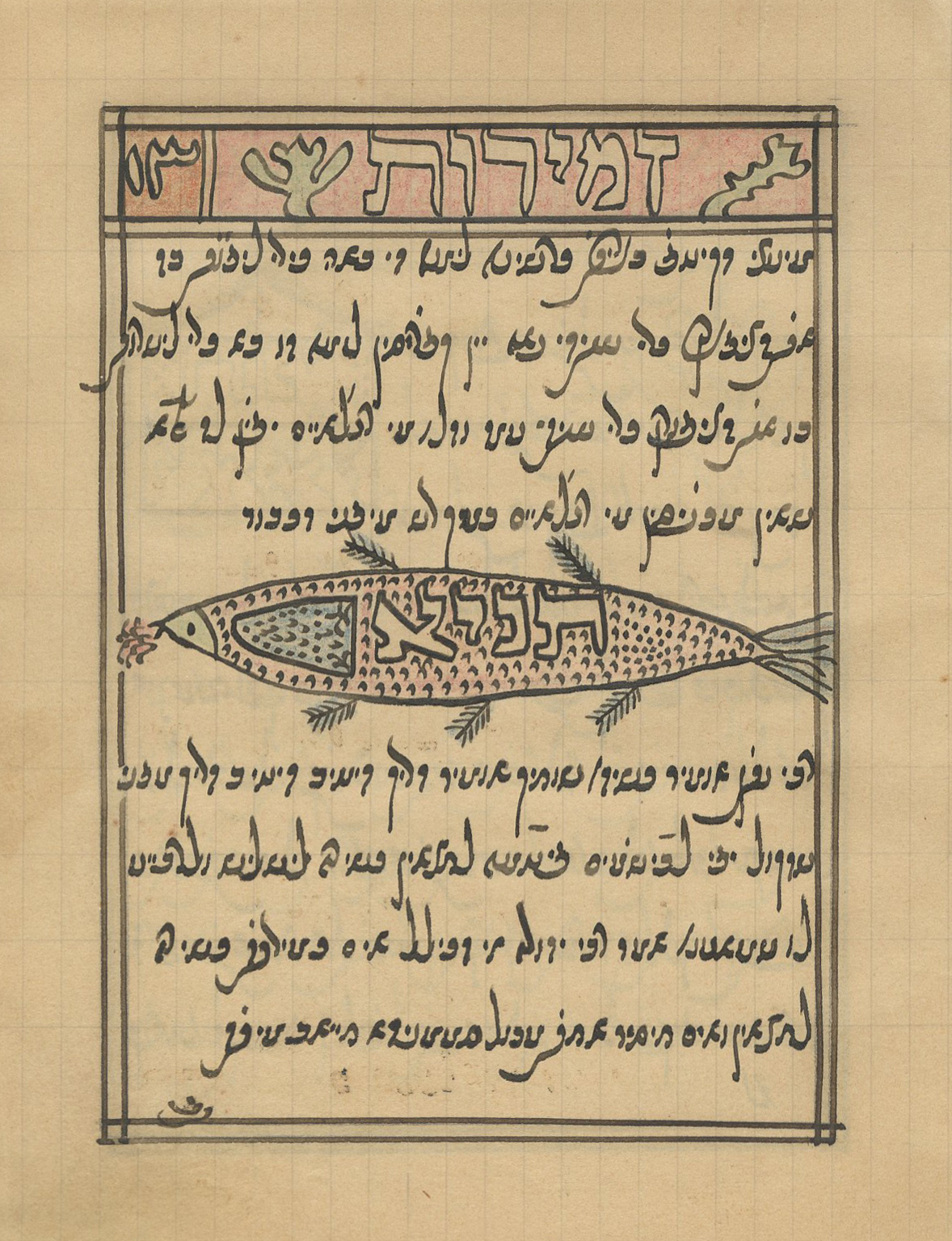
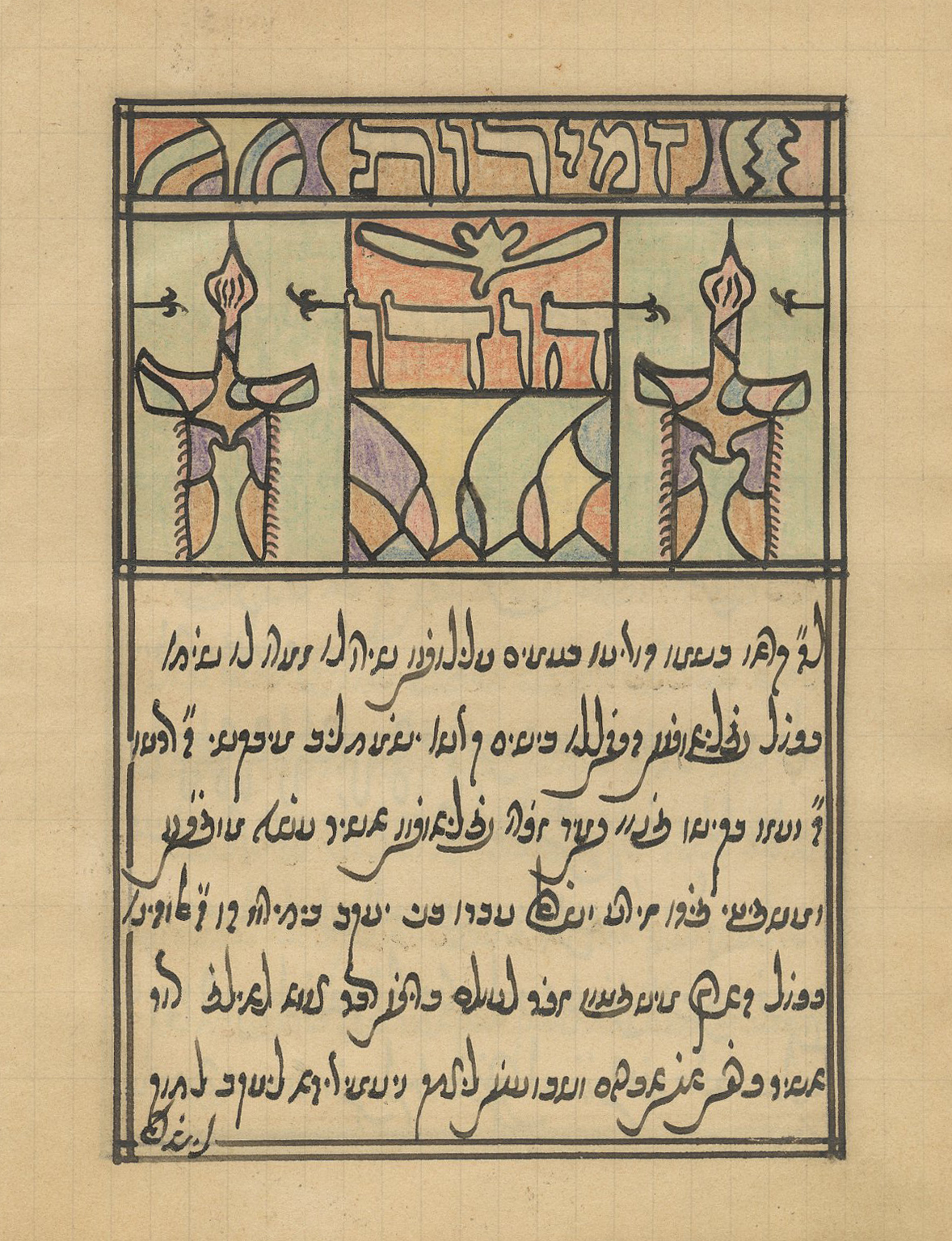
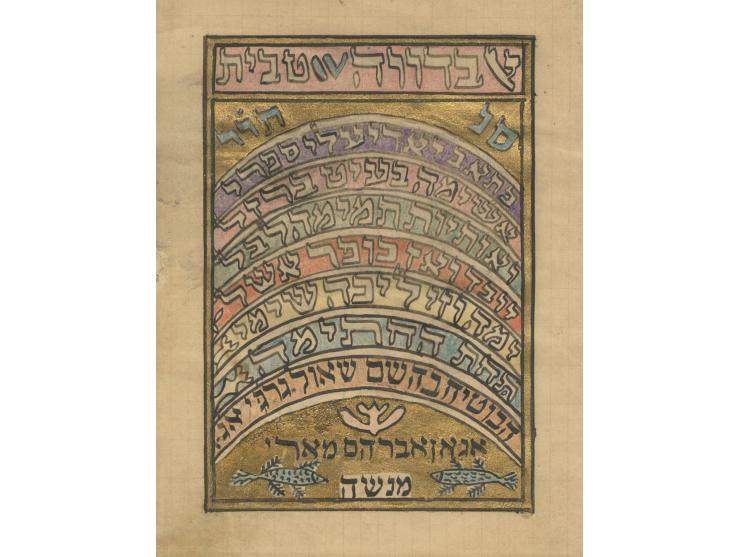
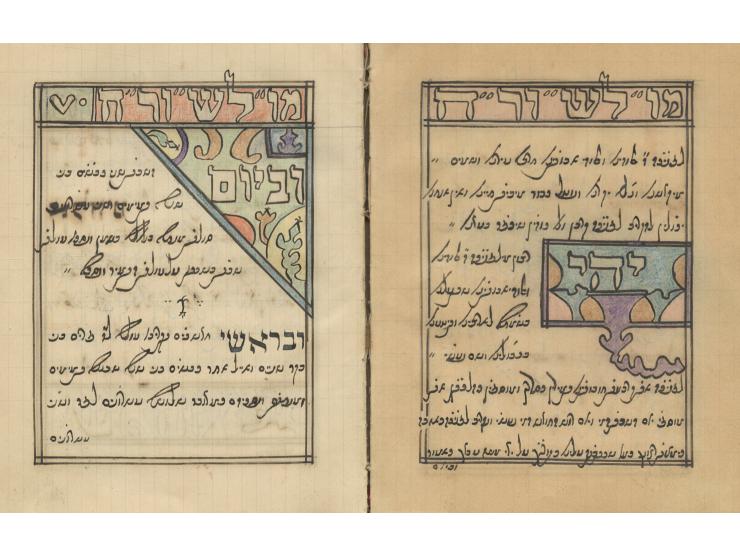
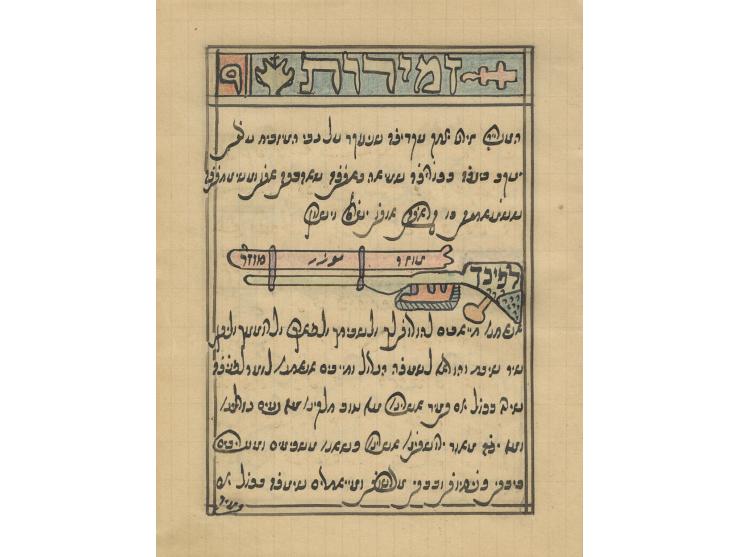
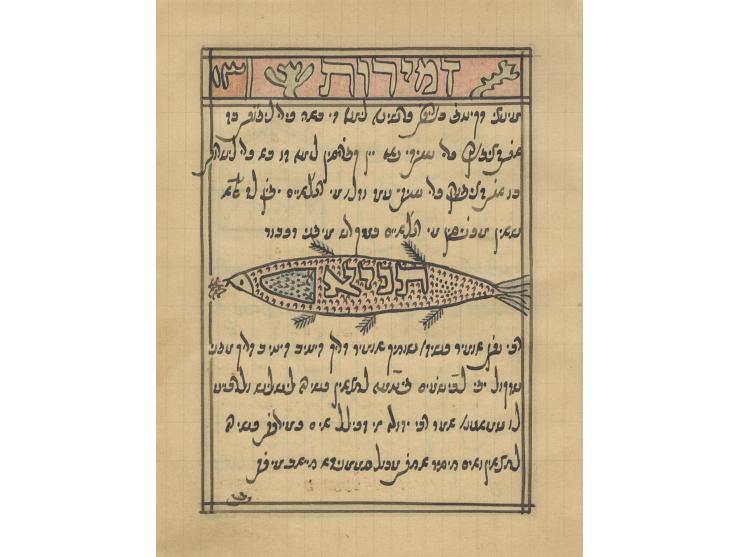
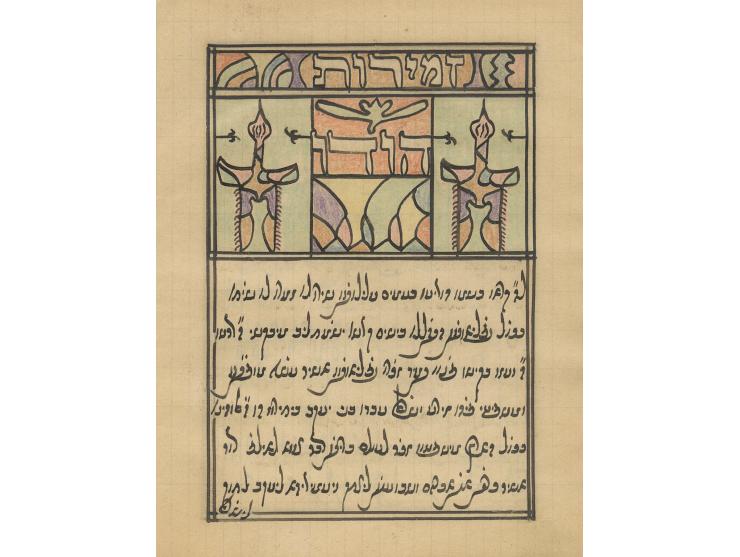
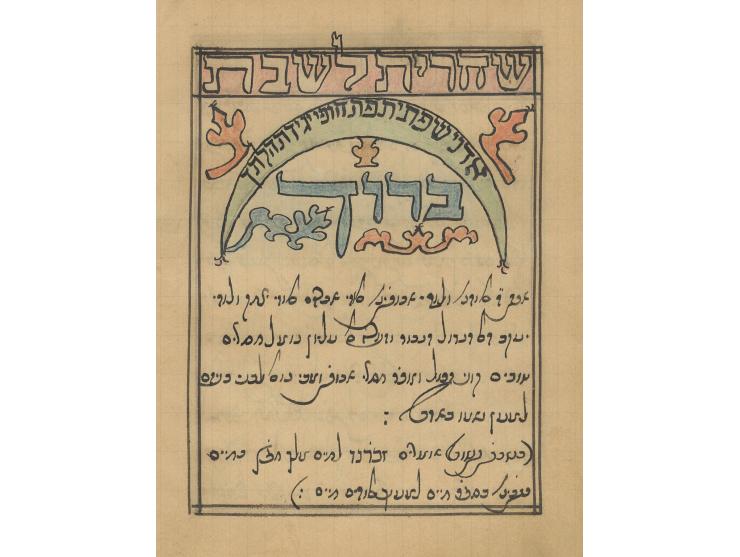
Complete manuscript, written and decorated with an artistic hand throughout. Pocket format. Oriental semi-cursive and square scripts. Initial panels illustrated and decorated (enlarged) in various colors. All pages have headers and initial words in decorative frames (enlarged, with paint, floral motifs and more; foliated with Eastern Arabic numerals within upper header). Some initial panels decorated with various illustrations around them, such as leaves, birds, fish, vases and more. Especially large decorations in several places, at times taking up about a third or half of the page.
The title page is designed as a sort of "rug", at the center of which is written (in rhyme and non-standard orthography): "I place my signature on my book in iron pen and perfect letter, lest it be lost and I pay ransom, and this is my name below the signature", followed by the name of the owner or scribe: "Having faith in G-d, Shaul Garji Agajan Avraham Mari Menashe" (see ownership inscription quoted below).
On p. 9a – Initial word (Lefichach) appears within an illustration of a rifle, with a caption in Hebrew (semi-cursive and cursive) and Arabic: "Mauser" (a German weapons manufacturer that lent its name to the rifles they produced). Another illustration of weaponry in the initial panel (Elu) on p. 7b – an illustration of a battle-axe (tabar), captioned in Judeo-Arabic, apparently meaning "tried and true".
All decorations variously colored (apparently colored pencils or pastels). On title page and initial panel on verso, also filled in with gold color.
The handwriting and decorations are characteristic of Baghdad; see for instance: manuscripts from the Gross Family Collection, IQ.011.007, auctioned at Kedem, Auction 92, Part II, Lot 133; and IQ.011.002, auctioned at Kedem, Auction 94, Part I, Lot 25.
The siddur includes: Shacharit, beginning with morning blessings, Korbanot and Ketoret, Pesukei DeZimra, Shema blessings, Shacharit and Musaf for Shabbat, Hallel, Musaf for Shabbat Rosh Chodesh, and Shacharit and Musaf for festivals.
At end of manuscript (on blank page after leaf 83), ownership inscription in another hand (cursive Judeo-Arabic): "This copy belongs to Shaul Garji son of Agajan son of Avraham son of Mari son of Menashe son of Mulla David son of Mulla Yosef son of Mulla Pinchas son of Mulla Ghiyas Yazdi".
83 leaves (original foliated in Eastern Arabic numerals). 13.5 cm. Good condition. Stains. Marginal tears to several leaves. Several leaves detached. Original leather binding, with metal decorations. Binding loose, with defects to spine.
Category
Manuscripts
Catalogue Value
Auction 107: Rare and Important Items
Apr 15, 2026
Opening: $12,000
Estimate: $20,000 - $25,000
Sold for: $23,750
Including buyer's premium
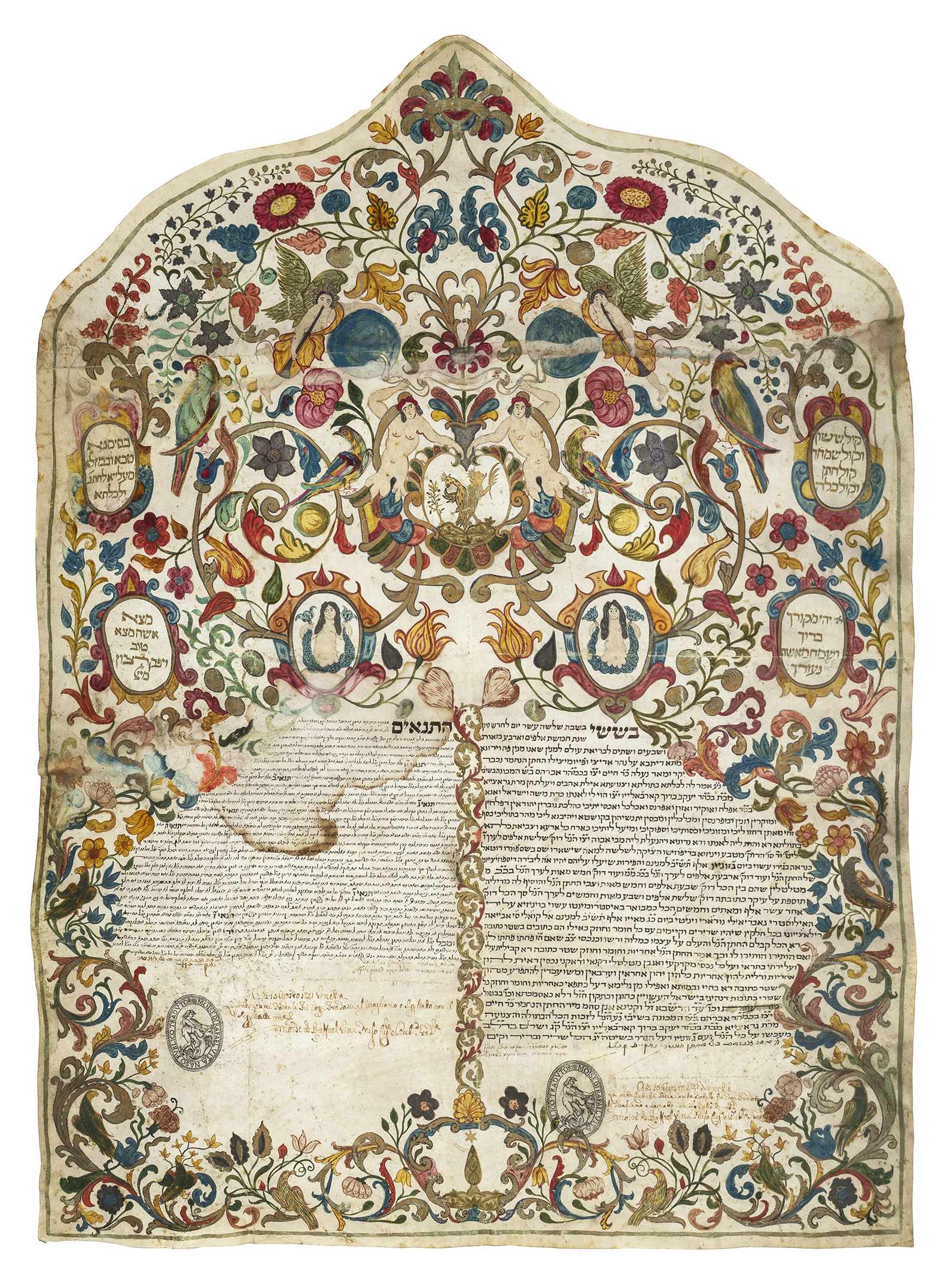
Decorated parchment ketubah, for the wedding of Chaim son of Avraham Basevi and Grazia daughter of Yaakov Baruch Caravaglio. Verona, Italy, 13th Sivan 5472 [17 June 1712].
Ink and paint on parchment.
Written on a large rectangular parchment sheet, with upper edge cut in a wave pattern. The text is written in two columns: the ketubah text in square script to the right, and the Tena'im in Sephardic cursive script to the left. Beneath the text of the ketubah as well as the Tena'im text are signatures of the groom and witnesses, R. Menashe son of Yaakov Chefetz and R. Yeshayahu son of Yisrael Chizkiyah Bassan; these are followed by a certificate of inscription in the community ledger, signed by the registrar Shlomo Levi Mortera (in Hebrew); below this is the signature and stamp of the translator, Moshe son of Refael Chai Naso of Venice, attesting that he translated the ketubah in Venice on 15 August 1741 (in Italian). After detailing the monetary agreements, the ketubah text states that a civil marriage document was drawn up in Venice on 10 June 1712 by Gabriele Nodari Veneti.
Both rabbis whose signatures appear on this ketubah officiated in Verona. R. Menashe Chefetz (d. 1734) served as rabbi in Gorizia and later Verona; he was a brother-in-law of R. Moshe Chagiz and teacher of R. Shimshon Morpurgo, author of Shemesh Tzedakah. R. Yeshayahu Bassan (1673-1739) was born in Verona to the city's rabbi, and himself served as rabbi in Verona, Padua and later Reggio; he was a disciple of R. Moshe Zacuto and primary teacher of R. Moshe Chaim Luzzatto (the Ramchal).
The ketubah frame is decorated brightly and colorfully, in symmetric composition, and comprises two parts: the top is fully decorated in vegetal patterns, incorporating a pair of angels blowing horns, two pairs of parrots, two two-tailed mermaids and four medallions inscribed with blessings. Another pair of figures supports the central cartouche, containing the Basevi coat of arms – an upright lion holding a branch, alongside an eagle next to an olive tree (which also appears on another ketubah of the Basevi family of Verona, dated 1687). The lower part is decorated in matching vegetal patterns, and at the center of the bottom edge is a decorated cartouche with a coat of arms – a star above a tree – probably that of the bride's family, Caravaglio (a name signifying the oak tree).
The Caravaglios were a Marrano family of Portuguese origin that settled in Venice in the mid-17th century, where they attained a high social status and became one of the wealthiest Jewish families, as reflected in the high quality of decorated ketubot of this family. For further information on the Caravaglio family, see: Aldo Luzzatto, La Comunità ebraica di Venezia e il suo antico cimitero (Milan, 2000), pp. 310-313 (the present ketubah as well as the ketubah appearing in the following lot are mentioned there on p. 312, note 4). Other ketubot of the Caravaglio family (Livorno, 1720 and Pisa, 1764) are located in the U. Nahon Museum of Italian Jewish Art in Jerusalem (388 Ms. ON) and the Cindy and David Sofer Collection in London (ketubah no. 8).
64.5X86.5 cm. Fair-good condition. Many creases and folding marks. Stains and some large, dark dampstains, slightly affecting text and decorations, mainly to upper half. Inscription in Italian script on verso, dated 1716.
Category
Ketubot
Catalogue Value
Auction 107: Rare and Important Items
Apr 15, 2026
Opening: $25,000
Estimate: $30,000 - $40,000
Sold for: $31,250
Including buyer's premium
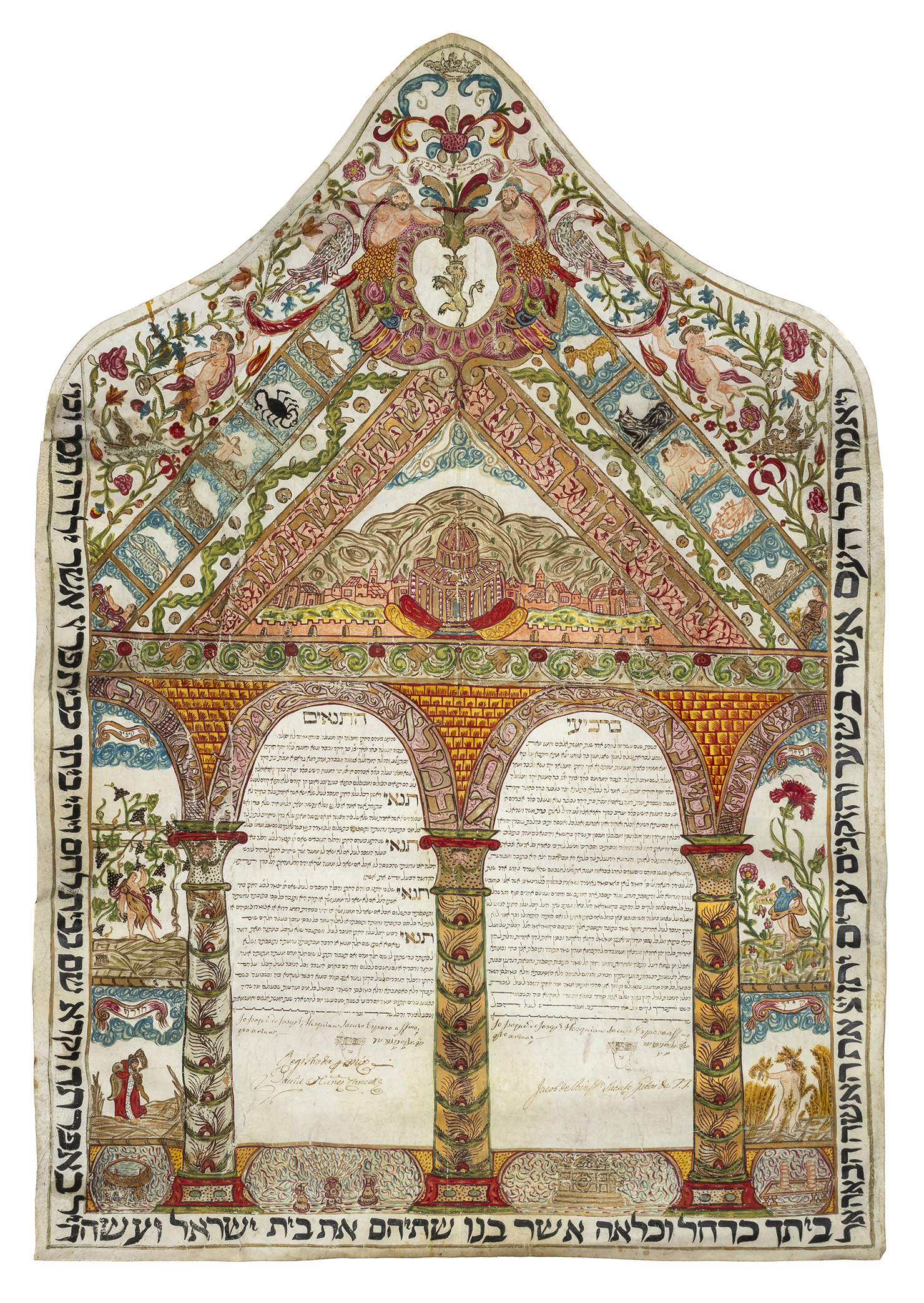
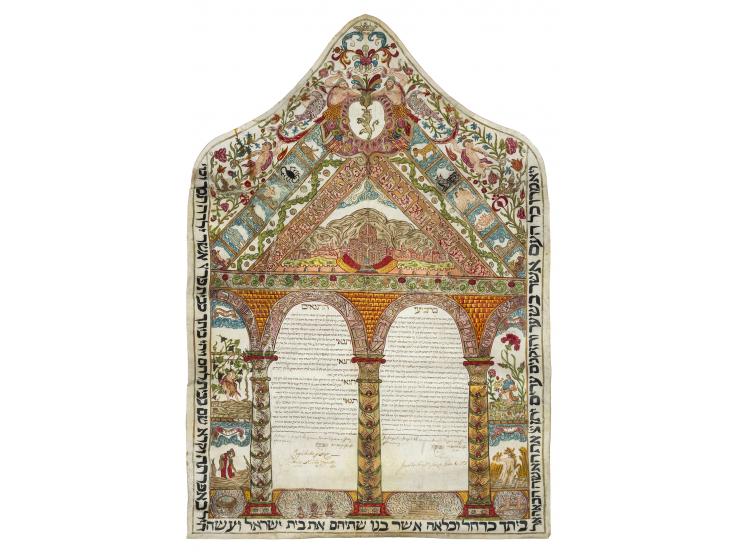
Decorated parchment ketubah, for the wedding of Yitzchak son of Yosef Chizkiyahu Sacuto and Donna Grazia daughter of Avraham Chai son of Yaakov Baruch Caravaglio. Livorno, Italy, 12th Adar 5507 [22 February 1747].
Ink and paint on parchment.
Written on a large parchment sheet, with upper part cut in pointed arched pattern. The text is written in two columns, in Sephardic semi-cursive script, with a few words in square script. The ketubah text is to the right, and the Tena'im to the left (in accordance with the custom of the Sephardic Jews of Livorno). Beneath the text of the ketubah are the signatures of the groom (in Latin characters), two witnesses – Shalom Attar and Moshe son of Refael Baruch (in Hebrew) – and the signature of the gabbai of the Talmud Torah, Yaakov Binyamin Sacuto (in Latin characters). Signatures of the groom and witnesses appear once more beneath the Tena'im, followed by the signature of the registrar, David Nuñez. The ketubah text states that a civil marriage document was drawn up by the notary Giovan Battista Gamerra on February 20th.
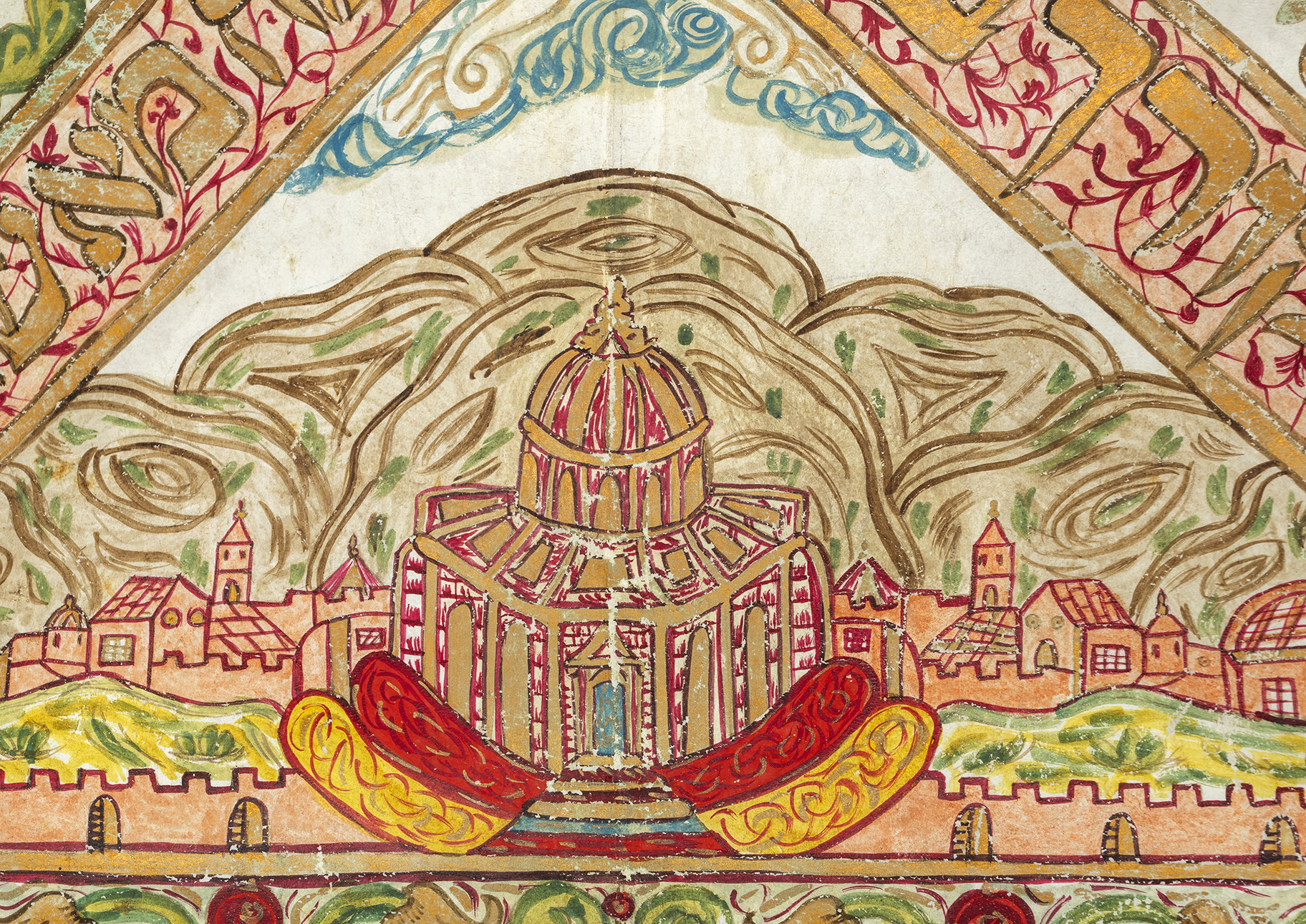
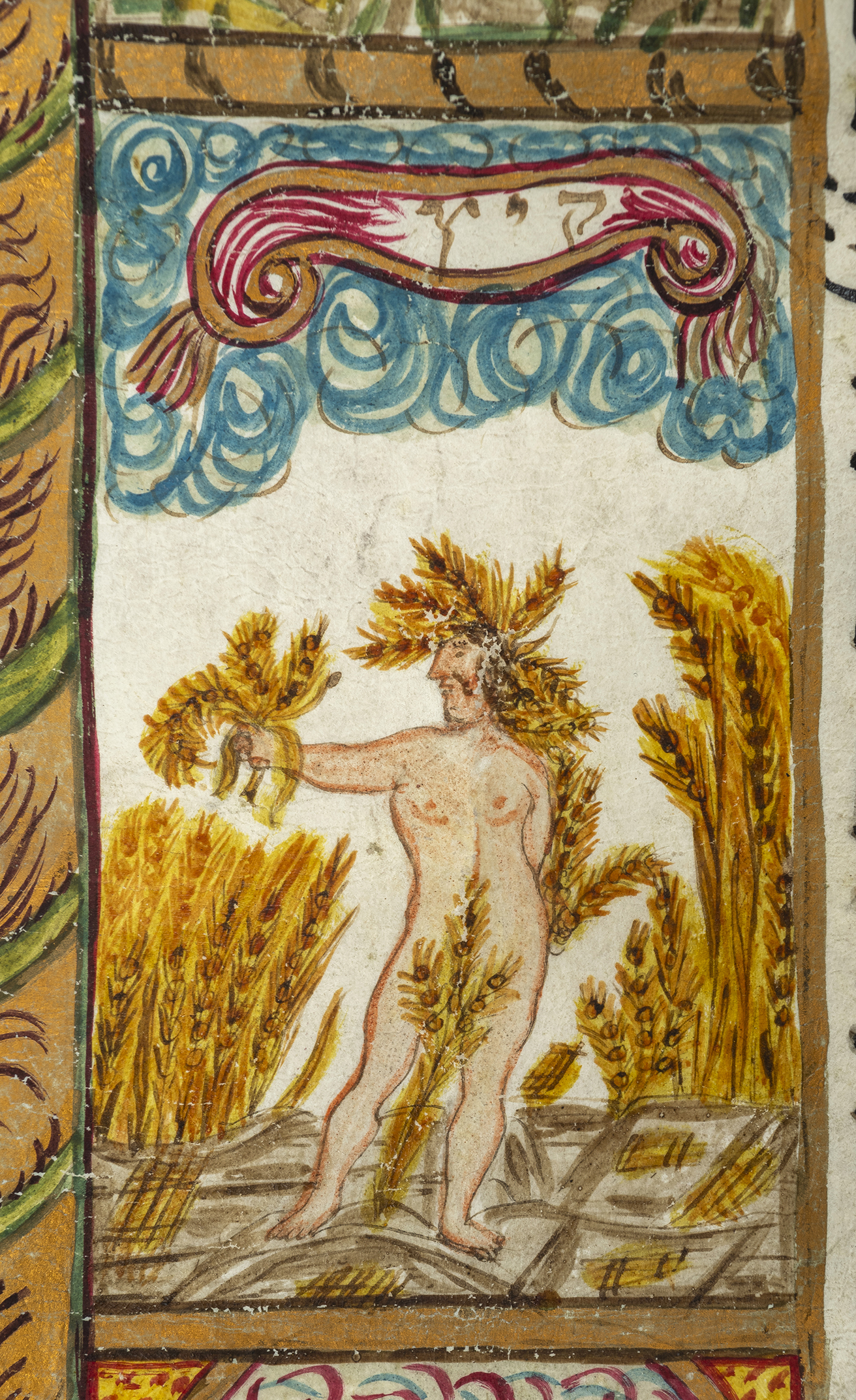
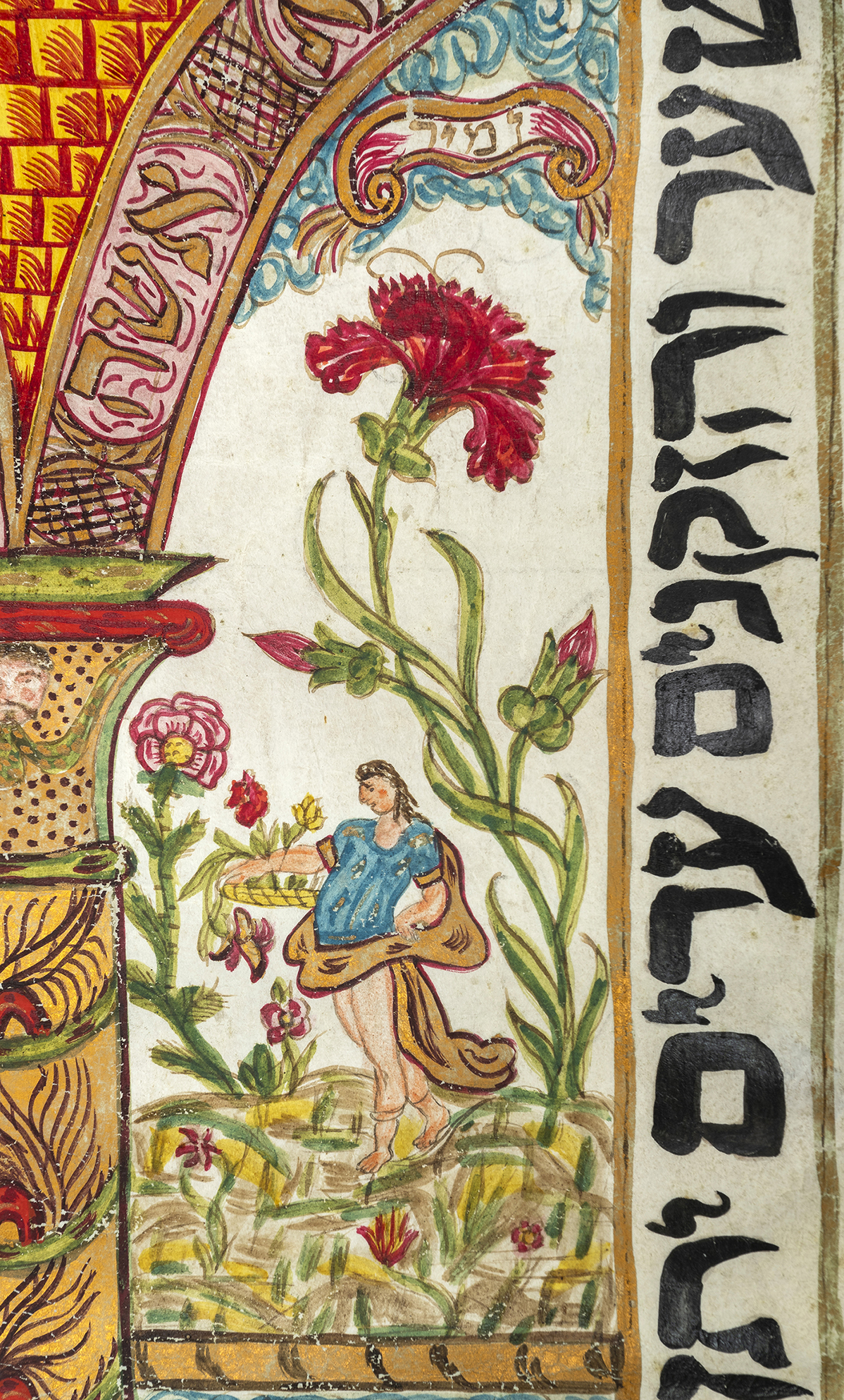
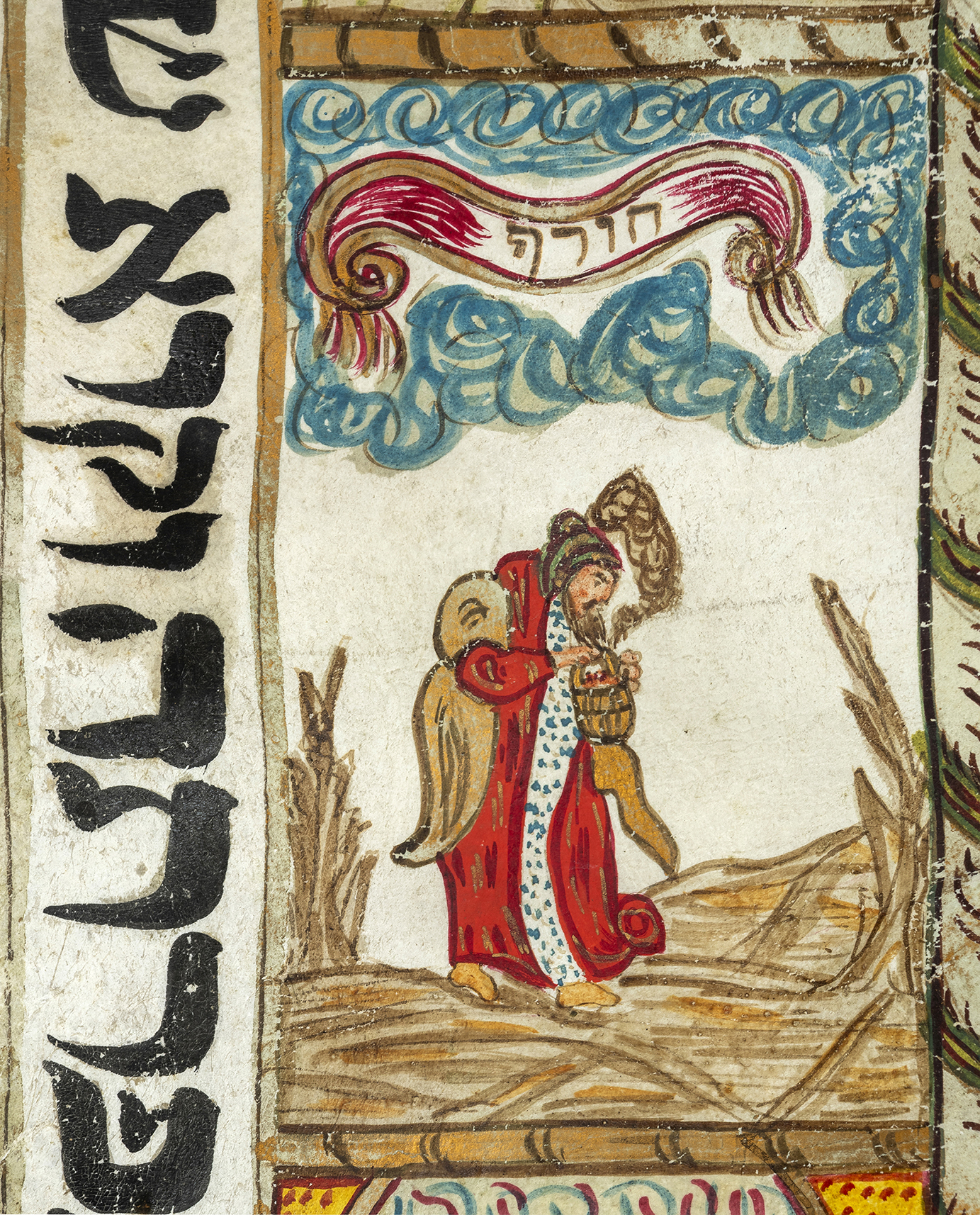
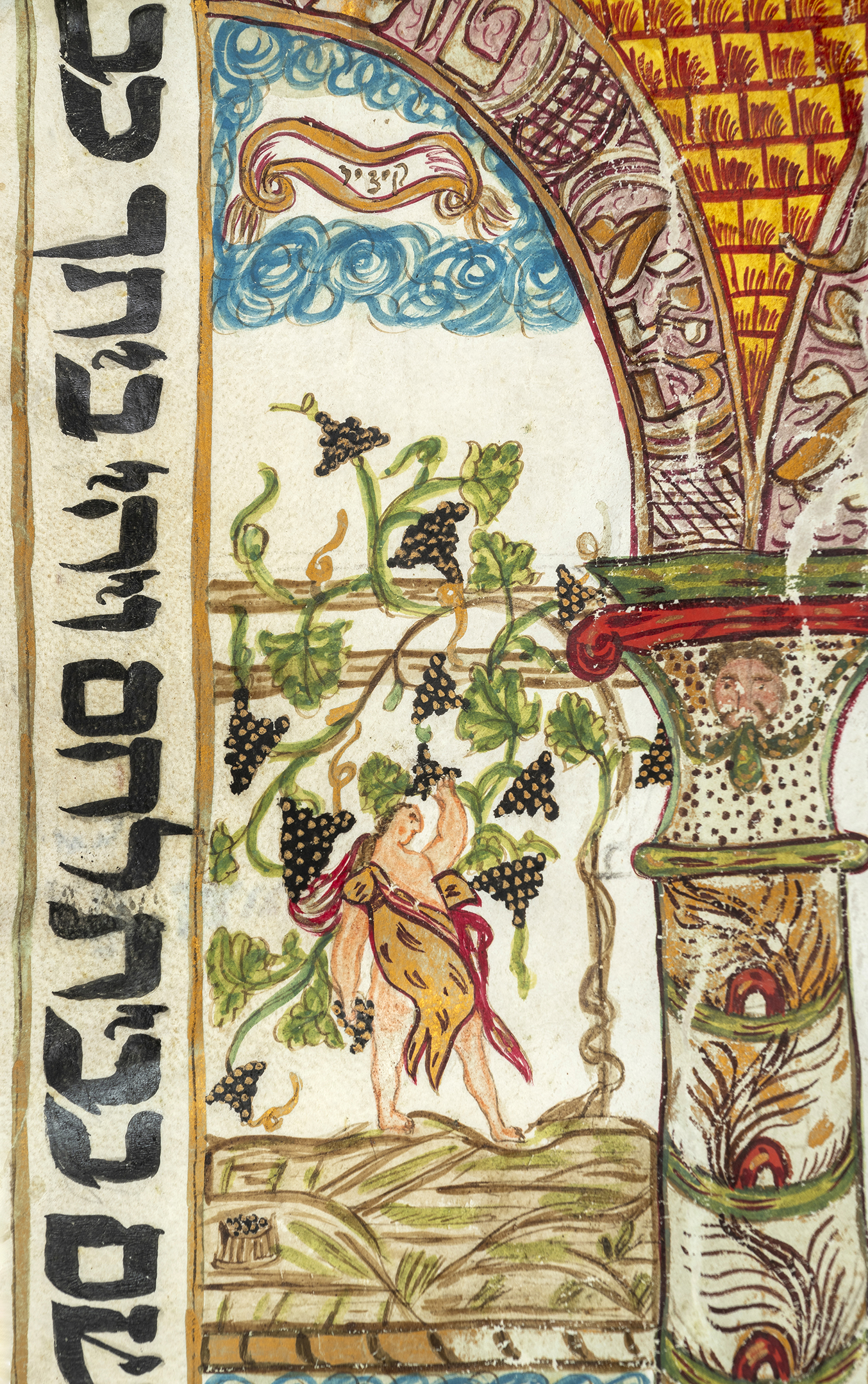
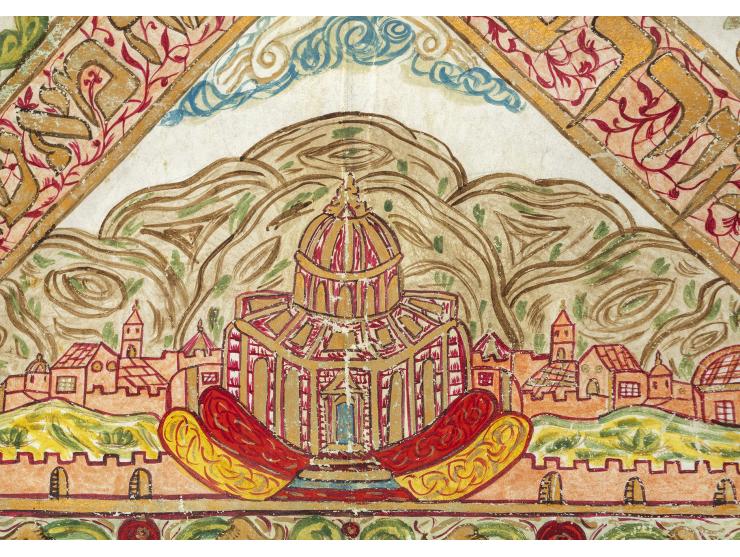
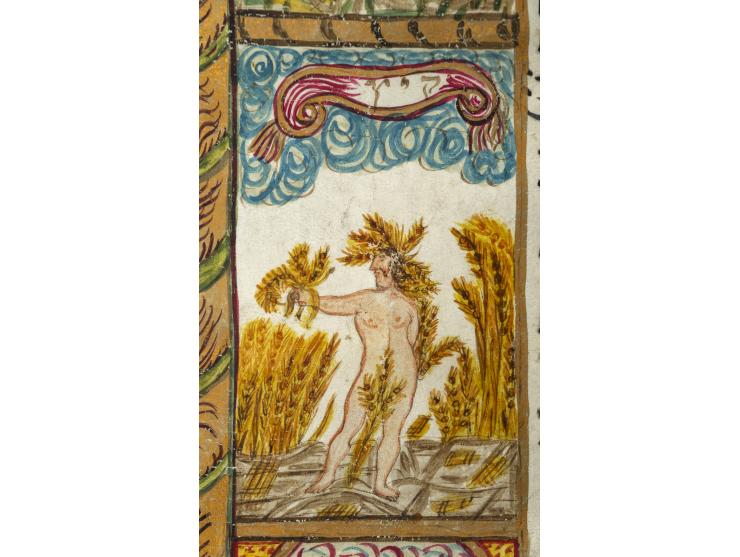
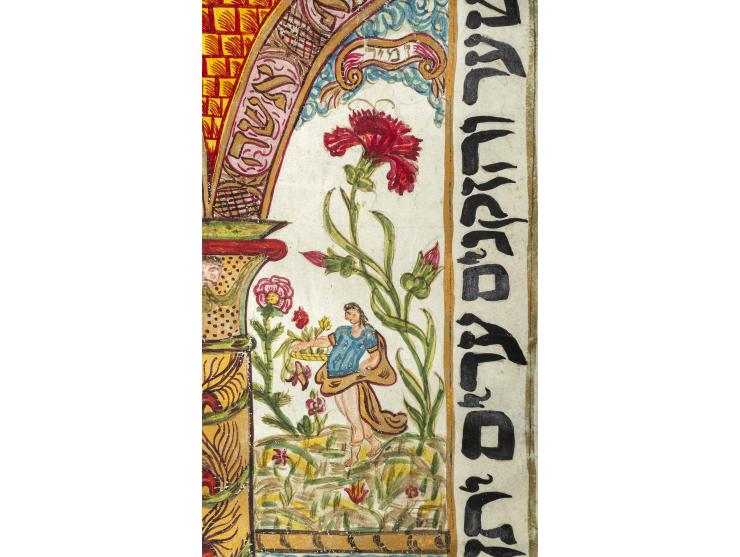
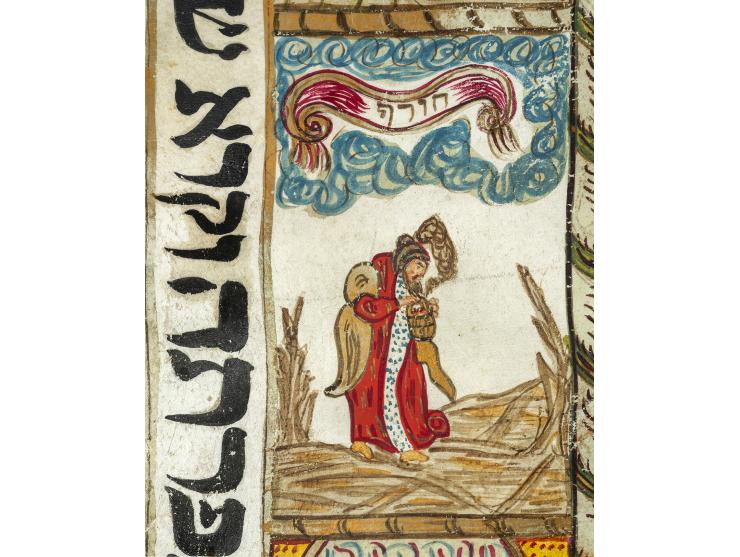
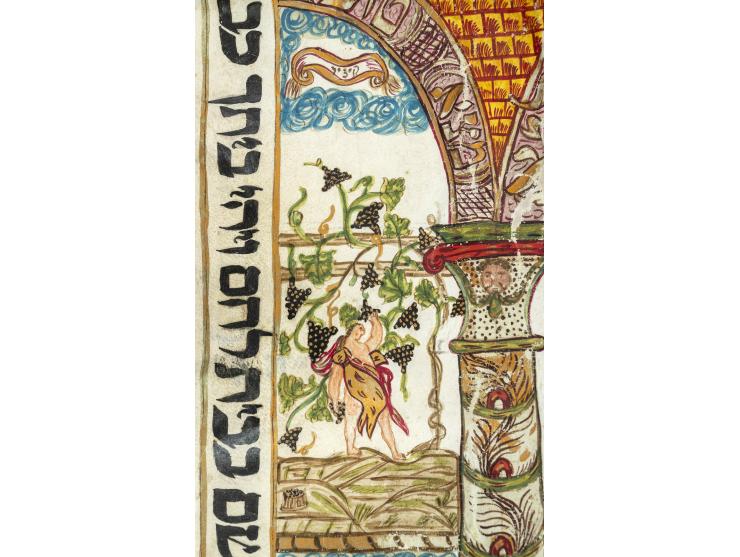
The ketubah is decorated in bright colors, with gilt decorations, in a symmetric architectural pattern comprised of three large pillars supporting the arches, topped by a large gable. The upper half is richly decorated with vegetal patterns incorporating: a pair of figures holding the upper arch, featuring a coat of arms – a crowned rampant lion facing to the left (perhaps the groom's family coat of arms), two pairs of birds and a pair of angels blowing horns. On the gable appear figurative illustrations of the twelve signs of the zodiac, inscribed blessings, and in the center – an illustration of Jerusalem, with the Dome of the Rock in the middle. At the bottom half appear four large allegorical illustrations depicting the Four Seasons (in the right and left margins), and four smaller illustrations depicting the Temple vessels (at the bottom edge).
A similarly designed ketubah from Livorno (1720) is located in the U. Nahon Museum of Italian Jewish Art in Jerusalem (388 Ms. ON). For another ketubah of the Caravaglio family and for further information on this family, see previous lot.
62.5X88 cm. Fair-good condition. Creases and folding marks. Stains and some large dampstains, slightly affecting text and decorations, mainly to upper half.
Category
Ketubot
Catalogue Value
Auction 107: Rare and Important Items
Apr 15, 2026
Opening: $3,000
Estimate: $10,000 - $15,000
Sold for: $10,625
Including buyer's premium
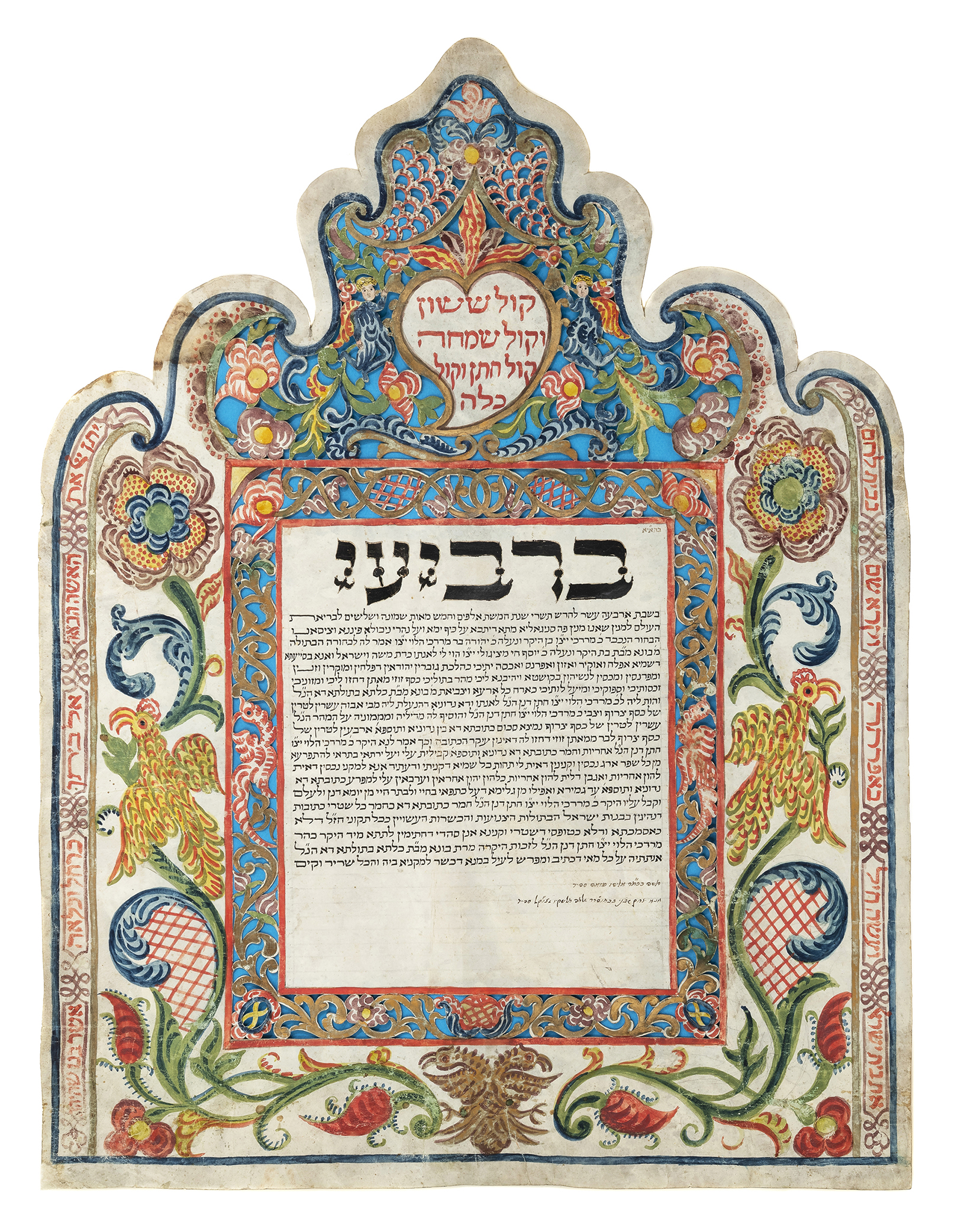
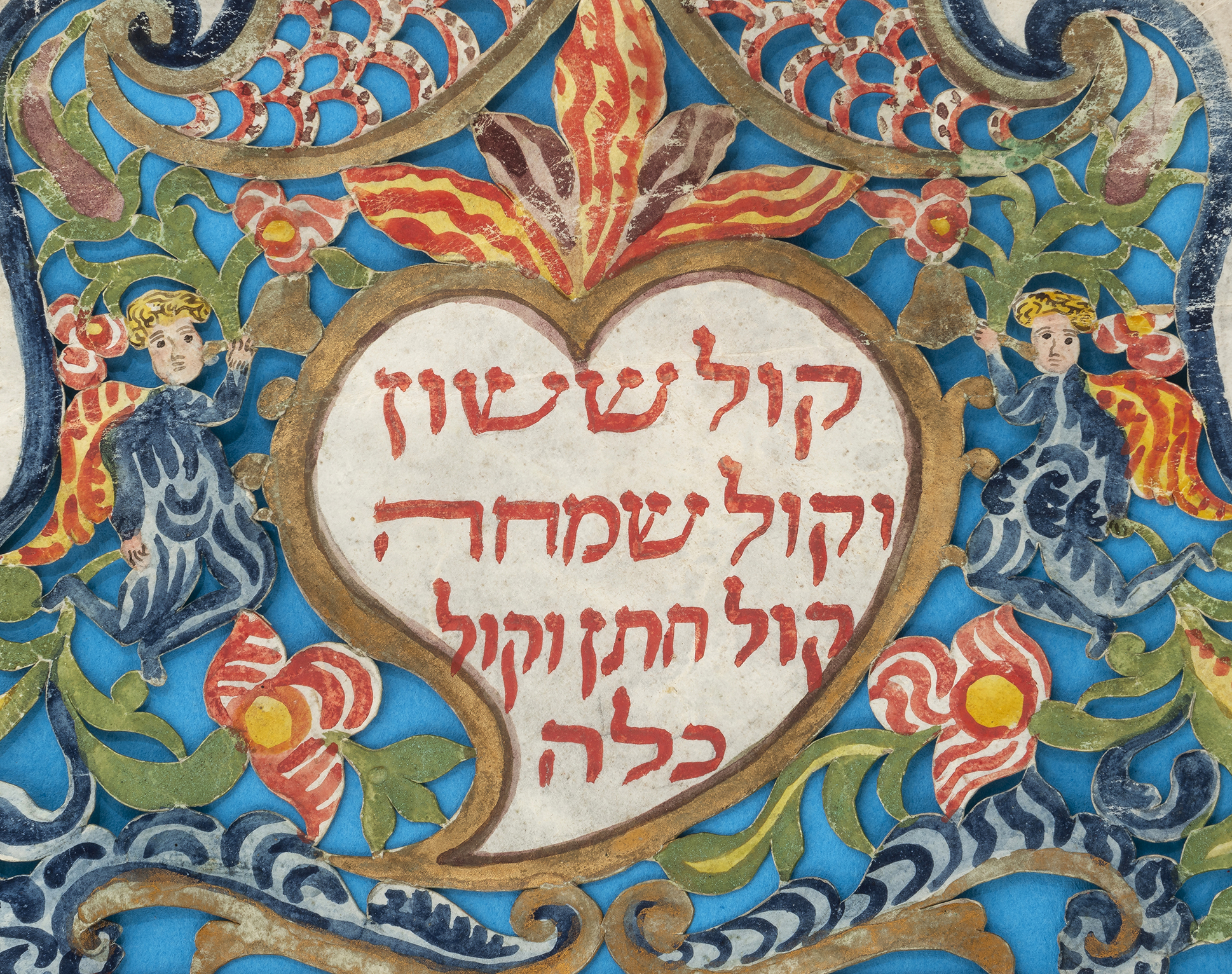
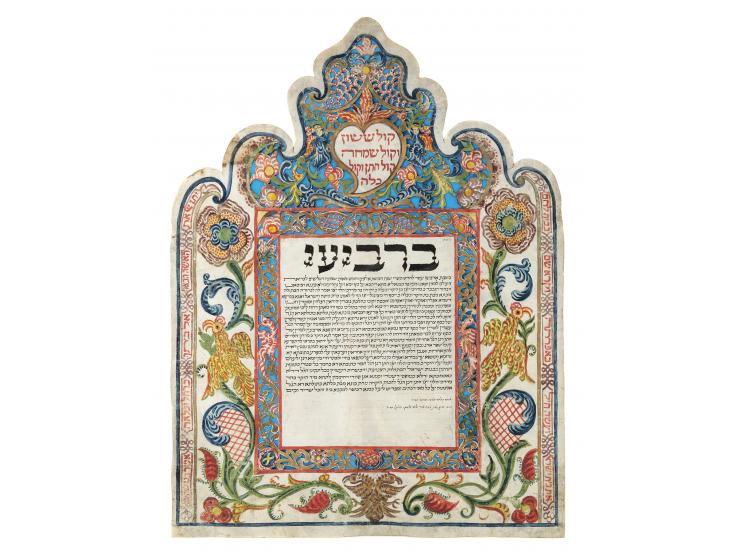
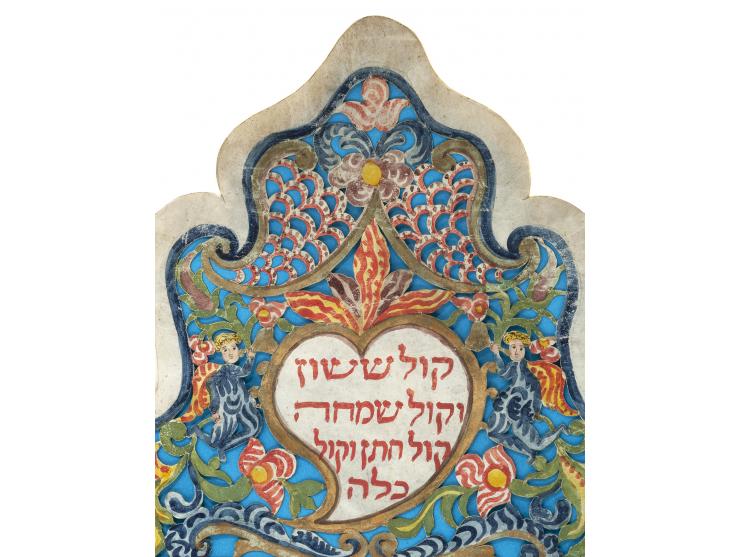
Ketubah decorated with parchment cut, for wedding of Mordechai son of Yehudah son of Mordechai HaLevi and Bona daughter of Yosef Chai di Cigoli. Senigallia, Italy, 14th Tishrei 5538 [15 October 1777].
Ink and paint on cut parchment.
Written on a rectangular parchment sheet with upper edges cut in wave pattern. Ketubah text in center in square script, with signatures of witnesses beneath the text: Moshe son of Eliyahu Foa and Yitzchak Shabtai son of Shlomo Delvecchio.
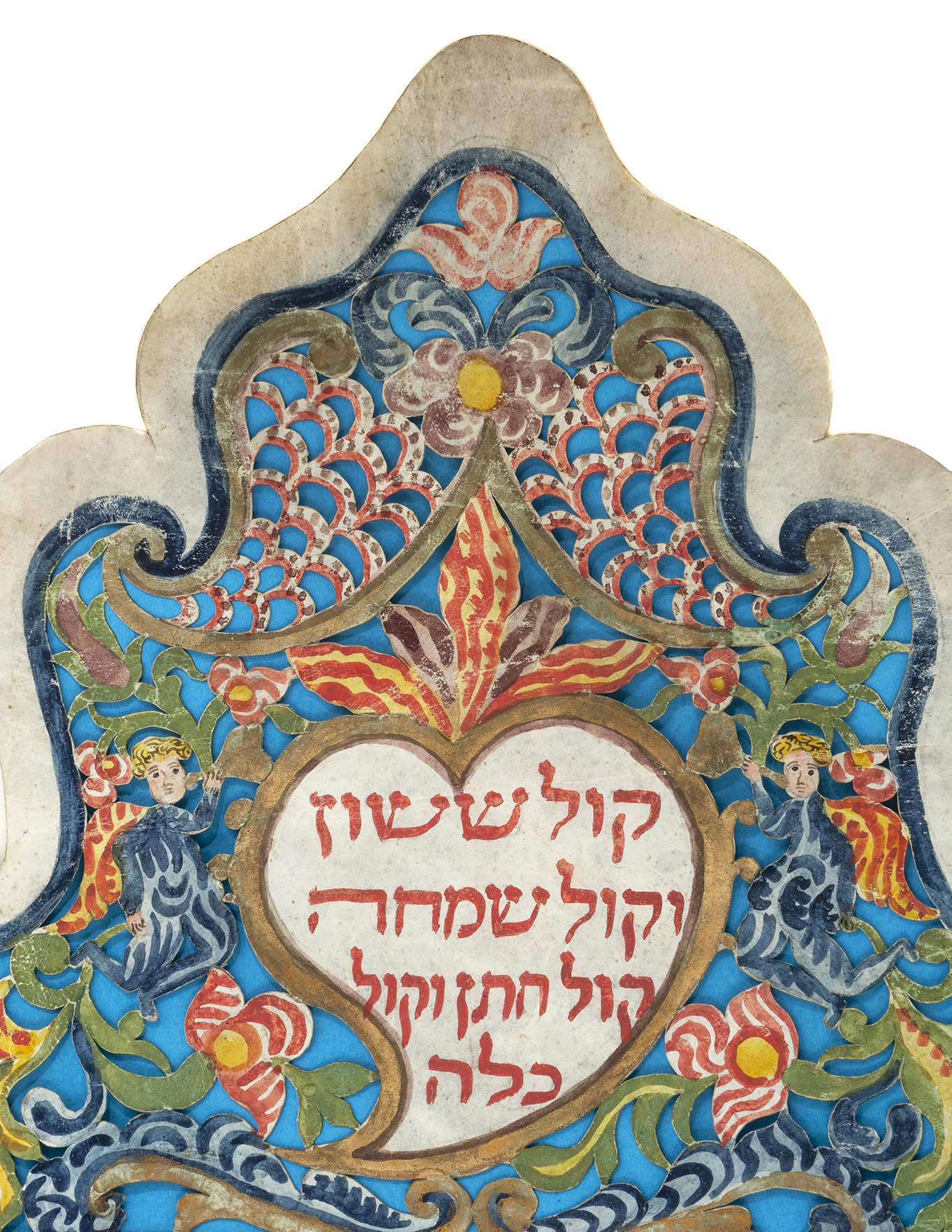
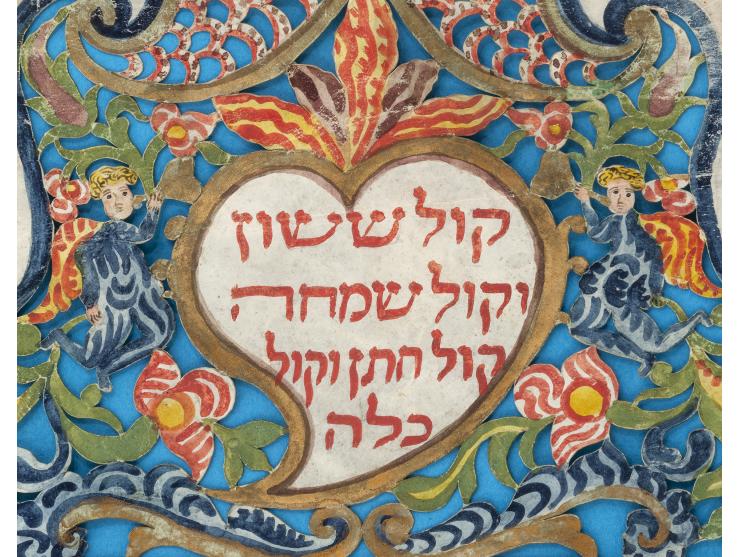
The ketubah text is set within a square frame decorated with a parchment cut (characteristic of ketubot of Lugo), including intertwining vines, flowers and birds. Upper edge includes further cut decorations, including flowers, foliage and a pair of angels holding a heart with an inscribed blessing. Three additional frames – to the left, right and below – are decorated with similar vegetal patterns, birds and a two-headed eagle. The outer margins incorporate another verse (Ruth 4:11).
48.5X63 cm. Overall good condition. Some creases and stains (some dark), slightly affecting text. Minor tears and small pieces missing from edges, professionally restored.
The present ketubah is also documented on the NLI ketubah site, listing 990003035460205171.
For additional parchment cut ketubot, see: Ebrei a Lugo, I Contratti matrimoniali (Imola: Galeati, 1994); René Braginsky Collection, K96, K105; Sotheby's, New York, 29 April 2013 (Steinhardt Collection), Lots 101-102.
Category
Ketubot
Catalogue Value
Auction 107: Rare and Important Items
Apr 15, 2026
Opening: $3,000
Estimate: $6,000 - $8,000
Sold for: $5,250
Including buyer's premium
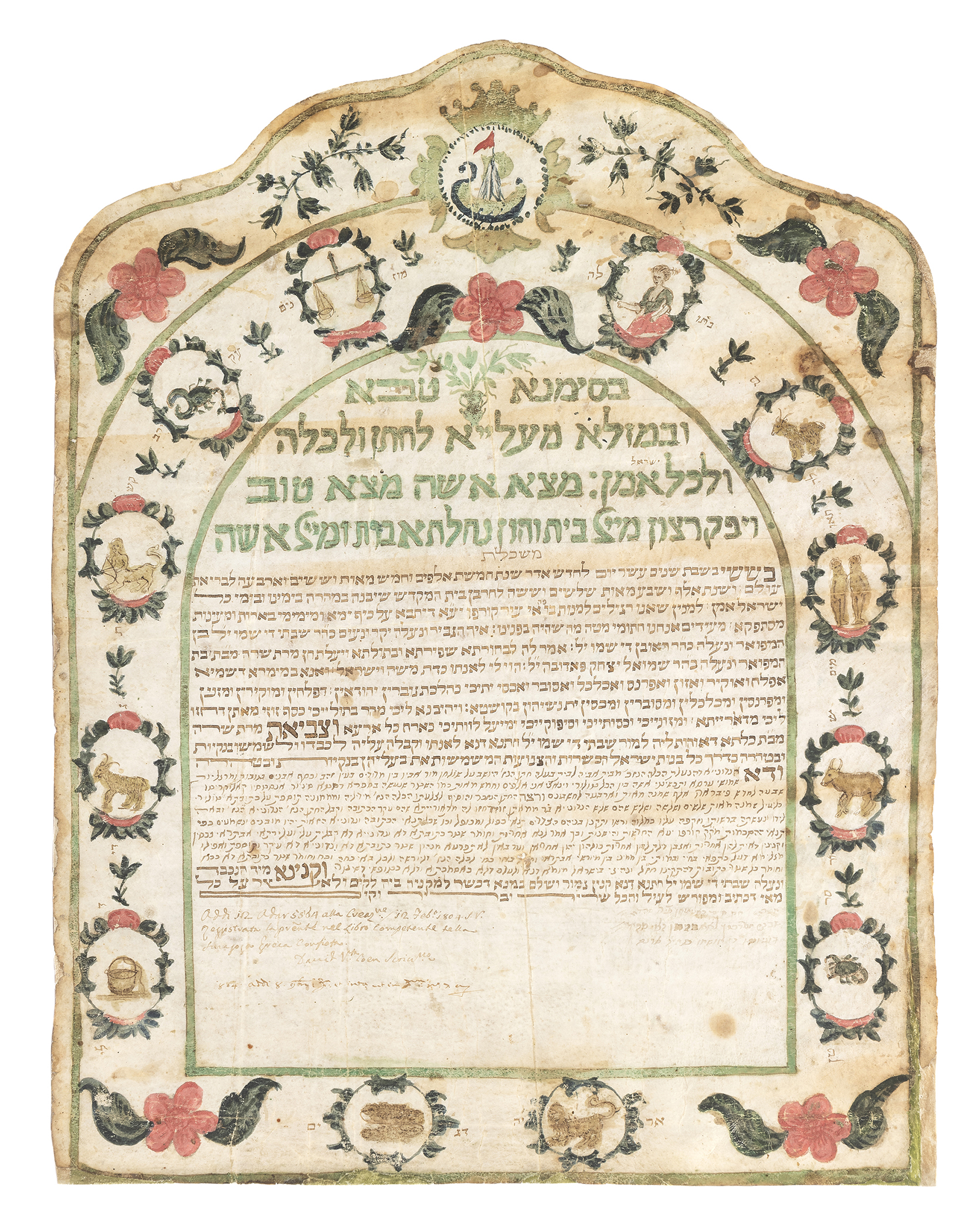
Decorated parchment ketubah, for the wedding of Shabtai son of Reuven de Semo and Sarah daughter of Shmuel Yitzchak Padova. Corfu (Kerkyra, Greece), 12th Adar 5564 [24 February 1804].
Ink and paint on parchment.
Written on a rectangular parchment sheet, upper part cut in wave pattern. Ketubah text in center, within an arched frame, written in square script. Dowry in Sephardic semi-cursive script, with signatures of witnesses beneath the text, on the right side: Avraham son of Chaim Caliman and Shabtai Mordechai son of Binyamin HaLevi and Bonivento de Osmo. Opposite the signatures of witnesses appears a certification of inscription in the community ledger, in Italian, signed by Daniel V. Coen. Besides the usual anno mundi date, the ketubah is also dated to "1736 to the destruction of the Temple, may it be soon rebuilt in our days and the days of all of Israel, Amen".
Borders decorated in characteristic Italian ketubah style, with colorful illustrations including vegetal patterns and a dozen cartouches with illustrations of the twelve zodiacs and their names. The top of the ketubah features a medallion with an illustration of a rowboat (perhaps a family coat of arms or allusion to the island of Corfu).
41X53 cm. Fair-good condition. Stains, some dark, slightly affecting text and illustrations. Old folding marks, slightly affecting text, professionally restored. Marginal tears and missing pieces, professionally restored.
The present ketubah is also documented on the NLI ketubah site, listing 990003035580205171.
Category
Ketubot
Catalogue Value
Auction 107: Rare and Important Items
Apr 15, 2026
Opening: $3,000
Estimate: $10,000 - $15,000
Sold for: $21,250
Including buyer's premium
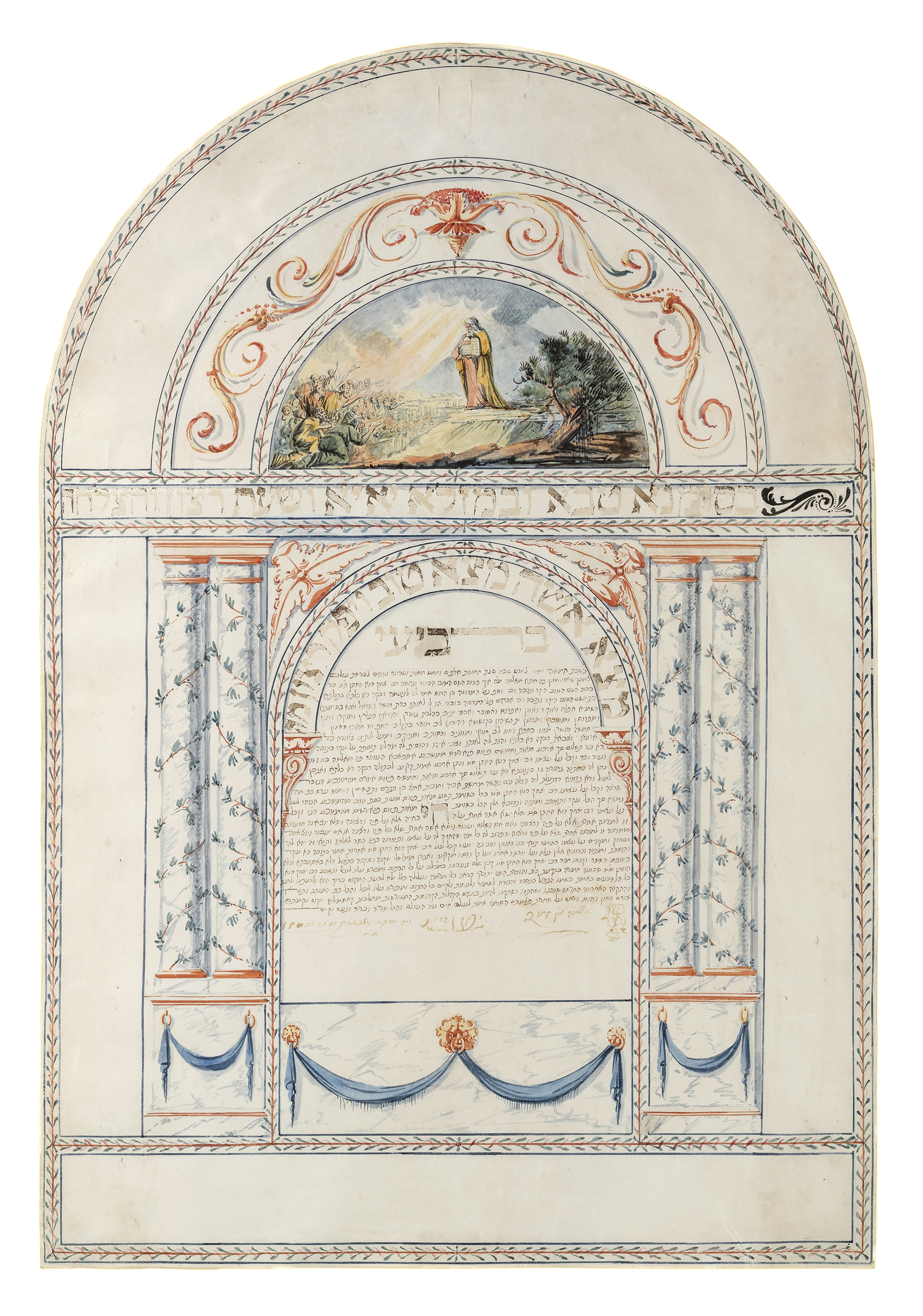
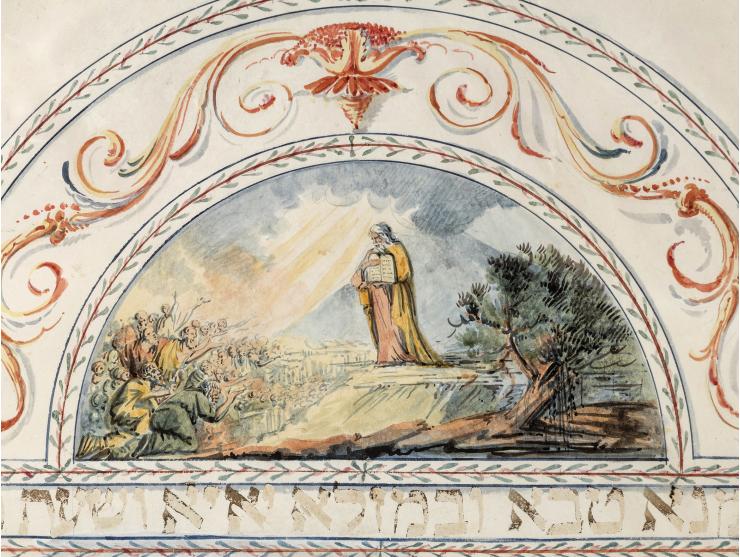
Decorated parchment ketubah, for the wedding of Yitzchak son of Yosef Ben Harosh and Rivkah daughter of Avraham Bovedi. Malta, 5th Shevat 5567 [14 January 1807].
Ink and paint on parchment.
Written on a rectangular sheet, with upper part cut into an arch. Ketubah text in the middle, in Sephardic semi-cursive script, with signatures of groom and witnesses beneath the text: Shlomo Ben Zimra, Yitzchak Baruch (?) and Yaakov Daninos. The ketubah text follows "the customs and stipulations of… the communities expelled from Spain…".
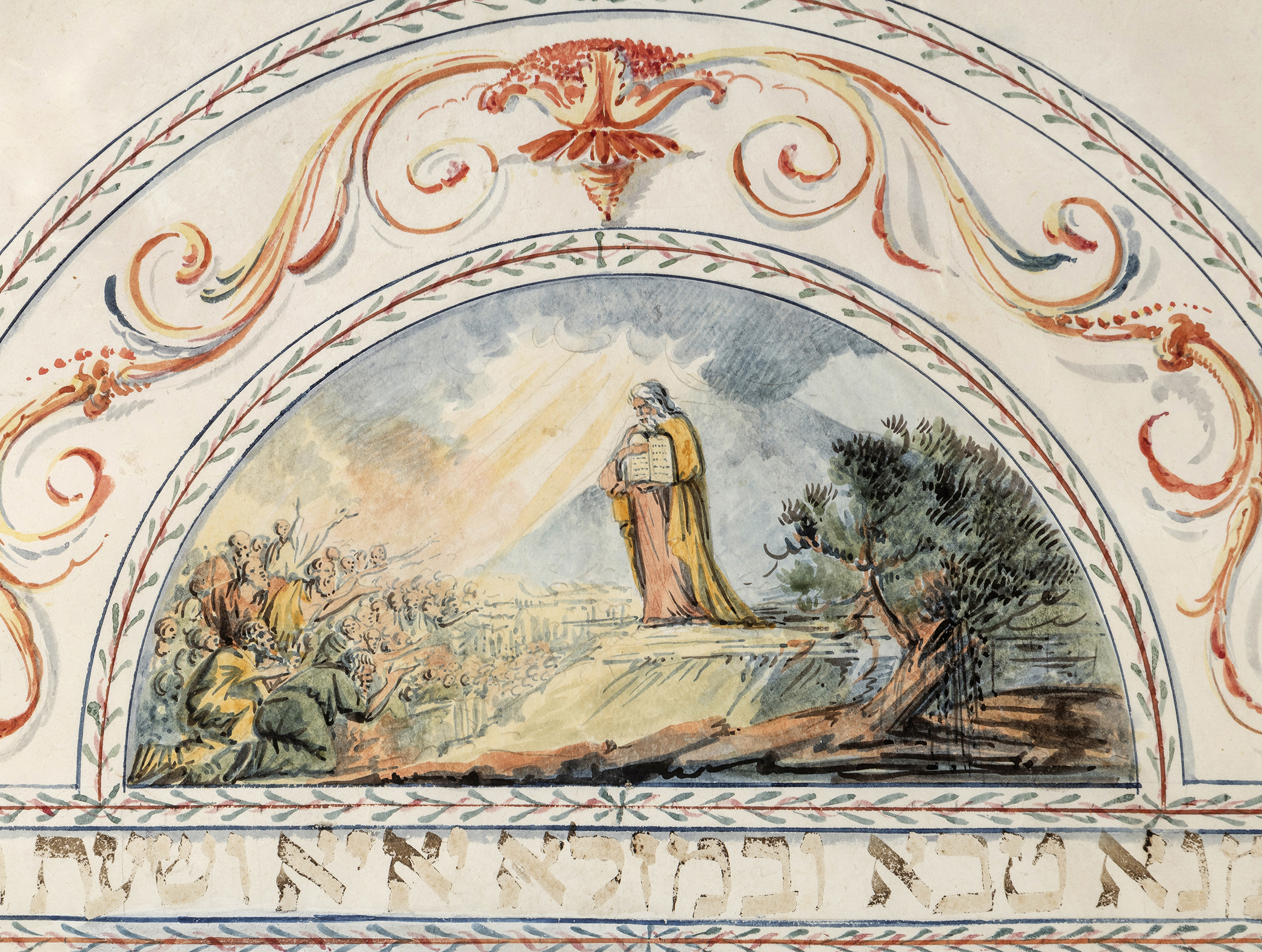
Frame decorations include a large structure with four massive marble pillars topped by an arch and dome. The dome at the upper third features a large illustration depicting Moses with the Tablets of the Covenant at Mount Sinai.
44X64.5 cm. Good condition. Some stains, only slightly affecting text. Fading of ink and paint, mainly to verses of blessing. Tear to bottom margins, professionally restored. Two slits cut out at the apex of the dome.
Reference: Encyclopedia Judaica, 1971, vol. 10, color plate no. 5 (illustrated).
The present ketubah is the only one known from Malta, and is documented on the NLI ketubah site, listing 990003035670205171.
Category
Ketubot
Catalogue Value
Auction 107: Rare and Important Items
Apr 15, 2026
Opening: $3,000
Estimate: $4,000 - $6,000
Sold for: $3,750
Including buyer's premium
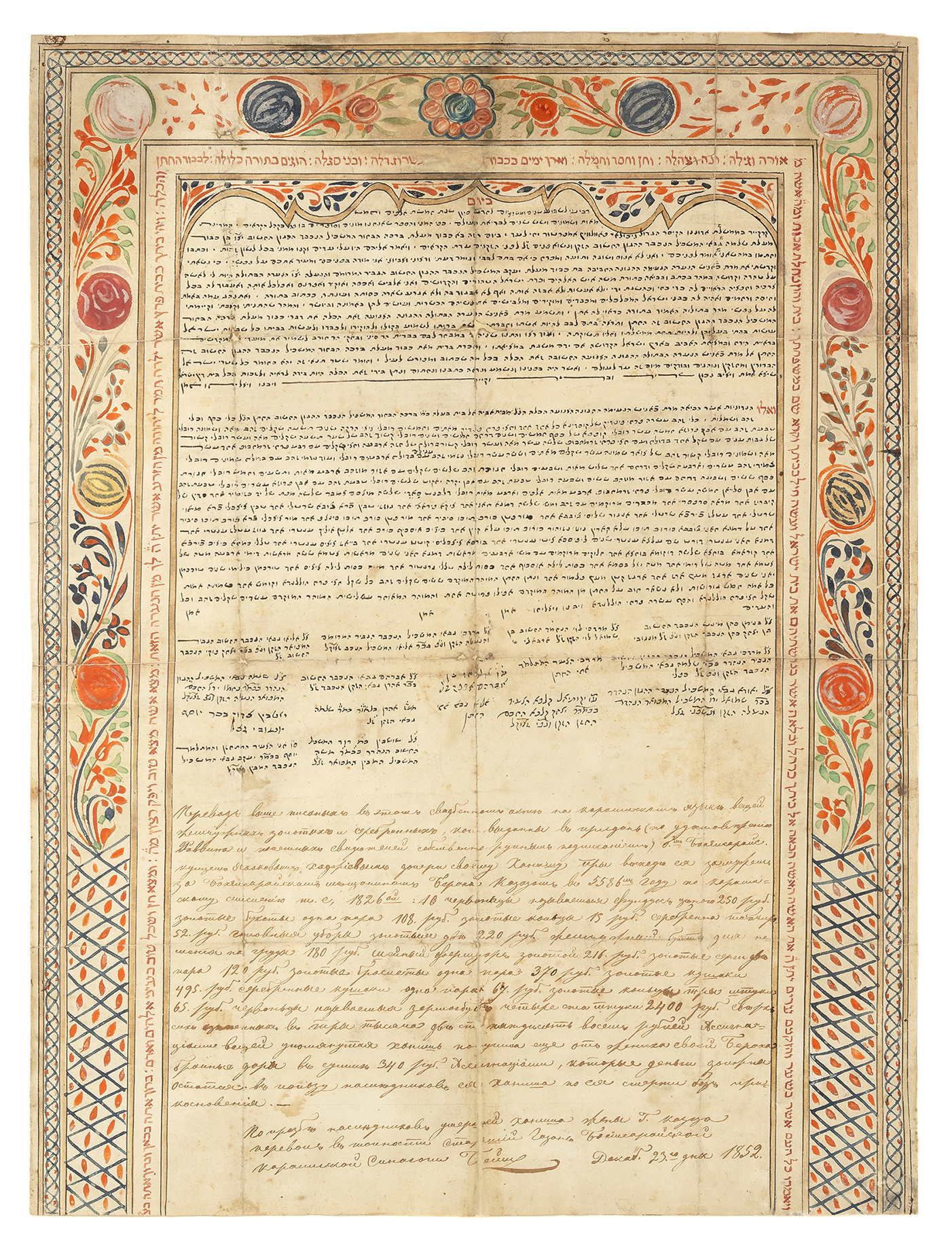
Decorated paper ketubah for the wedding of Berachah son of Shlomo and Kanish daughter of Yaakov. "Karaite community of Qırq Yer", Chufut-Kale, Crimean Peninsula, Ukraine, 22nd Sivan 5586 [27 June 1826].
Ink and paint on paper.
Written on a large paper sheet, reflecting the unique customs and rite of the Karaite community of Chufut-Kale in the Crimean Peninsula. The ketubah text is written in Hebrew (rather than Aramaic), the document is divided into two parts – the ketubah on the top and the dowry on the bottom, and no fewer than ten witnesses sign (fifteen signed the present document). The ketubah text also mentions "Emperor Nikolai Pavlovich I" (Tsar Nicholas I), and includes a commitment to the "covenant of Mount Sinai and the laws of Mount Horeb, to observe G-d's festivals, consecrated by observation of the moon and the presence of Spring in the holy Land of Israel…", in accordance with the Karaite custom. Below the witness' signatures, the dowry is also detailed in Russian translation, at the request of the bride's heirs after her passing, dated 23 December 1852.
The text is written in an arched frame, and the borders are decorated in a rectangular frame with colorful vegetal and geometric patterns.
Chufut-Kale (Çufut Qale, or Jewish Fortress) served as the center of Crimean Karaite Jewry until the end of the 19th century. The city was an important location, since Crimean Jews were forbidden from living in the capital city until 1783, leading them to settle in the nearby Chufut-Kale. After the Crimean Peninsula was conquered by the Russian Empire and Karaites were allowed to settle throughout Crimea, the city was abandoned, becoming a ghost town by the turn of the 20th century. Avraham Firkovich, the leader of the Eastern European Crimean community, was one of the last Karaites to live in the city.
40.5X50.5 cm. Fair-good condition. Folding marks, tears and stains, slightly affecting text and decorations, with loss of some words. Tears and defects, professionally restored. Holes to upper margins.
The present ketubah is also documented on the NLI ketubah site, listing 990003035720205171.
Category
Ketubot
Catalogue Value
Auction 107: Rare and Important Items
Apr 15, 2026
Opening: $2,000
Estimate: $6,000 - $8,000
Sold for: $6,250
Including buyer's premium
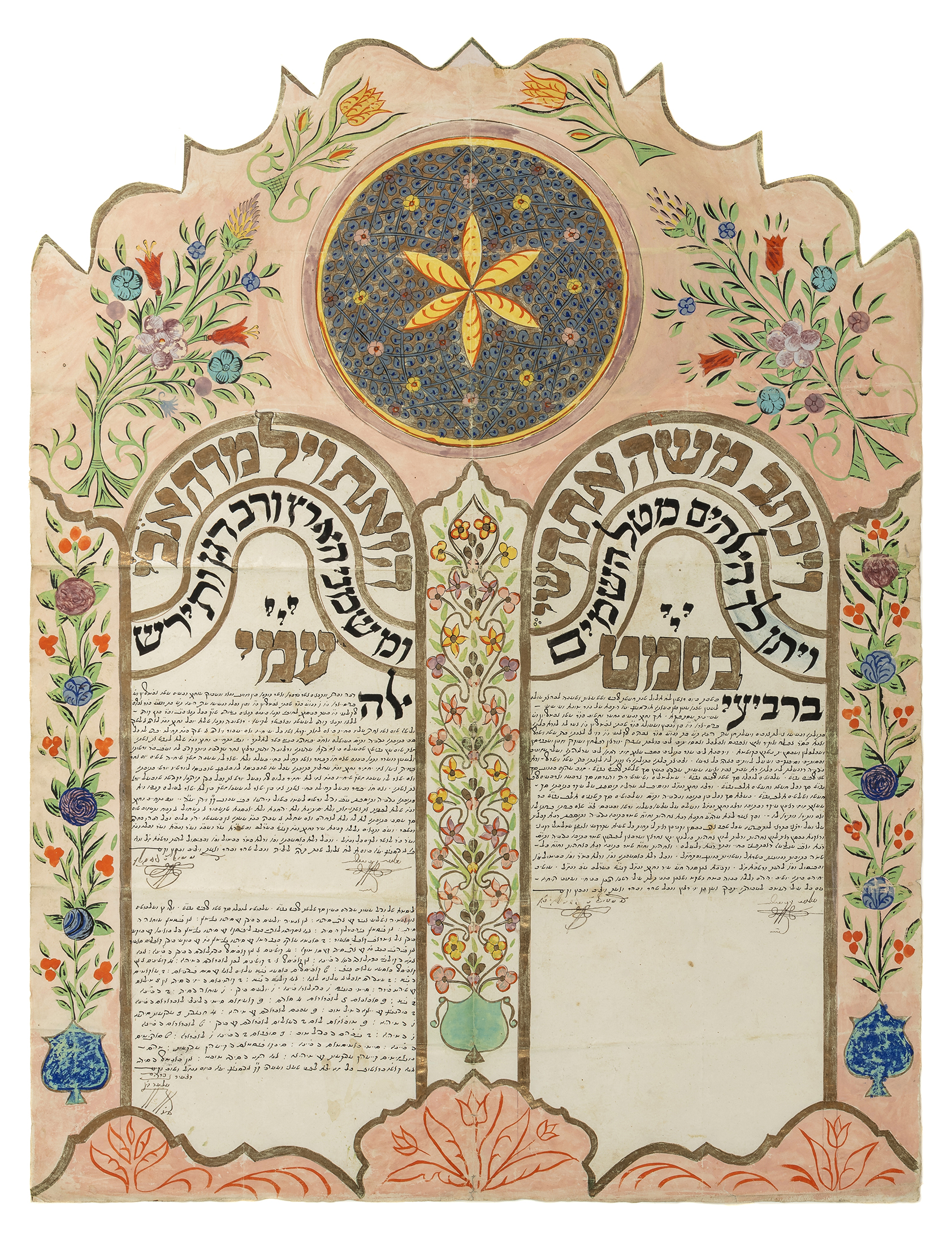
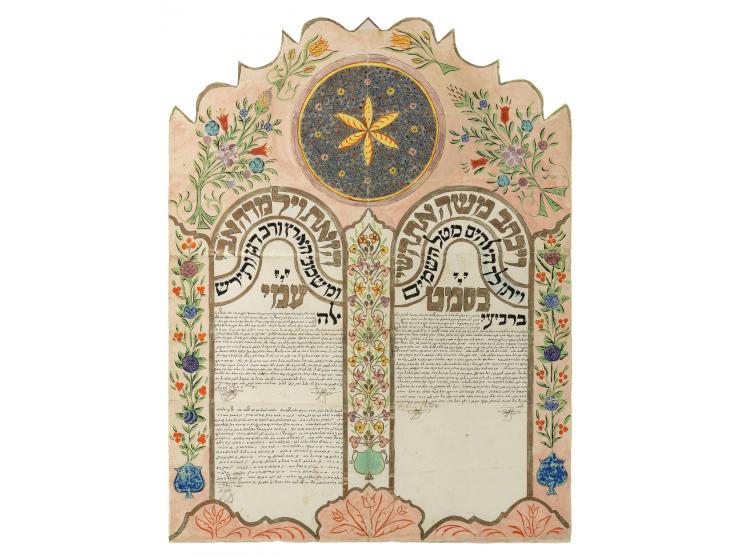
Decorated paper ketubah, for the wedding of Moshe Presiado son of Shabtai Avtalyon and Reicha daughter of Avraham Alkalai. Rustchuk (Ruse, Bulgaria), 1st Elul 5608 [30 August 1848].
Ink and paint on paper.
Written on a large rectangular paper sheet, with upper edges cut in an undulating wave pattern with sharp points. The text is written in two columns, with the ketubah text on the right and the Tena'im on the left, in Sephardic cursive script. Beneath the text, at the outer edges of the ketubah and Tena'im are the signatures of the witnesses: Shlomo Ventura and Shmuel Ben Didi (?) HaLevi. At the end of the Tena'im appears the dowry, signed by Avraham Melamed of Rustchuk.
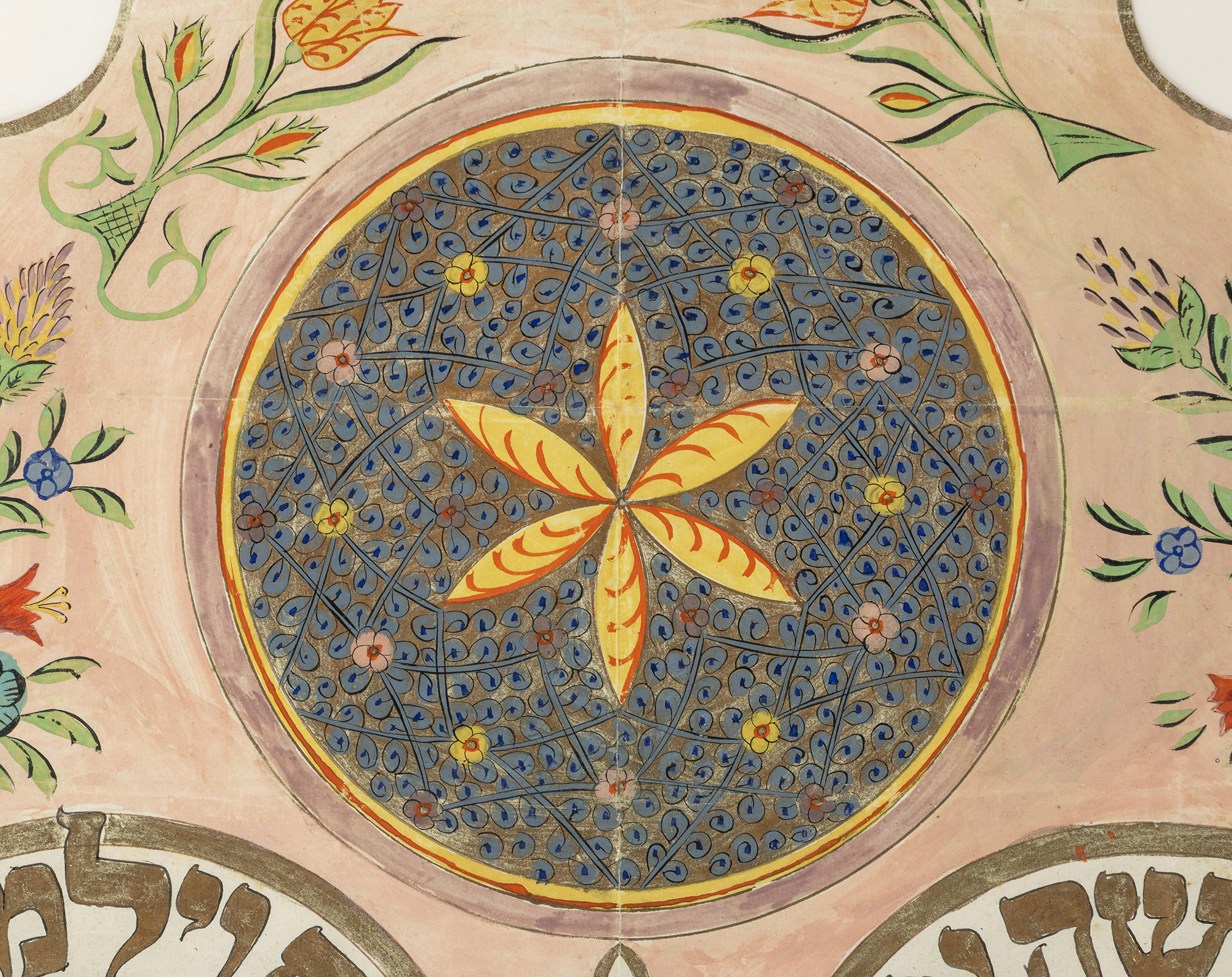
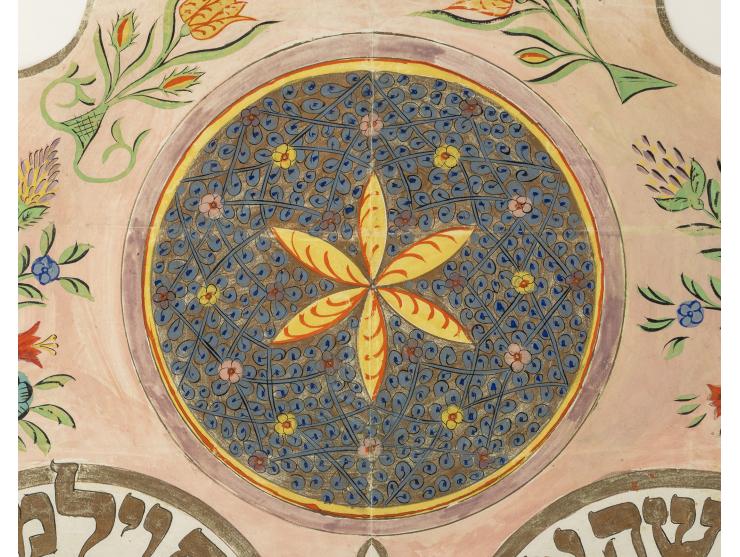
The ketubah text and Tena'im appear within two large arched frames, with gilt blessings inscribed at the top. Around the arches is a large frame decorated with rich vegetal patterns against a pink background, with a large circular medallion at the top, enclosing a large flower in its center against a background of geometrical guilloches, as seen in the decorations of other Sephardic ketubot from the Ottoman Empire.
51X67.5 cm. Overall good condition. Slight stains and creases. Open tear to upper border and minor tears to edges, professionally restored. Old folding marks, slightly affecting text and decorations. Slight fading of paint.
This ketubah is also documented on the NLI ketubah site, listing 990003035440205171; only one other ketubah from 19th-century Ruse is recorded.
Category
Ketubot
Catalogue Value