
Auction 107: Rare and Important Items
Apr 15, 2026
- and (82) Apply and filter
- item (32) Apply item filter
- various (27) Apply various filter
- object (23) Apply object filter
- ornament (23) Apply ornament filter
- ornaments, (23) Apply ornaments, filter
- synagogu (23) Apply synagogu filter
- torah (23) Apply torah filter
- book (17) Apply book filter
- print (17) Apply print filter
- earli (15) Apply earli filter
- incunabula (15) Apply incunabula filter
- jewish (13) Apply jewish filter
- the (13) Apply the filter
- manuscript (12) Apply manuscript filter
- public (12) Apply public filter
- letter (10) Apply letter filter
- ketubot (9) Apply ketubot filter
- anti (8) Apply anti filter
- anti-jewish (8) Apply anti-jewish filter
- antijewish (8) Apply antijewish filter
- antisemit (8) Apply antisemit filter
- edict (8) Apply edict filter
- edicts, (8) Apply edicts, filter
- law (8) Apply law filter
- laws, (8) Apply laws, filter
- ordin (8) Apply ordin filter
- rabbin (8) Apply rabbin filter
- royal (8) Apply royal filter
- haggadot (6) Apply haggadot filter
- israel (6) Apply israel filter
- mandatori (6) Apply mandatori filter
- of (6) Apply of filter
- palestin (6) Apply palestin filter
- passov (6) Apply passov filter
- siddurim (6) Apply siddurim filter
- state (6) Apply state filter
- zionism (6) Apply zionism filter
- zionism, (6) Apply zionism, filter
- bind (5) Apply bind filter
- havdalah (5) Apply havdalah filter
- holiday (5) Apply holiday filter
- person (5) Apply person filter
- shabbat (5) Apply shabbat filter
- shabbat, (5) Apply shabbat, filter
- silver (5) Apply silver filter
- art (4) Apply art filter
- brueckheim (4) Apply brueckheim filter
- collect (4) Apply collect filter
- from (4) Apply from filter
Displaying 49 - 60 of 104
Auction 107: Rare and Important Items
Apr 15, 2026
Opening: $2,000
Estimate: $3,000 - $5,000
Sold for: $8,125
Including buyer's premium
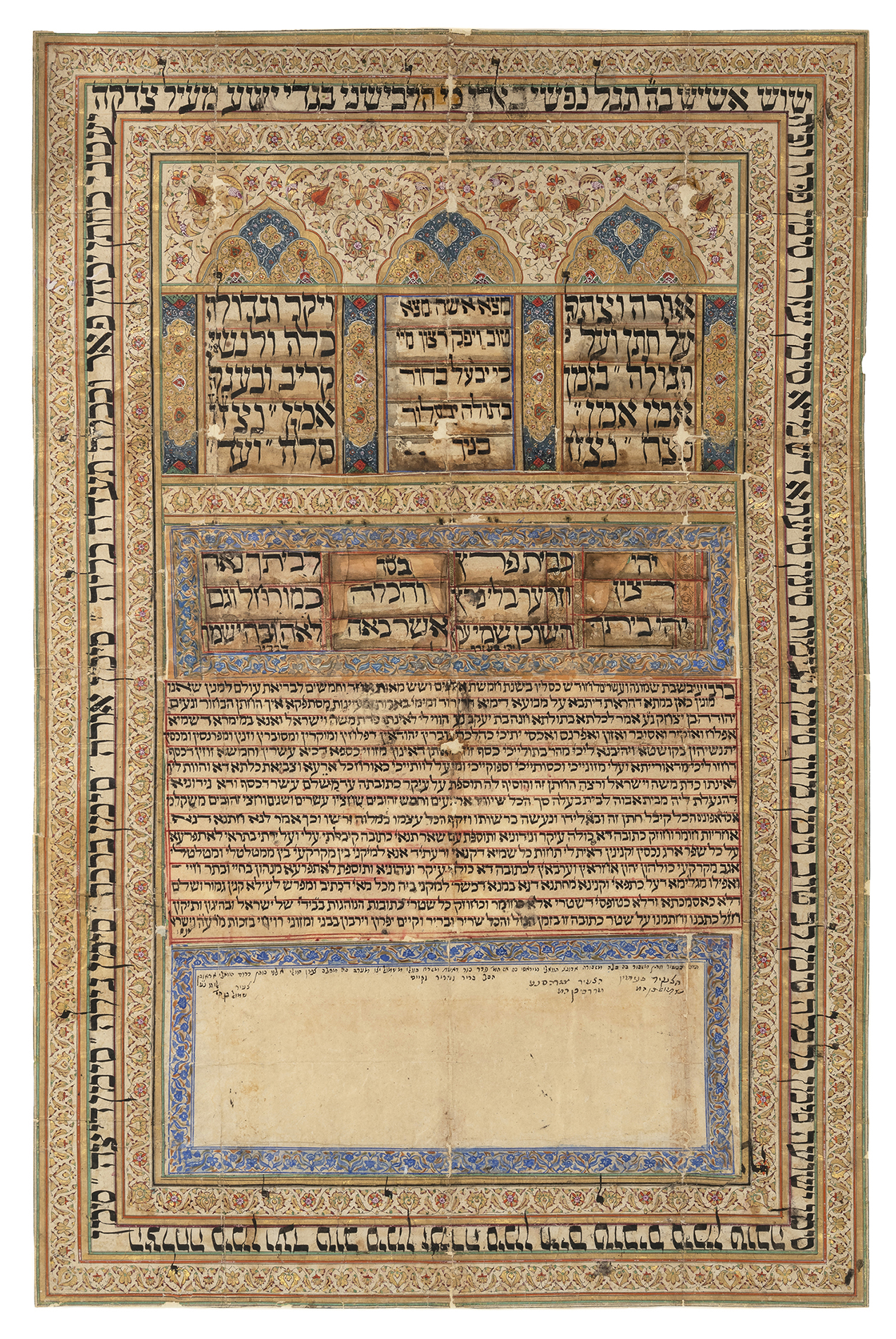
Decorated paper ketubah, for the marriage of the groom Yehuda son of Isaac and the bride Hannah daughter of Jacob. Herat (Afghanistan), 28 Kislev 5651 [10 December 1890].
Ink and color on paper.
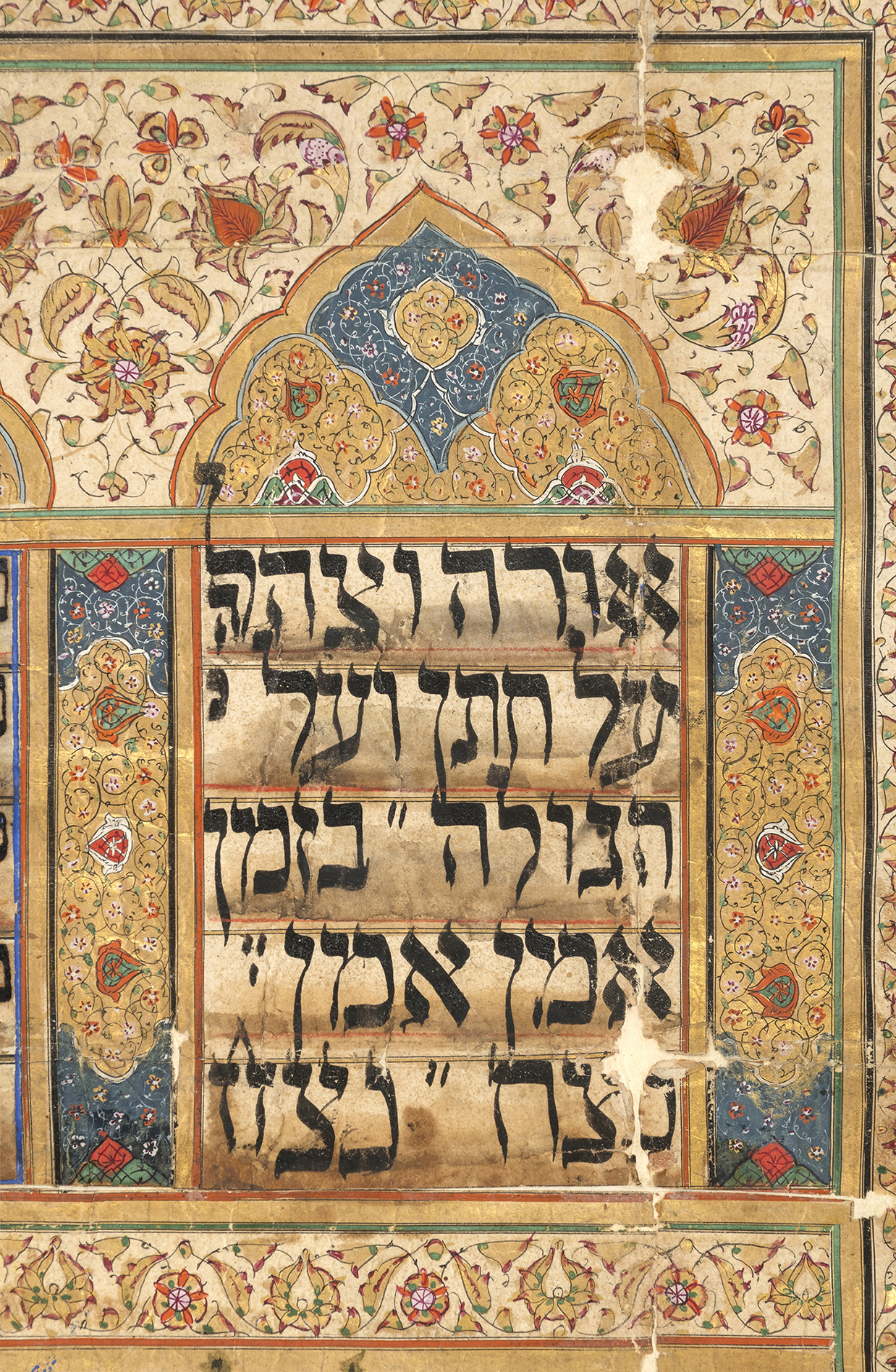
Written on a rectangular paper sheet. The upper half features inscribed blessings set within pointed arches and rectangular frames; the lower half contains the ketubah text (in square script), and beneath it, within a rectangular frame, the signatures of the witnesses: Samuel son of Benjamin, Mordechai son of Abraham, and Samuel son of Elijah.
The ketubah is richly decorated with vegetal arabesque patterns characteristic of Islamic art and adorned with gold ornamentation.
70X46 cm. Fair condition. Old folding marks and numerous tears, some open, professionally restored. Stains and old dampstains, affecting text and decorations. Apparently reused: an earlier decorated ketubah form was employed, with several sections of the 1890 ketubah pasted onto it.
This ketubah is also documented in the National Library of Israel ketubot database, no. 990003035450205171.
Category
Ketubot
Catalogue Value

Auction 107: Rare and Important Items
Apr 15, 2026
Opening: $5,000
Estimate: $10,000 - $15,000
Sold for: $6,875
Including buyer's premium
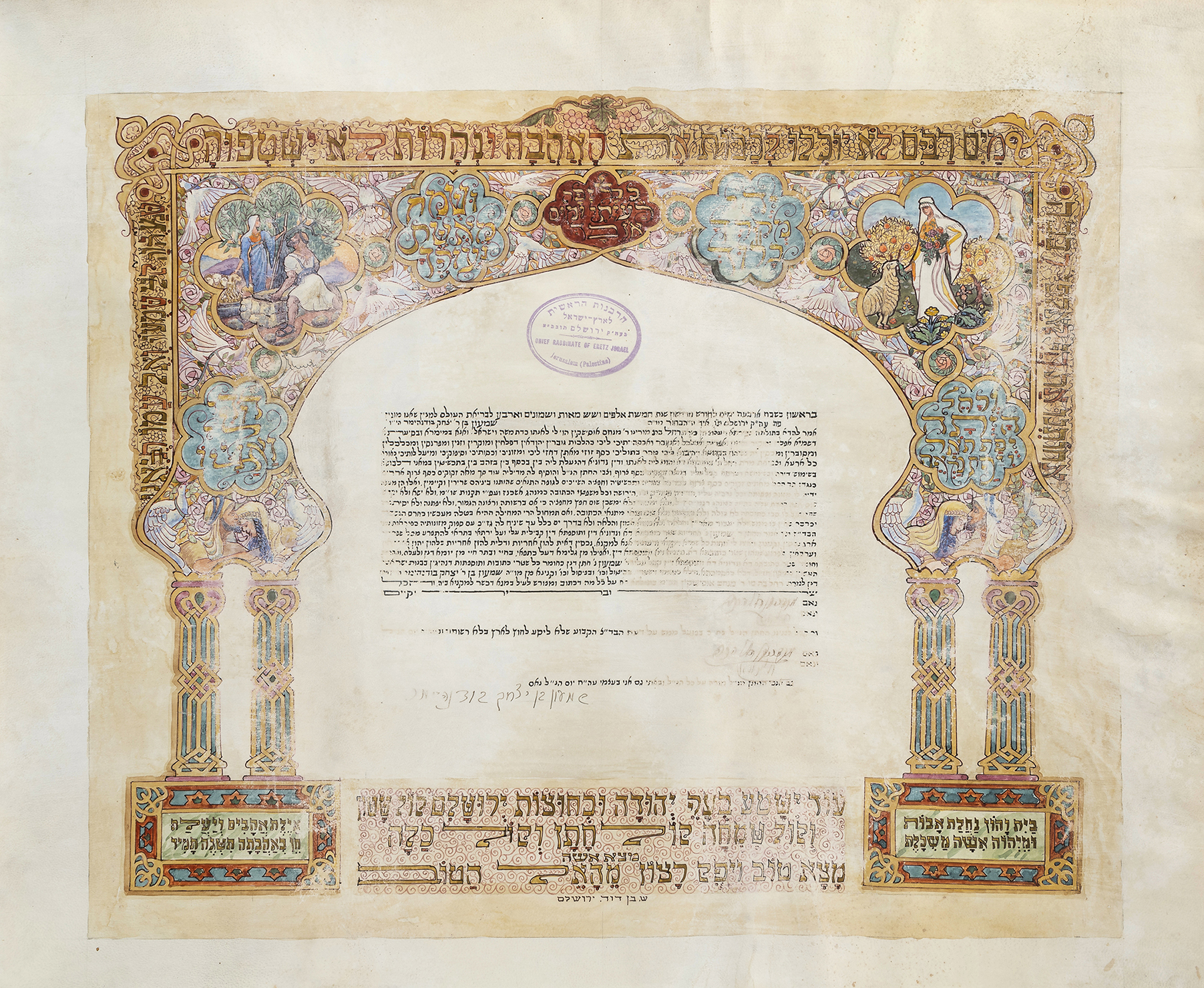
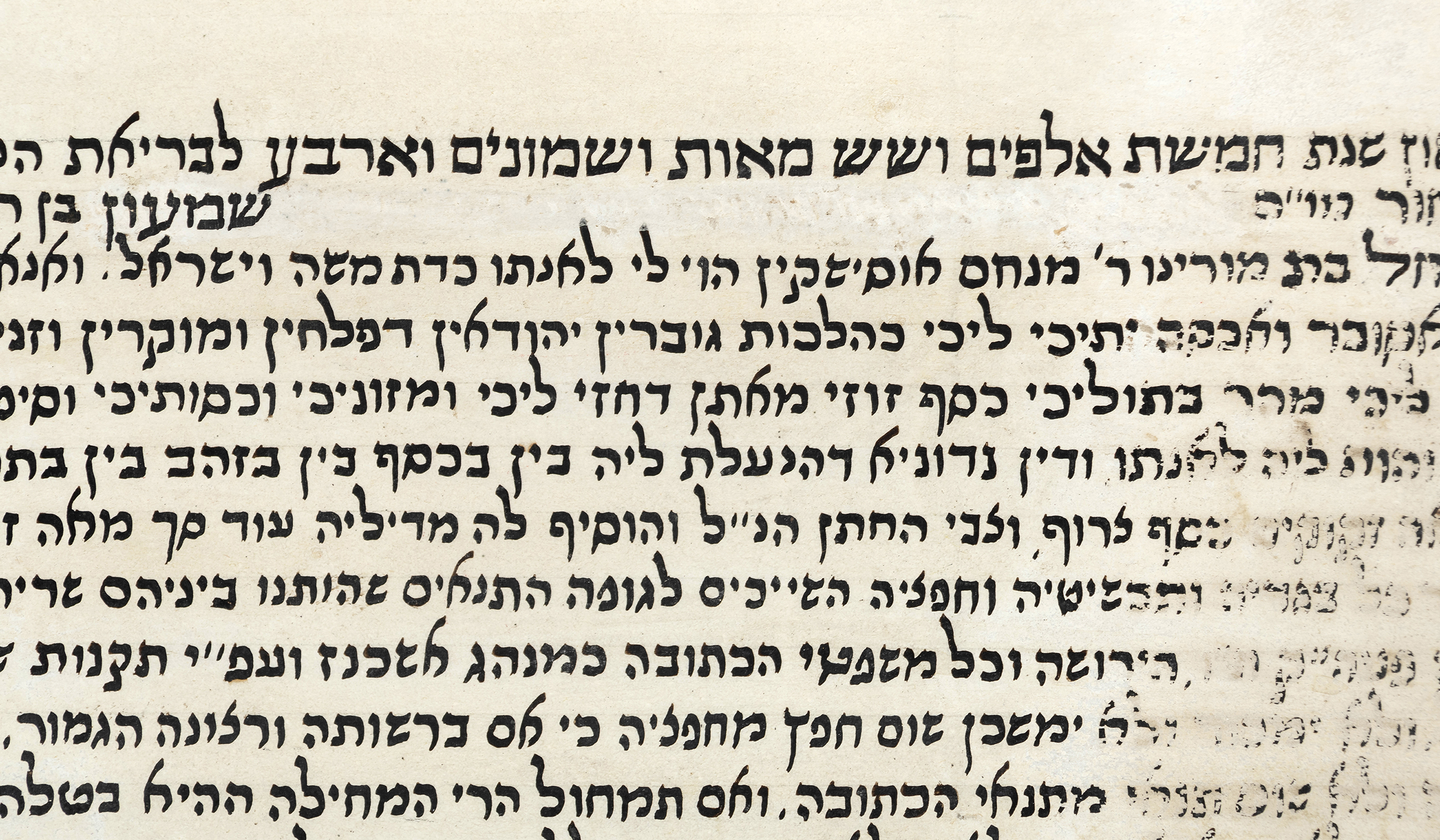
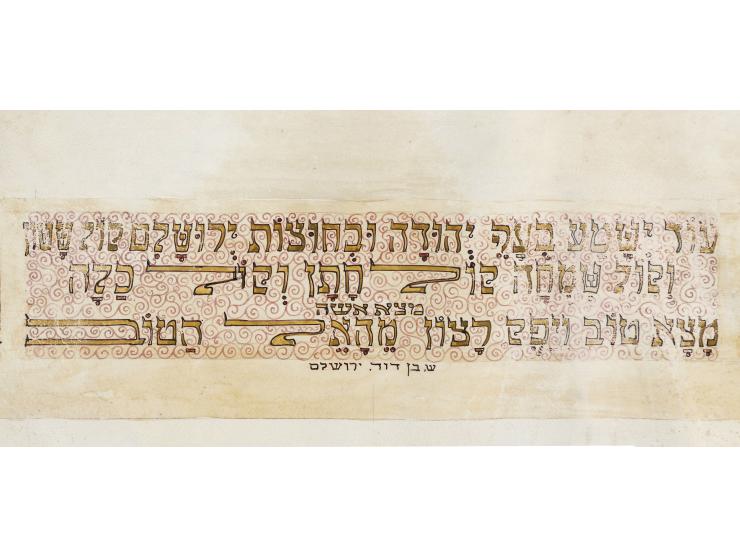
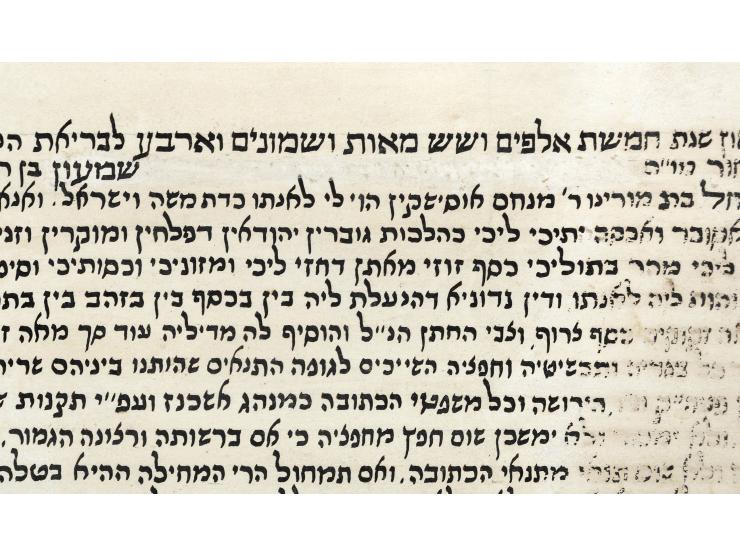
Decorated parchment ketubah for wedding of Shimon son of Yitzchak (Max) Bodenheimer and Rachel daughter of Menachem Ussishkin. Jerusalem, 4th Cheshvan 5684 [14 October 1923].
Ink and paint on parchment.
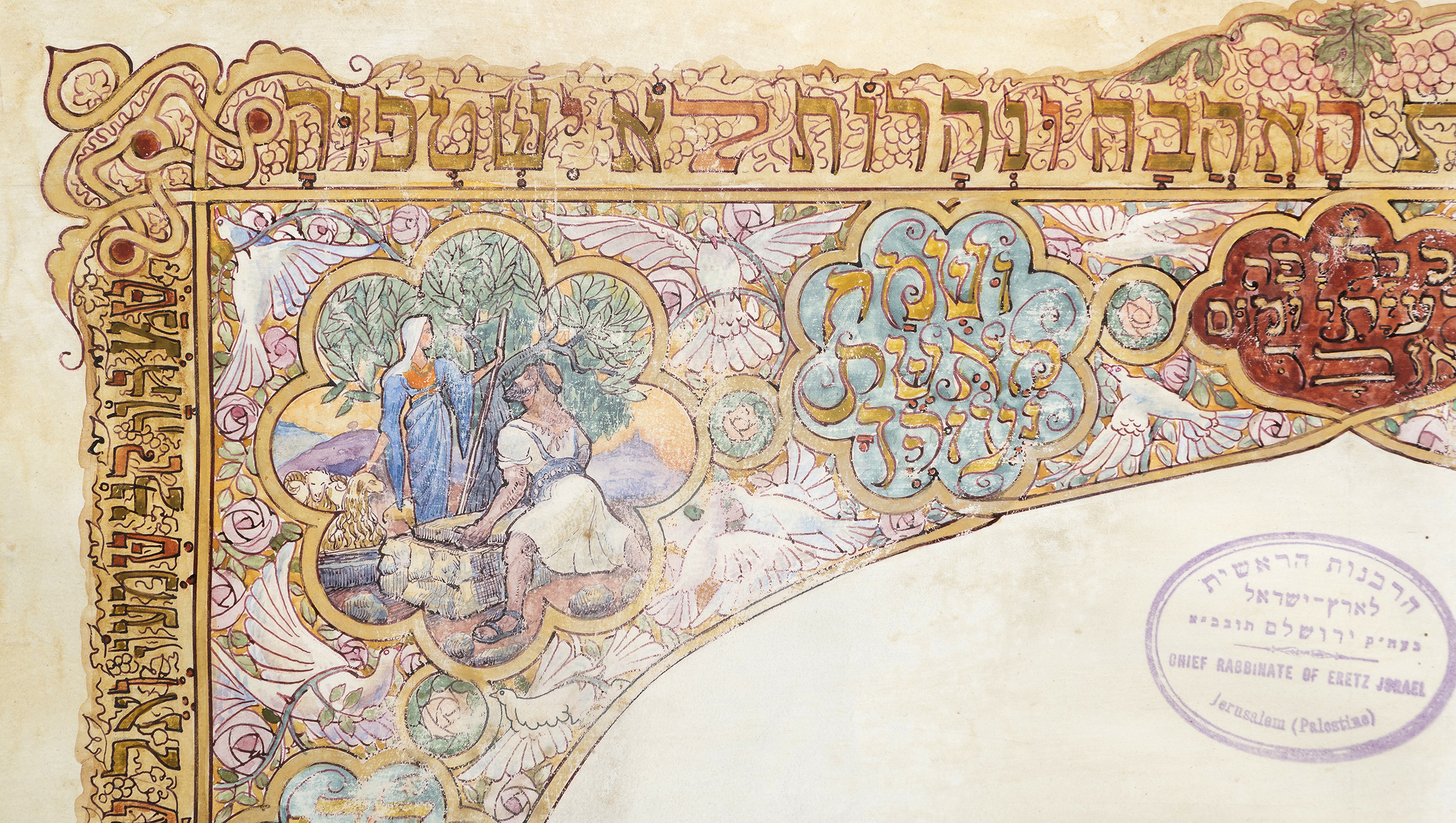
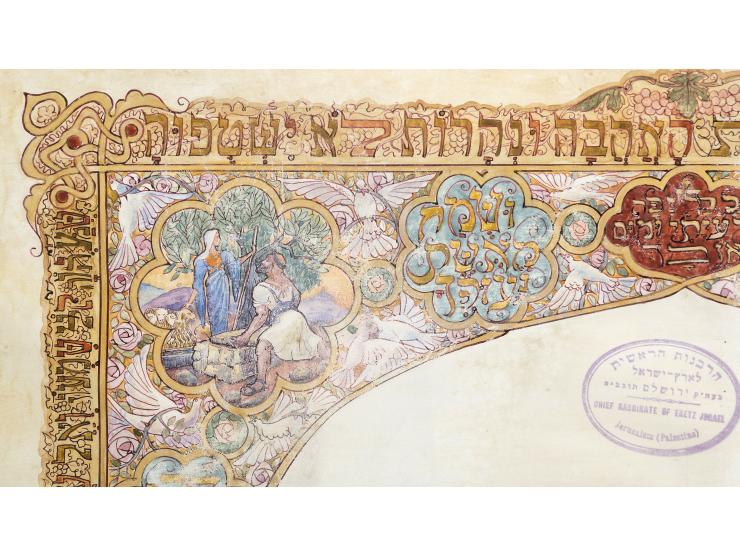
Written on a rectangular parchment sheet in Ashkenazic square and semi-cursive script. Signatures of witness Mordechai Hillel HaKohen (twice; the other witness' signature is faded) and the groom. The top of the ketubah bears the stamp of the Chief Rabbinate of Eretz Israel.
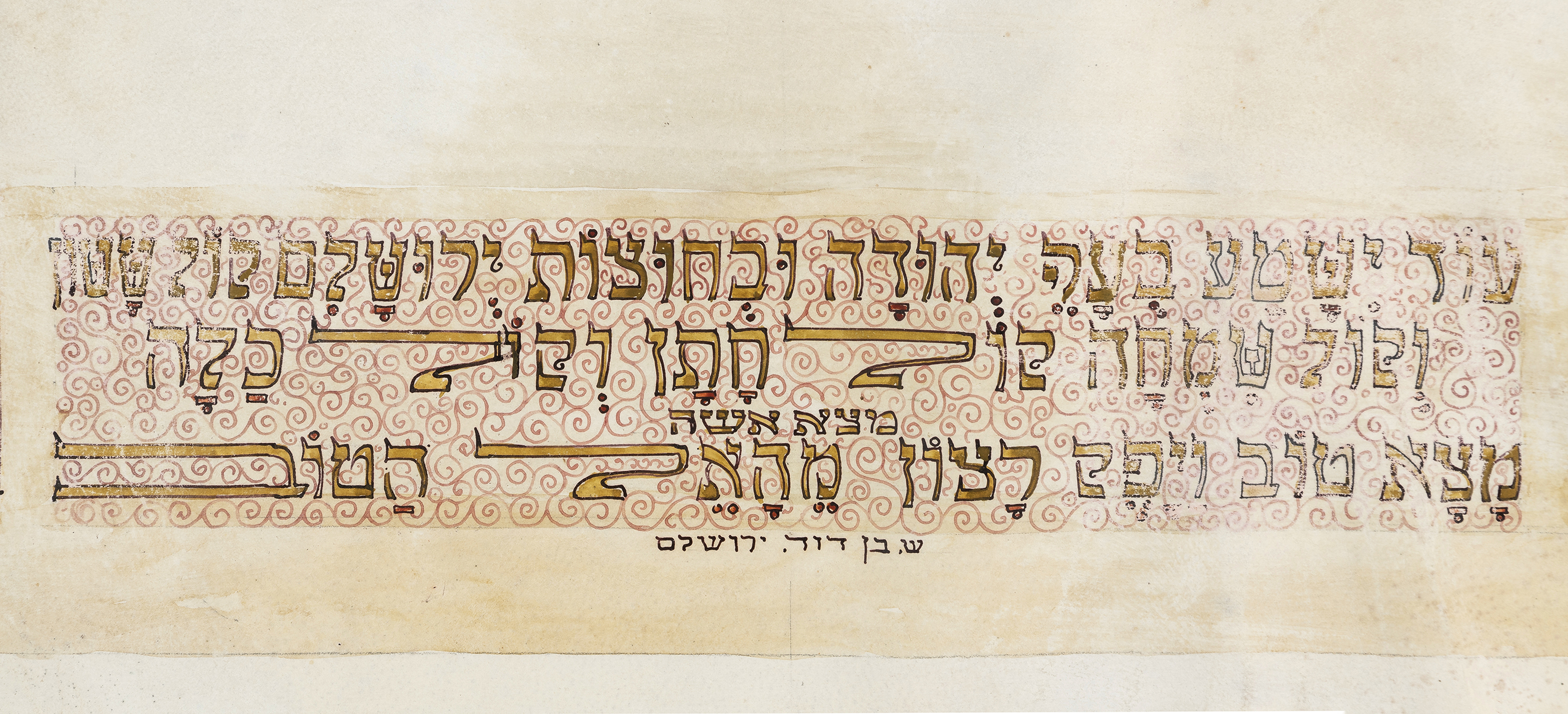
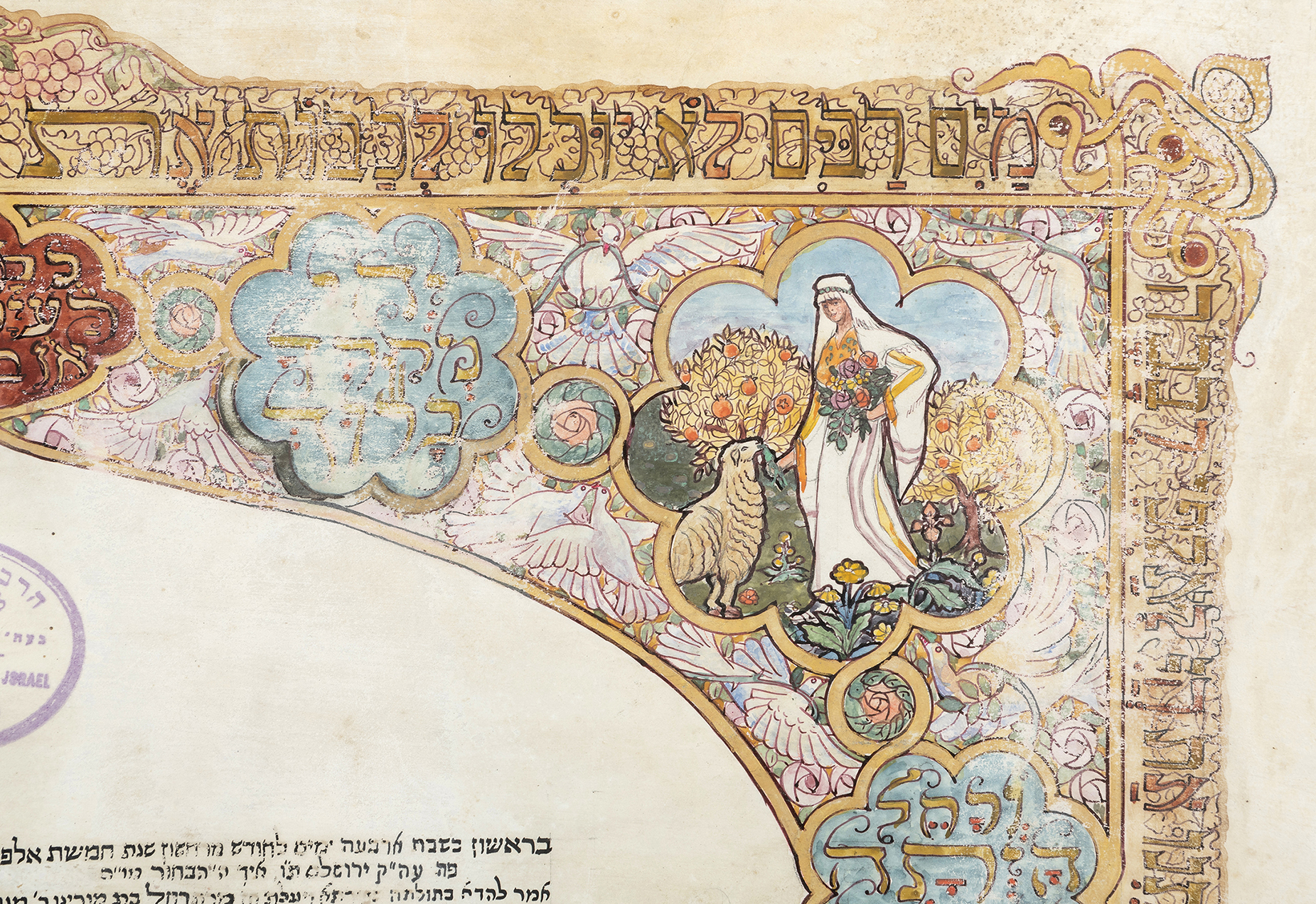
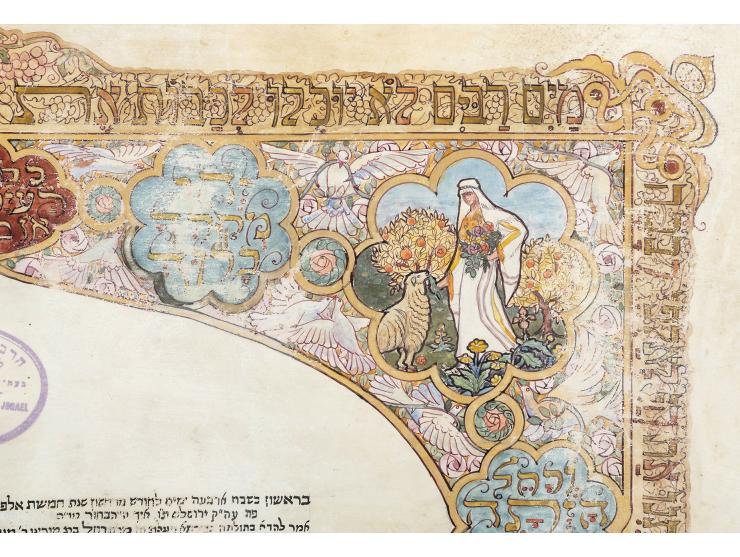
The ketubah is richly decorated by Shmuel Ben David (signature appears at bottom margin), a senior instructor in the Bezalel Academy in Jerusalem, in the characteristic Bezalel style combining Oriental decoration with motifs of Art Nouveau. The decorative design includes a large pointed horseshoe arch resting upon four massive pillars with wide bases, accompanied by many verses in alternating designs (some with decorative ligatures characteristic of the Bezalel style). The illustrations are composed for the most part of white doves, foliage and roses (or mandrakes), incorporating two large illustrations between them: one depicting the Biblical Rachel along with the caption "And Rachel was beautiful of form and appearance" (Bereshit 29:17), the second depicting Rachel and Jacob at the well with the verse "My beloved is for me and I am for him" (Shir HaShirim 2:16).
This ketubah registers the marriage of the children of two senior Zionist leaders: Menachem Ussishkin, Zionist leader and head of the Jewish National Fund, and Max Bodenheimer, chairman of the Zionist Federation of Germany, a founder of the World Zionist Organization and second chairman of the Jewish National Fund. The witness on the ketubah, Mordechai son of Hillel HaKohen, was also a familiar figure in the Zionist movement, as an activist and Hebrew author, and a founder of Tel Aviv. The wedding of Shimon Bodenheimer and Rachel Ussishkin, held in Ussishkin's home, Mahanaim House, was a ceremony attended by many distinguished guests from the Jewish settlement. It was recorded and filmed by Yaacov Ben-Dov, and attended by the two Chief Rabbis of Eretz Israel – R. Avraham Yitzchak HaKohen Kook and R. Yaakov Meir, among others, as well as Chief Commissioner Herbert Samuel and his wife.
Shmuel Ben David, born Shmuel Davidov in Sofia, Bulgaria in 1884, was accepted to an arts academy in Sofia where he studied under Boris Schatz from 1903-1905, specializing in rug weaving and rug design. In late December 1905, Ben David immigrated to Eretz Israel along with Boris Schatz, studying at the top of the first class of Bezalel. In 1907 he began organizing the rug department of Bezalel, where he taught, and in later years also taught perspective, sketching and ornamental craft. Ben David was a founder of the Association of Hebrew Artists which he headed. He passed away in Jerusalem in 1927 at the young age of 42. Ben David was a senior instructor at Bezalel, teaching Nachum Gutman, Chaim Gliksberg, Moshe Castel, Avigdor Stematsky and many others, and was a key contributor to the formulation of the "Bezalel" style. One of his better-known works, an Esther scroll he produced at the beginning of the 20th century, is highly reminiscent of the present ketubah's decorations. Another ketubah produced by Shmuel Ben David in 1926 is located in the Israel Museum, Jerusalem (B87.0178); another ketubah, also dated 1926, is documented in the exhibition catalogue Local Wedding: Ketubbot from Eretz Israel, 1800-1960 (Eretz Israel Museum, Tel Aviv, 2005, no. 53).
49X59.5 cm. Fair-good condition. Slight creases and stains (some dark), only slightly affecting text. Old moisture damage and fading of paint and ink, affecting illustrations and typographic decorations and noticeably affecting text.
This ketubah is documented on the NLI ketubah site, listing 990003035700205171.
Category
Ketubot
Catalogue Value


Auction 107: Rare and Important Items
Apr 15, 2026
Opening: $40,000
Estimate: $60,000 - $70,000
Sold for: $60,000
Including buyer's premium
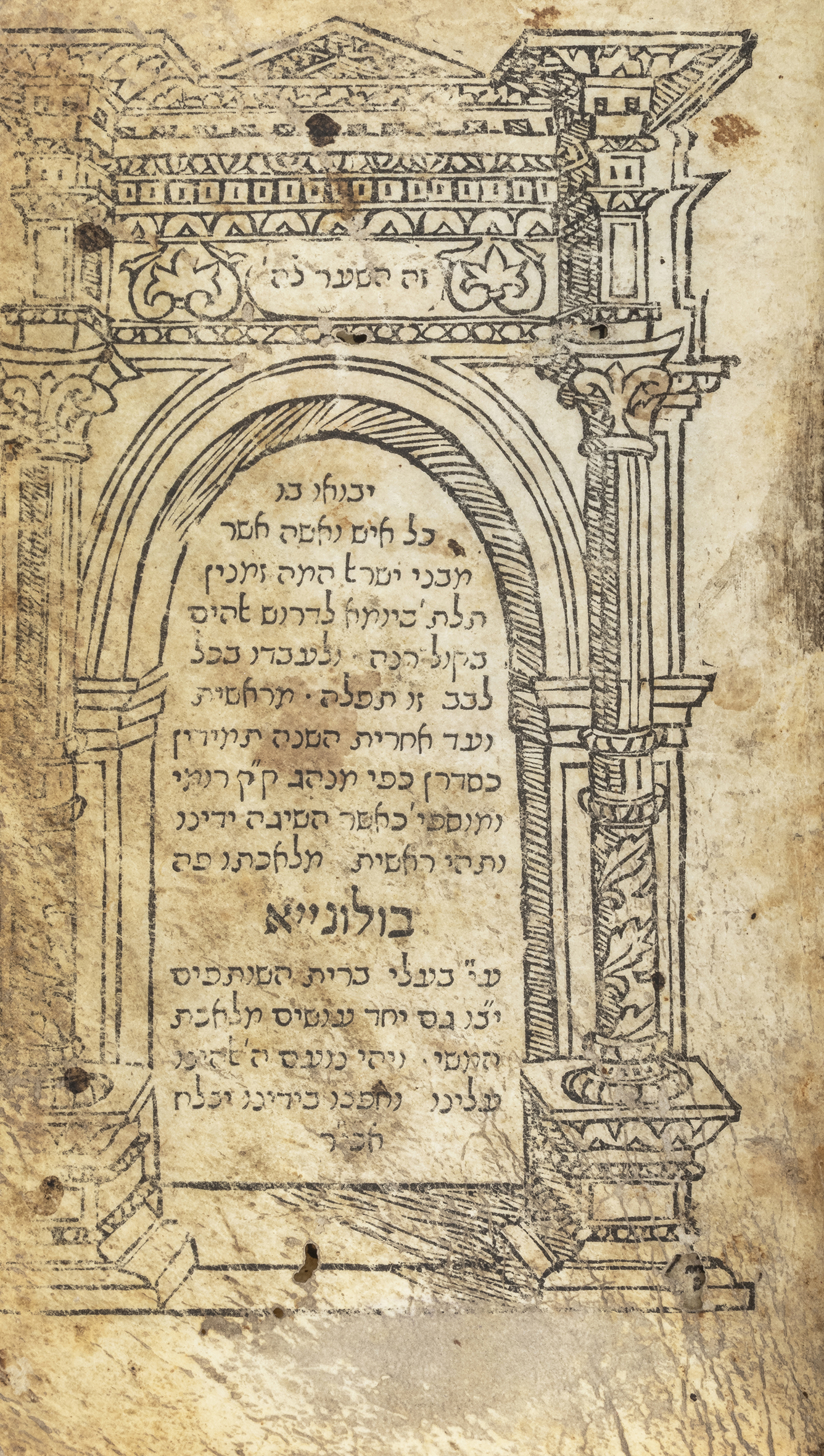
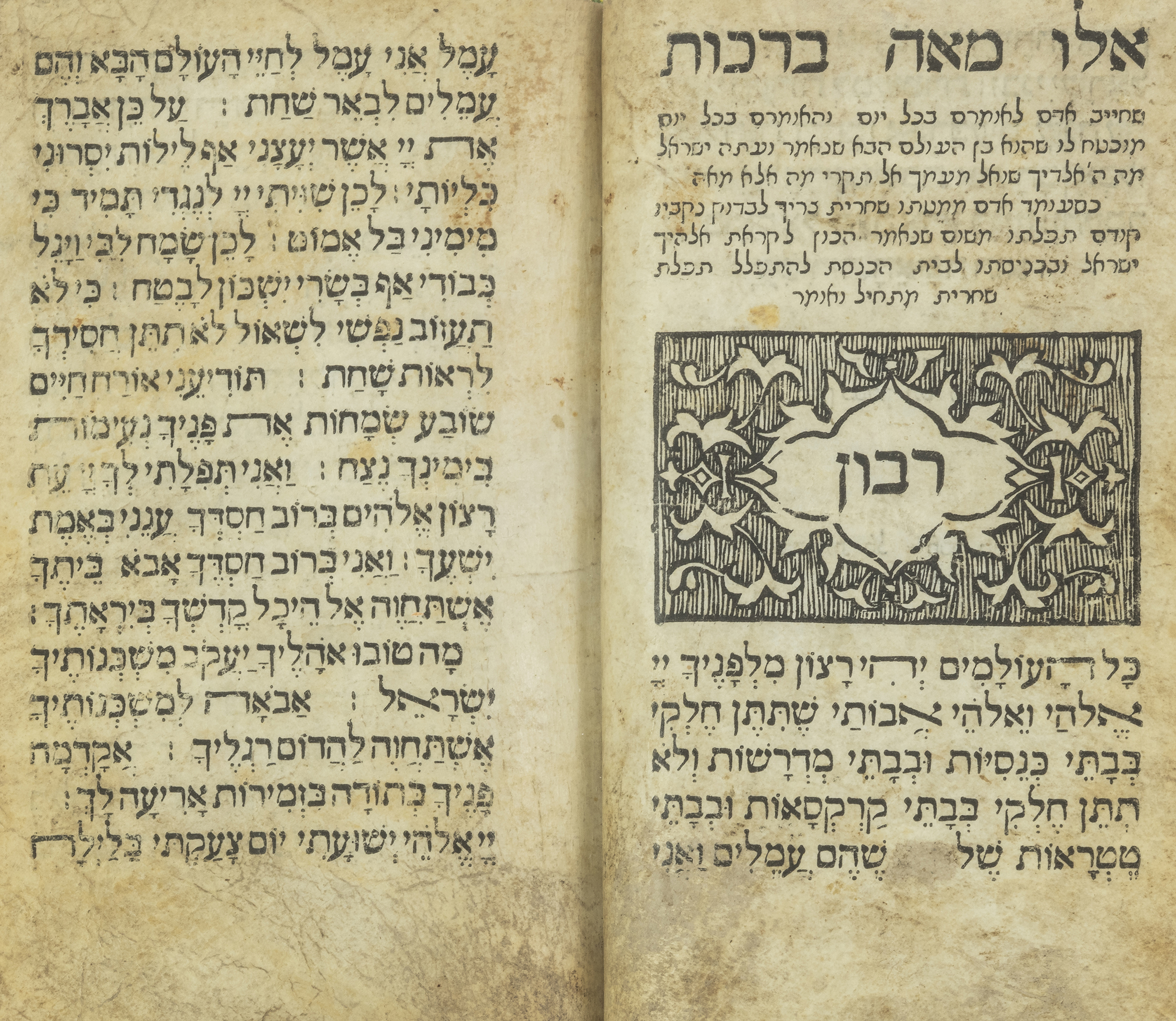
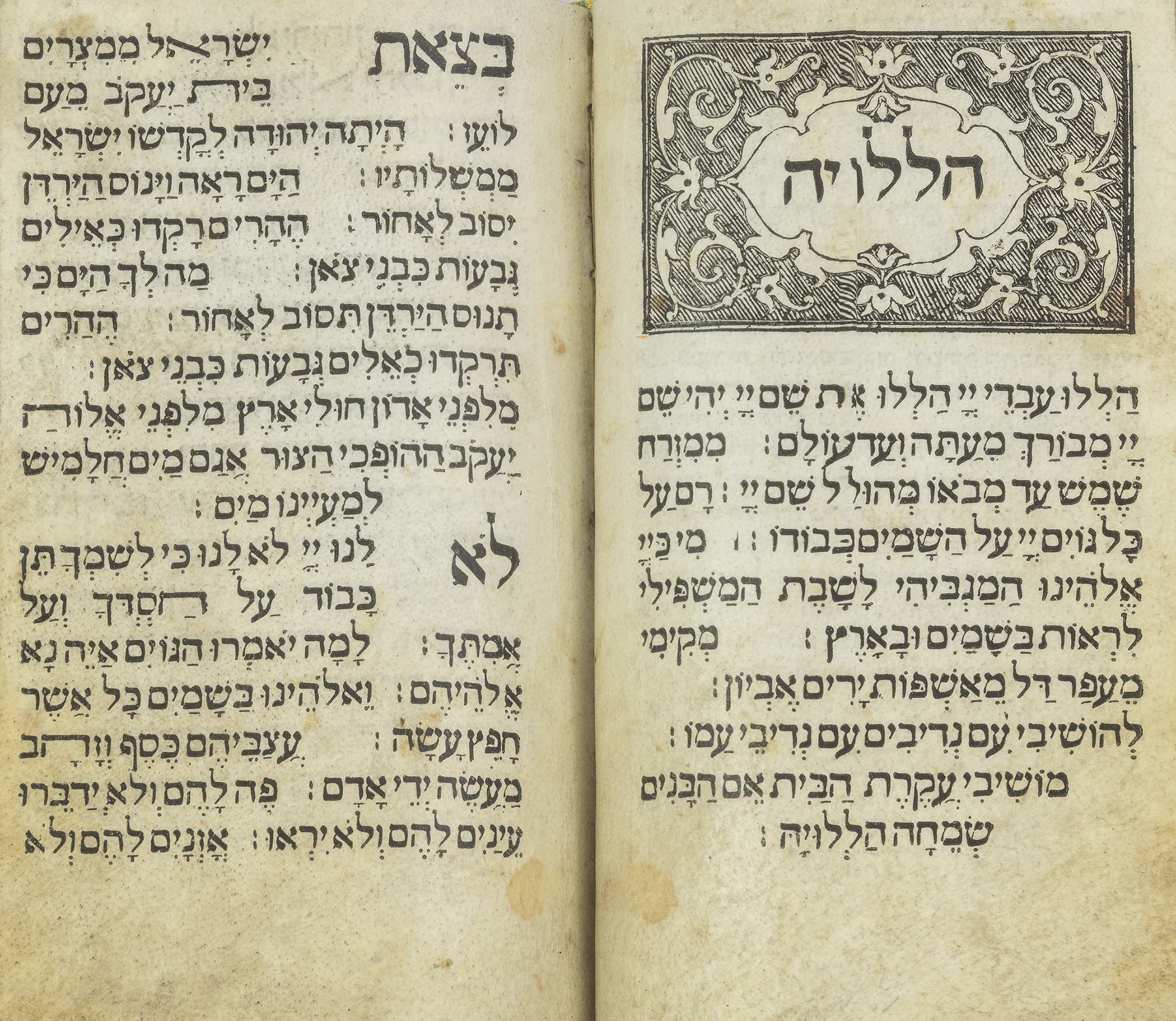
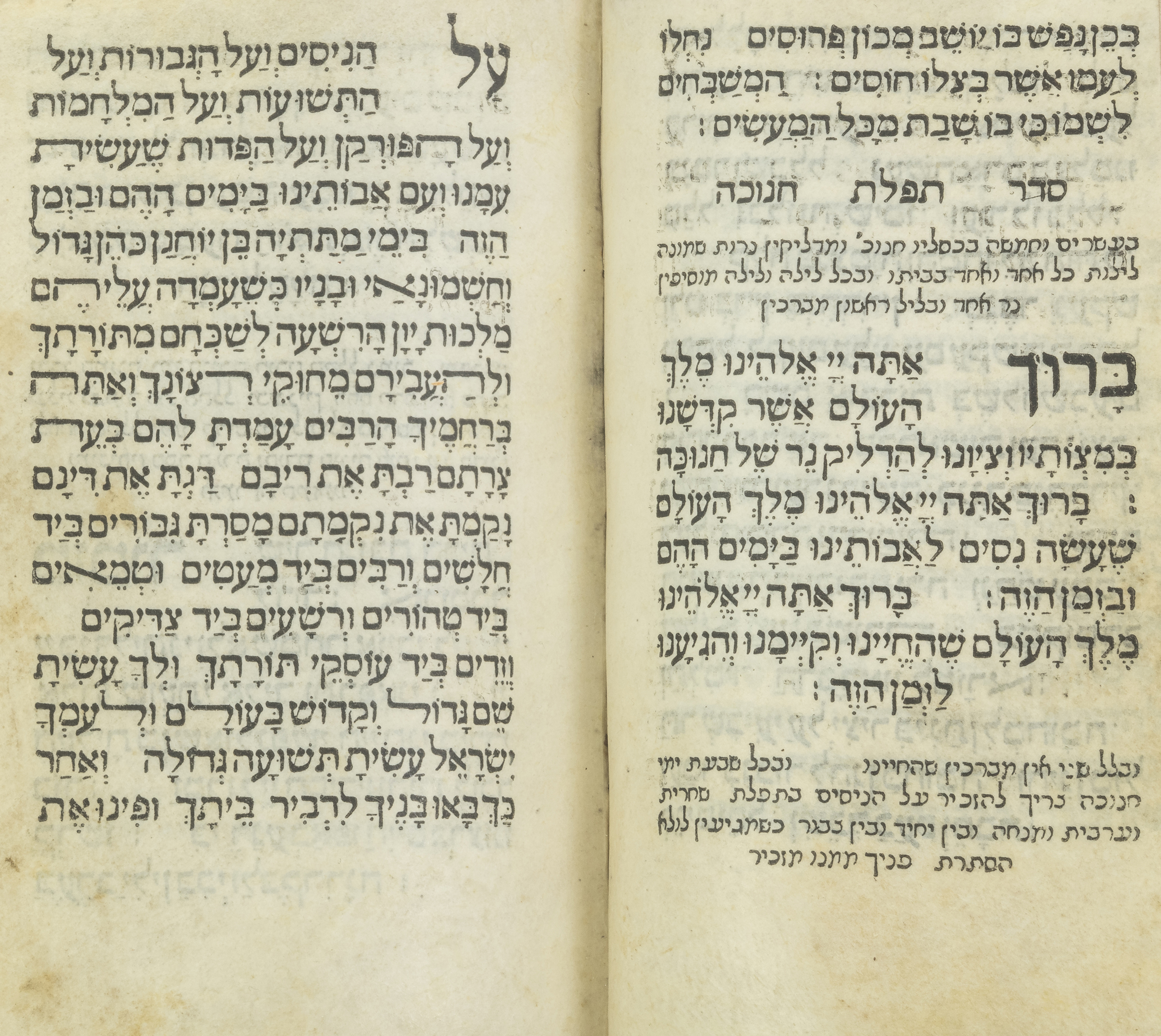
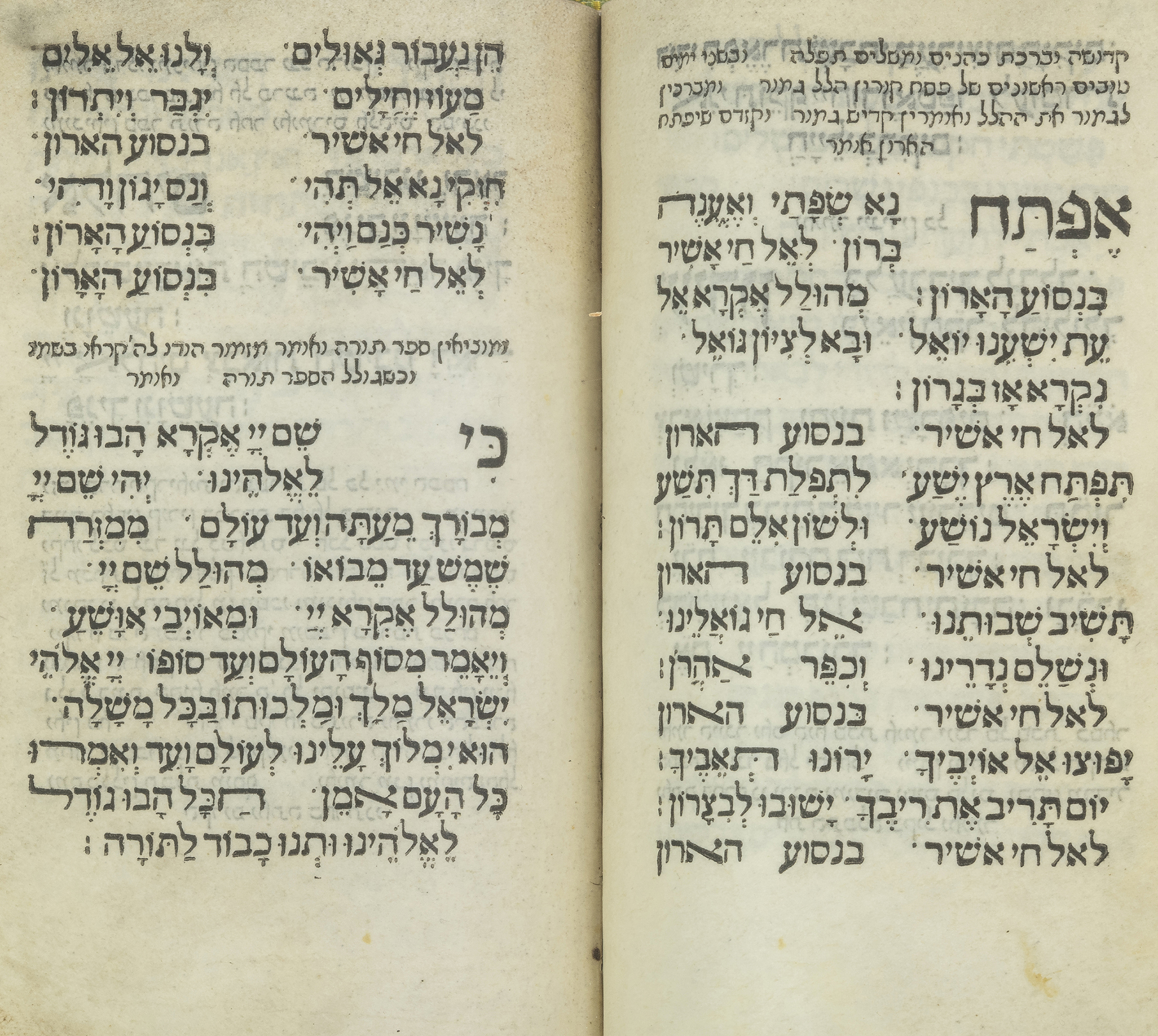
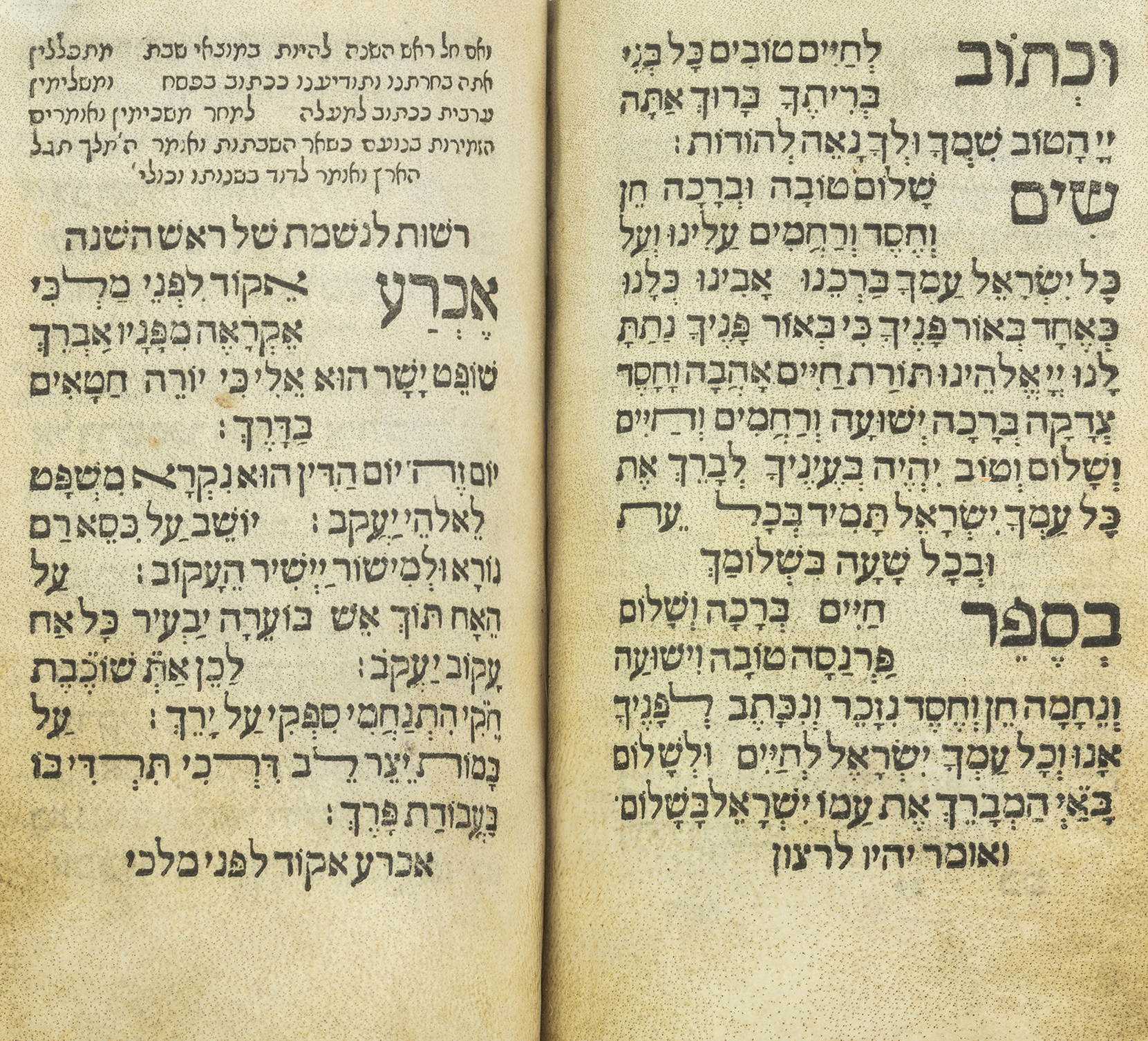
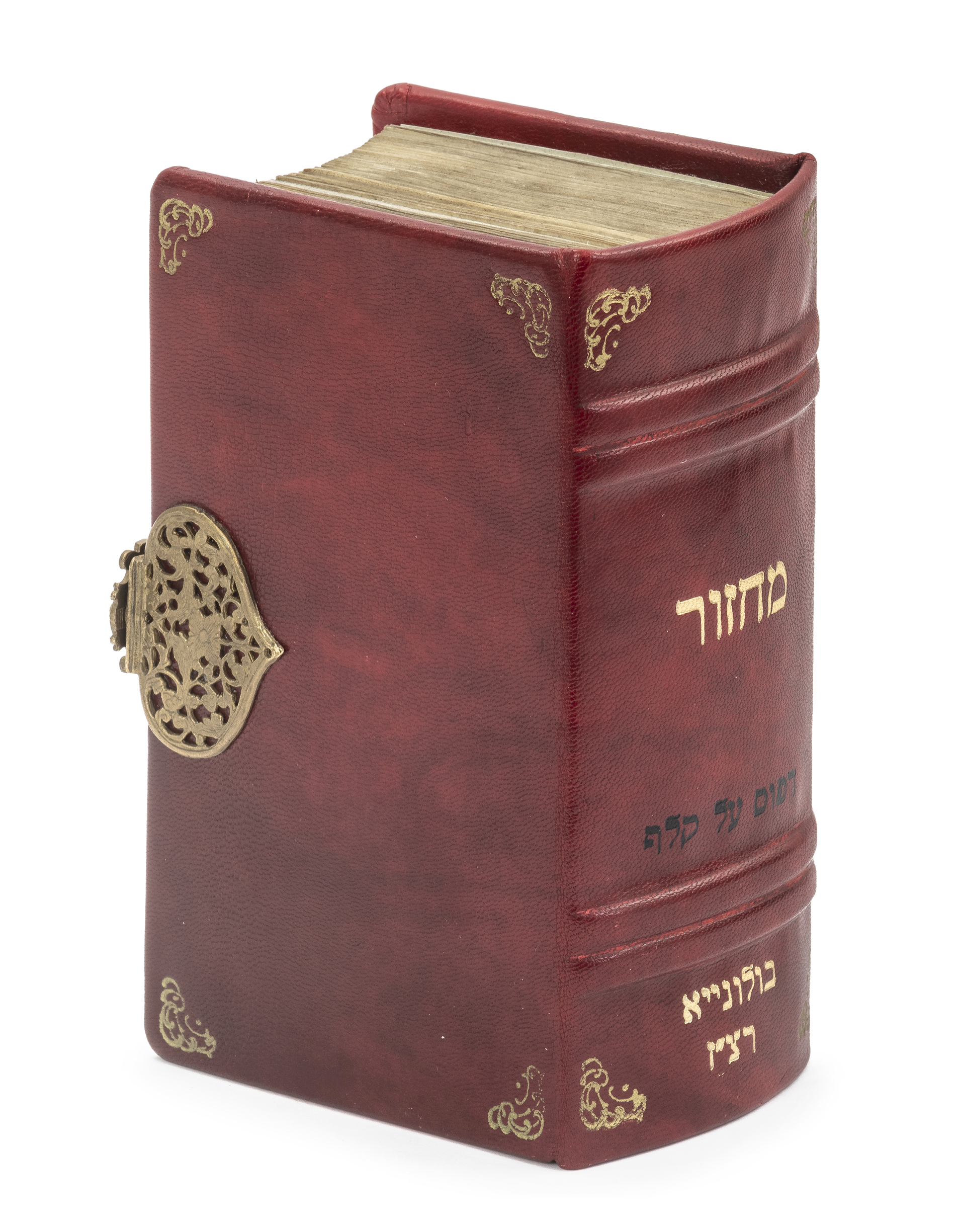
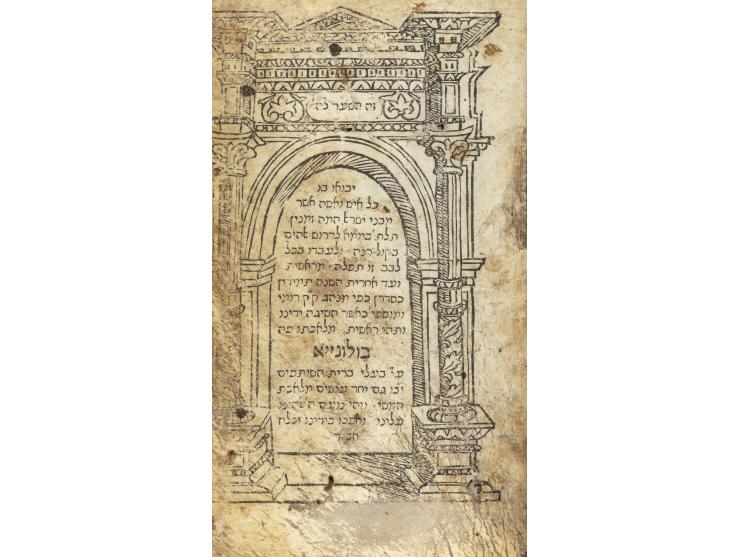
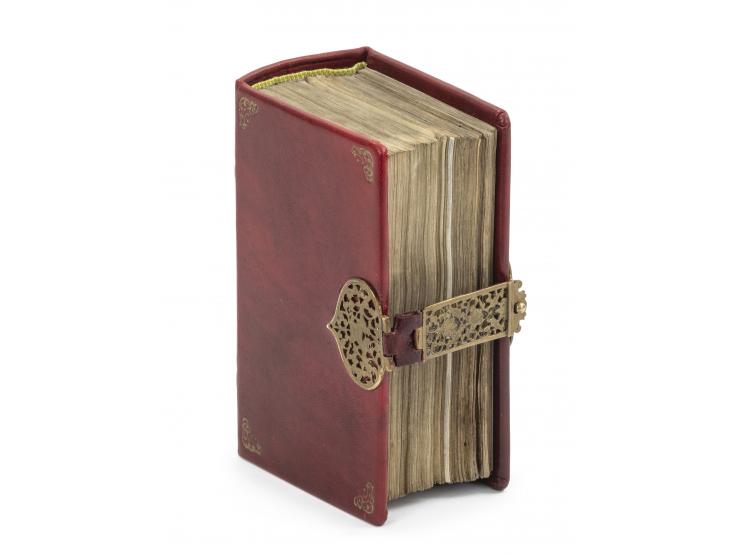
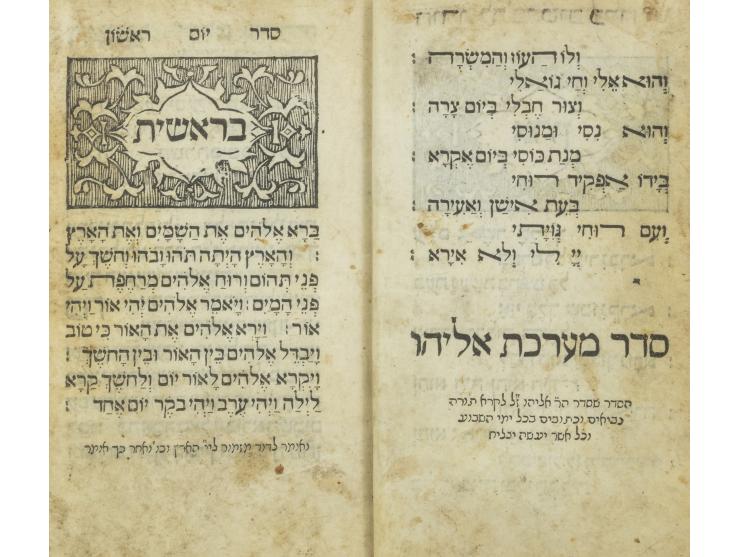
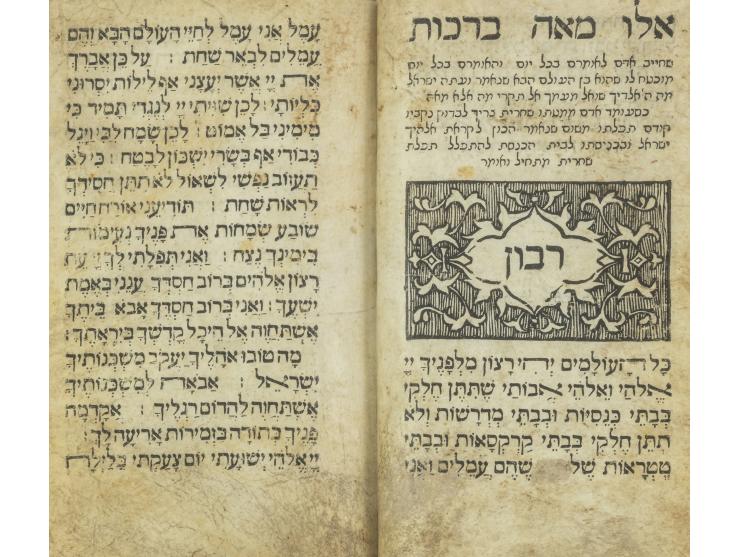
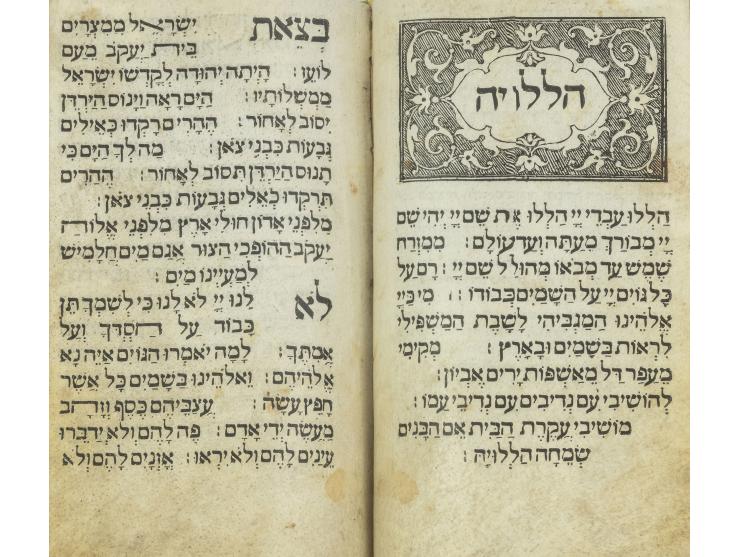
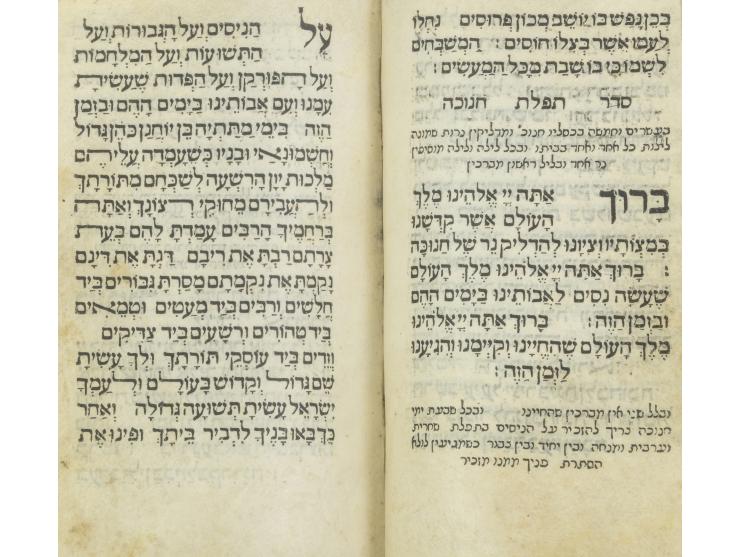
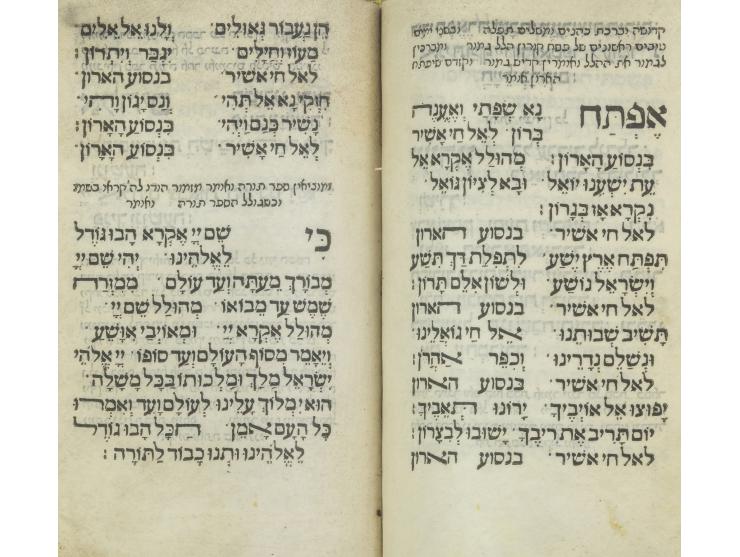
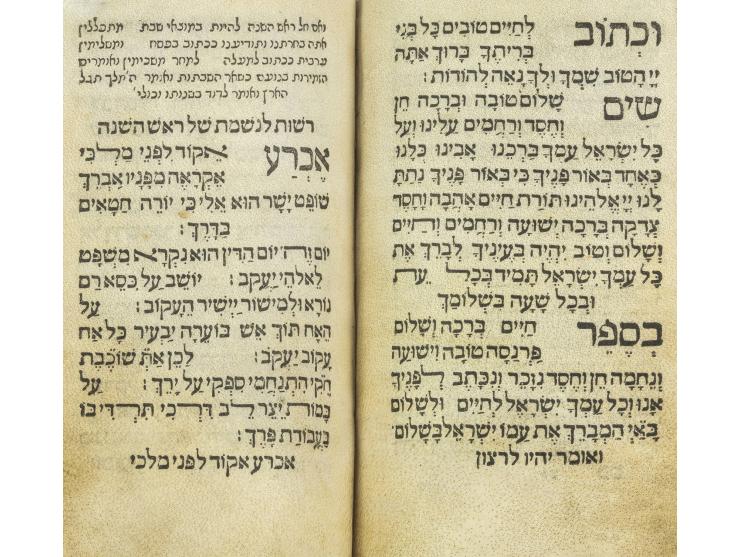
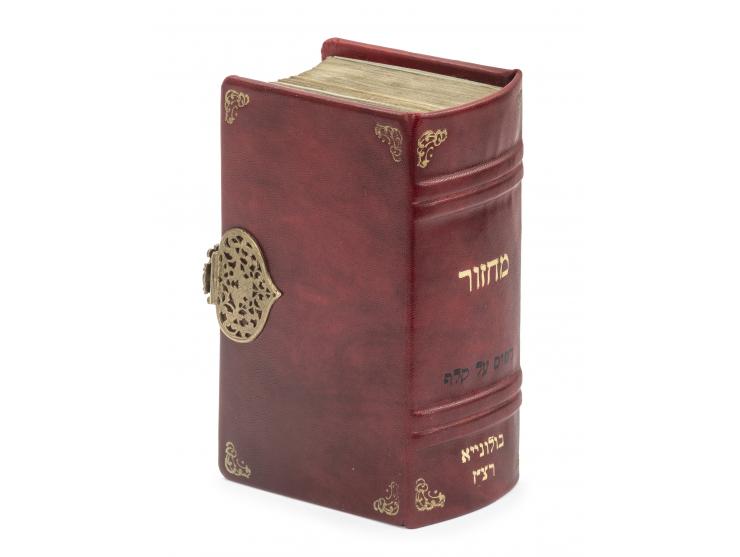
Year-round siddur, following the Roman rite. Bologna: Silk Weavers' Guild, 1537.
Complete copy printed entirely on parchment.
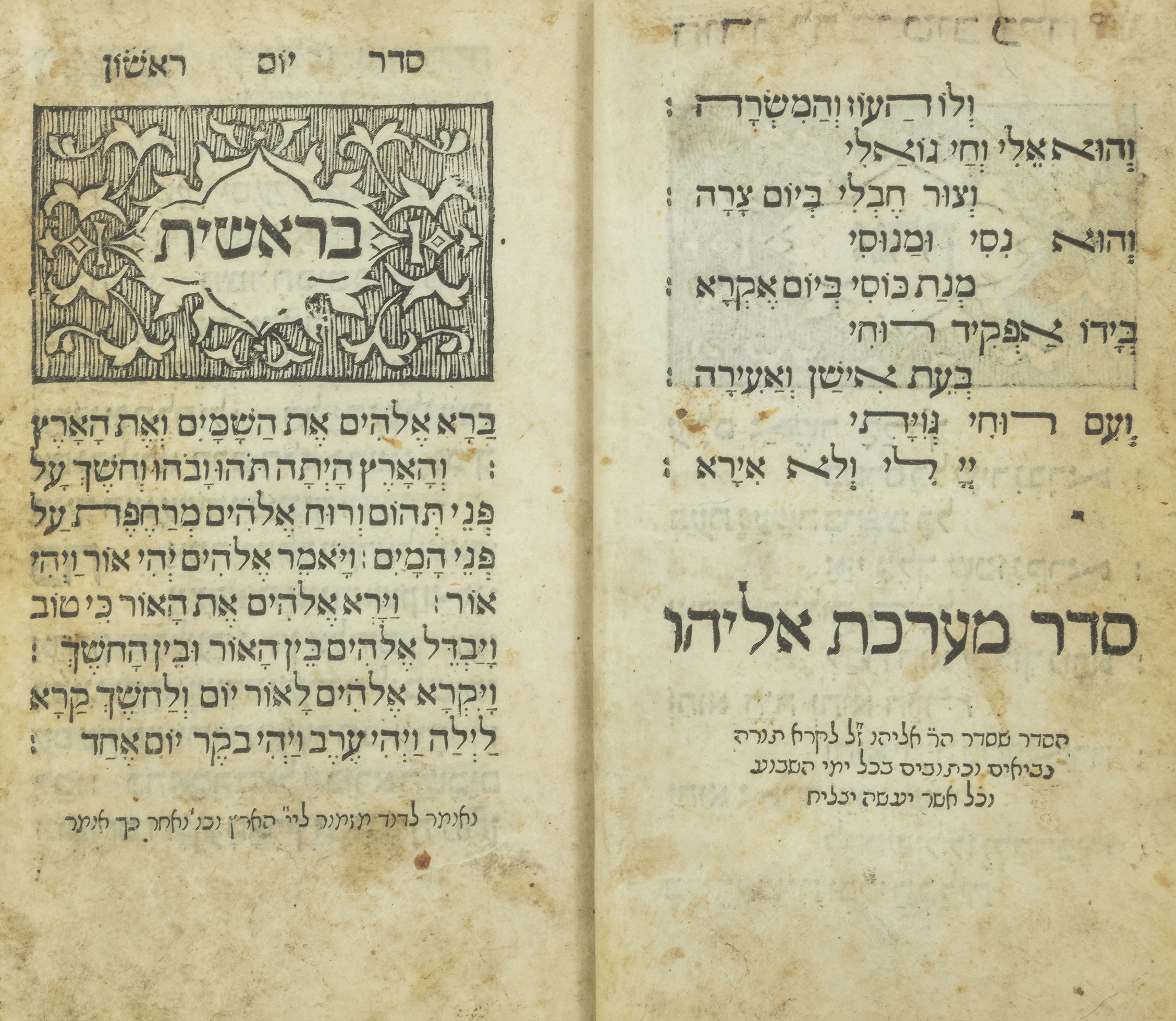
Year-round siddur, including prayers for weekdays, Shabbat, Rosh Chodesh and Shabbat Rosh Chodesh, Yotzer for Shabbat Bereshit, prayers for Chanukah and Shabbat Chanukah; prayers for fast days, Yotzrot for the Four Parashiot, prayers for Purim, Reshut for Shabbat HaGadol, prayers for Pesach, order of annulling curses, Yotzer for Shabbat before Shavuot, prayers for Shavuot, instructions for prayers of 17th of Tamuz, Yotzer for Shabbat Eichah, instructions for 9th of Av, Yotzer for Shabbat Nachamu and Shabbat before Rosh Hashanah, prayers for Rosh Hashanah, order of the Fast of Gedaliah, Yotzer for Shabbat Shuvah, prayers for Yom Kippur, Sukkot, piyyut by R. Bachya HeChassid for Yom Kippur (Barchi Nafshi), Mi SheBerach for Torah reading and Yizkor.
Prayers for festivals are richly interspersed with many piyyutim.
At the beginning of the book, after Adon Olam, is printed Seder Maarechet Eliyahu – a weekly study regimen of Torah, Neviim and Ketuvim instituted by R. Eliyahu [HaZaken son of R. Menachem], a sort of Maamadot, first printed here.
Colophon on last leaf: "…And it was completed here in Bologna, by the young typesetter Refael Talmai on behalf of the Guild and himself, Tuesday, 5th Sivan [1537]…".
Censorship expurgations in several places (the words "the dominion of evil" from the Rosh Hashanah prayers are erased by scraping).
Censor's signature on last leaf.
See further: A. Piattelli, Bibliography of Roman-Rite Machzorim and Siddurim (Hebrew), no. 11.
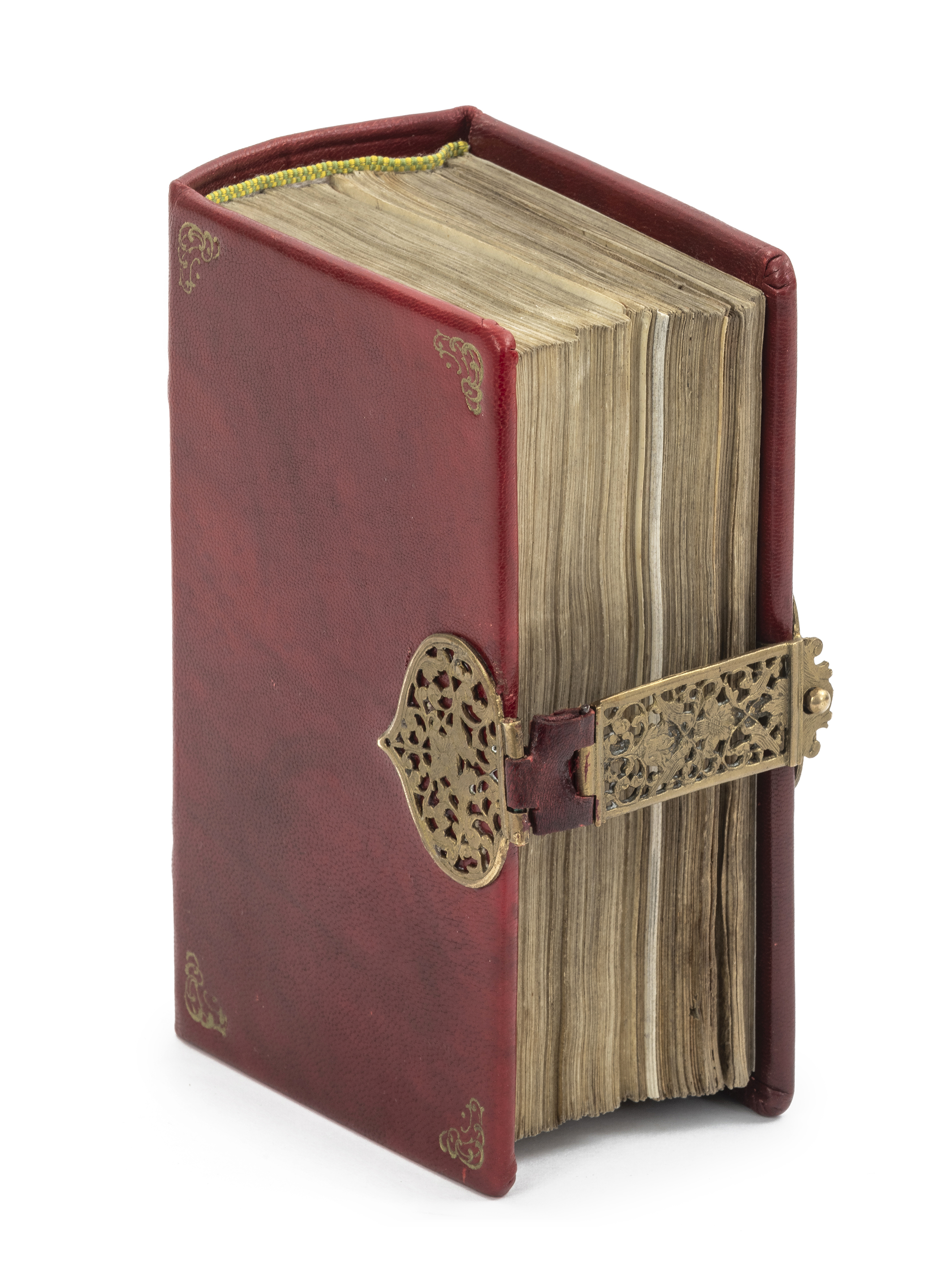
[354] leaves (all gatherings contain 8 leaves, gathering xxxii contains 10 leaves). Approx. 14 cm. Varying condition of leaves, fair to good-fair. Stains. Especially dark dampstains to last leaves. Wear and many signs of use to some leaves (some leaves dark). Worming, tears and open tears, affecting text in several places. Close trimming, bordering text, affecting title frame and text of several leaves. New leather binding, with gilt decorations and clasp.
Category
Siddurim and Passover Haggadot
Catalogue Value
Auction 107: Rare and Important Items
Apr 15, 2026
Opening: $50,000
Estimate: $70,000 - $90,000
Sold for: $93,750
Including buyer's premium
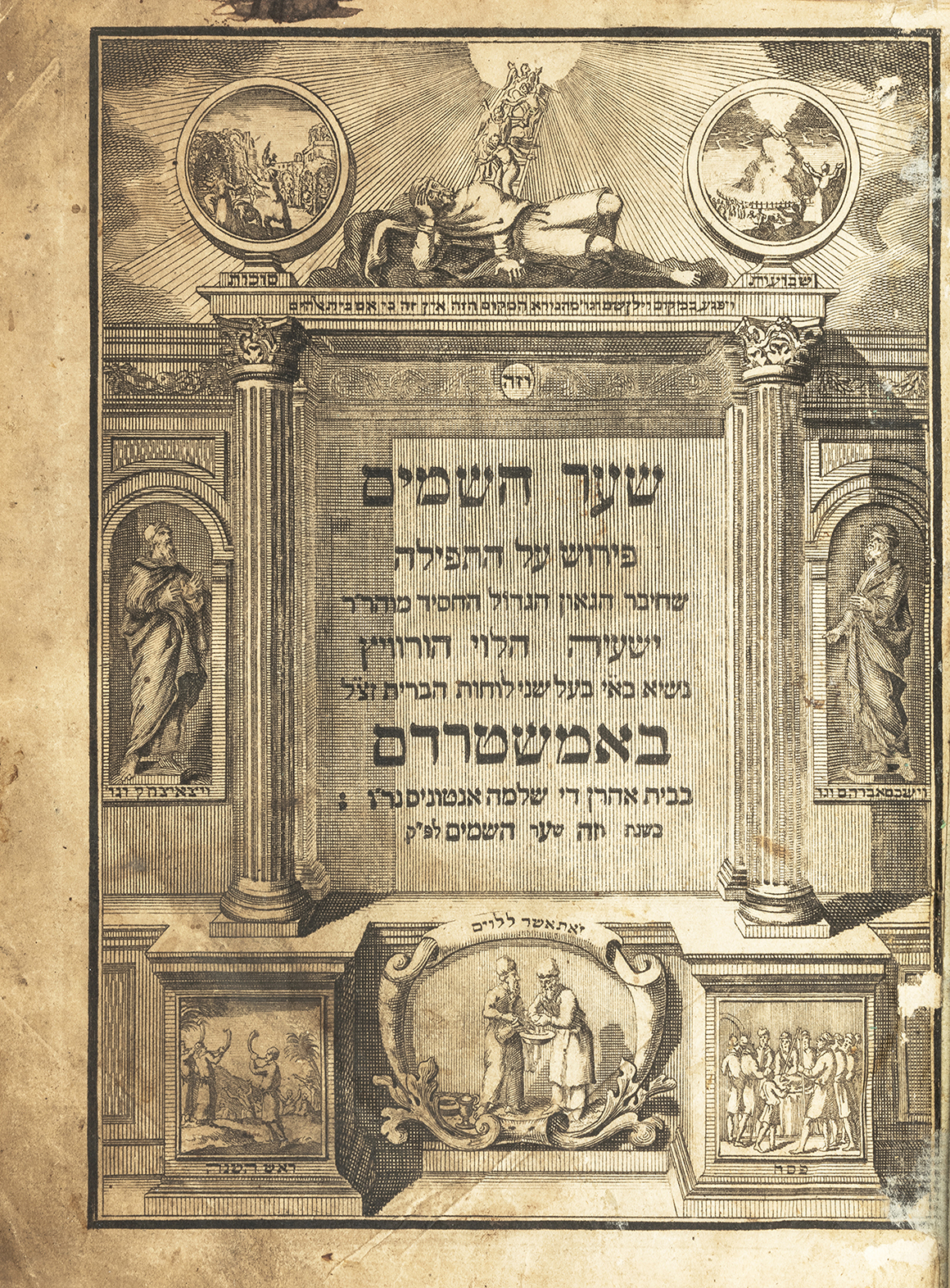
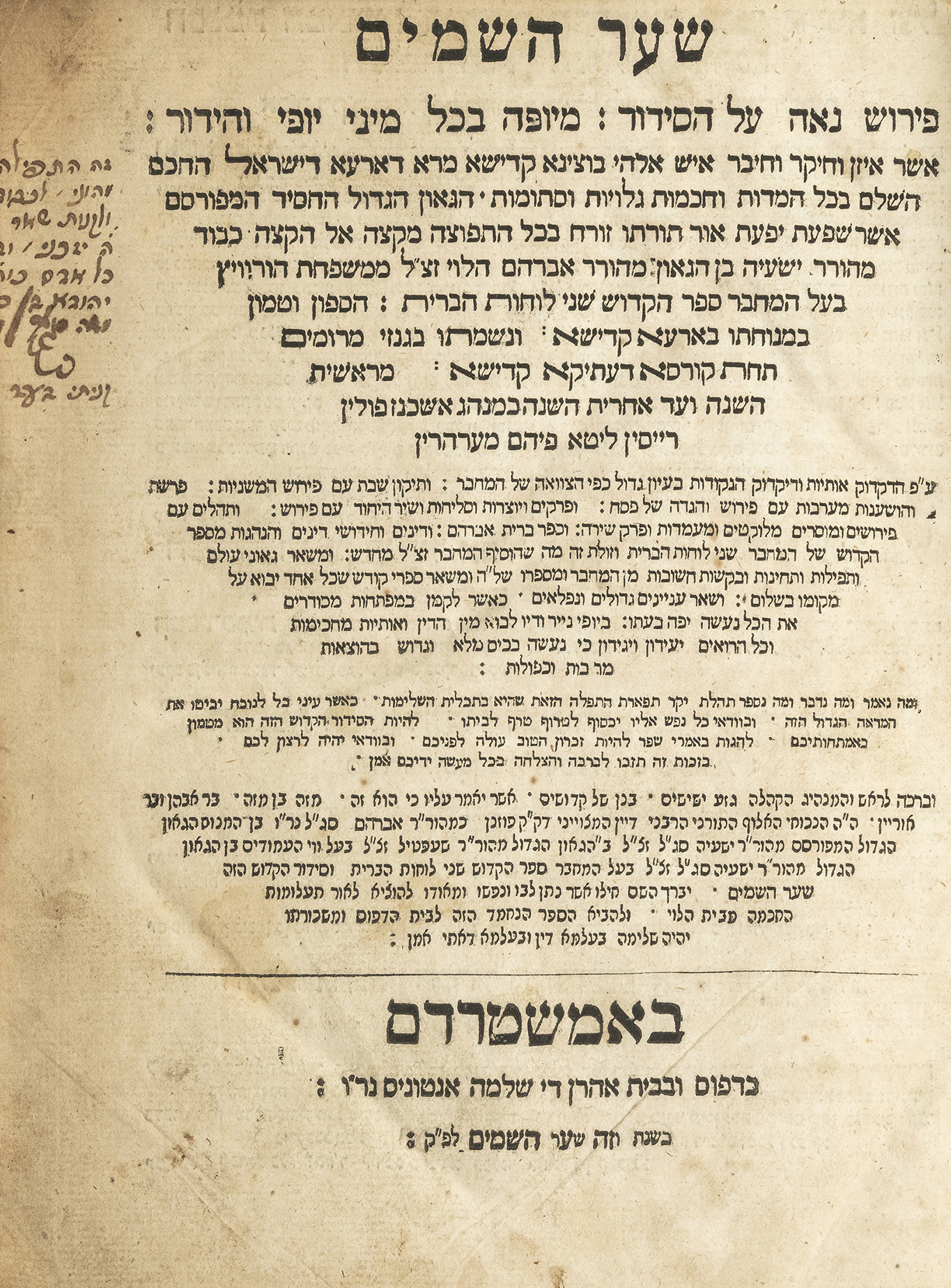
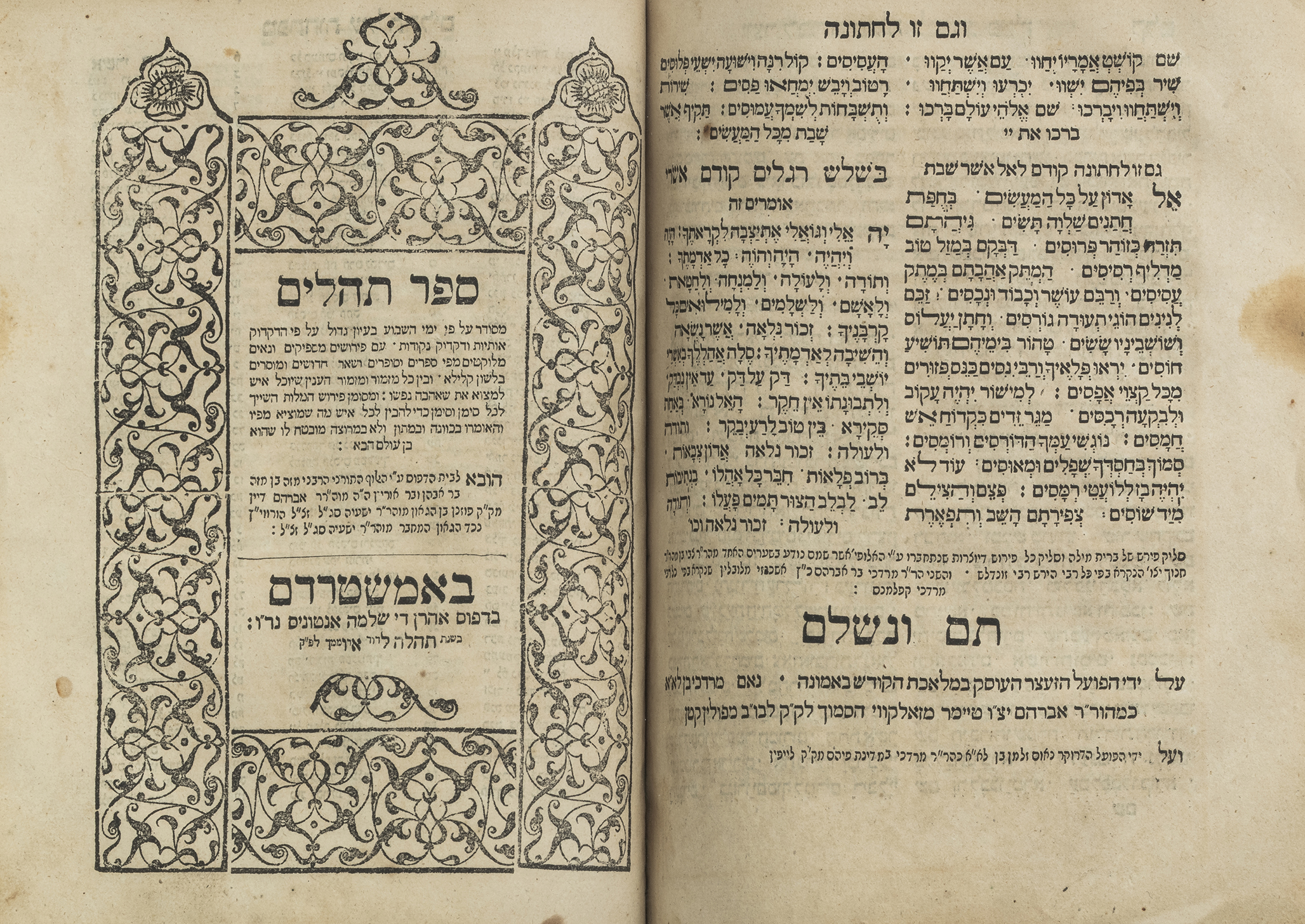
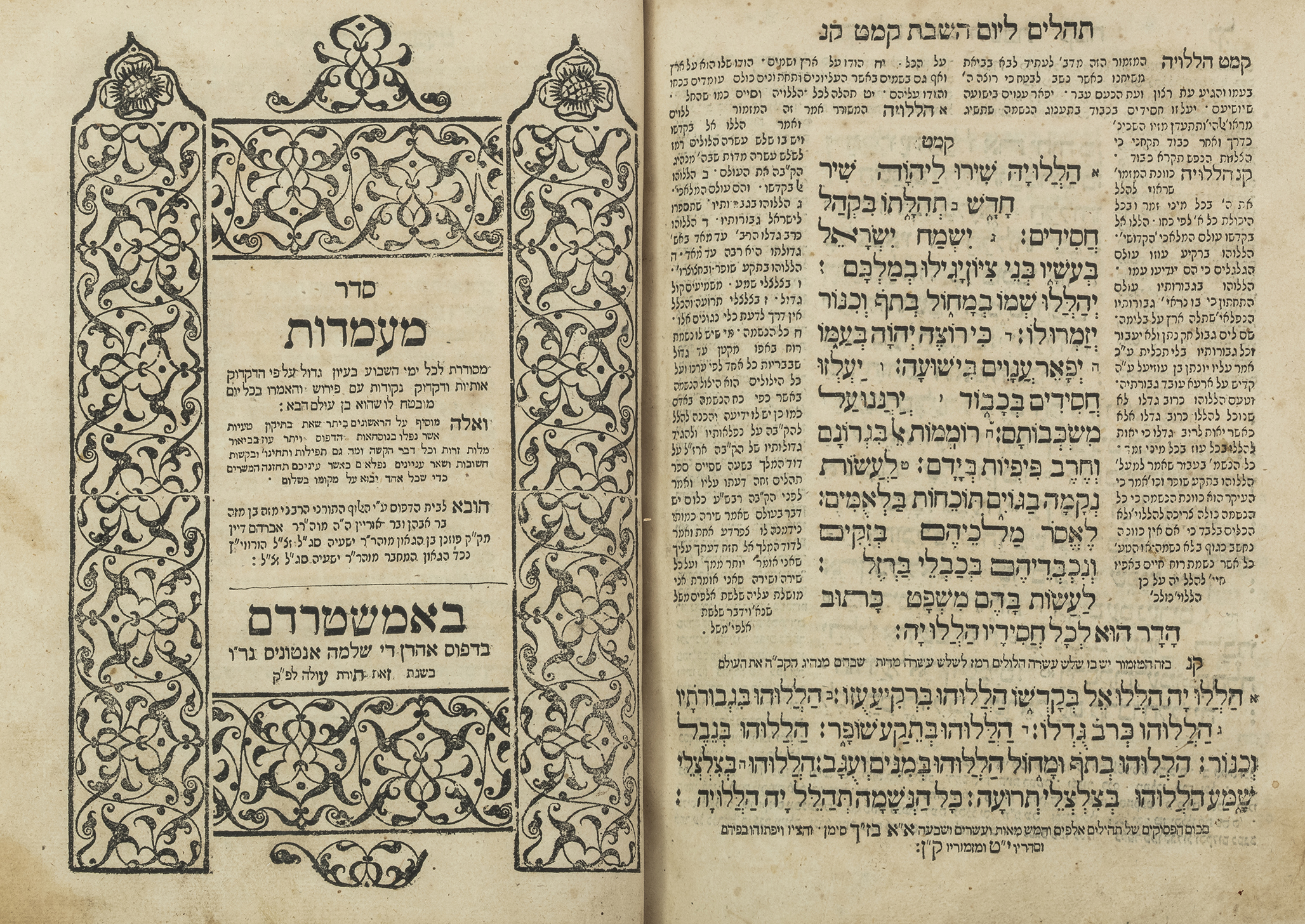
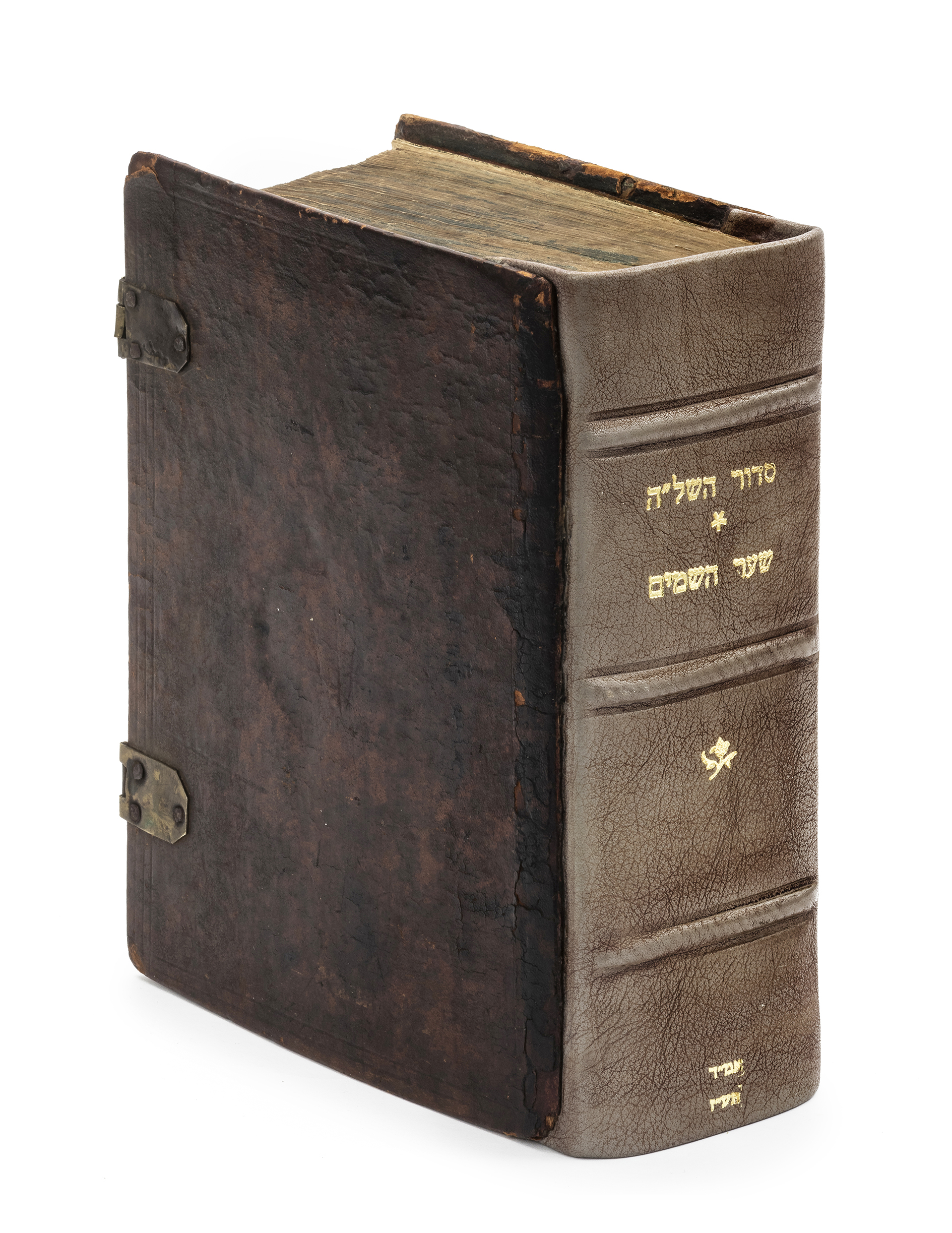
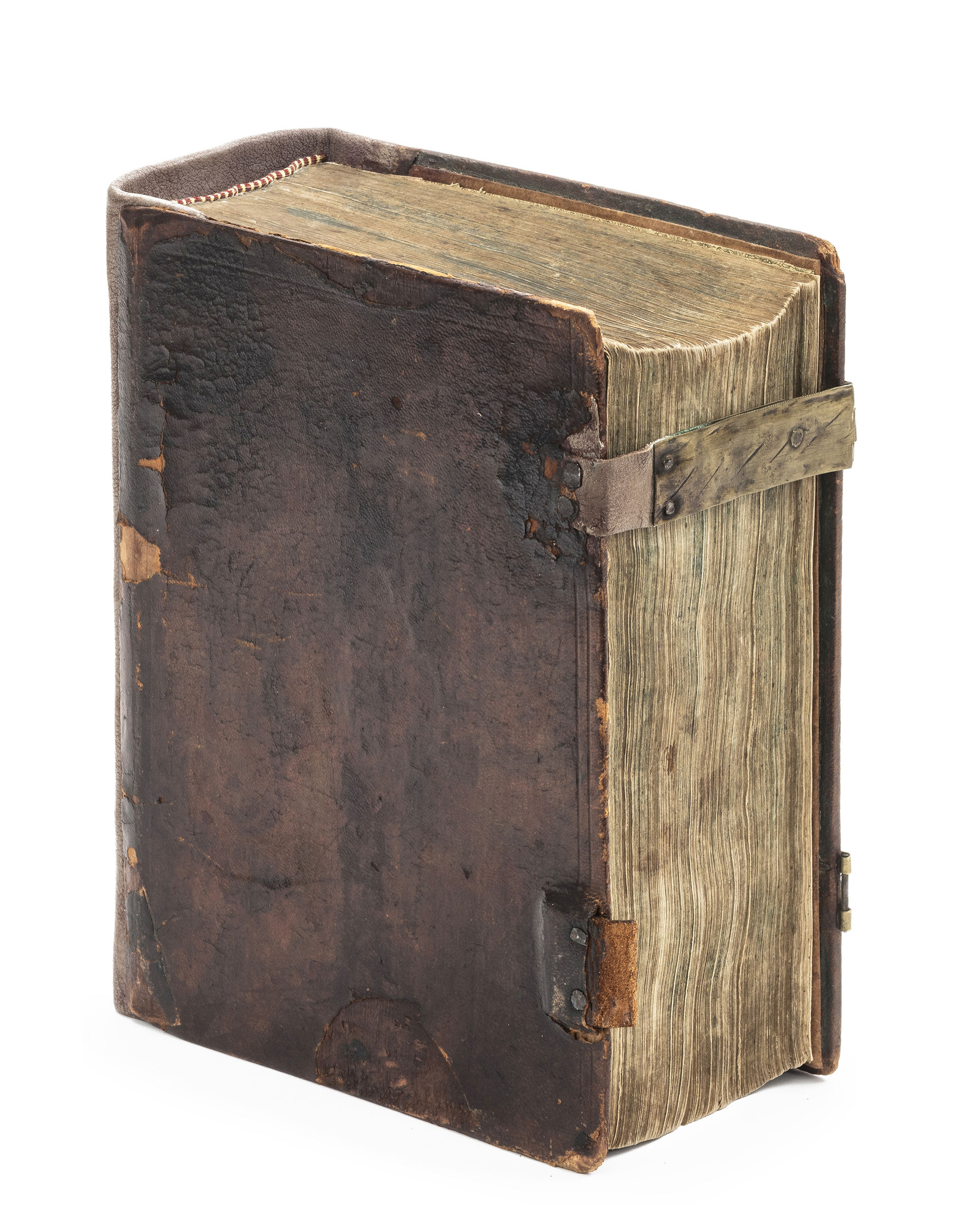
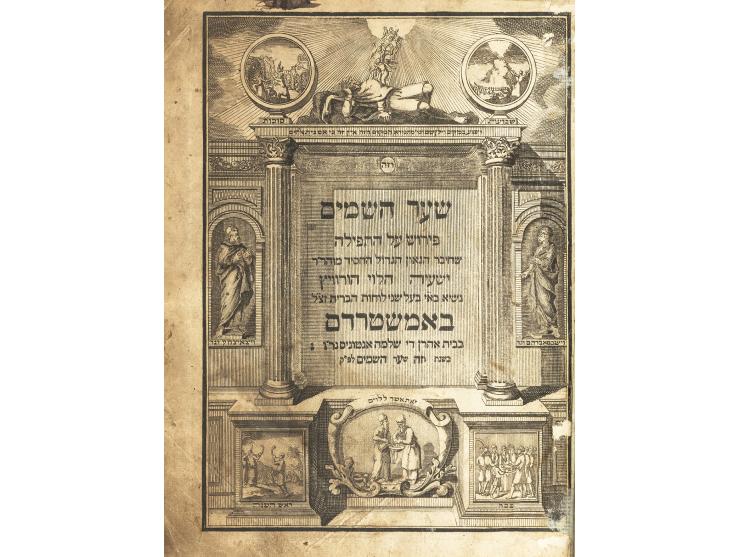
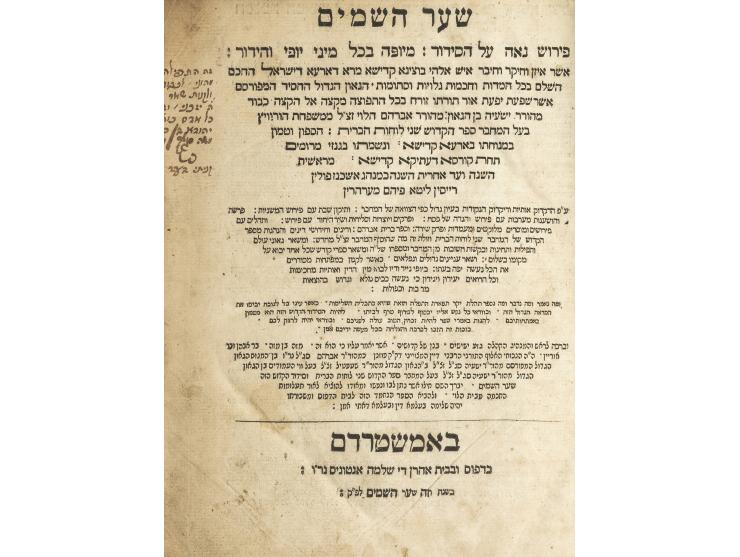
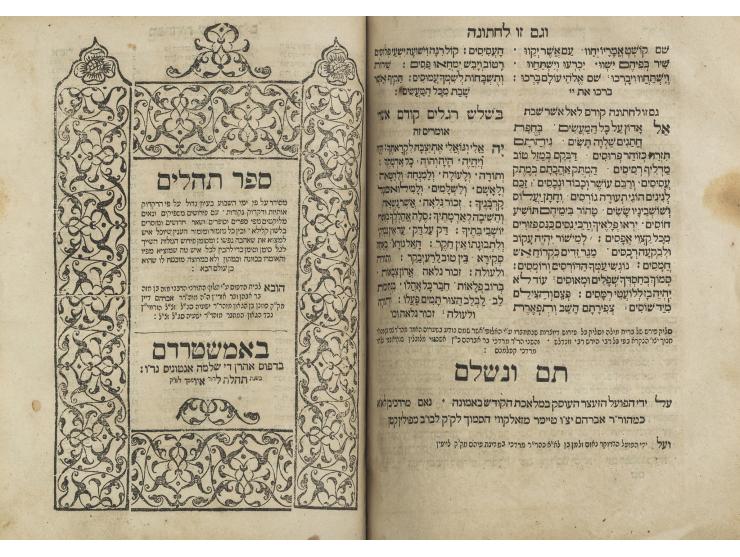
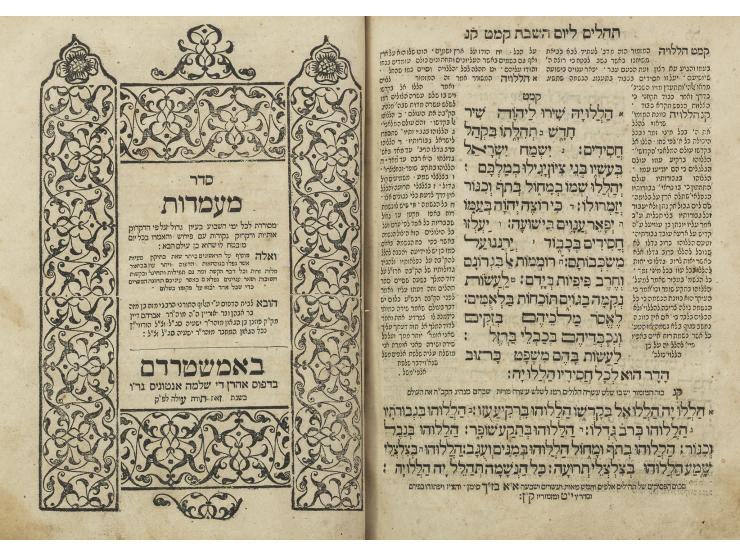
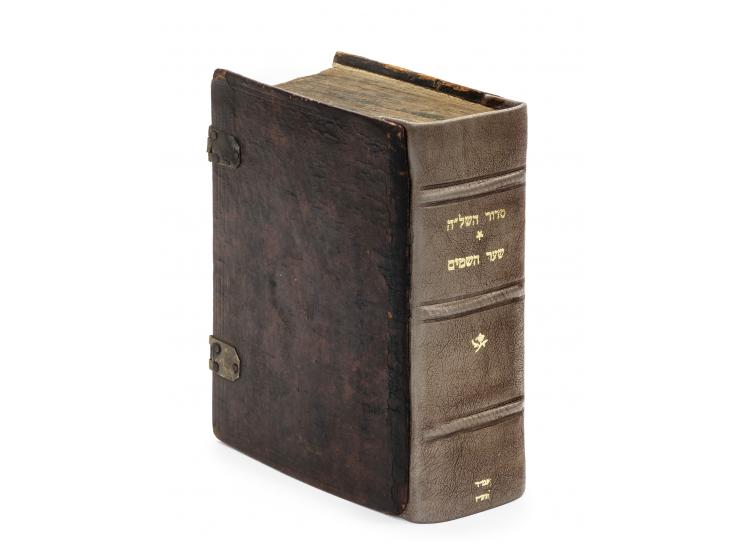
Shaar HaShamayim siddur – prayers for weekdays, Shabbat and festivals, Yotzrot, Passover Haggadah, piyyutim and Selichot for fast days, Tehillim and Maamadot. With Shaar HaShamayim – a kabbalistic commentary on the prayers, by R. Yeshayah HaLevi Segal Horowitz – the Shlah. Includes an anthology of laws and practices, by the editor and publisher R. Avraham Segal Horowitz of Posen, great-grandson of the author. Amsterdam, [1717]. First edition.
Complete copy containing all parts. Four title pages; on first title page, copper engraving with illustrations of Abraham, Isaac and Jacob and the festivals. Divisional title pages for Tehillim and Maamadot.
The Shlah writes in his introduction to the siddur: "Blessed is G-d… Who guided me on the true path… and brought me to the holy city of Jerusalem in 1622… to the gate where prayers ascend… through the gate of heaven (Shaar HaShamayim)". In the author's will printed at the beginning of the siddur, he adds that he decided to author this work "so that it would be printed and spread throughout the Jewish diaspora, so that I would have merit and a portion in all Jewish prayers".
Most of the prayers in this siddur follow the Ashkenazic rite, apart from some prayers which were printed side by side in both Ashkenazic and Sephardic rite, as the author requested in his will (although the editor and publisher did not in fact follow all the author's textual instructions for the siddur).
Praying from this siddur has the special segulah of the prayer being accepted, as the Bach writes in his approbation to this siddur: "We have no doubt that when it is disseminated throughout the Jewish people, whoever prays from it will not have his prayer go unanswered". This segulah is repeated by Rebbe Avraham Yaakov of Sadigura in his approbation to the third edition of the siddur (Warsaw, 1882). The kabbalist R. Naftali Katz, author of Semichat Chachamim, attributes this segulah to the author himself, the Shlah: "He was especially fond of this siddur, and he instructed his descendants to publish it in order to bring merit to the public by praying in this order with those kavanot. And there is a promise on his part that those who follow this order before Him Who hears prayer with all their strength and with those kavanot will not return emptyhanded…".
The Baal HaTanya reputedly followed the kavanot of the Shlah in this siddur for his prayer service during his youth (Beit Rebbe, Berditchev 1902, p. 2, chapter 1).
Birth and death inscriptions from late 1830s to early 1840s on front and back endpapers.
Ownership inscription (trimmed) on second title page at beginning of book: "This siddur [---] from my wealth, in honor [---] and to purchase other [---]. May G-d grant me the merit [---] everyone [---] Yehudah son of [---] Moshe Segal [---]. I purchased it for [---]".
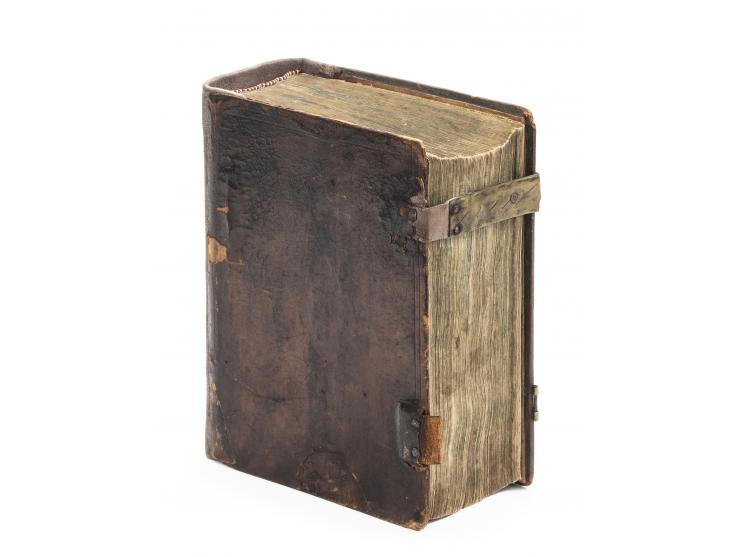
Complete copy. [5], 4-335; 139; 130; [1], 52 leaves. 21.5 cm. Good-fair condition. Stains, including dark stains. Wear and signs of use. Marginal tears and open tears in several places, last leaf repaired with paper filling. Tears and defects to inner margins of title page at beginning of book, slightly affecting illustrated frame. Close trimming, affecting page headers in several places (first line of header lacking on third leaf, headers entirely lacking on fourth leaf). Early wood and leather binding, with clasp (second clasp lacking), with new pastedowns and leather spine.
Category
Siddurim and Passover Haggadot
Catalogue Value
![Siddur according to the Sephardic rite. Amsterdam: Yosef, Yaakov and Avraham sons of Shlomo Proops, [1760]. Pocket format.](https://files.kedem-auctions.com/files/Sale107/53_1.jpg "Sephardic-Rite Siddur – Printed on Parchment – Amsterdam, 1760 – Pocke")
![Siddur according to the Sephardic rite. Amsterdam: Yosef, Yaakov and Avraham sons of Shlomo Proops, [1760]. Pocket format.](https://files.kedem-auctions.com/files/Sale107/53_2.jpg "Sephardic-Rite Siddur – Printed on Parchment – Amsterdam, 1760 – Pocke")
![Siddur according to the Sephardic rite. Amsterdam: Yosef, Yaakov and Avraham sons of Shlomo Proops, [1760]. Pocket format.](https://files.kedem-auctions.com/files/Sale107/53_3.jpg "Sephardic-Rite Siddur – Printed on Parchment – Amsterdam, 1760 – Pocke")
![Siddur according to the Sephardic rite. Amsterdam: Yosef, Yaakov and Avraham sons of Shlomo Proops, [1760]. Pocket format.](https://files.kedem-auctions.com/files/Sale107/53_4.jpg "Sephardic-Rite Siddur – Printed on Parchment – Amsterdam, 1760 – Pocke")
![Siddur according to the Sephardic rite. Amsterdam: Yosef, Yaakov and Avraham sons of Shlomo Proops, [1760]. Pocket format.](https://files.kedem-auctions.com/files/Sale107/53_5-WEB.jpg "Sephardic-Rite Siddur – Printed on Parchment – Amsterdam, 1760 – Pocke")
![Siddur according to the Sephardic rite. Amsterdam: Yosef, Yaakov and Avraham sons of Shlomo Proops, [1760]. Pocket format.](https://files.kedem-auctions.com/files/Sale107/53_6-WEB.jpg "Sephardic-Rite Siddur – Printed on Parchment – Amsterdam, 1760 – Pocke")
![Siddur according to the Sephardic rite. Amsterdam: Yosef, Yaakov and Avraham sons of Shlomo Proops, [1760]. Pocket format.](https://files.kedem-auctions.com/files/Sale107/53_7-WEB.jpg "Sephardic-Rite Siddur – Printed on Parchment – Amsterdam, 1760 – Pocke")
![Siddur according to the Sephardic rite. Amsterdam: Yosef, Yaakov and Avraham sons of Shlomo Proops, [1760]. Pocket format.](https://files.kedem-auctions.com/files/Sale107/53_8.jpg "Sephardic-Rite Siddur – Printed on Parchment – Amsterdam, 1760 – Pocke")
Auction 107: Rare and Important Items
Apr 15, 2026
Opening: $25,000
Estimate: $30,000 - $40,000
Sold for: $32,500
Including buyer's premium
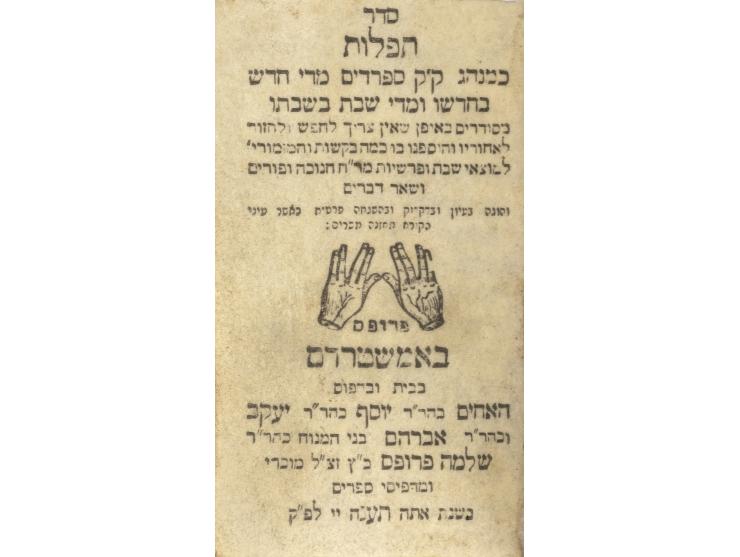
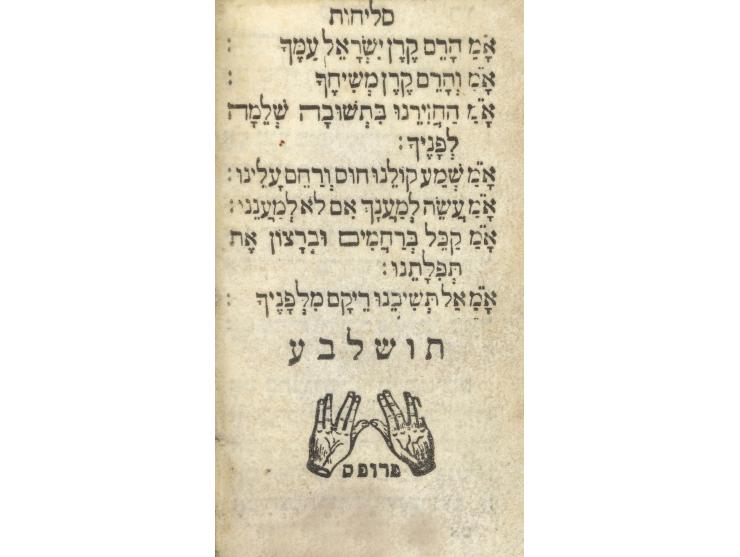
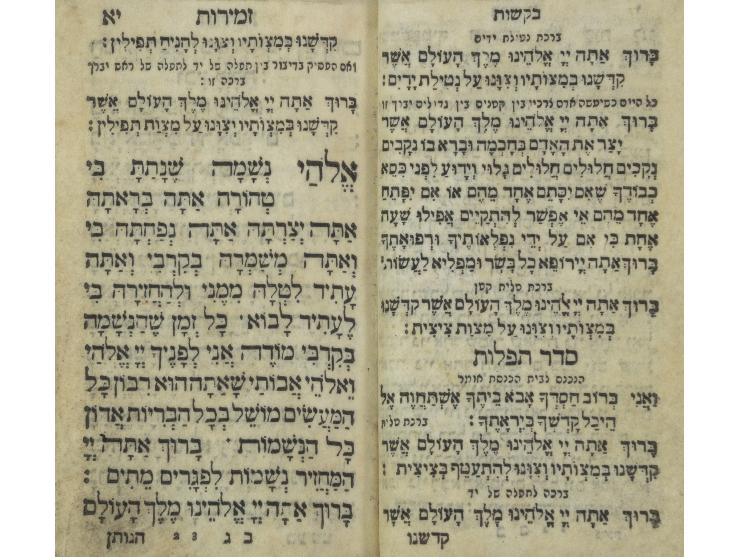
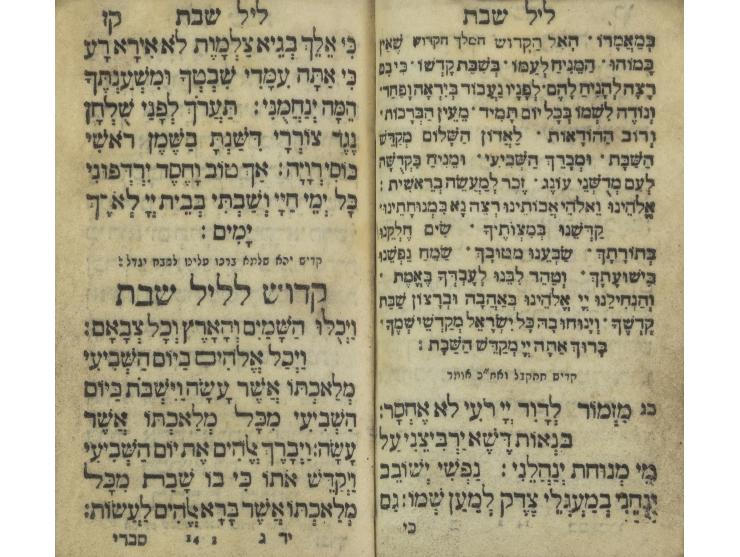
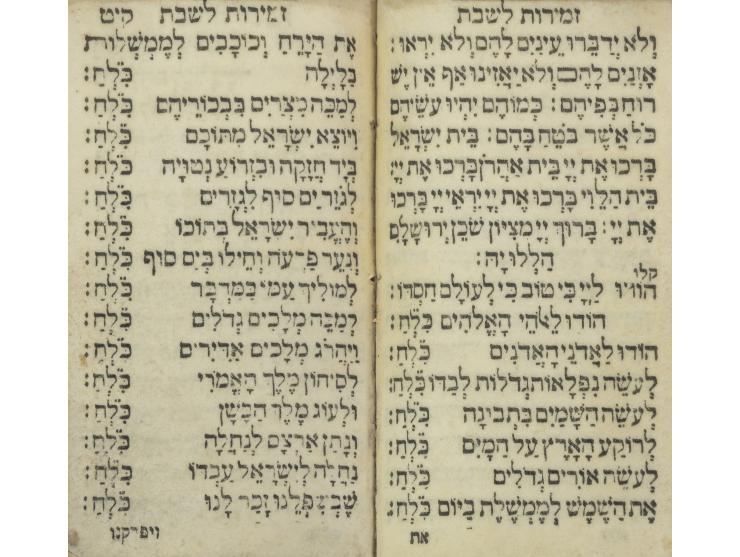
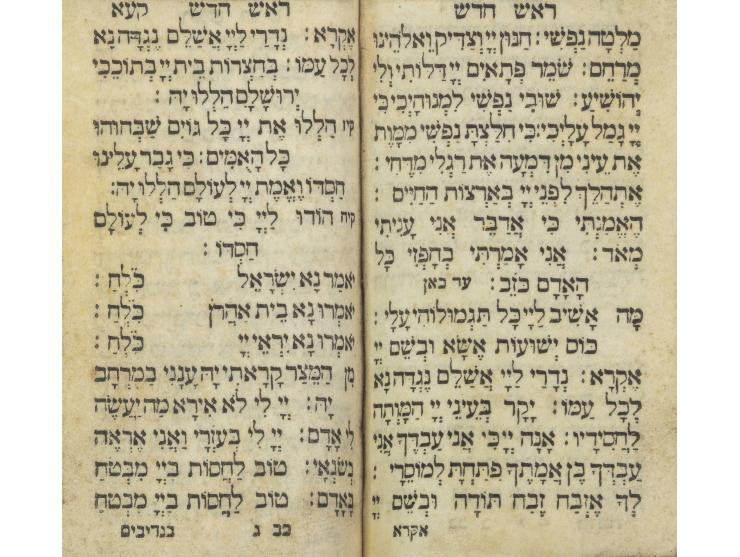
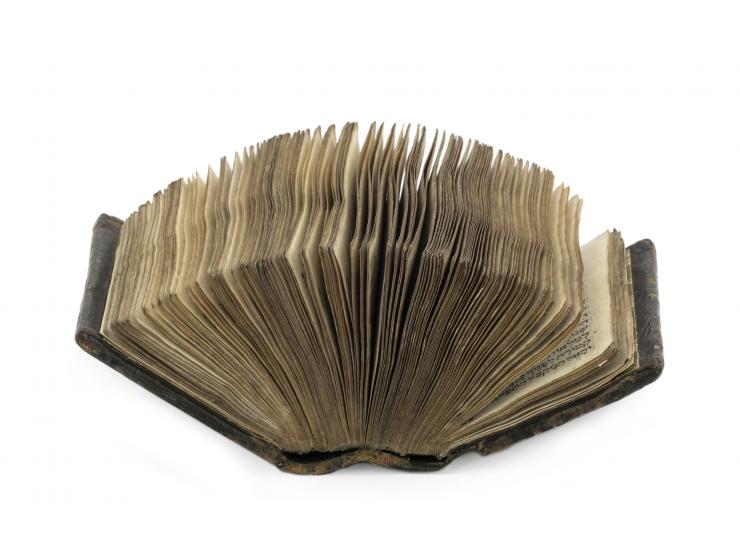
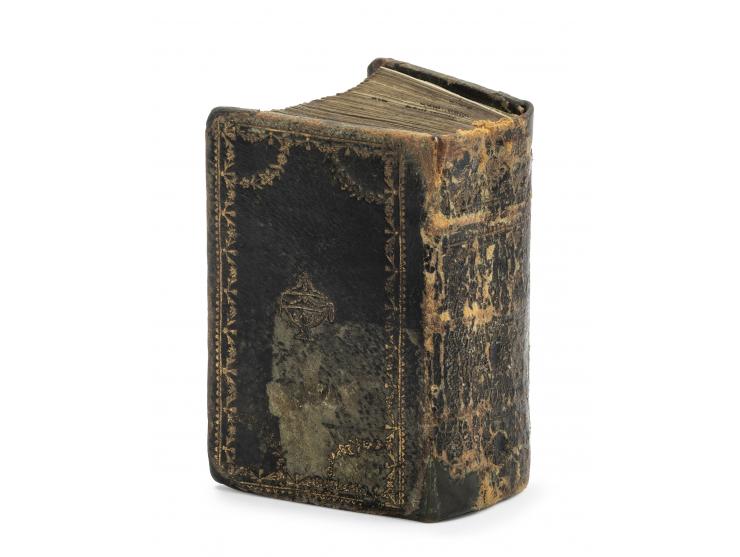
Siddur according to the Sephardic rite. Amsterdam: Yosef, Yaakov and Avraham sons of Shlomo Proops, [1760]. Pocket format.
Copy printed entirely on parchment.
Includes prayers for weekdays, Shabbat, Rosh Chodesh and festivals.
On title page: "Arranged so as not to require searching previous pages, and we added several bakashot and tehillim for Motzaei Shabbat, and Torah readings for Rosh Chodesh, Chanukah, Purim and more".
The center of the title page and last page features the famous Proops family printer's device, hands delivering the priestly blessing.
216 leaves. Approx. 10 cm. Good condition. Stains, including a few dampstains. Light wear. Early leather binding, with gilt decorations. Wear and defects to binding (repairs to spine and corners of binding, and new endpapers).
Category
Siddurim and Passover Haggadot
Catalogue Value
Auction 107: Rare and Important Items
Apr 15, 2026
Opening: $50,000
Estimate: $80,000 - $120,000
Sold for: $68,750
Including buyer's premium
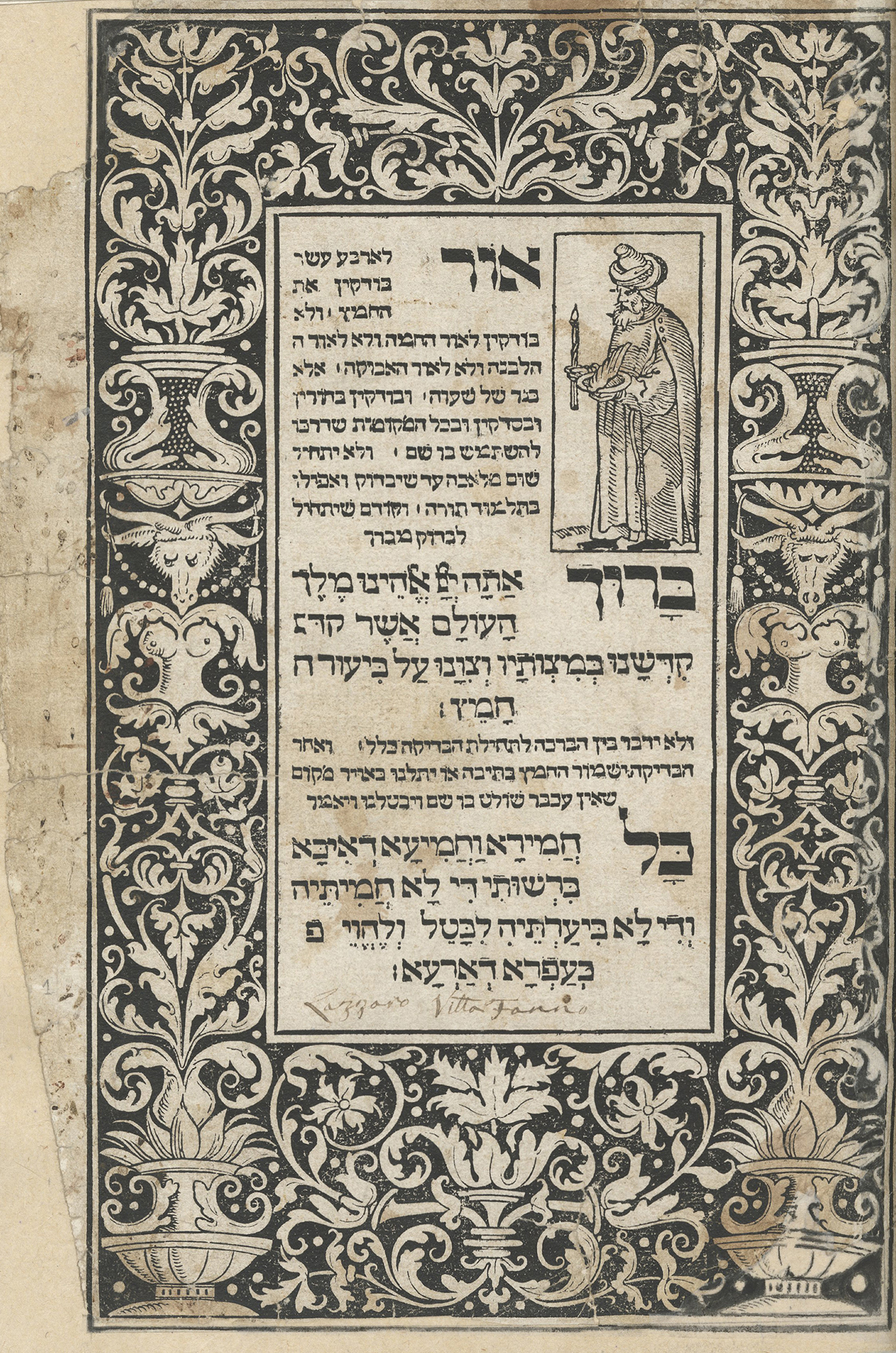
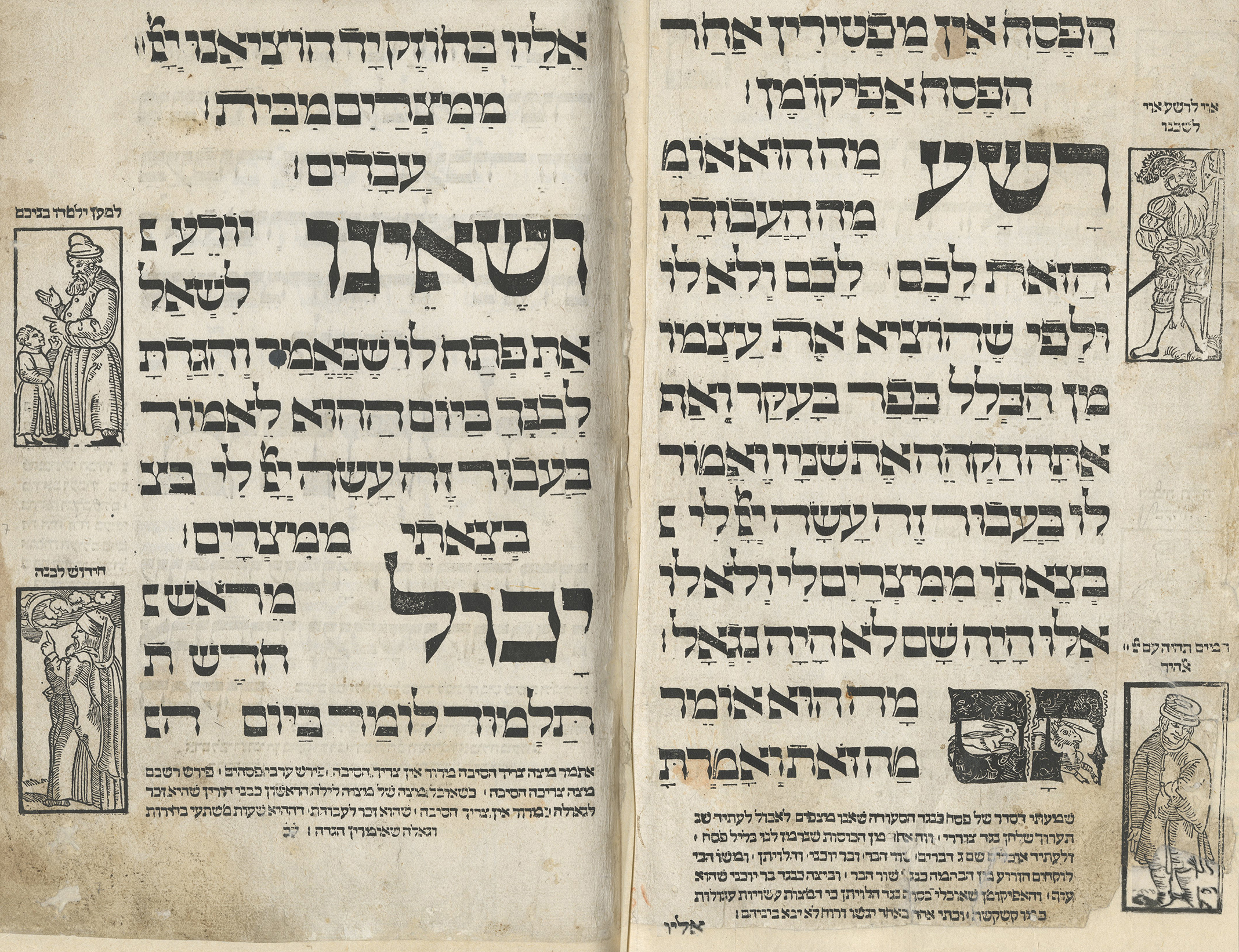
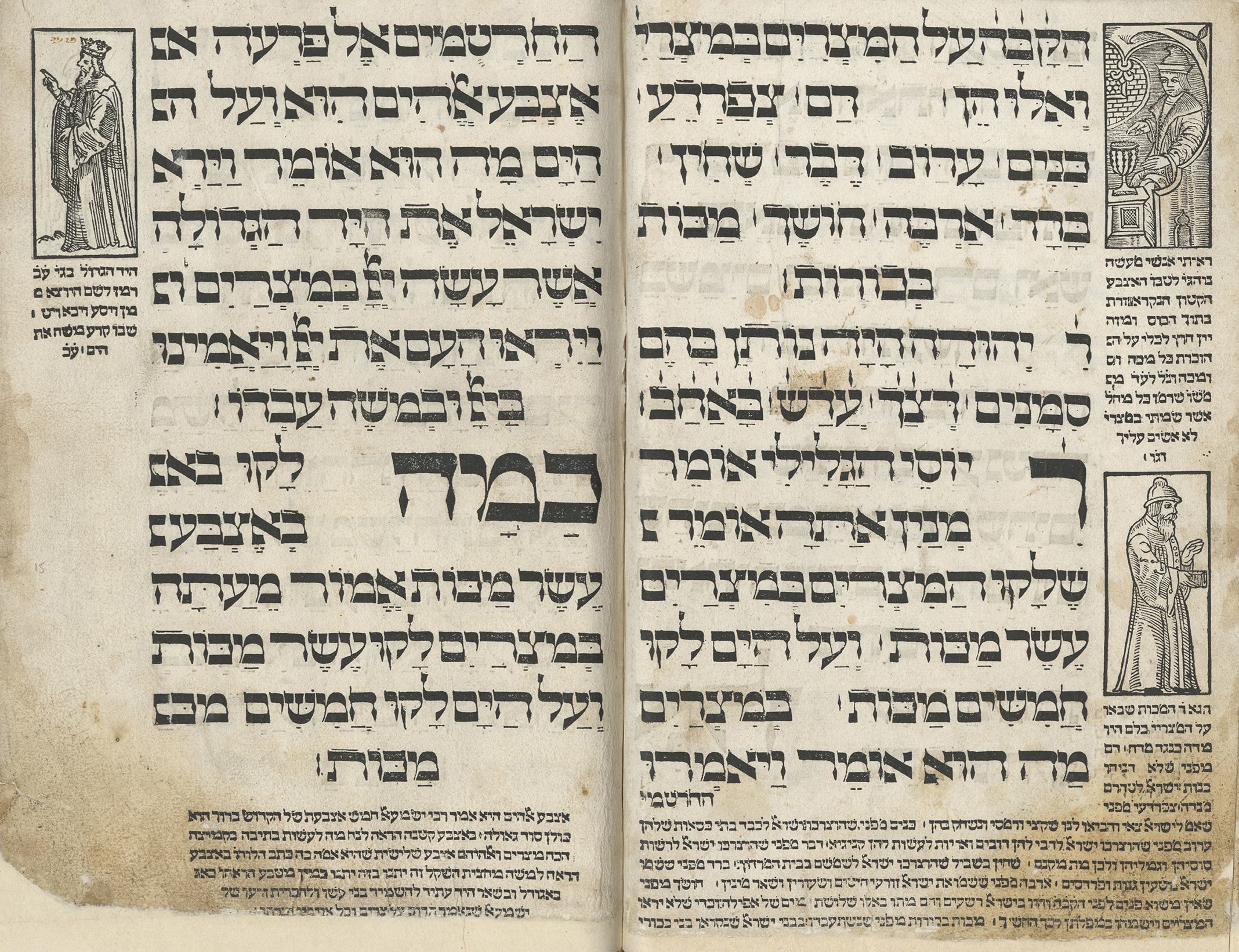
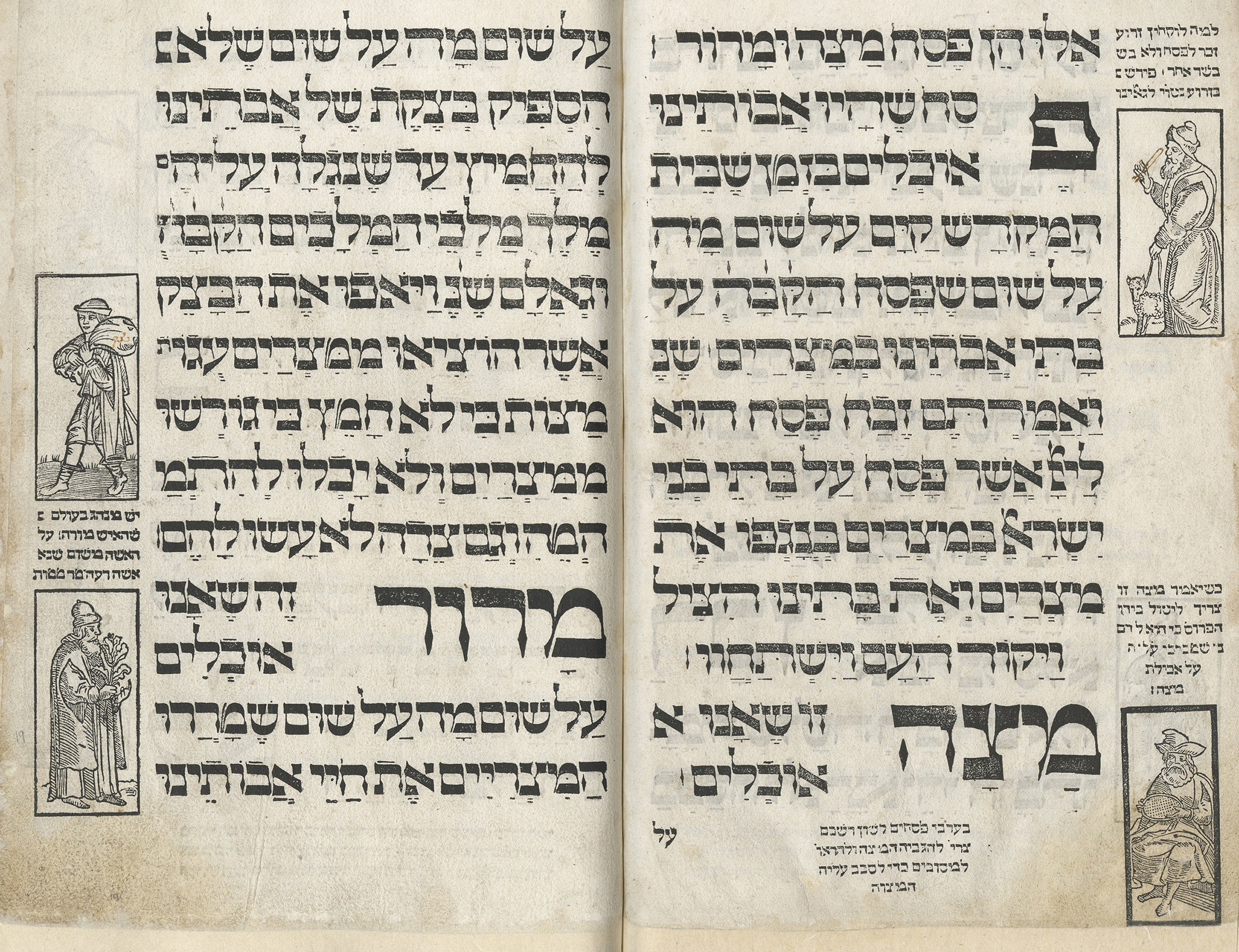
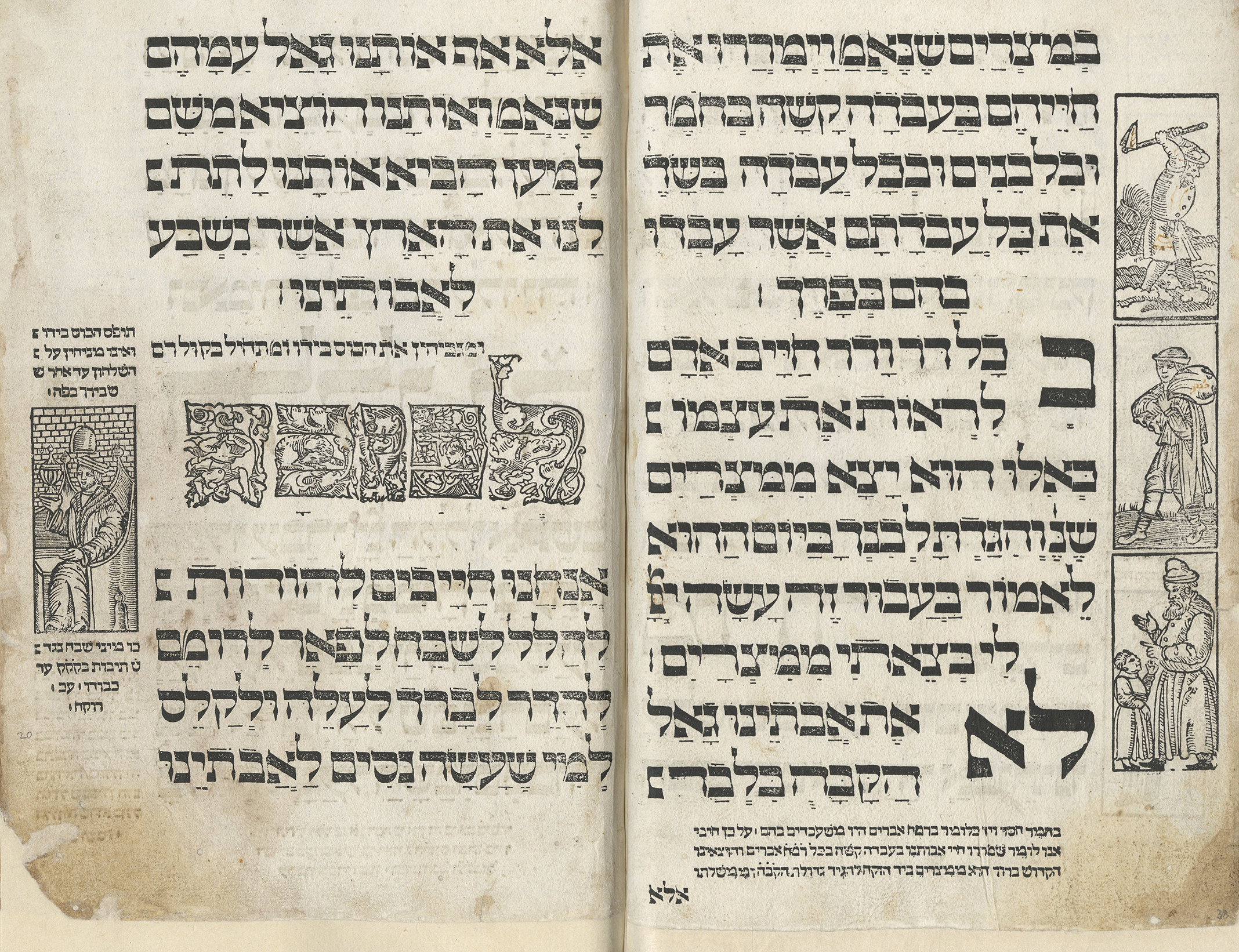
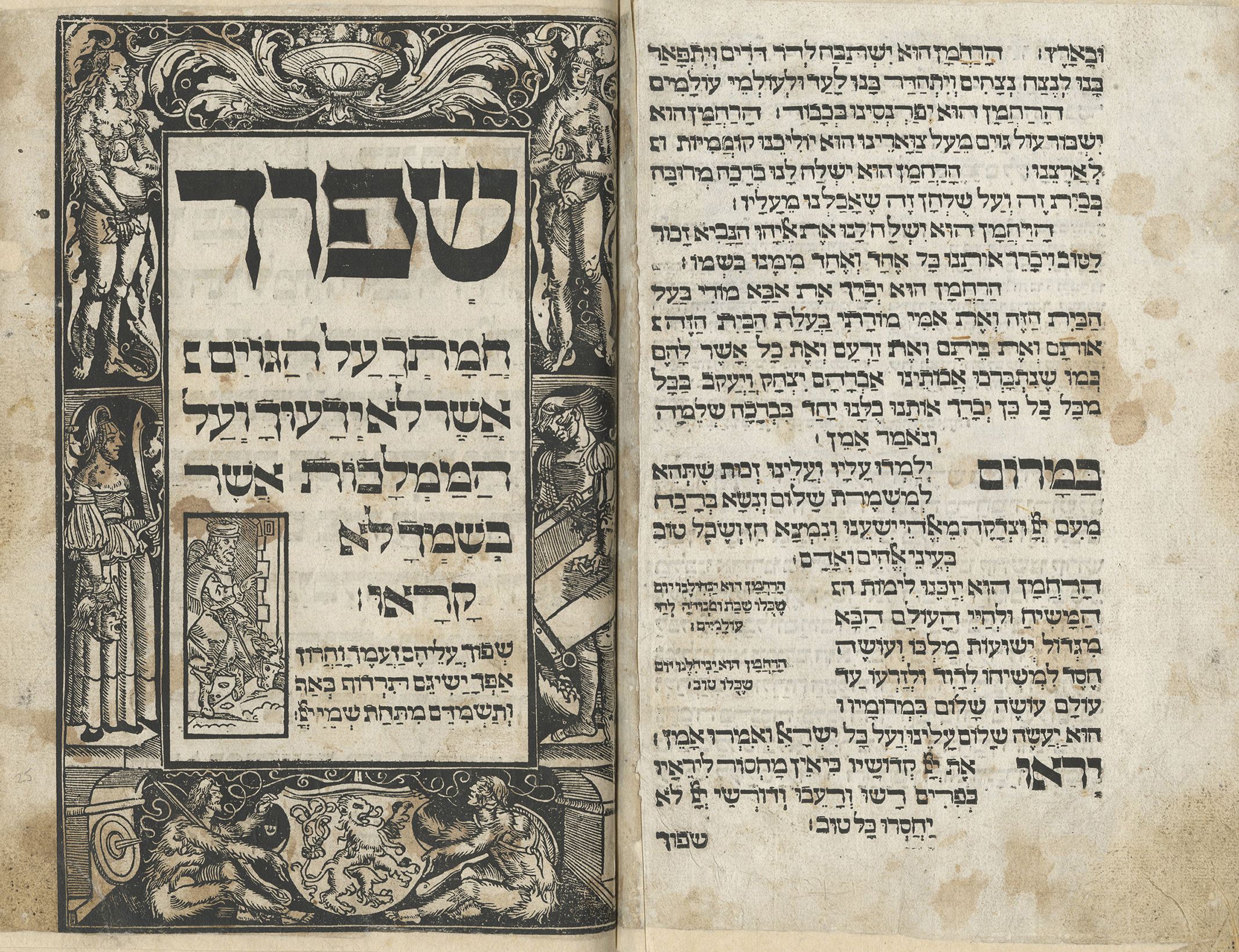
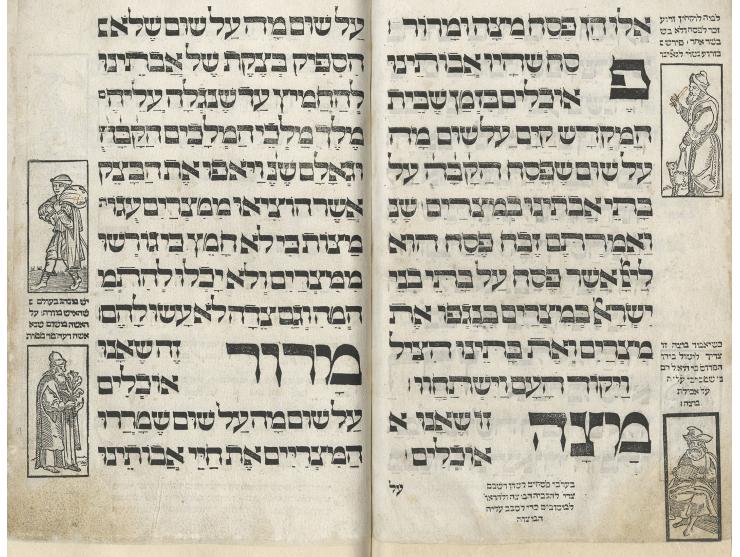
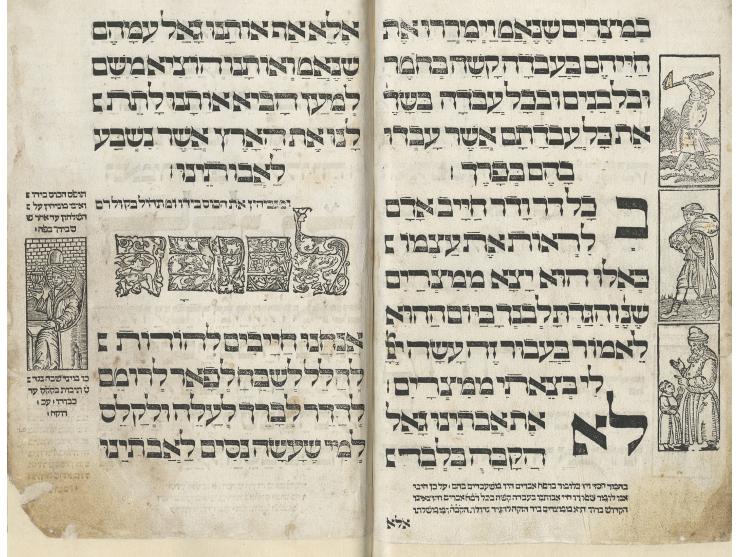
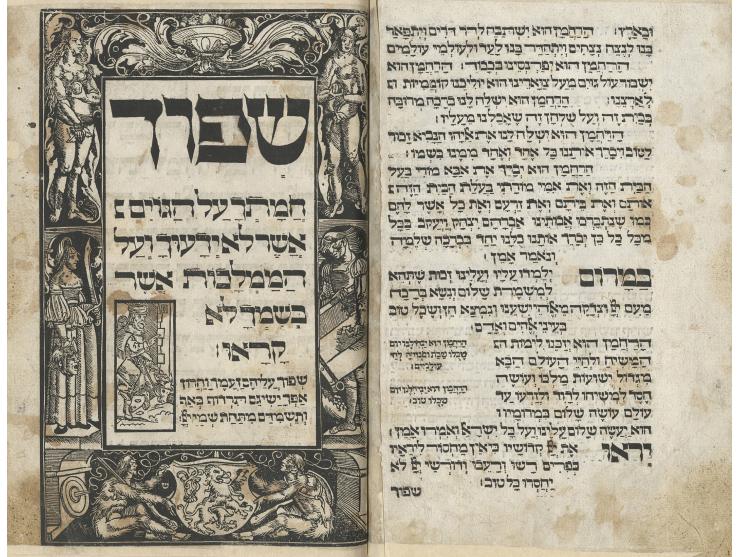
Passover Haggadah. Prague: Gershom son of Shlomo HaKohen and his brother Gronem, 1526.
Incomplete copy of the famous Prague Haggadah (or the Gershom Kohen Haggadah) – the first illustrated Haggadah to be printed, one of the most beautiful printed Hebrew books, and one of the most sought after.
This Haggadah was printed by Gershom Katz and his brother Gronem, sons of Shlomo Katz, who also served as publishers; its printing was completed on December 30 (26th Tevet) 1526 (date following the Julian calendar then in use). The printers' names are mentioned alongside the Hebrew date of printing in the colophon at the end of the Haggadah, which is lacking in the present copy, as is Gershom Katz's printer's device that appeared at the top of the illustrated frame on p. [3b].
Printed without title page.
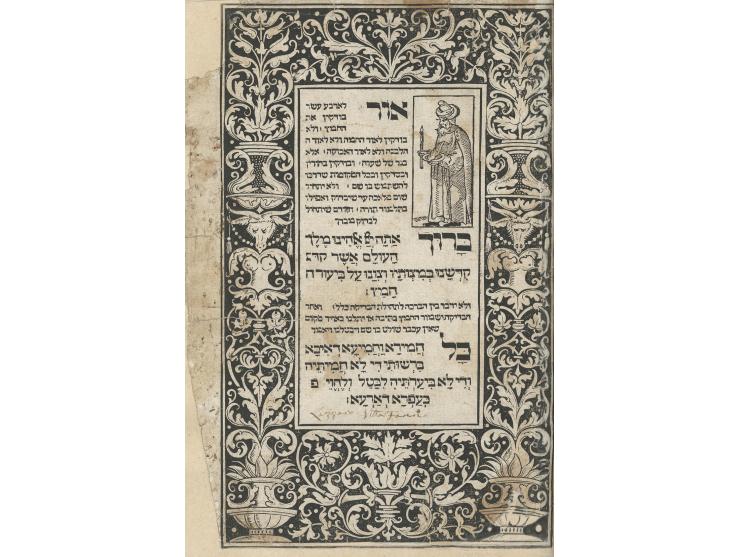
The Haggadah begins with the order of Bedikat Chametz – this page is framed in a fine woodcut, decorated with vegetal patterns, figures and various shapes (the present copy has Bedikat Chametz and the illustrated frame on the first page, due to the leaf being bound backwards; in the original, the first page of the leaf is blank, while the illustrated frame appears on the second page).
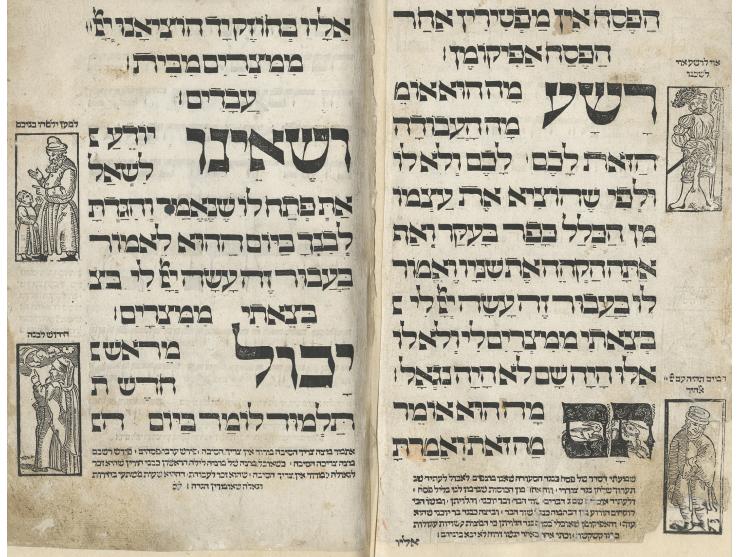
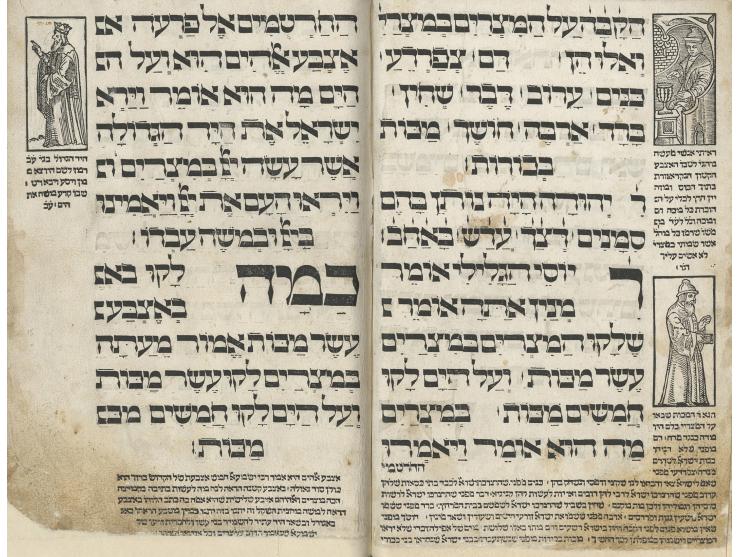
The Haggadah text is printed in a large square font of the Ashkenazic type, with Rafe marks. Bedikat Chametz, short marginal captions to some illustrations, a few instructions appearing within the Haggadah text and several other passages are printed in a smaller square font.
Some initial words include letters with a light background, incorporating illustrations of animals and various figures, and vegetal patterns.
Illustrations and Decorations in the Haggadah
The Prague Haggadah has achieved lasting renown for its impressive design and illustration, and would serve as a prototype for numerous illustrated Haggadah editions printed over the centuries to come.
The present copy includes two of three illustrated frames appearing in the Haggadah (lacking the frame on p. [3b] around KeHa Lachma Anya). The frame on the first leaf is decorated with vegetal patterns, figures and various shapes, with a discernible influence from early German Renaissance. The second frame in the present copy, the most impressive of all, appears on p. [25b], around Shefoch Chamatcha. This frame is designed in an impressive architectural style, comprising several figures: to the right is Adam, in the heroic style current among such artists as Albrecht Dürer and Hans Holbein, with an illustration of Samson lifting the gates of Gaza below; to the left is Eve, and below her is Judith carrying the head of Holophernes; next to her, within the frame and next to the text, is a small illustration of the Messiah riding a donkey; at the bottom of the frame is a shield bearing the image of a fork-tailed rampant lion, held by two mythical fur-laden savage men. To their left appears the letter Shin (this letter also features next to several small marginal illustrations in the Haggadah; several explanations have been proffered, but its meaning is not entirely clear).
Apart from the illustrated frames, dozens of illustrations are featured in the margins throughout the Haggadah (many repeated several times), sometimes with short captions. The present copy includes illustrations of the Four Sons; a father teaching his son; the new moon; Abraham crossing the Euphrates in a boat; the cities Pithom and Raamses; Pharaoh bathing in the blood of the male Hebrew babies; the casting of babies into the Nile; the Egyptians drowning in the sea; Moses taking the Children of Israel out of Egypt; a family seated around the table on the Seder night; and many other illustrations of various figures (some illustrations printed in a larger format, in the bottom margin of the page).
Signature on title page: "Lazzaro Vitta Fanno".
Incomplete copy. [26] leaves. Original: [38] leaves. Lacking 12 leaves: four leaves after first with illustrated frame ([2]-[5]; with photocopy replacements of these leaves on high-quality paper), and last eight leaves ([31]-[38]), with handwritten replacement on four other leaves (neat Italian square script, probably from 19th century; photocopy replacements of these eight leaves on high-quality paper also enclosed). First leaf bound backwards. 28.5 cm. Fair to fair-good condition. Stains, including dark food and wine stains (large stains to some leaves). Tears and open tears, affecting text and illustrations, repaired with paper filling, with handwritten and photocopy replacements (relatively large tears to leaves [1], [6] and [12], significantly affecting frame on first page and illustrations). Worming, affecting text and illustrations, mostly repaired with paper filling. Bottom edges of many leaves repaired and enlarged with paper filling. New leather binding.
Reference:
• Otzar HaHaggadot 7.
• Cecil Roth, HaHaggadah HaMetzuyeret ShebiDefus, Areshet, III (1961), pp. 7-11.
• Y. Tabori, Omanut HaDefus VehaTziyurim BeHaggadat Prague, Ohev Sefer, I (1987), pp. 13-21.
• Yosef Haim Yerushalmi, Haggadah and History, A Panorama in Facsimile of Five Centuries of the Printed Haggadah from the Collections of Harvard University and the Jewish Theological Seminary of America, Philadelphia, 1975, pp. 30-37; plates 9-13.
• Charles Wengrov, Haggadah and Woodcut: An Introduction to the Passover Haggadah Completed by Gershom Cohen in Prague, Sunday, 26 Teveth, 5287 (Dec. 30, 1526), New York, Shulsinger Bros., 1967.
Category
Siddurim and Passover Haggadot
Catalogue Value
Auction 107: Rare and Important Items
Apr 15, 2026
Opening: $50,000
Estimate: $80,000 - $120,000
Sold for: $75,000
Including buyer's premium
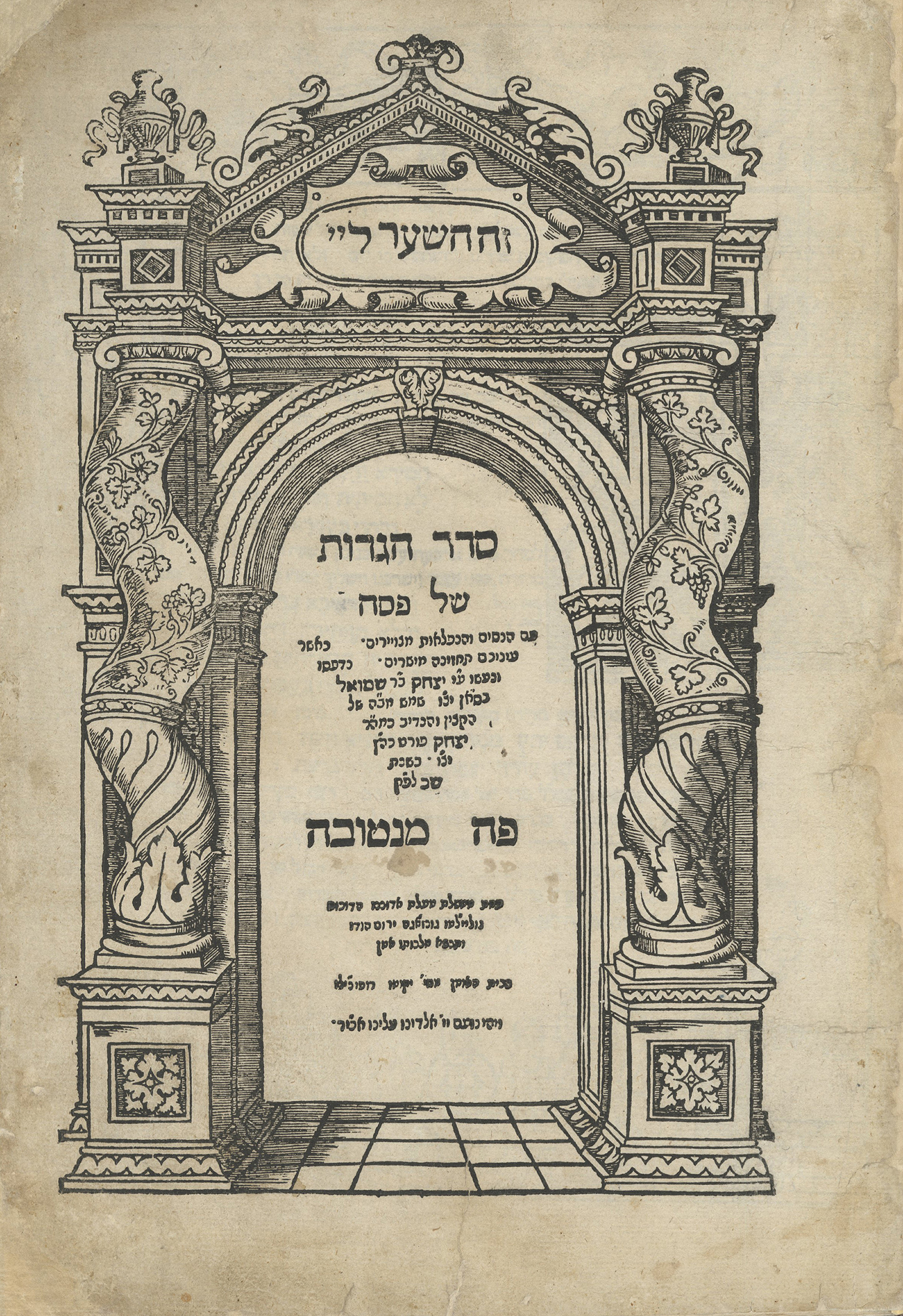
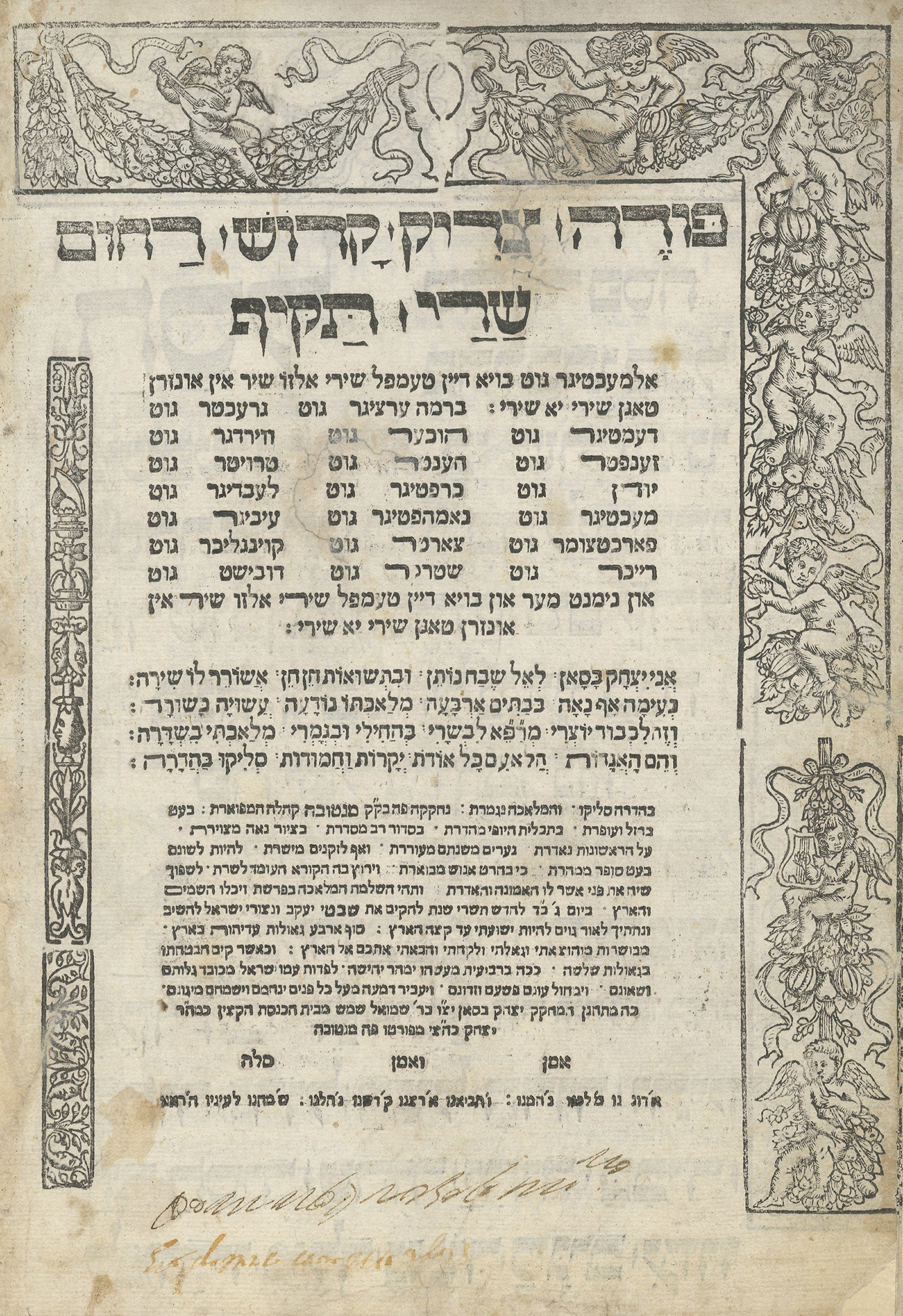
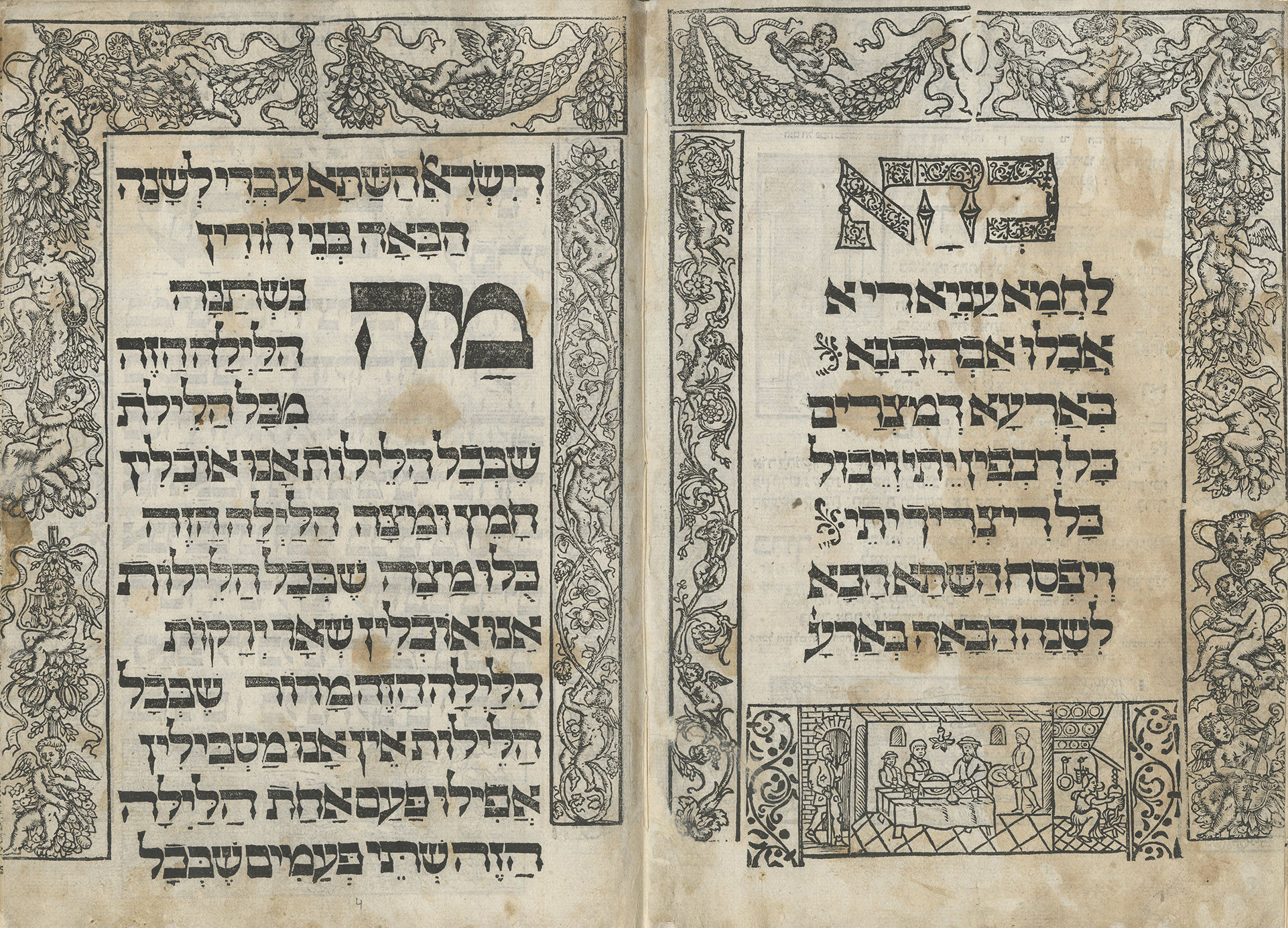
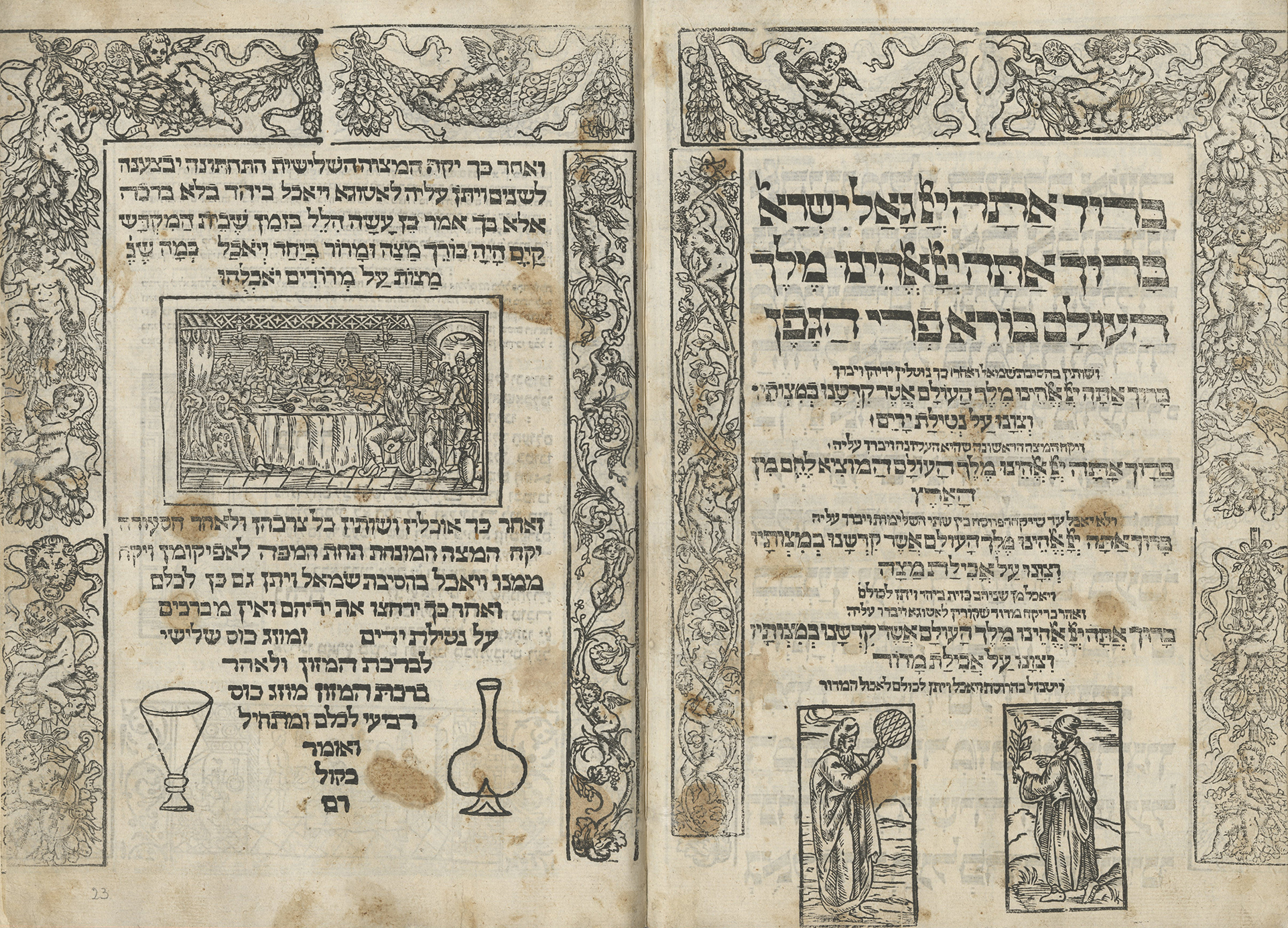
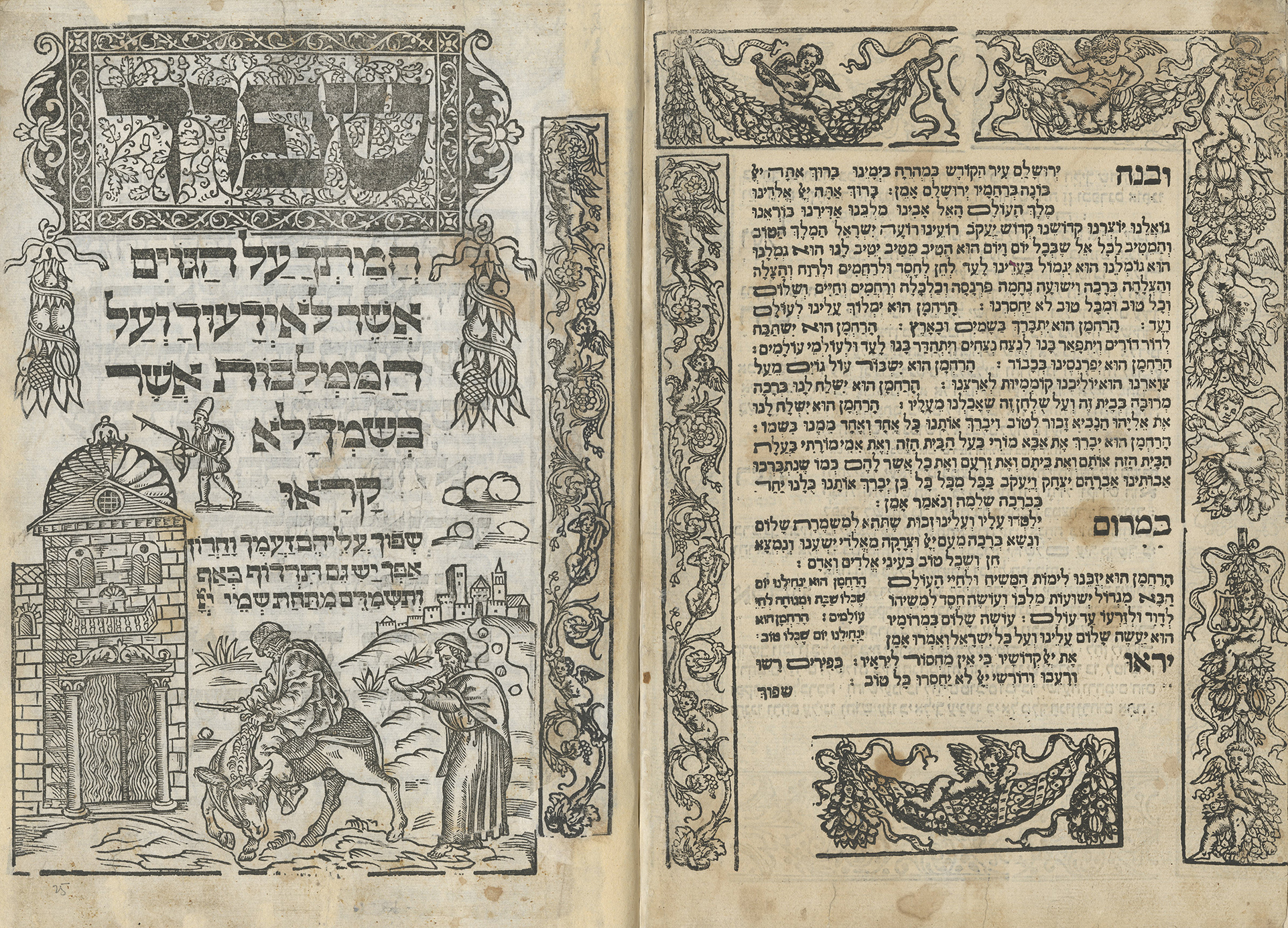
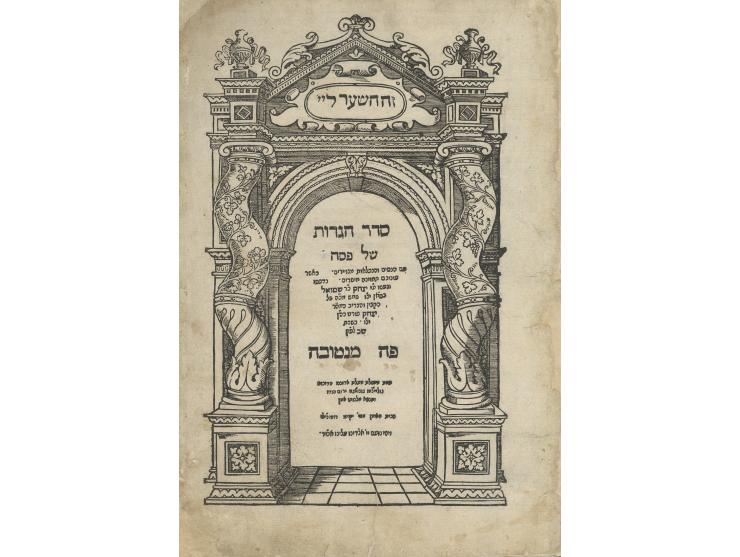
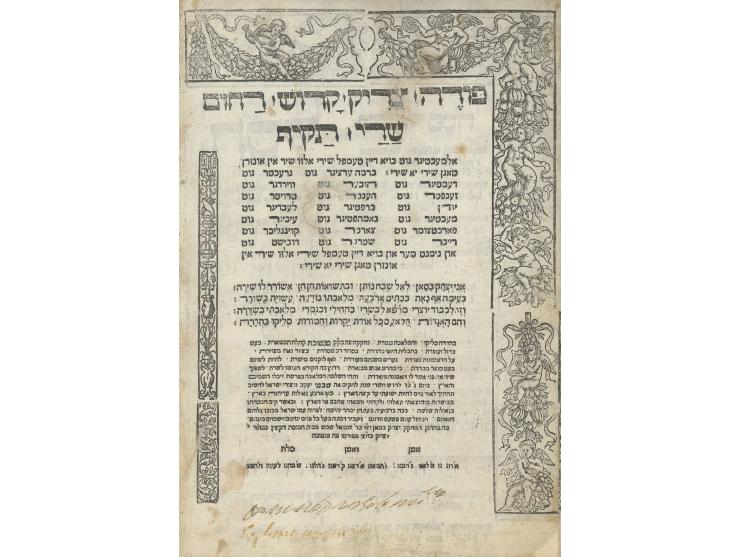
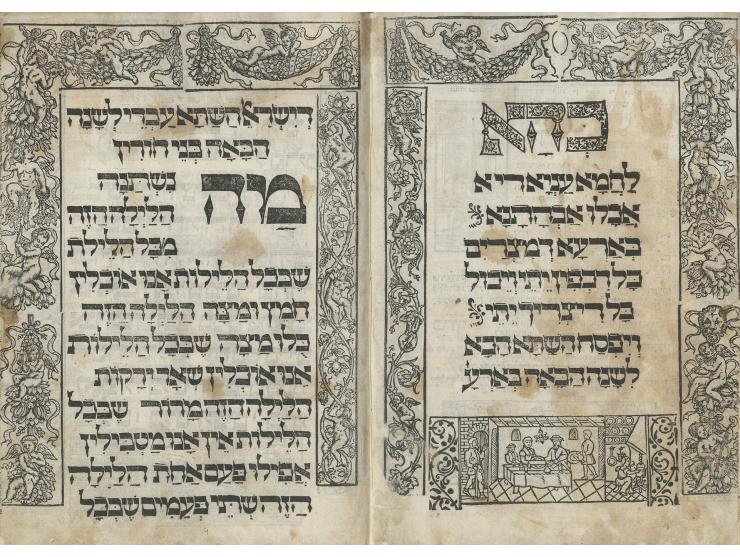
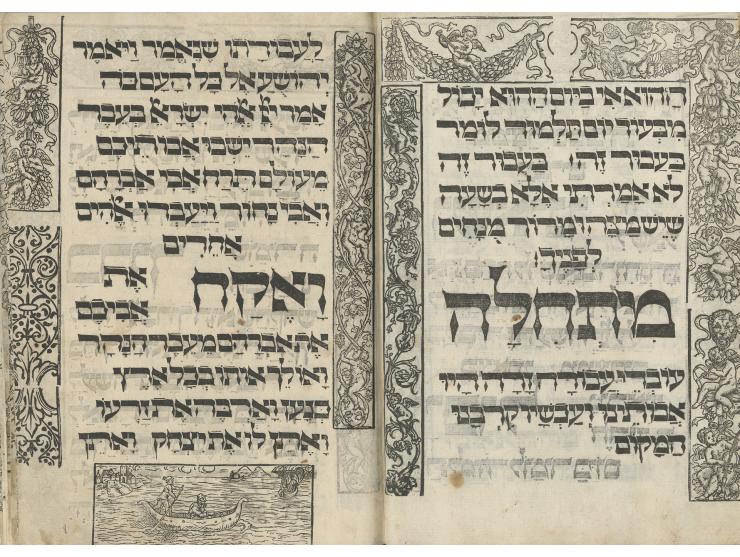
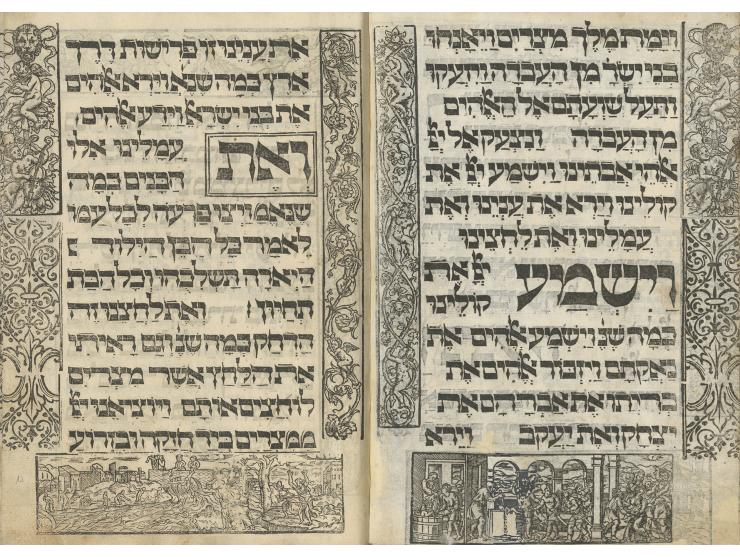
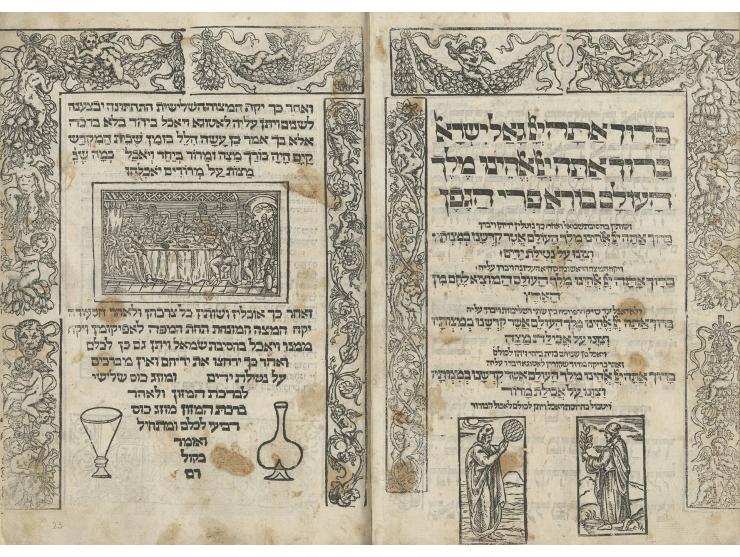
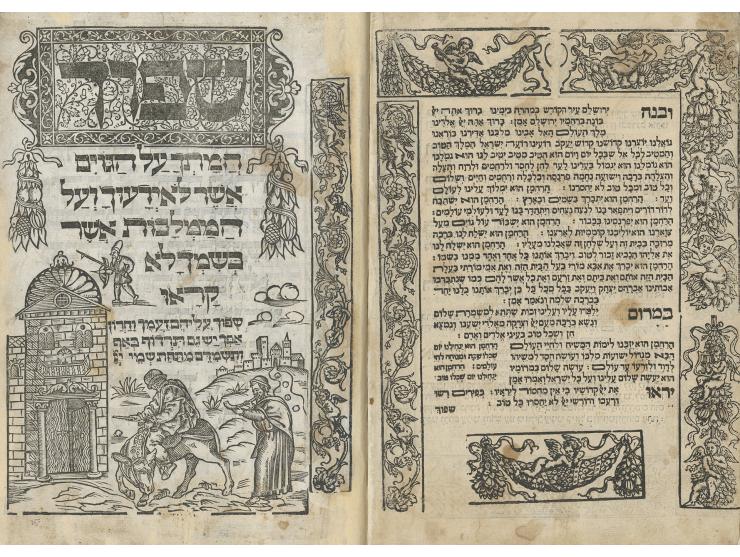
Passover Haggadah, with order of Bedikat Chametz and Passover evening kiddush. Mantua: Giacomo Ruffinelli for Yitzchak Bassan, 1560.
Especially rare complete copy of the first illustrated Haggadah printed in Mantua (see below for further information on the two illustrated Haggadot printed in Mantua).
On title page: "Order of Passover Haggadah, with the miracles and wonders illustrated, as your eyes shall see rightly. Printed and made by Yitzchak son of R. Shmuel Bassan…".
The Haggadah text is printed in a large square font of the Ashkenazic type, with Rafe marks. Bedikat Chametz, several other parts of the text and a few instructions appearing within the Haggadah text are printed in a smaller square font.
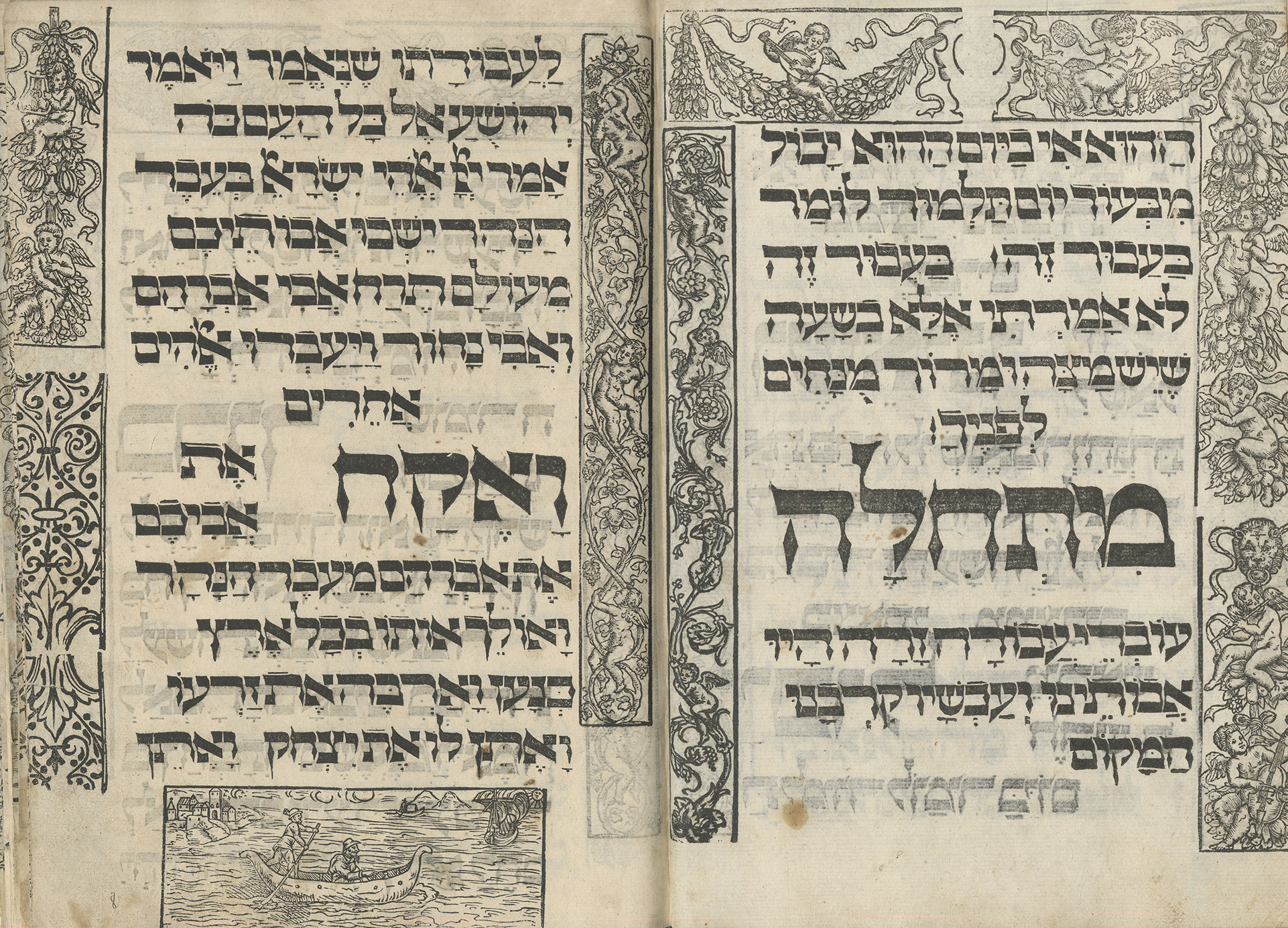
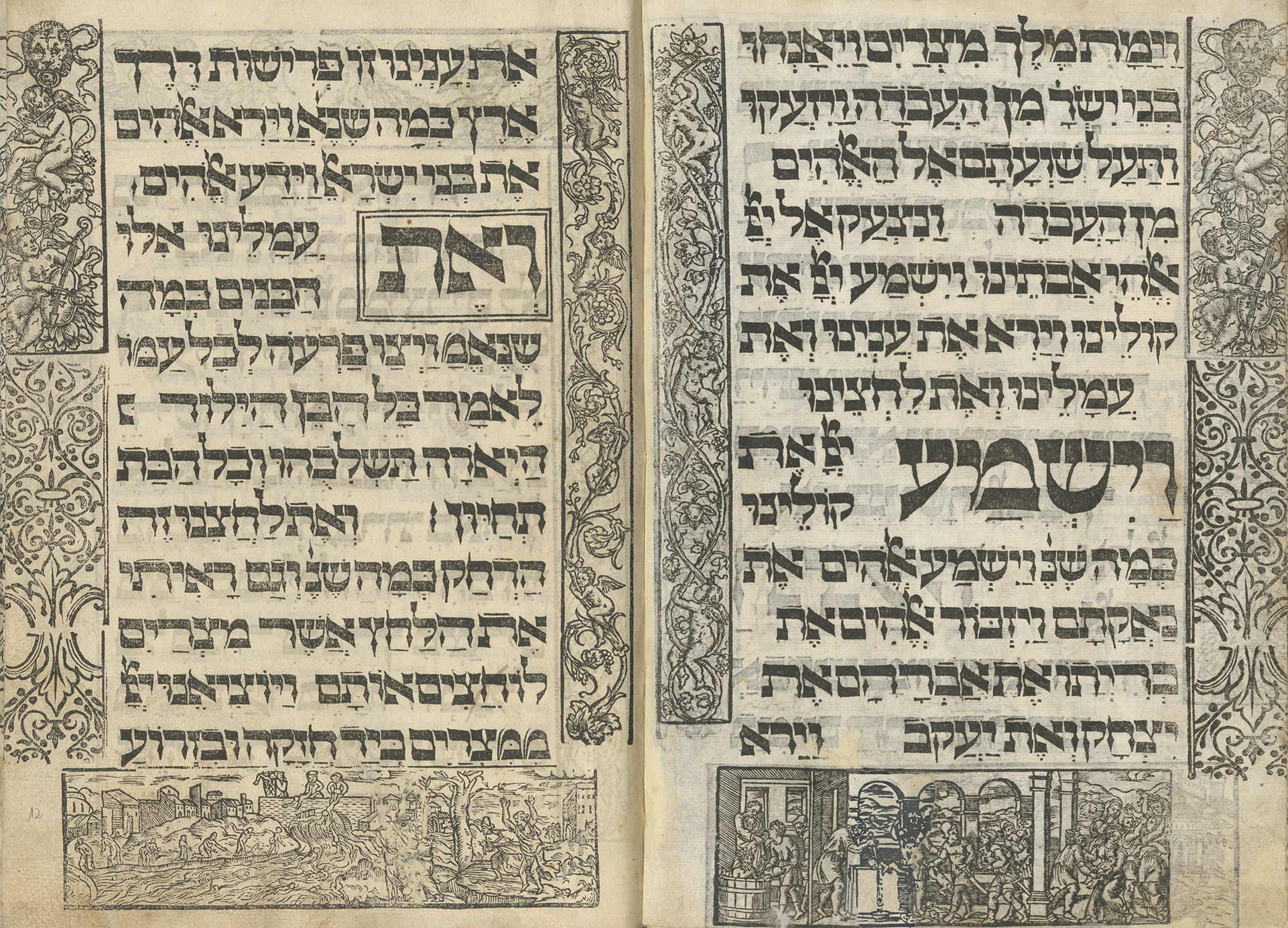
All pages are framed, most decorated in vegetal patterns, with illustrations of cherubs (putti) holding flowers and musical instruments, geometrical shapes and various figures, and various Renaissance motifs. Various fine woodcut Haggadah and Passover scenes are featured beside them, at the bottom and sometimes the margin of the page: preparation and baking of matzah for Passover; a family seated at the Seder night and a pauper knocking on their door; a hunter and dogs chasing rabbits (a motif appearing in various Haggadah manuscripts and the Haggadah of Prague, 1527, probably originating as a play on the Yaknehaz mnemonic for festival evening havdalah); the Four Sons; the Children of Israel laboring in Egypt and an Egyptian hitting an Israelite; Pharaoh bathing in the blood of the Israelite babies; the daughter of Pharaoh sending her maidservant for Moses' basket; the Children of Israel crossing the Red Sea and the Egyptians drowning; and more.
The influence of the Italian Renaissance is discernible not only in the Haggadah's decorated frames, but also in several other notable illustrations: Abraham crossing the Euphrates towards the Land of Canaan, depicted on p. [8a] as embarking in a gondola; the Wise Son (p. [6a]), a near copy of Michelangelo's rendition of Jeremiah in the Sistine Chapel; the Wicked Son (p. [6b]), depicted as an Italian condottiero (mercenary commander); and more.
On last page, Almechtiger G-tt piyyut (Yiddish variation of Adir Hu), a concluding poem by the publisher, and a lengthy and detailed colophon: "…printed here in Mantua… most beautifully… and the work was completed in Parashat [Bereshit], Tuesday, 24th Tishrei [1560]… at the end of four future redemptions in the land… And just as He fulfilled His promise with three redemptions, so may He hasten his work in the fourth, to redeem His people Israel from the drudgery of their exile and turmoil… so pleads the typesetter Yitzchak Bassan son of R. Shmuel, beadle at the synagogue of the officer R. Yitzchak Cohen of Porto, here in Mantua".
The Illustrated Mantua Haggadot Printed in the Sixteenth Century
Two typographically similar illustrated Haggadot were printed in Mantua in the mid-16th century. The first was printed in 1560 by Yitzchak son of Shmuel Bassan, at the press of Giacomo Ruffinelli; the second was printed some eight years later by the Filipponi brothers, under the name of Yosef son of Yaakov Shalit. Both Haggadot made use of the same plates for printing, and the format and typesetting of both are nearly identical to the Haggadah of Prague, 1527.
Both Mantua Haggadot served as models for numerous illustrated Haggadot in smaller sizes (quarto and octavo), printed in Venice around the turn of the 17th century.
For a detailed description of the second Haggadah printed in Mantua and variations between the two editions, see: Kedem, Auction 106, 24 February 2026, Lot 12.
Complete copy. [38] leaves. Approx. 30 cm. Good-fair condition. Stains, including dark wine and food stains. Worming, tears and open tears (relatively large tears in several places), affecting text, decorations and illustrations, repaired with paper filling (photocopy and handwritten replacements for parts of text, decorations and illustrations). Close trimming, affecting decorated frames on many leaves. New leather binding.
On last page, signatures of censors Domenico Gerosolimitano and Giovanni Domenico Carretto (dated 1618?).
Reference:
• Otzar HaHaggadot 20.
• Cecil Roth, HaHaggadah HaMetzuyeret ShebiDefus, Areshet, III (1961), pp. 13-18.
• Y. Rivkind, Dikdukei Sefarim, Kiryat Sefer, II (1925-1926), p. 61, no. 17 (on pages in this Haggadah known to have been printed in a slightly different design).
• Yosef Haim Yerushalmi, Haggadah and History, A Panorama in Facsimile of Five Centuries of the Printed Haggadah from the Collections of Harvard University and the Jewish Theological Seminary of America, Philadelphia, 1975, pp. 37-38; plates 22-26.
Provenance: Kestenbaum, New York, 17 November 1998, Lot 100.
Category
Siddurim and Passover Haggadot
Catalogue Value
Auction 107: Rare and Important Items
Apr 15, 2026
Opening: $7,000
Estimate: $12,000 - $18,000
Sold for: $23,750
Including buyer's premium
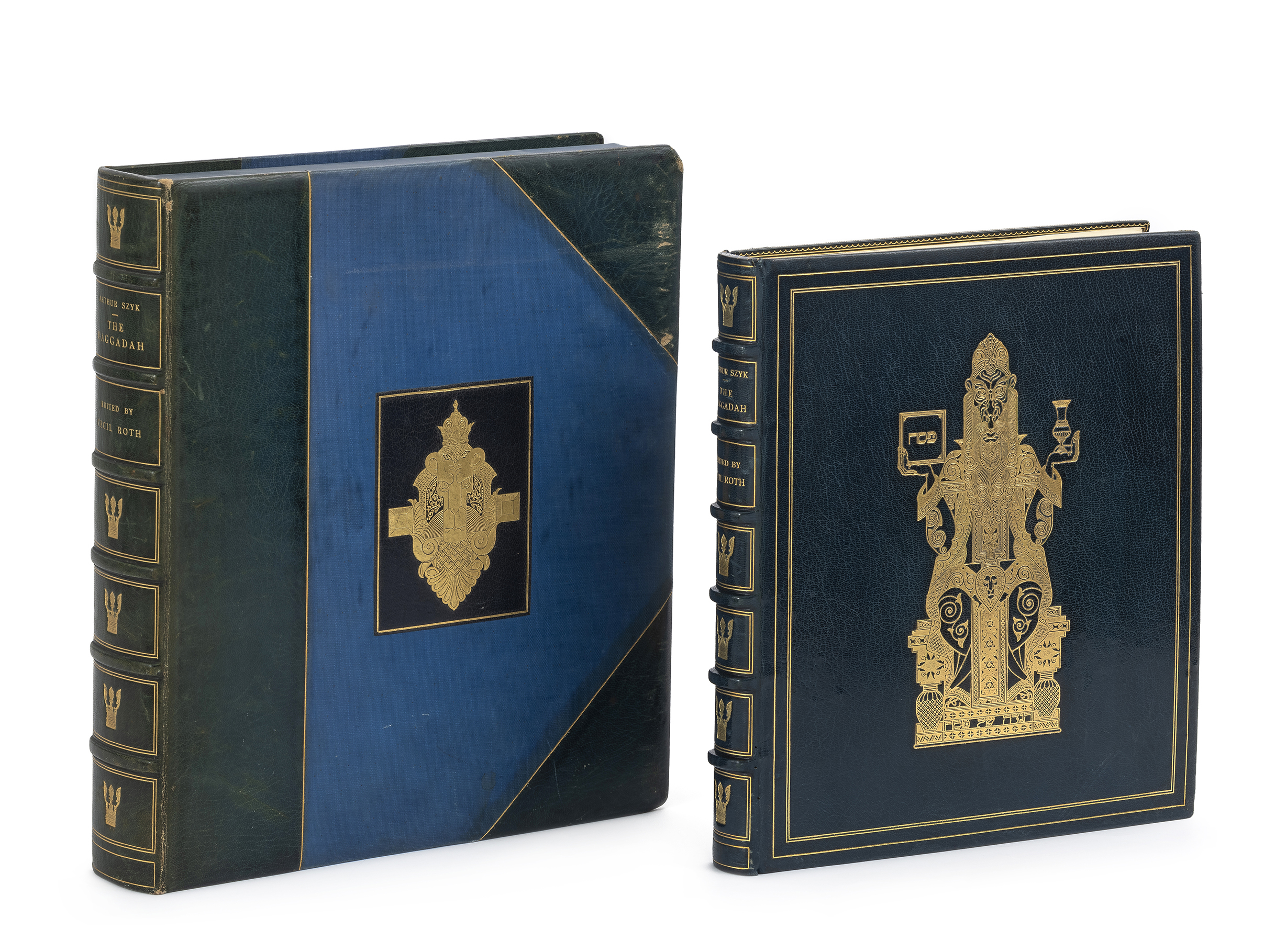
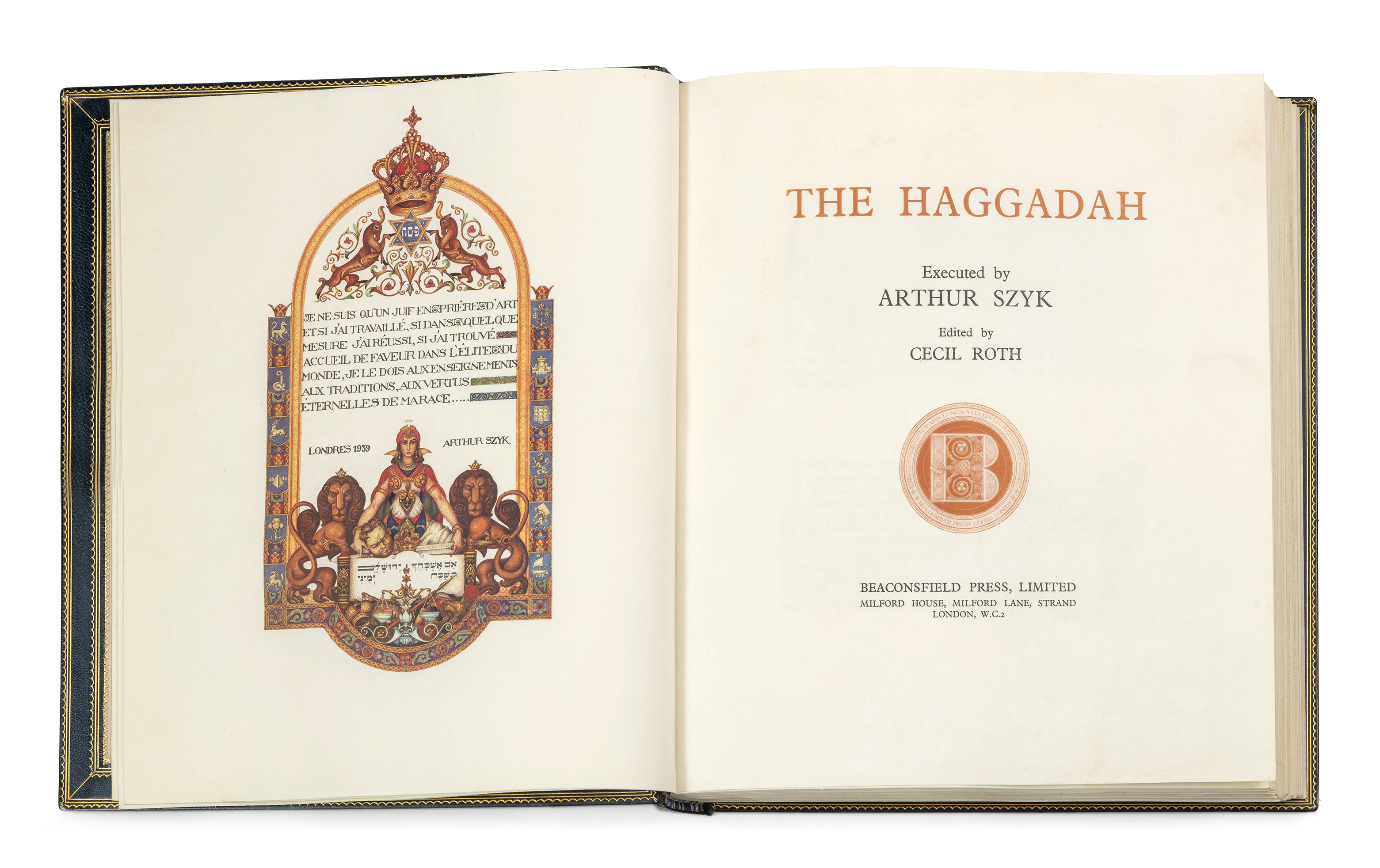
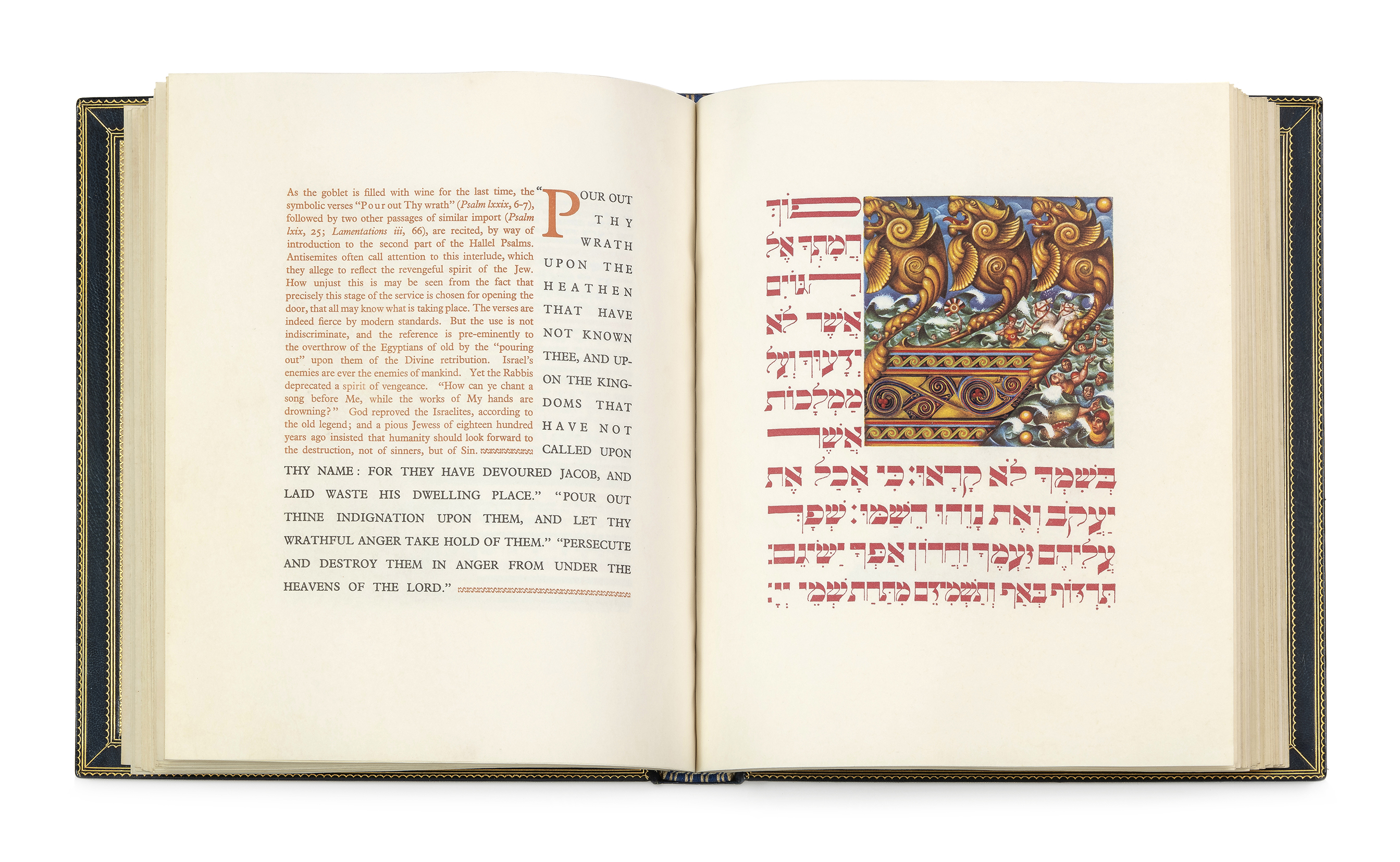
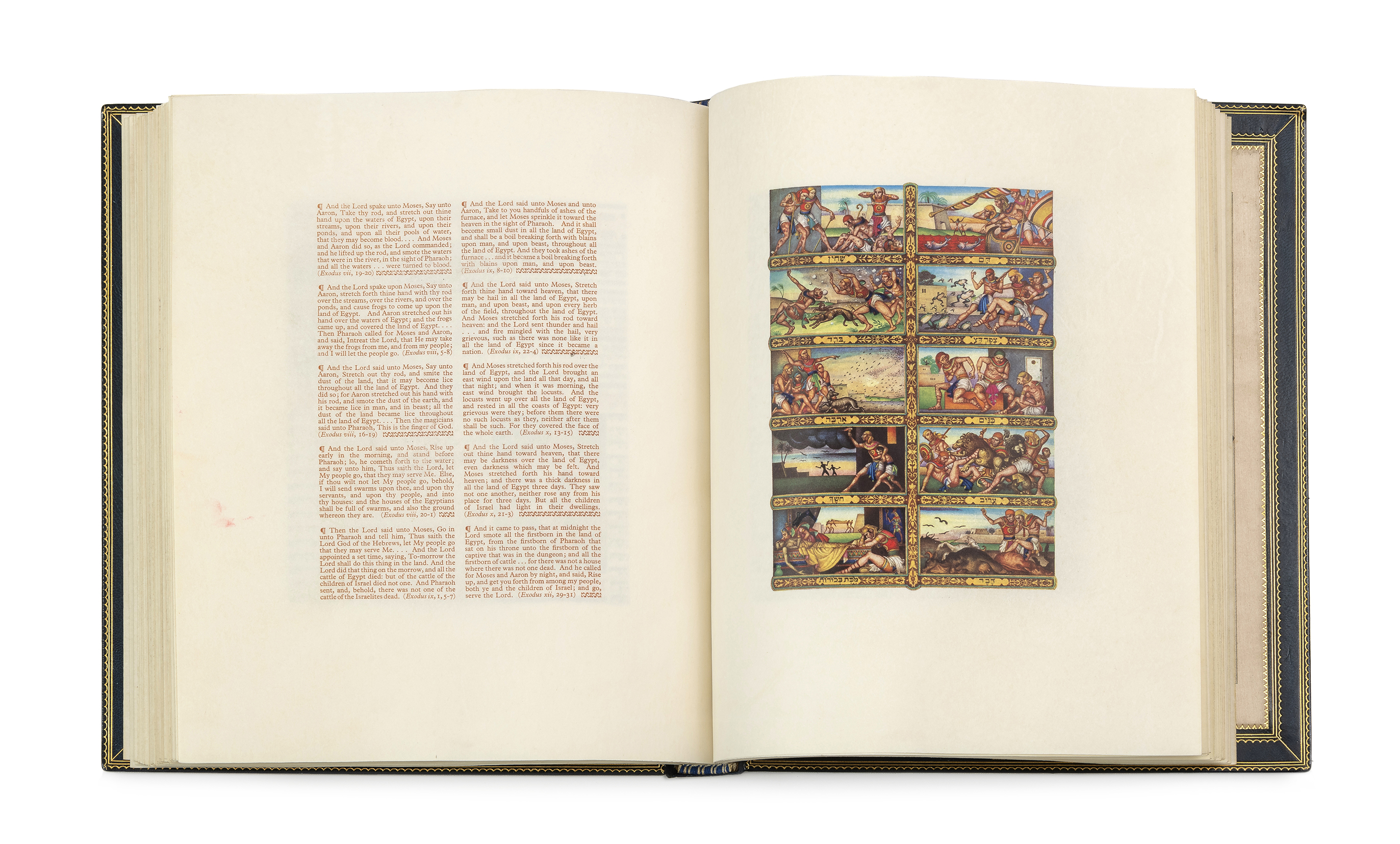
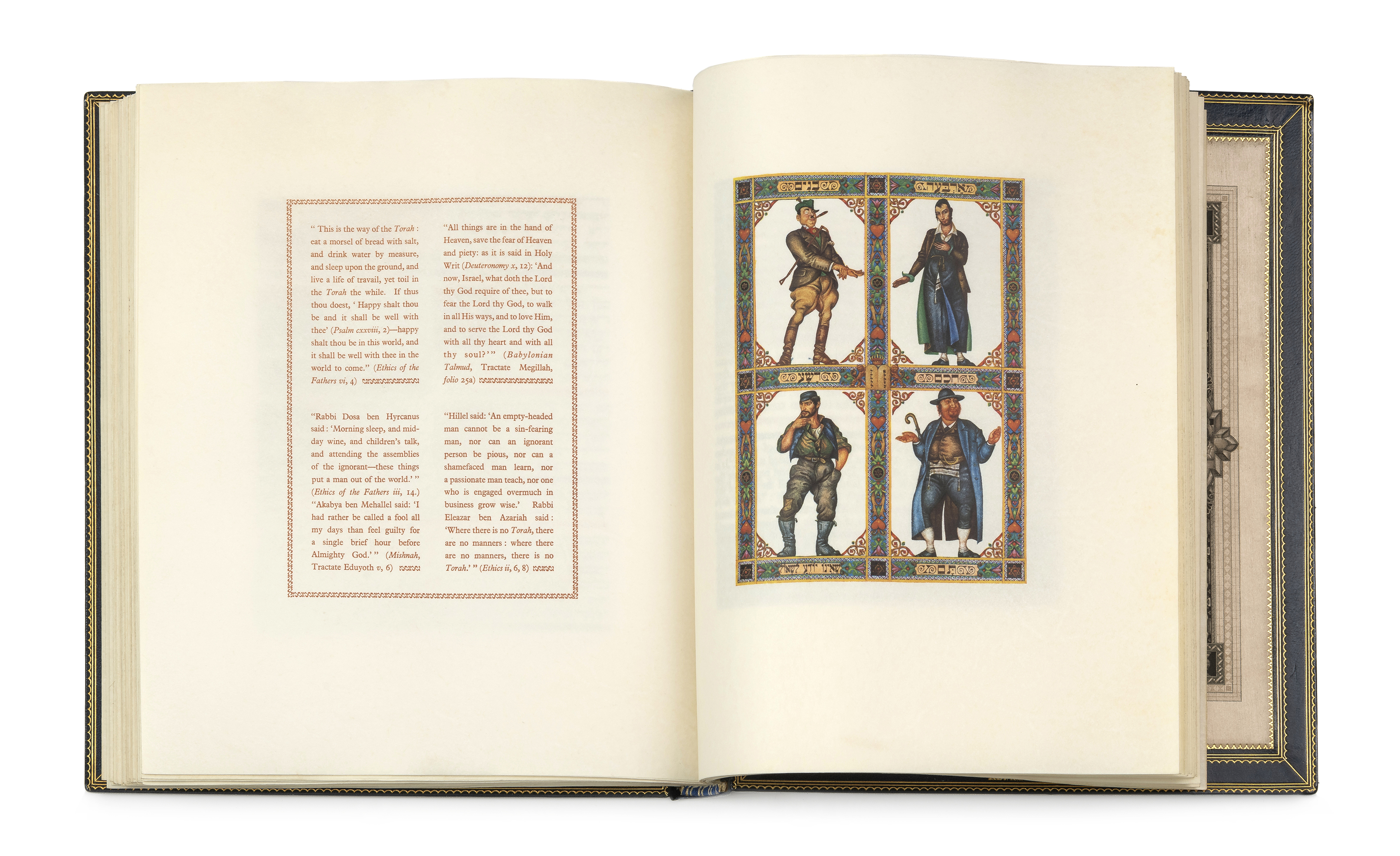
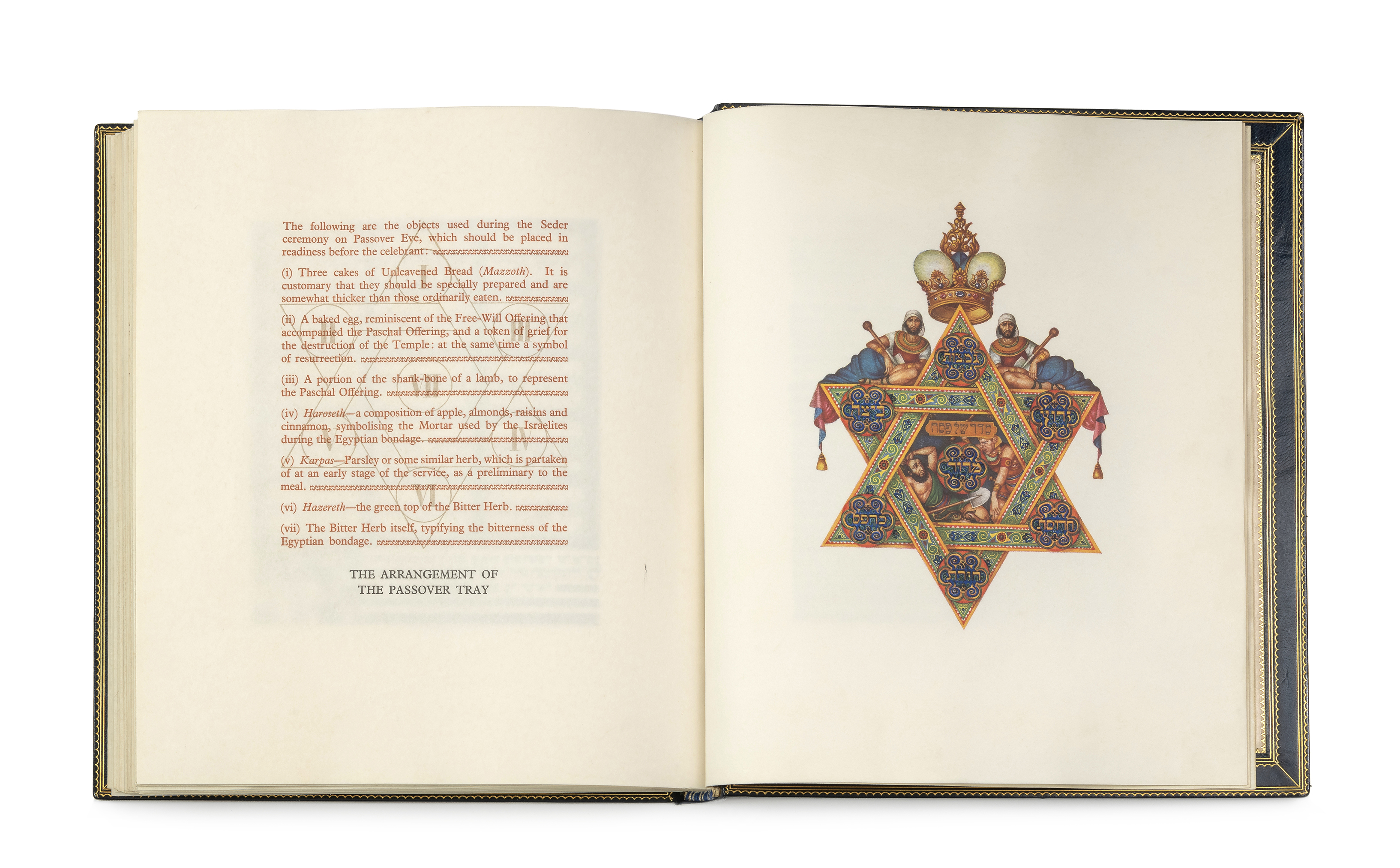
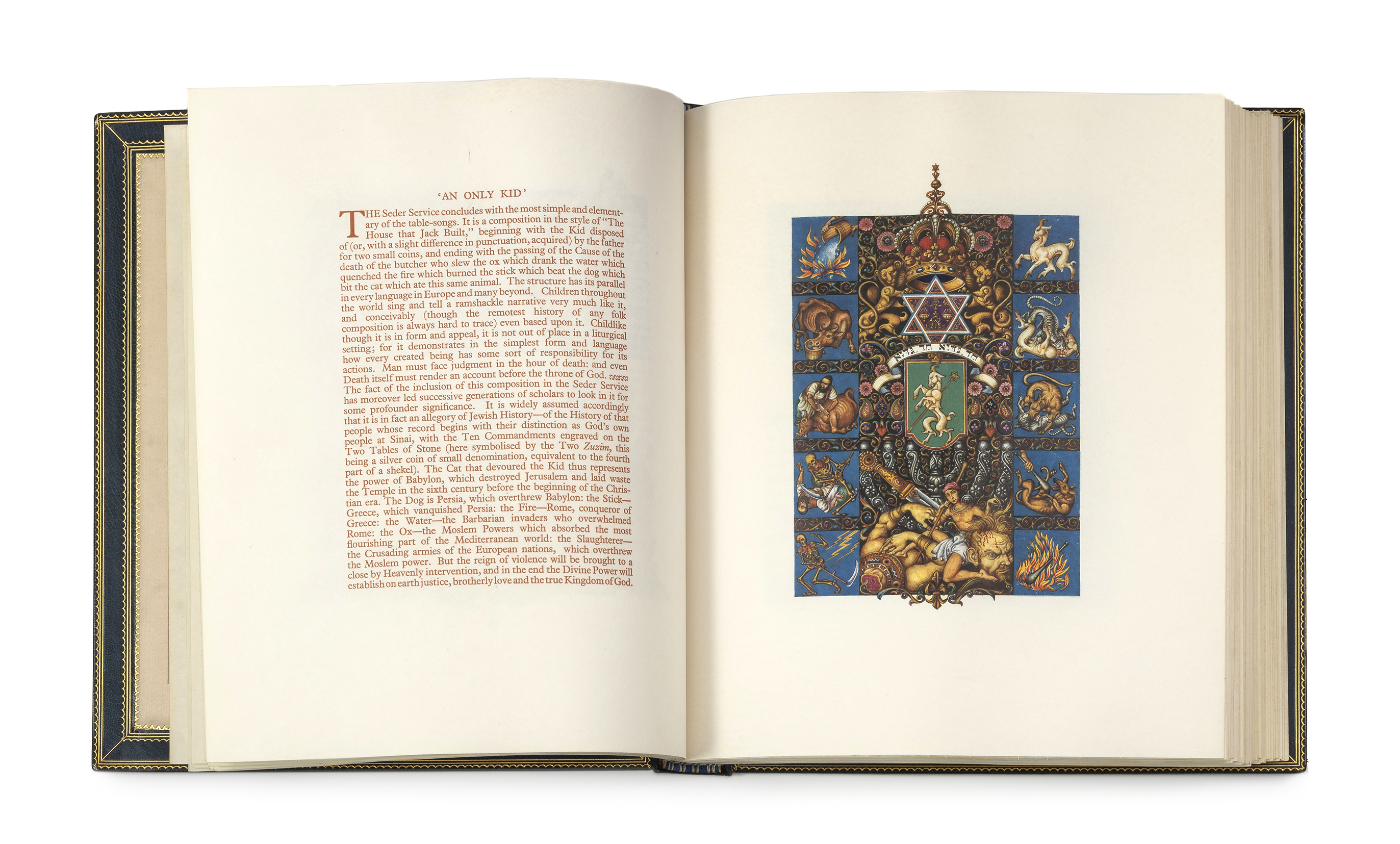
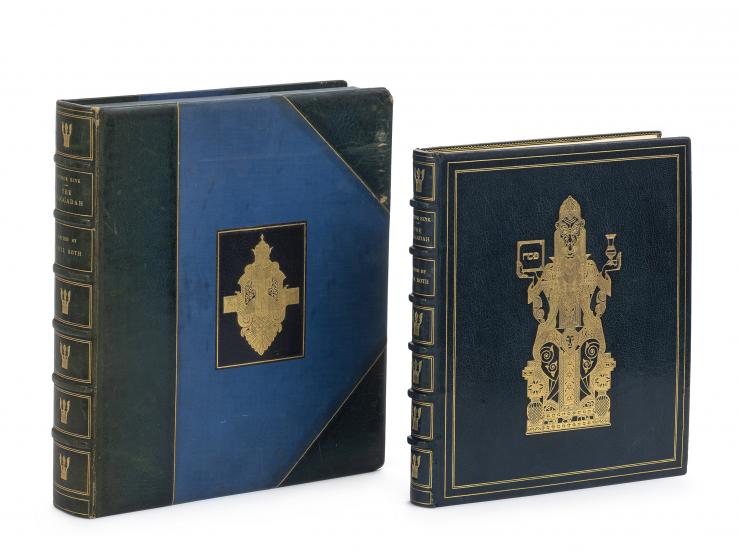
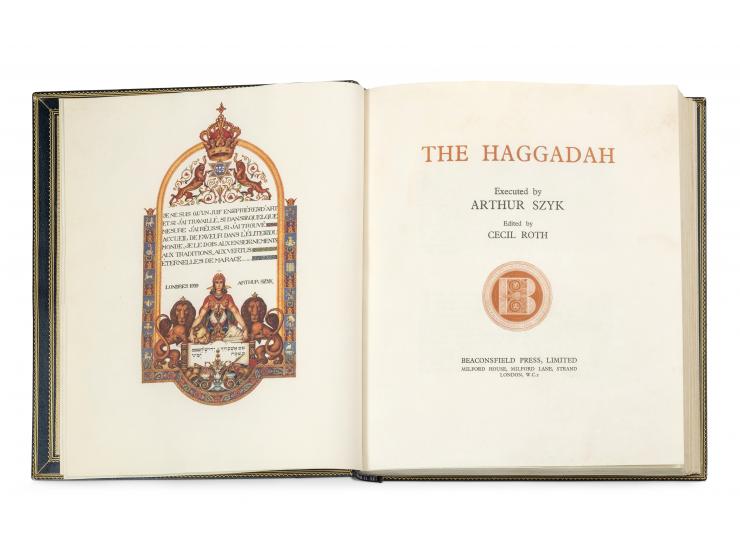
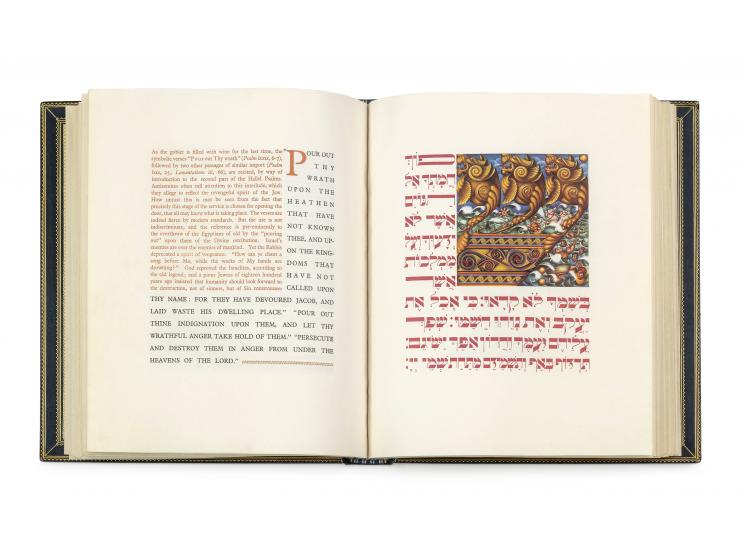
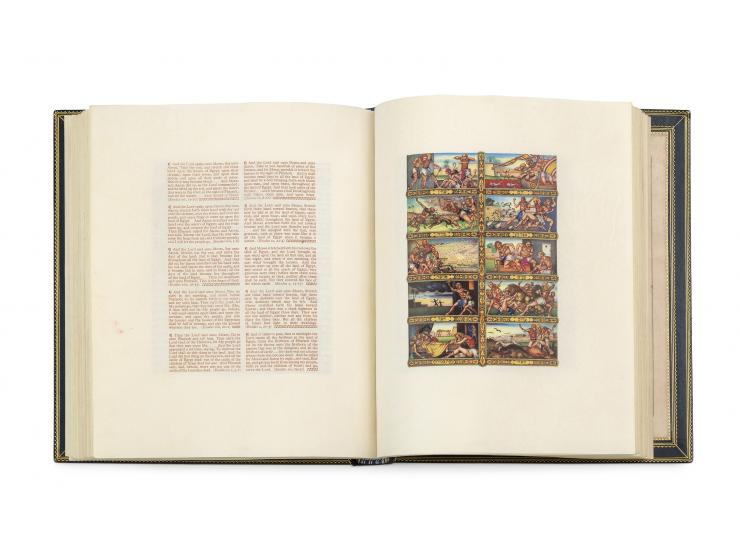
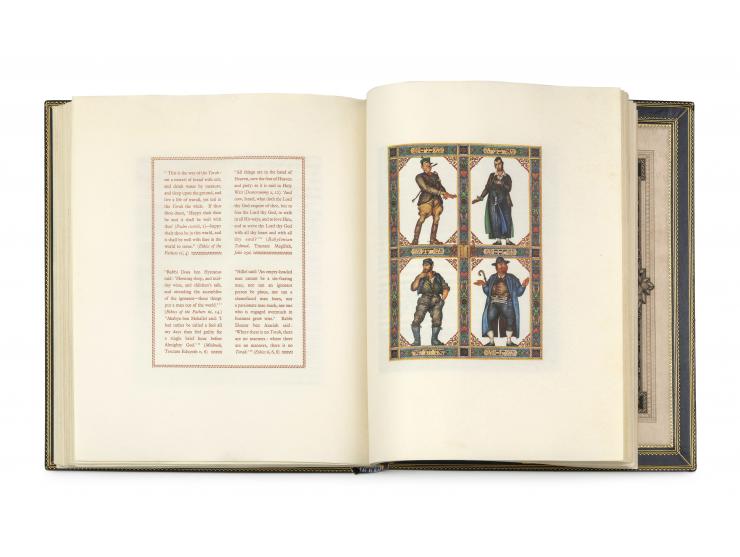
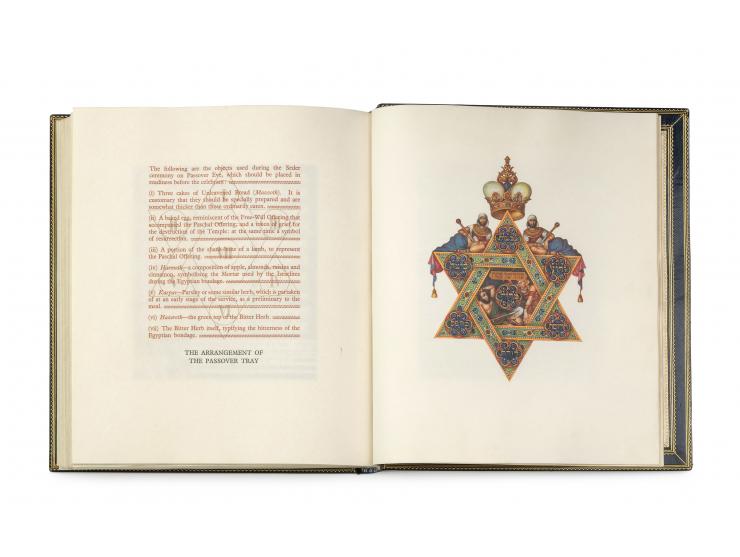
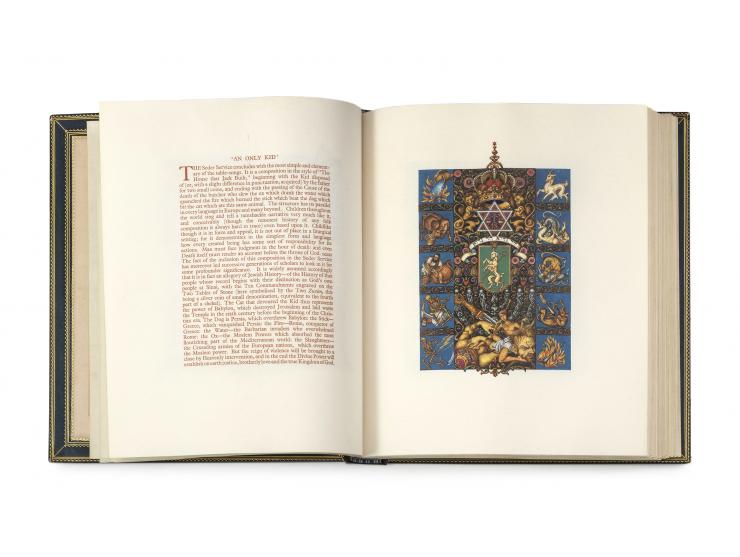
The Haggadah, Haggadah by Arthur Szyk, printed on parchment; English translation and foreword by Cecil Roth. London: Beaconsfield Press, [ca. 1940]. Hebrew and English.
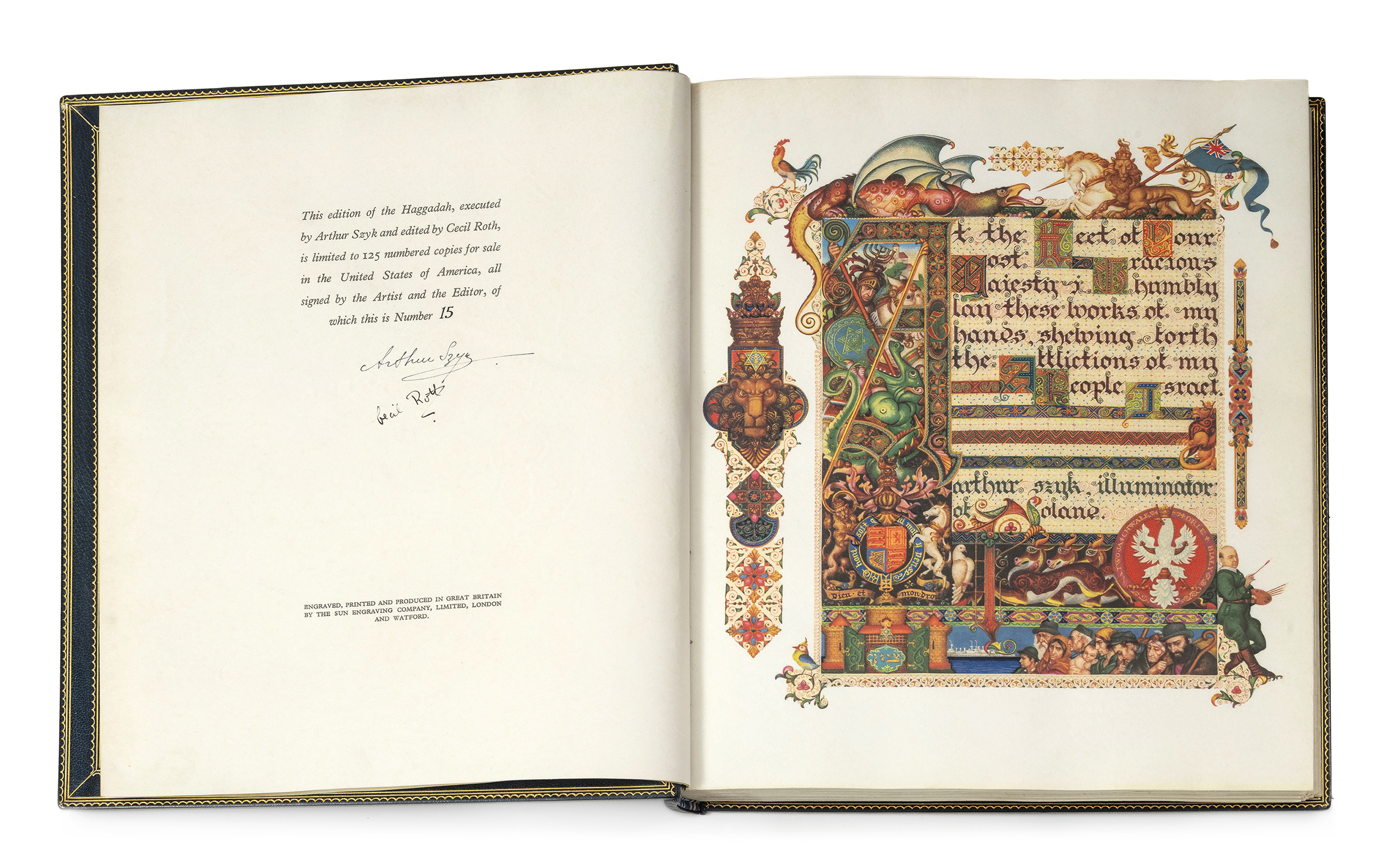
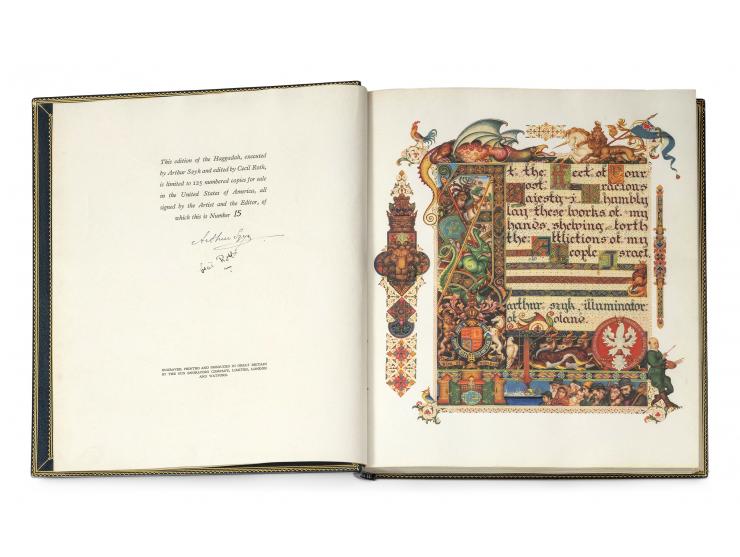
A bibliophile edition of superb aesthetic quality, designed in the spirit of medieval illuminated Hebrew manuscripts, and considered Arthur Szyk's magnum opus. Copy no. 15 of 125 copies (intended for sale in the United States; 125 additional copies were printed, intended for sale in England), signed on the colophon leaf by Arthur Szyk and Cecil (Bezalel) Roth.
Each page of the Haggadah is scribed in neat calligraphic script, with rich illustrations, ornaments and illuminated initial words. Fourteen full-page illustrations. Hebrew text and English translation on facing pages, occasionally with small ornament. Illustrated dedication to King George VI of England at the beginning of the book: "At the Feet of Your Most Gracious Majesty I humbly lay these works of my hands, shewing forth the Afflictions of my People Israel. Artur Szyk, illuminator of Poland" (the very first copy of the Haggadah was dedicated by Szyk and Cecil Roth to King George VI).
The Szyk Haggadah was created between 1932-1938 – 48 leaves of breathtaking beauty, qualified by the London Times as "worthy to be placed among the most beautiful of books that the hand of man has produced". Syzk produced the Haggadah against the backdrop of the increasingly deteriorating situation of European Jewry, and it is interwoven with allusions to the persecution the Jews were suffering and the dangers they faced. Szyk portrayed the Wicked Son, for instance, as a German figure with a Hitler-like moustache, wearing clothes reminiscent of the S.S. uniform. The battle against Amalek, as Cecil Roth writes in his foreword, is the central motif of the Haggadah illustrations. Due to its sharp messages, no European press was willing to print the Haggadah, and it was eventually printed in London, in the Beaconsfield Press (established specially for printing the Haggadah), during the war years.
There is a certain lack of clarity regarding the Haggadah's year of publication: the year 1939 is printed on the page opposite the title, under Szyk's brief preface (French). In Otzar HaHaggadot, the Haggadah is dated 1940 (Otzar HaHaggadot, no. 3712). Yaari dates the Haggadah to 1941 (Yaari, no. 2285). Cecil Roth himself once gives 1939 (Printed Illustrated Haggadot, Areshet – III, 1961, p. 28) and once 1940 as the year of printing (A Bibliographical Note on the Syzk Haggadah, by Cecil Roth, Studies in Bibliography and Booklore, vol. 9, no. 1, 1969, pp. 50).
Fine copy. Leather binding with gilt ornament after an illustration by Szyk. Placed in original, velvet-lined gilt-decorated case, with leather spine and corners. XXVI pages, [46] leaves. Volume: 28 cm. Case: approx. 33.5 cm. Good condition. Some stains and defects. Light wear to binding. Wear and stains to case.
Category
Siddurim and Passover Haggadot
Catalogue Value
![Sefer HaIkarim, principles of Jewish faith, by R. Yosef Albo. Soncino: [Yisrael Natan Soncino and sons], 1485. First editio](https://files.kedem-auctions.com/files/Sale107/57_1.jpg "Sefer HaIkarim. by Rabbi Yosef Albo – Incunabulum – Soncino, 1485")
![Sefer HaIkarim, principles of Jewish faith, by R. Yosef Albo. Soncino: [Yisrael Natan Soncino and sons], 1485. First editio](https://files.kedem-auctions.com/files/Sale107/57_2.jpg "Sefer HaIkarim. by Rabbi Yosef Albo – Incunabulum – Soncino, 1485")
![Sefer HaIkarim, principles of Jewish faith, by R. Yosef Albo. Soncino: [Yisrael Natan Soncino and sons], 1485. First editio](https://files.kedem-auctions.com/files/Sale107/57_3.jpg "Sefer HaIkarim. by Rabbi Yosef Albo – Incunabulum – Soncino, 1485")
Auction 107: Rare and Important Items
Apr 15, 2026
Opening: $25,000
Estimate: $30,000 - $40,000
Sold for: $35,000
Including buyer's premium
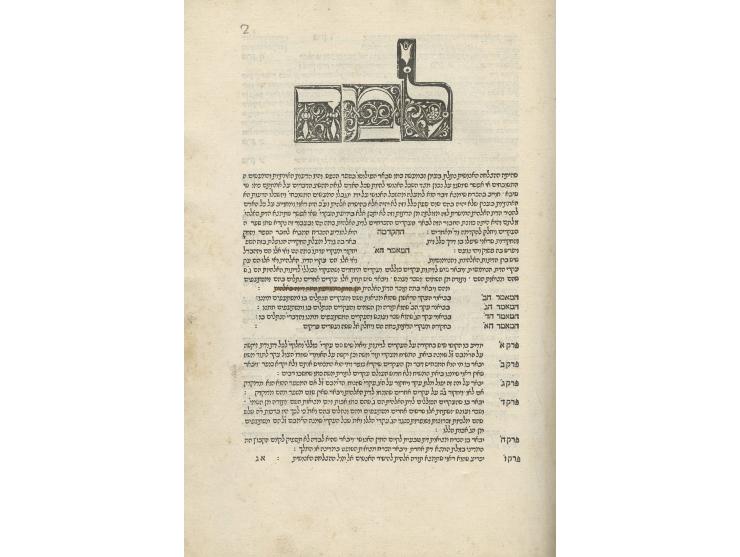
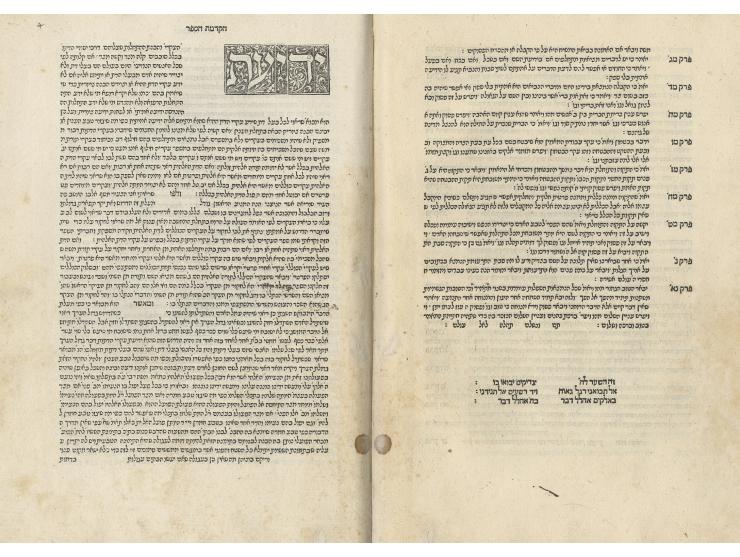
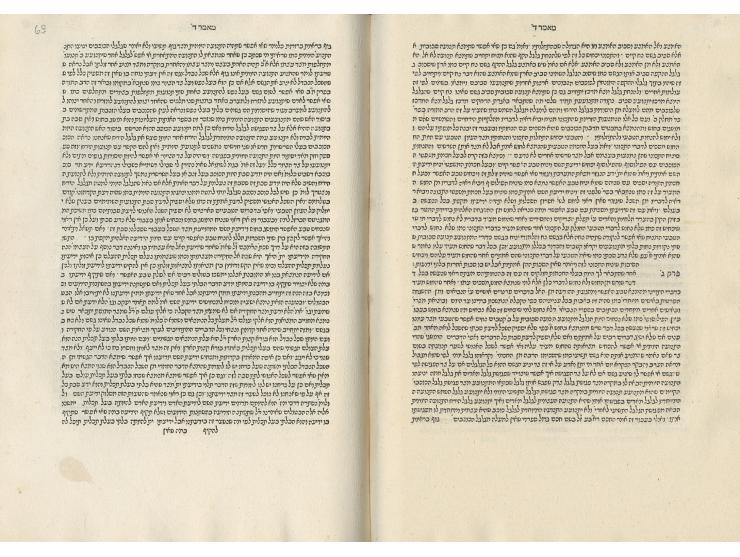
Sefer HaIkarim, principles of Jewish faith, by R. Yosef Albo. Soncino: [Yisrael Natan Soncino and sons], 1485. First edition. Incunabulum.
First edition of a classic work of Jewish thought. Printed in Soncino, Italy, in the early years of Hebrew printing, in the famous press of the first Jewish family of printers.
Printed without title page. The recto of first leaf is blank, while the printer's foreword occupies the verso: "As this important work, called Sefer HaIkarim, by the great sage R. Yosef Albo the Spaniard of Soria in Spain is of very great benefit to the people of our nation… and moreover… as it is less than seventy years since the passing of that sage, the author of this book… in order to spread its benefit… we decided to typeset it in full…". At the end of the foreword, date of commencement of printing: 22nd Cheshvan 1485, in Soncino.
Two colophons at end of book. The first gives the date of completion of printing as 21st Tevet 1485. The second colophon, by one of the print workers, concludes with the famous play on the verse from Yeshayahu (coined here): "From Zion shall go forth the Torah, and the word of G-d from Soncino".
Woodcut initial word panels at the beginning of the table of contents and of the introduction.
Many censorship expurgations (including deletions of entire lines in several places).
On first and last leaves, paper watermarks highlighted, forming the head of a horned animal.
On blank side of first leaf, rhyming inscription in Italian script praising and declaring the writer's affection for an individual referred to by initials.
Below this inscription is a Latin ownership inscription handwritten by Danish Orientalist and scholar Jacob Georg Christian Adler (1756-1834), attesting that he received the book from the scholar and bibliographer Giovanni Bernardo de Rossi (1742-1831, a pioneer of Hebrew incunabula research), in Parma, in 1780. He writes that complete copies of the book are scarce, and that the Inquisition destroyed them because of their anti-Christian content; he notes the leaves lacking in this copy due to censorship (see below).
[105] leaves. Originally: [108] leaves. Lacking [3] leaves: [56]-[58] (viii2-4), lacking in most copies, due to Christian censorship (the present copy contains photocopy replacements). 27.5 cm. Fine margins. Varying condition of leaves, some leaves in good-fair condition, others in fair to fair-good condition. Stains, including dark dampstains and traces of former dampness to last leaves. Worming (significant worming to inner margins of many leaves), affecting text, mostly repaired with paper filling. Tears and open tears, affecting text (large open tear to first leaf covering approx. half of leaf, and large marginal open tears to last leaves), mostly repaired with paper filling. Old binding (new endpapers), with leather spine and corners. Wear and defects to binding.
There are typographic variations between the different copies of the book (presumably because many leaves were reset during the course of the printing), notably on leaf 1 of gathering v (leaf [31]). See: Y. Rivkind, Kiryat Sefer, II, 1925-1926, pp. 55-56 (Rivkind distinguishes between two types of copies, one of which was proofread and corrected – the present copy is of the corrected type).
For a detailed bibliographic description of the book, and the bibliographical disagreement as to which member of the Soncino family printed the book, see further: P. Tishby, Kiryat Sefer, LXIII, 1990-1991, pp. 615-621, no. 36.
The Soncino family were prominent Hebrew printers in the 15th and 16th centuries, and particularly in the incunabula period. They established their first printing press in Soncino, Italy, ca. 1483, and later wandered through various Italian cities with their printing equipment, resuming their printing operations wherever they settled. A prominent member of this family was Gershom Soncino. The family derived its name from the first town in Italy where they operated.
Provenance: Sotheby's, Delmonico Collection, New York, 17 December 2008, Lot 20 (the catalogue notes that the copy belonged to the collection of the Royal Library in Copenhagen, and was sold by the library ca. 1950, after the Lazarus Goldschmidt incunabula collection was purchased).
Category
Incunabula and Early Printed Books
Catalogue Value
Auction 107: Rare and Important Items
Apr 15, 2026
Opening: $50,000
Estimate: $70,000 - $90,000
Sold for: $93,750
Including buyer's premium
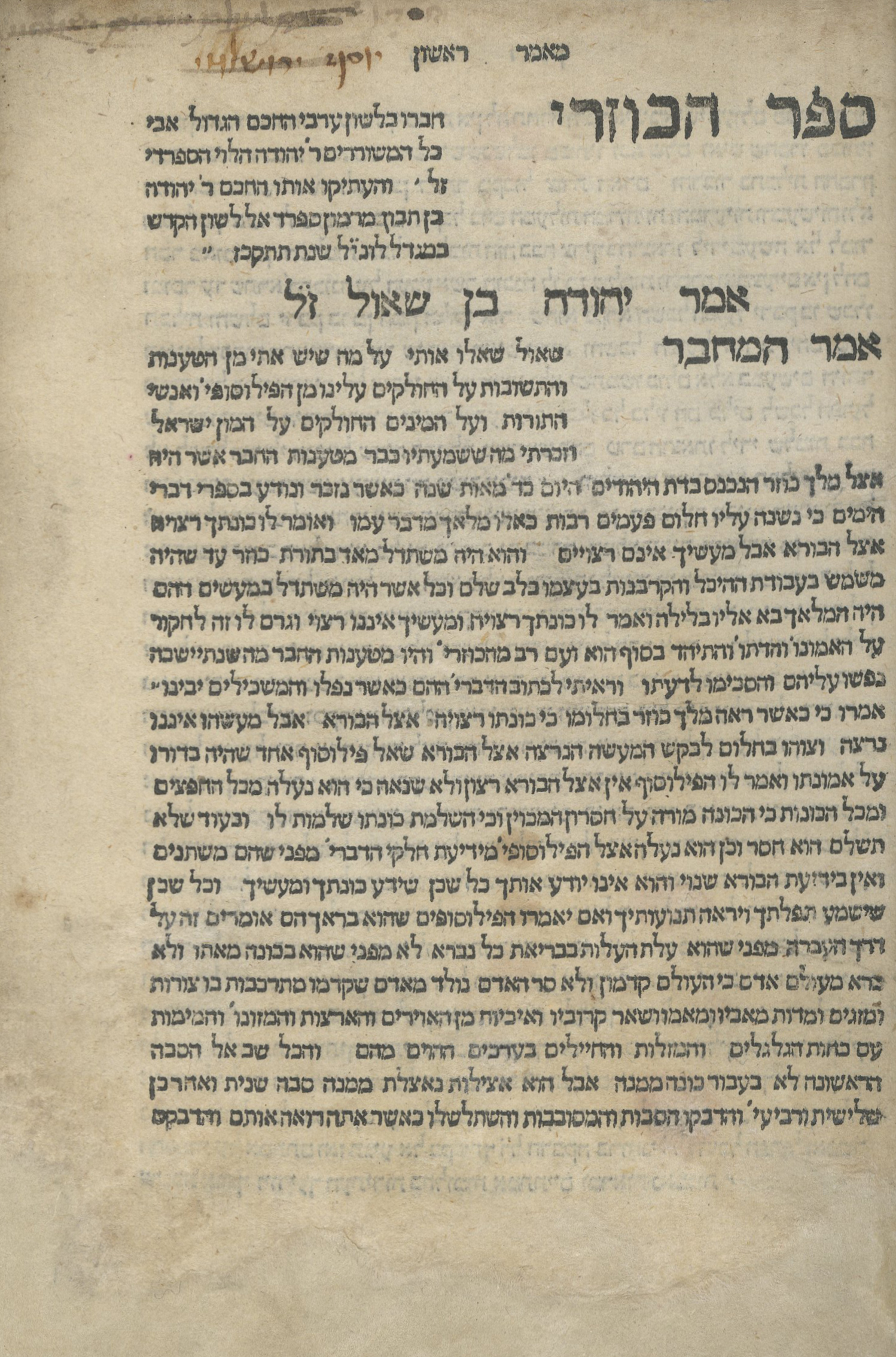
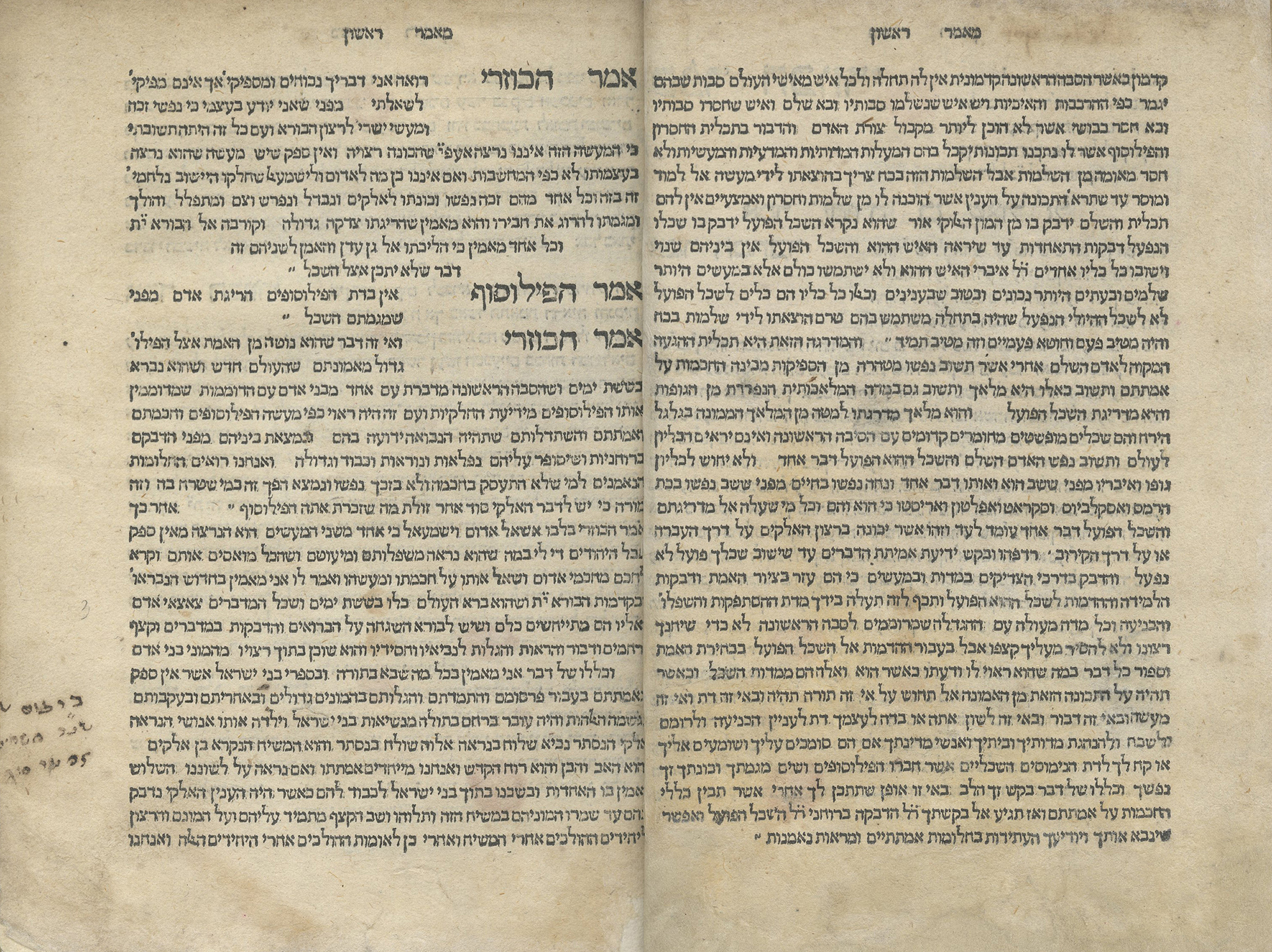
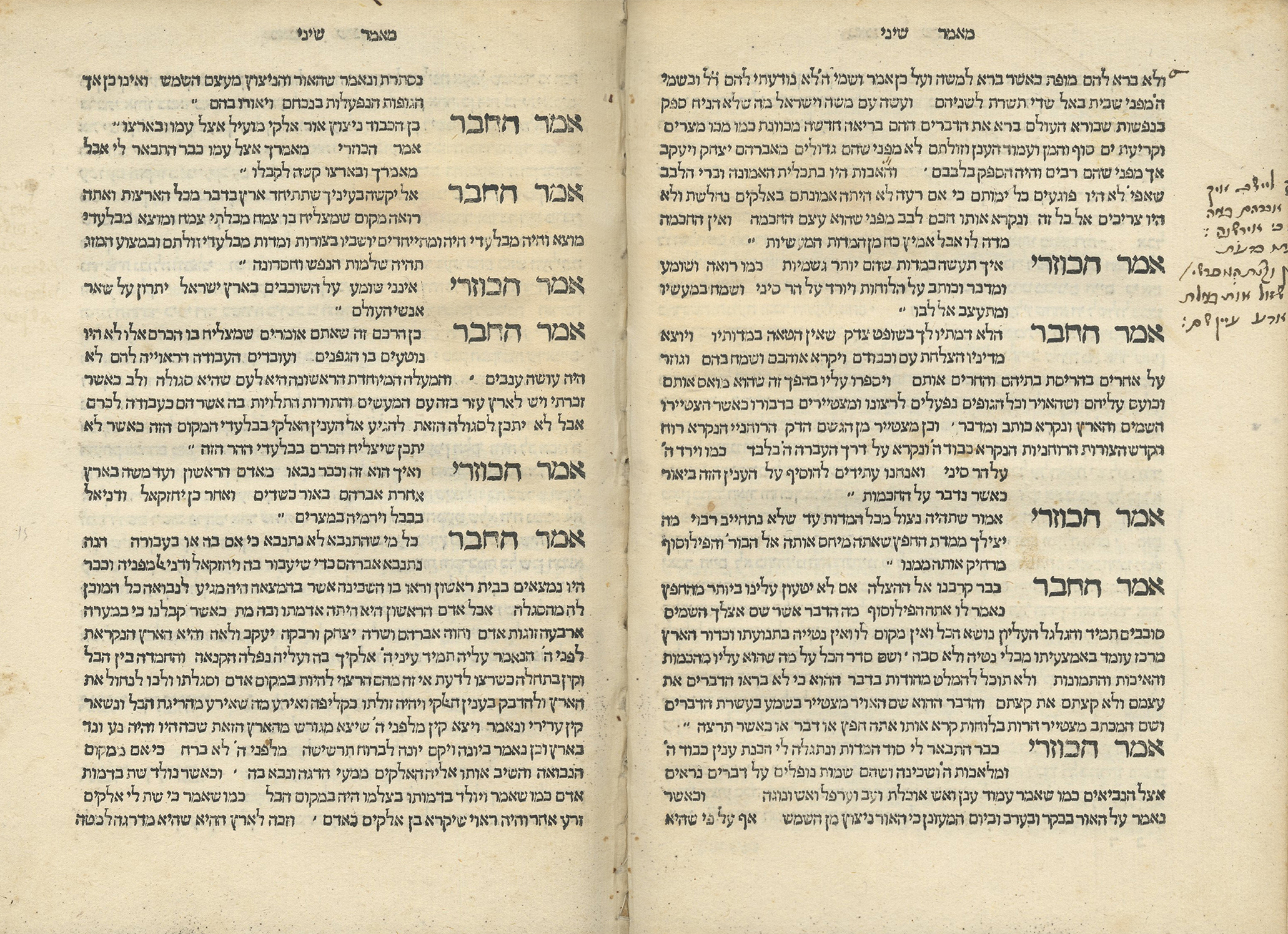
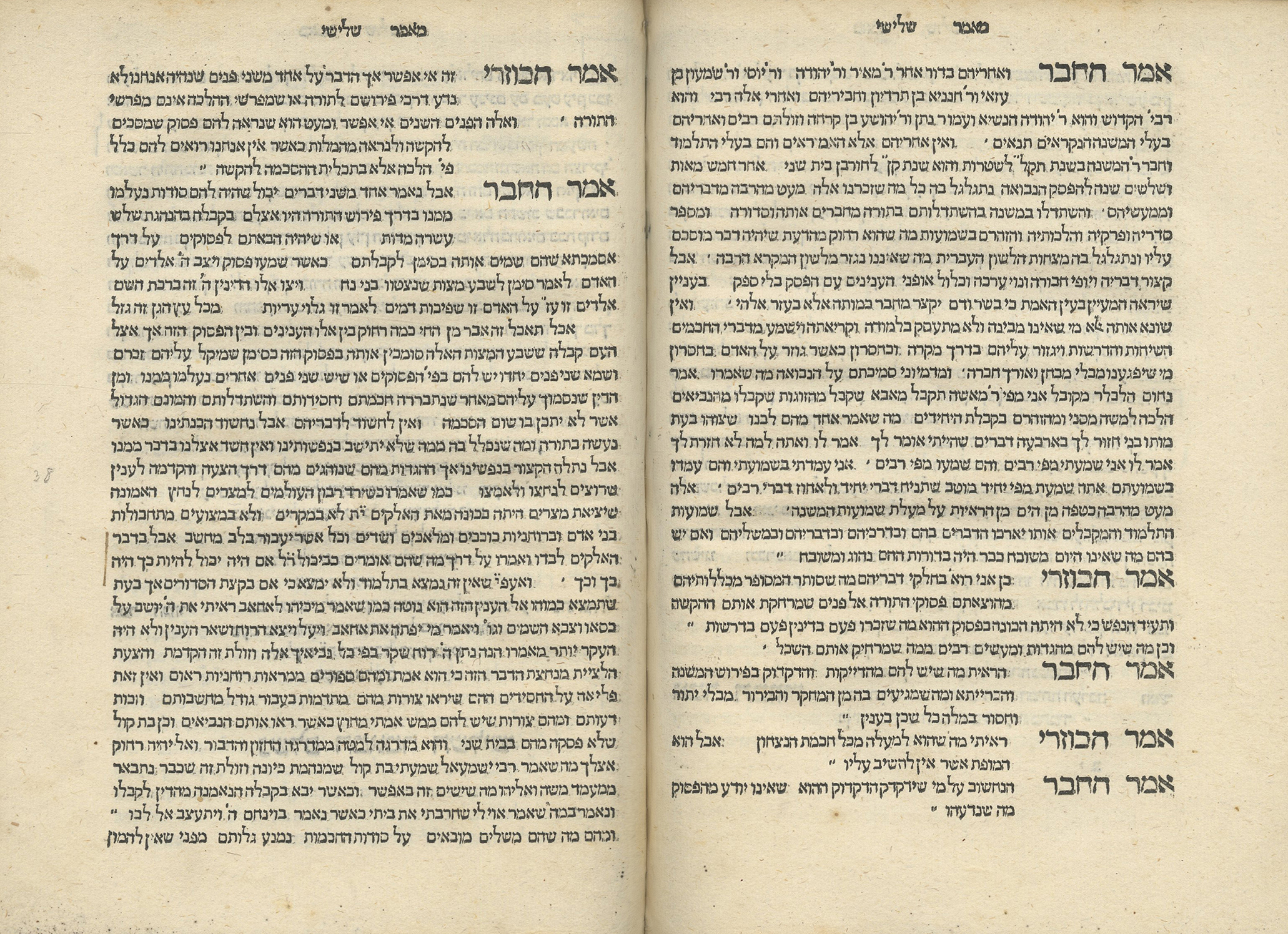
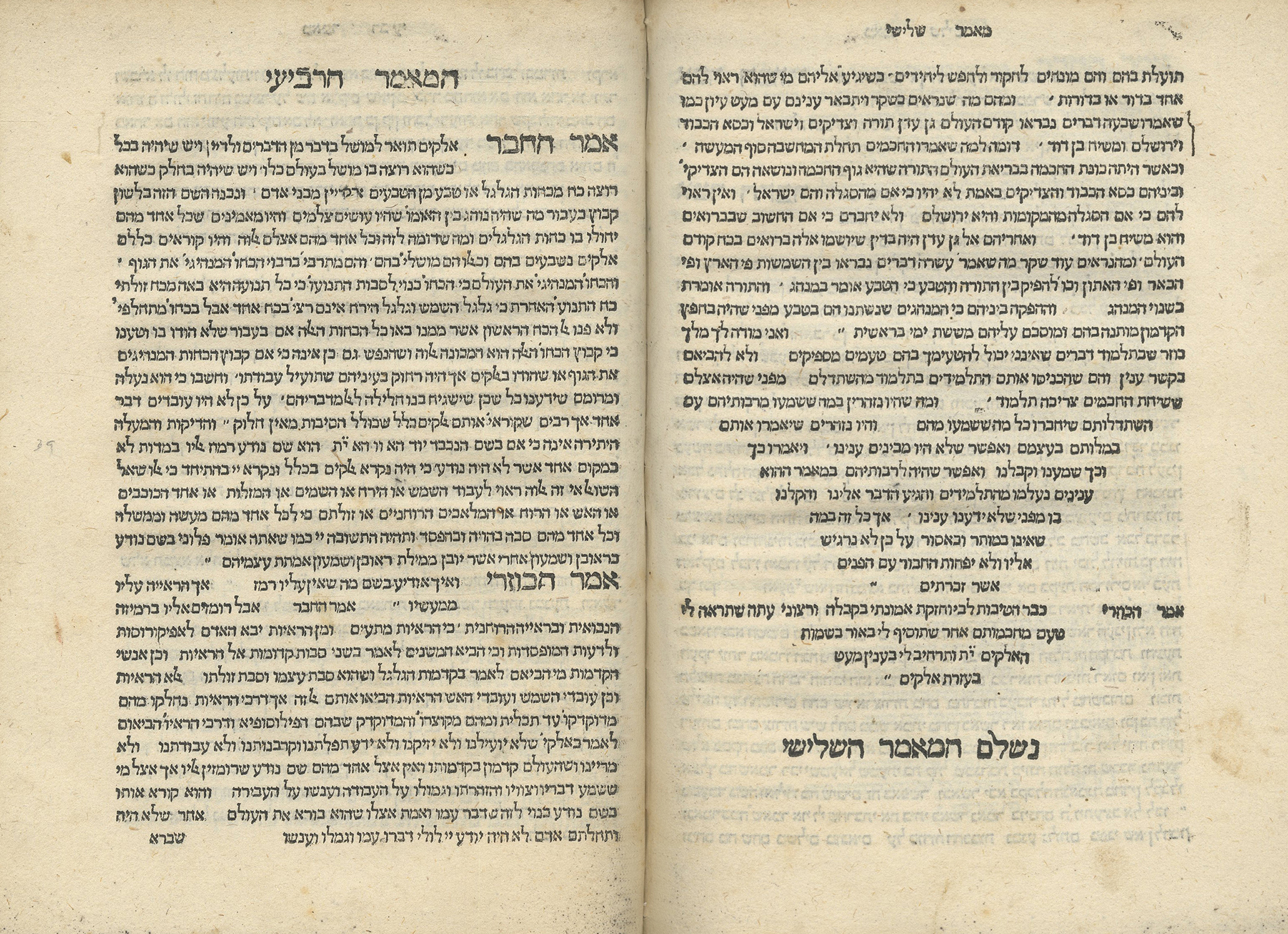
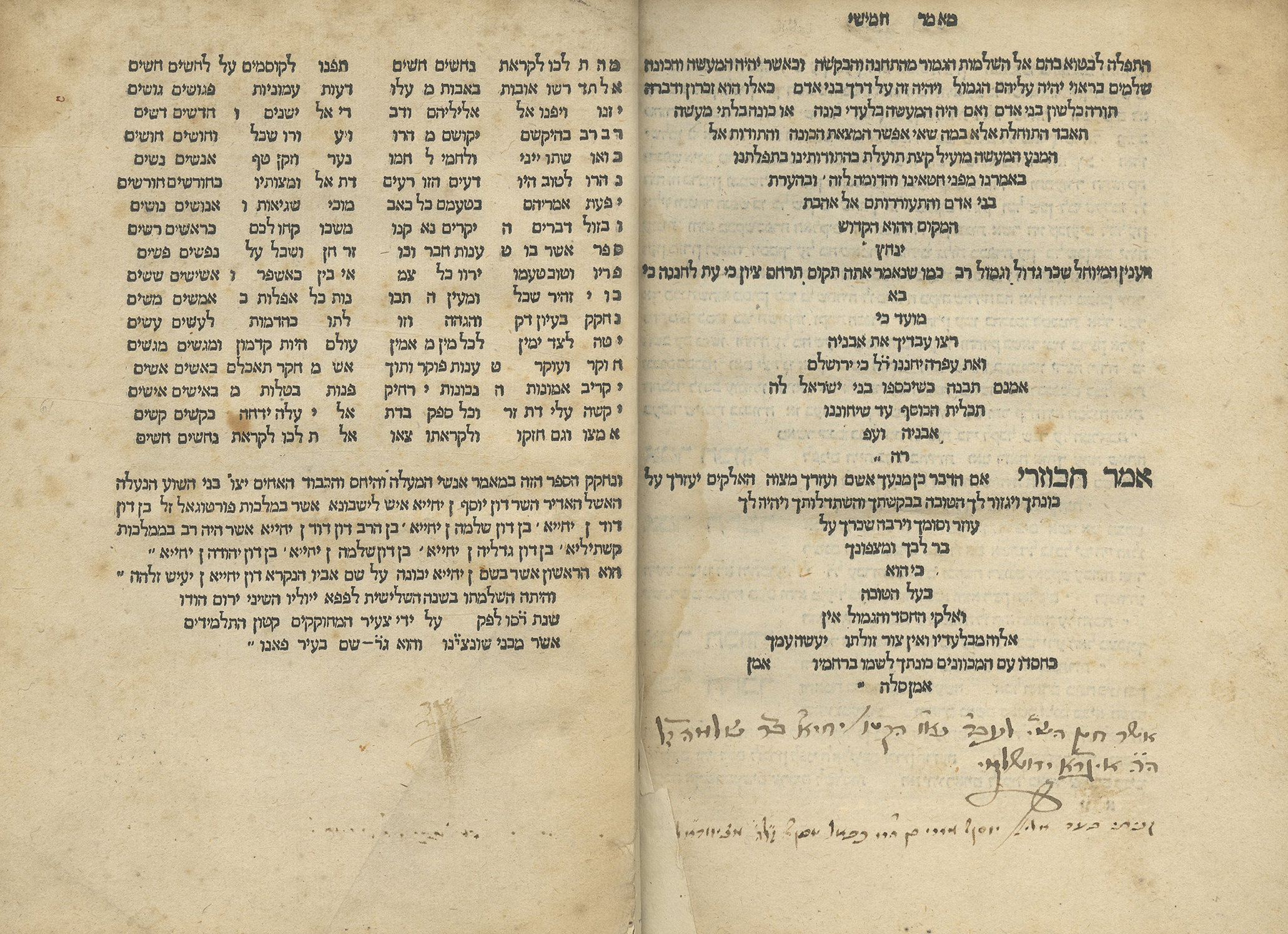
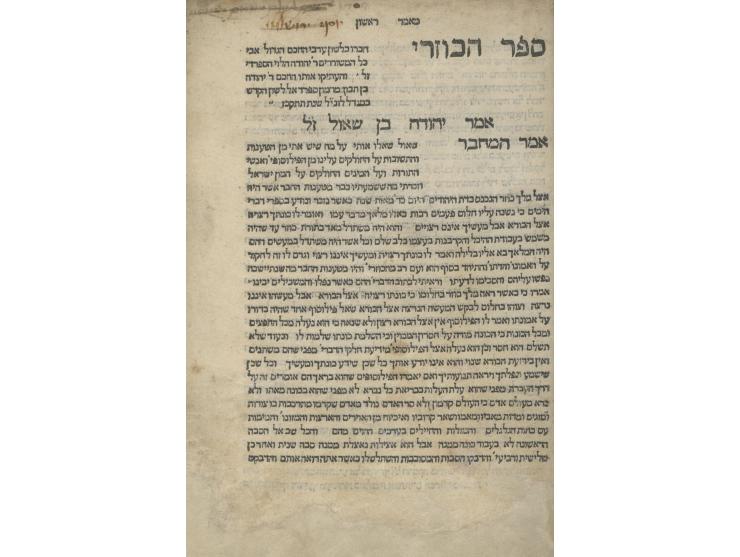
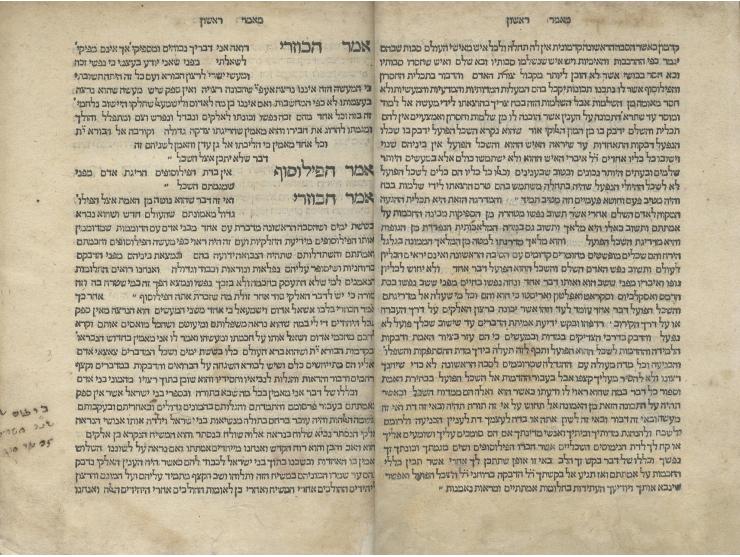
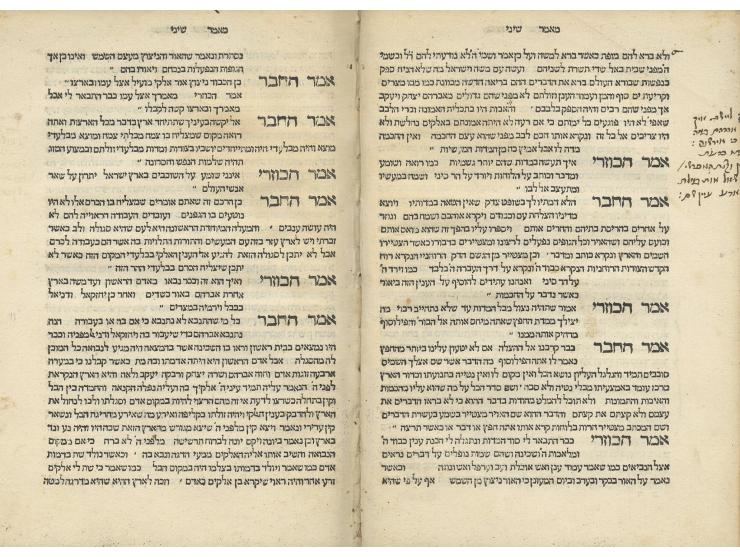
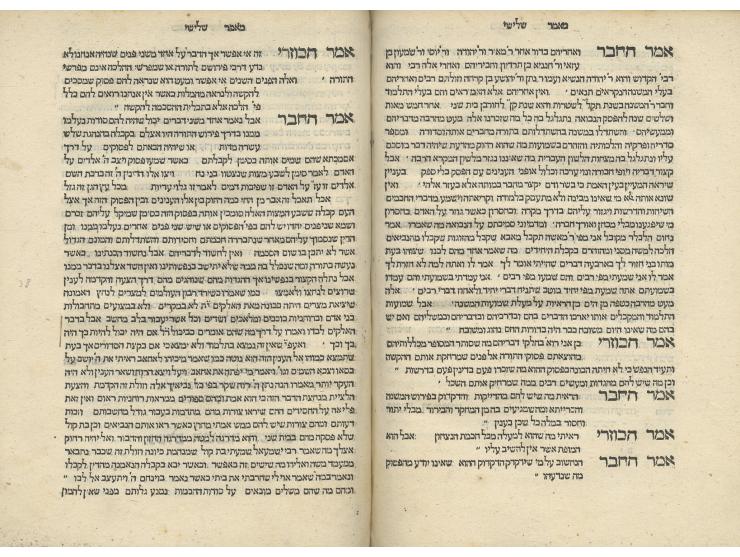
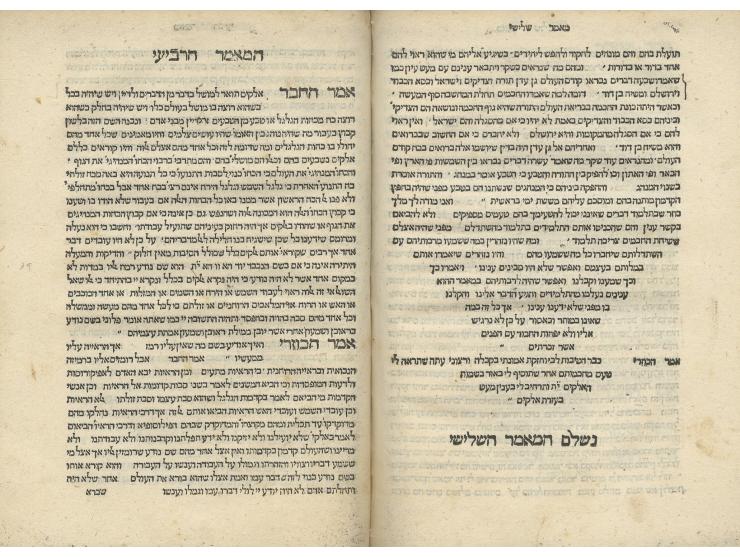
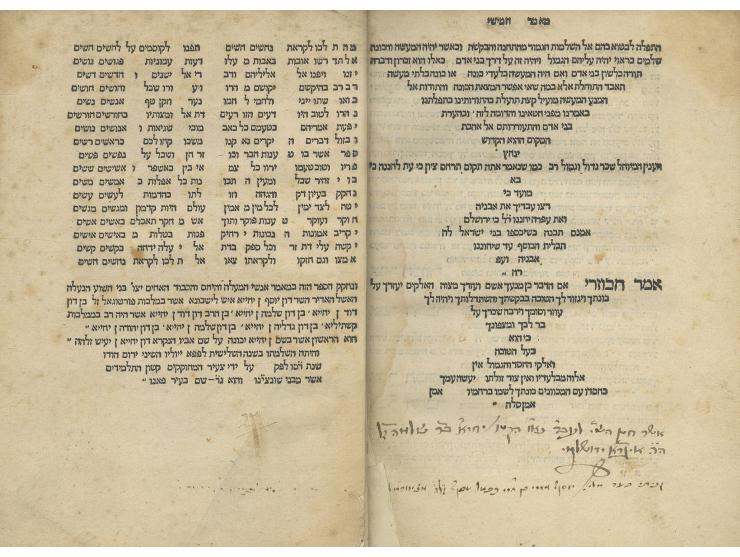
Kuzari, philosophical work on the fundamentals of Jewish faith, by R. Yehudah HaLevi, translated from Judeo-Arabic to Hebrew by R. Yehudah ibn Tibbon. [Fano: Gershom Soncino, 1506]. First edition.
Title on title page: Sefer HaKuzar. Two poems in praise of the book on verso of title page.
The second leaf states: "Sefer HaKuzari, authored in Arabic by the great sage, master poet, R. Yehudah HaLevi of Spain, translated by R. Yehudah ibn Tibbon of Granada, Spain into Hebrew in Lunel, 1167".
This is the first edition of the Kuzari, a classic of Jewish thought and philosophy. The author, R. Yehudah HaLevi (ca. 1075-1141), was a prominent medieval Jewish poet and philosopher. The book, originally written in Judeo-Arabic and titled "The Book of Refutation and Proof on Behalf of the Despised Religion", is best known as the Kuzari after its contents, describing a dialogue between the Khazar king and a Jewish scholar. Importantly, this book grounds Jewish belief on the historicity of prophetic revelation, as opposed to other works which used intellectual arguments and proofs for faith.
The Kuzari has been acknowledged as a foundational work on Jewish thought throughout the generations, to which many thinkers are indebted. The praise for the book articulated by the Vilna Gaon is particularly well known, as recorded by his disciple R. Yisrael of Shklow: "[The Vilna Gaon] used to say to study the first book of the Kuzari, which is holy and pure, and the principles of Jewish belief and the Torah depend on it" (Tosefet Maaseh Rav, Jerusalem 1896, leaf 21).
The book was originally written in Judeo-Arabic, and has been translated into Hebrew several times. The translation in the present edition is that of R. Yehudah ibn Tibbon, which was the common translation for centuries.
Colophon on final leaf, stating that the book was commissioned by the sons of Don Yosef ibn Yachya of Lisbon, Portugal, and was completed in the third year of the reign of Pope Julius II, in 1506, by Gershom Soncino in Fano (the colophon lists several generations of the Ibn Yachya family).
On second leaf – signature (deleted with ink): "Yosef Yerushalmi", and another inscription, deleted with ink.
Ownership inscription on leaf [61]: "Granted by G-d to His servant, so says Yechiel son of R. Shlomo Igra Yerushalmi"; "I purchased it for Eliyahu Yosef Merari son of R. Refael[?] Yosef of Essaouira[?] ---".
Trimmed glosses on margins of two leaves.
Complete copy. [62] leaves. 19.5 cm. Varying condition; first leaves and several others in fair condition, rest in fair-good condition. Stains, including dampstains and traces of former dampness with mold stains. Tears and open tears, including large open tears to title page, affecting part of title and affecting poem on verso in many places, and slightly affecting text in several other places, repaired with paper filling (with photocopy and handwritten replacements). Bookplate of collector Elkan Nathan Adler inside front board. Old binding, somewhat loose, with leather spine. Wear and defects to binding (spine partially detached, with tear across margins).
The present copy includes the third leaf, containing an attack on Christianity, which was removed from many copies.
This book was printed by the renowned Jewish printer Gershom Soncino, one of the most prominent Hebrew printers in Italy. Soncino traveled with his family and printing equipment through various Italian cities, printing Hebrew books wherever he stayed.
Provenance:
1. Elkan Nathan Adler Collection, London.
2. Salman Schocken Collection, Jerusalem.
3. Kestenbaum, New York, 2 June 2003, Lot 13.
Category
Incunabula and Early Printed Books
Catalogue Value
![Torat Kohanim, or Sifra, with commentary by the Raavad (R. Avraham son of David of Posquières). [Constantinople]: pr](https://files.kedem-auctions.com/files/Sale107/59_1.jpg "Torat Kohanim – Sifra – Constantinople, 1510 – First Edition – Printin")
![Torat Kohanim, or Sifra, with commentary by the Raavad (R. Avraham son of David of Posquières). [Constantinople]: pr](https://files.kedem-auctions.com/files/Sale107/59_2.jpg "Torat Kohanim – Sifra – Constantinople, 1510 – First Edition – Printin")
![Torat Kohanim, or Sifra, with commentary by the Raavad (R. Avraham son of David of Posquières). [Constantinople]: pr](https://files.kedem-auctions.com/files/Sale107/59_3.jpg "Torat Kohanim – Sifra – Constantinople, 1510 – First Edition – Printin")
![Torat Kohanim, or Sifra, with commentary by the Raavad (R. Avraham son of David of Posquières). [Constantinople]: pr](https://files.kedem-auctions.com/files/Sale107/59_4.jpg "Torat Kohanim – Sifra – Constantinople, 1510 – First Edition – Printin")
![Torat Kohanim, or Sifra, with commentary by the Raavad (R. Avraham son of David of Posquières). [Constantinople]: pr](https://files.kedem-auctions.com/files/Sale107/59_5-WEB.jpg "Torat Kohanim – Sifra – Constantinople, 1510 – First Edition – Printin")
![Torat Kohanim, or Sifra, with commentary by the Raavad (R. Avraham son of David of Posquières). [Constantinople]: pr](https://files.kedem-auctions.com/files/Sale107/59_6-WEB.jpg "Torat Kohanim – Sifra – Constantinople, 1510 – First Edition – Printin")
![Torat Kohanim, or Sifra, with commentary by the Raavad (R. Avraham son of David of Posquières). [Constantinople]: pr](https://files.kedem-auctions.com/files/Sale107/59_7-WEB.jpg "Torat Kohanim – Sifra – Constantinople, 1510 – First Edition – Printin")
Auction 107: Rare and Important Items
Apr 15, 2026
Opening: $20,000
Estimate: $30,000 - $40,000
Sold for: $93,750
Including buyer's premium
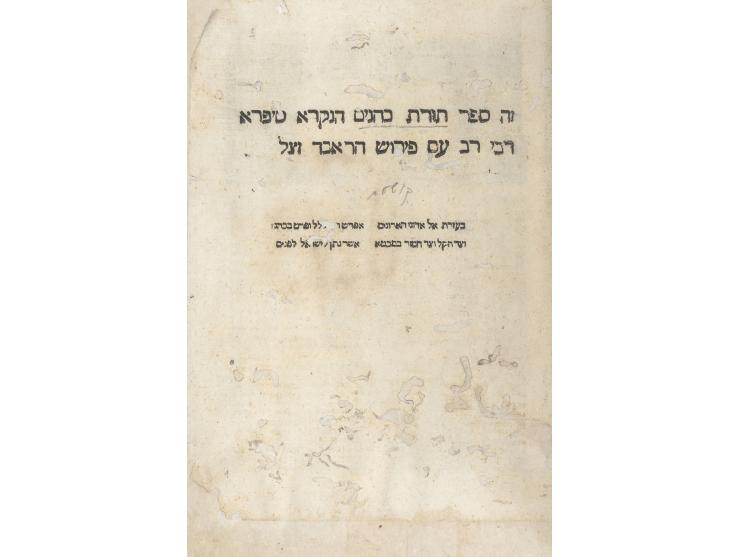
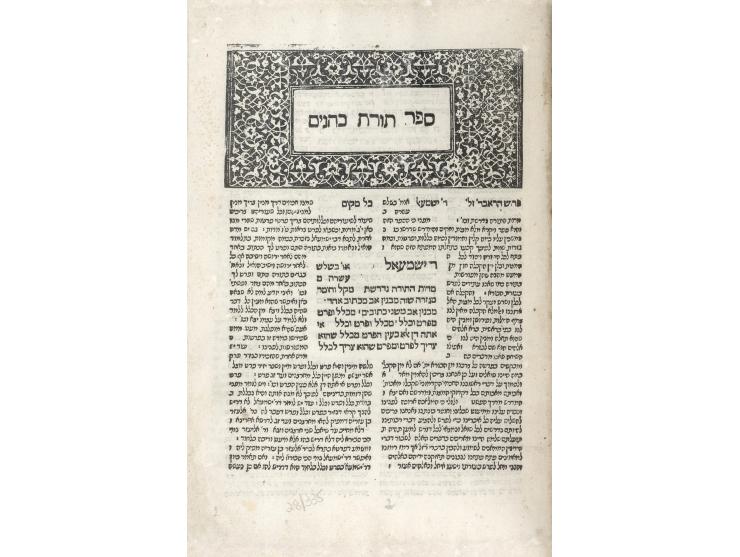
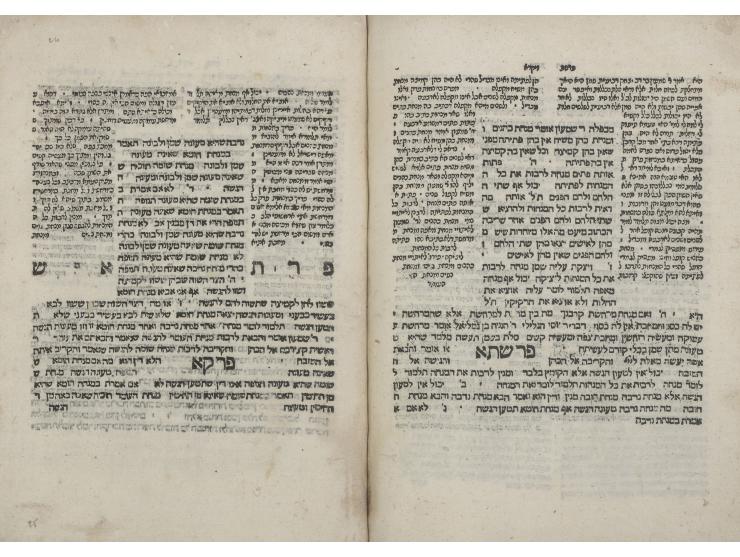
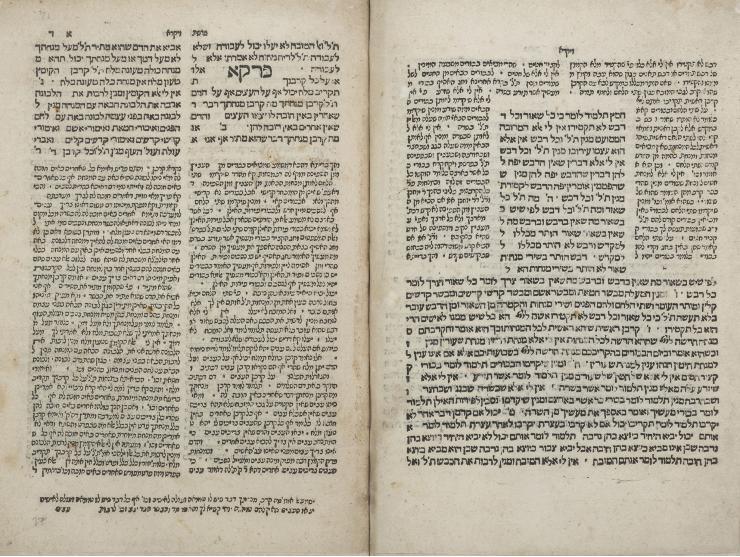
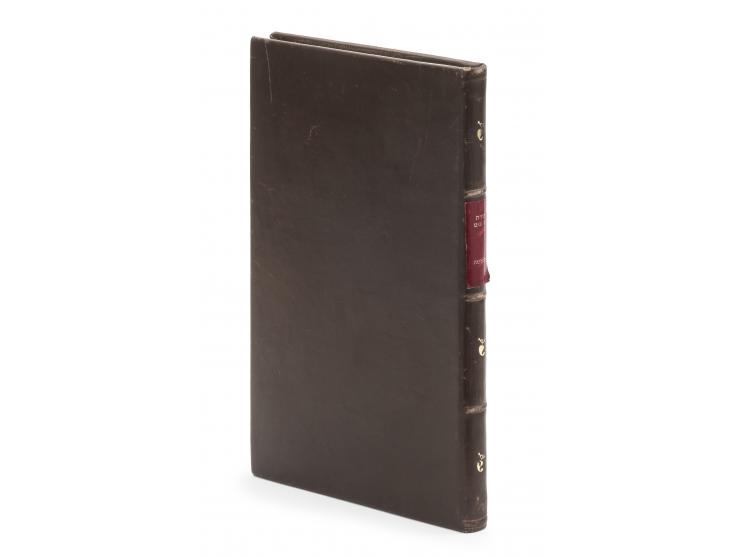
Torat Kohanim, or Sifra, with commentary by the Raavad (R. Avraham son of David of Posquières). [Constantinople]: printer not indicated, [ca. 1510].
First edition of Sifra, a halachic midrash to the Book of Vayikra originating in the school of R. Akiva, which was known in Eretz Israel as Torat Kohanim and in Babylonia as Sifra or Sifra Devei Rav, as well as first edition of the Raavad's commentary.
The book begins with the Baraita of R. Yishmael's thirteen hermeneutic rules, also with commentary of the Raavad. This baraita has since been printed at the beginning of subsequent editions.
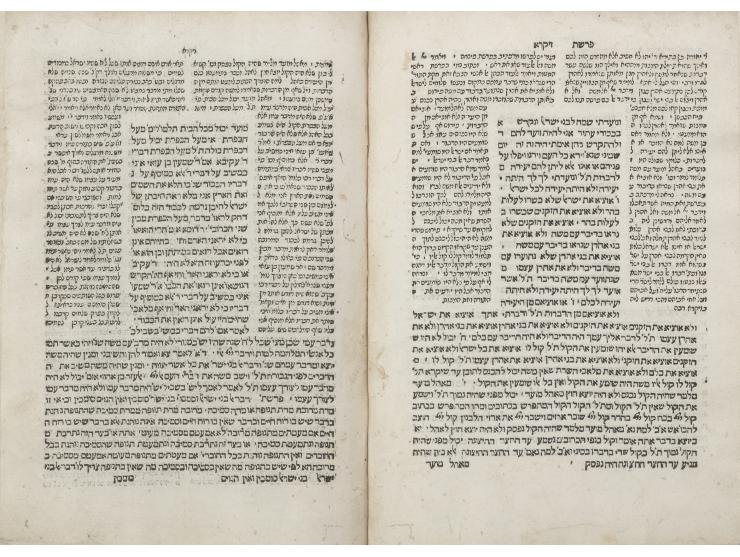
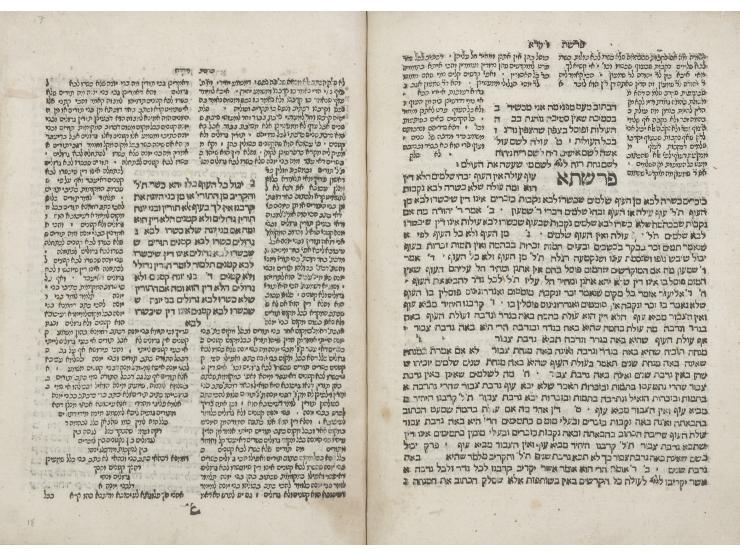
The text of the Baraita of R. Yishmael is printed in the center in square script, with the Raavad's commentary printed around it in two columns, in semi-cursive (Rashi) script. The Sifra text in the first part is printed in the same format, while later in the volume the Sifra text is printed at the upper part of the page in two columns in square script, with the Raavad's commentary at the bottom in two columns in semi-cursive script.
The printing was interrupted in the middle of Parashat Vayikra (mislabeled as Parashat Tzav on headers of leaves [33-42]), and the printing of the book was not completed (likewise in other known copies).
On second leaf, fine woodcut initial panel.
[42] leaves. 28.5 cm. Wide margins. Fair condition. Stains, including dark dampstains. Open tears, and much heavy worming (especially to title page), affecting text in many places, repaired with paper filling (all leaves repaired and margins slightly expanded). New leather binding.
The precise date of printing is unclear, and various hypotheses have been advanced (Habermann dates it to after 1505; Friedberg to 1530; Mehlman to 1494-1504; Yaari dated it to [1523?] but appears to have relied on a mistaken record by Aron Freimann).
Especially rare. Only a few copies are known.
Provenance: Kestenbaum, New York, 25 October 2004, Lot 34.
Category
Incunabula and Early Printed Books
Catalogue Value
Auction 107: Rare and Important Items
Apr 15, 2026
Opening: $25,000
Estimate: $30,000 - $40,000
Sold for: $125,000
Including buyer's premium
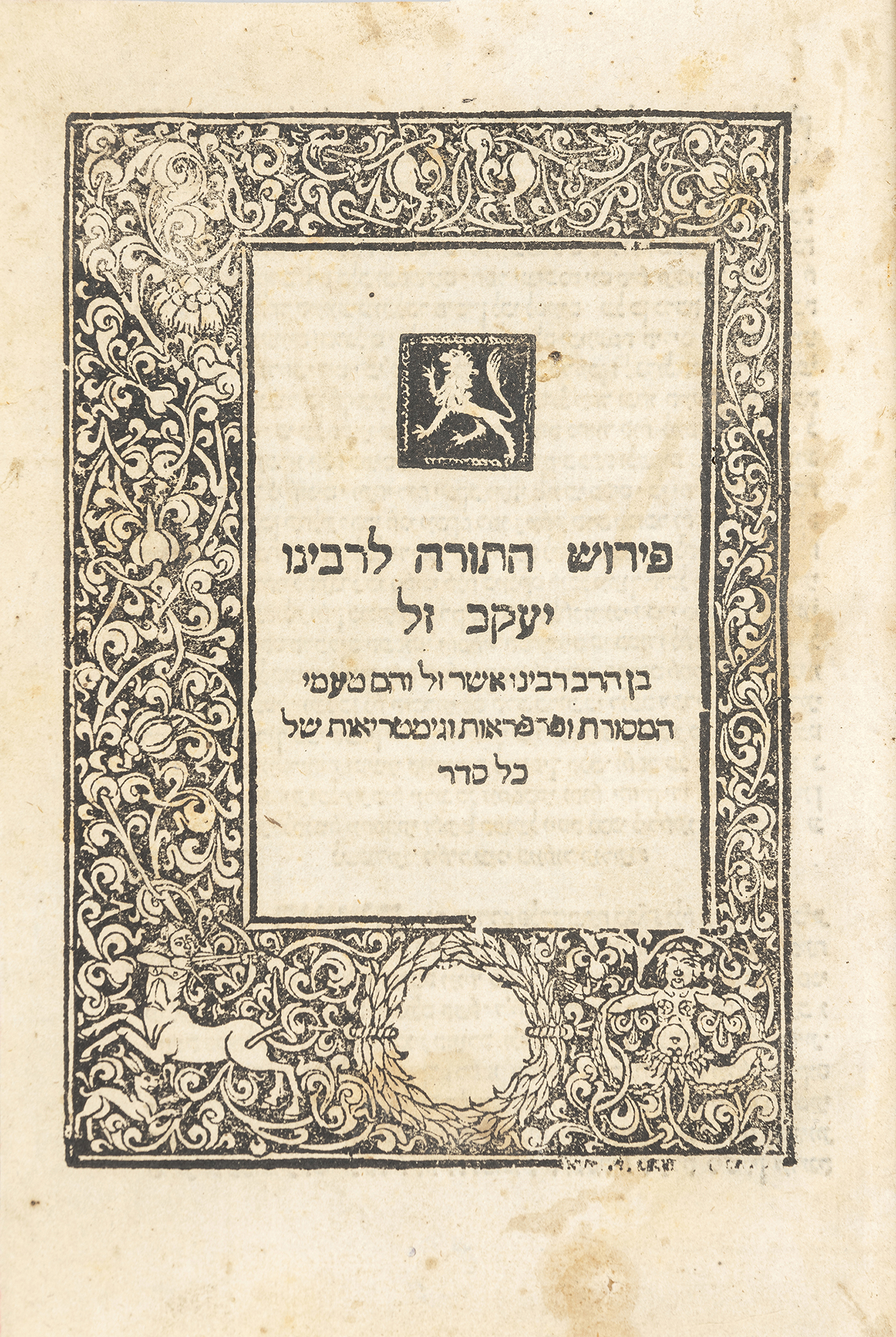
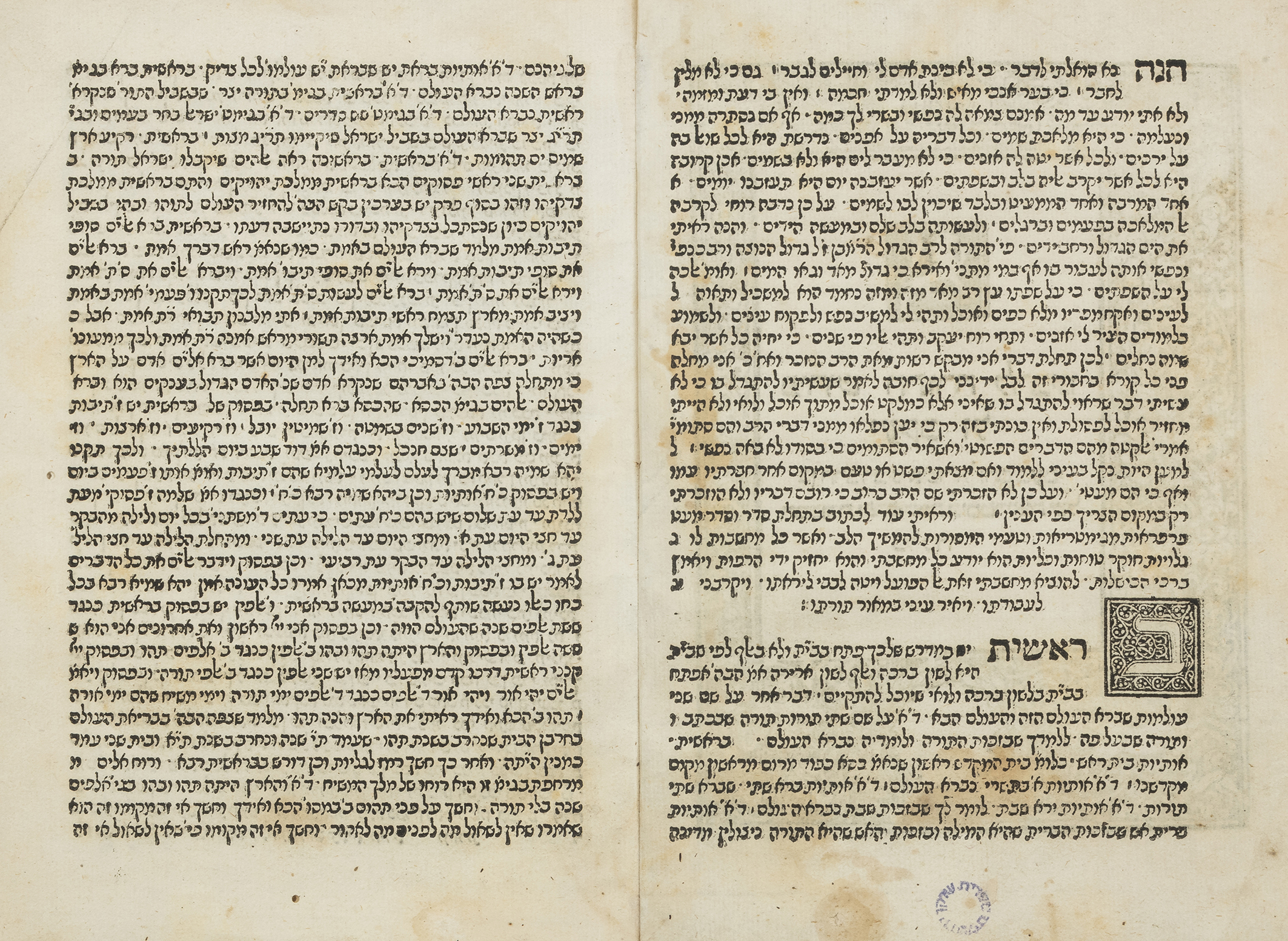
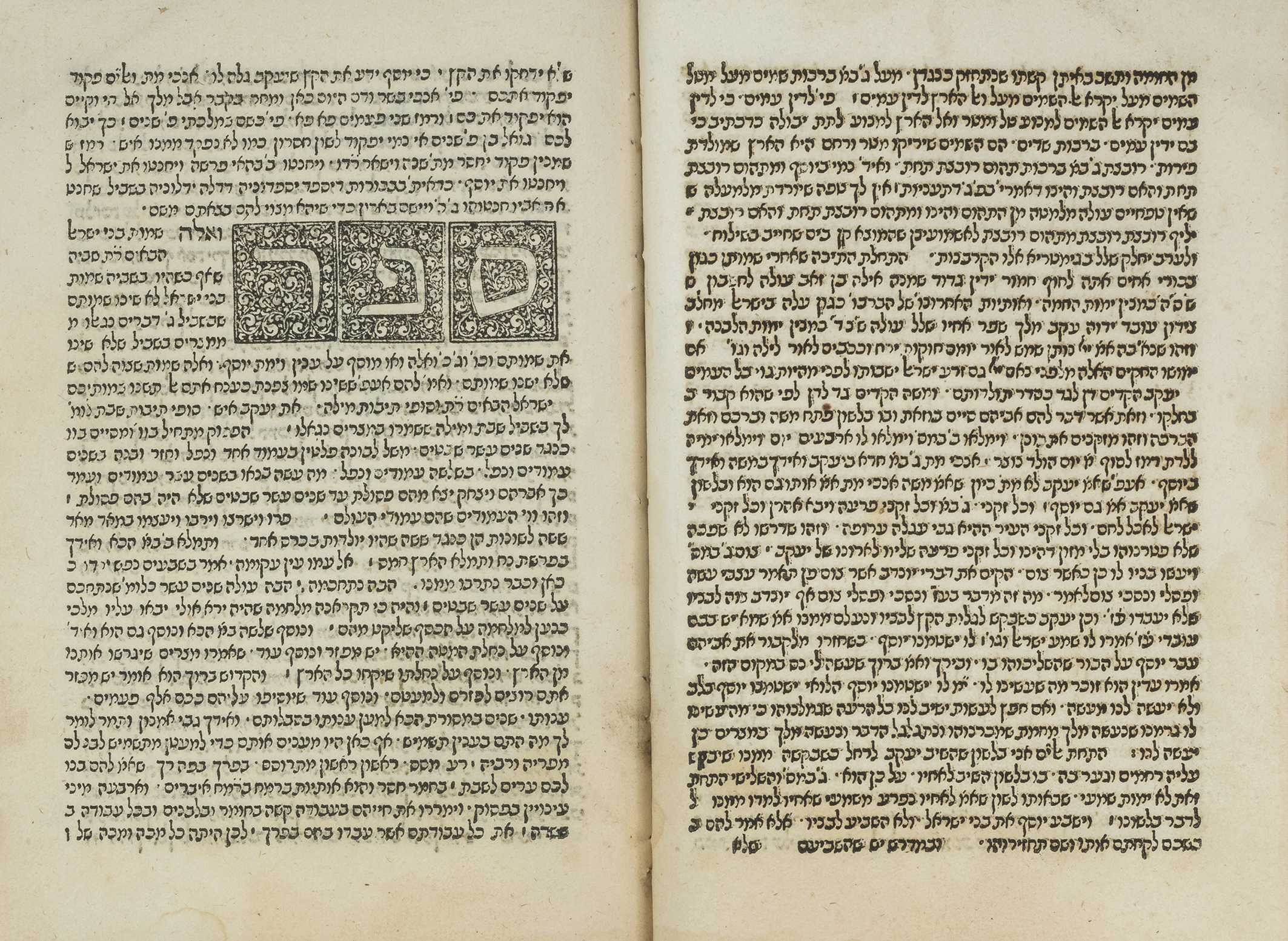
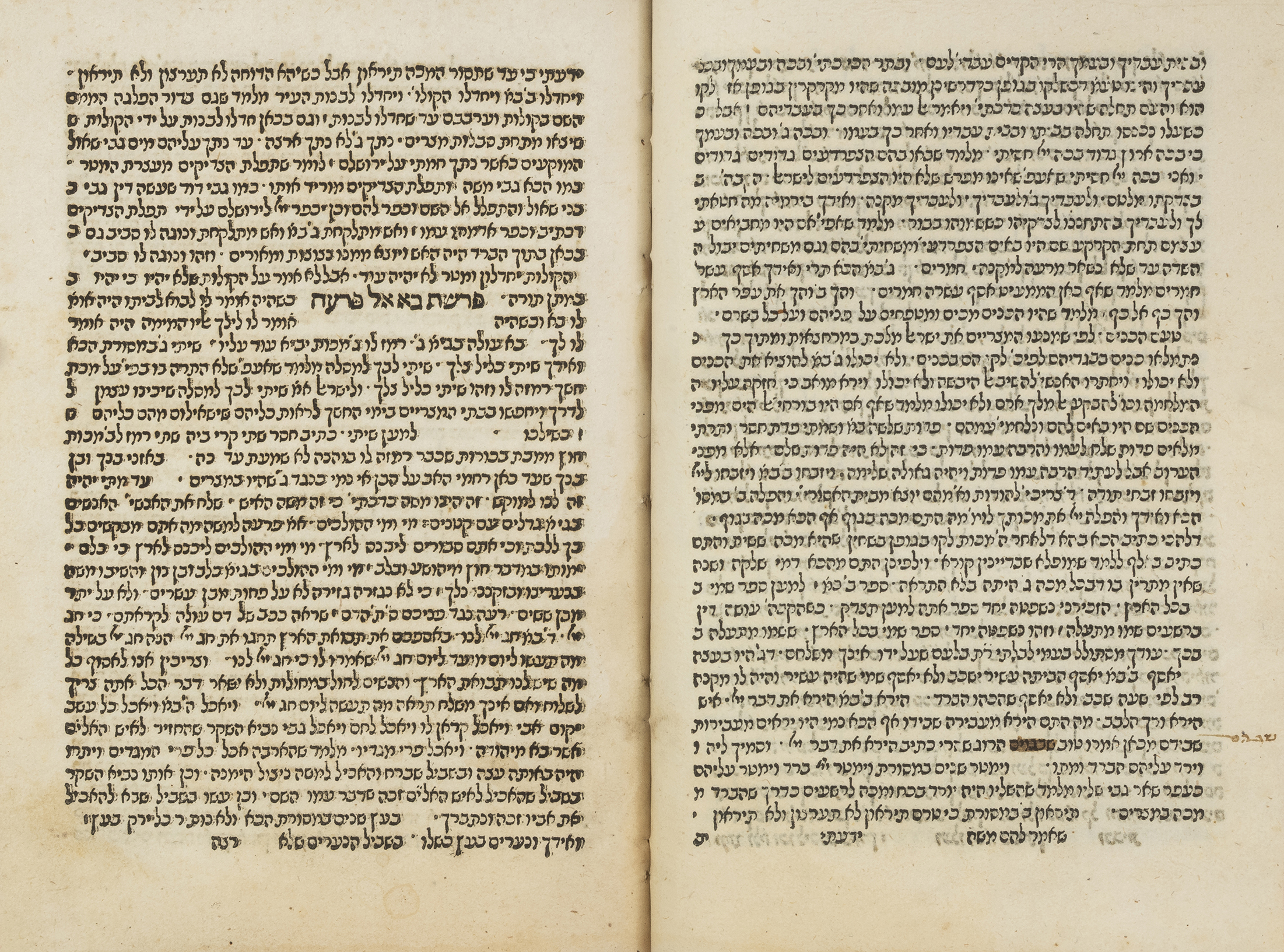
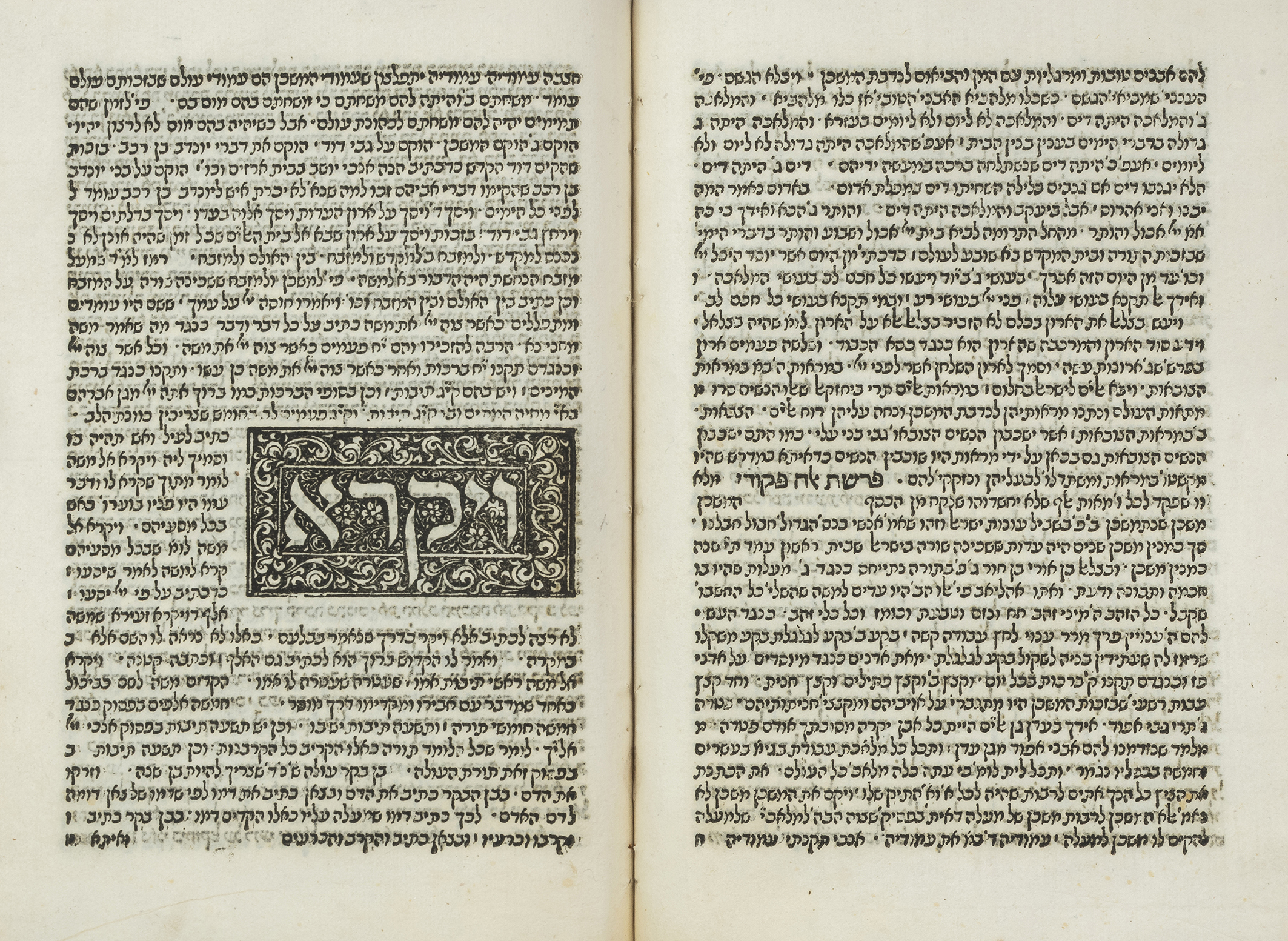
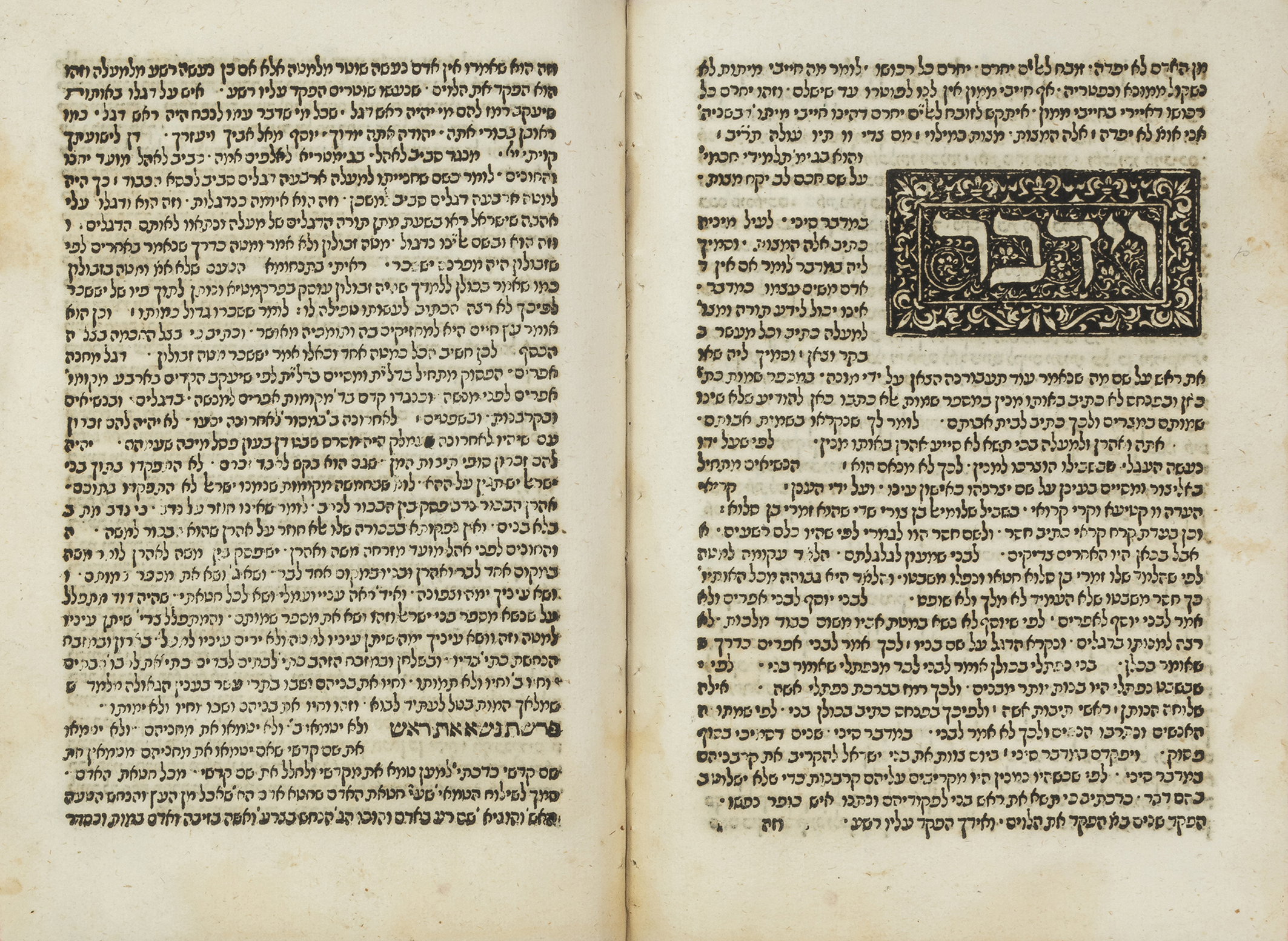
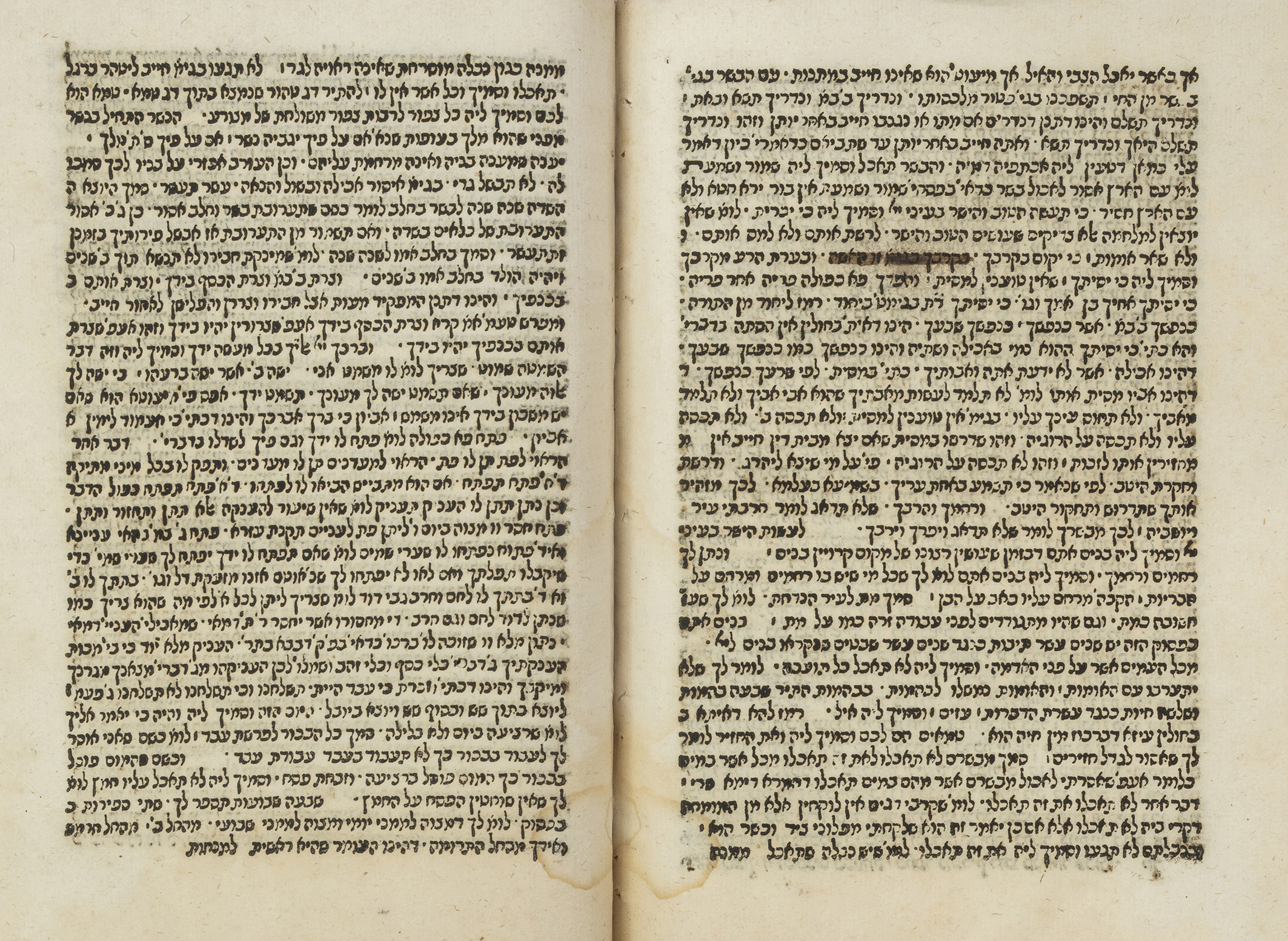
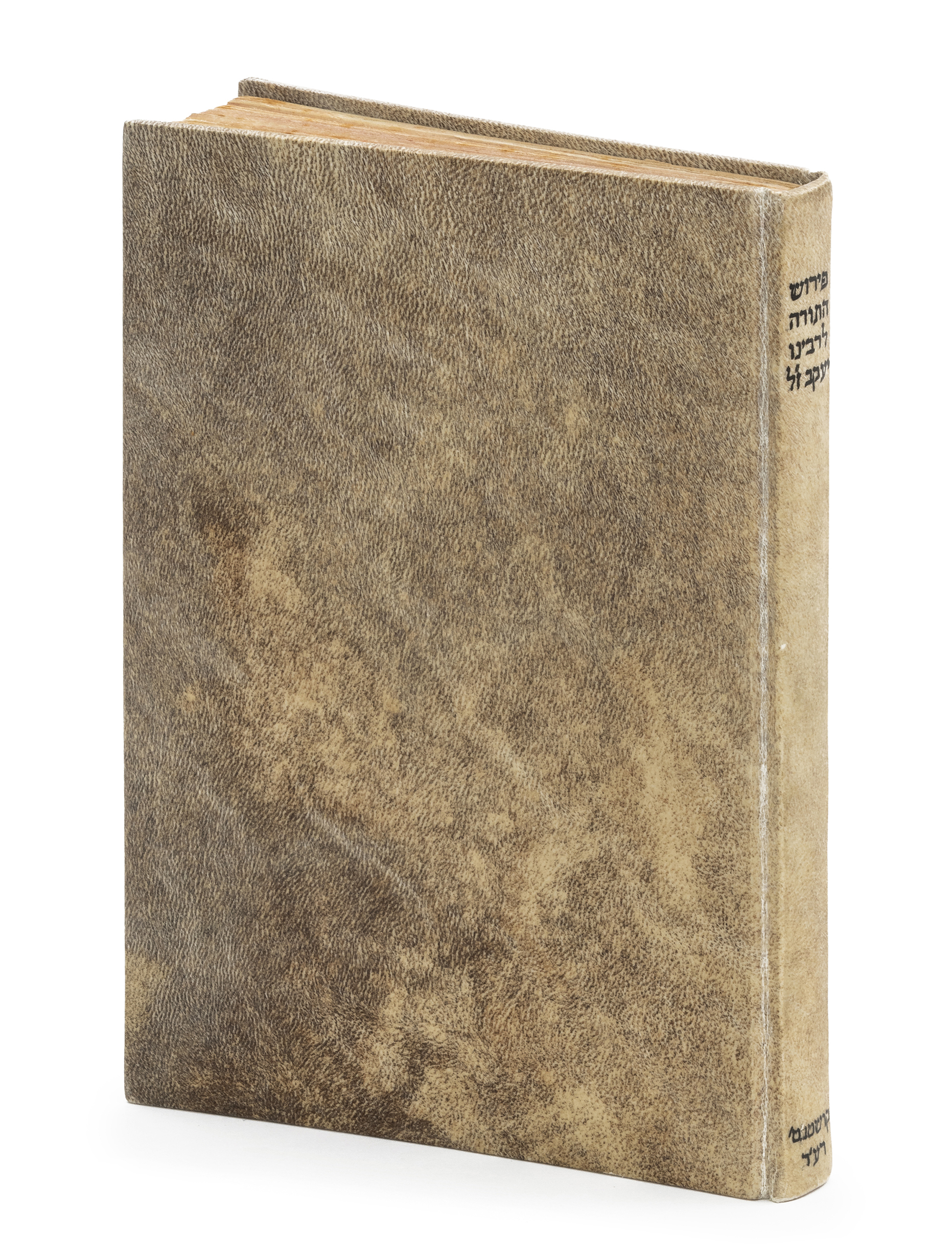
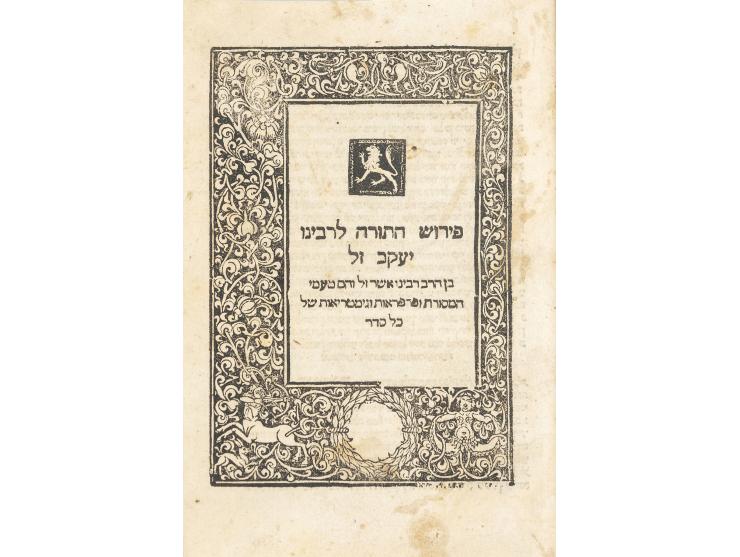
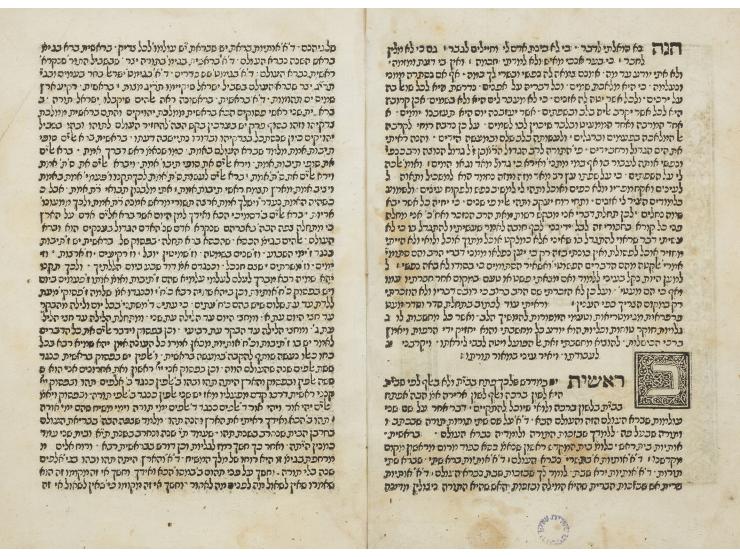
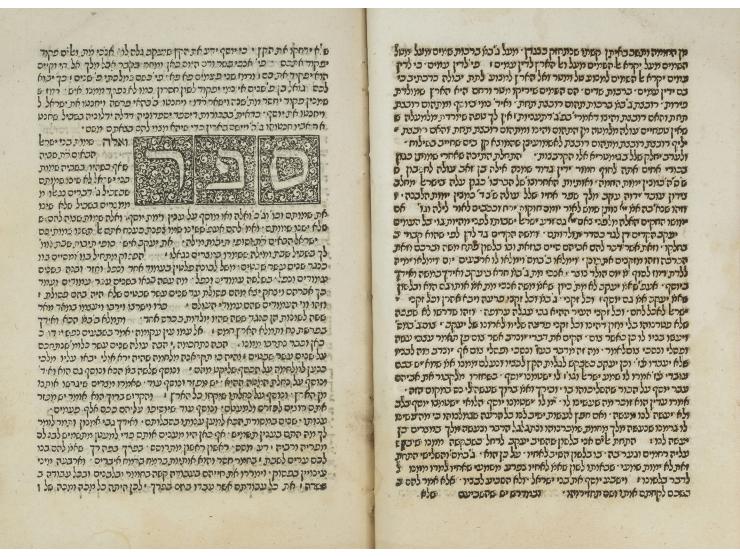
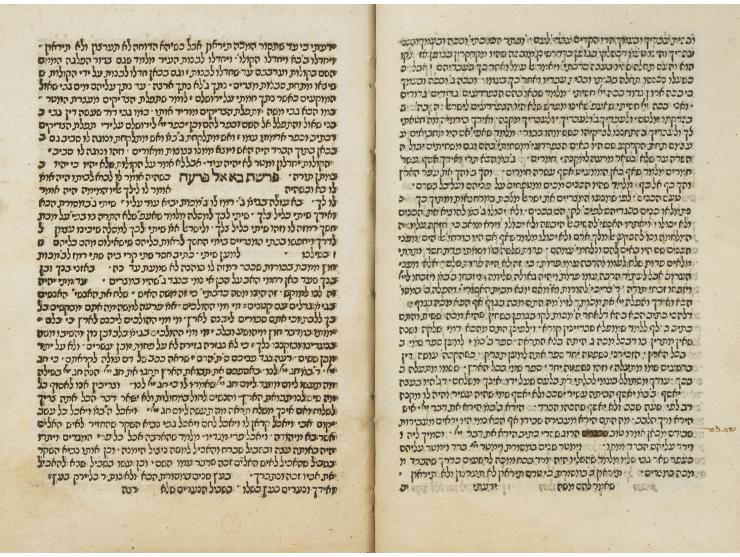
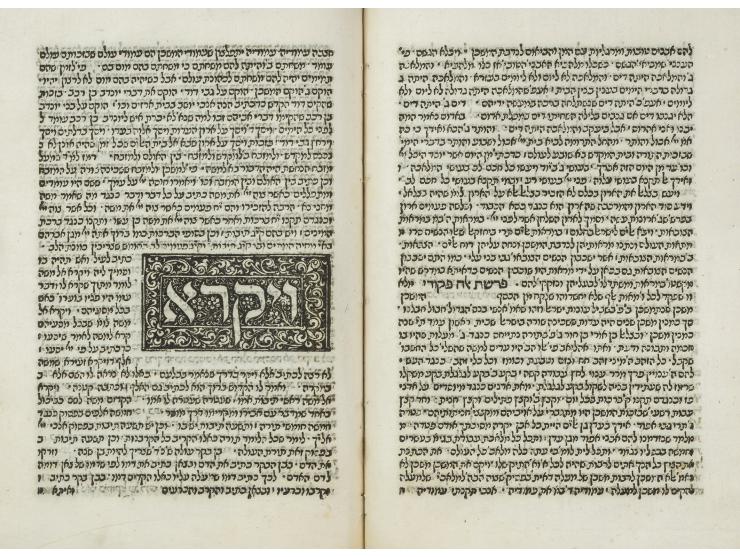
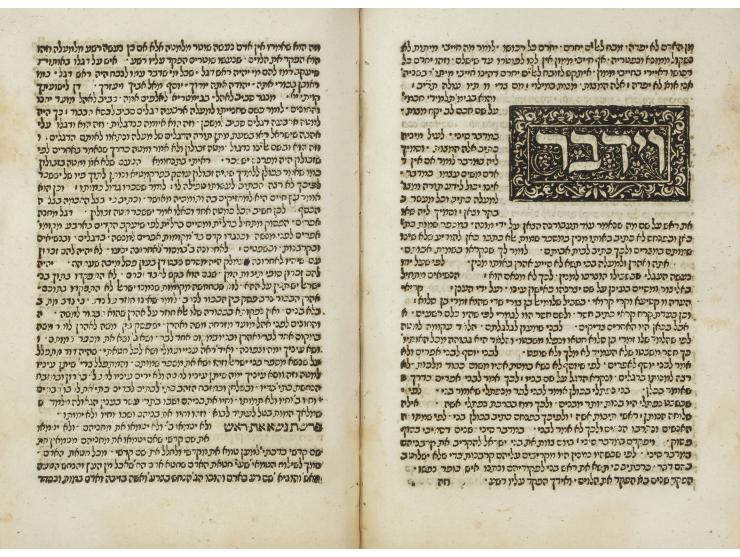
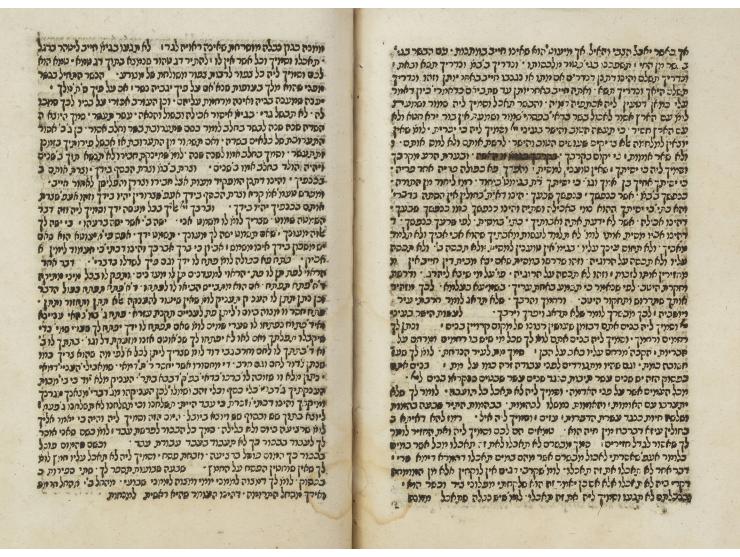
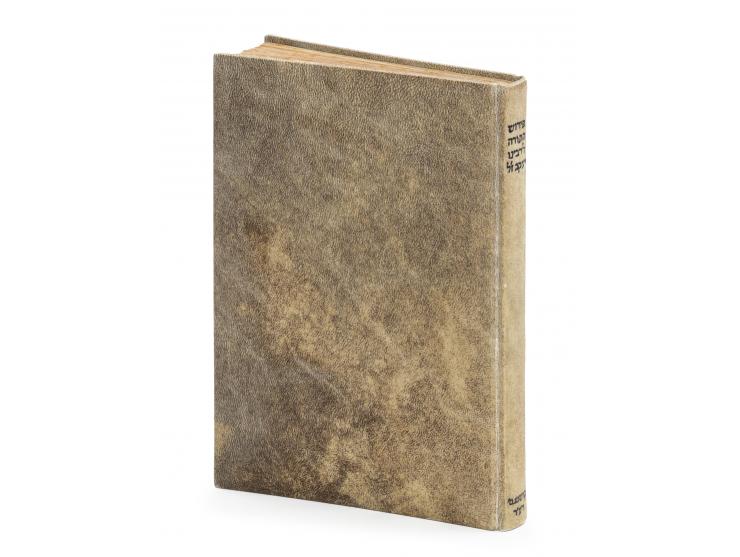
Commentary on the Torah by R. Yaakov son of R. Asher. Constantinople: Shmuel ibn Nachmias, 1514. First edition.
Fine copy.
Title page with frame decorated in fine woodcut, with figures of animals and vegetal patterns.
Fine woodcut initial panels for first letter of Bereshit and first word of each of the other four books.
First edition of the Baal HaTurim commentary on the Torah. This edition is of the short commentary, the allusions that the author included at the beginning of each Torah portion, based on numerical value and Masoretic notes, as mentioned in his introduction (p. [1b]; see below for more information on the different versions of the Baal HaTurim commentary).
An interesting tradition has it that the Rosh once admonished his son R. Yaakov for studying only the Oral Torah and not the Written Torah. R. Yaakov consequently authored the entire commentary on one Thursday night.
The title page features the printer's device of Yehudah Sason – an erect white lion against a black background, within a square frame (see: Yaari, Diglei HaMadpisim HaIvriyim, Jerusalem 1944, p. 7 and p. 126, no. 8).
Colophon on p. [71b]: "The heavenly labor was completed, beautiful and pure and refined sevenfold… by the wise R. Yehudah Sason who was inspired to increase and disseminate Torah among the Jewish people, and entered the fray with his money and wealth, may G-d be satisfied with his work and may his righteousness stand forever, for him and the typesetter R. Shmuel ibn Nachmias, Amen. And it was completed on Sunday, 15th Tamuz 1514, in Constantinople…".
On last leaf, poem in praise of the book by R. Shlomo son of R. Mazal Tov.
A few censorship expurgations, with handwritten correction to margin of one leaf.
Pencil inscriptions on endpaper, handwritten by Salman Schocken. On verso of title page and last page, stamps of the "Schocken Library, Jerusalem".
[72] leaves. 19 cm. Overall good condition. Stains, including dampstains. Worming, affecting text. New parchment binding.
The Baal HaTurim commentary has been printed in several versions over the years, with differences of content. The present edition, as stated above, contains the short version, with the allusions written by the author at the beginning of each Torah portion. The second version, selected allusions from the present edition, was first printed in the margins of the Venice 1590-1591 Chumash edition (and in many editions since). The third version is the full-length commentary, first printed in Zhovkva 1806 and called the Tur HaAroch.
On the short Baal HaTurim commentary, see: A. Ahrend, HaPerush HaKatzar Shel Baal HaTurim LaTorah, Machanayim, 3, Kislev 1992, pp. 108-189.
Recorded in the Bibliography of the Hebrew Book based on a copy in the British Library (the Bibliography of the Hebrew Book records only [71] leaves, probably in error).
Provenance:
1. Salman Schocken Collection, Jerusalem.
2. Kestenbaum, New York, 2 June 2003, Lot 15.
Category
Incunabula and Early Printed Books
Catalogue Value