
Auction 107: Rare and Important Items
Apr 15, 2026
- and (82) Apply and filter
- item (32) Apply item filter
- various (27) Apply various filter
- object (23) Apply object filter
- ornament (23) Apply ornament filter
- ornaments, (23) Apply ornaments, filter
- synagogu (23) Apply synagogu filter
- torah (23) Apply torah filter
- book (17) Apply book filter
- print (17) Apply print filter
- earli (15) Apply earli filter
- incunabula (15) Apply incunabula filter
- jewish (13) Apply jewish filter
- the (13) Apply the filter
- manuscript (12) Apply manuscript filter
- public (12) Apply public filter
- letter (10) Apply letter filter
- ketubot (9) Apply ketubot filter
- anti (8) Apply anti filter
- anti-jewish (8) Apply anti-jewish filter
- antijewish (8) Apply antijewish filter
- antisemit (8) Apply antisemit filter
- edict (8) Apply edict filter
- edicts, (8) Apply edicts, filter
- law (8) Apply law filter
- laws, (8) Apply laws, filter
- ordin (8) Apply ordin filter
- rabbin (8) Apply rabbin filter
- royal (8) Apply royal filter
- haggadot (6) Apply haggadot filter
- israel (6) Apply israel filter
- mandatori (6) Apply mandatori filter
- of (6) Apply of filter
- palestin (6) Apply palestin filter
- passov (6) Apply passov filter
- siddurim (6) Apply siddurim filter
- state (6) Apply state filter
- zionism (6) Apply zionism filter
- zionism, (6) Apply zionism, filter
- bind (5) Apply bind filter
- havdalah (5) Apply havdalah filter
- holiday (5) Apply holiday filter
- person (5) Apply person filter
- shabbat (5) Apply shabbat filter
- shabbat, (5) Apply shabbat, filter
- silver (5) Apply silver filter
- art (4) Apply art filter
- brueckheim (4) Apply brueckheim filter
- collect (4) Apply collect filter
- from (4) Apply from filter
Displaying 97 - 104 of 104


Auction 107: Rare and Important Items
Apr 15, 2026
Opening: $1,000
Estimate: $2,000 - $4,000
Sold for: $4,000
Including buyer's premium
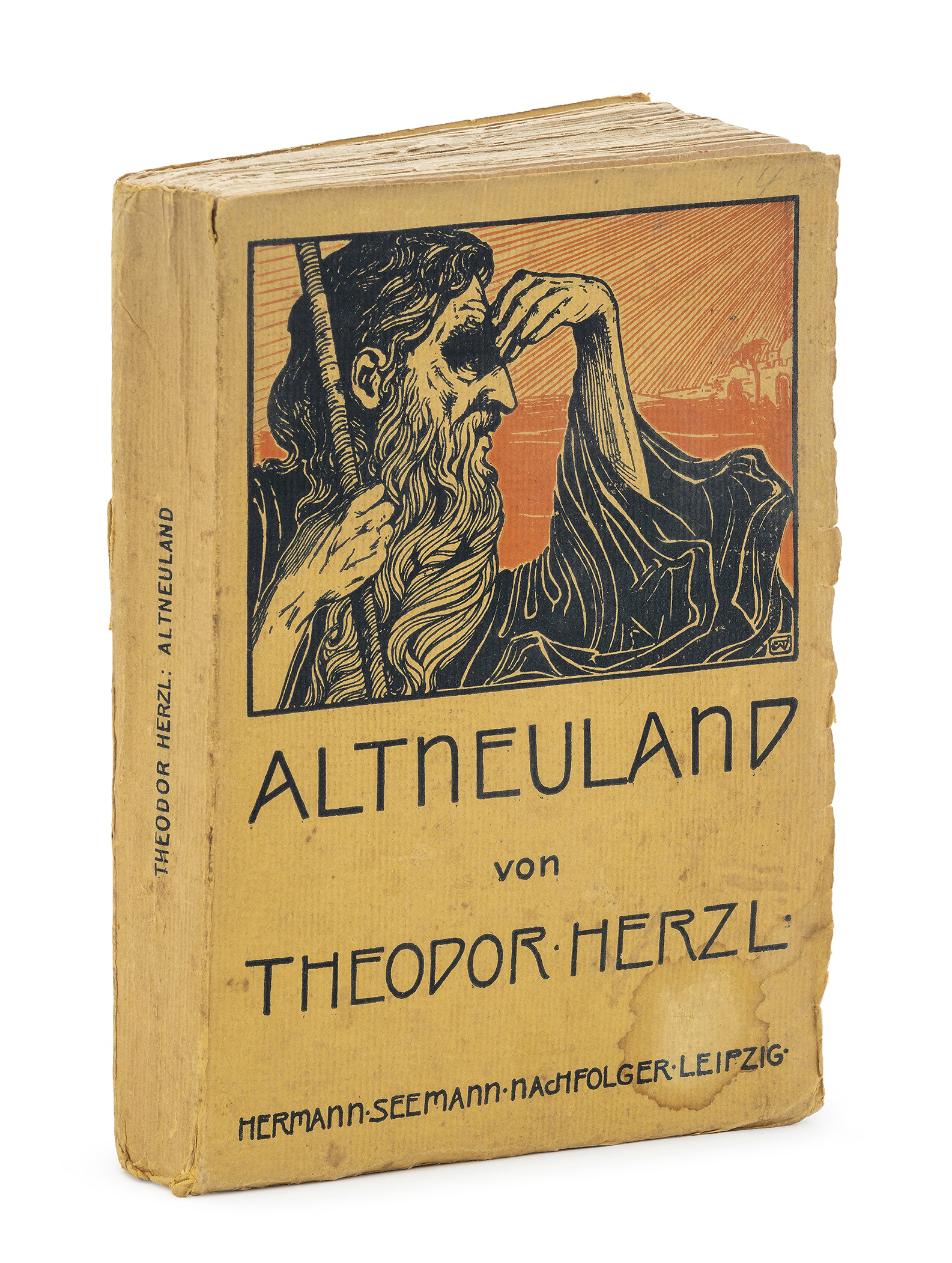
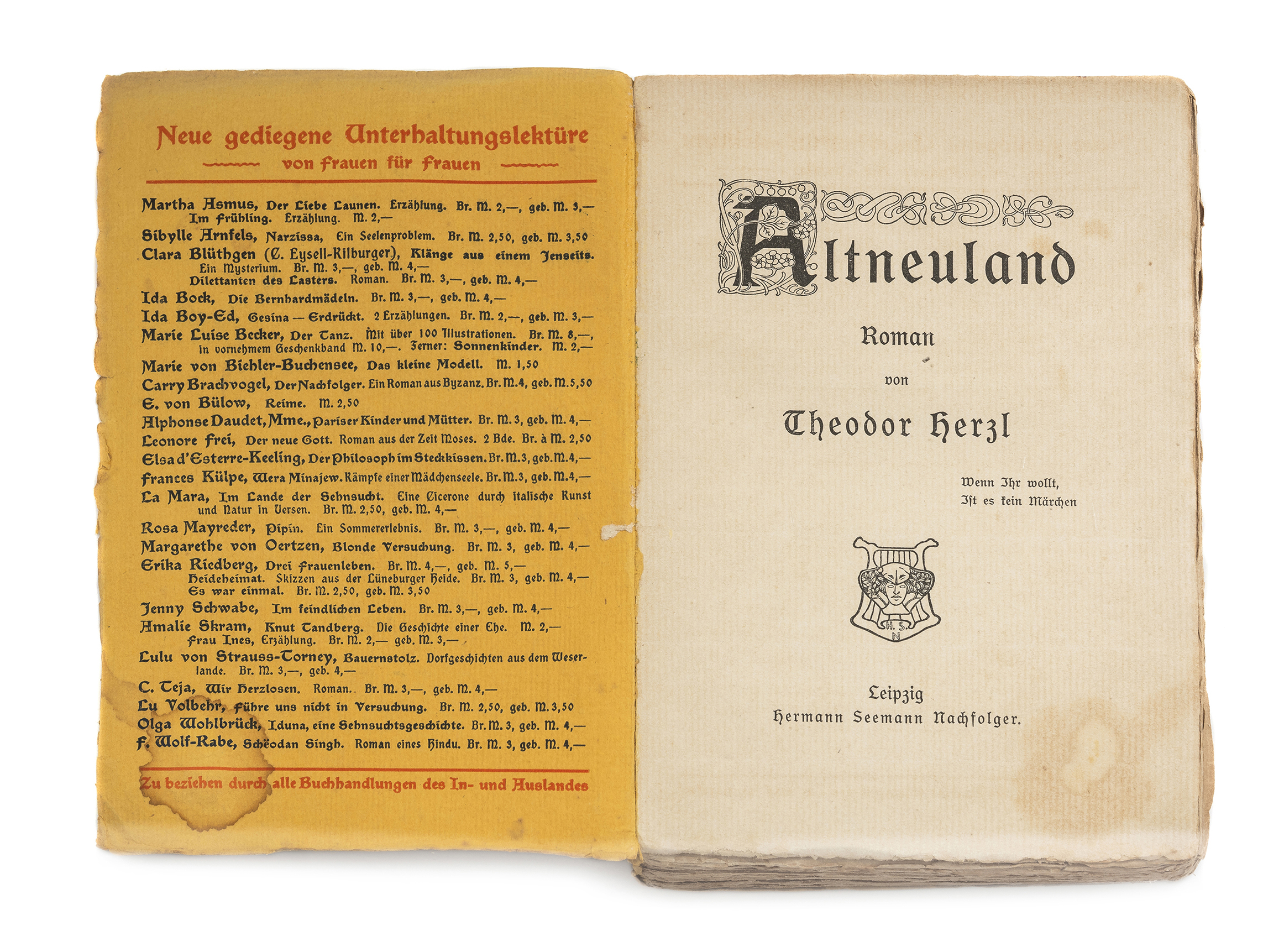
Altneuland, Roman von Theodor Herzl. Leipzig: Hermann Seemann Nachfolger, 1902. German. First edition.
Utopian novel. A narrative expressing Theodor Herzl’s vision of the Jewish State that would be established in the Land of Israel. Theodor Herzl authored his novel Altneuland ("The Old New Land") in the years 1899-1902 and originally titled it New Zion. He later renamed it Altneuland, inspired by the name of Prague’s great Old-New Synagogue, the Altneuschul. The book was translated into both Yiddish and Hebrew in 1902, the same year it was published in German (the translator Nachum Sokolow decided to title the Hebrew edition of the book "Tel Aviv", a name famously adopted for the newly founded "first Hebrew city"). Within a year, Herzl’s novel was translated into six languages. The title page bears Herzl’s motto: "Wenn ihr wollt, ist es kein Märchen" [If you will it, it is no dream].
Copy in original binding, colorful and illustrated.
[3], 343, [5] pages, 19 cm. Good-fair condition. Some stains. Minor marginal tears (several long or open tears, no damage to print). Several leaves loose. Minor wear and stains to binding, with minor tears to edges and tears to spine.
Category
Zionism, Mandatory Palestine and the State of Israel
Catalogue Value


Auction 107: Rare and Important Items
Apr 15, 2026
Opening: $8,000
Estimate: $15,000 - $25,000
Sold for: Unsold
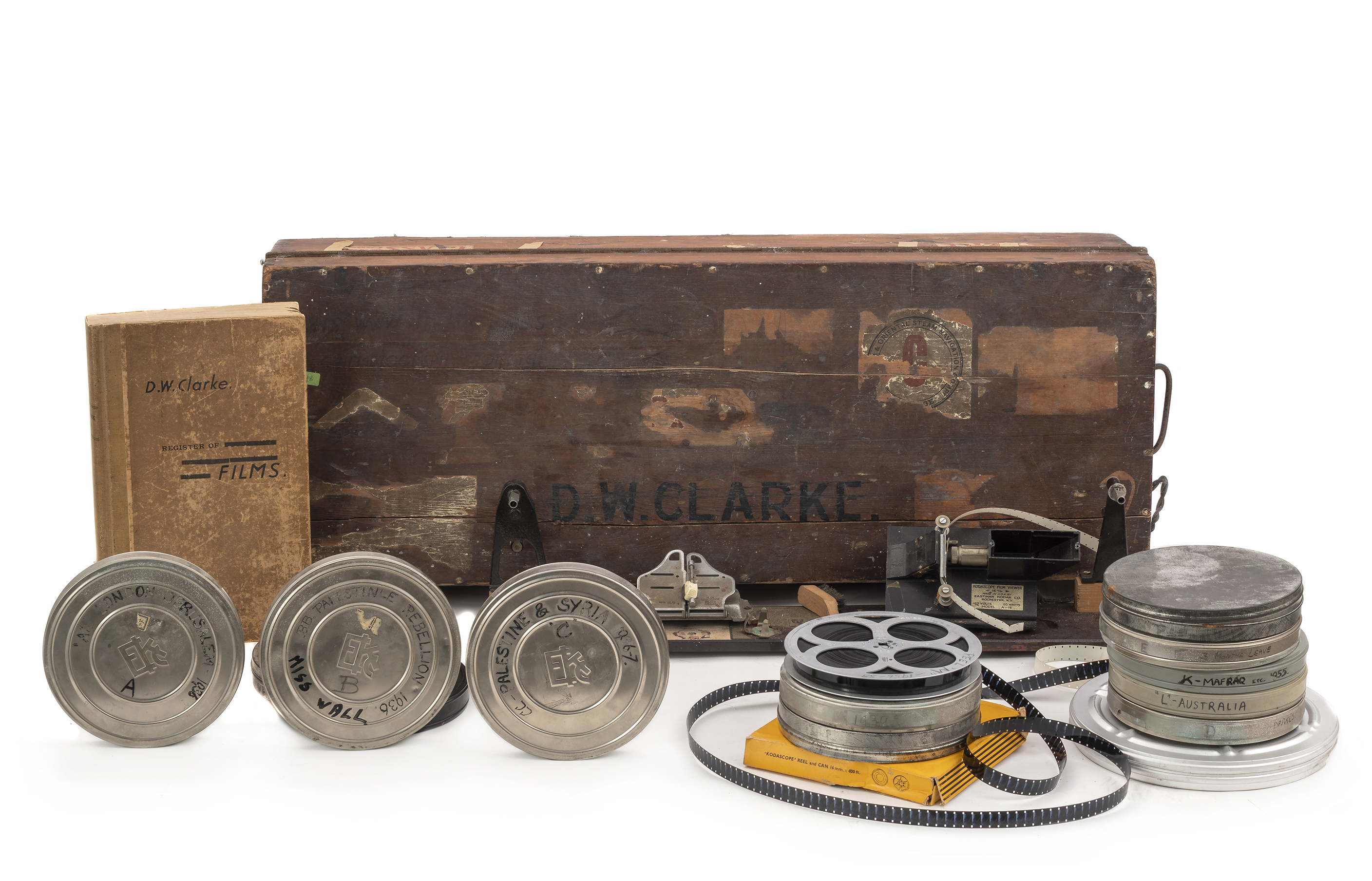
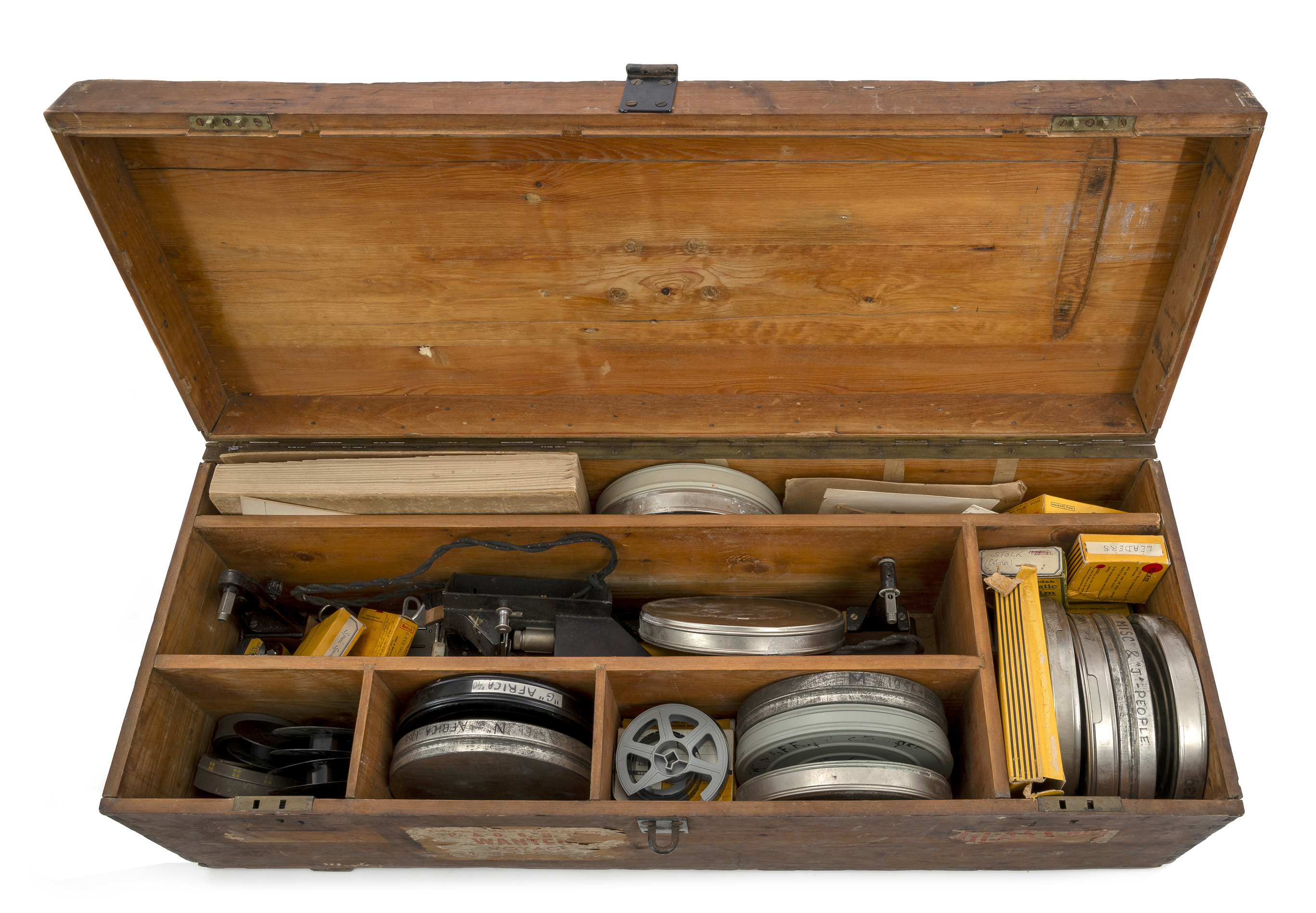
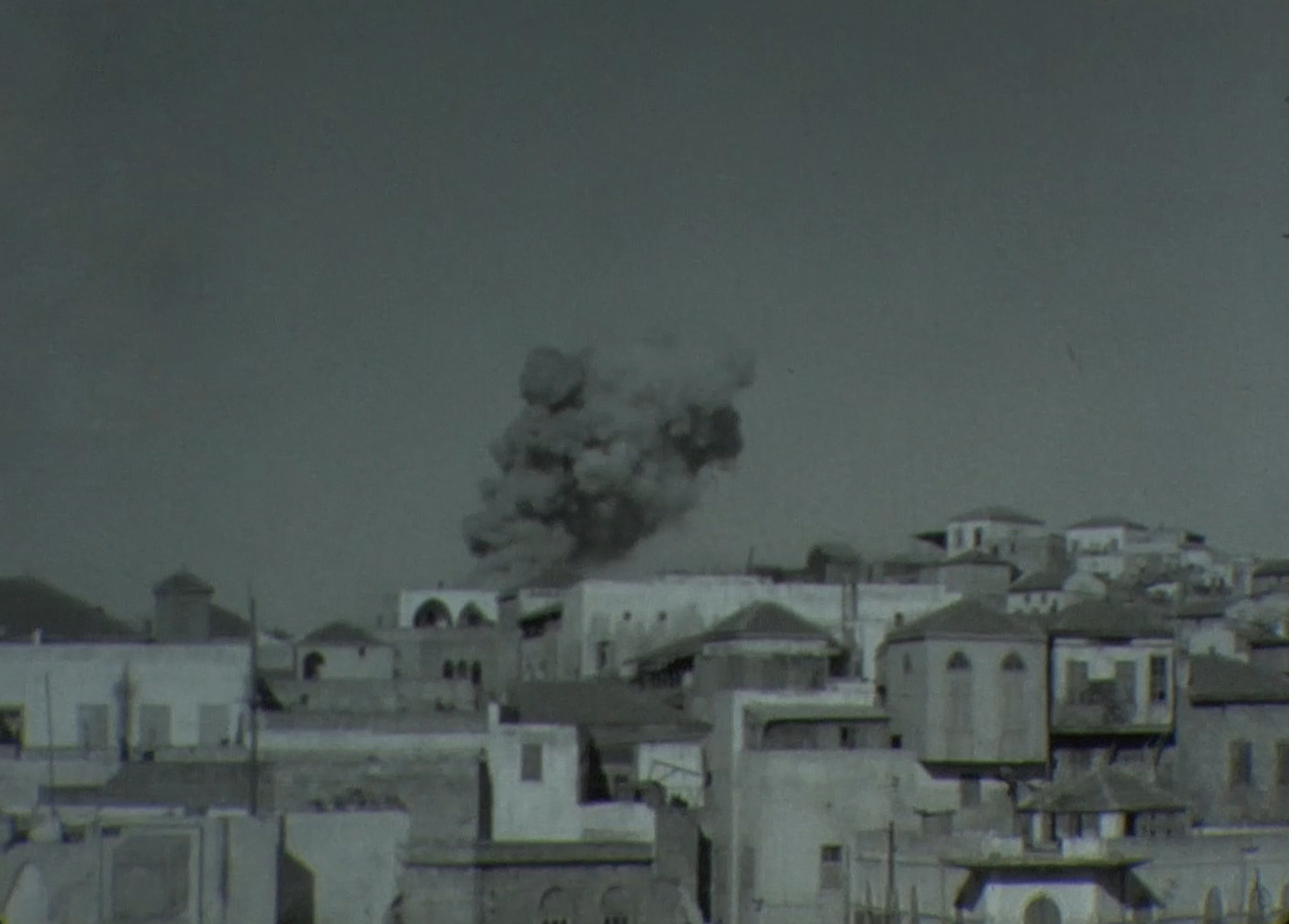
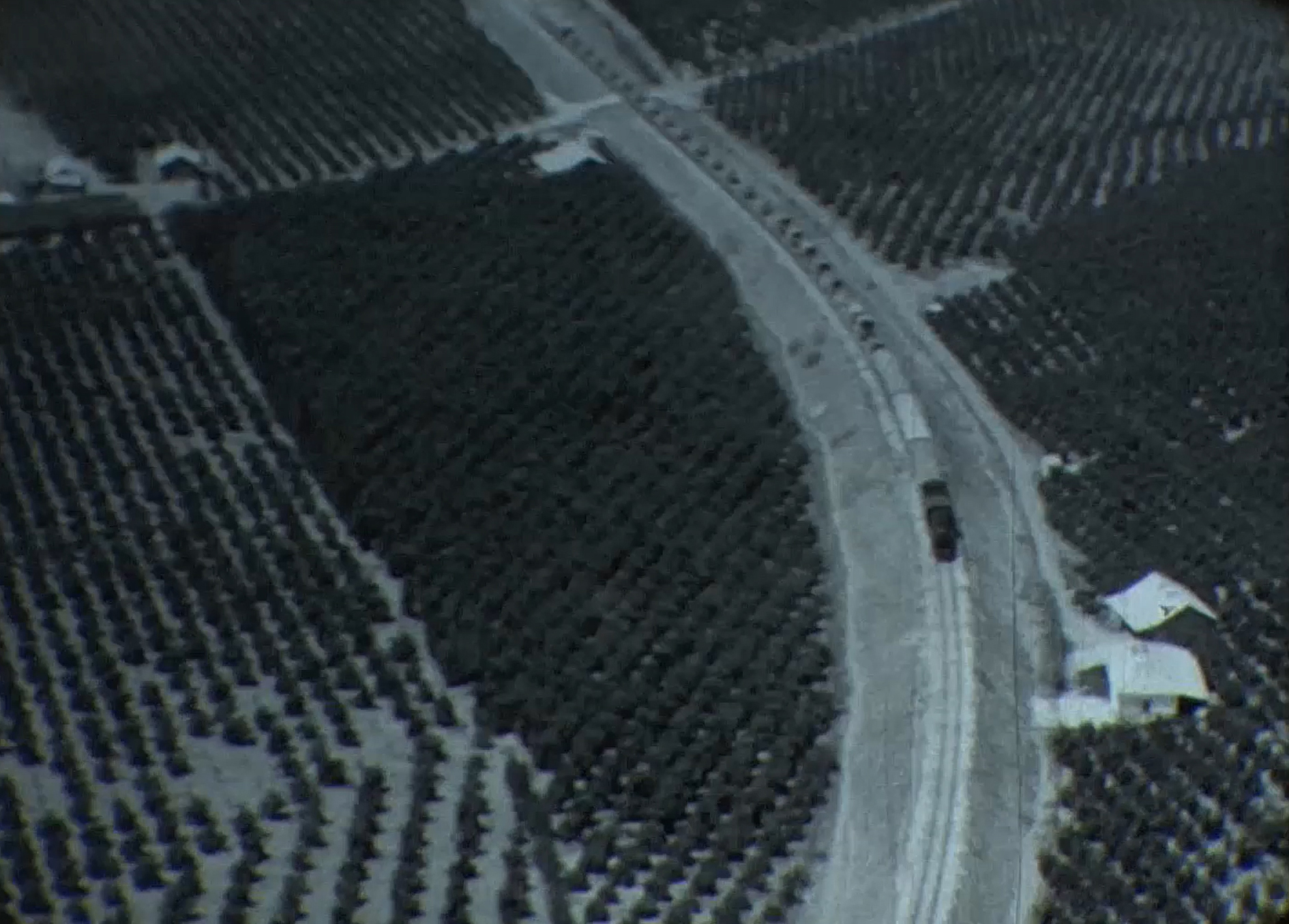
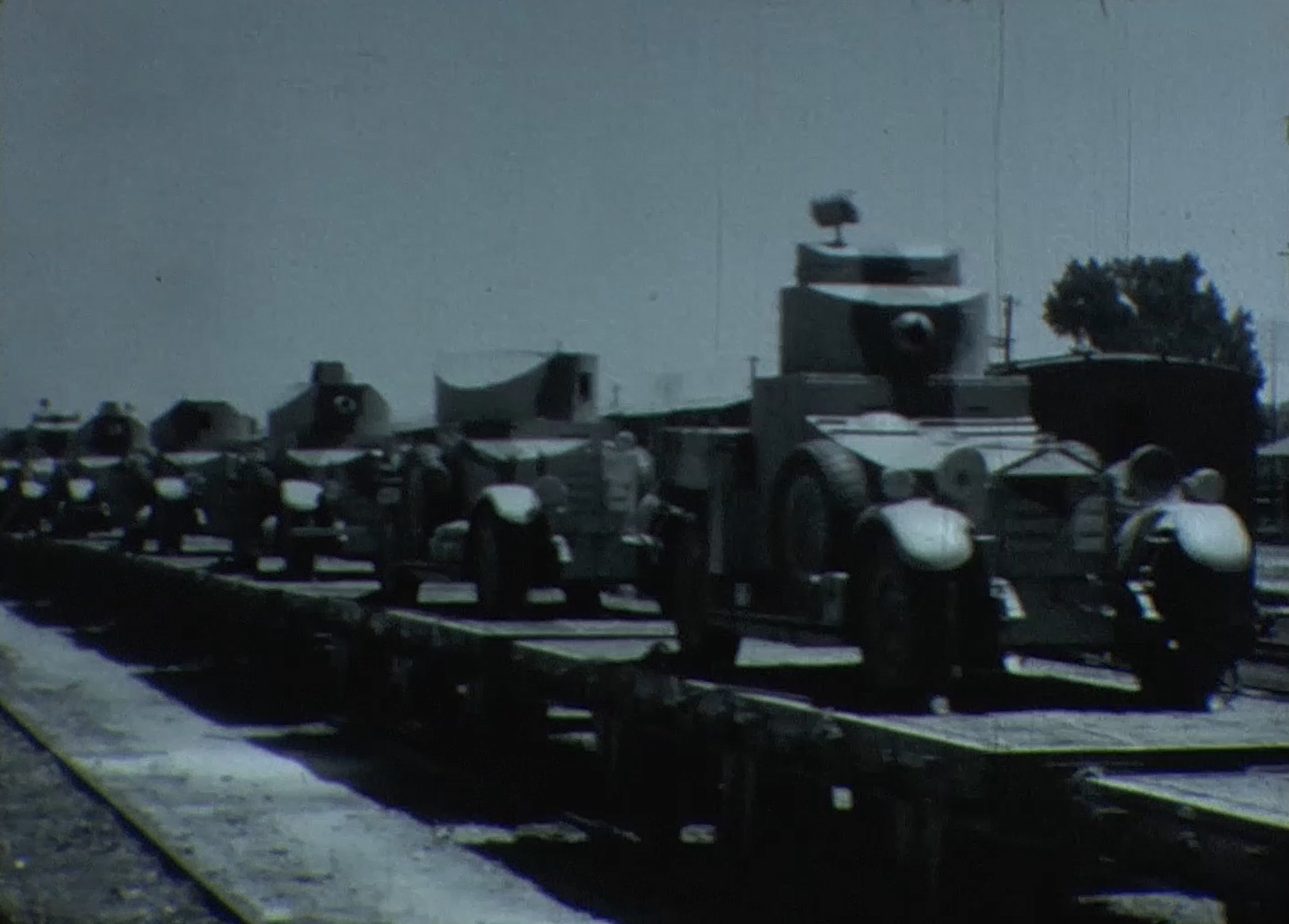
Collection of films (16mm reels) shot by British Brigadier Dudley Wrangel Clarke, comprising rare documentation of British military operations to suppress the Arab Revolt in Palestine, 1936-1937.
A small film archive from the period of the Arab Revolt in Palestine (housed in an original wooden crate, with handwritten editing log and editing equipment), including rare footage of events of the revolt, battles, British forces, and aerial photography.
In 1936, shortly after the outbreak of the Arab Revolt, Clarke was posted to Palestine at his own request. Brigadier Clarke focused on organizing an effective response to Arab guerrilla warfare, strengthening coordination between ground forces and the Royal Air Force, and improving intelligence capabilities of the fighting forces.
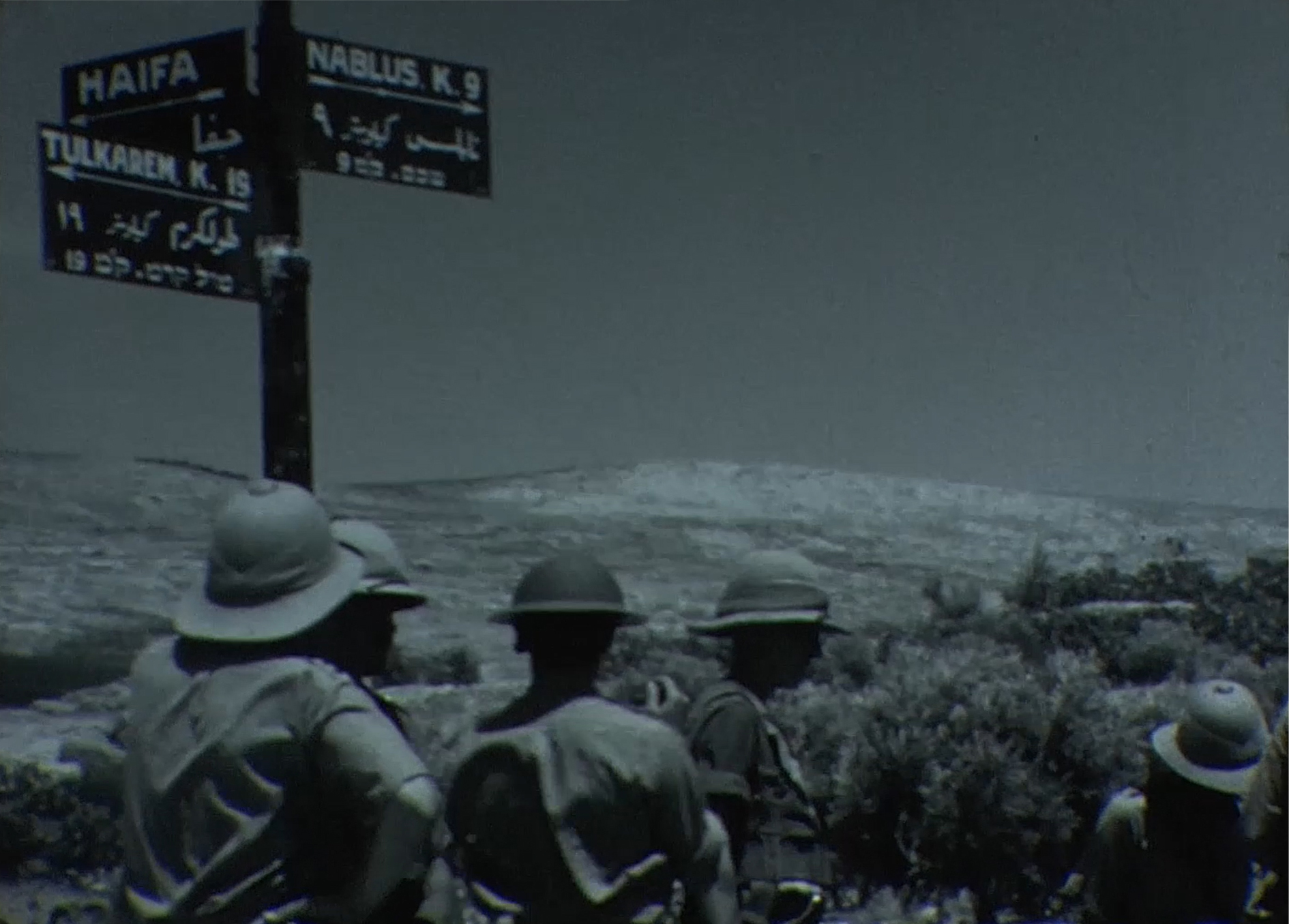
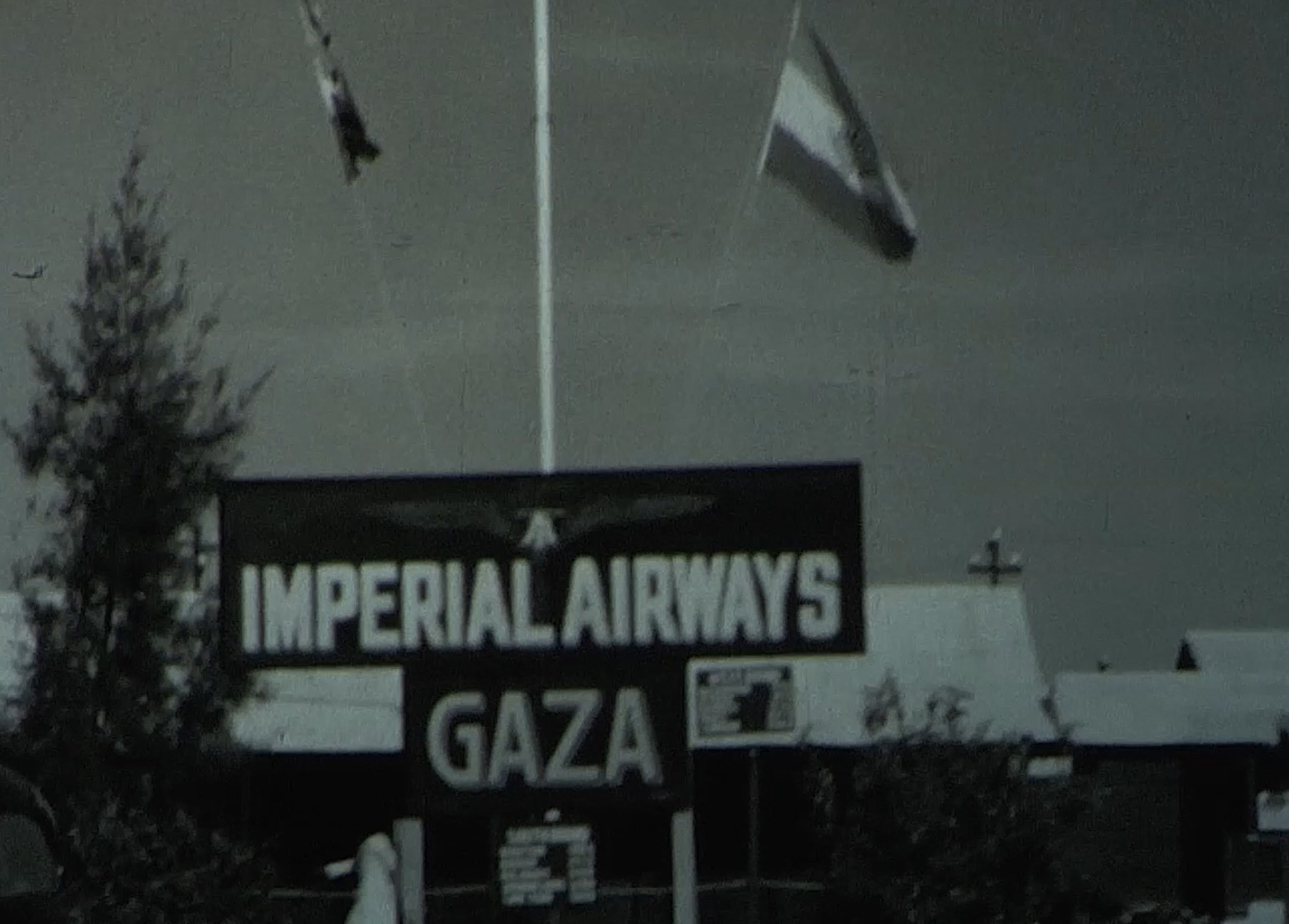
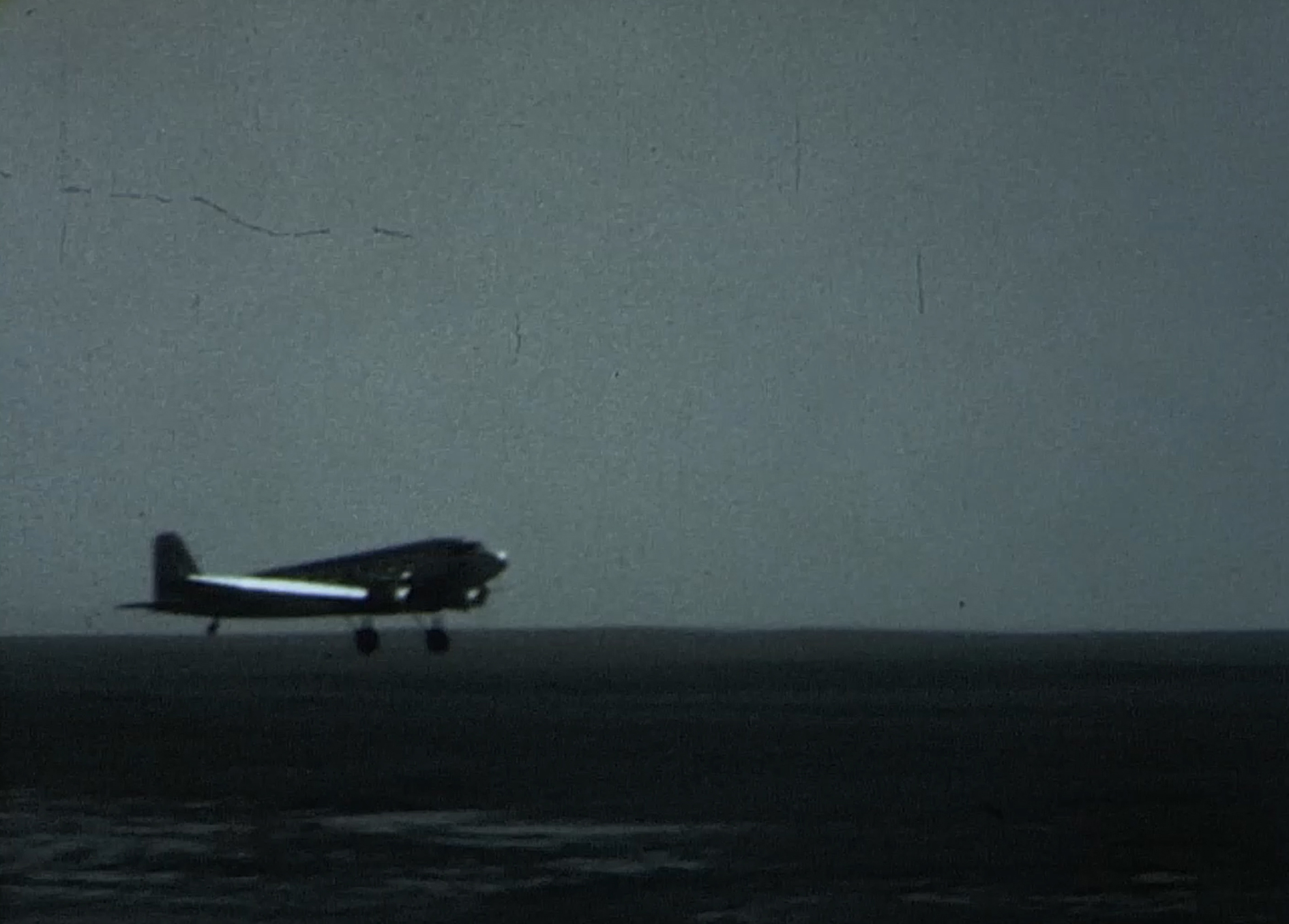
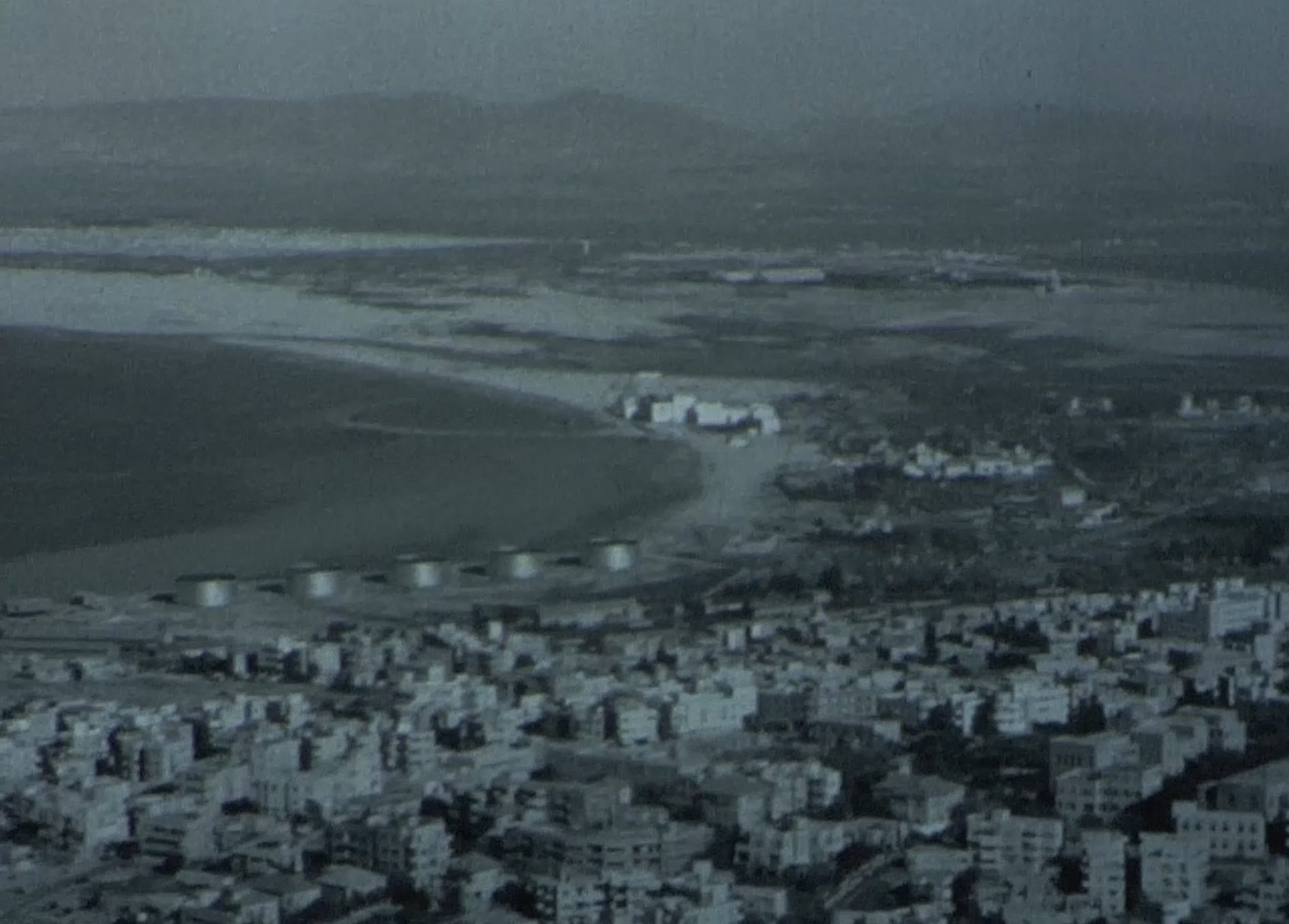
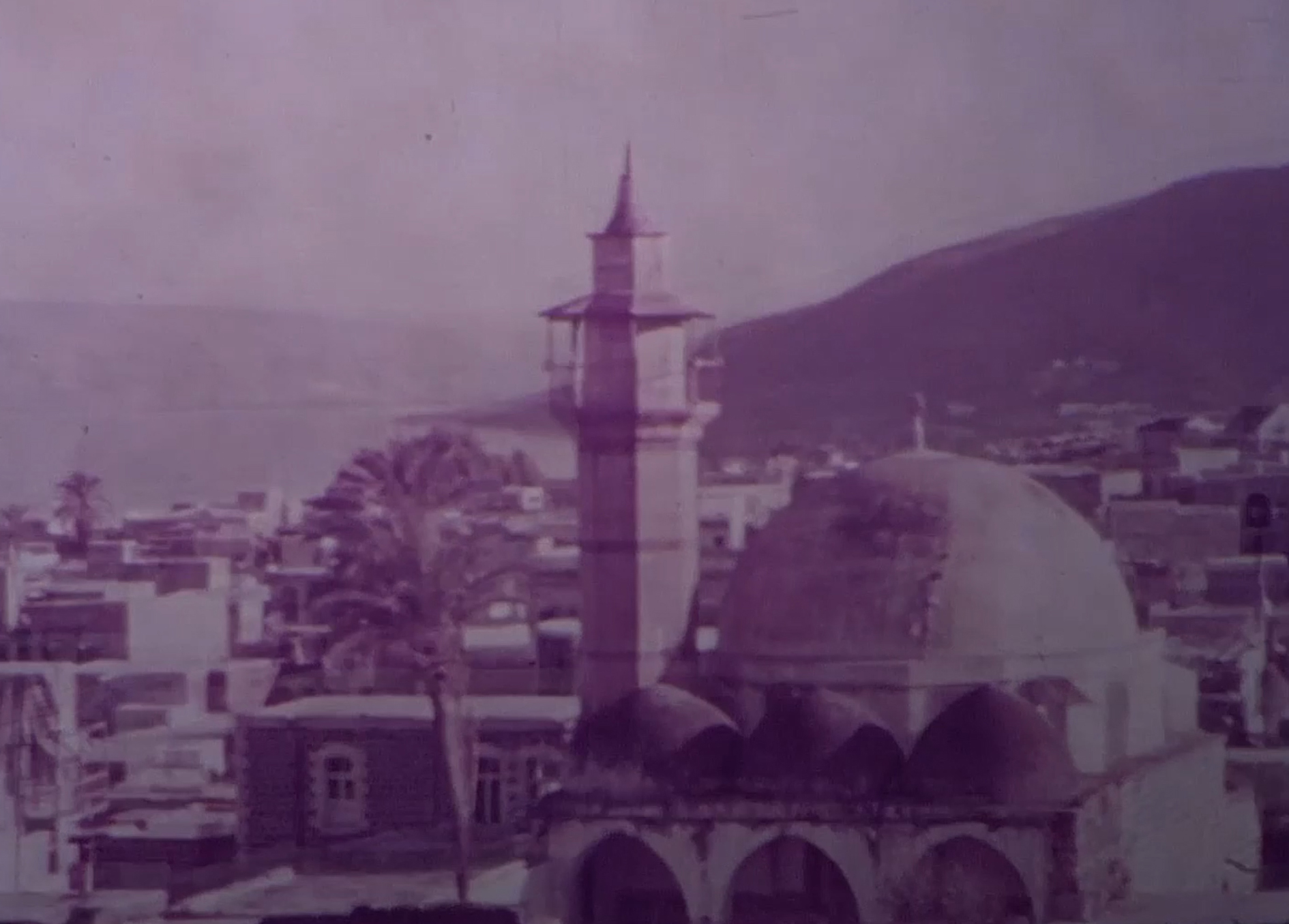
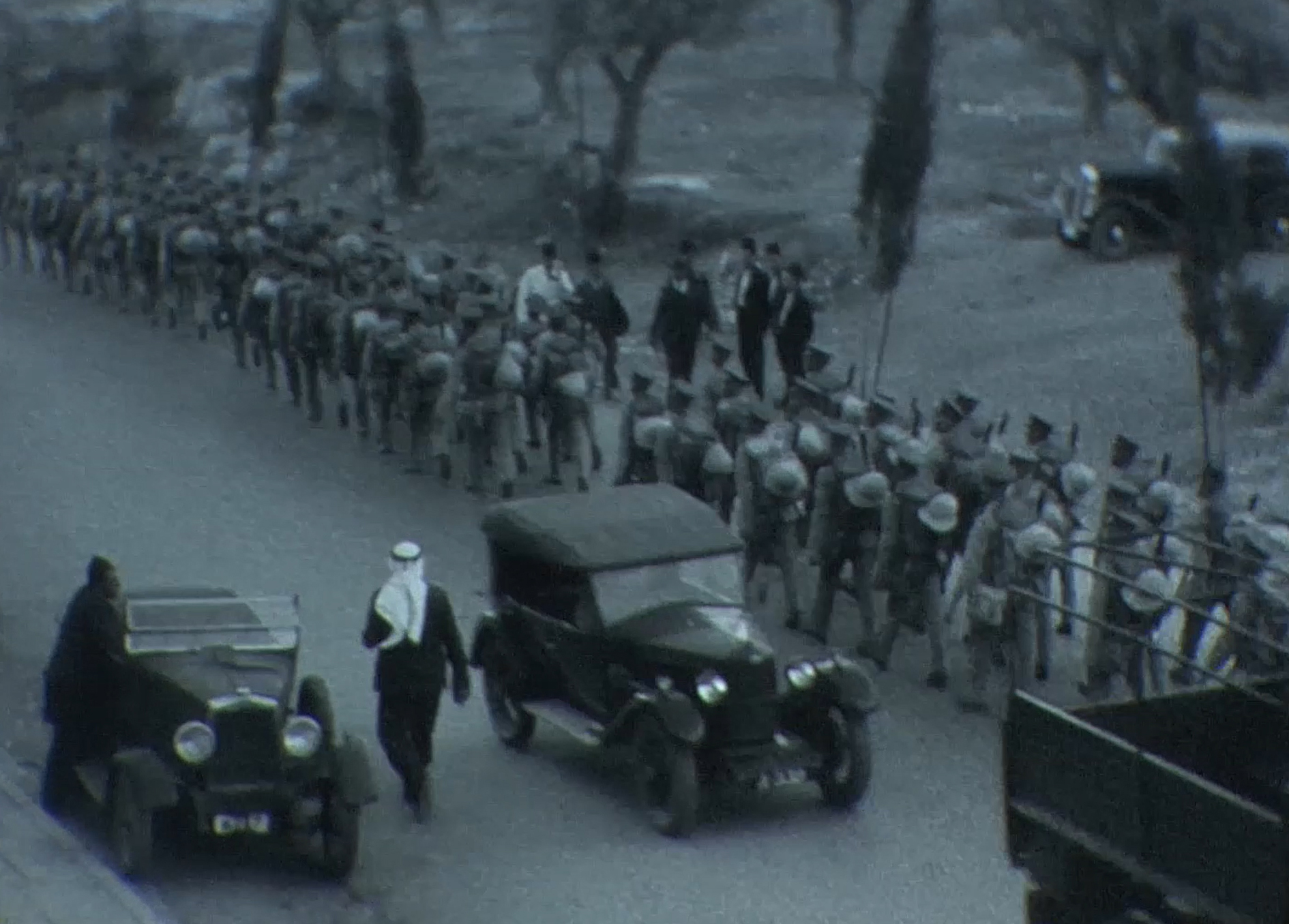
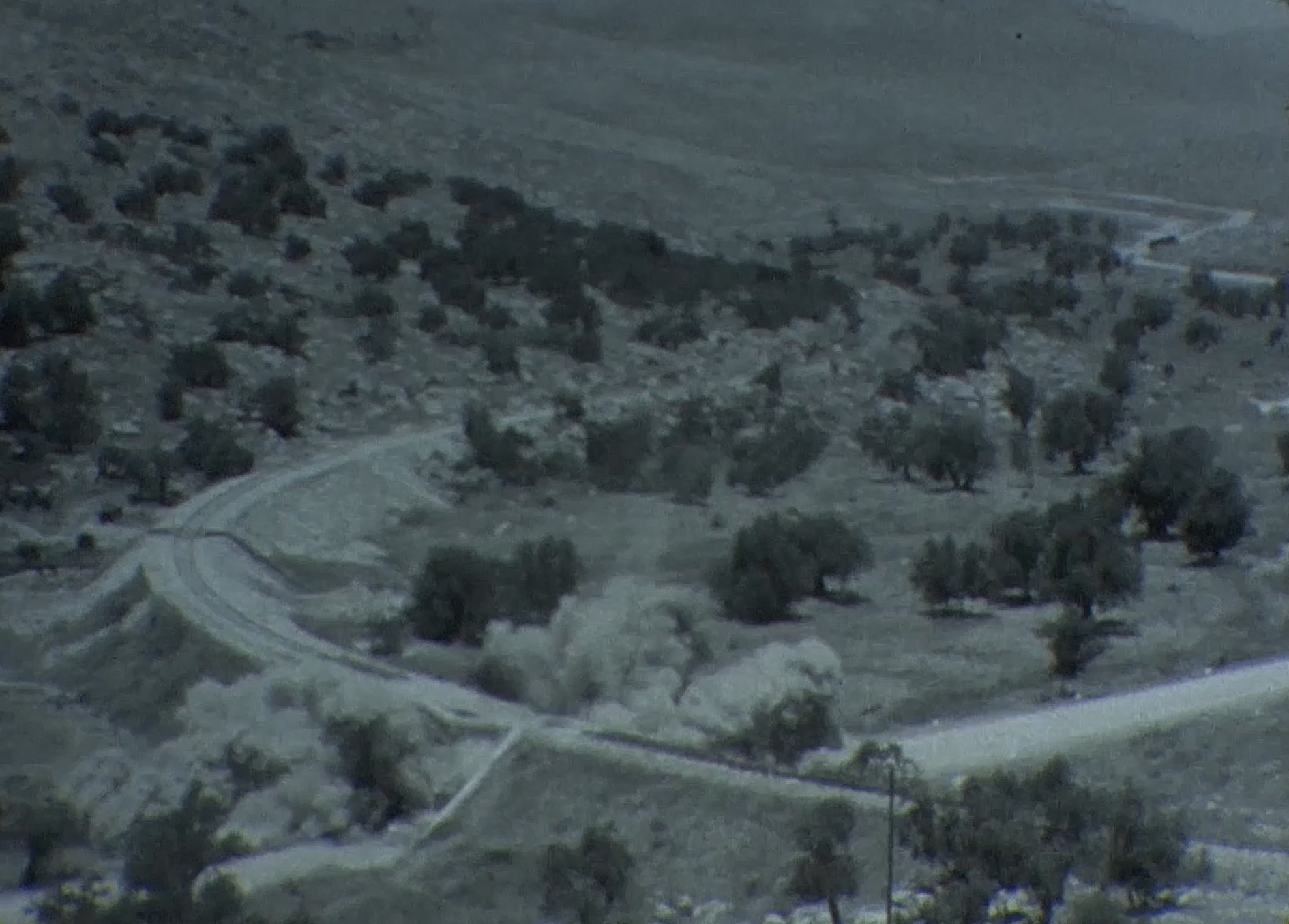
En route to Palestine and during his stay in the region, Clarke documented his experiences with a 16mm camera – from his voyage from Britain to Port Said, Egypt, through Palestine and back to Egypt. The present collection includes eleven reels – the most significant (marked B, C, and D; total running time of approx. 45 minutes) document British military operations in Palestine to suppress the revolt: British soldiers and police patrolling the streets of Jerusalem; British armored vehicles and infantry patrols in Nablus and the Jenin region; demolition of a railway bridge near Nablus; Operation Anchor to clear the Old City of Jaffa of Arab resistance; the Khan Luban operation; convoys of vehicles and armored cars in Judea and Samaria; activity of the 8th King’s Royal Irish Hussars; rare footage from an aircraft showing armored cars transported on freight wagons at Lydda railway station; arrival of the 11th Hussars (Prince Albert’s Own) at Lydda railway station prior to entering battle; British forces entering the port of Haifa aboard the ship Neuralia; an armored convoy near the village of Deir Sharaf (Nablus district); the Scots Guards preparing for action; early footage of the Gaza airfield; an aerial reconnaissance flight over Palestine, including views of Haifa, Mount Carmel and the bay; sports games of the Trans-Jordan Frontier Force (TJFF) in Tzemach; and more. A small portion of the footage is in color. The films were shot in 1936-1937; most were edited and cleaned ca. 1957-1963.
The additional eight reels include varied footage from Jerusalem, Haifa, Cairo, Damascus and Beirut; documentation of Clarke’s vacations in Europe; as well as a journey to Australia and locations along the route (Jordan, the port of Aden [Yemen], Thailand and Indonesia); a partially-staged short film titled 'Darkest Africa'; footage from New York, Toronto, the Bahamas, Jamaica, Barbados, Mauritania and Madeira; and more.
The lot also includes:
• Editing log comprising hundreds of pages, several dozen handwritten, apparently in Clarke’s hand. The notebook and accompanying leaves include a detailed description of the contents of the reels in the collection (and of additional reels not present here), a precise index of every shot, including dates, locations and editing notes (sections inserted or removed), etc. Clarke’s name appears on the cover.
• 10 later reels, from the 1960s-1970s, some in color, and short film fragments.
• 16mm film splicer by Kodak, and related accessories.
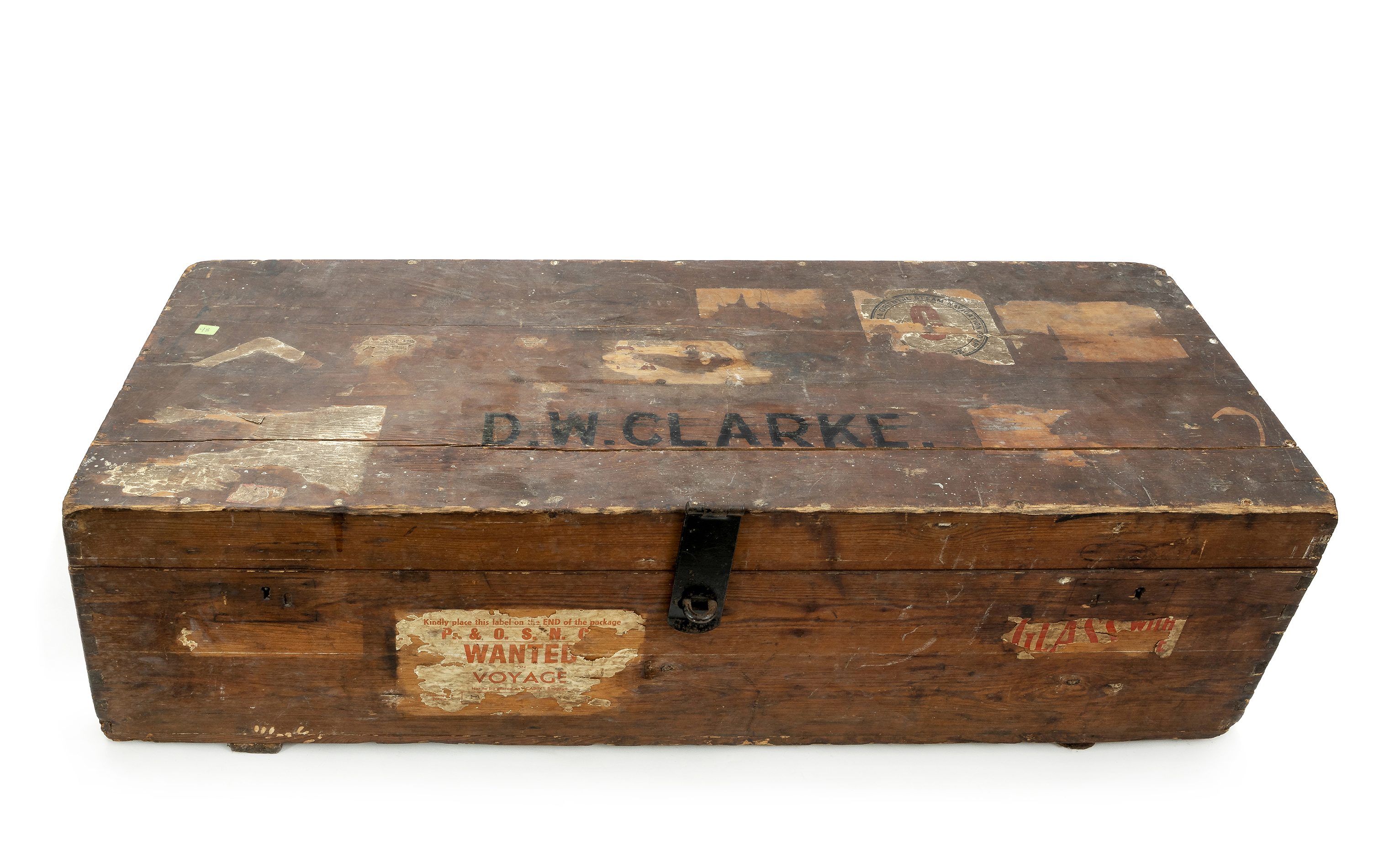
• Large wooden carrying crate (88.5X32.5X25.5 cm). On the lid appears Clarke’s name, stenciled: “D. W. Clarke”, a label of the Orient Steam Navigation Company, and additional labels.
Although extensive documentary material from Palestine during these years survives, documentation of suppression operations filmed by an active British commanding officer is exceedingly rare. It is unknown whether the raw footage in the present collection was used to produce a finished film, or whether such a film was publicly distributed.
Size and condition vary. Overall fair condition. Three reels (hand-numbered B, C and D on the storage canisters) have been digitized – USB flash drive enclosed.
Dudley Wrangel Clarke
(1899-1974), British intelligence officer. In 1936, at his own request, he was posted to Palestine and took part in suppressing the Arab Revolt. Clarke organized communications between field forces and the Royal Air Force in Palestine and coordinated intelligence operations against Arab guerrilla warfare; he served as chief of staff to Lieutenant-General John Dill and subsequently to Major-General Archibald Wavell (both later promoted to Field Marshal).
(1899-1974), British intelligence officer. In 1936, at his own request, he was posted to Palestine and took part in suppressing the Arab Revolt. Clarke organized communications between field forces and the Royal Air Force in Palestine and coordinated intelligence operations against Arab guerrilla warfare; he served as chief of staff to Lieutenant-General John Dill and subsequently to Major-General Archibald Wavell (both later promoted to Field Marshal).
During the Second World War, with Wavell’s support, Clarke established the "A Force" in Cairo, which became the principal British military deception organization in the Middle East. Clarke was regarded as an expert in the field. He developed his methods through a series of covert operations that successfully deceived German intelligence and helped establish deception and misinformation as essential components of Allied strategy.
His commander, Archibald Wavell, wrote of him: "When I commanded in Palestine in 1937-38, I had on my staff two officers in whom I recognised an original, unorthodox outlook on soldiering; and I pigeon-holed their names in my mind for use should I ever command an army in war. One was Orde Wingate, the second was Dudley Clarke. I was fortunate enough to be able to use them both" (see: Dudley Clarke, Seven Assignments. London: Jonathan Cape, 1948, p. 7 [Introduction by Field Marshal Wavell]).
Over the years Clarke developed a deep affection for Egypt and a particular love of cinema; he would hold work meetings in Cairo cinemas and drew inspiration from films. After the war he published the book Seven Assignments (1948), recounting his activities during the early stages of the war; he later engaged in public opinion research and business ventures. He authored several additional books (one of which was barred from publication by military censorship). Clarke died in London in 1974; a substantial portion of his wartime activities remained classified decades after his death.
Category
Zionism, Mandatory Palestine and the State of Israel
Catalogue Value


Auction 107: Rare and Important Items
Apr 15, 2026
Opening: $3,000
Estimate: $8,000 - $12,000
Sold for: $4,500
Including buyer's premium
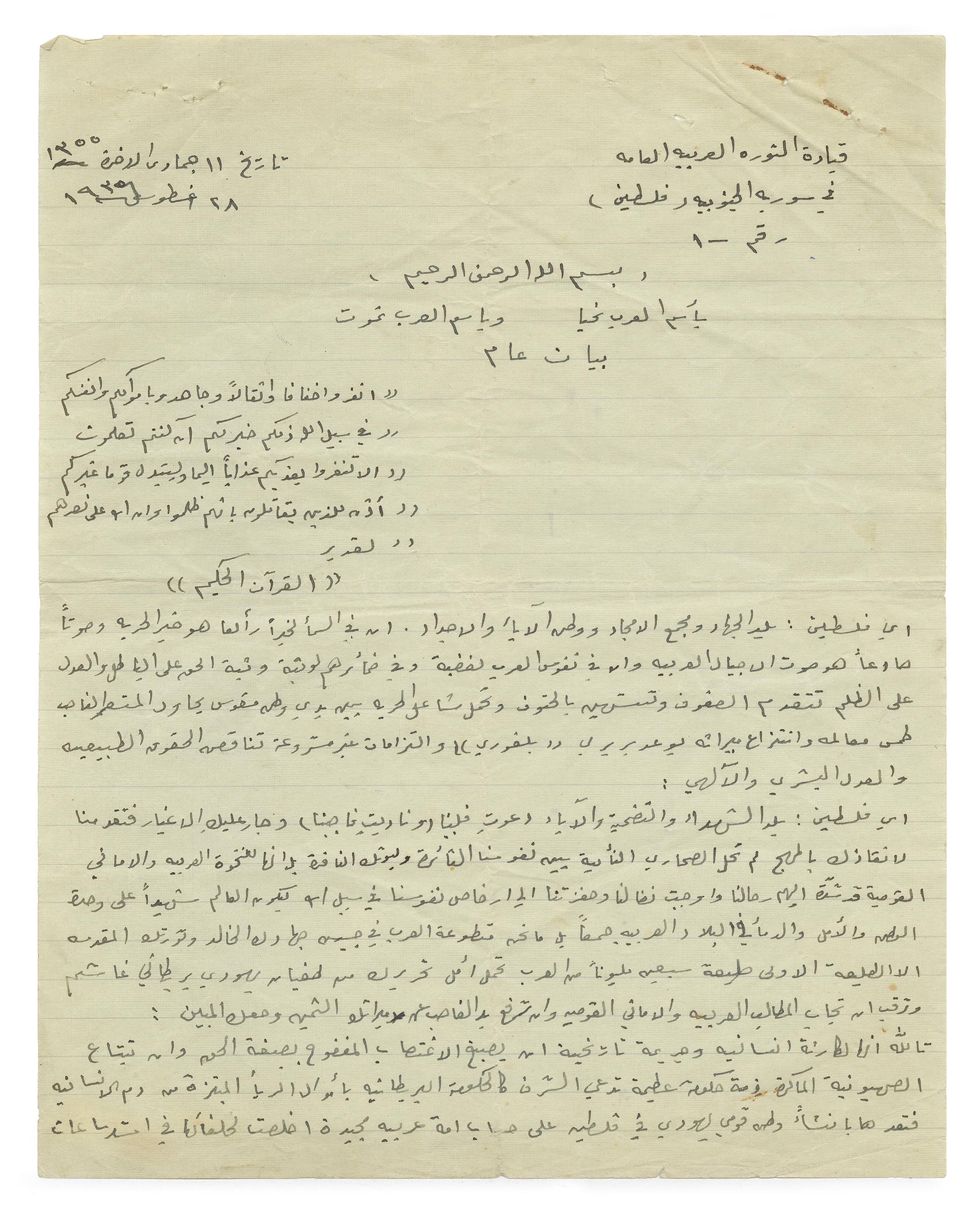
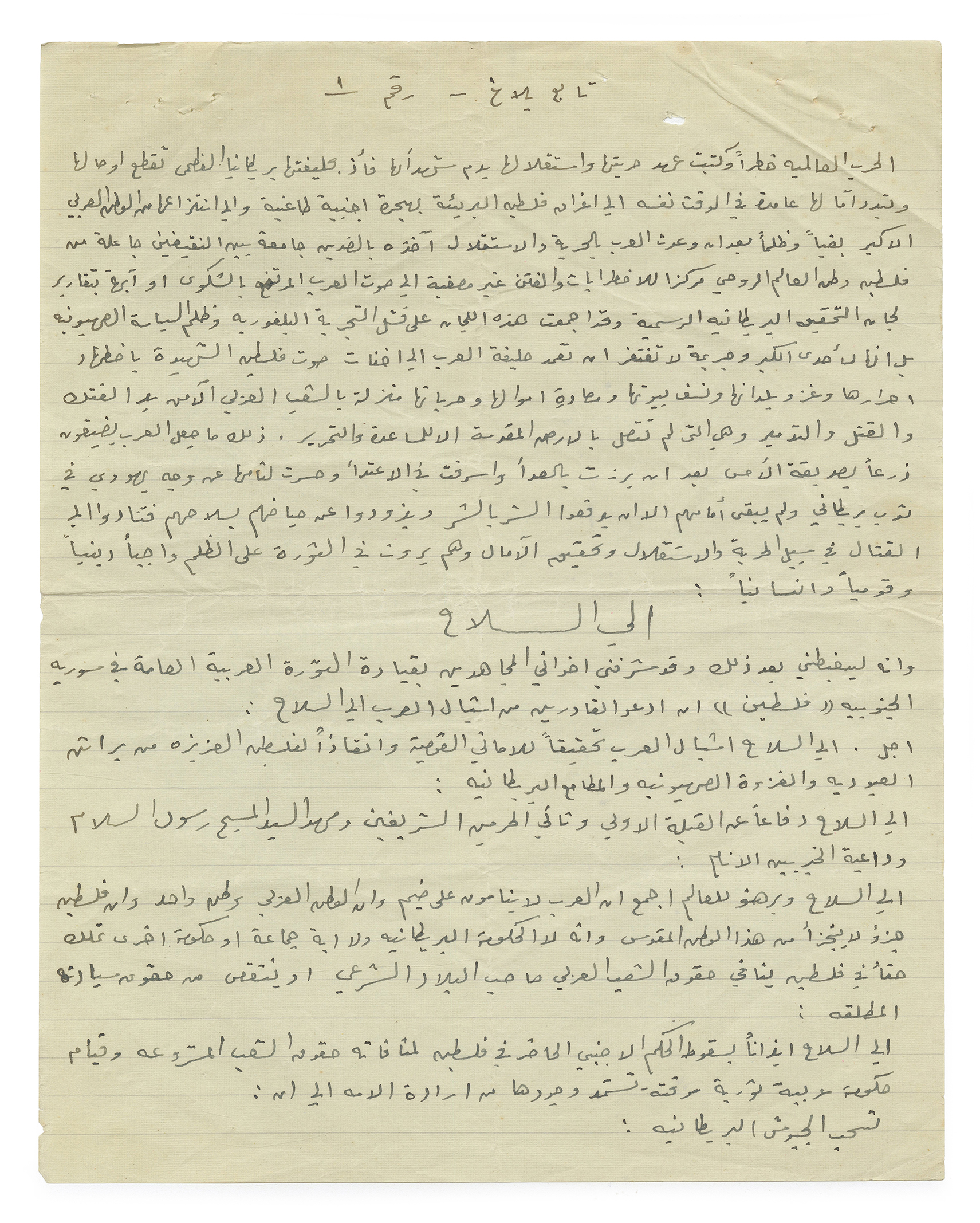
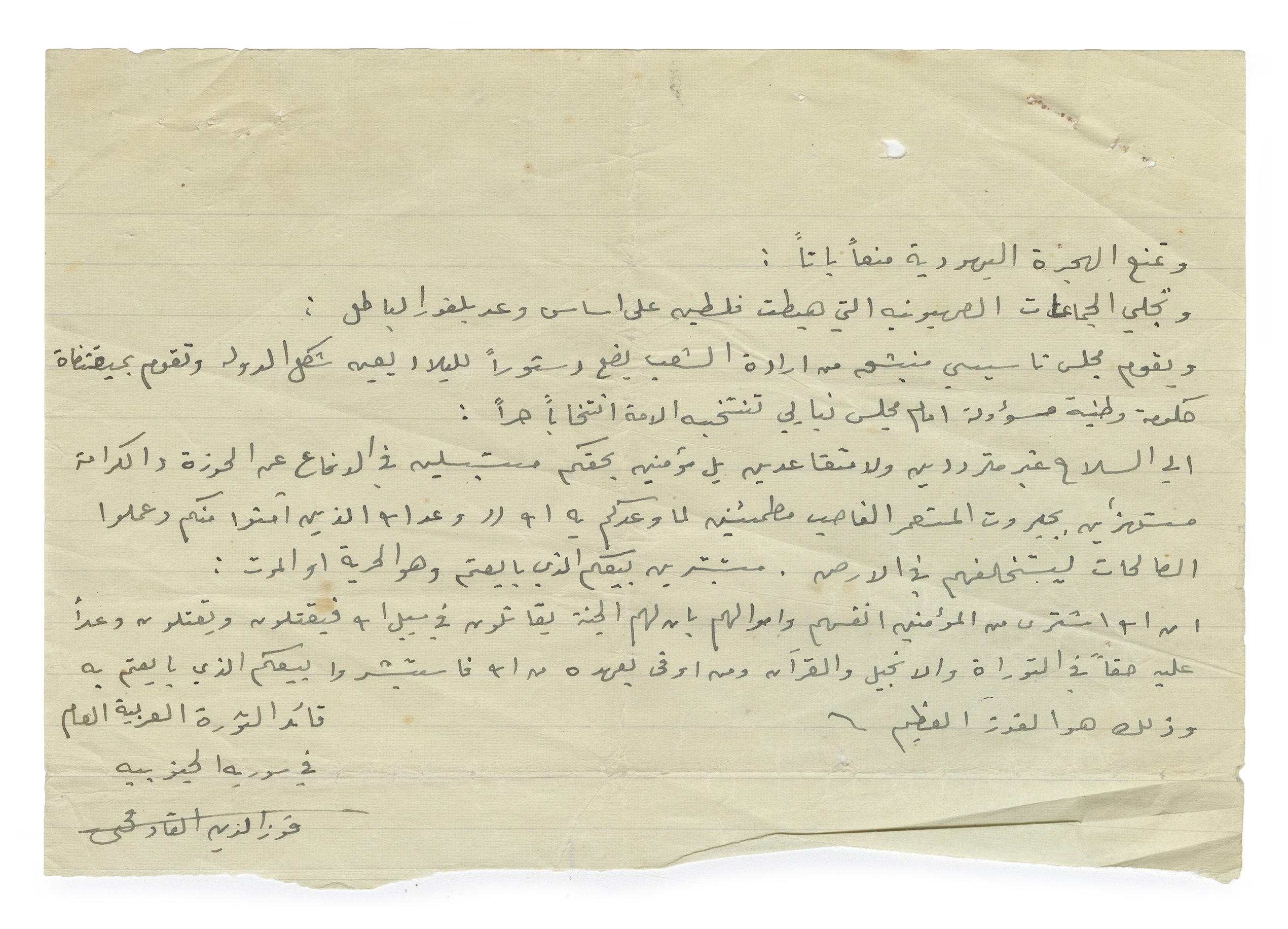
Manuscript text of a broadside, by Syrian General Fawzi al-Qawuqji, calling for armed resistance to Jewish settlement and the British regime in Eretz Israel. Signed "Fawz al-Din al-Qawuqji", "Southern Syria" (Eretz Israel), 28 August 1936.
Official proclamation no. 1 to the Arabs of Palestine by Fawzi al-Qawuqji, calling to make war against the Zionist forces conspiring to expel the Palestinian Arabs from their property and land, and to sow destruction in the country.
The letter is combative, full of quotations from the Quran, and repeatedly calls for jihad – religious warfare in this context – demanding Palestinian Arabs go "for arms" (ila al-silāḥ, written in large, emphasized letters in the center of the second leaf of the letter), and immediately stop Jewish immigration to the land.
The proclamation likewise demands opposition to the British, who had promised the Palestinian Arabs freedom and independence, but in fact ignore their demands and needs, while effectively supporting the Jewish settlement; and demands cancellation of the Balfour Declaration.
The proclamation is signed: "General of the Arab Revolt in Southern Syria, Fawzi al-Qawuqji".
This text is quoted in Abdel-Wahab al-Kayyali (ed.), Documents on the Palestinian Arab Resistance to the British Mandate and Zionism (1918-1939), Beirut: Institute for Palestine Studies, 1968, pp. 433-436 (Arabic).
Fawzi al-Qawuqji (1890-1977) was a Syrian general trained in an Ottoman military academy. He fought as part of various armies, under regular Arab forces as well as independent ones. He participated in the Great Arab Revolt against the Ottoman Empire in the Arabian Peninsula, fought the French Mandate in Syria, and assisted in the establishment of the armies of Saudi Arabia and Iraq – all for the cause of Arab independence.
From 1936, Qawuqji was a general of the Great Arab Revolt in Mandatory Palestine (known in Arabic as Thawrat Filistīn al-Kubra – the Great Palestine Revolt), during which he led a force of Palestinians and foreign volunteers against the Jewish settlement and the British army. He was recognized by many as the supreme general of the Arab Revolt in Southern Syria [Palestine], as he signs in the present letter.
Qawuqji continued his struggle against the British during World War II by joining forces with the Nazis in various ways. He moved to Germany and married a German woman, adopting anti-Semitic rhetoric in his writings and speeches. During the 1948 Israeli War of Independence, he commanded the Arab Liberation Army. Upon defeat to Yishuv forces, he moved to Damascus and later Beirut. He died in 1977.
[3] leaves. 25.5 cm (third leaf cut in half, not affecting text). Overall good condition. Creases and light stains. Folding marks lengthwise and widthwise. Minor tears and holes to margins and corners, not affecting text.
Category
Zionism, Mandatory Palestine and the State of Israel
Catalogue Value


Auction 107: Rare and Important Items
Apr 15, 2026
Opening: $1,500
Estimate: $2,000 - $3,000
Sold for: $1,875
Including buyer's premium
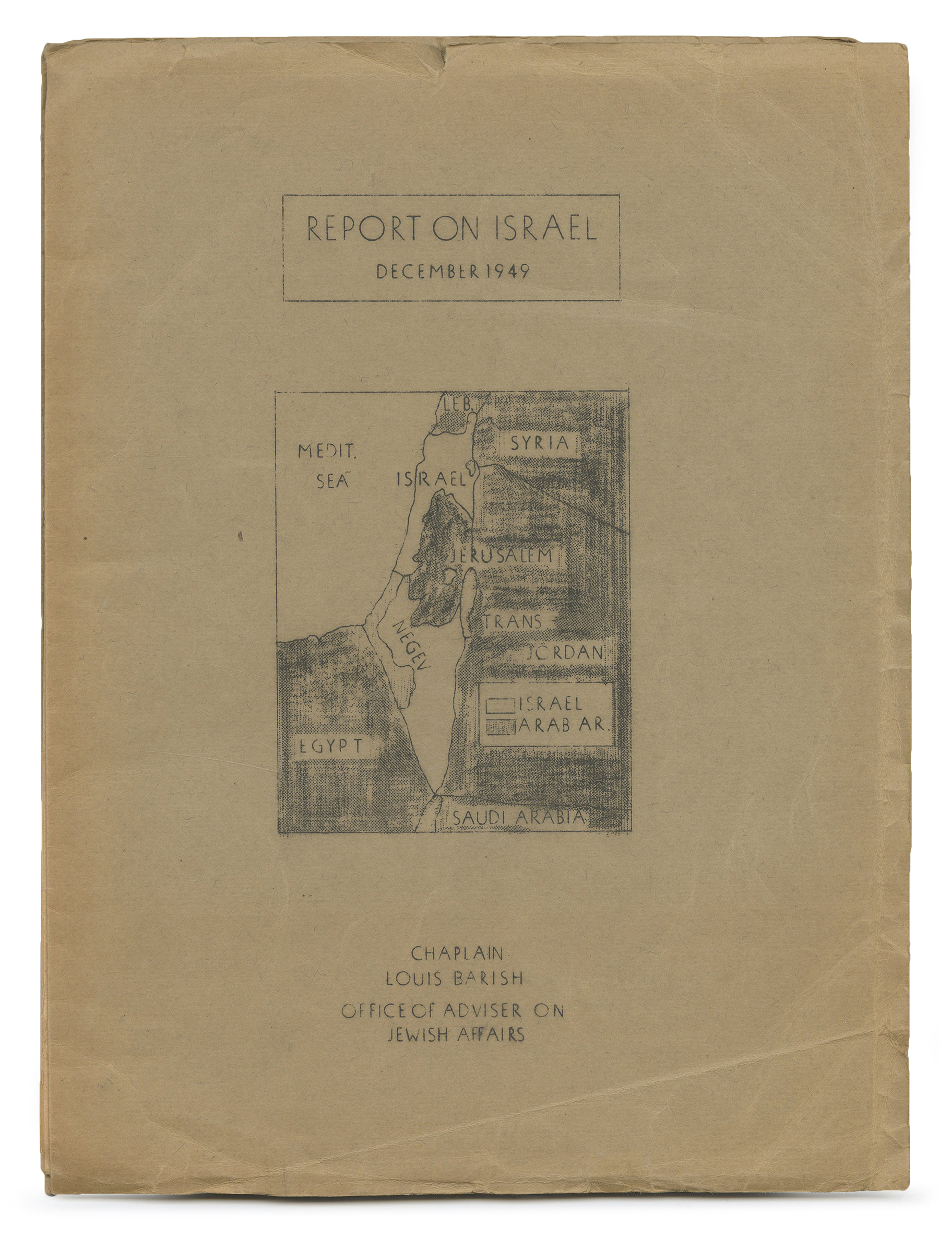
Report on Israel, by Captain Louis Barish, Jewish Chaplain for the United States Army. Heidelberg: United States Army – Office of Adviser on Jewish Affairs, December 1949. English.
Lengthy report, printed and stereographed, by Jewish Chaplain Louis Barish (1912-2012), authored after his visit to the nascent State of Israel.
The report is written plainly and succinctly, and surveys various general aspects of the new State's condition: politics, political parties (the Communists allied with the USSR, and Mapam, wary of the superpowers – the USSR and the West), the right (Herut, the General Zionists and the Radical Revisionists) and the center (the parties of the coalition – Mapai and the religious parties); the economy, problems and challenges with postwar stabilization and large waves of immigration (trade deficit, few natural resources, lack of foreign investment, unskilled workforce, lack of means of heavy production and more), the economic plan prepared by Ben Gurion's government; the security situation and the army's preparation for future wars, and various aspects of integrating large waves of immigration, which naturally produced many challenges (dedicated chapters discuss the role of kibbutzim and moshavim in the integration of immigrants).
The conclusion chapter strays from the matter-of-fact tone adopted throughout the report, segueing into a pathos that exhibits the warmth his visit to Israel inspired in him:
"Israel is a new country lacking somewhat in experience, but rich in vision, conscious of an important purpose. It is a country of dedicated and hard working people… Its strongest weapon is its spirit, a passionate determination to succeed because it has no alternative. If it does not lose its spirit it will win. Israel is intensely democratic. Because its people hungered for freedom in lands where human rights were denied to them, they have a keen appreciation of the meaning of liberty. They will not readily give it up. Israel is an ally of our country" (p. 39).
On the wrapper of the booklet is a schematic map of Israel and its neighbors.
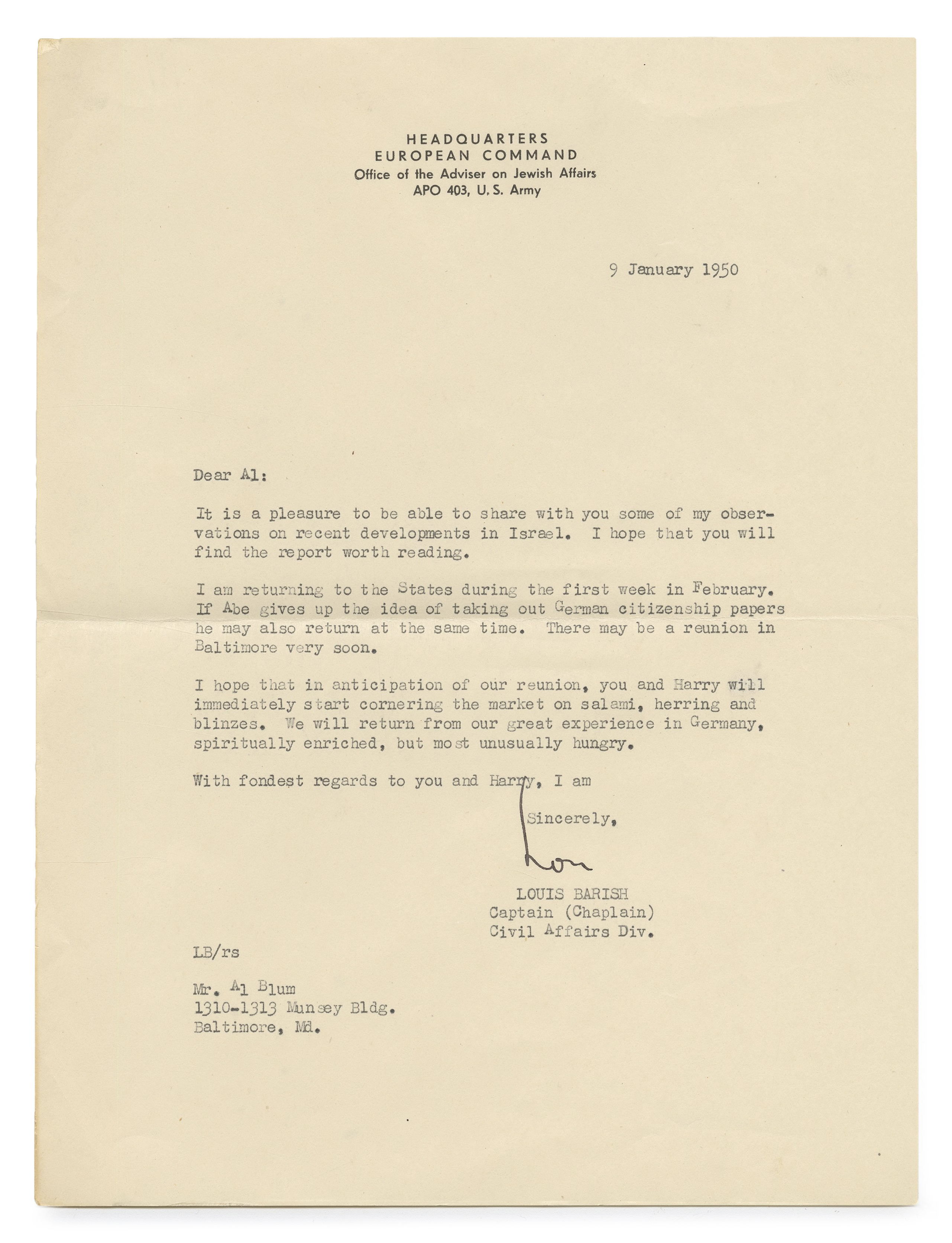
The present booklet is accompanied by a letter from R. Barish, addressed to his friend Al Blum in Baltimore, dated 9 January 1950. In the letter, R. Barish expresses his hope that the report would interest Blum. He goes on to advise him that he and a friend would soon return to the United States and reunite with friends and relatives; he asks him to "immediately start cornering the market on salami, herring and blinzes. We will return from our great experience in Germany, spiritually enriched, but most unusually hungry".
Rabbi Captain Dr. Louis Barish (1912-2012), a Conservative rabbi, scholar and author. Served as chaplain in the United States Army for some 23 years – during World War II, the Korean War and Vietnam War. During 1946-1950 he served as assistant to the Office of Adviser on Jewish Affairs of the US Army in Europe, and was involved in many issues relating to the welfare of Holocaust survivors in DP camps. He authored several books, including a popular book on halachah and custom, and edited a historical work on rabbis in the US Army (Rabbis in Uniform: the Story of the American Jewish Military Chaplain, 1962).
Rare. Not recorded in OCLC.
Booklet: 40 leaves. 28 cm. Good condition. Wear and minor creases. Minor marginal tears to paper wrapper; tear to inside of wrapper, near one of the staples. Letter: 26.5 cm. Good condition. Folding mark widthwise. Open tear to upper left corner.
Category
Zionism, Mandatory Palestine and the State of Israel
Catalogue Value
Auction 107: Rare and Important Items
Apr 15, 2026
Opening: $1,000
Estimate: $2,000 - $4,000
Sold for: $3,750
Including buyer's premium
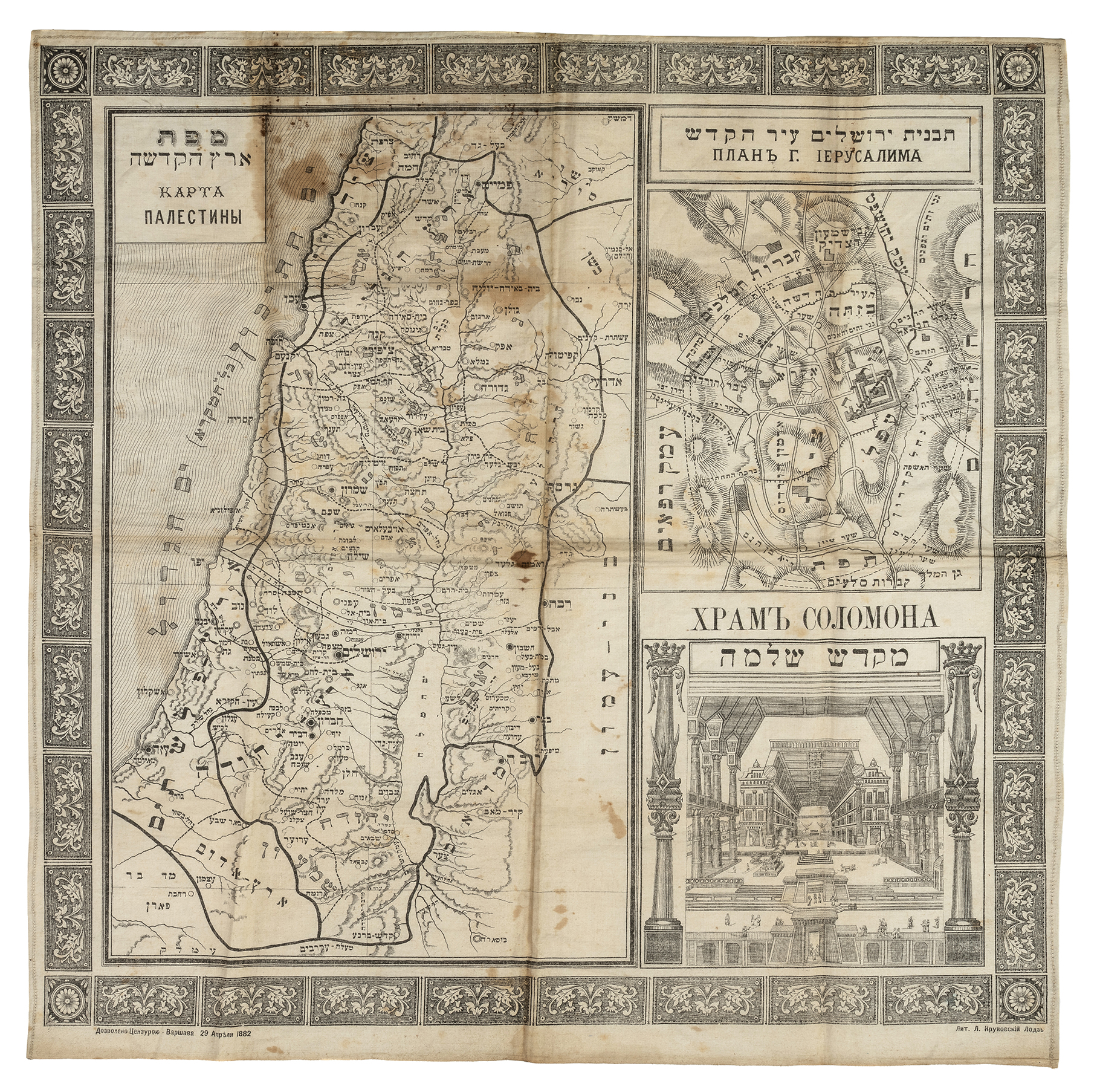
Map of Palestine, Jerusalem, and Solomon's Temple, with Hebrew and Russian titles. Łódź: L. Krukowski (Л. Круковскій), [ca. 1882].
Large map printed on a cloth sheet, produced at the lithographic press of Leon (Leib Israel) Krukowski in Łódź (grandfather of the Jewish-Polish poet Julian Tuwim). Censorship approval granted in Warsaw on 29 April 1882.
On the left appears a Hebrew map of Palestine, on both sides of the Jordan River, with the tribal allotments marked. At upper right is a map of Jerusalem, indicating Mount Moriah and the Temple, Herod’s palace and tomb, Tomb of Simeon the Just, the Assyrian camp, and other important sites. At lower right is a depiction of Solomon's Temple, rendered in a fantastic, architectural manner in a European classical style.
Headings printed in Hebrew and Russian; place-names and site names on the maps printed in Hebrew only. Wide outer border, divided into decorative panels adorned with an attractive vegetal motif.
30.5X49.5 cm. Fair condition. Stains, including dark staining. Creases and wear. Folding marks. Small holes at center and along fold lines.
Exceptionally rare. Not recorded by Laor and undocumented in public databases. To the best of our knowledge, this map has not appeared at auction.
Category
Art and Various Publications
Catalogue Value


Auction 107: Rare and Important Items
Apr 15, 2026
Opening: $11,000
Estimate: $12,000 - $20,000
Sold for: $18,750
Including buyer's premium
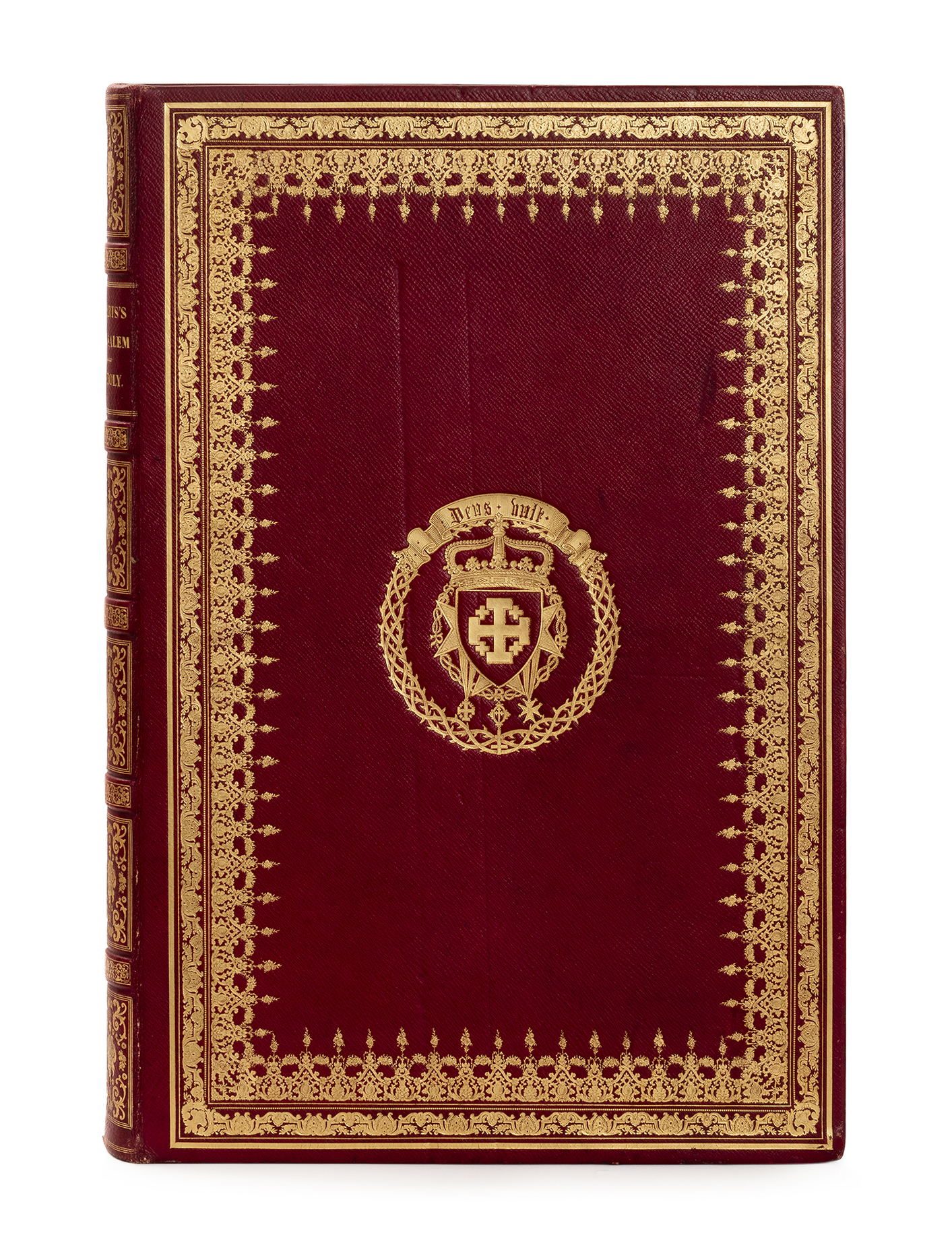
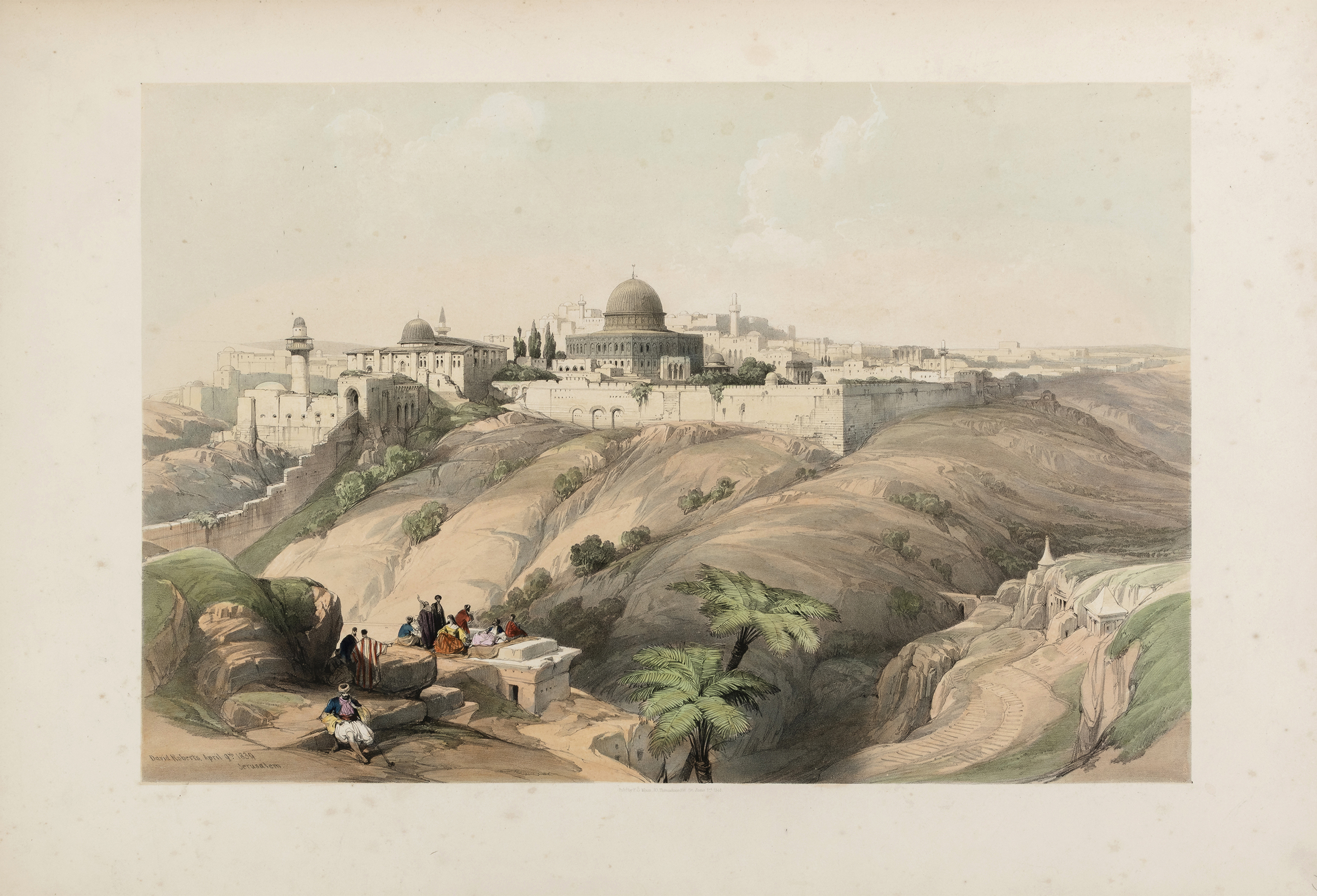
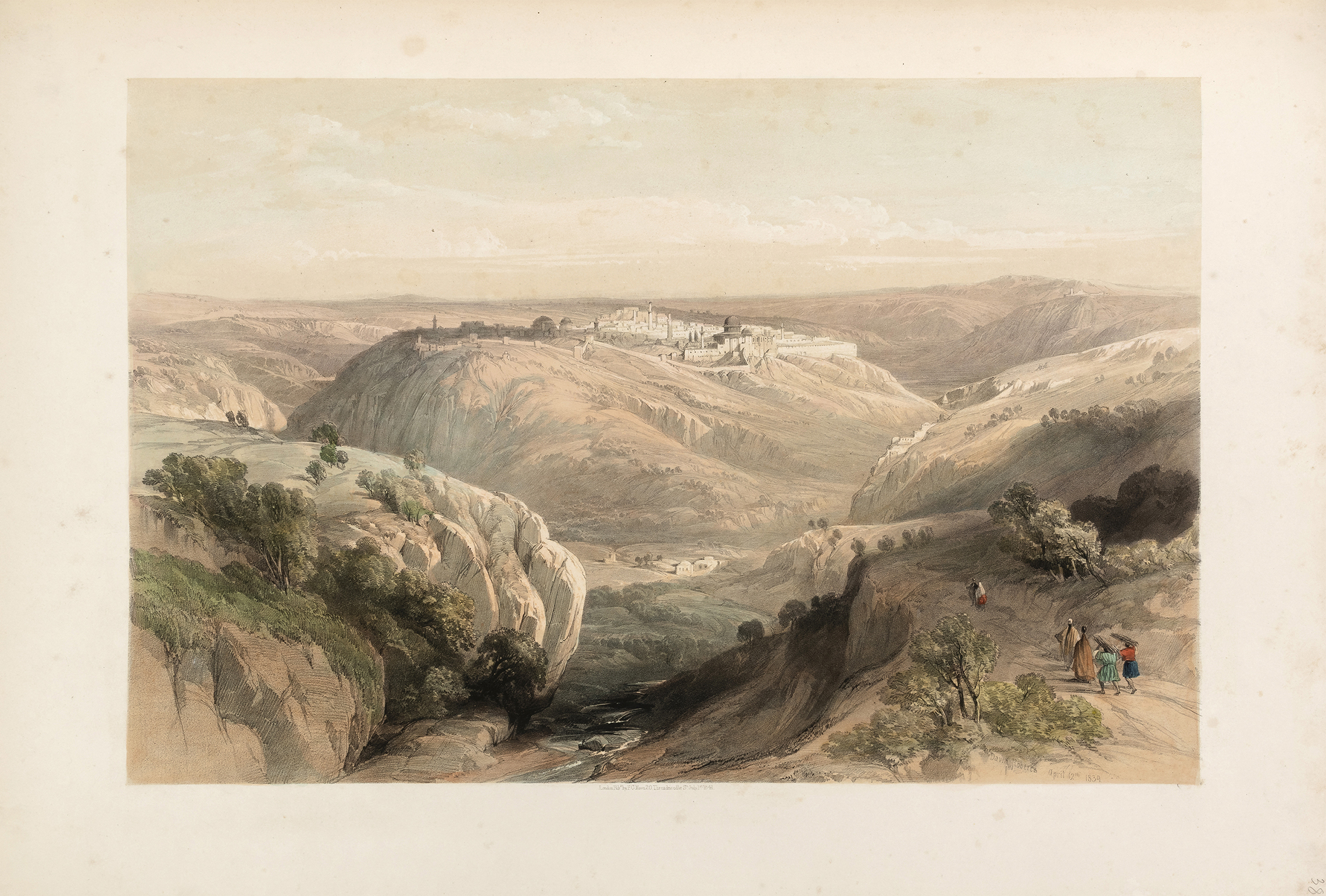
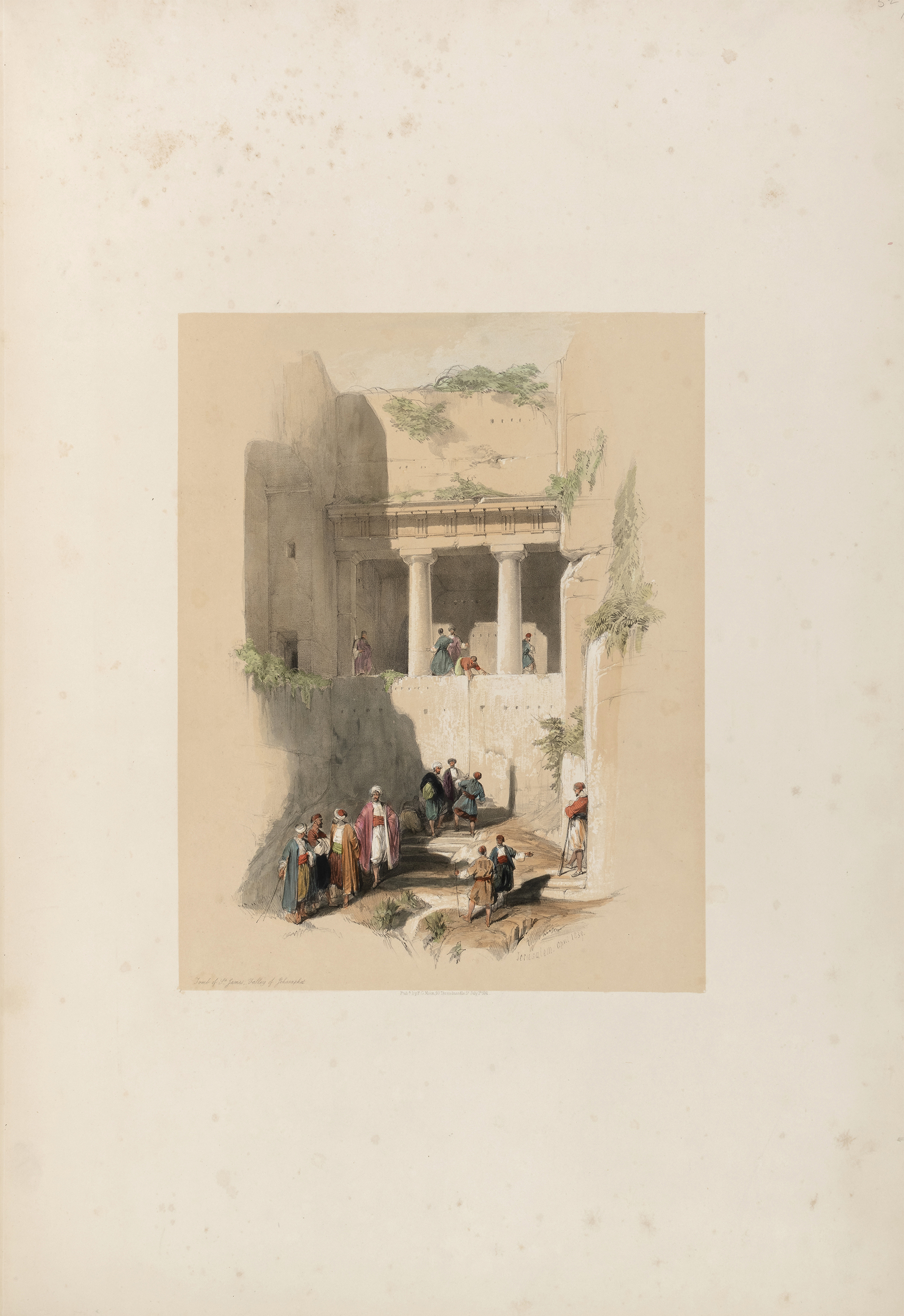
The Holy Land, Syria, Idumea, Arabia, Egypt, & Nubia. From drawings made on the spot by David Roberts. London: F.G. Moon, 1842 (title page print dated 1842; most lithographs dated 1841). First volume. English.
First edition of the monumental work "The Holy Land…" by David Roberts, printed in large (folio) format, with hand-painted lithographs.
The present work represents the first part (out of three), devoted to Jerusalem and its environs. It contains illustrations of the Temple Mount and the Dome of the Rock, the Tower of David, Damascus Gate, the Golden Gate, the Tomb of Absalom, the Church of the Holy Sepulchre, overviews of the city taken from its surrounding hills, and more. The album is contained in an elegant binding created by the Hering Family of bookbinders; the company stamp appears on the front flyleaf: "Bound by Hering, 9 Newman St". On the front is a gilt impression of the emblem of Jerusalem – "Armorial ensigns of Jerusalem" – first displayed following the conquest of Jerusalem in the First Crusade, 1099 CE (according to the explanation offered in the introduction).
Illustrations of the Holy Land by David Roberts are widely regarded as being among the finest achievements of 19th-century lithographic printing, and among the handsomest of photographic albums of the Holy Land ever published. The paintings were created in the course of Roberts' expedition to the Near East in the years 1839-1840, which he undertook by means of a camel caravan accompanied by armed bodyguards. This came about at a time when the cities of the Orient were mostly unknown to Western culture and English artists.
Upon Roberts' return from his journey, 250 of his original paintings were processed, converted, and reproduced as large-size printed plates, rich in detail, by the painter and print artist Louis Haghe, all the while under Roberts' direct supervision; with regard to Haghe's work, Roberts stated that his original paintings were reproduced "with a masterly vigour and boldness which none but a painter like him [Haghe] could have transferred to stone...".
The first edition of "The Holy Land..." was published in 1842, printed in full folio size (approx. 60 cm.) and in two different versions, one regular and the other hand-painted. In order to fund the project, over 600 subscribers were enlisted and required to pre-purchase their copies. These subscribers – members of the aristocracy and royalty from all across Europe – included Queen Victoria, the Archbishops of York and Canterbury, the Austrian emperor, the Russian Tsar, the monarchs of France and Prussia, and others. The copy reserved for Queen Victoria – designated as "Number One" on the list of subscribers – was given by the queen to her grandson Edward as a Christmas present in 1855. Today it is part of the Royal Collection (Item No. 1071157).
[1] title page (lithograph), [3] leaves, 30 pages, [24] pages + [24] lithographic plates. 62 cm. Good condition. Stains. Minor defects. Inked stamp on title page.
Category
Art and Various Publications
Catalogue Value
!["War da, Jussuf" (Yusuf was here). Sketch, unsigned and undated [ca. 1936-1942?].
Pencil on paper.
Minimal](https://files.kedem-auctions.com/files/Sale107/105_1.jpg "Else Lasker-Schüler – \"Yusuf was Here\" – Original Pencil Sketch")
!["War da, Jussuf" (Yusuf was here). Sketch, unsigned and undated [ca. 1936-1942?].
Pencil on paper.
Minimal](https://files.kedem-auctions.com/files/Sale107/105_2-WEB.jpg "Else Lasker-Schüler – \"Yusuf was Here\" – Original Pencil Sketch")


Auction 107: Rare and Important Items
Apr 15, 2026
Opening: $1,000
Estimate: $2,000 - $4,000
Sold for: $1,750
Including buyer's premium
"War da, Jussuf" (Yusuf was here). Sketch, unsigned and undated [ca. 1936-1942?].
Pencil on paper.
Minimalist inscription by Else Lasker-Schüler, depicting Prince Yusuf donning a fez, with the poet's handwritten inscription below: "War da Jussuf" (Yusuf was here).
Illustration of Prince Yusuf of Thebes, produced by Lasker-Schüler, first published on the binding of her Hebräische Balladen (Hebrew Ballads, 1913). The figure later appeared in variations in her book Der Prinz von Theben (The Prince of Thebes, 1914) and letters and postcards she sent her friends and acquaintances.
The figure of Prince Yusuf of Thebes repeats in Lasker-Schüler's poems and inscriptions, not a few times as a representation of herself: Yusuf was one of the two personas that populated her inner literary world throughout her years of creative work. In her Berlin days, she occasionally made public appearance as her alter ego Prince Yusuf, wearing male dress in Oriental style (see sidebar).
See:
• Drawings: Else Lasker-Schüler, exhibit catalog, Israel Museum, 1975, no. 42, and invitation to exhibition. The present illustration is printed in the inner cover of the catalog, and one detail from it appears on the invitation (both together form the present item).
• Else Lasker-Schüler: Die Bilder, exhibit catalog, Berlin: Jüdischer Verlag im Suhrkamp Verlag, [2010], no. 189.
21X18 cm. Good condition. Light stains. Folding marks lengthwise and widthwise. Open tear to top left corner, not affecting sketch. Uneven trimming. Matted. Frame: 37X47.5 cm.
Provenance:
1. Erich Gottgetreu, Jerusalem.
2. Zvi Barsky, Jerusalem.
Else Lasker-Schüler
(1869-1945), born in Elberfeld (now a quarter of Wuppertal), she relocated to Berlin after her marriage to the physician Berthold Lasker, where she dedicated her time to studying drawing. In 1899 she gave birth to her son Paul. That year, she published her earliest poems in Die Gesellschaft. In 1902, her first poetry collection, Styx, was published, earning some recognition. After her divorce, she remarried to Herwarth Walden (a pseudonym of Georg Lewin), editor of the expressionist magazine Der Sturm.
(1869-1945), born in Elberfeld (now a quarter of Wuppertal), she relocated to Berlin after her marriage to the physician Berthold Lasker, where she dedicated her time to studying drawing. In 1899 she gave birth to her son Paul. That year, she published her earliest poems in Die Gesellschaft. In 1902, her first poetry collection, Styx, was published, earning some recognition. After her divorce, she remarried to Herwarth Walden (a pseudonym of Georg Lewin), editor of the expressionist magazine Der Sturm.
In 1906, her first prose book was published, Das Peter-Hille-Buch, followed by many other works. In addition to her poetry and prose, Lasker-Schüler also authored essays and theater and literary reviews. She was known for her eccentricity, and her appearance and dress challenged reigning social conventions and gender roles.
Upon the death of her son in 1927, she gradually disappeared from the public stage. In 1932 she was awarded the Kleist Prize for her oeuvre, but the very next year, with the rise of the Nazi Party in Germany, she fled to Switzerland and later immigrated to Eretz Israel. She passed away in Jerusalem in 1945.
Irit Salmon writes of the figure of Yusuf of Thebes: "Lasker-Schüler lived in Berlin from 1894. She visited the Egyptian Museum, where she saw the collection of finds from the Necropolis of Thebes… It is easy to imagine Lasker-Schüler standing breathtaken looking at this art, colored blue, yellow and red, full of vitality and expression – and its themes – including androgyny – packed with tenderness and emotion. The influence of this culture on her is discernible in various places, primarily in her adoption of the figure of Prince Yusuf of Thebes… Lasker-Schüler cast into this early Egyptian figure the figure of the modern Arab or Bedouin, who, like her, wandered from one place to another, and the figure of Joseph the dreamer. Joseph, for her, represents the artist at the peak of his art, dreams and imagination, betrayed, but eventually achieving greatness. Joseph is also a figure representing wandering and the constant search for the native land… By choosing an androgynous figure in her art and work, Lasker-Schüler expresses a rebellion against contemporary norms that assign to woman a passive and marginal role that Lasker-Schüler refused to fulfill. The use of Yusuf allowed her to depict herself as she wished to be: an artist unbound by social norms and boundaries, and a universal figure uniting both sexes, the three monotheistic religions, and the ancient with the modern…" (from Else Lasker-Schüler, Poet-Artist, Hecht Museum exhibit catalog, Haifa University, 2006).
Category
Art and Various Publications
Catalogue Value


Auction 107: Rare and Important Items
Apr 15, 2026
Opening: $2,000
Estimate: $5,000 - $8,000
Sold for: $8,750
Including buyer's premium
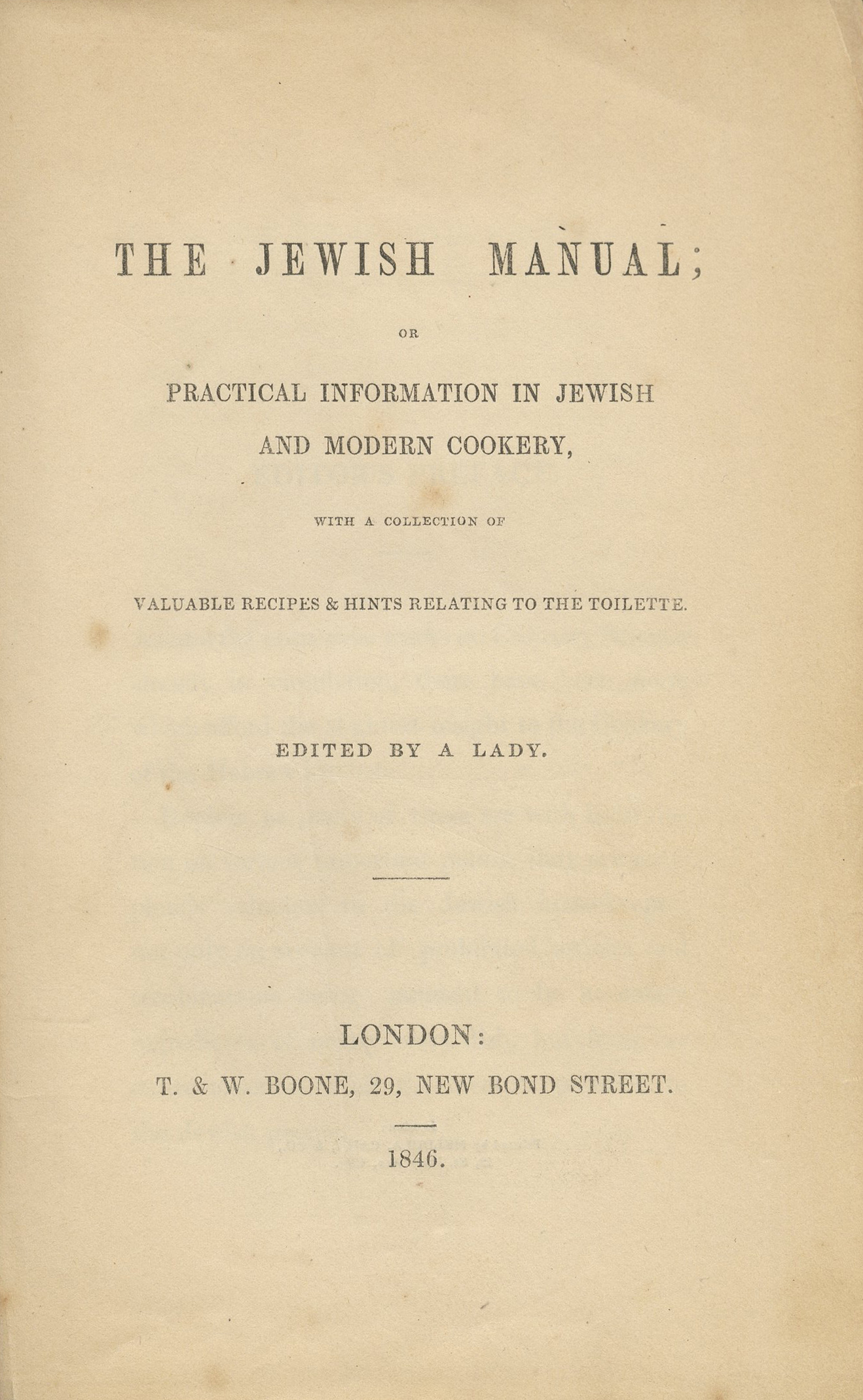
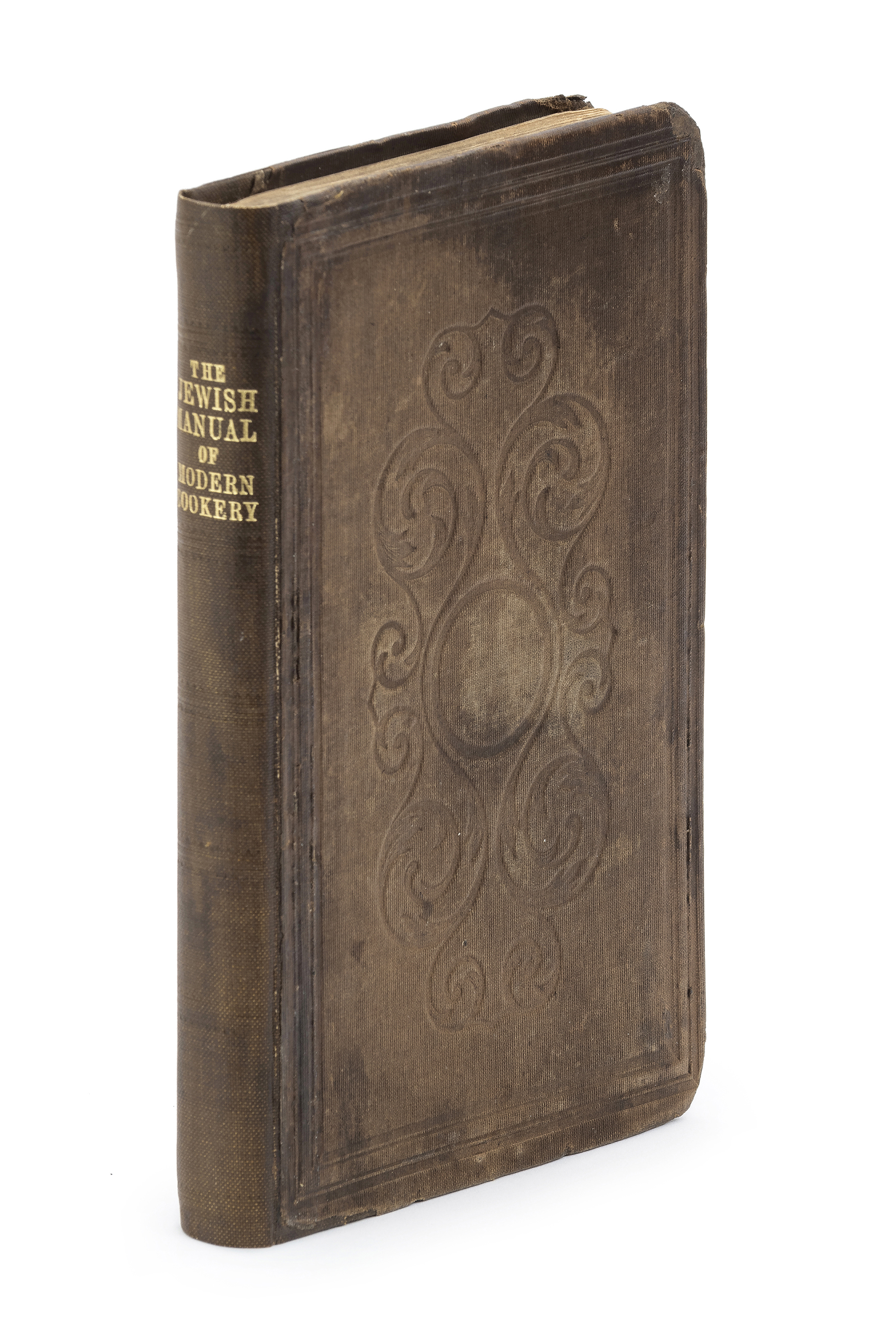
The Jewish Manual, or Practical Information in Jewish and Modern Cookery, With a Collection of Valuable Recipes & Hints Relating to the Toilette, Edited by a Lady. London: T. & W. Boone, 1846. First edition. English.
First kosher cookbook published in the English language. The present work was published anonymously ("Edited by a Lady"), who has been identified in modern scholarship as Judith Montefiore (1784-1862), wife of the famous Jewish advocate and philanthropist Sir Moses Montefiore.
The book addresses English women of a high social status, and includes selected recipes, "bequeathed only by memory or manuscript, from one generation to another of the Jewish nation", meeting the highest kosher standards (originating mainly in the Sephardic and Portuguese diaspora of Western Europe). Alongside traditional Jewish foods, the present cookbook also incorporates recipes reflecting an attempt to adapt non-kosher delicacies to the Jewish kitchen. Thus, we find recipes for beef chorizo, mock turtle soup, and fish fried in oil (fish and chips). In an amusing note, the author warns the reader of indiscriminate usage of such sauces as ketchup and soy in the dish by "inferior cooks".
The second part of the book is dedicated to practical advice in housekeeping and elegant reception, alongside tips for care and hygiene. In her introduction, the author writes: "The Cuisine of a woman of refinement, like her dress or her furniture, is distinguished, not for its costliness and profusion, but for a pervading air of graceful originality… She instinctively avoids every thing that is hackneyed, vulgar, and common place, and uniformly succeeds in pleasing by the judicious novelties she introduces". She adds her hope that the work would also be of use "even to those ladies who are not of the Hebrew persuasion, as it will serve as a sequel to the books on cookery previously in their possession".
The book reflects the socio-economic status of English Jews in the mid-19th century, offering a unique glimpse into the life, home and table of the Jewish housewife in Victorian London. It demonstrates the author's expertise in the mannerisms of the British high class; it also attests to her various travels throughout the world, including in Jerusalem, bringing unique recipes back with her.
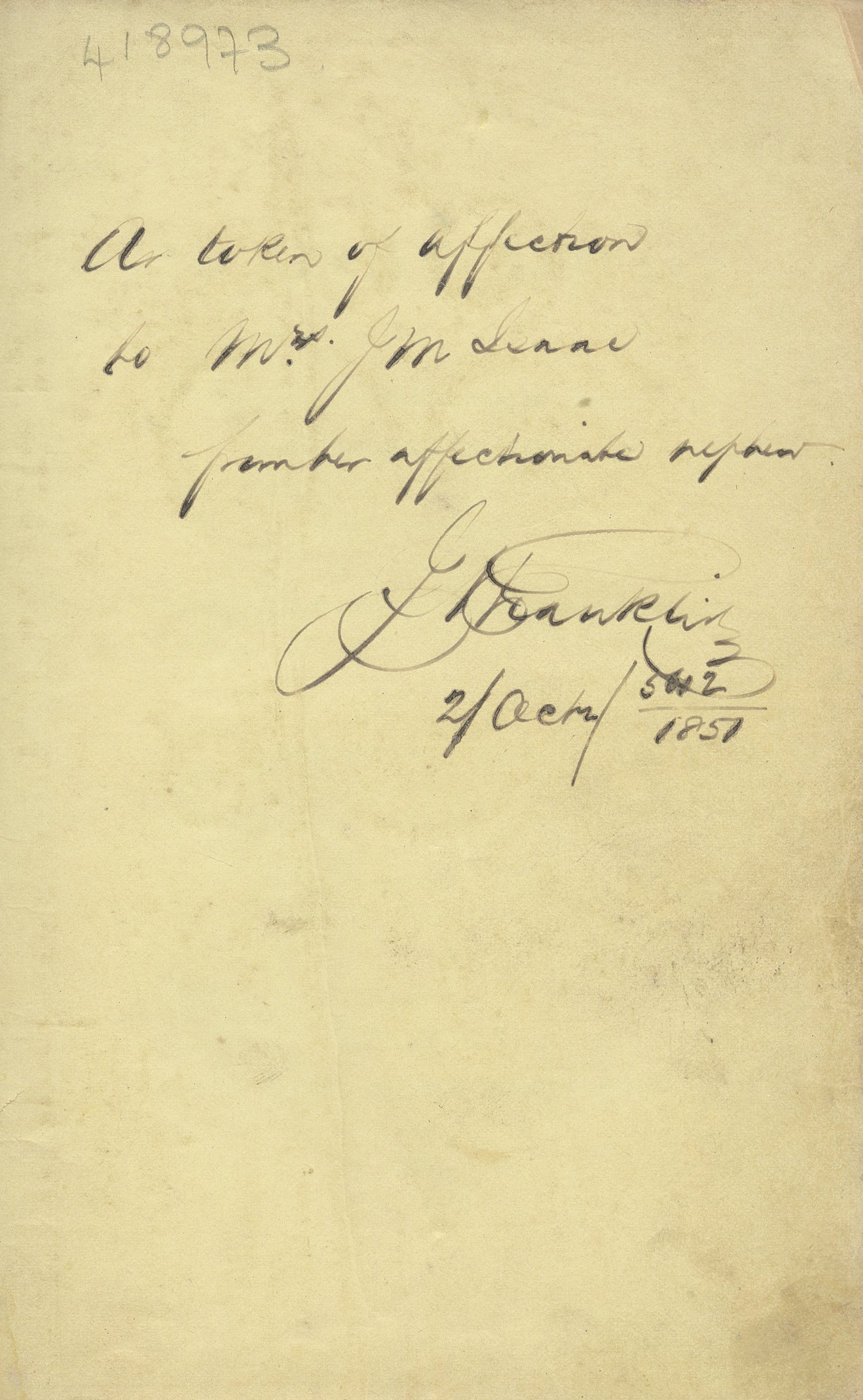
On the endpaper is a handwritten dedication dated 2 October 1851: "A token of affection to Mrs. J. M. Isaac from her affectionate nephew E. Franklin". The writer is evidently the banker and public figure Ellis Abraham Franklin (1822-1909), a prominent figure in Victorian English Jewry, father-in-law of Chief Commissioner Herbert Samuel and great-grandfather of scientist Rosalind Franklin. The recipient of the book is his aunt Sarah Frances Isaac (née Aaron; 1799-1884), wife of John Michael Isaac.
Another handwritten inscription inside front board, dated 1953: "Given to Florence Greenberg", apparently Florence Greenberg (1882-1980), wife of Leopold Greenberg, editor of the Jewish Chronicle; author of one of the most influential Jewish cookbooks of 20th century Britain; her classic Florence Greenberg's Jewish Cookery Book (1947) served for decades as a basic work of the British Jewish kitchen.
[2], XXI, 224, 235-244 pages (mispagination; the copy is complete). 18.5 cm. Good condition. Light stains. Minor marginal tears and open tears to some leaves (without loss). Pencil notations to margins of a few leaves; pen inscriptions to endpapers. Fine original fabric binding; repairs to spine (with title printed in gilt letters); placed in high-quality slipcase.
For an overview of English Jewry during this period and the question of the book's attribution to Judith Montefiore, see: Chaim Raphael, The History and Mystery of The Jewish Manual; foreword to a facsimile edition of The Jewish Manual (New York, 1983).
Rare. Not in the NLI catalog (recorded based on a scan from the Library of Congress). Few copies in OCLC.
Category
Art and Various Publications
Catalogue Value