
Auction 107: Rare and Important Items
Apr 15, 2026
- and (82) Apply and filter
- item (32) Apply item filter
- various (27) Apply various filter
- object (23) Apply object filter
- ornament (23) Apply ornament filter
- ornaments, (23) Apply ornaments, filter
- synagogu (23) Apply synagogu filter
- torah (23) Apply torah filter
- book (17) Apply book filter
- print (17) Apply print filter
- earli (15) Apply earli filter
- incunabula (15) Apply incunabula filter
- jewish (13) Apply jewish filter
- the (13) Apply the filter
- manuscript (12) Apply manuscript filter
- public (12) Apply public filter
- letter (10) Apply letter filter
- ketubot (9) Apply ketubot filter
- anti (8) Apply anti filter
- anti-jewish (8) Apply anti-jewish filter
- antijewish (8) Apply antijewish filter
- antisemit (8) Apply antisemit filter
- edict (8) Apply edict filter
- edicts, (8) Apply edicts, filter
- law (8) Apply law filter
- laws, (8) Apply laws, filter
- ordin (8) Apply ordin filter
- rabbin (8) Apply rabbin filter
- royal (8) Apply royal filter
- haggadot (6) Apply haggadot filter
- israel (6) Apply israel filter
- mandatori (6) Apply mandatori filter
- of (6) Apply of filter
- palestin (6) Apply palestin filter
- passov (6) Apply passov filter
- siddurim (6) Apply siddurim filter
- state (6) Apply state filter
- zionism (6) Apply zionism filter
- zionism, (6) Apply zionism, filter
- bind (5) Apply bind filter
- havdalah (5) Apply havdalah filter
- holiday (5) Apply holiday filter
- person (5) Apply person filter
- shabbat (5) Apply shabbat filter
- shabbat, (5) Apply shabbat, filter
- silver (5) Apply silver filter
- art (4) Apply art filter
- brueckheim (4) Apply brueckheim filter
- collect (4) Apply collect filter
- from (4) Apply from filter
Displaying 13 - 24 of 104


Auction 107: Rare and Important Items
Apr 15, 2026
Opening: $25,000
Estimate: $60,000 - $80,000
Sold for: $52,500
Including buyer's premium
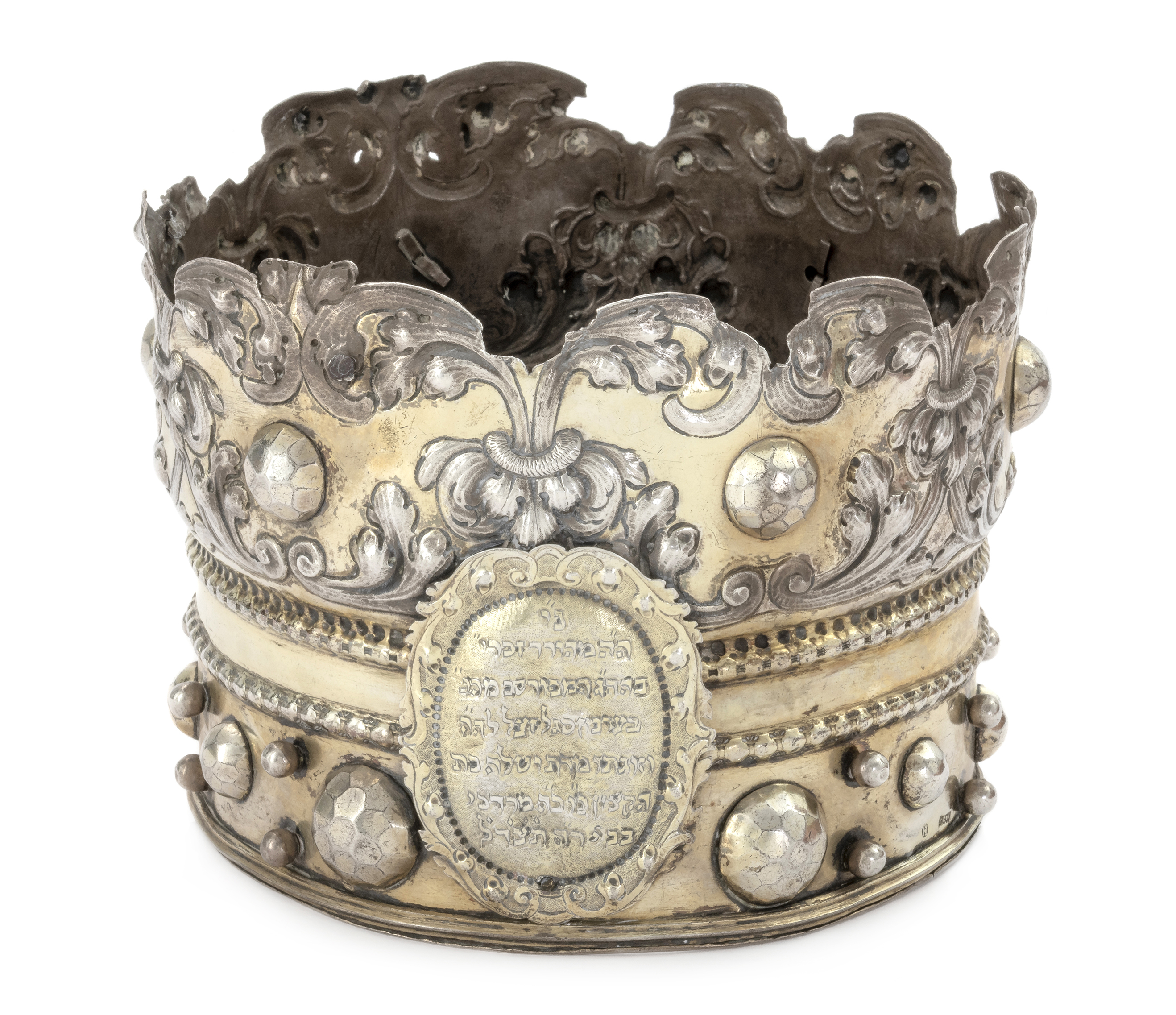
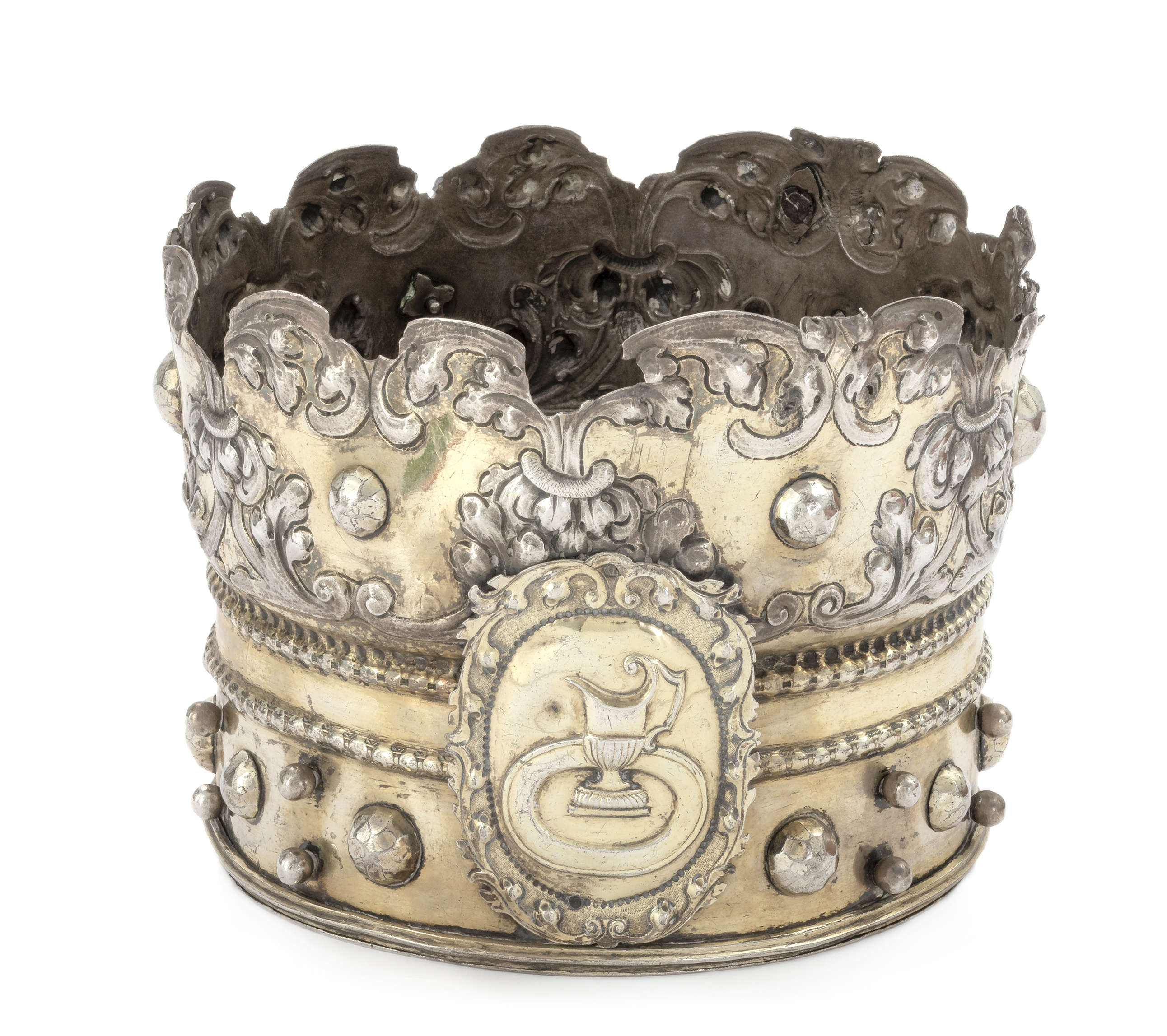
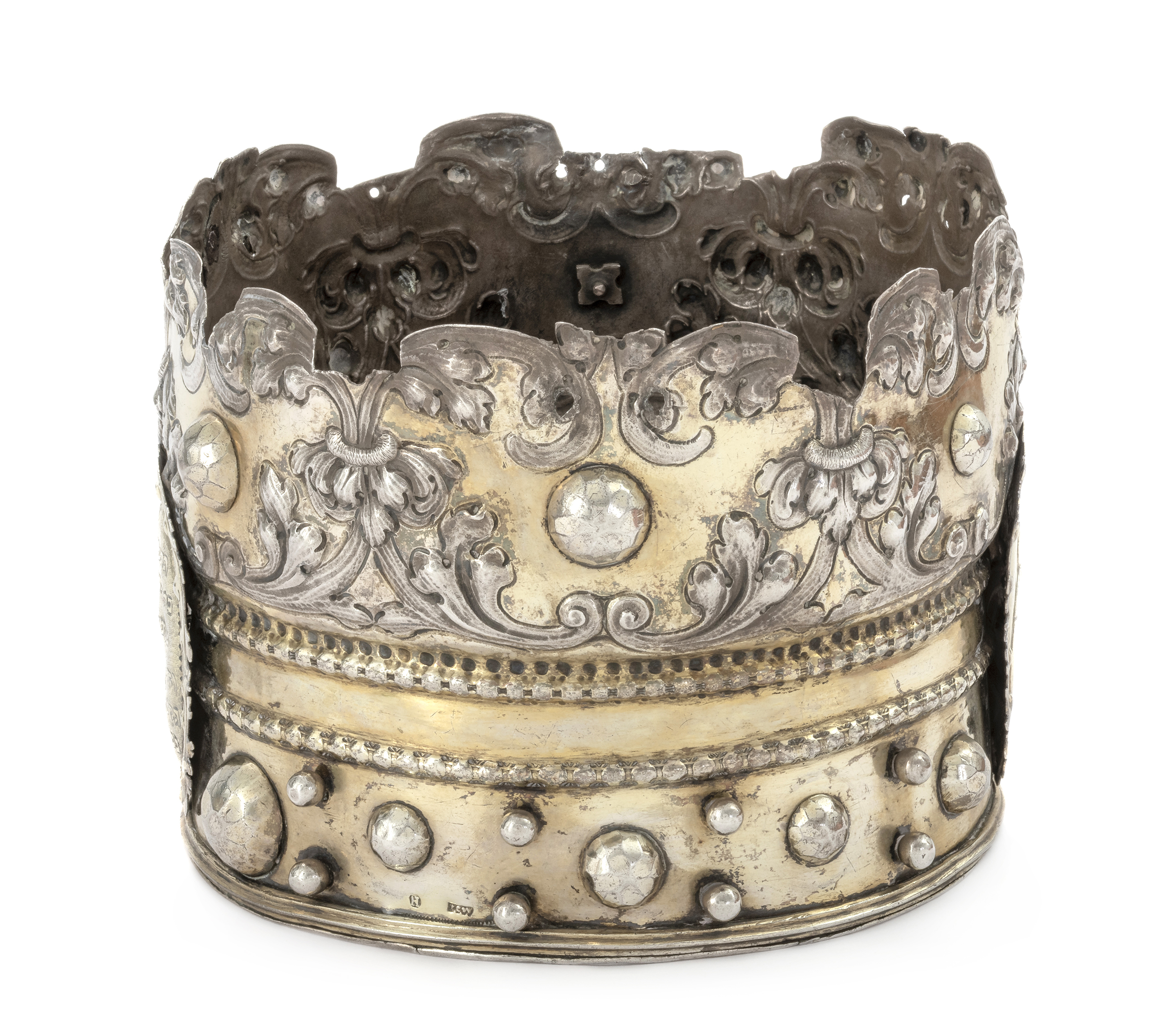
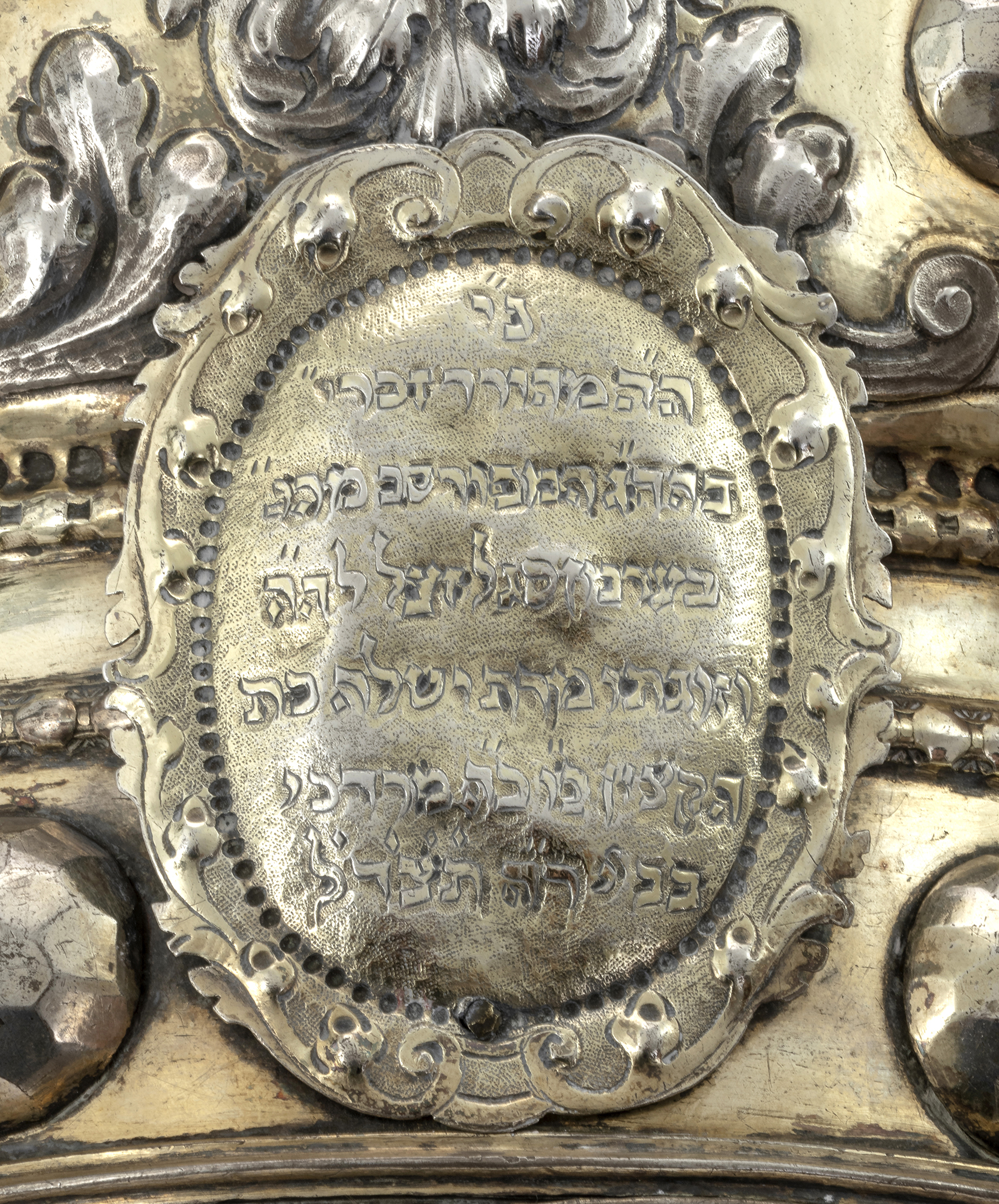
Torah crown. Nuremberg, Germany; dedicatory inscription from Fürth, dated 1734.
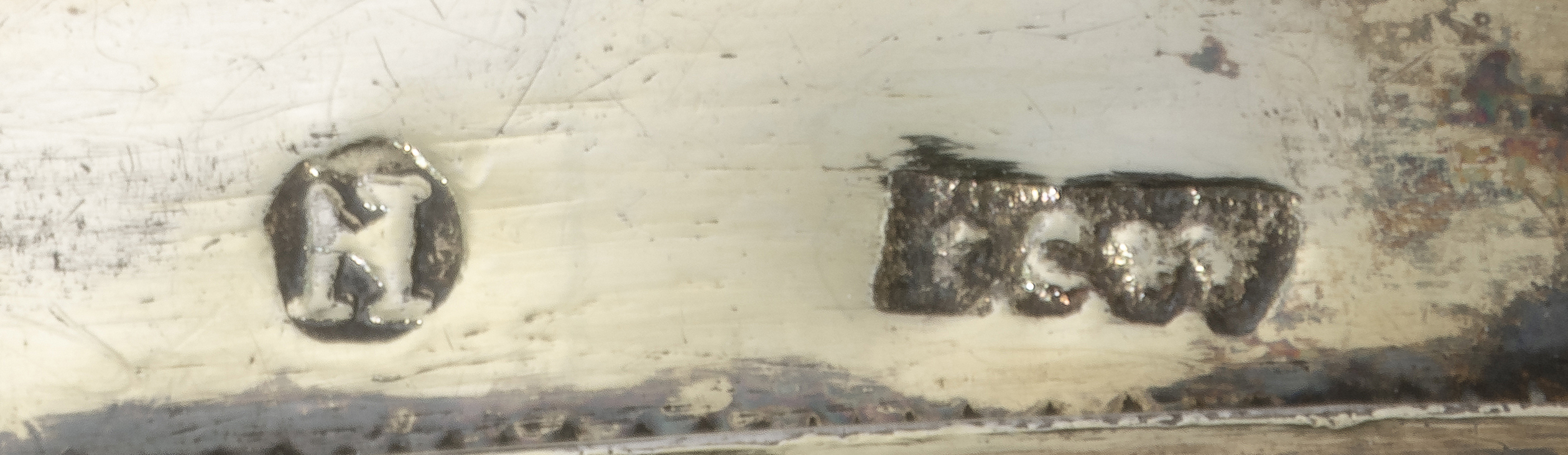
Silver, repoussé and engraved (marked with the city mark of Nuremberg, N, and with the maker’s mark ICW = Johann Conrad Weiss, active 1699-1751).
A rare and high-quality Torah crown by a renowned silversmith, apparently dedicated to one of the foremost Torah institutions of 18th-century South German Jewry – the synagogue of the "Kloiz" of the Mateh Yissachar in Fürth.
Cylindrical crown, open at the base and top, recalling in design Italian Torah crowns. Most of the surface is gilt, with applied silver ornaments. The upper section is decorated with large, repeating and symmetrical vegetal motifs in repoussé, interspersed with six domed, faceted ornaments resembling polished gemstones, affixed with bent pins. The lower section is largely plain; at its base are ten additional domed-faceted ornaments, alternating with pairs of spherical ornaments. Two large medallions are affixed to the crown: one bearing the image of a jug and basin – emblem of the Levi family (Segal = Segan Leviyah) – and the other bearing a dedicatory inscription dated 1734, by R. Zechariah son of R. Berman Segal and his wife Yitale daughter of R. Mordechai B.B. [Bamberg?].
The Inscription and the Kloiz of the Mateh Yissachar
R. Zechariah Segal, who dedicated this crown, was the son of R. Yissachar Berman (Fränkel) Segal, one of the leading German rabbis of the 18th century, rabbi of Fürth and author of the book Mateh Yissachar. In the Memorbuch records of the Fürth Kloiz (today in the collection of the Jüdisches Museum Franken), the name of Zechariah (Yosef), who passed away in 1746, is recorded, as well as that of his wife, Rachel Yitale daughter of Mordechai of B.B., who passed away in 1748.
R. Yissachar Berman Segal
(ca. 1659-1708), author of Mateh Yissachar, belonged to the affluent Fränkel family, which enabled him to establish a study house within his private residence – known as the "Kloiz of the Mateh Yissachar" – situated opposite the main synagogue of Fürth. The institution housed both a beit midrash and a synagogue, into which several Torah scrolls, sumptuous parochet curtains, and other ritual objects were introduced.
(ca. 1659-1708), author of Mateh Yissachar, belonged to the affluent Fränkel family, which enabled him to establish a study house within his private residence – known as the "Kloiz of the Mateh Yissachar" – situated opposite the main synagogue of Fürth. The institution housed both a beit midrash and a synagogue, into which several Torah scrolls, sumptuous parochet curtains, and other ritual objects were introduced.
Active until the Holocaust, the Kloiz was renowned throughout Europe and remained the final stronghold of Torah scholarship in Fürth after the local yeshiva was closed by the authorities in 1830. The sons of the Mateh Yissachar continued their father’s leadership of the Kloiz (as attested in the Memorbuch records), and it is highly probable that the present crown was donated to the Kloiz synagogue.
The Silversmith and His Work
Johann Conrad Weiss (1670-1758), a master silversmith from 1699, was active in Nuremberg in the first half of the 18th century. The catalogue of Nuremberg silversmiths, published by the Germanisches Nationalmuseum, notes that the relatively large number of surviving Judaica objects from his oeuvre attests to his specialization in Jewish ceremonial art. At the same time, many works he produced for regional synagogues in the Nuremberg area were lost or destroyed.
Among the Torah ornaments created by Weiss are several Torah shields (one in the collection of the Israel Museum, Jerusalem), two pairs of Torah finials (one in the collection of the the Jewish Museum, New York, and one in the collection of the Jewish Museum of Switzerland, Basel), one Torah pointer, and a pair of Torah rollers (in the Jewish Museum, New York). Another Torah crown by Weiss – the only other one known besides the present example – was documented by Theodor Harburger in Schwabach in 1929 (P160/448). In addition to Torah ornaments, several spice containers, goblets, a Chanukah Lamp, and a charity box are known.
For further information and a list of his works, see: Tebbe, Nürnberger Goldschmiedekunst 1541-1868, no. 943 (MZ0943a), pp. 438-439. The present crown is undocumented and does not appear in the list of Weiss' works.
German Torah crowns of this period are rare. While Harburger documented dozens of Torah finials in Bavaria in the 1920s-1930s and even more German Torah shields, he recorded only four Torah crowns, three of which were made in 18th-century Nuremberg.
Height: 15 cm. Diameter: 19-20 cm. Weight: 870 grams. Fair-good condition. Missing elements to upper rim; breaks and bends. Holes and remnants of nails near upper rim, apparently evidence of a lost upper ornament. (The crown documented by Harburger in Schwabach had three narrow arms with a floral ornament at their center; however, it is also possible that the original design of the present crown did not include arms, and that other, smaller ornaments are missing. For another German Torah crown from Fürth without arms, see: Tebbe, p. 728, no. 78).
For further information on the Segal family of Fürth and the Kloiz, see:
1. Jahrbuch der Jüdisch-Literarischen Gesellschaft, no. VIII (1910). Frankfurt am Main: J. Kauffmann, 1911, pp. 159–160, nos. 21 and 30.
2. Mateh Yissachar. Kiryat Sanz, Netanya: Machon LeHotza’at Sifrei Kadmonim, 1985; introduction by Benjamin Shlomo Hamburger (Hebrew).
3. Benjamin Shlomo Hamburger, HaYeshivah HaRamah BeFürth. Bnei Brak: Machon Moreshet Ashkenaz, 2010, vol. I, pp. 255-348 (Hebrew).
Category
Torah Ornaments, Synagogue Items
and Various Objects
Catalogue Value


Auction 107: Rare and Important Items
Apr 15, 2026
Opening: $4,000
Estimate: $20,000 - $30,000
Sold for: $25,000
Including buyer's premium
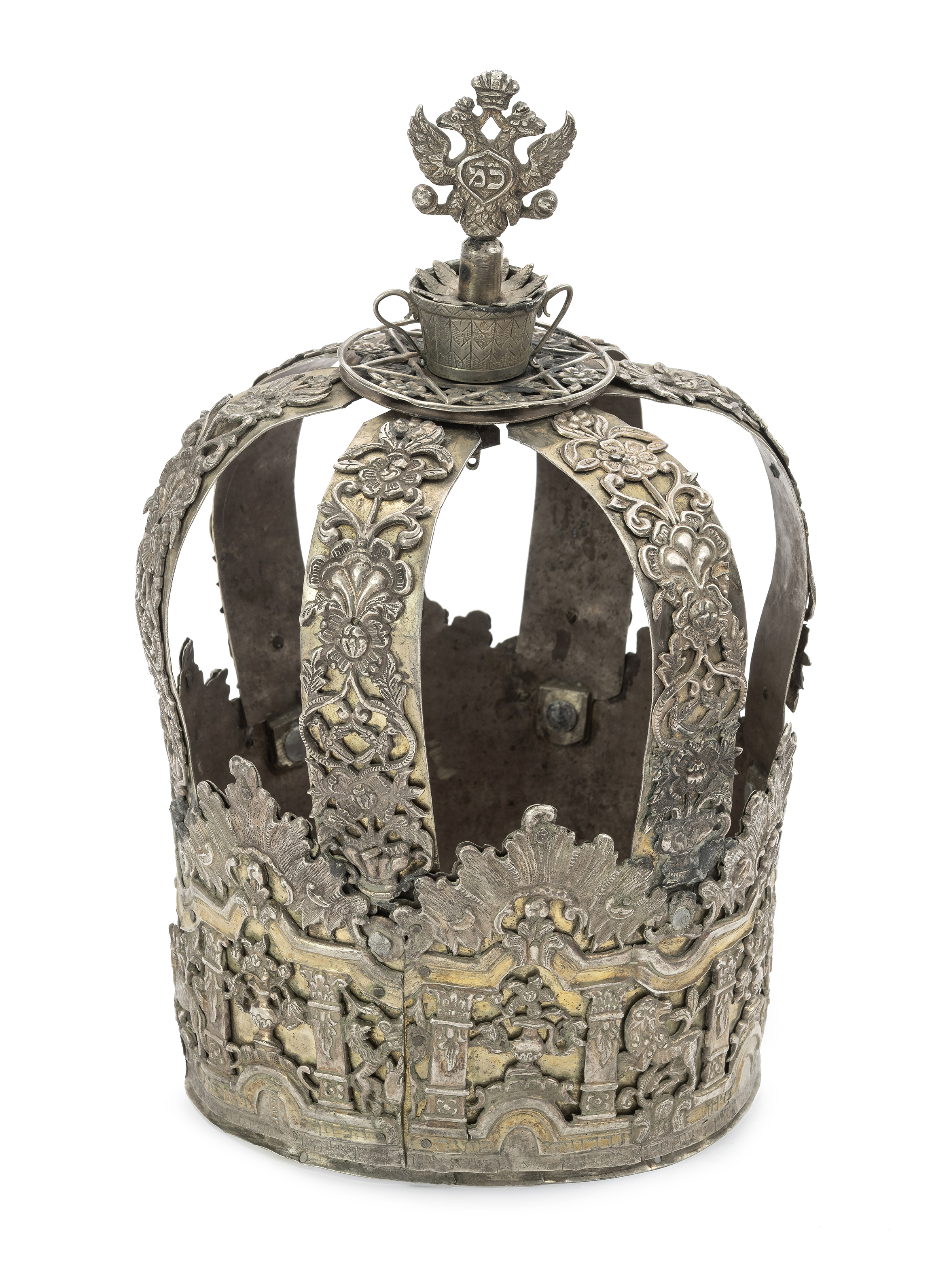
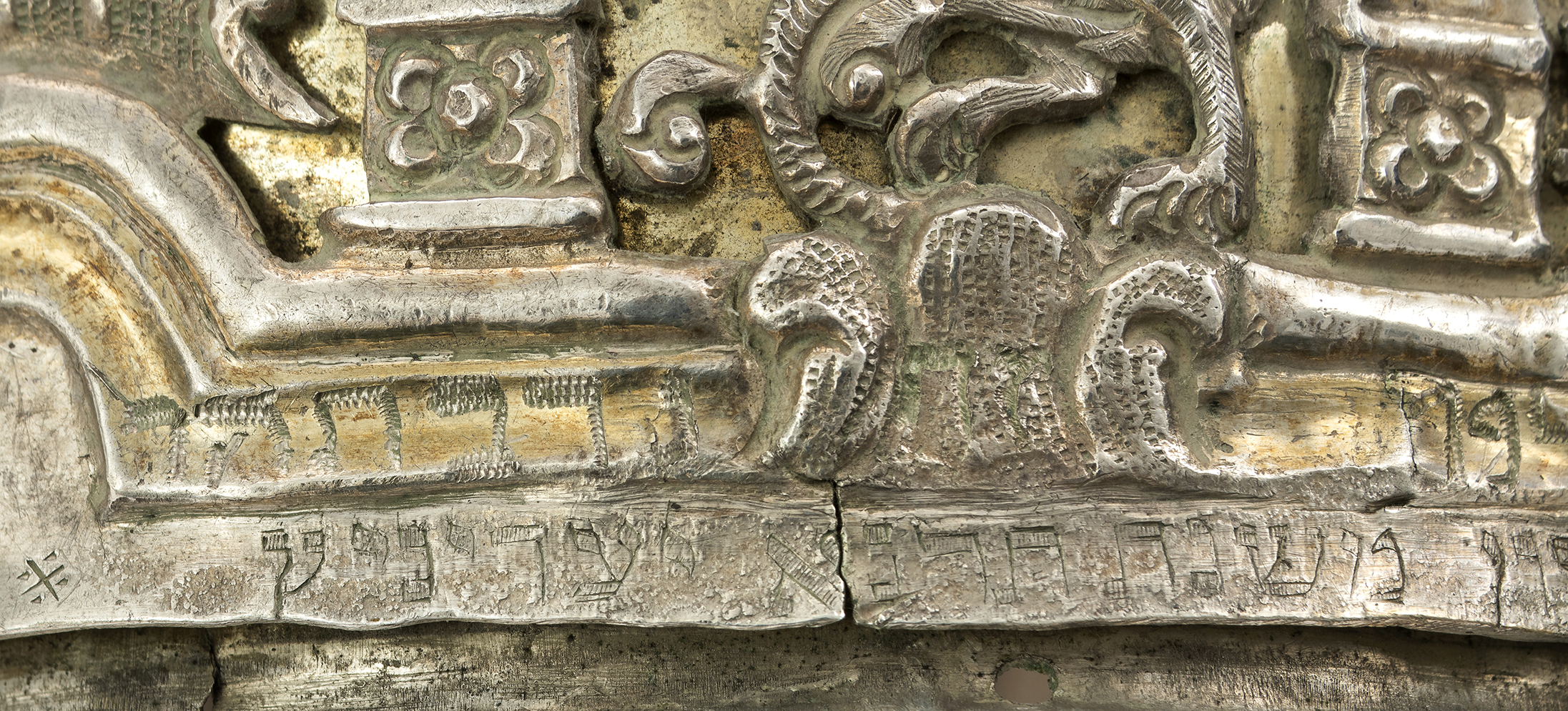
Torah crown. Kamenets-Podolsk (Kamianets-Podilskyi), Russian Empire (today Ukraine), 1872; dedicatory inscription from Edineț, Bessarabia, today Moldova, ca. 1890.
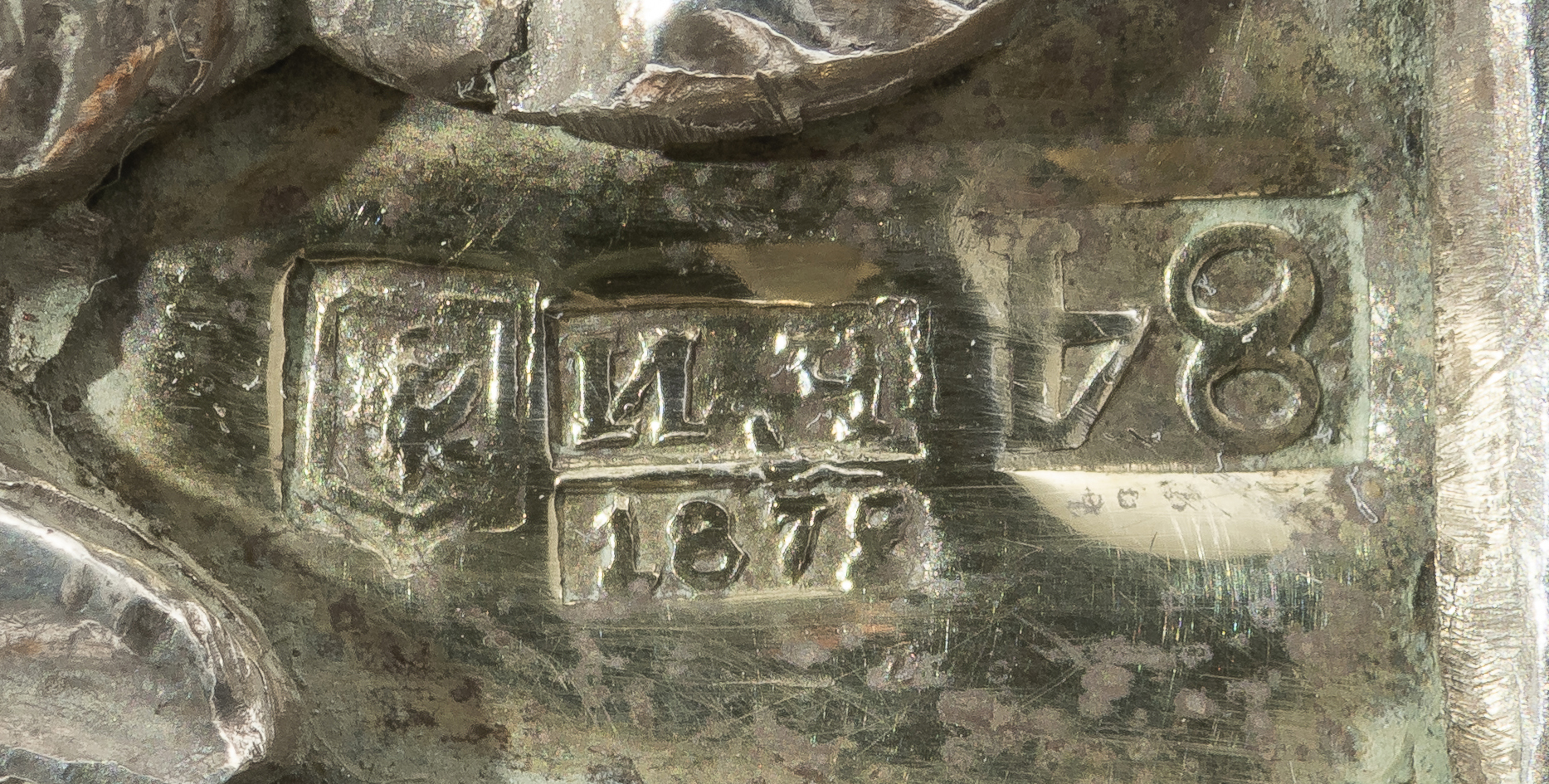
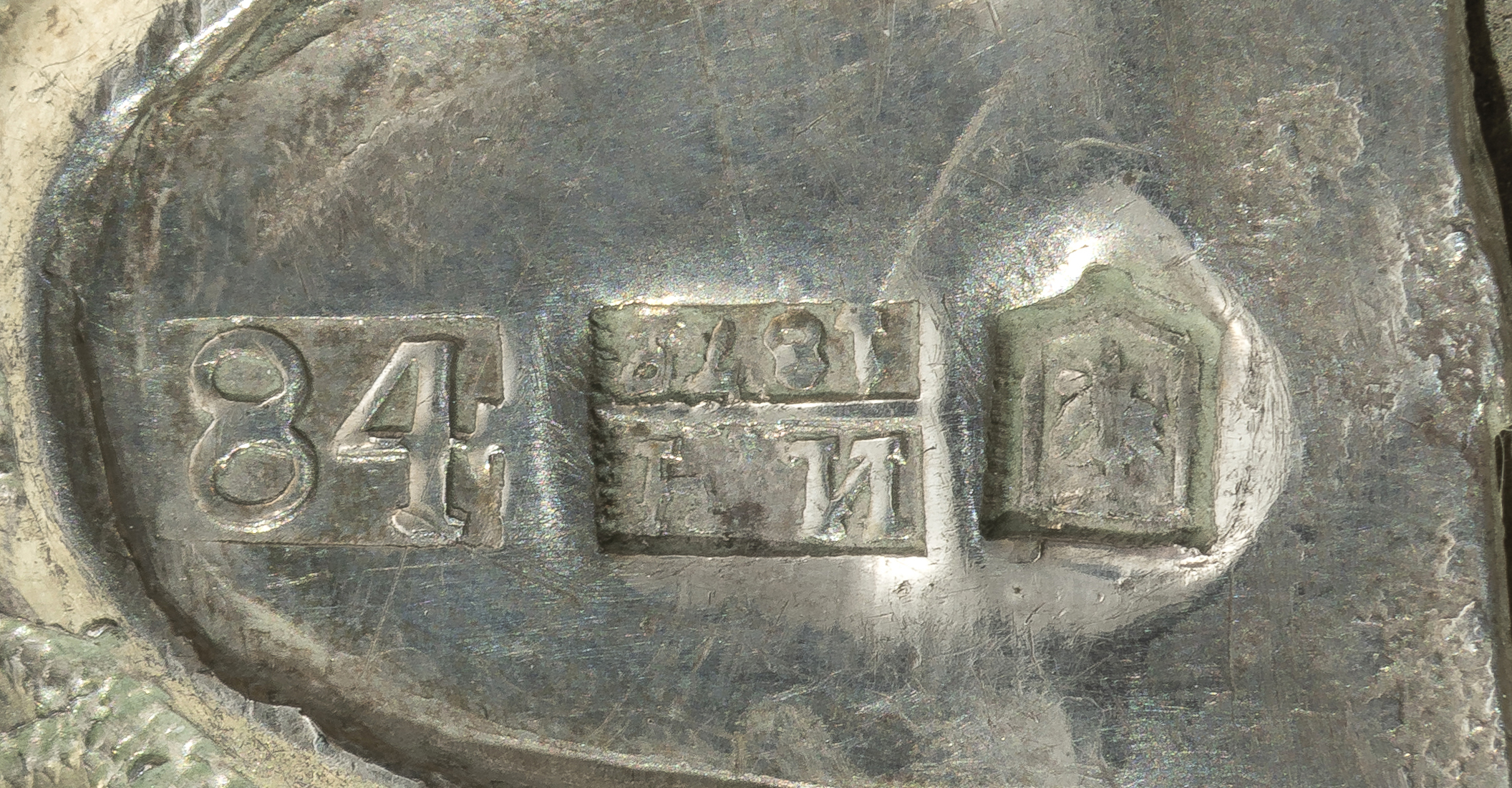
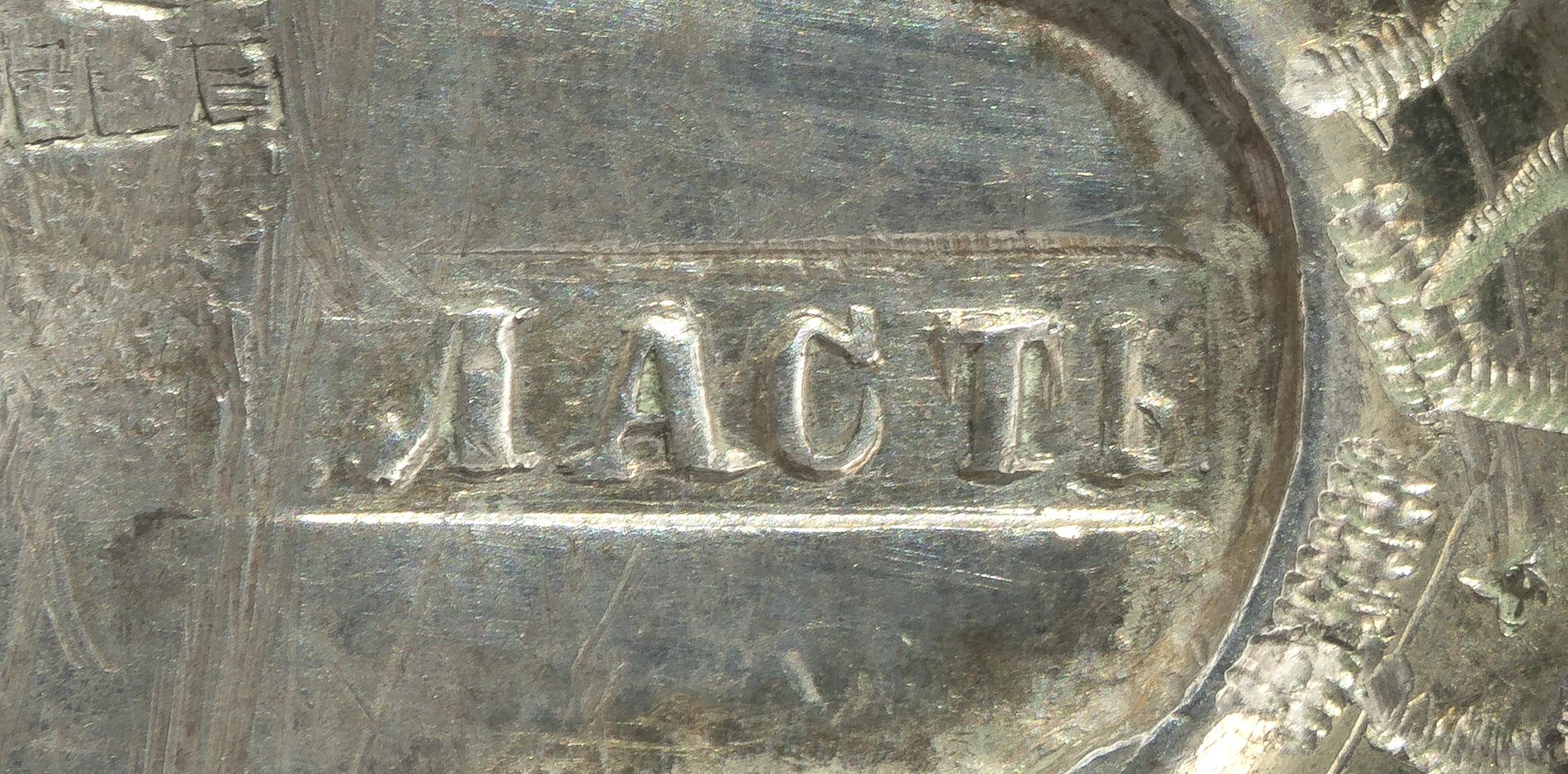
Silver, cut, stamped, and engraved (several hallmarks of Kamenets-Podolsk, assayer's marks of Ivan Chertenkov, dated 1872; and an additional, partial mark in Cyrillic script, apparently a maker’s mark); gilt.
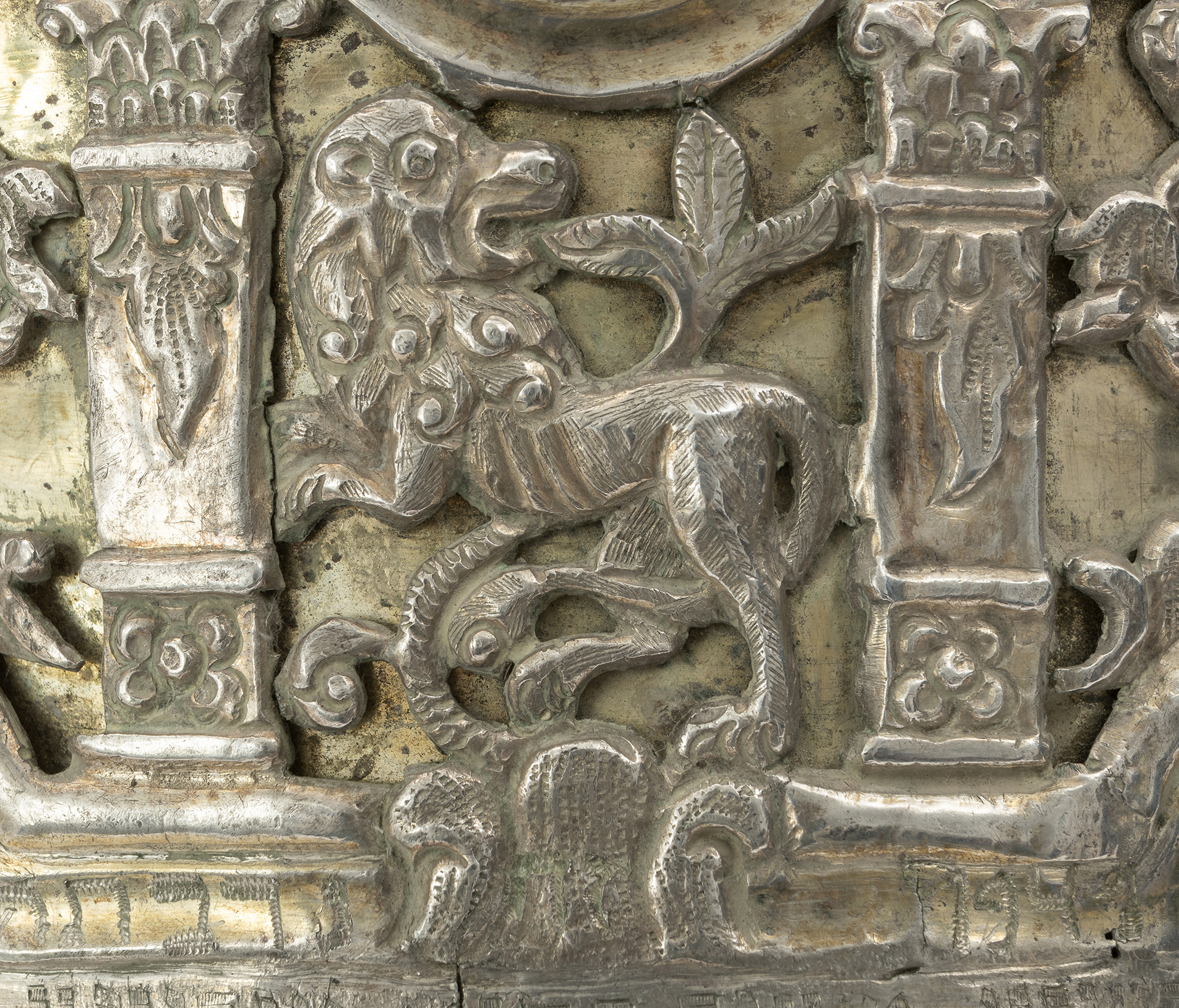
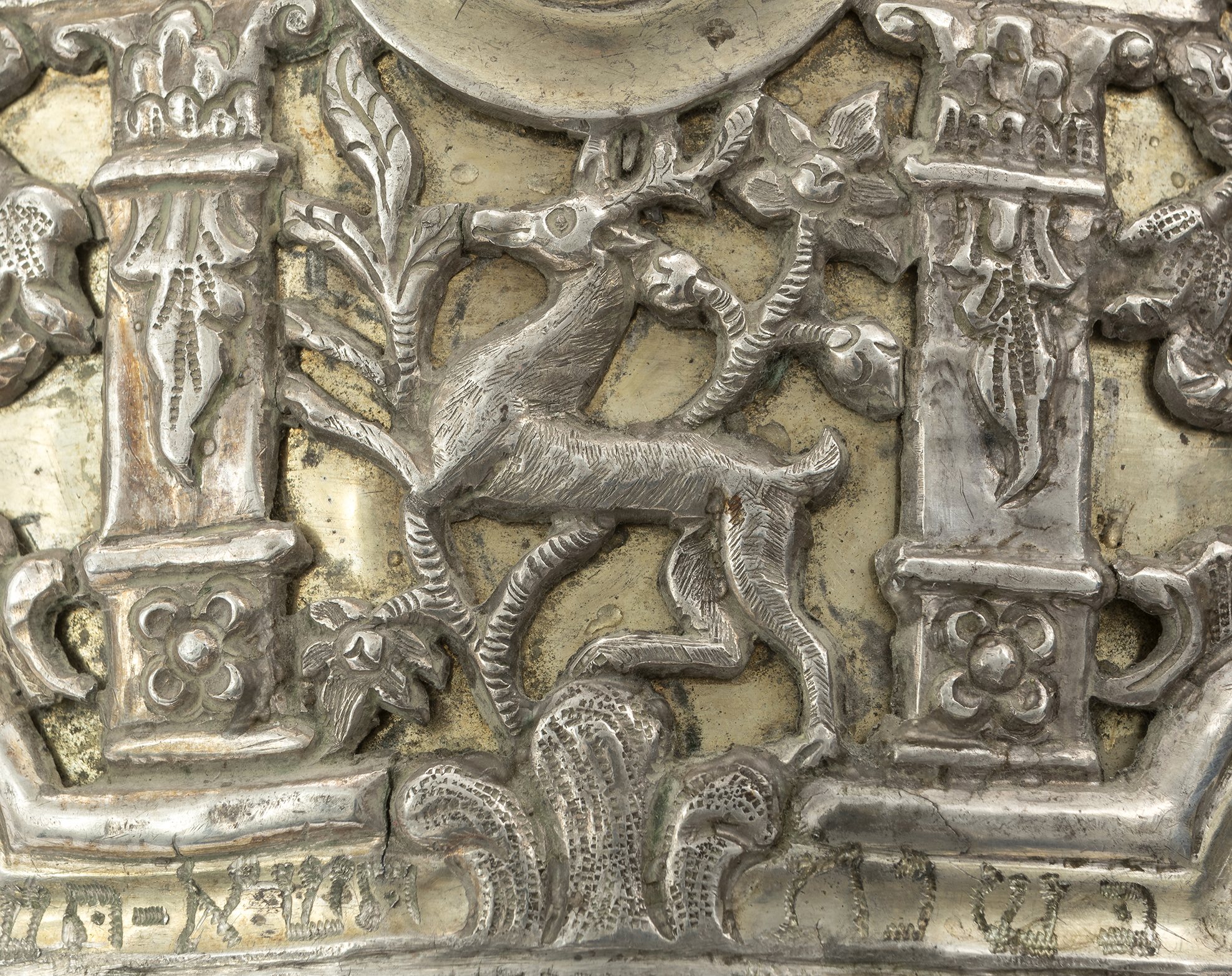
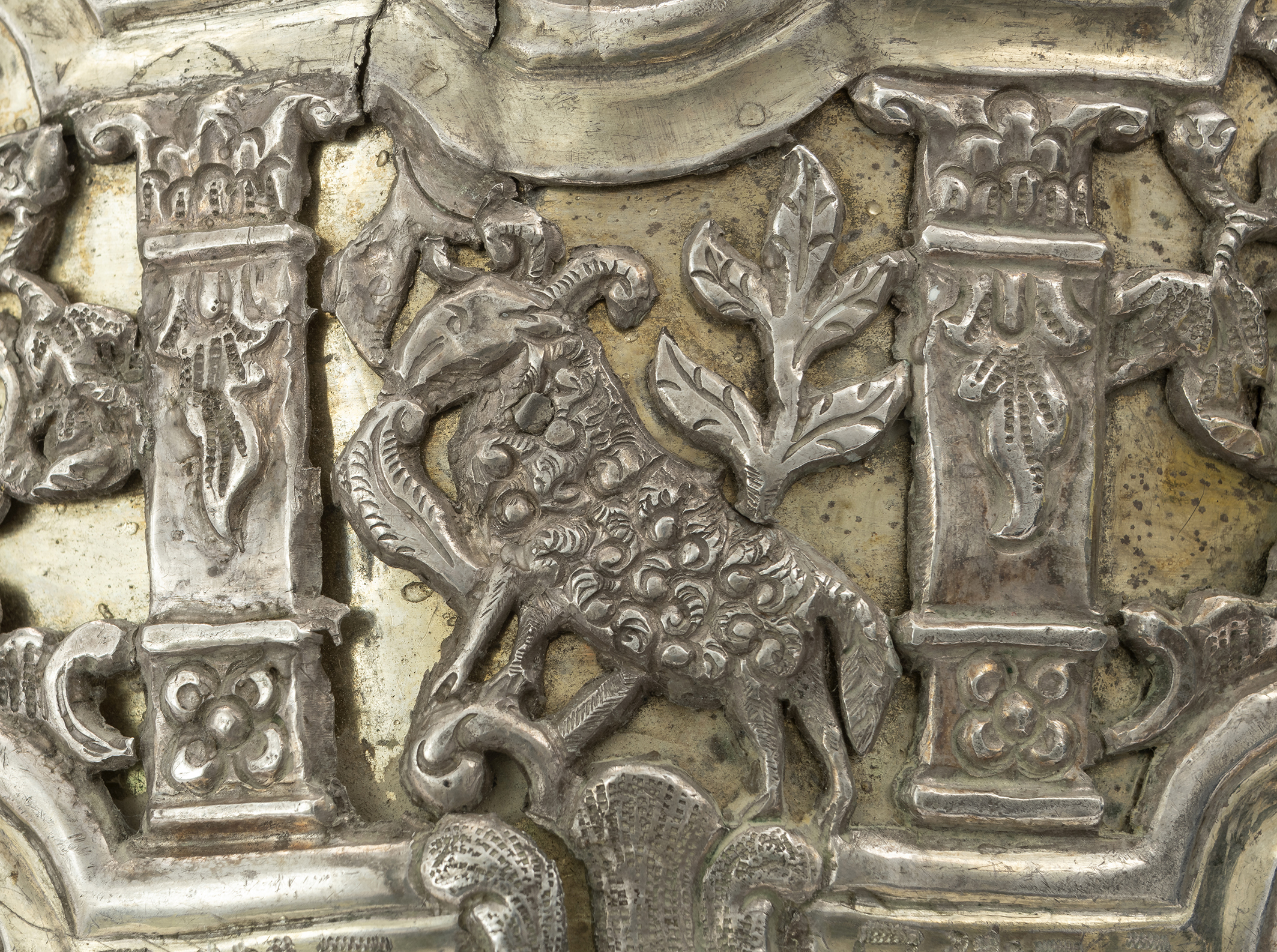
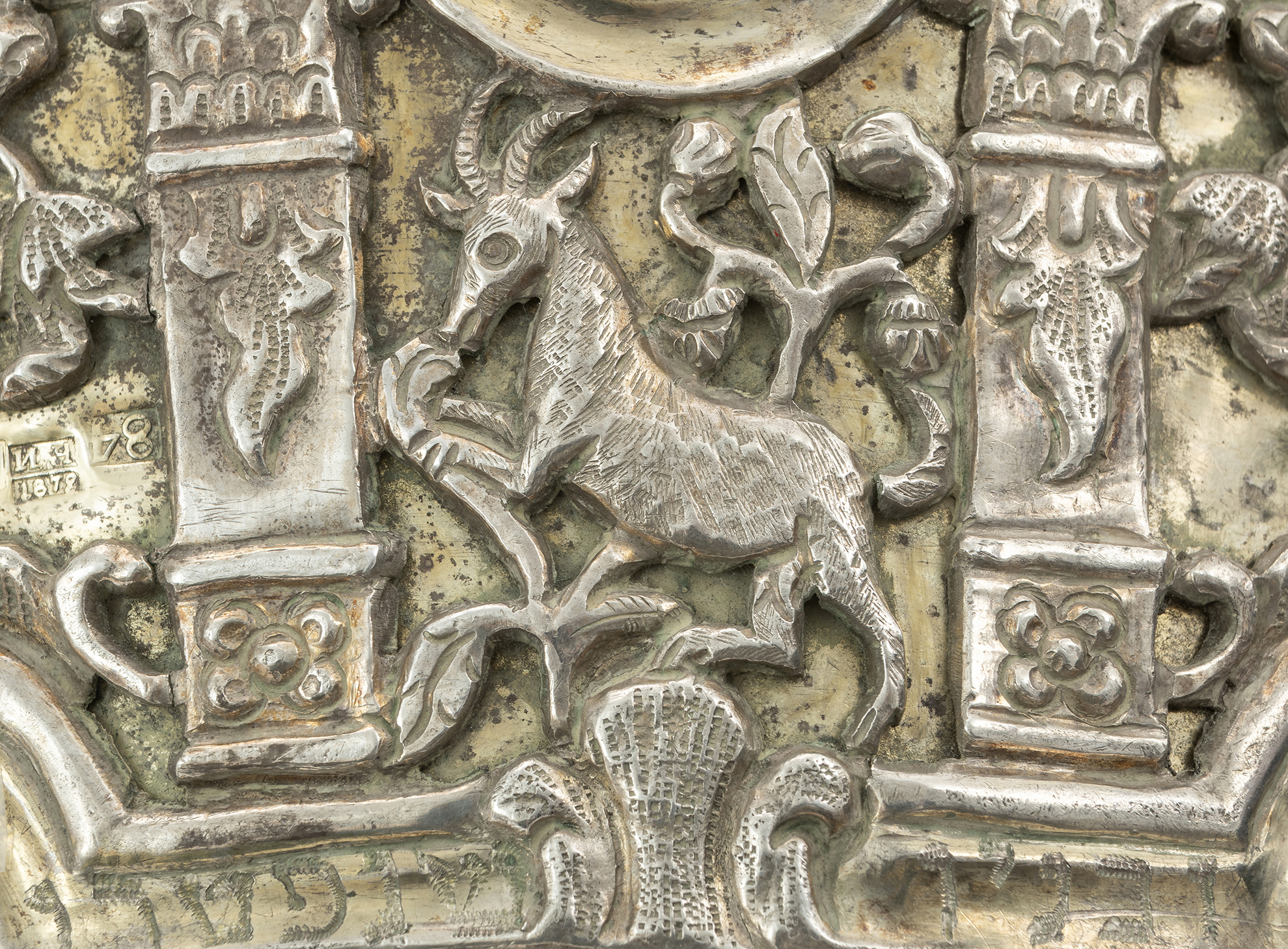
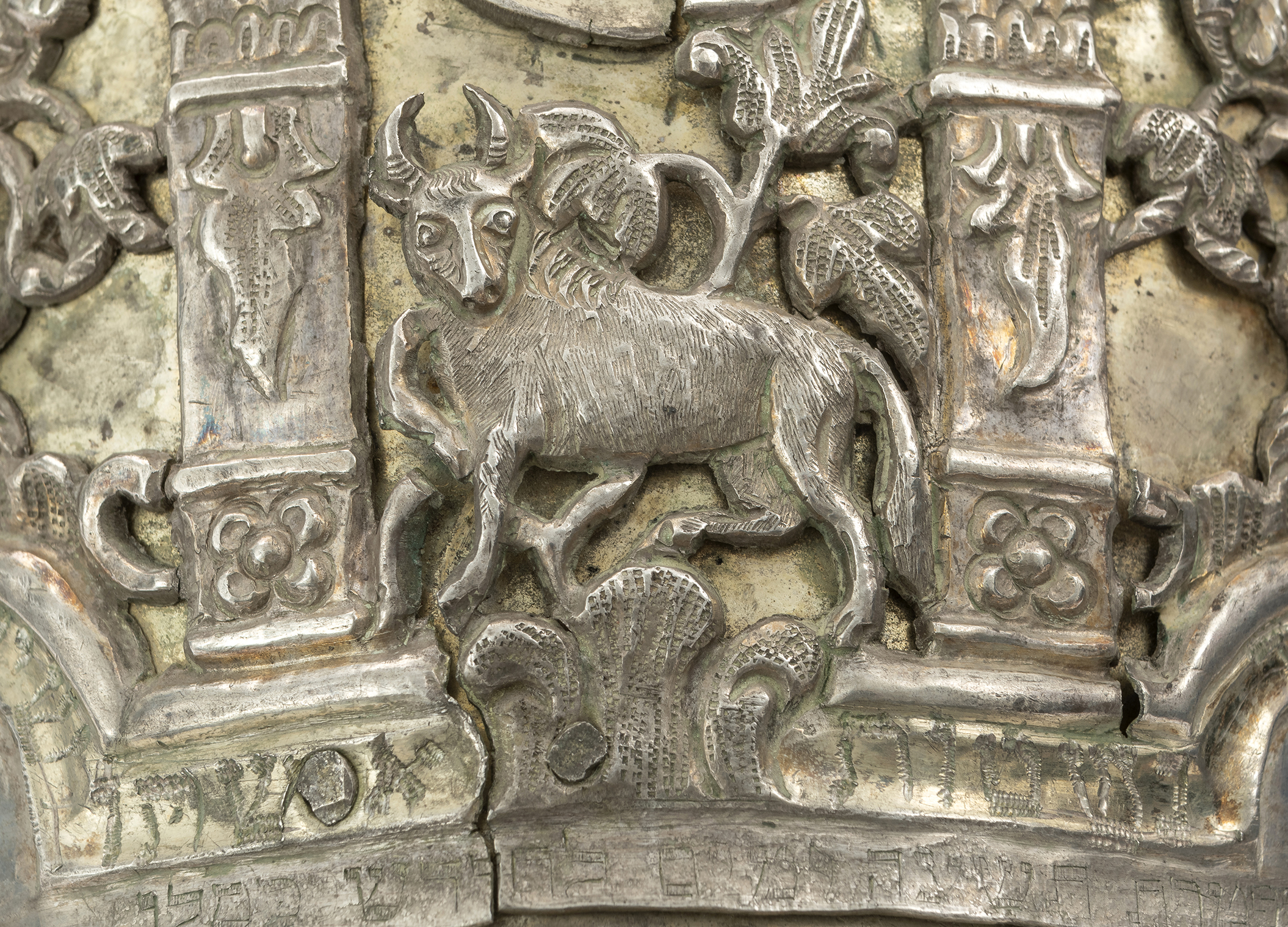
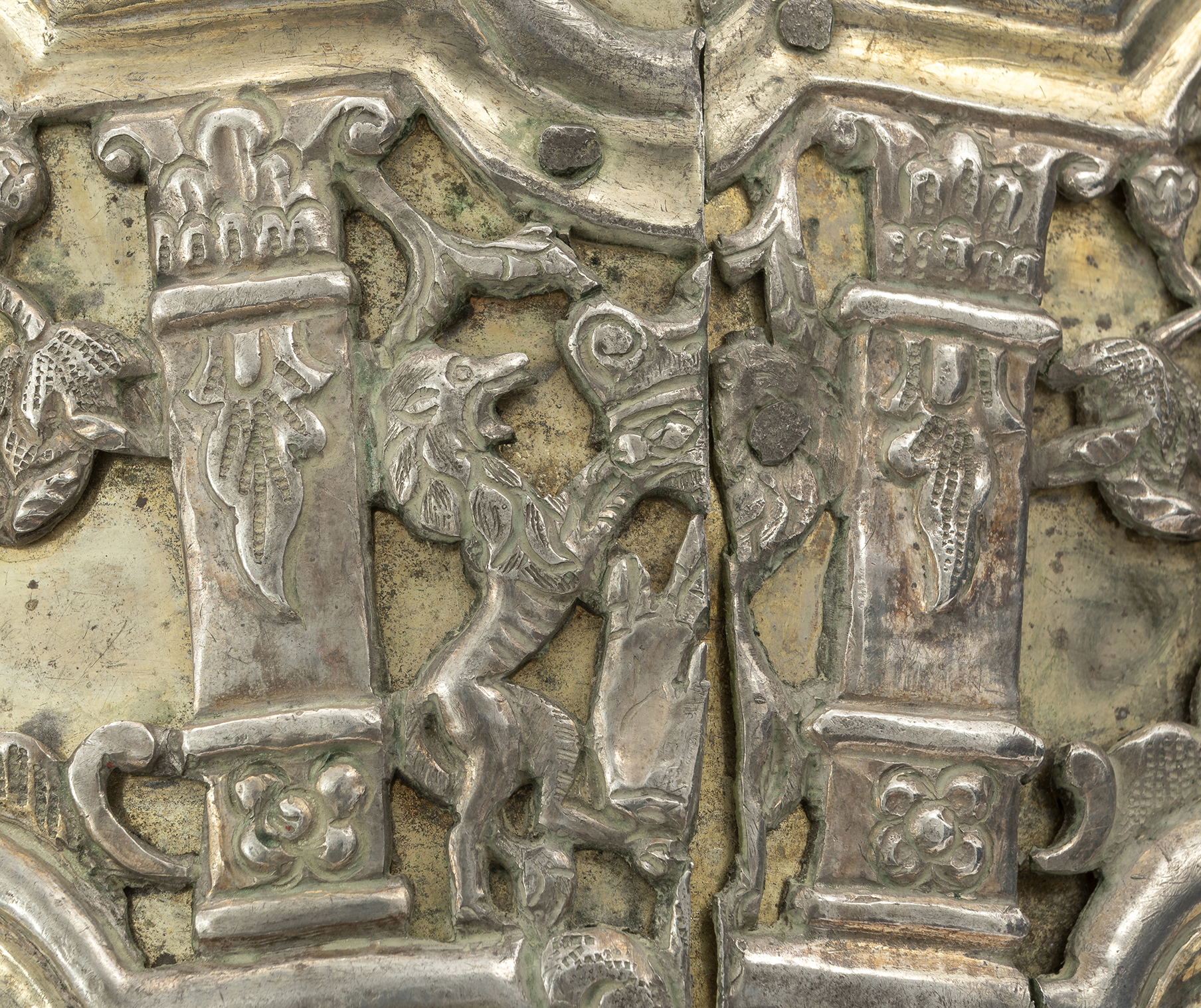
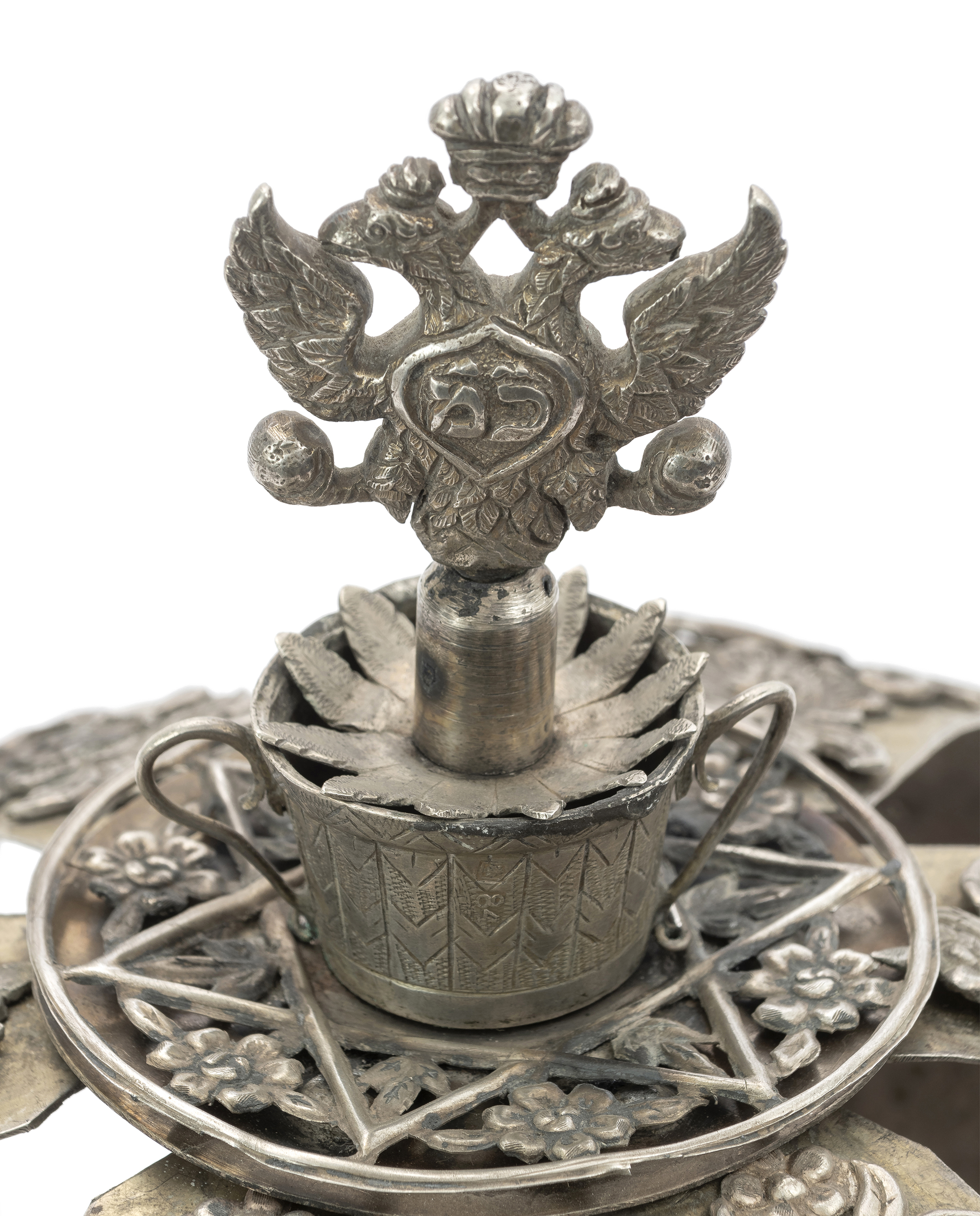
Large, magnificent Torah crown, with a design characteristic of such crowns from Galicia (southern Poland and Ukraine). With a tall, circular, gilt base. Onto this, figurative ornaments are attached with rivets. Prominent among these are a set of animals enclosed within frames consisting of architectonic columns and arches, including: an antelope under a tree, a ram, a deer, lions, and an ox. The animals are separated by vases of flowers, with vegetal patterns above them. The crown has six half-arches, decorated in a technique similar to that of the base, with matching vegetally-patterned ornaments attached, and with a pair of birds appearing on each half-arch. Above the half-arches is a flat ornament – an encircled Star of David – surmounted by pitcher with two handles. Inside the pitcher is another flat ornament – a flower – surmounted by a large, cast, crowned, two-headed eagle, imprinted on either face with the Hebrew initials "kaf-tav" and "kaf-mem" [representing "Keter Torah" and "Keter Malkhut" ("Crown of Torah" and "Crown of Royalty", respectively)].
Dedicatory inscriptions (Hebrew), dating from different periods, are engraved along the lower border. The clearer one is the upper inscription, dedicated to victims of the Holocaust: "This is a gift of Rabbi Moshe HaKohen for the sake of the souls of his wife Shayneh and his sons who perished in the year[s] 5701-5702, 1941"; Underneath this is one earlier inscription, "Henia Enid daughter of Shemuel HaLevi passed away 9th Kislev of year 5650 [1889]"; and an additional early inscription, faded and difficult to decipher, "Yitzhak Meir son of Menashe HaLevi Bronstein, passed away 6th Cheshvan of year 5651 [1890] Edineț".
Some 7,379 Jews lived in Edinet, northern Moldova, in 1897; at this time, Jews represented roughly 70% of the population of the town. But the Jewish population steadily declined up until WWII, whereupon many Jews were murdered, while the remainder were concentrated in the town ghetto from where they were deported to Transnistria.
Both the decorative technique and figurative motifs characterizing the present crown can be found in various Torah crowns originating from Galicia and dating from the 18th and 19th centuries. Similar Torah crowns, from the collection of the Museum of Historical Treasures of Ukraine (today the Treasury of the National Museum of the History of Ukraine), Kiev, were put on display at an exhibition at the Kunsthistorisches Museum Wien (KHM Vienna) in 1993. For comparison, see: Wilfried Seipel, ed., "Thora und Krone: Kultgeräte der jüdischen Diaspora in der Ukraine: eine Ausstellung des Kunsthistorischen Museums Wien", exhibition catalogue, Kunsthistorisches Museum, Vienna, 1993 (German), Kat. Nr. 5 (pp. 70-71), Kat. Nr. 9 (pp. 82-83).
Height: 30 cm. Diameter at base: 14-17 cm. Maximal width: 18.5 cm. Weight: 1161 g. Fair-good condition. Slight deformities and minor warping. Cracks and fractures to silver in several spots, several missing pieces, particularly to ornaments near bases of half-arches. Old soldering repairs, fractures, and more recent screws to joints of half-arches. Loose screw joints and more recent nut to attachment of uppermost ornament. Bell missing from upper ornament. Minor fractures to silver ornaments along base, but most figurative ornaments intact.
Category
Torah Ornaments, Synagogue Items
and Various Objects
Catalogue Value
![Torah crown. [Produced in the Bezalel School, Jerusalem or Ben Shemen, ca. 1912 (unmarked)]; dedicated to a synagogue in Gr](https://files.kedem-auctions.com/files/Sale107/15_1.jpg "Rare Torah Crown Produced by Bezalel – Jerusalem or Ben Shemen, Ca. 19")
![Torah crown. [Produced in the Bezalel School, Jerusalem or Ben Shemen, ca. 1912 (unmarked)]; dedicated to a synagogue in Gr](https://files.kedem-auctions.com/files/Sale107/15_2-WEB.jpg "Rare Torah Crown Produced by Bezalel – Jerusalem or Ben Shemen, Ca. 19")
![Torah crown. [Produced in the Bezalel School, Jerusalem or Ben Shemen, ca. 1912 (unmarked)]; dedicated to a synagogue in Gr](https://files.kedem-auctions.com/files/Sale107/15_3.jpg "Rare Torah Crown Produced by Bezalel – Jerusalem or Ben Shemen, Ca. 19")
![Torah crown. [Produced in the Bezalel School, Jerusalem or Ben Shemen, ca. 1912 (unmarked)]; dedicated to a synagogue in Gr](https://files.kedem-auctions.com/files/Sale107/15_4.jpg "Rare Torah Crown Produced by Bezalel – Jerusalem or Ben Shemen, Ca. 19")
Auction 107: Rare and Important Items
Apr 15, 2026
Opening: $5,000
Estimate: $20,000 - $30,000
Sold for: $25,000
Including buyer's premium
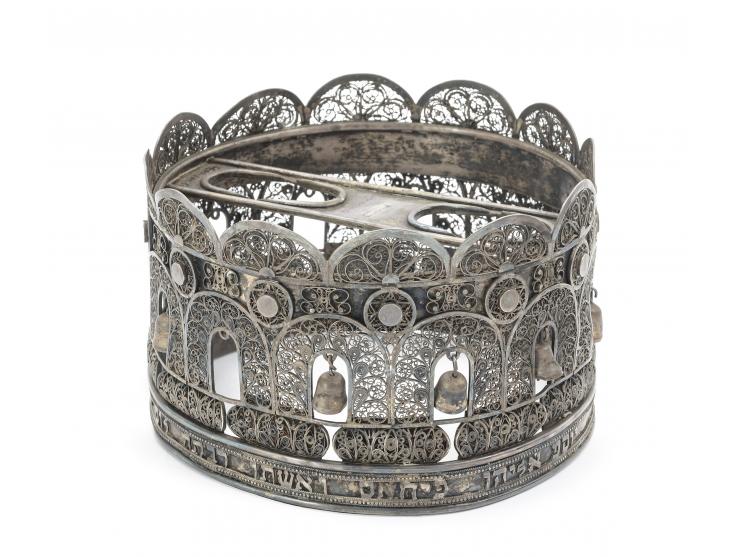
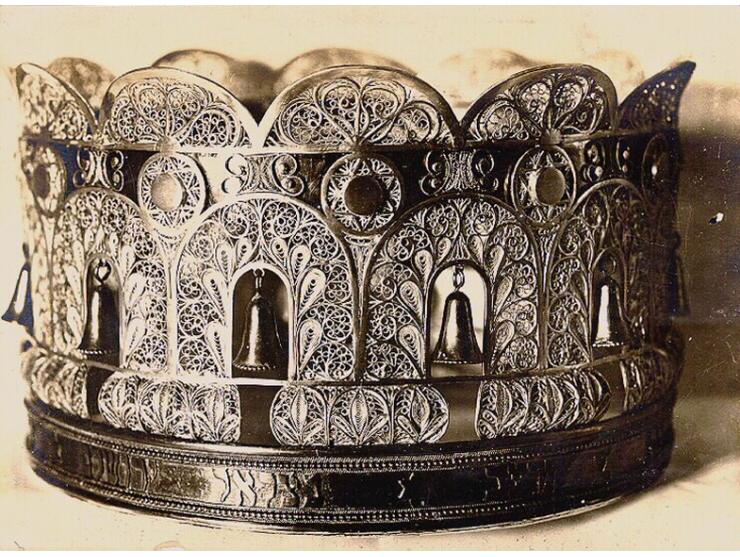
Torah crown. [Produced in the Bezalel School, Jerusalem or Ben Shemen, ca. 1912 (unmarked)]; dedicated to a synagogue in Greece, possibly Rhodes.
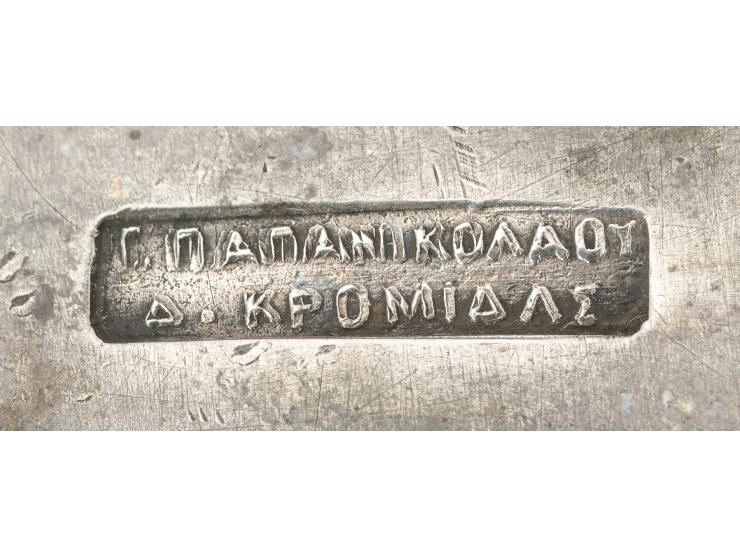
Silver, pierced and sawn (internal fitting marked in Greek: Γ. ΠΑΠΑΝΙΚΟΛΑΟΥ / Δ. ΚΡΟΜΙΔΑΣ [= G. PAPANIKOLAOU / D. KROMIDAS]); filigree.
High-quality and rare Torah crown created in the silver filigree department of the Bezalel School, used to adorn a Torah scroll in a synagogue in Greece.
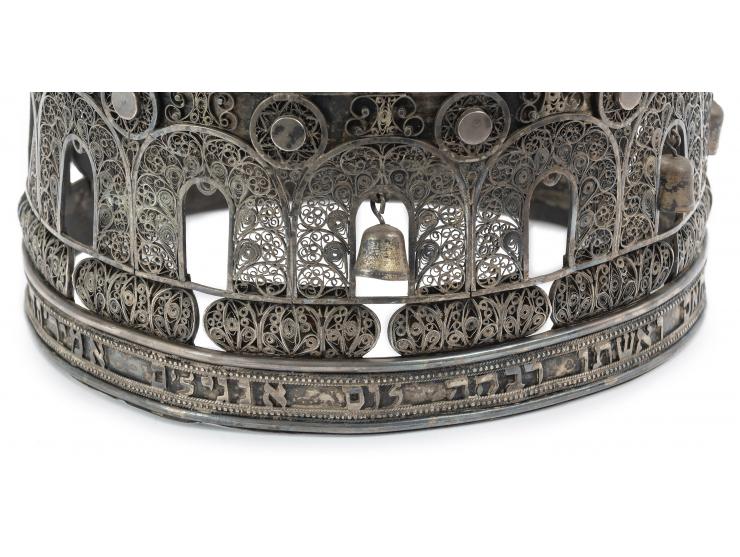
A heavy cylindrical crown, open at the base and top. The structure is based on two broad internal silver bands, to which outward-facing filigree ornaments are affixed with rivets. It is decorated with twelve filigree arches resting on wide bases, from which hang suspension rings with bells. Between the arches are affixed circular filigree medallions set with a Star of David motif. The upper rim is surmounted by twelve additional arched ornaments.
On the inner side of the crown – near the upper rim – a rectangular silver bar is soldered, with two oval apertures for the Torah scroll staves (this fitting was apparently added in Greece; the Greek silversmiths’ marks appear on it).
A dedicatory inscription appears near the base, in hand-sawn silver letters: "Yosef Eliyahu Pihas and his wife Rivkah Los Angeles America", followed by six small soldered Star of David ornaments.
Added note:
It is likely that the couple in question are Joseph (1883-1973) and Rebecca (1887-1974) Peha (or Piha) of Los Angeles. The gravestone of the couple is documented on the website Find a Grave; Joseph Piha is also mentioned as one of the members of the Sephardic Jewish community of Rhodes who immigrated to Los Angeles, United States, in the early 20th century (see: Western States Jewish Historical Quarterly, Vol. VI, No. 4, July 1974, p. 245).
It is likely that the couple in question are Joseph (1883-1973) and Rebecca (1887-1974) Peha (or Piha) of Los Angeles. The gravestone of the couple is documented on the website Find a Grave; Joseph Piha is also mentioned as one of the members of the Sephardic Jewish community of Rhodes who immigrated to Los Angeles, United States, in the early 20th century (see: Western States Jewish Historical Quarterly, Vol. VI, No. 4, July 1974, p. 245).
An identical crown is illustrated in the price list of Bezalel objects printed in Berlin, ca. 1913. It is the most expensive item listed in that catalogue, priced at 400-500 marks. Aside from the example documented there, no other copies of this model are known to us.
The Bezalel silver filigree department was established in 1908 and operated intensively during Bezalel’s "years of prosperity" (1908-1912). Although initially employing no more than four craftsmen, the Yemenite silversmiths’ colony was founded in Ben Shemen in 1911; the workforce expanded significantly and production increased accordingly. However, in 1913 the colony encountered financial difficulties and was ultimately closed in early 1914.
The combination of the Greek silversmiths’ marks on the internal fitting and the wording of the dedicatory inscription indicates that the crown was acquired or commissioned from Bezalel for a synagogue in Greece, apparently Rhodes. The name of the silversmith Demetrid Kromidas (or Kromidis) also appears on another Torah crown produced in Rhodes in the 19th century (see: Kedem, Auction 103, 1 September 2025, Lot 34).
Hand-sawn silver letters likewise appear on other Bezalel objects produced during this period, as well as on the crown illustrated in the above-mentioned price list.
Height: 15 cm. Diameter: 23 cm. Weight: 1870 g. Good condition. Minor bends. Minor blemishes to filigree, with several tiny elements missing. Slight corrosion to filigree in two areas and minor solder repairs. Seven bells missing. Minor fractures and traces of solder visible on the interior at the base; it is possible that the silver bar was originally positioned at the base of the crown rather than near the top.
Reference:
· Preisverzeichnis der Erzeugnisse der Kunstgewerbeschule Bezalel in Jerusalem, Berlin: Verein Bezalel, ca. 1913, no. 201, pages 8 and 15.
· Nurit Shilo-Cohen, Bezalel 1906-1929, Jerusalem, 1982, pp. 55, 151-152 (Hebrew edition).
Category
Torah Ornaments, Synagogue Items
and Various Objects
Catalogue Value
![Pair of Torah finials. Amsterdam, the Netherlands, [ca. 1750-1770].
Silver, cast, repoussé, pierced and engraved](https://files.kedem-auctions.com/files/Sale107/16_1.jpg "Pair of Torah Finials – The Netherlands, 18th Century")
![Pair of Torah finials. Amsterdam, the Netherlands, [ca. 1750-1770].
Silver, cast, repoussé, pierced and engraved](https://files.kedem-auctions.com/files/Sale107/16_2-WEB.jpg "Pair of Torah Finials – The Netherlands, 18th Century")
![Pair of Torah finials. Amsterdam, the Netherlands, [ca. 1750-1770].
Silver, cast, repoussé, pierced and engraved](https://files.kedem-auctions.com/files/Sale107/16_3-WEB.jpg "Pair of Torah Finials – The Netherlands, 18th Century")
![Pair of Torah finials. Amsterdam, the Netherlands, [ca. 1750-1770].
Silver, cast, repoussé, pierced and engraved](https://files.kedem-auctions.com/files/Sale107/16_5.jpg "Pair of Torah Finials – The Netherlands, 18th Century")
Auction 107: Rare and Important Items
Apr 15, 2026
Opening: $20,000
Estimate: $30,000 - $50,000
Sold for: $40,000
Including buyer's premium
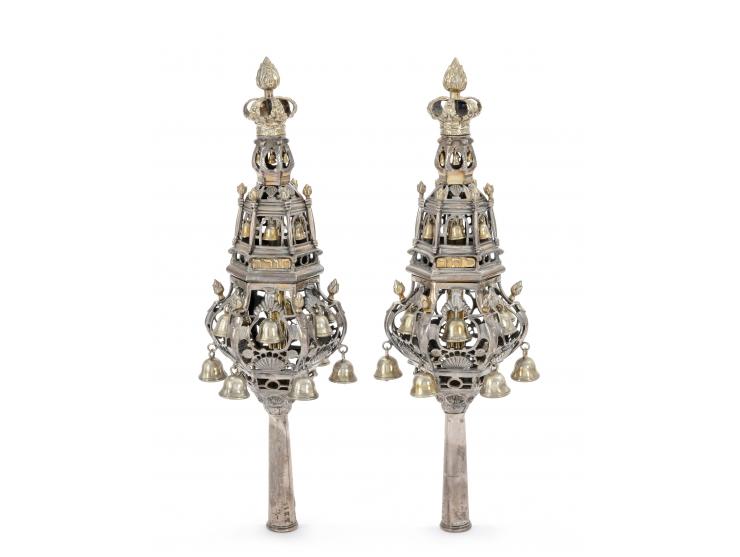
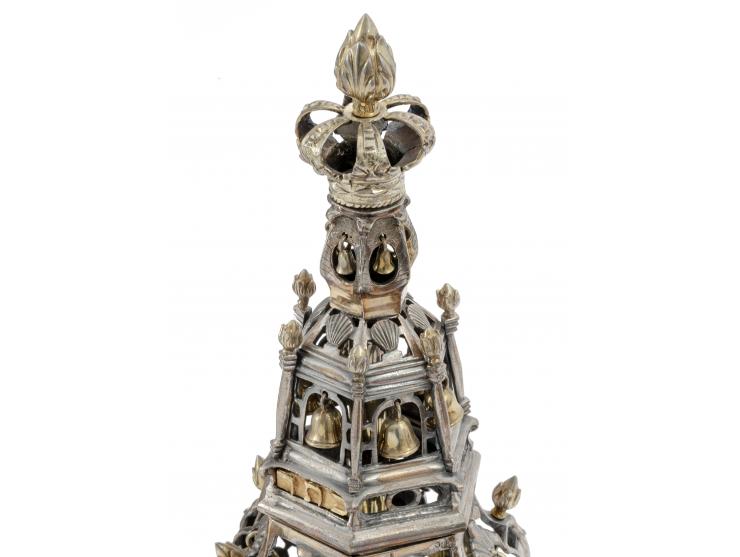
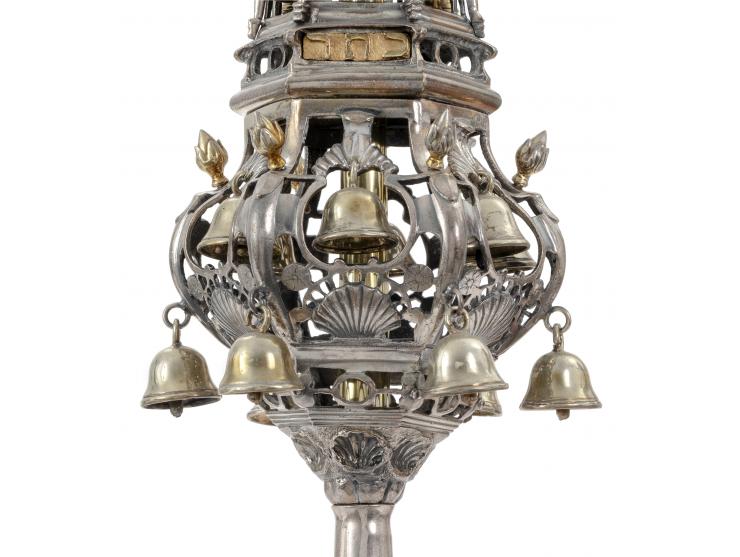
Pair of Torah finials. Amsterdam, the Netherlands, [ca. 1750-1770].
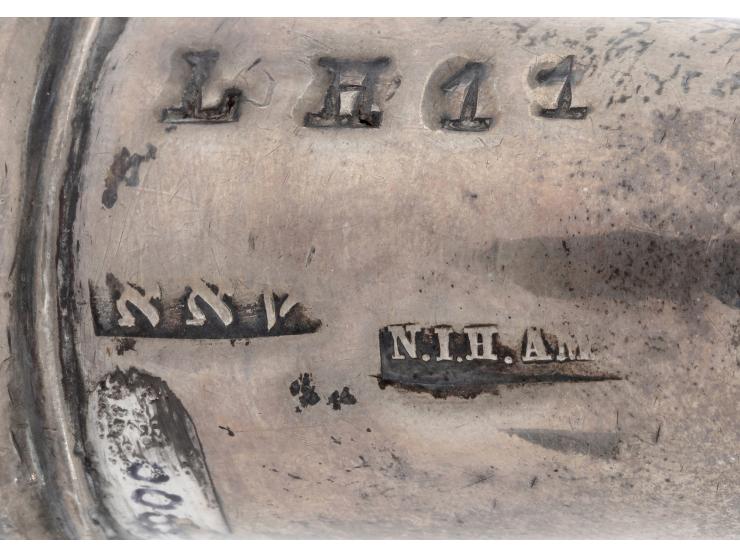
Silver, cast, repoussé, pierced and engraved (unmarked; at bottom, marks of Ashkenazic community of Amsterdam "NIH AMST" [Nederlands-Israelitische Hoofdsynagoge Amsterdam] in Hebrew and Latin characters, serial number LH11 [Lange Houtstraat]); gilt.
Stylized as hexagonal towers, characteristic of Dutch Torah finials from the 17th and 18th centuries. Decorated in gilt shell and blossom patterns. Each finial is set with two gilt silver plaques reading "Keter Torah".
The Lange Houtstraat synagogue in Amsterdam was built in 1894, founded after an earlier synagogue established by the Gemilut Chasadim Society in 1726. During World War II, the synagogue and its surroundings were severely damaged, and the structure was destroyed.
Height: 41 cm. Width: 11 cm. Weight: 2118 g. Overall good condition. Minor warping and defects. Some bells lacking.
For similar finials dated to the 1760s, see: Jewish Museum, Amsterdam, items C0404, C0488.
Provenance:
1. Lange Houtstraat synagogue, Ashkenazic community in Amsterdam, NIHS (Nederlands-Israëlitische Hoofdsynagoge Amsterdam).
2. Sotheby's, New York, 13 December 2006, Lot 108.
Category
Torah Ornaments, Synagogue Items
and Various Objects
Catalogue Value
Auction 107: Rare and Important Items
Apr 15, 2026
Opening: $3,000
Estimate: $8,000 - $10,000
Sold for: $7,500
Including buyer's premium
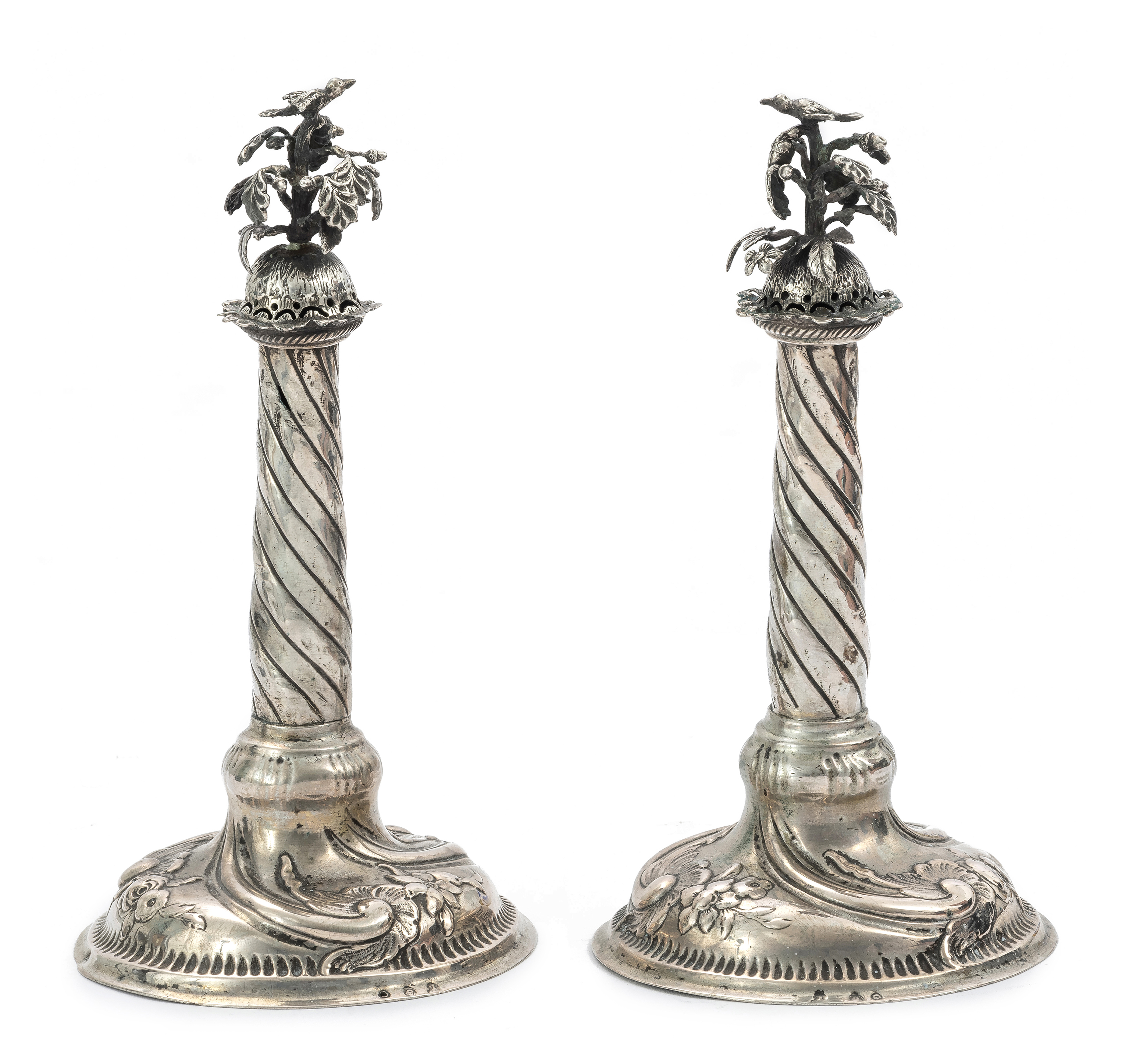
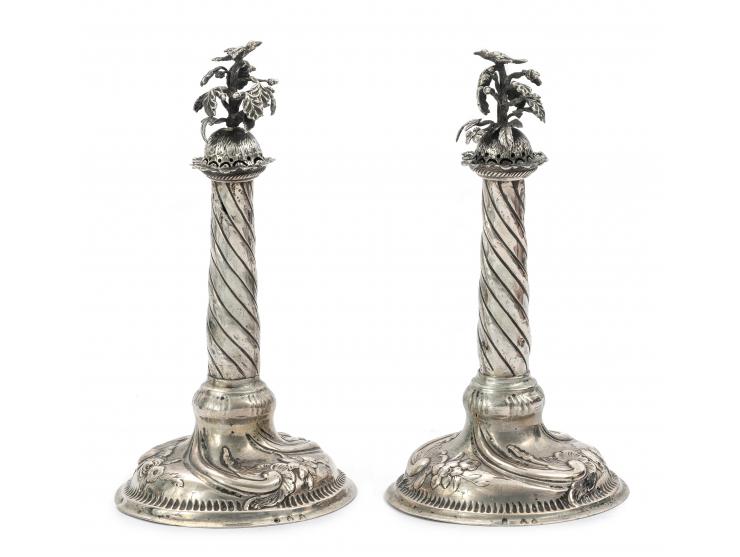
Pair of Torah finials. Breslau, Germany (today Wrocław, Poland), 18th century.
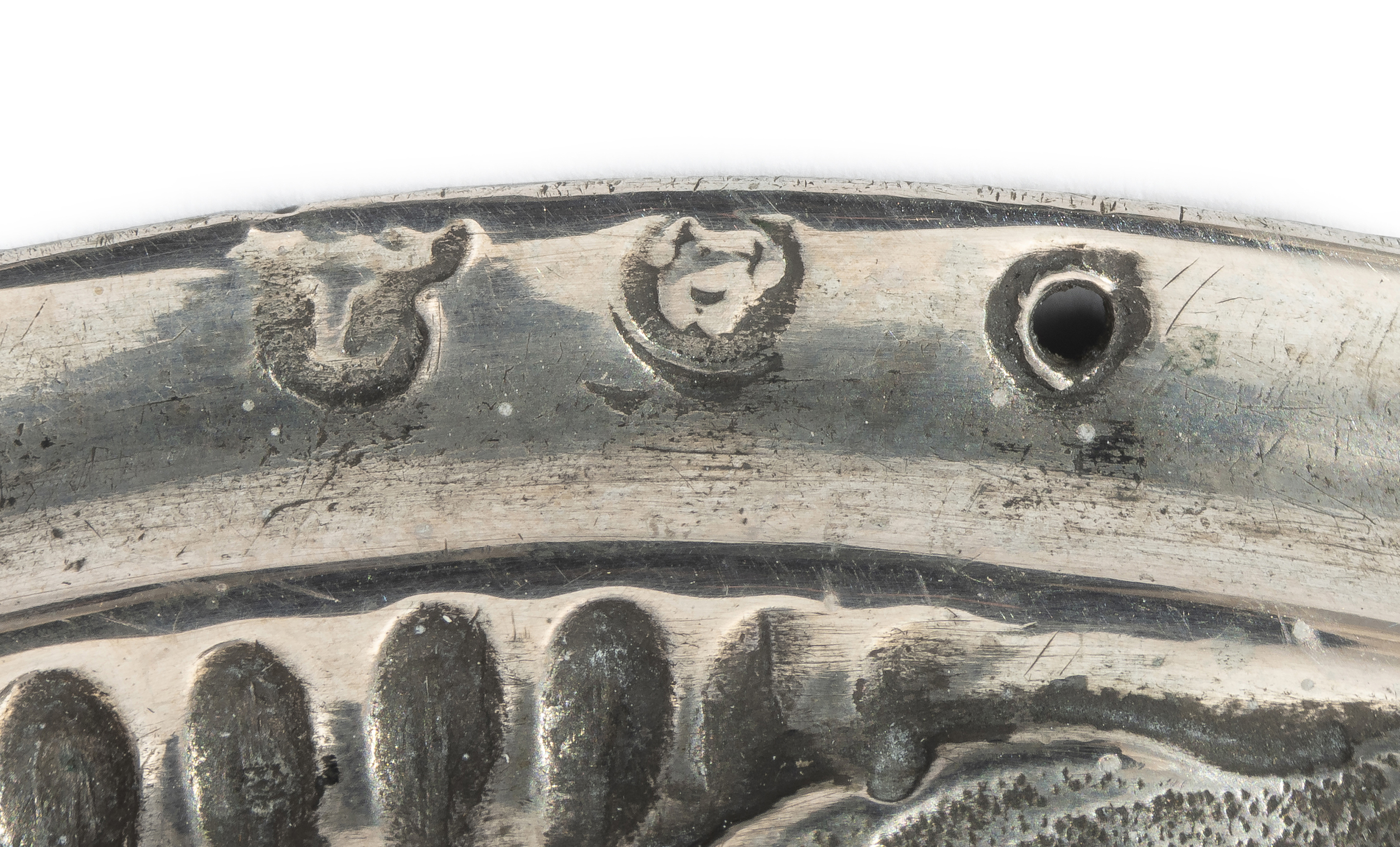
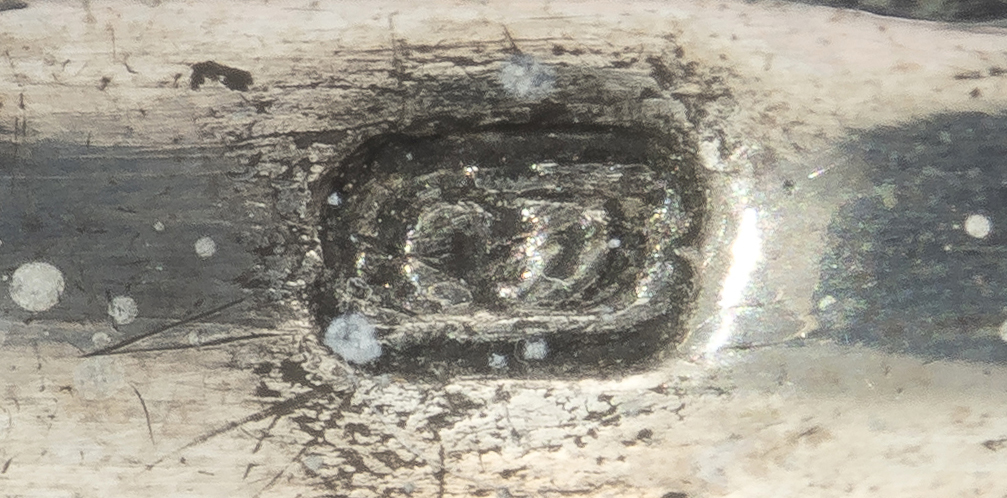
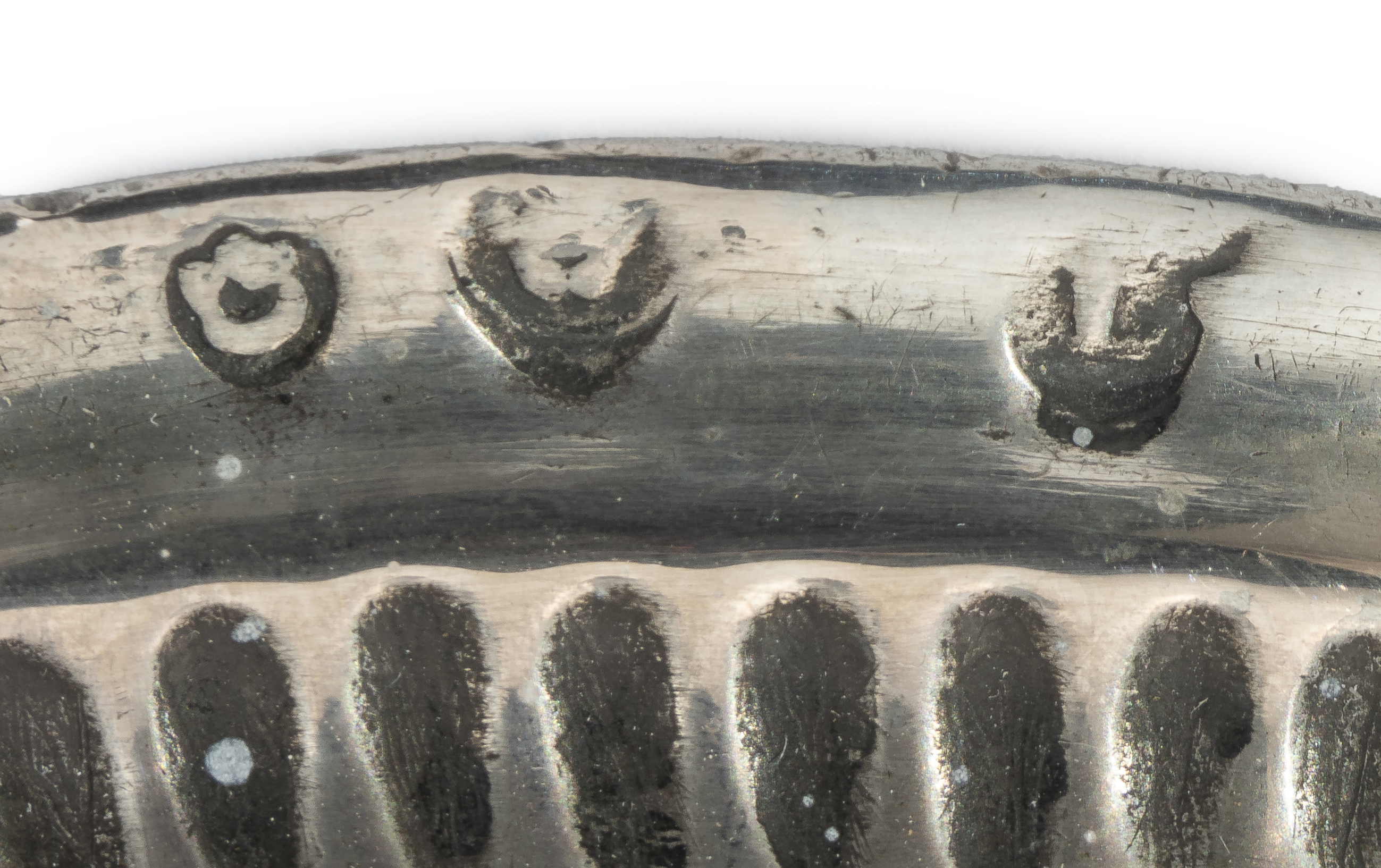
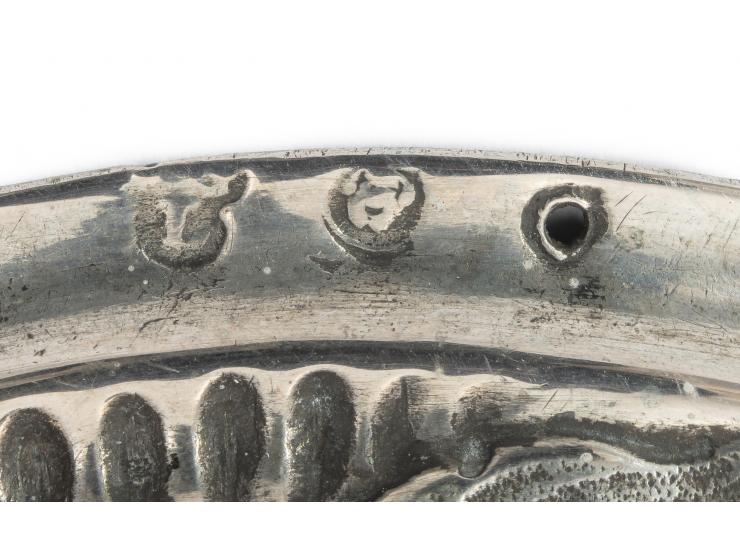
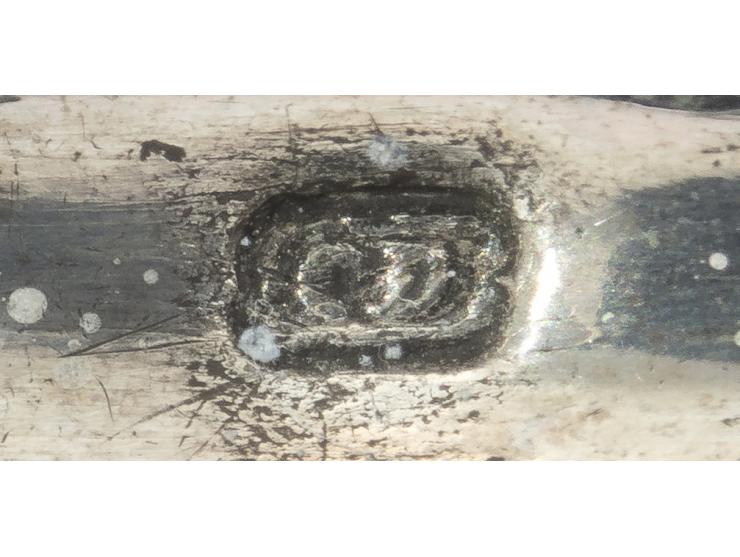
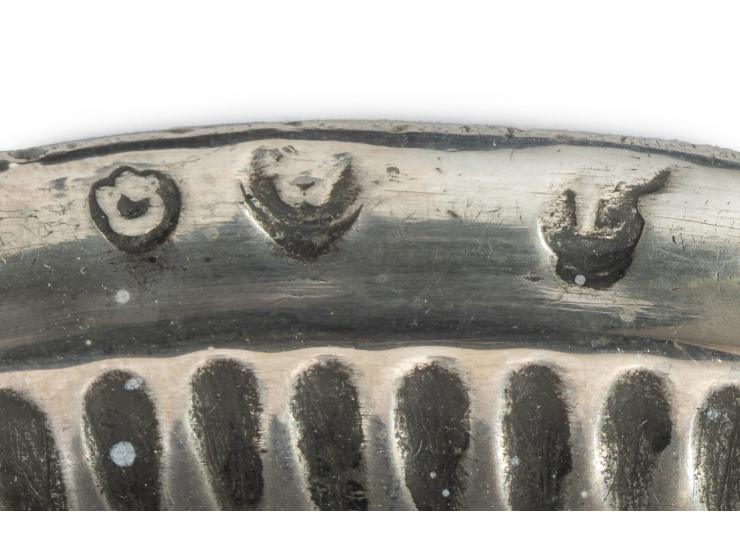
Silver, cast, repoussé, and pierced (marked with Breslau city mark; year mark – possibly the letter "G" – in use in years 1761-1776; partial maker’s mark, perhaps Joseph Gottlieb Lederhorse, active 1765-1817; and tax mark from Lemberg [Lwów, Lviv], in use in years 1806-1807).
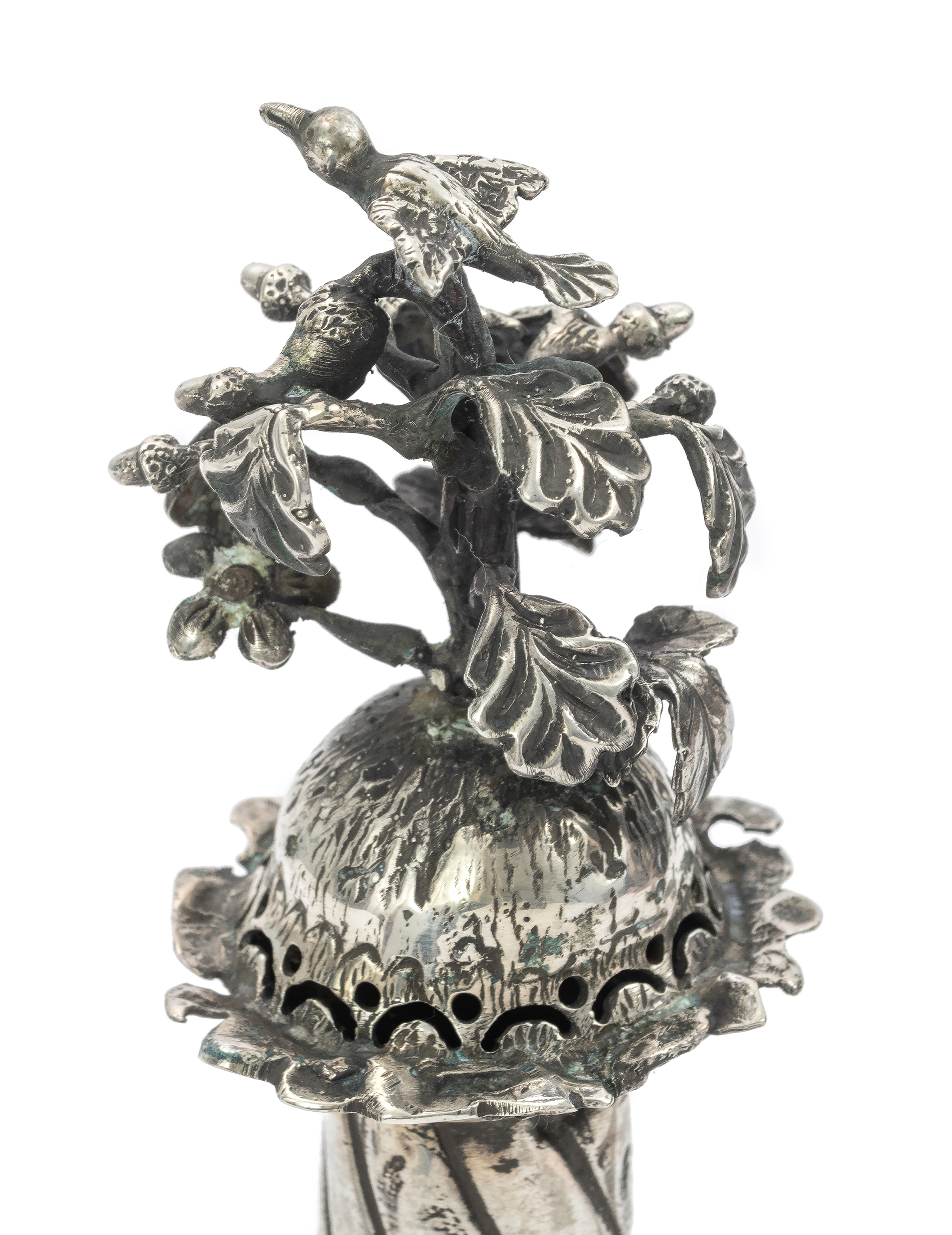
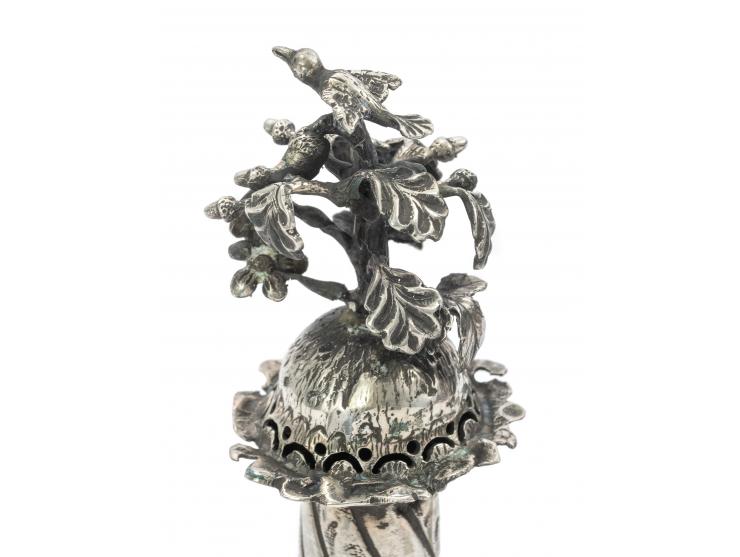
Torah finials in a design compatible with the shape of "Atzei Chayim" (Torah scroll handles). Each finial is in the form of a spiraling architectonic column tapering upward, and supported on a broad, dome-shaped base adorned with vegetal patterns. The tops of the columns of the finials are encircled with undulating ornaments, and surmounted by small domes pierced with crescent- and circle-shaped apertures. Over the domes are figurative ornaments in the form of leafy branches bearing flowers and acorns, with birds at the very top.
We have no knowledge of other items of Judaica created by the silversmith Joseph Gottlieb Lederhorse apart from a single Torah finial in the collection of the Jewish Museum, New York (F2672). For comparison, see: Rafi Grafman, Crowning Glory: Silver Torah Ornaments of the Jewish Museum, New York, NY, 1996, no. 267 (single finial from Breslau), no. 305 (single finial created by same silversmith), and no. 339 (pair of finials with similar upper ornaments).
Height: 21.5 cm. Diameter at base: approx. 11 cm. Weight: 320 g. Overall good condition. Minor warping and fractures to base. Small hole to edge of base of one finial. Minor warping and fractures to upper ornaments, and tiny pieces missing. Small holes in upper encircling ornaments may suggest formerly attached ornaments missing.
Category
Torah Ornaments, Synagogue Items
and Various Objects
Catalogue Value
Auction 107: Rare and Important Items
Apr 15, 2026
Opening: $7,000
Estimate: $20,000 - $30,000
Sold for: $15,000
Including buyer's premium
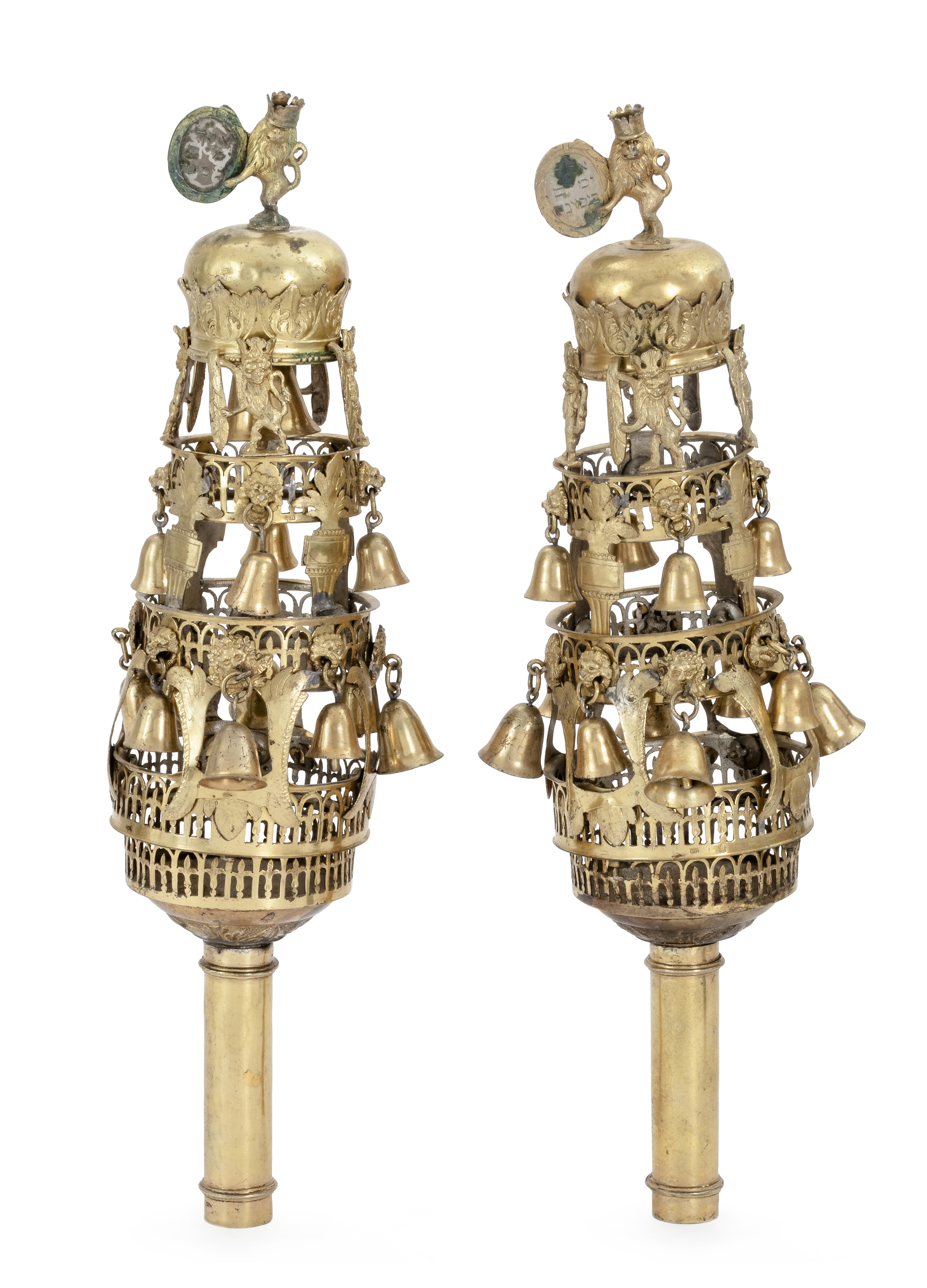
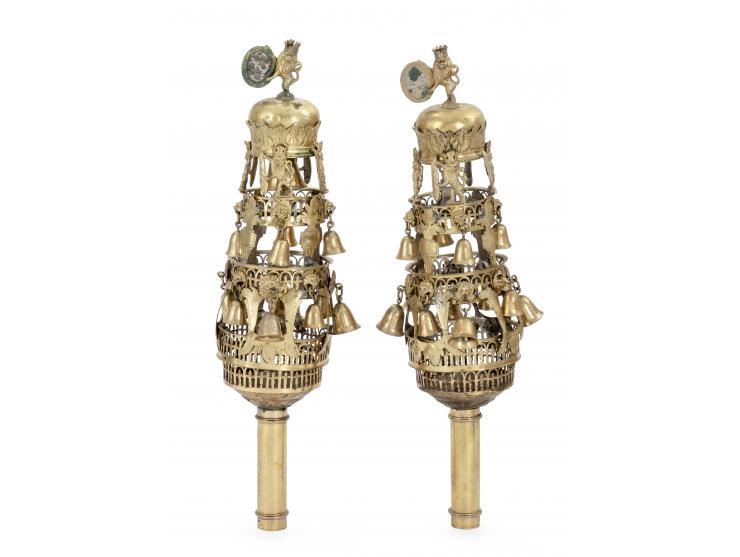
Pair of Torah finials. Augsburg, Germany, 1803.
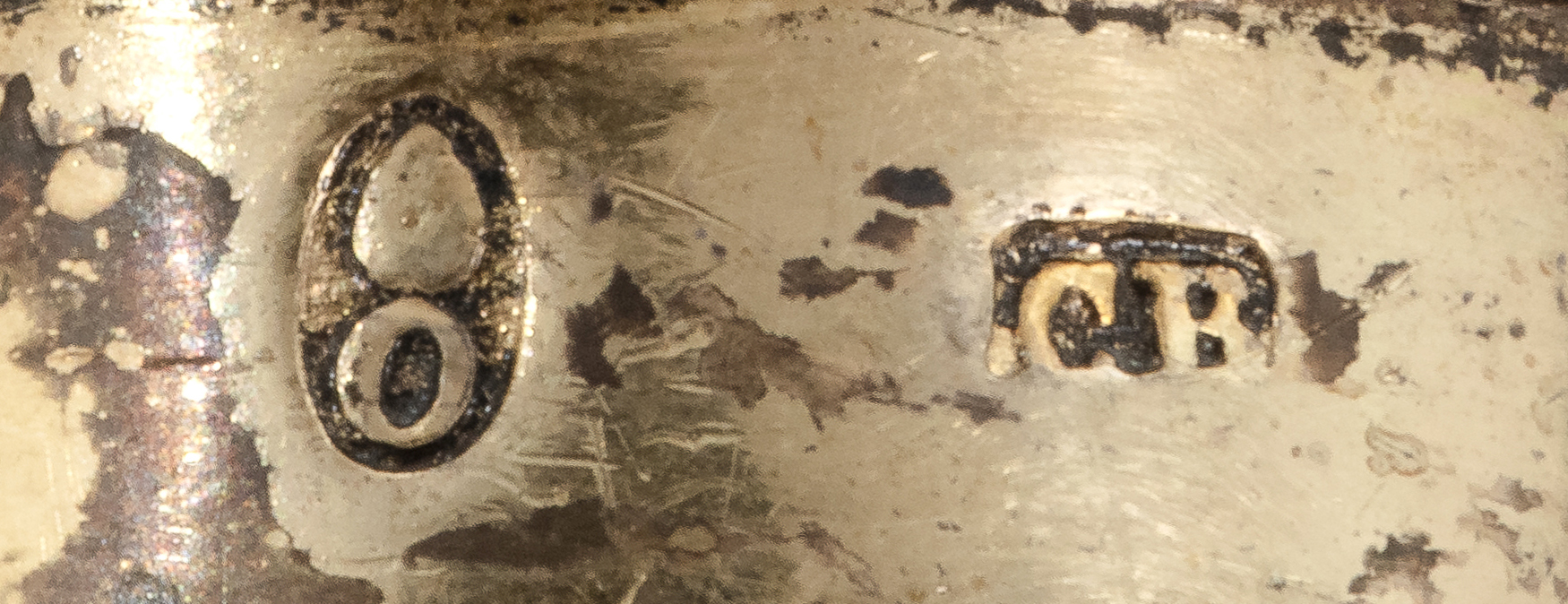
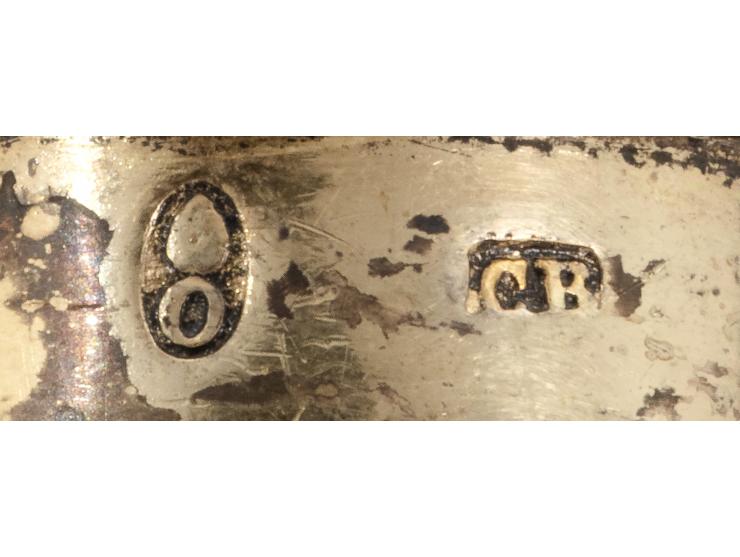
Silver, cut, pierced and engraved (marked with standard marks from Augsburg with O = 1803, and maker's mark "CB" = Carl Bitzel [1749-1823], licensed from 1787); gilt.
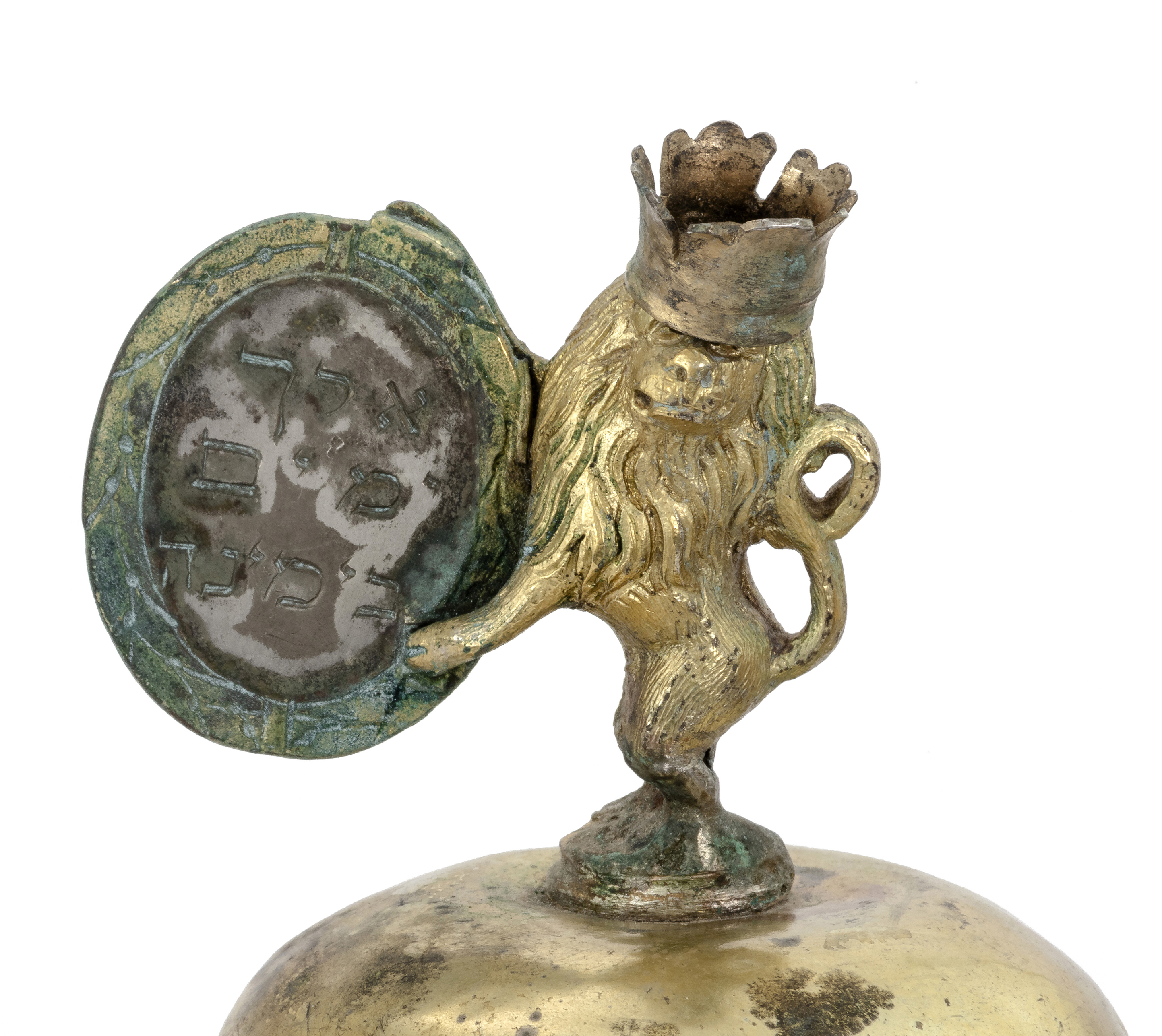
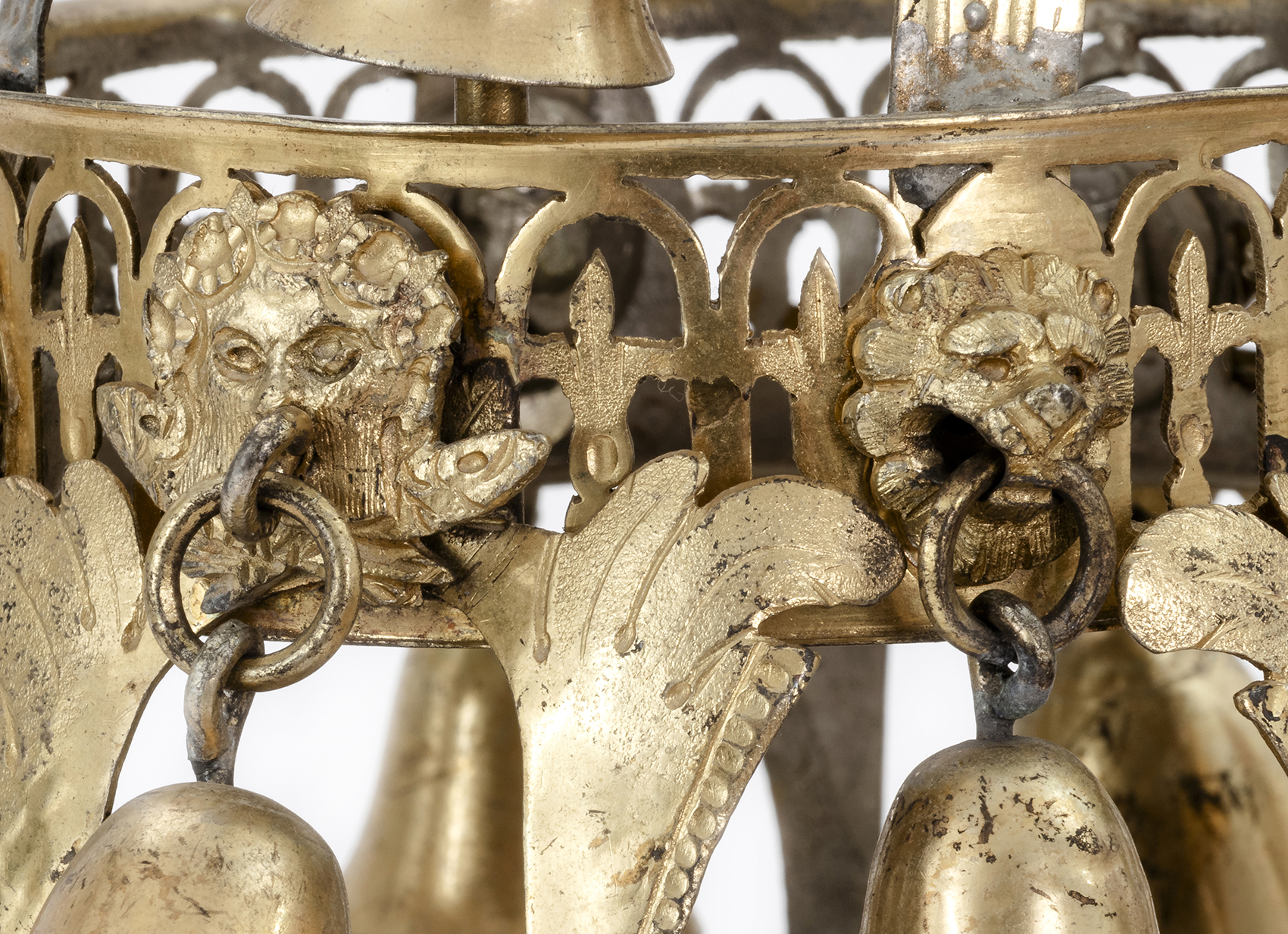
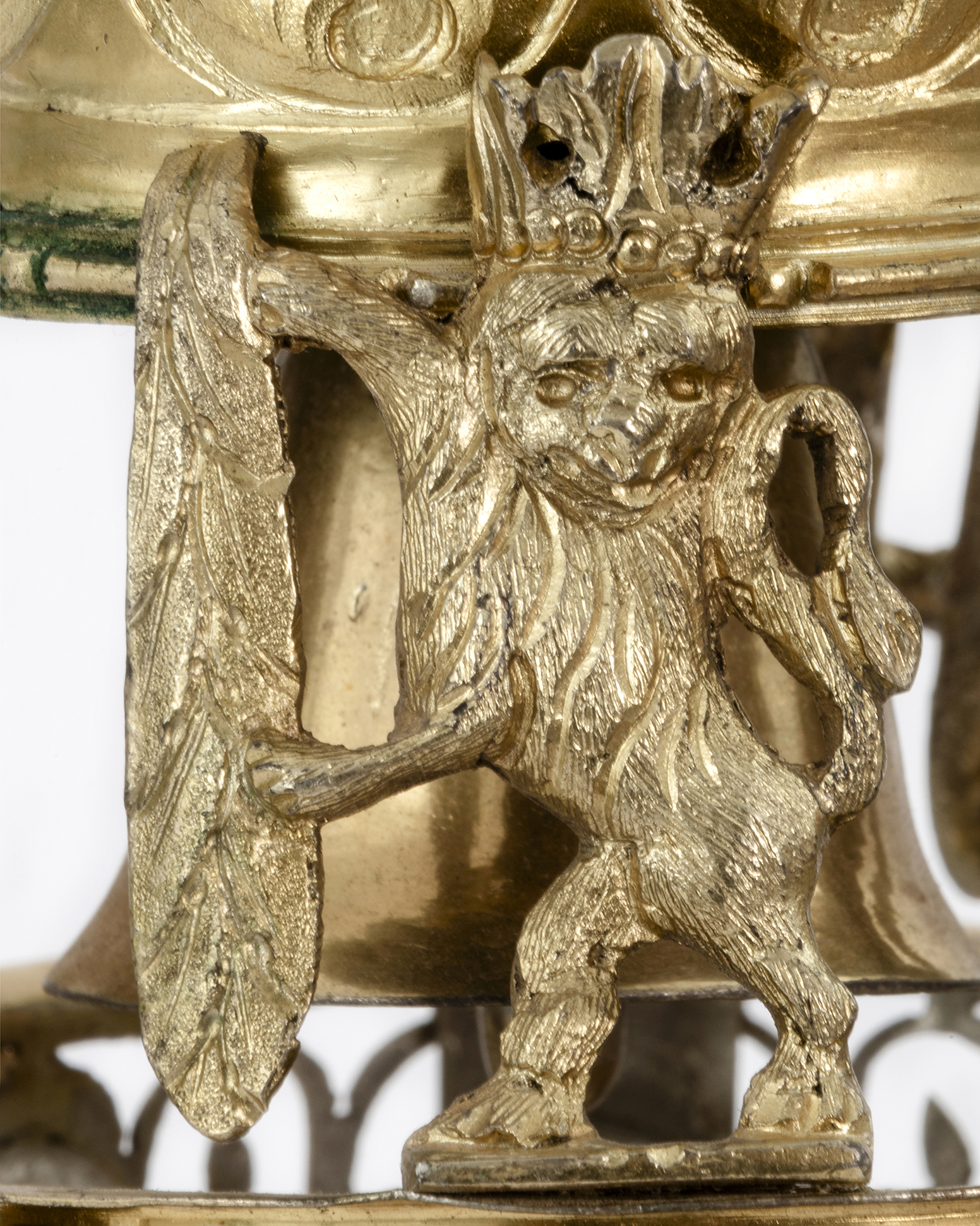
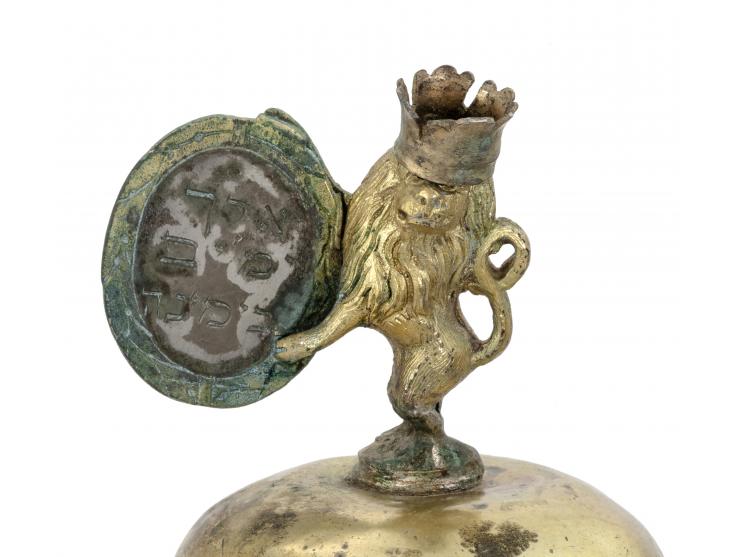
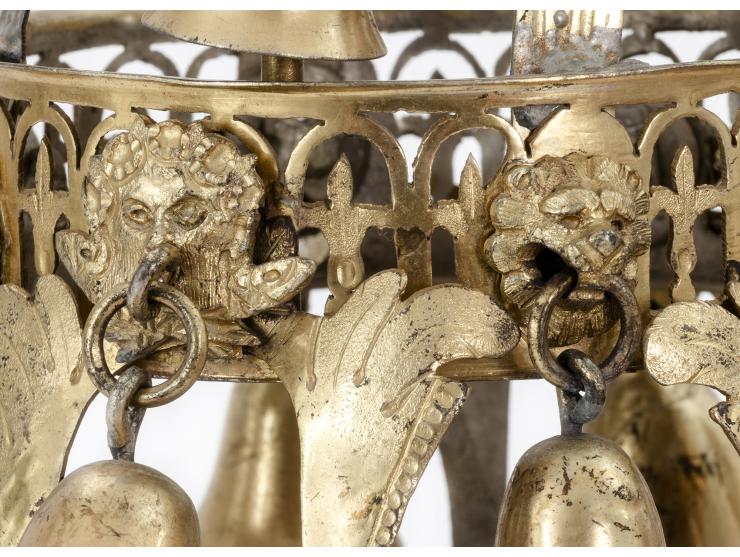
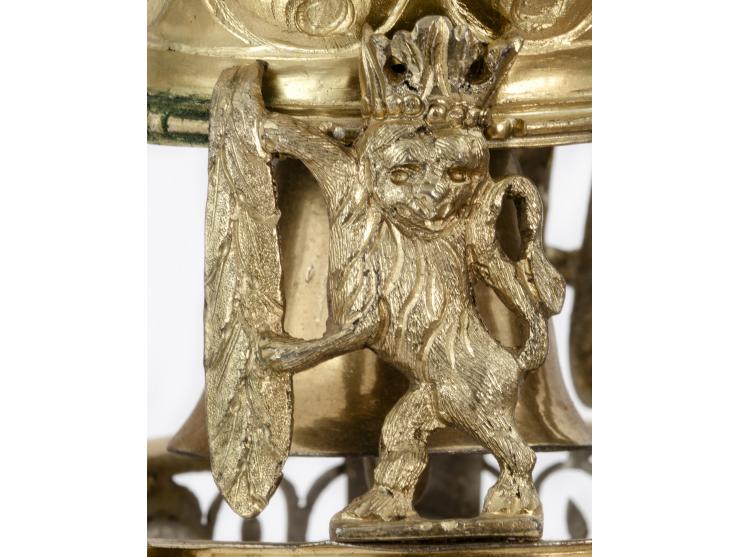
The design of this pair of finials is characteristic of Augsburg in the first quarter of the 19th century; 10 other pairs of this type are known. The present pair is especially prominent in its size and abundant decorations. Its decorations include a row of bell hangers stylized as alternating lion and human heads (with a pair of fish at the base of the head); additional bell hangers stylized as lion heads (in the central row); and rampant crowned lions holding branches (on the third row). At the top of each finial is a crown-like ornament topped by a rampant crowned lion, holding a shield captioned: "Length of days is in its right hand; in its left hand are riches and honor".
Height: 43 cm. Width: 10 cm. Weight: 1834 g. Overall good condition. One finial slightly skewed. Old soldering repairs near leg joints. Minor fractures and old soldering repairs to some decorations joining rows and decorations serving as bell hangers. Slight corrosion to upper decorations.
A pair of finials with a similar design is located in the Jewish Museum in New York (F3919, Grafman no. 270). For further information and comparison, see: Chaya Benjamin, The Stieglitz Collection: Masterpieces in Jewish Art (Israel Museum Press, 1987), no. 14; Rafi Grafman, Crowning Glory: Silver Torah Ornaments of the Jewish Museum, New York (New York, 1996), nos. 269-272.
Category
Torah Ornaments, Synagogue Items
and Various Objects
Catalogue Value
![Pair of Torah finials. Turin, Italy, [ca. 1815-1824].
Silver, cast, repoussé and pierced (all parts marked by sil](https://files.kedem-auctions.com/files/Sale107/19_1.jpg "Pair of Torah Finials – Turin, Ca. 1815-1824")
![Pair of Torah finials. Turin, Italy, [ca. 1815-1824].
Silver, cast, repoussé and pierced (all parts marked by sil](https://files.kedem-auctions.com/files/Sale107/19_2.jpg "Pair of Torah Finials – Turin, Ca. 1815-1824")
![Pair of Torah finials. Turin, Italy, [ca. 1815-1824].
Silver, cast, repoussé and pierced (all parts marked by sil](https://files.kedem-auctions.com/files/Sale107/19_3.jpg "Pair of Torah Finials – Turin, Ca. 1815-1824")
![Pair of Torah finials. Turin, Italy, [ca. 1815-1824].
Silver, cast, repoussé and pierced (all parts marked by sil](https://files.kedem-auctions.com/files/Sale107/19_4.jpg "Pair of Torah Finials – Turin, Ca. 1815-1824")
![Pair of Torah finials. Turin, Italy, [ca. 1815-1824].
Silver, cast, repoussé and pierced (all parts marked by sil](https://files.kedem-auctions.com/files/Sale107/19_5.jpg "Pair of Torah Finials – Turin, Ca. 1815-1824")
![Pair of Torah finials. Turin, Italy, [ca. 1815-1824].
Silver, cast, repoussé and pierced (all parts marked by sil](https://files.kedem-auctions.com/files/Sale107/19_6.jpg "Pair of Torah Finials – Turin, Ca. 1815-1824")
Auction 107: Rare and Important Items
Apr 15, 2026
Opening: $20,000
Estimate: $30,000 - $50,000
Sold for: $42,500
Including buyer's premium
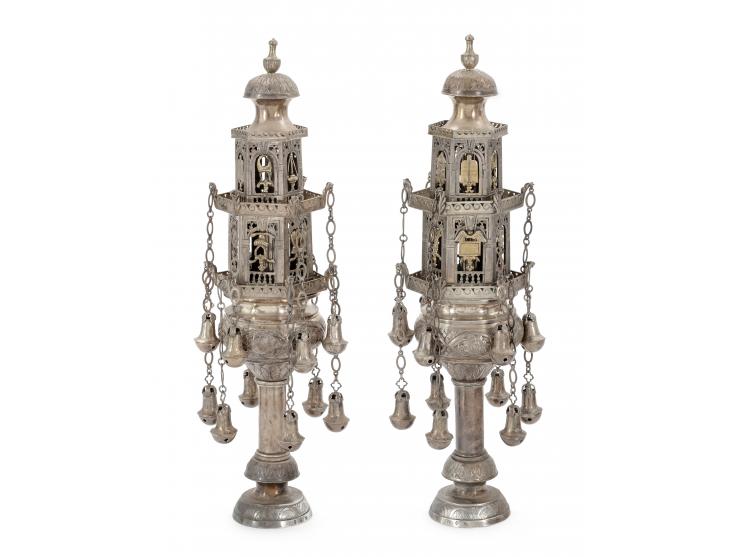
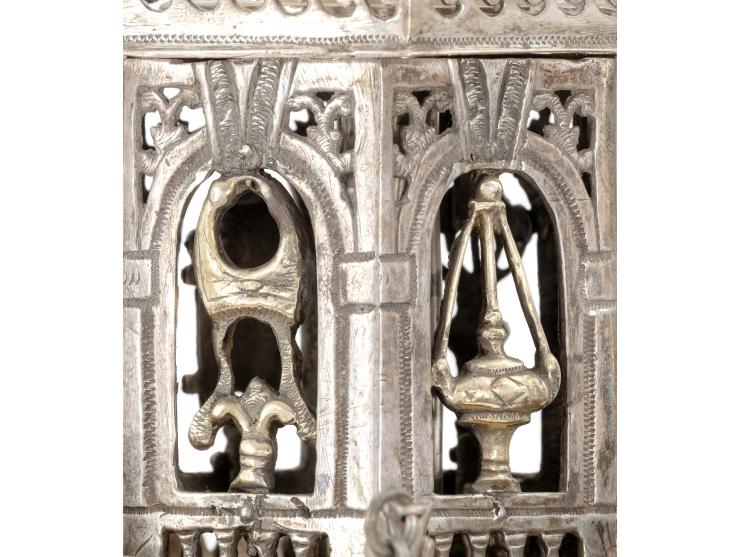
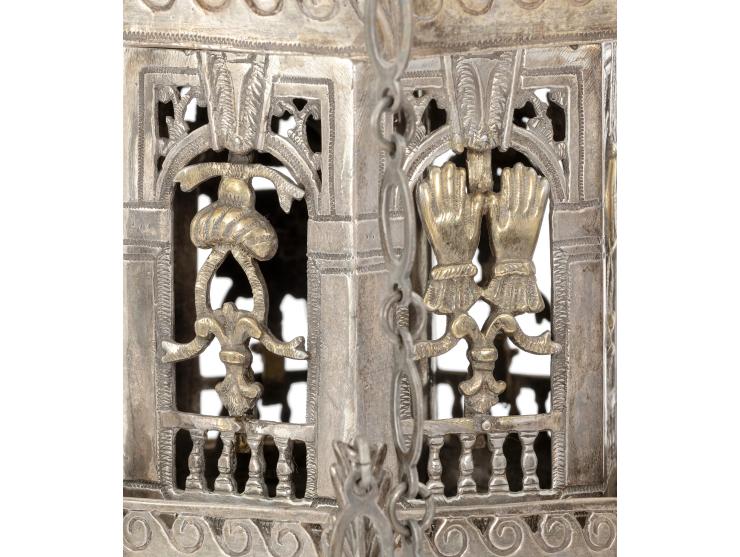
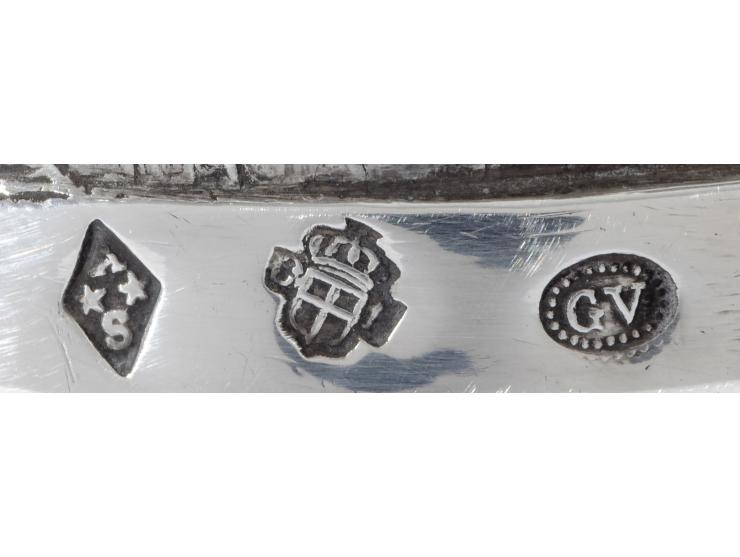
Pair of Torah finials. Turin, Italy, [ca. 1815-1824].
Silver, cast, repoussé and pierced (all parts marked by silversmith Andrea Stuardi, active in Turin ca. 1815-1824, Turin standard marks and assayer's marks of Kingdom of Sardinia, Giuseppe Vernoni, active 1814-1824).
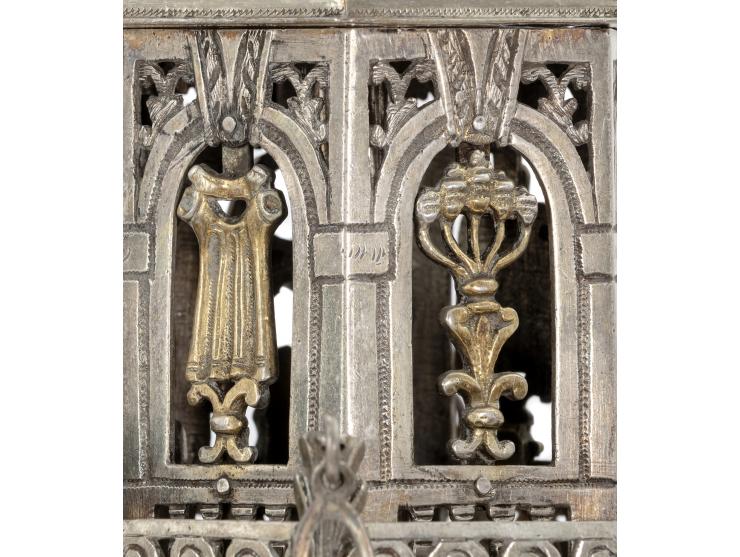
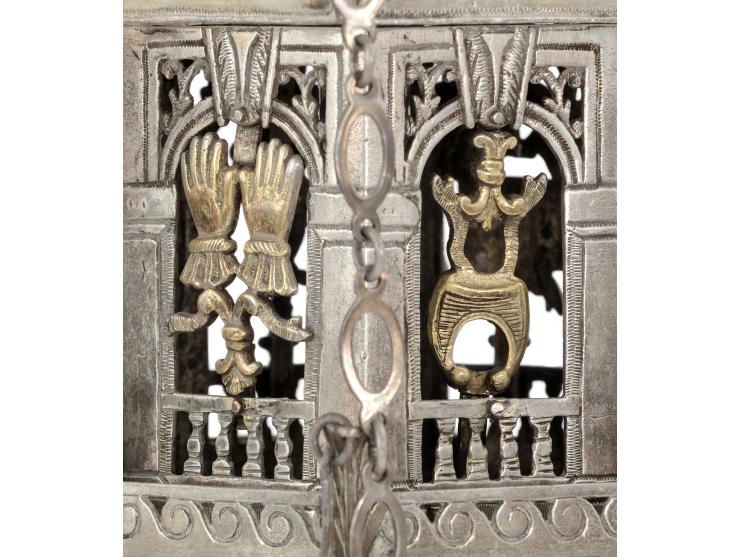
Large, impressive Torah finials, stylized as hexagonal towers with two stories (the lower story wider than the upper one), with balconies and parapets. At the base of each finial is a large, globular element decorated with vegetal patterns, located at the edge of a cylindrical leg with a wide domed base. The pierced windows are set with decorative cast appliqués, in alternating patterns characteristic of Italian ceremonial objects (priestly turban, Tablets of the Law, altar, menorah, etc.) and vegetal patterns. Long chains ending with large bells hang from the parapets of each finial (the chains and bells are all original).
Height: 46 cm. Width: 13 cm. Weight: 2958 g. Good condition. One finial somewhat warped. One appliqué partially detached. One leg with loose thread fitting.
Reference: Bargoni, Mastri orafi e argentieri in Piemonte. Turin: Centro Studi Piemontesi, 1988, no. S90.
Category
Torah Ornaments, Synagogue Items
and Various Objects
Catalogue Value
![Pair of Torah finials. Paris, France, [ca. 1880]. Dedicatory inscription from Sidi Bel Abbès, Algeria, dated 1889.](https://files.kedem-auctions.com/files/Sale107/20_1.jpg "Pair of Torah Finials – Henri Chevron – Paris, 1880 / Dedicatory Inscr")
![Pair of Torah finials. Paris, France, [ca. 1880]. Dedicatory inscription from Sidi Bel Abbès, Algeria, dated 1889.](https://files.kedem-auctions.com/files/Sale107/20_2.jpg "Pair of Torah Finials – Henri Chevron – Paris, 1880 / Dedicatory Inscr")
![Pair of Torah finials. Paris, France, [ca. 1880]. Dedicatory inscription from Sidi Bel Abbès, Algeria, dated 1889.](https://files.kedem-auctions.com/files/Sale107/20_3.jpg "Pair of Torah Finials – Henri Chevron – Paris, 1880 / Dedicatory Inscr")
![Pair of Torah finials. Paris, France, [ca. 1880]. Dedicatory inscription from Sidi Bel Abbès, Algeria, dated 1889.](https://files.kedem-auctions.com/files/Sale107/20_4.jpg "Pair of Torah Finials – Henri Chevron – Paris, 1880 / Dedicatory Inscr")
![Pair of Torah finials. Paris, France, [ca. 1880]. Dedicatory inscription from Sidi Bel Abbès, Algeria, dated 1889.](https://files.kedem-auctions.com/files/Sale107/20_5.jpg "Pair of Torah Finials – Henri Chevron – Paris, 1880 / Dedicatory Inscr")
Auction 107: Rare and Important Items
Apr 15, 2026
Opening: $5,000
Estimate: $10,000 - $15,000
Sold for: $8,125
Including buyer's premium
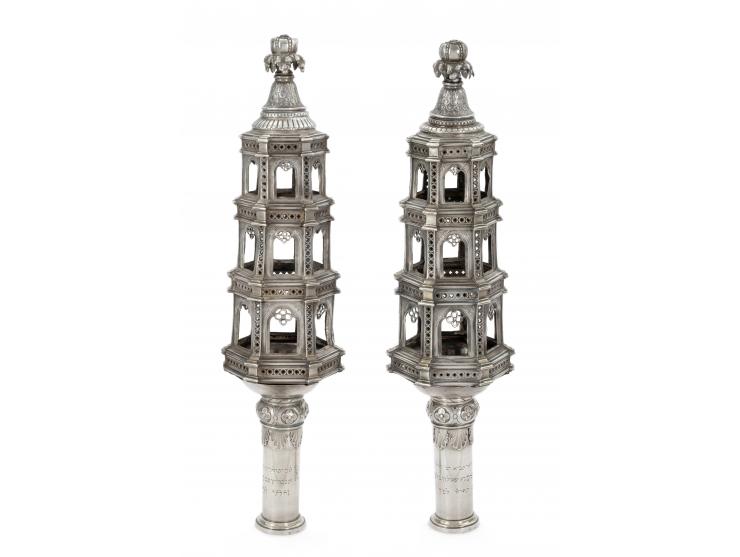
Pair of Torah finials. Paris, France, [ca. 1880]. Dedicatory inscription from Sidi Bel Abbès, Algeria, dated 1889.
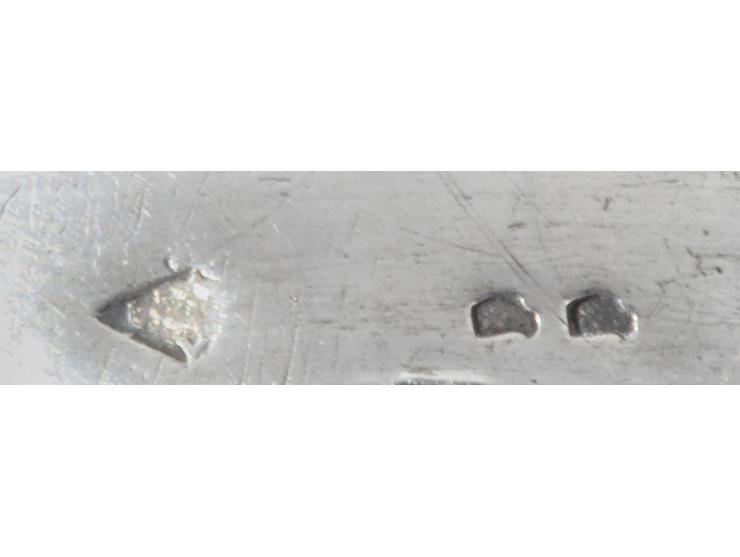
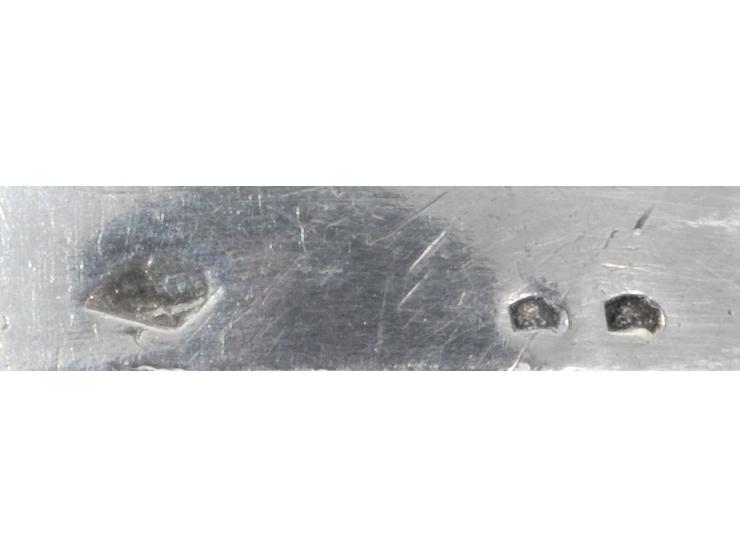
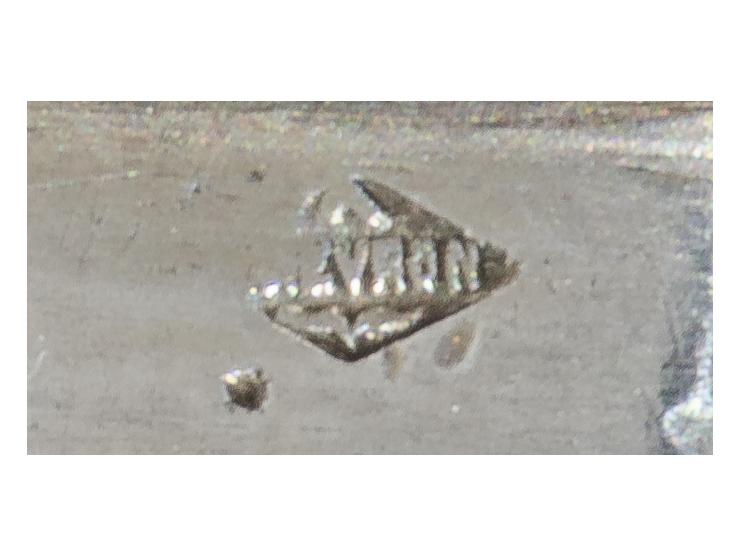
Silver, cast, repoussé, pierced and engraved (with maker's mark of Henri Chevron, active in Paris from 1879, and minute standard marks from Paris, 19th century).
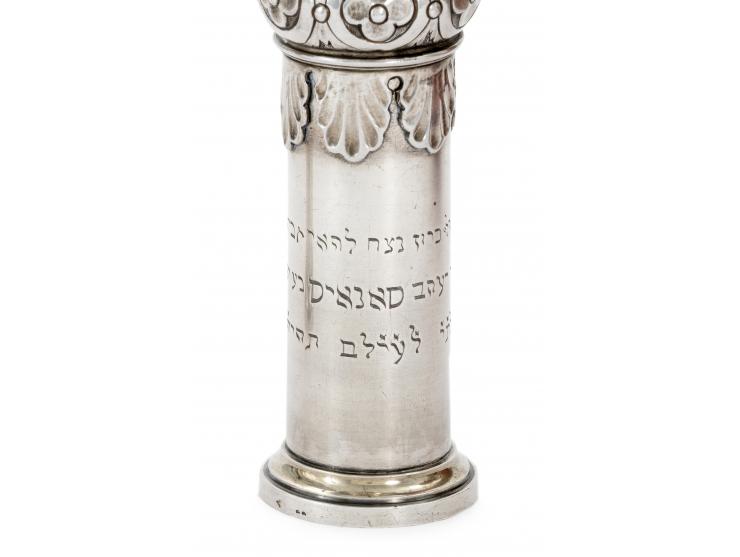
A pair of French Torah finials, with a design reminiscent of the work of Parisian silversmith Maurice Mayer. Stylized as hexagonal towers of three stories, topped by a roofed dome, surmounted by a large ornament in vegetal pattern. Each of the stories contains six large windows, shaped as horseshoes, each with a flower-like ornament (these may have served as hangers for bells). Mounted on wide cylindrical legs, decorated in vegetal patterns. Dedicatory inscription engraved on legs: "Donation in the merit and eternal memory of… the honorable Yaakov Sananes, head of the Bel Abbès community, [1889]" (one of the finials omits a letter from the name "Sananes" and does not correctly mark one letter of the chronogram).
Sidi Bel Abbès in northern Algeria served as a government stronghold under French occupation. From the mid-19th century, it was home to a Jewish community who settled there from other cities in Algeria and Morocco. The dedicatory inscription engraved on the finials indicates that Yaakov Sananes served as the head of the Sephardic community in this city. In a piyyut written in his honor by R. Yaakov HaLevi in 1877, he is named "Yaakov Sananes, consistory of Bel Abbès" (see NLI listing 990037784610205171).
For similar pairs of finials produced by Maurice Mayer, see: Center for Jewish Art (CJA), no. 37184 (Gross Family Collection); Sotheby's, New York, 29 April 2013, Lot 248 (Steinhardt Collection).
Height: 43 cm. Width: 10 cm. Weight: 1690 g. Fair-good condition. Bells or medallions lacking from windows. Detached legs and loose thread fittings in both finials: one lacking three internal and six external screws, the other lacking two screws and slots, six external screws, two nuts at joint between top and central story and four decorative flowers on windows. Top ornaments flattened.
Category
Torah Ornaments, Synagogue Items
and Various Objects
Catalogue Value
![Torah shield. [Poland, ca. 1800].
Silver, cast and pierced (unmarked, except a Kraków city mark, in use 1806-1807](https://files.kedem-auctions.com/files/Sale107/21_1.jpg "Torah Shield Decorated with Gemstones – Poland, Ca. 1800")
![Torah shield. [Poland, ca. 1800].
Silver, cast and pierced (unmarked, except a Kraków city mark, in use 1806-1807](https://files.kedem-auctions.com/files/Sale107/21_2.jpg "Torah Shield Decorated with Gemstones – Poland, Ca. 1800")
![Torah shield. [Poland, ca. 1800].
Silver, cast and pierced (unmarked, except a Kraków city mark, in use 1806-1807](https://files.kedem-auctions.com/files/Sale107/21_3.jpg "Torah Shield Decorated with Gemstones – Poland, Ca. 1800")
![Torah shield. [Poland, ca. 1800].
Silver, cast and pierced (unmarked, except a Kraków city mark, in use 1806-1807](https://files.kedem-auctions.com/files/Sale107/21_4.jpg "Torah Shield Decorated with Gemstones – Poland, Ca. 1800")
![Torah shield. [Poland, ca. 1800].
Silver, cast and pierced (unmarked, except a Kraków city mark, in use 1806-1807](https://files.kedem-auctions.com/files/Sale107/21_5.jpg "Torah Shield Decorated with Gemstones – Poland, Ca. 1800")
Auction 107: Rare and Important Items
Apr 15, 2026
Opening: $25,000
Estimate: $60,000 - $80,000
Sold for: $42,500
Including buyer's premium
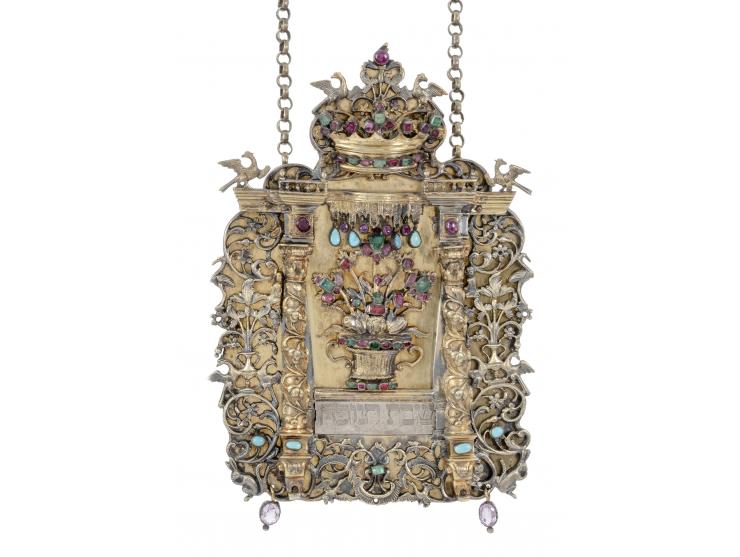
Torah shield. [Poland, ca. 1800].
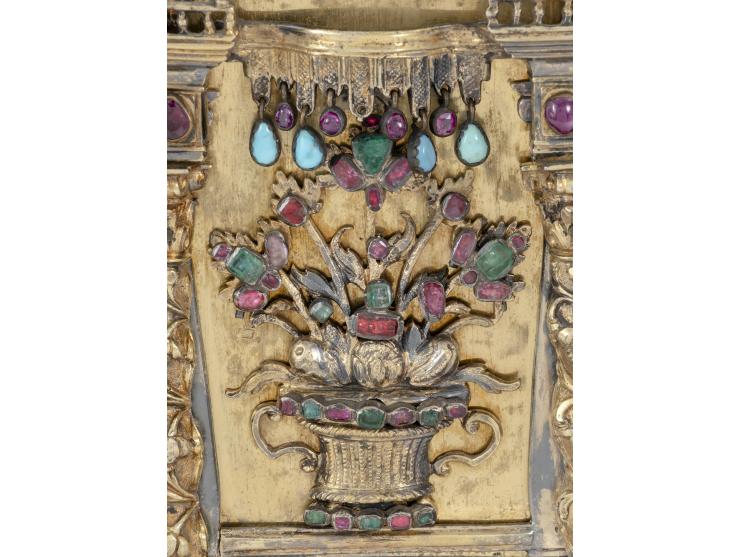
Silver, cast and pierced (unmarked, except a Kraków city mark, in use 1806-1807); gilt; colorful gems.
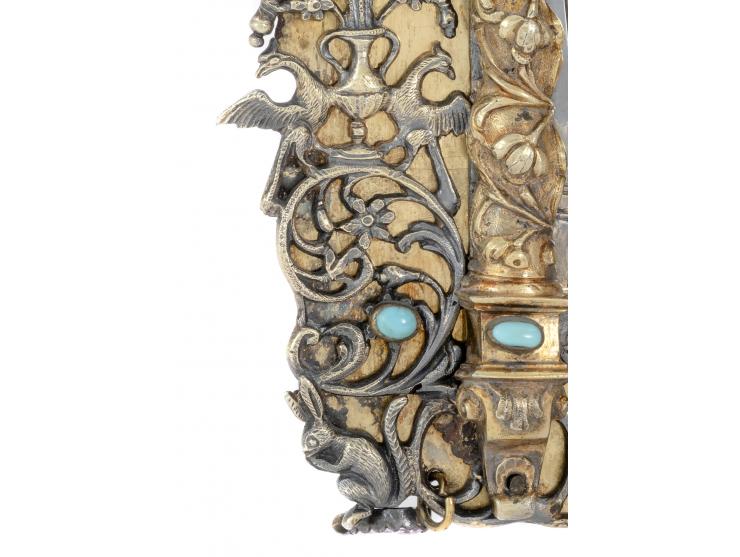
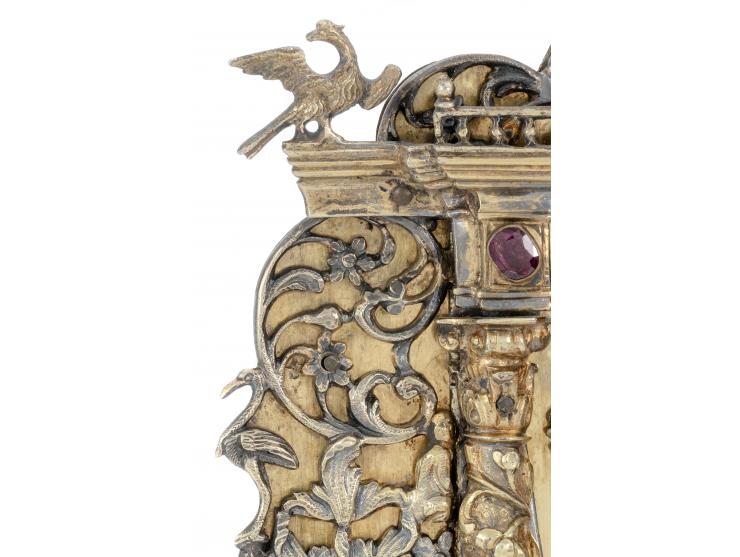
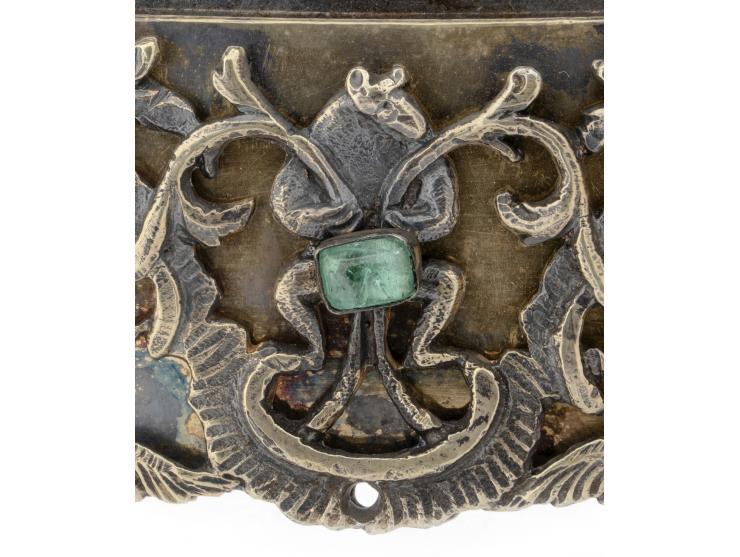
Small, heavy Torah shield of exceptionally high decorative quality, set with some 70 colorful gems, with a design inspired by Eastern European carved wooden arks. The shield is comprised of a smooth gilt backplate, with decorations attached with nails and pins in architectural patterns (with a pair of protruding massive pillars) and vegetal patterns. The center of the shield features a large basket with fruit and blossoming branches, with a valance-like ornament above, and a cornice with a pair of birds of prey on either side, all topped by a large crown with a pair of birds upon it. Most of these decorative elements are set with gems. The vegetal decorations at the right, left and bottom edges incorporate various animals, including cranes and monkeys, birds of prey, rabbits and a large bear. At the bottom of the shield is a rectangular compartment for interchangeable plaques (one later double-sided plaque included). Long suspension chain (original).
Height: 22 cm (with chain: 50 cm). Width: 15 cm. Weight: 692 g. Overall good condition. Two medallions with gems lacking, one at bottom edge and one at valance decoration. Some pins lacking. Soldering repairs and remains of chains to back side, apparently remains of old chain links.
For similarly designed Torah shields, see: Crowning Glory, item nos. 186, 190; Synagoga. Recklinghausen: Städtische Kunsthalle, 1960, item no. C55; see also Kedem, Auction 97, 8 May 2024 (Schloss Collection), Lot 2.
Provenance:
1. Sotheby's, London, 5 July 1982, Lot 218.
2. Collection of Michael and Judy Steinhardt.
3. Sotheby's, New York, 29 April 2013 (Steinhardt Collection), Lot 146.
Category
Torah Ornaments, Synagogue Items
and Various Objects
Catalogue Value
![Torah shield. [Poland or Galicia, first half of 19th century].
Silver, cast, parcel gilt (unmarked); filigree.
Small](https://files.kedem-auctions.com/files/Sale107/22_1.jpg "Small Torah Shield with Filigree – Poland or Galicia, 19th Century")
![Torah shield. [Poland or Galicia, first half of 19th century].
Silver, cast, parcel gilt (unmarked); filigree.
Small](https://files.kedem-auctions.com/files/Sale107/22_2.jpg "Small Torah Shield with Filigree – Poland or Galicia, 19th Century")
![Torah shield. [Poland or Galicia, first half of 19th century].
Silver, cast, parcel gilt (unmarked); filigree.
Small](https://files.kedem-auctions.com/files/Sale107/22_4-WEB.jpg "Small Torah Shield with Filigree – Poland or Galicia, 19th Century")
![Torah shield. [Poland or Galicia, first half of 19th century].
Silver, cast, parcel gilt (unmarked); filigree.
Small](https://files.kedem-auctions.com/files/Sale107/22_5-WEB.jpg "Small Torah Shield with Filigree – Poland or Galicia, 19th Century")
Auction 107: Rare and Important Items
Apr 15, 2026
Opening: $1,000
Estimate: $5,000 - $8,000
Sold for: $3,000
Including buyer's premium
Torah shield. [Poland or Galicia, first half of 19th century].
Silver, cast, parcel gilt (unmarked); filigree.
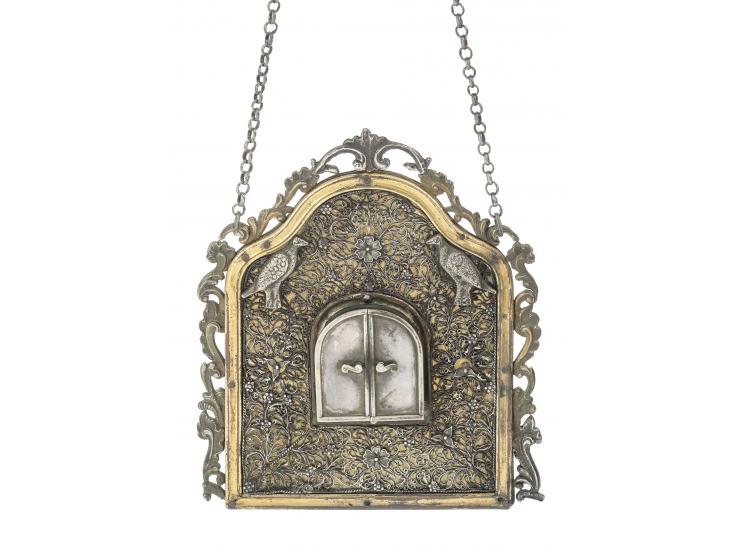
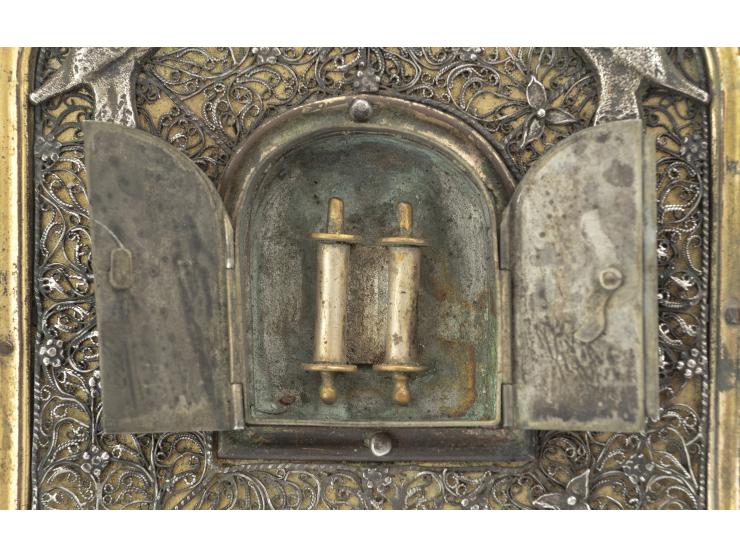
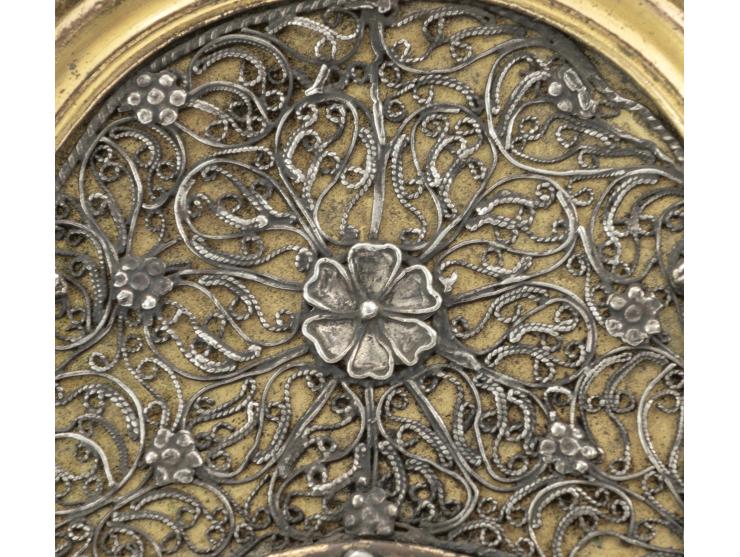
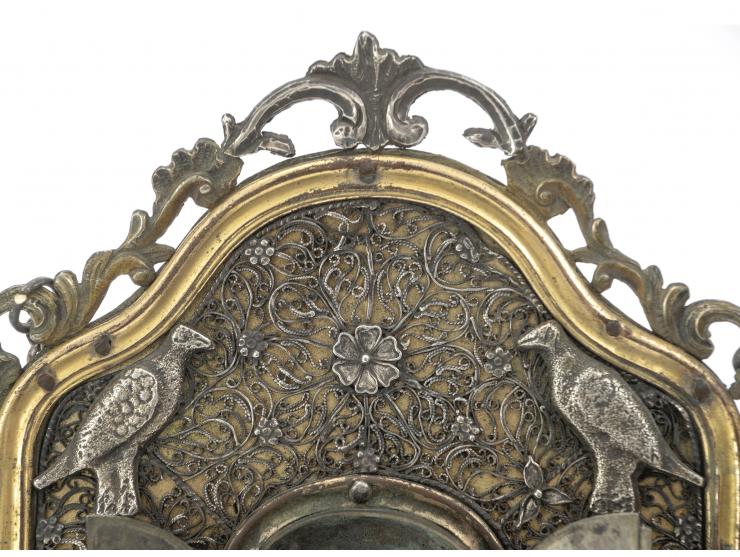
Small Torah shield, on the level of quality of fine jewelry. In shape of an arched building, with, at center, a Torah ark housing a tiny Torah scroll ornament and with doors attached with hinges. Gilt silver backplate. A work of delicate, high-quality filigree in a vegetal pattern is superimposed onto this plate. A pair of standing, cast silver birds are perched on top of the two doors of the Torah ark. Border in a vegetal pattern. Suspension chain.
Height: 15 cm. Width: 13 cm. Weight: 287 g. Overall good condition. Minor warping and slight fractures to vegetal-patterned border ornamentation. Several missing pieces to filigree.
For comparison, see: Rafi Grafman, Crowning Glory: Silver Torah Ornaments of the Jewish Museum, New York, 1996, nos. 183-184.
Category
Torah Ornaments, Synagogue Items
and Various Objects
Catalogue Value
![Torah shield. [Eastern Europe, Poland or Ukraine, 19th century].
Silver, repoussé, embossed and engraved (marked](https://files.kedem-auctions.com/files/Sale107/23_1.jpg "Torah Shield – Eastern Europe, 19th Century")
![Torah shield. [Eastern Europe, Poland or Ukraine, 19th century].
Silver, repoussé, embossed and engraved (marked](https://files.kedem-auctions.com/files/Sale107/23_2.jpg "Torah Shield – Eastern Europe, 19th Century")
![Torah shield. [Eastern Europe, Poland or Ukraine, 19th century].
Silver, repoussé, embossed and engraved (marked](https://files.kedem-auctions.com/files/Sale107/23_3.jpg "Torah Shield – Eastern Europe, 19th Century")
![Torah shield. [Eastern Europe, Poland or Ukraine, 19th century].
Silver, repoussé, embossed and engraved (marked](https://files.kedem-auctions.com/files/Sale107/23_4.jpg "Torah Shield – Eastern Europe, 19th Century")
Auction 107: Rare and Important Items
Apr 15, 2026
Opening: $5,000
Estimate: $8,000 - $10,000
Sold for: $8,750
Including buyer's premium
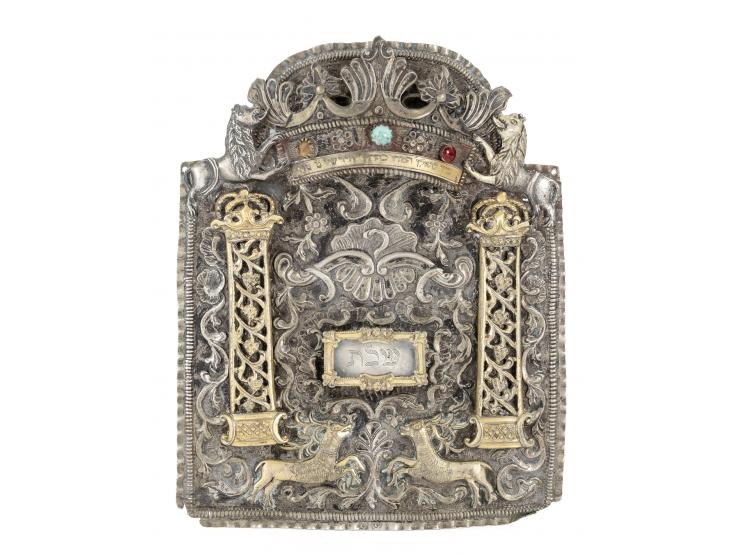
Torah shield. [Eastern Europe, Poland or Ukraine, 19th century].
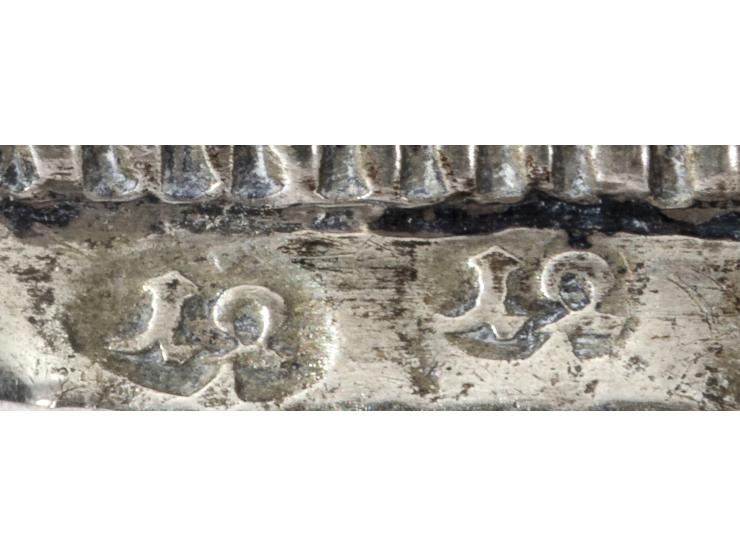
Silver, repoussé, embossed and engraved (marked with standard mark "12"); gilt; glass stones.
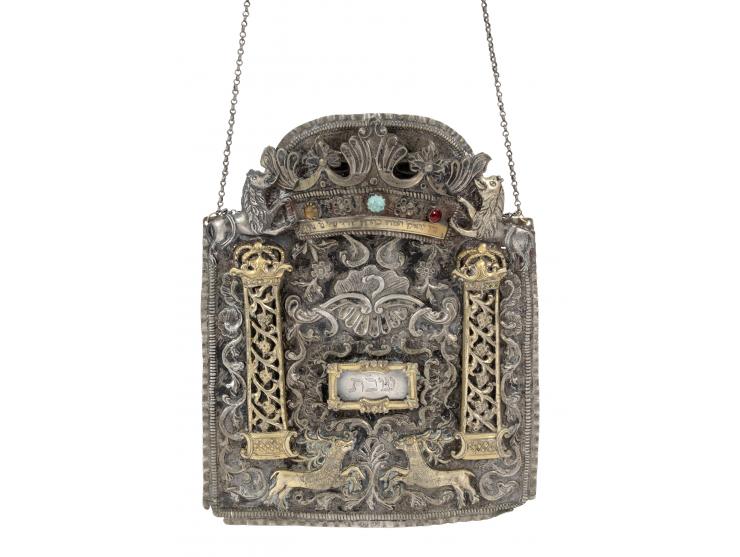
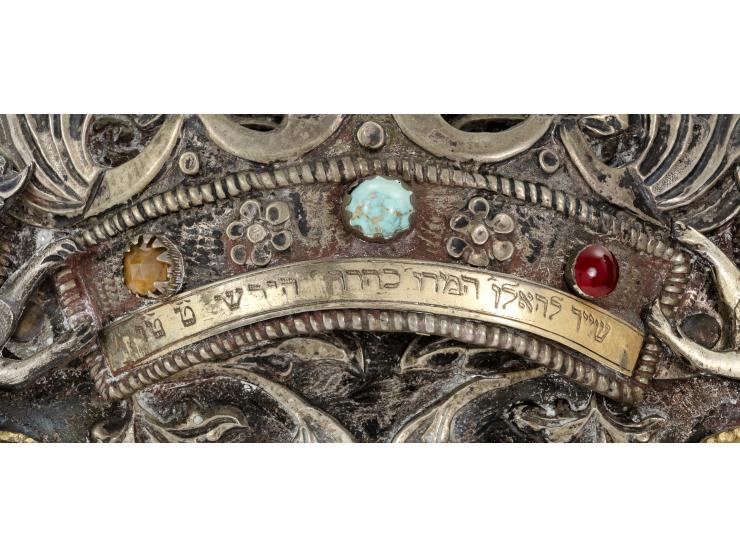
Torah shield in characteristic Eastern European style, shaped as a square structure topped by a dome. The shield is decorated with repoussé vegetal patterns and affixed with various appliqués, some gilded, affixed with rounded pins and nails: a pair of deer, a pair of large decorated pillars decorated with clusters of grapes, a pair of lions with protruding tongues and a large convex crown set with two glass beads and a turquoise stone. Dedicatory inscription engraved on crown: "Belongs to the lofty leader R. Hirsch…". The center of the shield features a rectangular compartment for interchangeable plaques (one later double-sided plaque included). Suspension chain enclosed (detached).
Height: 22.5 cm. Width: 18 cm. Weight: 385 g. Good condition. Warping and slight fractures, mainly to edges, with some pieces lacking. Minute piece lacking from one lion ornament. Nails affixed to top crown ornament non-original. Holes to upper margins for suspending chain.
Category
Torah Ornaments, Synagogue Items
and Various Objects
Catalogue Value
![Torah shield. Fürth (Bavaria, Germany), late 18th century [ca. 1790].
Silver, cast, stamped, repoussé and en](https://files.kedem-auctions.com/files/Sale107/24_1.jpg "Torah Shield – Johann Jakob Runnecke – Fürth, Ca. 1790")
![Torah shield. Fürth (Bavaria, Germany), late 18th century [ca. 1790].
Silver, cast, stamped, repoussé and en](https://files.kedem-auctions.com/files/Sale107/24_2.jpg "Torah Shield – Johann Jakob Runnecke – Fürth, Ca. 1790")
![Torah shield. Fürth (Bavaria, Germany), late 18th century [ca. 1790].
Silver, cast, stamped, repoussé and en](https://files.kedem-auctions.com/files/Sale107/24_3.jpg "Torah Shield – Johann Jakob Runnecke – Fürth, Ca. 1790")
![Torah shield. Fürth (Bavaria, Germany), late 18th century [ca. 1790].
Silver, cast, stamped, repoussé and en](https://files.kedem-auctions.com/files/Sale107/24_4.jpg "Torah Shield – Johann Jakob Runnecke – Fürth, Ca. 1790")
Auction 107: Rare and Important Items
Apr 15, 2026
Opening: $2,500
Estimate: $4,000 - $6,000
Sold for: $5,250
Including buyer's premium
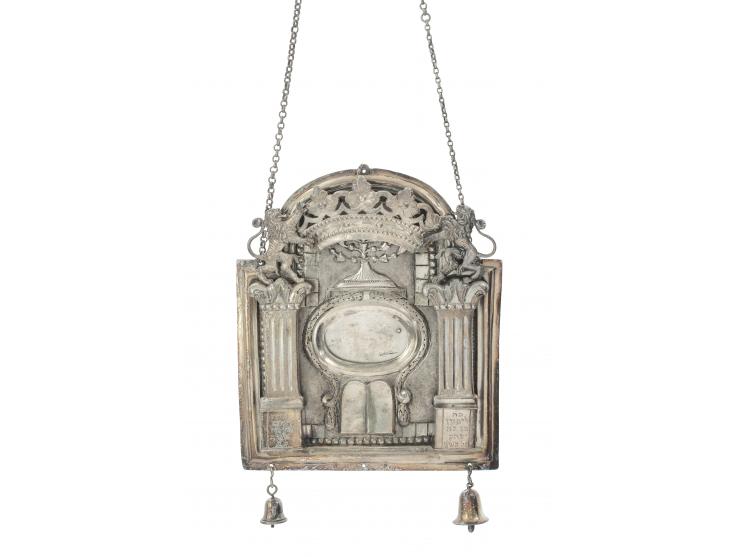
Torah shield. Fürth (Bavaria, Germany), late 18th century [ca. 1790].
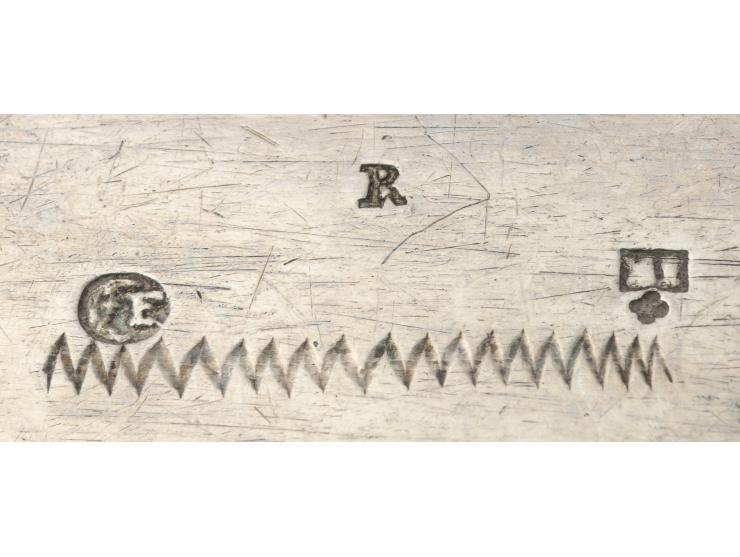
Silver, cast, stamped, repoussé and engraved (marked with a crescent-shaped city mark with the letter F for Fürth; date letter R; and maker’s mark IR with four dots above, for the silversmith Johann Jakob Runnecke / Runecke).
A small Torah shield, designed in a form characteristic of shields from Nuremberg, near the city of Fürth. Surmounted by a crown prominently projecting forward; flanked by a pair of columns, also projecting forward, standing on square bases and surmounted by capitals bearing rampant lions.
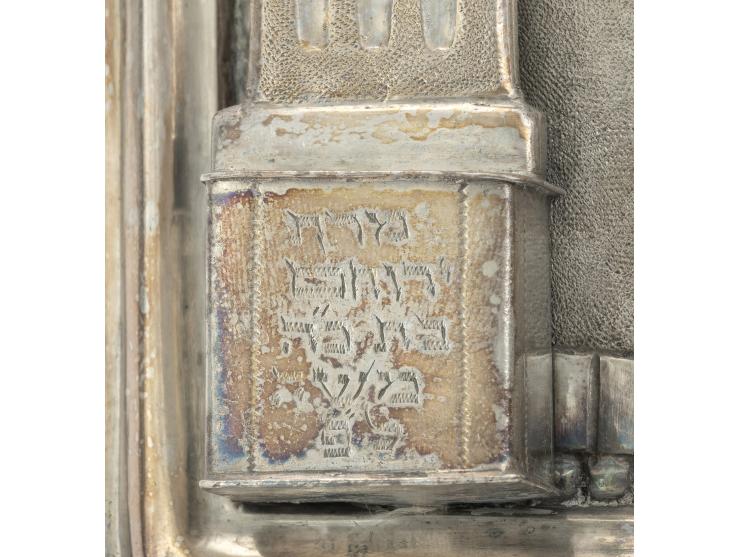
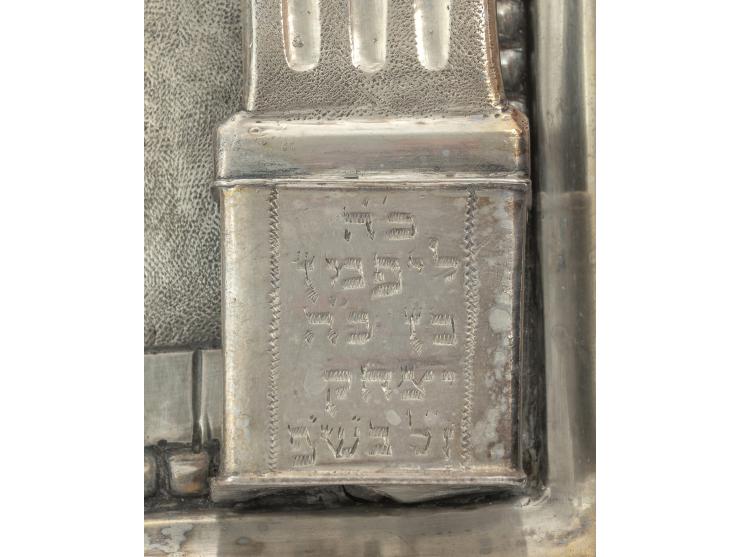
At center is an oval aperture for interchangeable plaques (plaques lacking); above it is a raised Menorah motif, and below it a relief ornament of the Tablets of the Law (blank). An engraved inscription appears on the column bases, dedicating the shield to R. Lipmann son of R. Isaac and Mrs. Yeruham daughter of R. Moses. Two bells are suspended from rings at the lower part of the shield. Long suspension chain.
The silversmith Johann Jakob Runnecke has been documented in the past by Marc Rosenberg ("Der Goldschmiede Merkzeichen", Frankfurter Verlags, Frankfurt A.M., 1922) and other sources and authorities, where Runnecke is referred to as "J. Rimonim". This craftsman, whose Berliner father was also a silversmith, was active in Fürth and produced quite a few articles of Judaica in the late 18th century, including Hanukkah lamps, Torah shields and Torah finials, Kiddush cups, and at least one magnificent Sabbath lamp (formerly part of the Sassoon Family Collection). For another one of his Torah shields, see: Rafi Grafman, Crowning Glory: Silver Torah Ornaments of the Jewish Museum, New York, 1996, Catalogue No. 32. See also next lot.
Height: 22.5 cm. Width: 19 cm. Weight: 571 g. Overall good condition. Minor warping and blemishes. Old soldering repairs. One bell non-original; an additional bell missing. Chain detached from upper loop.
Category
Torah Ornaments, Synagogue Items
and Various Objects
Catalogue Value