
Auction 106 Incunabula and First Editions | Illuminated Manuscripts | Jewish Ceremonial Art
Feb 24, 2026
Displaying 1 - 12 of 16
Auction 106 Incunabula and First Editions | Illuminated Manuscripts | Jewish Ceremonial Art
Feb 24, 2026
Opening: $8,000
Sold for: $35,000
Including buyer's premium
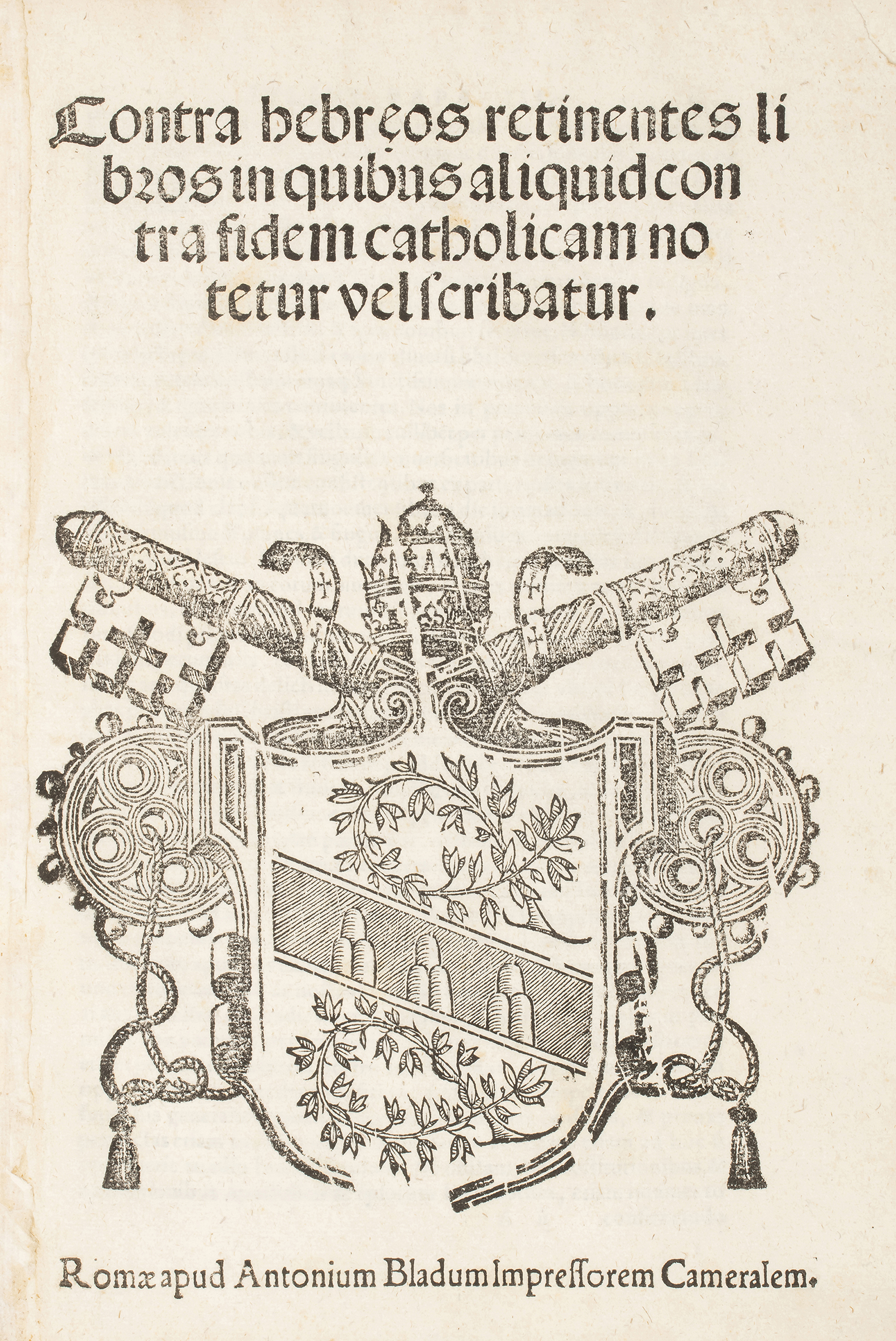
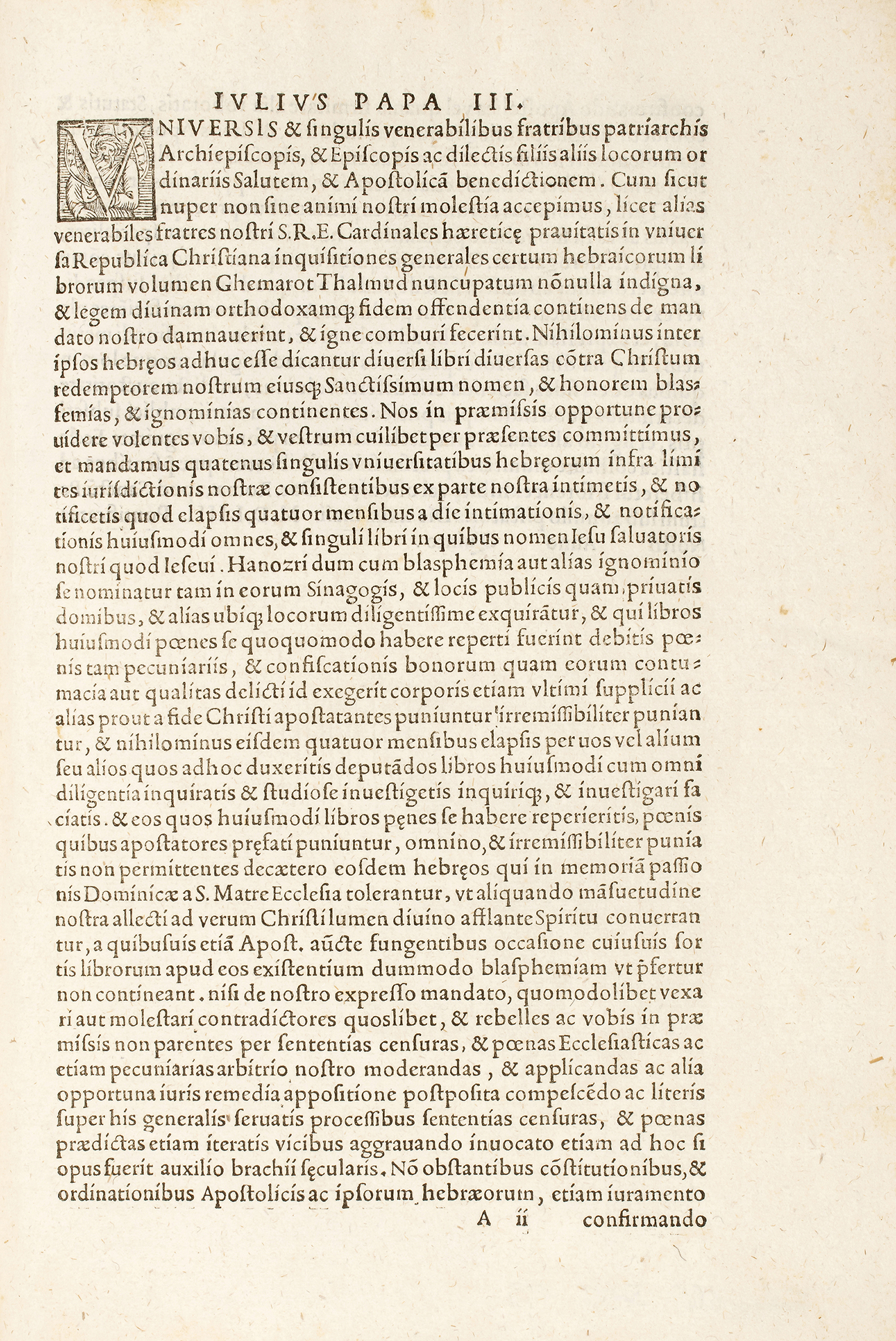
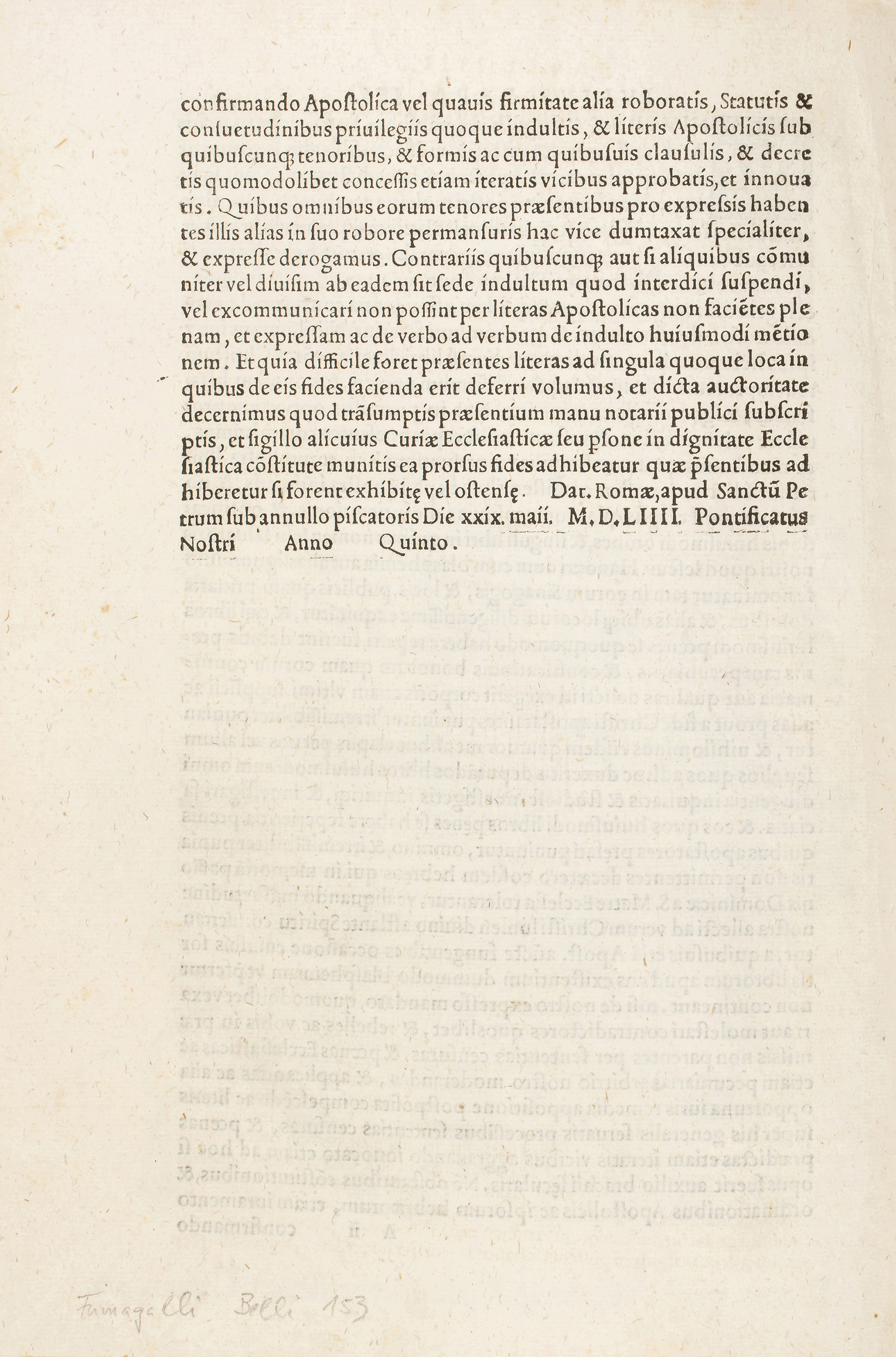
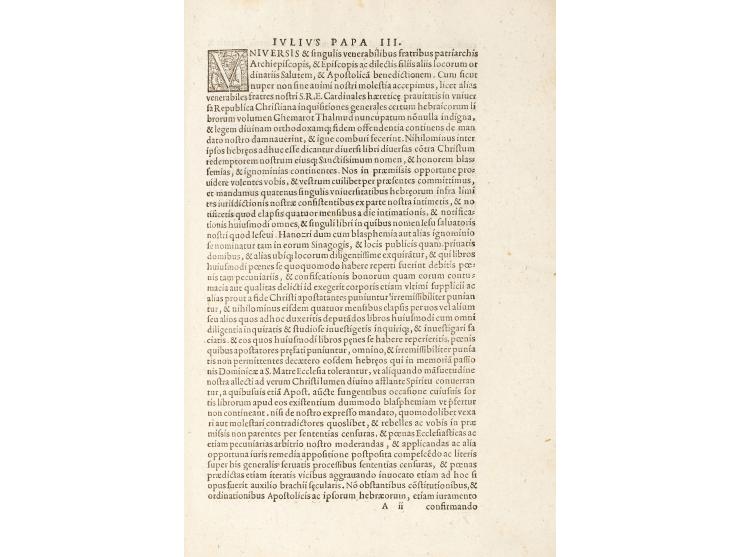
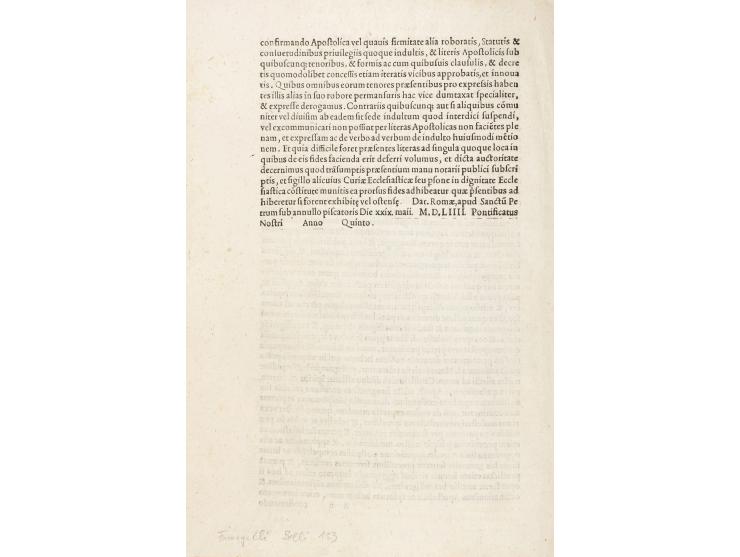
Printed papal bull – Cum sicut nuper, by Pope Julius III (1550-1555). Rome: Antonio Blado, May 29, 1554. Latin.
A rare document of extraordinary historical importance, maintaining and expanding the ordinances to burn the Talmud in Italy, and establishing an official censorship body responsible for examining Hebrew books.
The bull was published about nine months after the public burning of the Talmud in Campo de' Fiori, Rome, on the first day of Rosh Hashanah (1st Tishrei), September 9, 1553. It is addressed to Church authorities throughout the Christian world (patriarchs, archbishops, bishops and local authorities). The bull reinforces the directive to collect and burn all copies of the Talmud, and expands the prohibition to any Hebrew book – print or manuscript – that makes any statement or insinuation against Jesus, or contains blasphemy and censure of the Christian faith. Other Hebrew books are declared permitted, providing their content is officially condoned by an authorized Church censorship committee.
The bull instructs Church authorities to inform all Jewish communities within their jurisdiction that in four months' time, synagogues, community institutions and private homes were to be thoroughly searched for prohibited books. These offending books will be publicly burned, and their owners severely punished by heavy fines, confiscation of property and the "utmost corporal punishment", up to the death penalty, as apostates. It annuls any previous privilege or indulgence in contradiction to it, and permits invoking the secular authorities for enforcement.
Despite its severity, the bull in fact granted some leniency as opposed to the existing conditions: it forbids molestation of Jews for books that do not contain censure of Christianity, and determines a regulatory system for the deletion of anti-Christian content. In point of fact, the Jews of Italy were indeed relieved, as the policy did not demand a wholesale burning of the Talmud and Hebrew books, but only expurgation of passages viewed as blasphemous or otherwise offensive.
Large woodcut with coat of arms on first page (papal tiara with two crossed keys).
[1] folded leaf (3 printed pages). 29.5 cm. Good condition. Stains and minor defects. Open tear to top of first leaf (not affecting text). Bound (sewn) in new paper wrapper, with front endpaper.
Reference:
1. Attilio Milano, Il ghetto di Roma, Roma: Staderini, 1964, p. 64 and fig. 9.
2. Shlomo Simonsohn, The Apostolic See and the Jews, Documents: 1546-1555, Toronto: Pontifical Institute of Mediaeval Studies, 1990, pp. 2920-2921.
3. Kenneth R. Stow, "The Burning of the Talmud in 1553", Bibliothèque d’Humanisme et Renaissance, XXXIV, 3 (1972), pp. 435-459.
Rare. To the best of our knowledge, this bull has never before been offered at auction.
Catalogue Value
Auction 106 Incunabula and First Editions | Illuminated Manuscripts | Jewish Ceremonial Art
Feb 24, 2026
Opening: $150,000
Sold for: $475,000
Including buyer's premium
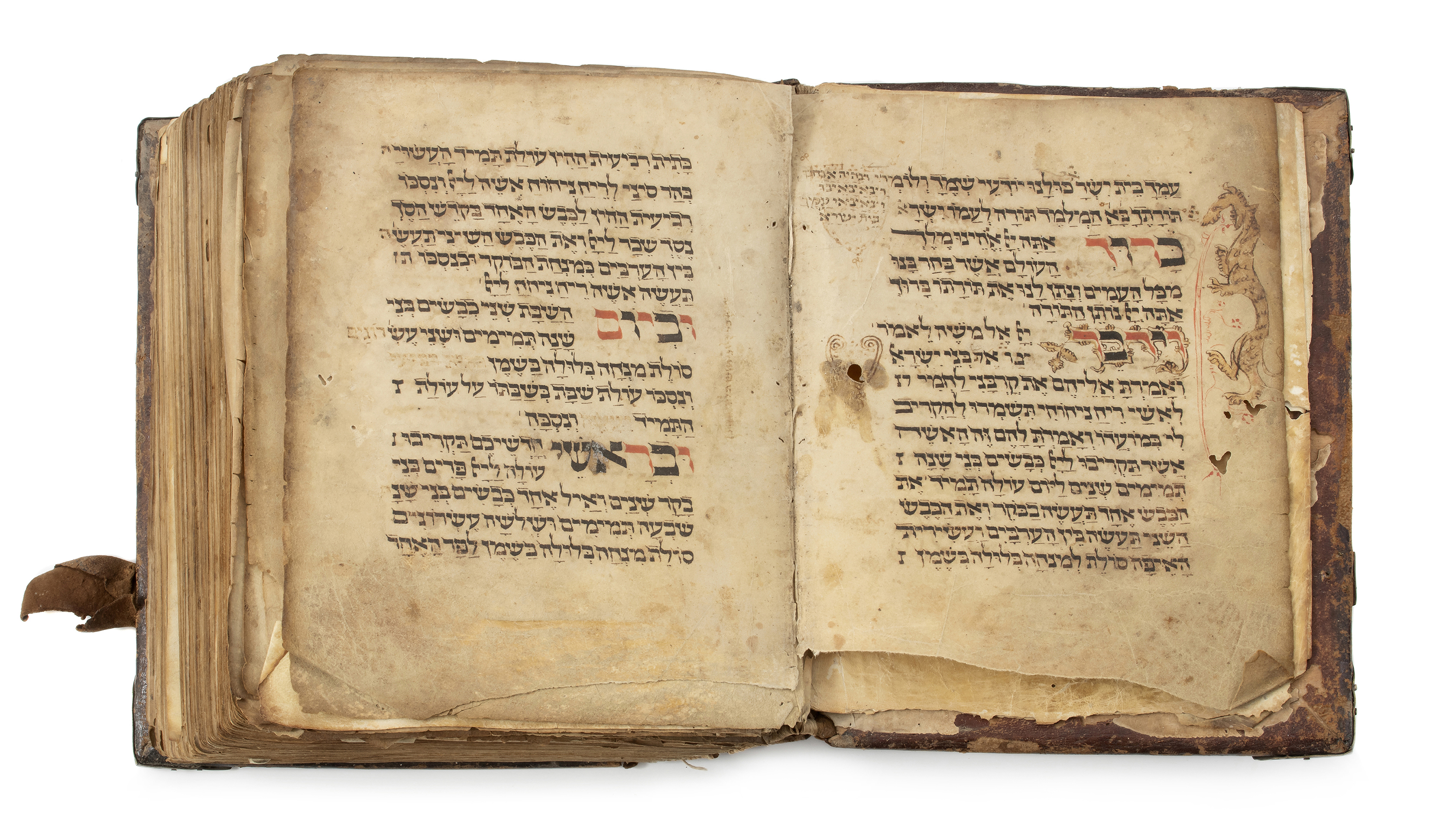
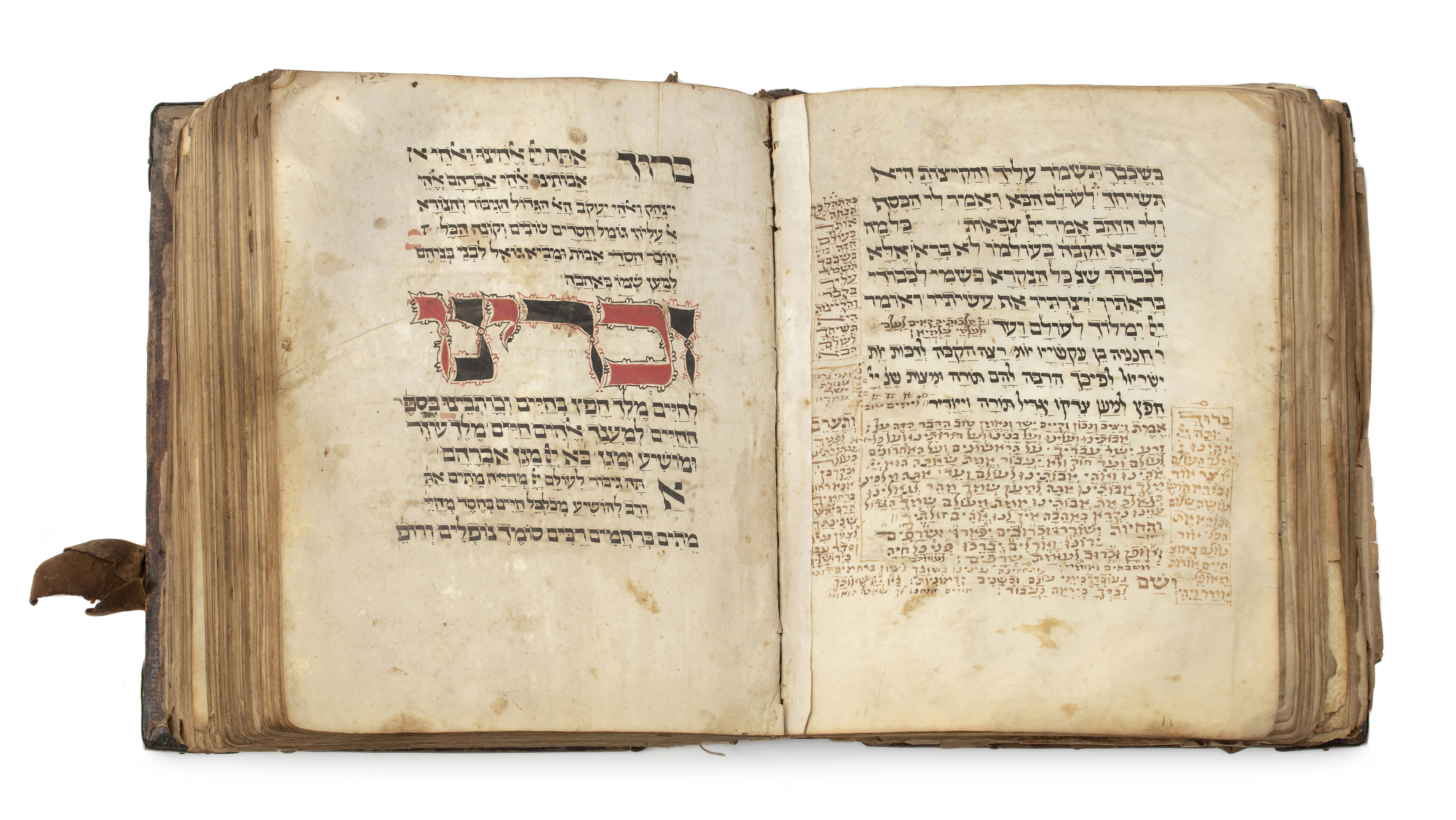
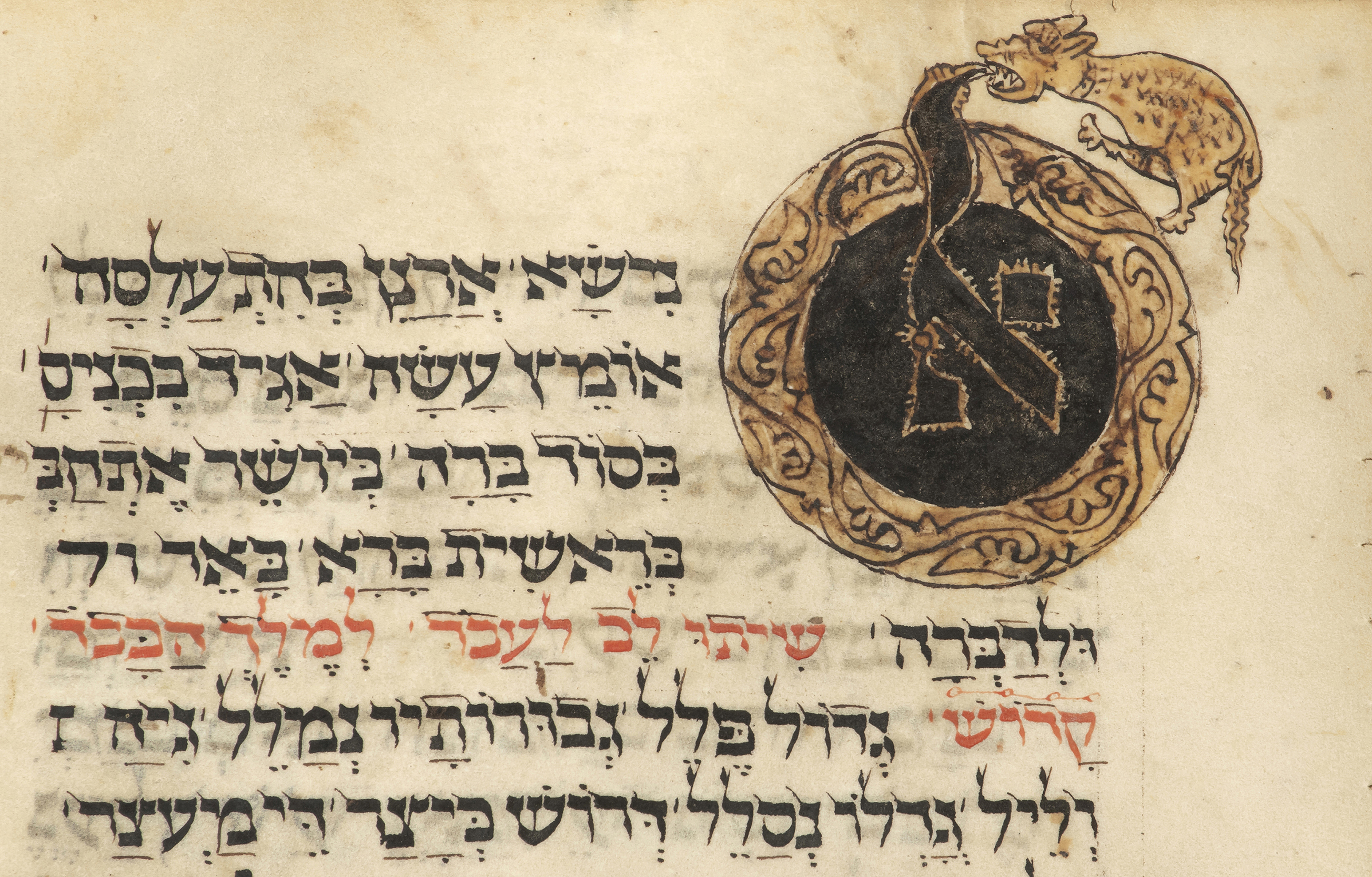
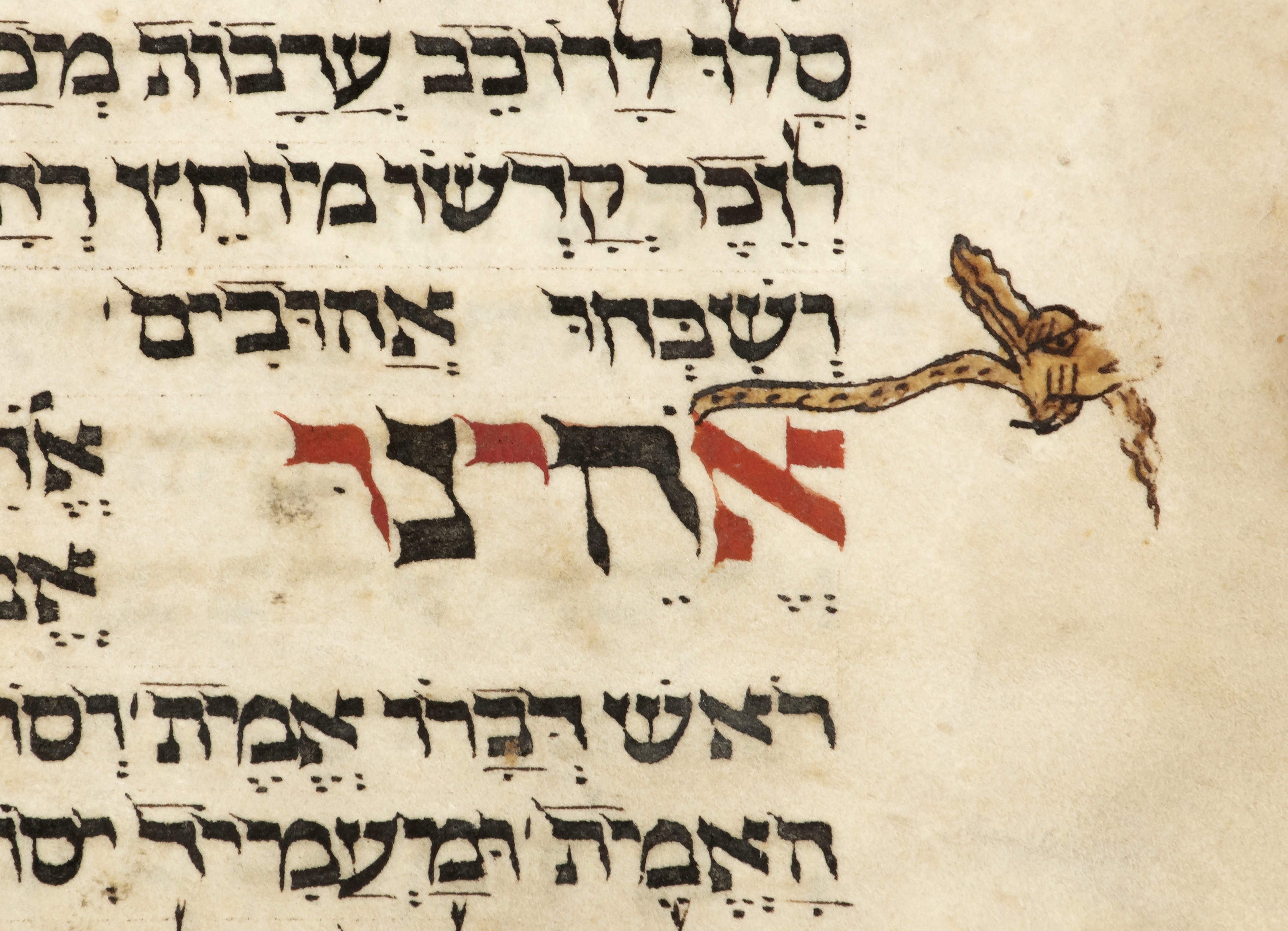
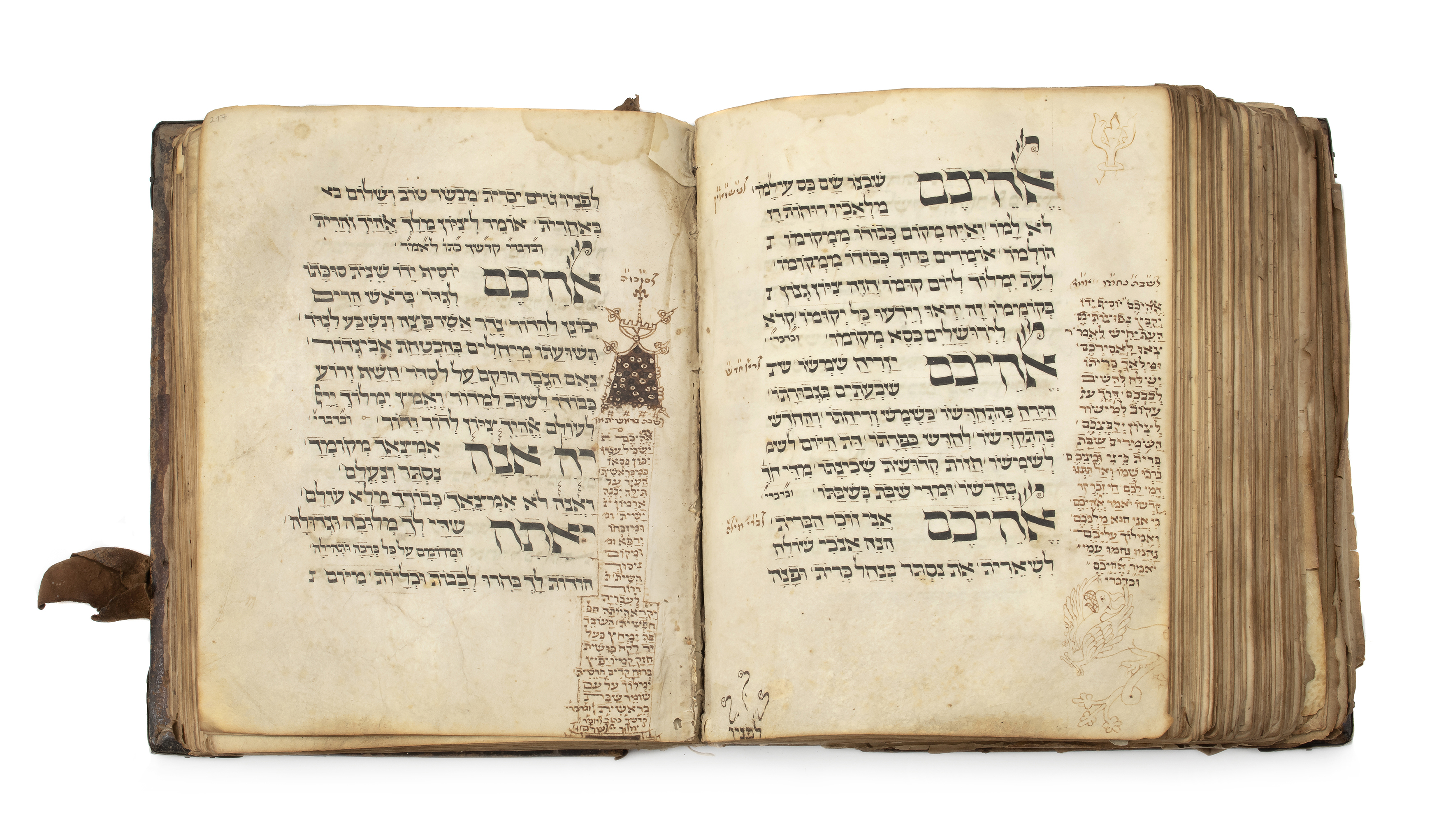
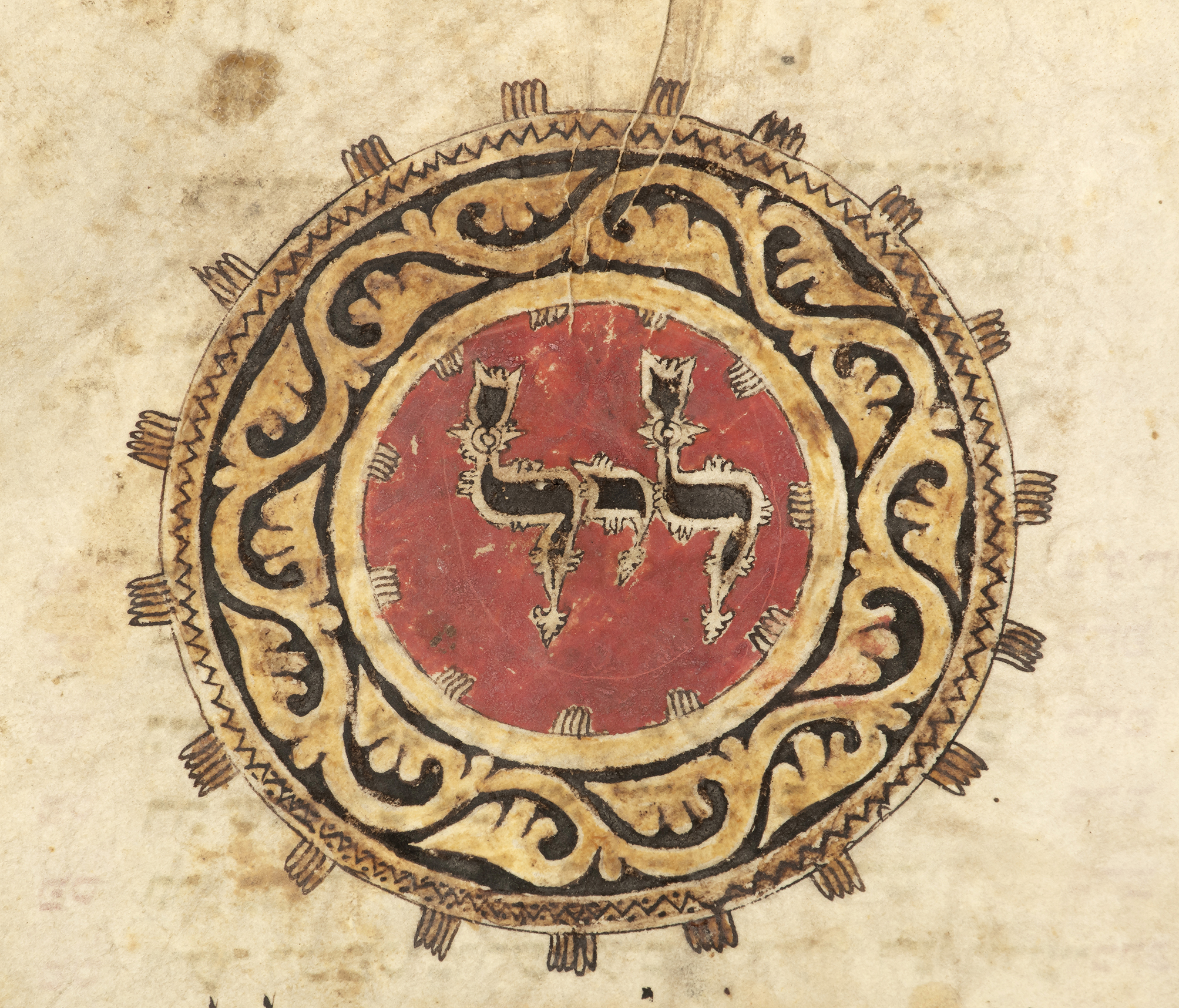
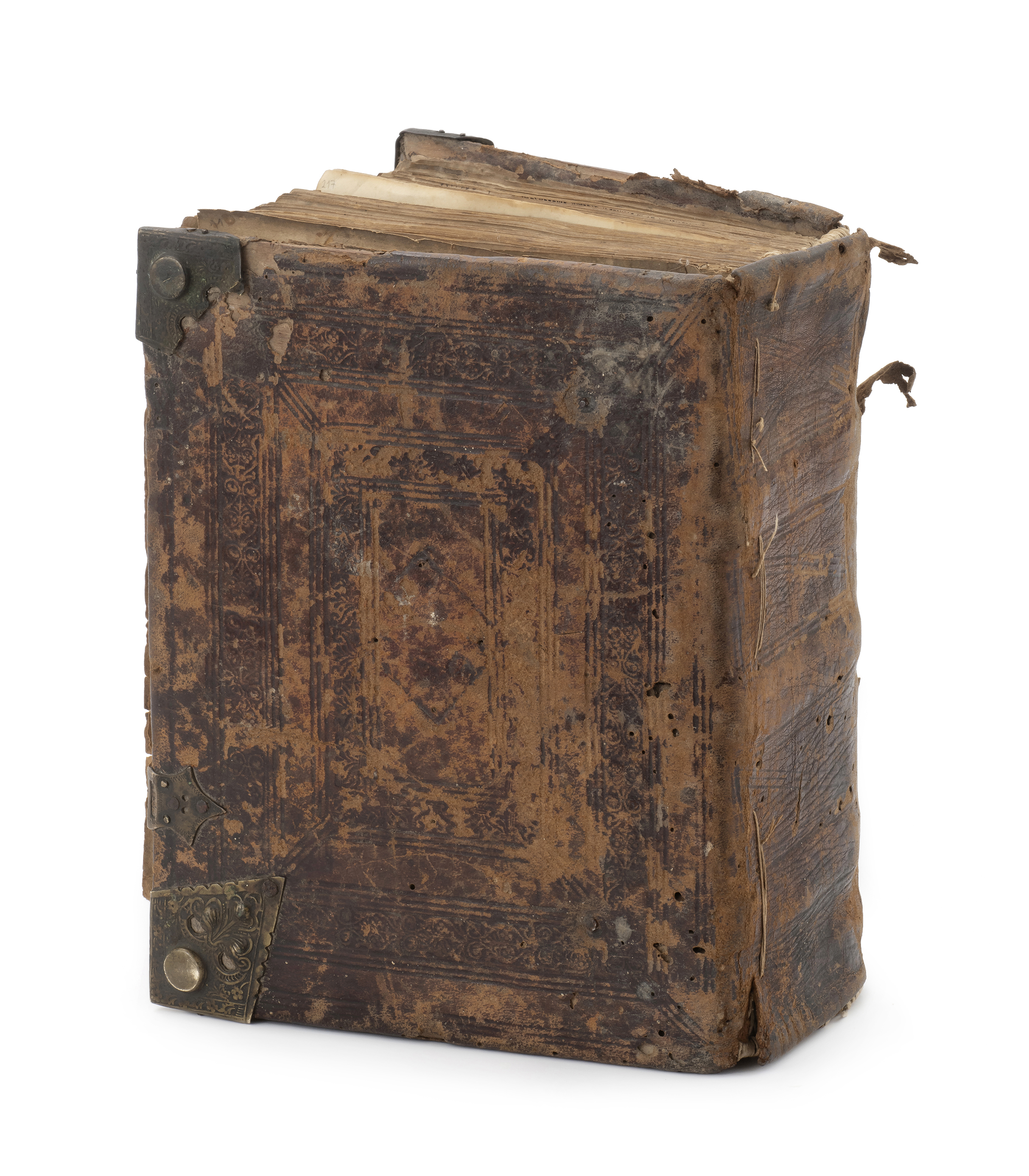
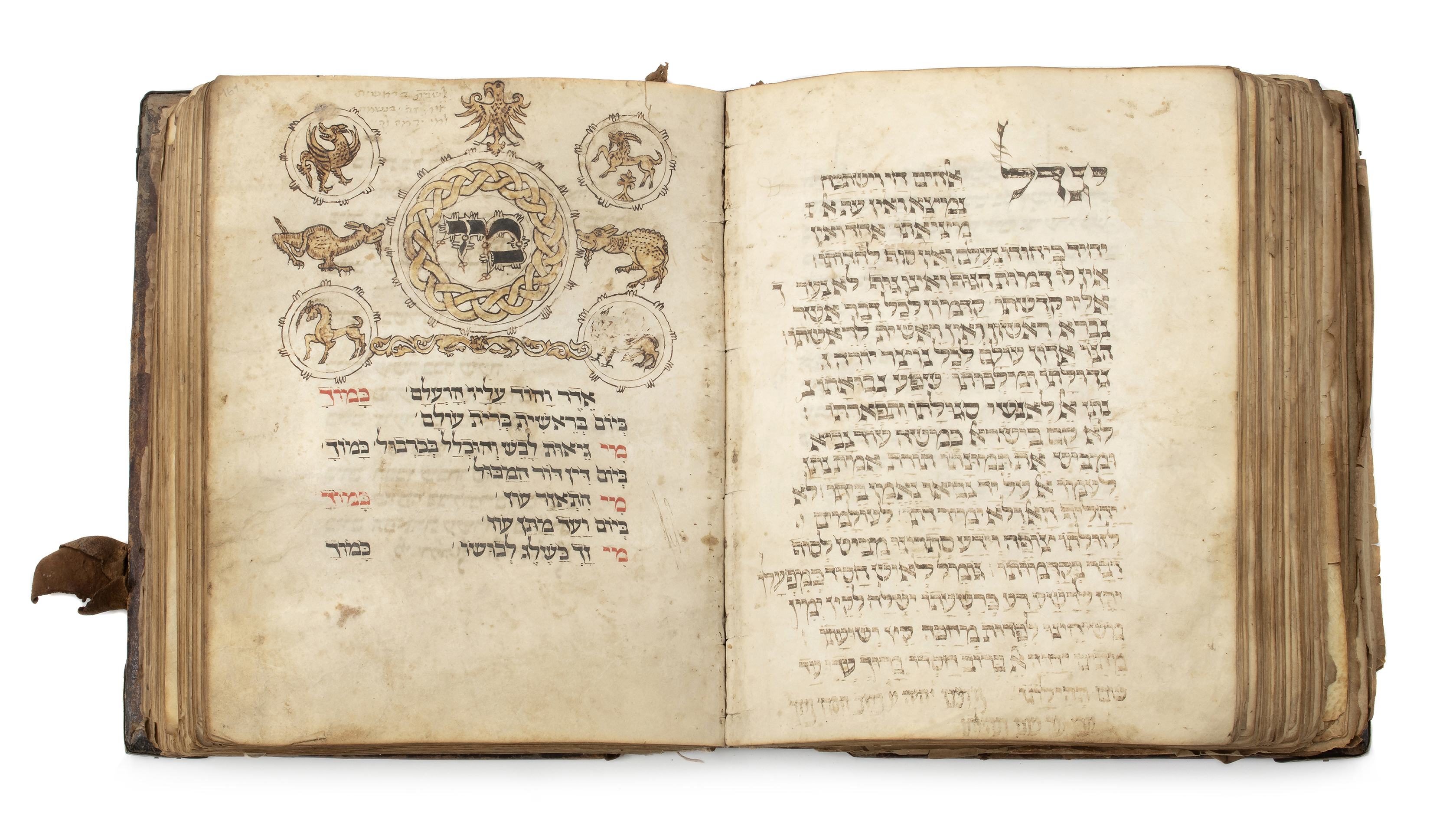
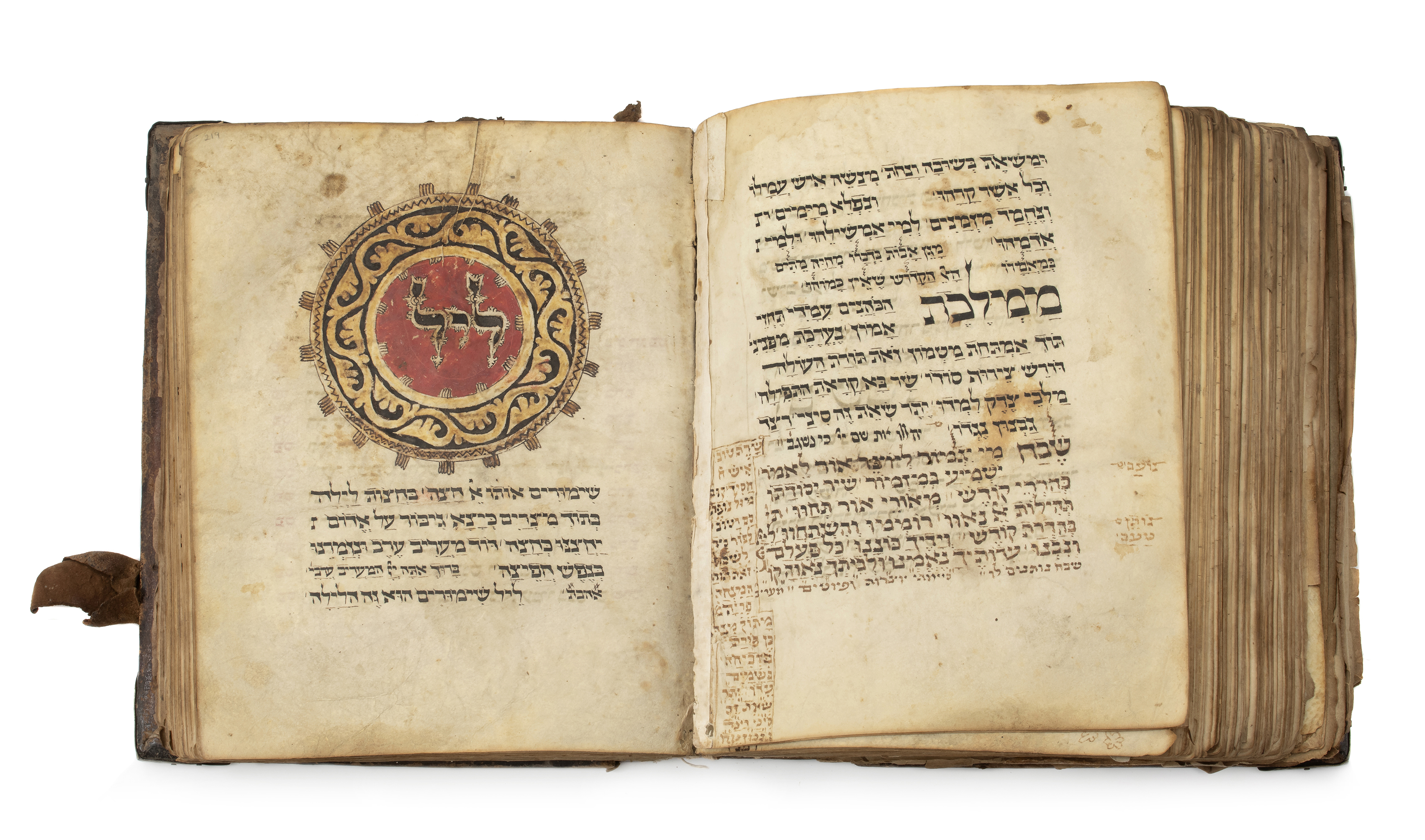
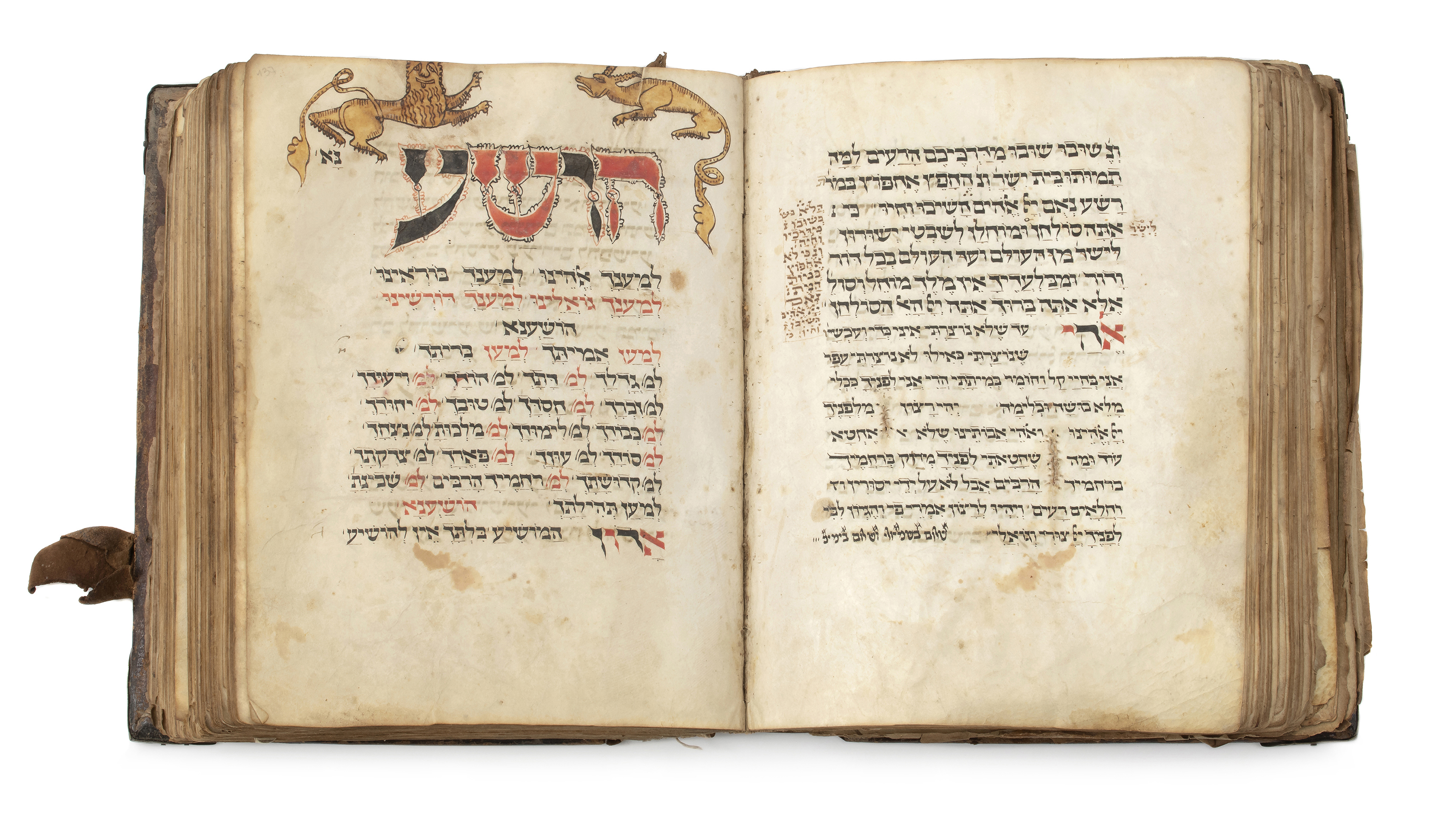
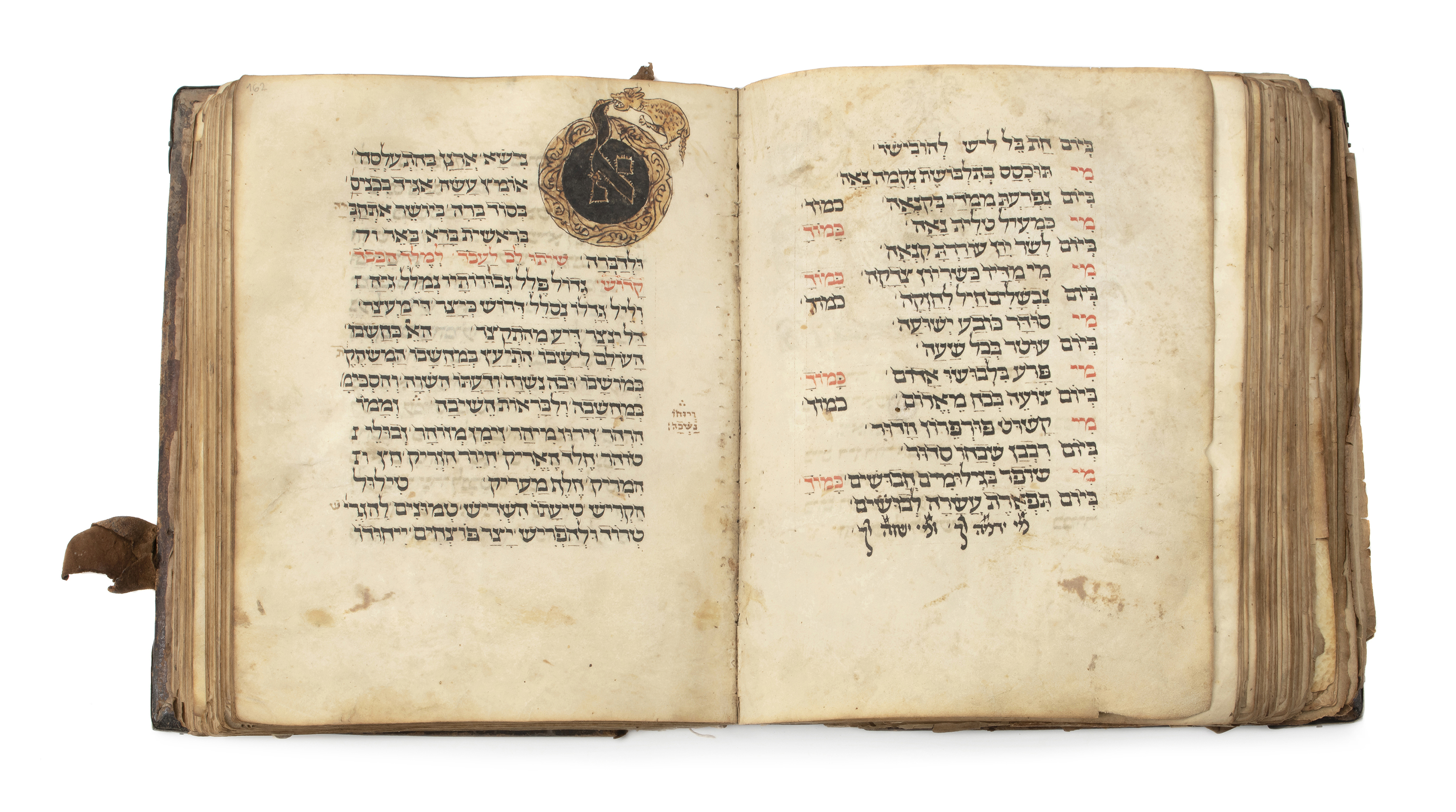
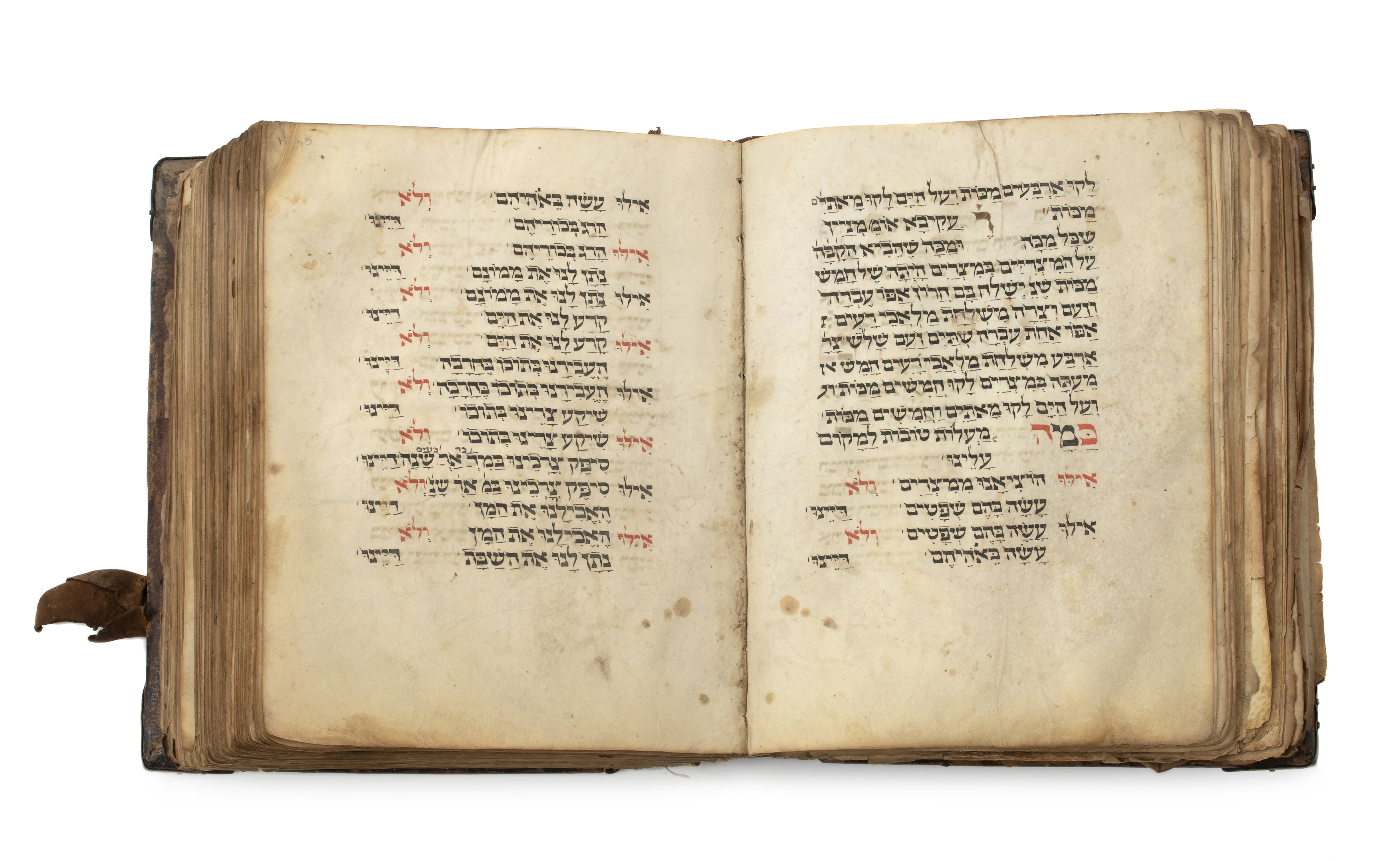
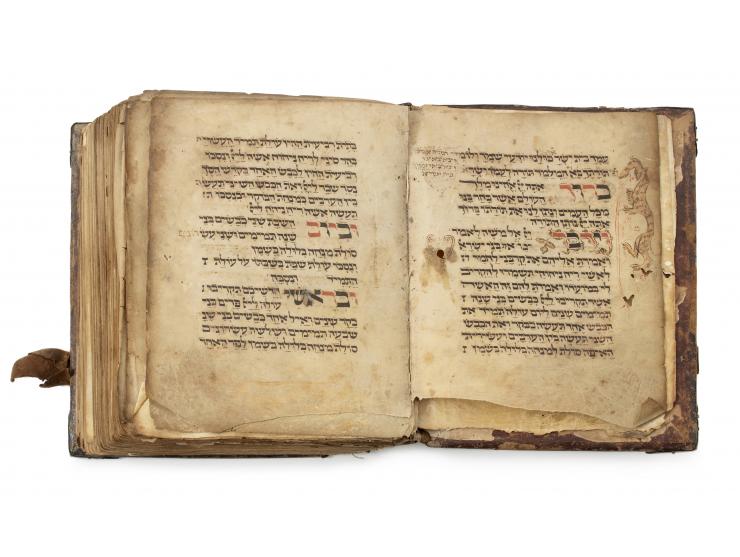
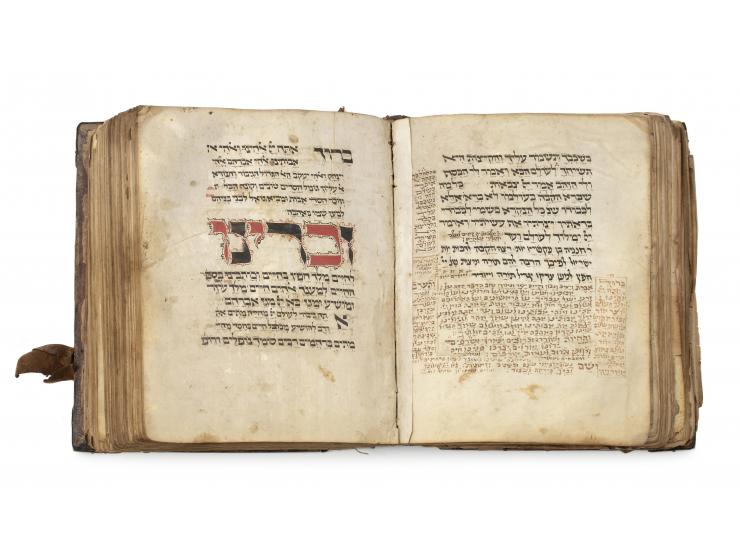
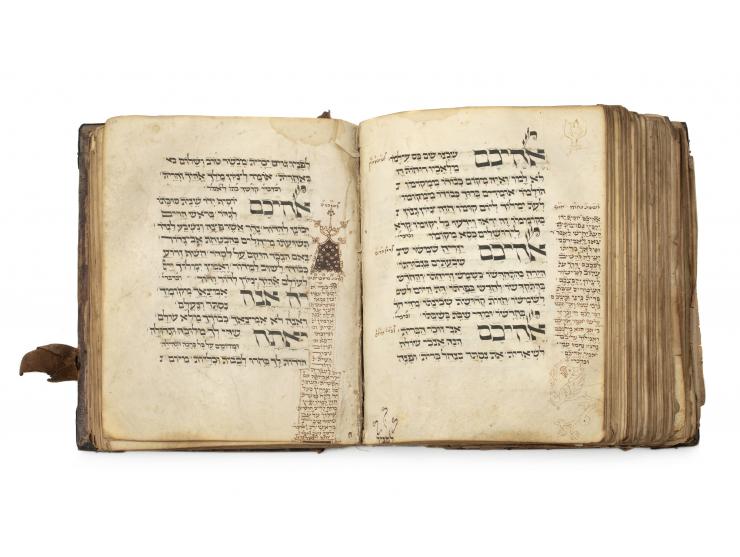
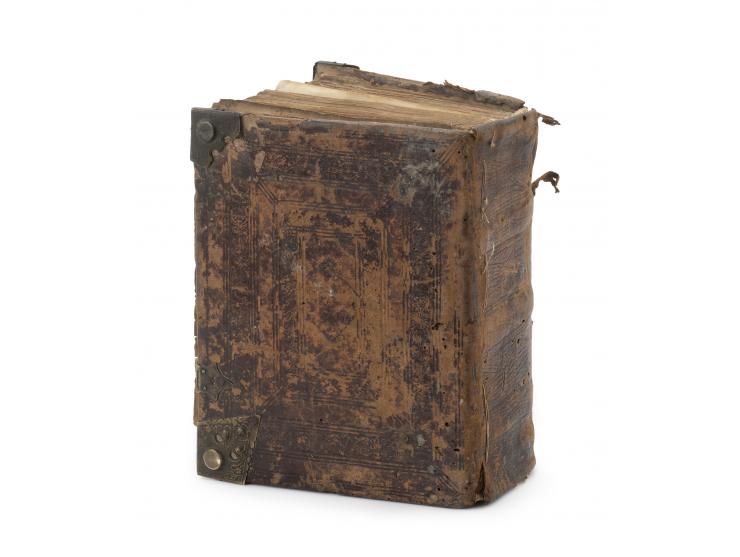
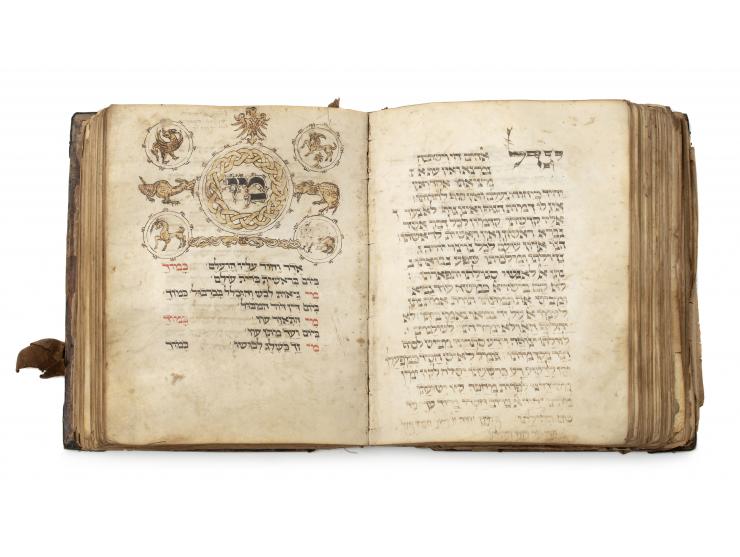
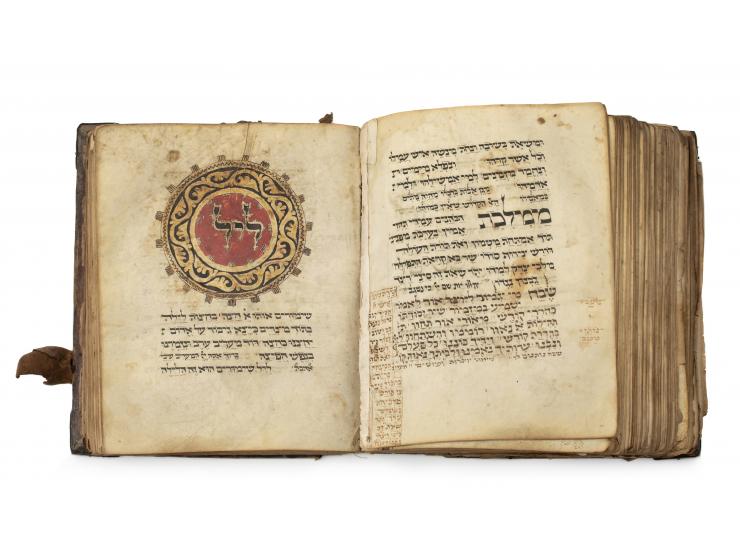
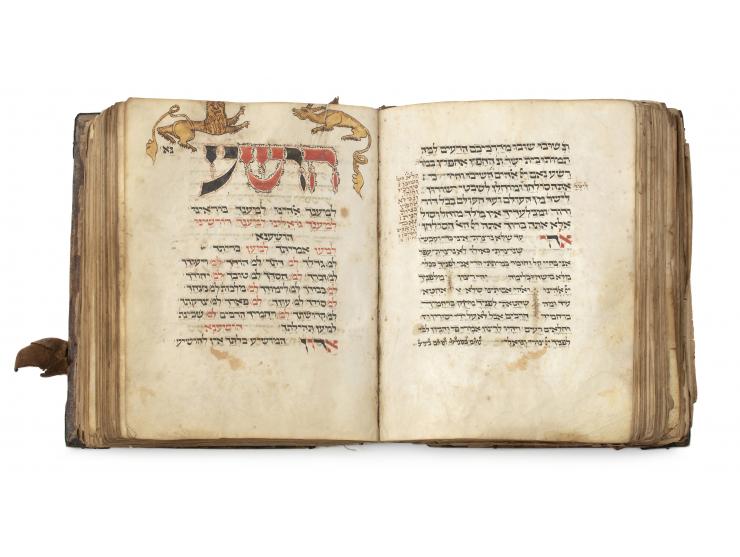
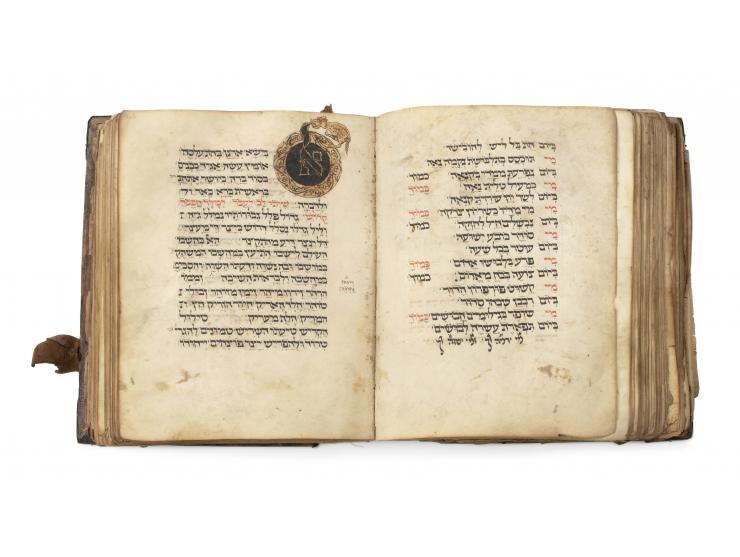
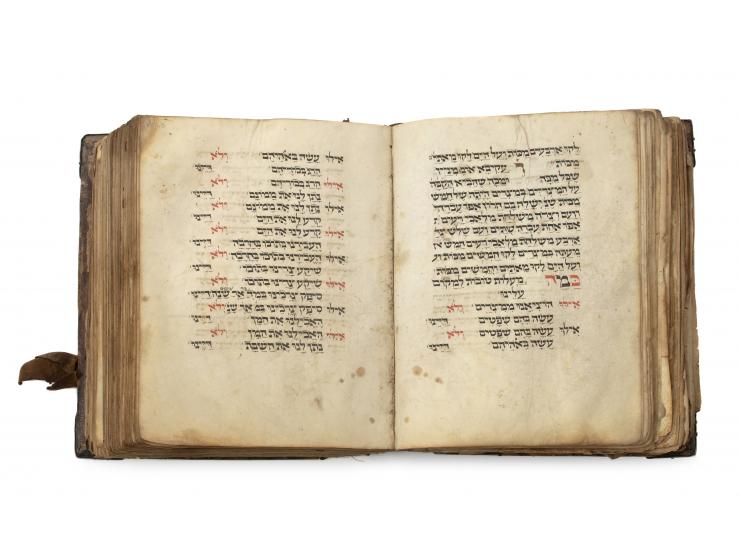
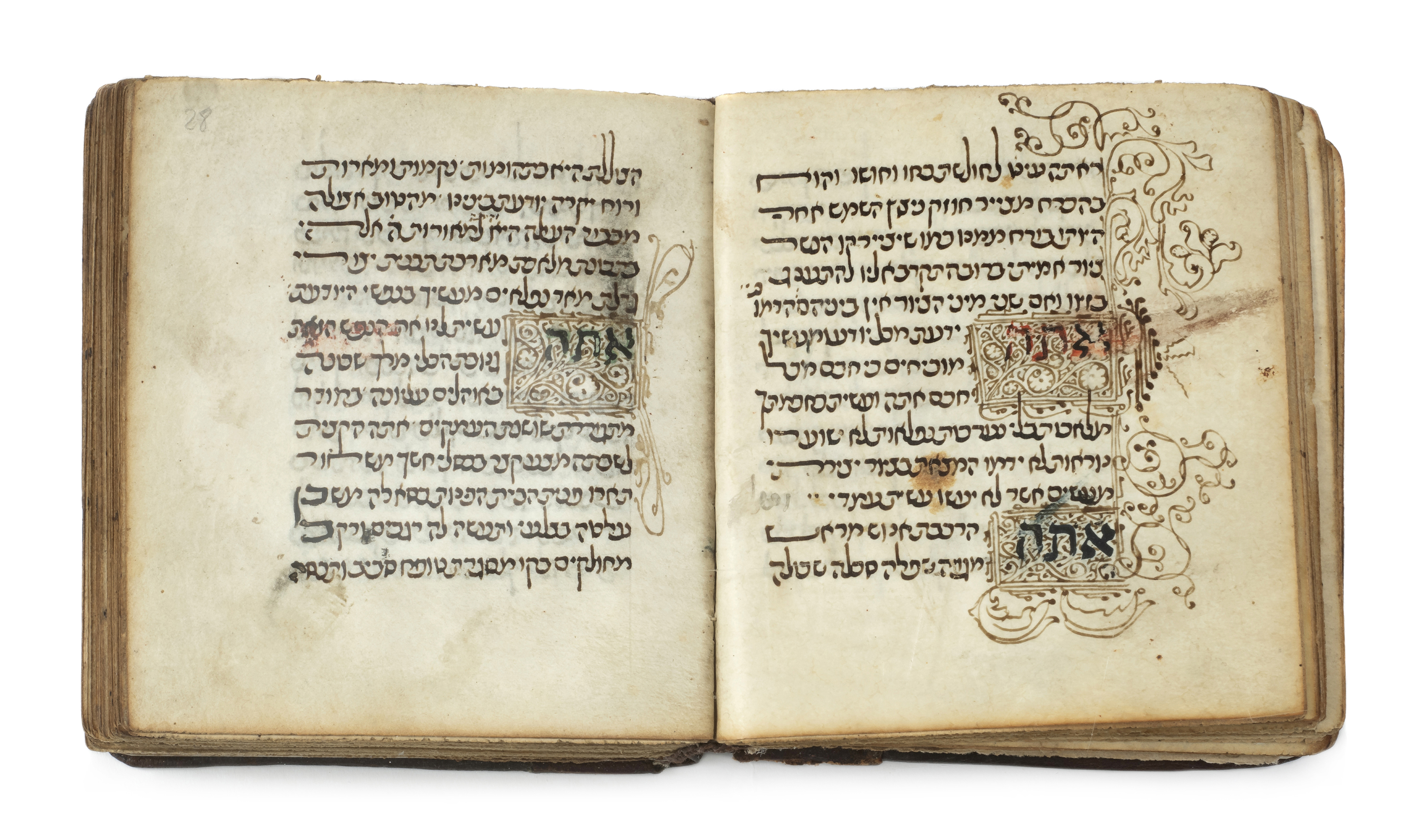
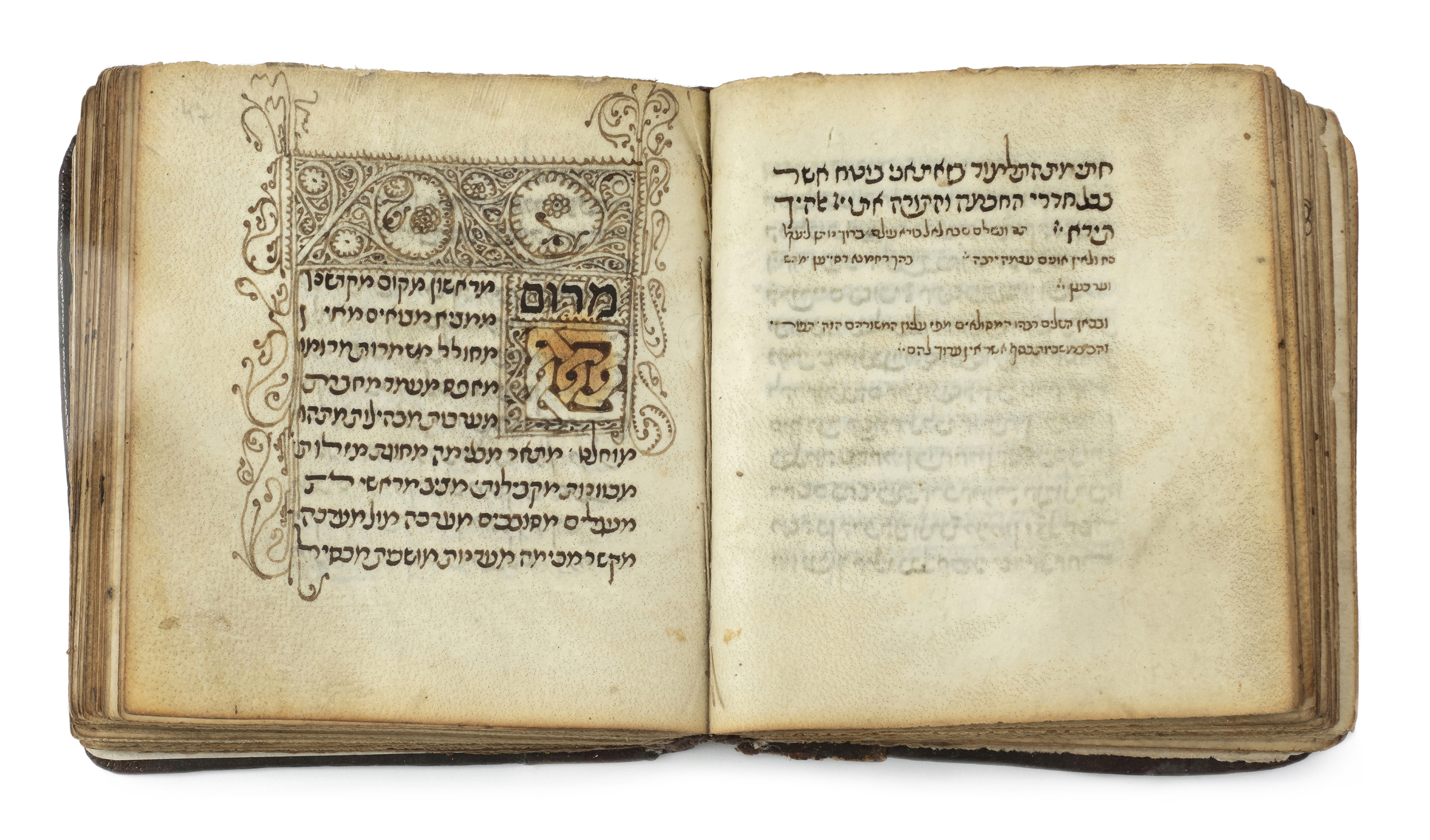
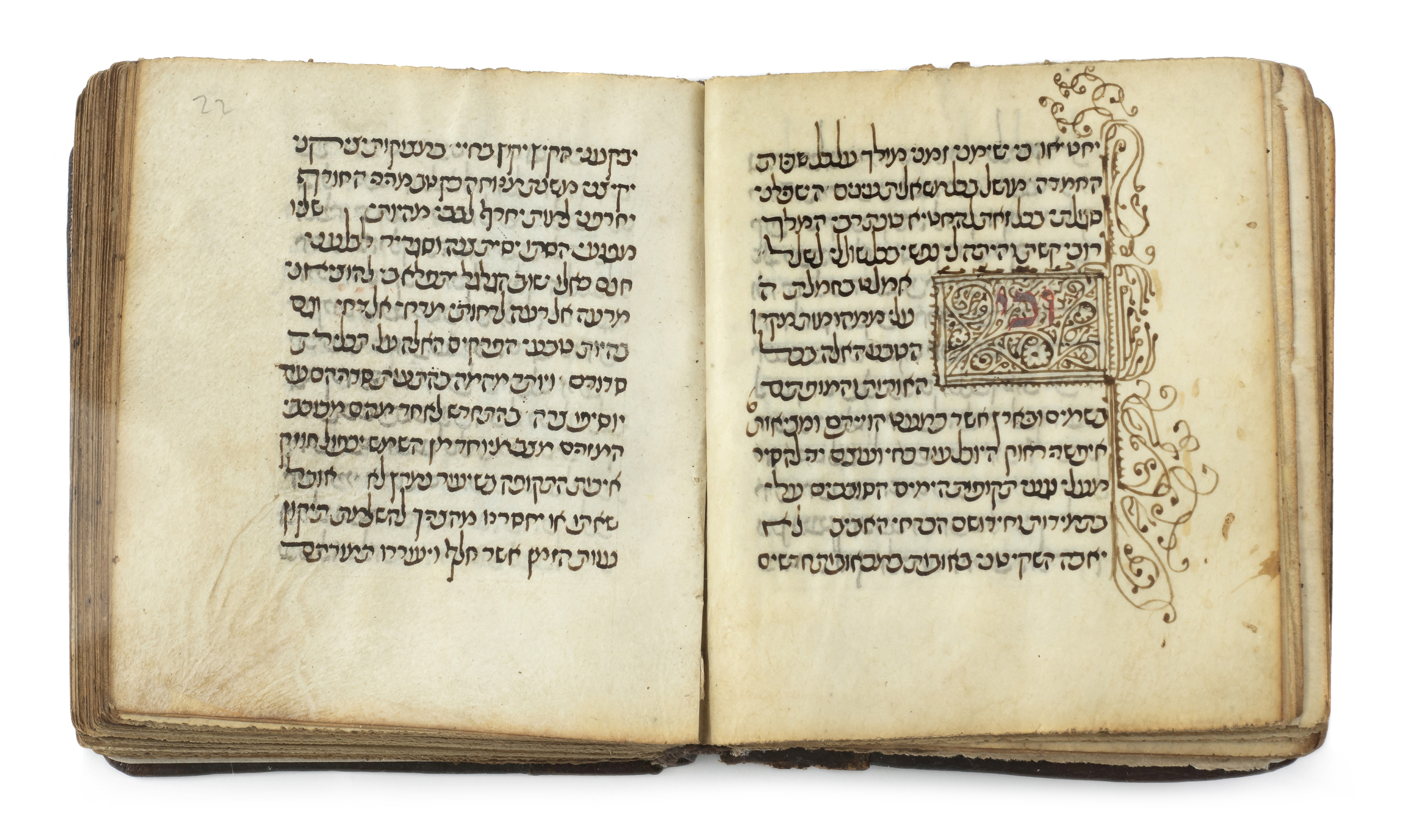
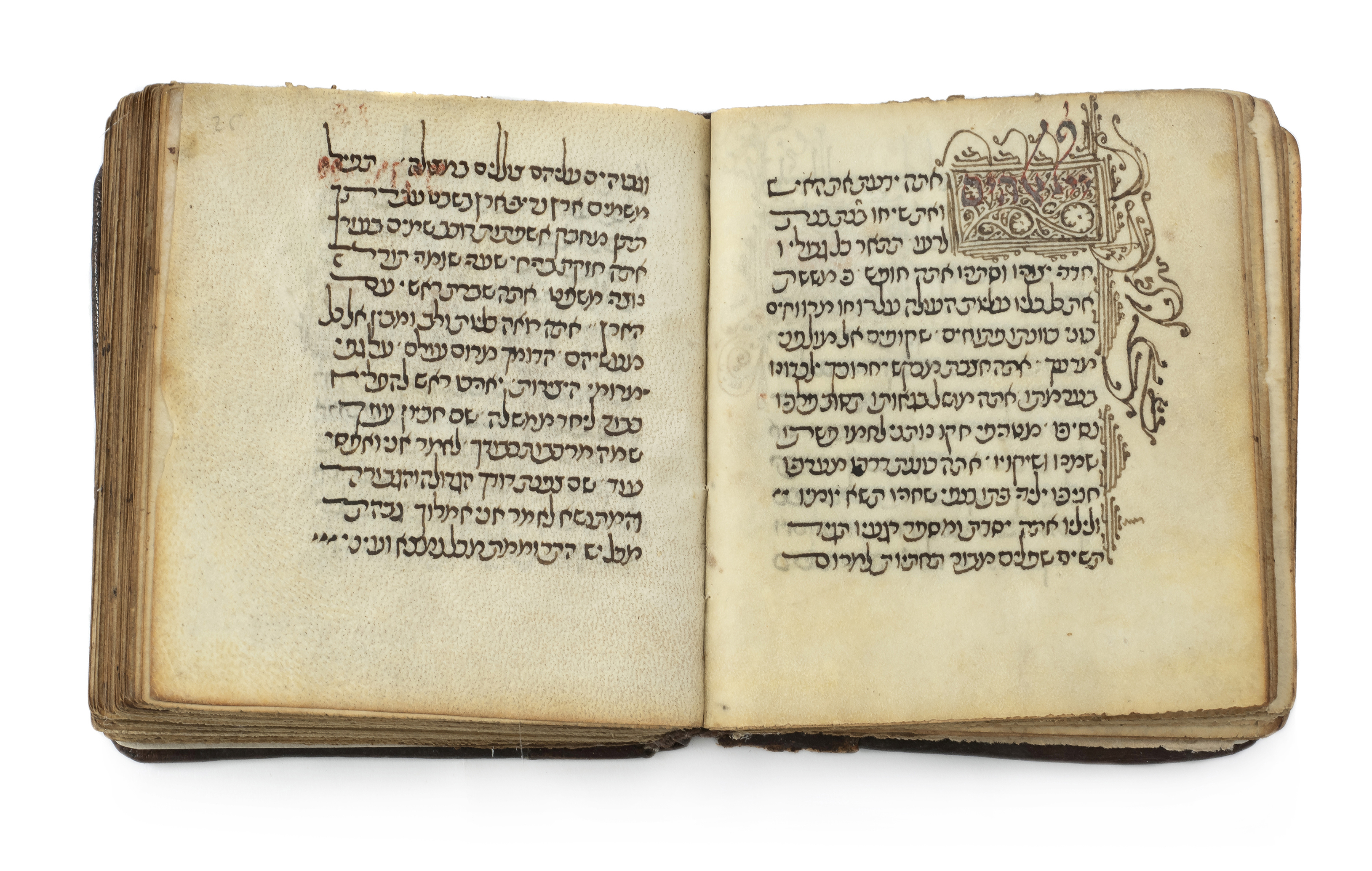
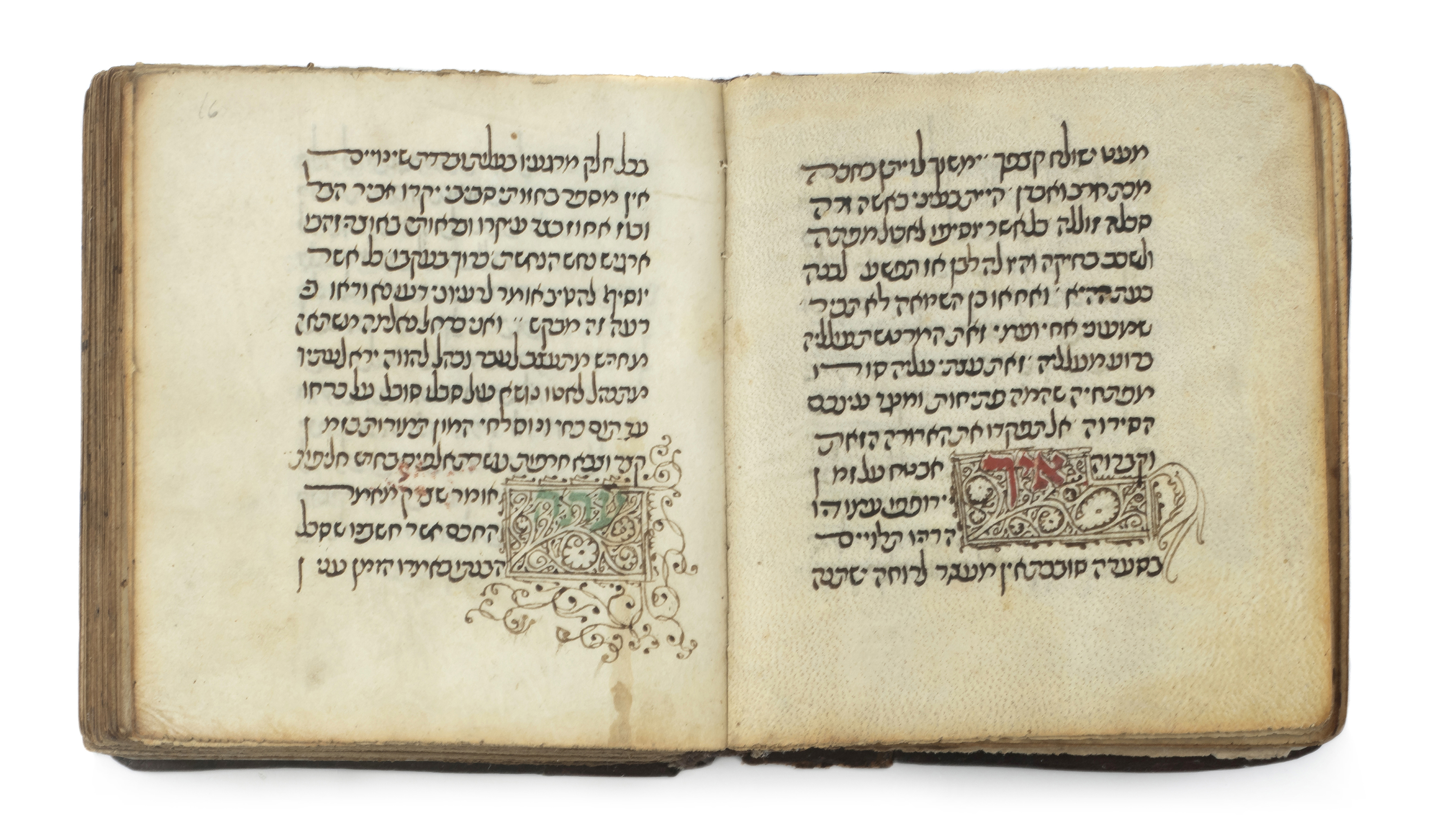
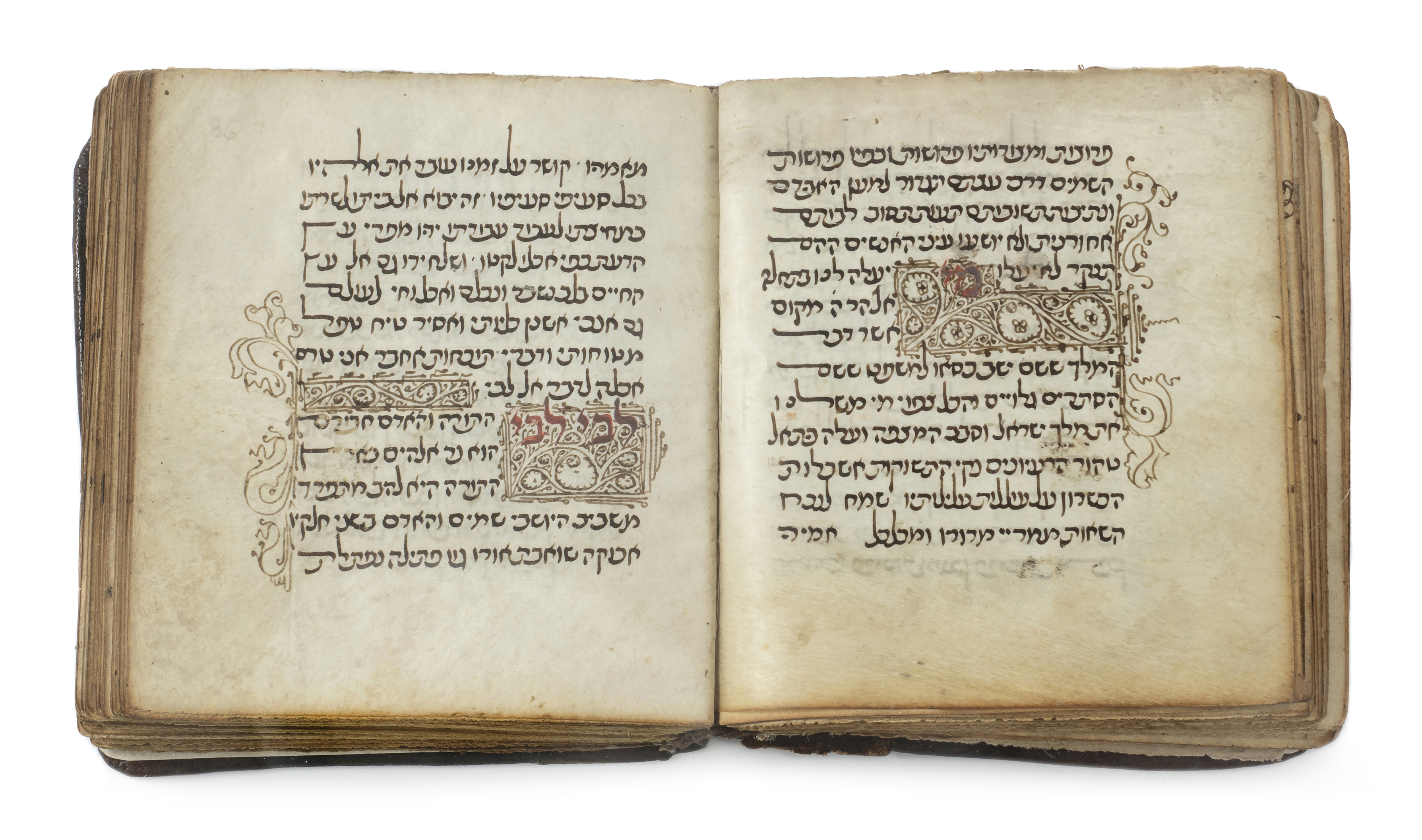
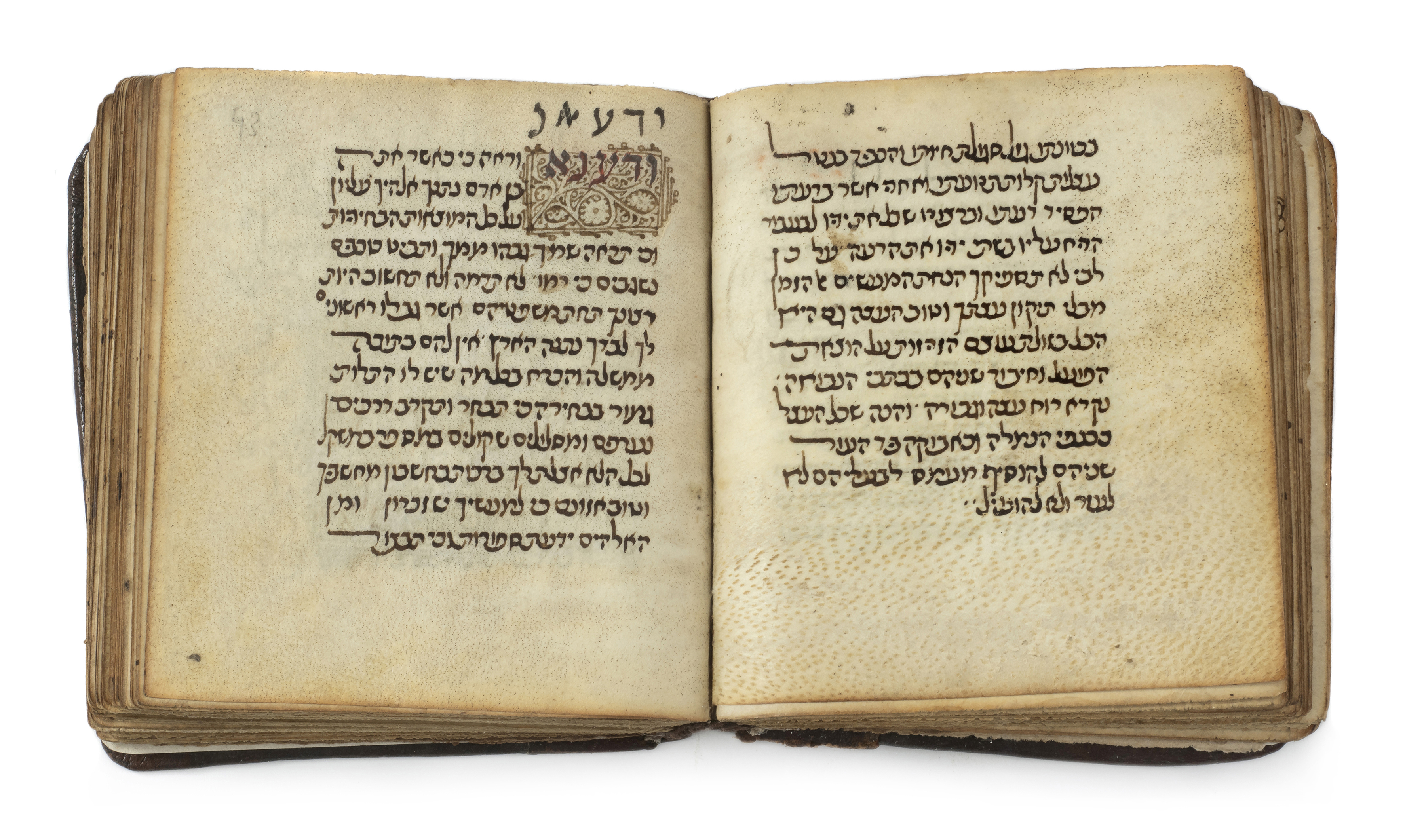
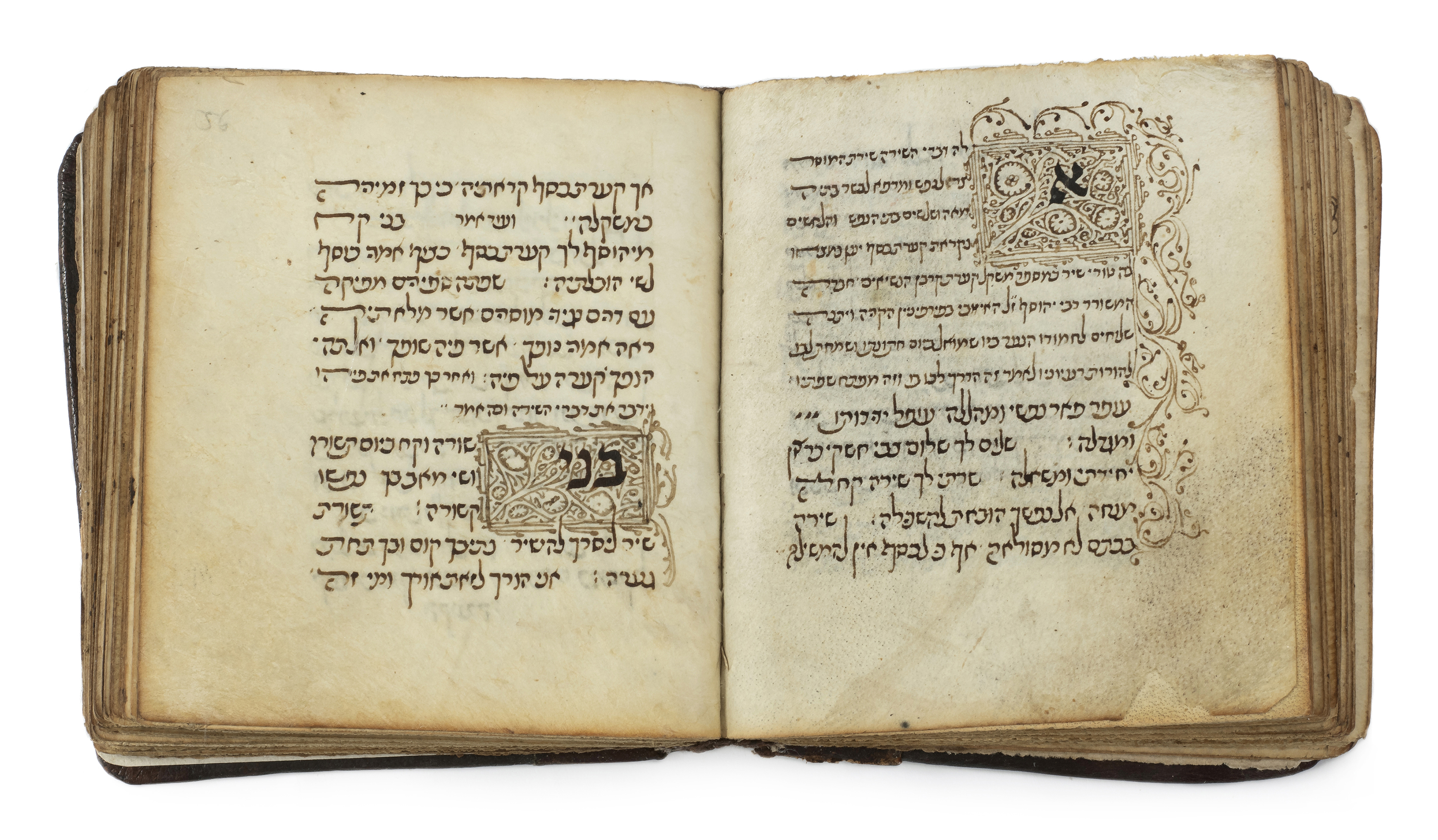
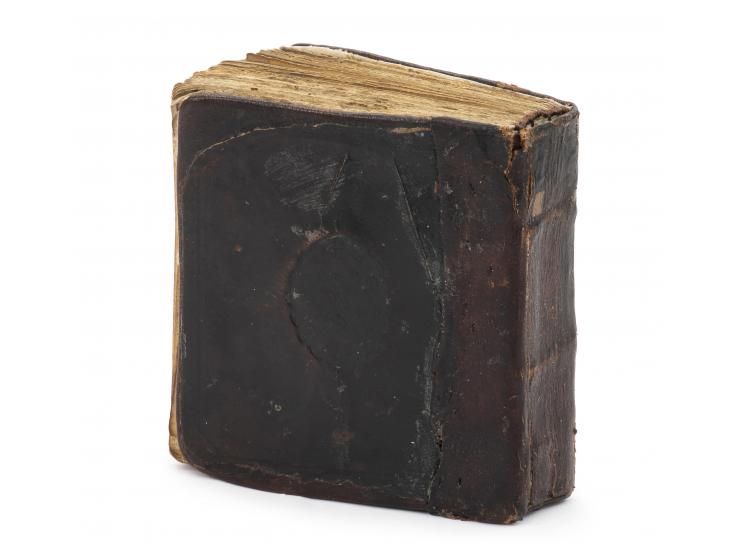
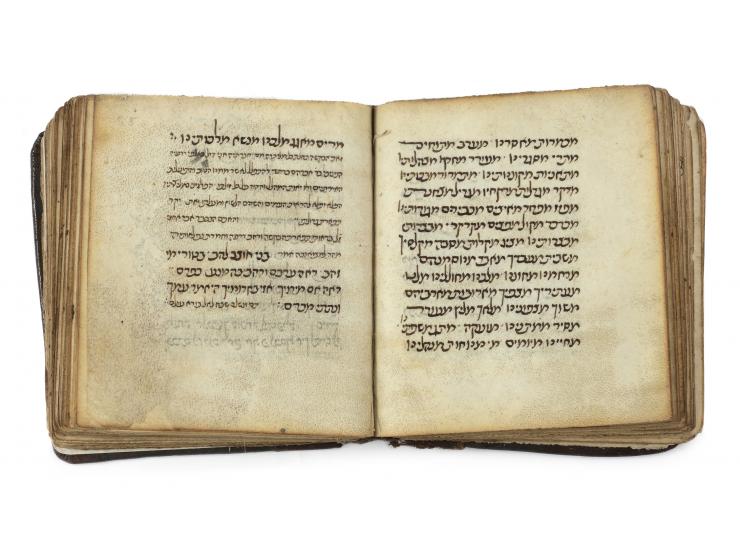
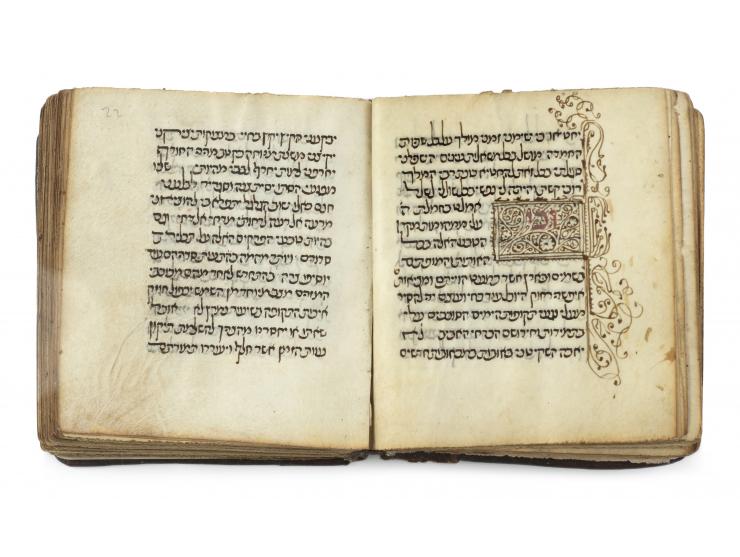
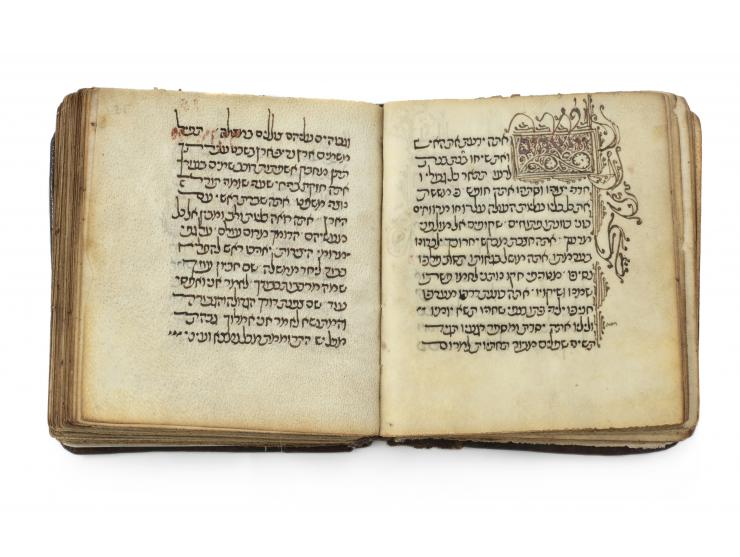
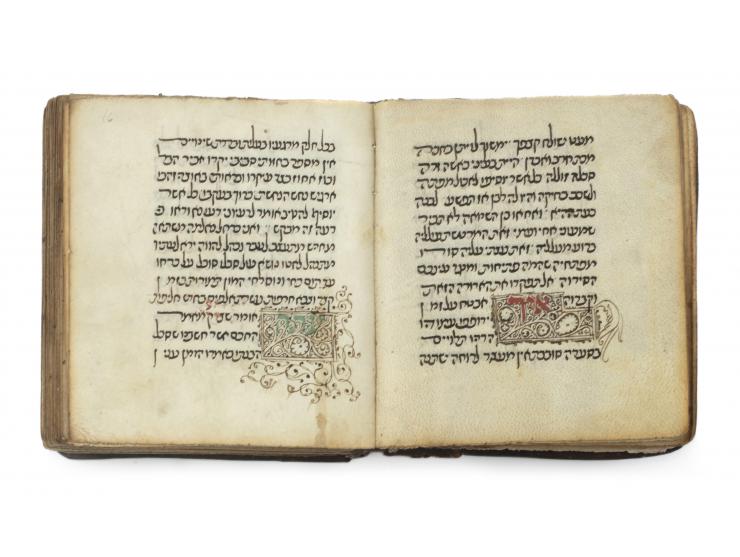
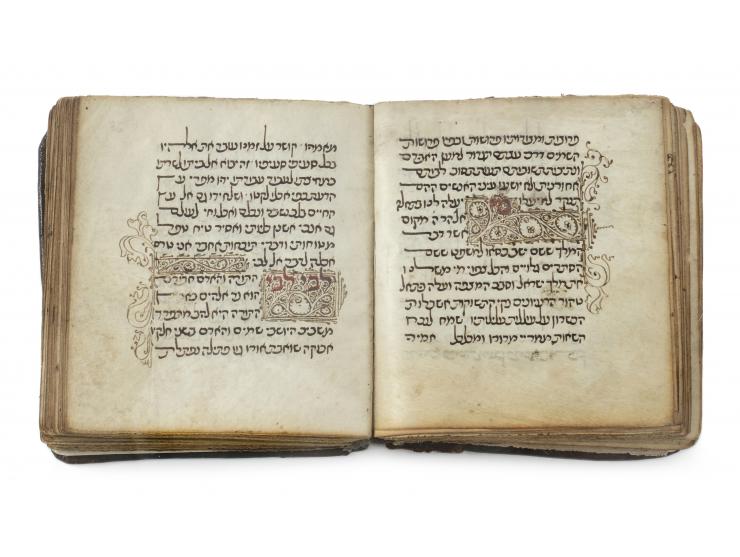
Parchment manuscript, Ashkenazic-rite siddur, for weekdays, Shabbat and festivals – prayers and piyyutim, with Passover Haggadah, Tractate Avot, selected laws and more. [Ashkenazic lands, ca. 14th century].
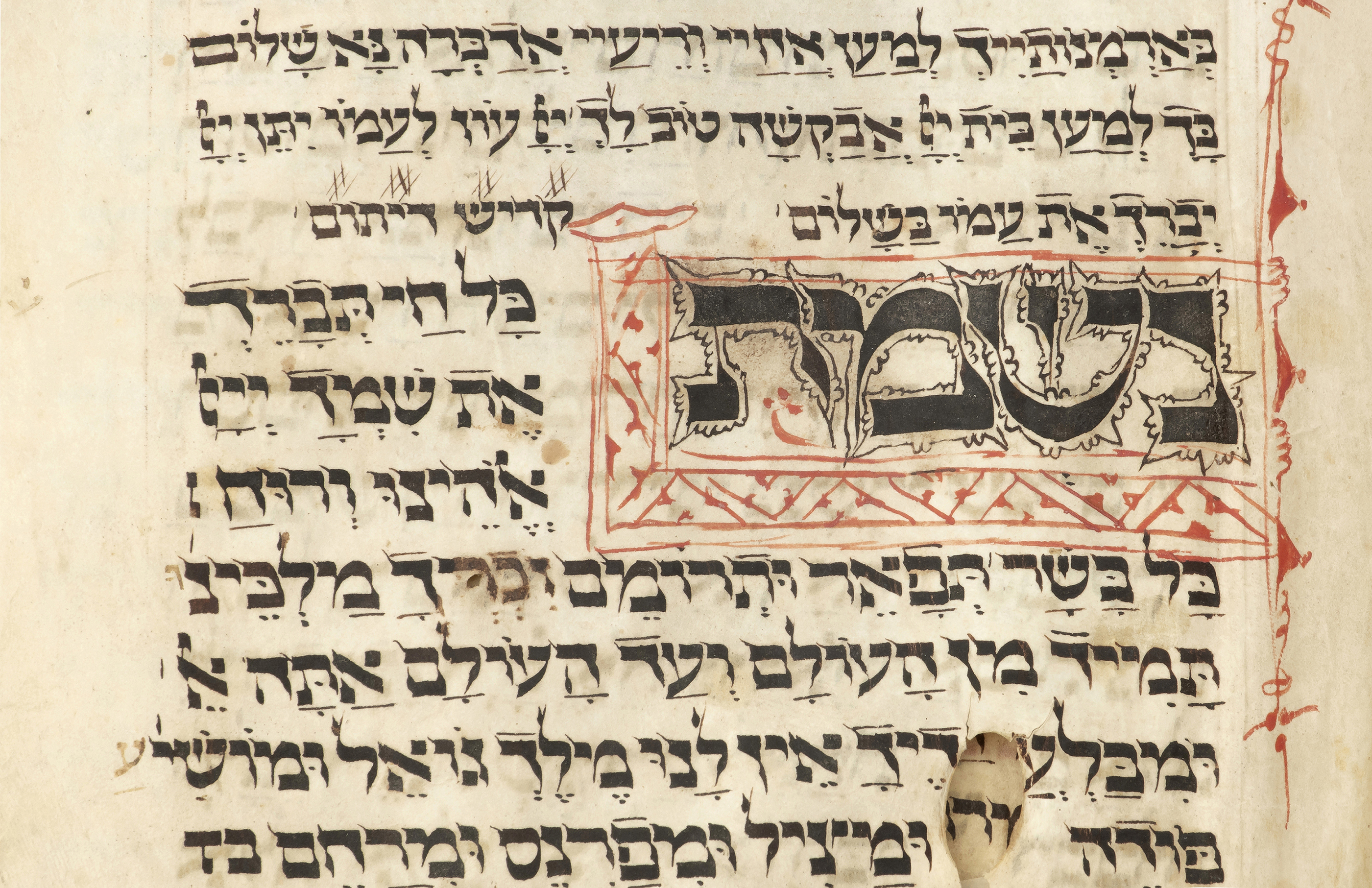
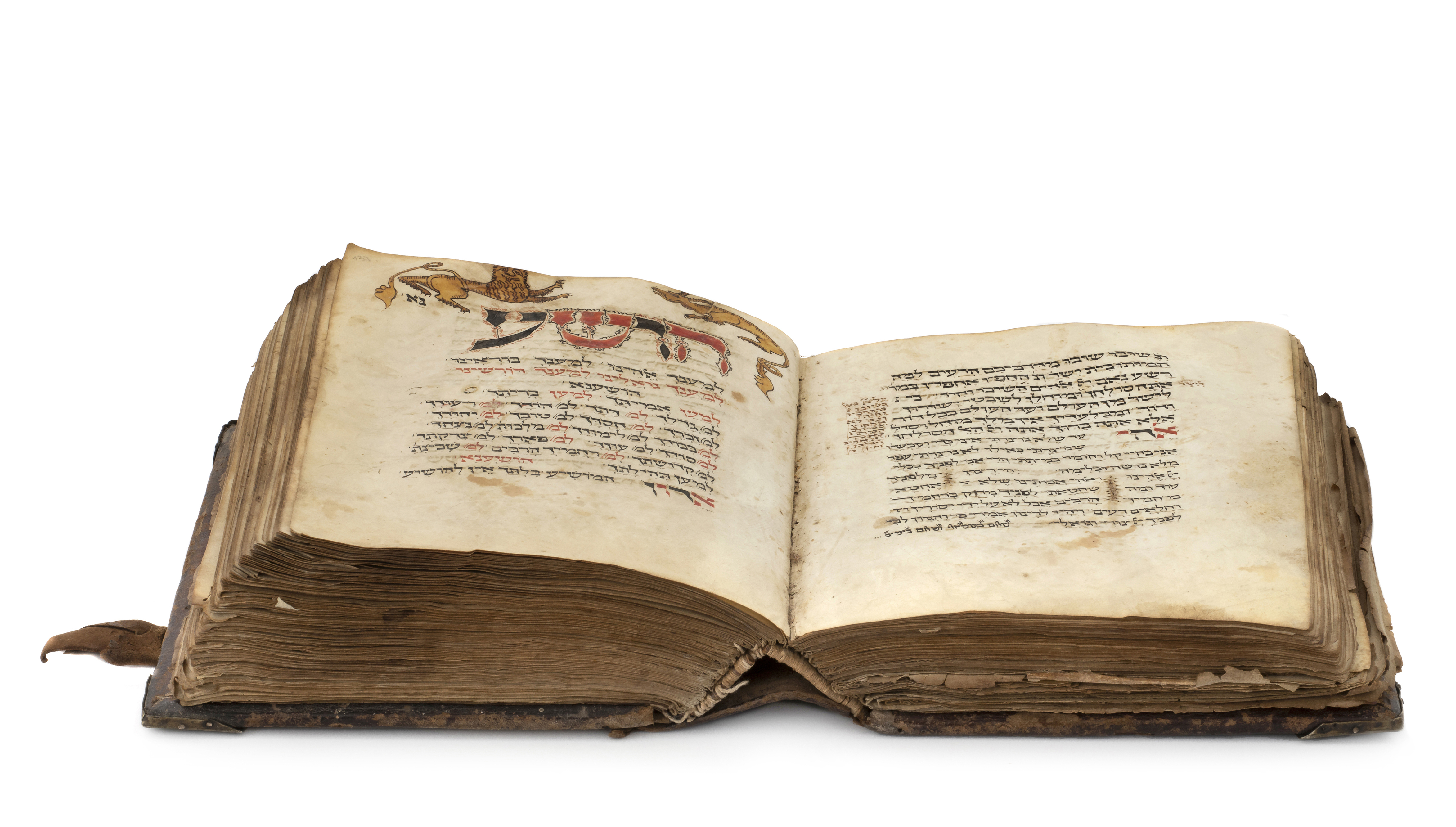
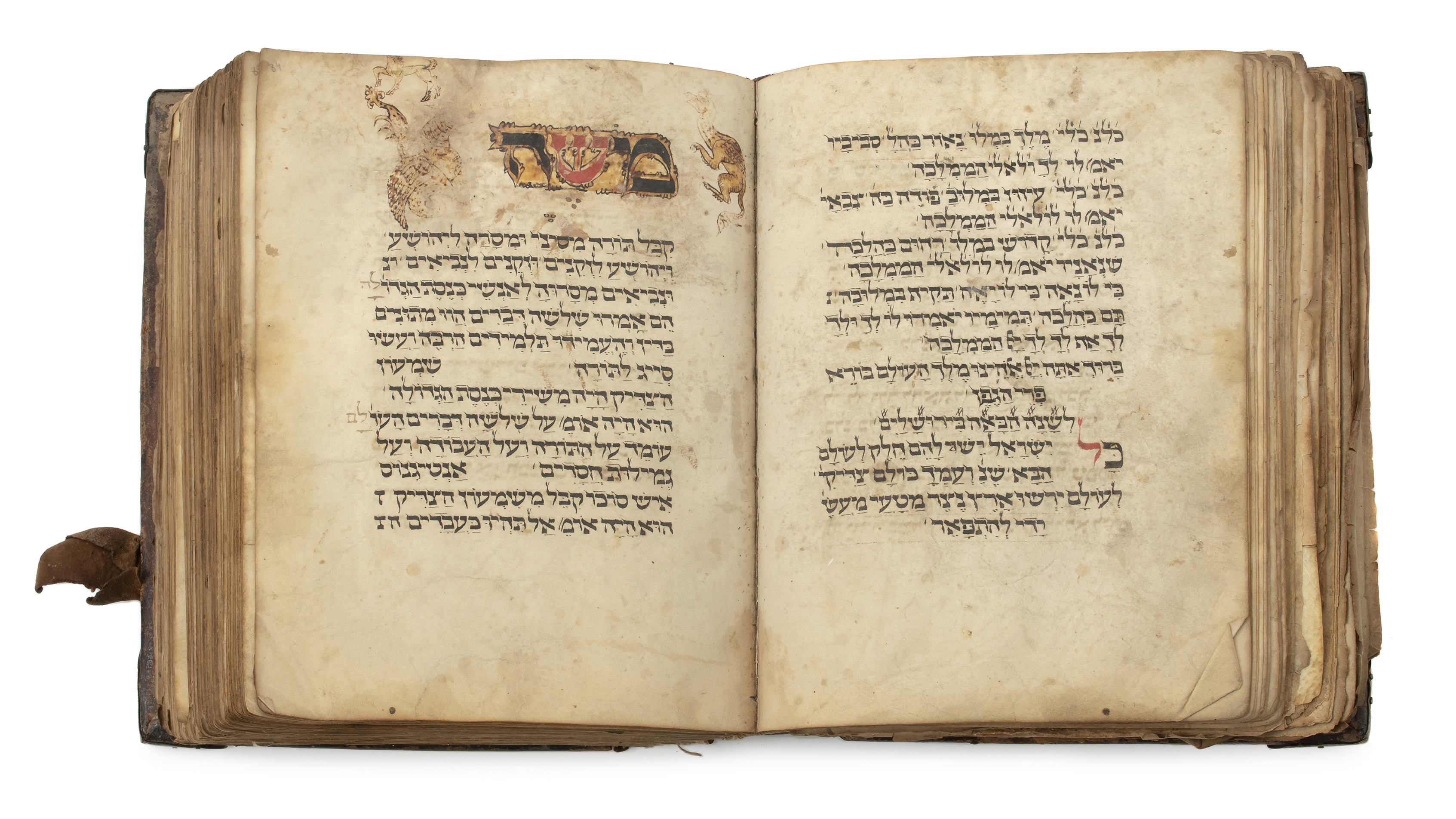
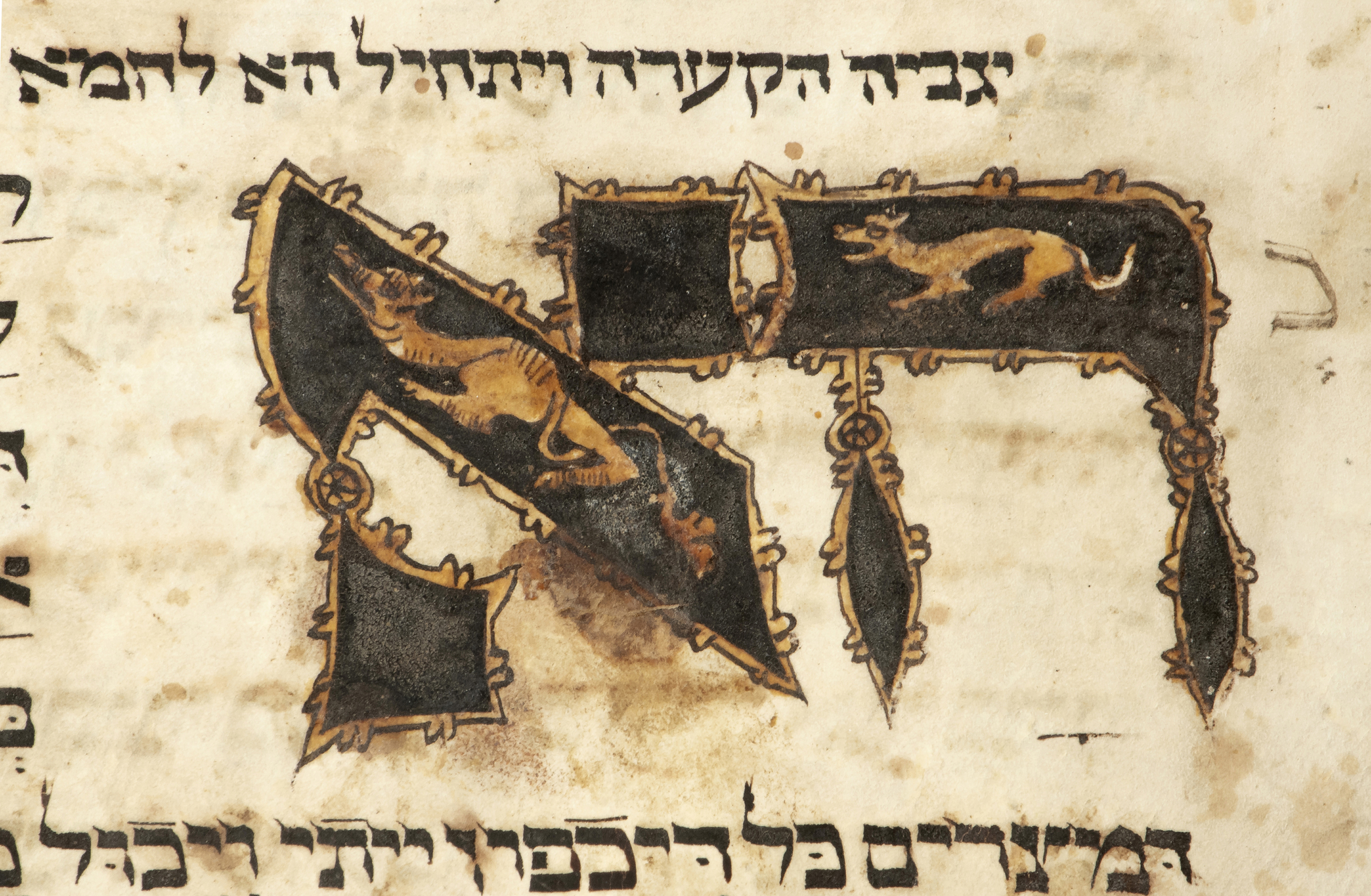
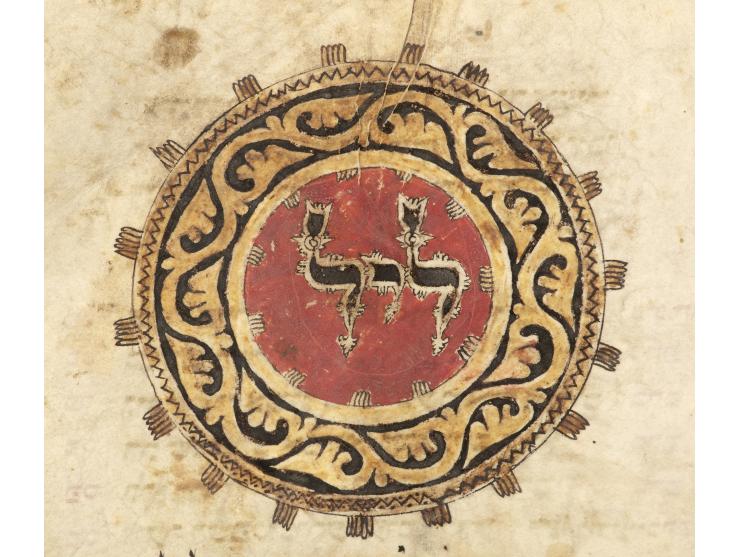
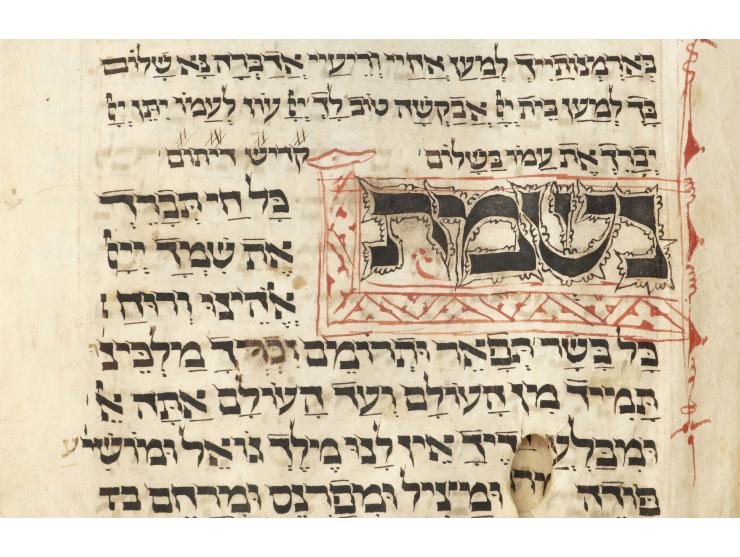
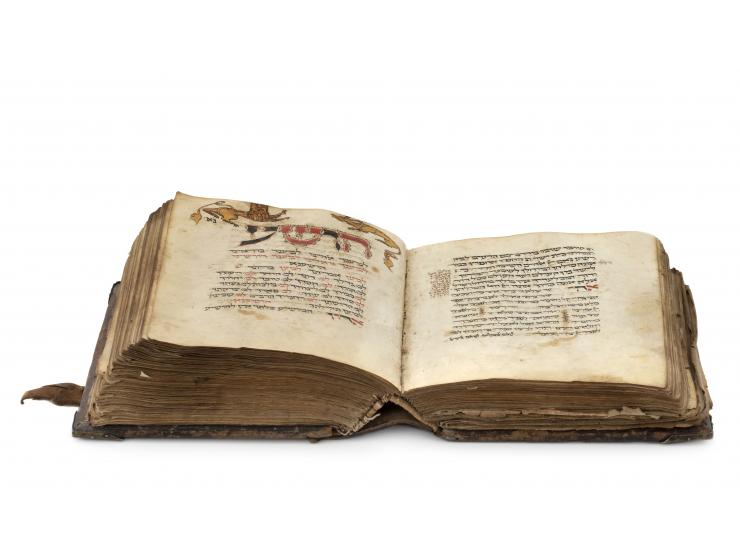
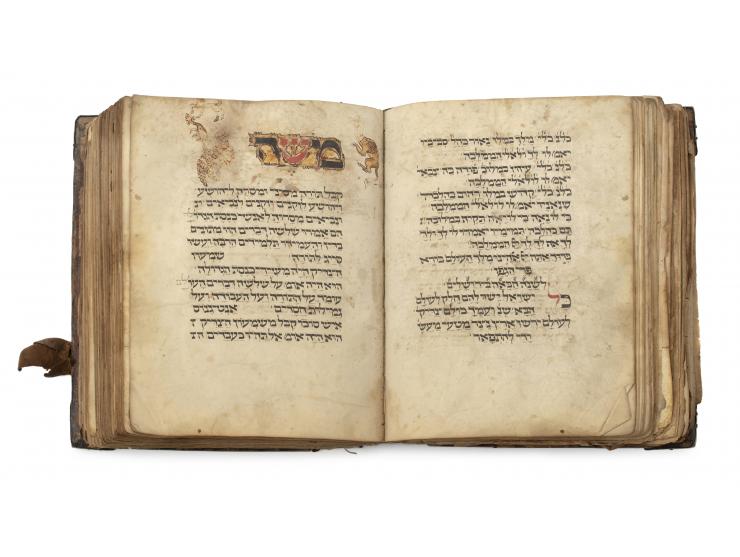
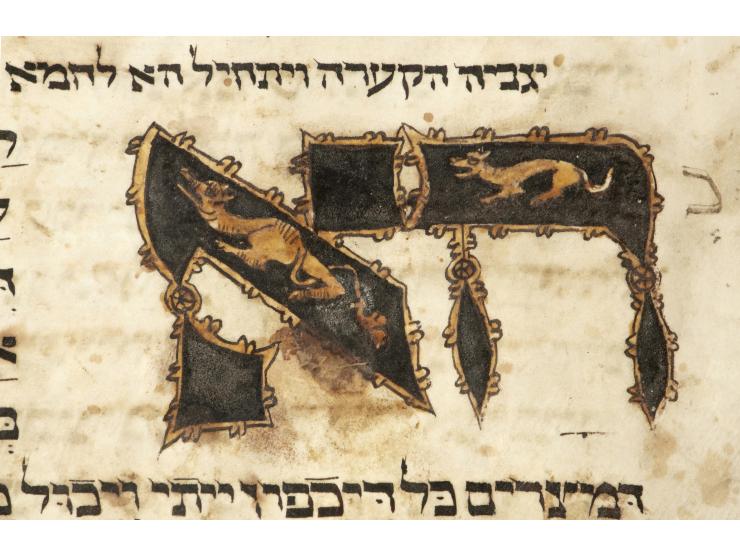
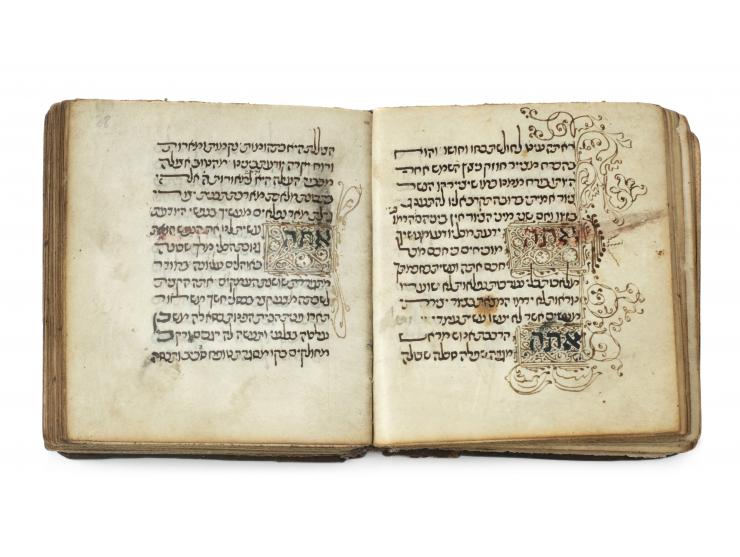
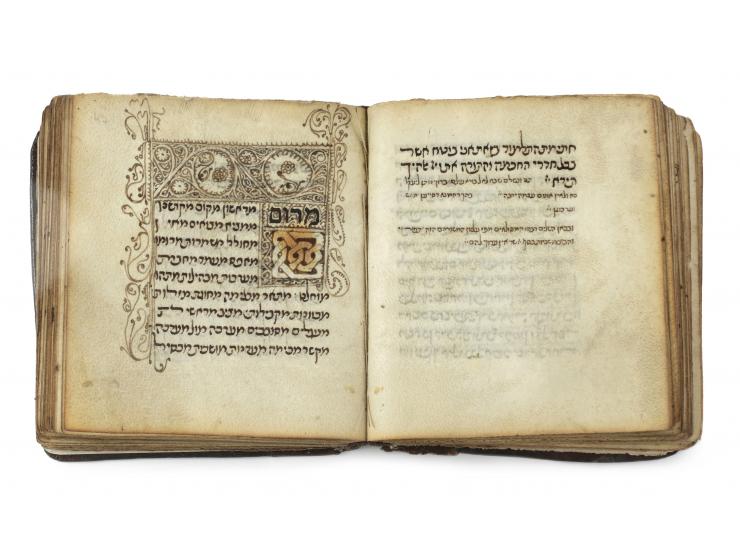
Thick volume. Ink on thin parchment leaves. Neat Ashkenazic script (square and semi-cursive, partially vocalized), in several hands. Several initial words enlarged and specially decorated. Some initial words decorated with frames, with some extending to the margins in geometrical and floral decorations, occasionally including illustrations of mythological beasts. Other initial words and lines of text in some places decorated with paint (alternating in black and red ink).
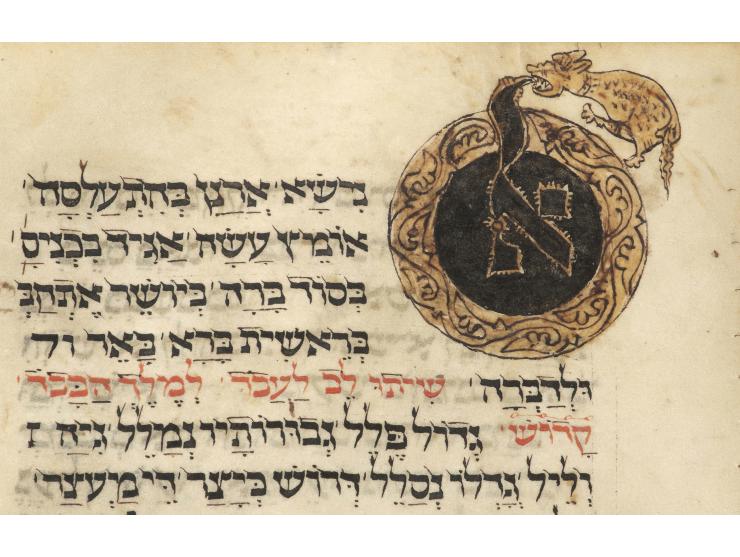
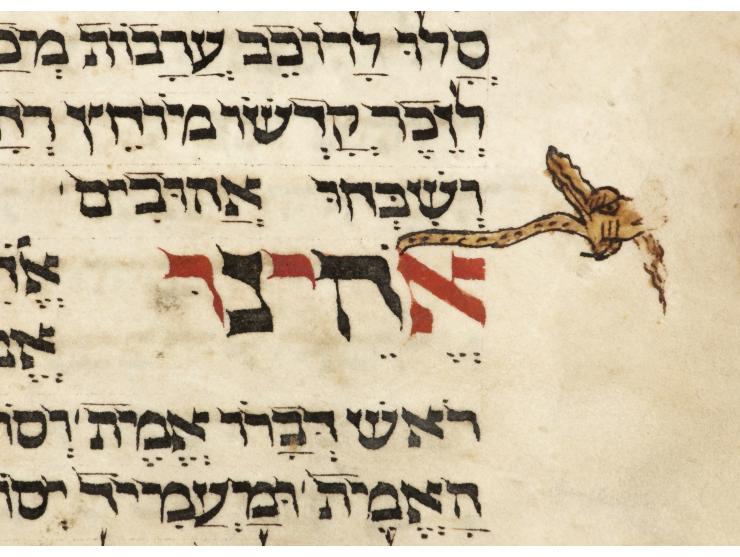
Illustrations of dragons, mythological beasts and hybrid creatures – characteristic of medieval manuscripts – appear next to some initial words. Dragons are featured on pp. 4b, 8a, 25a, etc.; hybrid creatures are featured on pp. 13a, 17b, 21b, 39b, etc. Large illustrations of a colorful dragon (partially colored in yellow), a hybrid creature and a unicorn (top trimmed) are featured around the initial word of Pirkei Avot (p. 85a). Illustrations of a crouching dragon and a lion (colored yellow) are featured around the initial word of Hoshanot (p. 138a).
Other large and significant decorations include:
P. 69a – Two dragons interlocked in the letters of the initial word, colored yellow against a black background.
P. 162a – Initial word of piyyut surrounded by round frames and a circular interlace; above it an eagle decoration and beneath two mythological creatures whose tails are designed in a vegetal pattern, with six animals on the sides: a goat, dragon (?), unicorn and a winged hybrid creature – surrounded by round frames – and an unframed pair of dragons (all creatures and interlace colored yellow).
P. 163a – Contours of initial word of piyyut colored yellow, against a black background, in a round frame surrounded by a decorative vegetal pattern, also colored yellow. A dragon atop the frame is biting the top of the Alef-Lamed ligature.
P. 220a – Initial word of piyyut against a dark red background, surrounded by several round frames decorated in vegetal and geometric patterns.
The handwriting and illustrations are characteristic of Ashkenazic manuscripts of the 13th-14th centuries (see, for instance, Bodleian Library Ms. Michael 627, and the Luzzatto Machzor – Sotheby's, October 2021).
Most of the volume was written by the same scribe. Various additions were added to the volume later, written by other scribes, and in a more amateurish hand (possibly from a slightly later period; such as Evronot, Tashbetz, Kinot for Tishah B'Av and more; see below). On pp. 99b, 101b, the name "Moshe" is indicated by a decoration next to the word, apparently as an allusion to the scribe's name.
The text of the siddur belongs to the western branch of the Ashkenazic rite (on this rite, see: D. Goldschmidt, Machzor LeYamim Noraim, I – Rosh Hashanah, Jerusalem 1970, preface). In this branch, the piyyutim (such as Maarivim and Yotzrot) were freely selected by the communities; the present siddur also reflects a unique local selection of piyyutim, including several rare piyyutim (noted below).
The manuscript comprises:
Year-round prayers (weekdays and Shabbat), Passover Haggadah, Pirkei Avot, High Holidays prayers, Hoshanot, Megillah blessings for Purim and "Asher Heni", Tziduk HaDin, and piyyut series for special Torah readings and special days (Reshut, Yotzer, Ofan, Zulat and Maariv).
Parts written by hands other than the main scribe: positive interpretation of a dream, Yotzer and Zulat for Chanukah, "Yigdal", Kinot for Tishah B'Av, Evronot, Tashbetz and more. Marginal glosses and additions in later hands appear in many places. In some places, the additions are written within decorated frames, adding tower-like illustrations in Gothic style (pp. 23b, 98b, etc.).
Ownership inscriptions: "I, Shmuel son of Gershon son of [?]" (p. 265b), "Shmuel son of Gershom" (p. 356b).
Censorship expurgations in a few places. Some places have the deleted text rewritten over the deletion.
Further information on the content of the siddur and its special piyyutim:
In the text of Al Chet for Yom Kippur (appearing twice, on pp. 124b-126a and pp. 129b-131a), the confession for "Pelilut" (judgment) is replaced by "Pitzat Peh" (opening of the mouth), and in the first text, the confession for "Kashyut Oref" (stiffness of the neck) is replaced by "Kefitzat Yad" (clenching of the hand).
On p. 149b, the order of Hoshanot for Sukkot and Hoshana Rabba is written in another hand. This order of Hoshana Rabba is not known from any other source. On the same page is a rare Elokeichem piyyut for Simchat Torah, also unknown from any other source, by R. Shlomo son of R. Yitzchak, beginning "Elokeichem Shochen Shechakim".
Leaves 162-219: Piyyutim for special Shabbatot – Shabbat Bereshit (including Nishmat piyyut "Mi Eder VaHod"), Shabbat Rosh Chodesh, Shabbatot between the Four Parashiot, Shabbatot of the Omer period and the Three Weeks preceding 9th of Av (including "Ezor Na Kenaot", which has not been printed), Shabbat Nachamu, Shabbat Shuvah, Shabbat Chol HaMoed Sukkot, Shabbat coinciding with a circumcision, Shabbat of a wedding (including several piyyutim that have not been printed; on p. 211a, added in the margin in another hand, a piyyut for Shabbat of a wedding "Michtam LeShadeha KaMigdalot"), and more.
Leaves 220-252: Maariv piyyutim for the nights of Pesach, Shavuot, Rosh Hashanah (for first night: "Kise Ori VeYishi"; for second night: "Ashrei HaAm Yodei Teruah Lefatoto"), Sukkot and Shemini Atzeret ("Erchomcha Hashem Chizki" and afterwards "Shemini Ototav").
Leaves 253-265: Piyyutim for Simchat Torah, blessings for betrothal and marriage, "Av HaRachamim", and laws of Eruvei Chatzerot (in another hand).
Leaves 266-272: Evronot, in another hand – beginning with cycle 268, comprising years 5074-5092 (1313-1332), presumably written during one of those years.
Pp. 272b-273a contain a rare piyyut written in another hand (apart from the present manuscript, we were able to locate it only in Vatican Ms. 326 and Hamburg Ms. 239), for the Shabbat before Tishah B'Av, by R. Yechiel son of R. Yaakov of Eisenach, beginning "Yom Matza Katzar".
P. 273b contains a rare piyyut written in another hand (apart from the present manuscript, we were able to locate it only in Hamburg Ms. 239), for Shabbat Chukat, "by R. Shmuel --- who was killed ---", beginning "Or Yeshurun Bnei Yeshurun". The author is R. Shmuel Devlin, cantor of Erfurt, who was martyred in Erfurt. This piyyut was customarily recited in Erfurt; see: Minhagei Erfurt, Sinai, XLVI, p. 267.
Pp. 274b-285b, 294a-312a – in another hand (Ashkenazic cursive script, in two columns): Tashbetz by R. Shimshon son of Tzadok. At the end: "Tashbetz of the Maharam is concluded". Afterwards, in the same hand: Sefer HaYirah by R. Yonah Gerondi (pp. 286a-292b); and selections from Maharam (pp. 312a-325b).
Pp. 326a-356b: Kinot for Tishah B'Av, in another hand. The final piyyut is incomplete.
356 parchment leaves. Collation: i-xiii8, xiv3, xv-xix8, xx2, xxi4, xxii-xxix8, xxx2, xxxi-xxxiii8, xxxiv9, xxxv8, xxxvi5, xxxvii-xxxviii8, xxxix4, xl-xlvii8, xlviii7 (lacking last leaf of final gathering). Parchment ruled and dotted for neatness of writing and straightening of lines. Size of leaves: 18X23 cm. Varying condition of leaves. Significant defects to some leaves in first nine gatherings, tears and open tears, affecting text and illustrations. First three leaves of first gathering lacking, replaced with three parchment leaves at a later date. Parchment replacement to several leaves, with replacement of affected text in several places. Most other leaves of volume in fair-good condition. Stains, including dark stains. Wear and creases. Tears to several leaves. Stitches and parchment repairs to several leaves throughout volume. Text affected in several places. Fading or erasure of ink in some places, including to some illustrations. Margins trimmed, affecting decorated catchwords as well as some illustrations and decorations at tops of pages. On several leaves, a few marginal glosses and additions affected. Early leather binding, with metal corners and remains of metal clasps. Various defects to binding.
The manuscript is currently in Zurich, Switzerland, and will be available for preview by appointment through Kedem’s office.
Catalogue Value
Auction 106 Incunabula and First Editions | Illuminated Manuscripts | Jewish Ceremonial Art
Feb 24, 2026
Opening: $50,000
Sold for: $100,000
Including buyer's premium
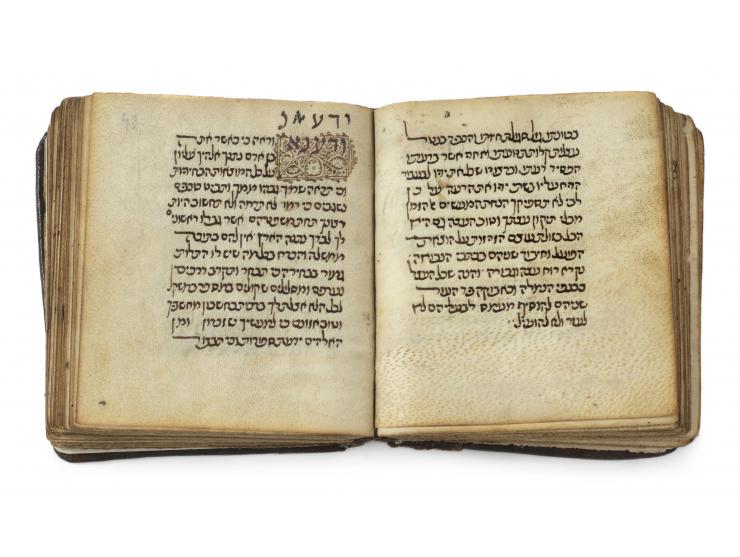
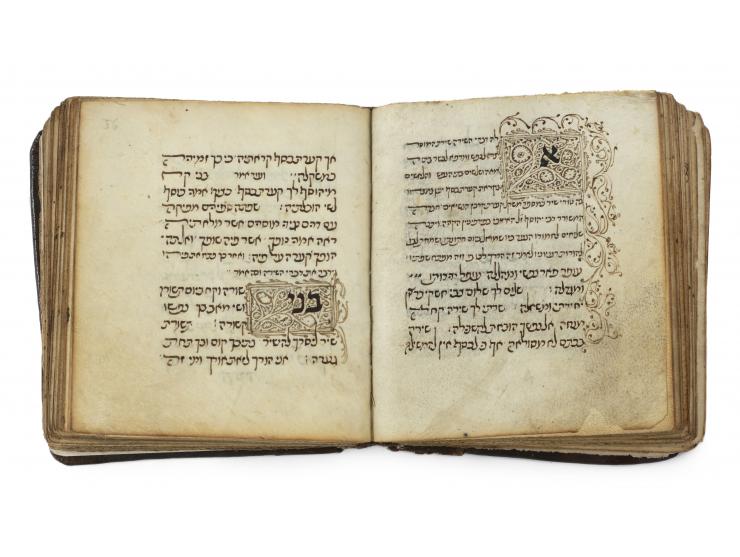
Decorated parchment manuscript, Bechinat Olam by R. Yedaiah HaPenini Bedersi (of Beziers), and other works. [Provence, Southern France, 14th/15th century].
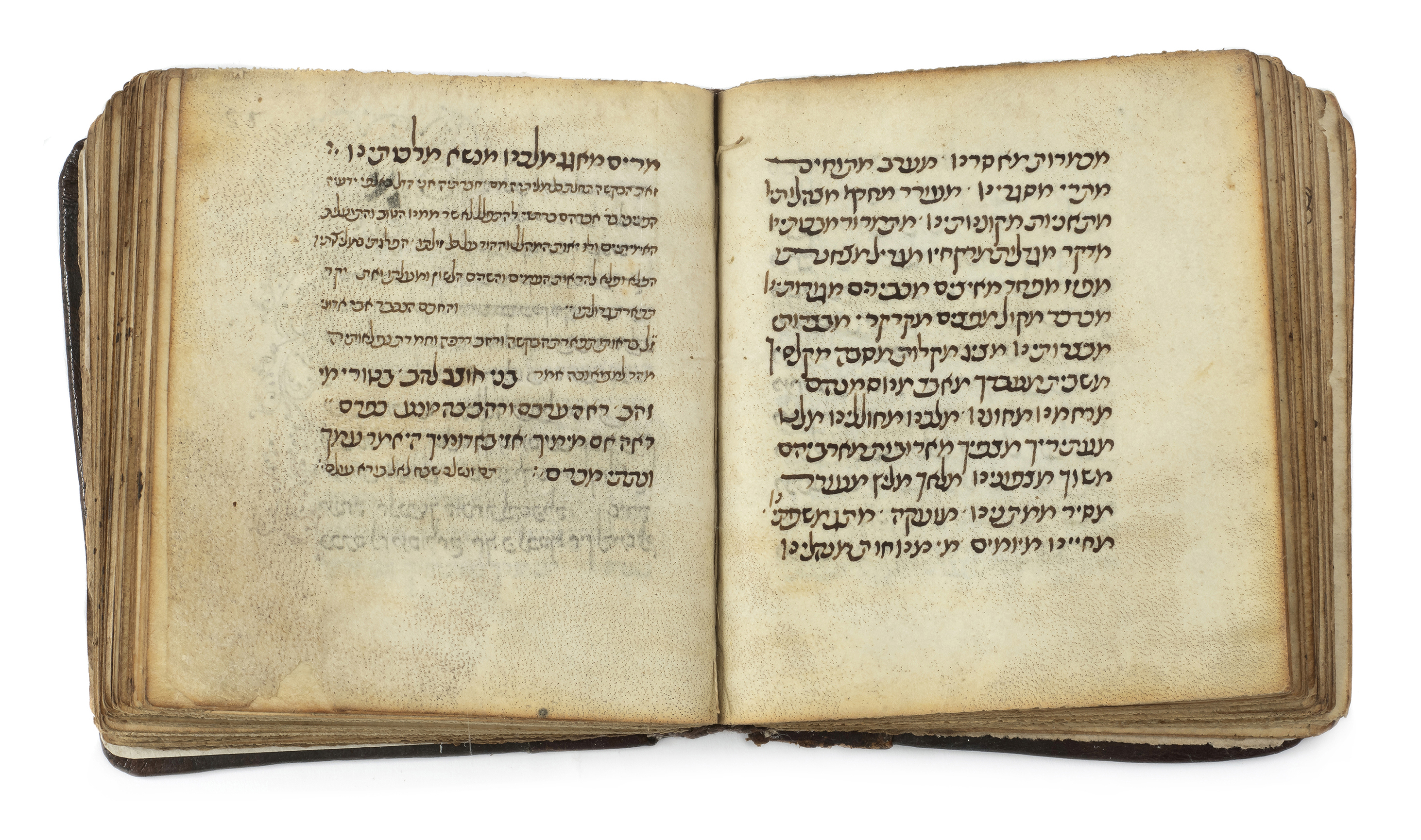
Pocket-size volume. Brown ink on thin parchment leaves. Color decorations. Sephardic semi-cursive script, in several hands. In the first half of the volume, initial words are in square script, with decorations colored red, green, blue and brown, in frames stylized as lacework or filigree, in delicate quill work. Some frames extend into the margins with geometric and vegetal patterns.
The volume mainly comprises poetic-ethical works of Provençal Torah scholars, from the circles associated with R. Yedaiah HaPenini Bedersi, and other works of a similar character by others.
The volume is written in two hands. The first is a neat and artistic hand, featuring the abovementioned decorations. Most of the second half of the volume is written in another hand. The second scribe's hand begins at p. 69b. Nevertheless, the second half of the volume also alternates with the handwriting of the first scribe. In addition, the first nine leaves are lacking in the original scribe's hand, and are replaced with parchment leaves handwritten by another scribe (approximately contemporaneous with the original writing).
The volume comprises:
Leaves 1-46: Bechinat Olam by R. Yedaiah HaPenini Bedersi.
Leaves 47-55: Bakashat HaMemin by R. Yedaiah HaPenini Bedersi. Colophon at end: "Each word of this prayer begins with [the letter] Mem. I authored it, the least of my tribe, Yedaiah HaPenini son of R. Avraham Bedersi, to pray to the Source of good… And when my noble father saw the beauty of the prayer… he hurried to compose a response…".
Leaves 55-66: Kaarat Kesef by R. Yehosef Ezovi (teacher of R. Avraham Bedersi, father of R. Yedaiah HaPenini). Colophon at end: "The ethical poem is concluded, made by R. Yosef Ezovi for his son on his wedding day… and they are 130 stanzas, corresponding to the weight of the silver plate [Kaarat Kesef]…".
Leaves 67-74: Elef Alfin, prayer by R. Avraham Bedersi (father of R. Yedaiah HaPenini; Davidson, Thesaurus of Mediaeval Hebrew Poetry, I, Alef 4645). A prayer composed of a thousand words, each beginning with the letter Alef.
Leaves 74-78: Batei HaNefesh, prayer for Yom Kippur by R. Yedaiah HaPenini Bedersi ("Lecha Keili", Davidson, ibid., III, Lamed 800).
Leaves 79-86: Sections of Machberot Immanuel by Immanuel of Rome (from sections 9 and 26).
Leaves 86-98: Musar Haskel, ethical poem by R. Hai Gaon (copying incomplete).
Leaves 99-108: "Aamir Et Hashem", prayer by R. Yosef son of Sheshet ibn Latimi (see: Dov Yarden, Kinot by R. Yosef son of Sheshet ibn Latimi, Sefer Zikaron LehaRav Yitzchak Nisim, V, Jerusalem 1985, pp. 185 ff. [Hebrew]). A prayer composed of a thousand words, each beginning with the letter Alef (Davidson, ibid., I, Alef 20).
Leaves 109-114: Various poems by R. Shmuel HaNagid, R. Avraham ibn Ezra, R. David Kimchi and others.
Leaves 115-128: Laws of shechitah and terefot.
Leaves 129-130: Poem by R. Yehosef HaEzovi in praise of Kaarat Kesef ("Nefesh Kenoh Musar", Davidson, ibid., III, Nun 463).
Notes in Ashkenazic script (ca. 19th century) in several places.
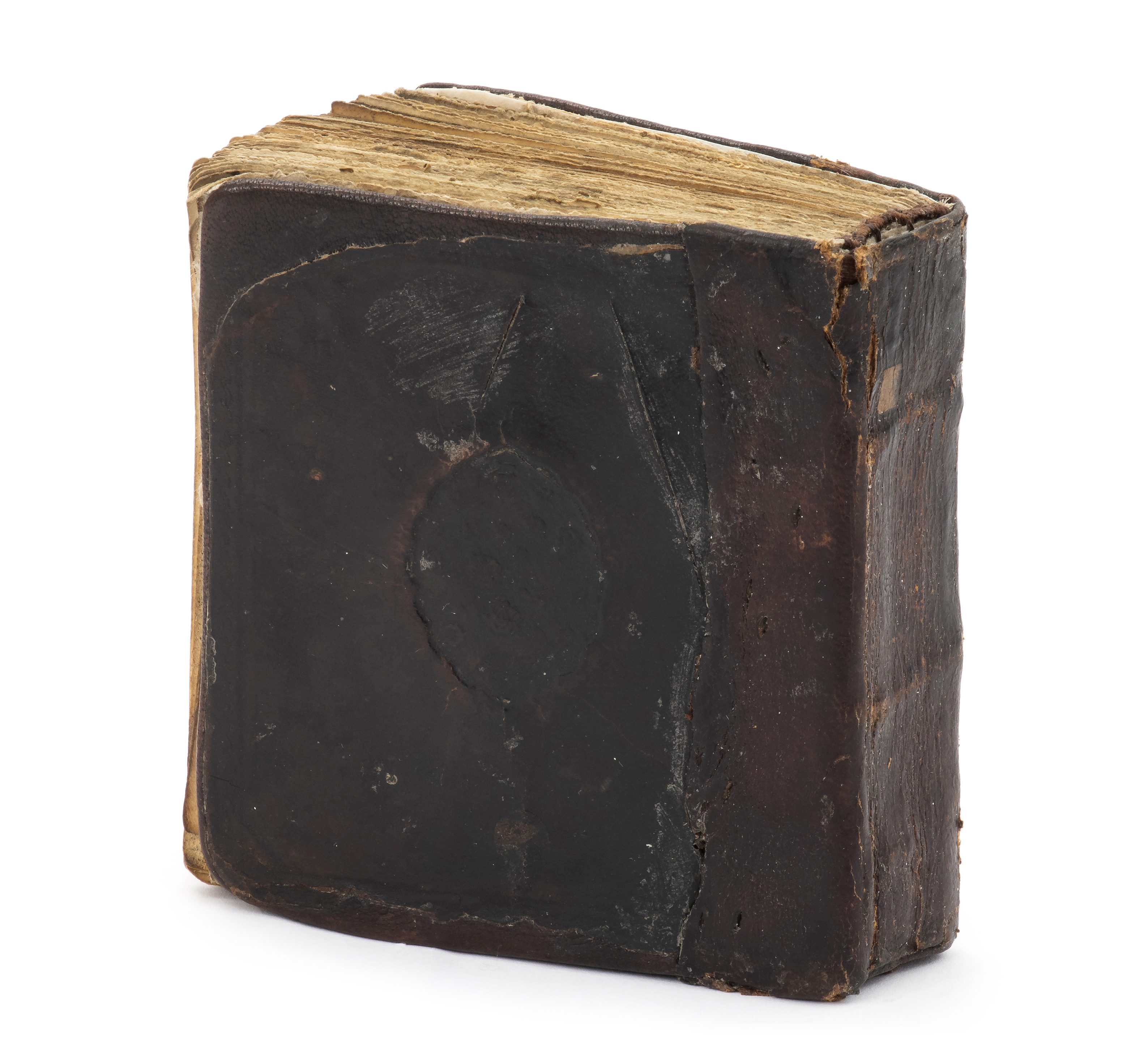
[130] parchment leaves. 9 cm. Overall good condition. Stains, including dark stains. Fading of ink and peeling of letters in several places. Creases and defects to first leaves, affecting text. Late Islamic leather binding (with inscribed shamsa medallion to front and back of binding), repaired and rebound.
Provenance: Collection of Dr. Felix Guggenheim. Recorded in Guggenheim's notes from the 1940s, and likely purchased by him in Germany before 1938, when he immigrated to the United States through Switzerland with his Judaica collection. Guggenheim lent this manuscript to the Jewish Book Council, for exhibition at the Jewish Book Month event in Los Angeles on November 15, 1948; and a 1948 record documents that the book was insured for $500. The manuscript was owned by the Guggenheim family continuously since its purchase by Felix Guggenheim.
See: Mark Funke, The Rare Book Collection of Dr. Felix Guggenheim, pp. 6-9.
Catalogue Value
![Handwritten and hand-illuminated Esther Scroll. [Northern Italy, first half of the 17th century].
Ink and color paint on](https://files.kedem-auctions.com/files/Sale106/4_1.jpg "Early and Important Esther Scroll – Italy, First Half of the 17th Cent")
![Handwritten and hand-illuminated Esther Scroll. [Northern Italy, first half of the 17th century].
Ink and color paint on](https://files.kedem-auctions.com/files/Sale106/4_10.jpg "Early and Important Esther Scroll – Italy, First Half of the 17th Cent")
![Handwritten and hand-illuminated Esther Scroll. [Northern Italy, first half of the 17th century].
Ink and color paint on](https://files.kedem-auctions.com/files/Sale106/4_11.jpg "Early and Important Esther Scroll – Italy, First Half of the 17th Cent")
![Handwritten and hand-illuminated Esther Scroll. [Northern Italy, first half of the 17th century].
Ink and color paint on](https://files.kedem-auctions.com/files/Sale106/4_12-WEB.jpg "Early and Important Esther Scroll – Italy, First Half of the 17th Cent")
![Handwritten and hand-illuminated Esther Scroll. [Northern Italy, first half of the 17th century].
Ink and color paint on](https://files.kedem-auctions.com/files/Sale106/4_13-WEB.jpg "Early and Important Esther Scroll – Italy, First Half of the 17th Cent")
![Handwritten and hand-illuminated Esther Scroll. [Northern Italy, first half of the 17th century].
Ink and color paint on](https://files.kedem-auctions.com/files/Sale106/4_14-WEB.jpg "Early and Important Esther Scroll – Italy, First Half of the 17th Cent")
![Handwritten and hand-illuminated Esther Scroll. [Northern Italy, first half of the 17th century].
Ink and color paint on](https://files.kedem-auctions.com/files/Sale106/4_16-WEB.jpg "Early and Important Esther Scroll – Italy, First Half of the 17th Cent")
![Handwritten and hand-illuminated Esther Scroll. [Northern Italy, first half of the 17th century].
Ink and color paint on](https://files.kedem-auctions.com/files/Sale106/4_17-WEB.jpg "Early and Important Esther Scroll – Italy, First Half of the 17th Cent")
![Handwritten and hand-illuminated Esther Scroll. [Northern Italy, first half of the 17th century].
Ink and color paint on](https://files.kedem-auctions.com/files/Sale106/4_18-WEB.jpg "Early and Important Esther Scroll – Italy, First Half of the 17th Cent")
![Handwritten and hand-illuminated Esther Scroll. [Northern Italy, first half of the 17th century].
Ink and color paint on](https://files.kedem-auctions.com/files/Sale106/4_19-WEB.jpg "Early and Important Esther Scroll – Italy, First Half of the 17th Cent")
![Handwritten and hand-illuminated Esther Scroll. [Northern Italy, first half of the 17th century].
Ink and color paint on](https://files.kedem-auctions.com/files/Sale106/4_2.jpg "Early and Important Esther Scroll – Italy, First Half of the 17th Cent")
![Handwritten and hand-illuminated Esther Scroll. [Northern Italy, first half of the 17th century].
Ink and color paint on](https://files.kedem-auctions.com/files/Sale106/4_20-WEB.jpg "Early and Important Esther Scroll – Italy, First Half of the 17th Cent")
![Handwritten and hand-illuminated Esther Scroll. [Northern Italy, first half of the 17th century].
Ink and color paint on](https://files.kedem-auctions.com/files/Sale106/4_21-WEB.jpg "Early and Important Esther Scroll – Italy, First Half of the 17th Cent")
![Handwritten and hand-illuminated Esther Scroll. [Northern Italy, first half of the 17th century].
Ink and color paint on](https://files.kedem-auctions.com/files/Sale106/4_22-WEB.jpg "Early and Important Esther Scroll – Italy, First Half of the 17th Cent")
![Handwritten and hand-illuminated Esther Scroll. [Northern Italy, first half of the 17th century].
Ink and color paint on](https://files.kedem-auctions.com/files/Sale106/4_3.jpg "Early and Important Esther Scroll – Italy, First Half of the 17th Cent")
![Handwritten and hand-illuminated Esther Scroll. [Northern Italy, first half of the 17th century].
Ink and color paint on](https://files.kedem-auctions.com/files/Sale106/4_4.jpg "Early and Important Esther Scroll – Italy, First Half of the 17th Cent")
![Handwritten and hand-illuminated Esther Scroll. [Northern Italy, first half of the 17th century].
Ink and color paint on](https://files.kedem-auctions.com/files/Sale106/4_5.jpg "Early and Important Esther Scroll – Italy, First Half of the 17th Cent")
![Handwritten and hand-illuminated Esther Scroll. [Northern Italy, first half of the 17th century].
Ink and color paint on](https://files.kedem-auctions.com/files/Sale106/4_6.jpg "Early and Important Esther Scroll – Italy, First Half of the 17th Cent")
![Handwritten and hand-illuminated Esther Scroll. [Northern Italy, first half of the 17th century].
Ink and color paint on](https://files.kedem-auctions.com/files/Sale106/4_7.jpg "Early and Important Esther Scroll – Italy, First Half of the 17th Cent")
![Handwritten and hand-illuminated Esther Scroll. [Northern Italy, first half of the 17th century].
Ink and color paint on](https://files.kedem-auctions.com/files/Sale106/4_8.jpg "Early and Important Esther Scroll – Italy, First Half of the 17th Cent")
![Handwritten and hand-illuminated Esther Scroll. [Northern Italy, first half of the 17th century].
Ink and color paint on](https://files.kedem-auctions.com/files/Sale106/4_9.jpg "Early and Important Esther Scroll – Italy, First Half of the 17th Cent")
21 PHOTOS
Auction 106 Incunabula and First Editions | Illuminated Manuscripts | Jewish Ceremonial Art
Feb 24, 2026
Opening: $40,000
Sold for: $93,750
Including buyer's premium
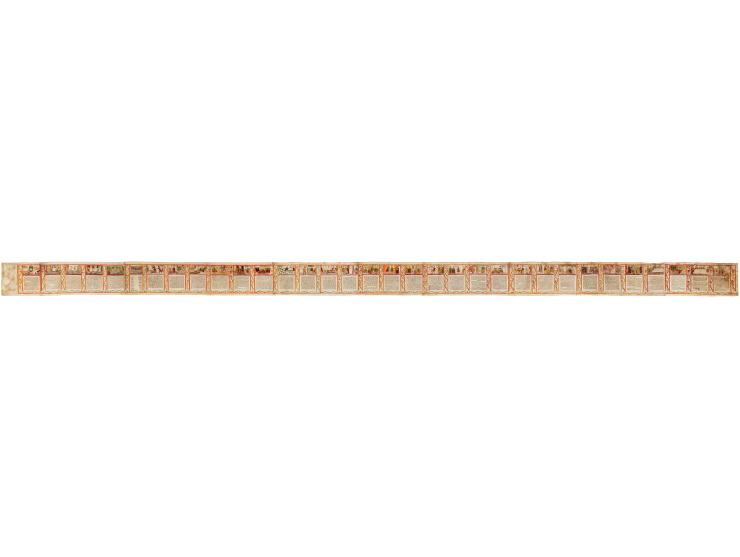
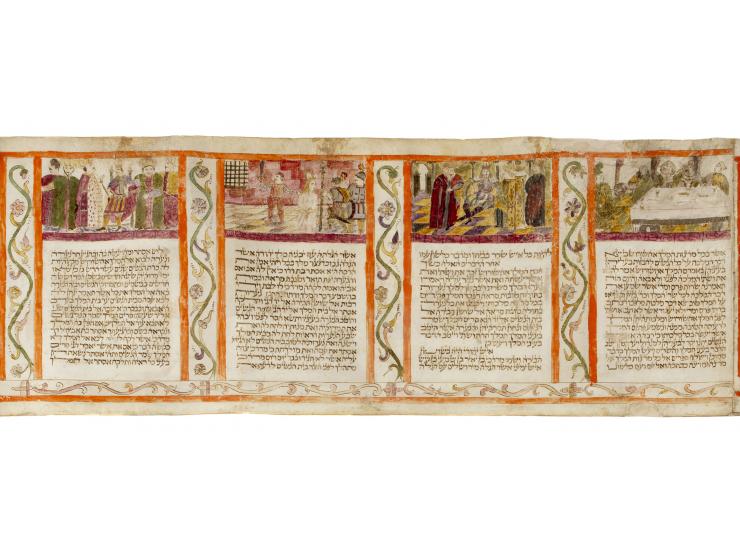
Handwritten and hand-illuminated Esther Scroll. [Northern Italy, first half of the 17th century].
Ink and color paint on parchment.
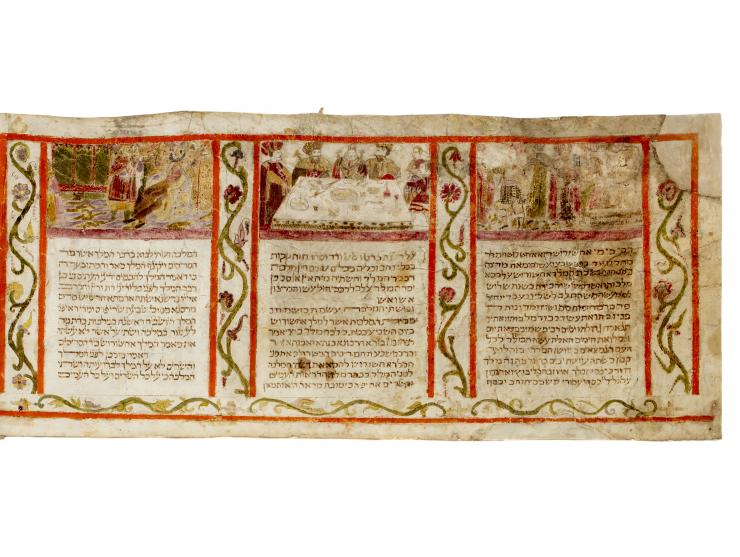
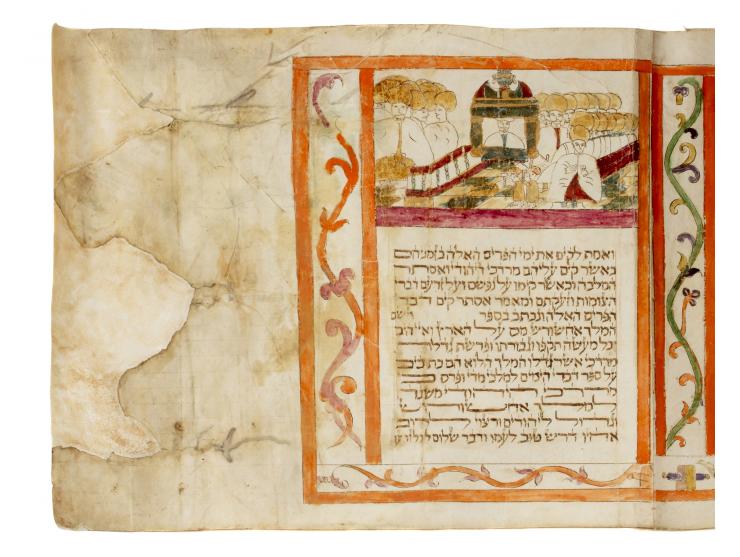
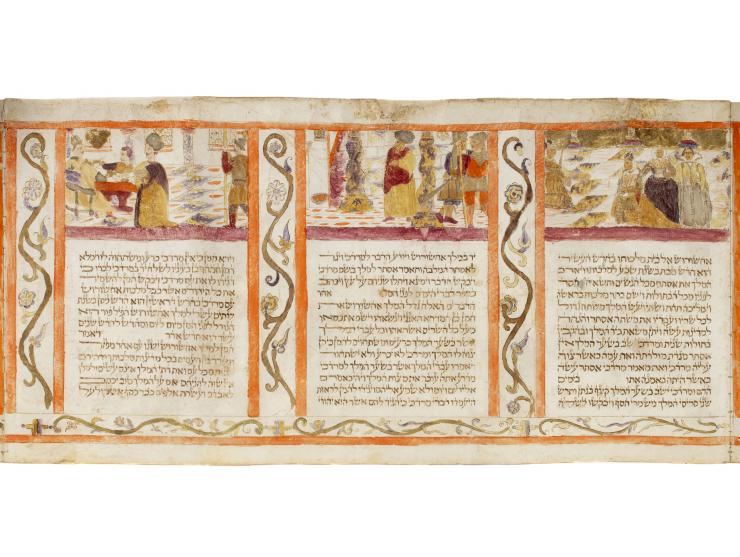
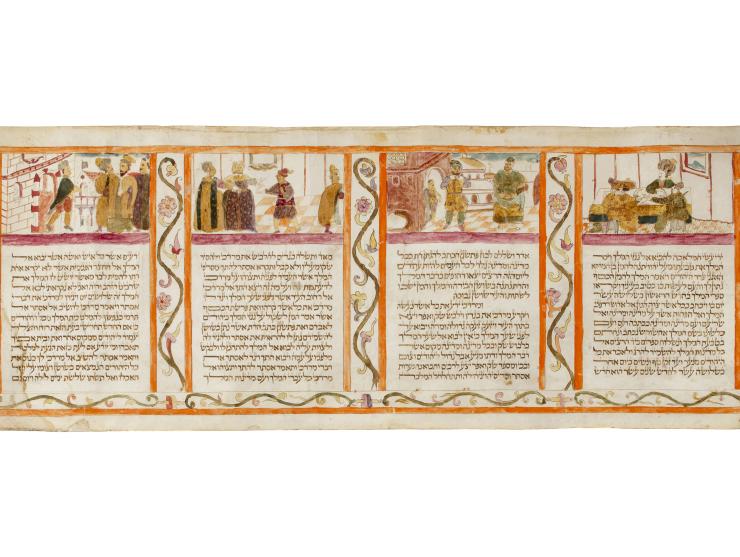
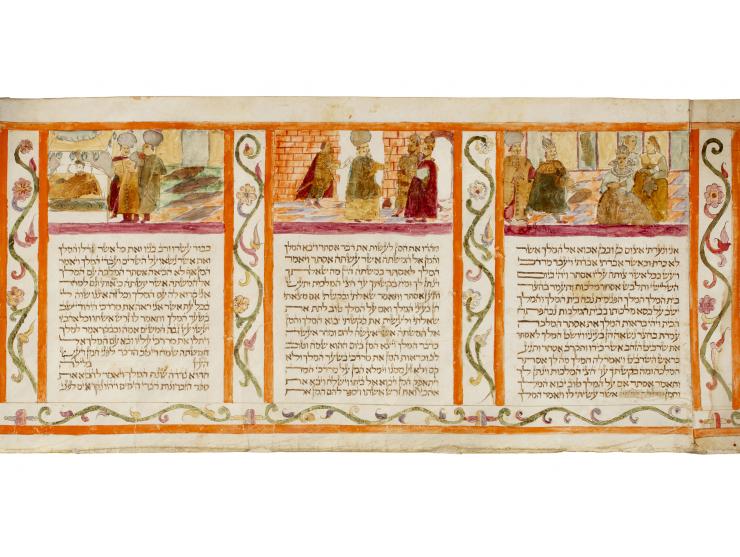
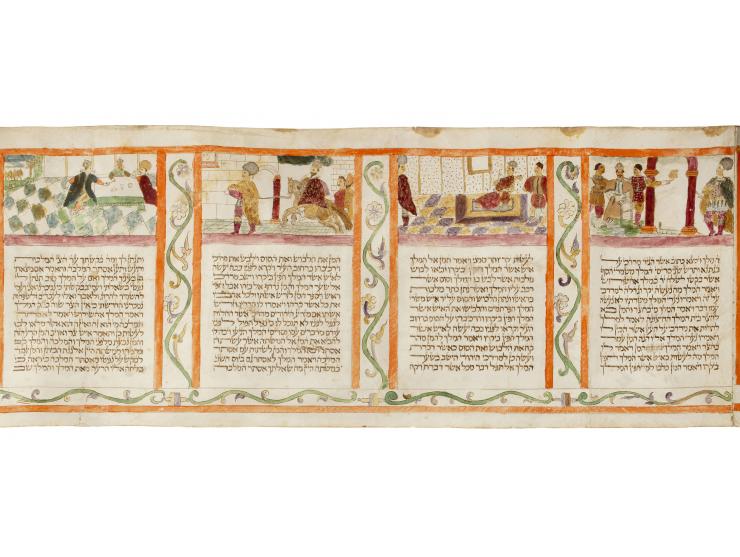
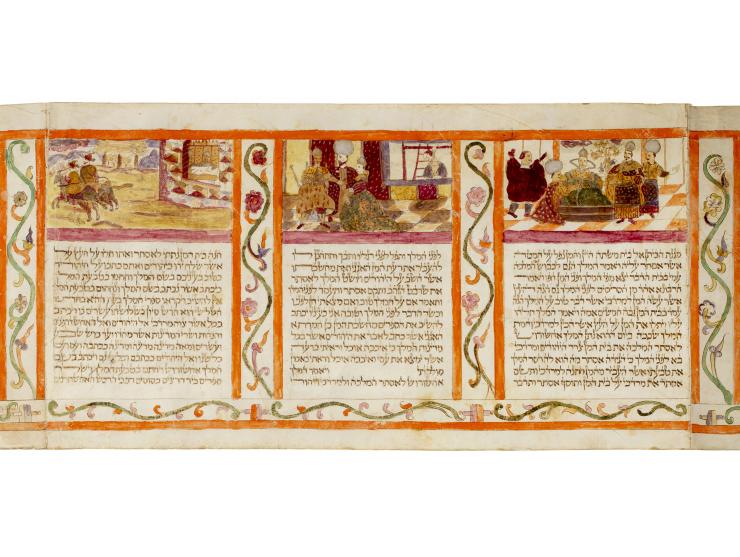
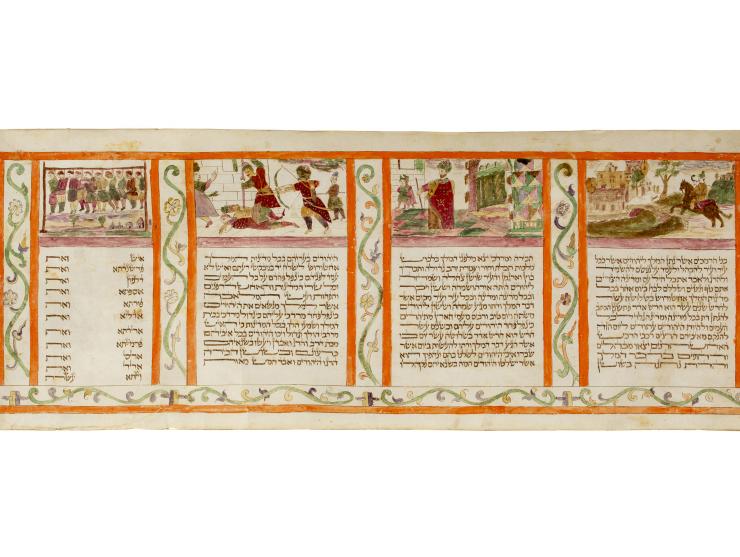
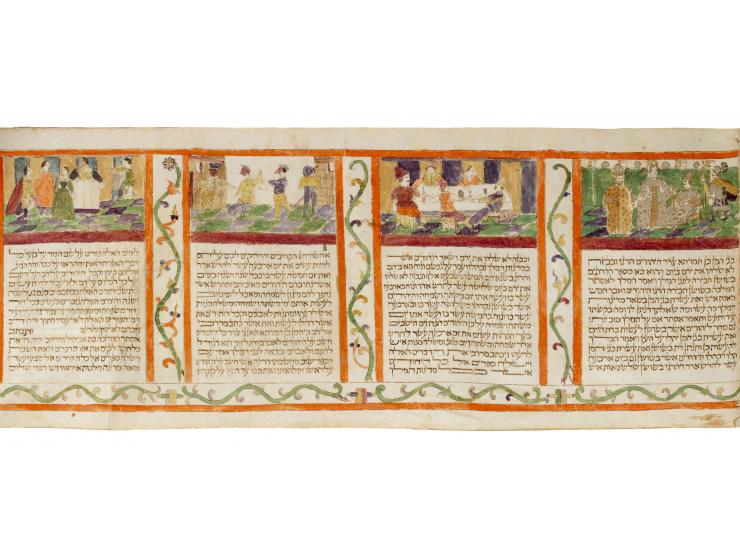
Esther scroll written in Italian Stam script, on ten parchment sheets sewn together, 33 columns of text, 12-15 lines per column. An exceptionally long scroll (approx. 5.5 meters), richly illuminated throughout with hand-painted illustrations in red, orange, ochre, green, purple and blue, as well as silver and gold, especially prominent in the figures' garments.
The scroll's decorative layout, with the upper third devoted to narrative illustrations in rectangular frames and the lower two-thirds containing the text and vegetal-decorated frames, accords with design practices known from Italian Esther scrolls of the first half of the 17th century; paleographically, the letterforms likewise correspond to those found in Italian Esther scrolls of the period.
Illustrations
All text columns are enclosed within orange rectangular frames and rectangular panels decorated with a repeating vegetal motif in several variations. At the top of each column appears a miniature narrative illustration (33 illustrations in total), each with a rectangular crimson frame along its lower edge.
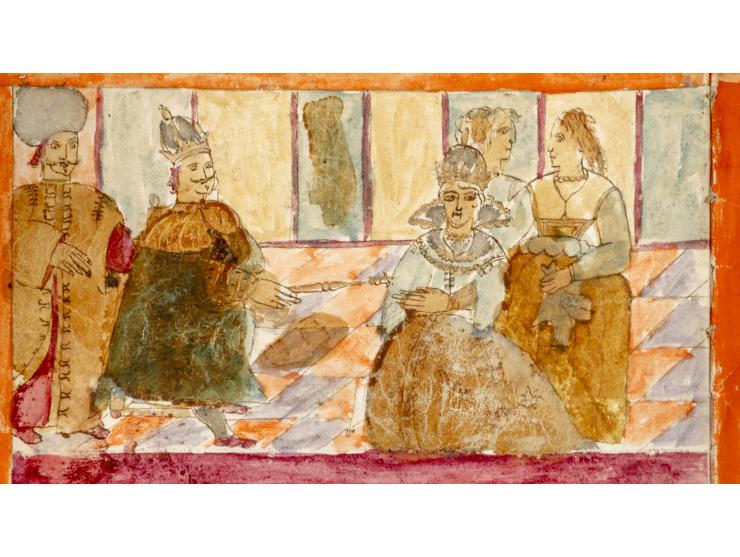
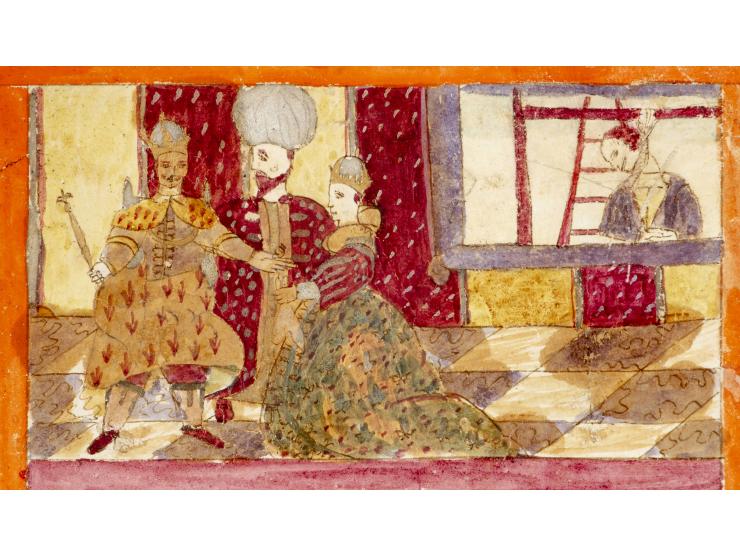
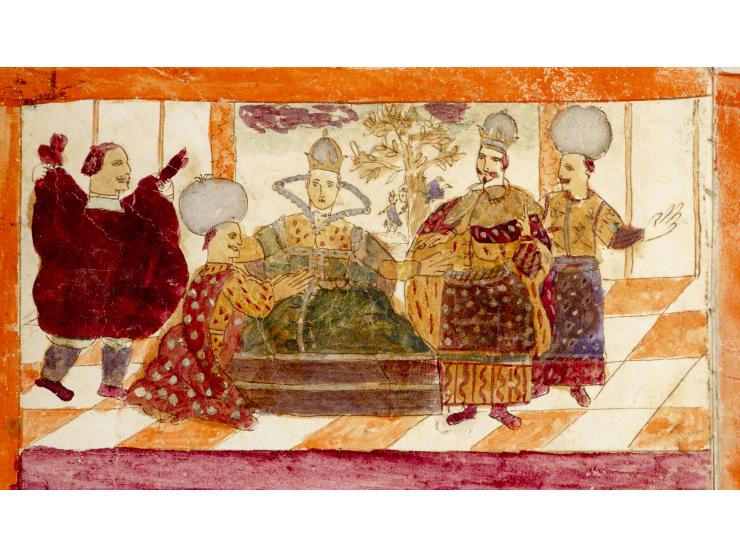
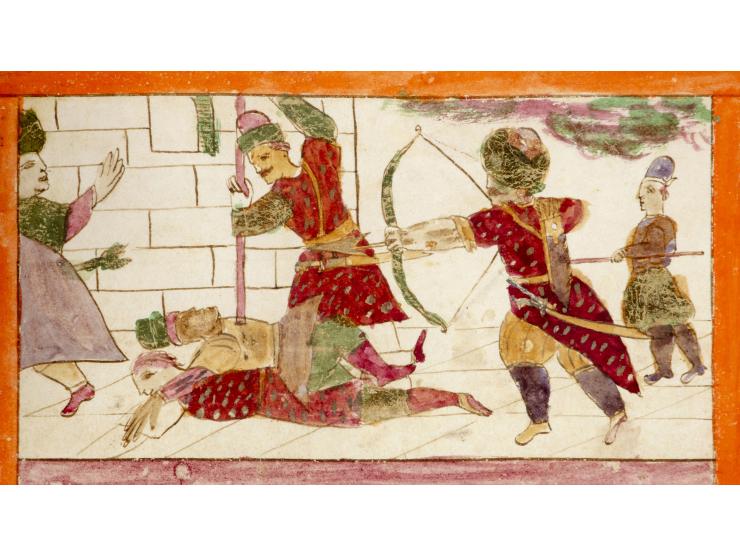
The thirty-three illustrations above the text columns depict episodes from the Esther narrative, as well as events drawn from Midrashic literature. They are arranged in chronological sequence, generally corresponding to the text below. The illustrations depict central scenes in detail (some include two scenes simultaneously) and portray the protagonists of the Megillah – King Ahasuerus, Vashti, Haman, Esther and Mordechai, as well as eunuchs, servants, soldiers and additional figures – clad in a mixture of Renaissance and Oriental dress, with emphasis on elaborate textile ornamentation.
Architectural settings shown in scenes outside the royal palace are rendered in Renaissance style, with some elements in an Oriental idiom. While the figures display a certain schematic quality reflecting the folk character of the artist, many scenes nevertheless demonstrate the artist's effort and ability to maintain perspective and volume, balanced proportions between figures and space, and particular attention to interior design, including wall decorations, columns, tiled floors and furniture.
The subjects of the illustrations are as follows:
• The ministers of the provinces assemble before Ahasuerus (damaged).
• The feast of King Ahasuerus.
• The king with several of his eunuchs.
• Vashti's feast and the arrival of the king's eunuchs.
• The king and his eunuchs.
• The beheading of Vashti.
• King Ahasuerus (holding a scroll) with several eunuchs.
• Esther is brought to the king's palace; the king extends his hand toward her.
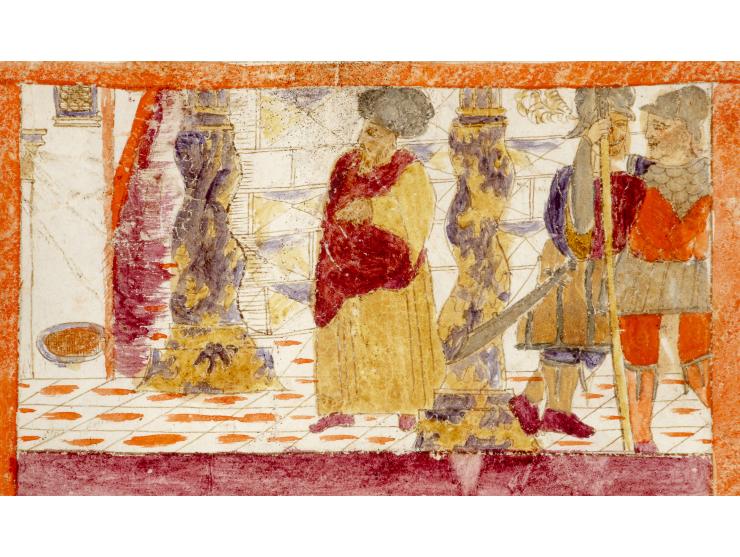
• Mordechai stands at the king's gate; to his right are Bigthan and Teresh.
• King Ahasuerus gives his ring to Haman.
• The scribes write the decree.
• Mordechai at the king's gate, clothed in sackcloth and ashes.
• Hathach brings the decree to Esther.
• Jews gather at Esther's command, "Go, assemble all the Jews who are present in Shushan and fast on my behalf…" (?); Esther looks out from a window.
• King Ahasuerus extends the golden scepter to Esther.
• A messenger of Ahasuerus hastens to summon Haman (?); at left, a figure holding a missive.
• The king's sleep is disturbed, his servants read before him from the Book of Records.
• Haman stands in the outside court of the king's palace, the king's attendants announce this to him.
• The king in his chamber, seated on the throne, instructs Haman to clothe Mordechai in royal raiment.
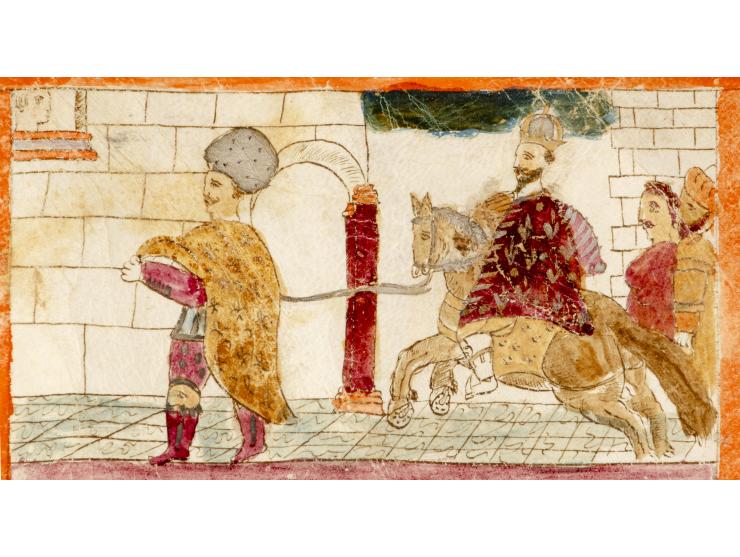
• Haman leads Mordechai on horseback.
• The king and Haman at Esther's second feast (Esther points her finger toward Haman).
• Haman kneels before Esther, pleading for his life; King Ahasuerus stands beside her.
• Esther and Mordechai stand beside the king, the king holds his scepter and extends his ring to Mordechai; in the background: the hanging of Haman.
• At right – inside the palace – two of the king's scribes write scrolls; at left – outside the palace – the couriers ride on horseback.
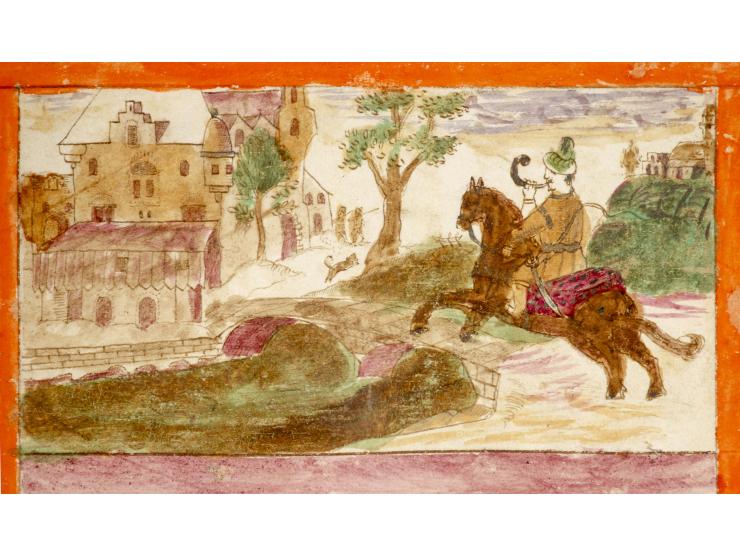
• One of the couriers rides on horseback and blows a horn (shofar), galloping across a bridge leading to a city; in the background, figures, a dog and buildings.
• Mordechai in royal raiment.
• The Jews "lay hands" on those who sought their harm, with arrows and spears.
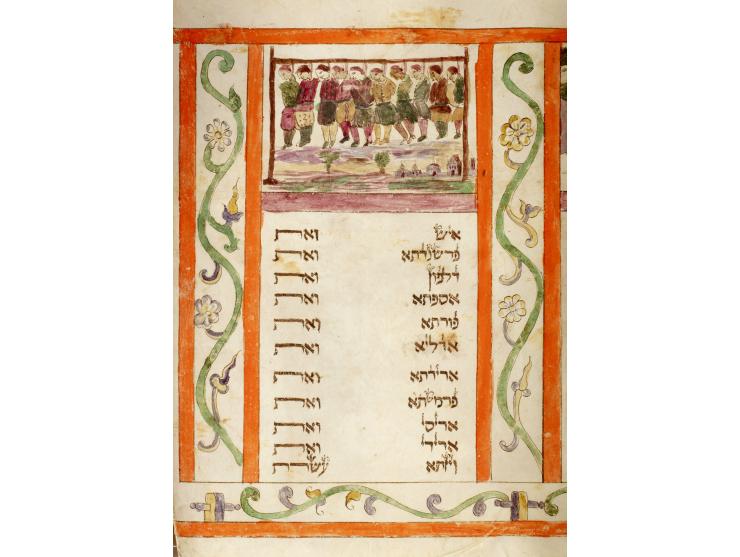
• The ten sons of Haman hanging from a beam.
• Esther and Mordechai stand before King Ahasuerus.
• A celebratory feast with five figures seated around a table.
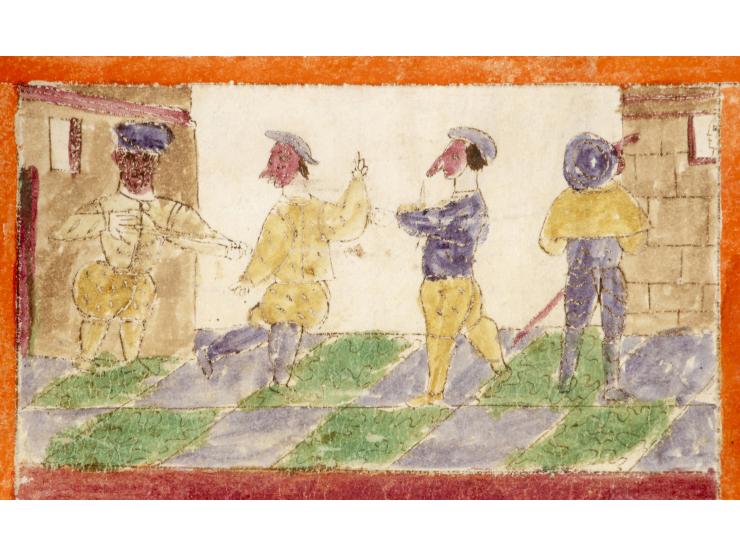
• Jews dancing at a ball with a mandolin player, three wear "medico della peste" masks with long beaks.
• Women at a ball with a violinist.
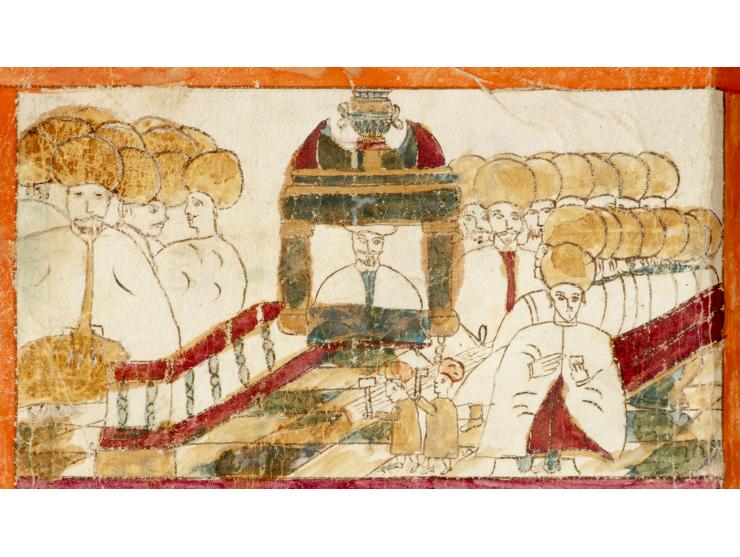
• A scene apparently depicting Purim night in a synagogue, at center are children holding Purim rattles.
Parallels: Scrolls by Moshe ben Avraham Pescarolo
The narrative character and abundance of the illustrations in the present scroll constituted an innovation in the first half of the 17th century. Until that time, illustrations in Esther scrolls had served as decoration alone, without reference to the narrative of the Purim story related in the text.
The earliest known Esther scrolls decorated with narrative scenes are the three scrolls created by scribe-illuminator Moshe ben Avraham Pescarolo in Ferrara, Italy, during the second decade of the 17th century. The earliest of these, dated 1616, is kept in the collection of the National Library of Israel, Jerusalem (Ms. Heb. 4° 197/89; facsimile published by Turnowsky, Tel Aviv, 1997). Another scroll, dated 1618, is kept in the collection of the John Rylands Library, Manchester (Hebrew MS 22). A third scroll (undated), formerly in the Gross Family Collection, Tel Aviv (081.012.036), is now kept in the Jay Schottenstein Collection, USA. All three feature a colophon signed by the artist.
The general artistic layout of the present scroll closely recalls that of Pescarolo's scrolls, although there are many differences in spatial design, the character of the figures and the decorative motifs surrounding the text columns. There are also significant differences in the subjects depicted: certain themes appear both in Pescarolo's scrolls and in the present scroll, though rendered differently (e.g. the feast of Ahasuerus, Vashti's feast, Vashti's beheading, Mordechai in sackcloth and ashes, the Book of Records brought before the king, Haman leading Mordechai on horseback, and others), while other subjects appear in the present scroll but not at all in Pescarolo's works (e.g. Esther's arrival at the king's palace, Mordechai standing at the king's gate with Bigthan and Teresh, the king extending his ring to Mordechai, the Jews striking their enemies, and others).
Since the present scroll is neither signed nor dated, and despite the similarities between the scrolls, it is difficult to determine with certainty whether its creator was indeed familiar with or influenced by Pescarolo's works. Alternatively, it is possible that both artists were independently influenced by a common source and by an artistic scheme common in their time.
Height: 25-25.5 cm. Length of scroll: 554 cm. Overall good condition. Tears, some extensive, and missing pieces at beginning of first parchment sheet and at end of last sheet, professionally restored. Additional tears, stains, creases and wear, with severe damage to text of first two columns and damage to illustrations at beginning of first sheet, with restoration and textual infill. Sheets re-sewn together. Housed in new leather case with velvet lining.
Enclosed is an expert report on the composition of the pigments and paint layers, prepared by Michael Maggen, former Head of Paper Conservation at the Israel Museum.
Reference:
• Chaya Benjamin, The Stieglitz Collection: Masterpieces of Jewish Art, Jerusalem: The Israel Museum, 1987, pp. 258-259.
• Dagmara Budzioch, "Italian Origins of the Decorated Scrolls of Esther", Kwartalnik Historii Żydów, 1 (2016), pp. 35-49.
• Mendel Metzger, "The John Rylands Megillah and some other illustrated Megilloth of the XVth to XVIIth centuries", Bulletin of the John Rylands Library, 45/1 (1962), pp. 148-184.
• Florence Soulam, "Unveiling the Secrets of the Scrolls of Moshe Pescarolo, Scribe and Artist: An Analysis of Pescarolo's Scrolls in the Historical Context of Italy in the Early 17th Century", unpublished PhD dissertation, supervised by Shalom Sabar, Jerusalem: The Hebrew University, 2006 (Hebrew, with English summary).
Our thanks to Prof. Shalom Sabar for his assistance in preparing this description.
Catalogue Value
![Esther Scroll with engraved decoration by Shalom Italia (Salomo d'Italia). [Amsterdam, The Netherlands, ca. 1641-1650].](https://files.kedem-auctions.com/files/Sale106/5_1.jpg "Engraved Esther Scroll by Shalom Italia – Amsterdam, Ca. 1641-1650")
![Esther Scroll with engraved decoration by Shalom Italia (Salomo d'Italia). [Amsterdam, The Netherlands, ca. 1641-1650].](https://files.kedem-auctions.com/files/Sale106/5_2.jpg "Engraved Esther Scroll by Shalom Italia – Amsterdam, Ca. 1641-1650")
![Esther Scroll with engraved decoration by Shalom Italia (Salomo d'Italia). [Amsterdam, The Netherlands, ca. 1641-1650].](https://files.kedem-auctions.com/files/Sale106/5_3.jpg "Engraved Esther Scroll by Shalom Italia – Amsterdam, Ca. 1641-1650")
![Esther Scroll with engraved decoration by Shalom Italia (Salomo d'Italia). [Amsterdam, The Netherlands, ca. 1641-1650].](https://files.kedem-auctions.com/files/Sale106/5_4.jpg "Engraved Esther Scroll by Shalom Italia – Amsterdam, Ca. 1641-1650")
![Esther Scroll with engraved decoration by Shalom Italia (Salomo d'Italia). [Amsterdam, The Netherlands, ca. 1641-1650].](https://files.kedem-auctions.com/files/Sale106/5_6.jpg "Engraved Esther Scroll by Shalom Italia – Amsterdam, Ca. 1641-1650")
![Esther Scroll with engraved decoration by Shalom Italia (Salomo d'Italia). [Amsterdam, The Netherlands, ca. 1641-1650].](https://files.kedem-auctions.com/files/Sale106/5_7.jpg "Engraved Esther Scroll by Shalom Italia – Amsterdam, Ca. 1641-1650")
![Esther Scroll with engraved decoration by Shalom Italia (Salomo d'Italia). [Amsterdam, The Netherlands, ca. 1641-1650].](https://files.kedem-auctions.com/files/Sale106/5_8.jpg "Engraved Esther Scroll by Shalom Italia – Amsterdam, Ca. 1641-1650")
![Esther Scroll with engraved decoration by Shalom Italia (Salomo d'Italia). [Amsterdam, The Netherlands, ca. 1641-1650].](https://files.kedem-auctions.com/files/Sale106/5_9.jpg "Engraved Esther Scroll by Shalom Italia – Amsterdam, Ca. 1641-1650")
Auction 106 Incunabula and First Editions | Illuminated Manuscripts | Jewish Ceremonial Art
Feb 24, 2026
Opening: $50,000
Sold for: $93,750
Including buyer's premium
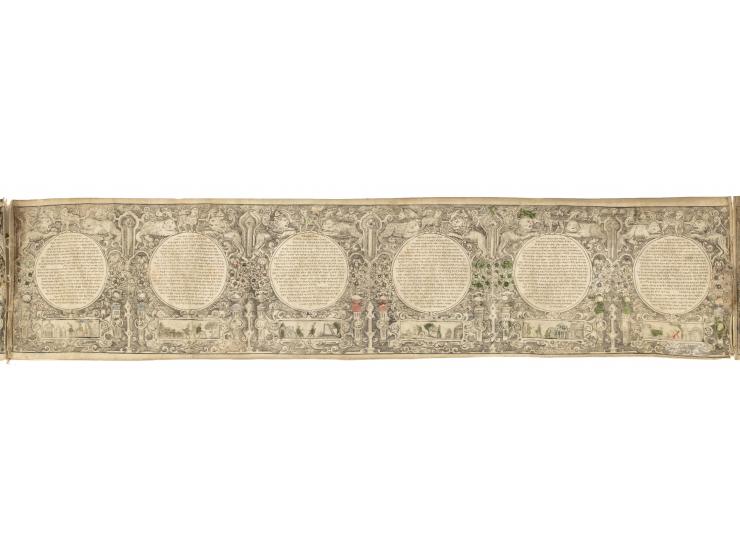
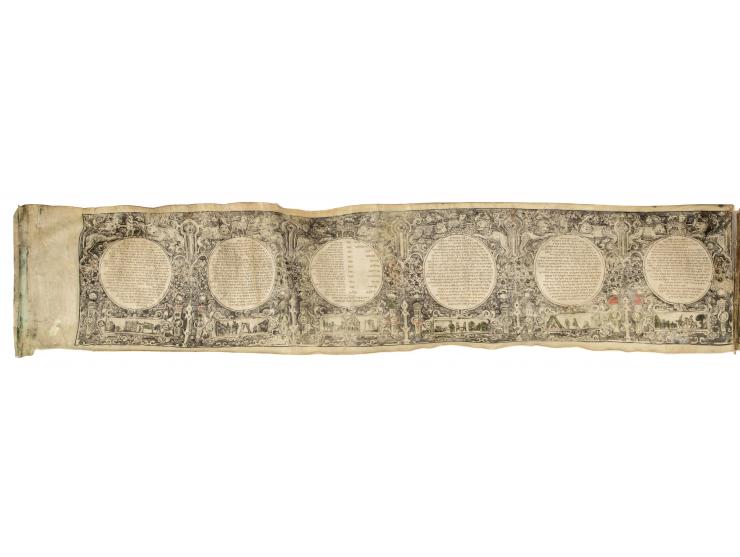
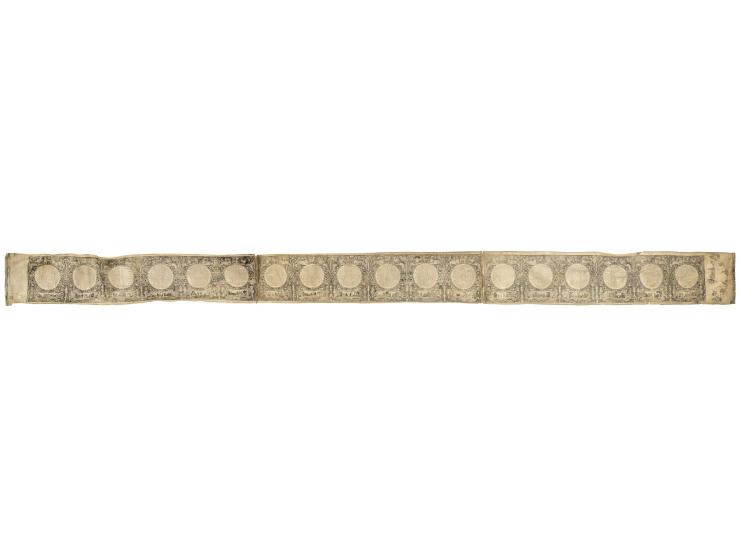
Esther Scroll with engraved decoration by Shalom Italia (Salomo d'Italia). [Amsterdam, The Netherlands, ca. 1641-1650].
Engraving, ink and color on parchment.
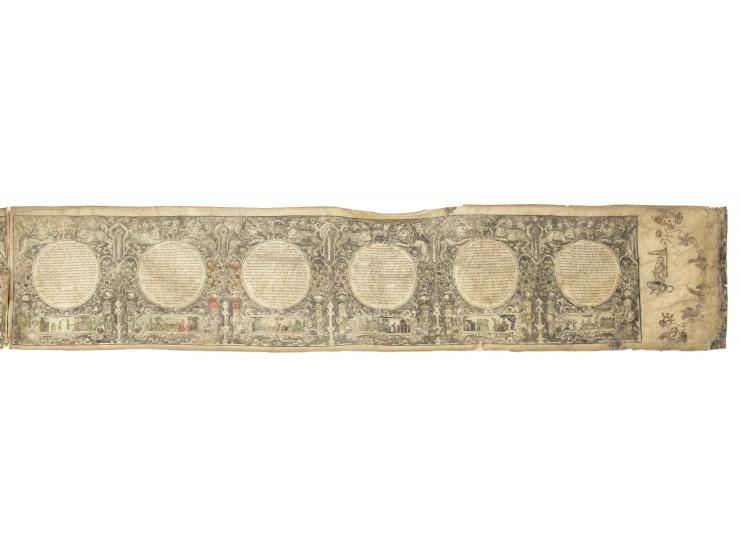
Esther scroll, written in Sephardic Stam script, on three parchment sheets sewn together, 18 circular engraved frames (six frames per sheet), 19 columns of text, 22-25 lines per column. The 16th frame contains two columns of text: names of the Ten Sons of Haman in one column, aligned to the right, and an additional text column to the left. Remnants of hand-coloring are visible, mainly along the lower margins and in some of the vegetal ornaments between the frames, in green and red, with some traces of blue and yellow.
Decorations
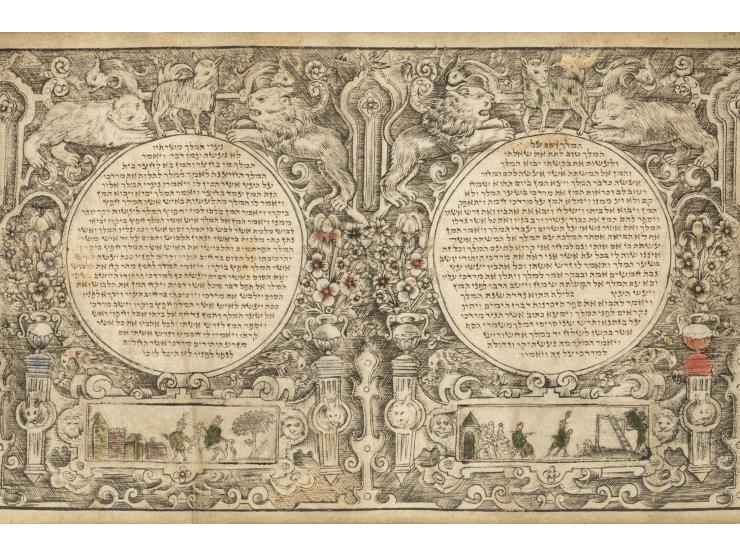
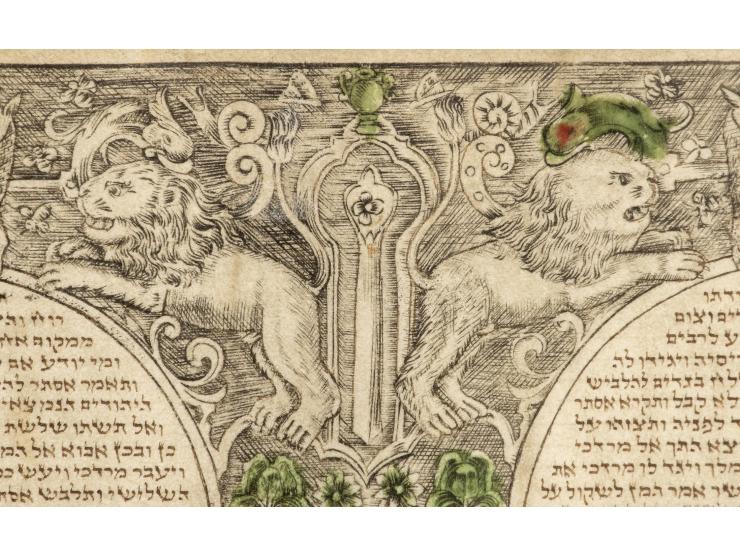
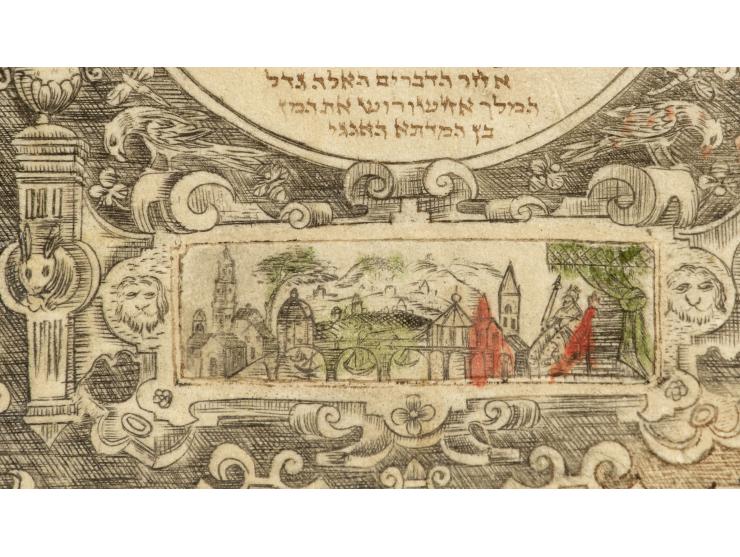
The scroll is decorated throughout with high-quality engravings, whose principal motifs include vegetal ornament and animals. Owing to these motifs, this type of Esther scroll is known as the "Lion, Lamb, and Bear" type (another designation for this group is the Roundel type). Each parchment sheet, as noted, contains six empty circular frames (for the text), surrounded by dense repeating ornaments, which include three large animals – lion, lamb and bear – positioned at the top of each frame, as well as vases with large, lush floral bouquets set atop architectural columns, additional vegetal motifs, and a variety of animals integrated among the ornaments: birds, rabbits, lion heads, fish (?), dragonflies, bees and snails.
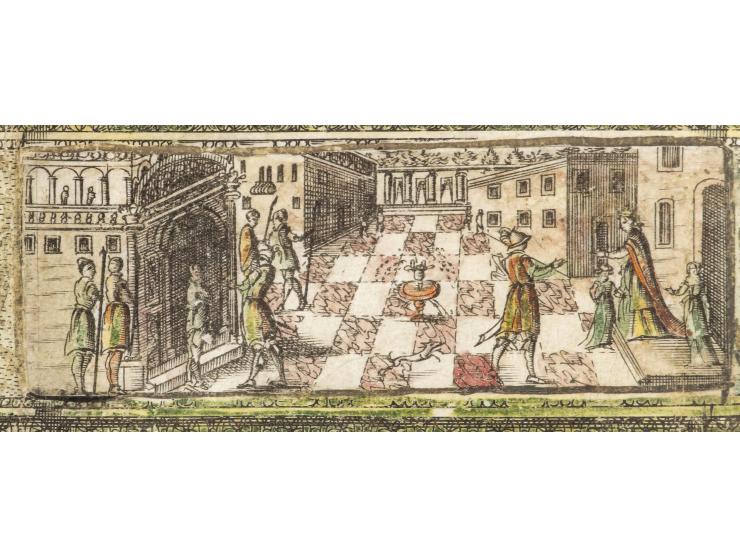
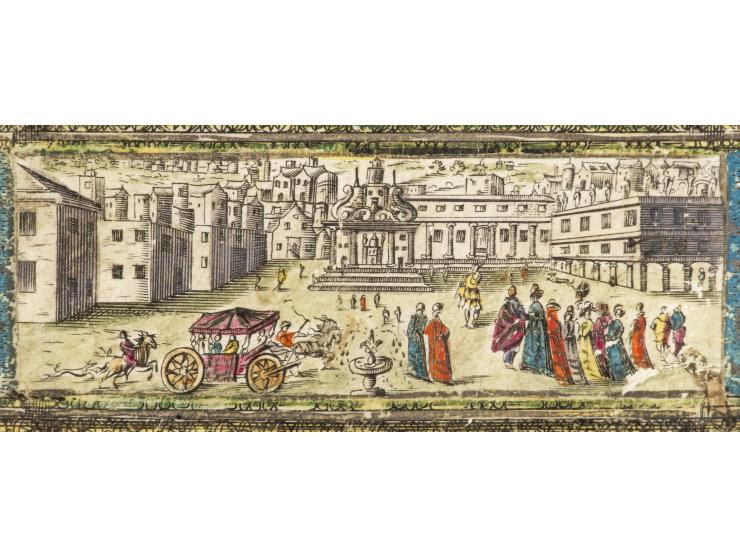
In addition, at the bottom of each circular engraved frame appears a rectangular miniature depicting a narrative scene from the Esther story, enclosed within a Baroque-style ornamental frame (one scene – Haman leading Mordechai on horseback – appears twice, in columns 11 and 13).
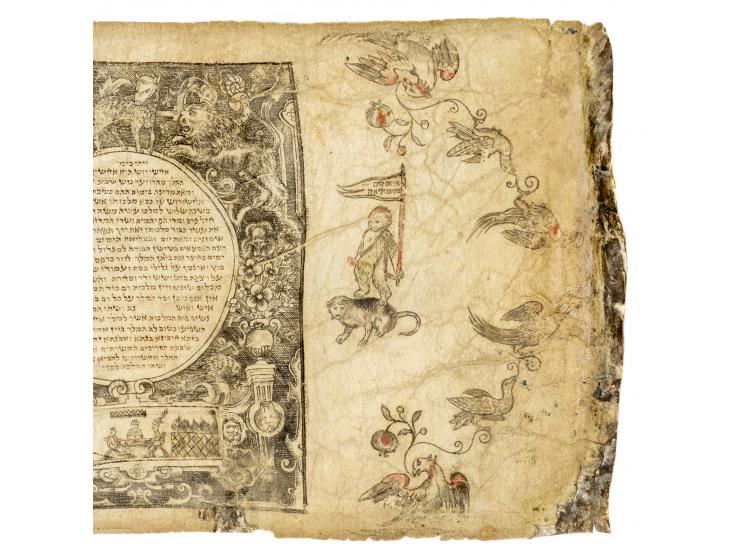
At the beginning of the first parchment sheet – preceding the text frames – appears an initial ornament featuring a symmetrical chain of birds, scrolling foliage and two pomegranates, alongside a figure of an upright monkey standing on the back of a large cat, holding a sword resting on his thigh in one hand and, in the other, a tall pole bearing a flag with the artist's engraved signature: "[By] Shalom [I]talia" (the letters alef and lamed appear as a ligature).
The Artist and His Oeuvre
Shalom ben Mordechai Italia (Salomo d'Italia – of Italy; born 1618/19, died after 1664) is regarded as one of the most important and prolific Jewish artists active in Europe in the 17th century. As his name indicates, he was born in Italy, in the city of Mantua, and apparently arrived in Amsterdam in 1641 or shortly before. His full name is known from his signature on a hand-illustrated Esther scroll he produced in 1644, signed "Shalom son of R. Mordechai d'Italia".
Italia was an engraver, and because he habitually signed his works it is possible to reconstruct his rich oeuvre. In an article by Mordechai Narkiss devoted to Italia's art (1956), 18 works are listed, including six types of engraved Esther scrolls, an engraved ketubah, ten single-sheet engravings (portraits, biblical illustrations and others), and a hand-illustrated Esther scroll. The present scroll is no. 3 in Narkiss' list and is classified as one of Italia's earliest works. In addition to the works documented by Narkiss, several further works by Italia have come to light over the years, including another type of Esther scroll (known as the Butterfly type) and several hand-illustrated Esther scrolls attributed to him.
Parallels
Only six or seven additional copies of this type of Esther scroll are known, most of them in public collections: Jewish Museum, Amsterdam (M000432); Cologne City Museum (Kölnisches Stadtmuseum, RML 2); Library of Geneva (MS heb. 4); Israel Museum, Jerusalem (182/60); a private collection in Zurich; a copy sold at Christie's, Amsterdam, June 19, 1991, Lot 477 (possibly identical with the Zurich private collection copy); and a copy sold at Sotheby's, New York, November 24, 2009, Lot 168.
The Jewish Museum, Amsterdam, dates its scroll to 1650. The Library of Geneva copy was the subject of a dedicated article by Justine Isserles, in which all known copies of this scroll type were documented (see bibliography). The present copy has not previously been studied or published.
The present copy is very similar, in terms of script style (and the arrangement of the column of the Ten Sons of Haman), to the scroll in the Jewish Museum, Amsterdam, and to the scroll sold at Christie's Amsterdam in 1991; it is therefore highly likely that all three were written by the same scribe.
Height: 12-12.5 cm. Length of scroll: 176.5 cm. Overall good condition. Creases and minor tears to margins, professionally restored. Dark stains and wear to beginning of first parchment sheet; tears in this area, with minor loss to opening ornament. Seams joining sheets somewhat loose. Stains and creases to end of final sheet (formerly sewn to a roller). Variation in parchment height of third sheet. Housed in new leather-covered case.
Reference:
• Sharon Assaf and Emily D. Bilski, The Triumph of Identity: Salom Italia's Esther Scrolls and the Dutch Golden Age, Amsterdam: Joods Historisch Museum, Menasseh ben Israel Instituut, 2011.
• Justine Isserles, "The Particular Case of an Engraved Esther Scroll Attributed to Shalom Italia", From Cairo to Amsterdam: Hebrew Scrolls from the 11th to the 18th Centuries, eds. E. Abate and J. Isserles, Henoch, 43/1 (2021), pp. 229-254.
• Mordechai Narkiss, "Yeẓurato shel Shalom ben rabbi Mordechai Italia (1619-1655?)" [The Oeuvre of the Jewish Engraver Salom Italia (1619-1655?)], Tarbiẓ, 25 (1956), pp. 441-451; Tarbiẓ, 26 (1956), pp. 87-101, with English summary, pp. v-viii.
• Shalom Sabar, "A New Discovery: The Earliest Illustrated Esther Scroll by Shalom Italia", Ars Judaica, 8, 2012.
Catalogue Value
![Esther Scroll with engraved decoration. [Italy, probably Venice, mid-18th century – ca. 1750].
Engraving, ink and color](https://files.kedem-auctions.com/files/Sale106/6_1.jpg "Hand-Colored Engraved Esther Scroll – Probably Venice, Ca. 1750 – Clos")
![Esther Scroll with engraved decoration. [Italy, probably Venice, mid-18th century – ca. 1750].
Engraving, ink and color](https://files.kedem-auctions.com/files/Sale106/6_10.jpg "Hand-Colored Engraved Esther Scroll – Probably Venice, Ca. 1750 – Clos")
![Esther Scroll with engraved decoration. [Italy, probably Venice, mid-18th century – ca. 1750].
Engraving, ink and color](https://files.kedem-auctions.com/files/Sale106/6_11.jpg "Hand-Colored Engraved Esther Scroll – Probably Venice, Ca. 1750 – Clos")
![Esther Scroll with engraved decoration. [Italy, probably Venice, mid-18th century – ca. 1750].
Engraving, ink and color](https://files.kedem-auctions.com/files/Sale106/6_2.jpg "Hand-Colored Engraved Esther Scroll – Probably Venice, Ca. 1750 – Clos")
![Esther Scroll with engraved decoration. [Italy, probably Venice, mid-18th century – ca. 1750].
Engraving, ink and color](https://files.kedem-auctions.com/files/Sale106/6_3.jpg "Hand-Colored Engraved Esther Scroll – Probably Venice, Ca. 1750 – Clos")
![Esther Scroll with engraved decoration. [Italy, probably Venice, mid-18th century – ca. 1750].
Engraving, ink and color](https://files.kedem-auctions.com/files/Sale106/6_4.jpg "Hand-Colored Engraved Esther Scroll – Probably Venice, Ca. 1750 – Clos")
![Esther Scroll with engraved decoration. [Italy, probably Venice, mid-18th century – ca. 1750].
Engraving, ink and color](https://files.kedem-auctions.com/files/Sale106/6_5.jpg "Hand-Colored Engraved Esther Scroll – Probably Venice, Ca. 1750 – Clos")
![Esther Scroll with engraved decoration. [Italy, probably Venice, mid-18th century – ca. 1750].
Engraving, ink and color](https://files.kedem-auctions.com/files/Sale106/6_6.jpg "Hand-Colored Engraved Esther Scroll – Probably Venice, Ca. 1750 – Clos")
![Esther Scroll with engraved decoration. [Italy, probably Venice, mid-18th century – ca. 1750].
Engraving, ink and color](https://files.kedem-auctions.com/files/Sale106/6_8.jpg "Hand-Colored Engraved Esther Scroll – Probably Venice, Ca. 1750 – Clos")
![Esther Scroll with engraved decoration. [Italy, probably Venice, mid-18th century – ca. 1750].
Engraving, ink and color](https://files.kedem-auctions.com/files/Sale106/6_9.jpg "Hand-Colored Engraved Esther Scroll – Probably Venice, Ca. 1750 – Clos")
Auction 106 Incunabula and First Editions | Illuminated Manuscripts | Jewish Ceremonial Art
Feb 24, 2026
Opening: $50,000
Sold for: $87,500
Including buyer's premium
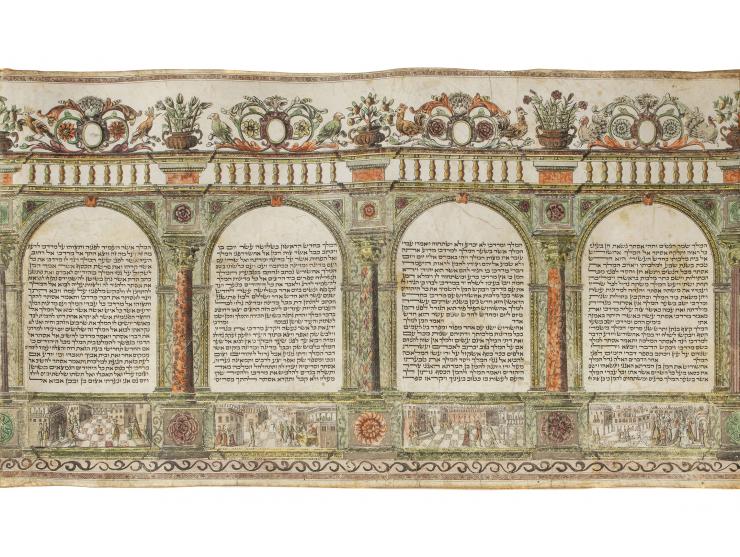
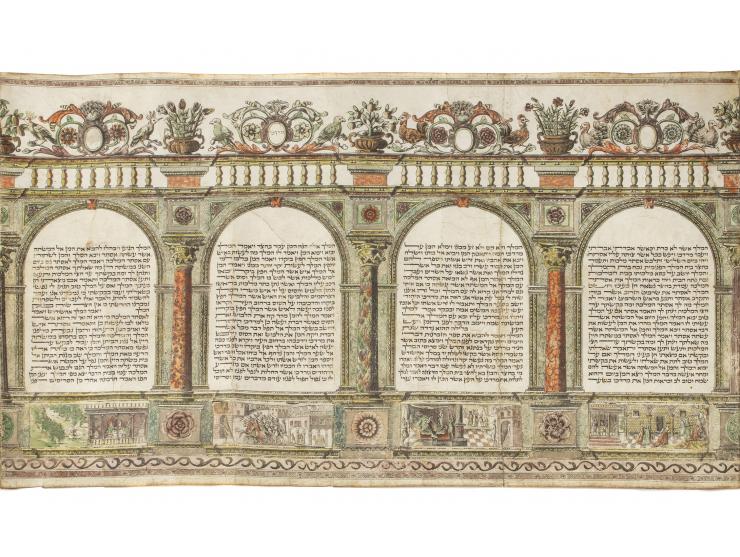
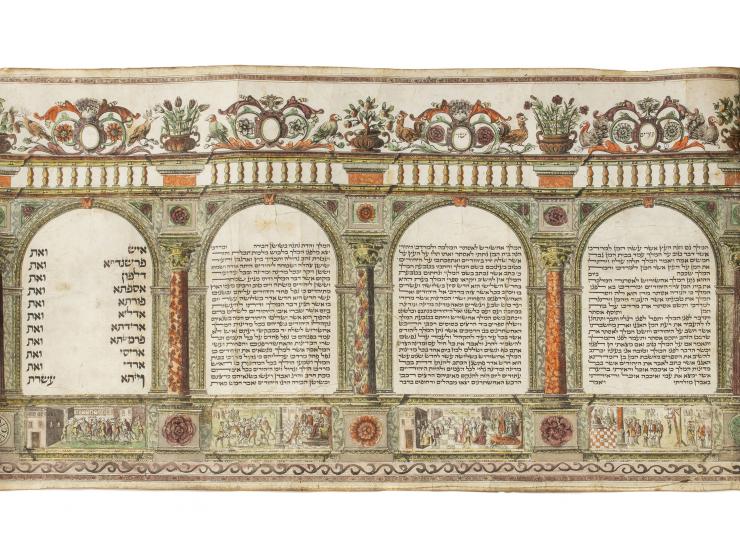
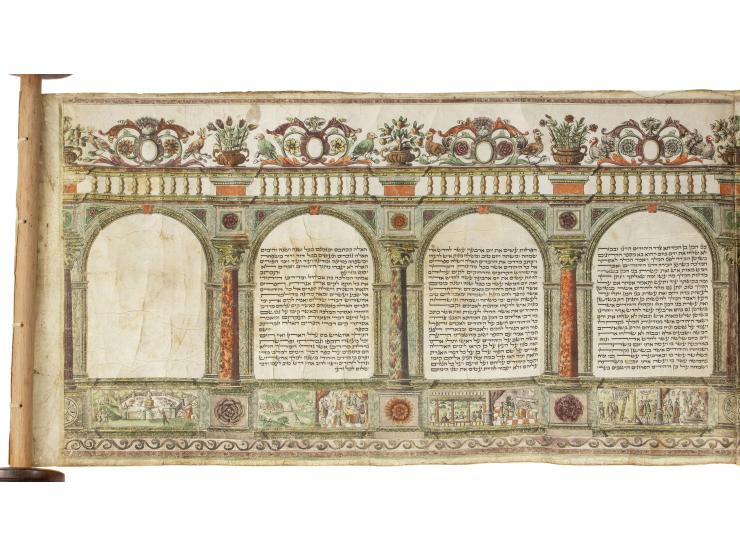
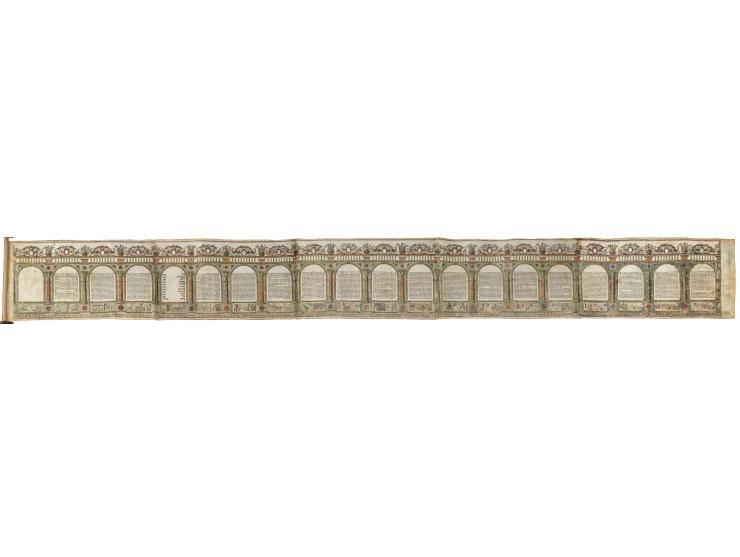
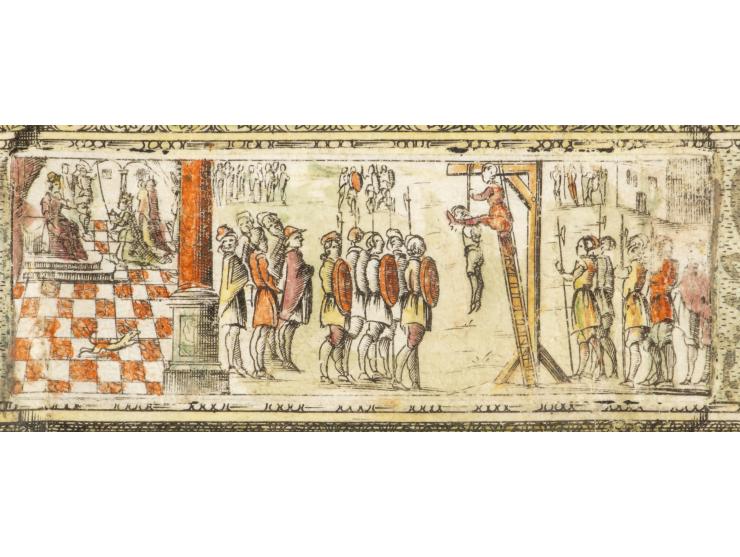
Esther Scroll with engraved decoration. [Italy, probably Venice, mid-18th century – ca. 1750].
Engraving, ink and color on parchment; turned wooden roller.
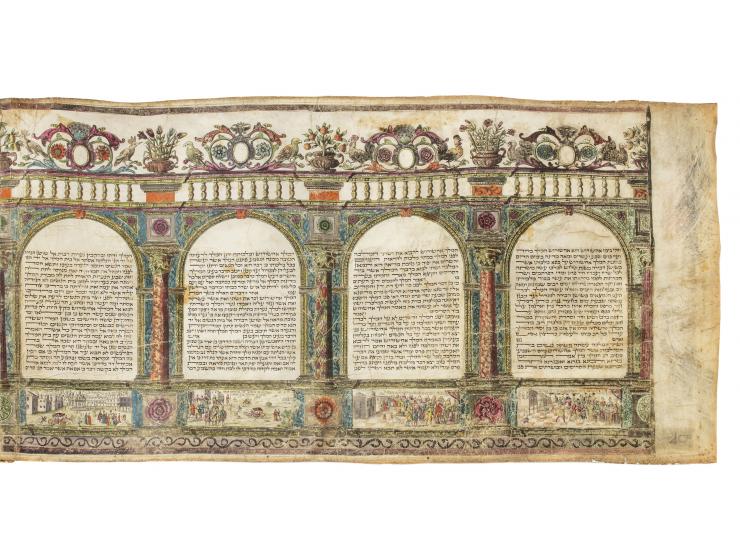
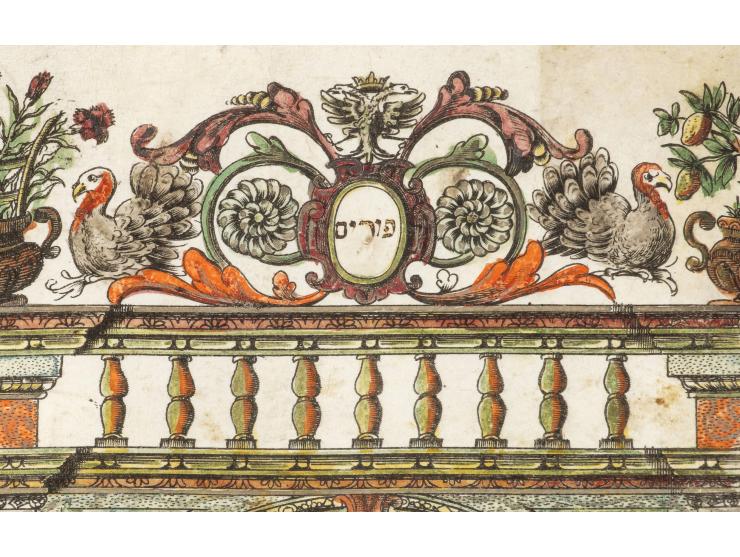
"HaMelech" Esther Scroll (most columns begin with the word "HaMelech"), in Italian Stam script, on five parchment sheets sewn together, 20 engraved frames (four frames per sheet), 19 columns of text, 22 lines per column (final frame blank). High-quality hand-coloring from the time of printing, in tones of red and orange, yellow, purple, green and blue. Additional inscriptions appear in medallions at the heads of columns 11, 13 and 14 (on third and fourth sheets): "Mordechai", "Purim", "Shad-dai" (erased inscription in the medallion above column 12).
Decorations and Artistic Sources
A large and impressive scroll, decorated throughout with high-quality engravings, in a symmetrical architectural scheme incorporating birds and vegetal ornament. Each text column is set within an arched structure supported by two columns, surmounted by a balustrade and crowned with medallions adorned with rich vegetal motifs and with vases of flowers and fruit in two alternating designs.
At the tops of the medallions appear alternately a crowned double-headed eagle or a peacock; flanking each medallion, on both sides, are pairs of turkeys, roosters, parrots and hoopoes. At the bottom of each column, between the column bases, is a rectangular miniature depicting a narrative scene from the Esther story. An additional vegetal border was added in hand-drawn color along the lower margins, above the engraved frame.
The artistic program of this scroll strikingly corresponds with that of the Esther scrolls engraved by Francesco Griselini in Venice in the 1740s: the architectural elements, bird motifs and vegetal decorations are closely similar – at times virtually identical – in both design and high artistic quality, to the extent that one wonders whether the present scroll is not by Griselini himsel.
Furthermore, the size of the engraved plates and the size of the narrative miniatures (printed from separate plates) are identical to those used in Griselini's scrolls. Nevertheless, subtle differences distinguish the present scroll, most notably in the narrative scenes along the lower margins: although the artist clearly used Griselini's narrative compositions as a basis, he enriched them by adding details, increasing the number of figures and animals, and by emphasizing and elaborating the architectural settings and floor tiles.
Finally, it should be noted that in Griselini's scrolls his engraved signature appears at the bottom of the plate, whereas the plates of the present scroll are entirely unsigned.
Francesco Griselini (1717-1787) was an engraver best known for the engravings he produced for Esther scrolls in the 1740s, as well as for several engraved maps and for engravings made for Bibles and prayer books printed in Venice in the 1750s.
Parallels
The Center for Jewish Art (CJA) documents several Esther scrolls of this type, studied by Dagmar Budzioch and designated "Griselini-Related Esther Scrolls".
Copies are held, in Berlin State Library (Hamilton 235); Jewish Museum, New York (F 3840); Jewish Museum London (C1973.4.2.5); Museum of Jewish Art and History (mahJ), Paris (D.98.04.074.CL); Israel Museum, Jerusalem (MS 182/041); and in several other collections.
Height: 27 cm. Length of scroll: 241.5 cm. Overall good condition. Stains, creases and small tears at beginning of first parchment sheet. Several tears along sheets, professionally restored. Old longitudinal tear along entire third sheet, professionally restored. Small holes at beginning of first sheet, apparently from a former tie cord sewn there. Slight fading of ink and color. Sheets re-sewn together. Sewn at end to new wooden roller. Roller height: 55 cm. Housed in new leather-covered box with velvet lining.
Catalogue Value
Auction 106 Incunabula and First Editions | Illuminated Manuscripts | Jewish Ceremonial Art
Feb 24, 2026
Opening: $1,000,000
Sold for: $1,250,000
Including buyer's premium
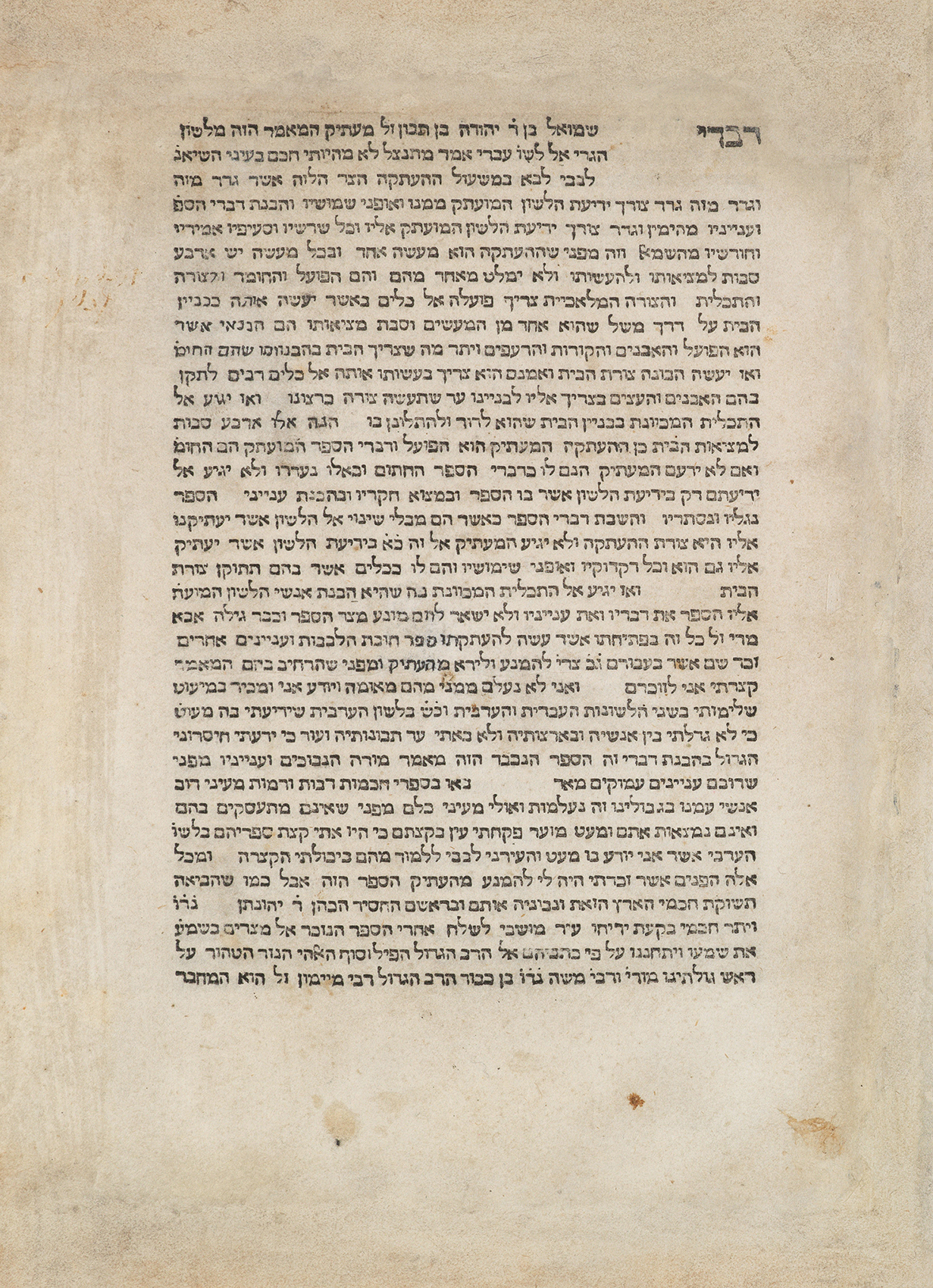
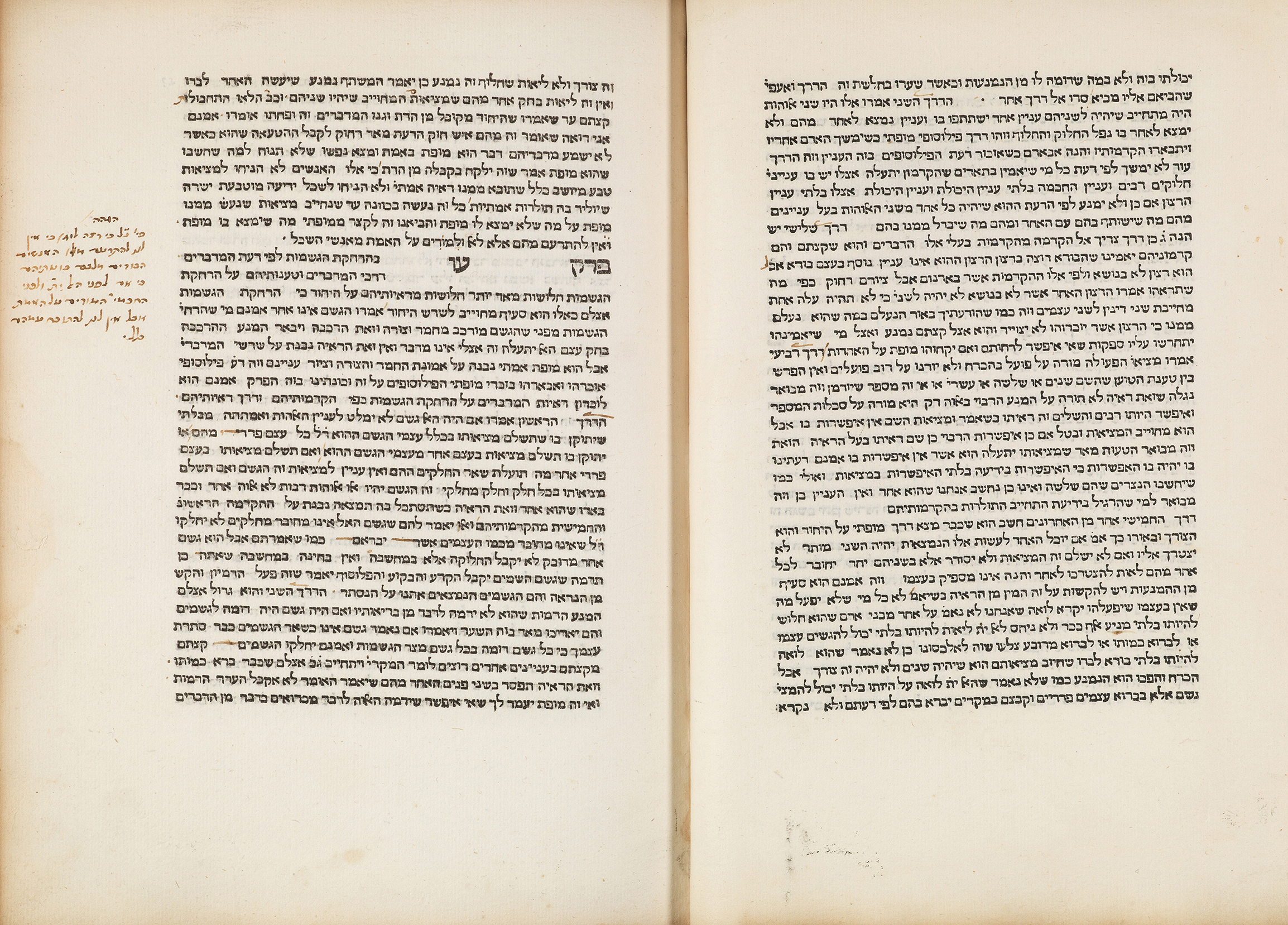
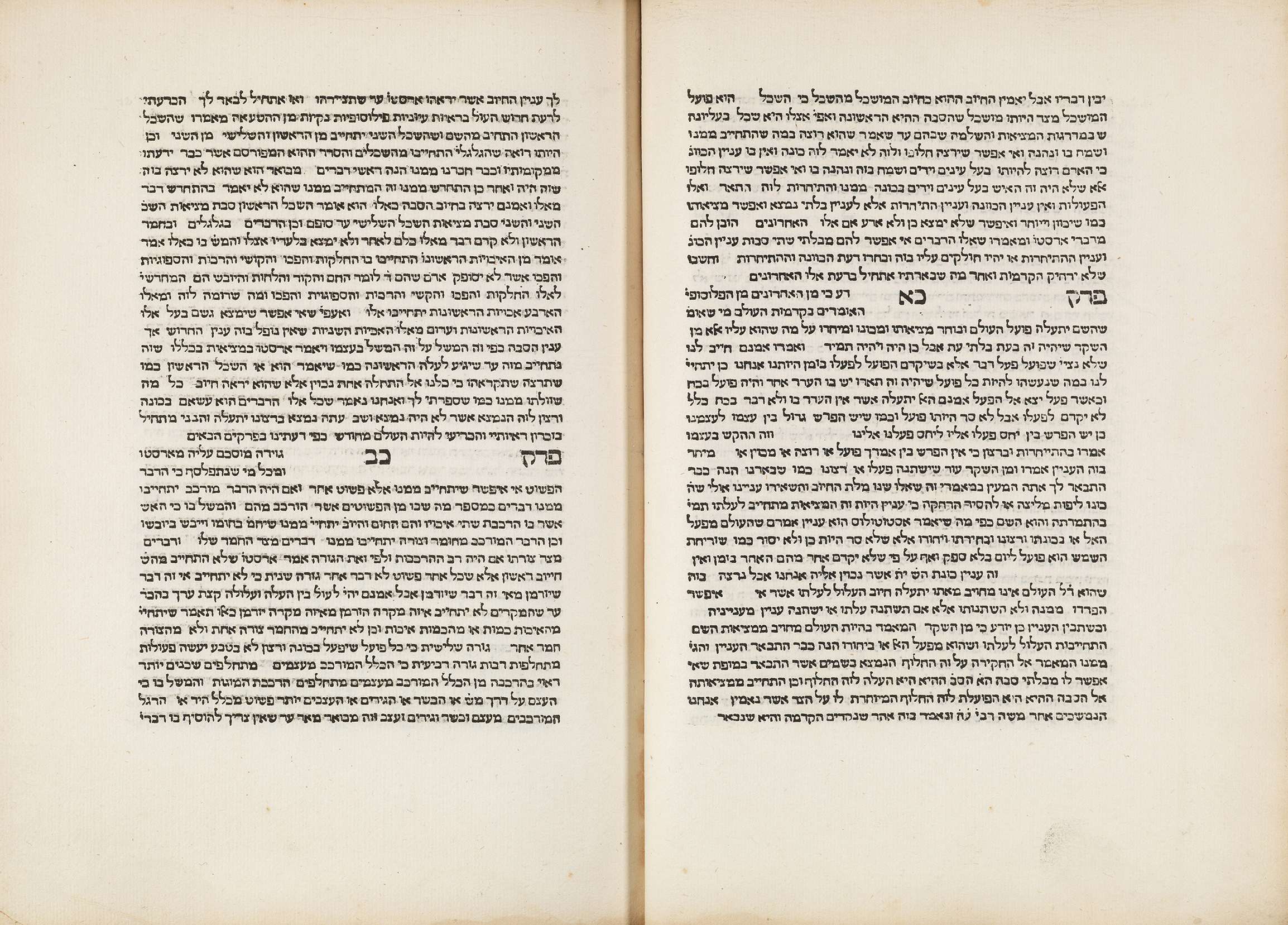
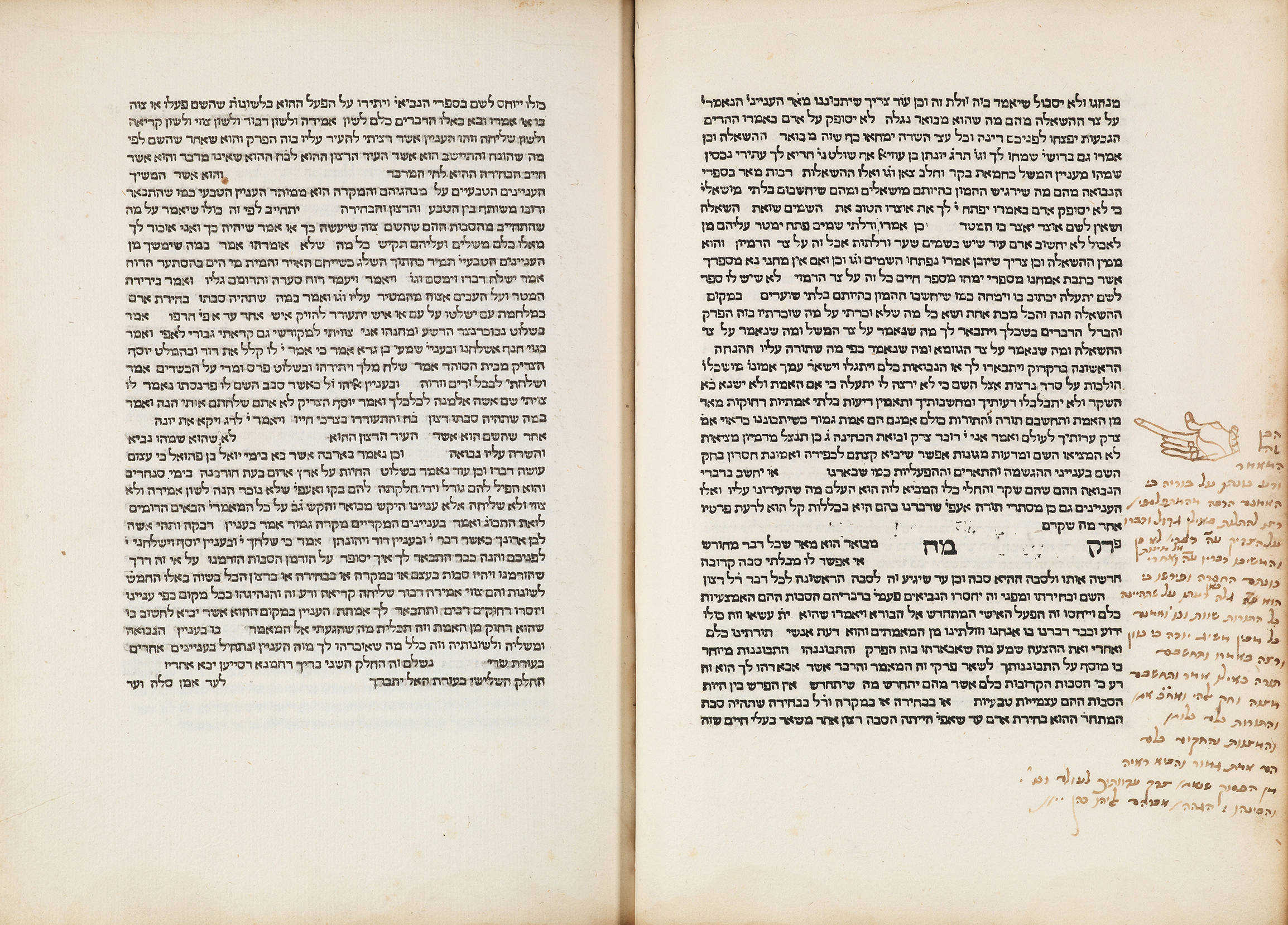
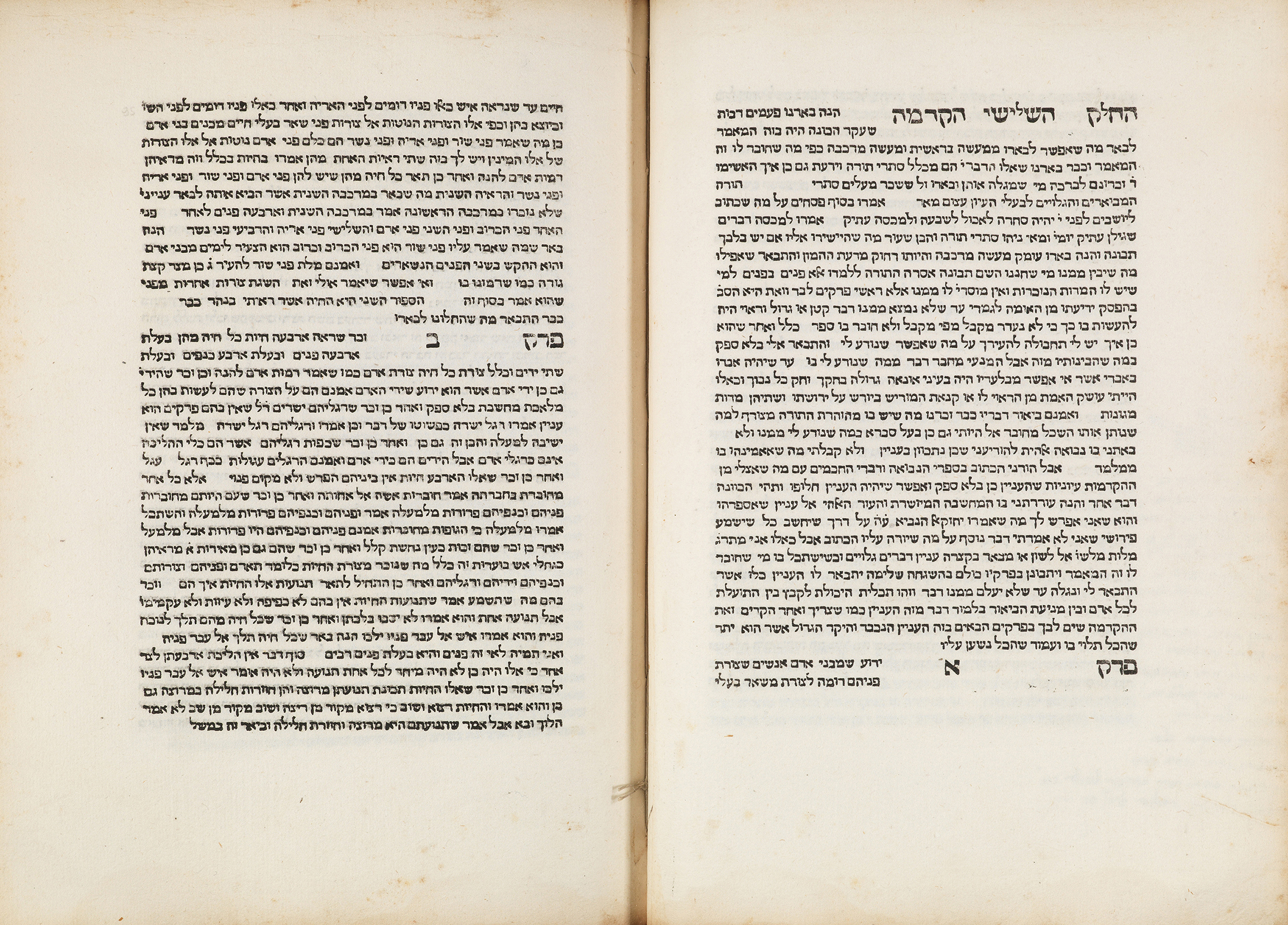
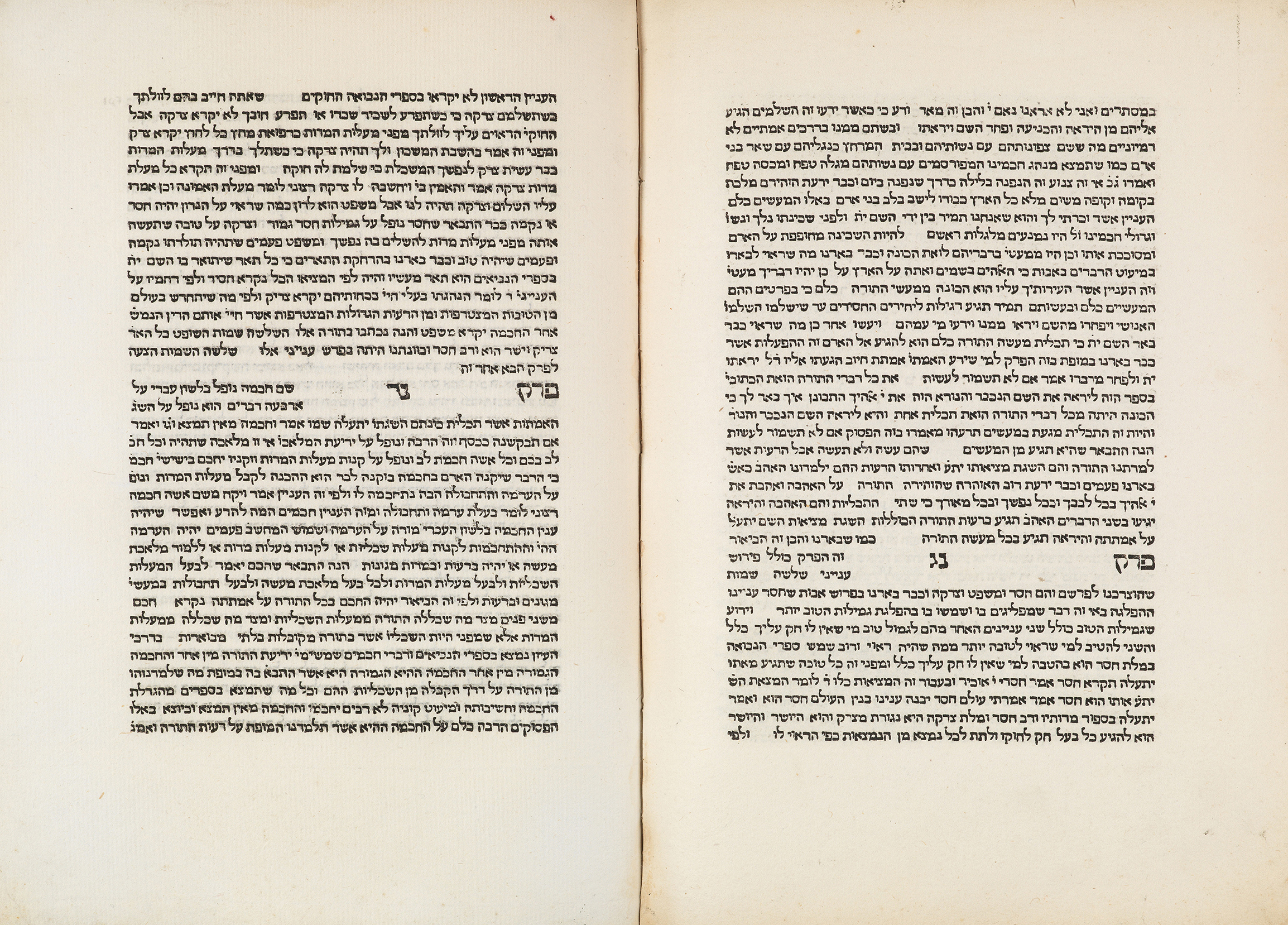
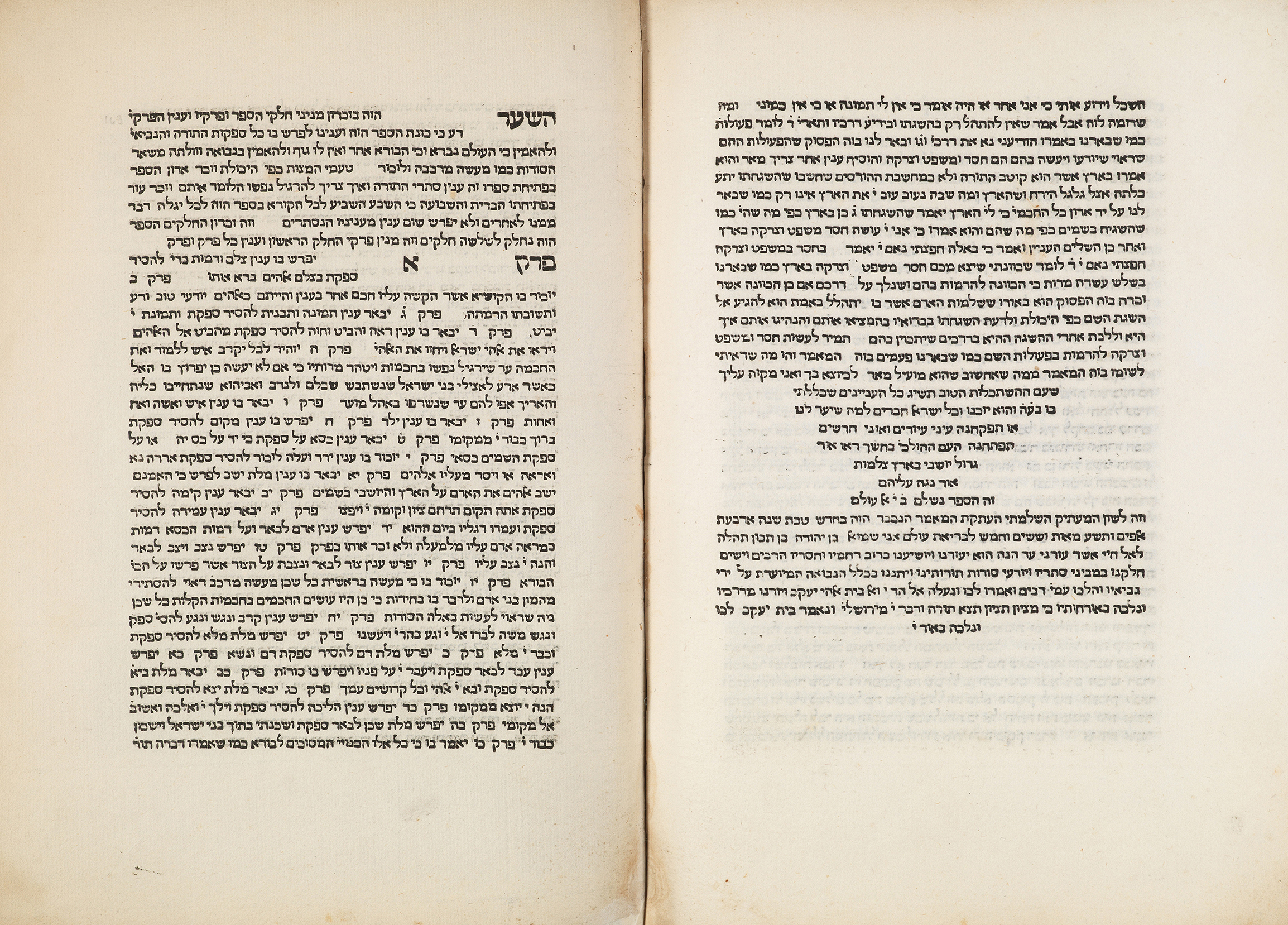
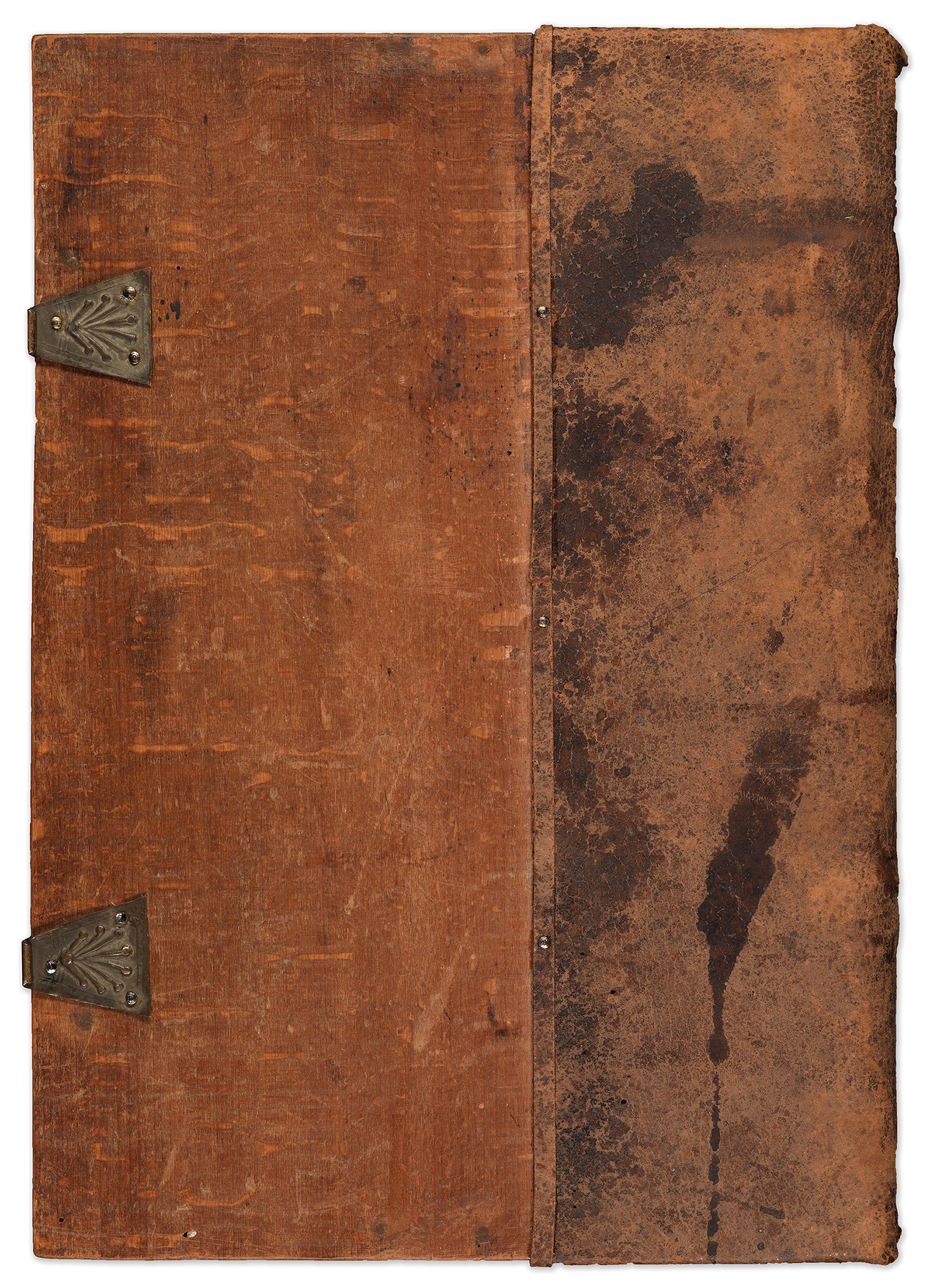
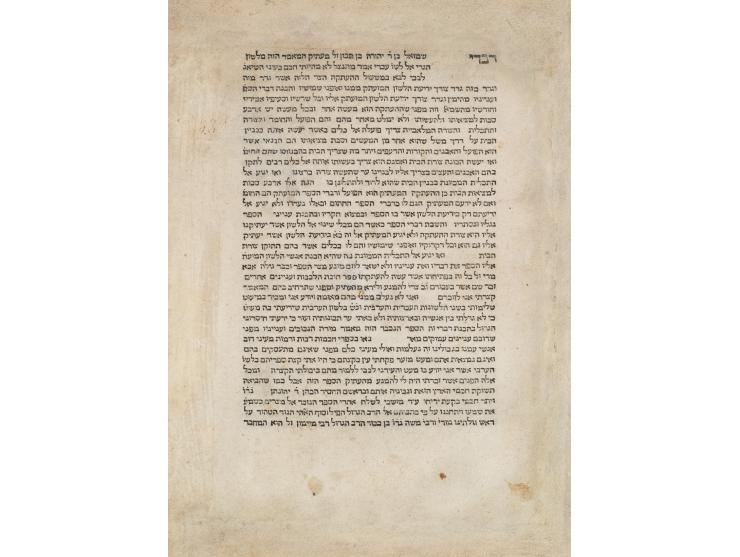
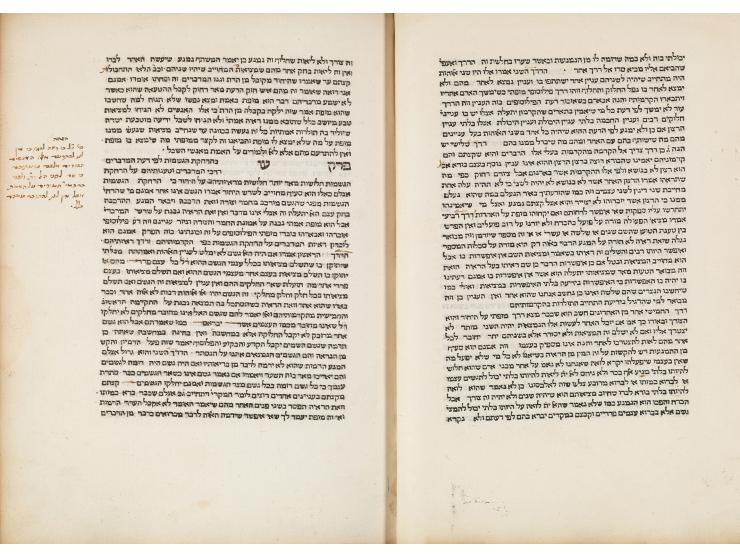
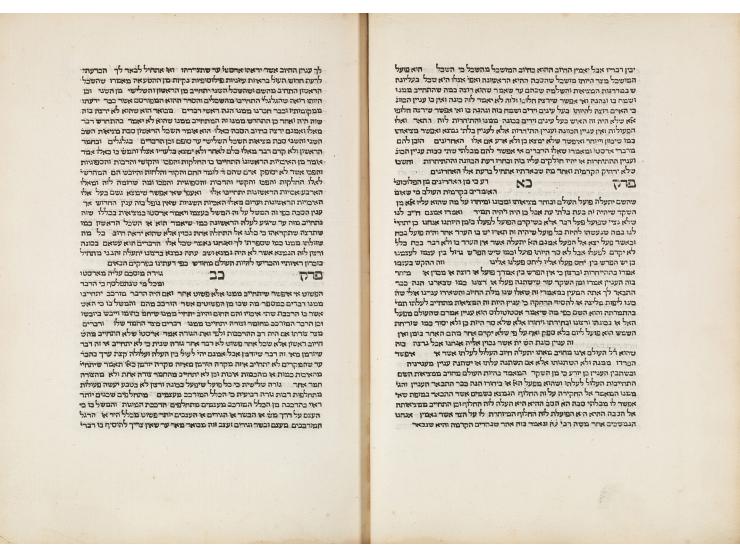
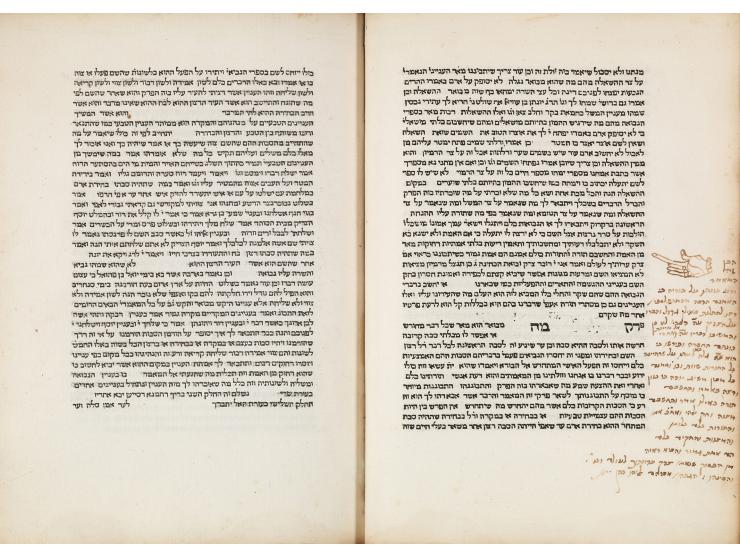
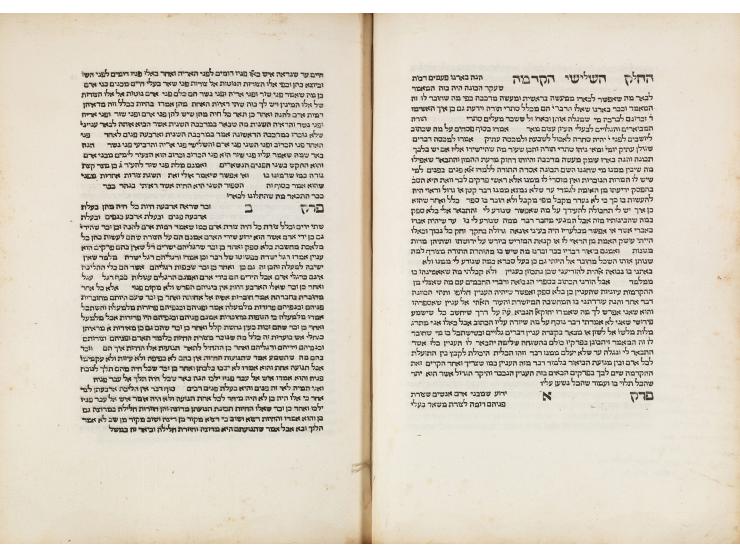
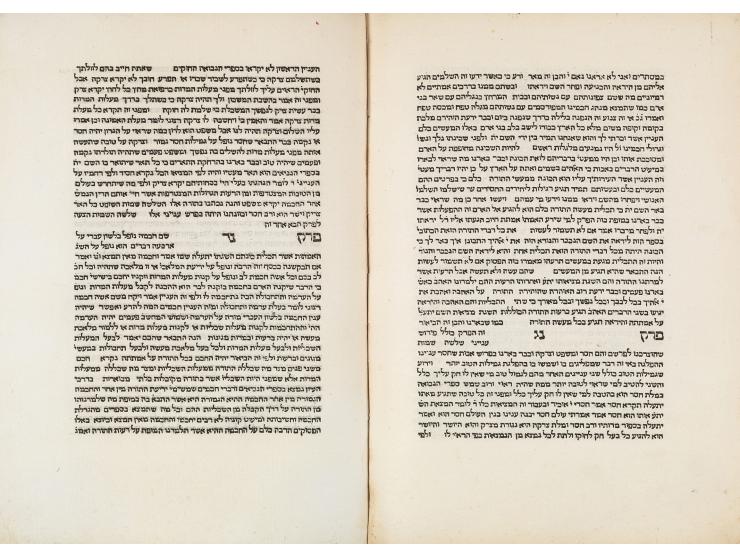
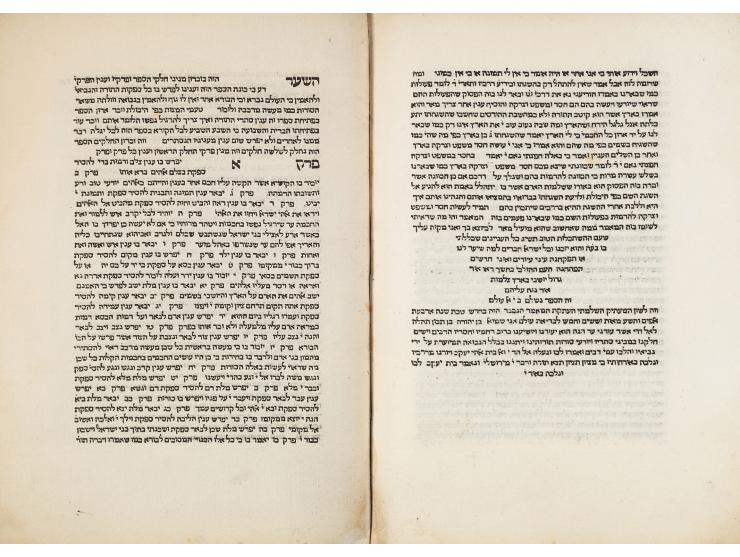
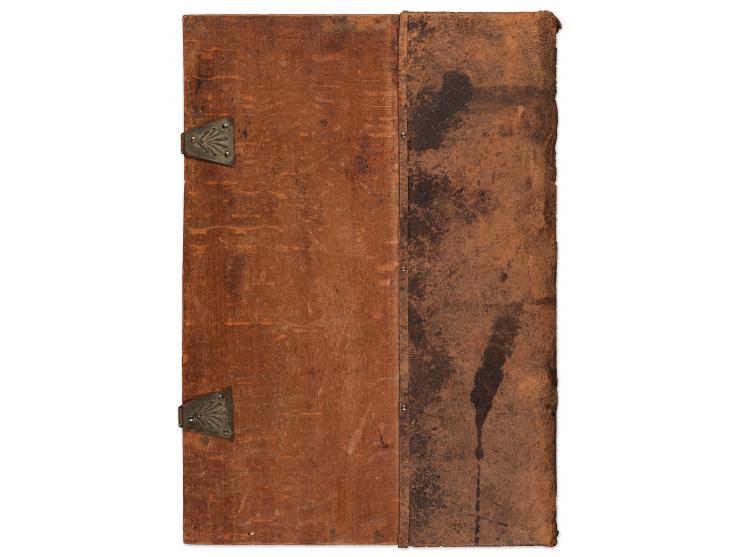
Moreh Nevuchim by the Rambam, translated into Hebrew by R. Shmuel ibn Tibbon. [Rome, ca. 1473-1475 (see below for further details on the location and date)]. First edition. Incunabulum.
First edition incunabulum, especially rare, of Moreh Nevuchim, a fundamental work of medieval Jewish thought and the philosophy of Judaism, authored by the Rambam (Maimonides), a leading halachic authority and philosopher of all time.
Moreh Nevuchim, known in English as Guide for the Perplexed, was authored in Judeo-Arabic ca. 1185-1190. It was originally titled Dalālat al-Ḥā'irīn (literally, Guidance of the Perplexed). Its Hebrew name, Moreh Nevuchim, was coined by its first translator, R. Shmuel ibn Tibbon, and this name was used in all Hebrew editions of the book. Ibn Tibbon worked on his translation in Montpellier, Provence, during the Rambam's lifetime, and the Rambam wrote him at least one letter in support of his translation endeavor, providing explanation, general guidance, instructions for accuracy and translation assistance.
The book was written by the Rambam for his disciple, R. Yosef son of Yehudah ibn Shimon. Written as a guide for the titular "perplexed", confronted with the disparity between Torah study and contemporary philosophical thought, the book is composed of three parts: Its first part (76 chapters) discusses biblical expressions whose surface meaning implies the corporeality of G-d, explained by the author as abstractions, expounding a system of negative theology and demonstrating the incorporeality of G-d. In the second part (48 chapters), he discusses the proofs for G-d's existence and the question of the eternity of the world, and examines the concept of prophecy and its meaning. The third part (54 chapters) begins by discussing the prophetic vision of the Merkavah, providence and recompense, concluding with an extensive study of the rationales for the commandments.
The Rambam's writing was heavily influenced by Greek philosophy, especially Aristotelean thought, and by his Islamic commentators, Al-Farabi (cited often in Moreh Nevuchim) and Avicenna, whose works he had thoroughly studied.
The last five leaves contain a summary of the contents of each chapter, made by R. Yehudah al-Charizi.
Ashkenazic square type. No page headers, foliation, collation or catchwords.
Watermark of an encircled bow (very similar to Briquet 746, and to Piccard IX, Werkzeug und Waffen, 12: 2388/89; see illustration in Tishby, plate A8).
Printed on especially thick and high-quality paper, with fine wide margins.
Handwritten annotations on several pages by various writers, including several long glosses. In Part II, Chapter 48, a lengthy annotation opening with the words: "Understand this discourse and know its true intent…", signed: "Avraham Eliyahu Cohen".
On verso of last page, signatures of censors Luigi da Bologna and Renato da Modena, and signature of censor Camillo Jaghel dated 1613.
[154] leaves. Collation: [i]9 (lacking first blank leaf), [ii-xv]10, [xvi]5 (lacking last blank leaf). Verso of fifth leaf in last gathering blank. 27.5 cm. Good condition. Stains. The book has been professionally cleaned. First twenty leaves supplied from Schocken copy (margins repaired with paper filling from the period of printing). Large open tear to last leaf, not affecting text, repaired with paper filling. Early binding (contemporaneous with printing of book), with clasps. Bookplate to inside of front cover.
The Influence of Moreh Nevuchim
Moreh Nevuchim was highly consequential for both Jewish thought and Western philosophy, including non-Jewish thinkers. Islamic philosophy had previously dealt with topics such as negative theology as a way of defining G-d, and the Rambam was viewed as offering a Jewish interpretation, influencing Muslim thinkers who viewed it as a natural part of Arabic Aristotelean philosophy. The book was also influential in Europe, and was soon translated into Latin in the 13th century, and several distinguished thinkers were influenced by it, including Albertus Magnus and Thomas Aquinas, who mentions Maimonides at times in his own writings. The book's influence at a later date is also discernible in the thought of Baruch Spinoza, the famous philosopher and Jewish apostate.
Almost from the outset, this book was greeted with an ambivalent reception in the Jewish world. Many banned the book, or even burned it, decrying the author's legitimization of philosophical study, or claiming non-Jewish influence upon the book. The book's chief opponents included R. Shlomo of Montpellier and his disciple R. Yonah Gerondi (who reputedly so regretted his support for the burning of the book that he traveled to the Rambam's grave in Eretz Israel to beg his forgiveness). The rabbinic opposition to the book led to its burning by the Inquisition in 1233. R. Shlomo ibn Adret (the Rashba) was another opponent; fearing excessive study of philosophy, especially among the youth, he banned in 1305 the study of philosophy, including Moreh Nevuchim, by students under the age of 25. On the other hand, the book had many enthusiastic supporters over the generations, such as Don Yitzchak Abarbanel and the Ralbag who authored commentaries to it, and the book enjoyed wide circulation, especially among the Jews of Provence, where it was first translated into Hebrew.
Over the last decades, Moreh Nevuchim has seen a new translation into Hebrew by R. Yosef Kapach (Qafih), and an academic translation by Prof. Michael Schwarz. The book has also been translated into English by Michael Friedländer, and more recently by Shlomo Pines.
Location and Date of Printing, and the Early Hebrew Press in Rome
The present book is one of eight printed in Italy with no indication of location or year of printing (Sefer HaShorashim by the Radak, Ralbag on Daniel, Ramban on the Torah, Aruch, Responsa of the Rashba, Rashi on the Torah, Sefer Mitzvot Gadol and Moreh Nevuchim). These books were first documented by bibliographer Bernardo De Rossi, recording their date of printing as "before 1480" (without discussing location of printing). De Rossi was followed by Steinschneider and the other bibliographers of the time.
In one of the eight books – the Ramban’s commentary on the Torah – the printers state in the concluding remarks at the end of Shemot that it was “copied by Ovadiah and Menashe and Binyamin of Rome”. From this, scholars inferred that the printers’ place of activity was the city of Rome (rather than understanding the phrase “of Rome” merely as indicating their place of origin). Since the typefaces of all eight books appeared typographically similar, the hypothesis was accepted that all of the books were printed in Rome. Over the years, supportive evidence was added, indicating that the Responsa of the Rashba was indeed printed in Rome.
The bibliographer Moses Marx compared these incunabula to ones then being printed in other languages in the region, demonstrating a prominent typographical similarity between the Hebrew books and those being printed in Christian presses between 1468-1473. Marx divided the eight incunabula into three groups, placing Moreh Nevuchim in the third and latest group, printed in Rome between 1472-1475. In 1984, Rabbi Riccardo (Shmuel) Di Segni published documents from the State Archives demonstrating that one or more Hebrew presses were already active in Rome prior to 1485.
Peretz Tishby, in a study dedicated to these incunabula, categorized the books somewhat differently (adding a ninth book, Mishneh Torah by the Rambam, also printed in Rome in his view). Tishby attributed most of the books to the press of Ovadiah, Menashe and Binyamin of Rome, but recorded Moreh Nevuchim as the work of an anonymous press, printed ca. 1473-1475.
Adriaan Offenberg, in a study on these incunabula, makes the claim, based on a thorough examination of watermarks and typographical details, that six of the books were indeed printed in Rome by Ovadiah, Menashe and Binyamin of Rome, between 1469-1473. As for Moreh Nevuchim (and Sefer Mitzvot Gadol), Offenberg states that it is not possible to assign Rome as the definite place of printing, and therefore attributes it to an unknown location, between 1473-1475.
With regard to the date of printing, mention should also be made of a copy of the Responsa of the Rashba preserved in the Casanatense Library in Rome, which contains a handwritten family inscription dated to the month of Shevat 5235 (January-February 1475), proving that the book was printed prior to that year.
Provenance:
The present copy comes from the collection of Dr. Felix Guggenheim. This copy contained only [134] leaves – the first [20] leaves with content (including the translator's introduction, a brief poem and introduction by the author, and the first 42 chapters) were lacking. These leaves were supplied from a copy in the Salman Schocken collection, purchased by Jack Lunzer (Sotheby's, London, December 6, 1993, Lot 1).
Reference:
• A. Freimann and M. Marx, Thesaurus Typographiae Hebraicae Saeculi XV, A18.
• S. Iakerson, Catalogue of Hebrew Incunabula from the Collection of the Library of the Jewish Theological Seminary of America, I, New York and Jerusalem, 2004, no. 8, pp. 34-38.
• P. Tishby, "Hebrew Incunabula, Italy-Rome", Kiryat Sefer, LVIII (1985), no. 8, pp. 839-842.
• A.K. Offenberg, Hebrew Incunabula in Public Collections, Nieuwkoop, 1990, no. 86.
• A.K. Offenberg (ed.), Catalogue of Books Printed in the XVth Century Now in the British Library BMC – Part XIII: Hebraica, Hes & De Graaf, 2004, pp. 9-10.
• M. Marx, "On the Date of Appearance of the First Printed Hebrew Books", Alexander Marx: Jubilee Volume on the Occasion of His Seventieth Birthday, English section, New York, 1950, pp. 481-501.
• M. Funke, The Rare Book Collection of Dr. Felix Guggenheim, Fifty Highlights from a Lifetime of Collection and Publishing, Presented in Two Parts: Judaica & Germanistic, [Mill Valley, California], 2025, pp. 31-32 (includes description of the original incomplete copy).
The book is currently in Zurich, Switzerland, and will be available for preview by appointment through Kedem’s office.
Catalogue Value
![Sefer HaIkarim, principles of Jewish faith, by R. Yosef Albo. Soncino: [Yisrael Natan Soncino and sons], 1485. First editio](https://files.kedem-auctions.com/files/Sale106/8_1.jpg "Sefer HaIkarim by Rabbi Yosef Albo – Incunabulum – Soncino, 1485 – Com")
![Sefer HaIkarim, principles of Jewish faith, by R. Yosef Albo. Soncino: [Yisrael Natan Soncino and sons], 1485. First editio](https://files.kedem-auctions.com/files/Sale106/8_2-WEB.jpg "Sefer HaIkarim by Rabbi Yosef Albo – Incunabulum – Soncino, 1485 – Com")
![Sefer HaIkarim, principles of Jewish faith, by R. Yosef Albo. Soncino: [Yisrael Natan Soncino and sons], 1485. First editio](https://files.kedem-auctions.com/files/Sale106/8_3-WEB.jpg "Sefer HaIkarim by Rabbi Yosef Albo – Incunabulum – Soncino, 1485 – Com")
![Sefer HaIkarim, principles of Jewish faith, by R. Yosef Albo. Soncino: [Yisrael Natan Soncino and sons], 1485. First editio](https://files.kedem-auctions.com/files/Sale106/8_4.jpg "Sefer HaIkarim by Rabbi Yosef Albo – Incunabulum – Soncino, 1485 – Com")
![Sefer HaIkarim, principles of Jewish faith, by R. Yosef Albo. Soncino: [Yisrael Natan Soncino and sons], 1485. First editio](https://files.kedem-auctions.com/files/Sale106/8_5.jpg "Sefer HaIkarim by Rabbi Yosef Albo – Incunabulum – Soncino, 1485 – Com")
![Sefer HaIkarim, principles of Jewish faith, by R. Yosef Albo. Soncino: [Yisrael Natan Soncino and sons], 1485. First editio](https://files.kedem-auctions.com/files/Sale106/8_6.jpg "Sefer HaIkarim by Rabbi Yosef Albo – Incunabulum – Soncino, 1485 – Com")
Auction 106 Incunabula and First Editions | Illuminated Manuscripts | Jewish Ceremonial Art
Feb 24, 2026
Opening: $30,000
Sold for: $57,500
Including buyer's premium
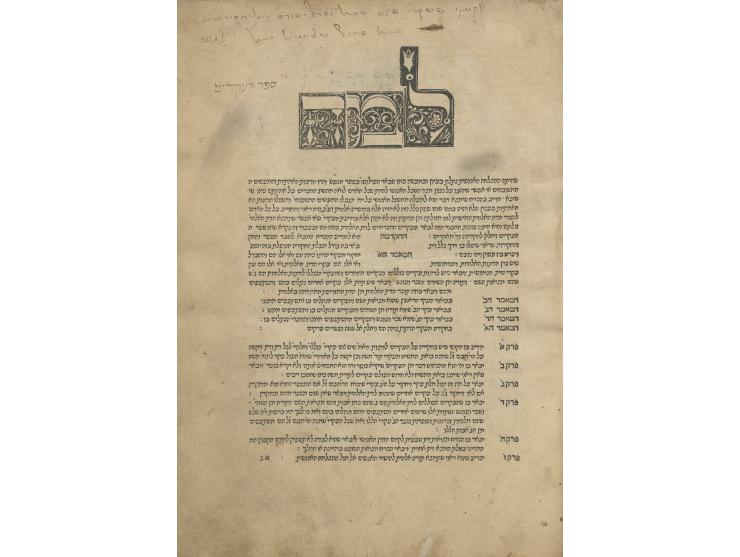
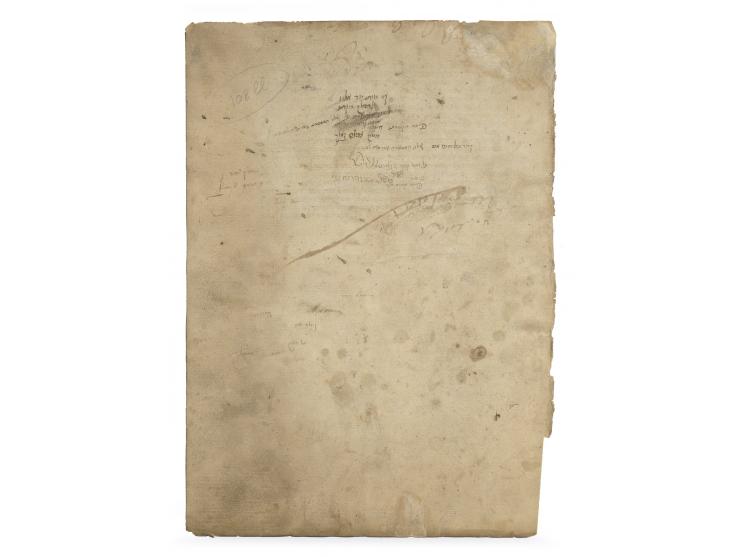
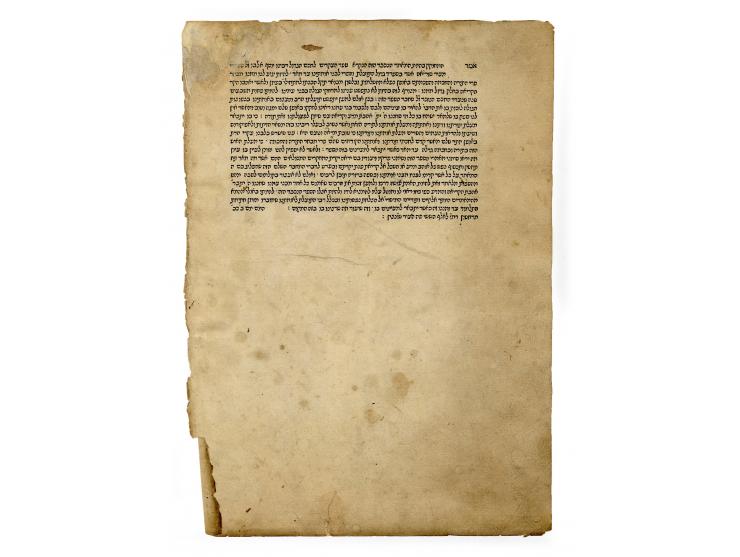
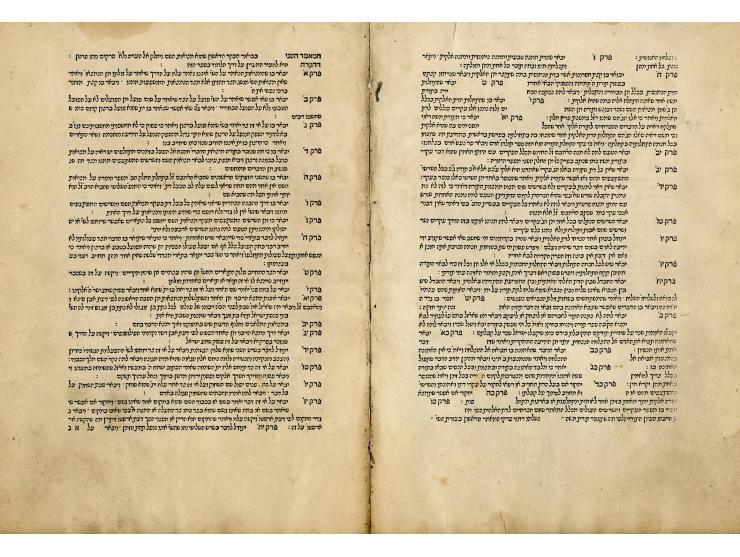
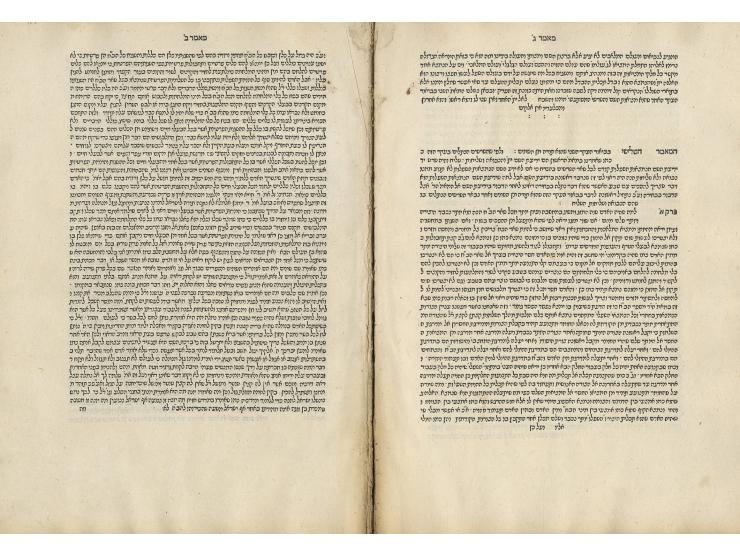
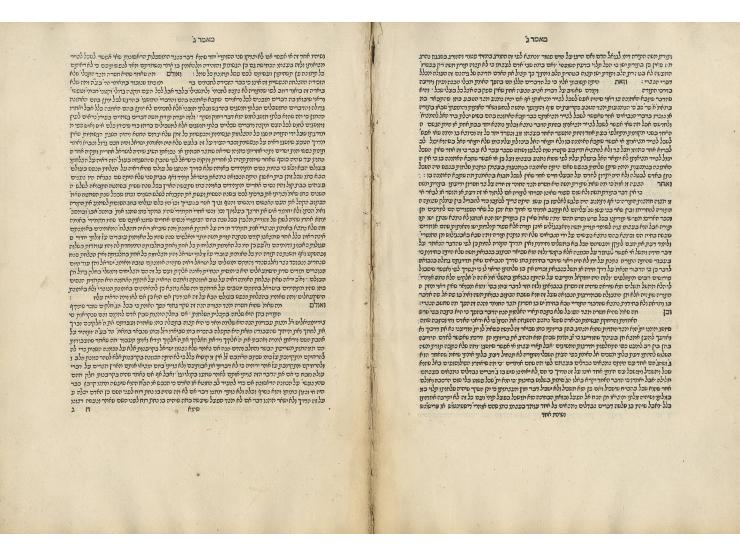
Sefer HaIkarim, principles of Jewish faith, by R. Yosef Albo. Soncino: [Yisrael Natan Soncino and sons], 1485. First edition. Incunabulum.
First edition of a classic work of Jewish thought. Printed in Soncino, Italy, in the early years of Hebrew printing, in the famous press of the first Jewish family of printers.
The present copy also includes leaves [56]-[58] (gathering viii, leaves 2-4), omitted from most copies due to Christian censorship (see Bibliography of the Hebrew Book, entry 109905). Even in those copies in which these leaves remain, they are generally heavily censored; in the present copy, however, they are present in full without any deletions, like the rest of the pages of the book.
Printed without title page. The recto of first leaf is blank, while the printer's foreword occupies the verso: "As this important work, called Sefer HaIkarim, by the great sage R. Yosef Albo the Spaniard of Soria in Spain is of very great benefit to the people of our nation… and moreover… as it is less than seventy years since the passing of that sage, the author of this book… in order to spread its benefit… we decided to typeset it in full…". At the end of the foreword, date of commencement of printing: 22nd Cheshvan 1485, in Soncino.
Two colophons at end of book. The first gives the date of completion of printing as 21st Tevet 1485. The second colophon, by one of the print workers, concludes with the famous play on the verse from Yeshayahu (coined here): "From Zion shall go forth the Torah, and the word of G-d from Soncino".
Woodcut initial word panels at the beginning of the table of contents and of the introduction.
On blank first page, various pen trials.
Ownership inscriptions in Italian script on leaf 2: "I purchased this Ikarim from R. Yisrael Yehudah of Sermide, [El--?] son of R. Shmuel Almagia".
On last leaf of first gathering, a line mistakenly omitted from the original text is added by hand (this error is repeated in the following editions, and was first corrected, with a slightly different text, in the Lublin edition of 1597).
Other small textual corrections in margins in several places.
Complete copy. [108] leaves, including leaves [56]-[58] (viii2-4), lacking in most copies, due to Christian censorship. 28.5 cm. Fine, wide margins. Good-fair condition. Stains, including dampstains and traces of former dampness (large stains to several leaves). Tears and open tears, including small open tear to last leaf of gathering x, affecting text, partially repaired with paper filling. Worming to several leaves. Detached leaves and gatherings. Early leather and wood binding (ca. 18th century), detached, with defects, without spine.
There are typographic variations between the different copies of the book (presumably because many leaves were reset during the course of the printing), notably on leaf 1 of gathering v (leaf [31]). See: Y. Rivkind, Kiryat Sefer, II, 1925-1926, pp. 55-56 (Rivkind distinguishes between two types of copies, one of which was proofread and corrected – the present copy is of the corrected type).
For a detailed bibliographic description of the book, and the bibliographical disagreement as to which member of the Soncino family printed the book, see further: P. Tishby, Kiryat Sefer, LXIII, 1990-1991, pp. 615-621, no. 36.
The Soncino family were prominent Hebrew printers in the 15th and 16th centuries, and particularly in the incunabula period. They established their first printing press in Soncino, Italy, ca. 1483, and later wandered through various Italian cities with their printing equipment, resuming their printing operations wherever they settled. A prominent member of this family was Gershom Soncino. The family derived its name from the first town in Italy where they operated.
Reference: A.K. Offenberg, Hebrew Incunabula in Public Collections, Nieuwkoop, 1990, No. 83.
Catalogue Value
![Midrash Rabbah, on the Five Books of the Torah. Constantinople: [Shmuel ibn Nachmias], 1512. First edition. All five parts,](https://files.kedem-auctions.com/files/Sale106/9_1.jpg "Midrash Rabbah on the Torah – First Edition – Constantinople, 1512 – S")
![Midrash Rabbah, on the Five Books of the Torah. Constantinople: [Shmuel ibn Nachmias], 1512. First edition. All five parts,](https://files.kedem-auctions.com/files/Sale106/9_2.jpg "Midrash Rabbah on the Torah – First Edition – Constantinople, 1512 – S")
![Midrash Rabbah, on the Five Books of the Torah. Constantinople: [Shmuel ibn Nachmias], 1512. First edition. All five parts,](https://files.kedem-auctions.com/files/Sale106/9_3.jpg "Midrash Rabbah on the Torah – First Edition – Constantinople, 1512 – S")
![Midrash Rabbah, on the Five Books of the Torah. Constantinople: [Shmuel ibn Nachmias], 1512. First edition. All five parts,](https://files.kedem-auctions.com/files/Sale106/9_4.jpg "Midrash Rabbah on the Torah – First Edition – Constantinople, 1512 – S")
![Midrash Rabbah, on the Five Books of the Torah. Constantinople: [Shmuel ibn Nachmias], 1512. First edition. All five parts,](https://files.kedem-auctions.com/files/Sale106/9_5-WEB.jpg "Midrash Rabbah on the Torah – First Edition – Constantinople, 1512 – S")
![Midrash Rabbah, on the Five Books of the Torah. Constantinople: [Shmuel ibn Nachmias], 1512. First edition. All five parts,](https://files.kedem-auctions.com/files/Sale106/9_6-WEB.jpg "Midrash Rabbah on the Torah – First Edition – Constantinople, 1512 – S")
![Midrash Rabbah, on the Five Books of the Torah. Constantinople: [Shmuel ibn Nachmias], 1512. First edition. All five parts,](https://files.kedem-auctions.com/files/Sale106/9_7.jpg "Midrash Rabbah on the Torah – First Edition – Constantinople, 1512 – S")
![Midrash Rabbah, on the Five Books of the Torah. Constantinople: [Shmuel ibn Nachmias], 1512. First edition. All five parts,](https://files.kedem-auctions.com/files/Sale106/9_8.jpg "Midrash Rabbah on the Torah – First Edition – Constantinople, 1512 – S")
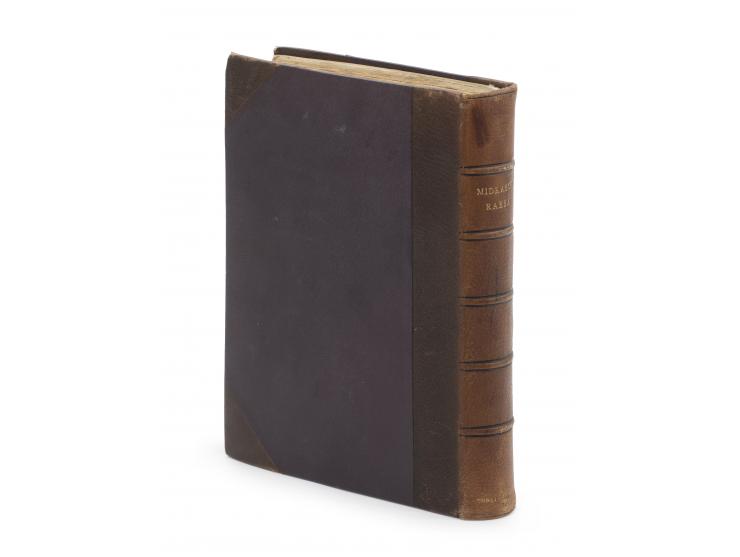
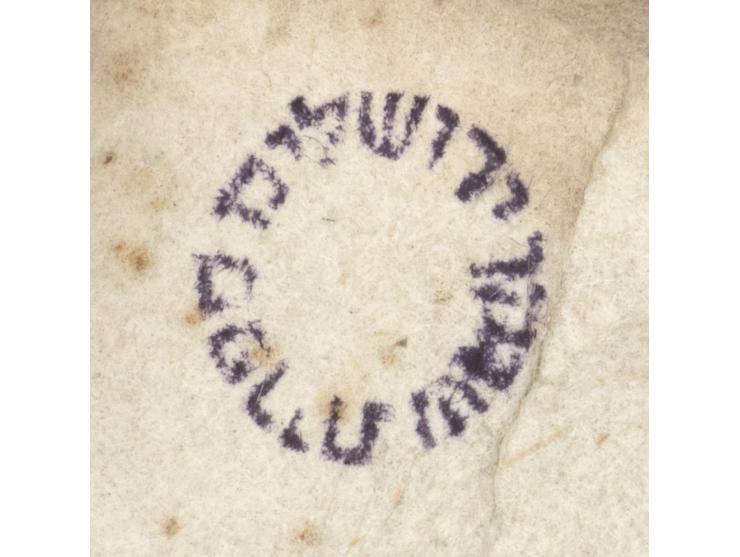
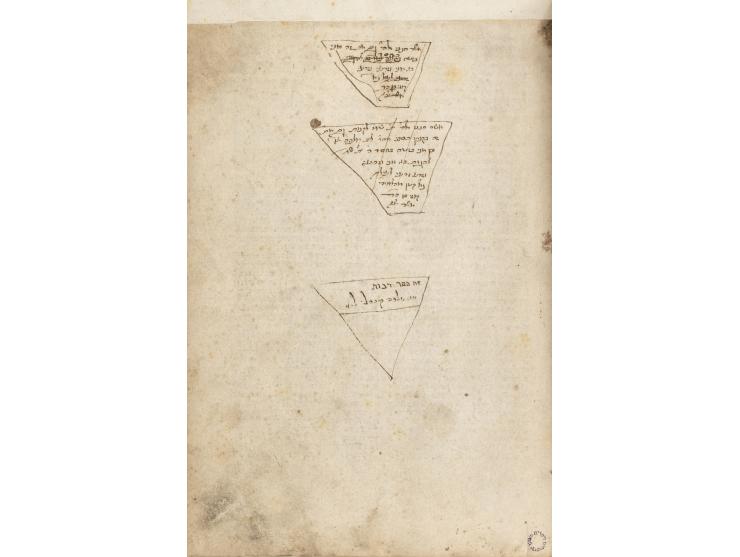
Auction 106 Incunabula and First Editions | Illuminated Manuscripts | Jewish Ceremonial Art
Feb 24, 2026
Opening: $30,000
Sold for: $212,500
Including buyer's premium
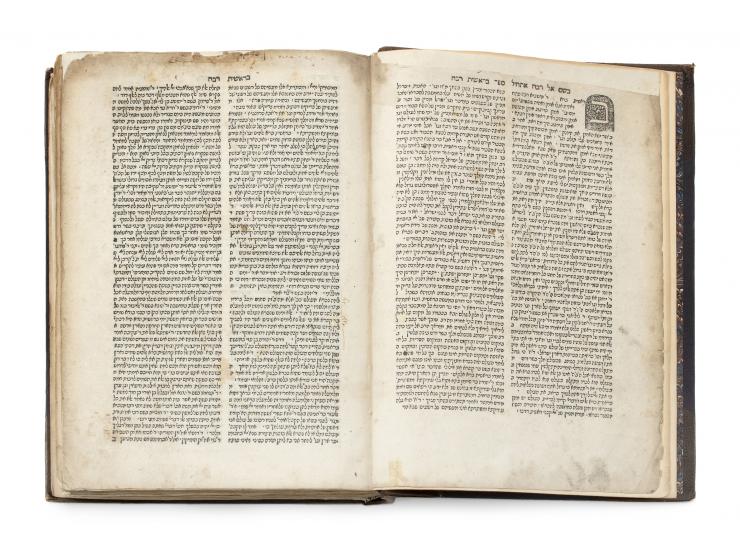
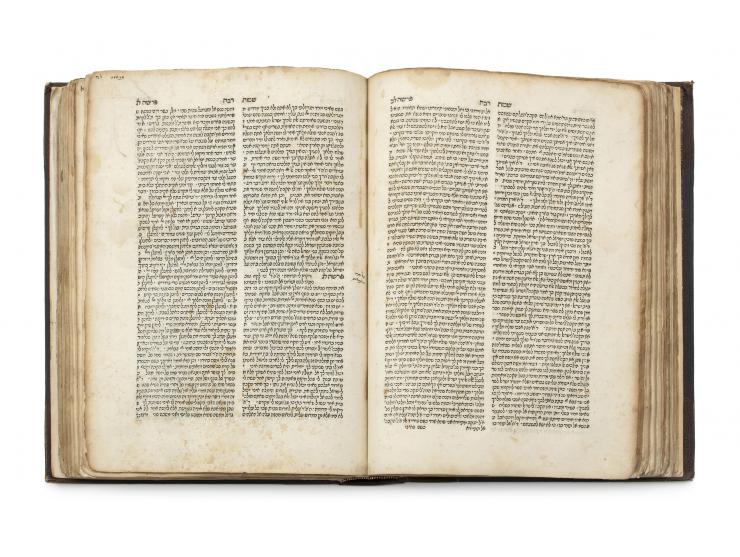
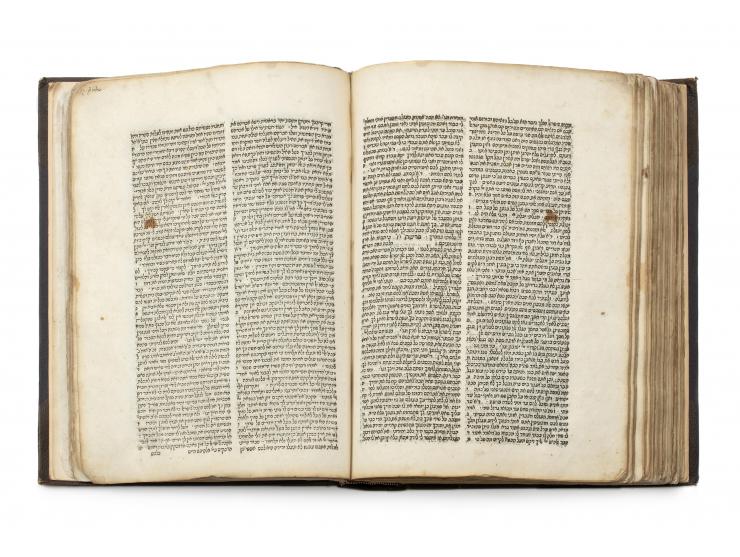
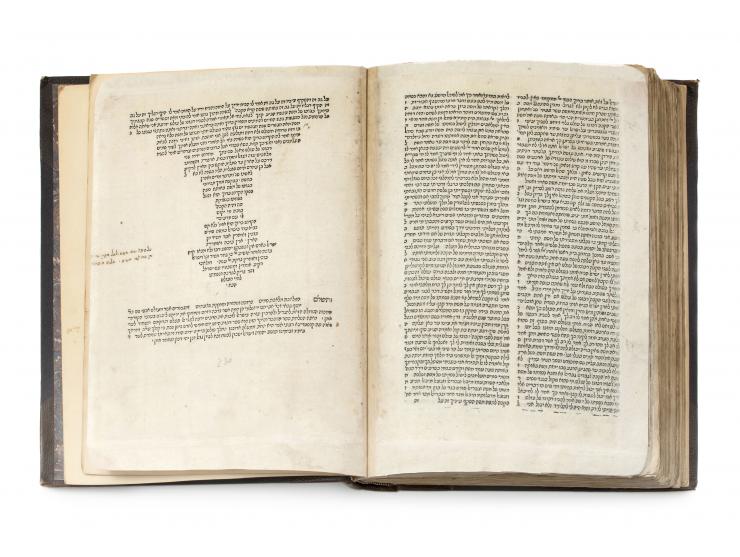
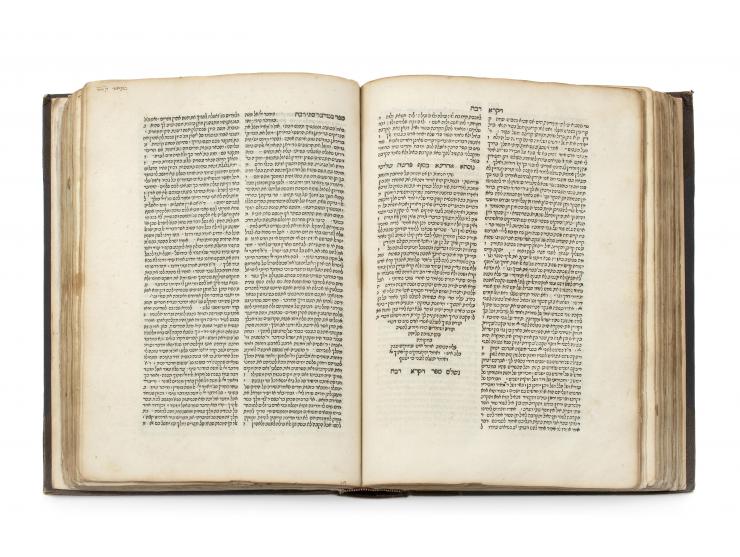
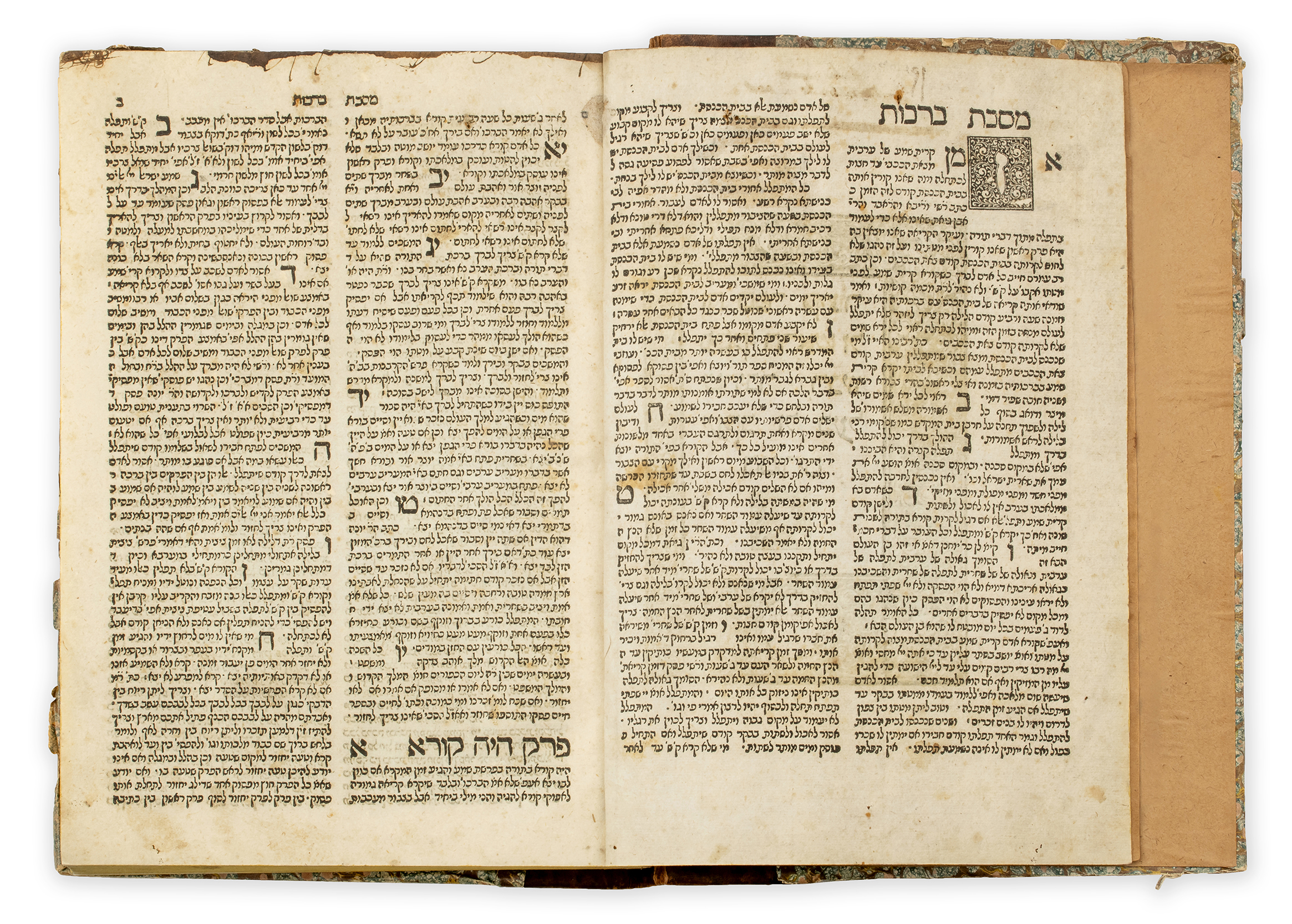
Midrash Rabbah, on the Five Books of the Torah. Constantinople: [Shmuel ibn Nachmias], 1512. First edition. All five parts, on the Five Books of the Torah, in one volume.
Printed without title page (first page blank). Printed in two columns, in Rashi type. Fine woodcut initial panel. First three parts printed with page headers: "Bereshit Rabbah", "Shemot Rabbah" and "Vayikra Rabbah"; last two parts on Bamidbar and Devarim printed without page headers.
Complete copy, with fine margins, of the especially rare first edition of the Midrash Rabbah on the Torah (also called Midrash Rabbot), regarded as the most important Midrash on the Torah.
Midrash Rabbah refers to an anthology of ten Aggadic Midrashim, on the Torah and the Five Megillot, consolidated over a period of hundreds of years. Its earliest parts are most of Bereshit Rabbah as well as Vayikra Rabbah (ca. 5th-7th centuries); its later parts are Shemot Rabbah, Bamidbar Rabbah, Devarim Rabbah and Esther Rabbah, some of which were probably compiled in their present forms no earlier than the year 1000.
Midrash Rabbah on the Five Megillot is not included in the present edition (it was first printed as a separate book in Pesaro, 1519; the two parts, on the Torah and Five Megillot, were first printed together in Venice, 1545).
Colophon on last leaf (text on upper part of page in special typographic design): "The work was completed… R. Yosef Gabbai and R. Avraham Yerushalmi… whose spirit moved them… to aggrandize and spread Torah among the Jewish people… This distinguished and precious book, the Rabbot, was completed today, 5th Nisan [1512], here in Constantinople…".
Inscriptions in early Ashkenazic script on blank first page: "G-d granted me this as well, and I trust in His kindness [---] [to study] it, I, my offspring and my offspring's offspring forever. So says Cusi son of R. Asher"; "G-d, blessed be His name, granted me to purchase this as well from R. Leib Kulpa, and so do I trust in G-d's kindness to study it, I, my offspring and my offspring's offspring forever. So says the least of the students, Cusi son of R. Asher". The signature appears to be that of R. Meshulam Cusi son of R. Asher, a Torah scholar of Italy and a member of the Beit Din of R. Meir Katzenellenbogen – Maharam Padua, who signed along with him on halachic rulings (see: Responsa Matanot BaAdam 77, 84; his signatures there, from 1545 and 1549: "The least of the students, Cusi son of R. Asher of Montagnana", or "So says the occupied one, least of the students, Meshulam Cusi son of R. Asher of Montagnana"; see further in preface to Responsa Matanot BaAdam, p. 24, note 67).
Another inscription on this leaf, in Italian script: "This is the Book of Rabbot. I, Shlomo Consalli".
Inscription on last leaf (trimmed): "I place my name upon my book that I not be among [---], and this is my name which I place, Shalom son of R. [---]".
Names of Torah portions handwritten in upper left margins of most leaves, and sometimes in other places, in accordance with page's content, as well as a continuous foliation of the book in Hebrew numerals.
A few glosses and various notations in margins of several leaves.
On endpaper, pencil inscriptions by Salman Schocken. At bottom of blank first page, stamp: "Schocken Library, Jerusalem".
Five parts in one volume. [68]; [44]; [34]; [68]; [16] leaves. Last four leaves supplied from another copy. Approx. 29 cm. Fine margins. Good-fair condition; last leaves in fair condition. Stains, including dampstains and traces of former dampness. Wear. Marginal tears and open tears to some leaves in various places, affecting text of several leaves (without loss), partially repaired with paper and tape strips (mainly to last leaves, sometimes bordering text). Slight worming, partially repaired with paper filling. Binding with leather spine and corners. Minor defects to binding.
Provenance:
• Schocken Collection, Jerusalem.
• Sotheby's, London, December 1993, Lot 114.
• Kestenbaum, New York, June 2003, Lot 28.
Catalogue Value
Auction 106 Incunabula and First Editions | Illuminated Manuscripts | Jewish Ceremonial Art
Feb 24, 2026
Opening: $18,000
Sold for: $62,500
Including buyer's premium
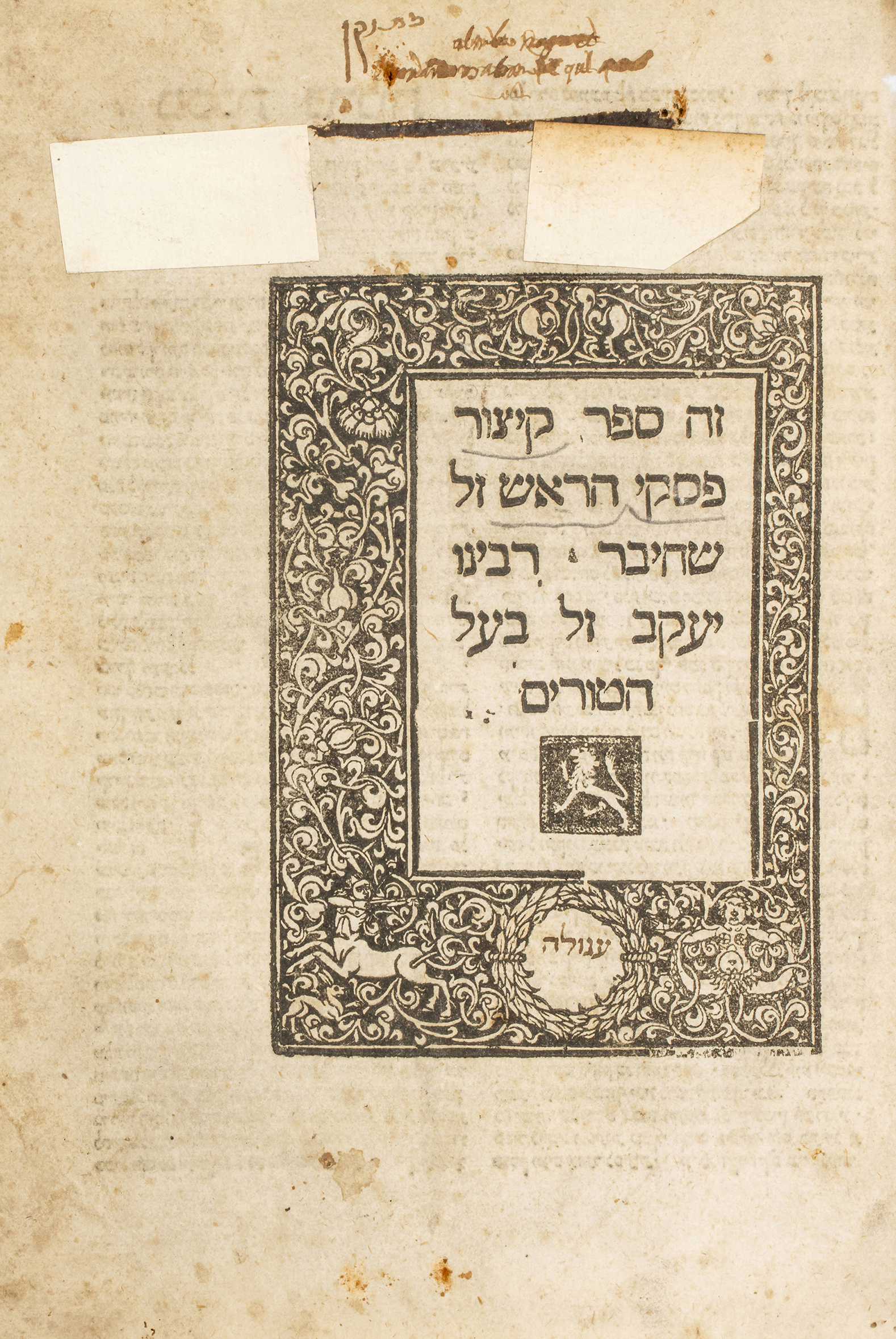
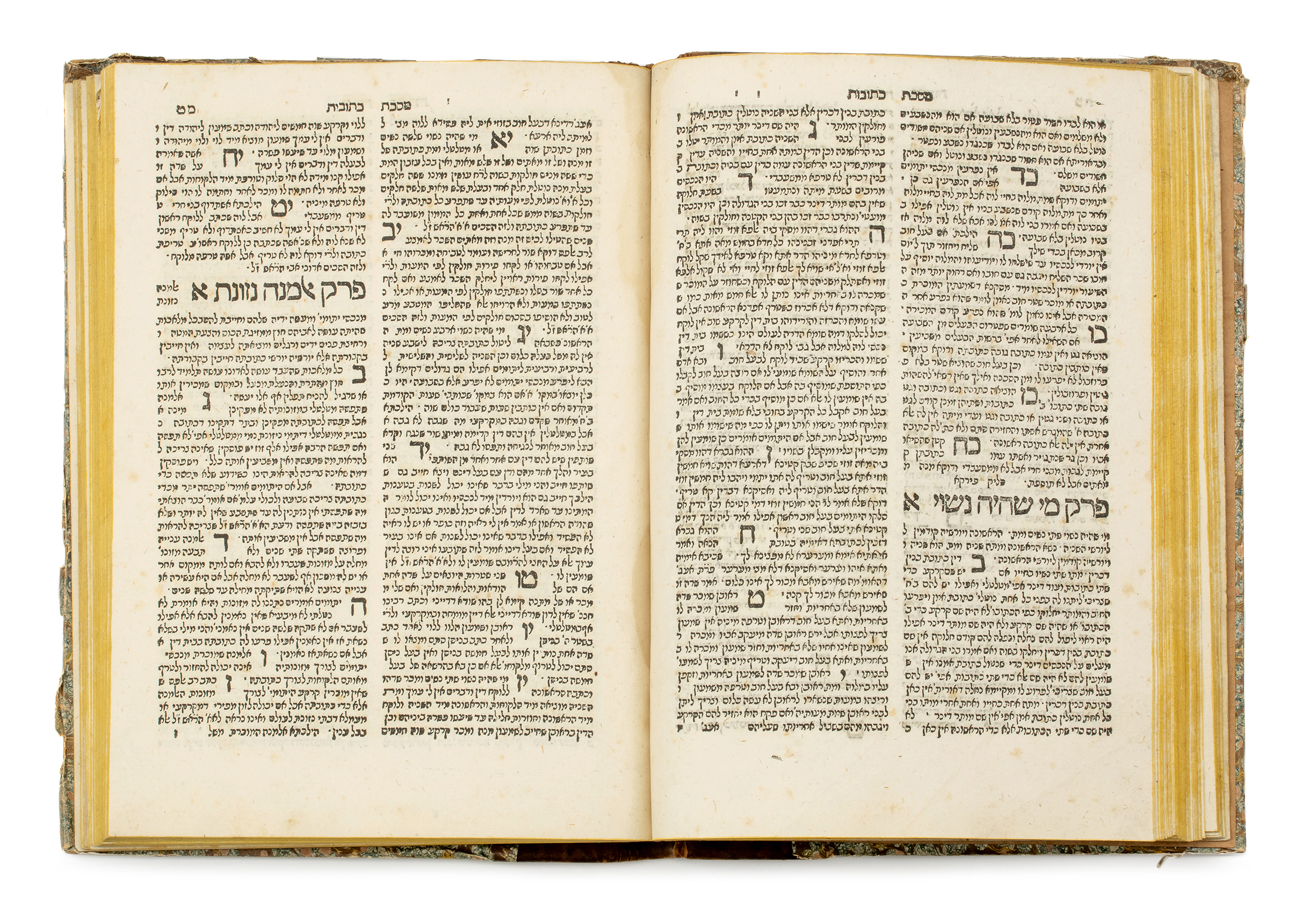
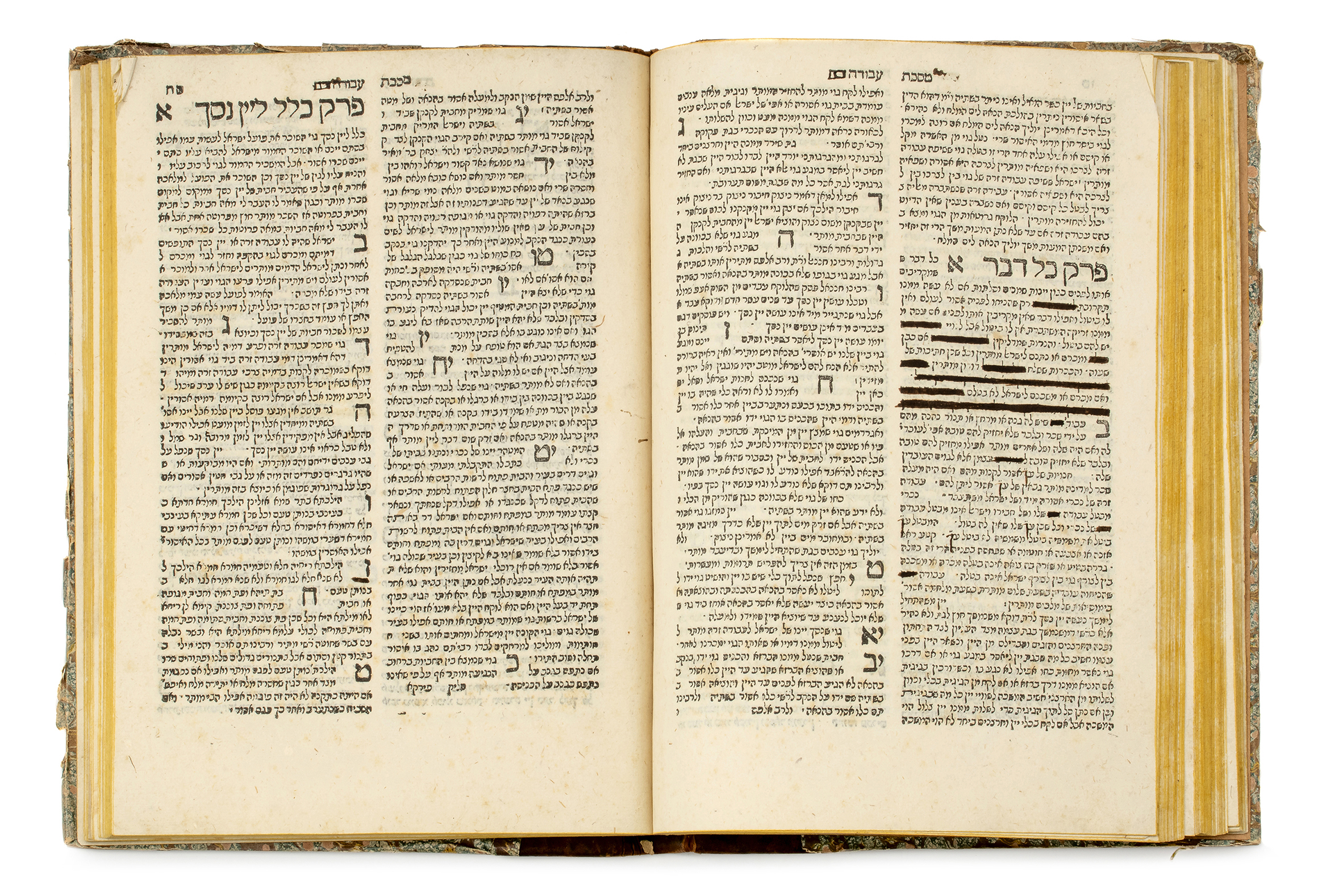
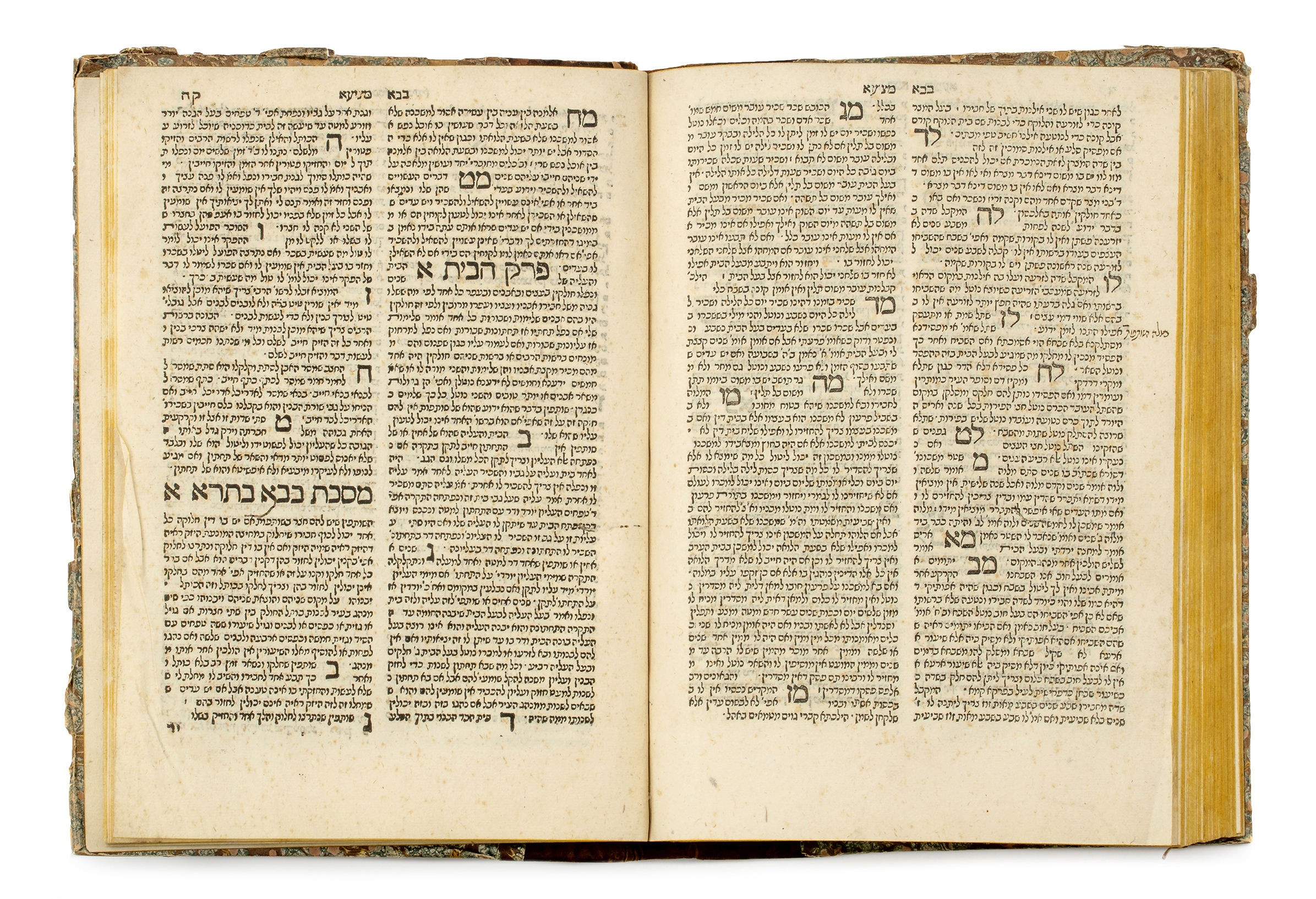
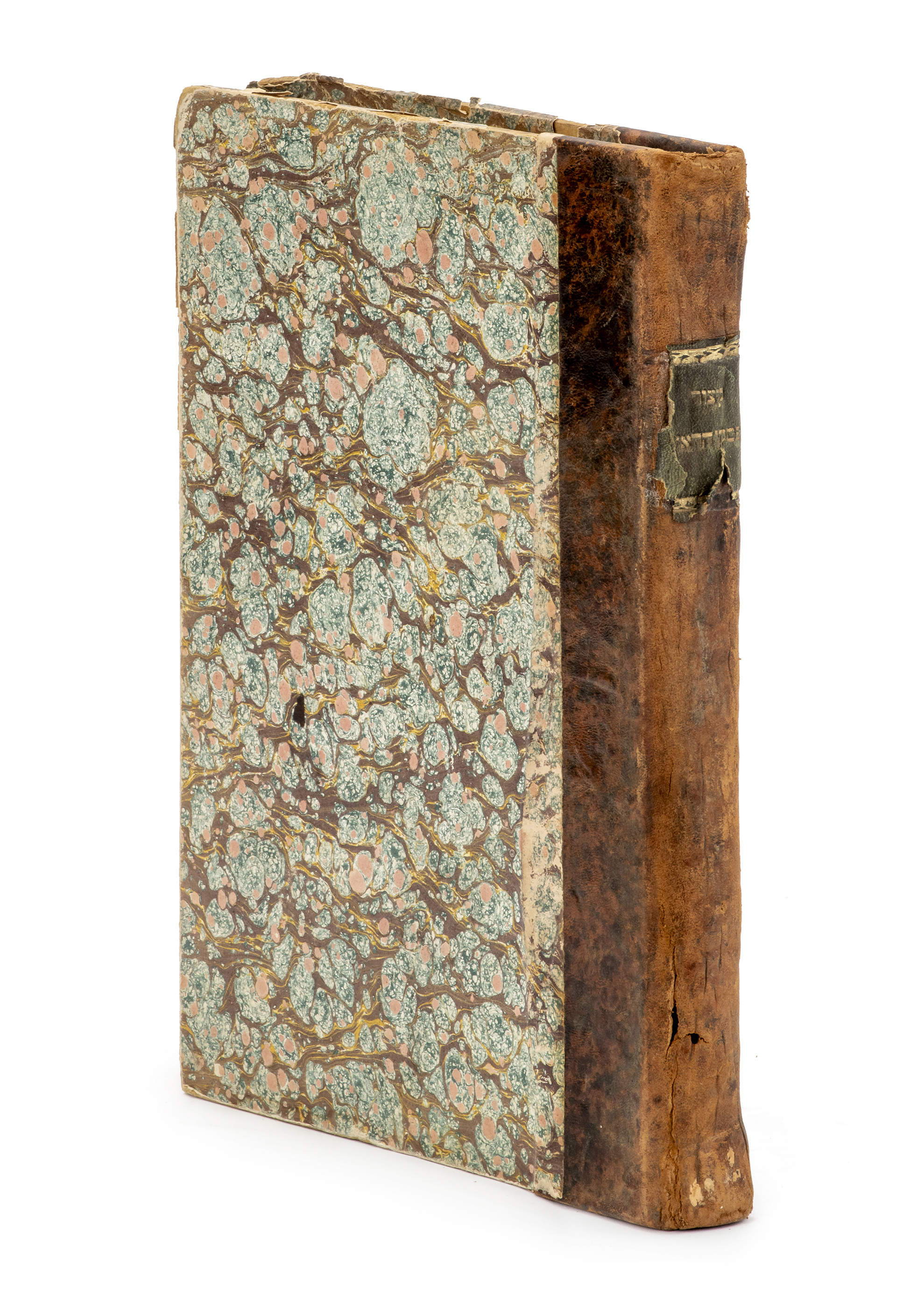
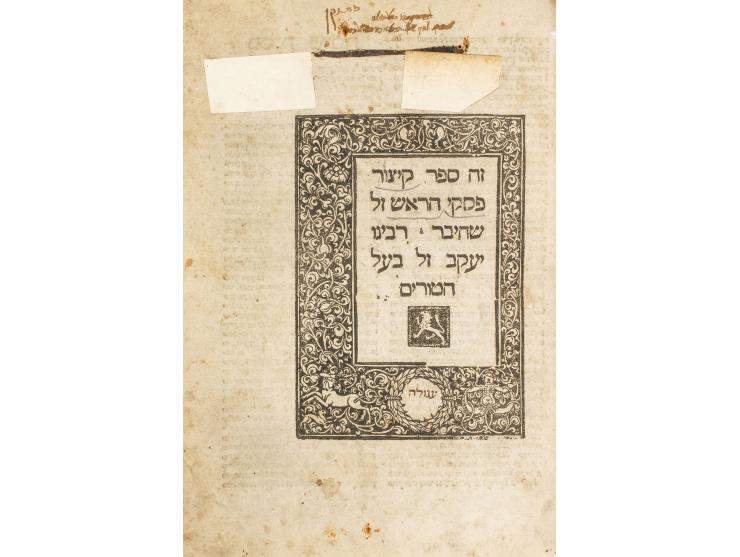
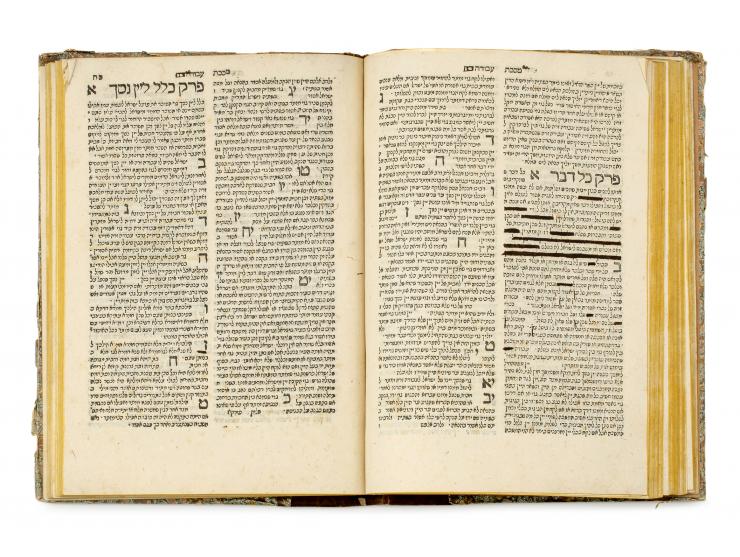
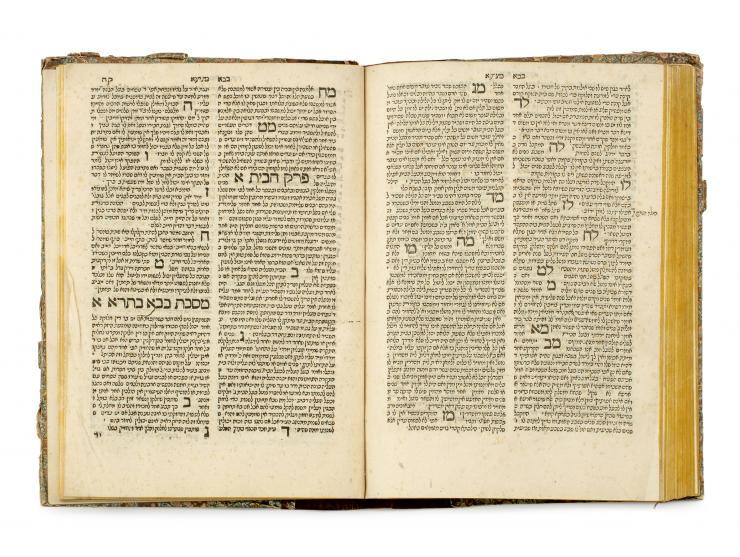
Kitzur Piskei HaRosh, authored by R. Yaakov, author of the Tur. Constantinople: Yehudah son of Yosef Sason and Shmuel son of David ibn Nachmias, 1515. First edition.
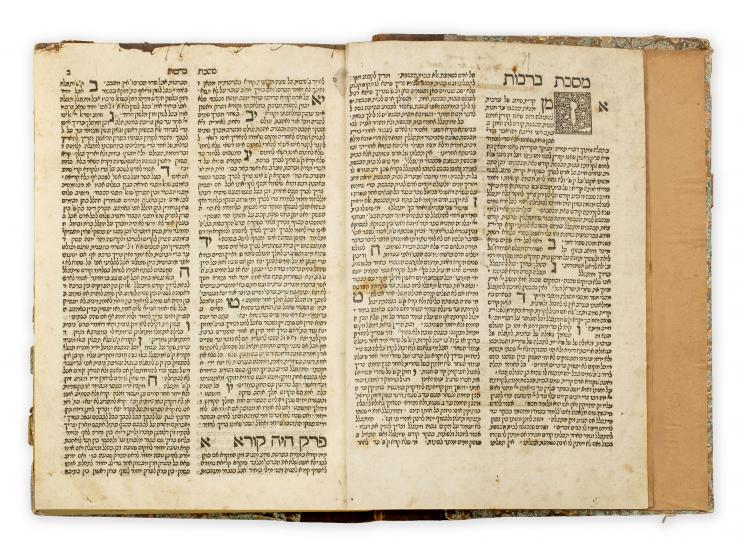
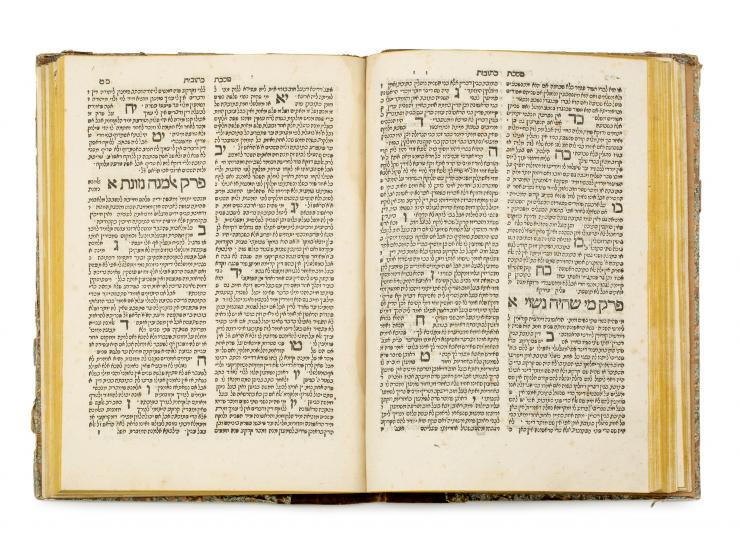
Rare first edition of Kitzur Piskei HaRosh – an abridgment of the halachic rulings of R. Asher son of Yechiel (the Rosh, 1250-1327), one of the three authorities (alongside the Rif and Rambam) who formed the basis for the halachic rulings of R. Yosef Karo in his Shulchan Aruch. The original Piskei HaRosh follow the order of the Babylonian Talmud; this abridgment of those rulings, Kitzur Piskei HaRosh, was written by the Rosh's son, R. Yaakov, author of the Tur, and they were printed in later editions together with the Piskei HaRosh, in the back matter of Talmud editions.
Title page with fine decorated woodcut frame, displaying figures of animals and vegetal patterns.
Colophon on last leaf: "The labor was completed… and typeset by the professional typesetters… R. Yehudah son of R. Yosef Sason and R. Shmuel son of R. David ibn Nachmias… and it was completed on Wednesday, 6th Adar [1515], in Constantinople…".
On title page, printer's device of Yehudah Sason – a rampant lion in white against a black background, within a square frame (see: Yaari, Diglei HaMadpisim HaIvriyim, Jerusalem, 1944, pp. 7, 126, no. 8).
Censorship expurgations to several leaves (one leaf with several lines deleted).
On title page, the word "corrected" appears (possibly referring to the censorship). Additional inscriptions on title page and p. 2a, deleted with ink.
On p. 104b, short gloss in Sephardic script.
On last page – signatures of censors: Giovanni Domenico Vistorini, dated 1609; Domenico Jerosolimitano (dated 1595?); Alessandro Scipione (last two signatures partly trimmed).
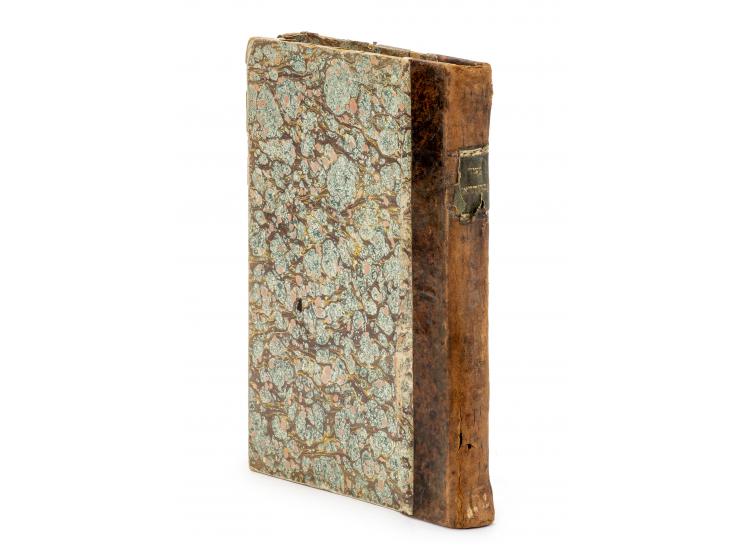
116 leaves. 26.5 cm. Good-fair condition. Stains, including somewhat dark dampstains to margins of some leaves. Worming, affecting text (significant worming affecting text in one place, to approx. eight leaves). Open tears to inner margins of several leaves, not affecting text. Paper repairs to upper part of title page and margins of several leaves. Old binding with leather spine, somewhat loose. Wear and defects to binding.
Catalogue Value
Auction 106 Incunabula and First Editions | Illuminated Manuscripts | Jewish Ceremonial Art
Feb 24, 2026
Opening: $15,000
Sold for: $57,500
Including buyer's premium
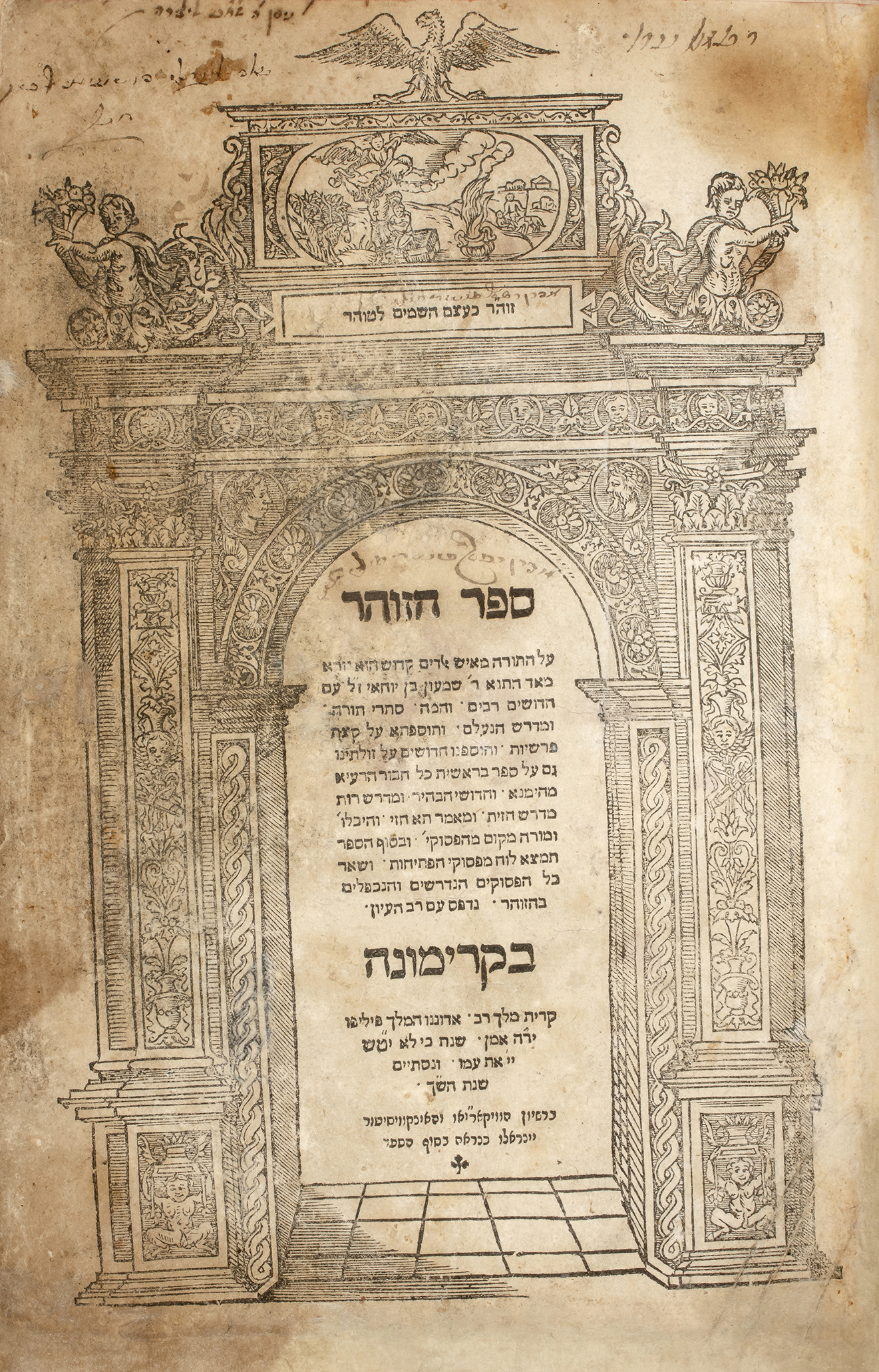
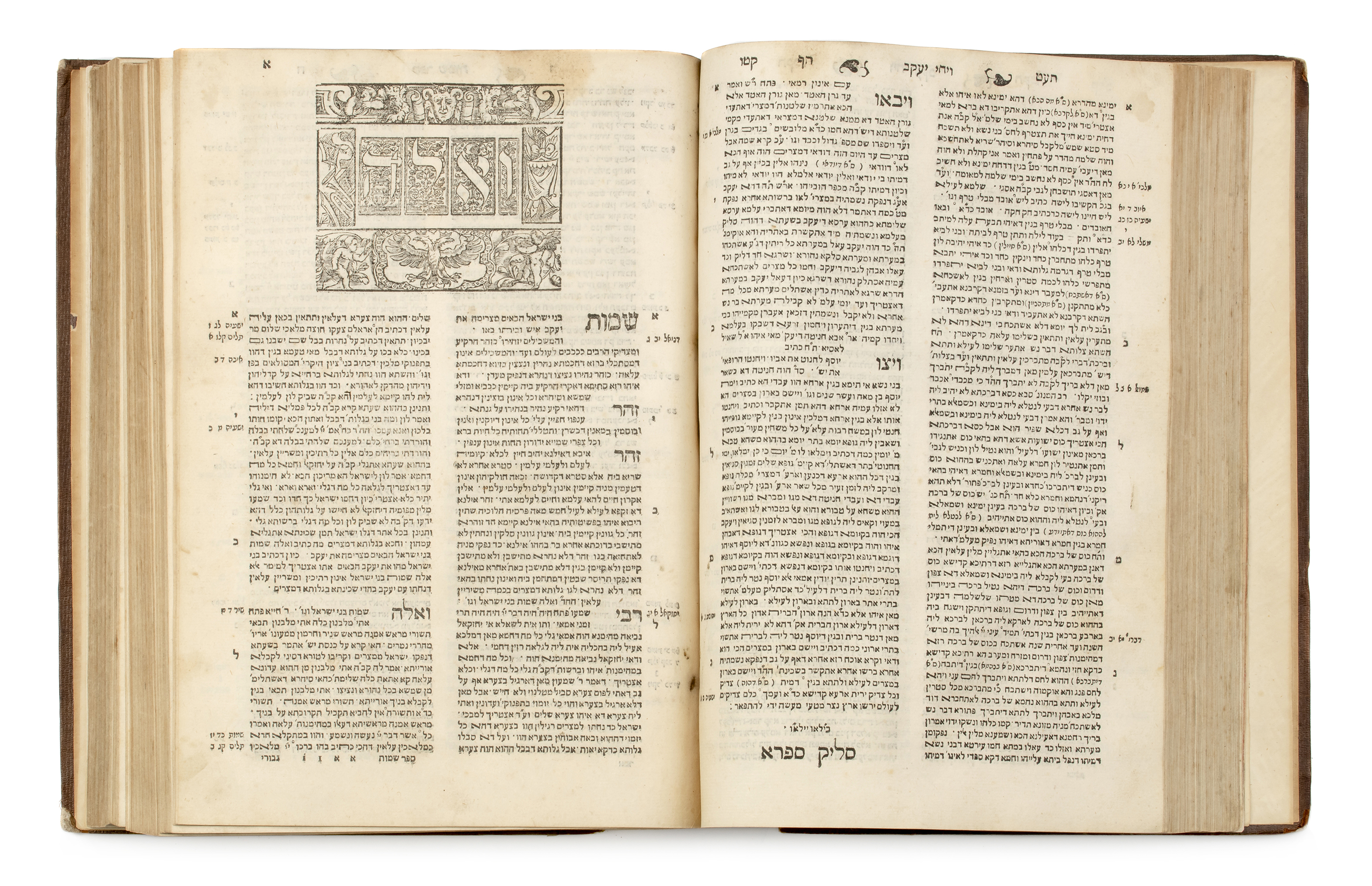
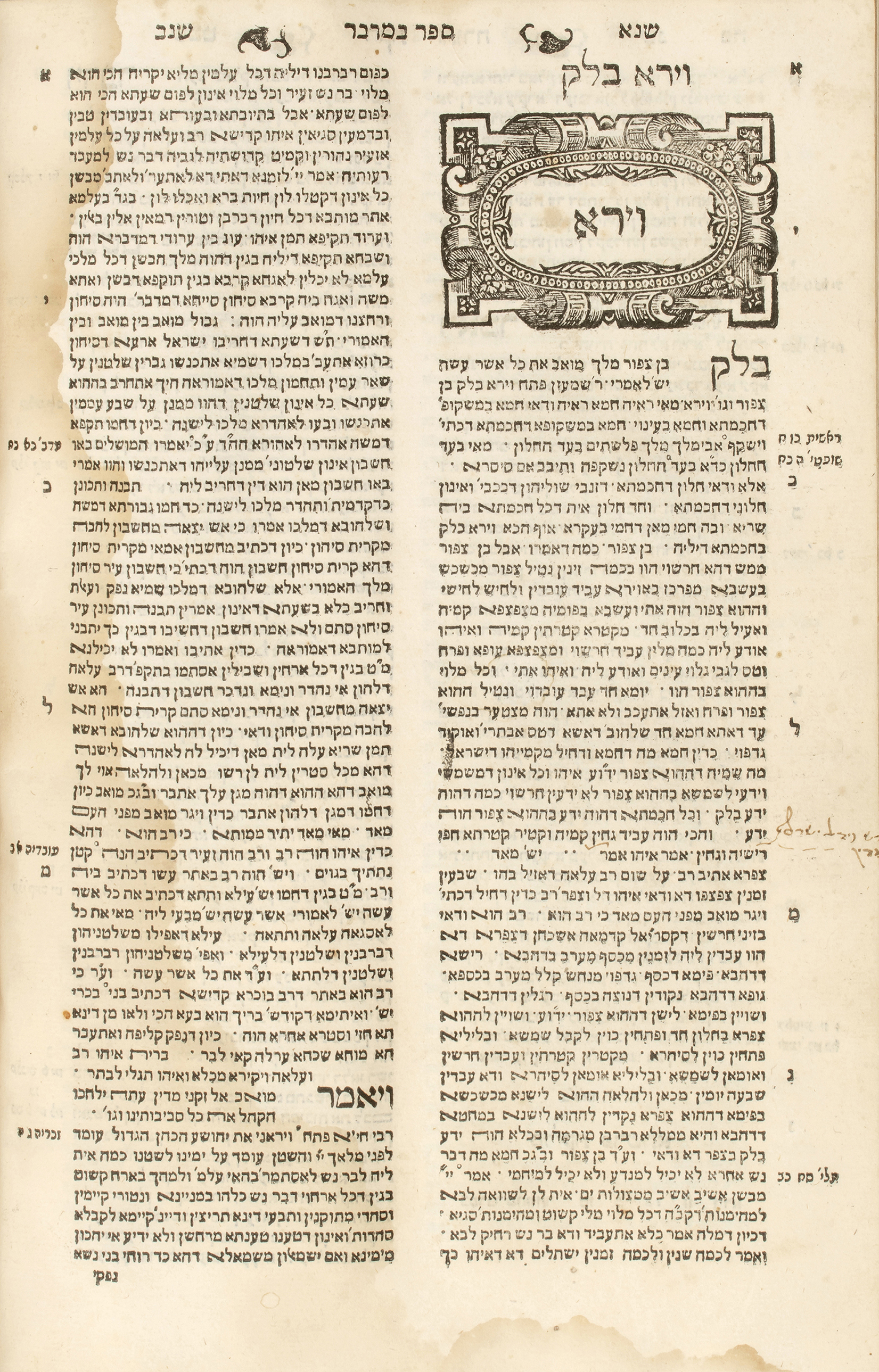
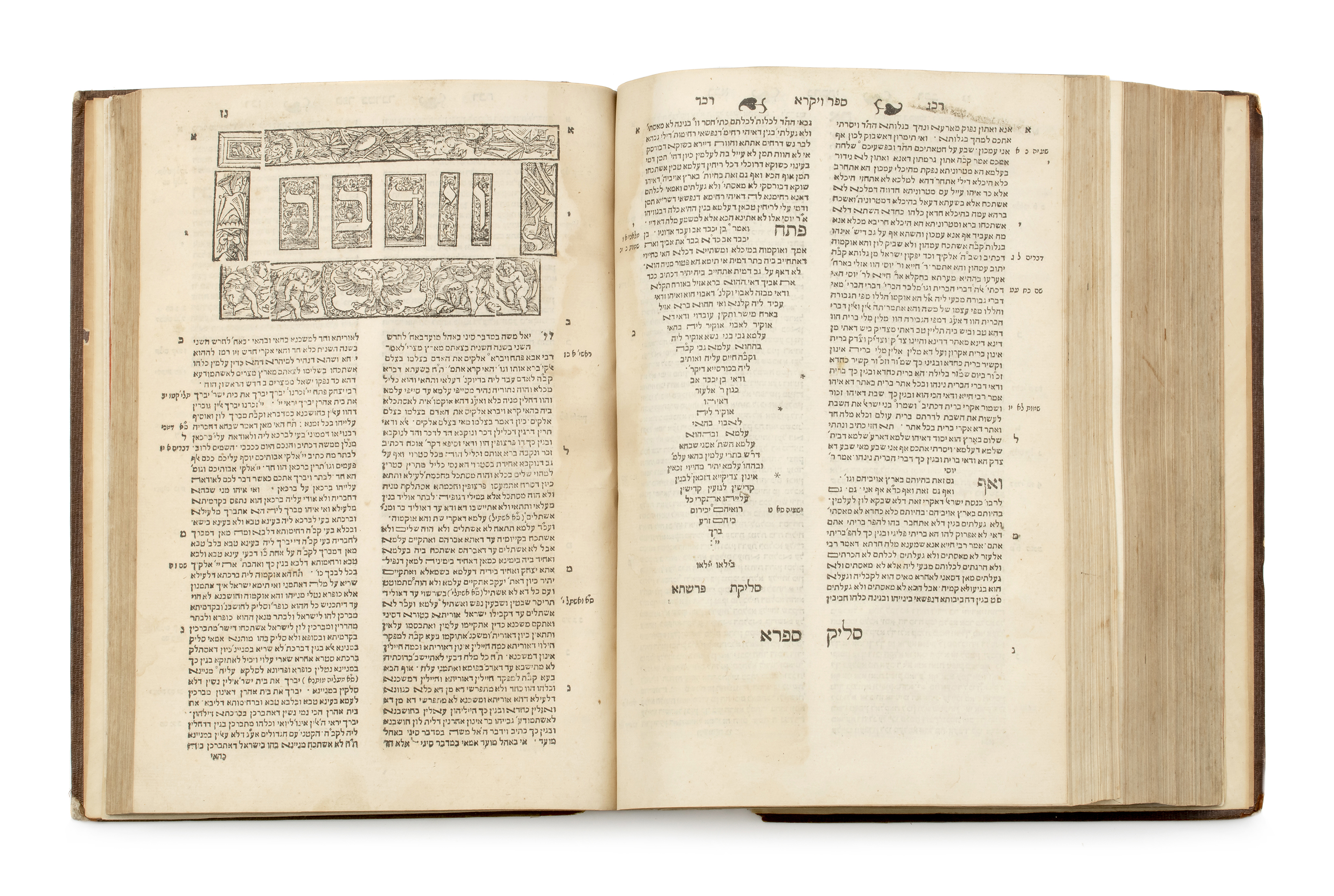
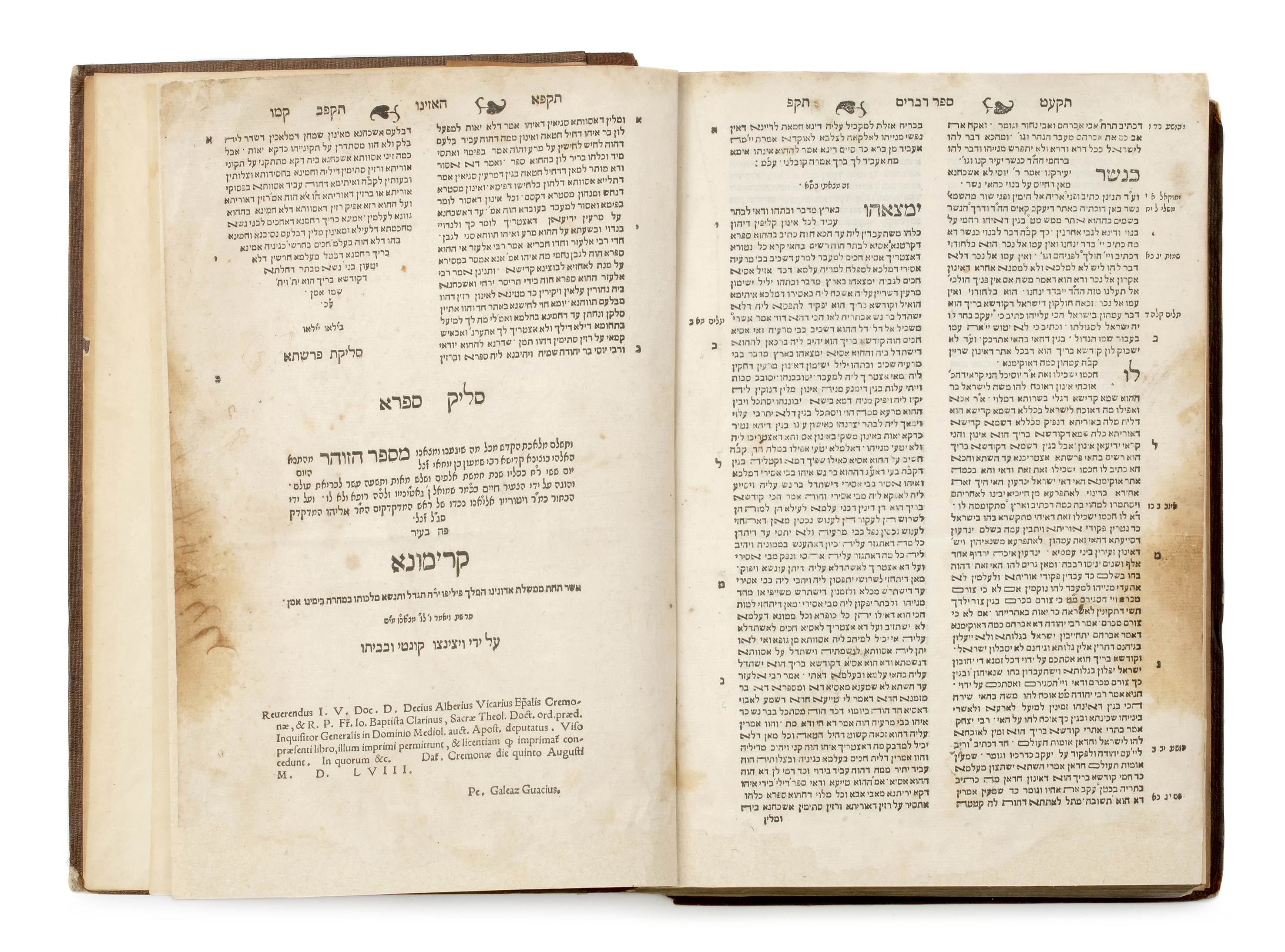
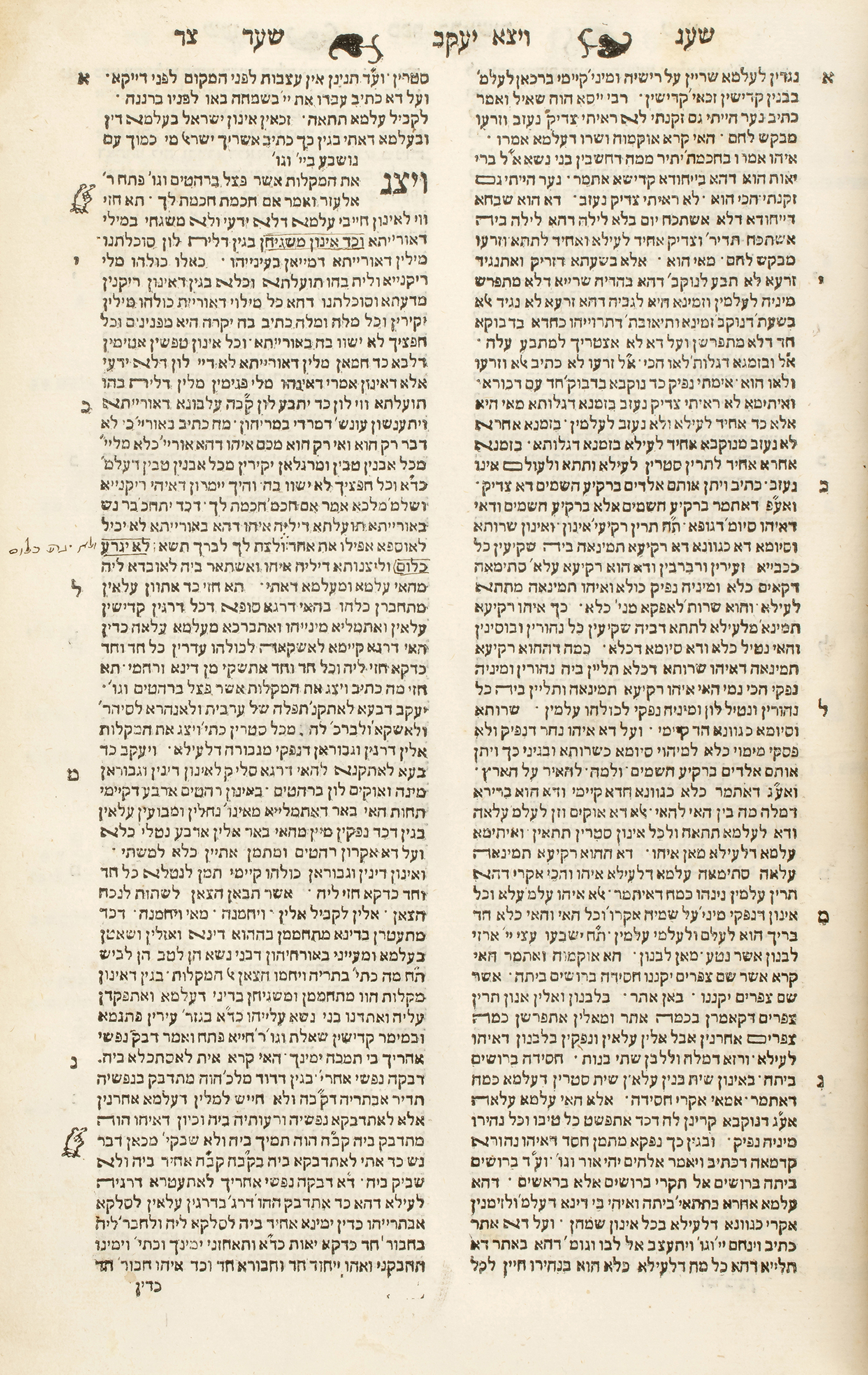
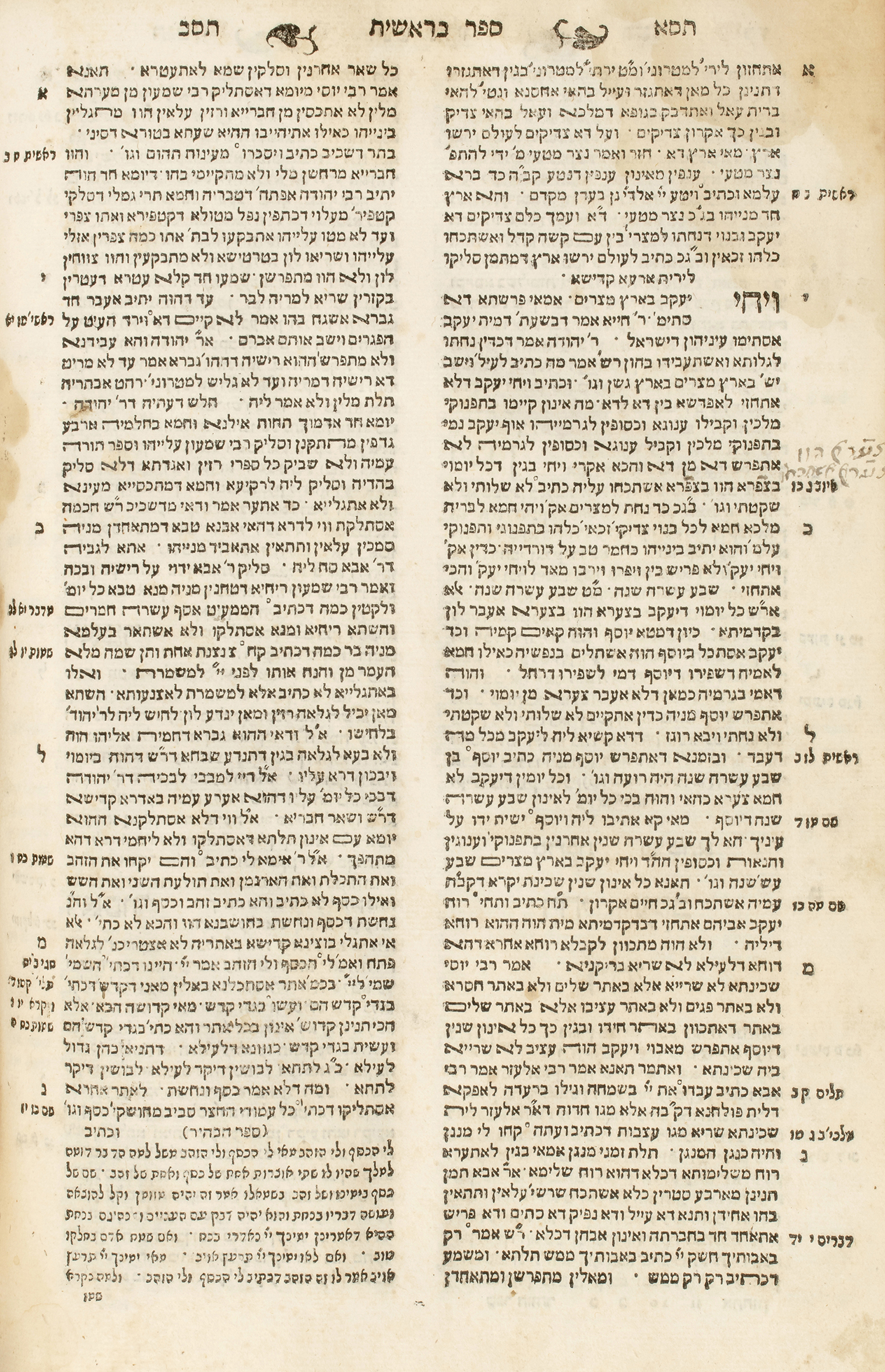
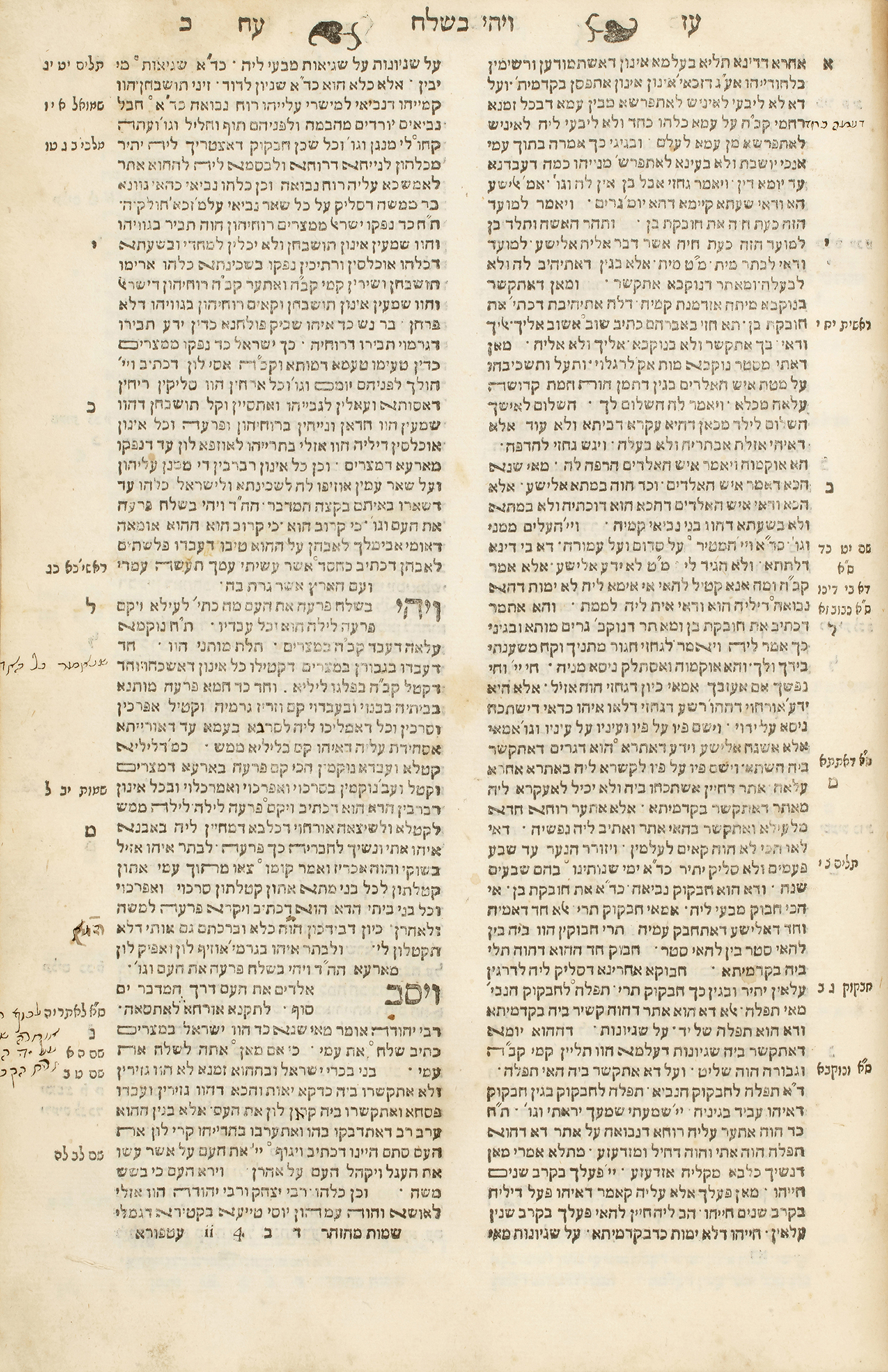
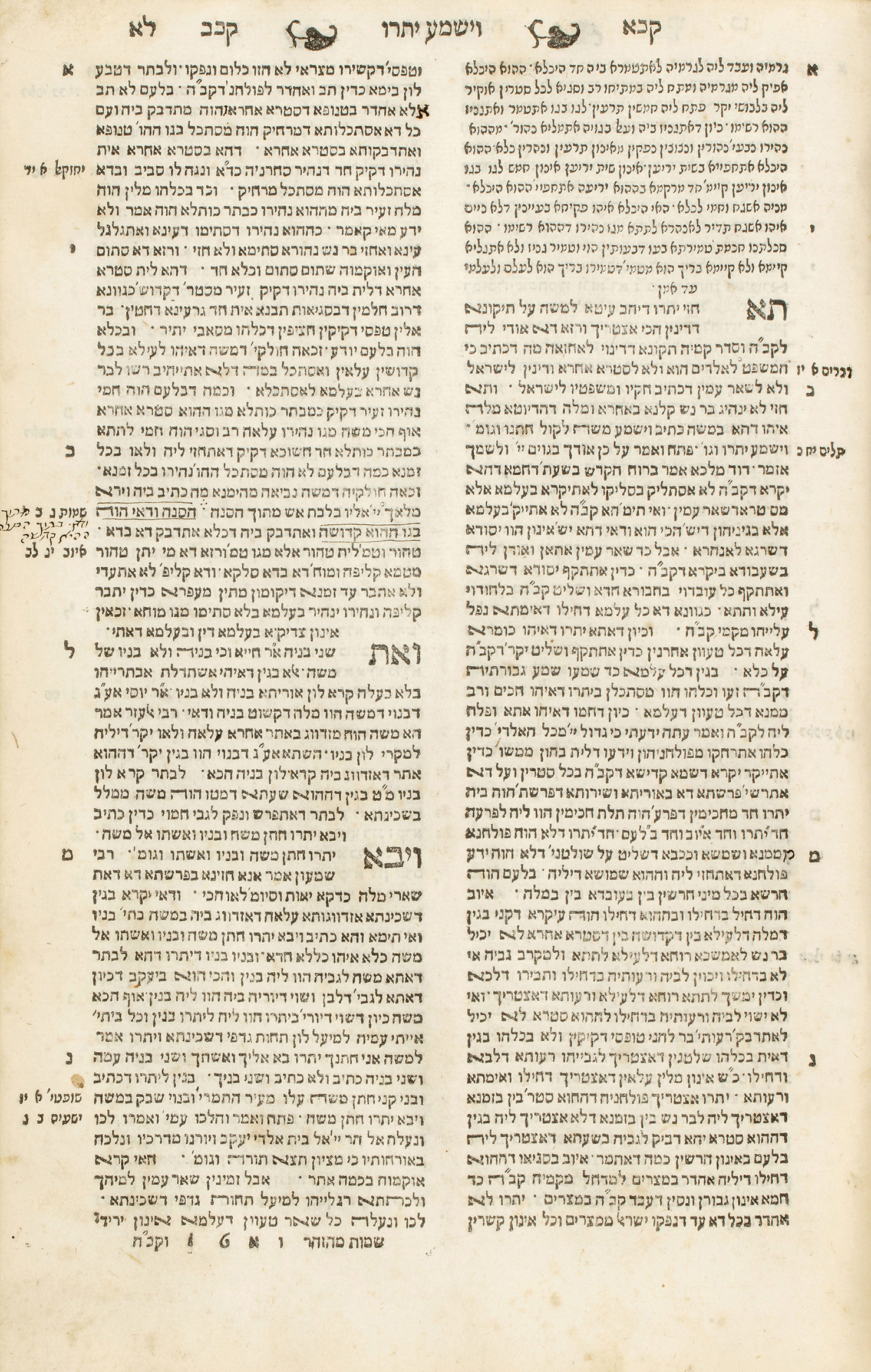
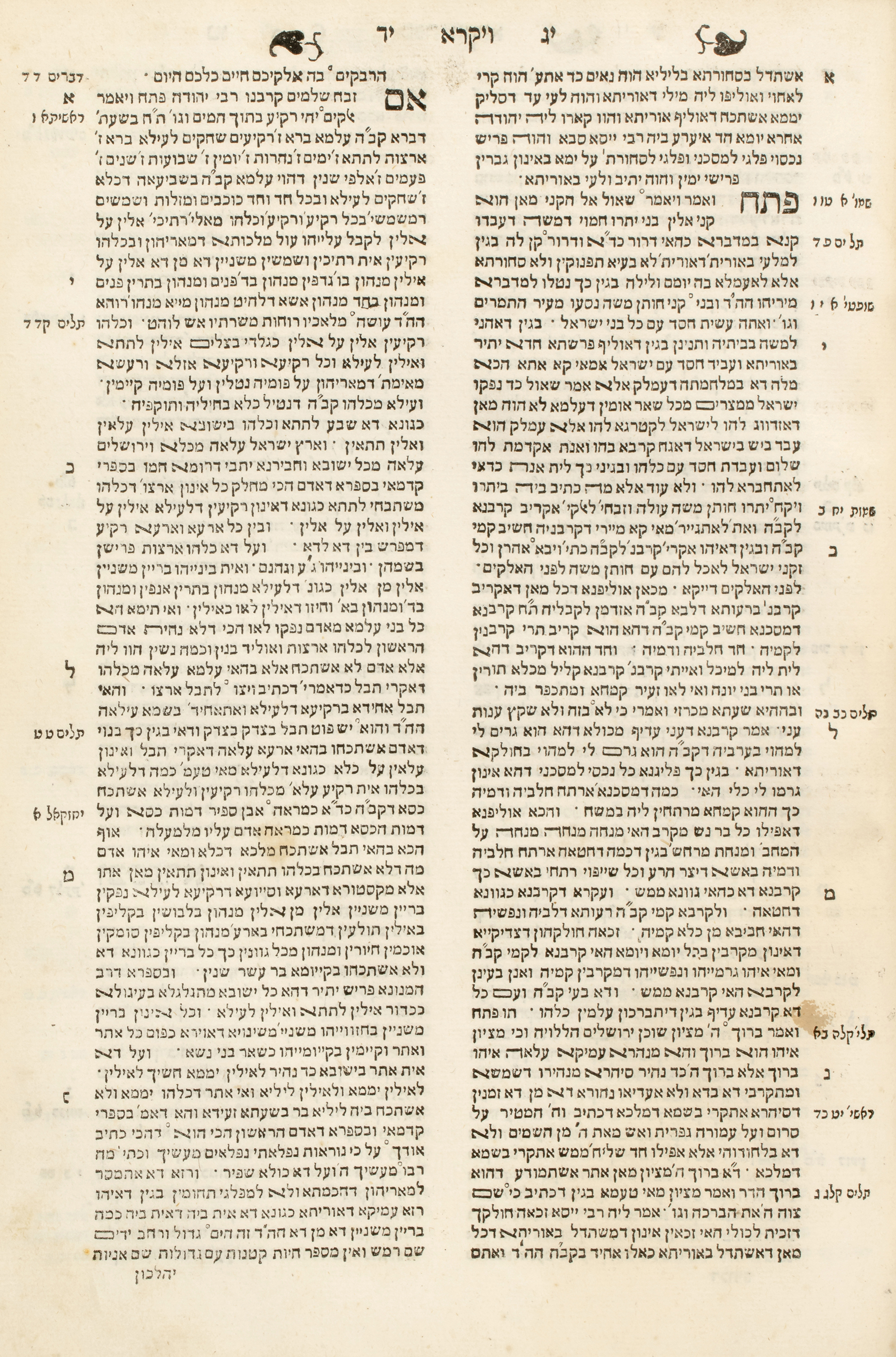
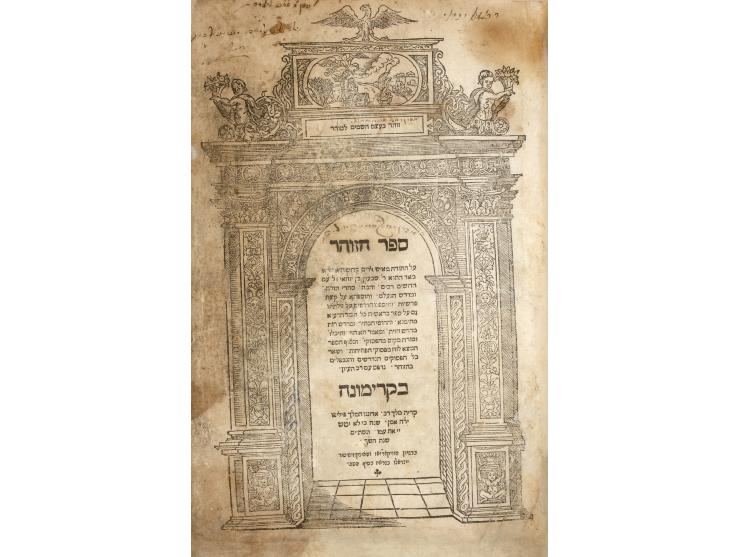
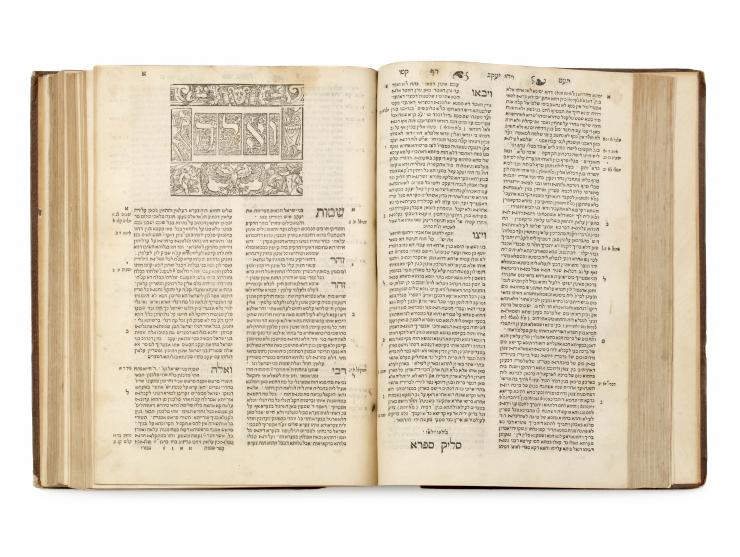
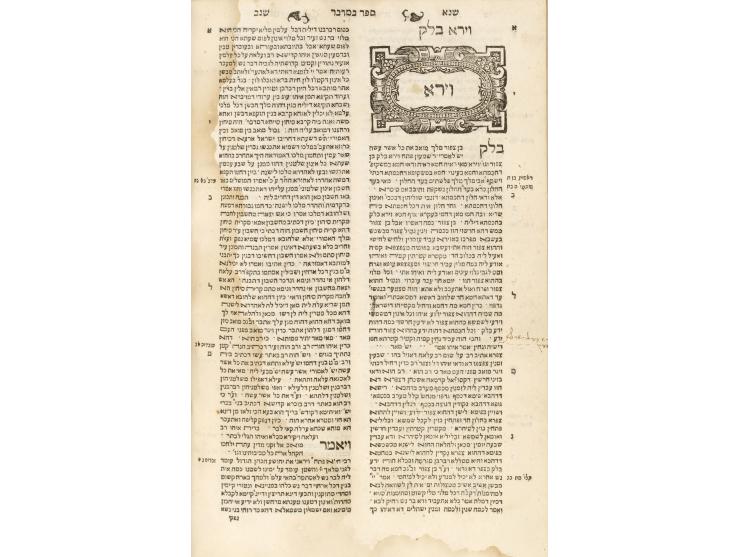
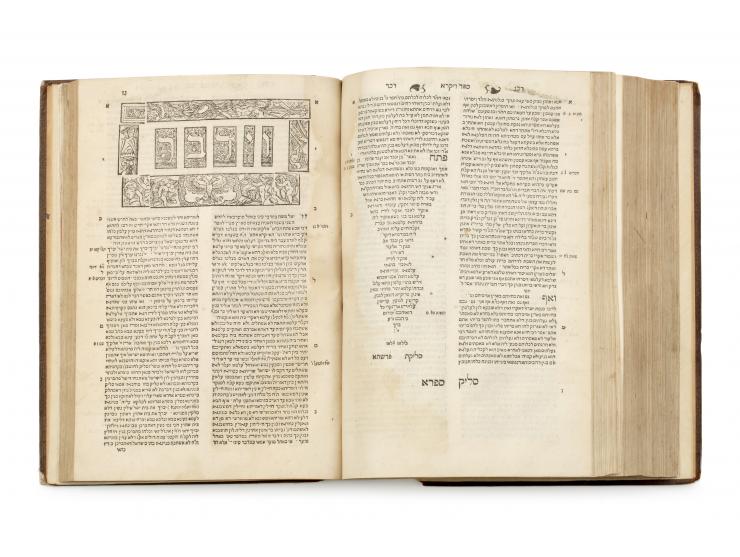
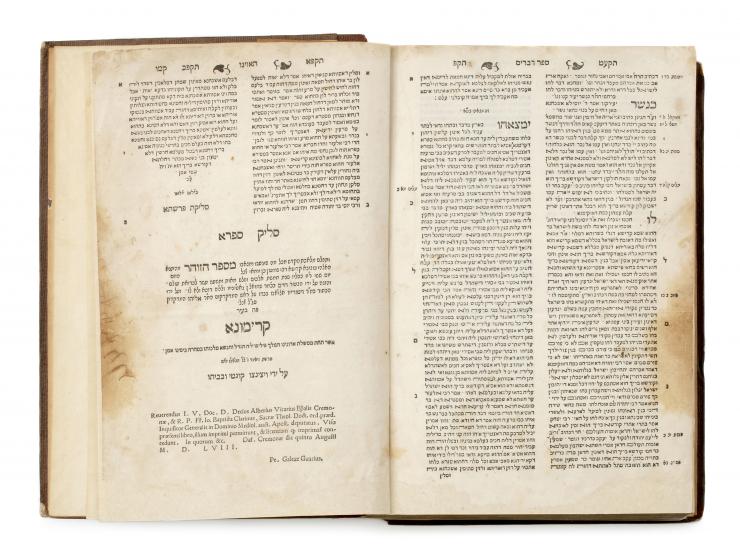
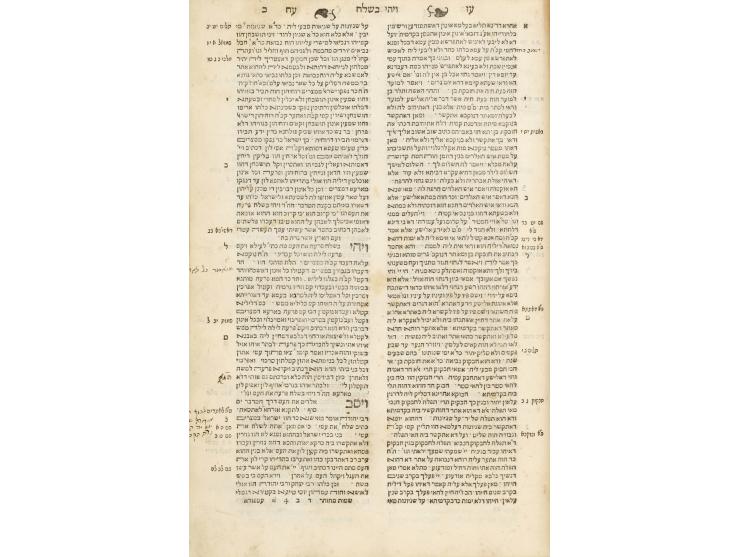
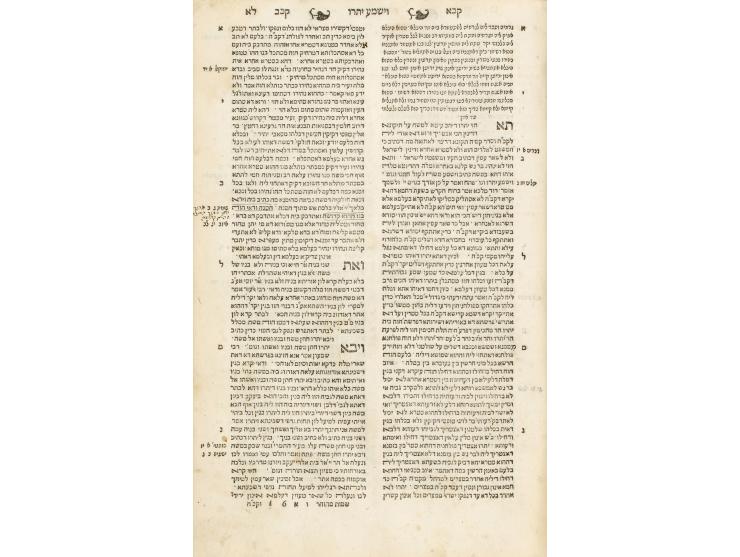
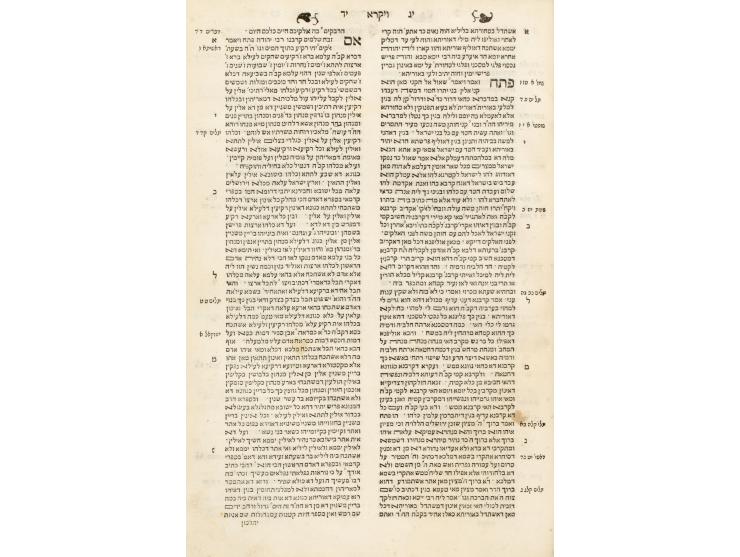
Zohar, attributed to R. Shimon bar Yochai, all three parts, on Bereshit, Shemot and Vayikra-Devarim. Cremona: Vincenzo Conti, 1559-1560. First edition of the Zohar, printed simultaneously with the Mantua edition.
Despite the imprint for 1559-1560 on the title page, the printing of the present edition actually began in 1558, the same year that printing of the Mantua edition of the Zohar commenced (M. Benayahu claims that the present edition even preceded the Mantua printing).
The present edition, with the entire Zohar printed in one volume and in large format (in square type), became known as the "large Zohar", while the small-format Mantua edition printed in three volumes (in Rashi type) was known as the "small Zohar".
Many copies of the present edition reached Ashkenazic lands – Poland and Germany (it may be that the printers had never intended to distribute copies of this edition in Italy). As evidence of this, until the mid-18th century (and later) many authors from Ashkenazic lands cite the text of the Cremona edition (see further Y. Yudlov's article, below). The subsequent Lublin 1622 and Sulzbach 1684 editions follow the format of the Cremona edition.
Over the years, the Cremona edition became especially rare, in contrast to the Mantua edition which was relatively more common. Benayahu writes that many copies of the Zohar were destroyed in the Cremona burning of Hebrew books (HaDefus HaIvri BiCremona, p. 137). This edition was rare even in the very next generation, as R. Moshe Zacuto writes in one of his letters: "Only a small minority possess the large [Cremona] edition…" (Igrot HaRemez, Livorno 1780, 2).
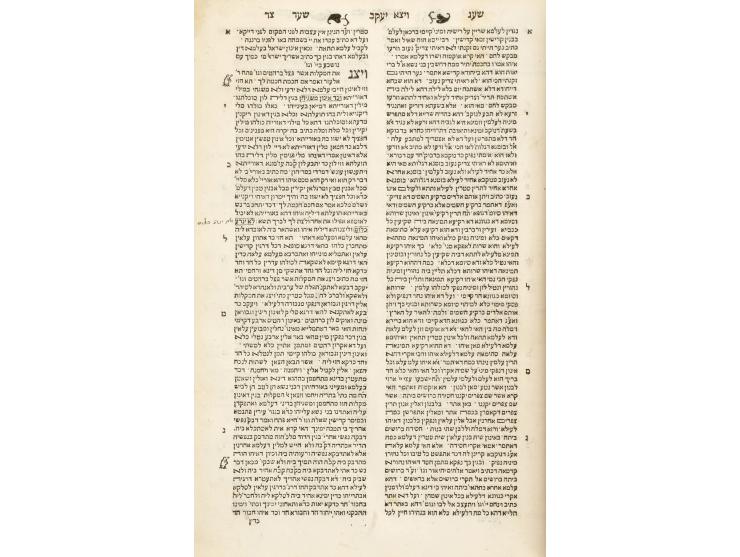
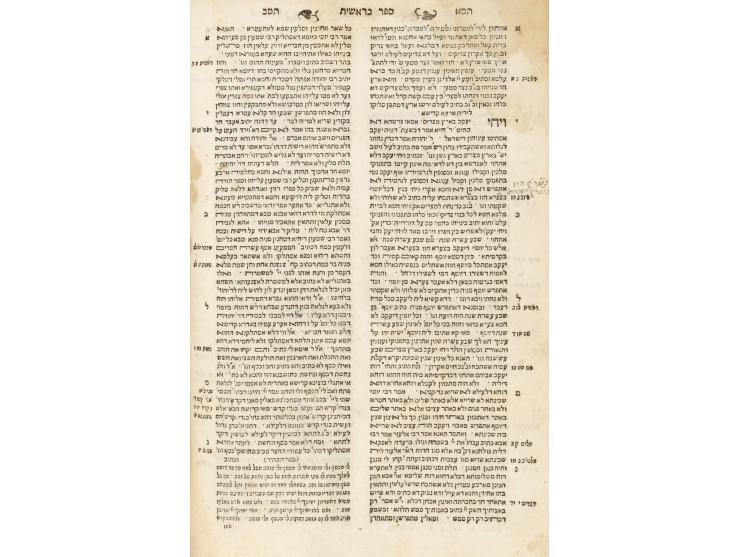
Biblical references are printed in the margins of the leaves (uniquely characteristic of the Cremona edition, unlike the Mantua edition). In addition to the foliation of leaves, the columns and lines are also numbered (every tenth line).
Variations have been identified between copies of the Cremona edition. In most known copies, the title page is dated 1559-1560, as in the present copy. These copies contain eight leaves (leaves 5-6 of Bereshit and leaves 113, 118-122 of Shemot) which according to Benayahu (see below) were printed in Mantua, and are typographically distinct from the other leaves. The Schocken Collection contains a copy with a different title page which does not mention the date of printing, and in which the abovementioned eight leaves were printed in Cremona and resemble the rest of the leaves of the book. The present copy contains the common version of the title page, and those eight leaves are identical to those printed in Mantua, as in the other copies.
Colophon on last leaf: "The holy work was completed… today, Friday… and was proofread by Chaim son of R. Shmuel ibn Gattegno… and R. Vittorio Eliano, grandson of the chief grammarian R. Eliyahu HaMedakdek Segal".
Under the colophon is printed a Latin approval of printing on the authority of the Milan Inquisition, dated August 1558.
Signatures and inscriptions to title page: "Aharon Refael Pontremoli"; "Refael Ami"; "Nisan 1582"; "This came to my portion, Hoshaiah of the family of [Baruch]…".
Inscriptions within text, handwritten corrections and short glosses in several places (by various writers; some glosses trimmed).
All parts in one volume. Bereshit: 132 leaves. Shemot: 122 leaves. Vayikra-Devarim: 146 leaves. 28 cm. Overall fair condition, some leaves in good-fair condition. Stains, including large dark dampstains (especially to first leaves, as well as in other places). Traces of former dampness with mold stains to first leaves. Tears, including marginal open tears to title page, first and last leaves, slightly affecting text, repaired with paper filling. Worming, partially repaired with paper filling. Old binding, with wear and defects (tears to spine and sides).
For a general description of the book and its printing, on the relation between the Cremona and Mantua editions, and different copies of the Cremona edition, see: Meir Benayahu, HaDefus HaIvri BiCremona, Jerusalem, 1971, pp. 121-137; Y. Yudlov, "On Books, Printers and Publishers", HaSefer – 70-year jubilee volume for Mosad Harav Kook, Jerusalem, 2008, pp. 556-559 (Hebrew).
Catalogue Value
Auction 106 Incunabula and First Editions | Illuminated Manuscripts | Jewish Ceremonial Art
Feb 24, 2026
Opening: $50,000
Sold for: $68,750
Including buyer's premium
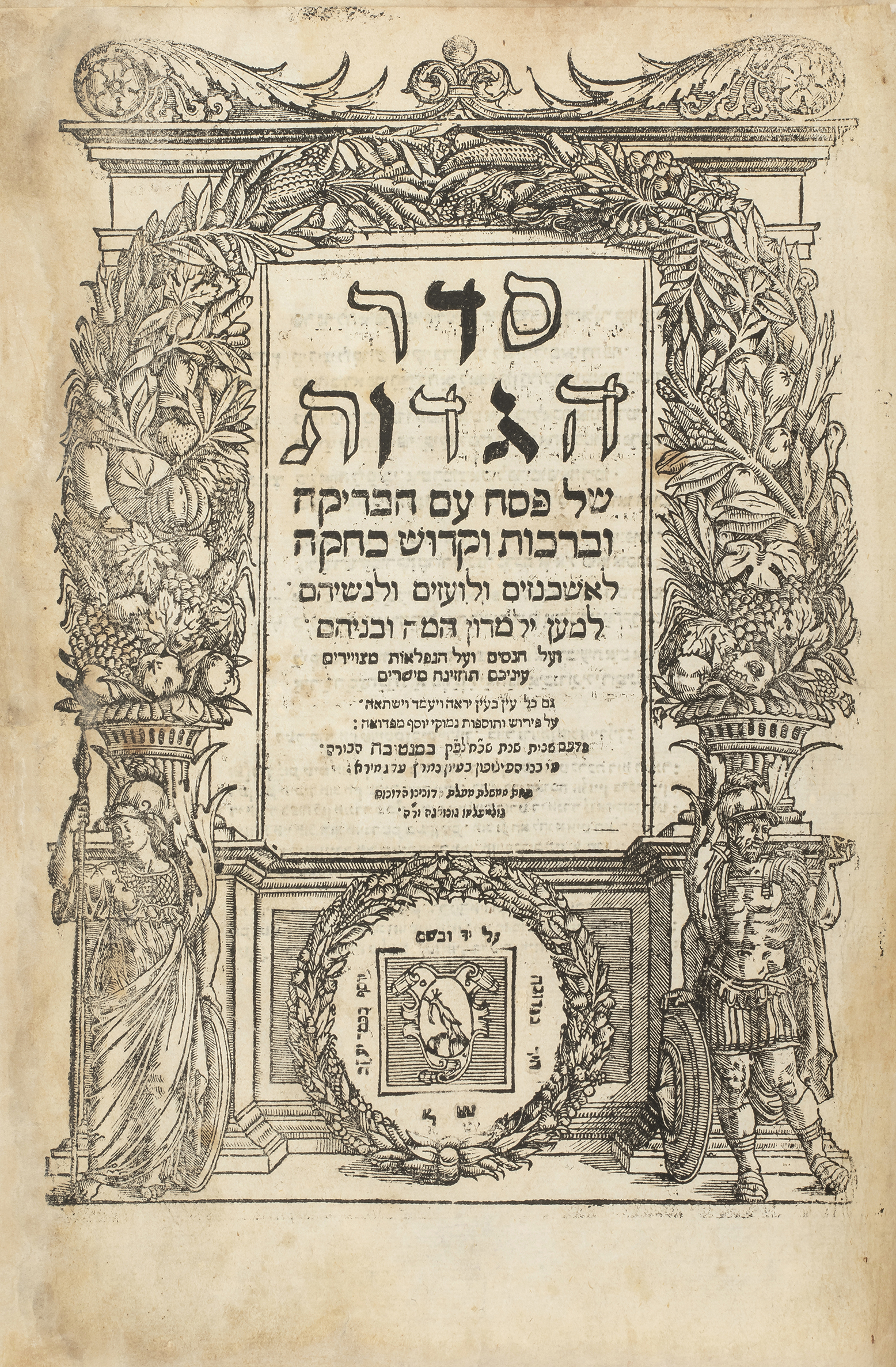
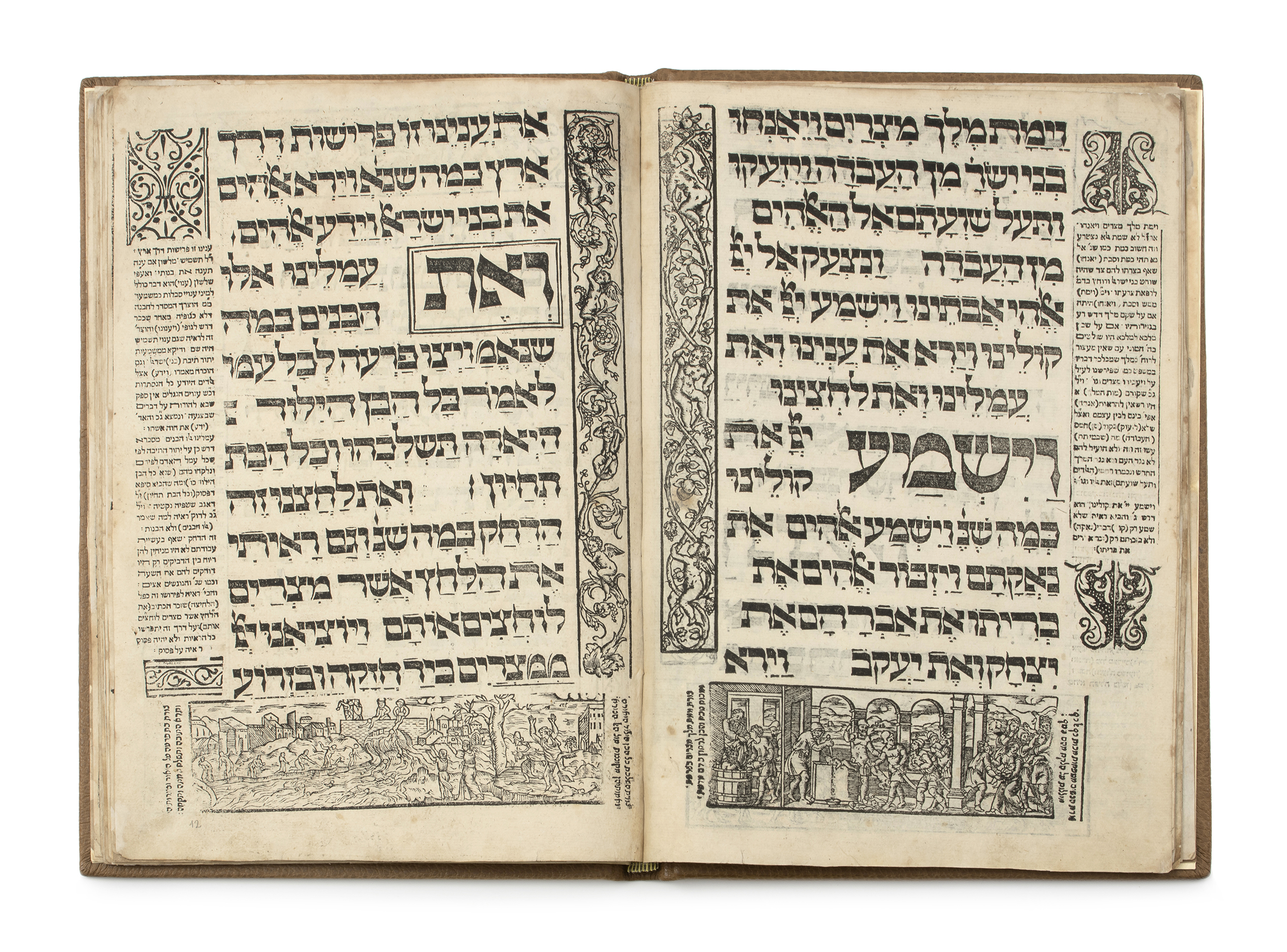
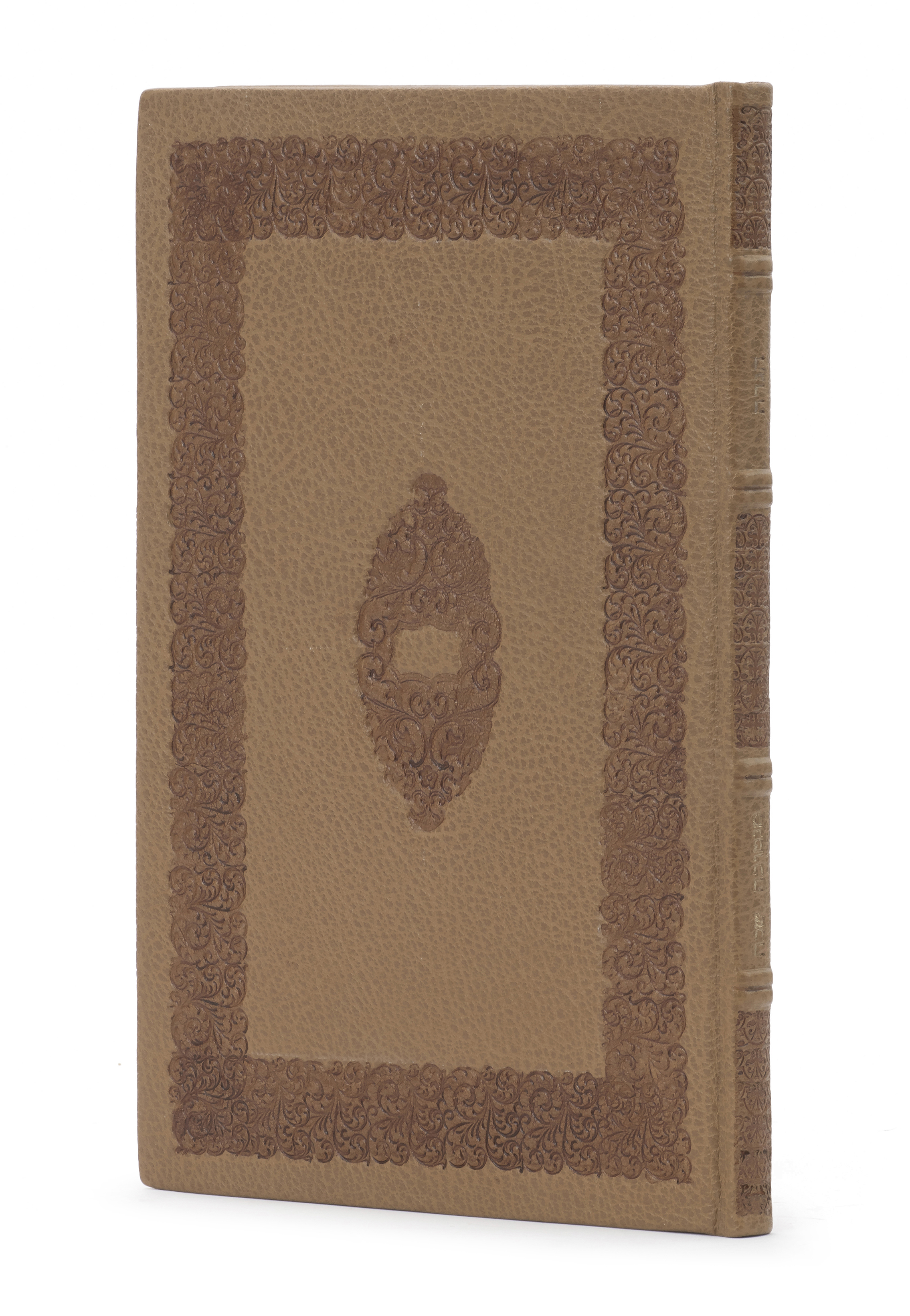
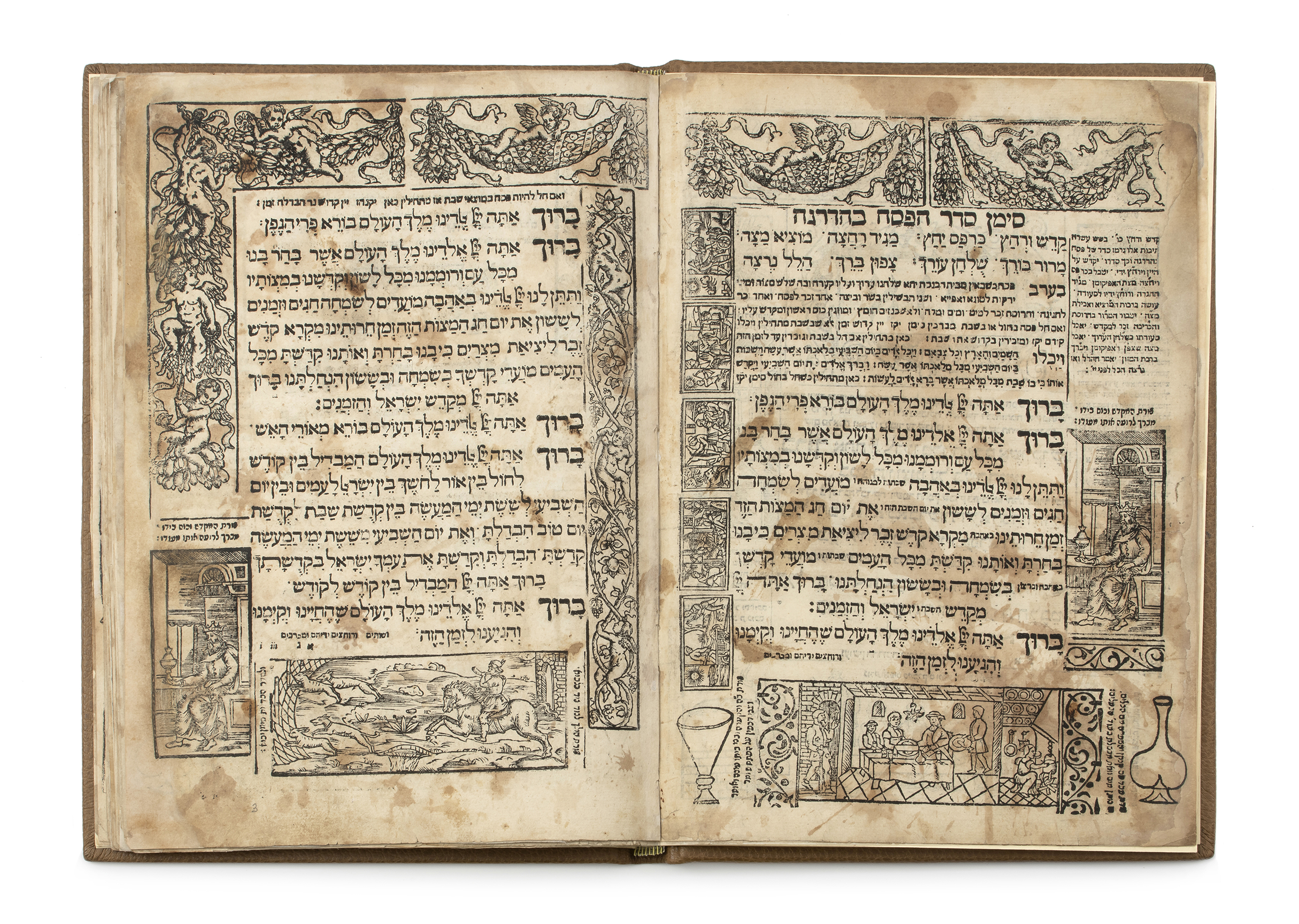
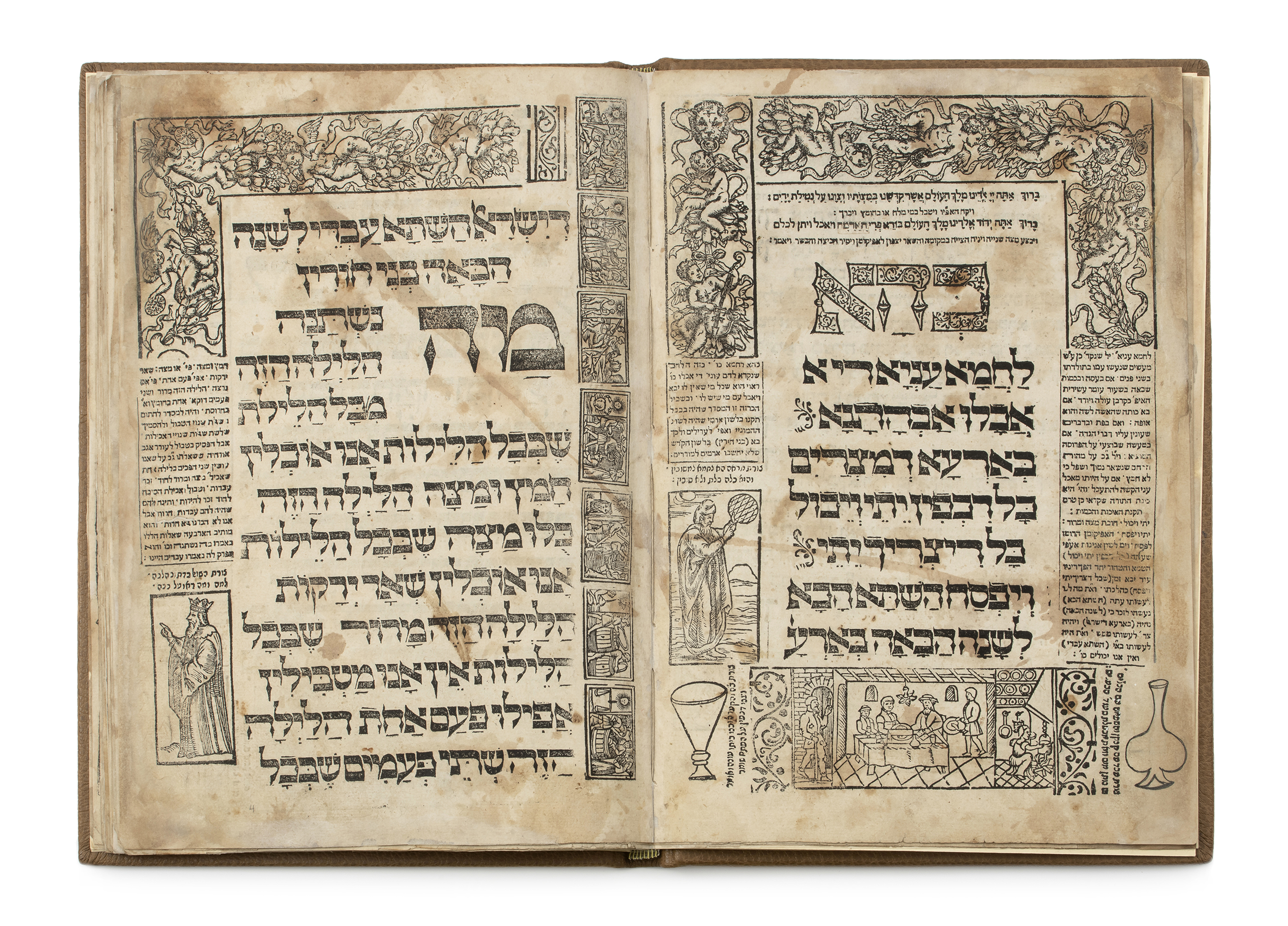
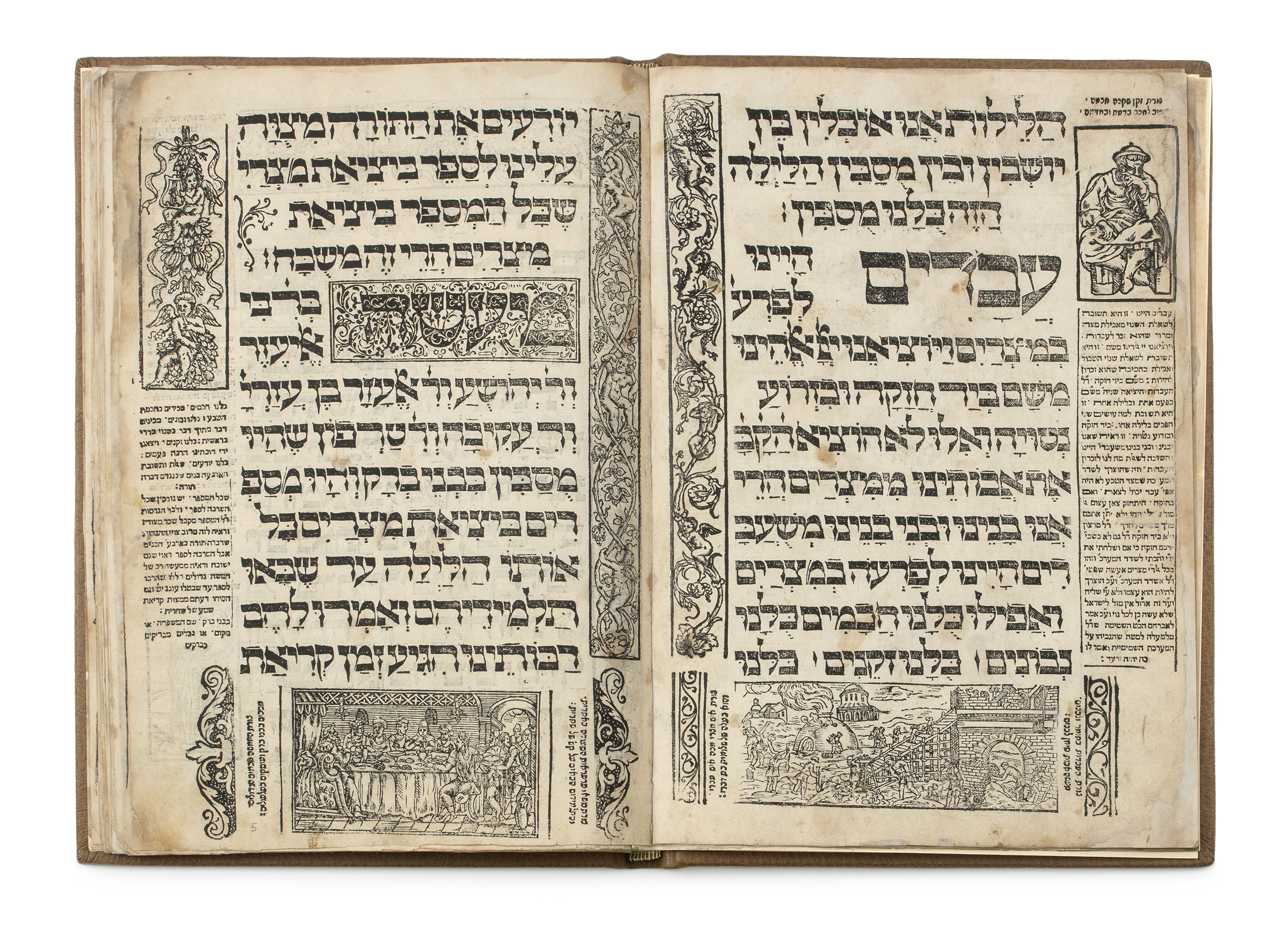
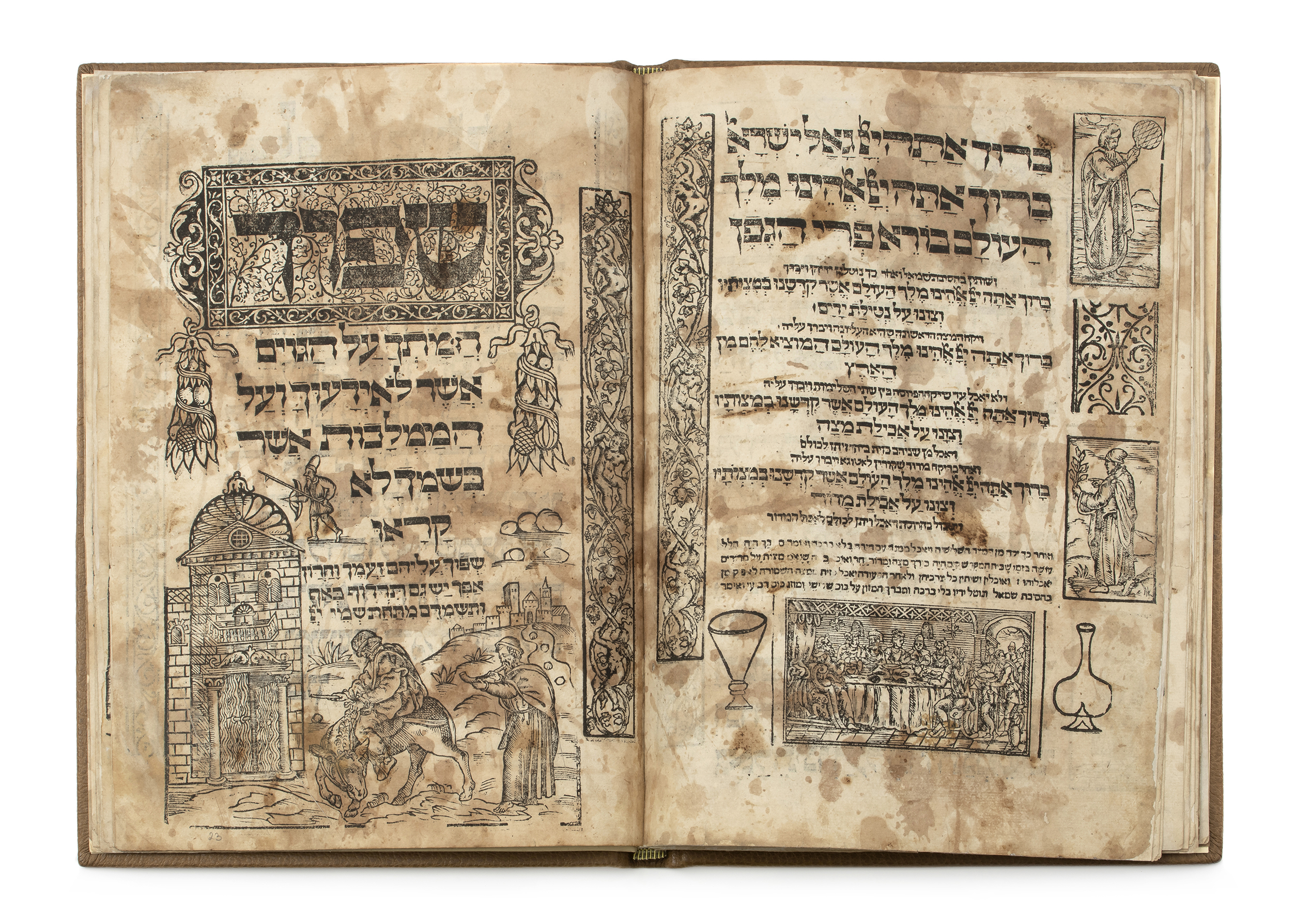
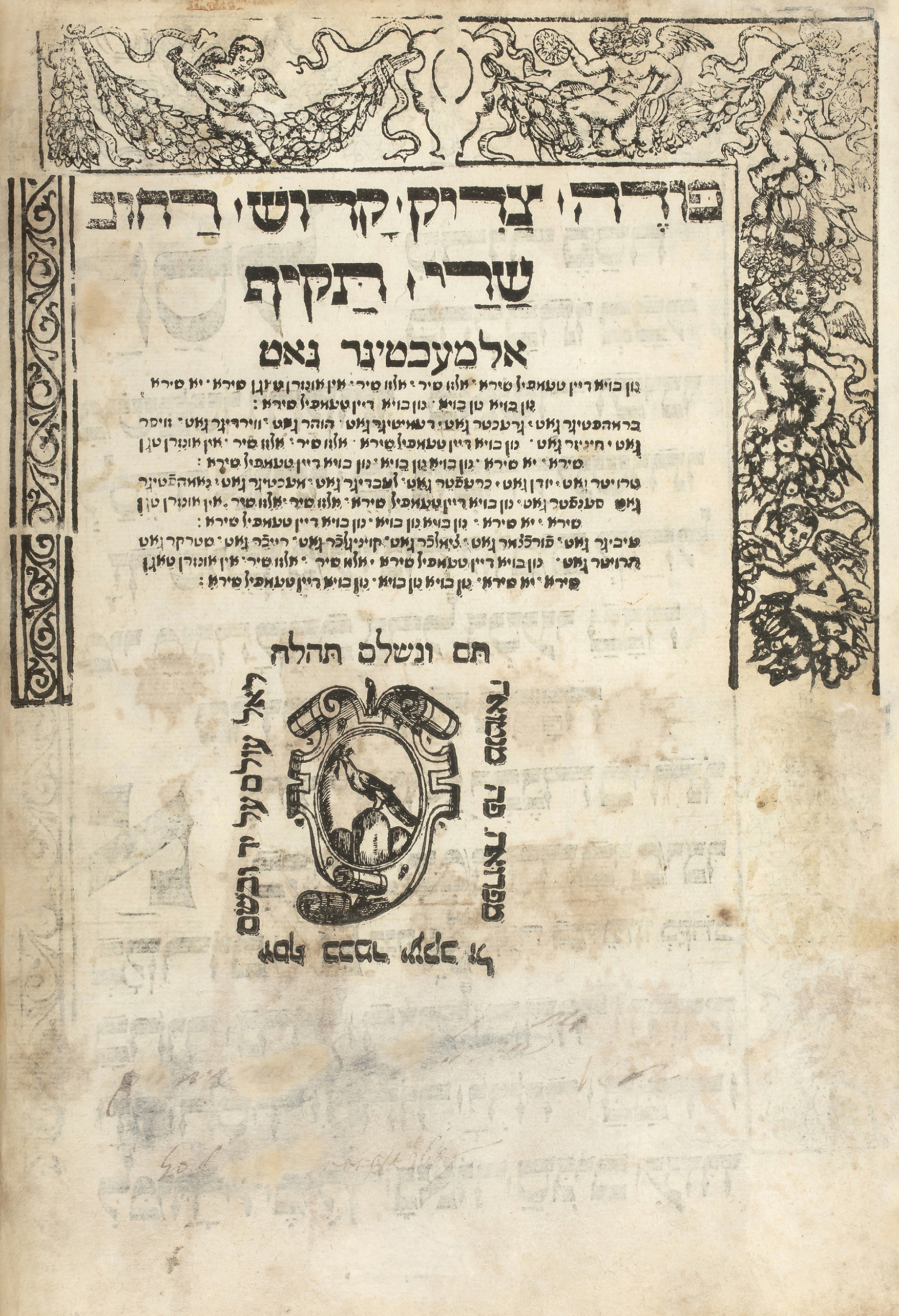
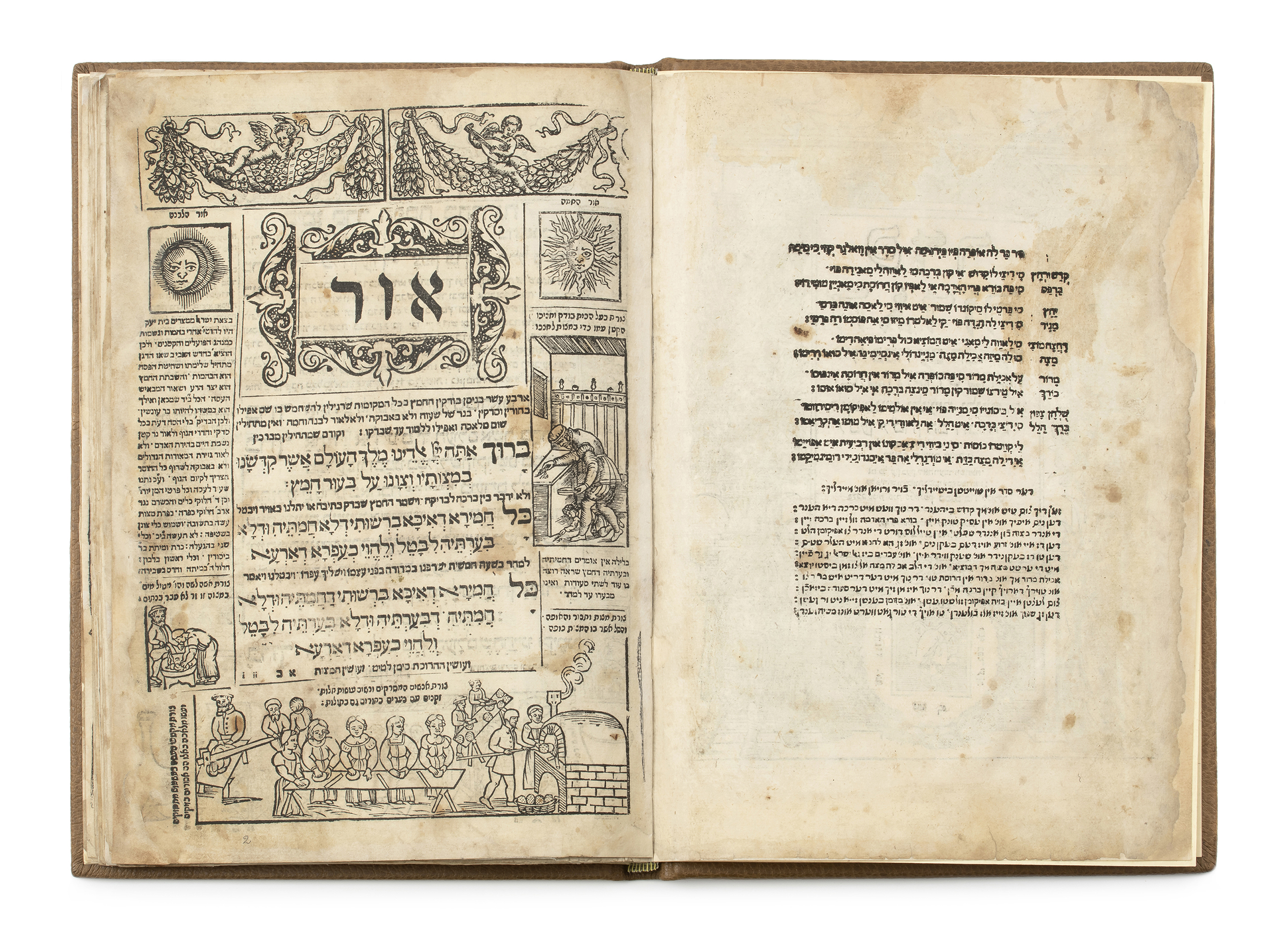
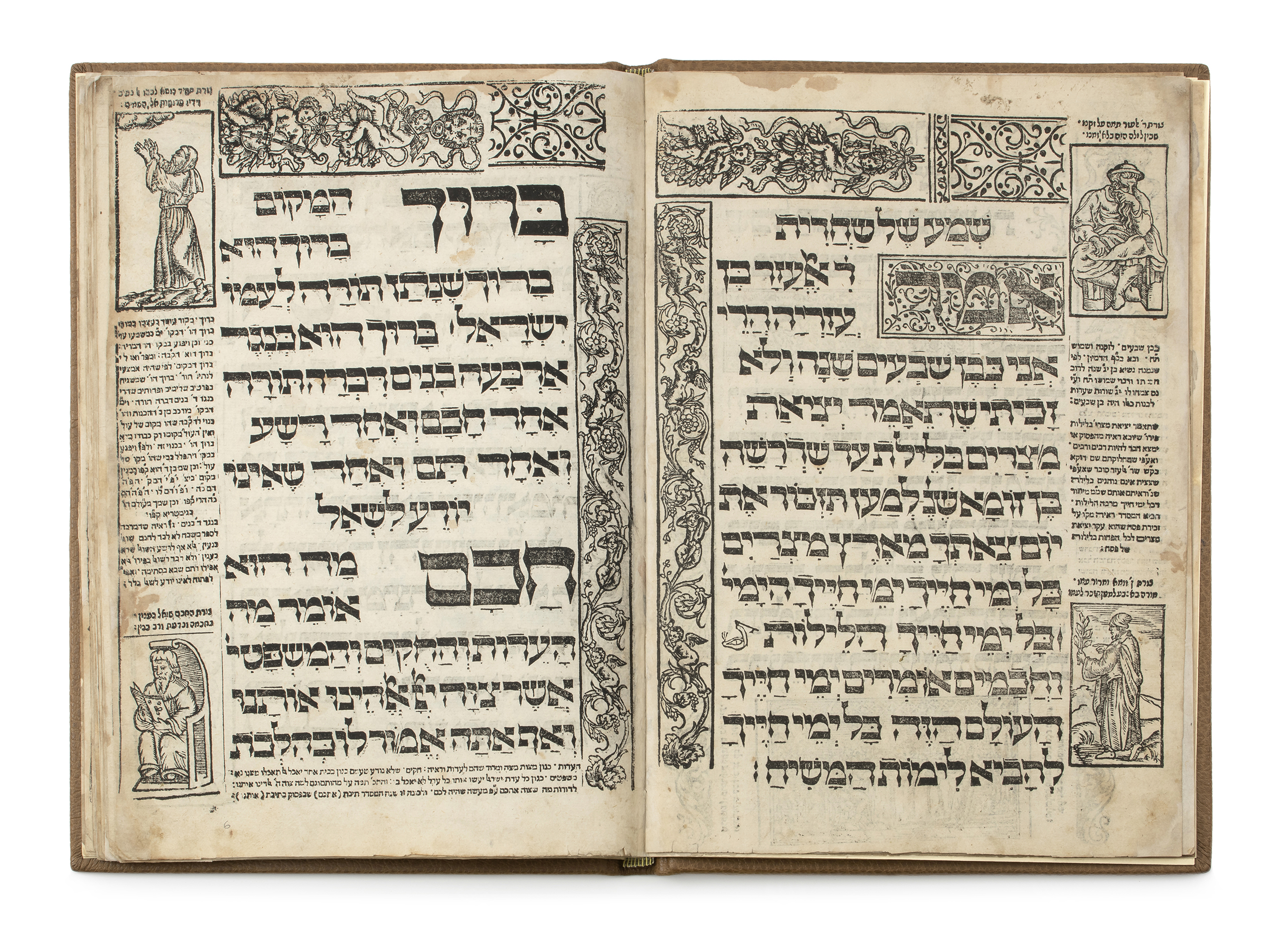
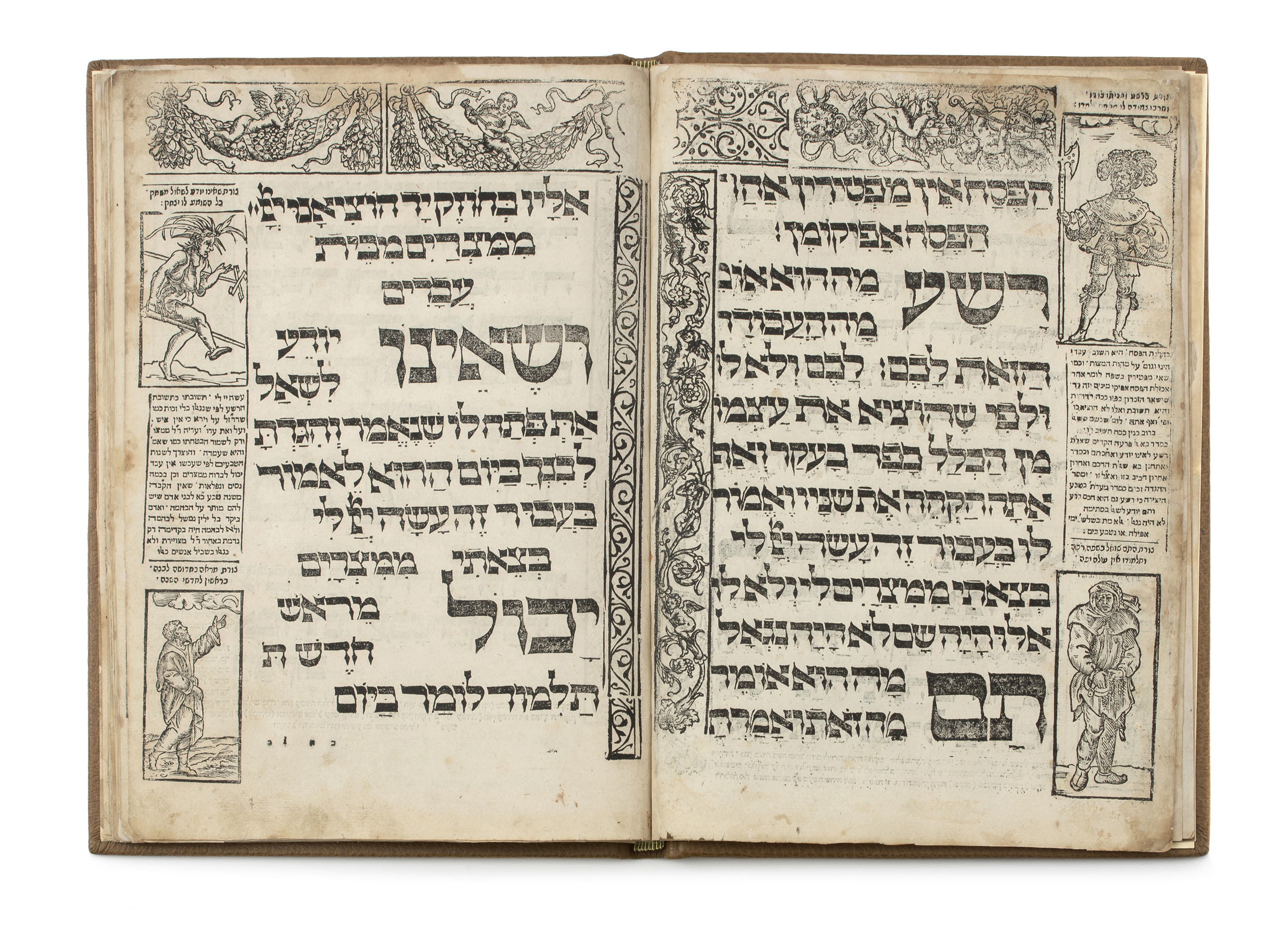
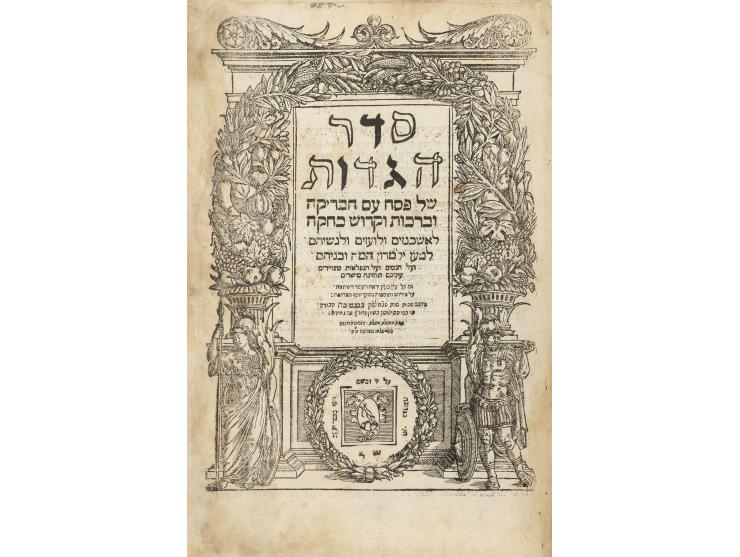
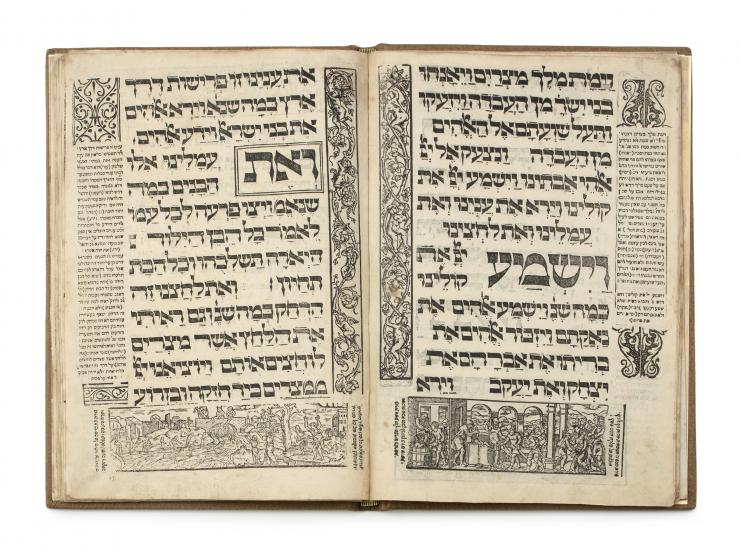
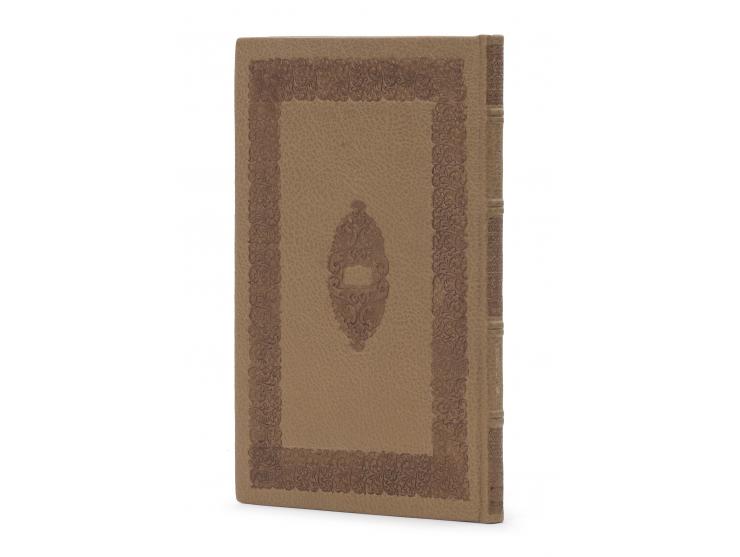
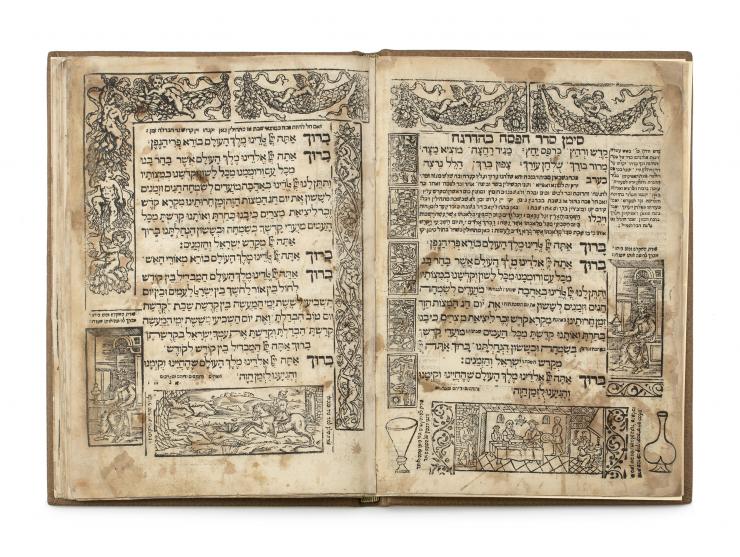
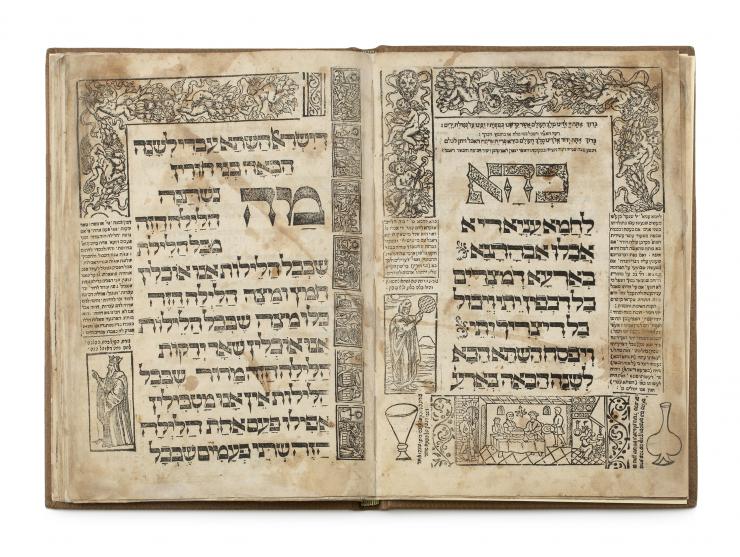
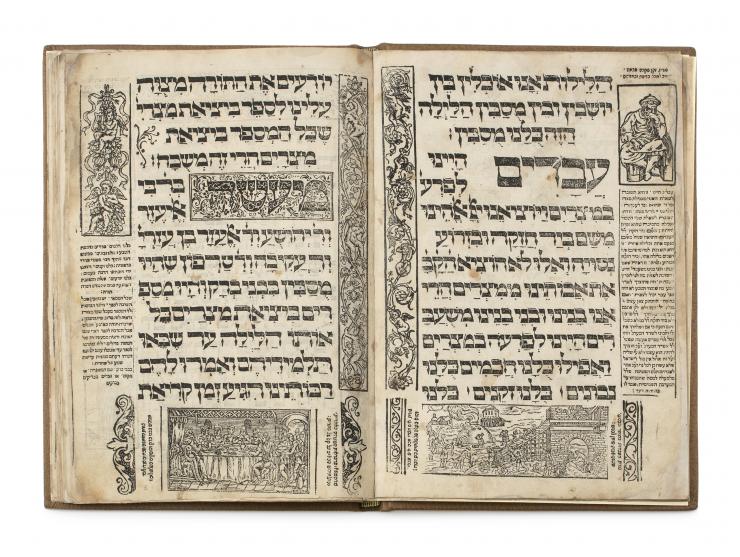
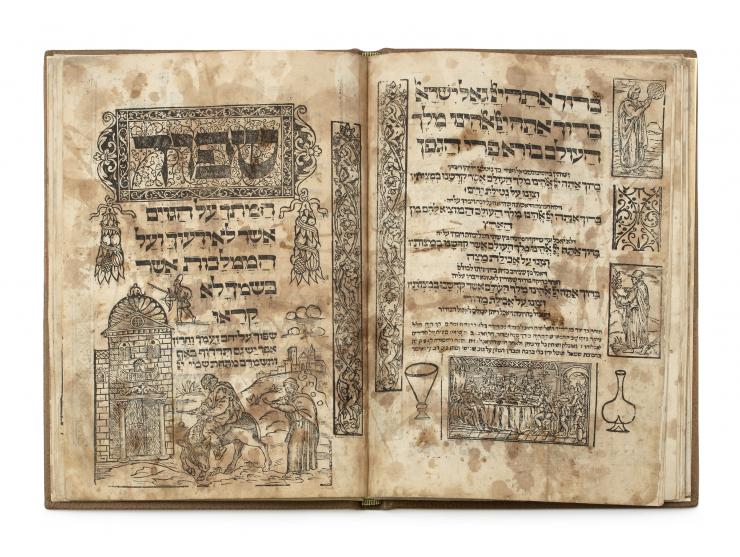
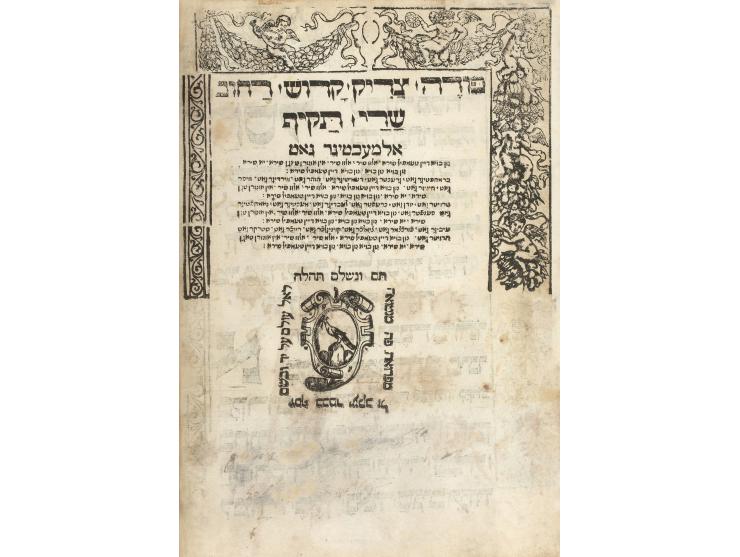
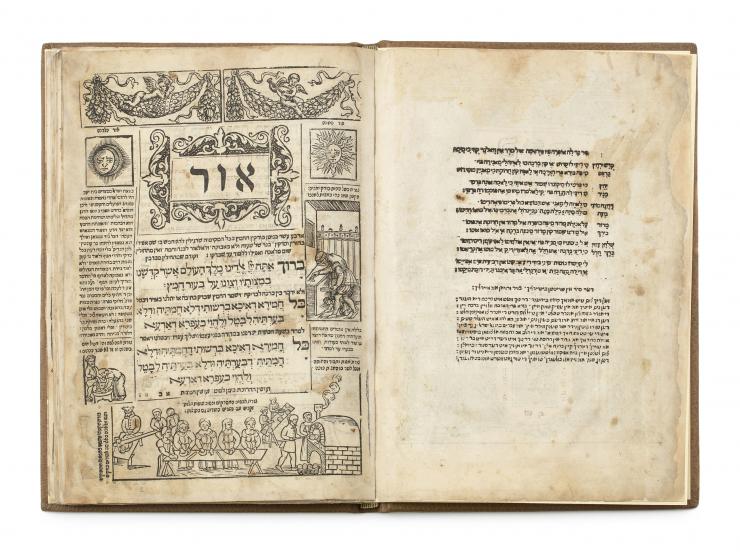
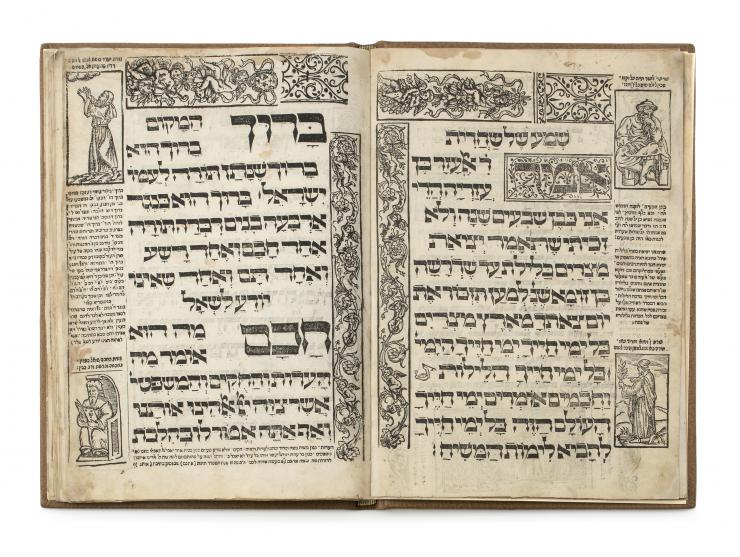
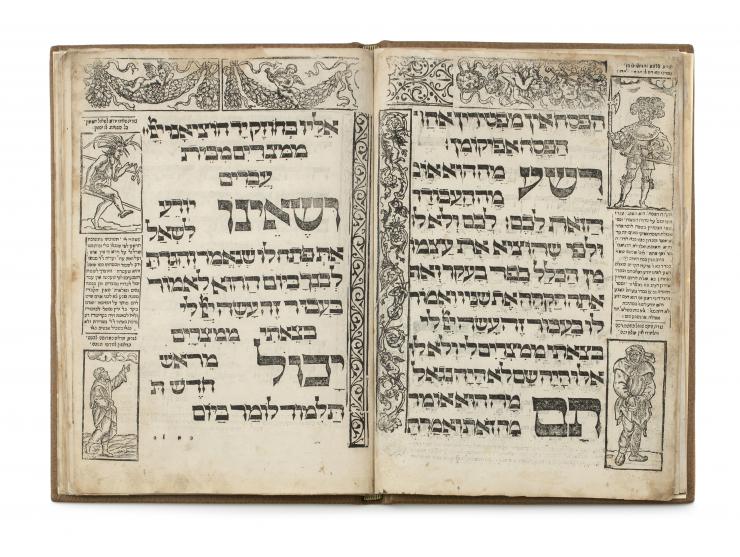
Passover Haggadah, with order of Bedikat Chametz and Kiddush for Pesach evening, and with Nimukei Yosef commentary by R. Yosef Ashkenazi of Padua. Mantua: Filipponi brothers and Yosef son of Yaakov Shalit, 1568.
Especially rare complete copy of the second illustrated Haggadah printed in Mantua (see below for more information on the two illustrated Haggadot printed in Mantua).
Fine illustrated title frame (featuring Mars and Minerva).
On title page: "Order of Passover Haggadah, with Bedikat Chametz, blessings and Kiddush as ordained, for Ashkenazim and Italian natives and their wives, in order that they and their children learn, and the miracles and wonders illustrated, your eyes shall see rightly".
On verso of title page: Order of Kadesh and Urechatz, with short commentary in Italian and Yiddish – both in Hebrew letters.
The Haggadah begins with the order of Bedikat Chametz.
The Haggadah text is printed in large Ashkenazic square type, with Rafe marks. The marginal commentary and a few instructions appearing within the Haggadah text are printed in a smaller square type (in varying sizes), while the captions accompanying some illustrations are printed in Rashi type.
The pages are framed, most decorated in vegetal patterns, with illustrations of cherubs (putti) holding flowers and musical instruments, geometrical shapes and various figures, and various Renaissance motifs. Various fine woodcut Haggadah and Passover scenes are featured beside them, at the bottom and sometimes the margins of the page: preparation and baking of matzah for Passover; a family sitting at the Seder night and a pauper knocking on their door; a hunter and dogs chasing rabbits (a motif appearing in various Haggadah manuscripts and the Haggadah of Prague, 1527, probably originating as a play on the Yaknehaz mnemonic for festival evening havdalah); the Four Sons and other sages; the Children of Israel laboring in Egypt and an Egyptian hitting an Israelite; Pharaoh bathing in the blood of the Israelite babies; the daughter of Pharaoh sending her maidservant for Moses' basket; the Children of Israel crossing the Red Sea and the Egyptians drowning; and more.
The influence of the Italian Renaissance is discernible not only in the Haggadah's decorated frames, but also in several other notable illustrations: Abraham crossing the Euphrates towards the Land of Canaan, depicted on p. [8a] as embarking in a gondola; a father figure answering his son's question (p. [4b]), reused as illustration for both R. Elazar ben Azariah and R. Akiva (pp. [5b], [16a]; in the first Mantua edition, this illustration was used for the Wise Son), is a near copy of Michelangelo's rendition of Jeremiah in the Sistine Chapel; the Wicked Son, depicted on p. [6b] as an Italian condottiero (mercenary commander); and more.
An illustration of white animals within the black background of the letters is featured as the emphasized initial word on p. [9b].
On last page, Almechtiger G-tt piyyut (Yiddish variation of Adir Hu).
The title page features the printer's device of Yosef son of Yaakov Shalit, depicting a bird holding a snake in its beak (this device reappears in enlarged form on last page; see: Yaari, Diglei HaMadpisim HaIvriyim, illustration 19 and p. 132).
On p. [3b], the blessing for Karpas is erroneously printed with the word "HaGefen"; a mounted paper strip contains the handwritten correction "HaAdamah" (remains of the paper repair also appear in the Haggadah copy from the Valmadonna Trust Library, digitized by NLI; the correction appears to have been made in the press after printing).
Censor signatures, blurred (and damaged by tears) on last leaf.
[36] leaves (handwritten foliation added in pencil to margins). 31.5 cm. Varying condition of leaves, fair-good to fair. Stains, including dark food and wine stains (many large stains to several leaves). Tears and open tears, to margins of title page and other leaves, affecting text and illustrations in several places, repaired with paper filling (with small parts of frames and illustrations replaced by hand). Worming, affecting text and illustrations, mostly replaced with paper filling. New leather binding. Placed in cardboard and fabric slipcase.
The Illustrated Mantua Haggadot Printed in the Sixteenth Century
Two typographically similar illustrated Haggadot were printed in Mantua in the mid-16th century. The first was printed in 1560 by Yitzchak son of Shmuel Bassan, at the press of Giacomo Ruffinelli; the second was printed some eight years later by the Filipponi brothers, under the name of Yosef son of Yaakov Shalit.
Both Haggadot made use of the same plates for printing, and the format and typesetting of both are nearly identical to the Haggadah of Prague, 1527. The main difference between the two Mantua editions is the commentary of R. Yosef Ashkenazi of Padua, appearing only in the present edition (up to p. [19a]), in the margins, replacing some of the decorations that had appeared in the first edition.
Several other variants also exist: the title frames are different, and a mnemonic for the Seder order is printed on the verso; the initial word on p. [2a] is enlarged and emphasized in the present edition; the format and size of the type for the instructions inside the Haggadah are somewhat different; some illustrations are newly captioned; Birkat HaMazon is absent in its entirety in the present edition; several illustrations have been moved; several decorations are added, including twelve small illustrations of the zodiacs on pp. [2b] and [4a] (no connection to text); a new woodcut appears twice only in the present edition, depicting the Children of Israel crossing the Red Sea (pp. [17b], [28a]).
Both Mantua Haggadot served as models for numerous illustrated Haggadot in smaller sizes (quarto and octavo), printed in Venice around the turn of the 17th century.
Of the two Haggadot, the present Haggadah is considered rarer, and few complete copies are extant. The NLI catalog records only a scanned copy.
Provenance:
• Habsburg-Feldman, Geneva, June 1989, Lot 17.
• Kestenbaum, New York, March 2002, Lot 194.
Reference:
• Cecil Roth, HaHaggadah HaMetzuyeret ShebiDefus, Areshet, III (1961), pp. 18-19.
• A.M. Habermann, HaHaggadah HaMetzuyeret – Kitvei Yad VeSifrei Defus, Safed, 1963, pp. 18-20.
• Yosef Haim Yerushalmi, Haggadah and History, A Panorama in Facsimile of Five Centuries of the Printed Haggadah from the Collections of Harvard University and the Jewish Theological Seminary of America, Philadelphia, 1975, pp. 38-39; plates 28-31.
• Otzar HaHaggadot 25.
Catalogue Value