
Auction 106 Incunabula and First Editions | Illuminated Manuscripts | Jewish Ceremonial Art
Feb 24, 2026
Displaying 13 - 16 of 16
![Likutei Amarim [Tanya], Part I: Sefer Shel Beinonim, with Part II: Shaar HaYichud VehaEmunah, by R. Shneur Zalman of Liadi,](https://files.kedem-auctions.com/files/Sale106/13_1.jpg "Likutei Amarim (Tanya) – First Edition – Slavita, 1796 – Complete Scho")
![Likutei Amarim [Tanya], Part I: Sefer Shel Beinonim, with Part II: Shaar HaYichud VehaEmunah, by R. Shneur Zalman of Liadi,](https://files.kedem-auctions.com/files/Sale106/13_2.jpg "Likutei Amarim (Tanya) – First Edition – Slavita, 1796 – Complete Scho")
![Likutei Amarim [Tanya], Part I: Sefer Shel Beinonim, with Part II: Shaar HaYichud VehaEmunah, by R. Shneur Zalman of Liadi,](https://files.kedem-auctions.com/files/Sale106/13_3.jpg "Likutei Amarim (Tanya) – First Edition – Slavita, 1796 – Complete Scho")
![Likutei Amarim [Tanya], Part I: Sefer Shel Beinonim, with Part II: Shaar HaYichud VehaEmunah, by R. Shneur Zalman of Liadi,](https://files.kedem-auctions.com/files/Sale106/13_4.jpg "Likutei Amarim (Tanya) – First Edition – Slavita, 1796 – Complete Scho")
![Likutei Amarim [Tanya], Part I: Sefer Shel Beinonim, with Part II: Shaar HaYichud VehaEmunah, by R. Shneur Zalman of Liadi,](https://files.kedem-auctions.com/files/Sale106/13_5.jpg "Likutei Amarim (Tanya) – First Edition – Slavita, 1796 – Complete Scho")
![Likutei Amarim [Tanya], Part I: Sefer Shel Beinonim, with Part II: Shaar HaYichud VehaEmunah, by R. Shneur Zalman of Liadi,](https://files.kedem-auctions.com/files/Sale106/13_6-WEB.jpg "Likutei Amarim (Tanya) – First Edition – Slavita, 1796 – Complete Scho")
![Likutei Amarim [Tanya], Part I: Sefer Shel Beinonim, with Part II: Shaar HaYichud VehaEmunah, by R. Shneur Zalman of Liadi,](https://files.kedem-auctions.com/files/Sale106/13_7.jpg "Likutei Amarim (Tanya) – First Edition – Slavita, 1796 – Complete Scho")
Auction 106 Incunabula and First Editions | Illuminated Manuscripts | Jewish Ceremonial Art
Feb 24, 2026
Opening: $300,000
Sold for: $375,000
Including buyer's premium
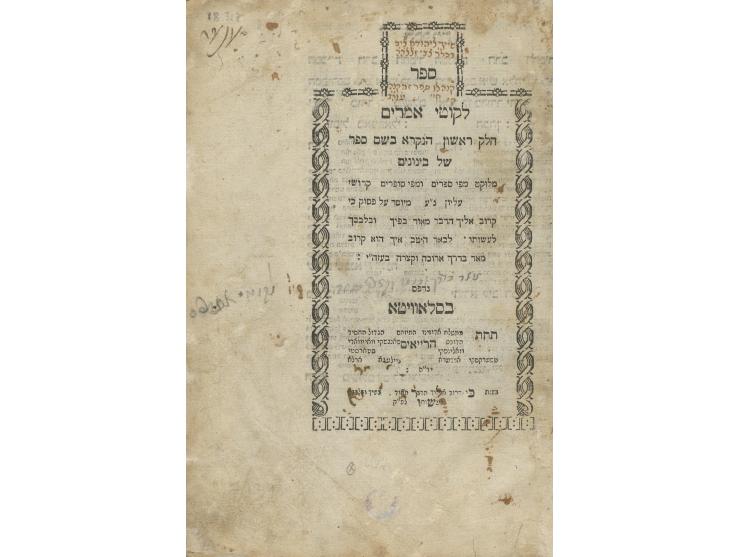
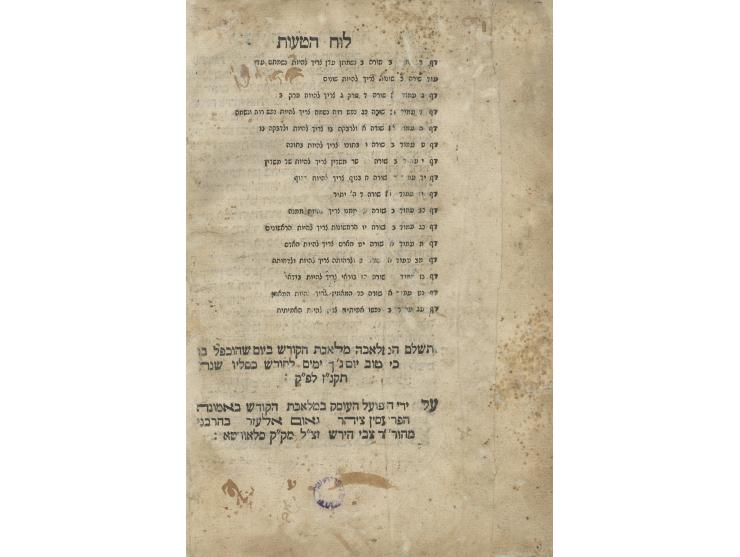
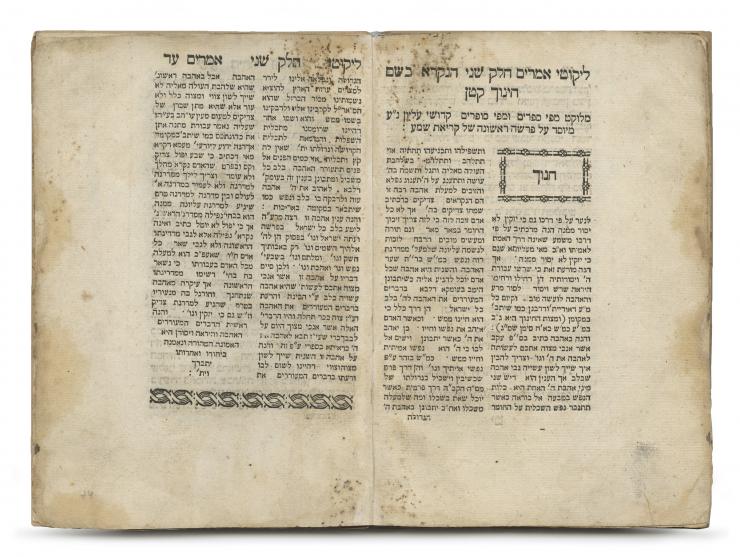
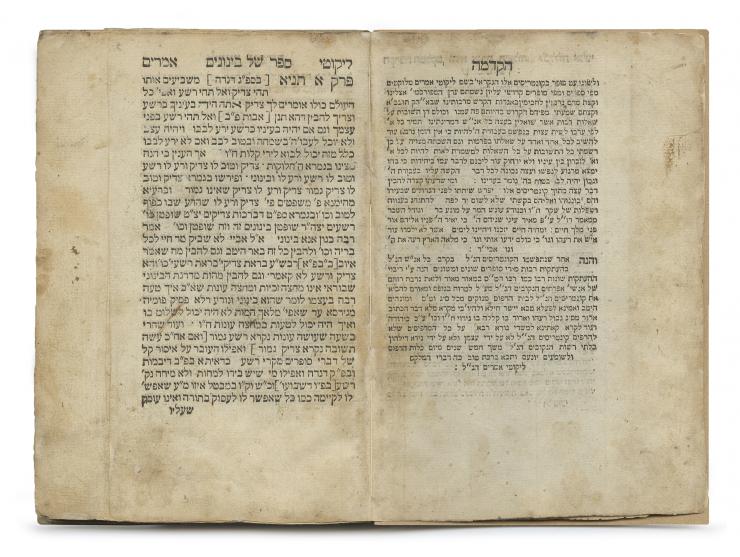
Likutei Amarim [Tanya], Part I: Sefer Shel Beinonim, with Part II: Shaar HaYichud VehaEmunah, by R. Shneur Zalman of Liadi, the Alter Rebbe. Slavita: [R. Moshe Shapira], 1796. First edition, printed in the author's lifetime.
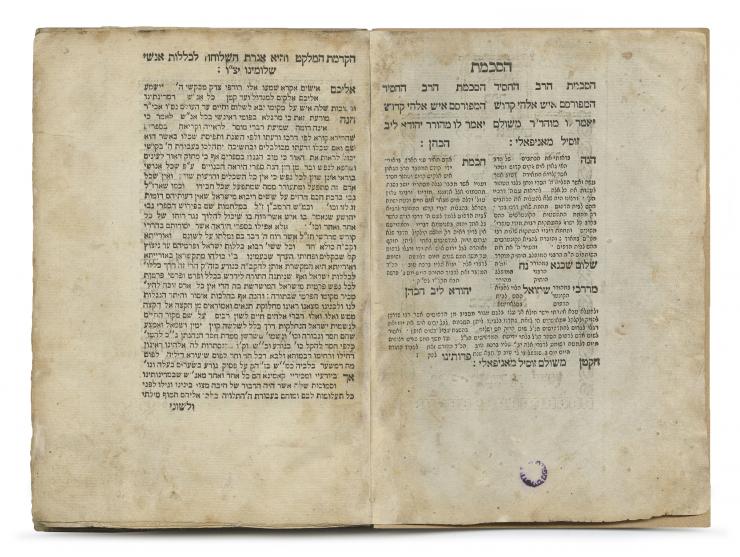
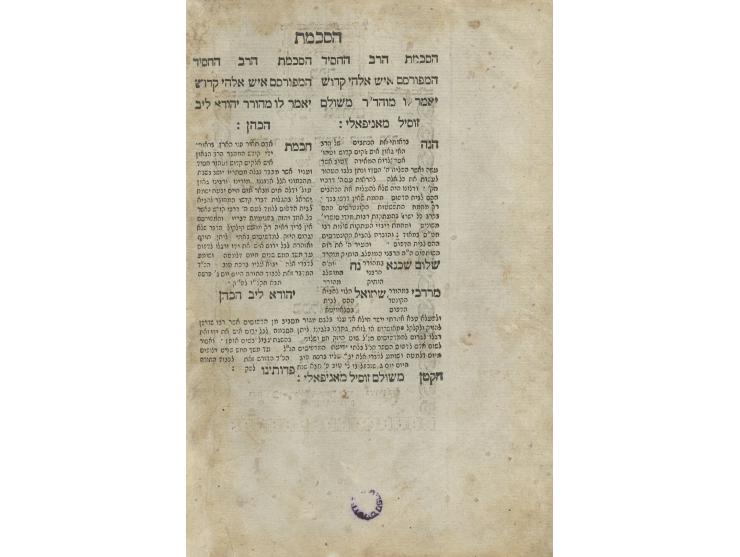
Approbations by two disciples of the Maggid of Mezeritch printed at the beginning of the book – R. Meshulam Zusha of Anipoli and R. Yehudah Leib HaKohen of Anipoli. The author's introduction (a 1795 letter) is printed afterwards.
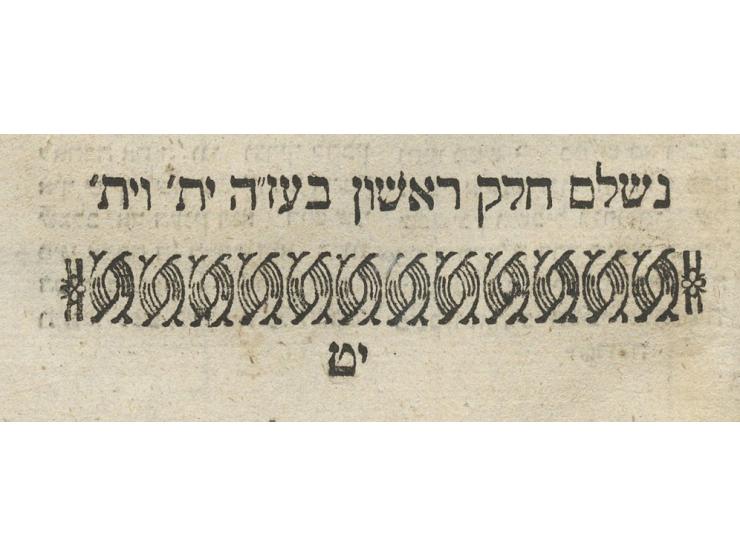
The book was printed anonymously (the author’s name appears neither on the title page nor in the two approbations or the author’s introduction). It was printed over the course of three months: the approbations are dated Tuesday, Ki Tavo, 17th Elul 1796, and the colophon at the end of the book is dated Tuesday, 20th Kislev 1796.
Published by R. Shalom Shachna Altschuler (son-in-law of the Alter Rebbe and father of the Tzemach Tzedek of Lubavitch) and his partner. Variant colophon: the present copy is signed by "the worker… Elazar son of… R. Tzvi Hirsch of Slavita" (other copies are signed by "the typesetter… Avraham Tzvi son of R. Eliezer Katz").
This edition is uniquely valuable as a completely uncensored text, unlike most later editions.
The first edition of this book included only the first two parts: "Part I, called Sefer Shel Beinonim, based on the verse 'For the matter is very close to you, in your mouth and in your heart to perform it', explaining thoroughly how it is very close…" – the elements of service of G-d, and "Part II, called Chinuch Katan [called Shaar HaYichud VehaEmunah on the page headers]… based on the first section of the Shema reading" – the elements of faith in G-d's unity.
Early ownership inscription at top of title page: "Belongs to Yehudah Leib son of R. Tzvi. Who purchases this book acquires the life of the World to Come".
Rare and exceptional copy, in unaltered original condition, untrimmed and unbound. Approximately half of the leaves display especially wide margins (the text was not printed in the center of the sheets; consequently, some leaves retain exceptionally broad margins – in some places nearly half the width of the text column – whereas the others show normal margins).
This book of Tanya is being auctioned from the estate of the noted philanthropist Refael Shlomo Drimmer (1951-2022), a distinguished Chabad Chassid in Brooklyn, and a descendant of R. Shlomo Drimmer, head of the Beit Din of Skala-Podilska, author of Yashresh Yaakov and Responsa Beit Shlomo. Reb Shlomo was famous for his generosity and his many acts of charity, and he supported Torah and charitable institutions open-handedly. He was dedicated to communal work, and promoted peace and reconciliation. He was a follower of the Lubavitcher Rebbe, and served as a member of the central Tomchei Temimim Lubavitch yeshiva administration, and as a council member in the Crown Heights neighborhood. For some three decades, Reb Shlomo collected antique manuscripts and rare and valuable books. At the request of the family, all proceeds from the sale of this Tanya will support a renovation project of the Lubavitcher Rebbe's Ohel.
[3], 4-86 leaves. 19 cm (width of leaves up to 13 cm). Good-fair condition. Stains and wear. Minor defects and tears. Worming to most leaves, affecting text, repaired with paper. Stamps of the Schocken Library in Jerusalem in margins of title leaf and last leaf. New endpapers (sewn on); without binding.
Provenance:
• Schocken Collection, Jerusalem (purchased before May 16, 1946).
• Sotheby's, London, December 1993, Lot 265.
• Judaica Jerusalem, April 2008, Lot 757.
• Estate of Shlomo Drimmer, Brooklyn, New York.
The Main Tanya Editions, Parts Printed During the Author's Lifetime and Posthumously
The first edition of the Tanya printed by the Alter Rebbe in Slavita (Slavuta) contained the first part of the book (53 chapters) and the second part (Chinuch Katan – Shaar HaYichud VehaEmunah, 12 chapters). The title page and page headers name the book Likutei Amarim (later editions would also call it Tanya). This edition bears no traces of censorship.
In 1799 and the first decade of the 1800s, four more editions of the Tanya were printed in Żółkiew, Galicia (present-day Zhovkva, Ukraine), including the first appearance of Part III: the earliest version of Igeret HaTeshuvah. In 1806, the Alter Rebbe printed his book for a second time in Shklow, including the final version of Igeret HaTeshuvah, with improvements in wording, additional explanation and with a division into twelve chapters. This edition contains added approbations by the rabbis of Shklow and Kopust, and is likewise free of censorship.
A year and a half after the passing of the Alter Rebbe, the author's sons printed a third edition of the Tanya (Shklow, 1814), with an additional fourth part called Igeret HaKodesh (32 letters), and a fifth part called Kuntres Acharon, giving their approbation with their signatures: R. Dov Ber (the Mitteler Rebbe), R. Chaim Avraham and R. Moshe.
From that point on, most Tanya editions were printed from the Shklow edition of 1814, comprising all five parts of the book. In the Vilna edition of 1900, the entire Tanya text was emended by the Rebbe Rashab of Lubavitch, with some important additions omitted from earlier printings. All subsequent Tanya editions were printed based on the Rebbe Rashab's text, printed in Vilna, 1900.
The Composition and Publication of the Tanya
During the 1790s, the Alter Rebbe was one of the main Chassidic leaders in Belarus. Many of his followers sought his advice in service of G-d. At times they would have to wait for weeks in order to gain a private audience with him – a time-consuming situation which he found burdensome. In three letters he wrote at the time, he asks to restrict admission of those who had already had private audiences with him, in order to enable newcomers to enter; in tandem, he authored booklets of guidance in service of G-d, as a replacement for private audiences. These booklets later became the Tanya.
In a 1795 letter to his followers (later printed as the introduction to the book), the Alter Rebbe writes of the booklets, called Likutei Amarim: "They are all responses to many requests for advice of the Chassidim of our country… to advise them on the service of G-d. Since time no longer permits a private response to each individual's question, and also because forgetfulness is a factor, I therefore wrote all the answers to all the questions, 'to be preserved as a sign', for each person to have 'as a remembrance between his eyes', and no longer butt in to speak with me privately, for in them he will find peace for his soul and proper advice for all of his difficulties in the service of G-d".
After inaccurate copies of the booklets were disseminated, the Alter Rebbe decided to have them published. The Tanya was printed during the last months of 1796.
The Alter Rebbe wrote his book over several years of intense and protracted study. His disciple, R. Aharon of Strashelye, writes: "I know and saw his great exertion while authoring his holy book. With his deep wisdom and understanding, he would select from all of the holy matters explained in Etz Chaim and Pri Etz Chaim, based on which he authored his holy work". The Alter Rebbe meticulously probed every word, every letter, leaving behind nothing extraneous or redundant. His grandson, the Tzemach Tzedek, writes that seeming synonyms are repeated deliberately and precisely. Reputedly, the author would sometimes deliberate for weeks over a single letter.
A Chassidic tradition attributed to the mashpia R. Shmuel Grunem Esterman has it that the Alter Rebbe would personally give the Tanya to his followers: "The sale or gift of the Tanya was performed by the Rebbe himself. And when emissaries would come from various cities, he himself was the one to estimate how many Tanyas were needed for that city…".
The Alter Rebbe said of his work: "From the Tanya, one can be a Chassid like Abraham". The Ohev Yisrael of Apta said that "even our holy ancestors, Abraham, Isaac and Jacob, followed the method of service of G-d written in Likutei Amarim". When the book reached his mechutan R. Levi Yitzchak of Berditchev, he marveled "how it was possible to put such a great and awesome G-d in such a small book".
The book was highly appreciated by the Chassidic masters, many of whom quote it in their books. The Maggid of Kozhnitz would reputedly study a chapter of the Tanya daily, while wearing his Rabbeinu Tam tefillin, and once told R. Asher of Stolin that the Tanya is "a book from the Garden of Eden". The Maggid cites the Tanya in several places in his books, despite being the Alter Rebbe's senior in age. The Ahavat Yisrael of Vizhnitz said that one should pledge one's shtreimel as collateral in order to purchase the Tanya.
From its first publication until the Holocaust, the book was printed in some forty editions; from that time onwards it was printed in thousands more. The book has been received in most Jewish circles as a foundational book on faith and service of G-d.
Chabad rebbes associated many Segulot with the study of the Tanya, and even with merely possessing it in one's home: Segulot for pure faith, preventing stray thoughts, rectification of sins, healing of body and soul, blessing and success, and rescue and salvation. The Lubavitcher Rebbe directed every home to have a Tanya, as a Segulah for protection.
Catalogue Value
Auction 106 Incunabula and First Editions | Illuminated Manuscripts | Jewish Ceremonial Art
Feb 24, 2026
Opening: $25,000
Sold for: $52,500
Including buyer's premium
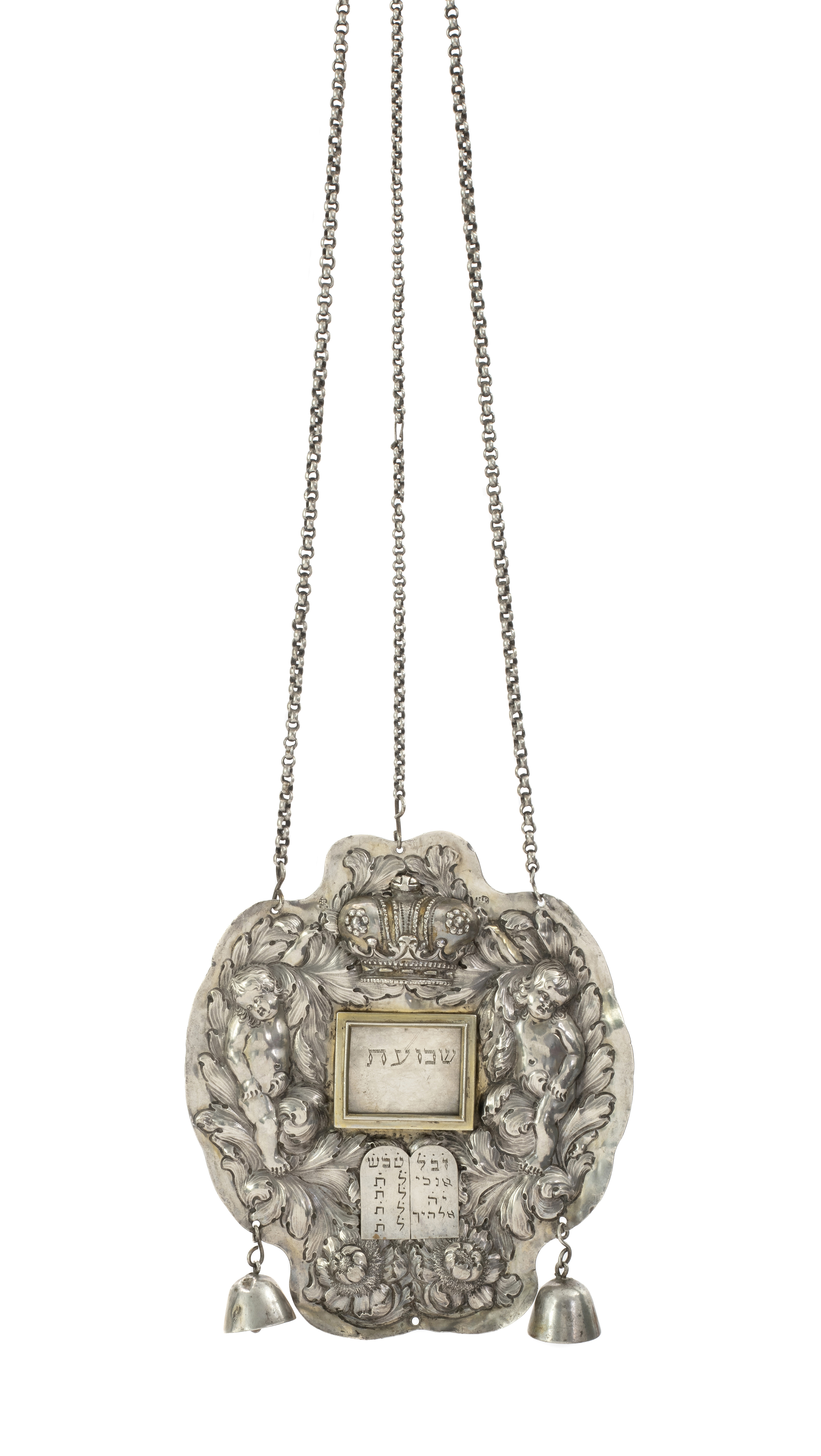
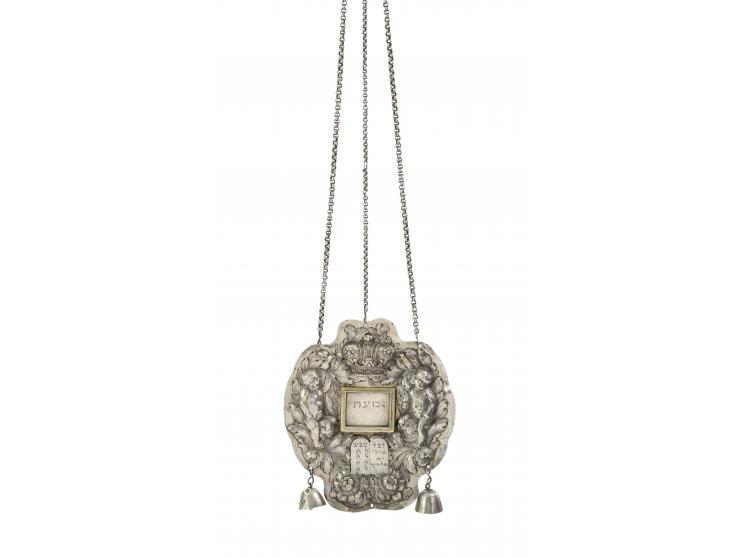
Torah shield. Augsburg, ca. mid-17th century.
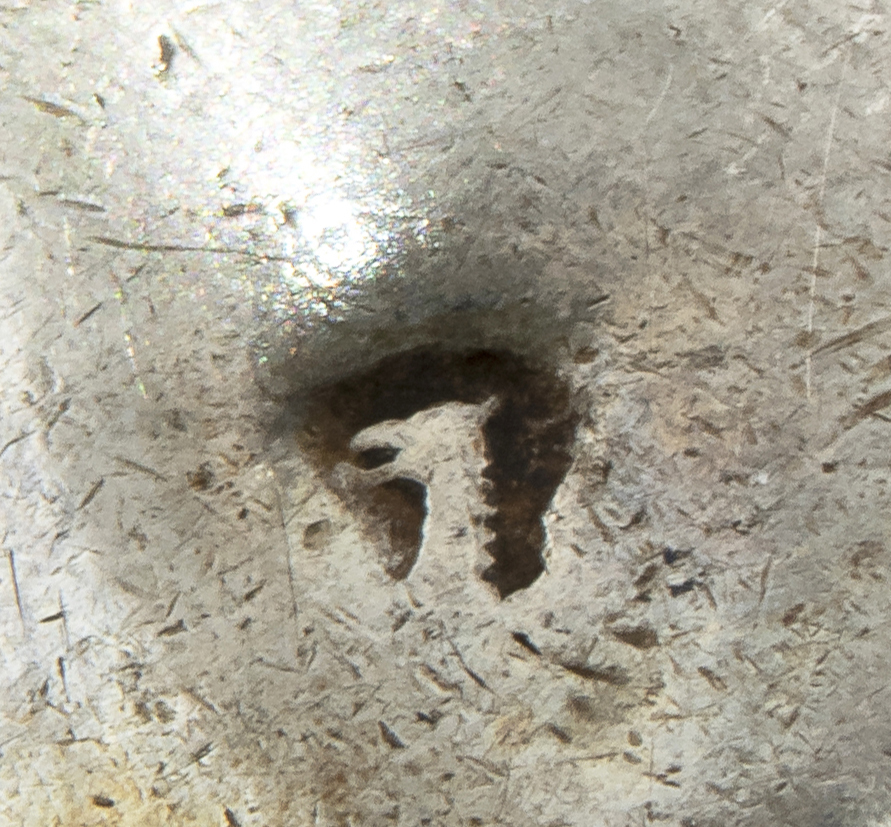
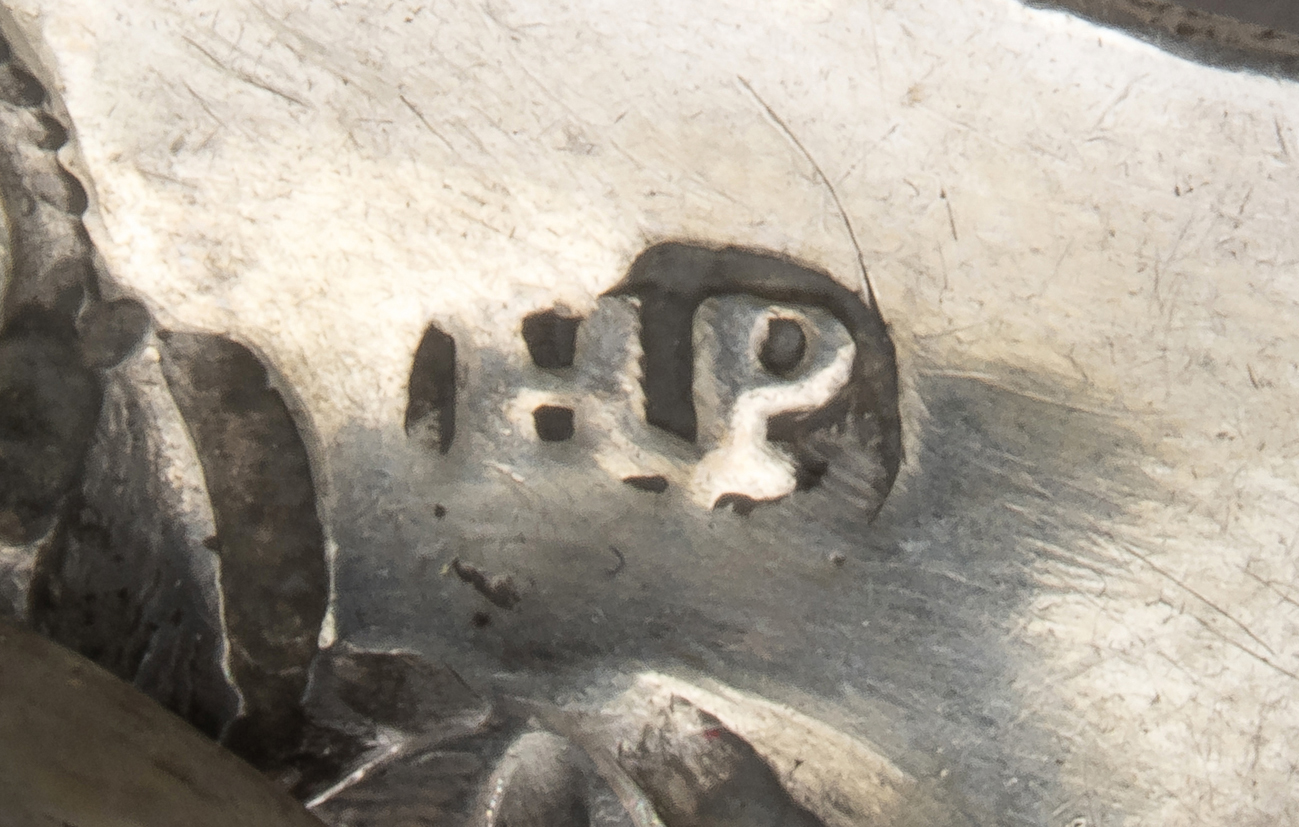
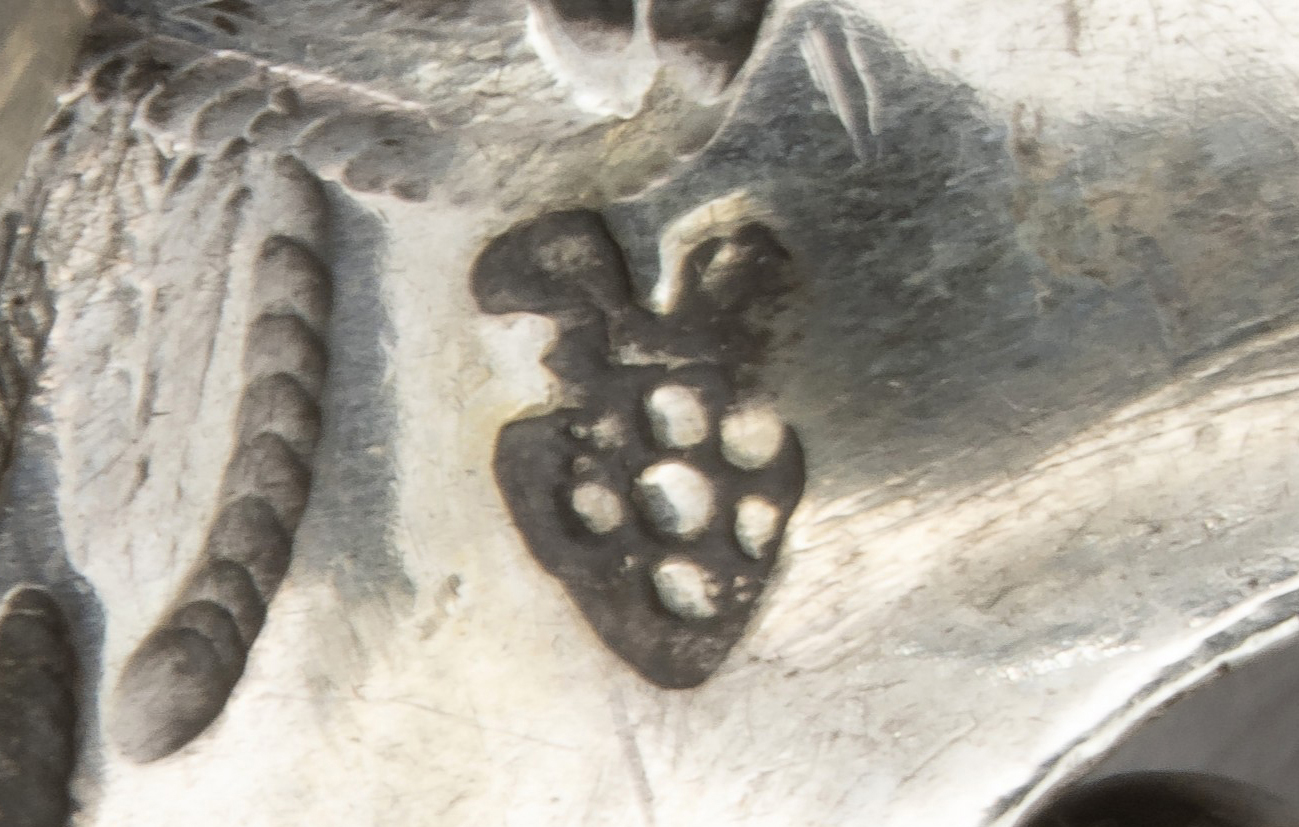
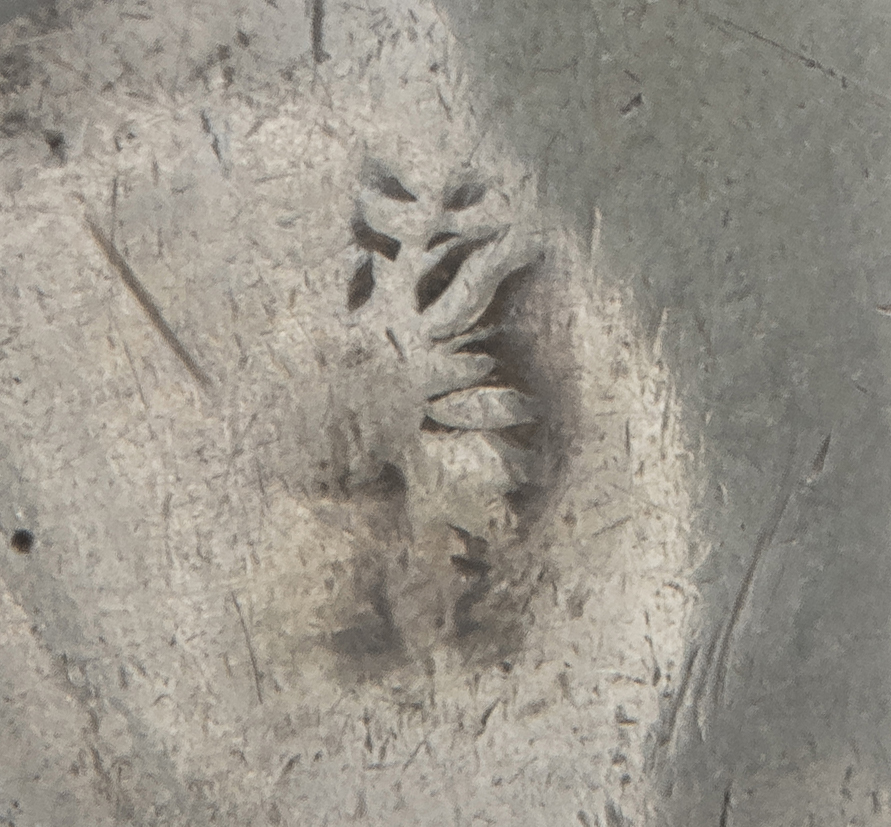
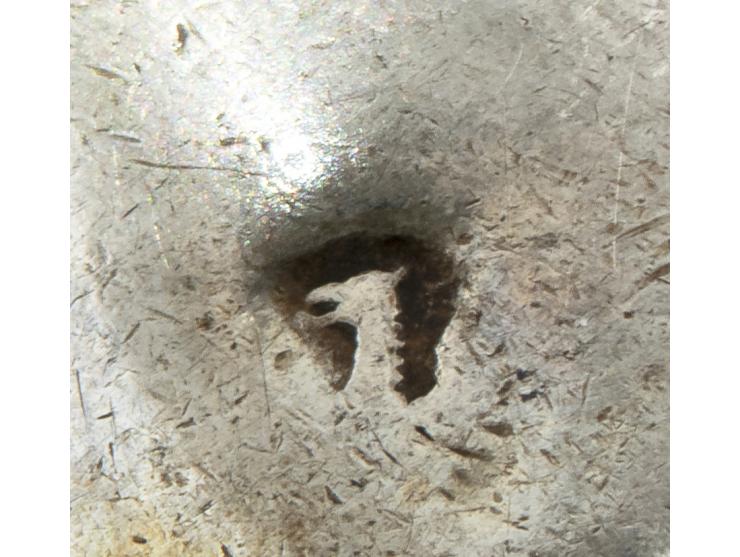
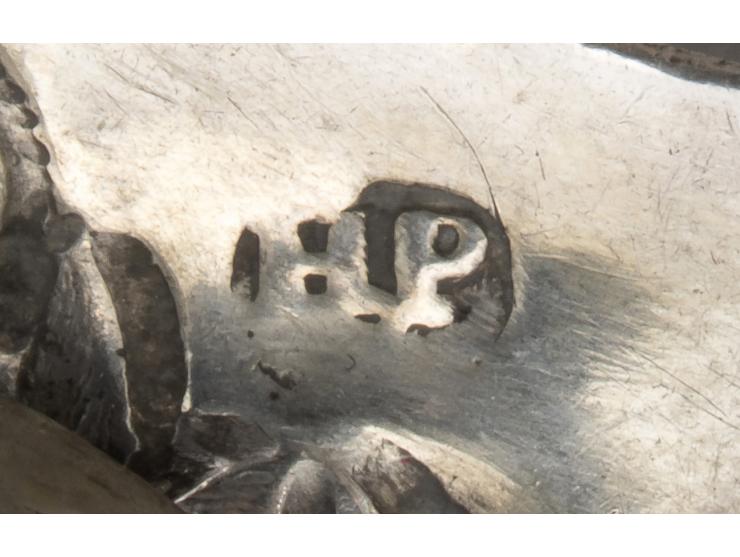
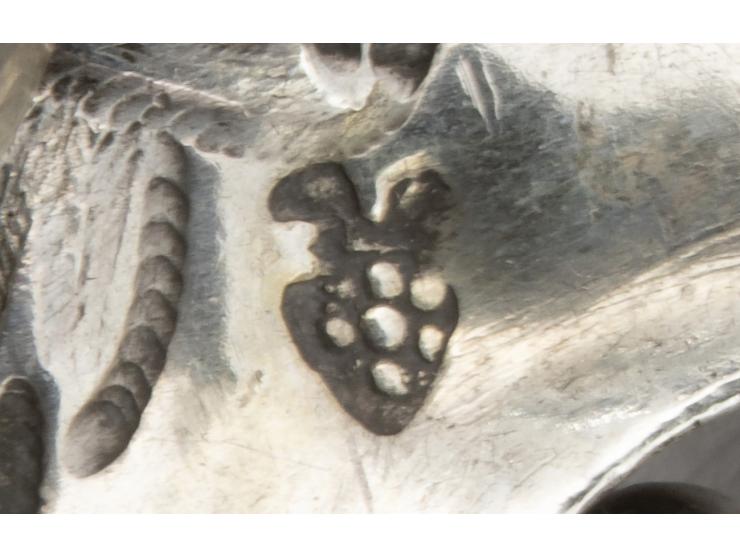
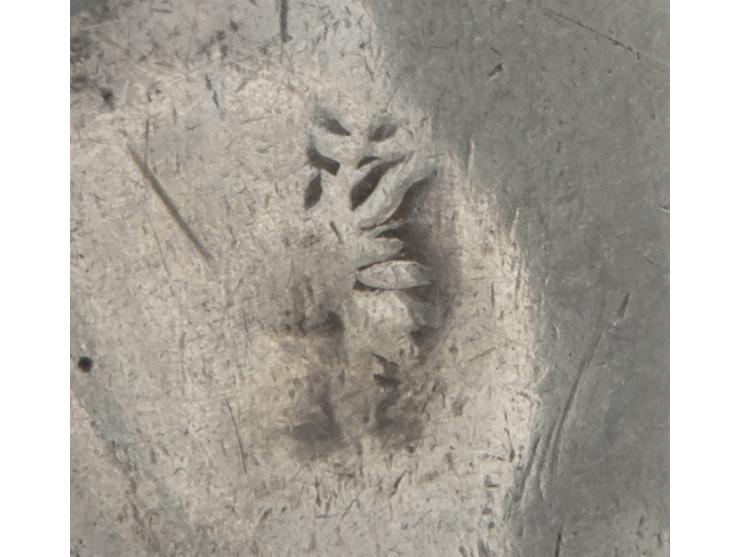
Silver, repoussé, cut and engraved. Marked with the Augsburg city mark (in use ca. 1645-1670) and with the maker's mark HP within an oval frame, apparently that of Hieronymus Priester, a master silversmith from 1649 onward (Seling 1555). Bells marked with partial 17th-century fineness marks from Frankfurt am Main (eagle).
This Torah shield was documented by Theodor Harburger in the village of Goßmannsdorf between ca. 1925 and 1932; owing to this documentation, its precise provenance in a small Bavarian Jewish community is known.
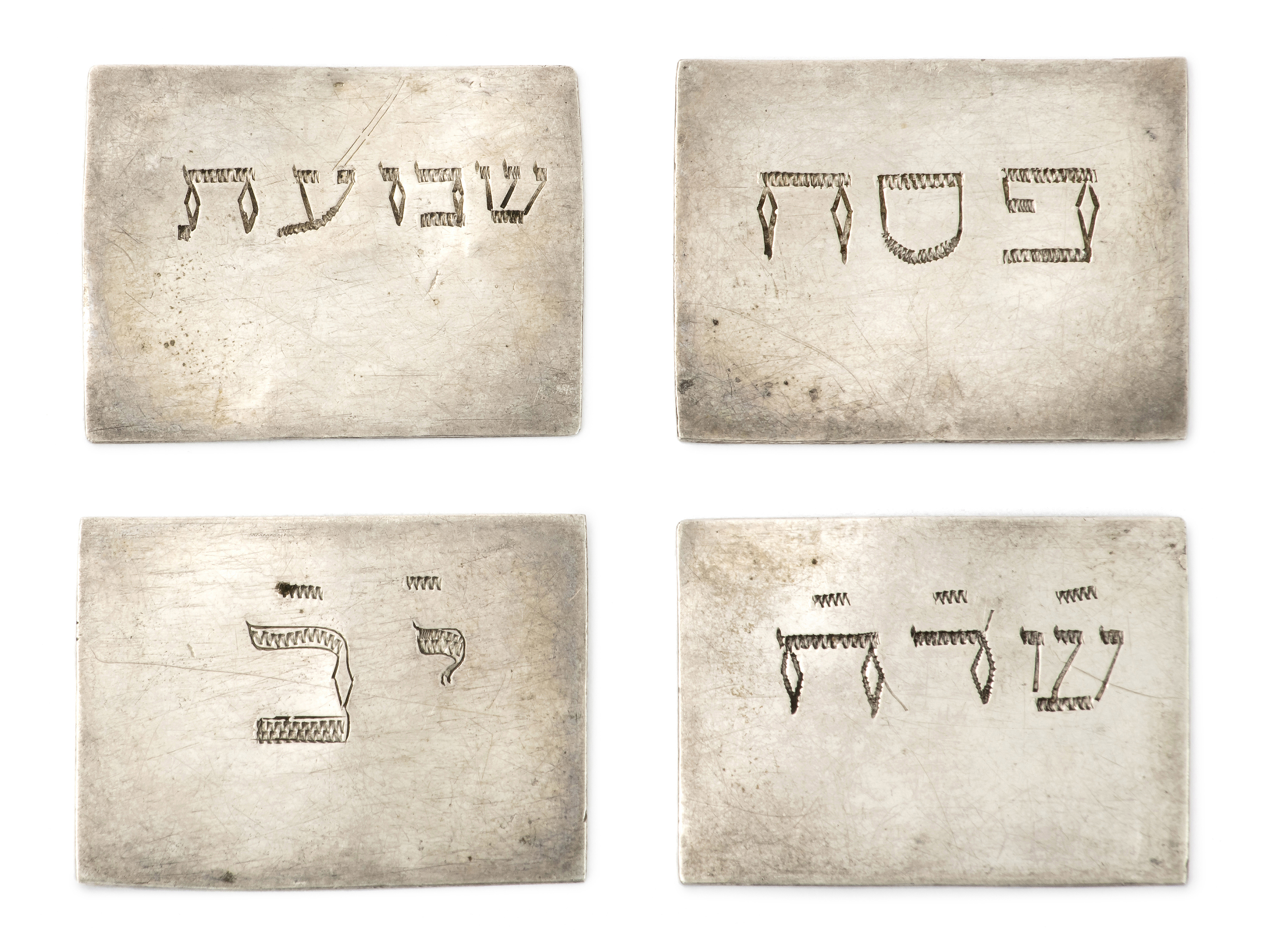
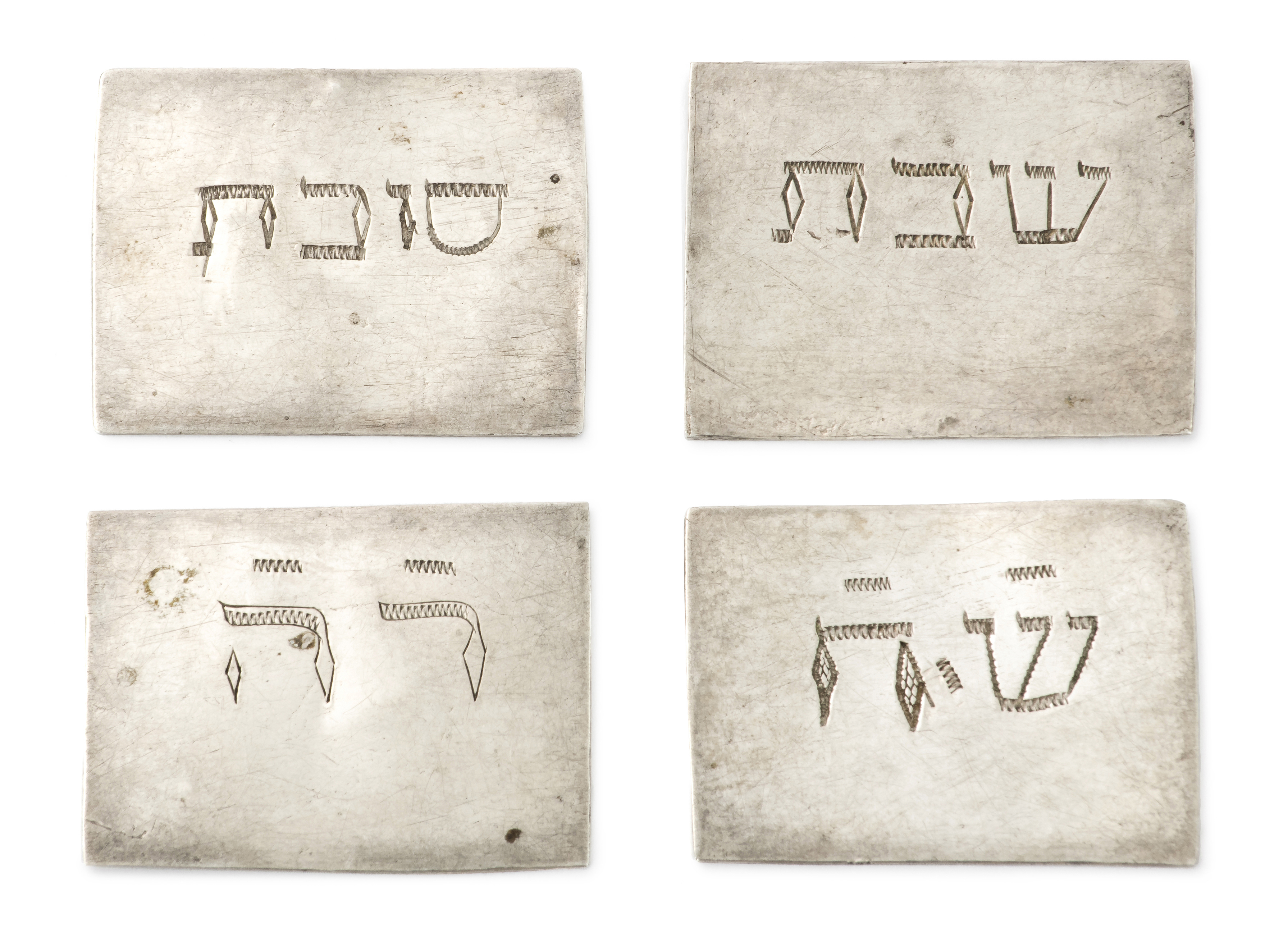
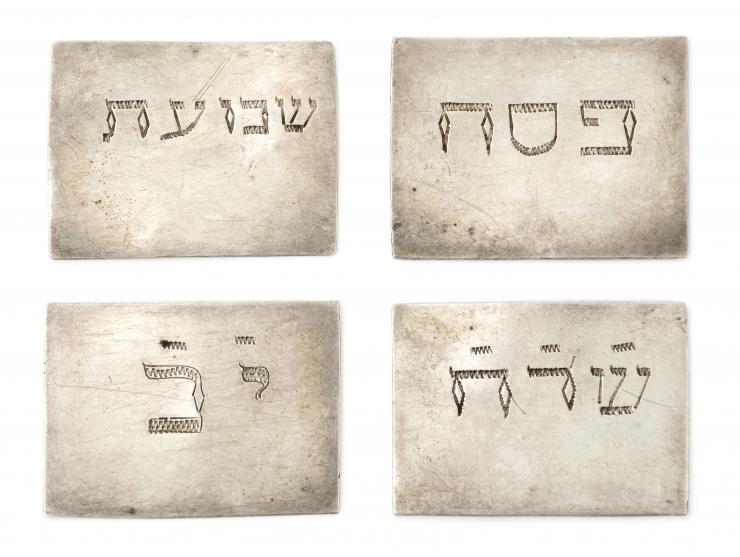
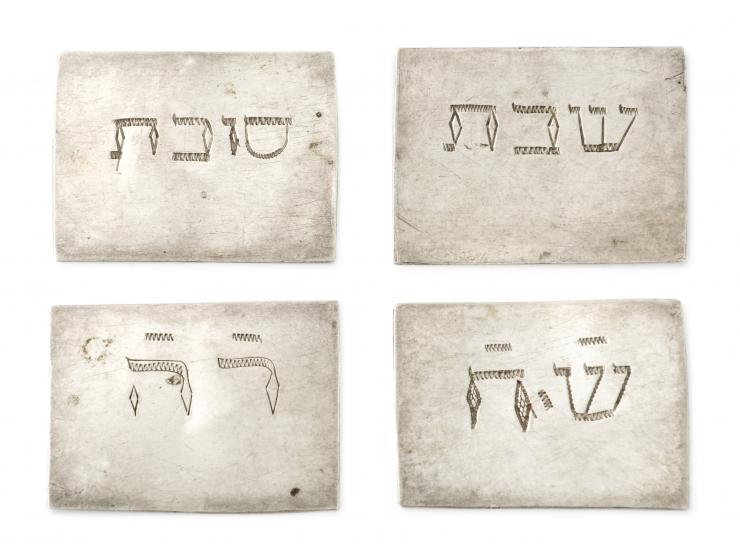
A small Torah shield, adorned with high-relief vegetal motifs in rich Baroque style and with a pair of putti figures. At the top is a crown-shaped ornament, affixed with two screws. At center is a rectangular compartment for interchangeable plaques (four double-sided plaques are present, possibly later), secured by two pins on the reverse. At the bottom is an ornament in the form of the Tablets of the Law, also affixed with two screws. Engraved on the tablets are abbreviated forms of five of the Ten Commandments, and above them are engraved the letters "ז'ב'ל' / ט'ב'ש'", apparently the initials of the couple who dedicated the shield to a synagogue. Three long suspension chains are attached through three dedicated holes along the upper edge. Three bells are suspended from dedicated holes along the lower edge (one bell non-original).
The shield originates from the collection of Simon Brueckheimer (see below). In a list compiled by Brueckheimer's son, Lazar (Eliezer), in 2014, it is noted that the shield was created through secondary use of a silver ornament from an antique piece of furniture. This hypothesis may explain the presence of the putti figures on the shield – an ornamental motif uncharacteristic of ritual objects of this type – although similar figures also appear on another Torah shield from Bavaria, originating in the town of Coburg, Upper Franconia (documented by Harburger, p. 144, P160-405).
A Jewish community in the village of Goßmannsdorf am Main, located approx. 16 km south of Würzburg, Lower Franconia, existed continuously from the 16th century onward, although it was always small and subject to restrictions imposed by the authorities. Jews from Goßmannsdorf are first mentioned in a document from 1510; another document, from 1532, lists ten Jewish men in the village, apparently attesting to the existence of a small community. By the 17th century, a Jewish community certainly existed there: in 1655, six Jewish families resided in the village, earning their livelihood primarily through trade in cattle and horses, raw materials and agricultural produce.
At the end of the 17th century, a Jew named Baruch ben Jirmiahu Naftali established a synagogue in his home for the village community and arranged for the writing of a Torah scroll. In 1720, a decision was made to establish a new synagogue in the home of a Jew named Mayer, but this initiative failed, and only in 1764 was official permission granted by the authorities to build a synagogue. This synagogue was inaugurated in 1765, in a festive ceremony during which the Torah scrolls were transferred from the old prayer room to the new building. Regular services were held in the synagogue until the early 20th century; in subsequent years, the community required assistance from Jews outside the village to complete a minyan.
During Kristallnacht in November 1938, Nazi rioters destroyed the interior of the synagogue, desecrated the last Torah scroll still kept there, and damaged the remaining ritual objects (some items had been transferred in advance to Munich). In 1939, the synagogue building was sold to the Goßmannsdorf municipality, under unjust conditions imposed upon the representatives of the village's destroyed community.
Height: 16 cm (including chains: 46 cm). Width: 14.2 cm. Overall good condition.
Provenance:
• Jewish Community of Goßmannsdorf, Bavaria.
• Collection of Simon Brueckheimer.
Reference: Theodor Harburger, Die Inventarisation jüdischer Kunst- und Kulturdenkmäler in Bayern, Fürth: Jüdisches Museum Franken, 1998, p. 229 (P160-620).
Additional information regarding the Jewish community of Goßmannsdorf appears on the Alemannia Judaica website.
Proceeds of sale will be donated.
The Collection of Simon Brueckheimer
Simon Brueckheimer was born in Külsheim in 1889. He moved to Marktbreit in 1911 and served there as a schoolteacher from 1920 onward. In 1929, he initiated a project to document Jewish ritual objects and property in the communities of Bavaria, which he conducted during school vacations as part of the Verband Bayerischer Israelitischer Gemeinden (Association of Bavarian Jewish Communities).
During Kristallnacht, Brueckheimer fled to Frankfurt, where he was arrested and sent to the Buchenwald concentration camp. After six weeks he was released, returned to Marktbreit, and in April 1939 emigrated with his family to London, where he continued his project of documentation of the Jewish communities of Bavaria.
During his travels among small communities, as well as after his emigration to London, Brueckheimer assembled a small collection of Jewish objects, which he gathered in the communities themselves or acquired later from Jewish refugees who had arrived in England. The highlight of his collection is a goblet used for the Chevra Kadisha meal of the community of Schwabach, now in the collection of the Israel Museum. His papers, documenting approximately 150 small Jewish communities throughout Bavaria, are preserved in the Yad Vashem archives in Jerusalem. Brueckheimer died in England in 1950.
Additional items from the Collection of Simon Brueckheimer will be offered for sale in our forthcoming auctions. Proceeds from the sale of these items will be donated in full.
Catalogue Value

Auction 106 Incunabula and First Editions | Illuminated Manuscripts | Jewish Ceremonial Art
Feb 24, 2026
Opening: $50,000
Sold for: $62,500
Including buyer's premium
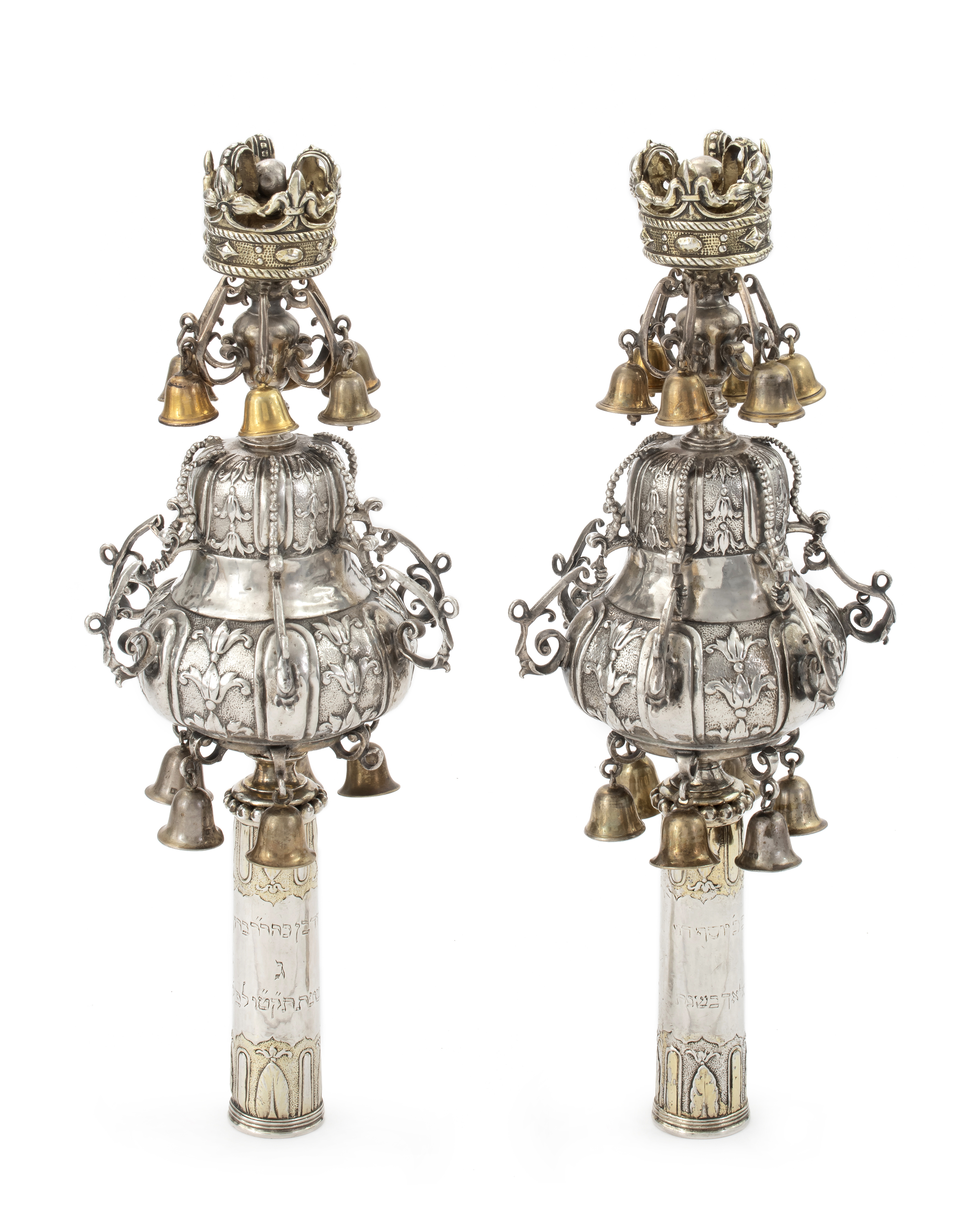
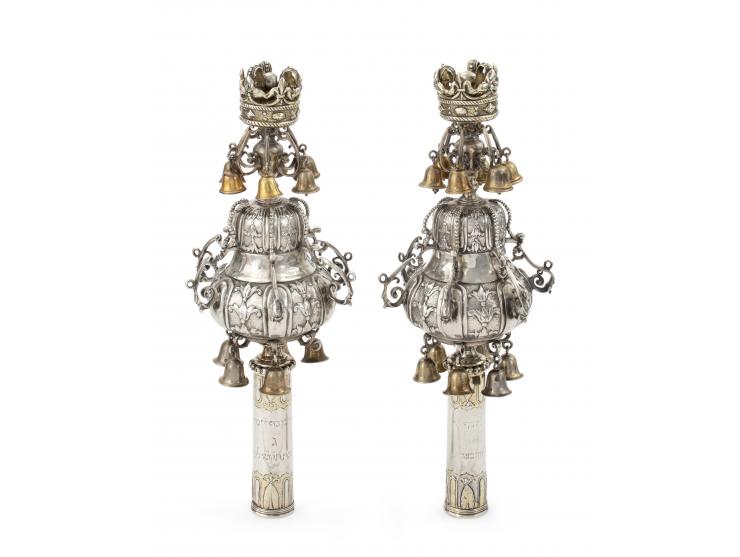
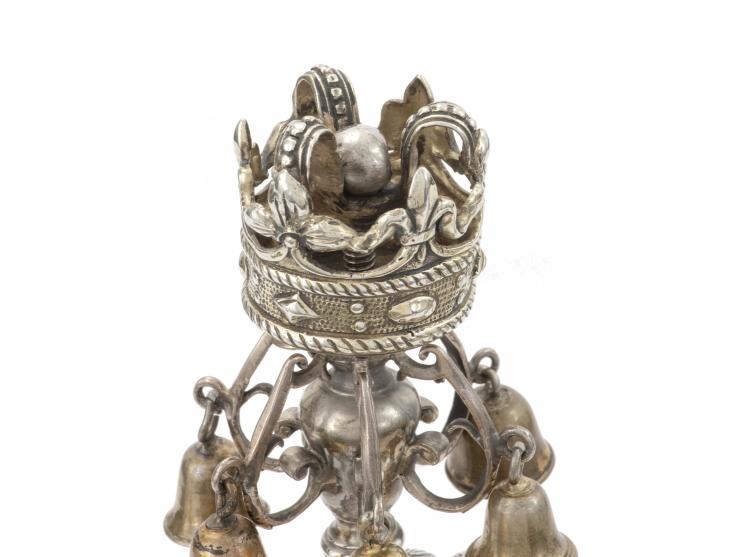
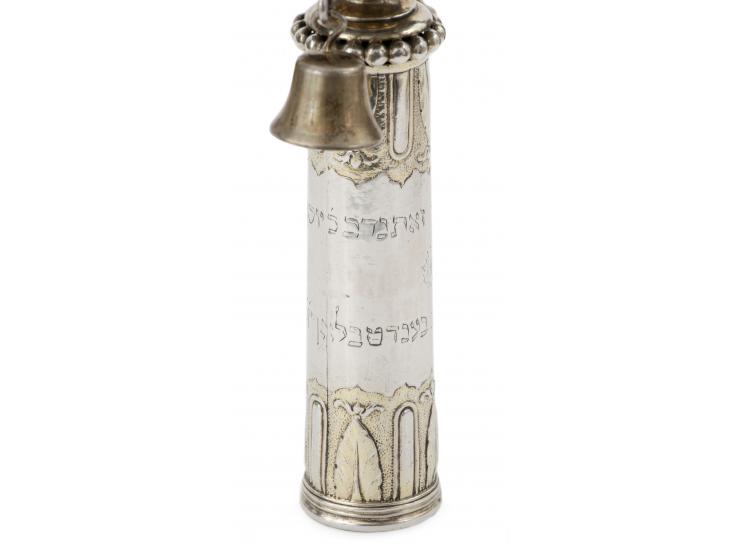
Pair of Torah finials. London, England, 1722, probably by Abraham Lopes de Oliveyra or William Spackman. Dedicatory inscription [to the Great Synagogue of London] dated 5515 [1755].
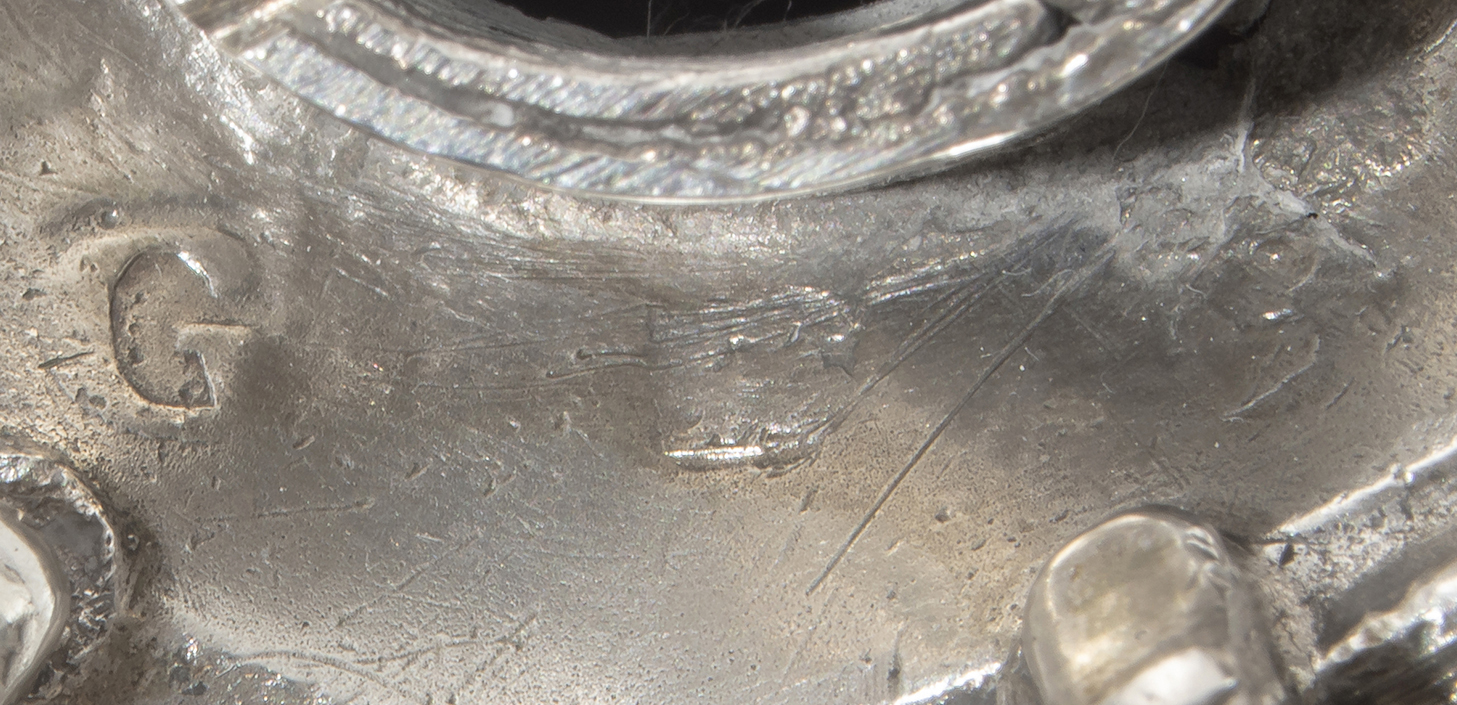
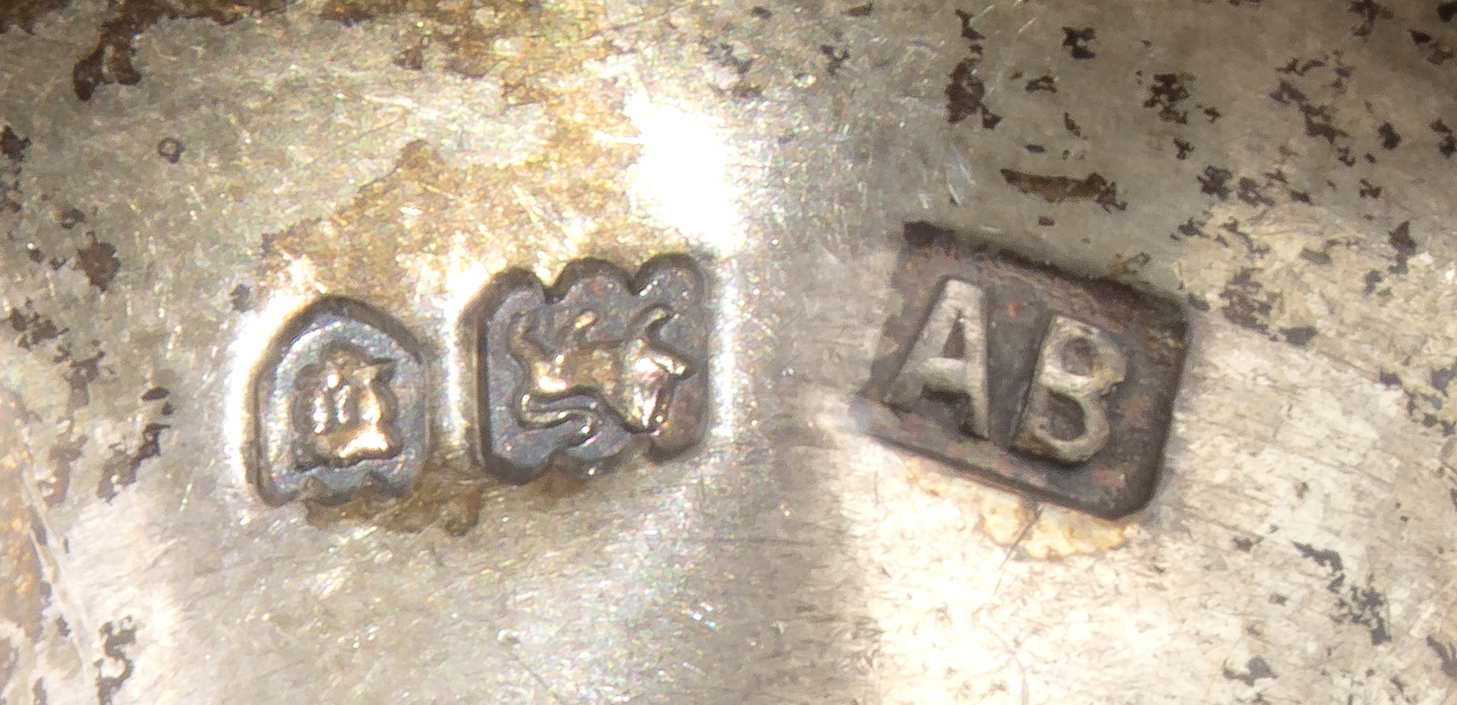
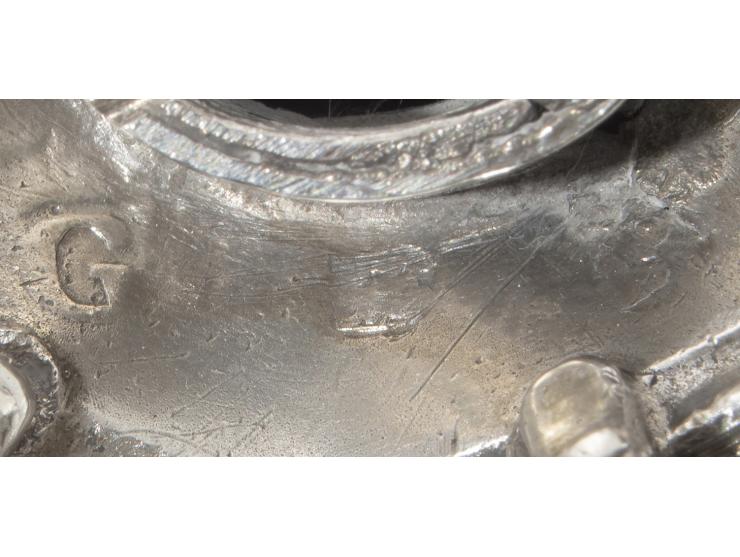
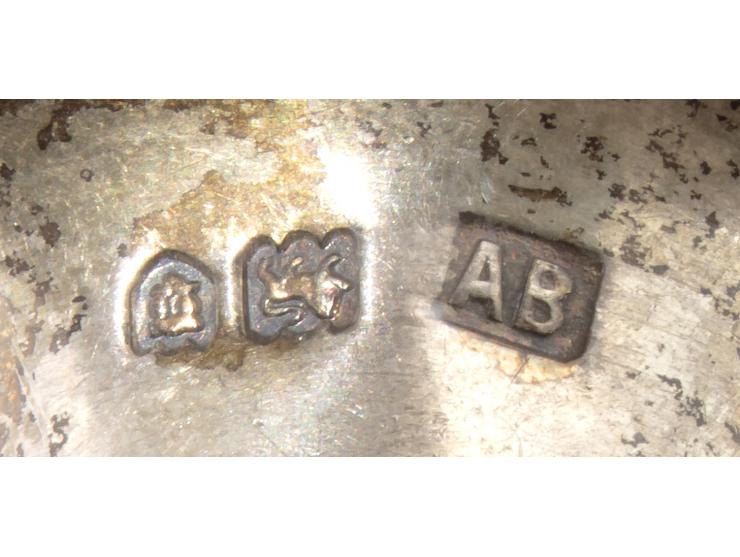
Silver, cast, repoussé, stamped and engraved (one finial marked with a worn fineness mark, apparently the Britannia standard, and with a London date letter – G = 1722; several later bells marked with the maker's mark AB, probably Abraham Benelisha, London, ca. 1910); parcel-gilt.
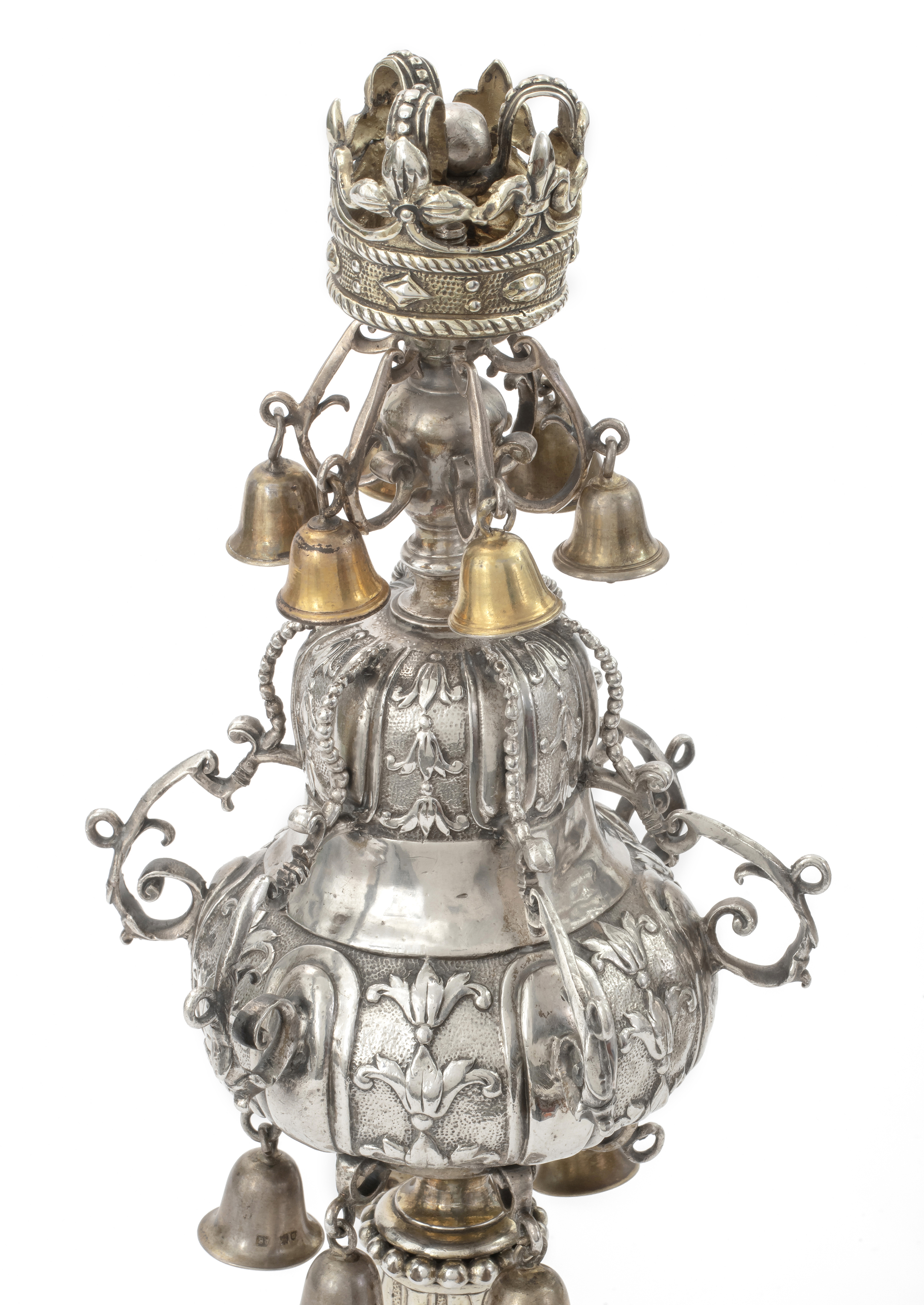
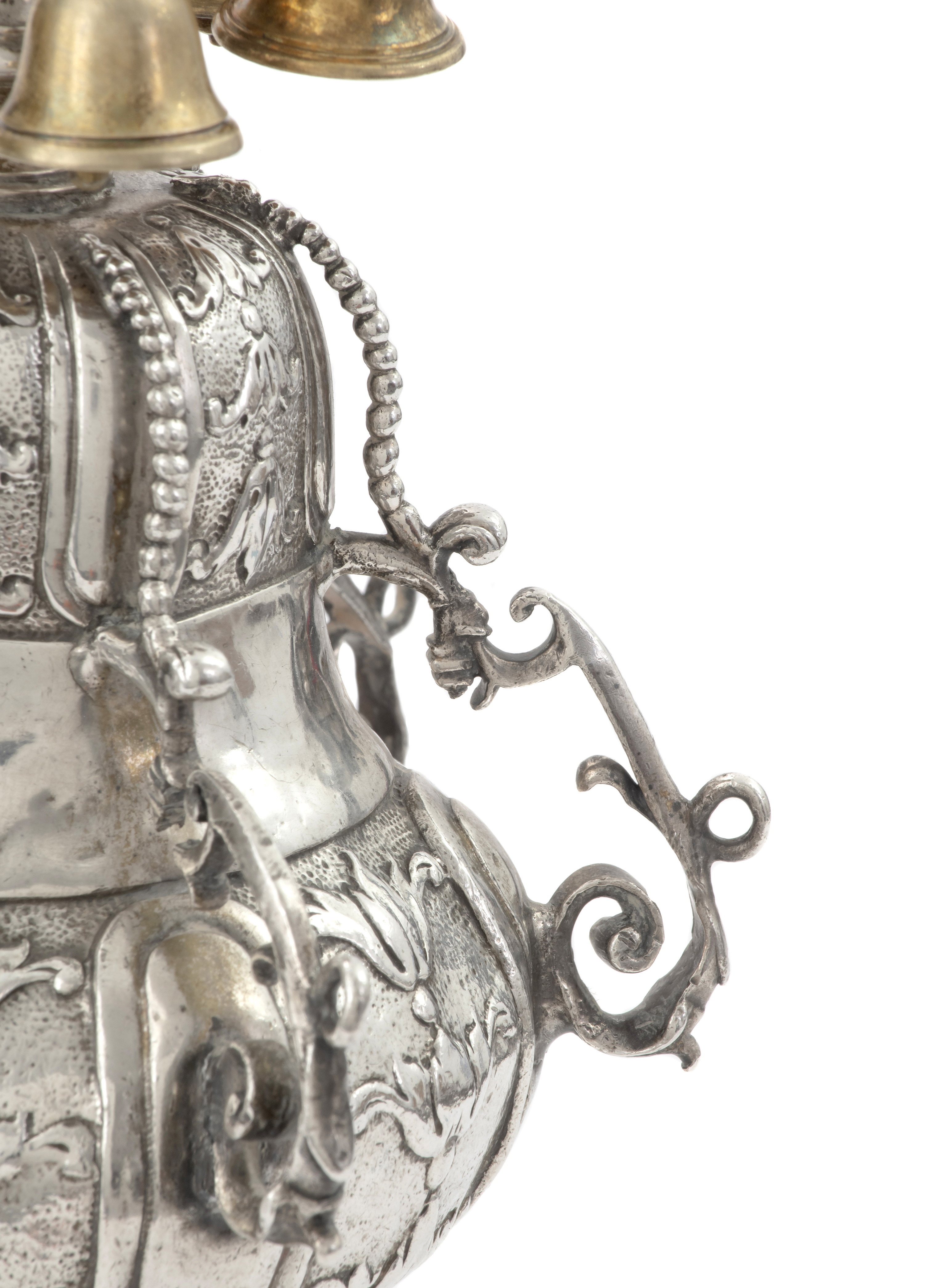
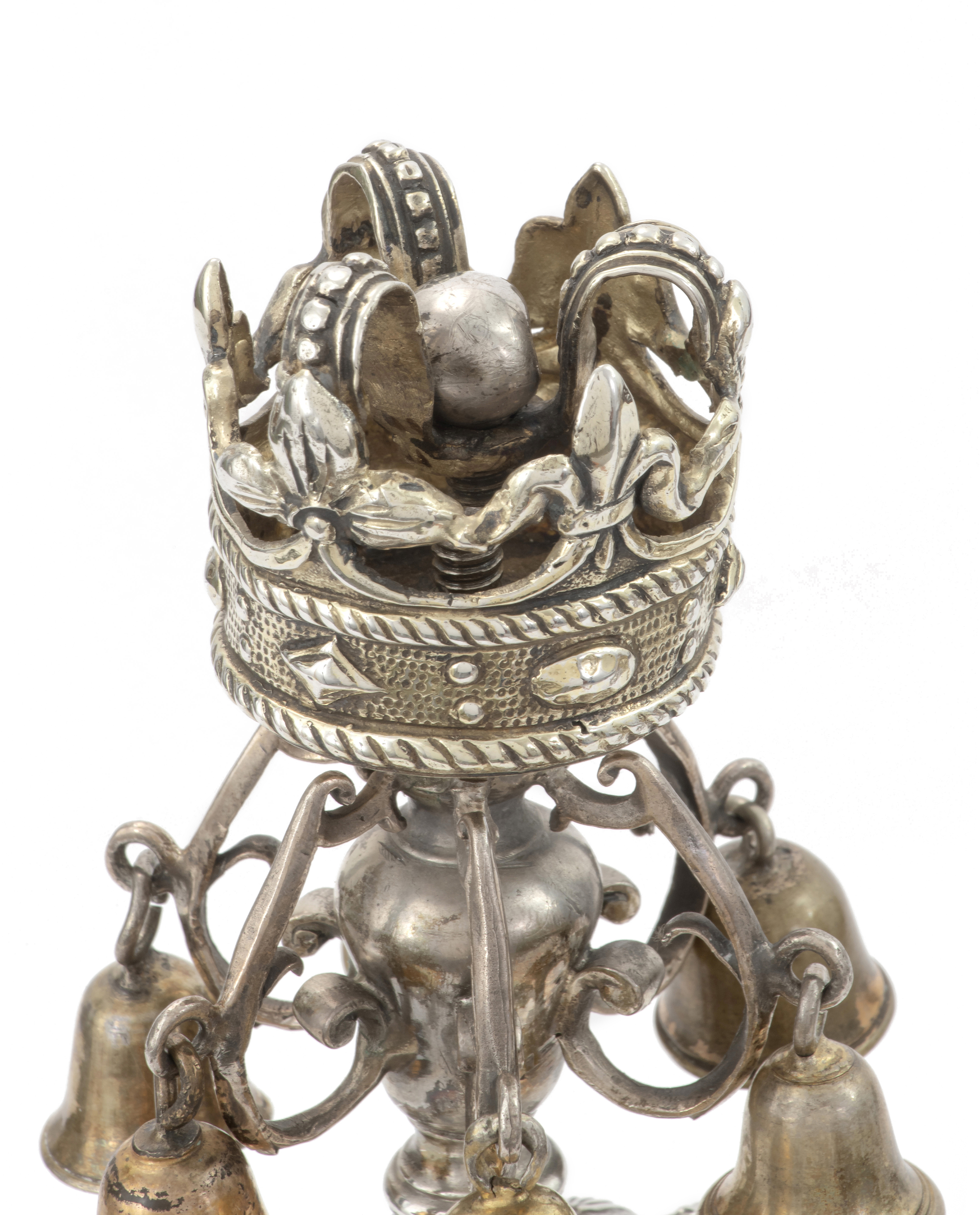
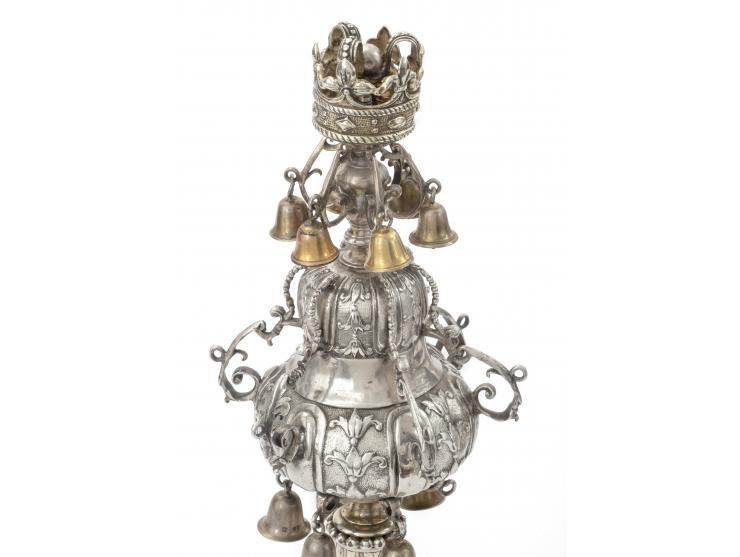
Each finial surmounted by a crown-shaped parcel-gilt ornament with three arms, centered by a silver orb. A vase-shaped ornament separates the upper crown from the finial body, which is formed of two flattened, pear-shaped globes, decorated with smooth bands and with repoussé bands of bellflowers.
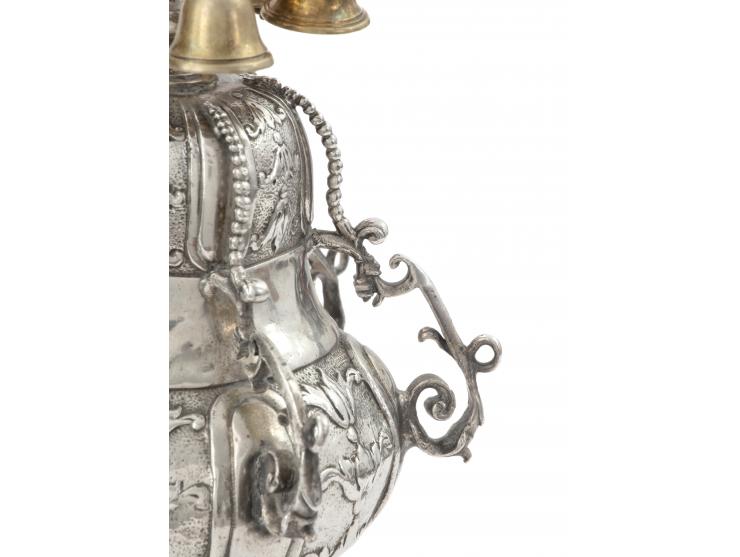
Three rows of six stylized hooks are soldered to the vase ornaments and to the finial bodies, with parcel-gilt bells suspended from dedicated rings on the upper and lower hooks. An additional ornament in the form of a chain of silver beads is soldered to the central hooks.
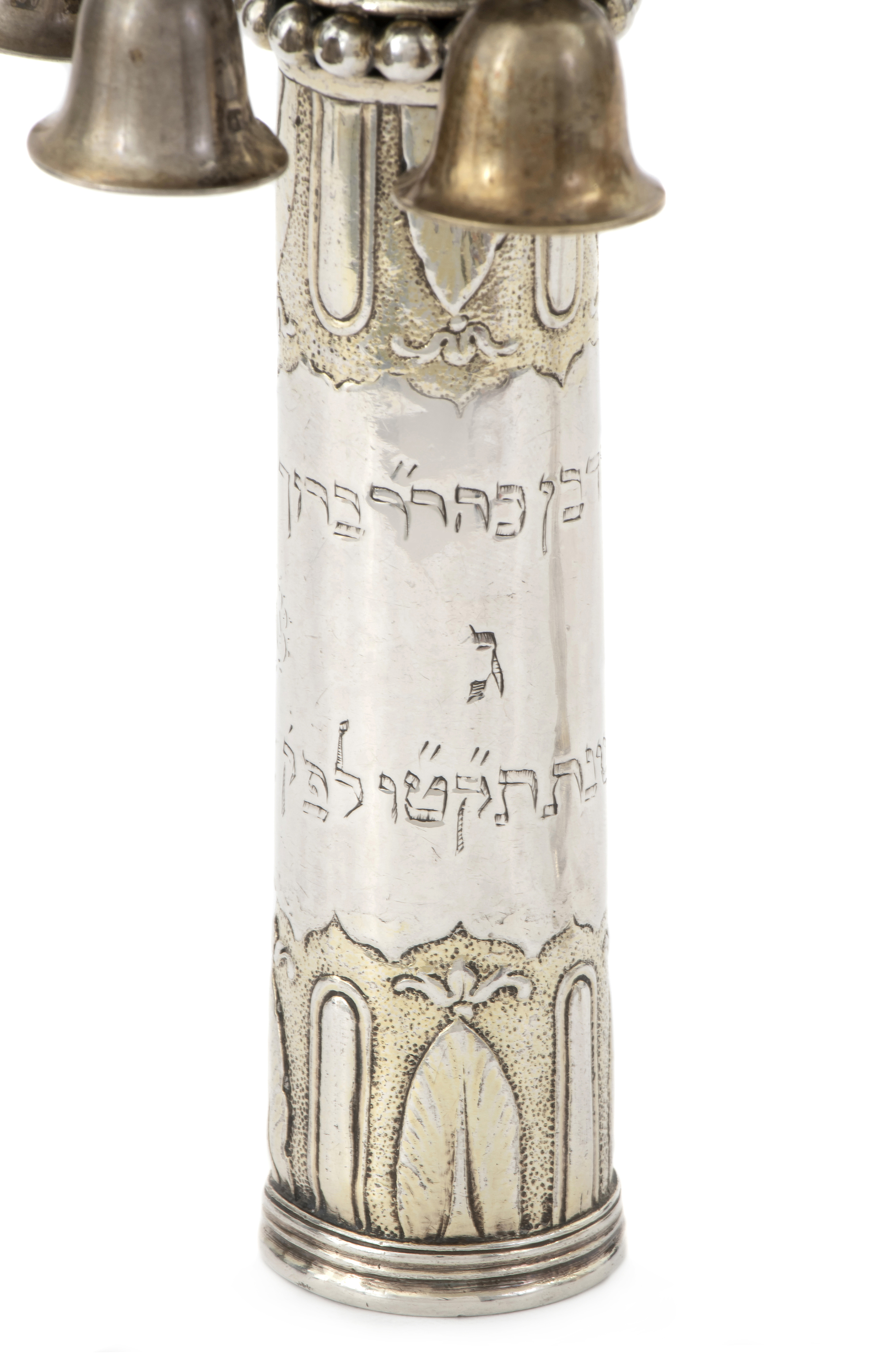
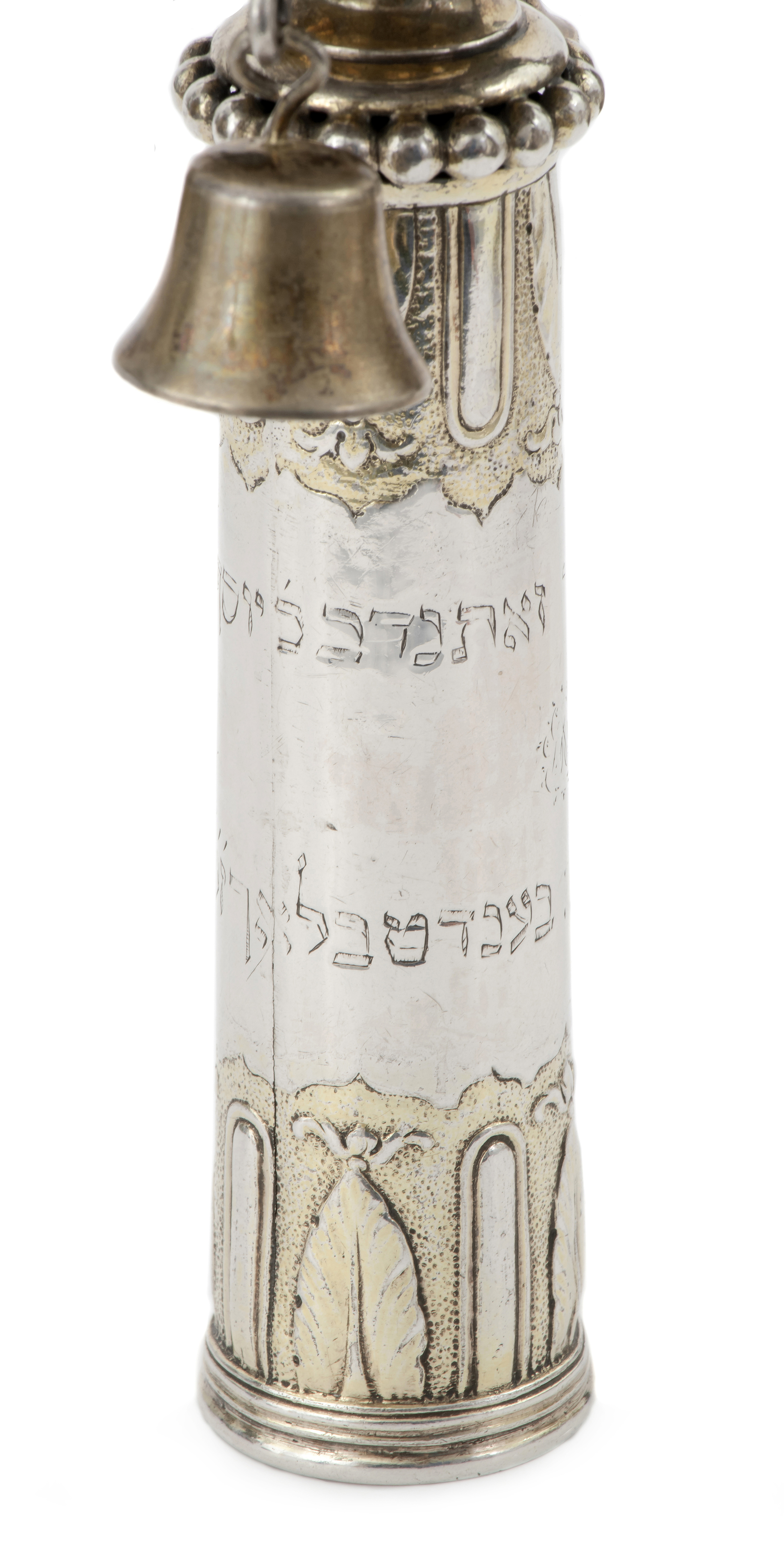
The finials stand on hollow cylindrical stems, decorated with parcel-gilt vegetal patterns echoing those on the finial bodies. Identical dedication inscriptions are engraved on the stems: "This was donated by R. Yosef David son of R. Baruch / Bendt Bloch, of blessed memory, in the year 5515" (on one stem, part of the inscription is slightly worn). Both stems are marked with the Hebrew letter gimel (engraved at the center of the dedication inscription) and also bear an additional ornament or monogram (worn).
The name of David son of Benedict (Baruch) Bloch, who donated the present finials, appears in Cecil Roth's study documenting the membership of the Great Synagogue of London from ca. 1708 to 1750 (see below, Roth, 1962), where the full name of his father, Benedict (Baruch) son of Solomon Bloch, is also recorded. The father's name is likewise documented in the records of the Chevra Kadisha of the Ashkenazi community of London (founded 1695/6), where he is listed as serving as Gabai in 1708, as well as in connection with the new synagogue building in 1722 (see Cecil Roth, The Great Synagogue, below; Roth's book also records a Shochet named Baruch Benedict, who may be the same individual).
The Great Synagogue served the Ashkenazi community of London for centuries, and was the first Ashkenazi synagogue established in the city following the readmission of Jews to England in the 17th century. It was first inaugurated in 1690, rebuilt and enlarged in 1722, 1766 and 1790, and was ultimately destroyed in May 1941 during the German Blitz in World War II.
London-made Torah finials from the first half of the 18th century are exceedingly rare. Of all pairs known today – fewer than twenty in total – most are preserved in museum collections. The documented finials from this period were produced by five silversmiths: Samuel Wastell (one pair), Gabriel Sleath (one pair), Richard Edwards (one pair, identification uncertain), William Spackman (three pairs), and Abraham Lopes de Oliveyra (approx. eleven pairs).
Among the documented finials by these makers, the present pair shows the closest affinities to finials made by de Oliveyra, although certain decorative elements – such as the beaded chains and the bellflower motifs – also appear on finials made by William Spackman (for comparison, see: Israel Museum Collection, item B13.0555(a-b); Rickie Burman et al., Treasures of Jewish Heritage: The Jewish Museum London, London: Scala, 2006, p. 79).
Abraham Lopes de Oliveyra (also, de Oliveira) – stemming from a Marrano family of Portuguese origin – was born in Amsterdam in 1657 and died in London in 1750. He was the first Jewish silversmith active in London and, throughout his career, the only Jewish silversmith working in England. In his early years in London, de Oliveyra was employed in cleaning and repairing silver objects and utensils for the Spanish-Portuguese synagogue on Creechurch Lane (which later became the Bevis Marks synagogue), until he received official authorization to use a hallmark and to produce silver in his own workshop. Among his Judaica works are approximately eleven pairs of Torah finials made in the 1720s-1730s for synagogues of the Jewish communities of London, one or two Torah pointers, two Sabbath lamps, and a small number of other objects, most of which – apart from a few exceptions – are now preserved in the collection of the Jewish Museum, London, and in other museum collections.
Height: 33.5 cm. Maximum width: 12.5 cm. Overall good condition. Minor bends and warping, partly professionally restored. Breaks to several central hooks, with small losses; some professionally restored. Missing hooks replaced with new ones on upper vase ornaments. Some bells are later replacements; one bell missing from lower suspension hook. Possibly, bells missing from central suspension hooks. The finials are composed of three parts: upper crown ornament (screw-mounted), finial body with upper vase ornament soldered to it, and stem (also screw-mounted). Possibly, the upper ornament was originally screw-mounted. Finials' bodies appear to have been damaged near junction with stem, where worn silver marks are located, and silver marks were abraded during restoration.
Provenance:
• The Great Synagogue, London.
• The Central Synagogue (Great Portland Street), London.
• Sotheby's, New York, June 5, 2019, Lot 2.
Reference:
• Cecil Roth, The Great Synagogue, London, 1690-1940 (published by E. Goldston, London, 1950), online version (2003), pp. 17, 29, 61.
• Cecil Roth, "The Membership of the Great Synagogue, London, to 1791", Miscellanies (Jewish Historical Society of England, London), 6 (1962), pp. 177 (no. 19), 181, 184.
• A.G. Grimwade, "Anglo-Jewish Silver", Transactions (Jewish Historical Society of England, London), 18 (1953-1955), pp. 113-125.
Catalogue Value
![Gold amulet case ("Shad-dai"). [Italy, 19th century].
Gold, cast, repoussé and engraved (unmarked).](https://files.kedem-auctions.com/files/Sale106/16_1.jpg "Gold Amulet Case – Italy, 19th Century – Luzzatto Family, San Daniele")
![Gold amulet case ("Shad-dai"). [Italy, 19th century].
Gold, cast, repoussé and engraved (unmarked).](https://files.kedem-auctions.com/files/Sale106/16_2.jpg "Gold Amulet Case – Italy, 19th Century – Luzzatto Family, San Daniele")
![Gold amulet case ("Shad-dai"). [Italy, 19th century].
Gold, cast, repoussé and engraved (unmarked).](https://files.kedem-auctions.com/files/Sale106/16_3-WEB.jpg "Gold Amulet Case – Italy, 19th Century – Luzzatto Family, San Daniele")
Auction 106 Incunabula and First Editions | Illuminated Manuscripts | Jewish Ceremonial Art
Feb 24, 2026
Opening: $15,000
Sold for: $40,000
Including buyer's premium
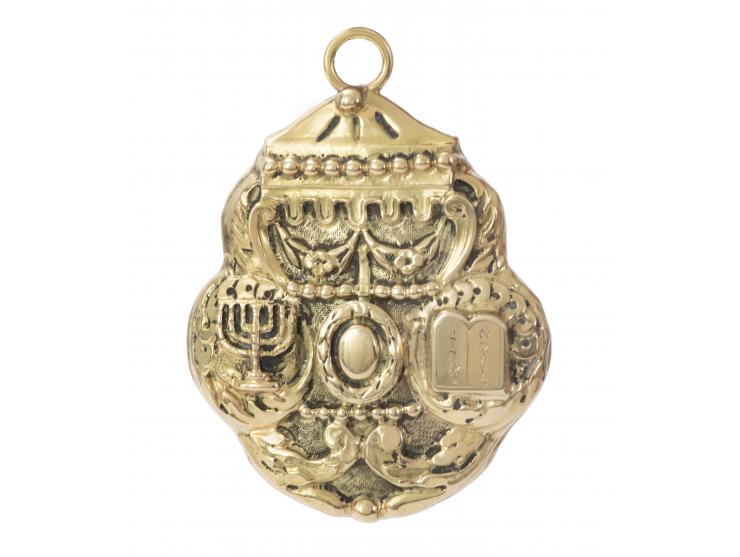
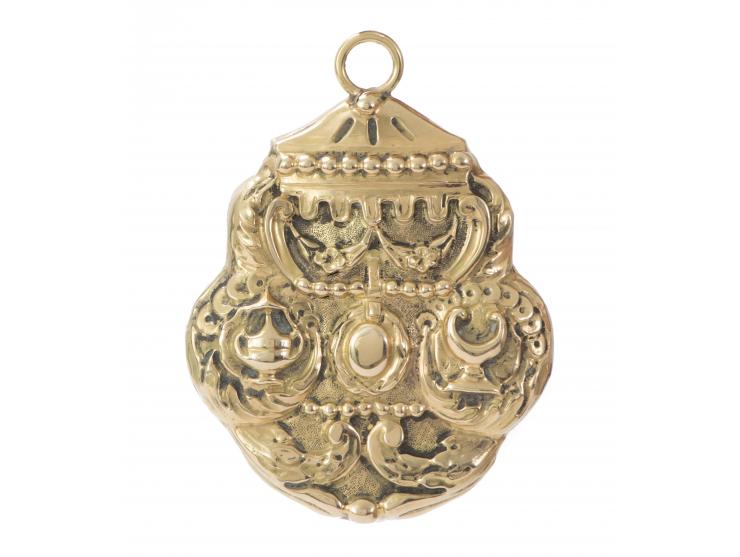
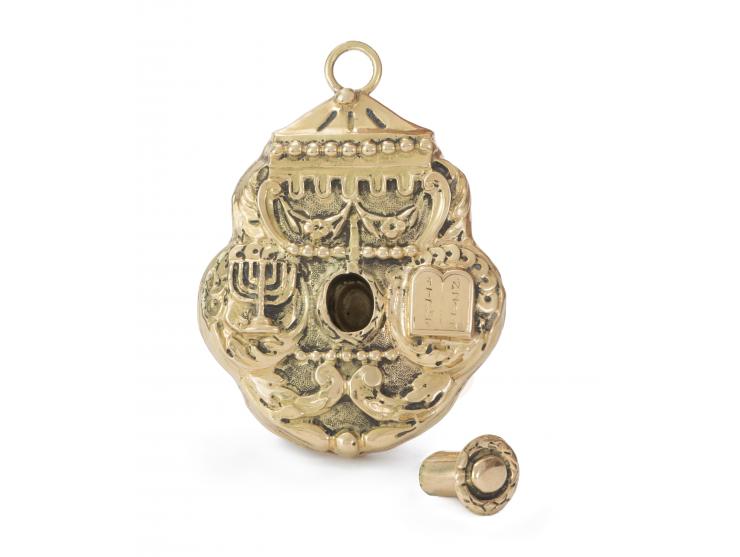
Gold amulet case ("Shad-dai"). [Italy, 19th century].
Gold, cast, repoussé and engraved (unmarked).
Two-sided gold amulet case. The top is surmounted by a canopy-shaped ornament, above which is a suspension ring. Both sides of the case are identically decorated, with symmetrical patterns including rocailles, flowers and strings of beads. In addition to these ornaments, the front of the amulet features engraved representations of the Tablets of the Law and a seven-branched Menorah, while the reverse is decorated with a priestly headdress and incense burner. The center of the front of the amulet features a removable lid, designed as a plain cartouche.
Italian amulet cases of this type were generally made of silver. Gold amulet cases of this kind are particularly rare. Originally, such cases were used to hold amulets that were folded and stored within their inner cavity; at times the amulets were written for a specific individual or for a particular purpose, and were replaced when the case passed into the possession of another person. Over time, the cases themselves also came to be regarded as amulets.
The present amulet case was handed down through several generations of the Luzzatto family, an Italian-Ashkenazic Jewish family originating from the town of San Daniele del Friuli, in the Friuli-Venezia Giulia region of northeastern Italy, between Venice and Trieste. Notable members of the family include R. Moshe Chaim Luzzatto (Ramchal), Shmuel David Luzzatto (Shadal), Rachel Luzzatto Morpurgo, and many others – among the most important thinkers, writers and figures of Italian Jewry from the 16th century onward.
For a similar gold amulet case, see: Sotheby's, New York, December 17, 2008, Lot 89.
Height: 10 cm. Width: 8 cm. Thickness: 1.5 cm. Weight: 86.9 g. Good condition. Minor bends. Several tiny old solder repairs. Small crack to spherical ornament at base of suspension ring.
Provenance: Luzzatto Family, San Daniele del Friuli, Italy.
Catalogue Value