
Auction 106 Incunabula and First Editions | Illuminated Manuscripts | Jewish Ceremonial Art
Passover Haggadah – Mantua, 1568 – Many Fine Woodcut Illustrations and Decorations – Second Illustrated Haggadah Printed in Mantua, Especially Rare – Highly Impressive Illustrated Hebrew Print Production of the 16th Century
Opening: $50,000
Sold for: $68,750
Including buyer's premium
Passover Haggadah, with order of Bedikat Chametz and Kiddush for Pesach evening, and with Nimukei Yosef commentary by R. Yosef Ashkenazi of Padua. Mantua: Filipponi brothers and Yosef son of Yaakov Shalit, 1568.
Especially rare complete copy of the second illustrated Haggadah printed in Mantua (see below for more information on the two illustrated Haggadot printed in Mantua).
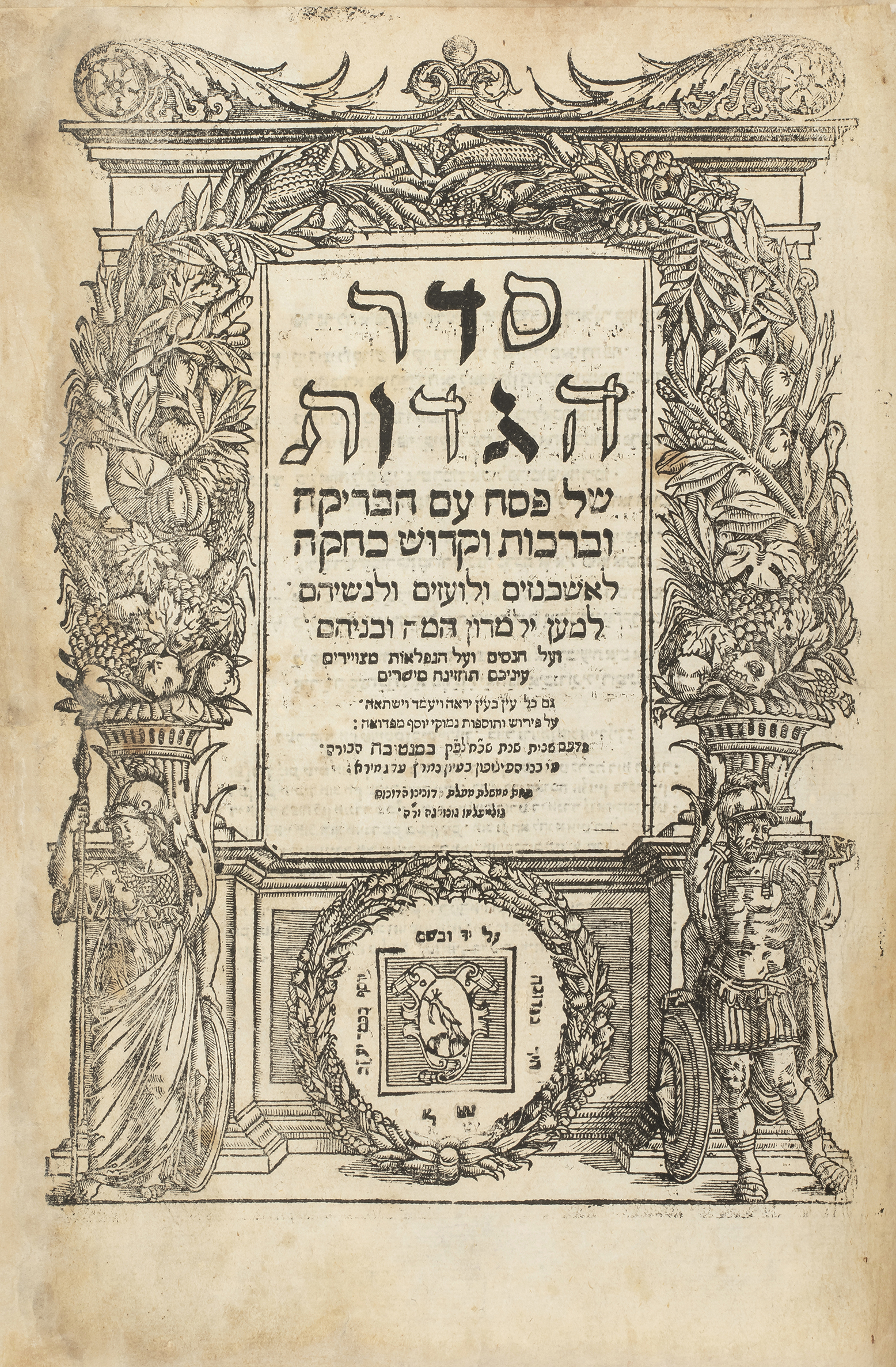
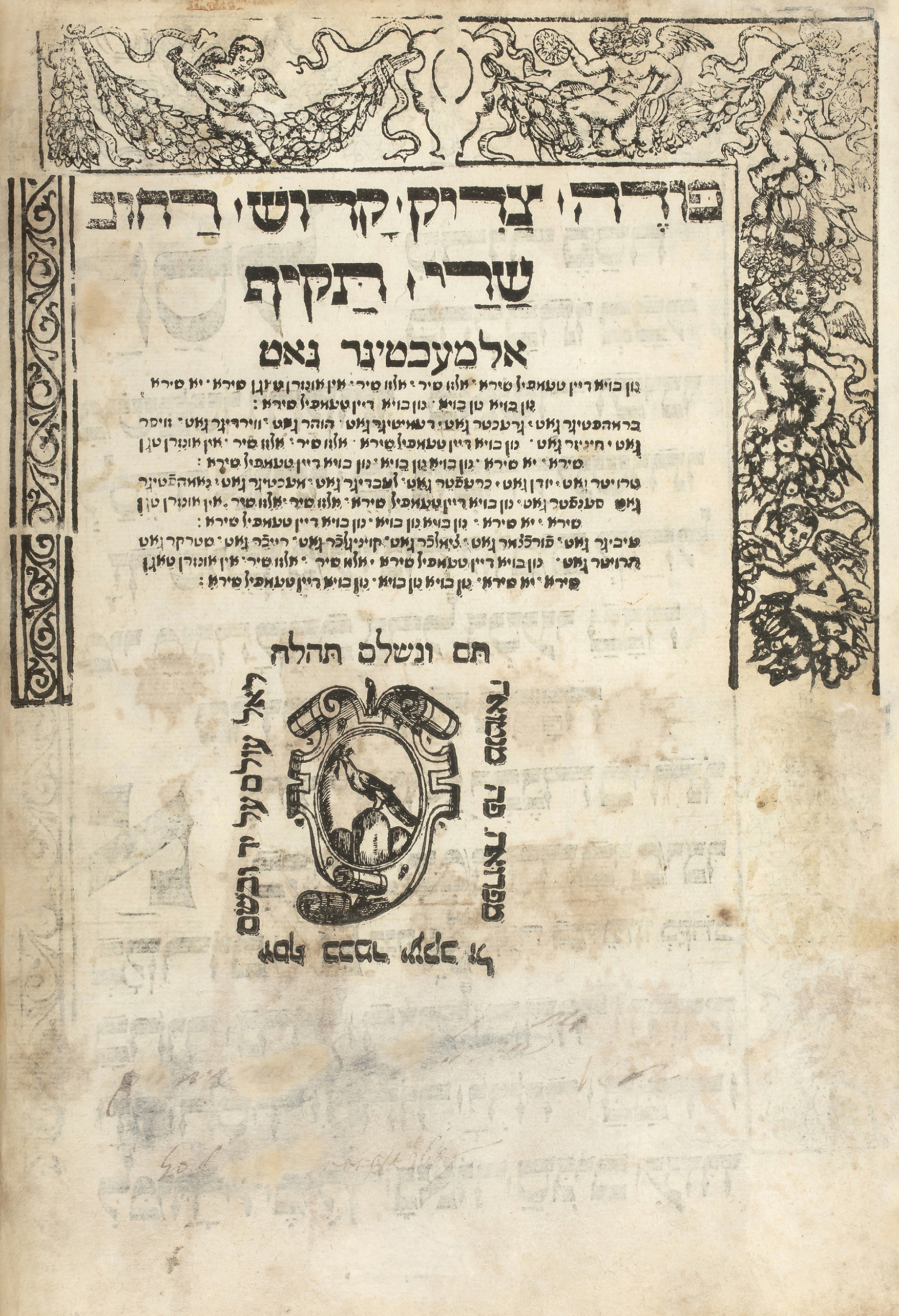
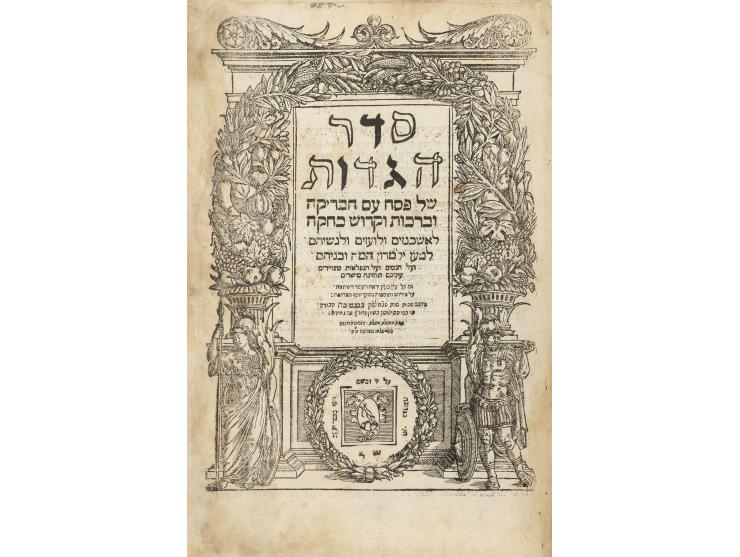
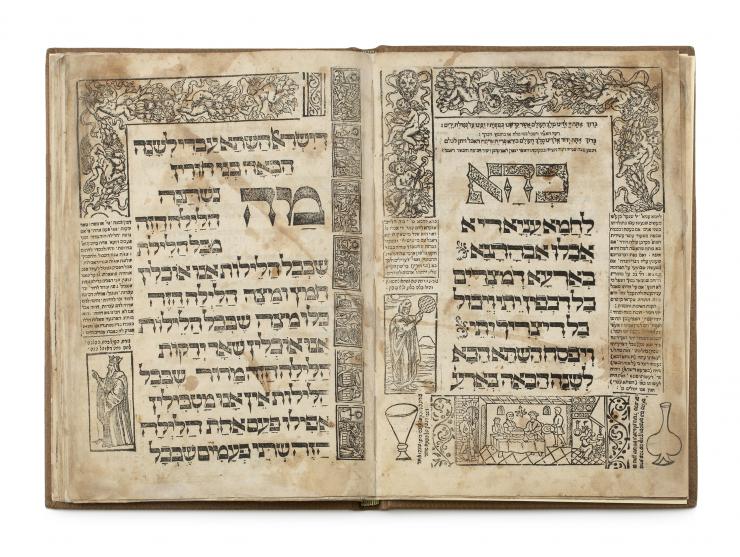
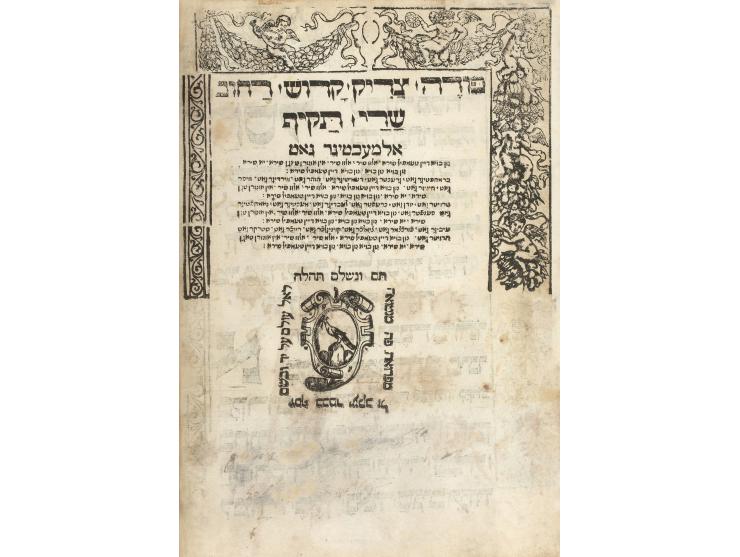
Fine illustrated title frame (featuring Mars and Minerva).
On title page: "Order of Passover Haggadah, with Bedikat Chametz, blessings and Kiddush as ordained, for Ashkenazim and Italian natives and their wives, in order that they and their children learn, and the miracles and wonders illustrated, your eyes shall see rightly".
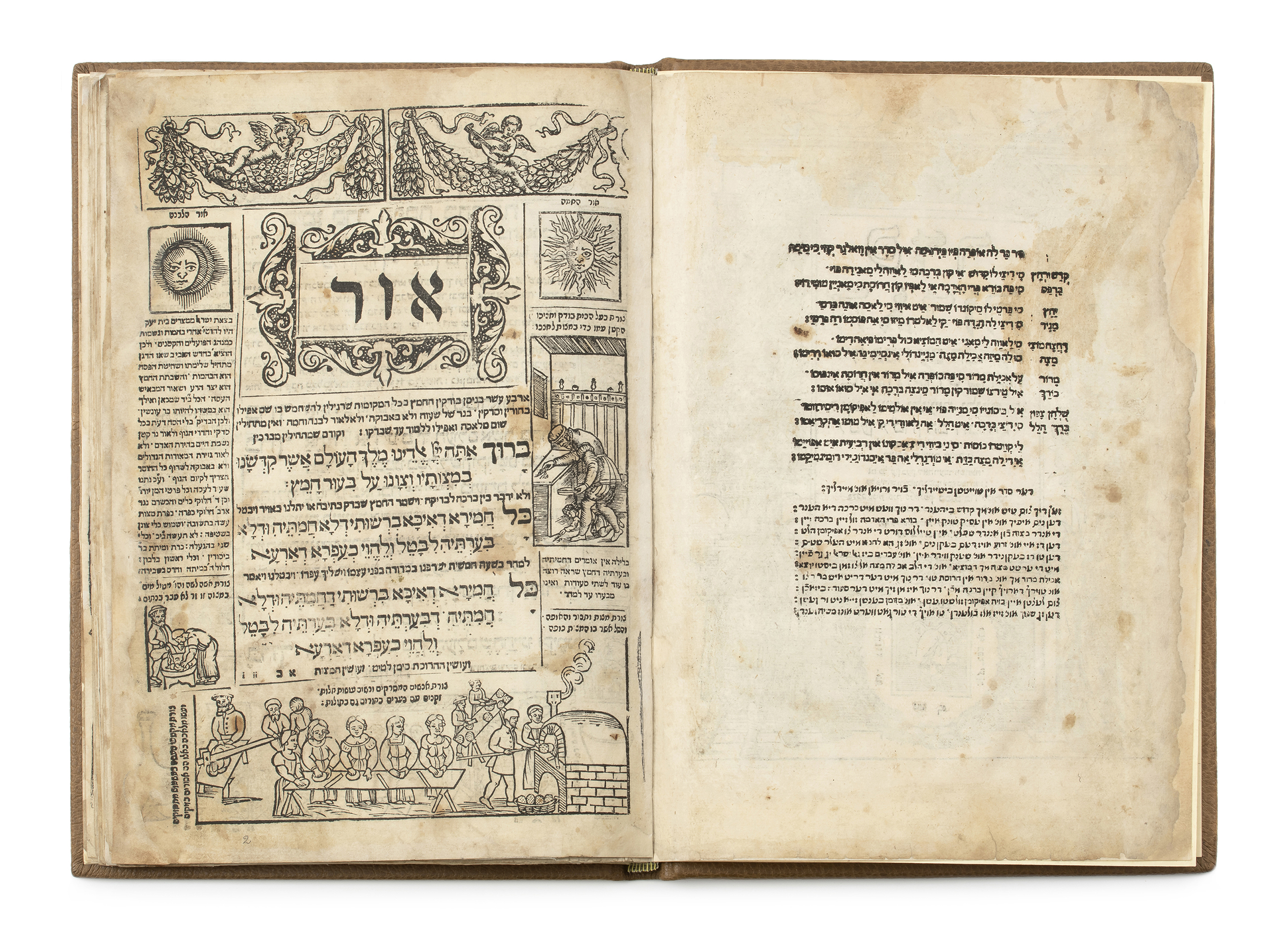
On verso of title page: Order of Kadesh and Urechatz, with short commentary in Italian and Yiddish – both in Hebrew letters.
The Haggadah begins with the order of Bedikat Chametz.
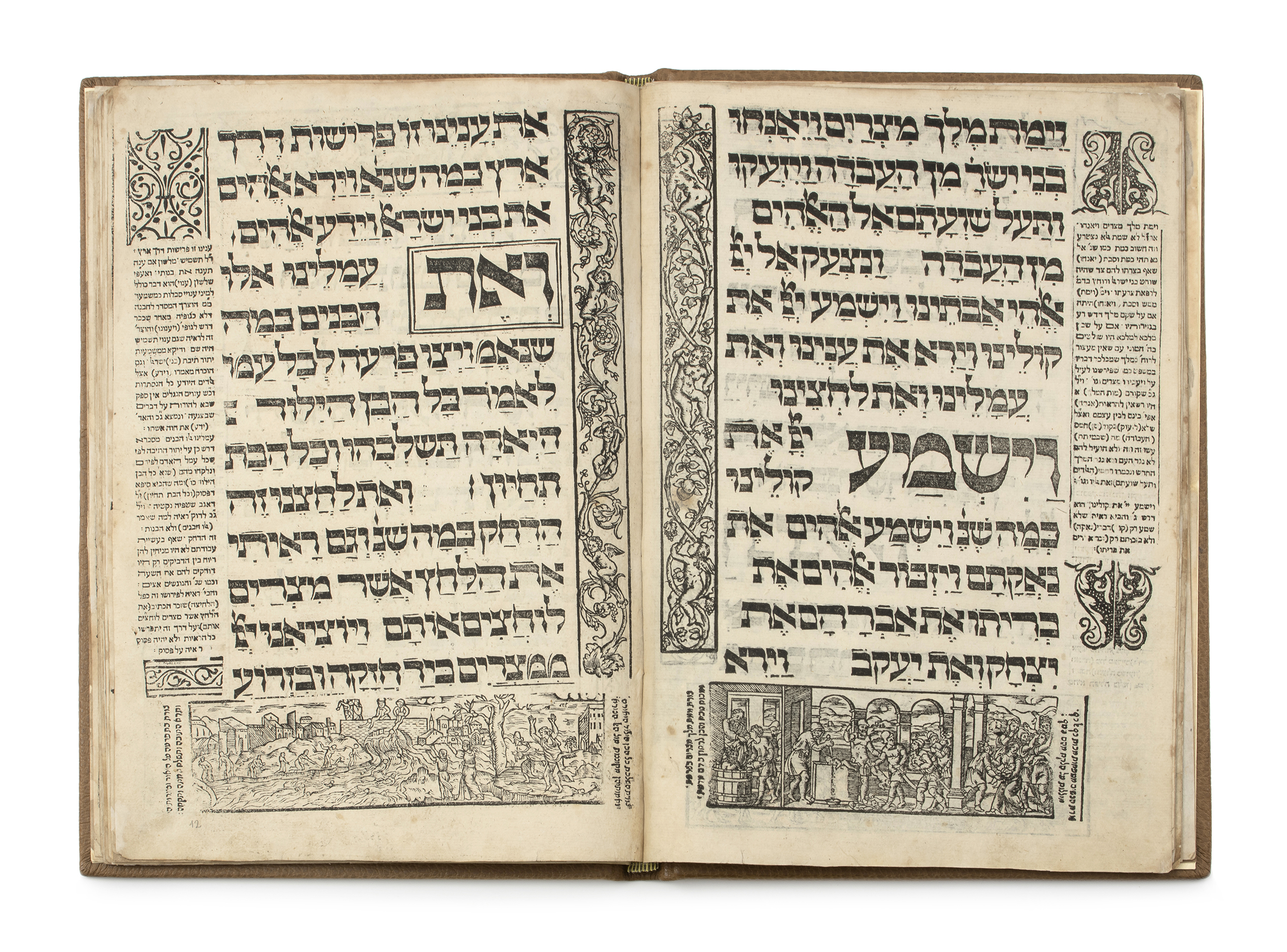
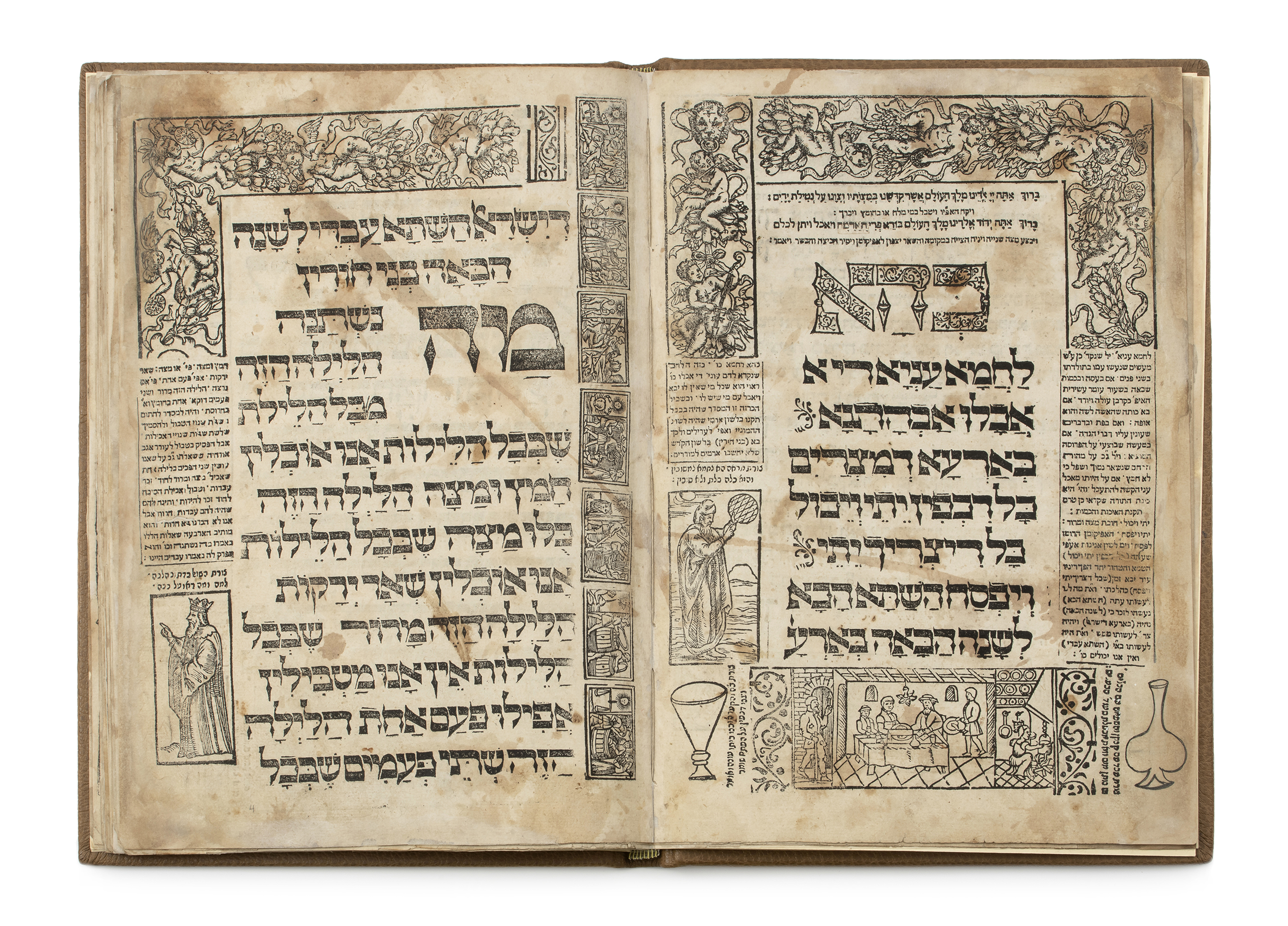
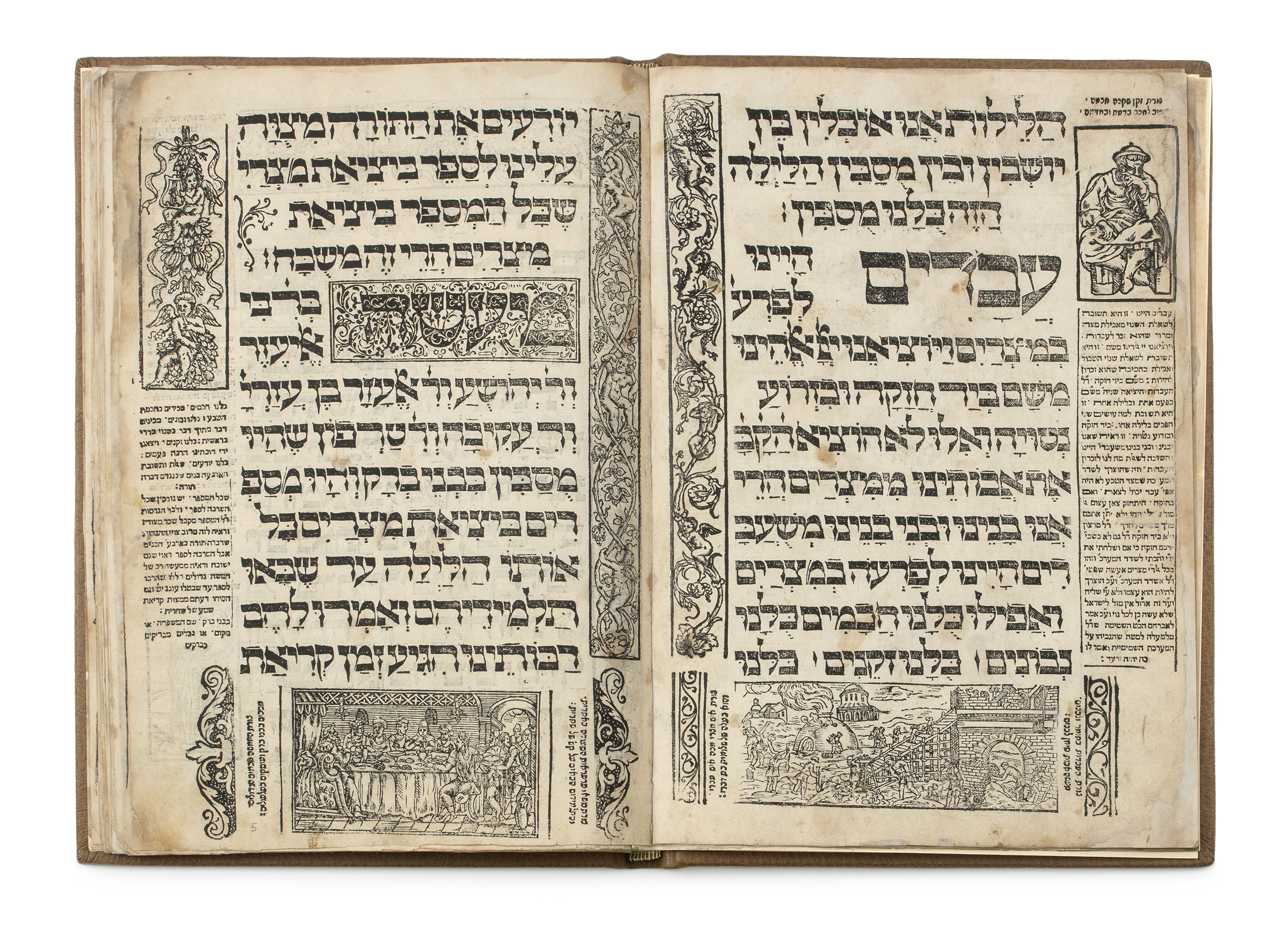
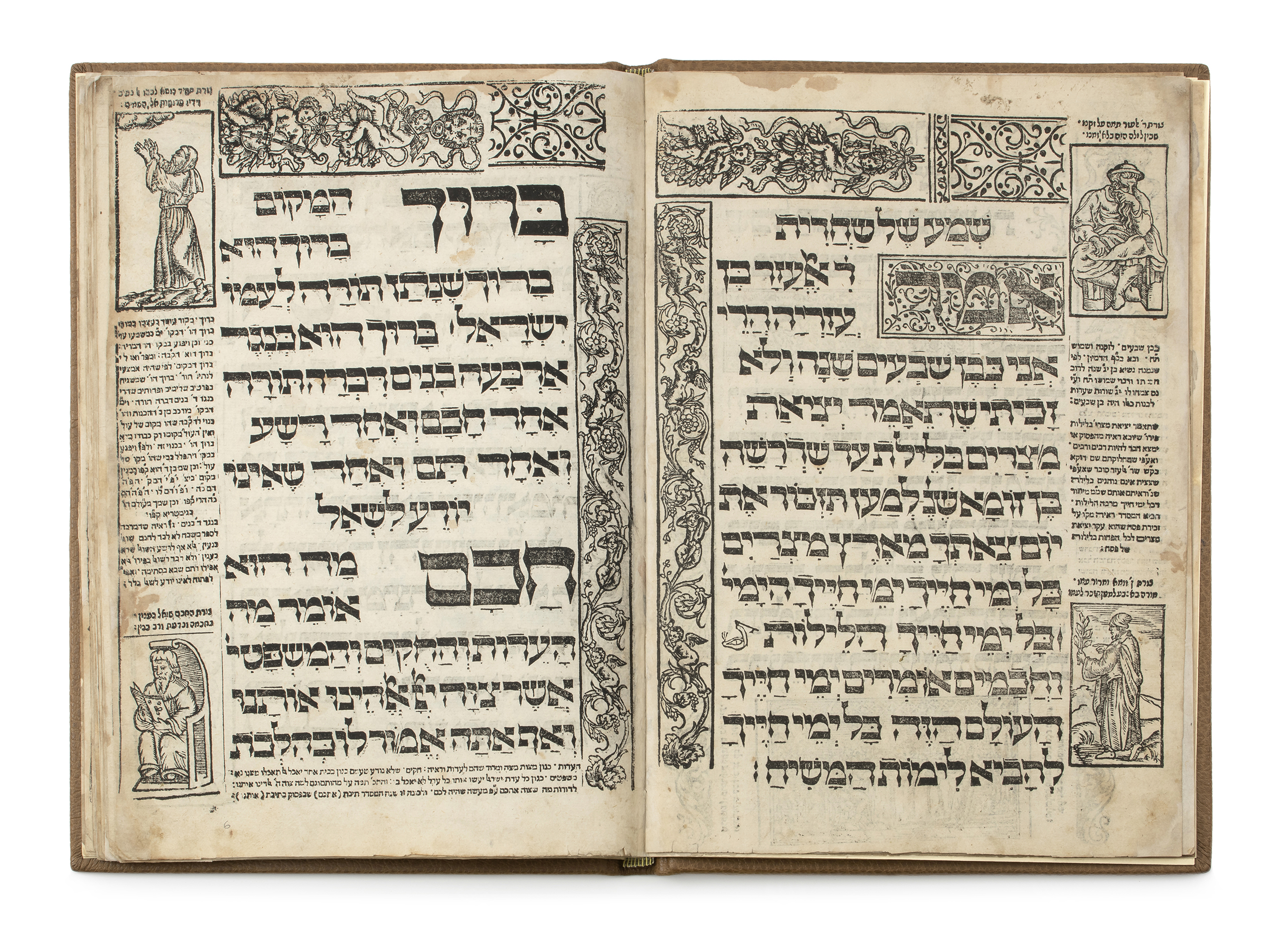
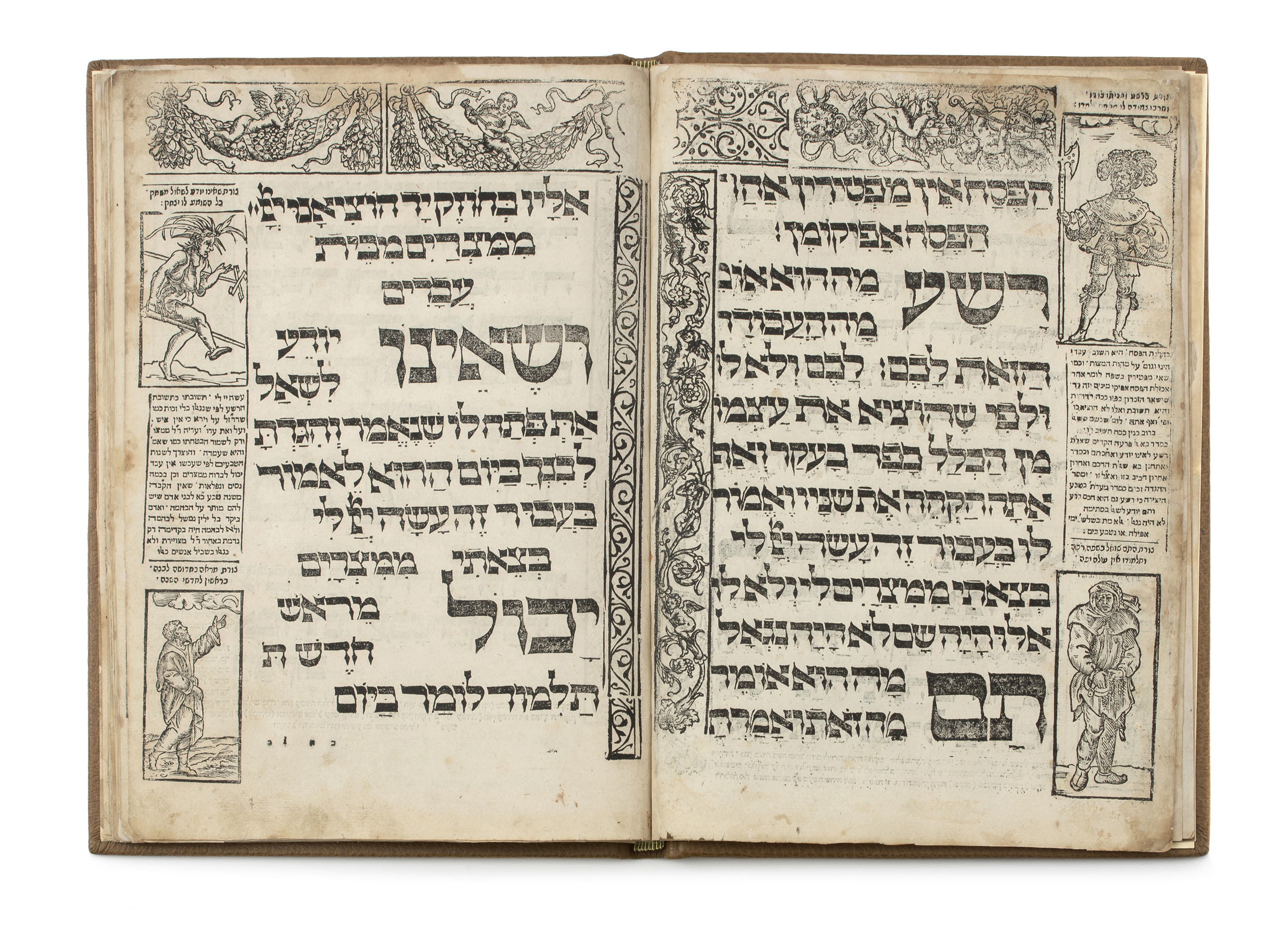
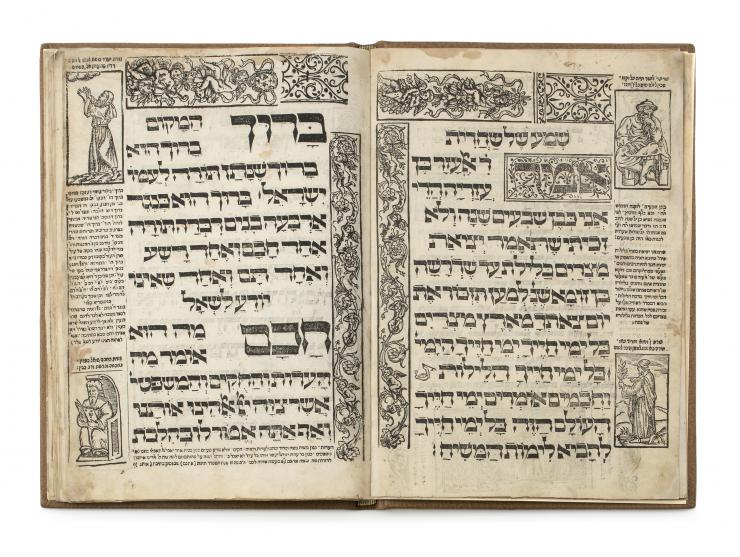
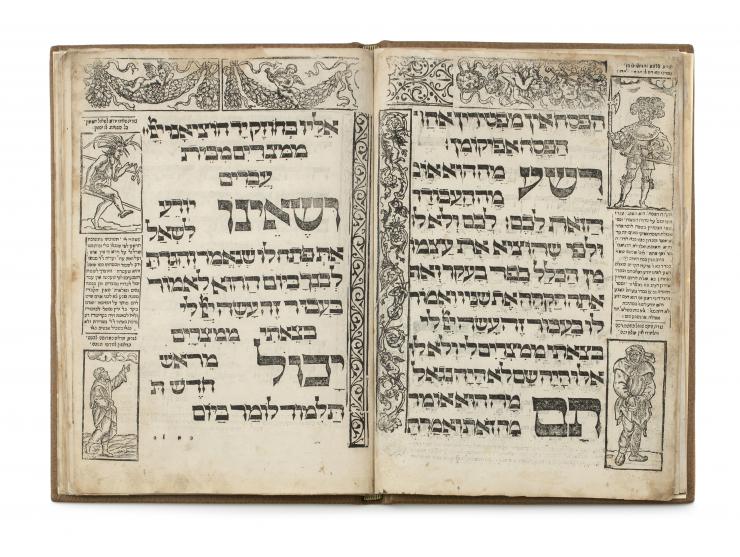
The Haggadah text is printed in large Ashkenazic square type, with Rafe marks. The marginal commentary and a few instructions appearing within the Haggadah text are printed in a smaller square type (in varying sizes), while the captions accompanying some illustrations are printed in Rashi type.
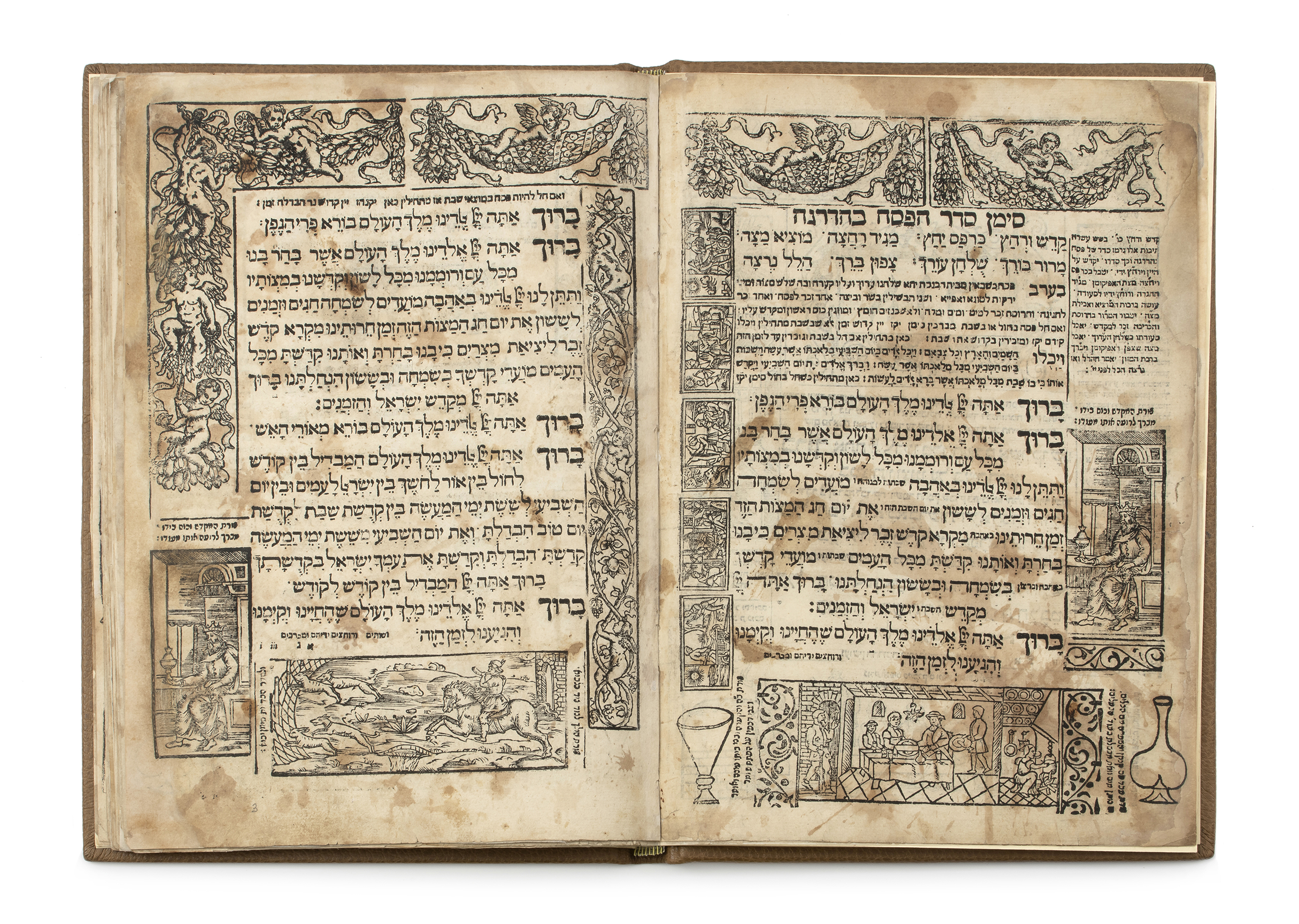
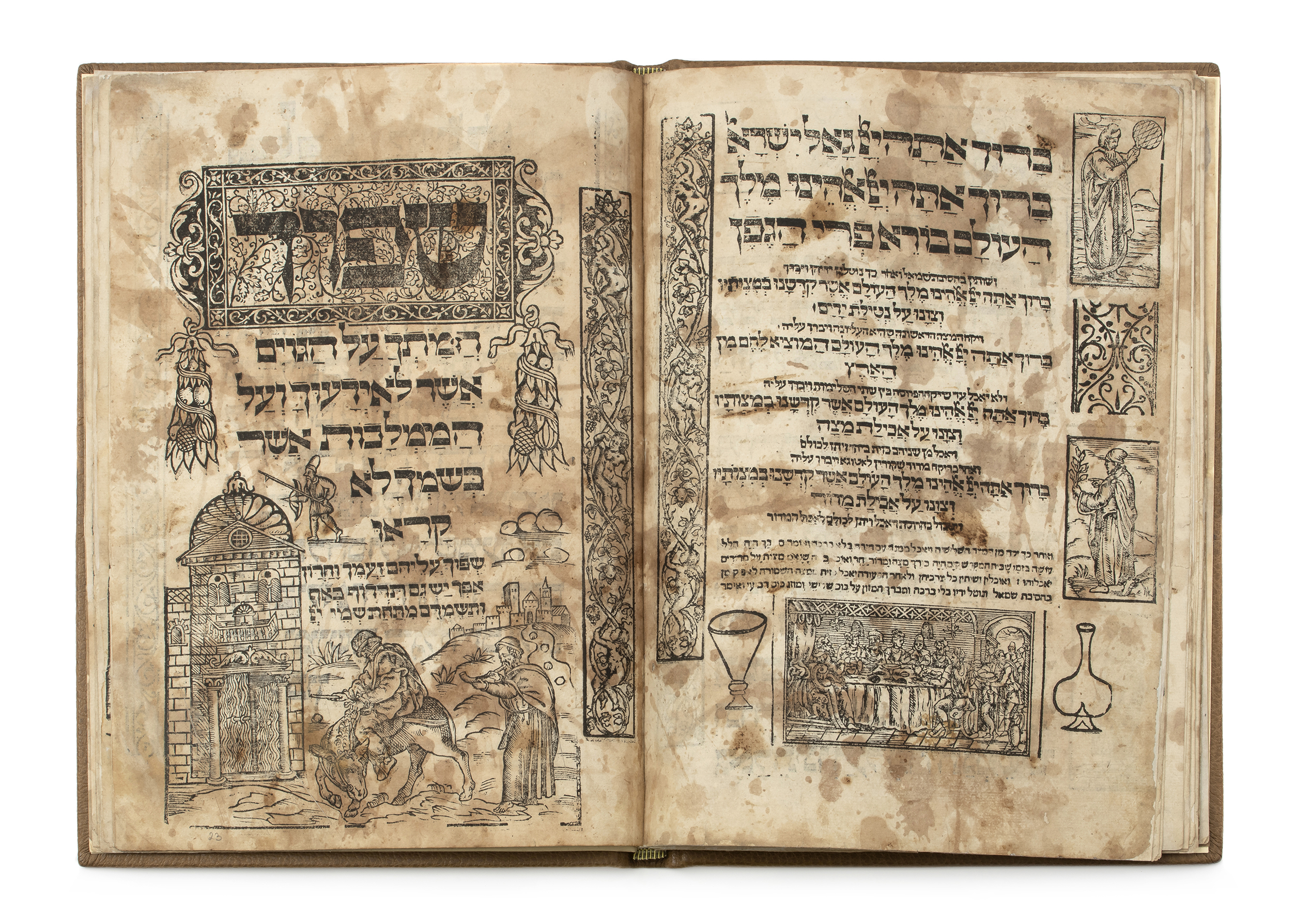
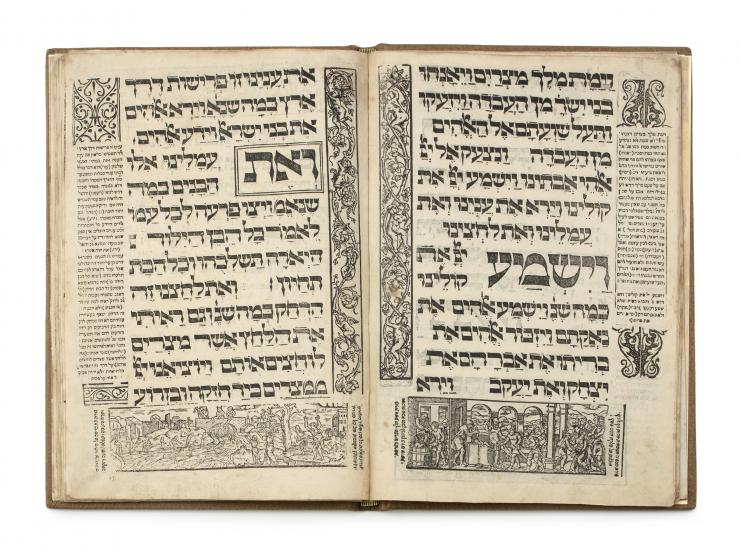
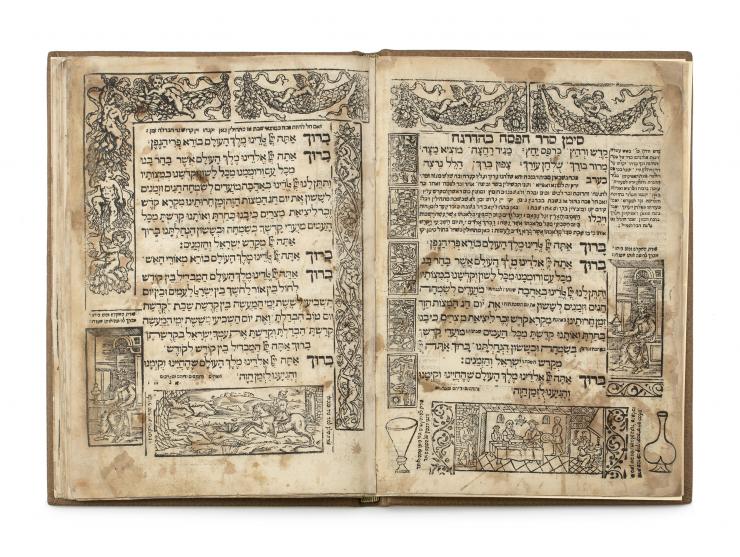
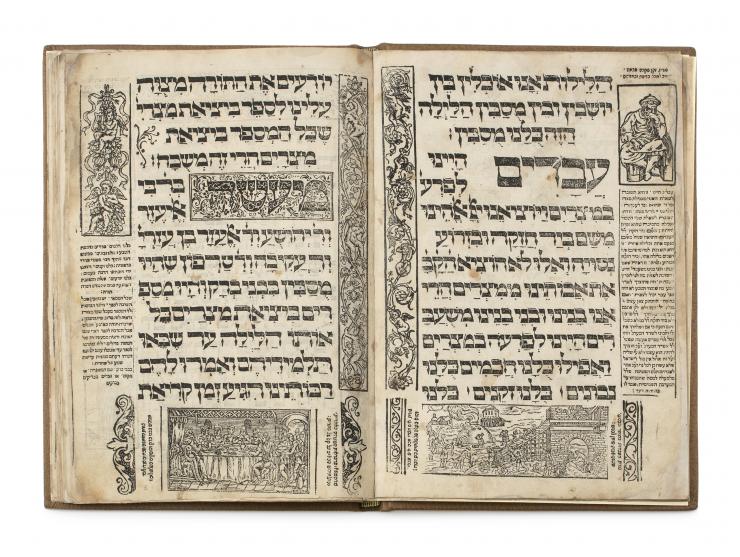
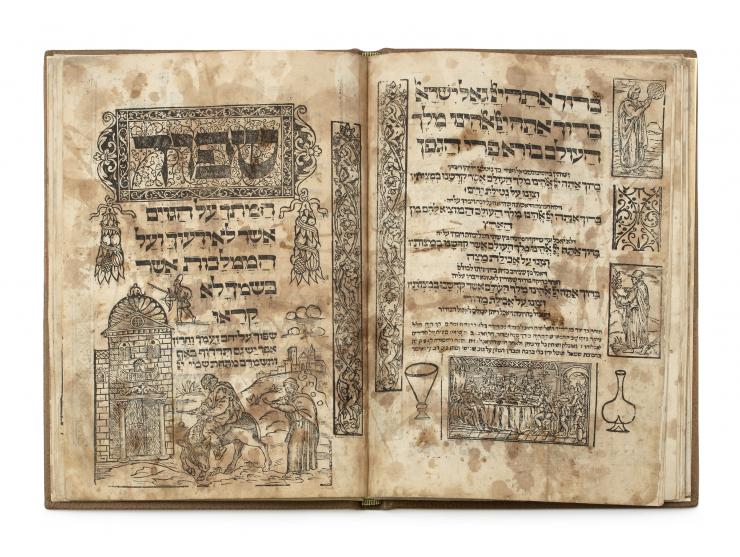
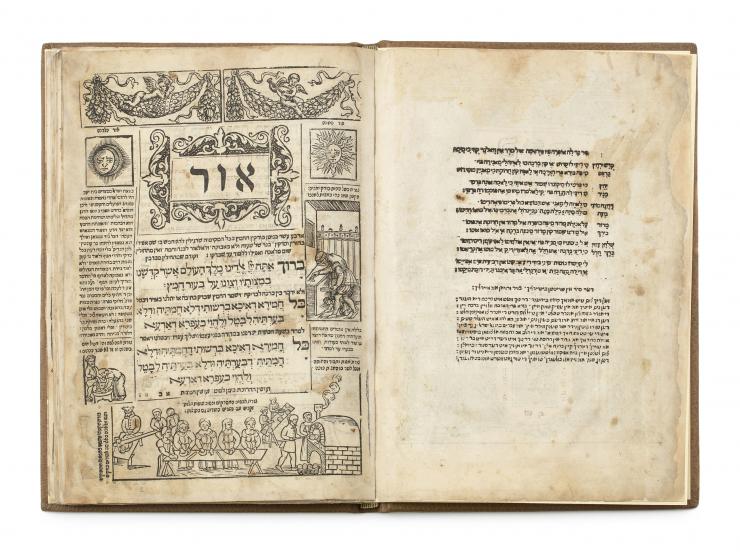
The pages are framed, most decorated in vegetal patterns, with illustrations of cherubs (putti) holding flowers and musical instruments, geometrical shapes and various figures, and various Renaissance motifs. Various fine woodcut Haggadah and Passover scenes are featured beside them, at the bottom and sometimes the margins of the page: preparation and baking of matzah for Passover; a family sitting at the Seder night and a pauper knocking on their door; a hunter and dogs chasing rabbits (a motif appearing in various Haggadah manuscripts and the Haggadah of Prague, 1527, probably originating as a play on the Yaknehaz mnemonic for festival evening havdalah); the Four Sons and other sages; the Children of Israel laboring in Egypt and an Egyptian hitting an Israelite; Pharaoh bathing in the blood of the Israelite babies; the daughter of Pharaoh sending her maidservant for Moses' basket; the Children of Israel crossing the Red Sea and the Egyptians drowning; and more.
The influence of the Italian Renaissance is discernible not only in the Haggadah's decorated frames, but also in several other notable illustrations: Abraham crossing the Euphrates towards the Land of Canaan, depicted on p. [8a] as embarking in a gondola; a father figure answering his son's question (p. [4b]), reused as illustration for both R. Elazar ben Azariah and R. Akiva (pp. [5b], [16a]; in the first Mantua edition, this illustration was used for the Wise Son), is a near copy of Michelangelo's rendition of Jeremiah in the Sistine Chapel; the Wicked Son, depicted on p. [6b] as an Italian condottiero (mercenary commander); and more.
An illustration of white animals within the black background of the letters is featured as the emphasized initial word on p. [9b].
On last page, Almechtiger G-tt piyyut (Yiddish variation of Adir Hu).
The title page features the printer's device of Yosef son of Yaakov Shalit, depicting a bird holding a snake in its beak (this device reappears in enlarged form on last page; see: Yaari, Diglei HaMadpisim HaIvriyim, illustration 19 and p. 132).
On p. [3b], the blessing for Karpas is erroneously printed with the word "HaGefen"; a mounted paper strip contains the handwritten correction "HaAdamah" (remains of the paper repair also appear in the Haggadah copy from the Valmadonna Trust Library, digitized by NLI; the correction appears to have been made in the press after printing).
Censor signatures, blurred (and damaged by tears) on last leaf.
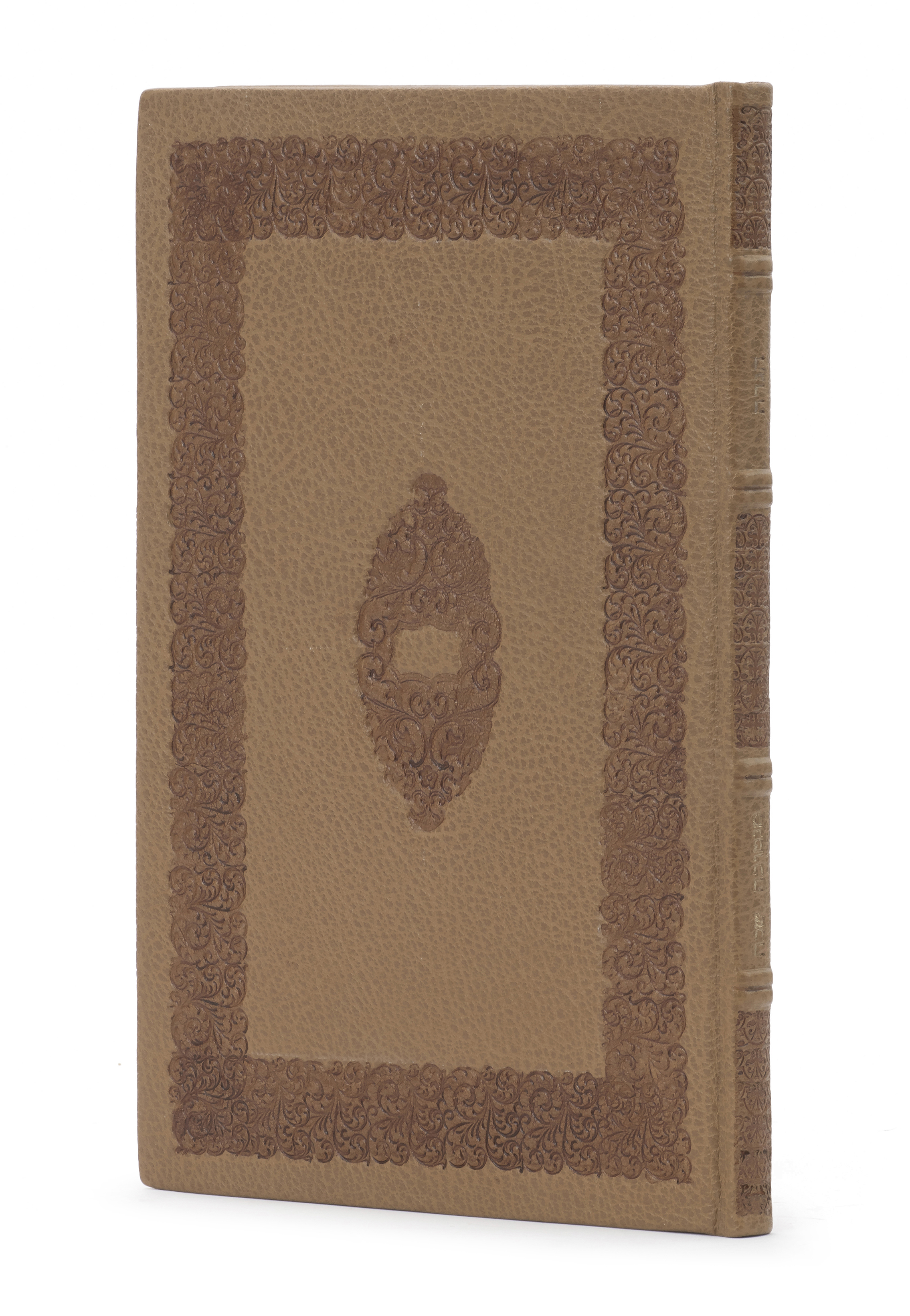
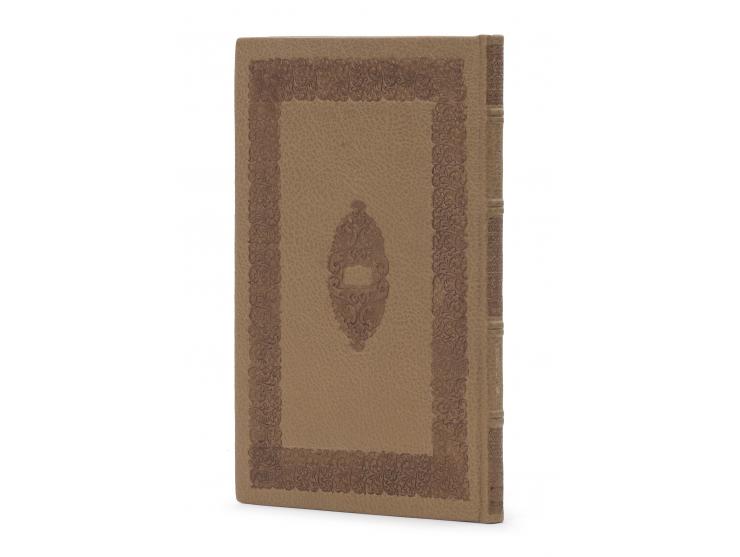
[36] leaves (handwritten foliation added in pencil to margins). 31.5 cm. Varying condition of leaves, fair-good to fair. Stains, including dark food and wine stains (many large stains to several leaves). Tears and open tears, to margins of title page and other leaves, affecting text and illustrations in several places, repaired with paper filling (with small parts of frames and illustrations replaced by hand). Worming, affecting text and illustrations, mostly replaced with paper filling. New leather binding. Placed in cardboard and fabric slipcase.
The Illustrated Mantua Haggadot Printed in the Sixteenth Century
Two typographically similar illustrated Haggadot were printed in Mantua in the mid-16th century. The first was printed in 1560 by Yitzchak son of Shmuel Bassan, at the press of Giacomo Ruffinelli; the second was printed some eight years later by the Filipponi brothers, under the name of Yosef son of Yaakov Shalit.
Both Haggadot made use of the same plates for printing, and the format and typesetting of both are nearly identical to the Haggadah of Prague, 1527. The main difference between the two Mantua editions is the commentary of R. Yosef Ashkenazi of Padua, appearing only in the present edition (up to p. [19a]), in the margins, replacing some of the decorations that had appeared in the first edition.
Several other variants also exist: the title frames are different, and a mnemonic for the Seder order is printed on the verso; the initial word on p. [2a] is enlarged and emphasized in the present edition; the format and size of the type for the instructions inside the Haggadah are somewhat different; some illustrations are newly captioned; Birkat HaMazon is absent in its entirety in the present edition; several illustrations have been moved; several decorations are added, including twelve small illustrations of the zodiacs on pp. [2b] and [4a] (no connection to text); a new woodcut appears twice only in the present edition, depicting the Children of Israel crossing the Red Sea (pp. [17b], [28a]).
Both Mantua Haggadot served as models for numerous illustrated Haggadot in smaller sizes (quarto and octavo), printed in Venice around the turn of the 17th century.
Of the two Haggadot, the present Haggadah is considered rarer, and few complete copies are extant. The NLI catalog records only a scanned copy.
Provenance:
• Habsburg-Feldman, Geneva, June 1989, Lot 17.
• Kestenbaum, New York, March 2002, Lot 194.
Reference:
• Cecil Roth, HaHaggadah HaMetzuyeret ShebiDefus, Areshet, III (1961), pp. 18-19.
• A.M. Habermann, HaHaggadah HaMetzuyeret – Kitvei Yad VeSifrei Defus, Safed, 1963, pp. 18-20.
• Yosef Haim Yerushalmi, Haggadah and History, A Panorama in Facsimile of Five Centuries of the Printed Haggadah from the Collections of Harvard University and the Jewish Theological Seminary of America, Philadelphia, 1975, pp. 38-39; plates 28-31.
• Otzar HaHaggadot 25.