


Auction 58 - Rare and Important Items
Collection of Posters Advertising Purim Celebrations in Tel Aviv, 1921-1935
Opening: $5,000
Sold for: Unsold
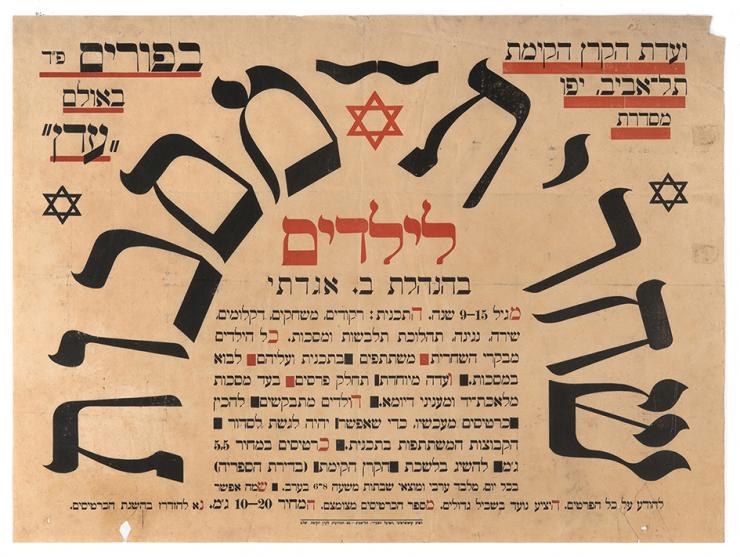
36 posters advertising Purim celebrations in Tel Aviv. Tel Aviv, 1921-1935.
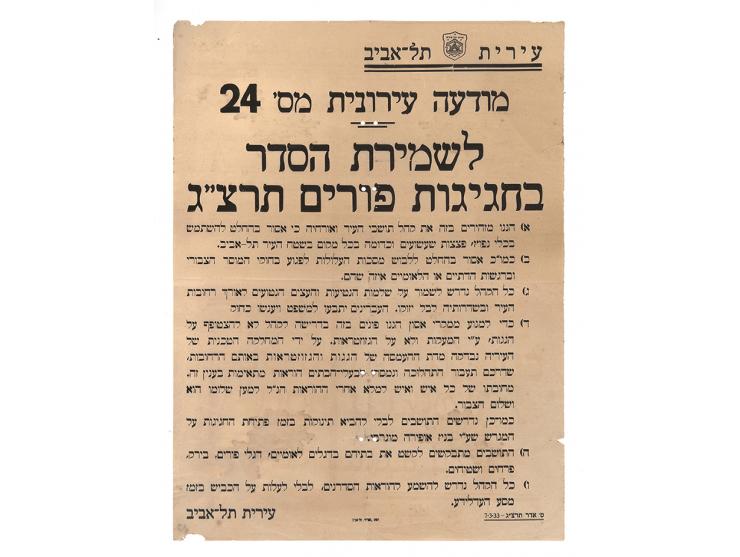
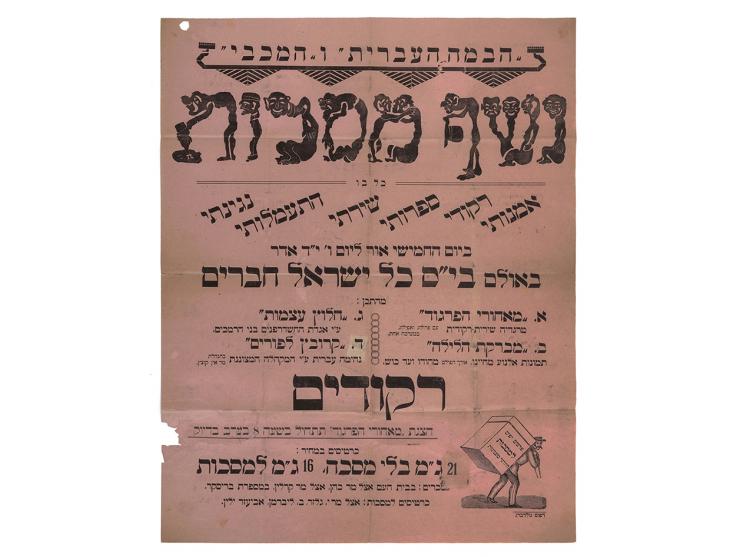
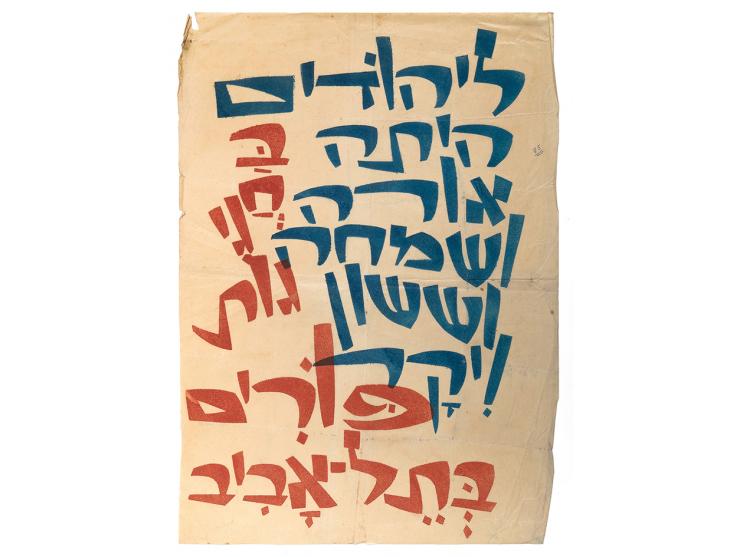
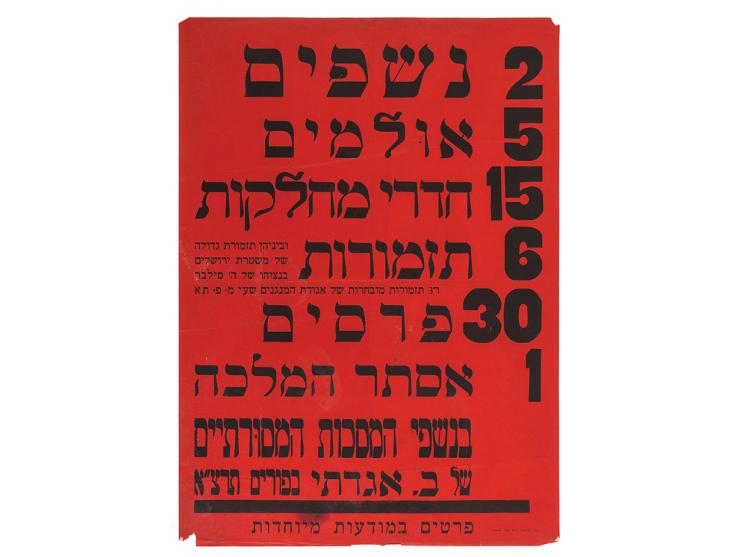
Collection of posters devoted to Purim celebrations that took place in Tel Aviv during the 1920s and 1930s, documenting different events that occurred in the course of the Purim festival and the preceding days.
Posters include: numerous advertising posters for the Purim balls organized by Baruch Agadati and the "Adloyada", poster by the Palestine Rail Company advertising discounted rides to Tel Aviv for the Purim celebrations, posters on preliminary balls to choose contestants for the "Hebrew Queen Esther" competition, advertising poster for a "Special Ball to Select the Yemenite Queen Esther" on behalf of "Tze'irei HaMizrachi", advertising poster for the masquerade organized by "HaBama Haivrit" and "HaMaccabi", poster of the "Palestine Theater Company", informative posters of the "Committee for Organizing the Celebrations and the Adloyada Carnival" of the Tel Aviv Municipality or the "JNF Organizing Committee", and more.
"Beginning in the city's first years, Purim celebrations fulfilled a significant role in Tel Aviv's cultural life. Near the late 1920s-early 1930s the celebrations became a kind of national holiday, with the masses rushing to Tel Aviv from the major cities, the colonies and even from abroad to take part in the balls and watch the carnival procession.
Tel Aviv's cultural life in those years was characterized by Western influence, on the one hand, and, on the other hand, an aspiration to create an original, local culture and lifestyle. […] The Purim celebrations became part of this trend of adopting European forms yet filling them with local Hebrew content. Agadati's masquerades adopted several prominent features of European carnivals. […] However, the masquerades also bore a distinctly local flavor. The halls were hung with sumptuous decorations based on the stories of the Book of Esther. Many costumes were inspired by those stories and by the way of life in the East and in Palestine, while also reflecting political, economic, social and cultural events in the life of the Yishuv. Tel Aviv, being the venue of the celebrations, gained a central status in this context […] the costume competition, which was the main event at the masquerades, rewarded the most original costumes with valuable prizes, all of them produced locally - gifts from local factories […] by choosing the Hebrew Queen Esther Agadati sought to convey a national-Zionist message and to fuse Jewish history with the present time in Palestine. At children's celebrations and processions held by the Jewish National Fund and the Tel Aviv Municipality, children appeared in costumes bearing explicitly Zionist messages, intended to reflect and extol the achievements of the Zionist enterprise".
Batia Carmiel, from the introduction to the catalogue "Tel Aviv in Costume and Crown, Purim Celebrations in the Years 1912-1935" (Eretz Israel Museum, Tel Aviv, 1999).
Size and condition vary. Some posters in a short and wide format. A number of posters (from early years) in poor condition, with many tears and creases. Most of the posters show light creases, small tears to margins and folding marks.
Collection of posters devoted to Purim celebrations that took place in Tel Aviv during the 1920s and 1930s, documenting different events that occurred in the course of the Purim festival and the preceding days.
Posters include: numerous advertising posters for the Purim balls organized by Baruch Agadati and the "Adloyada", poster by the Palestine Rail Company advertising discounted rides to Tel Aviv for the Purim celebrations, posters on preliminary balls to choose contestants for the "Hebrew Queen Esther" competition, advertising poster for a "Special Ball to Select the Yemenite Queen Esther" on behalf of "Tze'irei HaMizrachi", advertising poster for the masquerade organized by "HaBama Haivrit" and "HaMaccabi", poster of the "Palestine Theater Company", informative posters of the "Committee for Organizing the Celebrations and the Adloyada Carnival" of the Tel Aviv Municipality or the "JNF Organizing Committee", and more.
"Beginning in the city's first years, Purim celebrations fulfilled a significant role in Tel Aviv's cultural life. Near the late 1920s-early 1930s the celebrations became a kind of national holiday, with the masses rushing to Tel Aviv from the major cities, the colonies and even from abroad to take part in the balls and watch the carnival procession.
Tel Aviv's cultural life in those years was characterized by Western influence, on the one hand, and, on the other hand, an aspiration to create an original, local culture and lifestyle. […] The Purim celebrations became part of this trend of adopting European forms yet filling them with local Hebrew content. Agadati's masquerades adopted several prominent features of European carnivals. […] However, the masquerades also bore a distinctly local flavor. The halls were hung with sumptuous decorations based on the stories of the Book of Esther. Many costumes were inspired by those stories and by the way of life in the East and in Palestine, while also reflecting political, economic, social and cultural events in the life of the Yishuv. Tel Aviv, being the venue of the celebrations, gained a central status in this context […] the costume competition, which was the main event at the masquerades, rewarded the most original costumes with valuable prizes, all of them produced locally - gifts from local factories […] by choosing the Hebrew Queen Esther Agadati sought to convey a national-Zionist message and to fuse Jewish history with the present time in Palestine. At children's celebrations and processions held by the Jewish National Fund and the Tel Aviv Municipality, children appeared in costumes bearing explicitly Zionist messages, intended to reflect and extol the achievements of the Zionist enterprise".
Batia Carmiel, from the introduction to the catalogue "Tel Aviv in Costume and Crown, Purim Celebrations in the Years 1912-1935" (Eretz Israel Museum, Tel Aviv, 1999).
Size and condition vary. Some posters in a short and wide format. A number of posters (from early years) in poor condition, with many tears and creases. Most of the posters show light creases, small tears to margins and folding marks.