
Auction 82 - Part II - Books and Letters from the Rabbi Yaakov Landau Family Collection
- (-) Remove and filter and
- (-) Remove rabbi filter rabbi
- from (44) Apply from filter
- rebb (42) Apply rebb filter
- letter (35) Apply letter filter
- of (35) Apply of filter
- draft (26) Apply draft filter
- proclam (26) Apply proclam filter
- bnei (19) Apply bnei filter
- brak (19) Apply brak filter
- relat (19) Apply relat filter
- to (19) Apply to filter
- book (9) Apply book filter
- classic (9) Apply classic filter
- earli (9) Apply earli filter
- landau (9) Apply landau filter
- librari (9) Apply librari filter
- the (9) Apply the filter
- by (7) Apply by filter
- communal (7) Apply communal filter
- matter (7) Apply matter filter
- on (7) Apply on filter
- sign (7) Apply sign filter


Copy of Rebbe Nachum Dov Ber Friedman of Sadigura, with his handwritten ownership inscription on the front endpaper, and his stamps on the title page. Trimmed ownership inscriptions at top of title page.
Kvittel inscription on title page.
Signature on back endpaper, followed by birth records from the 1760s.
Rebbe Nachum Dov Ber Friedman of Sadigura (d. 1883), grandson of Rebbe Yisrael of Ruzhin. Renowned as a prominent collector of early manuscripts and books.
Stamps of R. Yaakov Landau Rabbi of Bnei Brak.
4; 250 leaves. 28 cm. Fair-poor condition. Stains, including dampstains. Significant worming to many leaves, affecting text. Open tears to title page, repaired with paper. Detached leaves and gatherings. Leaves trimmed close to headings in several places. Binding damaged and detached, with worming.
![Responsa of R. Betzalel Ashkenazi, author of Shitah Mekubetzet. Venice: Matteo Zanetti and Comino Presegno, [1595]. First edi](https://files.kedem-auctions.com/files/Sale81b-public/366.jpg "Responsa of Rabbi Betzalel Ashkenazi - Venice, 1595 - First Edition")
Signature of R. "Yitzchak Chai Lombroso" in Sephardic script at the top of the title page - presumably R. Yitzchak Chai Lombroso the second, Tunisian Torah scholar in the second half of the 18th century (d. 1799).
Stamps of R. Yaakov Landau Rabbi of Bnei Brak.
[1], 2-114 leaves. 28.5 cm. Fair condition. Stains. Dampstains to some leaves. Wear and tears. Worming, affecting text in many places. Inscriptions on title page and final page (covered with paper). Marginal paper repairs to some leaves. Old binding (non-original).


Signatures and inscriptions in early Ashkenazic script (from the time of the printing) on the title page and following leaf. Copy of Rebbe Elazar HaLevi Rosenfeld of Oshpitzin (Oświęcim; 1861-1943), youngest son-in-law of the Divrei Chaim of Sanz, with his stamps.
Shaarei Dura, composed in the 13th century, is one of the most important works on the laws of Kashrut, and is quoted extensively by both the Beit Yosef and the Rama. Until the printing of the Shulchan Aruch, Shaarei Dura was the primary Ashkenazic work on the laws of Kashrut.
This is the sixth edition of this work (first printed in Krakow, 1534). Since each edition of Shaarei Dura was printed based on a different manuscript, all the editions published in the 16th century are in effect first editions. This is also the first edition of the commentary and glosses of the Maharshal.
• Bound with:
Maamar Yayin HaMeshumar, kabbalistic essays on the severity of drinking Stam Yeinam (wine possessed or touched by a non-Jew) and shaving, by the kabbalist R. Natan Shapiro of Krakow-Jerusalem. [Venice, 1660]. First edition.
Signatures on the title page and following leaf.
Stamps of R. Yaakov Landau Rabbi of Bnei Brak in both books.
Shaarei Dura: 99 leaves. Maamar Yayin HaMeshumar: [8], 38 leaves. Approx. 18 cm. Fair condition. Stains, including dark dampstains. Worming, affecting text. Open tears to title pages and other leaves, affecting borders and text (paper repair to first title page). Old binding, with damage and worming.

Complete set of the Levush on all four parts of Shulchan Aruch, in three volumes. Separate title page for each part.
Ownership inscriptions and signatures on title pages.
Gloss in Sephardic script (trimmed) on p. 7a of first volume.
Stamp of R. Moshe Yehuda Leib Landau of Kornitz, father of R. Yaakov Landau Rabbi of Bnei Brak in Levush HaButz VehaArgaman.
Three volumes. Vol. I (Levush HaTechelet and Levush HaChur): 201, [2] leaves. Vol. II (Levush Ateret Zahav): 148, [2] leaves. Vol. III (Levush HaButz VehaArgaman and Levush Ir Shushan): 87; 162, [2] leaves. Approx. 33 cm. Overall fair condition. Some leaves in vol. III in fair-poor condition. Stains, including dampstains and dark stains (many leaves of vol. III with large dampstains and traces of past dampness). Extensive worming (significant worming in some places, particularly in vol. III), affecting text, repaired in part with paper. Open tears, affecting text, repaired with paper. Marginal tears and open tears to title pages of vols. I and III, repaired with paper. Stamps and handwritten inscriptions. New bindings.

The author, R. Yoshiyahu Pinto, author of Perush HaRif on Ein Yaakov, was a leading Syrian Torah scholar, disciple and mechutan of R. Chaim Vital.
Pieces of paper with the printed inscription: "Yaakov Landau Rabbi of Bnei Brak, Eretz Israel", pasted to title page and final page.
202, [8] leaves. 29.5 cm. Fair-good condition. Stains, including dampstains. Worming (significant worming in several places), affecting text. Marginal open tears to title page and leaf 2, repaired with paper. Minor open tear to one leaf, affecting text. Paper repairs in several places. Old leather binding, with significant damage and worming.

The book was printed in stages, beginning in Adar 1776 and ending in Tevet 1777.
At the top of the title page, ownership inscription of R. Gavriel HaKohen Adler (1788-1859), rabbi of Mühringen and Oberdorf am Ipf, brother of R. Natan HaKohen Adler, Chief Rabbi of the British Empire.
Stamp of R. Yaakov Landau Rabbi of Bnei Brak on title page.
[2], 86, [9] leaves; [1], 157 leaves. 32.5 cm. Most leaves in good condition. Stains, including dampstains. Worming. Tears (including open tears), repaired with paper. Margins reinforced with paper, with slight damage to text. Stamps. Handwritten inscriptions. Late glosses (in ballpen). Old binding, damaged, with worming. Spine partially detached.
![Or HaChaim, on the Five Books of the Torah, by R. Chaim ben Attar - the Or HaChaim HaKadosh. Zhovkva, [1799]. Separate title](https://files.kedem-auctions.com/files/Sale81b-public/371.jpg "Or HaChaim - Zhovkva, 1799 - Signatures")
Separate title page for each chumash.
Signatures and ownership inscriptions of R. Zalman Simcha Traub Rabbi of Keidan (grandfather of R. Yaakov Landau's wife) on the first title page and front endpaper.
Brief handwritten gloss on p. 41a of Vayikra.
Handwritten inscriptions on back endpaper.
Stamps of R. Yaakov Landau from his tenures as rabbi of Libau (Liepāja, Latvia) and Bnei Brak on the endpapers and title pages.
[2], 70; 66; 54; 56; 39 leaves. Divisional title pages. First title page printed in red and black. 22 cm. Fair-poor condition. Stains, including dampstains. Wear. Worming, affecting text (significant damage to some leaves). Open tears to title page, affecting text on verso (partially repaired with paper), and open tear to final leaf, affecting text, repaired with paper (with handwritten replacement). Handwritten inscriptions. Binding damaged and detached, with worming.

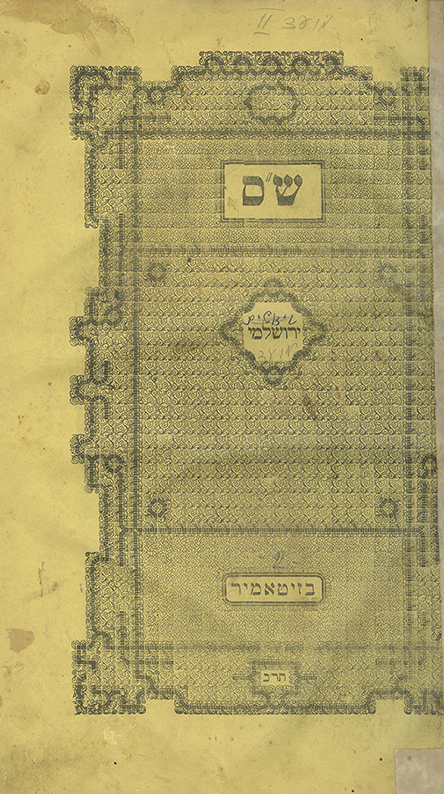


Jerusalem Talmud, with the Pnei Moshe, Mar'eh HaPanim, Korban HaEdah and Sheyarei Korban commentaries. First edition of the Pnei Moshe and Mar'eh HaPanim commentaries on Orders Zera'im-Mo'ed.
Title pages printed in red and black.
Signatures and stamps of R. Moshe Yehuda Leib Landau of Kornitz, and of his son - R. Yaakov Landau Rabbi of Bnei Brak.
Five volumes. Vol. I (Order Zera'im): [5], 14, 14-60; 30; 31; 24, 23-33; 33; 42; 18; 24; 18; 14; 9 leaves. Vol. II (Order Mo'ed, Part I): [2], 52, 34; 55; 61 leaves. Several leaves in tractate Eruvin bound out of sequence. Vol. III (Order Mo'ed, Part II): [1], 39; 2-31; 17, 17-23; 20; 21; 2-23; 5, 7-32; 20; 17 leaves. Lacking [1] title page of tractate Yoma. Yellow printed wrapper at beginning of volume. Vol. IV (Order Nashim): [2], 79; 45; 64; 34; 56; 51; 41 leaves. Vol. V (Order Nezikin and Tractate Niddah): [2], 33; 2-29; 2-26; 42; 31; 26; 6; 15; 9 leaves. (Tractate Makkot bound after Tractate Avoda Zara, not after Tractate Sanhedrin as listed in Bibliography of Hebrew Book). Approx. 38 cm. Overall good-fair condition. Stains. Worming, affecting text (several places with significant worming). Tears in several places, including title page, affecting title page border, repaired with paper. Damage to borders of some title pages, due to binding. Stamps and handwritten inscriptions. Damage, wear and worming to bindings.


1. Chafetz Chaim. Laws of derogatory speech and talebearing. Vilna, 1873. First edition.
2. Shemirat HaLashon (Part I), complement to the book Chafetz Chaim, words of inspiration and ethics on guarding one's tongue and Torah study. Vilna, 1876. First edition.
Stams of R. Yaakov Landau Rabbi of Bnei Brak.
First books of R. Yisrael Meir HaKohen of Radin, the Chafetz Chaim, published anonymously (the author's name was printed in Russian at the foot of the title pages).
Two books in one volume. Chafetz Chaim: 5, [1], 8-81 leaves. Without [4] leaves of subscribers added in some copies. Shemirat HaLashon: [2], [5]-76; [3]-14 pages. Lacking second leaf, with approbations and list of abbreviations. 22 cm. Good-fair condition. Some leaves (primarily in Shemirat HaLashon) printed on dry, brittle paper. Stains. Open tears, affecting text in several places at end of Shemirat HaLashon. Final leaf torn and detached. Stamps. Old binding, worn.


For a detailed list, see Hebrew description.
13 letters. Size and condition vary. Overall good to good-fair condition.

The letters are addressed to R. Yaakov Landau Rabbi of Bnei Brak, and discuss issues pertaining to the city and kashrut certification.
• Letter from 1967, regarding the kashrut certification of a reception hall. R. Wosner lists the decisions taken in regard to the hall, and requests R. Landau's opinion on the matter. • Letter (undated) regarding kashrut certification. R. Wosner (who was one of the heads of the Chug Chatam Sofer Bnei Brak kashrut certification) asserts that he has no intention of taking any steps which would cause any anguish or conflict between himself and R. Landau.
• Letter from 1984, regarding a Din Torah pertaining to a school on HaShomer St.
3 letters on official stationery. Size varies. Two letters in good condition and one letter in good-fair condition. Stains. Folding marks.


Lengthy letter (4 leaves), from Rebbe Yoel Teitelbaum of Satmar. Sharp protest against the proposed establishment of a religious council in Bnei Brak. Sharon Springs, NY, [20th Tammuz] 1964.
Typewritten on the official stationery of the rebbe, with his hand signature.
Addressed to R. Yaakov Landau Rabbi of Bnei Brak. The letter was written in 1964 during the course of the debate between various rabbis over the establishment of a religious council in Bnei Brak - see following items (see sidebar regarding the affair and particularly the involvement of the rebbe of Satmar).
[4] leaves + attached piece of paper (addition to letter). 29 cm. Good condition. Stains. Folding marks. Filing holes.
The letter was published in Divrei Yoel - letters.
The Rebbe of Satmar and His Involvement in the Bnei Brak Religious Council Polemic
The Orthodox city of Bnei Brak was unique since it's founding for its independent rabbinate. Unlike other cities, Bnei Brak never had a religious council - the rabbis received their salaries directly from the municipality, and all kashrut and religious services in Bnei Brak were funded directly by the municipality, without the involvement of a third, governmental party such as a religious council. In other places, all religious services were under the control and supervision of the religious council, which in those days was under the Ministry of Religions, led by members of the Mizrachi movement.
Bnei Brak was also the only city in Eretz Israel were Satmar Chassidim participated in the municipal elections, with the approval of Rebbe Yoel of Satmar, fierce opponent of any cooperation with the Zionist government, and with the approval of the rabbi of Riskeva, rabbi of the Satmar community in the city. The main reason for this exception was the necessity to maintain the independence of the Bnei Brak rabbinate, and to preserve the power of R. Landau and his colleagues who upheld proper Torah observance.
In the summer of 1964, the Ministry of Religions established a religious council in Bnei Brak. Knowing that the Orthodox community would not passively accept this move, it was done in an underhanded way, on paper only. A notice from the Ministry of Religions was published in the HaTzofeh newspaper, announcing the establishment of the religious council headed by 12 members lead by R. Yaakov Landau Rabbi of the city. The notice was published without the knowledge of the new council members, and without a prior notification. This placed them in a difficult position - on the one hand R. Landau and his colleagues did not wish to cooperate with the establishment of a religious council led by the Ministry of Religions, yet on the other, if they would renounce their positions, the Ministry of Religions would appoint other members to the council instead, and they would thus lose their control over the religious services in the city (see item 430 and enclosed material).
At the beginning of Tammuz 1964, R. Landau sent a letter to the rebbe of Satmar, explaining at length why his resignation from the religious council would wreak havoc on the religious services in Bnei Brak (see item 430). The rebbe of Satmar sent him a sharp letter in response (this item), to which R. Landau replied with another letter, in Av 1964, in which he clarifies certain points (see item 430).