
Auction 63 - Rare and Important Items
- (-) Remove and filter and
- letter (107) Apply letter filter
- manuscript (105) Apply manuscript filter
- manuscripts, (100) Apply manuscripts, filter
- signatur (98) Apply signatur filter
- rabbi (52) Apply rabbi filter
- chassid (48) Apply chassid filter
- luminari (41) Apply luminari filter
- of (37) Apply of filter
- the (33) Apply the filter
- lithuanian (32) Apply lithuanian filter
- book (27) Apply book filter
- erit (24) Apply erit filter
- hapletah (24) Apply hapletah filter
- hapletah, (24) Apply hapletah, filter
- holocaust (24) Apply holocaust filter
- israel (24) Apply israel filter
- palestin (24) Apply palestin filter
- she (24) Apply she filter
- she'erit (24) Apply she'erit filter
- sheerit (24) Apply sheerit filter
- state (24) Apply state filter
- zionism (24) Apply zionism filter
- zionism, (24) Apply zionism, filter
- galician (23) Apply galician filter
- lithuanian, (23) Apply lithuanian, filter
- polish (23) Apply polish filter
- print (20) Apply print filter
- earli (13) Apply earli filter
- edit (13) Apply edit filter
- rare (13) Apply rare filter
- 16 (11) Apply 16 filter
- 16th-19th (11) Apply 16th-19th filter
- 19 (11) Apply 19 filter
- centuri (11) Apply centuri filter
- famous (11) Apply famous filter
- th (11) Apply th filter
- torah (11) Apply torah filter
- basic (9) Apply basic filter
- chabad (9) Apply chabad filter
- generat (9) Apply generat filter
- includ (9) Apply includ filter
- kabbalah (9) Apply kabbalah filter
- past (9) Apply past filter
- dutch (8) Apply dutch filter
- german (8) Apply german filter
- illustr (7) Apply illustr filter
- leav (7) Apply leav filter
- megillot (7) Apply megillot filter
- parchment (7) Apply parchment filter
Displaying 61 - 72 of 162

Auction 63 - Rare and Important Items
November 13, 2018
Opening: $1,000
Estimate: $2,000 - $3,000
Sold for: $4,000
Including buyer's premium
Lengthy letter (approx. 27 lines) handwritten and signed by R. Chaim Kanievsky, to his father-in-law R. Yosef Shalom Elyashiv and his family. Zichron Meir [Bnei Brak], Elul 1956.
"To my teacher and father-in-law, the illustrious Torah scholar and all the members of his household – as the new year approaches, may they be immediately inscribed and sealed for a good year and for life in the book of entirely righteous people, and may this year be a year of redemption and salvation for the entire Jewish people". The rest of the letter contains novellae relating to the topics of marriage contracts and the recitation accompanying the first fruits offering.
At the foot of the letter, R. Chaim adds a line informing his father-in-law of an Etrog he obtained for him for the impending festival of Sukkot: "I already purchased an Etrog and am waiting for an opportunity to send it".
R. Chaim Kanievsky, leading Torah authority in our times, was the first son-in-law of R. Yosef Shalom Elyashiv (1910-2012). This letter was written some five years after his marriage in Kislev 1951. (The attributes "illustrious and renowned Torah scholar" with which R. Chaim addresses his father-in-law, were already terms commonly accorded to R. Elyashiv, though he was only 46 years old at that time).
[1] leaf. 22.5 cm. Approx. 27 lines in his handwriting and with his signature. Good condition. Light creases and folding marks.
This letter was published in Yeshurun, 28, Nissan 2013, p. 350.
"To my teacher and father-in-law, the illustrious Torah scholar and all the members of his household – as the new year approaches, may they be immediately inscribed and sealed for a good year and for life in the book of entirely righteous people, and may this year be a year of redemption and salvation for the entire Jewish people". The rest of the letter contains novellae relating to the topics of marriage contracts and the recitation accompanying the first fruits offering.
At the foot of the letter, R. Chaim adds a line informing his father-in-law of an Etrog he obtained for him for the impending festival of Sukkot: "I already purchased an Etrog and am waiting for an opportunity to send it".
R. Chaim Kanievsky, leading Torah authority in our times, was the first son-in-law of R. Yosef Shalom Elyashiv (1910-2012). This letter was written some five years after his marriage in Kislev 1951. (The attributes "illustrious and renowned Torah scholar" with which R. Chaim addresses his father-in-law, were already terms commonly accorded to R. Elyashiv, though he was only 46 years old at that time).
[1] leaf. 22.5 cm. Approx. 27 lines in his handwriting and with his signature. Good condition. Light creases and folding marks.
This letter was published in Yeshurun, 28, Nissan 2013, p. 350.
Category
Lithuanian Rabbis of the Past Generation – Manuscripts, Letters and Signatures
Catalogue Value


Auction 63 - Rare and Important Items
November 13, 2018
Opening: $10,000
Estimate: $15,000 - $20,000
Unsold
Emissary letter, addressed to the sages and dignitaries of the Padua community in Italy, appointing R. Avraham ibn Asher and R. Yitzchak Zerachya Azulai as emissaries to Italy and to Western Europe on behalf of the Jerusalem community, signed by Jerusalemite sages. Jerusalem, [1741].
Charming scribal writing, calligraphic signatures of Jerusalemite sages. Signed first by the Rishon L'Zion, R. "Eliezer Nachum", author of Chazon Nachum [1662-1745, renowned rabbi and head of yeshiva in Turkey, immigrated to Eretz Israel and was appointed Rabbi of Jerusalem after the passing of R. Binyamin HaCohen Ma'ali]. Following his signature are signatures of the members of his Beit Din: R. "Nissim Chaim Moshe Mizrachi", author of Admat Kodesh (ca. 1690-1749, Rishon L'Zion after R. Eliezer Nachum), R. "Ye'uda son of R. Amram Diwan", author of Chut HaMeshulash [died ca. 1752], R. "Yisrael Meir son of R. Yosef Mizrachi", author of Pri HaAretz [died after 1749, brother of R. Nissim Chaim Moshe Mizrachi. Head of the Beit Ya'akov Yeshiva], R. "David Yekutiel HaCohen", R. "Yitzchak Aruch", R. "Ya'akov Ashkenazi" and R. "Meyuchas Bachar Shmuel", author of Pri HaAdamah and Mizbach Adamah [1695-1771, served as Rishon L'Zion after the passing of R. Ya'akov Yisrael Algazi].
The letter is addressed to "Our brothers… in the city of Padua…" and describes at length the troubles and suffering of the Jerusalem community. The sages appoint R. Avraham ibn Asher and R. Yitzchak Zerachya Azulai to collect funds from the Padua Jewish community to support the settlement in Jerusalem. Inscribed on the verso - "For the cherished community in the city of Padua…".
R. Yitzchak Zerachya Azulai (1702-1765), for whom this emissary letter was written, was a leading Jerusalemite sage and Kabbalist and member of the Beit Ya'akov Beit Midrash. Together with his brother-in-law, R. Yonah Navon, he headed the Gedulat Mordechai Yeshiva founded by the notable Mordechai Talok. Having served as dayan in prominent Batei Din in Jerusalem, his signature appears on Jerusalem's regulations. The famous Chida was his eldest son and he often cites his father in his works. R. Yitzchak Zerachya was the first of the glorious four-generation dynasty of emissaries who travelled to foreign countries collecting funds on behalf of communities in Eretz Israel. His son, the Chida, was a famous emissary, as were his grandsons, R. Avraham Azulai and R. Refael Yeshaya Azulai (the Chida's sons), and R. Rafael Yeshaya's grandson, R. Yehuda Zerachya Azulai.
R. Zerachya's companion was R. Avraham ibn Asher (died in 1772), ra'avad of Jerusalem, head of the Yefa'er Anavim Yeshiva. In 1771 (after the passing of R. Meyuchas Bachar Shmuel, who signed this letter), he was appointed Rishon L'Zion and Rabbi of Jerusalem, but died one year later in an epidemic. Already in 1734, he traveled as Jerusalem's emissary, and reaching Constantinople printed his book Sha'arei Kedusha by R. Chaim Vital which he copied from a manuscript in Egypt. He continued on his own, fulfilling the mission documented in this letter, after R. Yitzchak Zerachya Azulai fell ill upon arriving in Constantinople and was compelled to return to Eretz Israel.
For further information about their travels, see: E. Ya'ari, Sheluchei Eretz Israel, pp. 389-391. Ya'ari published a different emissary letter written for the two rabbis.
Double leaf. 33.5 cm. Good condition. Stains. Folding marks. Small hole in the center of the leaf.
Charming scribal writing, calligraphic signatures of Jerusalemite sages. Signed first by the Rishon L'Zion, R. "Eliezer Nachum", author of Chazon Nachum [1662-1745, renowned rabbi and head of yeshiva in Turkey, immigrated to Eretz Israel and was appointed Rabbi of Jerusalem after the passing of R. Binyamin HaCohen Ma'ali]. Following his signature are signatures of the members of his Beit Din: R. "Nissim Chaim Moshe Mizrachi", author of Admat Kodesh (ca. 1690-1749, Rishon L'Zion after R. Eliezer Nachum), R. "Ye'uda son of R. Amram Diwan", author of Chut HaMeshulash [died ca. 1752], R. "Yisrael Meir son of R. Yosef Mizrachi", author of Pri HaAretz [died after 1749, brother of R. Nissim Chaim Moshe Mizrachi. Head of the Beit Ya'akov Yeshiva], R. "David Yekutiel HaCohen", R. "Yitzchak Aruch", R. "Ya'akov Ashkenazi" and R. "Meyuchas Bachar Shmuel", author of Pri HaAdamah and Mizbach Adamah [1695-1771, served as Rishon L'Zion after the passing of R. Ya'akov Yisrael Algazi].
The letter is addressed to "Our brothers… in the city of Padua…" and describes at length the troubles and suffering of the Jerusalem community. The sages appoint R. Avraham ibn Asher and R. Yitzchak Zerachya Azulai to collect funds from the Padua Jewish community to support the settlement in Jerusalem. Inscribed on the verso - "For the cherished community in the city of Padua…".
R. Yitzchak Zerachya Azulai (1702-1765), for whom this emissary letter was written, was a leading Jerusalemite sage and Kabbalist and member of the Beit Ya'akov Beit Midrash. Together with his brother-in-law, R. Yonah Navon, he headed the Gedulat Mordechai Yeshiva founded by the notable Mordechai Talok. Having served as dayan in prominent Batei Din in Jerusalem, his signature appears on Jerusalem's regulations. The famous Chida was his eldest son and he often cites his father in his works. R. Yitzchak Zerachya was the first of the glorious four-generation dynasty of emissaries who travelled to foreign countries collecting funds on behalf of communities in Eretz Israel. His son, the Chida, was a famous emissary, as were his grandsons, R. Avraham Azulai and R. Refael Yeshaya Azulai (the Chida's sons), and R. Rafael Yeshaya's grandson, R. Yehuda Zerachya Azulai.
R. Zerachya's companion was R. Avraham ibn Asher (died in 1772), ra'avad of Jerusalem, head of the Yefa'er Anavim Yeshiva. In 1771 (after the passing of R. Meyuchas Bachar Shmuel, who signed this letter), he was appointed Rishon L'Zion and Rabbi of Jerusalem, but died one year later in an epidemic. Already in 1734, he traveled as Jerusalem's emissary, and reaching Constantinople printed his book Sha'arei Kedusha by R. Chaim Vital which he copied from a manuscript in Egypt. He continued on his own, fulfilling the mission documented in this letter, after R. Yitzchak Zerachya Azulai fell ill upon arriving in Constantinople and was compelled to return to Eretz Israel.
For further information about their travels, see: E. Ya'ari, Sheluchei Eretz Israel, pp. 389-391. Ya'ari published a different emissary letter written for the two rabbis.
Double leaf. 33.5 cm. Good condition. Stains. Folding marks. Small hole in the center of the leaf.
Category
Oriental Rabbis – Manuscripts, Letters and Signatures
Catalogue Value

Auction 63 - Rare and Important Items
November 13, 2018
Opening: $10,000
Estimate: $20,000 - $25,000
Sold for: $20,000
Including buyer's premium
Letter handwritten and signed by the Chida, R. Yosef Chaim David Azulai, to his disciple "…the Maharshach". Signed "Chada'ei Nafsha'i" with his blessing "No harm should befall you… happy and joyous, calm and secure…". [Livorno, ca. late 18th century].
Four lines handwritten and signed by the Chida himself.
The Maharshach to whom the letter is addressed is apparently R. Shmuel son of R. Moshe HaCohen, a sage from Livorno whom the Chida refers to as "My friend the learned R. Shmuel HaCohen" (see Machzik Beracha by the Chida, Siman 511, 1) and whose fame spread as a leading disciple of the Chida [see: Meir Benayahu, Rabbi Yosef Chaim David Azulai, p. 67].
The Chida would often sign "Chada'ei Nafsha'i" [in Aramaic this literally translates to "My soul rejoices"], the first word being the initials of his name [see for example: Igrot HaChida, Livorno 1867; Igrot 31,37, 43, 64].
The Chida - R. Chaim Yosef David Azulai (1724-1806), a leading posek, kabbalist, exalted Torah scholar, prolific author and famous rabbinical emissary, wrote over 80 compositions on all facets of the Torah and was a renowned emissary. Born in Jerusalem, son of R. Raphael Yitzchak Zerachya Azulai, a Jerusalemite scholar and great-grandson of Kabbalist Rabbi Avraham Azulai, author of Chesed Le'Avraham. From his early years, he was a disciple of leading Jerusalemite scholars and kabbalists, including Rabbi Chaim ibn Attar, the Or HaChaim HaKadosh. He began studying kabbalah at the Beit E-l Yeshiva for Kabbalists headed by R. Shalom Mizrachi Sharabi, the holy Rashash, and was a contemporary of R. Yom Tov (Maharit) Algazi who studied with him in the yeshiva.
In 1753, he embarked on his first mission as a rabbinical emissary on behalf of the Hebron community. During the course of his five years of travel, he passed through Italy, Germany, the Netherlands, England and France, gaining fame and attracting a great deal of attention and esteem wherever he set foot. In 1873, the Chida embarked on another mission on behalf of the Hebron community, leaving a profound imprint on all the places he visited. At the end of this journey, he settled in Livorno, Italy, to officiate as rabbi, and there he published most of his books.
Folded leaf, 19 cm. Good condition. Stains, ink stains, folding marks and wear.
Four lines handwritten and signed by the Chida himself.
The Maharshach to whom the letter is addressed is apparently R. Shmuel son of R. Moshe HaCohen, a sage from Livorno whom the Chida refers to as "My friend the learned R. Shmuel HaCohen" (see Machzik Beracha by the Chida, Siman 511, 1) and whose fame spread as a leading disciple of the Chida [see: Meir Benayahu, Rabbi Yosef Chaim David Azulai, p. 67].
The Chida would often sign "Chada'ei Nafsha'i" [in Aramaic this literally translates to "My soul rejoices"], the first word being the initials of his name [see for example: Igrot HaChida, Livorno 1867; Igrot 31,37, 43, 64].
The Chida - R. Chaim Yosef David Azulai (1724-1806), a leading posek, kabbalist, exalted Torah scholar, prolific author and famous rabbinical emissary, wrote over 80 compositions on all facets of the Torah and was a renowned emissary. Born in Jerusalem, son of R. Raphael Yitzchak Zerachya Azulai, a Jerusalemite scholar and great-grandson of Kabbalist Rabbi Avraham Azulai, author of Chesed Le'Avraham. From his early years, he was a disciple of leading Jerusalemite scholars and kabbalists, including Rabbi Chaim ibn Attar, the Or HaChaim HaKadosh. He began studying kabbalah at the Beit E-l Yeshiva for Kabbalists headed by R. Shalom Mizrachi Sharabi, the holy Rashash, and was a contemporary of R. Yom Tov (Maharit) Algazi who studied with him in the yeshiva.
In 1753, he embarked on his first mission as a rabbinical emissary on behalf of the Hebron community. During the course of his five years of travel, he passed through Italy, Germany, the Netherlands, England and France, gaining fame and attracting a great deal of attention and esteem wherever he set foot. In 1873, the Chida embarked on another mission on behalf of the Hebron community, leaving a profound imprint on all the places he visited. At the end of this journey, he settled in Livorno, Italy, to officiate as rabbi, and there he published most of his books.
Folded leaf, 19 cm. Good condition. Stains, ink stains, folding marks and wear.
Category
Oriental Rabbis – Manuscripts, Letters and Signatures
Catalogue Value


Auction 63 - Rare and Important Items
November 13, 2018
Opening: $2,500
Estimate: $3,000 - $5,000
Unsold
Booklet (9 leaves) in the handwriting of R. Refael Yeshaya Azulai, the son of the Chida and Rabbi of Ancona, homily for Shabbat HaGadol. [Ancona], 1789.
Title at top of first leaf: "Shabbat HaGadol 1789". This sermon is the first "Shabbat HaGadol sermon" delivered by R. Yeshaya Azulai in Ancona since he began his tenure in the month of Tamuz 1788. This is the draft of the sermon, with erasures, additions and revisions in the handwriting of R. Refael Yeshaya Azulai.
R. Refael Yeshaya Azulai (1740-1823) was born in Jerusalem, the eldest son of his illustrious father R. Chaim Yosef David Azulai, the Chida. A great Torah scholar, he wrote halachic responsa, some of the responsa in his book Imrei No'am were printed in his son's book Zichron Moshe and some were printed in books authored by his father, who honored and esteemed him and always mentioned him with epithets of love ("my dear son", "my firstborn son, the perfect great chacham", "the light of my eyes", "friend of my soul", etc.). In 1780, he travelled to Italy and to Western Europe as emissary of the city of Tiberias. Apparently, he also visited Germany and his father, the Chida, wrote (in his recommendation to the Ancona community) of the wealth of Torah knowledge his son acquired from the Ashkenazi Torah scholars. He concluded his mission in the city of Amsterdam in 1783 and settled there trading in books. In 1785, R. Avraham Yisrael Rabbi of Ancona died and the position of rabbi remained unfilled until the community leaders applied to the Chida in 1787, requesting his assistance in finding a suitable candidate for rabbi of the city. The Chida suggested two candidates and hinted that his son R. Refael Yeshaya is also suitable for the position. The community readily agreed and in 1788, sent R. Refael Yeshaya a letter appointing him rabbi of Ancona. However, he only arrived in Ancona in the month of Sivan and in the beginning of Tamuz began his tenure. He served as Rabbi of Ancona until his death on the 9th of Shevat 1823 (he lived 83 years like his father). He was greatly honored at his death and was mourned by his congregation for a long time after [for further information see the book by M. Benayahu on the Chida, pp. 476-487].
[9] leaves, [14] written pages. 19 cm. Good condition. Stains. Several tears. New leather binding (erroneous embossment on the spine: "Manuscript of Rabbeinu the Chida").
Enclosed is an authentication letter identifying the handwriting as that of R. Refael Yeshaya Azulai.
Title at top of first leaf: "Shabbat HaGadol 1789". This sermon is the first "Shabbat HaGadol sermon" delivered by R. Yeshaya Azulai in Ancona since he began his tenure in the month of Tamuz 1788. This is the draft of the sermon, with erasures, additions and revisions in the handwriting of R. Refael Yeshaya Azulai.
R. Refael Yeshaya Azulai (1740-1823) was born in Jerusalem, the eldest son of his illustrious father R. Chaim Yosef David Azulai, the Chida. A great Torah scholar, he wrote halachic responsa, some of the responsa in his book Imrei No'am were printed in his son's book Zichron Moshe and some were printed in books authored by his father, who honored and esteemed him and always mentioned him with epithets of love ("my dear son", "my firstborn son, the perfect great chacham", "the light of my eyes", "friend of my soul", etc.). In 1780, he travelled to Italy and to Western Europe as emissary of the city of Tiberias. Apparently, he also visited Germany and his father, the Chida, wrote (in his recommendation to the Ancona community) of the wealth of Torah knowledge his son acquired from the Ashkenazi Torah scholars. He concluded his mission in the city of Amsterdam in 1783 and settled there trading in books. In 1785, R. Avraham Yisrael Rabbi of Ancona died and the position of rabbi remained unfilled until the community leaders applied to the Chida in 1787, requesting his assistance in finding a suitable candidate for rabbi of the city. The Chida suggested two candidates and hinted that his son R. Refael Yeshaya is also suitable for the position. The community readily agreed and in 1788, sent R. Refael Yeshaya a letter appointing him rabbi of Ancona. However, he only arrived in Ancona in the month of Sivan and in the beginning of Tamuz began his tenure. He served as Rabbi of Ancona until his death on the 9th of Shevat 1823 (he lived 83 years like his father). He was greatly honored at his death and was mourned by his congregation for a long time after [for further information see the book by M. Benayahu on the Chida, pp. 476-487].
[9] leaves, [14] written pages. 19 cm. Good condition. Stains. Several tears. New leather binding (erroneous embossment on the spine: "Manuscript of Rabbeinu the Chida").
Enclosed is an authentication letter identifying the handwriting as that of R. Refael Yeshaya Azulai.
Category
Oriental Rabbis – Manuscripts, Letters and Signatures
Catalogue Value

Auction 63 - Rare and Important Items
November 13, 2018
Opening: $1,500
Estimate: $2,000 - $4,000
Sold for: $3,500
Including buyer's premium
Handwritten booklet, Halachic composition on Shulchan Aruch and "Zichronot", by R. Chaim Avraham ben David, Rabbi of Serres and Torah scholar of Salonika, author of Tiferet Adam. [Salonika, 19th century].
Complete booklet, which was not published in his book Tiferet Adam. Includes: Novellae on Shulchan Aruch, Choshen Mishpat, Even HaEzer and Orach Chaim; "Zichronot" – Principles and Halachic treatises.
Author's autograph, with deletions, corrections and additions. This manuscript was known to the Torah scholars of Turkey, and is quoted in the books of R. David Pipano, Choshen HaEfod and Avnei HaEfod as "the Raavad, author of Tiferet Adam in a manuscript responsa" (see Choshen HaEfod, section 153, 1; section 312, 9; Avnei HaEfod, section 112, 2). All these citations appear in this manuscript, which R. Pipano had obviously studied.
R. Chaim Avraham ben David, Rabbi of Serres – known as the Raavad of Salonika (d. ca. 1840-1850s), was a Torah scholar of Salonika while his father R. David ben Moshe supported him financially (in the honor of and after his father, R. Avraham named his book Tiferet Adam: A.D.M – Avraham David Moshe). After his father's passing, he was compelled to assume a rabbinical position in Serres (near Salonika) – in place of R. Chaim Avraham Estrosa, author of Yerech Avraham and Ben Avraham, who served as rabbi there until 1814. R. Avraham later passed away and was buried in Serres. He was a disciple of R. Yehoshua HaKohen Perachya (d. 1810) and of R. Refael Yaakov Menashe, author of Be'er HaMayim (1762-1832. His book was printed in 1836). In this manuscript (Choshen Mishpat section 312), the author discusses and questions the words of his teacher, author of Be'er HaMayim. This discussion is quoted briefly in Choshen HaEfod (abovementioned): "The Raavad, author of Tiferet Adam in manuscript, cites the words of his teacher the Be'er HaMayim, relating to the words of Moharitatz (R. Yom Tov Tzahalon), and writes that his words are difficult to understand".
Tiferet Adam (Salonika, 1863) was printed after R. Chaim Avraham's passing, compiled from the manuscripts he left behind. This book is quoted in Halachic literature until this day. The printed book consists of novellae and responsa on the four parts of Shulchan Aruch, with a "Zichronot" list in alphabetical order at the end. This manuscript was presumably not known to those who compiled the book, as it should have been included.
Approx. 39 written pages. 20 cm. High-quality paper. Good-fair condition. Stains, tears and wear, slightly affecting text.
Complete booklet, which was not published in his book Tiferet Adam. Includes: Novellae on Shulchan Aruch, Choshen Mishpat, Even HaEzer and Orach Chaim; "Zichronot" – Principles and Halachic treatises.
Author's autograph, with deletions, corrections and additions. This manuscript was known to the Torah scholars of Turkey, and is quoted in the books of R. David Pipano, Choshen HaEfod and Avnei HaEfod as "the Raavad, author of Tiferet Adam in a manuscript responsa" (see Choshen HaEfod, section 153, 1; section 312, 9; Avnei HaEfod, section 112, 2). All these citations appear in this manuscript, which R. Pipano had obviously studied.
R. Chaim Avraham ben David, Rabbi of Serres – known as the Raavad of Salonika (d. ca. 1840-1850s), was a Torah scholar of Salonika while his father R. David ben Moshe supported him financially (in the honor of and after his father, R. Avraham named his book Tiferet Adam: A.D.M – Avraham David Moshe). After his father's passing, he was compelled to assume a rabbinical position in Serres (near Salonika) – in place of R. Chaim Avraham Estrosa, author of Yerech Avraham and Ben Avraham, who served as rabbi there until 1814. R. Avraham later passed away and was buried in Serres. He was a disciple of R. Yehoshua HaKohen Perachya (d. 1810) and of R. Refael Yaakov Menashe, author of Be'er HaMayim (1762-1832. His book was printed in 1836). In this manuscript (Choshen Mishpat section 312), the author discusses and questions the words of his teacher, author of Be'er HaMayim. This discussion is quoted briefly in Choshen HaEfod (abovementioned): "The Raavad, author of Tiferet Adam in manuscript, cites the words of his teacher the Be'er HaMayim, relating to the words of Moharitatz (R. Yom Tov Tzahalon), and writes that his words are difficult to understand".
Tiferet Adam (Salonika, 1863) was printed after R. Chaim Avraham's passing, compiled from the manuscripts he left behind. This book is quoted in Halachic literature until this day. The printed book consists of novellae and responsa on the four parts of Shulchan Aruch, with a "Zichronot" list in alphabetical order at the end. This manuscript was presumably not known to those who compiled the book, as it should have been included.
Approx. 39 written pages. 20 cm. High-quality paper. Good-fair condition. Stains, tears and wear, slightly affecting text.
Category
Oriental Rabbis – Manuscripts, Letters and Signatures
Catalogue Value


Auction 63 - Rare and Important Items
November 13, 2018
Opening: $5,000
Estimate: $10,000 - $15,000
Sold for: $6,250
Including buyer's premium
Handwritten leaf, appeal letter for assistance issued by the Torah scholars of the İzmir community in Turkey in the wake of a large fire which struck the city, addressed to the community of Ancona, Italy, and signed by R. Yehoshua Avraham Yehuda, R. Yehoshua Avraham Krispin and R. Chaim Palachi, with the stamp of the Chacham Bashi Refael Pinchas Yehoshua de Segura. İzmir, Tevet [1841].
Letter appealing for help, written following a large fire which erupted in İzmir on the eve of Av 11, 1841. This fire was recorded for posterity as having consumed dozens of R. Chaim Palachi's manuscript compositions.
The letter begins with a description of the difficult state of the city in the wake of the "great sorrow which befell our camp with the fire which G-d set alight…". They describe mostly the destruction of the synagogues, which they maintain were the most magnificent in all of Turkey, and the snatched prayers which were presently being organized in various provisional sites throughout the city, resulting in stumbling blocks such as carrying from one domain to another on Shabbat and other Shabbat desecrations, consequence of the prayers being held in distant locations. They relate that the Torah scrolls, instead of resting honorably in the synagogues, had been dispersed in thirty locations throughout the city so that they can be read in public, which was a disgrace to the Torah scrolls. They therefore request financial support in rebuilding the synagogues, listing the synagogues destroyed by the blaze, including seven major synagogues and two smaller ones. The names of the synagogues appear in the margin of the letter: Algazi, Talmud Torah - two communities, Orchim, Etz Chaim - two communities, Portugal, Geveret and Bikur Cholim.
The letter states that an estimated 50000 coins are required per synagogue, even if they are not reconstructed according to their prior glory and magnificence. They write that the wealthy members of the İzmir community are unable to help with rebuilding the synagogues, since they too were affected by the fire.
At the end of the first paragraph, the signatures of R. Yehoshua Avraham Yehuda and R. Yehoshua Avraham Krispin appear. It is followed by another paragraph, in which Chacham Bashi Pinchas de Segura and R. Chaim Palachi endorse the appeal, blessing the donors with multiple repayment of their kindness from G-d in gold and silver. At the end of this passage, the signature of R. Chaim Palachi appears, alongside the stamp of "…Pinchas Moreinu, Chacham Bashi of İzmir and its surroundings…" – the stamp of R. Refael Pinchas de Segura – known by the acronym Pardes.
The letter was folded and sent by mail, and the verso bears the address inscribed in Hebrew and Italian: "To the honorable treasurers and leaders of the Ancona community…", with post marks.
The first signatory: R. Yehoshua Avraham Yehuda (1772-1849), author of Avodat Masa (Salonika 1846), "Rabbi and yeshiva dean of İzmir". A Torah scholar of İzmir, he was responsible for the community taxes, and consequently composed a Halachic work pertaining to the tax regulations in İzmir. In his preface to his book Avoda Masa, he relates that the fire which struck İzmir consumed all his works apart from this composition, which was with him at the time of the fire, while he was staying in a nearby village. He later immigrated to Eretz Israel, lived for three years in Jerusalem and passed away there in 1849
The second signatory: R. Yehoshua Avraham Krispin (before 1785-1855), author of Vayeshev Avraham and Avraham BaMachaze. In his eulogy (Chelkam BaChaim, Homily 7 for eulogy), R. Chaim Palachi describes him as a close neighbor for twenty years, who prayed and studied together with him every evening. He relates that there were never any hard feelings between them, and they were always united in friendship.
The third signatory (stamped): the Chacham Bashi, R. Yehoshua Refael Pinchas (Moreinu) de Segura, author of Ot Hi LeOlam, Ot HaBrit and Ot LiYeshua. R. Chaim Palachi was his disciple-colleague, and they studied together in the "Beit Yaakov Rabi" yeshiva under the Chikrei Lev (grandfather of R. Chaim). After the passing of the R. Yehoshua Refael Pinchas, R. Chaim Palachi served in his place as rabbi of İzmir. In the eulogy he delivered in his memory, R. Chaim related that in his youth like in his older age, he studied under him day and night. He recounts in one of his books seeing R. Yehoshua Refael Pinchas, whom he accompanied constantly, crying and bemoaning the destruction of Jerusalem and the Temple morning and night, adding that he witnessed first-hand that the latter benefited from Divine Inspiration (Luach Erez, Seder Eliyahu Raba, chapter 4, p. 7b).
His book Ot LiYeshua contains the sermon delivered on the occasion of the inauguration of the Bikur Cholim synagogue in İzmir, which was rebuilt following this fire, in Elul 1843 (pp. 156b-164a). He describes the joy and consolation they drew from the speedy reestablishment of the synagogues in all their glory, while in a previous fire in 1772, which also destroyed all the synagogues, it took many years before the community succeeded in restoring what was lost.
The fourth signatory: R. Chaim Palachi – Chavif (1787-1868), an outstanding Torah scholar in hidden and revealed realms of the Torah, was the rabbi of İzmir and a renowned leading Torah scholar of his generation. He composed seventy-two books (corresponding with the numerical value of his name Chaim, including the letters), on Halacha, Aggada and ethics. He was the close disciple of his mother's father, the renowned Torah scholar R. Refael Yosef Hazan, author of Chikrei Lev. In his books, R. Chaim quotes his grandfather extensively,
as well as his father R. Yaakov Palachi. At the age of 25, in a ceremony attended by the entire community, R. Chaim was accorded rabbinical ordination by his grandfather, who bedecked him with a special rabbinic robe he personally purchased in honor of his earning the title of "Chacham HaShalem".
Over the years, he rose in the ranks of rabbinic hierarchy, reaching the position of "Rav HaKollel", head of the İzmir Beit Din, and was recognized by the Turkish government as Chacham Bashi. His exceptional wisdom and eminence in Torah earnt him the status of rabbi of the city. The Jewish community in İzmir was comprised in those days of various congregations, each with different customs and their own rabbi, and only R. Chaim bore the absolute authority of his rulings and opinions being accepted by the various congregations in the city. His Halachic authority exceeded the boundaries of the city, and he earnt world-wide recognition as a posek, responding to thousands of queries addressed to him from throughout the world, even beyond the Ottoman Empire, such as Poland, Germany and North-Africa.
R. Chaim was a most prolific author, covering all subjects of the Torah. When the fire broke out in 1841, he had already produced dozens of manuscript compositions, which he toiled on from a young age. The fire consumed 54 of his compositions. One of his disciples, R. Yitzchak Yeshurun, jumped into the fire and succeeded in salvaging 14 compositions, including Chaim LaRosh on the Passover Haggadah, and this was the first book R. Chaim published following the fire. In his preface to this book, he describes at length the compositions he lost in the fire of Av 11, 1841, comprehensive works he expended great effort on, spanning all fields of Torah, including all four parts of Shulchan Aruch, responsa, commentary to several tractates of the Talmud, novellae on Halacha and Aggada, sermons, commentary to the Bible, ethics works, Talmudic and Halachic principles, on Midrashim, Kabbalah and more, altogether 54 compositions.
R. Chaim also expresses in that preface the mourning and great sorrow the loss of his compositions caused him (further descriptions about the fire and the books he lost appear also in other books he authored and published subsequently).
Despite the great tragedy of the loss of most of his writings, he regained his strength and began composing new works, while also recovering from memory some of the compositions he lost. In the books he printed after the fire, he would add at the foot of the title page the serial number of the book. The names of his books usually allude to his name Chaim in various ways (Nefesh Chaim, Chaim Techila, Torah VeChaim, Chaim LaRosh, Chaim VeShalom, Kaf HaChaim, Re'eh Chaim, HaKatuv LeChaim, Yimatzeh Chaim, Birkat Moadecha LeChaim, Tzavaa MeChaim, Artzot HaChaim, Tzedaka LeChaim, and others).
This letter is a historic documentation of the great fire which struck İzmir in 1841, signed amongst others by R. Chaim Palachi, who lost 54 of his compositions to it.
35 cm. Good-fair condition. Stains. Folding marks. Large open tear to the bottom of the leaf, not affecting text, repaired with paper.
Letter appealing for help, written following a large fire which erupted in İzmir on the eve of Av 11, 1841. This fire was recorded for posterity as having consumed dozens of R. Chaim Palachi's manuscript compositions.
The letter begins with a description of the difficult state of the city in the wake of the "great sorrow which befell our camp with the fire which G-d set alight…". They describe mostly the destruction of the synagogues, which they maintain were the most magnificent in all of Turkey, and the snatched prayers which were presently being organized in various provisional sites throughout the city, resulting in stumbling blocks such as carrying from one domain to another on Shabbat and other Shabbat desecrations, consequence of the prayers being held in distant locations. They relate that the Torah scrolls, instead of resting honorably in the synagogues, had been dispersed in thirty locations throughout the city so that they can be read in public, which was a disgrace to the Torah scrolls. They therefore request financial support in rebuilding the synagogues, listing the synagogues destroyed by the blaze, including seven major synagogues and two smaller ones. The names of the synagogues appear in the margin of the letter: Algazi, Talmud Torah - two communities, Orchim, Etz Chaim - two communities, Portugal, Geveret and Bikur Cholim.
The letter states that an estimated 50000 coins are required per synagogue, even if they are not reconstructed according to their prior glory and magnificence. They write that the wealthy members of the İzmir community are unable to help with rebuilding the synagogues, since they too were affected by the fire.
At the end of the first paragraph, the signatures of R. Yehoshua Avraham Yehuda and R. Yehoshua Avraham Krispin appear. It is followed by another paragraph, in which Chacham Bashi Pinchas de Segura and R. Chaim Palachi endorse the appeal, blessing the donors with multiple repayment of their kindness from G-d in gold and silver. At the end of this passage, the signature of R. Chaim Palachi appears, alongside the stamp of "…Pinchas Moreinu, Chacham Bashi of İzmir and its surroundings…" – the stamp of R. Refael Pinchas de Segura – known by the acronym Pardes.
The letter was folded and sent by mail, and the verso bears the address inscribed in Hebrew and Italian: "To the honorable treasurers and leaders of the Ancona community…", with post marks.
The first signatory: R. Yehoshua Avraham Yehuda (1772-1849), author of Avodat Masa (Salonika 1846), "Rabbi and yeshiva dean of İzmir". A Torah scholar of İzmir, he was responsible for the community taxes, and consequently composed a Halachic work pertaining to the tax regulations in İzmir. In his preface to his book Avoda Masa, he relates that the fire which struck İzmir consumed all his works apart from this composition, which was with him at the time of the fire, while he was staying in a nearby village. He later immigrated to Eretz Israel, lived for three years in Jerusalem and passed away there in 1849
The second signatory: R. Yehoshua Avraham Krispin (before 1785-1855), author of Vayeshev Avraham and Avraham BaMachaze. In his eulogy (Chelkam BaChaim, Homily 7 for eulogy), R. Chaim Palachi describes him as a close neighbor for twenty years, who prayed and studied together with him every evening. He relates that there were never any hard feelings between them, and they were always united in friendship.
The third signatory (stamped): the Chacham Bashi, R. Yehoshua Refael Pinchas (Moreinu) de Segura, author of Ot Hi LeOlam, Ot HaBrit and Ot LiYeshua. R. Chaim Palachi was his disciple-colleague, and they studied together in the "Beit Yaakov Rabi" yeshiva under the Chikrei Lev (grandfather of R. Chaim). After the passing of the R. Yehoshua Refael Pinchas, R. Chaim Palachi served in his place as rabbi of İzmir. In the eulogy he delivered in his memory, R. Chaim related that in his youth like in his older age, he studied under him day and night. He recounts in one of his books seeing R. Yehoshua Refael Pinchas, whom he accompanied constantly, crying and bemoaning the destruction of Jerusalem and the Temple morning and night, adding that he witnessed first-hand that the latter benefited from Divine Inspiration (Luach Erez, Seder Eliyahu Raba, chapter 4, p. 7b).
His book Ot LiYeshua contains the sermon delivered on the occasion of the inauguration of the Bikur Cholim synagogue in İzmir, which was rebuilt following this fire, in Elul 1843 (pp. 156b-164a). He describes the joy and consolation they drew from the speedy reestablishment of the synagogues in all their glory, while in a previous fire in 1772, which also destroyed all the synagogues, it took many years before the community succeeded in restoring what was lost.
The fourth signatory: R. Chaim Palachi – Chavif (1787-1868), an outstanding Torah scholar in hidden and revealed realms of the Torah, was the rabbi of İzmir and a renowned leading Torah scholar of his generation. He composed seventy-two books (corresponding with the numerical value of his name Chaim, including the letters), on Halacha, Aggada and ethics. He was the close disciple of his mother's father, the renowned Torah scholar R. Refael Yosef Hazan, author of Chikrei Lev. In his books, R. Chaim quotes his grandfather extensively,
as well as his father R. Yaakov Palachi. At the age of 25, in a ceremony attended by the entire community, R. Chaim was accorded rabbinical ordination by his grandfather, who bedecked him with a special rabbinic robe he personally purchased in honor of his earning the title of "Chacham HaShalem".
Over the years, he rose in the ranks of rabbinic hierarchy, reaching the position of "Rav HaKollel", head of the İzmir Beit Din, and was recognized by the Turkish government as Chacham Bashi. His exceptional wisdom and eminence in Torah earnt him the status of rabbi of the city. The Jewish community in İzmir was comprised in those days of various congregations, each with different customs and their own rabbi, and only R. Chaim bore the absolute authority of his rulings and opinions being accepted by the various congregations in the city. His Halachic authority exceeded the boundaries of the city, and he earnt world-wide recognition as a posek, responding to thousands of queries addressed to him from throughout the world, even beyond the Ottoman Empire, such as Poland, Germany and North-Africa.
R. Chaim was a most prolific author, covering all subjects of the Torah. When the fire broke out in 1841, he had already produced dozens of manuscript compositions, which he toiled on from a young age. The fire consumed 54 of his compositions. One of his disciples, R. Yitzchak Yeshurun, jumped into the fire and succeeded in salvaging 14 compositions, including Chaim LaRosh on the Passover Haggadah, and this was the first book R. Chaim published following the fire. In his preface to this book, he describes at length the compositions he lost in the fire of Av 11, 1841, comprehensive works he expended great effort on, spanning all fields of Torah, including all four parts of Shulchan Aruch, responsa, commentary to several tractates of the Talmud, novellae on Halacha and Aggada, sermons, commentary to the Bible, ethics works, Talmudic and Halachic principles, on Midrashim, Kabbalah and more, altogether 54 compositions.
R. Chaim also expresses in that preface the mourning and great sorrow the loss of his compositions caused him (further descriptions about the fire and the books he lost appear also in other books he authored and published subsequently).
Despite the great tragedy of the loss of most of his writings, he regained his strength and began composing new works, while also recovering from memory some of the compositions he lost. In the books he printed after the fire, he would add at the foot of the title page the serial number of the book. The names of his books usually allude to his name Chaim in various ways (Nefesh Chaim, Chaim Techila, Torah VeChaim, Chaim LaRosh, Chaim VeShalom, Kaf HaChaim, Re'eh Chaim, HaKatuv LeChaim, Yimatzeh Chaim, Birkat Moadecha LeChaim, Tzavaa MeChaim, Artzot HaChaim, Tzedaka LeChaim, and others).
This letter is a historic documentation of the great fire which struck İzmir in 1841, signed amongst others by R. Chaim Palachi, who lost 54 of his compositions to it.
35 cm. Good-fair condition. Stains. Folding marks. Large open tear to the bottom of the leaf, not affecting text, repaired with paper.
Category
Oriental Rabbis – Manuscripts, Letters and Signatures
Catalogue Value


Auction 63 - Rare and Important Items
November 13, 2018
Opening: $1,500
Estimate: $3,000 - $5,000
Sold for: $11,875
Including buyer's premium
Leaf, two handwritten pages - outline for a sermon on the verses of Birkat Kohanim. Handwritten by R. Yosef Chaim of Baghdad, author of Ben Ish Chai. [Baghdad, ca. 1890s].
Covers a complete topic, with opening and closing words. It ends with a prayer: "G-d should help and protect us always, Amen".
"G-d should bless you with wealth and protect you that you use it to perform mitzvot… He performs more mitzvot than his obligation because G-d obligated him to tithe and he gives more than a tenth… By this increase, he will be saved… G-d will bless you with possessions and protect your person… 'You will be blessed when you come in and blessed when you go out'…".
R. Yosef Chaim of Baghdad (1833-1909), author of Ben Ish Chai and numerous other important books. Son of R. Eliyahu Chaim son of R. Moshe Chaim, Rabbi of Bagdad. Disciple of R. Abdallah Somekh. R. Yosef Chaim was 26 years old at the time of his father's passing in 1859 and succeeded him in delivering a sermon in the Great Synagogue, and continued delivering a discourse every Shabbat for fifty years. He became world famous for his knowledge of the revealed and hidden facets of the Torah and for his holiness. He wrote Rav Pe'alim, Torah Lishma, Ben Ish Chai, Ben Ish Chayil, Ben Yehoyada, Od Yoseph Chai, Leshon Chachamim, Aderet Eliyahu, Chasdei Avot and other books.
The manuscripts of the Ben Ish Chai are known as a segula for success and protection. This manuscript is especially important due to the many verses and sayings of blessing and protection it contains, written in the handwriting of R. Yosef Chaim of Baghdad.
[1] leaf ([2] pages), approximately 49 handwritten lines. Good condition. Stains.
Covers a complete topic, with opening and closing words. It ends with a prayer: "G-d should help and protect us always, Amen".
"G-d should bless you with wealth and protect you that you use it to perform mitzvot… He performs more mitzvot than his obligation because G-d obligated him to tithe and he gives more than a tenth… By this increase, he will be saved… G-d will bless you with possessions and protect your person… 'You will be blessed when you come in and blessed when you go out'…".
R. Yosef Chaim of Baghdad (1833-1909), author of Ben Ish Chai and numerous other important books. Son of R. Eliyahu Chaim son of R. Moshe Chaim, Rabbi of Bagdad. Disciple of R. Abdallah Somekh. R. Yosef Chaim was 26 years old at the time of his father's passing in 1859 and succeeded him in delivering a sermon in the Great Synagogue, and continued delivering a discourse every Shabbat for fifty years. He became world famous for his knowledge of the revealed and hidden facets of the Torah and for his holiness. He wrote Rav Pe'alim, Torah Lishma, Ben Ish Chai, Ben Ish Chayil, Ben Yehoyada, Od Yoseph Chai, Leshon Chachamim, Aderet Eliyahu, Chasdei Avot and other books.
The manuscripts of the Ben Ish Chai are known as a segula for success and protection. This manuscript is especially important due to the many verses and sayings of blessing and protection it contains, written in the handwriting of R. Yosef Chaim of Baghdad.
[1] leaf ([2] pages), approximately 49 handwritten lines. Good condition. Stains.
Category
Oriental Rabbis – Manuscripts, Letters and Signatures
Catalogue Value


Auction 63 - Rare and Important Items
November 13, 2018
Opening: $7,000
Estimate: $8,000 - $10,000
Unsold
Manuscript, novellae on Tractates Sukkah, Beitza, Megillah, Kiddushin, Chullin and omissions. Novellae and commentaries on the Rashi and Mizrachi commentaries to the book of Devarim (Parashiot Devarim to Ki-Tetze). [Meknes? (Morocco), ca. 1800].
A title appears at the beginning of Tractate Sukkah (p. 1a): "Novellae on Sukkah – I will begin recording novellae on Tractate Sukkah with the help of G-d"; and a colophon at the end of Tractate Sukkah (p. 7b): "We completed Tractate Sukkah on Thursday, Sivan 9, [1801]… and we began Tractate Beitza on Sunday, Sivan 12, may G-d help me…".
Unpublished compositions – a "Shita" of novellae and comments arranged in order of the tractates' pages. Author's autograph (unidentified), in particularly neat Oriental script, with corrections, deletions and many additions – interlinear, intercolumnar and marginal. The style of writing suggests that these compositions were compiled by the author over the course of his learning. The writer appears to be a Meknes Torah scholar. The formatting style is very typical of manuscripts produced by Torah scholars of Meknes, Morocco. The contents include citations of Meknes Torah scholars such as R. Moshe Toledano, R. Mordechai Berdugo and others. The flowing language he uses, rich in flowery expressions, also parallels the style of other books by Meknes Torah scholars. In many instances, the author quotes novellae in the name of his teacher "מור"י" and in several places, he transcribed entire passages from the writings of his teacher "מור"י" (see for example p. 11b). On p. 22b, to Tractate Kiddushin, he quotes teachings he heard in the name of Tosafot Shantz (the nonextant Tosafot Shantz composition on Kiddushin existed then in manuscript).
The novellae on the Torah primarily relate to the Rashi commentary on the Torah. He extensively quotes and discusses the words of R. Eliyahu Mizrachi and the Rashbatz (R. Shalom ibn Tzur, a Moroccan Torah scholar – who composed a super-commentary to Rashi on the Torah. The Rashbatz's composition was not published, but parts of it are extant in manuscript. The passages quoted here may not appear in the extant manuscripts). He also cites teachings by HaRav HaMarbitz (R. Mordechai Berdugo of Meknes, 1715-1762), and from the book Melechet HaKodesh by HaRav Maharmat (Melechet HaKodesh on the Torah by R. Moshe Toledano, printed in Livorno in 1803. The composition in this manuscript was presumably authored after that date, though a possibility remains that the author studied Melechet HaKodesh in manuscript form, before it was published).
An inscription appears near the beginning of the book (in a different handwriting), recording the receipt of funds "for learning" from "Senor Chaim Sayegh".
[3], 22, [30] leaves. Including 13 empty leaves (apart from a brief note not pertaining to Torah). 21 cm. Neat, close writing, most leaves are formatted in two columns. Fair condition. Wear and dampstains. Worming and small tears (affecting text in some places). Some detached leaves. Without binding.
A title appears at the beginning of Tractate Sukkah (p. 1a): "Novellae on Sukkah – I will begin recording novellae on Tractate Sukkah with the help of G-d"; and a colophon at the end of Tractate Sukkah (p. 7b): "We completed Tractate Sukkah on Thursday, Sivan 9, [1801]… and we began Tractate Beitza on Sunday, Sivan 12, may G-d help me…".
Unpublished compositions – a "Shita" of novellae and comments arranged in order of the tractates' pages. Author's autograph (unidentified), in particularly neat Oriental script, with corrections, deletions and many additions – interlinear, intercolumnar and marginal. The style of writing suggests that these compositions were compiled by the author over the course of his learning. The writer appears to be a Meknes Torah scholar. The formatting style is very typical of manuscripts produced by Torah scholars of Meknes, Morocco. The contents include citations of Meknes Torah scholars such as R. Moshe Toledano, R. Mordechai Berdugo and others. The flowing language he uses, rich in flowery expressions, also parallels the style of other books by Meknes Torah scholars. In many instances, the author quotes novellae in the name of his teacher "מור"י" and in several places, he transcribed entire passages from the writings of his teacher "מור"י" (see for example p. 11b). On p. 22b, to Tractate Kiddushin, he quotes teachings he heard in the name of Tosafot Shantz (the nonextant Tosafot Shantz composition on Kiddushin existed then in manuscript).
The novellae on the Torah primarily relate to the Rashi commentary on the Torah. He extensively quotes and discusses the words of R. Eliyahu Mizrachi and the Rashbatz (R. Shalom ibn Tzur, a Moroccan Torah scholar – who composed a super-commentary to Rashi on the Torah. The Rashbatz's composition was not published, but parts of it are extant in manuscript. The passages quoted here may not appear in the extant manuscripts). He also cites teachings by HaRav HaMarbitz (R. Mordechai Berdugo of Meknes, 1715-1762), and from the book Melechet HaKodesh by HaRav Maharmat (Melechet HaKodesh on the Torah by R. Moshe Toledano, printed in Livorno in 1803. The composition in this manuscript was presumably authored after that date, though a possibility remains that the author studied Melechet HaKodesh in manuscript form, before it was published).
An inscription appears near the beginning of the book (in a different handwriting), recording the receipt of funds "for learning" from "Senor Chaim Sayegh".
[3], 22, [30] leaves. Including 13 empty leaves (apart from a brief note not pertaining to Torah). 21 cm. Neat, close writing, most leaves are formatted in two columns. Fair condition. Wear and dampstains. Worming and small tears (affecting text in some places). Some detached leaves. Without binding.
Category
North African Rabbis – Manuscripts, Letters and Signatures
Catalogue Value
![Manuscript, Machzor for the Four Parashiot, Purim and the Three Festivals. [Algiers, ca. 17th/18th century]. Western cursive](https://files.kedem-auctions.com/files/Sale63-public/69_1.jpg "Manuscript, Machzor for the Four Parashiot, Purim and the Three Festiv")
![Manuscript, Machzor for the Four Parashiot, Purim and the Three Festivals. [Algiers, ca. 17th/18th century]. Western cursive](https://files.kedem-auctions.com/files/Sale63-public/69_2.jpg "Manuscript, Machzor for the Four Parashiot, Purim and the Three Festiv")
![Manuscript, Machzor for the Four Parashiot, Purim and the Three Festivals. [Algiers, ca. 17th/18th century]. Western cursive](https://files.kedem-auctions.com/files/Sale63-public/69_3.jpg "Manuscript, Machzor for the Four Parashiot, Purim and the Three Festiv")
![Manuscript, Machzor for the Four Parashiot, Purim and the Three Festivals. [Algiers, ca. 17th/18th century]. Western cursive](https://files.kedem-auctions.com/files/Sale63-public/69_4.jpg "Manuscript, Machzor for the Four Parashiot, Purim and the Three Festiv")
![Manuscript, Machzor for the Four Parashiot, Purim and the Three Festivals. [Algiers, ca. 17th/18th century]. Western cursive](https://files.kedem-auctions.com/files/Sale63-public/69_5.jpg "Manuscript, Machzor for the Four Parashiot, Purim and the Three Festiv")
![Manuscript, Machzor for the Four Parashiot, Purim and the Three Festivals. [Algiers, ca. 17th/18th century]. Western cursive](https://files.kedem-auctions.com/files/Sale63-public/69_6.jpg "Manuscript, Machzor for the Four Parashiot, Purim and the Three Festiv")


Auction 63 - Rare and Important Items
November 13, 2018
Opening: $2,000
Estimate: $3,000 - $5,000
Sold for: $2,500
Including buyer's premium
Manuscript, Machzor for the Four Parashiot, Purim and the Three Festivals. [Algiers, ca. 17th/18th century].
Western cursive script, with initial words and titles in florid calligraphic script. Contains hundreds of piyyutim recited by Algerian Jewry, many of them listed in Davidson's Thesaurus of Mediaeval Hebrew Poetry, based on Algerian-rite Machzorim. Some of the piyyutim appearing in this Machzor are not listed there.
Includes Kerovot (series of piyyutim) for the Four Parashiot: Shekalim, Zachor, Para and HaChodesh (includes amongst others the Kerova for Shabbat Shekalim by R. Yitzchak HaLevi ben Zerachia Gerondi, Azharot for Shabbat HaGadol by Rabbeinu Kalonymus HaNasi and others); order of piyyutim for Purim (Tikun Yom Purim); Kerovot and piyyutim for Passover (for the first and second day of Passover, for dew, Reshut for Shabbat and Chol HaMoed of Passover, for Yom HaShira [seventh day of Passover], Haftarot for Yom HaShira and for the last day of Passover); Seder Chag HaShavuot (including Kerovot for Shavuot, piyyut for the Ten Commandments by R. Saadia Gaon, the Ten Commandments in Judeo-Arabic, Azharot by R. Shlomo ibn Gabirol); Kerovot and piyyutim for Sukkot and Selichot for Hoshaanot; piyyutim for Shemini Atzeret (Reshut LeYom Shemini Atzeret, Magen LeMussaf HaGeshem); piyyutim for Simchat Torah.
Most of the leaves contain neat scribal script, several leaves were written by different writers. An ownership inscription appears in the margin of p. [37b]: "Mine, the dear and honorable Yosef Alashkar".
[140] leaves. Leaves may be missing from the beginning. Several leaves of the Machzor are lacking. 21.5 cm. Fair-good condition. Stains, dampstains. Tears and wear to several leaves. Worming, repaired in several places. Open tears affecting text to several leaves, mainly at the beginning and end of the Machzor, repaired. Restored binding, incorporating the original leather binding.
Western cursive script, with initial words and titles in florid calligraphic script. Contains hundreds of piyyutim recited by Algerian Jewry, many of them listed in Davidson's Thesaurus of Mediaeval Hebrew Poetry, based on Algerian-rite Machzorim. Some of the piyyutim appearing in this Machzor are not listed there.
Includes Kerovot (series of piyyutim) for the Four Parashiot: Shekalim, Zachor, Para and HaChodesh (includes amongst others the Kerova for Shabbat Shekalim by R. Yitzchak HaLevi ben Zerachia Gerondi, Azharot for Shabbat HaGadol by Rabbeinu Kalonymus HaNasi and others); order of piyyutim for Purim (Tikun Yom Purim); Kerovot and piyyutim for Passover (for the first and second day of Passover, for dew, Reshut for Shabbat and Chol HaMoed of Passover, for Yom HaShira [seventh day of Passover], Haftarot for Yom HaShira and for the last day of Passover); Seder Chag HaShavuot (including Kerovot for Shavuot, piyyut for the Ten Commandments by R. Saadia Gaon, the Ten Commandments in Judeo-Arabic, Azharot by R. Shlomo ibn Gabirol); Kerovot and piyyutim for Sukkot and Selichot for Hoshaanot; piyyutim for Shemini Atzeret (Reshut LeYom Shemini Atzeret, Magen LeMussaf HaGeshem); piyyutim for Simchat Torah.
Most of the leaves contain neat scribal script, several leaves were written by different writers. An ownership inscription appears in the margin of p. [37b]: "Mine, the dear and honorable Yosef Alashkar".
[140] leaves. Leaves may be missing from the beginning. Several leaves of the Machzor are lacking. 21.5 cm. Fair-good condition. Stains, dampstains. Tears and wear to several leaves. Worming, repaired in several places. Open tears affecting text to several leaves, mainly at the beginning and end of the Machzor, repaired. Restored binding, incorporating the original leather binding.
Category
North African Rabbis – Manuscripts, Letters and Signatures
Catalogue Value




Auction 63 - Rare and Important Items
November 13, 2018
Opening: $15,000
Estimate: $20,000 - $25,000
Unsold
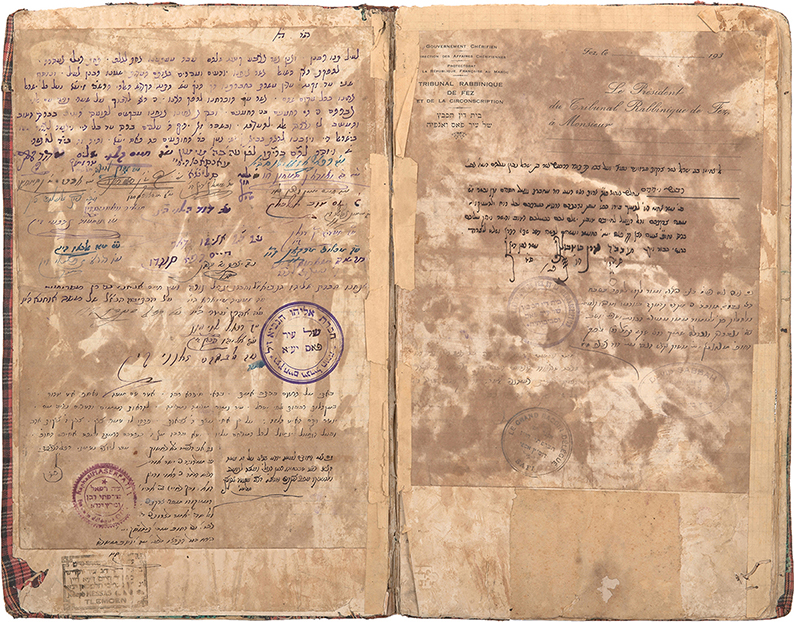
Letters of recommendation for hachnasat kalla (supplying a dowry for a bride), handwritten and signed by dozens of Moroccan sages and rabbis, including a letter of recommendation (three lines) handwritten and signed by R. Yisrael Abuchatzira (the Baba Sali). Bound together.
7 leaves, glued and bound together, containing handwritten and signed recommendations by Moroccan sages and rabbis from 1922-1936. Written in Moroccan cities: Fez, Meknes, Rabat, Tlemcen, Sefrou, Safi, Essaouira and El-Jadida. All the recommendations were written for "Moshe Ochana", some mentioning his wish to settle in Eretz Israel.
Below is a list of the letters of recommendation and some of the names of the rabbis who signed them:
· Page [1] – Recommendation of "…R. Ya'akov Abuchatzira…". Fez, 1935. Handwritten additions and signatures of members of the society appear on the margins.
· Page [2] – Letter of recommendation by the Rashbi society. Fez, 1932. Many signatures of members of the society, including the signature "Yitzchak Abuchatzira".
· Page [3] – Recommendation signed by the Beit Din in Rabat. 1923. Signatures of R. Refael Ankawa (Encouau) [HaMalach Refael], R. Yekutiel Birdugo, R. Yosef Chaim ibn Attar.
This recommendation is accompanied by another handwritten recommendation signed by R. Chaim Refael Attie, a Rabbi in Rabat and by another handwritten recommendation.
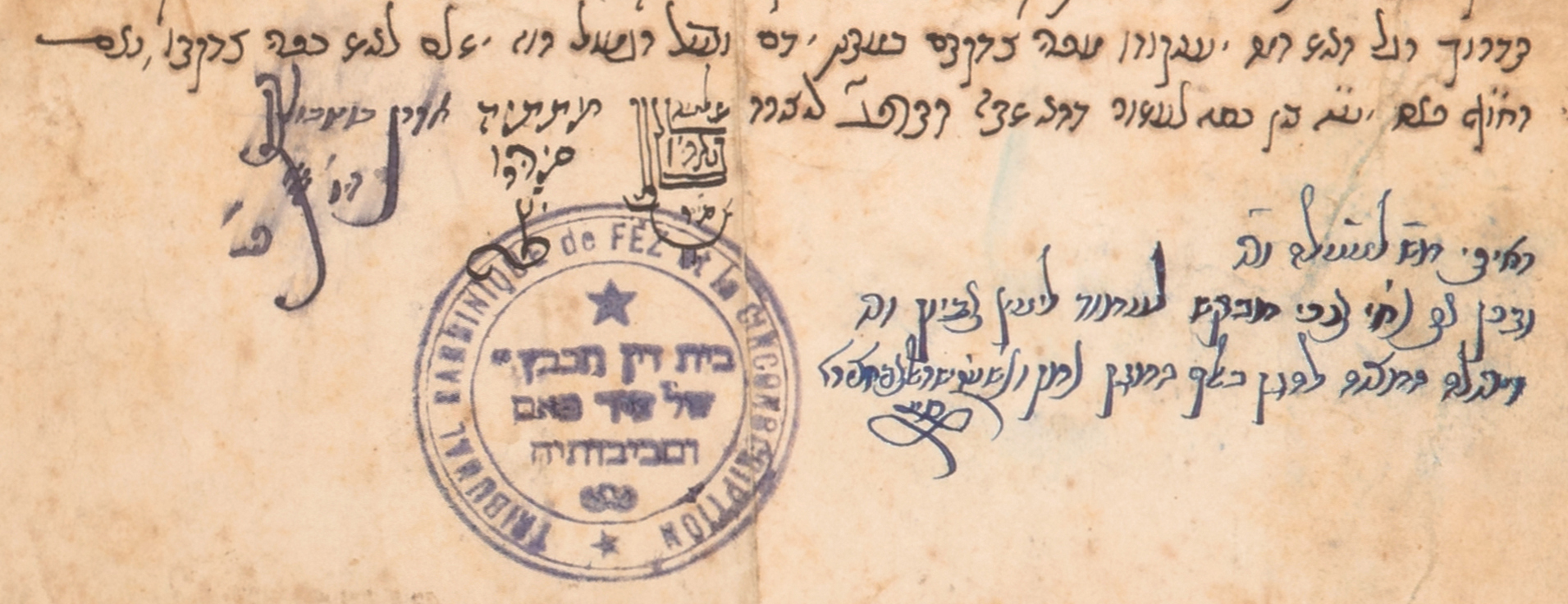
· Page [4] – Recommendation of the Fez Beit Din – Signatures of R. "Shlomo ---", R. "Matitya Siriro" and R. "Aharon Butbul". Fez, Tishrei 1922.
Three handwritten lines of recommendation signed by R. "Yisrael Abuchatzira", the Baba Sali, appear alongside this recommendation.
Recommendation handwritten and signed by R. Abba Elbaz, "Posek in the city of Sefrou".
Recommendation handwritten and signed by R. Yehoshua Birdugo – Meknes.
Recommendation handwritten and signed R. Shlomo ibn Shitrit – "Dayan and posek in Meknes".
Recommendation handwritten and signed by R. David Tzabach – Rabat.
Recommendation signed by Rabbis of Essaouira (Mogador) – Ra'avad R. Avraham ibn Sussan, R. David Knafo and R. Moshe ibn Simhon.
· Page [5] – Recommendation of the society "Called after… Rabbi Ish HaTzorfati…". Fez, 1923. With many signatures.
· Page [6] – Recommendation by Rabbis of the Fez Beit Din, 1933. Signed by R. Matitya Siroro, R. Aharon Butbul and R. Moshe ibn Denan.
Under these signatures are two more recommendations, one handwritten and signed by R. David Tzabach "Posek in El-Jadida" and the other handwritten and signed by R. Avner Tzorfati "Posek in Safi".
· Page [7] – Recommendation from societies in Fez, 1923: Recommendation from a society named after R. Shimon Bar Yochai, with signatures of its members, including the following: R. Shmuel ibn Denan, R. Sa'adia ibn Denan. Recommendation from Chevrat Eliyahu HaNavi, with signatures of its members.
Recommendation handwritten and signed by R. Refael Tzorfati, Oujda.
Recommendation handwritten and signed by R. Masud Aviktzitz.
Recommendation handwritten and signed by R. Yosef Mashash [author of Otzar HaMichtavim] – Tlemcen, 1936.
[7] leaves, glued and bound together. 36 cm. Fair condition. Dark stains, wear and tears, worming in several places. Traces of dampness. Repairs with paper. Folk fabric binding.
7 leaves, glued and bound together, containing handwritten and signed recommendations by Moroccan sages and rabbis from 1922-1936. Written in Moroccan cities: Fez, Meknes, Rabat, Tlemcen, Sefrou, Safi, Essaouira and El-Jadida. All the recommendations were written for "Moshe Ochana", some mentioning his wish to settle in Eretz Israel.
Below is a list of the letters of recommendation and some of the names of the rabbis who signed them:
· Page [1] – Recommendation of "…R. Ya'akov Abuchatzira…". Fez, 1935. Handwritten additions and signatures of members of the society appear on the margins.
· Page [2] – Letter of recommendation by the Rashbi society. Fez, 1932. Many signatures of members of the society, including the signature "Yitzchak Abuchatzira".
· Page [3] – Recommendation signed by the Beit Din in Rabat. 1923. Signatures of R. Refael Ankawa (Encouau) [HaMalach Refael], R. Yekutiel Birdugo, R. Yosef Chaim ibn Attar.
This recommendation is accompanied by another handwritten recommendation signed by R. Chaim Refael Attie, a Rabbi in Rabat and by another handwritten recommendation.
· Page [4] – Recommendation of the Fez Beit Din – Signatures of R. "Shlomo ---", R. "Matitya Siriro" and R. "Aharon Butbul". Fez, Tishrei 1922.
Three handwritten lines of recommendation signed by R. "Yisrael Abuchatzira", the Baba Sali, appear alongside this recommendation.
Recommendation handwritten and signed by R. Abba Elbaz, "Posek in the city of Sefrou".
Recommendation handwritten and signed by R. Yehoshua Birdugo – Meknes.
Recommendation handwritten and signed R. Shlomo ibn Shitrit – "Dayan and posek in Meknes".
Recommendation handwritten and signed by R. David Tzabach – Rabat.
Recommendation signed by Rabbis of Essaouira (Mogador) – Ra'avad R. Avraham ibn Sussan, R. David Knafo and R. Moshe ibn Simhon.
· Page [5] – Recommendation of the society "Called after… Rabbi Ish HaTzorfati…". Fez, 1923. With many signatures.
· Page [6] – Recommendation by Rabbis of the Fez Beit Din, 1933. Signed by R. Matitya Siroro, R. Aharon Butbul and R. Moshe ibn Denan.
Under these signatures are two more recommendations, one handwritten and signed by R. David Tzabach "Posek in El-Jadida" and the other handwritten and signed by R. Avner Tzorfati "Posek in Safi".
· Page [7] – Recommendation from societies in Fez, 1923: Recommendation from a society named after R. Shimon Bar Yochai, with signatures of its members, including the following: R. Shmuel ibn Denan, R. Sa'adia ibn Denan. Recommendation from Chevrat Eliyahu HaNavi, with signatures of its members.
Recommendation handwritten and signed by R. Refael Tzorfati, Oujda.
Recommendation handwritten and signed by R. Masud Aviktzitz.
Recommendation handwritten and signed by R. Yosef Mashash [author of Otzar HaMichtavim] – Tlemcen, 1936.
[7] leaves, glued and bound together. 36 cm. Fair condition. Dark stains, wear and tears, worming in several places. Traces of dampness. Repairs with paper. Folk fabric binding.
Category
North African Rabbis – Manuscripts, Letters and Signatures
Catalogue Value

Auction 63 - Rare and Important Items
November 13, 2018
Opening: $15,000
Estimate: $30,000 - $40,000
Sold for: $42,500
Including buyer's premium
Document signed by R. Pinchas HaLevi Horowitz, author of the Hafla'ah. Frankfurt am Main, 18th of Elul 1795.
Beit Din contract regarding transfer of ownership of a house in Frankfurt am Main, given to a bridegroom as a dowry. Scribal writing signed by the Rabbi of the city, author of the Hafla'ah: "Pinchas HaLevi, Ish Horowitz", followed by the signature of "David son of Yechiel Michel Shwartz Schild, shamash of this community".
R. Pinchas HaLevi Ish Horowitz, author of the Hafla'ah (1731-1805), close disciple of R. Dov Ber the Magid of Mezeritch [studied under his tutelage together with his brother R. Shmelke of Nikolsburg]. For more than 30 years, he served as Rabbi of Frankfurt am Main, the hub of Torah study in Germany at that time. The Chatam Sofer was among his disciples. He authored important books, including HaMikneh on Tractate Kiddushin, Ketubah on Tractate Ketubot and the Hafla'ah on several tractates and on the Shulchan Aruch, according him the cognomen of "Ba'al HaHafla'a".
Folded leaf, 17 cm. Good condition. Stains, folding marks.
Beit Din contract regarding transfer of ownership of a house in Frankfurt am Main, given to a bridegroom as a dowry. Scribal writing signed by the Rabbi of the city, author of the Hafla'ah: "Pinchas HaLevi, Ish Horowitz", followed by the signature of "David son of Yechiel Michel Shwartz Schild, shamash of this community".
R. Pinchas HaLevi Ish Horowitz, author of the Hafla'ah (1731-1805), close disciple of R. Dov Ber the Magid of Mezeritch [studied under his tutelage together with his brother R. Shmelke of Nikolsburg]. For more than 30 years, he served as Rabbi of Frankfurt am Main, the hub of Torah study in Germany at that time. The Chatam Sofer was among his disciples. He authored important books, including HaMikneh on Tractate Kiddushin, Ketubah on Tractate Ketubot and the Hafla'ah on several tractates and on the Shulchan Aruch, according him the cognomen of "Ba'al HaHafla'a".
Folded leaf, 17 cm. Good condition. Stains, folding marks.
Category
Chassidic Luminaries – Manuscripts, Letters and Signatures
Catalogue Value


Auction 63 - Rare and Important Items
November 13, 2018
Opening: $150,000
Estimate: $180,000 - $220,000
Sold for: $225,000
Including buyer's premium
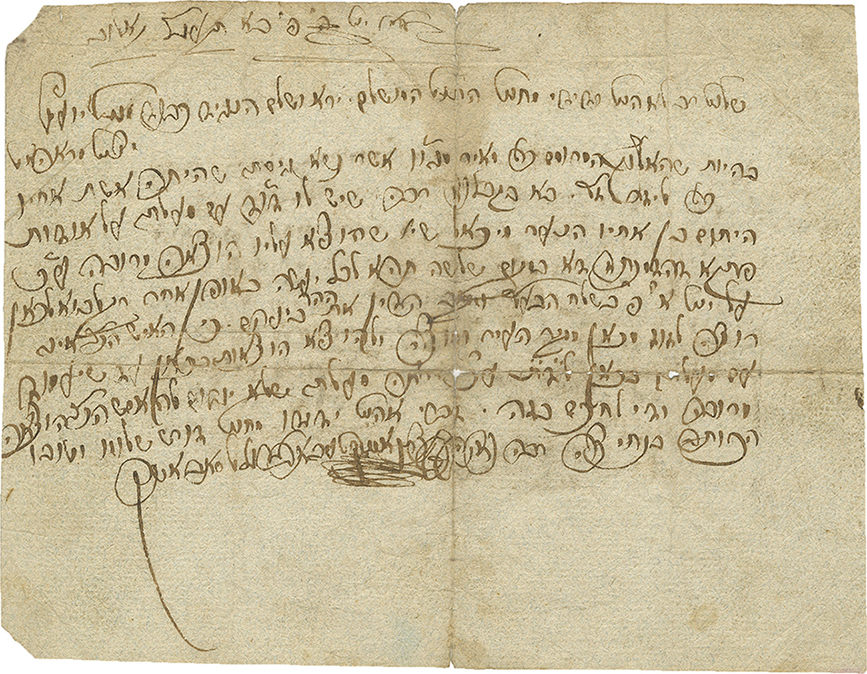
Letter (approx. 12 lines), handwritten and signed by Rebbe "Yitzchak Isaac Taub". Kaliv (Kalov, Nagykálló), 1813.
Summons to a rabbinical court hearing concerning child support for a young orphan, of a wealthy uncle residing in a different city. In the letter, the Rebbe explains the necessity of his coming to Kaliv for the trial. The Rebbe concludes the letter with his signature: "Yitzchak Isaac Taub Rabbi of Szabolcs county".
Rebbe Yitzchak Isaac Taub (1751-1821) was the first Chassidic Rebbe in Hungary. An outstanding Torah scholar and holy kabbalist, he was the close disciple of R. Shmuel Shmelke of Nikolsburg (Mikulov) and of R. Elimelech of Lizhensk (Leżajsk). Chassidic lore attributes his attraction to Chassidism to R. Leib Sarah's, who met him as a young boy of eight shepherding geese and singing shepherd songs with great emotion. R. Leib Sarah's, then on a mission in Hungary at the behest of the Baal Shem Tov, took the boy to Galicia to R. Shmelke Horowitz (who later served as rabbi of Nikolsburg and Moravia), describing him as possessing "an elevated and holy soul". There, he became acquainted with R. Elimelech of Lizhensk, and for a long period frequented his court. In 1781, he returned to his home country and was appointed rabbi of Kaliv (Nagykálló) and of the Szabolcs county, a position he held for forty years.
R. Yitzchak Isaac – progenitor of the Chassidic movement in Hungary, brought thousands of people back to Torah observance and was famed as a wonder-worker. Many flocked to Kaliv to receive his advice, blessings and salvations. He dealt extensively in Kabbalah. His prime disciples include R. Chaim Yosef of Stropkov, R. Yechezkel Panet the Mareh Yechezkel, R. Mendel and R. Wolf – whom Chassidic leaders testified were fluent in all the teachings of the Arizal by heart. Wondrous stories about R. Yitzchak Isaac circulated, including revelations of angels, studying Torah with the prophet Eliyahu, trips miraculously shortened, barren women conceiving, ill people recovering, and other miracles and revelations of Divine Inspiration.
The Minchat Elazar of Munkacs extols the virtues of R. Yitzchak Isaac in one of his books, describing him as an outstanding and holy Torah scholar, reputed amongst our rabbis as a true bearer of tremendous Divine Inspiration, reaching tremendous levels in his Torah and service of G-d. A teacher of great Torah scholars and Kabbalists, and founder of Chassidism in Hungary, giving over the teachings he received from R. Shmelke Horowitz, Rabbi of Nikolsburg. He quotes the Divrei Chaim of Sanz, who reputedly said that until today, R. Yitzchak Isaac's holiness is felt as far as three leagues away from Kalov (Nimukei Orach Chaim, Munkacs 1930, section 243, 1, p. 113).
In Igrot Sofrim (Vienna, 1928, p. 38, letter 40), a letter addressed to R. Yitzchak Isaac from the Chatam Sofer is excerpted, in which the latter addresses him in terms of great veneration, also signing the letter (ibid, p. 39) as "so are the words of one who loves him dearly".
R. Yitzchak Isaac would customarily sing Jewish and allegoric songs in Hungarian, such as the famous song "Szól a kakas már" ("The Rooster is Crowing" – sung until today in the original Hungarian words, at gatherings led by rebbes on festivals). Other famous songs he composed include: "The Shepherd and the Master" and "Forest, Forest" (this song, originally a shepherd's song on the vastness of the forest and his distance from the city, was adapted by R. Yitzchak Isaac to express the Jewish people's longing to exit the exile, like a wanderer who yearns to exit the vast forest: "Exile, O exile, how vast are you! Shechinah, Shechinah, how distant you are! Were the exile not so vast, the Shechinah wouldn't be so far. Would I be guided out of the exile, and reunited with the Shechinah…" – free translation from Hungarian).
[1] leaf. 22X17 cm. 12 handwritten lines. The verso of the leaf contains the address of the recipient of the letter (presumably also in R. Yitzchak Isaac's handwriting). Fair-good condition. Wear to the folds. Stains.
Summons to a rabbinical court hearing concerning child support for a young orphan, of a wealthy uncle residing in a different city. In the letter, the Rebbe explains the necessity of his coming to Kaliv for the trial. The Rebbe concludes the letter with his signature: "Yitzchak Isaac Taub Rabbi of Szabolcs county".
Rebbe Yitzchak Isaac Taub (1751-1821) was the first Chassidic Rebbe in Hungary. An outstanding Torah scholar and holy kabbalist, he was the close disciple of R. Shmuel Shmelke of Nikolsburg (Mikulov) and of R. Elimelech of Lizhensk (Leżajsk). Chassidic lore attributes his attraction to Chassidism to R. Leib Sarah's, who met him as a young boy of eight shepherding geese and singing shepherd songs with great emotion. R. Leib Sarah's, then on a mission in Hungary at the behest of the Baal Shem Tov, took the boy to Galicia to R. Shmelke Horowitz (who later served as rabbi of Nikolsburg and Moravia), describing him as possessing "an elevated and holy soul". There, he became acquainted with R. Elimelech of Lizhensk, and for a long period frequented his court. In 1781, he returned to his home country and was appointed rabbi of Kaliv (Nagykálló) and of the Szabolcs county, a position he held for forty years.
R. Yitzchak Isaac – progenitor of the Chassidic movement in Hungary, brought thousands of people back to Torah observance and was famed as a wonder-worker. Many flocked to Kaliv to receive his advice, blessings and salvations. He dealt extensively in Kabbalah. His prime disciples include R. Chaim Yosef of Stropkov, R. Yechezkel Panet the Mareh Yechezkel, R. Mendel and R. Wolf – whom Chassidic leaders testified were fluent in all the teachings of the Arizal by heart. Wondrous stories about R. Yitzchak Isaac circulated, including revelations of angels, studying Torah with the prophet Eliyahu, trips miraculously shortened, barren women conceiving, ill people recovering, and other miracles and revelations of Divine Inspiration.
The Minchat Elazar of Munkacs extols the virtues of R. Yitzchak Isaac in one of his books, describing him as an outstanding and holy Torah scholar, reputed amongst our rabbis as a true bearer of tremendous Divine Inspiration, reaching tremendous levels in his Torah and service of G-d. A teacher of great Torah scholars and Kabbalists, and founder of Chassidism in Hungary, giving over the teachings he received from R. Shmelke Horowitz, Rabbi of Nikolsburg. He quotes the Divrei Chaim of Sanz, who reputedly said that until today, R. Yitzchak Isaac's holiness is felt as far as three leagues away from Kalov (Nimukei Orach Chaim, Munkacs 1930, section 243, 1, p. 113).
In Igrot Sofrim (Vienna, 1928, p. 38, letter 40), a letter addressed to R. Yitzchak Isaac from the Chatam Sofer is excerpted, in which the latter addresses him in terms of great veneration, also signing the letter (ibid, p. 39) as "so are the words of one who loves him dearly".
R. Yitzchak Isaac would customarily sing Jewish and allegoric songs in Hungarian, such as the famous song "Szól a kakas már" ("The Rooster is Crowing" – sung until today in the original Hungarian words, at gatherings led by rebbes on festivals). Other famous songs he composed include: "The Shepherd and the Master" and "Forest, Forest" (this song, originally a shepherd's song on the vastness of the forest and his distance from the city, was adapted by R. Yitzchak Isaac to express the Jewish people's longing to exit the exile, like a wanderer who yearns to exit the vast forest: "Exile, O exile, how vast are you! Shechinah, Shechinah, how distant you are! Were the exile not so vast, the Shechinah wouldn't be so far. Would I be guided out of the exile, and reunited with the Shechinah…" – free translation from Hungarian).
[1] leaf. 22X17 cm. 12 handwritten lines. The verso of the leaf contains the address of the recipient of the letter (presumably also in R. Yitzchak Isaac's handwriting). Fair-good condition. Wear to the folds. Stains.
Category
Chassidic Luminaries – Manuscripts, Letters and Signatures
Catalogue Value